Category: Market Action

Market Action

December 4, 2007

Wow! How about them PerpetualDiscounts, eh?

It figures. The Bank of Canada cuts rates and retail figures that means all rates, ignoring the fact that long Canadas were down on the day … lower rates means higher inflation risks, says the Market. Also ignoring the idea that corporate spreads tend to widen during tough times, since there is higher default risk.

Or maybe pref investors are saying that they know all that, it’s just that the whole thing since March has been overdone. Who knows? Ask a priest. I’m just glad to see the fifth straight trading day of PerpetualDiscount gains and that sub-index off its lows. But who knows what tomorrow will bring?

Note that these indices are experimental; the absolute and relative daily values are expected to change in the final version. In this version, index values are based at 1,000.0 on 2006-6-30
Index Mean Current Yield (at bid) Mean YTW Mean Average Trading Value Mean Mod Dur (YTW) Issues Day’s Perf. Index Value
Ratchet 4.89% 4.88% 108,344 15.68 2 +0.0000% 1,049.6
Fixed-Floater 4.87% 4.87% 97,290 15.70 8 -0.1983% 1,033.6
Floater 5.00% 5.08% 79,229 15.28 2 -0.7736% 949.5
Op. Retract 4.87% 3.69% 79,873 3.50 16 +0.1603% 1,034.0
Split-Share 5.32% 6.45% 93,145 3.85 15 +0.2656% 1,022.3
Interest Bearing 6.23% 6.47% 69,871 3.74 4 +0.5871% 1,067.8
Perpetual-Premium 5.82% 5.38% 80,857 6.18 11 +0.1658% 1,010.8
Perpetual-Discount 5.55% 5.59% 350,006 14.50 55 +0.9188% 915.0
Major Price Changes
Issue Index Change Notes
BAM.PR.B Floater -1.5471%  
LBS.PR.A SplitShare -1.2808% Asset coverage of 2.4+:1 as of November 29, according to Brompton Group. Now with a pre-tax bid-YTW of 5.39% based on a bid of 10.02 and a hardMaturity 2013-11-29 at 10.00.
RY.PR.E PerpetualDiscount +1.0106% Now with a pre-tax bid-YTW of 5.41% based on a bid of 20.99 and a limitMaturity.
PWF.PR.F PerpetualDiscount +1.0204% Now with a pre-tax bid-YTW of 5.58% based on a bid of 23.76 and a limitMaturity.
CM.PR.I PerpetualDiscount +1.1029% Now with a pre-tax bid-YTW of 5.41% based on a bid of 22.00 and a limitMaturity.
SLF.PR.A PerpetualDiscount +1.1765% Now with a pre-tax bid-YTW of 5.53% based on a bid of 21.50 and a limitMaturity.
FTU.PR.A SplitShare +1.2022% Asset coverage of 1.8+:1 as of November 15, according to the company. Now with a pre-tax bid-YTW of 7.09% based on a bid of 9.26 and a hardMaturity 2012-12-01 at 10.00.
PIC.PR.A SplitShare +1.2658% Now with a pre-tax bid-YTW of 5.48% based on a bid of 15.20 and a hardMaturity 2010-11-1 at 15.00.
GWO.PR.G PerpetualDiscount +1.3274% Now with a pre-tax bid-YTW of 5.68% based on a bid of 22.90 and a limitMaturity.
CM.PR.J PerpetualDiscount +1.4010% Now with a pre-tax bid-YTW of 5.43% based on a bid of 20.99 and a limitMaturity.
CIU.PR.A PerpetualDiscount +1.4458% Now with a pre-tax bid-YTW of 5.50% based on a bid of 21.05 and a limitMaturity.
SLF.PR.D PerpetualDiscount +1.5347% Now with a pre-tax bid-YTW of 5.43% based on a bid of 20.51 and a limitMaturity.
TD.PR.O PerpetualDiscount +1.5385% Now with a pre-tax bid-YTW of 5.31% based on a bid of 23.10 and a limitMaturity.
SLF.PR.B PerpetualDiscount +1.5962% Now with a pre-tax bid-YTW of 5.54% based on a bid of 21.64 and a limitMaturity.
NA.PR.K PerpetualDiscount +1.6043% Now with a pre-tax bid-YTW of 5.97% based on a bid of 24.70 and a limitMaturity.
RY.PR.B PerpetualDiscount +1.6085% Now with a pre-tax bid-YTW of 5.35% based on a bid of 22.11 and a limitMaturity.
GWO.PR.H PerpetualDiscount +1.6393% Now with a pre-tax bid-YTW of 5.58% based on a bid of 21.70 and a limitMaturity.
BAM.PR.M PerpetualDiscount +1.7045% Now with a pre-tax bid-YTW of 6.79% based on a bid of 17.90 and a limitMaturity.
SLF.PR.C PerpetualDiscount +1.7318% Now with a pre-tax bid-YTW of 5.42% based on a bid of 20.56 and a limitMaturity.
POW.PR.D PerpetualDiscount +1.7471% Now with a pre-tax bid-YTW of 5.74% based on a bid of 22.13 and a limitMaturity.
FIG.PR.A SplitShare +1.7472% Asset coverage of 2.1+:1 as of December 3, according to the company. Now with a pre-tax bid-YTW of 6.68% (almost all as interest) based on a bid of 9.90 and a hardMaturity 2014-12-31 at 10.00.
BMO.PR.J PerpetualDiscount +1.9370% Now with a pre-tax bid-YTW of 5.39% based on a bid of 21.05 and a limitMaturity.
HSB.PR.C PerpetualDiscount +2.4218% Now with a pre-tax bid-YTW of 5.58% based on a bid of 23.26 and a limitMaturity.
IAG.PR.A PerpetualDiscount +2.9557% Now with a pre-tax bid-YTW of 5.51% based on a bid of 20.90 and a limitMaturity.
ELF.PR.F PerpetualDiscount +3.0099% Now with a pre-tax bid-YTW of 6.80% based on a bid of 19.85 and a limitMaturity.
ELF.PR.G PerpetualDiscount +3.4685% Now with a pre-tax bid-YTW of 6.87% based on a bid of 17.60 and a limitMaturity.
NA.PR.L PerpetualDiscount +3.6267% Now with a pre-tax bid-YTW of 5.72% based on a bid of 21.43 and a limitMaturity.
Volume Highlights
Issue Index Volume Notes
RY.PR.E PerpetualDiscount 69,875 National Bank crossed 20,000 at 21.00, then another 5,000 at the same price. Now with a pre-tax bid-YTW of 5.41% based on a bid of 20.99 and a limitMaturity.
BNS.PR.L PerpetualDiscount 64,525 Now with a pre-tax bid-YTW of 5.36% based on a bid of 21.26 and a limitMaturity.
RY.PR.W PerpetualDiscount 56,400 Now with a pre-tax bid-YTW of 5.42% based on a bid of 22.77 and a limitMaturity.
RY.PR.B PerpetualDiscount 51,715 Now with a pre-tax bid-YTW of 5.35% based on a bid of 22.11 and a limitMaturity.
RY.PR.D PerpetualDiscount 50,119 National Bank crossed 20,000 at 21.00, then another 5,000 at the same price … didn’t I already say that? No, I’ve checked it twice, and the only difference between these trades and the RY.PR.E ones above is a minute or two on the time stamp. Well, why, not? They’re a weak pair. Now with a pre-tax bid-YTW of 5.41% based on a bid of 20.99 and a limitMaturity.

There were thirty-five other index-included $25.00-equivalent issues trading over 10,000 shares today.
Market Action

December 3, 2007

Sorry – month-end is a busy time for me, so again, there’s not much colour today!

However, I was most interested in Accrued Interest’s essay on the implications of the Florida Money-Market Fund Freeze, together with the most recent Bloomberg story.

According to Bloomberg:

BlackRock, at a Tallahassee meeting today with officials from schools and cities in the Local Government Investment Pool, said it will recommend putting about 86 percent of the pool’s $14 billion of assets that have no risk of loss or default into a “fund A.” The remaining 14 percent will go into a “fund B,” said Simon Mendelson, chief operating officer of BlackRock’s cash management business.

“We want fund A to be really clean,” said Barbara Novick, vice chairman of BlackRock, who made the presentation with Mendelson. “We want to run it as a money-market fund.”

I don’t get it. When I look at the October 31 Holdings of the Florida fund, I don’t see 86% of the securities having “no risk of loss or defaults”. The only securities without default risk are central government securities denominated in the national currency (and their guarantees, if you want to be picky). Even then, “no risk” can be something of a relative term, as those who read about hyperinflation in the German Republic will remember:

The German Mark, the British shilling, the French franc, and the Italian lira all had about equal value, and all were exchanged four or five to the dollar. That was in 1914. In 1923, at the most fevered moment of the German hyperinflation, the exchange rate between the dollar and the Mark was one trillion Marks to one dollar, and a wheelbarrow full of money would not even buy a newspaper.

That was then and this is now, you say? I know a man with first-hand experience of Serbian hyperinflation:

In October of 1993 the created a new currency unit. One new dinar was worth one million of the old dinars. In effect, the government simply removed six zeroes from the paper money. This of course did not stop the inflation and between October 1, 1993 and January 24, 1995 prices increased by 5 quadrillion percent. This number is a 5 with 15 zeroes after it.

Many Yugoslavian businesses refused to take the Yugoslavian currency at all and the German Deutsche Mark effectively became the currency of Yugoslavia. But government organizations, government employees and pensioners still got paid in Yugoslavian dinars so there was still an active exchange in dinars. On November 12, 1993 the exchange rate was 1 DM = 1 million new dinars. By November 23 the exchange rate was 1 DM = 6.5 million new dinars and at the end of November it was 1 DM = 37 million new dinars. At the beginning of December the bus workers went on strike because their pay for two weeks was equivalent to only 4 DM when it cost a family of four 230 DM per month to live. By December 11th the exchange rate was 1 DM = 800 million and on December 15th it was 1 DM = 3.7 billion new dinars. The average daily rate of inflation was nearly 100 percent. When farmers selling in the free markets refused to sell food for Yugoslavian dinars the government closed down the free markets. On December 29 the exchange rate was 1 DM = 950 billion new dinars.

At the end of December the exchange rate was 1 DM = 3 trillion dinars and on January 4, 1994 it was 1 DM = 6 trillion dinars. On January 6th the government declared that the German Deutsche was an official currency of Yugoslavia. About this time the government announced a new new dinar which was equal to 1 billion of the old new dinars. This meant that the exchange rate was 1 DM = 6,000 new new dinars. By January 11 the exchange rate had reached a level of 1 DM = 80,000 new new dinars. On January 13th the rate was 1 DM = 700,000 new new dinars and six days later it was 1 DM = 10 million new new dinars.

So anyway, the moral of the story is: nothing is certain in this wicked world. There is default risk everywhere.

That being said, I find the holdings of the Florida fund rather surprising, in that (i) I don’t recognize a lot of the names held, and (ii) A lot of the names are of the form “XXX Funding LLC”. So, I’ll repeat, yet again, another moral we should all remember from the credit crunch: Diversify! Diversify! Diversify!

Without having had anything more than a casual once over of the Florida holdings, it seems to me that the managers were well diversified by name and tenor, but very poorly diversified by industry … I mean, geez, look at all those XXX Funding LLCs! You are not diversified if you have 1% of your portfolio in each of 100 different companies if each of those companies is in the business of manufacturing Britney Spears Fan Club kits.

As with Canadian ABCP – I have nothing but sympathy for portfolio managers who held 5-10% in the sector; it looked pretty good to me too, and (with the exception of Apsley Trust) the credit quality was fine – it was simply the liquidity that suddenly disappeared. But too much of a good thing is simply too much.

Accrued Interest‘s conclusions as to how the whole affair will play out look entirely reasonable to me … with one quibble:

Finally, government money market funds will likely become permanently more popular.

Permanently? I have my doubts. There have always been periodic flights to quality in the investment world, and sooner or later investor greed beats investor fear and competition forces the assumption of increased risk.

In sort-of related news on the MLEC/Super-Conduit front, Harrier Finance and Carrera Capital are being bailed out by their so-called off-balance-sheet sponsors, to the tune of $11-billion and $4.8 billion, respectively.

“Every day that goes by we are seeing more restructuring and liquidity provision by sponsors,” [Dresdner Kleinwort analyst Priya] Shah said in an interview today. “The longer M-LEC takes, the less of a need there will be for it.”

Another day of good volume and positive returns! Holy smokes, can this be the preferred market we’re looking at?

Note that these indices are experimental; the absolute and relative daily values are expected to change in the final version. In this version, index values are based at 1,000.0 on 2006-6-30
Index Mean Current Yield (at bid) Mean YTW Mean Average Trading Value Mean Mod Dur (YTW) Issues Day’s Perf. Index Value
Ratchet 4.87% 4.86% 111,120 15.72 2 +0.0000% 1,049.6
Fixed-Floater 4.81% 4.85% 98,454 15.73 8 +0.0258% 1,035.7
Floater 5.17% 5.25% 81,818 14.99 2 -1.4392% 956.9
Op. Retract 4.87% 3.54% 80,066 3.76 16 +0.0511% 1,032.3
Split-Share 5.34% 6.12% 91,819 4.08 15 +0.1062% 1,019.6
Interest Bearing 6.27% 6.57% 68,683 3.72 4 -0.3841% 1,061.6
Perpetual-Premium 5.83% 5.29% 81,052 8.06 11 +0.0962% 1,009.1
Perpetual-Discount 5.60% 5.65% 348,477 14.42 55 +0.2623% 906.7
Major Price Changes
Issue Index Change Notes
BSD.PR.A InterestBearing -2.7328% Asset coverage of 1.6+:1 according to the company. Pre-tax bid-YTW now 6.70% (mostly as interest) based on a bid of 9.61 and a hardMaturity 2015-3-31 at 10.00.
BAM.PR.K Floater -2.0979%  
GWO.PR.I PerpetualDiscount +1.0000% Now with a pre-tax bid-YTW of 5.58% based on a bid of 20.20 and a limitMaturity.
PWF.PR.L PerpetualDiscount +1.0323% Now with a pre-tax bid-YTW of 5.73% based on a bid of 22.51 and a limitMaturity.
BAM.PR.N PerpetualDiscount +1.4815% Now with a pre-tax bid-YTW of 6.82% based on a bid of 17.81 and a limitMaturity.
POW.PR.A PerpetualDiscount +1.5334% Now with a pre-tax bid-YTW of 5.79% based on a bid of 24.50 and a limitMaturity.
BNA.PR.B SplitShare +2.2727% Asset coverage of just under 4.0:1 as of October 31, according to the company. Now with a pre-tax bid-YTW of 6.56% based on a bid of 22.50 and a hardMaturity 2016-3-25 at 25.00. For those keeping score, this compares with BNA.PR.A (6.10% to 2010-9-30) and BNA.PR.C (7.65% to 2019-1-10).
HSB.PR.D PerpetualDiscount +2.4215% Now with a pre-tax bid-YTW of 5.57% based on a bid of 22.84 and a limitMaturity.
Volume Highlights
Issue Index Volume Notes
BCE.PR.I FixFloat 884,942 Scotia crossed 884,000 at 24.43 … now, that’s a nice ticket in anybody’s books!
FAL.PR.A Ratchet 251,000 RBC crossed 250,000 at 24.50.
IQW.PR.C Scraps (would be OpRet, but there are credit concerns) 161,400 Now with a pre-tax bid-YTW of 214.30% (!) based on a bid of 17.90 and a softMaturity 2008-2-29 at 25.00 … but don’t count on it!.
BPO.PR.H Scraps (would be OpRet, but there are credit concerns) 153,300 Scotia crossed 150,000 at 24.45. Now with a pre-tax bid-YTW of 6.39% based on a bid of 24.33 and a softMaturity 2015-12-30 at 25.00.
RY.PR.B PerpetualDiscount 62,840 Now with a pre-tax bid-YTW of 5.44% based on a bid of 21.76 and a limitMaturity.
SLF.PR.A PerpetualDiscount 36,570 Now with a pre-tax bid-YTW of 5.60% based on a bid of 21.25 and a limitMaturity.
MFC.PR.C PerpetualDiscount 30,895 Now with a pre-tax bid-YTW of 5.37% based on a bid of 21.01 and a limitMaturity.

There were twenty-five other index-included $25.00-equivalent issues trading over 10,000 shares today.

Market Action

November 30, 2007

An extremely busy day to finish the month!

Note that these indices are experimental; the absolute and relative daily values are expected to change in the final version. In this version, index values are based at 1,000.0 on 2006-6-30
Index Mean Current Yield (at bid) Mean YTW Mean Average Trading Value Mean Mod Dur (YTW) Issues Day’s Perf. Index Value
Ratchet 4.86% 4.84% 112,447 15.75 2 +0.0614% 1,049.6
Fixed-Floater 4.91% 4.93% 98,259 15.62 8 -0.1617% 1,035.4
Floater 4.84% 4.91% 59,518 15.59 3 +0.0592% 970.9
Op. Retract 4.88% 2.47% 80,591 3.81 16 -0.0406% 1,031.8
Split-Share 5.34% 6.23% 92,352 4.09 15 +0.1093% 1,018.5
Interest Bearing 6.24% 6.52% 69,058 3.75 4 -0.1081% 1,065.7
Perpetual-Premium 5.86% 5.34% 91,238 8.05 11 -0.0066% 1,008.1
Perpetual-Discount 5.61% 5.65% 348,050 14.20 55 +0.2244% 904.3
Major Price Changes
Issue Index Change Notes
BNA.PR.B SplitShare -4.3478% Asset coverage of 4.0:1 according to the company. Pre-tax bid-YTW now 6.90% based on a bid of 22.00 and a hardMaturity 2016-3-25 at 25.00.
BAM.PR.G FixFloat -1.5748%  
LBS.PR.A SplitShare -1.1765% Asset coverage of 2.4+:1 as of November 29, according to Brompton. Now with a pre-tax bid-YTW of 5.26% based on a bid of 10.08 and a hardMaturity 2013-11-29 at 10.08.
ELF.PR.G PerpetualDiscount -1.1696% Now with a pre-tax bid-YTW of 7.16% based on a bid of 16.90 and a limitMaturity.
BNA.PR.C SplitShare -1.0932% Asset coverage of 4.0:1 according to the company. Now with a pre-tax bid-YTW of 7.62% based on a bid of 19.00 and a hardMaturity 2019-1-10 at 25.00.
WFS.PR.A SplitShare +1.1213% Asset coverage of 1.9+:1 as of November 22, according to Mulvihill. Now with a pre-tax bid-YTW of 5.82% based on a bid of 9.92 and a hardMaturity 2011-6-30 at 10.00.
FIG.PR.A InterestBearing +1.1518% Asset coverage of 2.1+:1 as of November 28, according to Faircourt. Now with a pre-tax bid-YTW of 7.11% (mostly as interest) based on a bid of 9.66 and a hardMaturity 2014-12-31 at 10.00.
POW.PR.D PerpetualDiscount +1.1526% Now with a pre-tax bid-YTW of 5.78% based on a bid of 21.94 and a limitMaturity.
BNS.PR.M PerpetualDiscount +1.2013% Now with a pre-tax bid-YTW of 5.41% based on a bid of 21.06 and a limitMaturity.
CIU.PR.A PerpetualDiscount +1.2195% Now with a pre-tax bid-YTW of 5.58% based on a bid of 20.75 and a limitMaturity.
NA.PR.L PerpetualDiscount +1.4829% Now with a pre-tax bid-YTW of 5.97% based on a bid of 20.53 and a limitMaturity.
IAG.PR.A PerpetualPremium +1.7632% Now with a pre-tax bid-YTW of 5.70% based on a bid of 20.20 and a limitMaturity.
NA.PR.K PerpetualDiscount +1.9311% Now with a pre-tax bid-YTW of 6.07% based on a bid of 24.28 and a limitMaturity.
HSB.PR.D PerpetualDiscount +2.1530% Now with a pre-tax bid-YTW of 5.70% based on a bid of 22.30 and a limitMaturity
BSD.PR.A InterestBearing +2.2774% Asset coverage of just under 1.7:1 as of November 23, 2007, according to Brookfield Funds. Now with a pre-tax bid-YTW of 6.21% based on a bid of 9.88 and a hardMaturity 2015-3-31.
FFN.PR.A SplitShare +2.5961% Asset coverage of 2.3:1 as of November 15, according to the company. Now with a pre-tax bid-YTW of 5.77% based on a bid of 22.50 and a limitMaturity.
FTU.PR.A SplitShare +2.6667% Asset coverage of 1.8+:1 as of November 15, according to . Now with a pre-tax bid-YTW of 7.12% based on a bid of 9.24 and a hardMaturity 2012-12-1 at 10.00.
Volume Highlights
Issue Index Volume Notes
IQW.PR.C Scraps (would be OpRet, but there are credit concerns) 456,020 Now with a pre-tax bid-YTW of 209.05% (annualized!) based on a bid of 17.80 and a softMaturity 2008-2-29 at 25.00. But don’t count on it!
NTL.PR.F Scraps (would be Ratchet, but there are credit concerns) 376,393  
PWF.PR.E PerpetualDiscount 221,500 Scotia crossed 200,000 at 24.71. Now with a pre-tax bid-YTW of 5.57% based on a bid of 24.62 and a limitMaturity.
TD.PR.P PerpetualDiscount 142,760 Now with a pre-tax bid-YTW of 5.43% based on a bid of 24.42 and a limitMaturity.
RY.PR.W PerpetualDiscount 69,809 Now with a pre-tax bid-YTW of 5.46% based on a bid of 22.58 and a limitMaturity.
GWO.PR.H PerpetualDiscount 54,830 Now with a pre-tax bid-YTW of 5.69% based on a bid of 21.35 and a limitMaturity.
RY.PR.D PerpetualDiscount 54,830 Now with a pre-tax bid-YTW of 5.45% based on a bid of 20.80 and a limitMaturity.

There were seventy-four other index-included $25.00-equivalent issues trading over 10,000 shares today.

Market Action

November 29, 2007

Well … today the TD Bank and National Bank financials were analyzed … and, in addition, month-end is a-coming and duty calls with a shrill, unpleasant voice.

So there won’t be much colour today.

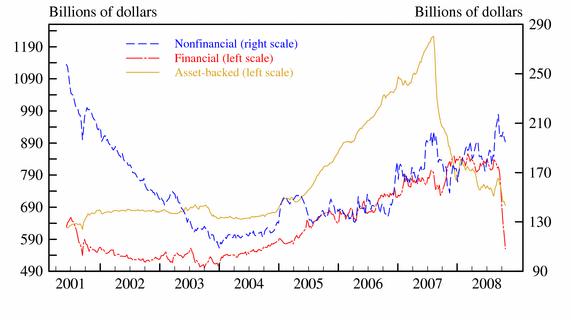
American ABCP outstanding was down another $11-billion this week, continuing its decline as the overleveraged economy continues to unwind. Domestic Financial CP outstanding was up $25-billion; although this figure has not picked up all the slack since the peak, this illustrates the Banks Advantage in Cushioning Liquidity Shocks.

The Florida State-sponsored Money Market Fund mentioned yesterday has suspended redemptions:

Florida officials voted to suspend withdrawals from an investment fund for schools and local governments after redemptions sparked by downgrades of debt held in the portfolio reduced assets by 44 percent.

It wasn’t decided how long the suspension would last. The trustees meet again on Dec. 4.

“We’re getting a lot of calls,” said Mike McCauley, the spokesman for the State Board of Administration.

The Florida pool crisis is a sign of poor risk management by state officials, said Harvey Pitt, former chairman of the Securities and Exchange Commission.

“In the longer-term, it’s unlikely that those whose funds have been frozen will leave their money in the investment fund once the freeze lifts,” Pitt said. “All of this could, and should, have been avoided by careful due diligence, constant reassessment of risk, and paying close attention to market trends.”

Mr. Pitt did not disclose his own track-record as a money manager. His criticisms are the kind that really drive me wild – post-hoc criticisms of fund managers by guys who’ve never done it. It’s very easy to be wise after the fact.

The big danger is that such public funds will eventually migrate to nothing riskier than three-month T-Bills; why would a trustee allow anything else if he’s going to be vilified whenever he’s wrong on something?

One can only applaud Henri-Paul Rousseau in his testimony to the Quebec legislature’s public finance committee:

Executives of Canada’s biggest pension fund agreed after careful study that what constituted a crisis was open to interpretation, but believed the financial institutions would honour their commitments, he said under questioning at the provincial legislature’s public finance committee.

“There was some thinking out there that this was very risky,” Mr. Rousseau said. “We thought it was not plausible and it happened. That’s it.”

“Were we prudent? Yes. Did we miscalculate in terms of the probability that this would happen? Yes,” he said. “Unfortunately, that happens in our business.”

Way to go, M. Rousseau! I have no idea whether you’re a good or bad manager, either of people or of money, but at least you know the right things to say – and on this occasion, when things have gone wrong, you’re willing to wear it. My own question is, regardless of whether or not it was prudent to have $13-billion out of total Caisse assets of $207-billion in Canadian ABCP, was it prudent to have $13-billion in a $35-billion asset class? M. Rousseau’s full remarks have been published by the Caisse. He points out that while liquidity is a problem, the credit quality is entirely acceptable. I will confess that I haven’t even checked to see what proportion of the entire Money Market portfolio was comprised of ABCP, or what the investment rationale behind the MM allocation might have been.

The US bond market is on fire, with a buying panic and lots of corporate issuance; Bernanke seems to be guiding the market to expect an ease.

Another day of good volume for preferreds, with some evidence of rationalization of prices, although overall performance wasn’t all that great. Split shares had a great day, but are still basically clobbered on the month, while floaters are getting hit … trouble is, it’s hard to separate the company specifics (BAM & BCE) from the asset types. Still, that’s what makes it fun, right?

Note that these indices are experimental; the absolute and relative daily values are expected to change in the final version. In this version, index values are based at 1,000.0 on 2006-6-30
Index Mean Current Yield (at bid) Mean YTW Mean Average Trading Value Mean Mod Dur (YTW) Issues Day’s Perf. Index Value
Ratchet 4.85% 4.83% 115,784 15.78 2 +0.0205% 1,048.9
Fixed-Floater 4.91% 4.91% 92,665 15.64 8 -0.0607% 1,037.1
Floater 4.85% 4.91% 58,963 15.59 3 -0.7731% 970.3
Op. Retract 4.88% 3.67% 76,988 3.81 16 -0.0594% 1,032.2
Split-Share 5.35% 6.10% 92,427 4.10 15 +0.9467% 1,017.4
Interest Bearing 6.29% 6.63% 67,207 3.73 4 -0.2882% 1,057.2
Perpetual-Premium 5.86% 5.11% 85,981 7.07 11 +0.5354% 1,008.2
Perpetual-Discount 5.62% 5.66% 343,498 13.99 55 +0.0703% 902.3
Major Price Changes
Issue Index Change Notes
FTU.PR.A SplitShare -2.7027% Asset coverage of 1.8+:1 as of November 15, according to the company. Pre-tax bid-YTW now 7.74% based on a bid of 9.00 and a hardMaturity 2012-12-1 at 10.00.
MST.PR.A InterestBearing -2.2287% Asset coverage of 2.1+:1 as of November 22, according to Sentry Select. Now with a pre-tax bid-YTW of 6.49% (as interest net of capital loss) based on a bid of 10.09 and a hardMaturity 2009-9-30 at 10.00.
CIU.PR.A PerpetualDiscount -1.4423% Now with a pre-tax bid-YTW of 5.65% based on a bid of 20.50 and a limitMaturity.
BAM.PR.K Floater -1.3364%  
BAM.PR.B Floater -1.1040%  
WFS.PR.A SplitShare +1.0299% Asset coverage of 1.9+:1 as of November 22, according to Mulvihill. Now with a pre-tax bid-YTW of 6.17% based on a bid of 9.81 and a hardMaturity 2011-6-30 at 10.00.
FIG.PR.A InterestBearing +1.0582% Asset coverage of 2.1+:1 as of November 28, according to Faircourt. Now with a pre-tax bid-YTW of 7.31% (mostly as interest) based on a bid of 9.55 and a hardMaturity 2014-12-31 at 10.00.
CM.PR.I PerpetualDiscount +1.1158% Now with a pre-tax bid-YTW of 5.46% based on a bid of 21.75 and a limitMaturity.
BNA.PR.A SplitShare +1.1779% Asset coverage of just under 4.0:1 according to the company. Now with a pre-tax bid-YTW of 6.38% based on a bid of 24.91 and a hardMaturity 2010-9-30 at 25.00.
SBN.PR.A SplitShare +1.2333% Asset coverage of just under 2.3:1 as of November 22, according to Mulvihill. Now with a pre-tax bid-YTW of 5.57% based on a bid of 9.85 and a hardMaturity 2014-12-1 at 10.00.
PWF.PR.K PerpetualDiscount +1.2785% Now with a pre-tax bid-YTW of 5.64% based on a bid of 22.18 and a limitMaturity.
GWO.PR.F PerpetualPremium +1.4293% Now with a pre-tax bid-YTW of 5.07% based on a bid of 25.80 and a limitMaturity.
LFE.PR.A SplitShare +1.4851% Asset coverage of 2.6+:1 as of November 15, according to the company. Now with a pre-tax bid-YTW of 4.70% based on a bid of 10.25 and a hardMaturity 2012-12-1 at 10.00.
CL.PR.B PerpetualPremium +1.5082% Now with a pre-tax bid-YTW of -0.49% based on a bid of 25.90 and a call 2007-12-31 at 25.75. A negative yield-to-worst! It’s been a while since we’ve seen that … will it be called soon, now that GWO has some money in hand?
NA.PR.K PerpetualDiscount +1.5345% Now with a pre-tax bid-YTW of 6.19% based on a bid of 23.82 and a limitMaturity.
HSB.PR.C PerpetualDiscount +2.2727% Now with a pre-tax bid-YTW of 5.77% based on a bid of 22.50 and a limitMaturity.
BNA.PR.C SplitShare +2.4533% Asset coverage of just under 4.0:1 as of October 31, according to the company. Now with a pre-tax bid-YTW of 7.48% based on a bid of 19.21 and a hardMaturity 2019-1-10 at 25.00. Another long awaited good day – but not as good as yesterday!
HSB.PR.D PerpetualDiscount +2.5846% Now with a pre-tax bid-YTW of 5.83% based on a bid of 21.83 and a limitMaturity.
BNA.PR.B SplitShare +8.4906% Whoosh! When it goes, it goes! Asset coverage of just under 4.0:1 as of October 31, according to the company. Now with a pre-tax bid-YTW of 6.22% based on a bid of 23.00 and a hardMaturity 2016-3-25 at 25.00. All three BNA issues had super days today; the yield on this one may be compared with BNA.PR.A (6.38% to 2010-9-30) and BNA.PR.C (7.48% to 2019-1-10).
Volume Highlights
Issue Index Volume Notes
BCE.PR.C FixFloat 69,400 Three Macs bought 50,000 from DS at 24.80.
BMO.PR.J PerpetualDiscount 68,715 Now with a pre-tax bid-YTW of 5.51% based on a bid of 20.55 and a limitMaturity.
BAM.PR.N PerpetualDiscount 65,710 Now with a pre-tax bid-YTW of 6.96% based on a bid of 17.45 and a limitMaturity.
RY.PR.B PerpetualDiscount 52,655 Now with a pre-tax bid-YTW of 5.44% based on a bid of 21.68 and a limitMaturity.
MFC.PR.C PerpetualDiscount 48,100 Now with a pre-tax bid-YTW of 5.37% based on a bid of 21.00 and a limitMaturity.

There were forty-one other index-included $25.00-equivalent issues trading over 10,000 shares today.

Market Action

November 28, 2007

Arthur Levitt brought his travelling anti-Credit Rating Agency roadshow to Toronto yesterday, giving a speech at the 2007 Dialogue with the OSC. The Globe has a video of his remarks; they were reported as the same old same old:

Credit rating agencies have lost the trust of investors following the recent meltdown in commercial paper markets, leading to a “systemic shock” in capital markets, a former chairman of the U.S. Securities and Exchange Commission said yesterday.

Arthur Levitt, who led the SEC between 1993 and 2001, told an Ontario Securities Commission conference yesterday the rating agencies are deeply conflicted because they take money from companies to rate their securities, and also offer them consulting services.

“The agencies have become both coach and referee,” he said. “Indeed, I believe we’re facing the prospect of a systemic shock directly as a result of investors’ loss of confidence in the ratings that they have relied upon for so long to evaluate risk.”

He said regulators must examine the conflicts of interest that “plague” rating agencies. Beyond simply prohibiting them from doing additional consulting work for companies they rate, he said the SEC should be given more authority to regulate agencies.

Well, fine. Levitt believes the agencies have lost the trust of investors. My first question is “Where’s the evidence?” and my second is “So what?”. There are plenty of shops around, well staffed and just aching to sell a subscription to their services to anybody who wants to pony up the cash. Unless, of course, having decided that the agencies screwed up, the regulators want to start awarding and yanking licenses on the basis of track record …

David Wilson, Chair of the OSC, mentioned them briefly in his published remarks:

And, we’re talking with credit rating agencies that do business in Canada.
Global securities regulators are carefully reviewing:
• the use of credit ratings in regulated instruments;
• the conflicts inherent in the rating process for structured products; and
• the transparency of the assets held and leverage embedded in these structured product vehicles.

Wilson’s remarks are reasonable enough (a regulator should certainly have some vague idea of what’s happening in capital markets!), but the fact that they invited Levitt to speak at their showcase event is more than just a little odd. 

It’s worrisome. Same old story. If there’s one thing that drives a regulator crazy, it’s the thought that somebody, somewhere, is not filling out a form. To address this issue, the agencies should hire some staff away from the regulators at, say, $200,000 p.a. + benefits, and get some of that good old revolving door regulation going – just like RS is so proud of.

Perhaps I’m feeling a little grumpy today, but I didn’t really see anything new and interesting in a Financial Times essay on the credit crunch referenced by Naked Capitalism. There was an interesting graphic, though:

Note that the sawtooth pattern for the Euribor rate is due to anticipation of well-telegraphed policy increases.

There’s more on the story about the Florida government money-market funds, which were briefly mentioned on November 14 (with friend Levitt labelling them “disgraceful”). Clients are pulling out their money:

Florida local governments and school districts pulled $8 billion out of a state-run investment pool, or 30 percent of its assets, after learning that the money- market fund contained more than $700 million of defaulted debt.

The Florida pool, which was the largest of its kind in the U.S. at $27 billion before the recent spate of withdrawals, has invested $2 billion in SIVs and other subprime-tainted debt, state records show. Connecticut, Maine, Montana and King County, Washington, are among other governments holding similar investments, in smaller quantities.

The Florida pool’s $900 million of defaulted asset-backed commercial paper now amounts to almost 5 percent of its holdings. The paper, which carried top ratings from Standard & Poor’s, Moody’s Investors Service and Fitch Ratings as recently as August, was downgraded after declines in the value of collateral affected by the subprime mortgage slump.

I’ve had a look at the State Board’s 2005-06 Investment Report, an extremely glossy puff-piece with little worthwhile investment reporting, but there is a description of the fund in question.

When local governments in Florida have surplus funds to invest, they often rely on the Local Government Investment Pool (LGIP). As a money market fund, the LGIP invests in short-term, highquality money market instruments issued by financial institutions, non-financial corporations, the U.S. government and federal agencies. In managing the pool, the SBA strives to maximize returns on invested surplus funds to generate revenue that helps local governments
reduce the need to impose additional taxes.

It will be most interesting to see how this pans out!

There was some bad news on the US Housing front brought to us via a National Association of Realtors press release:

Single-family home sales were unchanged from September at the seasonally adjusted annual rate of 4.37 million in October, and are 20.8 percent below 5.52 million-unit level in October 2006.  The median existing single-family home price was $205,700 in October, down 6.3 percent from a year ago.

Existing condominium and co-op sales fell 9.1 percent to a seasonally adjusted annual rate of 600,000 units in October from 660,000 in September, but are 20.2 percent below the 752,000-unit pace in October 2006.  The median existing condo price4 was $223,500 in October, up 4.9 percent from a year ago.

The month/month figures is just noise; it’s the year/year statistics that look worrisome. The Wall Street Journal prepared a graphic of inventory:

I love the handy little arrow they added, to ensure we didn’t look at the chart upside-down or something. They also provided a round-up of commentary.

Prof. Stephen Cecchetti continued his VoxEU series today, which commenced on November 26. He concludes:

So, here’s the problem: discount lending requires discretionary evaluations based on incomplete information during a crisis. Deposit insurance is a set of pre-announced rules. The lesson I take away from this is that if you want to stop bank runs – and I think we all do – rules are better.

This all leads us to thinking more carefully about how to design deposit insurance. Here, we have quite a bit of experience. As is always the case, the details matter and not all schemes are created equal. A successful deposit-insurance system – one that insulates a commercial bank’s retail customers from financial crisis – has a number of essential elements. Prime among them is the ability of supervisors to close preemptively an institution prior to insolvency. This is what, in the United States, is called ‘prompt corrective action,” and it is part of the detailed regulatory and supervisory apparatus that must accompany deposit insurance.

In addition to this, there is a need for quick resolution that leaves depositors unaffected. Furthermore, since deposit insurance is about keeping depositors from withdrawing their balances, there must be a mechanism whereby institutions can be closed in a way that depositors do not notice. At its peak, during the clean-up of the US savings and loan crisis, American authorities were closing depository institutions at a rate in excess of 2 per working day – and they were doing it without any disruption to individuals’ access to their deposit balances.

Returning to my conclusion, I will reiterate that the current episode makes clear that a well-designed rules-based deposit insurance scheme should be the first step in protecting the banking system from future financial crises.

I quite agree with him. The Northern Rock episode – discussed in the context of deposit insurance on October 18, shows that politicians – and, by contagion, government sponsored departments – have squandered the trust placed in them. There have been too many broken promises, too many excuses. Additionally, it is completely unreasonable to expect small retail depositors to monitor the health of their friendly neighborhood bank, particularly at the height of a crisis. Banks should be supported by government sponsored deposit insurance as a social good; in exchange, they must pay insurance premiums based on their risk and submit to regulation of their capital adequacy.

The recent crisis is showing us that there is some cause for concern that this inner fortress of stability may not have been insulated enough from the outer, much less regulated, ring of the general capital markets; but I feel confident that the gnomes of Basel will be reviewing their stress tests over the next few years to account for new ways around the rules. As I mentioned on October 3, guarantees of liquidity and credit, particularly, need to be charged to risk-weighted assets at a higher rate. The default assumption must be that if the bank’s name is on a product – or if the bank is profitting from the product’s existence – then the risk of the product should be consolidated onto the bank’s books.

People invest in these things because of the banks’ reputations. The bank has a good name due largely due to regulation and deposit insurance. When – not if – a product fails, the banks’ reputation is harmed. Therefore, regulation should not pretend that there is no risk to capital from an off balance sheet sponsored product.

VoxEU also published an interesting paper on capital integration within the EU by Sørensen and Kalemli-Ozcan. Essentially, the authors argue that capital markets in the EU are, at least to a certain extent, balkanized, with saving regions refusing to invest in growing regions due to lack of trust.

Our findings suggest that Europe has a long way to go before its capital markets are as integrated as the U.S. market is internally. However, our work also suggests that much of the fragmentation stems from things that the EU cannot directly affect in the short run. Trust and confidence are things that evolve slowly. Policies that reward transparency and punish corruption may help but this is likely to take generations as exemplified by the low level of confidence in East Germany.

Good volume today – and at least some of the completely wierd prices that have become normal lately are starting to rationalize. I just hope there weren’t any Assiduous Readers waiting for the bottom on BNA.PR.C … but on the other hand, I don’t know where it’s going to open tomorrow. One shot wonder, or trend-reversal? Place yer bets, gents, place yer bets…

Note that these indices are experimental; the absolute and relative daily values are expected to change in the final version. In this version, index values are based at 1,000.0 on 2006-6-30
Index Mean Current Yield (at bid) Mean YTW Mean Average Trading Value Mean Mod Dur (YTW) Issues Day’s Perf. Index Value
Ratchet 4.84% 4.82% 118,740 15.80 2 +0.3363% 1,048.7
Fixed-Floater 4.90% 4.90% 89,976 15.65 8 +0.0212% 1,037.7
Floater 4.81% 4.86% 58,984 15.65 3 -0.5619% 977.9
Op. Retract 4.87% 3.61% 76,119 3.61 16 +0.0226% 1,032.8
Split-Share 5.40% 6.10% 92,812 4.08 15 +1.0102% 1,007.9
Interest Bearing 6.27% 6.37% 66,510 3.72 4 +1.6570% 1,060.3
Perpetual-Premium 5.88% 5.70% 85,149 8.25 11 -0.0016% 1,002.8
Perpetual-Discount 5.62% 5.66% 344,281 14.17 55 +0.2909% 901.7
Major Price Changes
Issue Index Change Notes
BAM.PR.B Floater -1.7179%  
POW.PR.A PerpetualDiscount -1.4980% Now with a pre-tax bid-YTW of 5.83% based on a bid of 24.33 and a limitMaturity.
BAM.PR.I OpRet -1.3462% Now with a pre-tax bid-YTW of 5.20% based on a bid of 25.65 and a softMaturity 2013-12-30 at 25.00.
PWF.PR.G PerpetualPremium -1.1853% Now with a pre-tax bid-YTW of 5.96% based on a bid of 25.01 and a limitMaturity.
ELF.PR.G PerpetualDiscount +1.1723% Now with a pre-tax bid-YTW of 7.00% based on a bid of 17.26 and a limitMaturity.
RY.PR.W PerpetualDiscount +1.2489% Now with a pre-tax bid-YTW of 5.43% based on a bid of 22.70 and a limitMaturity.
POW.PR.D PerpetualDiscount +1.3889% Now with a pre-tax bid-YTW of 5.79% based on a bid of 21.90 and a limitMaturity.
NA.PR.L PerpetualDiscount +1.5920% Now with a pre-tax bid-YTW of 6.00% based on a bid of 20.42 and a limitMaturity.
RY.PR.A PerpetualDiscount +1.6192% Now with a pre-tax bid-YTW of 5.41% based on a bid of 20.71 and a limitMaturity.
PIC.PR.A SplitShare +1.9849% Asset coverage of 1.6+:1 as of November 22, according to Mulvihill. Now with a pre-tax bid-YTW of 6.21% based on a bid of 14.90 and a hardMaturity 2010-11-1 at 15.00
HSB.PR.D PerpetualDiscount +2.0134% Now with a pre-tax bid-YTW of 5.99% based on a bid of 21.28 and a limitMaturity.
BNA.PR.B SplitShare +2.1687% Asset coverage of just under 4.0:1 as of October 31, according to the company. Now with a pre-tax bid-YTW of 7.46% based on a bid of 21.20 and a hardMaturity 2016-3-25 at 25.00.
DFN.PR.A SplitShare +2.4646% Asset coverage of 2.7+:1 as of November 15, according to the company. Now with a pre-tax bid-YTW of 5.12% based on a bid of 10.09 and a hardMaturity 2014-12-1 at 10.00
MST.PR.A InterestBearing +2.4826% Asset coverage of 2.1+:1 as of November 22, according to Sentry Select. Now with a pre-tax bid-YTW of 5.15% (as interest net of a capital loss) based on a bid of 10.32 and a hardMaturity 2009-9-30 at 10.00.
FTU.PR.A SplitShare +3.1493% Asset coverage of just under 2.8+:1 1.8+:1 as of November 15, according to the company. Now with a pre-tax bid-YTW of 7.09% based on a bid of 9.25 and a hardMaturity 2012-12-1 at 10.00.
BSD.PR.A InterestBearing +3.6842% Asset coverage of just under 1.7:1 as of November 23, according to Brookfield Funds. Now with a pre-tax bid-YTW of 6.52% (mostly as interest) based on a bid of 9.70 and a hardMaturity 2015-3-31 at 10.00
BNA.PR.C SplitShare +7.0817% Asset coverage of just under 4.0:1 as of October 31, according to the company. Now with a pre-tax bid-YTW of 7.78% based on a bid of 18.75 and a hardMaturity 2019-1-10 at 25.00. Holy Smokey! It’s about time this issue had an up day – but this is ridiculous! The yield may be compared with BNA.PR.A (6.84% to 2010-9-30) and BNA.PR.B (7.46% to 2016-3-25).
Volume Highlights
Issue Index Volume Notes
SLF.PR.D PerpetualDiscount 569,048 Now with a pre-tax bid-YTW of 5.51% based on a bid of 20.20 and a limitMaturity.
SLF.PR.B PerpetualDiscount 299,345 Now with a pre-tax bid-YTW of 5.64% based on a bid of 21.30 and a limitMaturity.
SLF.PR.E PerpetualDiscount 230,700 Now with a pre-tax bid-YTW of 5.54% based on a bid of 20.31 and a limitMaturity.
SLF.PR.A PerpetualDiscount 166,275 Now with a pre-tax bid-YTW of 5.61% based on a bid of 21.20 and a limitMaturity.
GWO.PR.H PerpetualDiscount 129,220 Now with a pre-tax bid-YTW of 5.67% based on a bid of 21.70 and a limitMaturity.
RY.PR.B PerpetualDiscount 100,465 Now with a pre-tax bid-YTW of 5.43% based on a bid of 21.78 and a limitMaturity.

There were thirty-five other index-included $25.00-equivalent issues trading over 10,000 shares today.

Update: cowboylutrell in the comments points out I screwed up the asset coverage for FTU.PR.A in the ‘Price Changes’ table. It has been corrected. Sorry!

Market Action

November 27, 2007

Of most interest today (well … last night!) was the Abu-Dhabi SWF investment in Citigroup. As noted by Naked Capitalism, this deal was done, effectively, at a concession to the current market price, given that the preferreds are protected against a dividend cut on the common, have a dividend yield that is greatly in excess of the common yield, and convert to common at prices not all that much in excess of current prices in a few years’ time. The concession has not escaped notice:

The deal may dilute the value of Citigroup’s stock, reducing 2008 earnings by as much as 20 cents a share, Bank of America analyst John McDonald estimated.

Citigroup shareholders are “ultimately the ones who are paying,” said William Smith, chief executive officer of Smith Asset Management in New York, which oversees $80 million, including about 70,000 Citigroup shares. “If you look at 11 percent, that’s basically junk bond yields, and so it’s great for Abu Dhabi.”

However, the deal will reinforce Citigroup’s capital ratios and that’s what counts. A bad capital ratio could mean no profits to be diluted! Freddie Mac is also selling prefs at concessionary prices:

Freddie Mac, the second-biggest source of money for U.S. home loans, plans to sell $6 billion in preferred stock and cut its dividend in half to shore up capital depleted by record mortgage defaults and foreclosures.

The two-part sale will include non-convertible, non- cumulative preferred stock and a “substantially smaller” portion of convertible preferred shares, Freddie Mac said in a statement today.

Freddie Mac sold $500 million of preferred shares in September with a fixed dividend rate of 6.55 percent. The shares, issued at $25 each, were trading at about $20 today.

Those who are familiar with the rules for Tier 1 bank capital will be most amused by the following bizarre attempt to create a controversy (hat tip: Financial Webring Forum):

When either Freddie or Fannie attempt to build capital, they are handicapped by a peculiarity that very few investors know about: They cannot sell the most popular kind of preferred stock, the “cumulative” variety, because their regulator will not let these securities count toward capital.

What “cumulative” signifies in this context is that if dividends are missed, they pile up to be paid on some brighter day, if that arrives. To the extent that Freddie and Fannie issue preferred shares, therefore, they are forced into selling the “non-cumulative” variety. That means if a dividend is missed, say, in the first quarter of 2008, the owners of the preferred will never get that dividend. It’s just gone, zip!

Naturally, prudent investors are not wild about owning non-cumulative preferred shares, which is why there are not many of these securities around. What smart investor unnecessarily wants to put himself in the position – no matter how remote – of missing a dividend and never thereafter being able to capture it?

Note that Quantum Online lists 144 non-cumulative US issues. Cumulative issues are very nice to have, but they don’t count as Tier 1 Capital for banks. OFHEO is to be applauded for disallowing the inclusion of such issues in capital.

These deals, I think, may be classed in the same category as GWO’s sale of its US healthcare business, in that what is going on – once all the frippery is tossed aside, is a conversion of debt into equity. Lord knows what Abu-Dhabi has had its money invested in until now – I mentioned the transparency issue briefly on September 24 – but there is no reason why it can’t have been a savings account at Citigroup, which is now, as far as they’re concerned, moving up the ladder to become equity; with no effect on Citigroup’s cash, but salutary effects on their ratios.

GWO  is using the proceeds of their sale to repay the bridge debt on their purchase of Putnam, instead of selling term debt to finance this. Even if the buyer, Cigna, finances through debt it will be term debt from a strategic buyer.

There is another very similar – in its essentials – situation occuring in the SIV area. MBIA and its problems in finding financing for its conduit, Hudson-Thames was mentioned here on October 25. Now we learn that:

MBIA Inc., the largest bond insurer, is winding down its structured investment vehicle after failing to find buyers for the SIV’s short-term debt since August, Chief Financial Officer Chuck Chaplin said.

MBIA has shrunk its Hudson Thames Capital SIV to about $400 million from $2 billion through asset sales to bondholders, Chaplin said. The Armonk, New York-based company has taken an “impairment” on its own $15.8 million equity stake, Chaplin told a conference hosted by Bank of America Corp. in New York today.

MBIA asked holders of the lowest ranking bonds of Hudson Thames, known as capital notes, to buy a share of the SIV’s bank bonds, asset-backed securities and other holdings in proportion to the amount of debt they own.

The so-called “vertical slice” deals enable SIVs to raise cash while bondholders avoid the risk of their investment being wiped out in a fire sale, Fitch said in a report this month.

And this is how the credit crunch will be resolved. Equity holders will take their lumps; debt holders will move up the risk-return ladder at concessionary prices; and the indigestible debt will slowly, but as inexorably as the ticking of a clock, be run off the books.

I think.

There is shock and horror all over the place with the release of the Case-Shiller US Housing Price Index for September:

“The declines in the national figure are notable for two reasons,” says Robert J. Shiller, Chief Economist at MacroMarkets LLC. “First, the 3rd quarter decline, at 1.7%, was the largest quarterly decline in the index’s 21-year history. And, second, the year-over-year decline posted its second consecutive record low at -4.5%. Consistent with prior 2007 reports, there is no real positive news in today’s data. Most of the metro areas continue to show declining or decelerating returns on both an annual and monthly basis. All 20 metro areas were in decline in September over August. Even the five metro areas that still have positive annual growth rates — Atlanta, Charlotte, Dallas, Portland and Seattle — show continued deceleration in returns.”

Appallingly, the annualized internal rate of return for the indices since their base-date of January 2000 is a mere 9.15%. There’s a great post at the Irvine Housing Blog (hat tip: WSJ) about the loan history of a Very Nice House:

The property was purchased in January 2005 for $1,157,000. The combined first and second mortgages totalled $1,156,730 leaving a downpayment of $270. Let’s just call it 100% financing.

By April, they owners were able to find refinancing through Countrywide with a $999,999 first mortgage. This mortgage was an Option ARM with a 1% teaser rate. The minimum payment would be $3,216 per month.

Also in April of 2005, they took out a simultaneous second mortgage for $215,000 pulling out their first $58,000.

So look at their situation: They are living in a million dollar plus home in Turtle Ridge making payments less than those renting, and they “made” $58,000 in their first 4 months of ownership.

Apparently, these owners liked how hard their house was working for them, so they opened a revolving line of credit (HELOC) in August 2005 for $293,000. Did they spend it all? I can’t be sure, but the following certainly suggests they did.

In December of 2005, they extended their HELOC to $397,990.

In June of 2006, they extended their HELOC to $485,000.

In April of 2007, the well ran dry as they did their final HELOC of $491,000. I bet they were pissed when they couldn’t get more money.

So by April 2007, they have a first mortgage (Option ARM with a 1% teaser rate) for $999,999, and a HELOC for $491,000. These owners pulled $333,000 in HELOC money to fuel consumer spending.

Assuming they spent the entire HELOC (does anyone think they didn’t?), and assuming the negative amortization on the first mortgage has increased the loan balance, the total debt on the property exceeds $1,500,000. The asking price of $1,249,000 does not look like a rollback, but if the property actually sells at this price, the lender on the HELOC (Washington Mutual) will lose over $300,000.

Speculation about the forthcoming Fed meeting is ramping up, with Goldman calling for 150bp easing by the second quarter, but … what are the implications for inflation?

So far, inflation expectations have remained stable. Yet I consider those expectations more fragile now than I did four to six months ago. The rise in oil prices and the simultaneous increases in a broader basket of commodity prices suggest that significant inflationary pressures exist in the economy and thus the Fed must be very vigilant. If inflationary expectations rise, it could prove very costly to put the genie back in the bottle.

Very good volume in the pref market today, but performance continued to be (i) Weird and (ii) Poor. Splitshares bounced back (despite their expulsion from the S&P/TSX index), but that was more of a dead cat kind of thing than anything else – although it is rather pleasant to say that WFS.PR.A closed at 9.70-79, 121x10.

The PerpetualDiscount index broke below the 900-mark, setting yet another new low. But with all this volume, things must rationalize soon … mustn’t they?


Note that these indices are experimental; the absolute and relative daily values are expected to change in the final version. In this version, index values are based at 1,000.0 on 2006-6-30
Index Mean Current Yield (at bid) Mean YTW Mean Average Trading Value Mean Mod Dur (YTW) Issues Day’s Perf. Index Value
Ratchet 4.82% 4.83% 123,589 15.73 2 -0.0409% 1,045.2
Fixed-Floater 4.90% 4.90% 88,867 15.65 8 -0.2690% 1,037.5
Floater 4.78% 4.83% 58,734 15.70 3 -0.0939% 983.4
Op. Retract 4.86% 3.64% 77,012 3.64 16 +0.0974% 1,032.6
Split-Share 5.44% 6.16% 92,194 4.04 15 +0.4340% 997.8
Interest Bearing 6.35% 6.90% 66,675 3.68 4 -0.5087% 1,043.0
Perpetual-Premium 5.88% 5.70% 83,742 8.21 11 -0.1958% 1,002.8
Perpetual-Discount 5.63% 5.68% 340,747 14.36 55 -0.1285% 899.0
Major Price Changes
Issue Index Change Notes
PWF.PR.L PerpetualDiscount -2.4823% Now with a pre-tax bid-YTW of 5.86% based on a bid of 22.00 and a limitMaturity.
HSB.PR.C PerpetualDiscount -2.0045% Now with a pre-tax bid-YTW of 5.90% based on a bid of 22.00 and a limitMaturity.
BAM.PR.B Floater -1.2500%  
BNA.PR.B SplitShare -1.1905% Asset coverage of just under 4.0:1 as of October 31, according to the company. Now with a pre-tax bid-YTW of 7.79% based on a bid of 20.75 and a hardMaturity 2016-3-25 at 25.00. The yield may be compared to BNA.PR.A (6.69% to 2010-9-30) and BNA.PR.C (8.62% to 2019-1-10).
FIG.PR.A InterestBearing -1.1579% Asset coverage of 2.1+:1 as of November 26, according to Faircourt. Now with a pre-tax bid-YTW of 7.62% (mostly as interest) based on a bid of 9.39 and a hardMaturity 2014-12-31 at 10.00.
BCE.PR.Z FixFloat -1.0695%  
SBN.PR.A SplitShare +1.0299% Asset coverage of just under 2.3:1 as of November 22 according to Mulvihill. Now with a pre-tax bid-YTW of 5.63% based on a bid of 9.81 and a hardMaturity 2014-12-01 at 10.00.
ACO.PR.A OpRet +1.1171% Now with a pre-tax bid-YTW of 4.15% based on a bid of 26.25 and a call 2009-12-31 at 25.50
BNS.PR.N PerpetualDiscount +1.1475% Now with a pre-tax bid-YTW of 5.39% based on a bid of 24.68 and a limitMaturity.
LFE.PR.A SplitShare +1.8981% Asset coverage of 2.6+:1 as of November 15, according to the company. Now with a pre-tax bid-YTW of 4.90% based on a bid of 10.20 and a hardMaturity 2012-12-1 at 10.00
WFS.PR.A SplitShare +2.6455% Asset coverage of 1.9+:1 as of November 22 according to Mulvihill. Now with a pre-tax bid-YTW of 6.52% based on a bid of 9.70 and a hardMaturity 2011-6-30 at 10.00.
Volume Highlights
Issue Index Volume Notes
BMO.PR.K PerpetualDiscount 157,870 Now with a pre-tax bid-YTW of 5.46% based on a bid of 24.35 and a limitMaturity.
BMO.PR.H PerpetualDiscount 140,230 Scotia crossed 132,800 at 24.80. Now with a pre-tax bid-YTW of 5.35% based on a bid of 24.52 and a limitMaturity.
PWF.PR.E PerpetualDiscount 138,000 Scotia crossed 135,000 at 24.60. Now with a pre-tax bid-YTW of 5.57% based on a bid of 24.60 and a limitMaturity.
GWO.PR.G PerpetualDiscount 111,950 Now with a pre-tax bid-YTW of 5.82% based on a bid of 22.70 and a limitMaturity.
BMO.PR.J PerpetualDiscount 110,400 Now with a pre-tax bid-YTW of 5.57% based on a bid of 20.35 and a limitMaturity.
TD.PR.P PerpetualDiscount 107,435 Nesbitt crossed 25,300 at 24.30. Now with a pre-tax bid-YTW of 5.46% based on a bid of 24.25 and a limitMaturity.

There were forty-eight other index-included $25.00-equivalent issues trading over 10,000 shares today.

Market Action

November 26, 2007

The big news today was Quebecor World’s suspension of preferred dividends; but that has its own post.

There was a fair bit of news on the MLEC/Super-conduit front. HSBC is bailing out its SIVs, taking $35-45-billion onto its balance sheet to avoid a fire-sale of the assets. It has been reported:

The SuperSIV is “is all good and well, but it’s not big enough,” said Tom Jenkins, a credit analyst at Royal Bank of Scotland Group Plc in London. “If you have a large SIV, you’re going to need to find another solution.”

Cullinan’s net asset value, the amount left over after selling all its assets and repaying debt, fell to 69 percent of its capital, Moody’s Investors Service said Nov. 7. Asscher’s net asset value has declined to 71 percent, Moody’s said.

HSBC plans to make a formal offer to investors in the SIVs’ lower-ranking mezzanine and income notes later this year or early 2008. It expects to complete the restructuring by August 2008.

“HSBC believes there is not likely to be a near-term resolution of the funding problems faced by the SIV sector,” the bank said.

It will be most interesting to see what kind of bid the capital noteholders will see – I bet HSBC sticks it to them!

Meanwhile, there is a report that marketting of the Super-Conduit is about to commence in earnest … but one can detect a certain jeering tone in the commentary:

“Why should we put something on our balance sheet that is going to result in further writedowns?” is how most contributors will respond, [Punk Ziegel & Co. analyst Richard] Bove said in an interview. “The job of the Treasury isn’t to go out and defraud investors.”

Bank of America “has far more to gain down the road” with regulators by backing SuperSIV, said Tony Plath, a financial professor at the University of North Carolina at Charlotte, who expects the plan to fail. “They are setting themselves up so they aren’t criticized when this thing falls apart.”

The fund’s lack of disclosure makes it “a necessary failure,” Bill Gross, manager of the world’s biggest bond fund at Newport Beach, California-based Pacific Investment Management Co., said in an Oct. 31 interview. “Transparency is what the Treasury and Fed are supposedly all about.”

Loomis Sayles & Co. declined to invest after receiving one of 16 invitations for a personal meeting last week with current Fed Chairman Ben Bernanke, said Daniel Fuss, who oversees $22 billion as chief investment officer at the Boston-based firm. The Securities Industries Financial Markets Association trade group extended the invitations, Fuss said.

“It’s so nice to get a personal invitation to go to Washington and have a one-hour visit with Ben Bernanke,” said Fuss, who decided participating wasn’t worth the risk to his firm. “Oh, boy, did I feel important for about 27 seconds, and then you smell a rat.”

Well … we shall see! But it is certain that a certain amount of forceful statements need to be made by the sponsors if there is to be any funding extended … but, on the other hand, if the idea is to stick it to the SIVs that are in trouble, how much sales will be needed? Given a choice between defaulting on their senior debt and getting a fistful of Super-Conduit term senior FRNs and capital notes, sponsors of troubled SIVs will find themselves between a rock and hard place. Naked Capitalism notes that Larry Summers writes in the Financial Times:

The priority now has to be maintaining the flow of credit. The current main policy thrust – the so-called “super conduit”, in which banks co-operate to take on the assets of troubled investment vehicles – has never been publicly explained in any detail by the US Treasury. On the information available, the “super conduit” has worrying similarities with Japanese banking practices of the 1990s that aroused criticism from American authorities for their lack of transparency, suppression of genuine market pricing of bad credits, and inhibiting effect on new lending. Perhaps there is a strong case for it, but that case has yet to be made.

Mr. Summers predicts a recession, but many disagree with him … for now:

Even bulls say that the biggest rally in government debt since 2002 has pushed yields on 10-year notes so low that they can only decline if the economy shrinks. None of the 68 economists surveyed by Bloomberg News from Nov. 1 to Nov. 8 expect the economy to contract before the end of 2008.

Prof. Stephen Cecchetti of Brandeis has been quoted here on August 27 (blaming rating agencies) and November 19 (wanting as much trading as possible on regulated exchanges) and has now commenced a four part series for VoxEU. In Part 1 he notes that:

Financial institutions have been allowed to reduce the capital that they hold by shifting assets to various legal entities that they did not own – what we now know refer to as “conduits” and “special investment vehicles” (SIV). (Every financial crisis seems to come with a new vocabulary.) Instead of owning the assets, which would have attracted a capital charge, the banks issued various guarantees to the SIVs; guarantees that did not require the banks to hold capital.

but does not suggest a solution, noting that:

under any system of rules, clever (and very highly paid) bankers will always develop strategies for holding the risks that they wanted as cheaply as they can, thereby minimizing their capital.

I have suggested that the 10% charge for a liquidity guarantee should (almost certainly) be increased; to avoid the next evasion, regulators should deem these guarantees to be in place if the bank is merely sponsoring the SIV without a guarantee; or if it has an economic interest in the survival of the SIV. Or maybe X% for an arm’s-length guarantee, double that if the bank has an economic interest.

Yes, it’s a bit like trying to plug a seive (hah!). But you do what you can.

He admits that another problem defies solution in this wicked world:

Think about the manager of a pension fund who is looking for a place to put some cash. Rules, both governmental and institutional, restrict the choices to high-rated fixed-income securities. The manager finds some AAA-rated bond that has a slightly higher yield than the rest. Because of differences in liquidity risk, for example, one bond might have a yield that is 20 or 30 basis points (0.30 or 0.30 percentage points) higher. Looking at this higher-yielding option, the pension-fund manager notices that there is a very slightly higher probability of a loss. But, on closer examination, he sees that this higher-yielding bond will only start experiencing difficulties if there is a system-wide catastrophe. Knowing that in the event of crisis, he will have bigger problems that just this one bond, the manager buys it; thereby beating the benchmark against which his performance is measured.I submit that there is no way to stop this. Managers of financial institutions will always search for the boundaries defined by the regulatory apparatus, and they will find them.

I don’t have much of a solution either! Enforcement of the Prudent Man Rule can only go so far … and if some paper defaults, it’s very difficult to show that the chance of this happening was underestimated at time of purchase. But … Prudent Man Rule will help, anyway!

Remember the Federal Home Loan Banks (FHLBs) mentioned here on October 30? It seems that FHLB Atlanta has credit policies that would be considered somewhat unusual in the private sector:

Countrywide Financial Corp. fell more than 10 percent in New York Stock Exchange trading after U.S. Senator Charles Schumer urged the regulator of the Federal Home Loan Bank system to probe cash advances to the largest U.S. mortgage lender.

Schumer said he was alarmed by the volume of advances the system’s Atlanta bank has made to Countrywide considering “the rapid deterioration” in the credit quality of some of the Calabasas, California-based company’s mortgages. Schumer expressed his concerns in a letter sent today to Federal Housing Finance Board Chairman Ronald Rosenfeld.

The Atlanta bank has made $51.1 billion in advances to Countrywide as of Sept. 30, representing 37 percent of the bank’s total outstanding advances, Schumer wrote, citing U.S. Securities and Exchange Commission filings.

In more cheerful news, Naked Capitalism reports on a hedge fund that’s hit a ten-bagger betting against sub-prime and Ed Yardeni, of Millennium Bug fame, offers up nine reasons to be thankful:

(1) The S&P 500 is up 53% since Thanksgiving 2002. The current bull market has been the third best since 1960.
(2) The 10-year Treasury yield was near 5.5% in early 2002. It is down to 4.0% this morning.
(3) The core CPI inflation rate in the US has been remarkably steady around 2%, and down from 2.6% to 1.8% on average among the 30 members of the OECD, despite the soaring price of crude oil, which is up from $27 a barrel to $99 a barrel since Thanksgiving 2002, based on West Texas Intermediate price.
(4) Notwithstanding all the nonsense about outsourcing, the unemployment rate was down to 4.7% in October vs. 5.7% five years ago as payroll employment rose 8.1 million to a record high of 138.4 million.
(5) Real disposable personal income was at a record high in September, up 16.0% since September 2002. Real per capita income is also at a record high and up 2.1% per year, on average, over the past five years.
(6) Real GDP is up 15.3% over the past five years.
(7) In the US, since the end of 2002, household net worth is up nearly 50% to a record $57.9 trillion.
(8) World exports have doubled since November 2002. The OECD world industrial production index is up 30% since then. Today, roughly three billion people around the world are aspiring and perspiring to improve their standards of living.
(9) Alan Greenspan’s book tour is over.

The New York Fed made headlines, pumping $8-billion into the term-repo market, stating:

In response to heightened pressures in money markets for funding through the year-end, the Federal Reserve Bank of New York’s Open Market Trading Desk plans to conduct a series of term repurchase agreements that will extend into the new year.

The first such operation will be arranged and settle on Wednesday, November 28, and mature on January 10, 2008, for an amount of about $8 billion. The timing and amounts of subsequent term operations spanning the year-end will be influenced by market and reserve developments.

In addition, the Desk plans to provide sufficient reserves to resist upward pressures on the federal funds rate above the FOMC’s target rate around year-end.

The Bloomberg story seems a bit peculiar – they claim that:

Fed officials acted after the average U.S. overnight lending rate between banks exceeded their target seven of the past eight days, suggesting a reluctance to lend amid mounting subprime mortgage losses. In most years, banks face year-end pressures as they adjust their books to show ample liquidity and at the same time meet a jump in demand for cash from consumers.

While there may well be pressures, Fed Funds Data show that, in terms of averages, we’re only talking about a basis point or so. However, the maintenance period ended November 21 was clearly tighter than the period ended November 4 – and we don’t know what they had to do to keep the actual rate so well aligned with target. They may well have been influenced by the fearsome size of the TED spread:

The cost of borrowing dollars for three months rose as banks hoarded cash to cover their commitments through the end of the year. The London interbank offered rate, or Libor, for dollars rose 1 basis point to 5.05 percent, for a four-week high and the ninth straight day of gains, the British Bankers’ Association said today.

That pushed the “TED” spread, or the difference between three-month Treasury bill yields and Libor, to 1.92 percentage points from 1.82 percentage points on Nov. 23. The yield on the three-month bill fell 9 basis points to 3.12 percent.

Preferreds saw heavy volume today and violent random (as far as I can tell!) price movements based on the latest headlines. PerpetualDiscounts hit a new post-2006-6-30 low, as did SplitShares, the latter now having provided negative return since the start of these temporary indices.

Note that these indices are experimental; the absolute and relative daily values are expected to change in the final version. In this version, index values are based at 1,000.0 on 2006-6-30
Index Mean Current Yield (at bid) Mean YTW Mean Average Trading Value Mean Mod Dur (YTW) Issues Day’s Perf. Index Value
Ratchet 4.81% 4.82% 124,920 15.76 2 +0.1229% 1,045.6
Fixed-Floater 4.88% 4.88% 86,257 15.69 8 -0.0180% 1,040.3
Floater 4.78% 4.83% 59,270 15.72 3 -0.6483% 984.3
Op. Retract 4.87% 3.68% 76,907 3.67 16 -0.1070% 1,031.6
Split-Share 5.46% 6.24% 92,732 4.04 15 -0.9907% 993.5
Interest Bearing 6.32% 6.77% 66,740 3.70 4 +0.1436% 1,048.3
Perpetual-Premium 5.87% 5.65% 83,316 7.29 11 -0.0237% 1,004.8
Perpetual-Discount 5.63% 5.67% 335,737 14.38 55 -0.2240% 900.2
Major Price Changes
Issue Index Change Notes
BNA.PR.B SplitShare -5.6180% Asset coverage of just under 4.0:1 as of October 31, according to the company. Now with a pre-tax bid-YTW of 7.60% based on a bid of 21.00 and a hardMaturity 2016-3-25 at 25.00. This will make arbitrageurs happy! The yield may be compared with 6.66% on BNA.PR.A (2010-9-30 maturity) and 8.66% on BNA.PR.C (2019-1-10 maturity).
HSB.PR.D PerpetualDiscount -3.5088% Presumably a reaction to the the SIV bail-out, but holy smokes, the common was only down 1.9%! Now with a pre-tax bid-YTW of 6.09% based on a bid of 20.90 and a limitMaturity. HSB.PR.C, a comparable issue with a little less upside, was unchanged and yields 5.78%.
BAM.PR.M PerpetualDiscount -2.9428% Now with a pre-tax bid-YTW of 6.94% based on a bid of 17.48 and a limitMaturity.
ELF.PR.F PerpetualDiscount -2.2959% Now with a pre-tax bid-YTW of 7.04% based on a bid of 19.15 and a limitMaturity.
BAM.PR.N PerpetualDiscount -2.2284% Now with a pre-tax bid-YTW of 6.91% based on a bid of 17.55 and a limitMaturity.
BNA.PR.C SplitShare -2.1312% Asset coverage of just under 4.0:1 as of October 31, according to the company. Now with a pre-tax bid-YTW of 8.66% (interest equivalent of 12.12%!) based on a bid of 17.45 and a hardMaturity 2019-1-10 at 25.00.
PIC.PR.A SplitShare -1.8767% Asset coverage of 1.6+:1 as of November 15 according to Mulvihill. Now with a pre-tax bid-YTW of 6.87% based on a bid of 14.64 and a hardMaturity 2010-11-1 at 15.00.
BNA.PR.A SplitShare -1.5139% Asset coverage of just under 4.0:1 as of October 31, according to the company. Now with a pre-tax bid-YTW of 6.66% based on a bid of 24.72 and a hardMaturity 2010-9-30 at 25.00.
BMO.PR.H PerpetualDiscount -1.4907% Now with a pre-tax bid-YTW of 5.37% based on a bid of 24.45 and a limitMaturity.
PWF.PR.D OpRet -1.2879% Now with a pre-tax bid-YTW of 4.34% based on a bid of 26.06 and a softMaturity 2012-10-30 at 25.00.
BAM.PR.K Floater -1.1494% Because it’s BAM or because it’s a floater? Your guess is as good as mine … but volume was only 1,500 shares.
BCE.PR.S Ratchet -1.1382%  
BCE.PR.R FixFloat -1.0976%  
PWF.PR.L PerpetualDiscount -1.0526% Now with a pre-tax bid-YTW of 5.71% based on a bid of 22.56 and a limitMaturity.
FIG.PR.A InterestBearing -1.0417% Asset coverage of just under 2.2:1 as of November 23 according to Faircourt. Now with a pre-tax bid-YTW of 7.40% (mostly as interest) based on a bid of 9.50 and a hardMaturity 2014-12-31 at 10.00.
DFN.PR.A SplitShare -1.0000% Asset coverage of 2.7+:1 as of November 15, according to Quadravest. Now with a pre-tax bid-YTW of 5.52% based on a bid of 9.90 and a hardMaturity 2014-12-1 at 10.00.
CM.PR.J PerpetualDiscount +1.2225% Now with a pre-tax bid-YTW of 5.50% based on a bid of 20.70 and a limitMaturity.
BSD.PR.A FixFloat -1.0976% Asset coverage of just under 1.7:1 according to Brookfield Funds. Now with a pre-tax bid-YTW of 7.04% (mostly as interest) based on a bid of 9.56 and a hardMaturity 2015-3-31 at 10.00.
Volume Highlights
Issue Index Volume Notes
IQW.PR.C Scraps (would be OpRet but there are urgent and pressing credit concerns) 222,586 ITG (who?) bought 10,000 from Nesbitt at 16.50. Defaulted today. Now with a pre-tax bid-YTW of 278.53% (annualized) based on a bid of 16.15 and a softMaturity 2008-2-29 at 25.00.
IQW.PR.D Scraps (would be FixFloat, but there are urgent and pressing credit concerns) 169,285 Defaulted today.
RY.PR.C PerpetualDiscount 95,559 National Bank crossed 80,000 at 21.36. Now with a pre-tax bid-YTW of 5.41% based on a bid of 21.39 and a limitMaturity.
TD.PR.P PerpetualDiscount 86,695 Now with a pre-tax bid-YTW of 5.46% based on a bid of 24.25 and a limitMaturity.
BAM.PR.M PerpetualDiscount 60,104 Now with a pre-tax bid-YTW of 6.94% based on a bid of 17.48 and a limitMaturity.
ELF.PR.G PerpetualDiscount 46,250 Now with a pre-tax bid-YTW of 7.02% based on a bid of 17.20 and a limitMaturity.
CM.PR.J PerpetualDiscount 45,494 Now with a pre-tax bid-YTW of 5.50% based on a bid of 20.70 and a limitMaturity.

There were forty other index-included $25.00-equivalent issues trading over 10,000 shares today.

Market Action

November 23, 2007

Today’s phrase is “Minsky Moment” and today’s question is “Have we arrived at one?”.

Prof. Charles W. Calomiris of Columbia explains a “Minsky Moment” with:

The late Hyman Minsky developed theories of financial crises as macroeconomic events. The economic logic he focused on starts with unrealistically high asset prices and buildups of leverage based on momentum effects, myopic expectations and widespread overleveraging of consumers and firms. When asset prices collapse, the negative wealth effect on aggregate demand is amplified by a “financial accelerator”; that is, collapsing credit feeds and feeds on falling aggregate demand credit. A severe economic decline is the outcome. Many bloggers refer to this as a “Minsky moment” (see Minsky 1975 for the real thing.)

… in other words, a self-feeding collapse of the economy.

In an paper posted at VoxEU which summarizes his Not (yet) a Minsky Moment paper published by the American Enterprise Institute, he says (as one may surmise by the title) that we’re not there yet and provides eight reasons. Naked Capitalism takes violent exception to this view … so, let’s have a look at the reasons.

Calomiris: Housing prices may not be falling by as much as some economists say they are.

Smith: Real estate industry participants who have an incentive to say things are fine are instead saying they are terrible.

This is simply the old story: forecasts vs. experience. Neither player is particularly convincing.

Calomiris:Although the inventory of homes for sale has risen, housing construction activity has fallen substantially.

Smith: Per these charts, overhang is much worse than in 1988-1989, and rental vacancies are considerably higher as well. So you can’t take too much comfort from the fall off in housing starts.

I’ll award that point to Smith. Calomiris (both in the summary and the full paper) simply states that the trend in housing starts is in the proper direction; he performs no analysis of how long it will take to work of the excess inventory he acknowledges exists.

However, I would like to see more work done to relate the overhang to affordability. The latest NAHB Housing Affordability Index (MS-Excel File) shows a nationwide value of 43.1%. According to the NAHB:

“The latest HOI indicates that 43.1 percent of new and existing homes that were sold in the United States during this year’s second quarter were affordable to families earning the national median income,” said NAHB President Brian Catalde, a home builder from El Segundo, Calif.

… which is good enough, but I’m looking for something more like RBC’s Affordability Analysis, which indicates the percentage of household income taken up by ownership costs. Even this isn’t really good enough because what we are really interested in is the potential take-up of housing by those who don’t currently own houses. There must be somebody, somewhere, who’s devoted his life to the analysis of the work-out of housing inventory overhangs! Let’s find out who he is and talk to him … but I bet he’s a pretty popular guy at the moment.

Calomiris: The shock to the availability of credit has been concentrated primarily in securitisations rather than in credit markets defined more broadly (for example, in asset-backed commercial paper but not generally in the commercial paper market).

Smith Securitization has been taking market share from traditional credit intermediation (bank lending) for the last 30 years. Corporate lending, commercial and residential real estate loans, auto and credit card receivables and LBO loans are all securitized to a considerble degree. Residential real estate now depends on securitization; if there is no rebound in securitization, we will see a heap of trouble. That’s why policymakers are so keen to revive it.

Point to Calomiris. He is arguing that there is still credit around – albeit at a higher price – and (with the exception of Northern Rock) there are plenty of buyers around for commercial paper, provided the seller is willing to discount the price. Smith does not address the point raised.

Calomiris: Aggregate financial market indicators improved substantially in September and subsequently.

Smith: Events subsequent to the writing of his paper prove make this view inaccurate. The S&P 500 is on the verge of giving up its gains for the year. Bloomberg today reports that Treasuries are enjoying their longest rally in 5 years as investors seek safety.

Point to Calomiris. The fact that the S&P 500 “is on the verge of giving up its gains for the year” isn’t the most terrible thing that could happen, and hardly supports the idea that we have entered a self-feeding collapse. The point about Treasuries is stronger, but while spreads have widened, yields on mid-term bank & finance paper have more or less stayed the same.

Calomiris: nonfinancial firms are highly liquid and not overleveraged. Thus, many firms have the capacity to invest using their own resources, even if bank credit supply were to contract.

Smith: I’m not sure what his sample is. Average ratings of corporate issuers have declined, with nearly half the bonds now junk rated.

Point to Calomiris. He disclosed his sample, Federal Reserve Statistical Release Z.1, Table B.102, and Smith’s other points are irrelevant. They may be a cause for concern about the stability of the financial system, but they do not indicate that we are now in the midst of a collapse.

Calomiris: households’ wealth is at an all-time high and continues to grow. So long as employment remains strong, consumption may continue to grow despite housing sector problems.

Smith:  It won’t be for very long if housing continues on the trajectory that most anticipate, and will decline even more if the stock market follows.

Easy point to Calomiris (I should even consider giving him a bonus point). Smith is mistaking the existence of gloomy forecasts for evidence of horrible current conditions.

Calomiris: Of central importance is the healthy condition of banks.

Smith: Many are believed to be otherwise. Financial stocks hare dropped sharply this year, and large banks are now paying as much as 6% in dividends when Treasuries yield a mere 4%.

Point to Calomiris. Market prices – Smith’s idol – are down, but Tier 1 capital ratios are not showing evidence of disaster. Tough times are not a disaster. Citigroup is getting hammered – the stock is down 40% over the past year – but what’s really going on?

Deutsche Bank AG analyst Michael Mayo wrote in a report yesterday that Citigroup shares may fall to $29. He reiterated his “sell” rating and said the company may be prevented by regulators from making acquisitions because “recent risk management mishaps seem to violate” terms of an earlier agreement.

“It looks to us that recent problems with CDOs and their lack of disclosure reflect a serious risk management breakdown,” Mayo said. At $29, Citigroup would trade at eight times estimated earnings for 2008, he said.

‘Sell the stock!’ cries Mayo, ‘The earnings yield’s less than 12%!’ There may be no growth, and there may be more risks than were previously deemed to be the case, but Citigroup is still making lots of money. Dividends won’t grow much over the next few years as they rebuild their balance sheet … but this is not the end of the world. It’s a pause.

Calomiris: Banks hold much more diversified portfolios today than they used to. They are less exposed to real estate risk than in the 1980s, and much less exposed to local real estate risk, although US banks’ exposure to residential real estate has been rising since 2000

Smith: Not directly addressed.

Full point by default to Calomiris.

So I score the match 6-1 to Calomiris, with one point considered lost by both. And what’s more, I agree with him – which may, of course, have influenced my scoring. Times are tough. There’s a big indigestible mass of dubious debt on the books all over the place, but – as far as I can see – the financial system is not melting down and we are not in a depression. I’ll simply repeat what I’ve been saying for the past several months: Times are tough. Firms that have been living on the edge may find they fall off. There may even be a spectacular blow-up or two, if a financial institution finds out its risk controls aren’t what they might have wished them to be. And I most certainly would not want to be earning my living as a casual labourer in the US housing industry. But it’s a pause, nothing more.

There has been some news of interest to the carrion feeders: remember CPDOs? One of them is liquidating after a mark-to-market breached the terms of the deal. That’s the trouble with these things – it’s a great strategy, as long as there aren’t any margin calls or mark-to-markets. Moody’s assigned them a Aaa long term rating on July 6, 2007, put them under review for possible downgrade on August 21, and now they’ve defaulted. I hope UBS took its management fee in advance!

Highly leveraged muck – but, of course, when they work, they really work well. The problem with the market is, as always, stockbrokers: they’ll buy anything so long as somebody with a deep voice tells them it’s good. I cannot begin to tell you how much stuff I’ve been offered over the years that (so the salesmen say) may certainly be placed in a fixed income portfolio, but has a payoff based on something that won’t behave like a bond in the slightest. Somehow it sells. 

It’s a lot like buying an GIC from a bank with the return linked to the stock market and pretending to yourself that, because it’s a GIC, it’s really a fixed income instrument. It may be good, it may be bad – but it sure as hell ain’t a bond!

And another CDO is liquidating as the senior note-holders have decided they want their money back. I’ve had a look at the prospectus … I would like to say I can’t understand why anybody would invest in such a thing, but unfortunately, I know only too well. You can offer nice interest if you lever up to hell and gone.

The saga of Canadian ABCP continues, with Alberta Treasury Branches disclosing their write-down. They have assets of $22.5-billion, of which $1.2-billion is in ABCP and they’re taking a hit of 6.6%.

“ATB Financial has year-to-date earnings of $73 million despite absorbing a $79.6-million ABCP provision,” CEO Dave Mowat said in a release.

In more cheery news, there is a school of thought that predicts a takeover of E-Trade:

Ameritrade has an advantage as a potential buyer because it’s 40 percent owned by Toronto-Dominion Bank, Canada’s third- largest bank, Repetto said. “The bank has deep pockets and it has the ability to deal with some of the issues at E*Trade,” he said.

Exactly the kind of thing the bank should be doing … as long as they’re willing to walk away without a deal after starting negotiations.

Bond insurers, which I have discussed yesterday, took heart from the recent French bail-out and were up a lot on the day.

Still, on the lighter side, remember Flaherty and his Big Plans to Help Canadian Consumers? He was told about one of the problems at the time:

Diane Brisebois, of the Retail Council of Canada, said Flaherty should help retailers by cutting duties collected at the border.

“If you bring in sneakers from China, for example, retailers in Canada pay 18 per cent taxes. Retailers in the U.S. pay absolutely nothing,” she said.

So I thought of him today when I read this amusing snippet:

So how did the Buffalo-area mall prepare for the post-Thanksgiving shopping madness?

For one thing, Goodwill collection bins were situated at three entrances for all the clothes and shoes the crowds from the north have been ditching in restrooms and parking lots. Many shoppers have been wearing their new clothes home to avoid paying hefty taxes and duty at the border.

Good volume again in the pref market; Floaters got beat up again. It could be simply a credit thing on BAM; it could be that people are selling other BAM names to buy the perpetuals (and the derivative split share!); it could be that people are just getting out of floaters and picking on BAM to sell for other reasons. Who knows?

I continue to be utterly amazed by the yield on BNA.PR.C, which had yet another rough ride today, down 0.9444% to close at 17.83 bid, yield 8.39% to maturity. 8.39%! Basically, 11.75% interest equivalent!

I confess, I thought for a fleeting moment today that it might be inventory overhang from a barely successful underwriting … but that doesn’t seem to fit the data. They started trading January 10 and hung around at the $25.00 level until early May, when they – quite reasonably – got caught up in the downdraft. Markets were strong in the first part of the year – if the dealers had been left holding the baby, surely they would have, and could have, blown it out the door at $24.00 in, say, March.

The fund has a position in this issue and I’m getting killed on it. But how can it possibly be fairly valued at 160bp over the similar-and-parri-passu BNA.PR.B? On the bright side, looking at the price chart is highly entertaining … I’ve found a new illustration for the word “parabola”.

Such is the life of a preferred share investor …

Note that these indices are experimental; the absolute and relative daily values are expected to change in the final version. In this version, index values are based at 1,000.0 on 2006-6-30
Index Mean Current Yield (at bid) Mean YTW Mean Average Trading Value Mean Mod Dur (YTW) Issues Day’s Perf. Index Value
Ratchet 4.81% 4.82% 128,389 15.77 2 -0.0205% 1,044.3
Fixed-Floater 4.89% 4.88% 84,504 15.70 8 -0.2919% 1,040.5
Floater 4.75% 4.79% 59,536 15.78 3 -0.7146% 990.7
Op. Retract 4.86% 2.64% 76,706 3.35 16 +0.0564% 1,032.7
Split-Share 5.40% 5.98% 92,053 4.07 15 +0.2593% 1,003.4
Interest Bearing 6.33% 6.68% 65,410 3.48 4 -0.1524% 1,046.8
Perpetual-Premium 5.86% 5.64% 82,735 8.23 11 -0.1003% 1,005.0
Perpetual-Discount 5.61% 5.66% 334,137 14.19 55 +0.1703% 902.2
Major Price Changes
Issue Index Change Notes
BAM.PR.G Floater -2.9114%  
BAM.PR.K Floater -1.3605%  
MFC.PR.A OpRet +1.0260% Now with a pre-tax bid-YTW of 3.73% based on a bid of 25.60 and a hardMaturity 2015-12-18 at 25.00.
CM.PR.H PerpetualDiscount +1.0541% Now with a pre-tax bid-YTW of 5.50% based on a bid of 22.05 and a limitMaturity.
WFS.PR.A SplitShare +1.0638% Asset coverage of just under 2.0:1 according to Mulvihill. Now with a pre-tax bid-YTW of 7.16% based on a bid of 9.50 and a hardMaturity 2011-6-30 at 10.00.
SLF.PR.A PerpetualDiscount +1.1933% Now with a pre-tax bid-YTW of 5.60% based on a bid of 21.20 and a limitMaturity.
FTN.PR.A SplitShare +1.2146% Asset coverage of just under 2.5:1 according to the company. Now with a pre-tax bid-YTW of 5.49% based on a bid of 10.00 and a hardMaturity 2008-12-1 at 10.00.
PIC.PR.A SplitShare +1.4276% Asset coverage of 1.6+:1 as of November 15, according to Mulvihill. Now with a pre-tax bid-YTW of 6.13% based on a bid of 14.92 and a hardMaturity 2010-11-1 at 15.00.
IAG.PR.A PerpetualDiscount +2.2785% Now with a pre-tax bid-YTW of 5.79% based on a bid of 20.20 and a limitMaturity.
Volume Highlights
Issue Index Volume Notes
BNS.PR.M PerpetualDiscount 83,580 Now with a pre-tax bid-YTW of 5.44% based on a bid of 20.90 and a limitMaturity.
TD.PR.M OpRet 64,250 Now with a pre-tax bid-YTW of 3.94% based on a bid of 26.10 and a softMaturity 2013-10-30 at 25.00.
MFC.PR.C PerpetualDiscount 34,065 Now with a pre-tax bid-YTW of 5.37% based on a bid of 21.00 and a limitMaturity.
CM.PR.H PerpetualDiscount 33,253 Now with a pre-tax bid-YTW of 5.50% based on a bid of 22.05 and a limitMaturity.
TD.PR.P PerpetualDiscount 32,830 Now with a pre-tax bid-YTW of 5.48% based on a bid of 24.17 and a limitMaturity.

There were thirty-five other index-included $25.00-equivalent issues trading over 10,000 shares today.

Market Action

November 22, 2007

The travails of Fannie & Freddie continued to attract attention, with James Hamilton of Econbrowser reviewing their purpose, capital structure and capital adequacy and concluding:

Perhaps you think we’ll probably muddle through OK, unless the sale of Freddie’s assets would so depress the market as to hinder extensions of new loans to creditworthy borrowers, thereby reducing home sales further, thereby depressing house prices further, thereby inducing more borrowers to default, so that we go from the good equilibrium to the bad equilibrium. But figuring out exactly where we stand currently on that slippery slope between A and B is not an easy matter.

Here’s my bottom line: if Freddie cuts its dividend, that’s a good thing. All the rest is worrisome.

The disagreement at issue is expressed by Felix Salmon:

According to the WSJ, Freddie Mac has serious capital-adequacy problems, and they’re basically the fault of the Office of Federal Housing Enterprise Oversight

because OFHEO is being strict with Freddie, it’s being forced to sell tens of billions of dollars’ worth of mortgages.

Instead, they’re dumping mortgages onto the secondary market in order to comply with OFHEO’s capital-adequacy requirements. There’s a time and a place for those kind of requirements, and it is emphatically not now.

My position remains that the GSEs walk like banks, talk like bank, make profits like banks and should be regulated like banks – as James Hamilton implied at Jackson Hole. I have been unable to determine what the Tier 1 and Total Capital ratios of the GSEs would be were this to be put into effect, but OFHEO head James B. Lockhart’s March speech to America’s Community Bankers is telling:

Presently, Fannie Mae and Freddie Mac have low regulatory minimum capital requirements compared with other financial institutions. The 1992 Act that created OFHEO requires them to maintain stockholder’s equity equal to 2.5 percent of assets. The FHLBanks hold 4 percent, albeit with a much different capital structure, and major banks hold over 6 percent. Given Fannie Mae’s and Freddie Mac’s present condition, I am certainly more comfortable with today’s extra 30 percent add-on for operational risk.

OFHEO’s risk-based capital test is also prescribed by that 15-year-old statute and needs to be modernized. Risk-based capital should be based on the full array of Enterprise risks — market, credit, and operational risk, as well as the risks they present to the overall financial markets. A new, stronger regulator needs the flexibility and authority to change both the risk-based and minimum capital requirements through a regulatory process supplemented by the ability to respond quickly to changing conditions.

So … my bottom line is that the GSEs are grossly undercapitalized. If they want to grow, let them issue more equity. If it is deemed to be a social good that they grow, enough of a social good that the US Government is explicitly willing to bear some losses if things get really bad (right now the guarantee is only implicit) then fine! Make that decision! Have the US Government buy and pay for a big fat whack of common and preferred stock! 

In other news, it looks as if the MLEC / Super-Conduit is getting under way slowly, though not without carping from Naked Capitalism:

am now wondering who, exactly, will purchase the commercial paper that will fund this new entity. While this is anecdotal, I have heard a fair number of people, including financially savvy ones, say they would take money out of a money market fund that invested in this entity. So retail money market funds are somewhere between a hard sell and a non-starter. Enhanced cash management fund would have been the perfect target, but a number have broken the buck recently. Some mangers are contributing cash to the fund to make investors whole; others are letting investors take losses. As a result, that type of fund is operating under a cloud right now. Expect there to be near-term net withdrawals and greater conservatism in investment, which works against the SIV rescue program.

Hey – show me that the assets are fairly valued, show me that I’m senior to a good whack of mezzanine and capital notes, and show me that there’s a solid liquidity guarantee and I’ll invest! To be fair, Naked Capitalism has been dubious from the beginning as to whether my first condition would be met!

Naked Capitalism also provides a round-up of recent news concerning the bond insurance industry. ACA Capital and its woes – and subsequent vulnerability to a deep-pocketted strategic acquirer – was briefly mentioned yesterday. A ratings downgrade of the firm could have significant effects:

ACA Capital Holdings Inc., the bond insurer under scrutiny by Standard & Poor’s, may have its credit rating cut, forcing banks to take on $60 billion of collateralized debt obligations, JPMorgan Chase & Co. analyst Andrew Wessel said.

After all, there has just been a bail-out of a French insurer by those with a deep interest in its continuing health!

Natixis SA’s bond-insurance unit, CIFG Guaranty, will be taken over by the French bank’s controlling shareholders in a $1.5 billion rescue to preserve its top credit rating.

Natixis, France’s fourth-largest bank by market value, rose 16 percent in Paris trading after Groupe Banque Populaire and Groupe Caisse d’Epargne, French mutual banks that jointly control Natixis, said today they will provide the capital and assume full ownership of CIFG. They said the purchase will be completed “as quickly as possible.”

And continuing on the bond insurance theme, Accrued Interest has taken a look at AMBAC and doesn’t like what he sees:

I have completed a deep dive of AMBAC’s insured portfolio. The conclusion: I don’t see how they maintain a AAA rating without raising new capital.

So how much in capital would they need to retain their rating? Probably at least $2 billion.

Whether they can raise this kind of capital or not is difficult to see. It will be a question of whether a well-capitalized partner sees long-term value in their lucrative municipal insurance franchise in excess of the losses expected in ABS. I don’t doubt that many potential partners would be interested in the municipal business.

We’ll see how it goes … speaking for myself, and without having done any analysis or understanding the culture … I say this is a Canadian banking opportunity. Come on, guys! You’ve got great balance sheets and a strong currency behind you! Put them to work!

The links under “US Fixed Income Data” in the right-hand panel of this blog now includes a link to the US Yield-to-Maturity Convention, continuing my struggle to remind the world that YTM is not annualized-IRR.

It was a thoroughly horrific day for preferred shares, although the nature of the market showed itself by having normal volume even though the US was closed. The Floater total return index fell below its 2006-6-30 value – negative total return for floaters over a 16+ month period – on what appears to be a combination of BAM-bashing and a conviction that Canada Prime is going to zero. Split-shares only just barely managed to hang on to positive 16+ month returns, as bids just evaporated.

P.S.: I almost forgot. The PerpetualDiscount index hit a new post-June-30-2006 low today. JH

Note that these indices are experimental; the absolute and relative daily values are expected to change in the final version. In this version, index values are based at 1,000.0 on 2006-6-30
Index Mean Current Yield (at bid) Mean YTW Mean Average Trading Value Mean Mod Dur (YTW) Issues Day’s Perf. Index Value
Ratchet 4.81% 4.81% 132,685 15.78 2 -0.0817% 1,044.6
Fixed-Floater 4.88% 4.86% 83,764 15.73 8 +0.0103% 1,043.5
Floater 4.71% 4.75% 59,385 15.84 3 -1.2857% 997.9
Op. Retract 4.86% 2.32% 77,268 3.35 16 -0.0085% 1,032.1
Split-Share 5.42% 6.14% 91,259 4.08 15 -0.8472% 1,000.8
Interest Bearing 6.32% 6.67% 64,514 3.49 4 +0.2573% 1,048.4
Perpetual-Premium 5.86% 5.61% 82,944 8.15 11 +0.0826% 1,006.0
Perpetual-Discount 5.62% 5.66% 335,104 14.39 55 -0.1410% 900.7
Major Price Changes
Issue Index Change Notes
BAM.PR.K Floater -3.1621%  
FFN.PR.A SplitShare -2.4121% Asset coverage of 2.3:1 according to the company. Now with a pre-tax bid-YTW of 5.85% based on a bid of 9.71 and a hardMaturity 2014-12-1 at 10.00.
SBN.PR.A SplitShare -2.4121% Asset coverage of just under 2.3:1 as of November 15 according to Mulvihill. Now with a pre-tax bid-YTW of 5.80% based on a bid of 9.71 and a hardMaturity 2014-12-1 at 10.00.
HSB.PR.D PerpetualDiscount -2.2911% Now with a pre-tax bid-YTW of 5.83% based on a bid of 21.75 and a limitMaturity.
BNA.PR.C SplitShare -2.1739% Asset coverage of just under 4.0:1 according to the company. Now with a pre-tax bid-YTW of 8.27% based on a bid of 18.00 and a hardMaturity 2019-1-10 at 25.00.
WFS.PR.A SplitShare -1.6736% Asset coverage of just under 2.0:1 according to Mulvihill. Now with a pre-tax bid-YTW of 7.49% based on a bid of 9.40 and a hardMaturity 2011-6-30 at 9.40 10.00.
FTN.PR.A SplitShare -1.5936% Asset coverage of just under 2.5:1 according to the company. Now with a pre-tax bid-YTW of 6.72% based on a bid of 9.88 and a hardMaturity 2008-12-1 at 10.00.
LFE.PR.A SplitShare -1.4563% Asset coverage of 2.6+:1 according to the company. Now with a pre-tax bid-YTW of 5.00% based on a bid of 10.15 and a hardMaturity 2012-12-1 at 10.00.
BAM.PR.M PerpetualDiscount -1.3661% Now with a pre-tax bid-YTW of 6.71% based on a bid of 18.05 and a limitMaturity.
BAM.PR.N PerpetualDiscount -1.3216% Now with a pre-tax bid-YTW of 6.76% based on a bid of 17.92 and a limitMaturity.
Volume Highlights
Issue Index Volume Notes
MFC.PR.C PerpetualDiscount 245,332 Now with a pre-tax bid-YTW of 5.37% based on a bid of 21.00 and a limitMaturity.
BAM.PR.N PerpetualDiscount 190,160 Now with a pre-tax bid-YTW of 6.76% based on a bid of 17.92 and a limitMaturity.
TD.PR.O PerpetualDiscount 150,871 Now with a pre-tax bid-YTW of 5.43% based on a bid of 22.52 and a limitMaturity.
BAM.PR.M PerpetualDiscount 40,300 Now with a pre-tax bid-YTW of 6.71% based on a bid of 18.05 and a limitMaturity.
CM.PR.J PerpetualDiscount 38,794 Now with a pre-tax bid-YTW of 5.57% based on a bid of 20.42 and a limitMaturity.

There were thirty-one other index-included $25.00-equivalent issues trading over 10,000 shares today.

Update 2007-11-22: HardMaturity price of WFS.PR.A noted in table of price changes has been corrected. Sorry!

Market Action

November 21, 2007

Menzie Chinn of Econbrowser wrote a good piece yesterday reviewing the dollar’s decline, noting:

So while there is a tremendous amount of inertia in a currency’s reserve role, what we might be seeing now is the interaction of cyclical factors (low U.S. interest rates and dollar depreciation) and structural factors (the strains on dollar pegs and consequent erosion of demand for dollar assets) which could lead to a substantial drop in the dollar’s value.

It’s always the way. Any kind of accident – whether in the financial markets or in everyday life – generally results from a confluence of factors … the one percent chance that you don’t look when crossing the street will sometime coincide with somebody else’s one percent chance of not checking carefully when making a turn. The comments to the post are quite good, but I confess I’m not looking forward to the next year … an economics discussion on the Internet about the US during an election year? The mind boggles.

In a related essay, Richard Baldwin writes an excellent review of a paper by Martin Feldstein that provides an intellectual framework for thinking about currency values:

Feldstein makes a bold simplification that helps him to think clearly about the messy world. He takes US savings and investment as primitives and views the value of the dollar as the variable that adjusts to make things fit. As he writes it: “This line of reasoning leads us to the low level of the U.S. saving rate as the primary cause of the high level of the dollar.”

If the US saving rate rises without a dollar drop, there is no narrowing of the trade gap to offset the closing saving/investment gap. Aggregate demand falls and we get a US recession or at least growth deceleration. More to the point facing us today, Feldstein notes that since a falling dollar stimulates net exports only with a lag, avoiding a slowdown in US aggregate demand growth would have required the dollar to fall before the saving rate rises, maybe a couple of quarters earlier. Or, as he puts it: “the domestic weakness will occur unless the dollar decline precedes the rise in saving.”

There was another insight into A Day in the Life of a Bond Guy on Accrued Interest; a discussion of an investment in Washington Mutual that the author is not prepared to support any more. After all the analysis, all the securities filings, all the worry … it all comes down to trust. In the comments section, AI floats the possibility of a takeover of WM … now that’s something that looks interesting. Every morning I rush to the newspaper, looking for the news that I am convinced will come in the near future: Major Canadian Bank Makes Massive Purchase in States.

The Canadian banks have balance sheets that are very strong by world standards – never mind just by comparison to US banks – AND we’re sitting on a hot currency AND the US financial sector is getting beat up beyond the bounds of rationality. If there was ever time to do something like this, it’s now. It doesn’t have to be another bank, or a big-name company like WaMu … it could be something like ACA Capital Holdings, which is not having a very nice time.

In more news of interest, yet another “enhanced yield” product was found to be in danger of breaking the buck and is getting a cash transfusion from Federated Investors. Note that Bear Stearns Cos.’ Enhanced Income Fund and General Electric Co.’s GEAM Trust Enhanced Cash Trust both broke the buck without support from their sponsors.

Readers will remember the concept of covered bonds and some will be aware that BMO is planning an issue. However, in addition to deterorating market conditions

Abbey National Plc, the U.K. home lender owned by Banco Santander SA, became the third financial company to cancel an offering of covered bonds within a week today as investors demanded banks pay the highest interest premiums to sell bonds in the 12 years since Merrill Lynch & Co. began collecting the data.

“We are in a deteriorating situation,” Patrick Amat, chairman of the Brussels-based ECBC, said in a telephone interview. “A single sale can be like a hot potato. If repeated, this can lead to an unacceptable spread widening and you end up with an absurd situation.”

… there is now a recommendation from the trade association that:

“In light of the current market situation and in order to avoid undue over-acceleration in the widening of spreads, the 8-to-8 Market-Makers & Issuers Committee recommends that inter-bank marketmaking be suspended, temporarily, until Monday the 26th of November 2007. As this recommendation relates only to inter-bank trading, market-maker obligations to investors will remain unaffected.”

Fascinating. I have been advised that this recommendation only applies to extant market making agreements that commit the banks to calling a market in good size and is not a flat (unenforceable) prohibition of trades between two banks that want to trade. The Covered Bond Fact Book states:

Market Makers’ commitments define bid/offer spreads for sizes up to 15 million EUR for different maturities as follows:
> up to 4 years maturity – 5 cents;
> from 4 to 6 years – 6 cents;
> from 6 to 8 years – 8 cents;
> from 8 to 15 years – 10 cents;
> from 15 to 20 years – 15 cents; and
> from 20 years upwards – 20 cents.

I wrote about Fannie Mae and its accounting on November 16Accrued Interest has fleshed that out a little more (with the benefit of an American market background!) in a post about Freddie Mac.

Good volume for prefs today, and some of the more egregious silliness was smoothed away, but all in all performance was poor.

Note that these indices are experimental; the absolute and relative daily values are expected to change in the final version. In this version, index values are based at 1,000.0 on 2006-6-30
Index Mean Current Yield (at bid) Mean YTW Mean Average Trading Value Mean Mod Dur (YTW) Issues Day’s Perf. Index Value
Ratchet 4.81% 4.81% 137,055 15.79 2 +0.0205% 1,045.4
Fixed-Floater 4.88% 4.85% 84,801 15.74 8 -0.1054% 1,043.4
Floater 4.65% 4.69% 59,618 15.96 3 -0.8663% 1,010.9
Op. Retract 4.86% 2.68% 77,362 3.52 16 -0.1088% 1,032.2
Split-Share 5.37% 5.86% 89,871 4.09 15 -0.3494% 1,009.4
Interest Bearing 6.33% 6.68% 64,499 3.49 4 -0.5718% 1,045.7
Perpetual-Premium 5.86% 5.65% 82,876 8.25 11 -0.0784% 1,005.2
Perpetual-Discount 5.61% 5.66% 335,883 14.41 55 -0.2357% 902.0
Major Price Changes
Issue Index Change Notes
BNA.PR.B SplitShare -4.3478% This issue was the topic of some comments regarding yesterday’s post. Asset coverage of just under 4.0:1 according to the company. Now with a pre-tax bid-YTW of 6.87% based on a bid of 22.00 and a hardMaturity 2016-3-25 at 25.00. Note BNA.PR.A yields 6.04% to 2010-9-30 and BNA.PR.C yields 7.99% to 2019-1-10.
FIG.PR.A InterestBearing -2.5432% Asset coverage of 2.1+:1 according to Faircourt. Now with a pre-tax bid-YTW of 7.23% (mostly as interest) based on a bid of 9.58 and a hardMaturity 2014-12-31 at 10.00.
HSB.PR.C PerpetualDiscount -2.1314% Now with a pre-tax bid-YTW of 5.76% based on a bid of 22.50 and a limitMaturity.
ELF.PR.G PerpetualDiscount -1.9155% Now with a pre-tax bid-YTW of 6.93% based on a bid of 17.41 and a limitMaturity.
FTU.PR.A SplitShare -1.7544% Asset coverage of 1.8+:1 according to the company. Now with a pre-tax bid-YTW of 7.92% based on a bid of 8.96 and a hardMaturity 2012-12-1.
BAM.PR.B Floater -1.6253%  
ACO.PR.A OpRet -1.5849% Now with a pre-tax bid-YTW of 4.45% based on a bid of 26.08 and a call 2009-12-31 at 25.50.
GWO.PR.G PerpetualDiscount -1.5666% Now with a pre-tax bid-YTW of 5.84% based on a bid of 22.62 and a limitMaturity.
CM.PR.H PerpetualDiscount -1.2556% Now with a pre-tax bid-YTW of 5.50% based on a bid of 22.02 and a limitMaturity.
IAG.PR.A PerpetualDiscount -1.1558% Now with a pre-tax bid-YTW of 5.95% based on a bid of 19.67 and a limitMaturity.
POW.PR.D PerpetualDiscount -1.1348% Now with a pre-tax bid-YTW of 5.82% based on a bid of 21.78 and a limitMaturity.
BAM.PR.K Floater -1.0430%  
BAM.PR.M PerpetualDiscount +1.1050% Now with a pre-tax bid-YTW of 6.62% based on a bid of 18.30 and a limitMaturity. The virtually identical BAM.PR.N is quoted at 18.16-20 … yesterday’s Assiduous Reader may be hoping to get on the merry-go-round again!
PIC.PR.A SplitShare +3.3496% Making up for some (but not all!) of yesterday’s losses. Asset coverage of 1.6+:1 according to Mulvihill. Now with a pre-tax bid-YTW of 6.39% based on a bid of 14.81 and a hardMaturity 2010-11-1 at 15.00.
Volume Highlights
Issue Index Volume Notes
TD.PR.M OpRet 678,300 Scotia did two crosses, 225,000 and 419,300, both at 26.10, just before the bell. Now with a pre-tax bid-YTW of 3.93% based on a bid of 26.10 and a softMaturity 2013-10-30 at 25.00.
IQW.PR.D Scraps (would be FixFloat but there are rather pressing and urgent credit concerns) 267,150 The company had to scrap a financing.
NTL.PR.F Scraps (would be Ratchet but there are credit concerns) 257,600 Scotia crossed 250,000 at 15.50 … somebody badly wanted to sell, it looks like they took out quite a few bids before being able to trade at the day’s low. Closed at 16.00-50, 5×20. What is this, Junk Day on Bay Street?
EPP.PR.A Scraps (would be PerpetualDiscount but there are credit concerns) 244,450 TD crossed 227,100 at 17.50 and, just as with NTL.PR.F, it looks like a few bids had to be taken out on the way to that price. Now with a pre-tax bid-YTW of 6.97% based on a bid of 17.75 and a limitMaturity.
CM.PR.G PerpetualDiscount 210,440 Scotia crossed 100,000 at 24.71, and 103,700 at 24.73 about two-and-a-half hours after that. Now with a pre-tax bid-YTW of 5.51% based on a bid of 24.70 and a limitMaturity.
IQW.PR.C Scraps (would be OpRet but there are rather pressing and urgent credit concerns) 140,828 See yesterday’s comments – I’m not writing all that muck out again! Now with a pre-tax bid-YTW of 183.54% (annualized) based on a bid of 17.80 and a softMaturity 2008-2-29 at 25.00. Now, this one qualifies as a Distressed Preferred!

There were thirty-seven other index-included $25.00-equivalent issues trading over 10,000 shares today.