Category: Market Action

Market Action

October 23, 2007

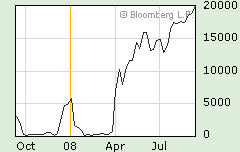
More details are emerging regarding the SIV situation: FT-Alphaville has republished a Fitch graph showing the NAV of the SIVs it rates:

In this case, “NAV” is a measure of the asset coverage provided to the equity noteholders; therefore, when it’s below 100%, they’ve lost money. These numbers have no independent implications for the asset coverage ratios for the senior noteholders; that will depend on the original capital structure of the SIV.

Naked Capitalism discusses this and other tidbits from the SIV front. An anonymous Fed tipster is putting out the word that the Fed’s silence should not be misconstrued. The WSJ has published an extract from an interview with the head of the Basel Committee on Banking Supervision – he’s not impressed by the Super-Conduit idea. One question-and-answer brought tears of gratitude to my eyes:

Might Basel II’s reliance on rating agencies, for instance, come under consideration?

There are problems to be solved with rating agencies. … but you remain responsible at the end of the day, yourself, and you have to make your own assessments.

Fitch Ratings has published an initial review, dated September 20, and an update, dated October 12, of the SIVs it rates (the chart above is taken from the update). Credit Sights, an independent credit rating agency (that is, one paid by its subscribers rather than – gasp! – the issuers) that delights in being gloomier than the the issuer-paid credit rating agencies, has released a report (to paying clients) that claims:

Many structured-investment vehicles may be forced to close in the next few months as defaults by SIVs run by European hedge funds make it harder for others to avoid selling off their assets

So if Super-Conduit ever gets off the ground, there is every indication that it will have plenty of assets to choose from!

I mentioned the issue of bank purchases of ABCP held in their money-market funds on August 20 in the context of managerial independence, but there are other problems with the idea. Mainly, is a MMF a stand-alone investment vehicle, or is it a bank deposit? There are some US banks purchasing SIV paper from their MMFs; this is not a right and proper thing to do. I hope that the OSFI in Canada and the Fed in the US will nail these banks to the wall on their next audit; unless unitholders are taking ALL the risk of the investment, EVERY SINGLE PENNY, then the MMF is not a stand-alone vehicle.

Given all the excitement regarding the issuance of covered bonds, it would seem that if bank-run MMFs are really “covered bank deposits” then the banks’ balance sheets should be grossed up by the size of their funds and capital adequacy determined from these figures. The National Bank, for example, has total assets of about $117-billion and a total of about $1.7-billion in various MMF vehicles: Money Market Fund, Treasury Bill Plus, US MMF, Corporate Cash Management, Treasury Management and Strategic Yield. Grossing up the balance sheet would not be the biggest charge in the world, but if the banks are going to give implicit support to their funds, it is a charge that should be taken in order to protect depositors.

Business Week has a fascinating story on the implosion of the two Bear Stearns hedge funds that triggered the whole crisis. I have updated my post on stress-testing of Australian mortgages with a report from Bloomberg that one of the largest mortgage insurers is being downgraded.

The decline in perpetual preferreds actually accellerated today; to me, the yields have gone beyond “wow!” and into “outlandish” territory … but those who are selling evidently disagree with me!

There are some proxy-variables in the yield curve analysis that lead me to suspect that there is a definite bias towards selling the newer issues – by which I mainly mean everything issued in the last year; this is a change from the situation last spring. I had mentioned at that point that liquidity appeared to be at a premium – and so it was, according to the analysis. I am beginning to suspect, however, that the yield curve needs some kind of – yech! – momentum indicator, because I am now hypothesizing that the liquidity premium was actually a proxy for a “recent issue premium”. Currently, I am analyzing a premium being paid for “cumulative dividends”; this might be a proxy for “recent issue discount”.

There’s always something new, something to be tested, that becomes apparent only in times of extreme stress. ‘Nature reveals her secrets best under torture’, and all that. If Bacon didn’t say it, then I will.

I should note – for those who might be alarmed at the idea that I don’t know everything already – that yield curve analysis is the least of my analytical worries right now. Fits to the curve are excellent; it’s diversification that has me concerned. The yield pick-up of Perpetuals over Retractibles is now so extreme it’s becoming harder and harder to justify any holdings of the latter at all!

Note that these indices are experimental; the absolute and relative daily values are expected to change in the final version. In this version, index values are based at 1,000.0 on 2006-6-30
Index Mean Current Yield (at bid) Mean YTW Mean Average Trading Value Mean Mod Dur (YTW) Issues Day’s Perf. Index Value
Ratchet 4.85% 4.82% 515,214 15.65 1 0.0000% 1,043.7
Fixed-Floater 4.88% 4.79% 102,556 15.80 7 +0.1108% 1,039.9
Floater 4.52% 4.54% 69,471 16.29 3 -0.1101% 1,038.4
Op. Retract 4.86% 3.91% 79,823 3.13 15 -0.0733% 1,029.4
Split-Share 5.16% 5.03% 86,188 4.13 15 -0.0030% 1,043.5
Interest Bearing 6.20% 6.16% 58,669 3.64 4 +0.7660% 1,067.6
Perpetual-Premium 5.74% 5.60% 98,396 9.89 17 -0.2768% 1,002.1
Perpetual-Discount 5.51% 5.55% 321,954 14.61 47 -0.5871% 915.7
Major Price Changes
Issue Index Change Notes
CM.PR.H PerpetualDiscount -3.6697% Now with a pre-tax bid-YTW of 5.75% based on a bid of 21.00 and a limitMaturity.
PWF.PR.K PerpetualDiscount -3.3095% Now with a pre-tax bid-YTW of 5.74% based on a bid of 21.62 and a limitMaturity.
ELF.PR.F PerpetualDiscount -2.7706% Now with a pre-tax bid-YTW of 5.94% based on a bid of 22.46 and a limitMaturity.
ELF.PR.G PerpetualDiscount -1.9990% Now with a pre-tax bid-YTW of 5.96% based on a bid of 20.10 and a limitMaturity.
RY.PR.G PerpetualDiscount -1.7435% Now with a pre-tax bid-YTW of 5.49% based on a bid of 20.50 and a limitMaturity.
SLF.PR.E PerpetualDiscount -1.6941% Now with a pre-tax bid-YTW of 5.45% based on a bid of 20.89 and a limitMaturity.
PWF.PR.L PerpetualDiscount -1.6883% Now with a pre-tax bid-YTW of 5.64% based on a bid of 22.71 and a limitMaturity.
BAM.PR.M PerpetualDiscount -1.4742% Now with a pre-tax bid-YTW of 6.00% based on a bid of 20.05 and a limitMaturity.
CM.PR.I PerpetualDiscount -1.4078% Now with a pre-tax bid-YTW of 5.62% based on a bid of 21.01 and a limitMaturity.
GWO.PR.H PerpetualDiscount -1.3093% Now with a pre-tax bid-YTW of 5.61% based on a bid of 21.86 and a limitMaturity.
BSD.PR.A InterestBearing +2.3037% Asset coverage of just under 1.8:1 as of October 19 according to Brookfield Funds. Now with a pre-tax bid-YTW of 6.55% (mostly as interest) based on a bid of 9.77 and a hardMaturity 2015-3-31 at 10.00.
Volume Highlights
Issue Index Volume Notes
PWF.PR.K PerpetualDiscount 260,500 Now with a pre-tax bid-YTW of 5.74% based on a bid of 21.62 and a limitMaturity.
BMO.PR.J PerpetualDiscount 220,300 Now with a pre-tax bid-YTW of 5.38% based on a bid of 21.25 and a limitMaturity.
MFC.PR.B PerpetualDiscount 140,482 Now with a pre-tax bid-YTW of 5.33% based on a bid of 22.05 and a limitMaturity.
CM.PR.E PerpetualPremium 59,025 Desjardins crossed 50,000 at 25.15. Now with a pre-tax bid-YTW of 5.52% based on a bid of 25.10 and a call 2012-11-30 at 25.00.
BAM.PR.M PerpetualDiscount 51,880 Now with a pre-tax bid-YTW of 6.00% based on a bid of 20.05 and a limitMaturity.

There were twenty-eight other index-included $25.00-equivalent issues trading over 10,000 shares today.
Market Action

October 22, 2007

Sometimes I wish that this blog would get more comments. At other times, I’m glad that I don’t have to make the decision ten times per day on whether a particular comment is so ad hominem that I have to zap it. Today is one of those other days!

Menzie Chinn of Econbrowser posted a graph for which the general outlines have been known for a long time by those who are following the subprime debacle:

…and it triggered a lot of nastiness in the comments when a (purported – I haven’t checked!) market professional asked, essentially, ‘What’s the big deal?’.

It continually surprises me to see just how much bitterness there is out there against investment managers. But – that’s the Internet! As far as graphs go, I like the one from Moody’s showing mortgage delinquency rates:


Bear Stearns has agreed to a deal with CITIC whereby CITIC will take equity in Bear Stearns and Bear Stearns will, essentially, provide vendor financing. This should calm some fears about the future independence and financial viability of Bear Stearns going forward, and a joint-venture deal in Hong Kong with CITIC might even be profitable!

whereby CITIC will take equity in Bear Stearns and Bear Stearns will, essentially, provide vendor financing. This should calm some fears about the future independence and financial viability of Bear Stearns going forward, and a joint-venture deal in Hong Kong with CITIC might even be profitable!whereby CITIC will take equity in Bear Stearns and Bear Stearns will, essentially, provide vendor financing. This should calm some fears about the future independence and financial viability of Bear Stearns going forward, and a joint-venture deal in Hong Kong with CITIC might even be profitable!Naked Capitalism has again done a good job of collecting media references to the Super-Conduit … and it looks like my speculation regarding the operation of this vehicle as a Vulture Fund is both right and wrong. Wrong because that’s not what the primary sponsors have in mind. Right because if it ain’t, there won’t be any secondary sponsors:

One key concern is over the process by which it is proposed that the fund will decide on prices to offer SIVs for their securities. The lead banks are proposing that prices should be determined according to quotes provided by dealers for small volumes of the particular security rather than large trades. Critics say this means prices will be artificially high. “Banks are being asked to finance a vehicle full of overvalued assets which is not very attractive,” said one banker. Critics believe it would be better to work with true market prices – however painful.

I will now speculate that buying good assets from distressed SIVs is exactly how the RBS / Cheyne deal will unfold … but we will see! Accrued Interest has clearly been puzzling over the sponsors’ motivations as much as I have … he has introduced the rather Machievellian possibility that it is actually a rescue of the bank Money Market Funds.

The fair value estimate for the TD 5.25% Perpetual New Issue has been updated to $24.05 as of the close today.

Perpetuals continued to decline today. Holders of the Royal Bank issues should note – before they have a heart attack at 9:31 tomorrow – that today, 10/22 was the last day of cum-dividend trading; tomorrow, 10/23, will be the first day of ex-dividend trading for the current dividend.

Note that these indices are experimental; the absolute and relative daily values are expected to change in the final version. In this version, index values are based at 1,000.0 on 2006-6-30
Index Mean Current Yield (at bid) Mean YTW Mean Average Trading Value Mean Mod Dur (YTW) Issues Day’s Perf. Index Value
Ratchet 4.83% 4.79% 536,593 15.69 1 0.0000% 1,043.7
Fixed-Floater 4.89% 4.79% 103,780 15.80 7 -0.2944% 1,038.7
Floater 4.52% 4.54% 70,226 16.30 3 -0.3148% 1,039.6
Op. Retract 4.85% 3.92% 79,850 3.18 15 +0.0163% 1,030.2
Split-Share 5.16% 5.03% 85,394 4.13 15 -0.1342% 1,043.6
Interest Bearing 6.24% 6.33% 56,885 3.63 4 +0.1012% 1,059.5
Perpetual-Premium 5.72% 5.57% 97,476 9.92 17 -0.1918% 1,004.9
Perpetual-Discount 5.47% 5.51% 322,445 14.63 47 -0.2600% 921.2
Major Price Changes
Issue Index Change Notes
GWO.PR.H PerpetualDiscount -1.7738% Now with a pre-tax bid-YTW of 5.53% based on a bid of 22.15 and a limitMaturity.
GWO.PR.I PerpetualDiscount -1.7469% Now with a pre-tax bid-YTW of 5.47% based on a bid of 20.81 and a limitMaturity.
IAG.PR.A PerpetualDiscount -1.6744% Now with a pre-tax bid-YTW of 5.50% based on a bid of 21.14 and a limitMaturity.
PWF.PR.F PerpetualDiscount -1.2283% Now with a pre-tax bid-YTW of 5.64% based on a bid of 23.32 and a limitMaturity.
BCE.PR.Z FixFloat -1.2205%  
ELF.PR.F PerpetualDiscount -1.1130% Now with a pre-tax bid-YTW of 5.77% based on a bid of 23.10 and a limitMaturity.
PIC.PR.A SplitShare -1.0390% Now with a pre-tax bid-YTW of 5.16% based on a bid of 15.24 and a hardMaturity 2010-11-1 at 15.00.
Volume Highlights
Issue Index Volume Notes
BNS.PR.L PerpetualDiscount 116,295 National Bank crossed 100,000 at 21.12. Now with a pre-tax bid-YTW of 5.35% based on a bid of 21.12 and a limitMaturity.
PWF.PR.K PerpetualDiscount 30,112 Nesbitt crossed 25,000 at 22.43. Now with a pre-tax bid-YTW of 5.56% based on a bid of 22.36 and a limitMaturity.
RY.PR.B PerpetualDiscount 27,900 Now with a pre-tax bid-YTW of 5.51% based on a bid of 21.64 and a limitMaturity.
CM.PR.I PerpetualDiscount 21,600 Now with a pre-tax bid-YTW of 5.54% based on a bid of 21.31 and a limitMaturity.
CM.PR.H PerpetualDiscount 16,063 Now with a pre-tax bid-YTW of 5.51% based on a bid of 21.80 and a limitMaturity.

There were fifteen other index-included $25.00-equivalent issues trading over 10,000 shares today.

Market Action

October 19, 2007

 The box-score for today is:

In more interesting news, the media has reported somebody saying something intelligent about regulation:

“If you intervene in the system, the vultures stay away,” [Former Fed Chairman Greenspan] said. “The vultures sometimes are very useful.”

“When it breaks, it’s very abrupt and you just have to wait it out,” he added.

This was in an interview with Emerging Markets, which was in turn linked by the WSJ.

More rules will not stop market booms, busts or outright fraud. They can – sometimes – mitigate and contain the effects; I have previously suggested that rules for the capital treatment of liquidity guarantees be reviewed with an eye to ensuring the banking system, as a whole, can withstand bigger shocks than this piddly little liquidity crisis. But there are far too many people around who rush to revise the rule book every time something bad happens. Life sucks. Get used to it.

Specifically, Greenspan was opining on Super-Conduit:

But Greenspan argued that that a delicate market psychology could be speared by the move. “It could conceivably make [conditions affecting investor psychology] somewhat adverse because if you believe some form of artificial non-market force is propping up the market you don’t believe the market price has exhausted itself.

“What creates strong markets is a belief in the investment community that everybody has been scared out of the market, pressed prices too low and they’re wildly attractive bargaining prices there,” he said.

“If you intervene in the system, the vultures stay away,” he said. “The vultures sometimes are very useful.”

Well, I’ve speculated that Super-Conduit is the vulture; and that the aim of the exercise is to wipe out the junior note-holders of the shakier SIVs to leave only the strong still standing. This got a little support in an unsubstantiated, anonymous comment on Accrued Interest:

From Total Securitization:

“Citigroup Won’t Use Super SIV To Save Its Own

Citigroup officials, reacting to claims that the master liquidity enhancement conduit it is creating with JPMorgan and Bank of America will be used to specifically rescue Citi’s more than $80 billion SIV exposure, is expected to announce that it will not utilize the fund at all.”

Well, it ties in with my thought on Super-Conduit; but I don’t have a subscription to Total Securitization, so I’ll have to wait for those remarks to be reported elsewhere.

Cheyne and Rhinebridge officially defaulted on their commercial paper today:

Rhinebridge has $791 million of commercial paper and a portfolio with a face value of $1.1 billion, S&P said. The market value of the assets is now 63 percent of face value, having fallen $69 million since Oct. 16 alone, S&P said. Revaluations of CDOs of asset-backed securities have caused a “dramatic” fall in value, the rating company said.

Cheyne Finance’s managers said its assets are worth 93 percent of face value, enough to pay back all of its $6.6 billion of senior debt, S&P said. CDOs of asset-backed securities make up 6 percent of Cheyne Finance’s holdings.

The SIVs aren’t the only outfits being affected by the market revulsion to all things sub-prime – after announcing mark-to-market write-downs of $1.3-billion, Wachovia has discussed its earnings:

“Next line addresses other structured products [Total of $438MM]. Here we have the marks on warehouse positions and trading inventory, both of which we hold in trading portfolios. This includes the positioning Ken referred to in reference to sub prime mortgage exposure and AAA rated securities. $308 million is associated with sub prime securities [Their slides say $347 of the mark was related to subprime of which $308 was AAA subprime]. Basically there, we never would have expected that you see AAA securities trade so far so quickly from par.”

The same comments thread on Accrued Interest yielded the following revealing exchange:

Anonymous: IF my money market funds invest in this SIV I will sell them and buy one that doesn’t. Plain and simple.

Accrued Interest: A **TON** of investors have moved into government money market funds to ensure they don’t own any ABCP over the last 2 months. I think that’s the right move. Money Market funds aren’t a place to take any risk at all as far as I’m concerned.

In other – No Analysis Necessary. As soon as the dreaded words of power are spoken – SELL! It is no wonder that, as I mentioned yesterday:

asset-backed commercial paper backstopped by real assets and a full bank credit backstop yielding more than unsecured commercial paper issued by the same bank—in other words, the real assets as collateral viewed by market participants as a negative rather than a positive,

To how many people does this make sense? Stick yer hands up!

I’ve said before that the danger of the credit crunch has not passed – that we’ve got a long way to go before we’re out of the woods (and, I hasten to add, I am not suggesting that market timing is the investor’s answer; analysis and diversification is the investor’s answer). Some of the specific risks to markets over the next six(?) months are outlined at the WSJ

This may be a little off-topic; but I want to point out that the benefits of diversification are everywhere:

The Utah scientists are trying to sell farmers on the idea that more bee diversity is needed, which was a hard sell because farmers had to pay more for wild bees. Now that honeybee prices are rising, farmers are more willing to try other species, James says.

Getting back to Canada and economic news for a moment, the Canadian CPI numbers were released today, and:

It was the highest year-over-year increase in the all-items index since May 2006, and the sharpest acceleration since February of this year.

Gasoline prices were the primary cause of an increase in the 12-month variation of the Consumer Price Index (CPI) in most provinces.

The year-over-year increase in gasoline prices (+12.7%) owed more to a sudden drop in last year’s prices than to any significant developments in the most recent month. Indeed, on a month-to-month basis, gasoline prices barely budged, rising a mere 0.8% from August to September 2007.


Of particular interest is:

On a year-over-year basis, consumer prices increased at a faster pace than the national average in only four provinces in September: New Brunswick (+2.9%), Manitoba (+2.8%), Saskatchewan (+3.8%) and Alberta (+4.6%).

In other words, inflation (such as it is) remains fairly well localized to the petro-provinces (with the exception of poor old Brunny). This suggests – to me – that there is nothing much in this report that would lead anybody to expect a rate-hike in the near future. Mind you, there are many who believe that the level was sufficiently high that we shouldn’t expect any lowering, either:

The Canadian dollar jumped 0.98 of a cent to 103.68 cents US – a level last seen in mid-1976 – after going as high as 103.71 cents US on expectations the higher CPI reading means the Bank of Canada won’t be lowering interest rates any time soon. The bank stood pat on interest rates Tuesday.

All this talk of inflation inevitably leads to the Fed. James Hamilton of Econbrowser attended a St. Louis Fed conference and reports that a hot topic of conversation was whether the Fed should operate according to a few simple and mechanical rules. Well, I haven’t read the papers yet, but my gut reaction is: “Sort of”. There should be enough mechanical rules so that Fed action is reasonably predictable; but none so binding as prevent reaction to special cases. Of course, there’s always going to be a lot of pressure to declare a special case so, as Poole said in his concluding remarks, central bankers need to be people of unquestionable integrity.

Mainly, though, I liked the graph:

Actual path of fed funds rate (black line), path predicted by a Taylor Rule that uses actual values of inflation and GDP (blue line), and path predicted by a Taylor Rule that uses forecasts of inflation and GDP (red line). Source: Orphanides and Wieland (2007).

Look carefully! Do you see the bit that has Greenspan blamed for the housing bubble? He was relying on forecasts, wasn’t he?

Another day of heavy volume for preferreds – and, er, yields were up! Yes, hold that thought firmly in your minds … yields, and therefore expectations of future returns, were up!

This is starting to get somewhat annoying. According to Canadian Bond Indices, long corporates are up 1.64% on the month, but prefs are getting killed … CPD is down a little over 1.5% month-to-date, perpetualDiscounts are down about 2.8%. Yield on long corporates is around 5.9% … about the same as it was on October 10, when I looked at spreads on One Bull Checks In. Since then, the perpetualDiscount yield has increased from 5.42% to 5.49%, and return for this index has been -1.28% (this doesn’t work out nicely with the Modified Duration in the range of 14.7 because of rounding errors and the obscuring effects of averages and outliers).

I think retail is mistaking preferreds for common again! And with things like CM.PR.D yielding 5.81% at the bid (interest equivalent of 8.13%) … well, they can mistake preferreds for common all they like, I guess!

Note that these indices are experimental; the absolute and relative daily values are expected to change in the final version. In this version, index values are based at 1,000.0 on 2006-6-30
Index Mean Current Yield (at bid) Mean YTW Mean Average Trading Value Mean Mod Dur (YTW) Issues Day’s Perf. Index Value
Ratchet 4.81% 4.77% 558,861 15.75 1 0.0000% 1,043.7
Fixed-Floater 4.87% 4.77% 104,288 15.84 7 +0.0119% 1,041.8
Floater 4.50% 3.27% 71,095 10.71 3 -0.0930% 1,042.9
Op. Retract 4.85% 3.91% 80,695 3.19 15 +0.1241% 1,030.0
Split-Share 5.15% 4.93% 85,241 3.90 15 +0.0081% 1,045.0
Interest Bearing 6.25% 6.37% 56,148 3.64 4 -0.0738% 1,058.4
Perpetual-Premium 5.71% 5.55% 97,542 9.95 17 -0.3077% 1,006.8
Perpetual-Discount 5.45% 5.49% 326,421 14.67 47 -0.2400% 923.6
Major Price Changes
Issue Index Change Notes
CM.PR.D PerpetualPremium (for now!) -2.1293% Now with a pre-tax bid-YTW of 5.81% based on a bid of 24.82 and a limitMaturity.
RY.PR.A PerpetualDiscount -2.1097% Now with a pre-tax bid-YTW of 5.42% based on a bid of 20.88 and a limitMaturity.
NA.PR.L PerpetualDiscount -1.7666% Now with a pre-tax bid-YTW of 5.75% based on a bid of 21.13 and a limitMaturity.
TD.PR.O PerpetualDiscount -1.3596% Now with a pre-tax bid-YTW of 5.41% based on a bid of 22.49 and a limitMaturity.
PWF.PR.E PerpetualDiscount -1.1837% Now with a pre-tax bid-YTW of 5.63% based on a bid of 24.21 and a limitMaturity.
HSB.PR.D PerpetualDiscount -1.1250% Now with a pre-tax bid-YTW of 5.31% based on a bid of 23.73 and a limitMaturity.
W.PR.H PerpetualDiscount -1.0105% Now with a pre-tax bid-YTW of 5.84% based on a bid of 23.51 and a limitMaturity.
LFE.PR.A SplitShare +1.1561% Asset coverage of 2.7+:1 as of October 15, according to the company. Now with a pre-tax bid-YTW of 4.22% based on a bid of 10.50 and a hardMaturity 2012-12-1 at 10.50.
Volume Highlights
Issue Index Volume Notes
SLF.PR.D PerpetualDiscount 588,980 Now with a pre-tax bid-YTW of 5.32% based on a bid of 21.15 and a limitMaturity.
SLF.PR.C PerpetualDiscount 411,725 Now with a pre-tax bid-YTW of 5.32% based on a bid of 21.15 and a limitMaturity.
MFC.PR.C PerpetualDiscount 267,380 Now with a pre-tax bid-YTW of 5.31% based on a bid of 21.45 and a limitMaturity.
BCE.PR.Z FixFloat 142,802  
BAM.PR.K Floater 70,655 Nesbitt crossed 70,000 at 23.90.

There were thirty-four other index-included $25.00-equivalent issues trading over 10,000 shares today.

Market Action

October 18, 2007

ABCP is in the news nowadays – and the Fed reports that outstandings are down another $11-billion over the week, as the unwinding / delevering continues. The total outstanding is now down about 21% from the July month-end figure.

The WSJ has published an article blaming the mess on London bankers, a piece of revisionism to which Naked Capitalism takes violent exception. Naked Capitalism has also reviewed the failure of Cheyne discussed here yesterday; the S&P Pre-sale report for Cheyne, dated May, 2005, has, perhaps, been accidentally left on the Web. Brad Setser applauds Naked Capitalism and points out that, for all the talk of globalization, a lot of US money is simply making a round-trip via London/Offshore right back to the US.

I can present some more support for my conception of Super-Conduit as Vulture Fund:

  • AAA-rated mortgage-backed securities selling at 85 or 90 cents on the dollar
  • asset-backed commercial paper backstopped by real assets and a full bank credit backstop yielding more than unsecured commercial paper issued by the same bank—in other words, the real assets as collateral viewed by market participants as a negative rather than a positive,
  • 3-month LIBOR (the interbank deposit rate in London for dollars) as high as 100 basis points above the fed funds rate target—certainly possible if the monetary authorities were in the process of tightening monetary policy aggressively, but nearly inconceivable given the widely held expectation that the central bank would likely be cutting interest rates,
  • Treasury bill rates rising and falling 100 basis points in a single day, and
  • nearly a failed Treasury bill auction—total bids were barely sufficient to cover the amount the Treasury was offering. This near-miss occurred despite the fact that money market mutual fund investors were fleeing to rather than away from Treasury securities.
  • And, reported in the context of a $1.2-billion whoopsee by Rhinebridge Plc:

    SIVs worldwide have been forced to sell about $75 billion of assets in the past two months to repay maturing debt as investors balked at buying securities linked to money-losing subprime mortgages.

    As of late August, 79 percent of Rhinebridge’s holdings were in the U.S. and 80 percent in mortgage-backed bonds, Fitch Ratings estimated in an Aug. 22 report. Eighty-three percent of the assets had the highest-possible AAA rating, Fitch said.

    Even Warren Buffett has opined on Super-Conduit!

    Buffett said he was skeptical about the U.S. Treasury’s plan to create an $80 billion fund to buy distressed assets from structured investment vehicles linked to home lending.

    “I don’t see any way that pooling a bunch of mortgages, changing the ownership, is going to change the viability of the mortgage instrument itself — whether people can make the payments,” he said. “It would be better to have them on the balance sheets so everyone would know what’s going on”

    I hesitate to question the wildly popular Oracle of Omaha publicly, but I don’t see Super-Conduit as being merely a vehicle to change ownership – I see it as a matter of wiping out the old equity-holders and injecting new equity while keeping the note-holders happy and senior.

    However, the Super-Conduit plan seems to be having trouble attracting supporters; this may be an indication that the potential players see it more as Citibank bail-out than as a vulture fund; or it may simply indicate that potential players would rather be vultures all by themselves. Without disclosure of every nuance of the negotiations, it’s hard to guess! 

    Nouriel Roubini writes a very gloomy assessment of the chances for a major 1987-style stock market collapse and concludes:

    To avoid such a meltdown, we need many reforms: better regulation and supervision of mortgages and of financial institutions, including the lightly or unregulated hedge funds; more transparency on who is holding which risky assets; better risk management by investors; avoidance of a bailout of reckless lenders and investors; a more competitive market for ratings as the small set of only three rating agencies seriously misread very complex and risky instruments; and hopefully a modest and soft—rather than hard—landing for the U.S. economy.

    In other words: it would be a really wonderful world if only there were more rules in it! I won’t reiterate my past arguments against Regulation Nirvana; I’ll just say again that regulators should ensure there is a solid banking system at the core of financial operations, then let the rest of us play with it as we will. And strengthen the concept of fiduciary responsibility, so that those who recklessly violate Prudent Man rules end up wearing the losses.

    Default Risk has published a paper on Equity Implied Ratings:

    Fitch’s Equity Implied Ratings and Probability of Default (EIR) model is estimated to provide a view of a firm’s credit condition given its current equity price and available financial information.

    This is an enhancement that I have been longing to bring into HIMIPref™ … perhaps someday!

    There aren’t many bank runs nowadays and some credible analysis of the Northern Rock run is getting done. Two major conclusions: Northern Rock was overleveraged and UK Deposit Insurance is inferior. Deposit insurance in the UK covers:

    100% of the first £2,000 (about $4,100) and 90% of the next £33,000 (about $ 67,500)

    Various forms of deposit insurance were reviewed by BIS in 1998; I am somewhat surprised to learn that deposit insurance is something of a novelty in Europe:

    While most commentators see some merit in the idea of deposit insurance, there is more disagreement as to whether deposit protection schemes should be explicit or not. Most commentators seem to accept the former position. One part of the argument is that, in the middle of a crisis, olicymakers will be forced to offer explicit protection to everyone. Thus, the costs to taxpayers may be very high. In contrast, Demirgüç-Kunt and Detragiache (2000) seem to argue that poor design can make the explicit protection route even more costly. This design issue is returned to below. Explicit deposit insurance schemes are certainly much more widespread than they used to be. The first nationwide system was introduced in 1934 in the United States, but other countries only began to follow in the postwar period. This trend accelerated in OECD countries in the 1980s, culminating with the introduction of limited deposit insurance in the European Union in 1994.

    The argument against deposit insurance is moral hazard:

    Erlend Nier and Ursel Baumann find, in a cross-country study, that enhanced disclosure by banks seems to induce banks to limit their risk of default by keeping higher capital buffers for given asset risk. Their results also suggest that market discipline is stronger for banks that are funded by uninsured liabilities and weaker for those that benefit from wide deposit protection schemes or other safety nets. The latter may therefore be introducing a degree of moral hazard.

    I don’t buy it. The average retail investor is doing well if he can balance his chequebook – how can he be expected to analyze the soundness of a bank during a crisis? He’s going to know nothing and know he knows nothing; he will therefore withdraw his deposits and contribute to a run.

    The North American system of providing full deposit insurance on amounts up to $100,000 per institution per person is a good solution; but as I have previously mentioned, the CDIC doesn’t have enough cash in the till to be credible during a genuine crisis. They should have at least enough to recapitalize their largest member completely and the Royal Bank has capital of about $26-billion. And further, not a single dime of the CDIC’s reserve fund should be invested in Canada!

    Menzie Chinn of Econbrowser continues to worry about the prospects for the national debt:

    … following her assault on the implausible economic assumptions of the Bush administration:

    But real change in American fiscal policy will not happen until they become very close to hitting the wall. And, for all the dollar drama, they’re a long way from that point. It will be interesting to see if record lows against the Euro become an issue in the 2008 elections. Oil at USD 90 ain’t going to help the economy much!

    Remember the Moody’s mass downgrade of October 11? In a fascinating development, Global DIGIT (last mentioned October 16, with a full post regarding its suspension of dividends) has announced:

    As at October 3, 2007, the reference portfolios of Global DIGIT contained 8 of the securities downgraded by Moody’s.

    The total exposure to downgraded instruments is $463-million – out of a total portfolio of $1.4-billion. Whoopsee!

    Very good volume in the preferred share market today, but the perpetual indices resumed their descent.

    Note that these indices are experimental; the absolute and relative daily values are expected to change in the final version. In this version, index values are based at 1,000.0 on 2006-6-30
    Index Mean Current Yield (at bid) Mean YTW Mean Average Trading Value Mean Mod Dur (YTW) Issues Day’s Perf. Index Value
    Ratchet 4.79% 4.74% 582,043 15.79 1 0.0000% 1,043.7
    Fixed-Floater 4.87% 4.76% 105,407 15.85 7 -0.0171% 1,041.7
    Floater 4.50% 4.27% 68,513 10.76 3 +0.0687% 1,043.8
    Op. Retract 4.86% 4.23% 81,341 3.25 15 +0.2191% 1,028.7
    Split-Share 5.16% 4.95% 83,628 3.91 15 -0.0176% 1,044.9
    Interest Bearing 6.25% 6.31% 56,371 3.64 4 +0.4621% 1,059.2
    Perpetual-Premium 5.69% 5.51% 97,699 8.79 17 -0.1344% 1,010.0
    Perpetual-Discount 5.44% 5.48% 326,751 14.69 47 -0.2314% 925.8
    Major Price Changes
    Issue Index Change Notes
    BNS.PR.K PerpetualDiscount -1.7857% Now with a pre-tax bid-YTW of 5.47% based on a bid of 22.00 and a limitMaturity.
    RY.PR.B PerpetualDiscount -1.5068% Now with a pre-tax bid-YTW of 5.52% based on a bid of 21.57 and a limitMaturity.
    CM.PR.I PerpetualDiscount -1.3583% Now with a pre-tax bid-YTW of 5.61% based on a bid of 21.06 and a limitMaturity.
    RY.PR.G PerpetualDiscount -1.1732% Now with a pre-tax bid-YTW of 5.76% about 5.36% based on a bid of 21.84 and a limitMaturity.
    FTN.PR.A SplitShare -1.0774% Now with a pre-tax bid-YTW of 4.47% based on a bid of 10.10 and a hardMaturity 2008-12-1 at 10.00.
    PWF.PR.L PerpetualDiscount -1.0638% Now with a pre-tax bid-YTW of 5.50% based on a bid of 23.25 and a limitMaturity.
    CM.PR.P PerpetualPremium (for now!) -1.0000% Now with a pre-tax bid-YTW of 5.49% based on a bid of 24.75 and a limitMaturity.
    IAG.PR.A PerpetualDiscount +1.1210% Now with a pre-tax bid-YTW of 5.34% based on a bid of 21.65 and a limitMaturity.
    ELF.PR.G PerpetualDiscount +1.4314% Now with a pre-tax bid-YTW of 5.82% based on a bid of 20.55 and a limitMaturity.
    IGM.PR.A OpRet +1.7850% Now with a pre-tax bid-YTW of 3.91% based on a bid of 26.80 and a call 2009-7-30 at 26.00.
    BSD.PR.A InterestBearing +1.7989% Now with a pre-tax bid-YTW of 6.81% (mostly as interest) based on a bid of 9.62 and a hardMaturity 2015-3-31 at 10.00.
    Volume Highlights
    Issue Index Volume Notes
    HSB.PR.C PerpetualDiscount 105,600 Nesbitt did three crosses at 24.07: 35,000 shares, 40,000 and 25,000. Now with a pre-tax bid-YTW of 5.34% based on a bid of 24.05 and a limitMaturity.
    FAL.PR.A Scraps (for now! Recent credit upgrade will probably have it moving to Ratchet at next rebalancing) 103,210 Scotia crossed two lots at 24.69: 75,000 and 25,000.
    CIU.PR.A PerpetualDiscount 75,100 Nesbitt crossed 75,000 at 21.39.
    BMO.PR.I OpRet 73,345 Nesbitt crossed 30,000 at 25.25, then another 30,000 at 25.22. Now with a pre-tax bid-YTW of 3.83% based on a bid of 25.21 and a call 2007-12-25 at 25.00.
    BCE.PR.R FixFloat 62,975 Scotia crossed two lots of 30,000 at 24.60.
    MFC.PR.A OpRet 54,100 Now with a pre-tax bid-YTW of 3.91% based on a bid of 25.44 and a softMaturity 2015-12-18 at 25.00.

    There were forty-six other index-included $25.00-equivalent issues trading over 10,000 shares today.

    Update: Typographical error on RY.PR.G yield corrected. Revised number is approximate.

    Market Action

    October 17, 2007

    US Inflation numbers were announced today and seem relatively benign – while the headline number ticked up for the month and trailing year, the core rate remained steady at 2.1% for the year. Housing starts continued to decline to the horror of many so it would appear that, whatever else we have to worry about, a superheated US economy is not the greatest concern! As the Bank of Canada said yesterday when announcing that the bank rate would be unchanged:

    the outlook for the U.S. economy has weakened because of greater-than-expected slowing in the housing sector. The Bank has revised down its projection for U.S. growth to 1.9 per cent in 2007 and 2.1 per cent in 2008. U.S. growth is expected to pick up to 3 per cent in 2009.

    What’s going to happen in the US? Brad Setser is worried:

    The August TIC Data was really bad.  Even Fox Business News would have trouble putting a happy face on it.

    The net outflow in August – from a combination of foreign investors reducing their claims on the US and Americans adding to their claims on the world – was around $160b.   Most of that — $140b – came from the private sector, but the official sector also reduced its claims on the US.  The total monthly outflow works out to a bit more than 1% of US GDP.   Annualized, that is a 12% of GDP outflow.    To put a 12% of GDP outflow in context, it is roughly the magnitude of the private outflow from Argentina in 2001, at the peak of its crisis.

    Meanwhile, there is on sub-prime securitization:

    Many of the mortgages underpinning this housing expansion were resold. They were securitized – meaning a loan would become a tradable asset – and packaged – meaning many loans were put together to form a single asset. The resulting bundles, called credit derivatives, were then sold worldwide, most of them with high AAA ratings because the large number of loans that they included meant a very small risk on any single one of them.

    As PrefBlog’s readers will know, that’s not how it works. The number of loans is basically irrelevant – you want to have enough diversification that you’re eliminating asystemic risk and reflecting the asset class’ systemic risk, but after that you’re simply increassing the size of the pool. The AAA ratings are only available through subordination.

    The number of loans is basically irrelevant – you want to have enough diversification that you’re eliminating asystemic risk and reflecting the asset class’ systemic risk, but after that you’re simply increassing the size of the pool. The AAA ratings are only available through subordination.Ordinarily, of course, I’d make a snarky comment about the writer … but Angel Ubide is the Director of Global Economics at Tudor Investment Corporation. Well, I won’t be putting any money into that firm until I see some clarification!

    A much more informed review is available on Econbrowser, where James Hamilton has put together some fascinating graphs and asks the question:

    So here’s my question– why did the “most sophisticated” investors apparently become less and less sophisticated as time went on?

    It depends on how you define “sophisticated”, doesn’t it? I suggest that

    • if one performs a regression between trailing long term performance and assets under management, you’ll find little correlation
    • regress trailing short term performance and AUM, high correlation
    • AUM and future performance, little correlation
    • trailing change in AUM and future performance, high negative correlation

    The investment business is NOT, generally speaking, about returns.

    The MLEC (or “Super-Conduit”) that was discussed yesterday and Monday got some public disclosure of its rationale today:

    Cheyne Finance Plc, the structured investment vehicle managed by hedge fund Cheyne Capital Management Ltd., will stop paying its debts, a receiver from Deloitte & Touche LLP said.

    Deloitte is negotiating a refinancing of the SIV or a sale of its assets, according to an e-mailed statement today. Cheyne Finance’s debt with different maturities will now be pooled together, rather than shorter term debt being repaid sooner, Neville Kahn, a receiver from Deloitte said today in a telephone interview.

    “It doesn’t mean we have to go out and fire-sell any assets, quite the opposite in fact,” Kahn said. “The paper that falls due today or tomorrow won’t be paid as it falls due.”

    I discussed Cheyne on August 28. Meanwhile the debate regarding the advisability of the Super-Conduit / MLEC / Whatever continued to rage. Naked Capitalism heaped scorn on the idea; but it seems to me that his initial opposition to the scheme is what’s driving his arguments:

    the biggest one being pricing of the assets to be sold to the MLEC, since the interests of current SIV owners and prospective funding sources seem hopelessly in conflict

    Well, sort of. Conflict is what makes a market, after all – buyers and sellers are always in conflict. My suggestion is that the conflict will be resolved by the prospective funding sources riding roughshod over the current SIV owners/investors, who will be forced to take a hit; I suggest that current SIV owners will be forced to pay off their ABCP holders and leave their junior tranche holders with nothing … or not much, anyway.

    They (the current SIV sponsors and junior debt-holders) are between a rock and a hard place. I suspect that many of them are in a negative carry situation – this may be the reason why the Cheyne receiver has suspended redemptions – and if ABCP investors move to the new conduit, this will only get worse, if they’re able to finance at all. They will then be forced to give up all their equity in the SIV just to get out, by selling to the Super Conduit at the lowest possible prices – as suggested by the Financial Times:

    Thus, if the M-LEC is to produce a genuine solution to the current financial woes, it is imperative that it buy assets at genuine, clearing prices – not artificial prices created by banks. If not, investors will retain nagging fears that prices have further to fall.

    And, to repeat myself, it is my suggestion that the Super Conduit has been conceived as a vulture fund – that will seek to profit from the utter helplessness of the current SIVs. Another way of looking at it, perhaps, is as a cram-down: the senior note (ABCP) holders will get back their full amount (which might include Super-Conduits junior notes instead of cash); the junior note-holders will get Super-Conduits junior notes (if anything). I suggest that the current SIV junior noteholders will be forced to go along with the idea, because the ABCP holders always have the option of walking away as their notes mature … the current SIV junior noteholders are going to get what we in the investment management business refer to as “screwed”. And serve ’em right.

    See my example with respect to the DG.UN holders (who are the junior noteholders of that particular SIV) yesterday.

    Accrued Interest also discussed this issue today, but opined that operating as a vulture fund necessarily meant accepting second-rate assets. I’m not sure that’s the case … I suggest that Super Conduit aims to purchase first-class assets at second-class prices, using the power of (projected) lower funding costs and better liquidity guarantees.

    I will be fascinated to see how this unfolds. There is no doubt that sub-prime is resulting in a big heap of losses; but it is my contention that market values have grossly over-compensated for these losses. Readers with good memories will remember the IMF Report which I have discussed previously:

    Spreads have since widened across the capital structure, especially on lower-rated ABS and ABS CDO tranches, but also on AAA-rated senior tranches (Figure 1.9). Implied losses based on these spreads total roughly $200 billion, exceeding the high end of estimated realized losses by roughly $30 billion—an indication that market uncertainty and liquidity concerns may have pushed down prices further than warranted by fundamentals (Box 1.1). While many structured credit products were bought under the assumption that they would be held to maturity, those market participants who mark their securities to market have been (and will continue to be) forced to recognize much higher losses than those who do not mark their portfolios to market. So far, actual cash fl ow losses have been relatively small, suggesting that many highly rated structured credit products may have limited losses if held to maturity.

    I’ll suggest that the discrepency between mark-to-market and hold-to-maturity values is even bigger today.

    Meanwhile, back to sub-prime for a moment, Treasuries were up a lot today, helped by S&P’s mass downgrade of 2007-vintage RMBS:

    Standard & Poor’s Ratings Services today lowered its ratings on 1,713 classes of U.S. RMBS backed by first-lien subprime mortgage loans, first-lien Alternative-A (Alt-A) mortgage loans, and closed-end second-lien mortgage loans issued from Jan. 1, 2007, through June 30, 2007. These classes are from 136 subprime transactions, 128 Alt-A transactions, and 19 closed-end second-lien transactions. The downgraded classes represent approximately $23.35 billion of original par amount, which is 6.28% of the $371.9 billion original par amount of these three types of U.S. RMBS rated by Standard & Poor’s between Jan. 1, 2007, and June 30, 2007, and 4.71% of the approximately $495 billion original par amount of all U.S. RMBS rated during this period.

    In addition, we placed the ratings on 646 other classes from 109 transactions backed by U.S. RMBS first-lien subprime mortgage loans and U.S. RMBS first-lien Alt-A mortgage loans issued during the same period on CreditWatch with negative implications. We expect to resolve the CreditWatch placements within the next few weeks, and anticipate that the results of that review will be similar to the rating actions announced herein.

    Finally, we affirmed the ratings on securities representing $245.1 billion original par value of U.S. RMBS backed by these three types of mortgage loans issued during the same period.

    There’s a lot more detail in the S&P press release – read it all!

    In preferred news, the PerpetualDiscount index actually rose today, making just the second trading day since September 19 that it has been in the black. It was aided in part by BAM.PR.M (which has been inaccurately “Distressed Preferred”) now bid at 20.45 to yield 5.87% while the virtually identical BAM.PR.N closed at 19.50 bid to yield 6.16%. Sometimes I despair of this market, I really do … especially since the fund swapped into the Ns when the spread was at a huge $0.35! *sigh* Oh well, sanity will return sooner or later. It always does.

    Note that these indices are experimental; the absolute and relative daily values are expected to change in the final version. In this version, index values are based at 1,000.0 on 2006-6-30
    Index Mean Current Yield (at bid) Mean YTW Mean Average Trading Value Mean Mod Dur (YTW) Issues Day’s Perf. Index Value
    Ratchet 4.77% 4.72% 606,189 15.83 1 0.0000% 1,043.7
    Fixed-Floater 4.87% 4.76% 99,922 15.85 7 +0.0875% 1,041.9
    Floater 4.50% 4.19% 69,823 10.75 3 +0.1655% 1,043.1
    Op. Retract 4.87% 4.28% 77,290 3.41 15 -0.0115% 1,026.4
    Split-Share 5.15% 4.94% 83,543 4.02 15 +0.0189% 1,045.1
    Interest Bearing 6.27% 6.42% 55,913 3.63 4 -0.2521% 1,054.3
    Perpetual-Premium 5.68% 5.50% 96,755 9.40 17 +0.0201% 1,011.3
    Perpetual-Discount 5.43% 5.47% 327,166 14.72 47 +0.0991% 927.9
    Major Price Changes
    Issue Index Change Notes
    IGM.PR.A OpRet -1.2008% Now with a pre-tax bid-YTW of 4.76% based on a bid of 26.33 and a softMaturity 2013-6-29 at 25.00.
    CM.PR.P PerpetualPremium +1.0101% Now with a pre-tax bid-YTW of 5.42% based on a bid of 25.00 and a limitMaturity.
    ELF.PR.G PerpetualDiscount +1.2494% Now with a pre-tax bid-YTW of 5.90% based on a bid of 20.26 and a limitMaturity.
    BAM.PR.M PerpetualDiscount +1.2878% Now with a pre-tax bid-YTW of 5.90% based on a bid of 20.26 and a limitMaturity. Closed at 20.45-50, 14×2, while the virtually identical BAM.PR.N closed at 19.50-59, 16×4. Like I said above, go figure!
    Volume Highlights
    Issue Index Volume Notes
    MFC.PR.C PerpetualDiscount 232,074 Now with a pre-tax bid-YTW of 5.26% based on a bid of 21.55 and a limitMaturity.
    SLF.PR.E PerpetualDiscount 129,800 Now with a pre-tax bid-YTW of 5.32% based on a bid of 21.35 and a limitMaturity.
    FAL.PR.A Scraps (for now! Would have been Ratchet had it not been for credit concerns) 126,420 Recently upgraded. Desjardins bought 75,000 from National Bank at 24.66, then crossed 24,000 at the same price.
    SLF.PR.D PerpetualDiscount 108,464 Nesbitt crossed 100,000 at 21.30. Now with a pre-tax bid-YTW of 5.27% based on a bid of 21.31 and a limitMaturity.
    SLF.PR.B PerpetualDiscount 59,060 Now with a pre-tax bid-YTW of 5.37% based on a bid of 22.55 and a limitMaturity.
    GWO.PR.E OpRet 57,291 Now with a pre-tax bid-YTW of 4.01% based on a bid of 25.65 and a call 2011-4-30 at 25.00.

    There were twenty other index-included $25.00-equivalent issues trading over 10,000 shares today.

    Market Action

    October 16, 2007

    Controversy continued regarding the US ABCP Super-Conduit mentioned yesterday. Noriel Roubini dislikes the plan, but bases his reasoning on a somewhat dubious assumption:

    Indeed, if we assume that many of the assets held by the SIVs are of low quality, the attempt to avoid losses that would be incurred by selling these assets in secondary markets would not be possible.

    Sadly, his alternative to what he perceives as regulatory interference in the market is simply more interference; different interference:

    The right solution would have been to punish the banks that created these dangerous schemes in the first place by forcing them to take the losses on their illiquid and/or impaired asset; or to bring such asset on balance sheet and take the capital charges or liquidity charges required to do that.  Forcing the banks to sell the asset and take the losses would have helped to create secondary markets for these illiquid assets; thus, while losses would have occurred this would have reliquified a frozen market.

    Meanwhile, Naked Capitalism supports my hypothesis that the super-conduit is not so much of a bail-out fund as a vulture fund, although he doesn’t yet know it!

    If you want a rescue program, you don’t lard it up with fees beyond what is necessary for costs and risk assumption. In this case, that would mean market fees for any credit enhancement provided by third parties, plus a mechanism for recovery of costs (and we mean real costs) of establishing and running the entity. That means no debt placement fees, since the old SIV owners were capable of doing that for themselves. If the spin is that this vehicle is being established to prevent a possible crisis, then it behooves the organizers to do so on a cost recovery basis. Anything else raises questions about the real motives (including are the fees yet another way to shore up Citigroup?).

    The MLEC, by cherry picking assets, will make thing worse for the remaining SIVs

    How do I see this working? Let’s say we have an SIV with $100 “good” assets, $5 “bad” assets, financed with $100 ABCP and $5 subordinated or equity financing. The asset pool is earning $7 annually, but due to increased spreads in the ABCP market, it’s costing them $8 to finance and operate. So the sponsors have no equity and negative carry; they’d love to get out of the business, but they would only be able to realize $80 if they sold out. That’s too much, so they struggle along.So along comes a friendly super-conduit. “Hi! I’m from the Big Bank, and I’m here to help you!”. Super-Conduit offers $95 for the “good” assets. Accepting the offer will let the sponsors get out of the business gracefully, so they accept. Super-Conduit can finance with a positive carry AND make a fat capital gain on maturity of the assets AND eliminate competitors, so everybody’s happy.

    Is this the case? I don’t know; I don’t have access to all the details on the assets. But most of the underlying remains highly rated – it’s only the speculative junior tranches of ABS that are genuinely impaired.

    Could it be the case? Most certainly. I’m going to let you in on a little secret here: investment management has nothing to do with managing investments. It’s all about selling. Huge pools of capital are controlled by guys who, frankly, don’t really know what they’re doing. If they do know how to do it, guess what? Their clients have to be kept happy. Look at what happened in August – US T-bills dipping to three percent and change, simply due to a public relations effort on the part of money-market funds desperate to have a higher quality portfolio than the next guy, even if it meant giving away money.

    I’m sure there were quite a few portfolio managers and traders executing those purchases while holding their noses; knowing that what they were doing was best defined as “panic”, but either having been given the orders, or having to provide window dressing for the paying customers.

    As far as I have been able to make out, the current crisis has everything to do with fear and greed, and nothing to do with analysis. The super-conduit will make boatloads of money for its sponsors and Treasury will achieve its objective of a functioning ABCP market.

    As an example of how this might work, and to get a ballpark idea of the numbers, let’s  look at Global DIGIT (DG.UN) again. This is cheating, because DG.UN has sub-prime exposure through derivatives, but let’s look anyway. There are about 9.75-million units outstanding, supporting $1.4-billion in ABCP via the net asset value (NAV). The NAV is most recently estimated as $7.92; the units are trading on the TSX at a little less than $3.00.

    So lets say Super-Conduit comes along and says – ‘I’ll bail you out, with enough to pay the unitholders $3.50. Or you can just wait until the ABCP holders bankrupt you. Choose!’

    So Super-Conduit makes the loan of $1.4-billion and pays the unitholders $34-million. That’s an immediate profit of $43-million  (about 3% of the loan) AND the $1.4-billion is in a comfortable positive-carry situation. To me, this sounds like good business.

    How may such interuptions in the smooth functioning of capital markets be avoided in future? Well, I’ve already given one possibility: increase the capital charge on Global Liquidity Guarantees, preferably on a sliding scale based on bank capital, to decrease the attractiveness of issuance. Other adjustments to this charge could include a charge for the term mis-match between the guarantee’s assets & liabilities … it seems reasonable that if a conduit has 8-year liabilities, a guarantee of financing via 1-2 year FRNs is less risky – given staggered maturities – than a guarantee of financing via 30-day paper. One may also wish to increase the charge when the bank is thinly capitalized to begin with; that is, pay more attention to what will happen if the guarantee is actually triggered. There is news today that:

    the Bush administration will review accounting rules for the off-balance sheet units that large U.S. banks set up to invest in assets including mortgage-backed securities.

    In somewhat related US brokerage news, there are reports that CITIC will buy a piece of Bear Stearns – which has lost a lot of value due to sub-prime contagion and the blow-up of two of its hedge funds – while Merrill Lynch’s CEO O’Neal is facing criticism due to its quarterly loss, which is in no small part due to its investment in a sub-prime mortgage originator last year. This is happening while Morgan Stanley is bulking up its mortgage servicing unit via a purchase from an originator that is desperately trying to survive. Sub-prime is casting a long shadow!

    Good volume in the preferred share market, but no returns as the slide continued.

    Note that these indices are experimental; the absolute and relative daily values are expected to change in the final version. In this version, index values are based at 1,000.0 on 2006-6-30
    Index Mean Current Yield (at bid) Mean YTW Mean Average Trading Value Mean Mod Dur (YTW) Issues Day’s Perf. Index Value
    Ratchet 4.75% 4.70% 631,339 15.87 1 0.0000% 1,043.7
    Fixed-Floater 4.88% 4.76% 100,218 15.85 7 +0.1347% 1,040.9
    Floater 4.51% 4.20% 71,998 10.73 3 +0.0550% 1,041.4
    Op. Retract 4.87% 4.19% 76,562 3.12 15 -0.1180% 1,026.6
    Split-Share 5.16% 4.95% 84,094 4.26 15 +0.0165% 1,044.9
    Interest Bearing 6.26% 6.37% 56,043 3.64 4 +0.0508% 1,057.0
    Perpetual-Premium 5.68% 5.49% 96,243 9.40 17 -0.0853% 1,011.1
    Perpetual-Discount 5.43% 5.47% 327,521 14.71 47 -0.2027% 927.0
    Major Price Changes
    Issue Index Change Notes
    IAG.PR.A PerpetualDiscount -2.2727% Now with a pre-tax bid-YTW of 5.40% based on a bid of 21.50 and a limitMaturity.
    POW.PR.D PerpetualDiscount -1.6071% Now with a pre-tax bid-YTW of 5.71% based on a bid of 22.04 and a limitMaturity.
    RY.PR.W PerpetualDiscount -1.4133% Now with a pre-tax bid-YTW of 5.40% based on a bid of 23.02 and a limitMaturity.
    BAM.PR.N PerpetualDiscount -1.2658% Now with a pre-tax bid-YTW of 6.16% based on a bid of 19.50 and a limitMaturity.
    ELF.PR.G PerpetualDiscount -1.1852% Now with a pre-tax bid-YTW of 5.98% based on a bid of 20.01 and a limitMaturity.
    BAM.PR.M PerpetualDiscount +1.0511% Now with a pre-tax bid-YTW of 5.95% based on a bid of 20.19 and a limitMaturity. BAM.PR.N was down on the day and is bid at 19.50. Go figure!
    Volume Highlights
    Issue Index Volume Notes
    HSB.PR.C PerpetualDiscount 200,500 Desjardins crossed 200,000 at 24.20. Now with a pre-tax bid-YTW of 5.35% based on a bid of 24.01 and a limitMaturity.
    PWF.PR.L PerpetualDiscount 194,200 RBC crossed 15,000 at 23.60, TD crossed two lots of 24,000 each at 23.60 and Nesbitt crossed 124,000 at the same price. Now with a pre-tax bid-YTW of 5.42% based on a bid of 23.55 and a limitMaturity.
    MFC.PR.C PerpetualDiscount 116,350 Now with a pre-tax bid-YTW of 5.25% based on a bid of 21.61 and a limitMaturity.
    GWO.PR.I PerpetualDiscount 422,996 Nesbitt crossed 100,000 at 21.25. Now with a pre-tax bid-YTW of 5.36% based on a bid of 21.20 and a limitMaturity.
    MFC.PR.B PerpetualDiscount 91,740 Nesbitt crossed 75,000 at 22.10. Now with a pre-tax bid-YTW of 5.31% based on a bid of 22.10 and a limitMaturity.

    There were twenty-three other index-included $25.00-equivalent issues trading over 10,000 shares today.

    Market Action

    October 15, 2007

    The Web is alive with commentary on the plan to create a super-SIV, which would hold about $80-billion in non-sub-prime ABS, finance with commercial paper and be guaranteed by the super-major banks – notably Citigroup, which took a beating today on credit concerns.

    The Wall Street Journal has used the word “Bailout” in describing this plan; James Hamilton at Econbrowser asks:

    The reality is that someone must absorb a huge capital loss. The question we should be asking from the point of view of public policy is, Who should that someone be?

    My answer is: the shareholders of Citigroup.

    Accrued Interest has taken a more nuanced view:

    if the assets are valued correctly, a significant loss will still be realized by the sellers, because even very strong non-resi ABS have widened significantly in recent months. The losses might only be like 1-2% of par, … We’ll see how well the assets are indeed valued. Call me highly skeptical.

    SivieMae will supposedly have a limited life, although I’m skeptical on that as well, perhaps as short as 1-year.

    Here we have some banks, particularly Citigroup, who were using off-balance sheet vehicles to increase their leverage. … Those that choose to stay away from the SIV structures were still dragged down by the liquidity crunch.

    Now squint your eyes a little and what do you see? One bank paying another bank a fee to avoid reporting their complete assets and liabilities on their balance sheet.

    I find it rather surprising that this move should arouse so much interest, frankly. $80-billion in financing is a big deal, but not an incredible deal. What interests me much more about the deal is the banks motivations. Liquidity guarantees are charged to the banks’ risk-weighted assets at a 10% CCF. If the banks actually have to implement those guarantees – either directly or through buying the commercial paper – then it gets charged at a 100% CCF.

    Naked Capitalism notes:

    Citi can provide funding for however many days and weeks until the conduit is functioning, but it seems highly unlikely that this entity will be up and running before Citi starts feeling squeezed.

    I have previously speculated as to the adequacy of the 10% number, suggesting that:

    perhaps something like … “10% on the first capital-equivalent, 15% on the next, 20%…” might permit the market to operate efficiently while keeping the number of lines under control.

    However, Citigroup’s Tier 1 Capital Ratio has declined to 7.4% in 3Q07, from 8.6% in 1Q06. That’s a hell of a drop, and it has occurred even as Shareholders equity increased from $114.4-billion to $127.4-billion. Note that HSBC had a Tier 1 ratio of 9.3% at June 30, 2007, while Bank of America was at 8.64% at year-end and 8.52% at the half. Bank of America, it will be recalled, recently purchased LaSalle Bank as part of the ABN AMRO deal for USD 21-billion. Bank of America has issued a press release stating:

    consortium of leading global banks today announced an agreement in principle to create and provide liquidity support to a master conduit to enhance liquidity in the market for asset-backed commercial paper and medium-term notes issued by structured investment vehicles (“SIVs”).

    Bank of America Corp. (NYSE: BAC), Citigroup Inc. (NYSE: C), JPMorgan Chase & Co. (NYSE: JPM) and several other financial institutions have reached an agreement in principle to create a single master liquidity enhancement conduit (“M-LEC”). Once established, M-LEC will agree, for a set period of time, to purchase qualifying highly-rated assets from certain existing SIVs that choose, in their sole discretion, to take advantage of this new source of liquidity. Access to such liquidity is intended to allow participating sellers to meet pending redemptions and facilitate asset-backed commercial paper rollovers.

    Now: why?

    All the comment so far is to the effect that this is a bail-out of Citigroup. Is it? Is it really?

    Citigroup’s Tier 1 ratio is low for a global bank, but it not yet anywhere close to the point where they have to make room for extra Fed Inspectors. Given Citigroup’s exposure to the SIV market of about $100-billion, they clearly have the most to gain from a re-normalization in ABCP … but are they really afraid of financing or are they afraid of spreads?

    I’m not going to stick my neck out too far here. I haven’t studied the market in detail, I’m not hearing the gossip. But I will suggest that there’s a reasonable chance that the consortium is pulling a JPMorgan.

    We all remember, of course, the Panic of 1907. In the denouement to that crisis, Morgan stuck it to a fellow banker, purchasing a big whack of stock extremely cheaply – and I’m afraid I cannot remember the name of the company off-hand. I don’t think it was the US Steel deal; US Steel had to be bullied into buying whichever it was they bought. This was Morgan’s bank buying common equity in something else, a railroad, perhaps, if memory serves. At any rate, once Morgan had become convinced the world was not going to end, he got down to the serious business of sticking it to the competition.

    Update: I am remembering two different versions of the same incident. Geisst claims that “Morgan agreed to rescue Moore & Schley if it would sell him its holdings in Tennessee Coal & Iron at $45-million, considerably less than the market price…. US Steel acquired the stock, Moore & Schley and the Trust Company of America were saved, and the steel trust became larger and more influential than ever. … Almost all were in agreement that the deal found remarkably little resistance given that Morgan made at least a $650 million profit”. The story in Bruner & Carr is more complex, and has US Steel resisting the importunities to take over TC&I. For sources, see The Panic of 1907

    So how about this scenario? The ABCP market could really use a helping hand, and this consortium is going to provide it. A decline in spreads will benefit Citigroup. And note, from BofA’s press release:

    Once established, M-LEC will agree, for a set period of time, to purchase qualifying highly-rated assets from certain existing SIVs that choose, in their sole discretion, to take advantage of this new source of liquidity. Access to such liquidity is intended to allow participating sellers to meet pending redemptions and facilitate asset-backed commercial paper rollovers.

    We know, from the continuing decline in US ABCP that I have been gleefully documenting every Thursday for the past month or so, that there are some US conduits that are on the ropes. And Canadian conduits, of course, are on the mat, but there’s no indication as yet whether these conduits will be eligible to sell assets to the consortium.

    I suggest that the following hypothesis at least be considered: the consortium is willing to extend itself to bail out the non-bank conduits. With every expectation of making an obscene profit from the deal.

    As support for this idea, I’ll go back to the Naked Capitalism post:

    That takes us to the problem of the assets that will go into the MLEC. As the New York Times tells us:

    To maintain its credibility with investors from whom it would raising money, the conduit will not buy any bonds that are tied to mortgages made to people with spotty, or subprime, credit histories. Rather, it will buy debt with the highest ratings — AAA and AA — and debt that is backed by other mortgages, credit card receipts and other assets.

    Huh? The market is objecting to the crappy assets in the SIVs, not the better quality ones. It would seem more logical to take the lousy assets, issue a guarantee, and seek funding for them, and let the banks keep the good assets in existing SIVs, which ought to be marketable once the dodgy assets are excised. The banks are on the hook for the SIVs, anyhow, since they are having to fund the SIVs via backup credit lines, so any mechanism that enables them to get third party funding advances the ball.

    My point exactly. Everybody’s screaming bail-out here, worried about Citigroup’s finances and deeply suspicious of Treasury’s involvement … but the actual structure looks a lot more like a vulture fund than anything else to me – with, perhaps, Citigroup as weak sister, but still a member of the family … especially as it benefits so directly from tighter spreads on ABCP in general.

    I’ll look up the details on the 1907 Morgan thing shortly.

    Good volume in prefs today; perpetuals continued to slide.

    Note that these indices are experimental; the absolute and relative daily values are expected to change in the final version. In this version, index values are based at 1,000.0 on 2006-6-30
    Index Mean Current Yield (at bid) Mean YTW Mean Average Trading Value Mean Mod Dur (YTW) Issues Day’s Perf. Index Value
    Ratchet 4.73% 4.68% 654,375 15.91 1 0.0000% 1,043.7
    Fixed-Floater 4.88% 4.76% 102,267 15.84 7 +0.0998% 1,039.5
    Floater 4.51% 4.20% 73,604 10.73 3 -0.0134% 1,040.8
    Op. Retract 4.86% 4.07% 76,215 3.13 15 -0.1042% 1,027.8
    Split-Share 5.16% 4.86% 84,464 4.26 15 -0.0308% 1,044.7
    Interest Bearing 6.26% 6.36% 56,608 3.64 4 +0.4626% 1,056.5
    Perpetual-Premium 5.68% 5.48% 95,634 8.81 17 -0.2495% 1,012.0
    Perpetual-Discount 5.42% 5.46% 325,647 14.73 47 -0.2831% 928.9
    Major Price Changes
    Issue Index Change Notes
    W.PR.H PerpetualDiscount -3.2573% Now with a pre-tax bid-YTW of 5.77% based on a bid of 23.76 and a limitMaturity.
    NA.PR.L PerpetualDiscount -1.6431% Now with a pre-tax bid-YTW of 5.61% based on a bid of 21.55 and a limitMaturity.
    RY.PR.W PerpetualDiscount -1.5183% Now with a pre-tax bid-YTW of 5.32% based on a bid of 23.35 and a limitMaturity.
    ELF.PR.G PerpetualDiscount -1.5078% Now with a pre-tax bid-YTW of 5.90% based on a bid of 20.25 and a limitMaturity.
    PWF.PR.E PerpetualDiscount -1.2092% Now with a pre-tax bid-YTW of 5.55% based on a bid of 24.51 and a limitMaturity.
    RY.PR.C PerpetualDiscount -1.1312% Now with a pre-tax bid-YTW of 5.34% based on a bid of 21.85 and a limitMaturity.
    RY.PR.E PerpetualDiscount -1.1111% Now with a pre-tax bid-YTW of 5.35% based on a bid of 21.36 and a limitMaturity.
    ELF.PR.F PerpetualDiscount -1.0634% Now with a pre-tax bid-YTW of 5.72% based on a bid of 23.26 and a limitMaturity.
    BSD.PR.A InterestBearing +1.5021% Asset coverage of just under 1.8:1 as of October 12, according to Brookfield Funds. Now with a pre-tax bid-YTW of 7.09% (mostly as interest) based on a bid of 9.46 and a hardMaturity 2015-3-31 at 10.00
    Volume Highlights
    Issue Index Volume Notes
    BMO.PR.K PerpetualDiscount 399,385 Recent new issue. Now with a pre-tax bid-YTW of 5.39% based on a bid of 24.50 and a limitMaturity.
    BNS.PR.N PerpetualDiscount 114,300 Recent new issue. Now with a pre-tax bid-YTW of 5.32% based on a bid of 24.80 and a limitMaturity.
    MFC.PR.C PerpetualDiscount 111,014 Now with a pre-tax bid-YTW of 5.23% based on a bid of 21.66 and a limitMaturity.
    BNS.PR.L PerpetualDiscount 45,788 Now with a pre-tax bid-YTW of 5.34% based on a bid of 21.17 and a limitMaturity.
    GWO.PR.H PerpetualDiscount 38,603 RBC crossed 32,000 at 22.95. Now with a pre-tax bid-YTW of 5.34% based on a bid of 22.90 and a limitMaturity.

    There were seventeen other index-included $25.00-equivalent issues trading over 10,000 shares today.

    Update: I have updated the reference to Morgan in the body of the post.

    Market Action

    October 12, 2007

    There’s no commentary today, I’m afraid! What with PrefLetter production, seeing whether the IIF had anything interesting to say, admitting that I cannot time the markets and so on, I’m just running out of time!

    Note that these indices are experimental; the absolute and relative daily values are expected to change in the final version. In this version, index values are based at 1,000.0 on 2006-6-30
    Index Mean Current Yield (at bid) Mean YTW Mean Average Trading Value Mean Mod Dur (YTW) Issues Day’s Perf. Index Value
    Ratchet 4.71% 4.66% 681,528 15.94 1 0.0000% 1,043.7
    Fixed-Floater 4.89% 4.76% 104,131 15.85 7 -0.3002% 1,038.5
    Floater 4.51% 4.20% 75,432 10.73 3 -0.0134% 1,041.0
    Op. Retract 4.86% 3.99% 76,085 3.20 15 +0.0058% 1,028.9
    Split-Share 5.15% 4.84% 84,493 4.27 15 -0.0135% 1,045.0
    Interest Bearing 6.29% 6.37% 56,439 3.63 4 -0.0248% 1,051.6
    Perpetual-Premium 5.66% 5.45% 95,481 8.25 17 -0.0404% 1,014.5
    Perpetual-Discount 5.40% 5.44% 321,718 14.77 47 -0.0440% 931.5
    Major Price Changes
    Issue Index Change Notes
    BNS.PR.K PerpetualDiscount -1.6601% Now with a pre-tax bid-YTW of 5.34% based on a bid of 22.51 and a limitMaturity.
    PWF.PR.K PerpetualDiscount -1.6264% Now with a pre-tax bid-YTW of 5.54% based on a bid of 22.38 and a limitMaturity.
    FFN.PR.A SplitShare -1.1538% Asset coverage of 2.5+:1 as of September 28 according to the company. Now with a pre-tax bid-YTW of 4.84% based on a bid of 10.48 and a hardMaturity 2014-12-01 at 10.28.
    POW.PR.D PerpetualDiscount -1.1384% Now with a pre-tax bid-YTW of 5.56% based on a bid of 22.58 and a limitMaturity.
    BCE.PR.I FixFloat -1.0077%  
    PWF.PR.H PerpetualPremium +1.1327% Now with a pre-tax bid-YTW of 5.71% based on a bid of 25.00 and a call 2012-1-19 at 25.00.
    RY.PR.E PerpetualDiscount +1.6471% Now with a pre-tax bid-YTW of 5.27% based on a bid of 21.60 and a limitMaturity.
    Volume Highlights
    Issue Index Volume Notes
    BNS.PR.N PerpetualDiscount 584,870 New issue settled today; it did better than I thought it would, closing at 24.81-82, 20×124. This may be due to the fact that it was the first of the recent bank 5.25% perps to be announced; together with the fact that BNS issues are relatively scarce, a fair amount of the new issue may have found its way into ‘real money’ accounts. Now with a pre-tax bid-YTW of 5.31% based on a bid of 24.81 and a limitMaturity.
    BCE.PR.I FixFloat 71,169 Scotia crossed 70,000 at 24.75.
    PWF.PR.I PerpetualPremium 66,316 Now with a pre-tax bid-YTW of 5.51% based on a bid of 25.46 and a call 2012-5-30 at 25.00.
    PWF.PR.L PerpetualDiscount 38,650 DS crossed 35,000 at 23.62. Now with a pre-tax bid-YTW of 5.40% based on a bid of 23.62 and a limitMaturity.
    BNS.PR.M PerpetualDiscount 33,900 Nesbitt bought 11,500 from DS at 21.35. Now with a pre-tax bid-YTW of 5.29% based on a bid of 21.35 and a limitMaturity.

    There were nine other index-included $25.00-equivalent issues trading over 10,000 shares today.

    Market Action

    October 11, 2007

    Willem Buiter is outraged at some aspects of the Northern Rock bail-out – specifically, the extension of deposit insurance to new money:

    Why should the unsecured wholesale creditors of Northern Rock get any protection at all? There is no social justice (widows and orphans) argument to support this intervention, nor an efficiency argument – the wholesale creditors to Northern Rock should be expected to be able to pay the cost of verifying its financial viability. No public purpose is served by subsidising, through ex-post insurance, the ‘rate whores’ that are likely to make up the bulk of the wholesale creditors of Northern Rock. Municipalities, charities and professional and institutional investors that were happy to pocket the slightly above-market interest rates offered by Northern Rock should not be able to dump the default risk (whose anticipation/perception was the reason for the higher rates) on the tax payer. 

    Meanwhile, the situation at Countrywide isn’t looking very pretty:

    Overdue loans as a percentage of unpaid principal increased to 5.85 percent in September from 4.04 percent a year earlier, the company said in a statement. Foreclosures climbed to 1.27 percent from 0.51 percent. Mortgages funded by the Calabasas, California-based company last month declined to $21 billion.

    Which appears to be a nationwide phenomenon:

    U.S. home foreclosures doubled in September from a year earlier as subprime borrowers struggled to make payments on adjustable-rate mortgages, RealtyTrac Inc. said.

    In related news, Moody’s downgraded a big batch of sub-prime today. From their press release:

    Moody’s Investors Service today announced that it has downgraded $33.4 billion of securities issued in 2006 backed by subprime first lien mortgages, representing 7.8% of the original dollar volume of such securities rated by Moody’s. Of the $33.4 billion downgraded securities, $3.8 billion remain on review for further downgrade. Moody’s also affirmed the ratings on $258.6 billion of Aaa-rated securities and $21.3 billion of Aa-rated securities, representing 74.7% and 52.0% of the original dollar volume of such securities rated in 2006, respectively. In addition, another $23.8 billion of first-lien RMBS were placed on review for downgrade, representing 5.6% of the dollar volume of subprime first-lien securities rated in 2006, including 48 Aaa-rated and 529 Aa-rated securities.

    The analysis driving today’s rating actions takes into account several key factors. First, Moody’s assumes that the severity of loss associated with loans that are now seriously delinquent will be 40%-50% on average. Second, based on its recent survey of subprime loan servicers, Moody’s analysis assumes that significant loan modifications that might mitigate future losses are not likely to occur in the near term.

    There was continued decline in outstanding ABCP in the States; on a probably-not-entirely-unrelated note, bond issuance is massive this week.

    There was good volume in the preferred share market today … and continued declines in the perpetual sector which, quite frankly, I am at a loss to understand.

    I have uploaded a graph comparing the yield curves as of the June 12 trough in the PerpetualDiscount index; the September 19 peak, and today. Note that the graph shown plots AFTER-TAX SPOT YIELDS:

    • After Tax: The after tax yield received by an investor for an investment
    • Spot Yields: Every cash flow is discounted with its own yield. For a “30-year” perpetual (I make the approximation of “30 Years = Forever” in the analysis), there will be
      • 120 dividend payments
      • 30 tax payments
      • 1 return of principal

      making a total 151 cash flows, each of which gets its own yield in accordance with the yield curve. In traditional bond mathematics, a flat yield curve is assumed and all cash flows are discounted with the same yield

    At any rate, the steepening in the past three weeks is stupendous. This is really strange!

    Note that these indices are experimental; the absolute and relative daily values are expected to change in the final version. In this version, index values are based at 1,000.0 on 2006-6-30
    Index Mean Current Yield (at bid) Mean YTW Mean Average Trading Value Mean Mod Dur (YTW) Issues Day’s Perf. Index Value
    Ratchet 4.70% 4.64% 709,805 15.97 1 0.0000% 1,043.7
    Fixed-Floater 4.87% 4.74% 105,214 15.87 7 +0.1586% 1,041.6
    Floater 4.51% 4.20% 76,396 10.74 3 +0.5121% 1,041.1
    Op. Retract 4.86% 3.85% 76,714 3.16 15 +0.1117% 1,028.8
    Split-Share 5.15% 4.81% 85,547 4.27 15 -0.0982% 1,045.2
    Interest Bearing 6.29% 6.41% 56,867 3.64 4 +0.0772% 1,051.9
    Perpetual-Premium 5.66% 5.45% 95,701 8.26 17 -0.2561% 1,014.9
    Perpetual-Discount 5.41% 5.44% 267,770 14.77 46 -0.3840% 931.9
    Major Price Changes
    Issue Index Change Notes
    IAG.PR.A PerpetualDiscount -2.0000% Now with a pre-tax bid-YTW of 5.25% based on a bid of 22.05 and a limitMaturity.
    CM.PR.J PerpetualDiscount -1.8087% Now with a pre-tax bid-YTW of 5.47% based on a bid of 20.63 and a limitMaturity.
    ELF.PR.G PerpetualDiscount -1.6386% Now with a pre-tax bid-YTW of 5.85% based on a bid of 20.41 and a limitMaturity.
    RY.PR.D PerpetualDiscount -1.3921% Now with a pre-tax bid-YTW of 5.38% based on a bid of 21.25 and a limitMaturity.
    ELF.PR.F PerpetualDiscount -1.3889% Now with a pre-tax bid-YTW of 5.68% based on a bid of 23.43 and a limitMaturity.
    CM.PR.I PerpetualDiscount -1.3699% Now with a pre-tax bid-YTW of 5.44% based on a bid of 21.60 and a limitMaturity.
    RY.PR.E PerpetualDiscount -1.1628% Now with a pre-tax bid-YTW of 5.38% based on a bid of 21.25 and a limitMaturity.
    PWF.PR.K PerpetualDiscount -1.1299% Now with a pre-tax bid-YTW of 5.45% based on a bid of 22.75 and a limitMaturity.
    CM.PR.H PerpetualDiscount -1.0738% Now with a pre-tax bid-YTW of 5.44% based on a bid of 22.11 and a limitMaturity.
    ENB.PR.A PerpetualDiscount -1.0040% Now with a pre-tax bid-YTW of 5.65% based on a bid of 24.65 and a limitMaturity.
    SLF.PR.A PerpetualDiscount +1.0328% Now with a pre-tax bid-YTW of 5.32% based on a bid of 22.50 and a limitMaturity.
    Volume Highlights
    Issue Index Volume Notes
    MFC.PR.B PerpetualDiscount 157,800 Now with a pre-tax bid-YTW of 5.32% based on a bid of 22.05 and a limitMaturity.
    BMO.PR.J PerpetualDiscount 109,520 Now with a pre-tax bid-YTW of 5.37% based on a bid of 21.25 and a limitMaturity.
    CIU.PR.A PerpetualDiscount 108,500 Now with a pre-tax bid-YTW of 5.49% based on a bid of 21.25 and a limitMaturity.
    BCE.PR.C FixFloat 75,100 Nesbitt crossed 25,000 at 24.86; DS crossed 50,000 at 24.95.
    SLF.PR.D PerpetualDiscount 62,833 Now with a pre-tax bid-YTW of 5.26% based on a bid of 21.35 and a limitMaturity.

    There were twenty-four other index-included $25.00-equivalent issues trading over 10,000 shares today.

    Market Action

    October 10, 2007

    On September 18 I mentioned the investment firm Calyon and its sudden discovery that it had a big position in credit derivatives it didn’t want. Today, the plot thickened:

    The Calyon trader fired last month for alleged unauthorized trading that led to 250 million euros ($353 million) of losses said his bosses knew what he was doing and considered him a “golden child” of the New York office.”There was nothing deceptive or rogue,” Richard “Chip” Bierbaum, 26, said in an interview. “My positions were reported on a daily basis. It did not blow up. I expect there were some losses but nowhere near the amounts they are discussing. I was the golden child of credit trading in New York.”

    It will be most interesting to see how this unfolds; but when things go wrong, all bureaucrats go into ass-covering mode, integrity be hanged. A trading loss of $353-million is a mere bagatelle anyway.

    James Hamilton of Econbrowser writes about the return of backwardation to oil futures. A friend of mine claims that the recent contango in oil futures showed that there was no real North American oil shortage; contango implies that you can buy spot, sell futures, pay storage and make a profit. Therefore, the huge amount of contango in the recent past simply proved that there was so much oil around that the market had run out of places to store it for a few months … therefore no shortage. The current backwardation implies that the market is returning to normal, at any rate – as long as one considers a spot price of USD 80+ normal!

    We will probably be hearing a lot about free trade in the next year, as the American presidential cycle ticks over. There are some polls that show the average North American supports free trade; other polls that show the opposite. The Republican front-runners are largely in favour; the Cato Institute considers Hillary Clinton to be an “interventionist” in its classification:

    On the basis of their voting records, members of the 107th Congress can be classified in four categories: free traders, who oppose both trade barriers and subsidies; internationalists, who oppose barriers and support subsidies; isolationists, who support barriers and oppose subsidies; and interventionists, who support barriers and subsidies.

    Her website does not discuss free trade as an issue. Anyway, in the grand tradition of American politics, we’re going to hear a lot of disingenuous statements, unfounded assertions and outright lies over the next year. Jagdish Bhagwati has written a short essay on current economic thought.

    Eric Rosengren of the Boston Fed has spoken in favour of the concept of sub-prime mortgages and noted that important regional benefits resulted from their existence. His speech, published on the Boston Fed’s website, conveys some fascinating detail:

    A  first finding is that recent foreclosures have been disproportionately related to multi-family dwellings.  In Middlesex County, Massachusetts, multi-family properties accounted for approximately 10 percent of all homes, but 27 percent of foreclosures in 2007.  This highlights a potentially serious problem for tenants, who may not have known that the owner might be in a precarious financial position.

    Second, the Bank’s research shows that the duration of a subprime mortgages is on average quite short – for a sample of subprime mortgages used to purchase a home between 1999 and 2004,  two-thirds have prepaid within two years and almost 90 percent have prepaid within three years.  Prepayment will occur if the home is refinanced or if it is sold.  While some of those sales may have been under difficult circumstances, it is plausible that many borrowers who purchased homes with subprime products did benefit from the appreciation of home prices in New England that occurred over the last decade.

    First, many subprime borrowers have respectable credit histories.  LoanPerformance data from Middlesex County show that almost two-thirds (64 cent) of borrowers who received subprime loans had FICO scores greater than 620, and 18 percent had scores over 700.  They may have been in subprime products because they chose to make a highly leveraged home purchase, or they may have been steered to a more costly mortgage for which they might have otherwise qualified.  Either way, it is encouraging to note that these borrowers could be in a position to refinance to another product.

    Third, many borrowers of so-called “teaser” 2/28 mortgages were actually paying a much higher rate than is found on prime loans.  The average “teaser” rate was 7.3 percent in 2005 and 8.35 percent in 2006 for loans located in Middlesex County in Massachusetts.  This suggests that if these borrowers could qualify for a prime product, they would likely see a significant reduction in their interest rate.

    Second, many subprime borrowers have held their house long enough for it to appreciate, so they may now have sufficient equity in their house to facilitate refinancing into a prime product.

    Sorry to include such a long quote – but seeing some actual data on subPrime, as opposed to reporters’ drivel, is very exciting!

    He even included a rather puzzling note, that may be an elliptic reference to Canadian ABCP:

    Much of the asset-backed commercial paper had liquidity and often credit enhancements provided by banks, to insure that investors would receive their money should they decide they no longer wanted to hold the commercial paper.  The success of the asset-backed commercial paper in financing assets has encouraged some organizations to choose structures that were less reliant on liquidity provisions by banks.

    But … that’s it for me. I have better things to do this evening; I will be updating HIMIPref™ data later and may have time for some comments (and perhaps some snarky comments about the election) but no guarantees!

    Update: So … the Ontario election results are in and it looks like John Tory will have to run for Prime Minister next time. It’s a bit of a shame, in many ways, because he ran an absolutely masterful campaign. The faith-based-school thing (which was only charter-school-lite, anyway) was a beautiful distraction from the completely ludicrous budgetary plan and he managed to escape with a reputation as an earnestly mistaken zealot, rather than a dangerous bozo.

    What has happened to the (Progressive) Conservative party to which I used to belong in pre-Harper, pre-Eves days? It used to be the party of fiscal responsibility and competent management; it has become the party of moronic tax cuts and vindictive politics of resentment.

    Ontario voters have also shown good sense in rejecting proportional representation; a number of supporters are showing all the intellectual honesty of unrepentent Stalinists: ‘It’s a great system! It just wasn’t done right!’. Still rejection of the changes as written provides Ontario with an opportunity to increase revenues at some point in the future … instead of presenting the party leaders with a batch of seats to sell, the province might in the future sell them directly, at so much per year. This makes a lot more fiscal sense in these troubled times.

    It was another bad day for prefs, with the PerpetualDiscount index down just over a third of a percentage point. PerpetualPremiums were down marginally.

    I received some more fascinating correspondence tonight and will post about it tomorrow.

    Update 2007-10-11

    Note that these indices are experimental; the absolute and relative daily values are expected to change in the final version. In this version, index values are based at 1,000.0 on 2006-6-30
    Index Mean Current Yield (at bid) Mean YTW Mean Average Trading Value Mean Mod Dur (YTW) Issues Day’s Perf. Index Value
    Ratchet 4.69% 4.63% 739,258 15.99 1 -0.0408% 1,043.7
    Fixed-Floater 4.87% 4.75% 104,097 15.84 7 +0.3158% 1,040.0
    Floater 4.53% 4.52% 77,642 11.27 3 -0.7793% 1,035.8
    Op. Retract 4.86% 3.95% 77,331 3.15 15 -0.1174% 1,027.6
    Split-Share 5.14% 4.76% 85,311 4.04 15 -0.0748% 1,046.2
    Interest Bearing 6.29% 6.40% 56,493 3.64 4 +0.5475% 1,051.1
    Perpetual-Premium 5.65% 5.41% 94,826 8.89 17 -0.0422% 1,017.5
    Perpetual-Discount 5.38% 5.42% 266,215 14.81 46 -0.3463% 935.5
    Major Price Changes
    Issue Index Change Notes
    RY.PR.F PerpetualDiscount -2.5058% Now with a pre-tax bid-YTW of 5.38% based on a bid of 21.01 and a limitMaturity.
    LBS.PR.A SplitShare -1.5385% Asset coverage of 2.5+:1 as of 2007-10-4, according to Brompton. Now with a pre-tax bid-YTW of 4.81% based on a bid of 10.24 and a hardMaturity 2013-11-29 at 10.00.
    BAM.PR.K Floater -1.3790%  
    BNS.PR.M PerpetualDiscount -1.1163% Now with a pre-tax bid-YTW of 5.31% based on a bid of 21.26 and a limitMaturity.
    BSD.PR.A InterestBearing +2.4202% Asset coverage of 1.79:1 as of October 5, according to Brookfield. Now with a pre-tax bid-YTW of 7.35% (mostly as interest) based on a bid of 9.31 and a hardMaturity 2015-3-31 at 10.00.
    Volume Highlights
    Issue Index Volume Notes
    SLF.PR.C PerpetualDiscount 275,564 Now with a pre-tax bid-YTW of 5.27% based on a bid of 21.30 and a limitMaturity. Down 0.0469% on the day.
    SLF.PR.D PerpetualDiscount 413,039 Now with a pre-tax bid-YTW of 5.26% based on a bid of 21.35 and a limitMaturity. Down 0.7438% on the day.
    BMO.PR.J PerpetualDiscount 336,250 Now with a pre-tax bid-YTW of 5.36% based on a bid of 21.30 and a limitMaturity. Down 0.6993% on the day.
    MFC.PR.C PerpetualDiscount 307,740 Now with a pre-tax bid-YTW of 5.20% based on a bid of 21.75 and a limitMaturity. Down 0.2294% on the day.
    MFC.PR.B PerpetualDiscount 306,000 Now with a pre-tax bid-YTW of 5.32% based on a bid of 22.05 and a limitMaturity. Down 0.9434% on the day.
    FAL.PR.A Scraps (Would be Floater, but there are credit concerns) 175,526 Down 0.3241% on the day.
    GWO.PR.G PerpetualDiscount 107,850 Now with a pre-tax bid-YTW of 5.37% based on a bid of 24.35 and a limitMaturity. Down 0.7338% on the day.

    There were fourteen other index-included $25.00-equivalent issues trading over 10,000 shares today.