Category: Market Action

Market Action

September 10, 2007

The Economist points out that mark-to-market accounting (which is a hallmark of securitization) can be destabilizing; it can turn bankers from rather dry borrow-short-lend-long types into market speculators. I believe we are seeing this effect in the CPDO market where the deleterious effects of spread widening on capital have been observed, but the benefits of realizing on those spreads over the mid-term have not yet materialized.

It is also possible that cooler heads will prevail and avoid rushing for the exits – a possible example is:

Washington Mutual plans to hold more loans for investment, citing potential for strong risk-adjusted returns.

And it would appear that some shops have resolved their funding issues:

Thornburg Mortgage Inc., the home lender that sold $20.5 billion of mortgage bonds at a loss last month to ease a cash shortage, now plans $3 billion to $4 billion of purchases to take advantage of low prices.

The AAA-rated securities could yield 1.25 to 2.25 percentage points over Thornburg’s cost of funds, President Larry Goldstone said in an interview. That compares with an average of 0.5 points for securities now in the Santa Fe, New Mexico-based company’s portfolio. The purchases will occur “over the next month or two,” presuming mortgage markets begin to stabilize, he said.

Goldstone said $546 million of fresh capital from a preferred-stock sale last week will help the company pounce on opportunities that cash-starved rivals can’t afford.

Some of my more fanatical readers may remember my post about BSABST 2005-1, in which I attempted to demonstrate that the S&P downgrade of one particular ABS wasn’t as scary as it sounded when one looked at the actual dollar values. I’m a little late reporting this, but I’ve found a S&P press release about subprime that puts a little meat on those bones:

Our July 2007 downgrades affect around 1% (by value) of the US subprime first lien mortgage tranches we rate:
• 85% of the ratings downgraded were BBB and below (ie, the weakest quality subprime securities)
• no AAA ratings on these securities were downgraded
• between July 1 and August 24, 2007, S&P received reports of only three defaults from approximately 15,000 current first lien subprime mortgage tranches rated by S&P globally (two of the defaulted tranches were issued in 2002, the other was issued in 2004).

We’ll see how it all turns out. We’ll probably find that the ratings agencies acted in a less than perfect way – I haven’t yet found an analytical system or an analyst who’s perfect. But I’ll bet a nickel that in ten years we’ll be saying that the pendulum of sentiment swung from “Everything is perfect” to “The world is about to end” and that hedgies as a group are attempting to deflect criticism of their own performance towards the agencies; aided by the regulators, who can’t stand to see anything happen in the capital markets that doesn’t involve a kow-tow to the regulators; abetted by the reporters, who don’t care what they say as long as it sells papers; and encouraged by the politicians, who need to show Concern and Judicious Thought.

Like, for instance, Flaherty:

Finance Minister Jim Flaherty says the summer credit crunch is indisputable proof of the need for a single Canadian securities regulator: one that could better guard against, and fend off, shocks buffeting this country’s capital markets.

Such nonsense – and Flaherty doesn’t do anything but wring his hands at the horrifying idea that something might happen in this country without federal regulation.

Regulation of the securities markets in Canada can clearly be improved – see my summary of sales restrictions applying to my firm, for instance – but not, I believe, in terms of the end product. There will be the same good points and bad points about the effects of the application of regulation whether we have one regulator or five hundred. The effects of regulatory unification will be noticable only in the cost – in terms of actual dollars, time and elimination of basically arbitrary selling restrictions – and should be pursued for that end alone.

There is considerable debate regarding what the Fed should be doing at their September 18 meeting. James Hamilton view is:

They can clearly communicate they’re not panicked by the market or bullied by the politicians by waiting until the scheduled September 18 meeting before announcing a cut, and even then one or two members could cast a dissenting vote. Markets would see a 25-basis-point cut delivered in that manner as a splash of pretty cold water. If next month’s data show the same trends as last week (some comforting and some alarming numbers), the Fed could cut another 25 basis points at the end-of-October meeting, adding another dissenting vote. That would leave them free to move any way they want, up or down, in December.

If we get stronger confirmation that the August employment and LA home sales numbers are not an anomaly, the Fed should be prepared to make that a 50-basis-point cut for October.

I agree; I’d like to see some language in the statement that they’re still worried about inflation, jobs number or no jobs number … monthly data can vary significantly. As JDH notes, the increase in LIBOR has done a lot of the anti-inflation heavy lifting on the Fed’s behalf.

Brad Setser notes that:

At least part of the dollar’s August rally seems – at least to me – to have been tied to deleveraging (including deleveraging by European banks) rather than safe haven flows.  Selling rubles and Asian equities to pay back borrowed dollars isn’t quite the same as seeking out the dollar because you expect it to rally in times of stress.

… and sees interesting times ahead for countries with currencies tied – explicitly or implicitly – to the dollar.

US equities looked like they were going to have a horrible day until Thornburg announced its plans to rebuild a position in some high-grade sub-prime tranches. Then they recovered, followed by Canadian equities.

Treasuries continued to roar, yields falling 6bp in a parallel shift, but it’s not doing the dealers much good and reports of foreign selling into the rally continue to accumulate. Canadas were listless.

There were a few good sized crosses in the preferred market today, but the increase in volume wasn’t very broadly based. PerpetualDiscounts continued to recover; they have had only one (minor) down day since August 16 and are up 2.05% since that date.

Note that these indices are experimental; the absolute and relative daily values are expected to change in the final version. In this version, index values are based at 1,000.0 on 2006-6-30
Index Mean Current Yield (at bid) Mean YTW Mean Average Trading Value Mean Mod Dur (YTW) Issues Day’s Perf. Index Value
Ratchet 4.93% 4.88% 1,728,774 15.54 1 +0.0000% 1,043.7
Fixed-Floater 4.85% 4.76% 108,007 15.84 8 -0.0038% 1,032.0
Floater 4.44% 3.12% 88,443 10.74 4 -0.2023% 1,046.5
Op. Retract 4.82% 3.92% 76,015 2.96 15 +0.0164% 1,028.4
Split-Share 5.10% 4.66% 99,509 3.69 15 +0.0305% 1,051.0
Interest Bearing 6.30% 6.87% 66,969 4.54 3 +0.1734% 1,030.8
Perpetual-Premium 5.47% 4.99% 91,567 4.99 24 -0.0345% 1,032.3
Perpetual-Discount 5.05% 5.09% 260,791 15.06 38 +0.1514% 984.0
Major Price Changes
Issue Index Change Notes
BAM.PR.M PerpetualDiscount -1.1888% Now with a pre-tax bid-YTW of 5.84% based on a bid of 20.78 and a limitMaturity. Closed at 20.78-87, 4×2. The almost-equivalent-slightly-better BAM.PR.N closed at 20.40-54, 2×1.
CIU.PR.A PerpetualDiscount +1.3333% Now with a pre-tax bid-YTW of 5.08% based on a bid of 22.80 and a limitMaturity.
Volume Highlights
Issue Index Volume Notes
NA.PR.K PerpetualPremium 209,800 Desjardins crossed 50,000 at 25.90; Scotia crossed 50,000 at the same price. Now with a pre-tax bid-YTW of 5.22% based on a bid of 25.80 and a call 2012-6-14 at 25.00.
TD.PR.O PerpetualDiscount 105,900 Desjardins crossed 74,900 at 24.87, followed by 25,000 at the same price. Now with a pre-tax bid-YTW of 4.93% based on a bid of 24.86 and a limitMaturity.
TD.PR.N OpRet 100,850 Scotia crossed 90,000 at 26.25, then 10,000 at the same price. Now with a pre-tax bid-YTW of 3.89% based on a bid of 26.15 and softMaturity 2014-1-30 at 25.00.
NA.PR.L PerpetualDiscount 53,507 TD crossed 44,400 at 23.41. Now with a pre-tax bid-YTW of 5.23% based on a bid of 23.40 and a limitMaturity.
SLF.PR.E PerpetualDiscount 50,250 Scotia crossed 50,000 at 22.85. Now with a pre-tax bid-YTW of 4.95% based on a bid of 22.76 and a limitMaturity.

There were nine other $25-equivalent index-included issues trading over 10,000 shares today.
Market Action

September 7, 2007

Well – a short week, but not entirely devoid of interest!

Today’s big news was that the US Jobs number was negative, which hasn’t happened in a while. Politicians reacted according to their stripe; economists hastily revised downwards their expectations for both growth and rates. Greenspan sounds very happy it’s not his problem. There is general agreement chances of a recession have increased.

I’ve previously mentioned Deutsche Bank’s success at Credit Anticipation in betting against sub-prime. Another winner emerged today:

The $4.5 billion Credit Opportunities fund, started last year, gained 26.7 percent in August, according to a Paulson investor. Credit Opportunities II, a newer $2.3 billion fund, is up more than threefold after a 32 percent return last month.

I feel quite sure that a lot of these massive losses we’re reading about are just hedge funds transferring money back and forth … when you share 20% of winnings and 0% of losses, why not bet the firm?

The Canadian bank-operated ABCP market is having major problems. Three-month BAs are yielding about 5% … ABCP is yielding about about 5.60% … when three-month bills are at 4.04%. That kind of spread is … well, let’s just say that banks are not having a nice time. Mind you, it’s even worse in the States, with bills at 4.07% and financial paper at 5.48% (US ABCP at 6.18%). While we’re on the topic of ABCP, the outstandings in America continue to shrivel, which indicates a ferocious combination of deleveraging and transfer to bank lines. The ‘transfer to bank lines’ part is dangerous – there is some concern regarding the banks’ committments and whether regulators need to step in. I don’t know, frankly, if line committments are added in any way to risk-adjusted capital. They should be! Especially since laying off risk is, to an extent, boomeranging.

Countrywide Credit is having a mass layoff, trying to survive in environment where it’s difficult, to say the least, to securitize mortgages that it originates. Citigroup is reportedly refusing to accept new mortgage clients. But maybe they’re just providing bigger lines to fewer clients.

Centex Corp., a Dallas-based homebuilder and lender, said in a regulatory filing today it replaced a warehouse credit line with a larger one arranged by JPMorgan Chase & Co. that may provide as much as $1 billion. Centex increased the credit line because the global credit crunch made it hard to rely on selling short-term notes to finance mortgages, the filing said.

US equities went splat on the jobs number. Recessions aren’t generally good for profits! Canadian equities also fell.

Treasuries had such a good day on the back of the jobs number it has to be referred to as panic-buying (possibly sending a lot of profit to foreign central banks, since boneheaded fiscal policies have sent a lot of money abroad). Why not, when Fed Fund Futures are predicting a rate of 4.5% by December? Well, perhaps because Fed officials are watching the economy, not marketsCanadas had a super day, with the ten-years’ yield declining about 13bp.

Note that these indices are experimental; the absolute and relative daily values are expected to change in the final version. In this version, index values are based at 1,000.0 on 2006-6-30
Index Mean Current Yield (at bid) Mean YTW Mean Average Trading Value Mean Mod Dur (YTW) Issues Day’s Perf. Index Value
Ratchet 4.94% 4.89% 1,800,839 15.54 1 +0.0000% 1,043.7
Fixed-Floater 4.85% 4.76% 110,120 15.85 8 +0.4523% 1,032.1
Floater 4.43% 3.06% 89,111 10.77 4 +0.4089% 1,048.6
Op. Retract 4.83% 3.91% 76,509 3.03 15 -0.0474% 1,028.2
Split-Share 5.11% 4.62% 100,629 3.70 15 +0.2704% 1,050.6
Interest Bearing 6.31% 6.90% 65,636 4.55 3 -0.3771% 1,029.0
Perpetual-Premium 5.47% 5.00% 91,498 5.00 24 +0.0058% 1,032.7
Perpetual-Discount 5.06% 5.10% 262,025 15.06 38 +0.0996% 982.5
Major Price Changes
Issue Index Change Notes
MFC.PR.A OpRet -1.0828% Now with a pre-tax bid-YTW of 3.77% based on a bid of 25.58 and a softMaturity 2015-12-18 at 25.00. That’s about 5.25% yield equivalent – bonds are a better bet than this.
LFE.PR.E SplitShare +1.0348% Now with a pre-tax bid-YTW of 3.71% based on a bid of 10.74 and a hardMaturity 2012-12-1 at 10.00. Again – bonds look like a better idea at levels like this!
BCE.PR.T FixFloat +1.1066%  
RY.PR.E PerpetualDiscount +1.2849% Now with a pre-tax bid-YTW of 4.95% based on a bid of 22.86 and a limitMaturity.
Volume Highlights
Issue Index Volume Notes
GWO.PR.I PerpetualDiscount 353,675 Nesbitt crossed 24,300 at 22.70. Now with a pre-tax bid-YTW of 4.96% based on a bid of 22.68 and a limitMaturity
PWF.PR.F PerpetualPremium 38,626 National Bank crossed 35,000 at 24.95. Now with a pre-tax bid-YTW of 5.29% based on a bid of 25.05 and a limitMaturity.
SLF.PR.A PerpetualDiscount 32,950 Now with a pre-tax bid-YTW of 4.99% based on a bid of 23.80 and a limitMaturity.
MFC.PR.C PerpetualDiscount 27,825 Now with a pre-tax bid-YTW of 4.86% based on a bid of 23.20 and a limitMaturity.
POW.PR.A PerpetualPremium 27,550 Scotia crossed 25,000 at 25.11. Now with a pre-tax bid-YTW of 5.67% based on a bid of 25.10 and a limitMaturity.

There were ten other $25-equivalent index-included issues trading over 10,000 shares today.
Market Action

September 6, 2007

Month-end is taking its dreaded toll … there will be no indices AGAIN today and precious little commentary.

My sole comment for today is that DBRS is sounding very defensive! They have released a “commentary” titled Rating Volatility in Structured Credit and a press release titled DBRS Approach to Canadian ABCP Surveillance – neither of which I can link to because ratings agencies, for all their good points, are complete dorks when it comes to public relations. So visit their web site and poke around for a few hours until you find their precious commentary.

If we do manage to avoid government regulation and control of the credit ratings process – the prospect that fills me with dread – it won’t be because of the slick publicity campaign managed by the agencies, that’s for sure.

The S&P equivalent was published August 23 and titled Structured Finance Commentary.

Major Price Changes
Issue Index Change Notes
RY.PR.E PerpetualDiscount -1.4410% Now with a pre-tax bid-YTW of 5.02% based on a bid of 22.57 and a limitMaturity.
BCE.PR.G FixFloat -1.1475%  
SLF.PR.E PerpetualDiscount -1.0503% Now with a pre-tax bid-YTW of 4.98% based on a bid of 22.61 and a limitMaturity.
IAG.PR.A PerpetualDiscount +1.0989% Now with a pre-tax bid-YTW of 5.00% based on a bid of 23.00 and a limitMaturity.
BAM.PR.M PerpetualDiscount +1.1154% Now with a pre-tax bid-YTW of 5.81% based on a bid of 20.85 and a limitMaturity. BAM.PR.N closed at 20.40-50.
BNS.PR.L PerpetualDiscount +1.5106% Now with a pre-tax bid-YTW of 4.83% based on a bid of 23.52 and a limitMaturity.
Volume Highlights
Issue Index Volume Notes
TD.PR.M OpRet 102,400 Nesbitt crossed 100,000 at 26.35. Now with a pre-tax bid-YTW of 3.94% based on a bid of 26.17 and a softMaturity 2013-10-30 at 25.00.
GWO.PR.X OpRet 101,665 Nesbitt crossed 100,000 at 26.65. Now with a pre-tax bid-YTW of 3.49% based on a bid of 26.54 and a call 2009-10-30 at 26.00.
GWO.PR.I PerpetualDiscount 83,850 RBC crossed 40,000 at 22.70, then another(?) 40,000 at the same price. Now with a pre-tax bid-YTW of 4.96% based on a bid of 22.68 and a limitMaturity.
RY.PR.B PerpetualDiscount 57,400 National Bank crossed 50,000 at 23.90. Now with a pre-tax bid-YTW of 4.93% based on a bid of 23.98 and a limitMaturity.
BNS.PR.L PerpetualDiscount 31,220 Now with a pre-tax bid-YTW of 4.83% based on a bid of 23.52 and a limitMaturity.

There were eleven other $25-equivalent index-included issues trading over 10,000 shares today.
Update, 2007-09-07

Note that these indices are experimental; the absolute and relative daily values are expected to change in the final version. In this version, index values are based at 1,000.0 on 2006-6-30
Index Mean Current Yield (at bid) Mean YTW Mean Average Trading Value Mean Mod Dur (YTW) Issues Day’s Perf. Index Value
Ratchet 4.95% 4.90% 1,875,505 15.53 1 0.0000% 1,043.7
Fixed-Floater 4.87% 4.78% 109,627 15.82 8 -0.1107% 1,027.4
Floater 4.45% 2.56% 89,455 10.65 4 +0.2857% 1,044.4
Op. Retract 4.82% 3.61% 77,249 3.03 15 +0.1984% 1,028.7
Split-Share 5.12% 4.78% 102,166 3.90 13 +0.0391% 1,047.8
Interest Bearing 6.28% 6.84% 67,013 4.56 3 +0.1733% 1,032.9
Perpetual-Premium 5.47% 5.00% 92,141 5.71 24 +0.1507% 1,032.6
Perpetual-Discount 5.06% 5.10% 262,140 15.05 38 +0.2591% 981.5

Market Action

September 5, 2007

It was an interesting day, with a number of cross-currents resulting in a strong day for bonds at the expense of stocks.

The day started with a thump, as the Financial Post reported a gloomy sentiment from Edward Devlin of PIMCO:

The vast majority of about $35-billion of non-bank ABCP is backed by risky bets on credit default rates that are now so far underwater that investors could be looking at losses as high as 50 on the dollar

With all respect to Mr. Devlin, I’ll repeat my tired old refrain of “I wanna see more detail”! Readers will remember the sad story of Global DIGIT’s suspension of redemptions, which fits his story quite well – they’re leveraged to hell and gone on credit-default-swaps on the dreaded sub-prime (senior tranches only, so they claim). Global Digit issued a press release on August 28, stating:

The Trustee has now received from the Bank the indicative price which will be used to calculate the NAV as at August 31, 2007. If that indicative price, which was based on market conditions known on August 28, 2007, had been used to calculate the NAV as at July 31, 2007, the NAV would be $7.92, representing a reduction of about 12.5% from the NAV calculated based on the July 16, 2007 market conditions.

So, on the cheerful side, we can say that August 28 was pretty close to the height of the hysteria and the loss, while not likely to make the equity holders very happy, are not yet eating into the security of the ABCP holders. Now, there’s problems with this statement. In the first place, “indicative prices” don’t necessarily mean very much, as most rookie bond guys find to their consternation sometime before their tenth trade. And, of course, many many bad things can happen before those CDSs in the DG.UN portfolio unwind. And there’s no indication that DG.UN is representative of the kind of problem that Mr. Devlin refers to. Lots of uncertainty … but uncertainty with respect to Mr. Devlin’s statement as well. Details! Give me details!

This topic arose during a lunch I had today with a PrefLetter subscriber (He bought! I wish to take this opportunity, firstly to thank him, and secondly to encourage subscribers and others to buy me lunch at every opportunity!). We were talking about Tier 1 Capital Ratios, and the National Bank’s purchase of ABCP, preferred shares and how all those things related. My friend made the comment that ABCP buyers – buying assets that were levered 10+:1 – got everything they deserved. But, as I have now confirmed, such leverage is normal! Royal Bank’s financials reveal $537-billion in assets supported by $22-billion in equity, a gearing of 24:1.

They have a perfectly adequate Tier 1 Capital Ratio nonetheless, because not all assets are created equal. I’ve looked at a document from BIS that gives a few formulae and rules of thumb for calculating capital adequacy … on Page 160 of the document, for instance, we get the risk weights for various terms of bonds, while Page 156 gives the risks weights for various grades of issuer. As may be understood by comparing RBC’s asset-to-equity gearing with its Tier 1 Capital Ratio, the RBC assets have an average risk-weight of about-maybe 33%.

So – I’m not drawing any conclusions about the riskiness of ABCP or of RBC paper, but I’m just pointing out … there’s risk and then there’s risk; the leveraging factor in and of itself conveys some of the answer, but not all.

In news today with implications on the FedFunds rate, the Beige Book was released:

“Outside of real estate, reports that the turmoil in financial markets had affected economic activity during the survey period were limited,” the Fed said in the survey, which concluded before Aug. 27 and was released today in Washington. “Economic activity has continued to expand” nationwide, the Fed said in the Beige Book, named for the color of its cover.

Another perspective is available from the WSJ Economics Blog which also produced a summary by district. ADP is projecting a lousy jobs number for Friday’s release.

Longer term, the OECD released a report stating that in the US:

slower job creation, mortgage-rate resets and tighter credit standards will prompt a slowdown in the second half of the year that will drag annual growth down to 1.9%, from 2.1% forecast previously

The author does not believe a US recession is imminent.

A suggestion that banks pool and securitize their LBO debt caught Tom Graff’s attention, but another solution was implemented by AstroZeneca:

AstraZeneca Plc, the U.K.’s second- largest pharmaceutical company, sold $6.9 billion of bonds in the biggest U.S. debt offering in more than five years.

AstraZeneca will use proceeds from the sale to pay back commercial paper that financed the $15.2 billion purchase of U.S. biotechnology firm MedImmune Inc. in June

That’s the way to reduce liquidity risk on your balance sheet! Bite the bullet and extend term, even if it hurts.

The five-year 5.4 percent debt priced to yield 130 basis points more than Treasuries of similar maturity; the 10-year 5.9 percent securities have a yield premium of 145 basis points; and the 30-year 6.45 percent bonds paid a spread of 170 basis points.

AstraZeneca’s debt is rated A1 by Moody’s Investors Service, the fifth-highest investment grade and AA- by Standard & Poor’s, the fourth-highest ranking.

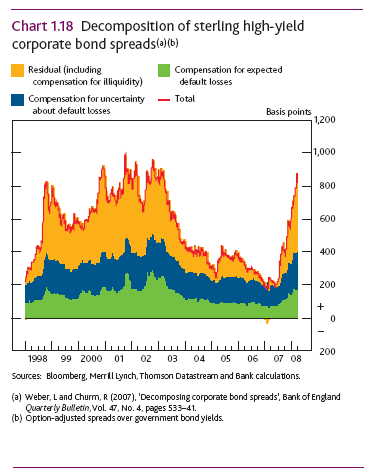
In this context, it’s worth noting that the Treasury 10-year to Baa spread, highlighted by James Hamilton a while ago, doesn’t appear to have moved much: the Fed is now showing Baa paper at 6.60%, which is actually less than each of the three most recent monthly observations. Granted, Treasury 10-years are down a lot but while spread-to-treasuries is important, spread-to-business risk is even more important. This looks like good insurance for the issuer.

Citigroup is closing a poorly performing hedge fund; it should be noted that while it underperformed its peers, it’s down only slightly on the year. It’s not all hedge funds that will blow up over the next few months … only some of them. Particularly those who are forced to sell their assets at whatever they will fetch in this environment.

The losers will be replaced:

The amount of debt in the Merrill Lynch distressed bond index tripled in July to $13.8 billion, and about doubled again in August to $24.8 billion. In addition to Residential Capital and WCI, the debt of New York-based amusement park operator Six Flags Inc., and pizza chain Uno Restaurant Corp. of West Roxbury, Massachusetts, is distressed based on their yields.

Investors specializing in distressed debt are gearing up for more opportunities. They raised $23 billion this year through Aug. 17, breaking 2006’s record of more than $16 billion, according to London-based Private Equity Intelligence Ltd.

There’s another good quote in that story too, that will help give some perspective on the Credit Rating Agency controversy:

Moody’s in January 2005 predicted the default rate would rise to 2.7 percent by the end of that year from 2.2 percent. Instead, it fell to 1.8 percent. Moody’s then forecast it would rise to 3.3 percent by the end of 2006. It fell again, to 1.7 percent, the lowest year-end level in a decade.

“The last couple of years we always used to say `Gee, isn’t it crazy, we’re seeing top of market behavior and this can’t be sustained,”’ Marshella said. “It did go on longer and we were wrong. You always thought there’d be an inflection point and, finally, an inflection point came,” he said, referring the increase in financing costs caused by the contamination of asset- backed securities by subprime mortgages.

US equities fell, as financials are now out of favour; Canadian stocks also fell on fears of a credit crunch. LIBOR just won’t go down!

Treasuries had a banner day; Canada didn’t do quite so well but there was a major steepening.

I wasn’t able to update the index values today, although I did update the index constituents. Tomorrow, I promise! 

Note: Somehow … don’t ask me how … I managed to screw up the input of the Volume and Price Change tables so completely that my software has given up. Sorry.

Update, 2007-09-07

Note that these indices are experimental; the absolute and relative daily values are expected to change in the final version. In this version, index values are based at 1,000.0 on 2006-6-30
Index Mean Current Yield (at bid) Mean YTW Mean Average Trading Value Mean Mod Dur (YTW) Issues Day’s Perf. Index Value
Ratchet 4.95% 4.90% 1,953,508 15.52 1 0.0000% 1,043.7
Fixed-Floater 4.87% 4.77% 111,825 15.83 8 +0.4181% 1,028.6
Floater 4.46% 3.19% 89,009 10.68 4 +0.2733% 1,041.4
Op. Retract 4.83% 3.79% 76,720 2.97 15 +0.1418% 1,026.6
Split-Share 5.12% 4.69% 102,728 3.90 13 +0.0614% 1,047.4
Interest Bearing 6.29% 6.84% 66,115 4.56 3 -0.8367% 1,031.1
Perpetual-Premium 5.47% 5.03% 92,494 6.21 24 +0.2696% 1,031.0
Perpetual-Discount 5.08% 5.11% 262,414 15.31 38 +0.1613% 979.0

Market Action

September 4, 2007

Well, I’ll tell everybody straight off: there ain’t no indices being published today. I don’t have time; I’ll have to update tomorrow.

Bush’s profferred help for hapless homeowners is attracting considerable comment. Willem Buiter takes the view that “A rate cut is unnecessary. Congress will swiftly augment the Bush bail-out, adding a fiscal stimulus worth, say, 0.5% of GDP. The anticipation of relief on both the fiscal and monetary side is likely to be enough to normalise credit conditions.” Most importantly:

By subsidising excessive and imprudent borrowing, it reinforces the moral hazard faced in the future by low and middle income Americans pondering the size of the mortgage they can enforce (if the market-friendly President Bush is willing to bail us out today, would a more market-sceptical President Barack Obama or President Hilary Clinton not do so again tomorrow?)

There is a reasonable prospect that Federal legislation and Federal regulation and supervision of the housing finance industry will be changed in such a way as to reduce the likelihood of the excesses, the mis-selling and the misrepresentations that became rampant especially during the past 5 years or so.

It is, unfortunately, quite likely, that the legislative and regulatory changes we will get will amount to a Sarbanes-Oxley-style regulatory overshoot, that is, regulation of the ‘if it moves, stop it’ variety. This will discourage future lending to low-income or credit-impaired would-be homeowners even when such lending is fundamentally sound.

Tom Graff also worries about the moral hazard issues.

Meanwhile, at the Jackson Hole conference, sub-prime and related issues continued to be front and centre. Professor Hamilton of Econbrowser argues, in effect, that moral hazard has already happened; that the Government Sponsored Enterprises (GSEs) in the States that guarantee mortgages are woefully undercapitalized and are viable only due to an implicit government guarantee.

While I think that preserving the solvency of the GSEs is a legitimate goal for policy, it is equally clear to me that the correct instrument with which to achieve this goal is not the manipulation of short-term interest rates, but instead stronger regulatory supervision of the type sought by OFHEO Director James Lockhart, specifically, controlling the rate of growth of the GSEs’ assets and liabilities, and making sure the net equity is sufficient to ensure that it’s the owners, and not the rest of us, who are absorbing any risks. So here’s my key recommendation– any insitution that is deemed to be “too big to fail” should be subject to capital controls that assure an adequate net equity cushion.

It also might be useful to revisit whether Fed regulations themselves may be contributing to this misinformation. Frame and Scott (2007) report that U.S. depository institutions face a 4% capital-to-assets requirement for mortgages held outright but only a 1.6% requirement for AA-rated mortgage-backed securities, which seems to me to reflect the (in my opinion mistaken) assumption that cross-sectional heterogeneity is currently the principal source of risk for mortgage repayment.

A tax on GSE mortgages has been proposed, but I’ll need a bit more convincing on that matter! I like the regulation of capital better – it fits into the existing regulatory framework in a better way, allowing for more efficient use of capital. 

Professor Taylor – of Taylor-rule fame – argues instead that the culprit is loose Fed policy in the 2003-05 period. He was supported by Martin Feldstein, who feels the Fed should act more proactively on asset bubbles – such as, it is now clear, US housing – on the grounds that the rewards for correctly identifying an asset bubble in real time outweigh the risks of being wrong. This has very immediate implications for the correct Fed response to a housing-led slowdown: should the Fed assume the worst, and avoid a recession at the risk of easing too much, or should it react to data from the real economy as it arrives? After all, there has been minimal indication of damage in the manufacturing sector, but there are some indications consumers are running scared.

It certainly sounds as if the conference was fraught with interest! The basic debate can be cast as:

“Rick is basically saying, ‘We can’t lean, but we can clean up,”’ White said, referring to Mishkin by name and raising his voice to make his point. “I think we can make equally strong arguments for `You can lean and you may not be able to clean up.”’

For now, count me among the ‘wait for data to come in’ and ‘regulate capital usage of the GSEs’ camps. For now.

There has been plenty of damage to economic sectors closer to the epicentre of the financequake. Novastar is cutting back sharply on new loans and is desperately trying to survive on its servicing income. This role may achieve higher prominence (and fees, undoubtedly) now that regulators are urging loan workouts. First Data, a junk credit, is going to have to pay through the nose for loans.

Brad Setser continues his attempt to understand China’s USD holdings … an interesting and potentially lucrative specialty! The Chinese have not yet weighed in regarding Credit Rating Agency regulation, but Josh Rosner has. This last one is interesting because it’s the first balanced (which is to say, non-hysterical) approach to the topic I’ve seen. Mr. Rosner wants the following reforms (bolded; my comments in italics):

  • ratings for structured securities use a different scale—say, numbers instead of letters—to differentiate them from ratings for corporate and municipal bonds. Cosmetic. Possibly useful if it can be shown that such securities have a genuinely different risk/reward profile than regular bonds, but it raises the spectre of different scales for each sector of the economy.
  • He believes the agencies need to step up the training for analysts Training is a motherhood issue. Every time there’s a train wreck, we hear more calls for increased training of engine drivers. I’m OK with requiring some kind of registration for credit analysts, but (having fulfilled my regulatory educational requirements) I’m extremely dubious about the potential for this having much value.
  • and should be compelled to re-rate transactions regularly rather than monitor them haphazardly. “Haphazardly” is rather a loaded word and I’d like to see more details about why it was chosen. This strikes me as micro-management.
  • Furthermore, he thinks efforts should be made to distance the agencies from Wall Street. He proposes that any ­ratings-agency employee involved with a structured-finance deal for a Wall Street firm should have to wait a year before being able to join that firm. Such a waiting period already exists for auditors. No, no, a thousand times no! In the first place, acting as a credit analyst is simply an advisory function; there is no legal force to the analysts’ work. I definitely support such rules for employees of regulators – they have all the power of the State behind them when they exercise their function – but to extend this to credit analysts is going too far. They are advisors, only advisors, and should not be subject to employment restrictions that are any more stringent than those that exist for other advisors.

Redemption demands have led one fund to close, but the managers are now trying to put together a vulture fund. An internal Deutsche Bank unit is being shut down. And so the wheel spins…

US equities had a great day on speculation the Fed will cut two notches to 4.75% at their next meeting; Canadas were also strong on hopes fears that hurricanes in the Gulf will be destructive.

It was a quiet day for Treasuries, with some steepening; Canadas followed.

I hope to update the indices, performance and volume tables tomorrow.

Update, 2007-09-07

Note that these indices are experimental; the absolute and relative daily values are expected to change in the final version. In this version, index values are based at 1,000.0 on 2006-6-30
Index Mean Current Yield (at bid) Mean YTW Mean Average Trading Value Mean Mod Dur (YTW) Issues Day’s Perf. Index Value
Ratchet 4.96% 4.91% 2,034,989 15.52 1 -0.0816% 1,043.7
Fixed-Floater 4.88% 4.79% 93,337 15.83 7 +0.0654% 1,024.3
Floater 4.93% 2.68% 74,544 7.99 4 +0.0560% 1,038.5
Op. Retract 4.84% 3.96% 77,682 2.97 15 +0.0471% 1,025.2
Split-Share 5.12% 4.63% 103,543 3.89 13 +0.2057% 1,046.7
Interest Bearing 6.24% 6.73% 66,580 4.59 3 -0.1022% 1,039.8
Perpetual-Premium 5.49% 5.13% 93,011 6.80 24 -0.1083% 1,028.3
Perpetual-Discount 5.08% 5.12% 265,023 15.30 38 +0.1694% 977.4
Market Action

August 31, 2007

A rousing day in the markets to cap a tumultuous month!

There will be some kind of assistance – not a bailout, honest – for delinquent mortgagees:

Under Bush’s plan, the FHA during the fiscal year beginning Oct. 1 would help in 80,000 more refinancings than under current programs, FHA Commissioner Brian Montgomery said in a conference call with reporters. The agency plans to help 240,000 homeowners refinance during the period, compared to about 100,000 during the fiscal year ending Sept. 30, he said. FHA intends to increase refinancings to more than 600,000 within the next three years.

In the first quarter of this year, the FHA serviced about 3 million mortgages, 12 percent of which were delinquent or in foreclosure. Nationwide, the Washington-based Mortgage Bankers Association reported about 44 million mortgages in existence with an overall delinquency rate of 4.8 percent.

I’ll admit, I’m not entirely sure how much difference this will make … but one can be sure that the Democrats will find some way of trumping it as the Primary and Presidential cycle continues.

At the conference at Jackson Hole, Bernanke made it clear that the Fed would give some kind of assistance – not a bail-out, honest – to the financial system:

“The Federal Reserve stands ready to take additional actions as needed to provide liquidity and promote the orderly functioning of markets,” Bernanke said. He also made clear he won’t rescue investors from bad decisions.

Bloomberg has published the full text of the speech, complete with references. The WSJ has published some reactions to the remarks. In the meantime, inflation news is also good which may provide a veneer of respectability to a rate cut at the next FOMC meeting.

James Hamilton at Econbrowser has reported on the conference but, in my mind, was trumped by one of the commenters, a reader with the sobriquet “Constantine”:

If memory serves, the 1st edition of Shiller’s Irrational Exuberance came out in March 2000. The 2nd edition with expanded coverage of the housing market followed in 2005.

As soon I get word of a 3rd edition going to press, I’m going to fuckin’ liquidate everything I own.

Thanks, Constantine! It’s been a long month – I needed that.

The WSJ is reporting on the conference and has provided more detailed reviews of today’s papers: Should the Fed Target Housing; The Tension between Traditional Economics and Bubbles; and After the Mortgage Revolution the Terror – the last of which highlighting the authors’ view that:

the revolution has still been positive: “mortgage markets that are linked to capital markets are better for consumers and investors, than mortgage systems where the price and allocation of mortgages is determined by the government.”

Thank heavens … it hasn’t been often lately that I’ve seen an endorsement of the free market. I was also heartened to see that The Economist and I are in agreement:

But what look like incredibly sophisticated strategies on the surface can still be very simple at heart. Investors have been doing what banks have done over the centuries, borrowing short and lending long. Or, to put it another way, they have borrowed in liquid form and invested the proceeds in illiquid assets.

They also provide a link to what looks – at a very quick glance – to be a fascinating paper:Market Liquidity and Funding Liquidity, which I may review here … sometime …

Creative destruction in the mortgage business is continuing:

Citigroup Inc., the largest U.S. bank, agreed to buy the wholesale mortgage origination and servicing businesses of ACC Capital Holdings, operator of Ameriquest Mortgage Company and once the nation’s biggest subprime home lender.

Truly, one of the greatest pleasures in life must be access to cash in a buyers’ market!

US equities rose to the point where they were actually up on the month – which I will admit I find shocking. I’m glad, sometimes, that I’m not an equity guy. Canadian equities also rose but are down on the month.

Treasuries finished August’s wild ride with an upwards shift of 4-5 bp, but the big story is the month’s massive steepening of about 18bp.  Will it continue or reverse? Place yer bets, gents, place yer bets … the wheel spins again starting Tuesday.

Mutual funds’ retail cash flows show a move into junk bonds and a slackening of the move out of investment-grade. together with the equity data, it would appear that greed is beginning to triumph over fear!

It was another light day for preferreds – there seems to be some interest in BAM.PR.N at the current price, since it has been in the volume leaders table very often lately.

Note that these indices are experimental; the absolute and relative daily values are expected to change in the final version. In this version, index values are based at 1,000.0 on 2006-6-30
Index Mean Current Yield (at bid) Mean YTW Mean Average Trading Value Mean Mod Dur (YTW) Issues Day’s Perf. Index Value
Ratchet 4.85% 4.88% 21,583 15.81 1 +0.0000% 1,044.5
Fixed-Floater 4.98% 4.79% 112,116 15.85 8 +0.0053% 1,023.6
Floater 4.93% -0.59% 74,442 7.94 4 +0.1397% 1,038.0
Op. Retract 4.84% 3.98% 79,816 3.04 15 -0.0608% 1,024.7
Split-Share 5.08% 4.78% 93,566 3.96 15 +0.0145% 1,044.6
Interest Bearing 6.23% 6.70% 67,665 4.60 3 +0.1041% 1,040.9
Perpetual-Premium 5.51% 5.09% 92,721 5.34 24 +0.1513% 1,029.4
Perpetual-Discount 5.10% 5.13% 263,527 15.28 39 +0.2453% 975.7
Major Price Changes
Issue Index Change Notes
GWO.PR.E SoftMaturity -1.0285% Now with a pre-tax bid-YTW of 4.60% based on a bid of 25.02 and a call 2011-4-30 at 25.00.
BMO.PR.J PerpetualDiscount +1.0245% Now with a pre-tax bid-YTW of 4.99% based on a bid of 22.68 and a limitMaturity.
RY.PR.A PerpetualDiscount +1.0634% Now with a pre-tax bid-YTW of 4.90% based on a bid of 22.81 and a limitMaturity.
CIU.PR.A PerpetualDiscount +1.1111% Now with a pre-tax bid-YTW of 5.08% based on a bid of 22.75 and a limitMaturity.
BMO.PR.H PerpetualPremium +1.3027% Now with a pre-tax bid-YTW of 4.16% based on a bid of 26.44 and a call 2013-3-27 at 25.00
BAM.PR.K Floater +1.4226%  
IAG.PR.A PerpetualDiscount +1.5521% Now with a pre-tax bid-YTW of 5.02% based on a bid of 22.90 and a limitMaturity.
GWO.PR.I PerpetualDiscount +1.8519% Now with a pre-tax bid-YTW of 4.99% based on a bid of 22.55 and a limitMaturity
Volume Highlights
Issue Index Volume Notes
BAM.PR.H OpRet 41,051 Now with a pre-tax bid-YTW of 3.69% based on a bid of 26.55 and a call 2008-10-30 at 25.75.
BMO.PR.J PerpetualDiscount 19,850 Now with a pre-tax bid-YTW of 4.99% based on a bid of 22.68 and a limitMaturity.
BAM.PR.N PerpetualDiscount 15,500 Now with a pre-tax bid-YTW of 5.97% based on a bid of 20.27 and a limitMaturity.
BNS.PR.M PerpetualDiscount 13,205 Now with a pre-tax bid-YTW of 4.91% based on a bid of 23.15 and a limitMaturity.
BAM.PR.B Floater 12,500  

There were two other $25-equivalent index-included issues trading over 10,000 shares today.

Market Action

August 30, 2007

A relatively quiet day!

The Fed’s discount window is less dusty nowadays, averaging $1.3-billion in loans – but $1.3-billion isn’t a lot in the great scheme of things.

“There are very few people in the money markets that I talk to who think it is providing any relief beyond psychological relief,” said Christopher Low, chief economist at FTN Financial in New York. “It is too expensive. If a bank has decent credit, they can get a much lower rate in the market” than the discount rate.

True enough … but I’d hate to see what the market would look like if it didn’t have some psychological relief!

In a somewhat-sort-of related post, Tom Graff looked at Fed Funds today, as did the WSJ.

A reporter joined in the ‘blame the rating agency’ chorus today:

Moody’s recently added some new phrases to its lexicon of code words. When the rating company refers to “updating its methodology” or “refining its risk assessments,” what it really means is that its historical models say absolutely nothing about how the future might turn out.

Last week, for example, Moody’s summarized “the most recent refinements” to how it treats bonds backed by so-called Alternative-A mortgages. “In aggregate, the change in our loss estimates is projected to range from an increase of approximately 10 percent for strong Alt-A pools to an increase of more than 100 percent for weak Alt-A pools,” Moody’s said.

So a mortgage-backed security with a rating based on, say, a 1.5 percent loss rate might now suffer 3 percent losses in its collateral, Moody’s said. How’s that for missing something the first time?

The reporter did not disclose his track record; nor did he provide an indication of what it is he thought that Moody’s missed. The story was about the Solent & Avendis meltdown – the structures have been forced to sell assets for anything they would fetch after failing to refinance their ABCP. Quite a few shops haven’t refinanced! Commercial Paper outstanding continued to decline and is now down $244-billion in three weeks:

The total fall in the commercial paper may end up at $300 billion, the amount of mortgages funded by asset-backed commercial paper, wrote Tony Crescenzi, chief bond market strategist for New York-based Miller Tabak & Co. LLC, in a note today.

Poor Bernanke! Despite plaudits from Barrington Research (and me, by the way), he’s going to get an earful at the Jacksons Hole conference this weekend: 

The “big debate” will be about how subprime mortgages were turned into gold-plated securities, especially the collateralized debt obligations that have caused the headaches, said Hale, president of Hale Advisors LLC in Chicago.

Headaches is definitely the word, as investors and principals of Basis Capital can tell you:

The Yield Alpha Fund has assets of $100 million. That’s down from $436 million at Jan. 31, according to Bloomberg data. 

Basis Capital asked a Cayman Islands court for permission to liquidate the fund, according to a petition filed in New York yesterday

There is a growing school of thought that feels the problem is asymmetric information but, frankly, I’m not sure if any regulatory regime that addressed that issue in particular will have the desired effect. In order for information to be useful, the purchasing portfolio manager must

  • be able to get the information
  • analyze the information
  • draw logical conclusions from the information

I’m not convinced that a regulatory solution to step one will necessarily lead to steps two and three. And I suspect that it’s impossible to enforce due diligence in a broad and consistent manner. “Due Diligence” means “Having a bunch of binders in your office somewhere”.

The investment business is more about sales than performance and diligence. And to the extent that performance does matter:

Pushed by fierce competition to make it to the “funds-of-the week” top-ten list of pseudo-specialised financial reviews, with the comfortable belief that one will be handsomely compensated in the case of success and allured by the possibility of diversifying much of the risk away, many funds’ managers have probably taken up an increasingly inefficient amount of risk. A correct assessment of risk should instead consist in compensating funds managers just slightly less if the fund is listed, e.g., eleventh in the ranking (if only such an ideal ranking existed!)3. To be sure, this potential source of inefficiency does not lie in the funding of subprime loans per se, but in the excess funding of risky projects due to a perverse/distorted assessment of risk.

And it’s not just sub-prime:

Freddie Mac, the second-biggest U.S. mortgage finance company, reported quarterly profit fell 45 percent after setting aside $320 million for losses as the housing slump deepened.

as a lot of mortgage defaults are investments. However, there’s still plenty of money for good credits:

Rio Tinto Group, the world’s third- largest mining company, raised $40 billion in loans for the purchase of aluminum producer Alcan Inc., a record for a U.K. borrower.

…even for American companies:

General Electric Capital Corp., the financing arm of the world’s second-biggest company by market value, sold $3.2 billion of hybrid bonds in pounds and euros.

US Equities were off a bit, led by financials:

Lehman reduced its earnings estimates for investment banks two days after Merrill Lynch analysts slashed their projections. Financial shares in the S&P 500, which comprise about one-fifth of the index’s value, are headed for their worst quarter in five years amid concern that higher borrowing costs spurred by mortgage defaults by the riskiest borrowers will erode earnings.

It’s not just cost of funds that will have the investment banks worried – it’s possible wind-up or delevering of their best customers that is causing concern:

“The recent expansion of hedge-fund positions and trading activity has been so rapid and consistent that it is now no exaggeration to say that hedge funds are no longer just an important part of the market in some fixed-income products; they are the market,” according to the report, which covered the 12 months ended in April.

Hedge funds accounted for more than 80 percent of trading in the debt of financially distressed companies and high-yield derivatives such as credit-default swaps, the Greenwich, Connecticut-based consulting and research firm said. The loosely regulated investment pools generated almost half of U.S. trading volume in structured credit.

Canadian equities fell too, on growth concerns. Silly traders! John Tory’s election platform calls for continued normal growth and we all know what superstars of fiscal acumen the Ontario PCs are!

With all these scares US T-Bills continued their amazing journey and yield less than 4% again. Treasuries had another good day, with a parallel shift 5bp downwards. Canadas underperformed quietly.

Note that these indices are experimental; the absolute and relative daily values are expected to change in the final version. In this version, index values are based at 1,000.0 on 2006-6-30
Index Mean Current Yield (at bid) Mean YTW Mean Average Trading Value Mean Mod Dur (YTW) Issues Day’s Perf. Index Value
Ratchet 4.84% 4.86% 22,463 15.84 1 +0.0000% 1,044.5
Fixed-Floater 4.98% 4.79% 113,193 15.85 8 -0.2042% 1,023.6
Floater 4.94% -0.41% 74,295 7.92 4 -0.0606% 1,036.5
Op. Retract 4.84% 3.96% 79,729 2.99 15 -0.0169% 1,025.3
Split-Share 5.08% 4.78% 94,039 3.97 15 +0.0121% 1,044.4
Interest Bearing 6.24% 6.67% 67,487 4.60 3 -0.4001% 1,039.8
Perpetual-Premium 5.52% 5.09% 93,596 5.74 24 +0.1183% 1,027.8
Perpetual-Discount 5.11% 5.14% 266,383 15.26 39 -0.0337% 973.3
Major Price Changes
Issue Index Change Notes
BSD.PR.A InterestBearing -1.6895% Asset coverage of just under 1.8:1 as of August 24, according to Brookfield Funds. Now with a pre-tax bid-YTW of 7.21% based on a bid of 9.31 and a hardMaturity 2015-3-31 at 10.00.
IAG.PR.A PerpetualDiscount -1.3129% Now with a pre-tax bid-YTW of 5.09% based on a bid of 22.55 and a limitMaturity.
RY.PR.F PerpetualDiscount -1.1062% Now with a pre-tax bid-YTW of 5.01% based on a bid of 22.35 and a limitMaturity.
FBS.PR.B SplitShare +1.1863% Asset coverage of just over 1.9:1 according to TD Sponsored Companies. Now with a pre-tax bid-YTW of 3.89% based on a bid of 10.01 and a call 2008-1-14 at 10.00.
Volume Highlights
Issue Index Volume Notes
GWO.PR.H PerpetualDiscount 53,300 Desjardins crossed 50,000 at 23.63. Now with a pre-tax bid-YTW of 5.13% based on a bid of 23.60 and a limitMaturity.
ALB.PR.A SplitShare 15,439 Scotia crossed 14,900 at 25.00. Asset coverage of just over 2.0:1 as of August 23, according to Scotia Managed Companies. Now with a pre-tax bid-YTW of 4.37% based on a bid of 24.92 and a hardMaturity 2011-2-28 at 25.00.
RY.PR.G PerpetualDiscount 15,400 Now with a pre-tax bid-YTW of 5.04% based on a bid of 22.45 and a limitMaturity.
BAM.PR.N PerpetualDiscount 13,065 Now with a pre-tax bid-YTW of 6.00% based on a bid of 20.16 and a limitMaturity.
CM.PR.E PerpetualPremium 12,700 Now with a pre-tax bid-YTW of 4.73% based on a bid of 26.16 and a call 2012-11-30 at 25.00.

There were eight other $25-equivalent index-included issues trading over 10,000 shares today.

Market Action

August 29, 2007

OK, everybody! The end of the world, previously scheduled for Friday, has been cancelled. You are encouraged to make plans for the long weekend.

Loyal readers will know that I’ve become sufficiently irritated by calls for increased regulation to write a post on the topic (well, it’s really just a commentary on another essay) and even to initiate a category for what promises to be a series of posts. I don’t think the issue is going to go away any time soon … the New York Times has published an article with many interesting statements:

“In a globalized economy with hedge funds, leveraged buyouts and all these investment funds, we have to ask the question about more transparency,” said Claude Bébéar, the chairman of the supervisory board of the insurance company AXA

I have some free advice for M. Bébéar: ask these questions before investing.

Washington and London rebuffed the German government earlier when it pushed for an international code of conduct for hedge funds. Now some economic advisers to the German government are going further, suggesting that rating agencies should be nationalized, that large-scale loans be registered publicly and that minimum standards be developed for complex debt securities.

Super. “We’re from the German Government and we’re here to help you”. Can’t wait for that. Trouble is, the US national debt, fiscal deficit and trade deficit are all in such lousy shape that the US is not in a strong position to tell its creditors where to stuff their nationalized credit rating agencies. We shall see!

Christian de Boissieu, president of the group and a member of the Committee for Credit and Investment Institutions, which helps regulate French banks, is calling for a global register of hedge funds. In addition, he said, complex securities should be scrutinized before being sold to bank portfolios.

Is M. de Boissieu claiming that complex securities were not scrutinized before being bought by bank portfolios? Quick, tell me which banks! I want to buy a lot of puts on such poorly run stocks … except … um … French banks are halfway nationalized already aren’t they? And thoroughly scrutinized by … um … M. de Boissieu?

“It’s not just the U.S. regulators that failed, though they did fail,” Mr. Rosner said. International regulators have “thrown the keys to the rating agencies,” which have been left in charge of the safety and soundness of bank capital, insurance and pension money.

The article did not specify where the regulators are alleged to have failed. Pension money? Sorry, Mr. Rosner. Responsibility for pension money rests with the pension fund board. If they’ve been sleeping there are lots and lots of regulations on the books about that already.

Oooh, all this jockeying for regulatory power and salaries makes me angry! I do want to stress again, however, that my defense of the ratings agencies does not have an origin in any thought that they’re perfect. They’re not: Credit Anticipation is a perfectly good fixed income management strategy, one that Deutsche Bank has done very well with recently, although maybe that’s just because they’re German and have good connections with the German Government Credit Ratings Analysis Department.

However … in the first place, they offer investment advice. See that word? I’ll bold it. advice. If you don’t trust their advice, don’t take it. If you think their advice is sort-of usually OK but not perfect, then listen to it while checking it and staying diversified. If you believe so completely in their advice that you’re willing to lever up 15:1 (with all your money, not just a small chunk of it as your ‘hedge fund flutter’), on the basis that not only is it perfect but that everybody else will also always believe it’s perfect … then go home and play with your dollies.

In the second place, they major agencies have extremely good track records. Better than virtually all of their critics are willing to disclose, anyway.

And in the third place, I have yet to see any actual evidence that they’ve made any mistakes other than, possibly, the defaults on some ABCP issues. This is a black eye, definitely, but are due to market convulsions rather than actual deterioration of the underlying; market convulsions are very hard to predict. Shall we fault them, for instance, for the fact that 100-year floaters (e.g. Royal Bank) are now almost impossible to sell at a decent price [CUSIP# 780087AK8. Indicated at $94.50]? If recovery is (eventually) 100% it’s not the worst catastrophe finance has ever seen.

So there.

Return to my usual boring drone about economics, there is renewed discussion of the efficiacy of the yield curve in predicting recessions. Some of the data looks a little dated already:

The spread has turned negative with the 10-year rate at 4.79 percent and the 3-month rate at 4.83 percent (both for the week ending August 10).

With luck, however, the German government will soon regulate yield curve slopes and then we’ll never have a recession again. Econbrowser notes that the Fed Funds market is starting to look almost normal again. Tomorrow the US Treasury will release statistics on Commercial Paper Outstandings, which should be quite interesting. RAMS is liquidating as well as Cheyne, to name but two.

The US mortgage market is tightening, with banks both having less money to lend AND not being able to securitize as efficiently as they used to. The mortgage curve is now inverted, which seems very strange. All the short money has been sucked up by distressed ABCP issuers. Bernanke has opined that US Agencies should stick to securitization and not increase their leverage for the time being, which probably disappoints many.

US Equities roared back from the horror of yesterday and were accompanied by their Canadian cousins. Three-Month US T-Bills continued their wild ride (this is really strange, by the way) even as Treasury notes got whacked. Canadas were hurt as well, in what may be dubbed a Flight to Equity.

There has as yet been no comment from the German Government concerning the correct level of bond yields.

It took nine straight days of gains, but the PerpetualDiscount index is now up on the month, albeit marginally. Only floaters and splitShares are still under water.


Note that these indices are experimental; the absolute and relative daily values are expected to change in the final version. In this version, index values are based at 1,000.0 on 2006-6-30
Index Mean Current Yield (at bid) Mean YTW Mean Average Trading Value Mean Mod Dur (YTW) Issues Day’s Perf. Index Value
Ratchet 4.83% 4.85% 22,739 15.86 1 +0.0358% 1,044.5
Fixed-Floater 4.97% 4.79% 113,942 15.87 8 +0.2634% 1,025.7
Floater 4.93% -0.41% 74,627 7.93 4 -0.0913% 1,037.1
Op. Retract 4.84% 4.00% 81,200 3.05 15 +0.2936% 1,025.5
Split-Share 5.07% 4.87% 94,994 3.85 15 +0.1115% 1,044.3
Interest Bearing 6.21% 6.59% 67,257 4.61 3 +0.6483% 1,044.0
Perpetual-Premium 5.52% 5.10% 93,750 5.67 24 +0.1590% 1,026.6
Perpetual-Discount 5.11% 5.14% 268,800 15.27 39 +0.2064% 973.7
Major Price Changes
Issue Index Change Notes
BNA.PR.A SplitShare -1.4961% These BNA issues all have massive asset coverage; the constraint on their rating is simply that their sole holding is BAM.A, and therefore their credit ceiling is equal to the BAM preferreds. Now with a pre-tax bid-YTW of 6.21% based on a bid of 25.02 and a hardMaturity 2010-9-30 at 25.00.
CL.PR.B PerpetualPremium +1.1594% Now with a pre-tax bid-YTW of 4.07% based on a bid of 25.84 and a call 2008-1-30 at 25.75.
FTU.PR.A SplitShare +1.2228% Asset coverage of just over 2.0:1 as of August 15 according to Quadravest. Now with a pre-tax bid-YTW of 4.83% based on a bid of 10.20 and a hardMaturity 2012-12-1 at 10.00.
RY.PR.F PerpetualDiscount +1.2545% Now with a pre-tax bid-YTW of 4.95% based on a bid of 22.60 and a limitMaturity.
IAG.PR.A PerpetualDiscount +1.2582% Now with a pre-tax bid-YTW of 5.03% based on a bid of 22.85 and a limitMaturity.
RY.PR.E PerpetualDiscount +1.2826% Now with a pre-tax bid-YTW of 4.94% based on a bid of 22.90 and a limitMaturity.
BSD.PR.A InterestBearing +1.7989% Asset coverage of just under 1.8:1 as of August 24, according to Brookfield Funds. Now with a pre-tax bid-YTW of 6.92% (mainly as interest) based on a bid of 9.47 and a hardMaturity 2015-3-31 at 10.00
IGM.PR.A OpRet +2.5221% Now with a pre-tax bid-YTW of 3.52% based on a bid of 26.85 and a call 2009-7-30 at 26.00. Even with an equivalency factor of 1.4, why wouldn’t you just buy a bond?
Volume Highlights
Issue Index Volume Notes
TOC.PR.B Floater 88,100 Desjardins crossed 73,600 at 25.24.
BCE.PR.A FixFloat 61,100 RBC crossed 50,000 at 24.50.
PWF.PR.F PerpetualDiscount 45,775 National Bank crossed 30,800 at 24.74. Now with a pre-tax bid-YTW of 5.35% based on a bid of 24.75 and a limitMaturity.
PWF.PR.K PerpetualDiscount 39,738 Nesbitt crossed 35,500 at 24.00. Now with a pre-tax bid-YTW of 5.19% based on a bid of 24.06 and a limitMaturity.
TD.PR.O PerpetualDiscount 33,900 Scotia crossed 30,000 at 24.70. Now with a pre-tax bid-YTW of 4.97% based on a bid of 24.61 and a limitMaturity.

There were eleven other $25-equivalent index-included issues trading over 10,000 shares today.

Market Action

August 28, 2007

Whoosh!

Just when you thought you were safe …

I was most impressed today by the DG.UN suspension of redemptions, a made-in-Canada $1.4-billion whoopsee, when in comes news of S&P’s downgrade of Cheyne, a $6-billion oopsy-daisy. According to S&P’s actual release (emphasis added):

Cheyne Finance is a SIV structure managed by Cheyne Capital Management Ltd. who has responsibility for purchasing assets, managing the portfolio, and overseeing the issuance of CP and medium-term notes.
 
Current pressure on market prices and the associated recent deterioration in the net asset value (NAV) of this vehicle have reached a level where the ratings have come under pressure.

The portfolio is predominantly invested in real estate securitizations, and we note that the portfolio has not suffered any downgrades to these underlying assets.
 
We have been notified today that the vehicle breached its major capital loss
test and so an enforcement event has occurred. In accordance with the program documents, the portfolio manager upon consultation with the security trustee may begin an orderly liquidation of assets and by Aug. 30 it will estimate the expected proceeds from future liquidations.

Both the “Issuer Credit Rating” and the rating on the Senior Notes has been downgraded from AAA to A-[Watch Negative]. Those of you who are in furious disagreement with my defense of the ratings agencies and eager to see me with egg all over my face (which I know is practically all of you, you’re not fooling anybody) will be most pleased!

What makes this event notable is the bolded disclosure above that this event results from a decline in market prices of the underlying security, not simply an inability to roll the paper at sensible prices. I eagerly await more information regarding Euromoney’s Best CDO Manager of 2006.

The good part about these events with Cheyne is that some actual liquidation of the underlying portfolio will take place. This will lead to at least some delevering of the financial system – this calling on bank lines stuff merely transfers debt. Some equity guys will be wiped out, but that’s what equity guys are for.

There’s more ghoulish news about liquidity exposures, this time from the Times:

State Street, the American bank, has been identified as having $22 billion (£10.9 billion) of exposure to asset-backed commercial paper conduits, the off-balance sheet vehicles that have caused severe problems for rivals in recent weeks amid turmoil in credit markets.

According to regulatory filings, the Boston-based bank has credit lines to at least six conduits, which account for 17 per cent of its total assets. That proportion makes State Street the most highly exposed bank to conduits among its European and American peers.

17% of assets is a very lot. On a positive note, their most recent 10-Q filing discloses that the bank had a Tier 1 Capital ratio of 12%, which is quite good, equal to TD Bank’s ratio as of last year-end, which was the best of the big 5. Even if we divide their 12% by 1.17 to get a ballpark idea of capital adequacy in the event all their lines get called on, we’re still in excess of 10%, which is still quite reasonable. But holy smokes, that’s a lot of lines!

Meanwhile, credit card delinquencies are rising while housing prices are falling, not a great combination.

The Fed’s trying to help! More banks got an exemption allowing them to lend discount money to their broker subsidiaries and I think we can count on this sort of thing being earnestly debated at this weekend’s Jackson Hole conference.

However, I can now provide links to another panic: the Panic of ’07 (not this ’07, the last one), brought to my attention by the WSJ Economics blog, which has some interesting-sounding links to papers I haven’t yet read. If I do read them and they’re good, I’ll post again. Panics, panics panics! Collect them all at PrefBlog!

In other news, some brave Australians are putting together a $1.9-billion LBO, Brad Setser discusses a claim that sub-prime was dumped on the Chinese, jumbo mortgages have become much less available, which is hitting Californial real-estate where the average house needs a jumbo loan and European politicians are planning to do some credit-crunch grandstanding.

Given the gloomy tone of today’s post, nobody will be surprised that US Equities got hammered, mainly financials. Canadian equities got pasted as well, but here it was mainly commodity-related stocks. Treasuries steepened on a banner day with more of the same for Canadas.

Preferreds had quite a good day, ignoring the stock market and the credit concerns. But it’s always the way! No sooner do I point out what a lousy month the splitShares are having than they have a great day and make up half the difference between their returns and OpRet’s. It’s nice to see, but maybe I should just keep my mouth shut from now on.

BAM.PR.N had very high volume today, courtesy of two large blocks crossed by Scotia. I have no idea whether that’s cleaned out their inventory or not, but it’s about time we saw some big-time crosses! Volume in general picked up, which is good to see … equity refugees?

BMO.PR.G has been removed from the OpRet index because it no longer exists. It’s the end of an era … the world was different at the time of its first month-end in the index, February, 1998.

Note that these indices are experimental; the absolute and relative daily values are expected to change in the final version. In this version, index values are based at 1,000.0 on 2006-6-30
Index Mean Current Yield (at bid) Mean YTW Mean Average Trading Value Mean Mod Dur (YTW) Issues Day’s Perf. Index Value
Ratchet 4.80% 4.84% 22,933 15.82 1 +0.0410% 1,044.1
Fixed-Floater 4.98% 4.81% 112,352 15.85 8 +0.2382% 1,023.0
Floater 4.93% -0.46% 75,222 7.95 4 +0.0918% 1,038.1
Op. Retract 4.84% 4.12% 81,061 3.53 15 -0.0446% 1,022.5
Split-Share 5.07% 4.87% 96,148 3.85 15 +0.5090% 1,043.2
Interest Bearing 6.22% 6.72% 67,002 4.58 3 -0.2351% 1,037.3
Perpetual-Premium 5.53% 5.19% 93,897 6.20 24 +0.1018% 1,025.0
Perpetual-Discount 5.11% 5.15% 271,118 15.24 39 +0.1515% 971.6
Major Price Changes
Issue Index Change Notes
IGM.PR.A OpRet -1.0440% Now with a pre-tax bid-YTW of 4.75% based on a bid of 26.54 and a softMaturity 2013-6-29 at 25.00.
FIG.PR.A InterestBearing -1.0050% There go most of yesterday’s gains! Asset coverage of just over 2.3:1 as of August 27 according to Faircourt. Now with a pre-tax bid-YTW of 6.73% (almost all as interest) based on a bid of 9.85 and a hardMaturity 2014-12-31 at 10.00.
PWF.PR.K PerpetualDiscount +1.1859% Now with a pre-tax bid-YTW of 5.23% based on a bid of 23.89 and a limitMaturity.
LFE.PR.A SplitShare +2.3346% Makes up for yesterday’s loss and then some! Asset coverage of just over 2.6:1 as of August 15 according to the company. Now with a pre-tax bid-YTW of 4.23% based on a bid of 10.52 and a hardMaturity 2012-12-1 at 10.00.
Volume Highlights
Issue Index Volume Notes
BAM.PR.N PerpetualDiscount 257,600 Scotia crossed 150,000 at 20.00, then another 100,000 at the same price. Now with a pre-tax bid-YTW of 6.05% based on a bid of 20.00 and a limitMaturity. There was a good bid at the close, too, closing at 20.00-13, 33×10; the almost-identical, very very slightly inferior BAM.PR.M closed at 20.23-35, 2×11.
TD.PR.O PerpetualDiscount 114,700 Nesbitt was working the ‘phones today, obviously, crossing 30,000, then 50,000, then 30,000, all at 24.61. Now with a pre-tax bid-YTW of 4.97% based on a bid of 24.61 and a limitMaturity.
GWO.PR.E OpRet 45,151 Now with a pre-tax bid-YTW of 4.07% based on a bid of 25.75 and a call 2011-4-30 at 25.00.
BCE.PR.C FixFloat 40,125  
ALB.PR.A SplitShare 30,937 Now with a pre-tax bid-YTW of 4.38% based on a bid of 24.90 and a hardMaturity 2011-2-28 at 25.00.

There were fifteen other $25-equivalent index-included issues trading over 10,000 shares today.

Market Action

August 27, 2007

Another reasonably normal day, bearing in mind that we’re talking about financial markets here and the word “normal” needs to be taken with a grain of salt.

Of great interest to me (I dare not say, “Of prime interest”, for fear of being misunderstood) was the Bank of Canada’s cash management bill, $2.5-billion of one-month bills to be auctioned tomorrow morning. They had to do something! The spread between 1-month bills and one-month CP as of the 24th had widened to 137bp (out 40bp just on the week) which I find just incredible … I mentioned on the 21st that I thought a 60bp three-month Bill/BA spread was amazing.”Cash Management Bill” is simply what they’re calling it – I’m not even sure if they can call it anything else, given that it’s not part of the regular auction routine.

I suspect that all the actual cash will be pushed right back into the money supply as loans against ABCP (maybe indirectly, e.g., National finances all the ABCP it suddenly owns by repo-ing more of its Canada holdings) … but I’m sure only a few people know that for sure at this point.

Bank of Canada deputy governor Pierre Duguay stated:

“Specifically, we are asking ourselves two questions: First, how much greater is the risk to the Canadian economy now posed by developments in the U.S. economy? And second, to what extent would the re-pricing of credit risk lead to a sustained tightening of credit conditions in Canada?”

In other words, they may have to ease considerably just to keep the commercial paper market (and the rest of the corporate curve) where they want it to be. We’ll see! The money-market quality spread has, maybe, stabilized in the US.

Speaking of the US, Brad Setser continues his probing of the current account deficit, Menzie Chinn highlights risks to the US deficit projections and Stephen Cecchetti reviews the Fed reaction to the crisis. He also includes the sentence

The sub-prime crisis made it clear that the rating agencies were doing a poor job of evaluating risks in securities that were backed by sub-prime mortgages.

but does not substantiate the charge that they’re doing a poor job. But that’s another post … and doubtless many more, as actual data start to come in to replace all this guessing.

I hope nobody thinks I’m totally indifferent to the situation, or that I’m carrying a torch for the ratings agencies. It’s just that … I’m not the oldest guy in the business, not by a long shot, but I’ve been around the block. If I had a nickel for every time I’ve been told the world’s about to end (and a dime for each time it was the result of a conspiracy or massive negligence by big institutions) … I’d be too busy with my troupe of dancing girls to bother writing this blog.

A lot of hedgies are going to get wiped out and the sooner the better; a few pension funds are going to play blame the manager; credit squeezes and the sudden conversion of Money Market instruments to term debt a la Coventree may give a recessionary cast to the economy; the US may well enter a recession, since a lot of their deficit-fuelled growth in the past few years has been housing-related and there ain’t gonna be much more of that; a few real companies will probably get weak enough that they get taken over at prices that don’t make long-term shareholders very happy (like just happened to Sachsen, mentioned here on August 20); and we might even see a spectacular flame-out if a big institution’s risk-controls are found wanting  … but I’m not so sure that the solidly investment-grade tranches of sub-prime debt are as bad as they’re made out to be.

What I am sure of, is that if I was a hedgie myself, I’d be bidding … low. And telling the newspapers how awful everything is.

US Equities fell a bit, as did those in Canada. There is concern that the de facto easing will be bad for Treasuries; the Fed Fund Futures are pricing in an immediate ease to 5.00% (the current de facto rate) and another ease to the 4.75% area – and beyond – by November. Canadas had a good day, with a basically parallel shift.

Another quiet, directionless day in pref land. Split shares are getting hit this month … people appear to want direct investments in companies with recognizable names!

Note that these indices are experimental; the absolute and relative daily values are expected to change in the final version. In this version, index values are based at 1,000.0 on 2006-6-30
Index Mean Current Yield (at bid) Mean YTW Mean Average Trading Value Mean Mod Dur (YTW) Issues Day’s Perf. Index Value
Ratchet 4.79% 4.83% 23,170 15.84 1 +0.3289% 1,043.7
Fixed-Floater 4.99% 4.82% 111,071 15.82 8 +0.0003% 1,020.5
Floater 4.93% -0.35% 73,700 7.94 4 +0.0312% 1,037.1
Op. Retract 4.84% 4.13% 79,637 3.16 16 +0.0848% 1,023.0
Split-Share 5.10% 4.93% 95,761 3.96 15 -0.2316% 1,037.9
Interest Bearing 6.21% 6.68% 66,919 4.59 3 +0.3803% 1,039.7
Perpetual-Premium 5.53% 5.20% 94,143 5.78 24 +0.0443% 1,024.0
Perpetual-Discount 5.12% 5.16% 272,353 15.23 39 +0.0423% 970.2
Major Price Changes
Issue Index Change Notes
LBS.PR.A SplitShare -1.9139% Asset coverage of just under 2.5:1 as of August 23 according to Brompton Group. Now with a pre-tax bid-YTW of 4.92% based on a bid of 10.25 and a hardMaturity 2013-11-29 at 10.00.
LFE.PR.A SplitShare -1.4382% Asset coverage of just over 2.6:1 as of August 15 according to the company. Now with a pre-tax bid-YTW of 4.74% based on a bid of 10.28 and a hardMaturity 2012-12-1 at 10.00.
FIG.PR.A SplitShare +1.3238% Asset coverage of over 2.3:1 as of August 24 according to Faircourt. Now with a pre-tax bid-YTW of 6.55% (almost all as interest) based on a bid of 9.95 and a hardMaturity 2014-12-31 at 10.00.
Volume Highlights
Issue Index Volume Notes
GWO.PR.I PerpetualDiscount 20,663 RBC crossed 10,000 at 22.21. Now with a pre-tax bid-YTW of 5.14% based on a bid of 22.25 and a limitMaturity.
SLF.PR.D PerpetualDiscount 19,934 Nesbitt bought a total of 16,300 from “Anonymous” (various Anonymouses? Anonymice?) in five tranches from 22.18 to 22.25. Now with a pre-tax bid-YTW of 5.01% based on a bid of 22.20 and a limitMaturity.
BNS.PR.M PerpetualDiscount 17,925 Now with a pre-tax bid-YTW of 4.94% based on a bid of 23.01 and a limitMaturity.
RY.PR.C PerpetualDiscount 17,600 National Bank crossed 11,900 at 23.05. Now with a pre-tax bid-YTW of 5.01% based on a bid of 23.05 and a limitMaturity.
MFC.PR.C PerpetualDiscount 17,300 Now with a pre-tax bid-YTW of 4.89% based on a bid of 23.00 and a limitMaturity.

There were seven other $25-equivalent index-included issues trading over 10,000 shares today.