I was quoted in a recent Investment Executive article with the captioned title.
Category: Miscellaneous News
John Nagel Likes Brookfield Floaters
Fabrice Taylor had a column in the Globe yesterday, Preferred offer value, but watch your step. I confess to being a little perplexed by his remarks on discounts to call:
And you have to understand the math. Take a $20 par value preferred that can be called from you (i.e., the company can buy back from you) in two years. If it pays a fixed dividend of $1 per year but can be had for $16, you’re not getting 5 or 6 per cent, you’re getting almost 18 per cent annually. That’s the real beauty of buying these things below par.
Call options are bad. They are always bad. They always limit your winnings in the event of yield declines, while doing nothing to protect you in the event of yield increases. Unfortunately, they cannot be avoided – so the question on an investor’s mind should always be “How bad is this particular call option schedule and how much extra yield do I want in this particular case as compensation?”.
Mr. Taylor also quotes John Nagel, who has been mentioned on PrefBlog previously, touting BCE Prefs:
When we spoke, [Desjardins’ preferred share trader] Mr. Nagle [sic] was partial to a Brookfield Asset Management floating rate preferred issue that, while enjoying the same rating as a Thomson Reuters issue, is quoted at half the price. He’s waiting for Brookfield’s earnings next week to see if that discount is warranted, but otherwise finds the discount highly attractive, and there are other opportunities for those who can roll up their sleeves and do some hard-nosed work.
Mr. Nagel’s track record was not disclosed. Brookfield’s quarterly earnings will be released on November 7, but I can’t help but think that waiting to see them is a bit of an affectation. Brookfield is an investment grade company. Black swan events excepted – always excepted! – one quarter’s earnings are not going to make a huge amount of difference to its credit risk, whatever it might do to the stock. If it were otherwise, the company would not be investment grade: virtually the whole meaning of “investment grade” is that a bad quarter or two – even the occasional horrible quarter – will not dislodge the company’s status.
There have been no rumours of a Black Swan event at Brookfield and,while the common (which takes the first loss) has done just as badly as everything else lately, it hasn’t been taken out to the woodshed for particular punishment. While I will be just as interested in Brookfield’s earnings as anybody else, I’m not about to recommend freezing trading in its issues until they have been released.
The BAM issues are discussed often on PrefBlog – f’rinstance, with respect to the BAM / BPO Floater Credit Inversion and the recent DBRS affirmation of BAM’s credit quality.
I’ve uploaded some charts [click for big] … for instance BAM.A (common) versus BAM.PR.K (floater):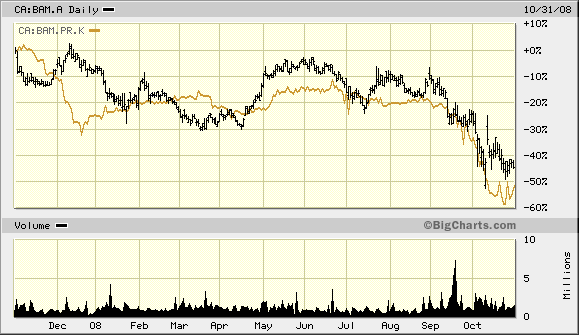
and TRI (common) vs. TRI.PR.B (floater): 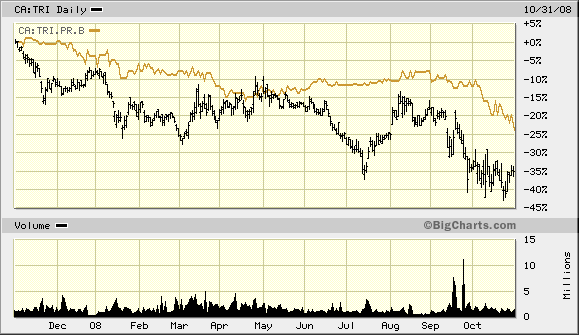
and, just for fun, RY (common) vs. RY.PR.F (PerpetualDiscount) 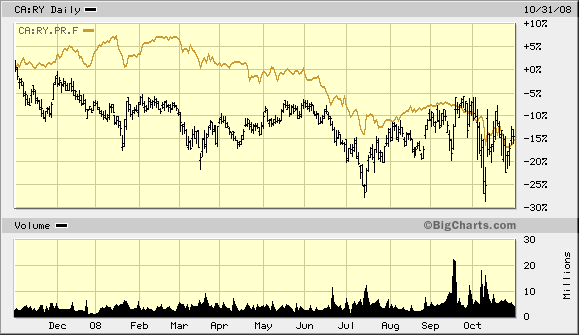
and BMO (common) vs. BMO.PR.J (PerpetualDiscount): 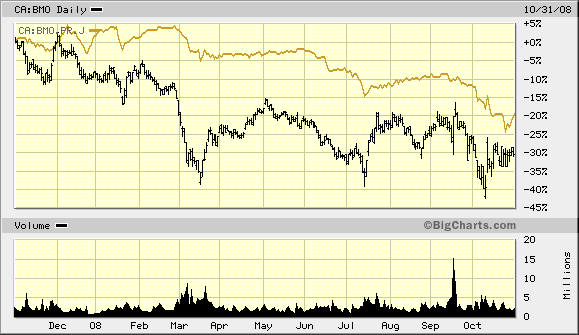
Update, 2008-11-14: I missed this at the time, but Brookfield issued (small) US debt 2008-10-24:
TORONTO, October 24, 2008 – Brookfield Asset Management Inc. (“Brookfield”) (NYSE/TSX: BAM) announced today that it has issued US$150 million of unsecured term debt comprising US$75 million of 5-year 6.65% notes and US$75 million of 4-year 6.4% notes.
Small issues, but in this environment those are pretty good terms.
Accounting Standards & Intellectual Bankruptcy
The Accounting Standards Board has announced:
amendments to Sections 3855, Financial Instruments — Recognition and Measurement, and 3862, Financial Instruments — Disclosures. The amendments permit reclassification of financial assets in specified circumstances. They are being made to ensure consistency of Canadian standards with International Financial Reporting Standards (IFRS) and US standards. They are effective for reclassifications made on or after July 1, 2008, but only for periods for which annual or interim financial statements have not been issued previously.
“The amendments allow entities to move financial assets out of categories that require fair value changes to be recognized immediately in net income,” said Paul Cherry, Chair, AcSB. “However, it must be stressed that assets will remain subject to impairment testing and the amendments involve extensive disclosure requirements. Transparency will remain for investors.”
Predictably, this is being treated as big news by the Financial Post:
Canada’s top financial institutions will get relief from the corrosive effects of the toxic assets sitting on their books today thanks to a controversial decision that turns back the clock on modern accounting methods, according to people familiar with the process.
…
The timing of the announcement will be welcomed by the Conservatives and puts Ottawa onside with Paris on a divisive issue that has split Europe because of fears that loosening of so-called mark-to-market rules will mask losses and encourage riskier behaviour.
…
The decision will be welcomed on Bay Street and give insurers such as Manulife Financial Corp. extra breathing room when they report on their performance next month after seeing their share prices punished.The new ruling will also provide some relief to Canada’s banks as they prepare end-of-year results expected to show a broad decline in profitability.
Chief executives on Bay Street have said they were counting on the measures to help them deal with problematic portfolios of mostly foreign loans.
…
Associations representing accountants and financial analysts have objected to the rule changes, charging that they mask the problem of toxic assets on the books of financial services companies.
The Globe and Mail story is similar but not as detailed.
Why is this important? There’s one small reason why it matter, but to your basic investor it doesn’t mean a thing.
I’ve got some news for the “associations representing accountants and financial analysts” mentioned in the report … nothing is being masked. The assets will still be on the books and will be worth whatever it is they’re worth, regardless of which of the “historical cost”, “mark-to-market” or “discounted cash flows” methods is used to value them for bookkeeping purposes. Each of these three methods has its strengths and weaknesses – big deal.
Virtually the only people affected by this will be brain-dead pseudo-quants, who pick a few numbers of the balance sheet and income statements, throw away all those boring old notes to the financial statements – geez, who reads all that muck anyway? – and makes a big kerfuffle about how scientific they’re being.
The only real-life implications I can see to this change is that it may affect the enforcement of regulatory capital ratios, because the regulators pick a few numbers off the balance sheets and cherish them deeply. The regulators are the guys who figured the credit rating agencies spoke with the voice of God, remember, and turned a blind eye to potential problems. But now they’re frantically trying to patch up the divinity with MORE RULES, so perhaps everything will be OK. If not, expect MORE RULES!
Each of the various methods of valuing an asset has its strengths and weaknesses. Sometimes one form will be appropriate, sometimes another. All in all, the Accounting Standards Board has got it right, telling the industry: use your best efforts and justify yourself in the notes. Investors may then make any adjustments they please to the published figures. It is desirable, of course, that they read the notes to the financial statements and make a genuine effort to understand what’s going on.
James Hymas to Appear at Financial Forum
Break-out seminar session Friday Jan 16/09 5:00-5:45 pm at the Toronto Financial Forum.
Seminar: Preferred Shares for Taxable Income Portfolios
Description: Preferred shares can complement bonds in taxable fixed-income portfolios. A wide variety of characteristics allows a preferred share portfolio to be tailored to the individual needs of the investor, but this very variety can lead to the “tyranny of choice”, in which the necessity of choosing between various options leads investors to avoid the sector entirely. In this seminar, you will learn to assess the characteristics of different preferred shares, how to compare the prices of these shares and how to put together a portfolio that meets your needs … with very attractive tax savings compared to bonds and GICs!
Biography: James Hymas commenced managing bond portfolios in 1992 and has achieved first quartile performance throughout his career. He founded Hymas Investment Management Inc. in 2000, with the objective of filling a niche as a source of top quality preferred share analysis and portfolio management, programming his firm’s software, HIMIPref™, to bring the full force of his fixed-income analytical knowledge quickly and consistently to any set of market prices that the vagaries of the stock market can bring. This methodology has resulted in a long track-record of returns far above the benchmark index; his insights are shared through frequent articles in Canadian Moneysaver.
Help Wanted: Compliance Officer
In these trying times, it will come as a great relief to many to learn that there will be at least one new hire on Bay Street between now and Christmas (2009). The subject of this post is a little unusual for PrefBlog, but I’m just trying to help out and spread the news of a vacancy. And besides, this is hilarious.
How many of youse guys know what a compliance officer at a registered firm does for a living? According to OSC Rule 31-505:
1.3 Designation of Compliance Officer
(1) A registered dealer or adviser shall designate a registered partner or officer as the compliance officer who is responsible for discharging the obligations of the registered dealer or adviser under Ontario securities law.
(2) The person designated under subsection (1) by a registered dealer or adviser shall also be responsible for opening each new account, supervising trades made for or with each client and supervising advice provided to each client or, if a branch manager is designated under subsection 1.4(1), for supervising the branch manager’s conduct of the activities specified in subsection 1.4(2).
(3) Despite subsections (1) and (2), the designated compliance officer may delegate supervisory functions to an individual who reports to the compliance officer and who meets the proficiency requirements under Rule 31-502 Proficiency Requirements for Registrants for a salesperson in the same category of registration as the dealer or an officer in the same category of registration as the adviser, that has in each case designated the compliance officer.
(4) An applicant for registration or reinstatement of registration as a dealer or adviser shall deliver to the Commission, with the application, written notice of the name of the person proposed to be designated under subsection (1).
He’d soon approach the desk. He’d demand cash, threaten the teller and often say he had a gun – although no weapon was ever seen. Sometimes he was given cash; other times he came out empty-handed. But in each case he ran, and got away.
And so it continued, since 2003, in some 26 suspected robberies carried out by the “exchange bandit.” The most recent happened last month, and this week, the Canadian Bankers Association decided that was enough.
On Thursday, it offered a $10,000 reward for information leading to the arrest and conviction of the thief
…
On Friday morning, they got a break. A 37-year-old vice-president of a Toronto investment firm walked into a downtown police station, with his lawyer, and turned himself in.A compliance officer with Paradigm Capital in Toronto’s financial district, Kevin John Pinto’s job was to make sure his company’s deals were all within regulation and above-board. On Friday, Mr. Pinto was charged by Toronto police with 10 bank robberies. More charges from other regions are expected, Constable Tony Vella said.
Friday night, Paradigm Capital confirmed Mr. Pinto had been an employee since January, 2006. Chief executive officer David Roland said the company found out about the allegations Friday afternoon, suspended Mr. Pinto, began contacting all the regulatory bodies which may need to investigate, while striking up an investigation of its own.
Paradigm has 37 registrants. Kevin Pinto was only the Vice President, Compliance; the Chief Compliance Officer is Michael Ward, CA. Mr. Pinto has been suspended.
The Toronto police published a news release about his surrender and arrest. What gets me is:
the latest robbery occurred in Toronto on Friday, September 12, 2008, at Scotiabank, 44 King Street West.
and Paradigm’s address is:
95 Wellington Street West, Suite 2101, P.O. Box 55, Toronto, Ontario, Canada M5J 2N7
What did he do? Walk up during lunch?
Update, 2008-10-08: Via Financial Webring Forum, some colour from the Star.
BlogRoll Addition: Real Time Economics Watch
I particularly liked Seven Reasons the US Today is Not Like Japan 15 Years Ago.
This is a brand new blog, brought to my attention by Menzie Chinn of Econbrowser.
Blogroll addition: Jim Hamilton & Securities Regulation
After reading his post regarding the SEC’s short-selling order today, I have added the blog Jim Hamilton’s World of Securities Regulation to the blogroll.
He knows what he’s talking about, a rare and valuable quality in the blogging world. The blog is something of a showpiece for his firm, which gives it additional credibility.
Obama and the Credit Rating Agencies
My attention was caught by a throwaway line on Bloomberg:
Democratic presidential nominee Barack Obama said regulation of Wall Street needs to “catch up” with changes in financial markets, and investors can’t expect taxpayers to bail them out in bad times.
Obama said the role of ratings services must be examined as part of any revamping of the way markets are monitored and regulated, and he suggested that he doesn’t favor having the government stepping in to rescue failing firms.
The role of ratings services?
So I looked at his Economic Platform:
Improve Transparency in the Market
Investigate Potential Conflict of Interest between Credit Rating Agencies and Financial Institutions: Credit agencies are paid by the issuers of securities, not by the buyers of securities, which creates a potential conflict of interest in favor of issuing strong securities ratings. This problem was illustrated in the subprime market crisis in which credit rating agencies strongly rated subprime mortgage securities even as there were significant indications of large numbers of foreclosures and a weakening housing market. Barack Obama supports an immediate investigation into the ratings agencies and their relationships to securities’ issuers, similar to the investigation the EU has recently announced.
The European Union Kangaroo Court has been previously discussed on PrefBlog.
We can only hope that – in both the Obama campaign and the EU – that these public utterances are made merely for populist appeal and signify nothing. But it’s not a good sign.
I was actually more offended by another line from the Obama Economic Platform (emphasis added):
Obama’s STOP FRAUD Act provides the first federal definition of mortgage fraud, increases funding for federal and state law enforcement programs, creates new criminal penalties for mortgage professionals found guilty of fraud, and requires industry insiders to report suspicious activity.
Yay! Even more Informers and Secret Policemen! The west’s moral fibre is going to hell. But when I start ranting about this stuff, people usually just treat me kindly, so I’ll shut up now.
Global Scale for Municipal Credit Ratings a Bust?
Surprise, surprise.
PrefBlog reported on March 13 that Moody’s was going to assign Municipal credit ratings on its Global Scale, an idea I mocked at the time, with continued mockery in the post Municipal Ratings Scale: Be Careful What You Wish For!
Now Bloomberg is reporting:
The difference in borrowing costs for top-rated debt on the current municipal grading scale and A rated tax-exempt bonds in the $2.66 trillion municipal market has widened, rather than narrowed, leading up to when the new higher ratings take effect. The so-called spread has expanded to an average 60 basis points this month, according to Lehman data. A basis point is 0.01 percentage point.
Interest costs on 15-year debt for Nebraska’s largest public power utility, rated A1 on Moody’s municipal scale, have more than doubled from a year ago relative to top-rated tax-exempt bonds, climbing to 52 basis points, data compiled by Bloomberg and Municipal Market Advisors show.
“We have not witnessed any material tightening in the asset class as a result of the potential recalibration of muni ratings,” said Peter DeGroot, head of the municipal strategies group at New York-based Lehman.
Particularly funny is:
California Treasurer Bill Lockyer said in March that getting a Aaa rating may save taxpayers more than $5 billion over the life of the $61 billion in additional borrowing approved by voters. He also said the state paid $102 million from 2003 to 2007 to buy bond insurance, which would have been “unnecessary” if the state had a top rating.
…
California won a Aaa rating for its taxable debt in 2007, four grades higher than where Moody’s rates the most populous U.S. state on its municipal scale. Under the new system, the state may be rated instead at Aa2, based on the average, two grades below the top, said Tom Dresslar, Lockyer’s spokesman.“They are not giving credit where credit is due,” Dresslar said. “The only promise we make to investors is that we will pay you your money on time and in full. California has never failed to do that.”
Many companies that have never yet defaulted on their debt have less than AAA ratings, Mr. Dressler!
And finally, a comment that is at least half-way sensible:
“The mapping of municipal credits to the global scale by Moody’s should have been done many years ago as the U.S. economy was growing strongly,” Mike Pietronico, chief executive officer of Miller Tabak Asset Management in New York, said in an e-mail. “We believe investors will balk at accepting lower yields with inflated ratings, and Moody’s has further damaged their franchise by bowing to political pressure.”
It’s too early to pronounce judgement regarding the effect of the Global Scale on municipal financing costs. The Global Scale isn’t even implemented yet and we are still experiencing interesting times. I suspect that it will not be possible to draw conclusions for at least ten years – long after the heroic politicians have been re-elected and the issue faded again into obscurity.
And I will also point out … I may be wrong on this! Maybe investors, as a class, are so utterly dumb that the cosmetic difference between the scales has had an effect that will unequivocably be shown to have increased the issuers’ expenses substantially.
But maybe it won’t. My concern about the issue is that there is very little public evidence that anybody has thought it through.
DiversiCapital Pulls Split-Share Offering
DBRS has announced it:
has today discontinued its provisional rating on the Preferred Shares offered by DiversiCAPITAL Global Dividend Split Corp. (the Company) because the minimum offering of shares of the Company was not achieved.
According to the Confidential Information Memorandum:
This memorandum is confidential and for the use of selling group members only. The contents are not to be reproduced or distributed to the public or press.
Oops, I didn’t mean to quote that part of the confidential information memorandum I found on the web via google, I meant to quote this part:
Preferred Shares: Approximately $40 million. Class A Shares: Approximately $60 million.
…
The Company has been created to provide investors with an opportunity to gain exposure to an actively managed, globally-diversified portfolio comprised primarily of equity securities of dividend-paying issuers selected by the Manager. The Company will invest in dividend-paying equity securities (“Dividend-Paying Equities”) of issuers (“Dividend-Paying Issuers”) that the Manager believes are trading at a discount to their intrinsic value and have strong cash flows and the ability to grow their dividends. Investors in the Company’s Class A Shares will receive leveraged exposure to the performance of the Dividend-Paying Issuers, including increases or decreases in the value of their equity securities and increases or decreases in the dividends paid on such securities. Investors in the Company’s Preferred Shares will receive attractive quarterly distributions on a fixed, cumulative and preferential basis.
diversiCAPITAL is a wholly-owned subsidiary of DundeeWealth Inc.