Issue Comments

NA.PR.W Soft On Unimpressive Volume

National Bank of Canada has announced:

that it has closed its domestic public offering of non-cumulative 5-year rate reset first preferred shares series 32 (the “Series 32 Preferred Shares”). National Bank issued 12 million Series 32 Preferred Shares at a price of $25.00 per share to raise gross proceeds of $300 million.

The offering was underwritten by a syndicate led by National Bank Financial Inc.

The Series 32 Preferred Shares will commence trading on the Toronto Stock Exchange today under the ticker symbol NA.PR.W.

The Series 32 Preferred Shares were issued under a prospectus supplement dated October 2, 2014 to National Bank’s short form base shelf prospectus dated October 5, 2012.

NA.PR.W will be tracked by HIMIPref™. It is still rated Pfd-2(low) by DBRS, as confirmed on July 7, so despite being considered junk by S&P, it will be added to the FixedResets subindex.

The issue traded 740,000 shares today (consolidated exchanges) in a range of 24.76-97 before closing at 24.78-82, 1×12. Vital statistics are:

NA.PR.W FixedReset YTW SCENARIO
Maturity Type : Limit Maturity
Maturity Date : 2044-10-09
Maturity Price : 23.06
Evaluated at bid price : 24.78
Bid-YTW : 3.77 %

Update, 2014-10-11: NA.PR.W is a FixedReset, 3.90%+225, announced September 30.

Market Action

October 8, 2014

Russia is intervening in the currency markets:

Russia’s central bank sold $420 million of foreign currency in its third day of interventions this month to slow the ruble’s world-beating decline.

The monetary authority spent the funds on Oct. 6 to shore up the ruble, the latest data on its website showed today. The bank also said it shifted the upper boundary of the currency’s trading band by 5 kopeks yesterday. The exchange rate was little changed at 44.6979 versus the dollar-euro basket as of 10:12 a.m. in Moscow today.

Bank of Russia will probably need to spend as much as $30 billion by year-end to slow the decline in the ruble, which lost 14 percent against the dollar last quarter, according to UralSib Capital.

Demand for dollars and euros is growing among Russian companies as they contend with $54.7 billion of debt repayments in the next three months, according to central bank data.

A little bird asked me to comment on a paper by Pablo Fernandez of University of Navarra – IESE Business School titled CAPM: An Absurd Model:

The CAPM is an absurd (having no rational or orderly relationship to human life; contrary to all reason or common sense) model because its assumptions and its predictions/conclusions have no basis in the real world. The use of CAPM is also a source of litigation: many professors, lawyers… get nice fees because many professionals use CAPM instead of common sense to calculate the required return to equity. Users of the CAPM make many illogical errors valuing companies, accepting/rejecting investment projects, evaluating fund performance, pricing goods and services in regulated markets, calculating value creation…

According to the dictionary, a theory is “an idea or set of ideas that is intended to explain facts or events”; and a model is “a set of ideas and numbers that describe the past, present, or future state of something”. With the vast amount of information and research that we have, it is quite clear that the CAPM is neither a theory nor a model because it does not “explain facts or events”, nor does it “describe the past, present, or future state of something”.

It is important to differentiate between a fact (something that truly exists or happens: something that has actual existence; a true piece of information) and an opinion (what someone thinks about a particular thing). The CAPM could be described as an uninformed opinion, and not as a sensible opinion.

We all should try to explain a portion of “the world as it is”, not of “the world according to a wrong theory” nor of “the world if men were not men”. Ricardo Yepes, professor of philosophy of my university, wrote: “Learning means being able to keep perceiving reality as it truly is: complex – and not trying to fit every new experience into a closed and pre-conceived notion or overall scheme”. We may find out an investor’s expected IBM beta and expected market risk premium (MRP) by asking him. However, it is impossible to determine the expected IBM beta and the expected MRP of the market (for the market as a whole), because these two parameters do not exist. Different investors have different cash flow expectations and use different expected (and required) returns to equity (different expected market risk premium and different expected beta). One could only talk of the beta and the market risk premium if all investors had the same expectations. But investors do not have homogeneous expectations.

Sections 11 and 12 show how to calculate required returns in a sensible way and how to use betas being a reasonable person.

Just an example: calculation of the beta of electrical companies done by a European Electricity Regulatory Commission. “We calculate the betas of all traded European companies. Leveraged betas were calculated using 2 years of weekly data. The Market Index chosen was the Dow Jones STOXX Total Market Index. There is a great dispersion (from -0.24 to 1.16) and some odd betas (negative and higher than one). We decided to maintain all betas… To unlever the betas, we assumed that the beta of the debt is zero for all companies. Then, the Commission calculates the average of the unlevered betas and relever it using an objective debt to equity ratio based on the average debt to equity ratio of comparable companies. The levered beta proposed by the Commission for the transport activity is 0.471870073”

The Commission acknowledges that calculated betas have a “great dispersion (from -0.24 to 1.16)” but calculates the average of all of them and finally provides betas with a precision of 9 figures after the decimal point!

According with the CAPM “the market” assigns a beta to every company and that beta may be calculated with a regression of historical data. Of course, every investor should use this “market beta”. As we have already mentioned, the first problem is that this “market beta” does not exist.

When we calculate betas using historical data we encounter several well-known problems:
1. They change considerably from one day to the next.
2. They depend very much on which stock index is used as the market reference.
3. They depend very much on the historical period (5 years, 3 years…) used.
4. They depend on what returns (monthly, yearly…) are used to calculate them.
5. Very often we do not know if the beta of one company is lower or higher than the beta of another.
6. Calculated betas have little correlation with stock returns.
7. β = 1 has a higher correlation with stock returns than calculated betas for many companies
8. The correlation coefficients of the regressions used to calculate the betas are very small.
9. The relative magnitude of betas often makes very little sense: companies with high risk often have lower calculated betas than companies with lower risk.

It was a mixed day for the Canadian preferred share market, with PerpetualDiscounts gaining 1bp, FixedResets off 7bp and DeemedRetractibles down 8bp. Volatility was low (Floaters don’t count!). Volume was low.

PerpetualDiscounts now yield 5.16%, equivalent to 6.71% interest at the standard equivalency factor of 1.3x. Long corporates are now at about 4.2%, so the pre-tax interest-equivalent spread (in this context, the “Seniority Spread”) is now about 250bp, a widening from the 240bp reported September 10.

HIMIPref™ Preferred Indices
These values reflect the December 2008 revision of the HIMIPref™ Indices

Values are provisional and are finalized monthly
Index Mean
Current
Yield
(at bid)
Median
YTW
Median
Average
Trading
Value
Median
Mod Dur
(YTW)
Issues Day’s Perf. Index Value
Ratchet 3.13 % 3.12 % 23,525 19.44 1 -0.2079 % 2,671.5
FixedFloater 0.00 % 0.00 % 0 0.00 0 -0.7553 % 4,099.0
Floater 2.91 % 3.07 % 62,551 19.58 4 -0.7553 % 2,752.3
OpRet 4.04 % 1.81 % 111,987 0.08 1 0.0000 % 2,732.5
SplitShare 4.29 % 4.00 % 89,954 3.85 5 0.1193 % 3,156.2
Interest-Bearing 0.00 % 0.00 % 0 0.00 0 0.0000 % 2,498.6
Perpetual-Premium 5.49 % 0.07 % 78,136 0.08 18 0.0937 % 2,453.9
Perpetual-Discount 5.32 % 5.16 % 95,861 15.14 18 0.0142 % 2,592.5
FixedReset 4.22 % 3.73 % 168,986 16.36 74 -0.0741 % 2,552.8
Deemed-Retractible 5.02 % 2.33 % 101,409 0.23 42 -0.0831 % 2,561.5
FloatingReset 2.58 % -4.24 % 79,206 0.08 6 -0.1890 % 2,548.8
Performance Highlights
Issue Index Change Notes
PWF.PR.P FixedReset -1.89 % YTW SCENARIO
Maturity Type : Limit Maturity
Maturity Date : 2044-10-08
Maturity Price : 21.80
Evaluated at bid price : 22.29
Bid-YTW : 3.61 %
BAM.PR.B Floater -1.32 % YTW SCENARIO
Maturity Type : Limit Maturity
Maturity Date : 2044-10-08
Maturity Price : 17.17
Evaluated at bid price : 17.17
Bid-YTW : 3.07 %
BAM.PR.K Floater -1.04 % YTW SCENARIO
Maturity Type : Limit Maturity
Maturity Date : 2044-10-08
Maturity Price : 17.14
Evaluated at bid price : 17.14
Bid-YTW : 3.08 %
TRP.PR.B FixedReset -1.04 % YTW SCENARIO
Maturity Type : Limit Maturity
Maturity Date : 2044-10-08
Maturity Price : 19.05
Evaluated at bid price : 19.05
Bid-YTW : 3.82 %
Volume Highlights
Issue Index Shares
Traded
Notes
BAM.PF.G FixedReset 740,320 New issue settled today.
YTW SCENARIO
Maturity Type : Limit Maturity
Maturity Date : 2044-10-08
Maturity Price : 23.12
Evaluated at bid price : 25.00
Bid-YTW : 4.34 %
FTS.PR.M FixedReset 93,750 Recent new issue.
YTW SCENARIO
Maturity Type : Limit Maturity
Maturity Date : 2044-10-08
Maturity Price : 23.18
Evaluated at bid price : 25.10
Bid-YTW : 3.95 %
BMO.PR.S FixedReset 78,090 RBC crossed 75,000 at 25.39.
YTW SCENARIO
Maturity Type : Call
Maturity Date : 2019-05-25
Maturity Price : 25.00
Evaluated at bid price : 25.40
Bid-YTW : 3.75 %
MFC.PR.K FixedReset 70,460 RBC crossed 63,900 at 25.02.
YTW SCENARIO
Maturity Type : Hard Maturity
Maturity Date : 2025-01-31
Maturity Price : 25.00
Evaluated at bid price : 25.01
Bid-YTW : 3.84 %
MFC.PR.H FixedReset 64,790 RBC crossed 60,100 at 26.16.
YTW SCENARIO
Maturity Type : Call
Maturity Date : 2017-03-19
Maturity Price : 25.00
Evaluated at bid price : 26.14
Bid-YTW : 2.77 %
RY.PR.H FixedReset 61,010 RBC crossed 50,000 at 25.35.
YTW SCENARIO
Maturity Type : Limit Maturity
Maturity Date : 2044-10-08
Maturity Price : 23.29
Evaluated at bid price : 25.36
Bid-YTW : 3.69 %
There were 23 other index-included issues trading in excess of 10,000 shares.
Wide Spread Highlights
Issue Index Quote Data and Yield Notes
CIU.PR.C FixedReset Quote: 20.39 – 21.24
Spot Rate : 0.8500
Average : 0.7318

YTW SCENARIO
Maturity Type : Limit Maturity
Maturity Date : 2044-10-08
Maturity Price : 20.39
Evaluated at bid price : 20.39
Bid-YTW : 3.73 %

TRP.PR.B FixedReset Quote: 19.05 – 19.39
Spot Rate : 0.3400
Average : 0.2411

YTW SCENARIO
Maturity Type : Limit Maturity
Maturity Date : 2044-10-08
Maturity Price : 19.05
Evaluated at bid price : 19.05
Bid-YTW : 3.82 %

MFC.PR.B Deemed-Retractible Quote: 22.92 – 23.20
Spot Rate : 0.2800
Average : 0.1816

YTW SCENARIO
Maturity Type : Hard Maturity
Maturity Date : 2025-01-31
Maturity Price : 25.00
Evaluated at bid price : 22.92
Bid-YTW : 5.80 %

CU.PR.F Perpetual-Discount Quote: 22.15 – 22.34
Spot Rate : 0.1900
Average : 0.1302

YTW SCENARIO
Maturity Type : Limit Maturity
Maturity Date : 2044-10-08
Maturity Price : 21.84
Evaluated at bid price : 22.15
Bid-YTW : 5.13 %

BAM.PR.K Floater Quote: 17.14 – 17.30
Spot Rate : 0.1600
Average : 0.1022

YTW SCENARIO
Maturity Type : Limit Maturity
Maturity Date : 2044-10-08
Maturity Price : 17.14
Evaluated at bid price : 17.14
Bid-YTW : 3.08 %

NA.PR.M Deemed-Retractible Quote: 26.36 – 26.53
Spot Rate : 0.1700
Average : 0.1138

YTW SCENARIO
Maturity Type : Call
Maturity Date : 2014-11-07
Maturity Price : 25.75
Evaluated at bid price : 26.36
Bid-YTW : -27.91 %

Issue Comments

BAM.PF.G Firm on Good Volume

Brookfield Asset Management Inc. has announced:

the completion of its previously announced Class A Preference Shares, Series 42 issue in the amount of C$300,000,000. The offering was underwritten by a syndicate led by TD Securities Inc., RBC Capital Markets, CIBC and Scotiabank.

Brookfield issued 12,000,000 Series 42 Shares at a price of C$25.00 per share, for total gross proceeds of C$300,000,000. Holders of the Series 42 Shares will be entitled to receive a cumulative quarterly fixed dividend yielding 4.50% annually for the initial period ending June 30, 2020. Thereafter, the dividend rate will be reset every five years at a rate equal to the 5-year Government of Canada bond yield plus 2.84%. The Series 42 Shares will commence trading on the Toronto Stock Exchange this morning under the ticker symbol BAM.PF.G.

BAM.PF.G is a FixedReset, 4.50%+284, announced October 1. It will be tracked by HIMIPref™ and has been assigned to the FixedResets subindex.

The issue traded 1,056,420 shares today (consolidated exchanges) in a range of 24.95-05 before closing at what TMX Money claims to be a locked market at 25.00, 6×10, with the bid on the TSX and the offer on Pure. Vital statistics are:

BAM.PF.G FixedReset YTW SCENARIO
Maturity Type : Limit Maturity
Maturity Date : 2044-10-08
Maturity Price : 23.12
Evaluated at bid price : 25.00
Bid-YTW : 4.34 %

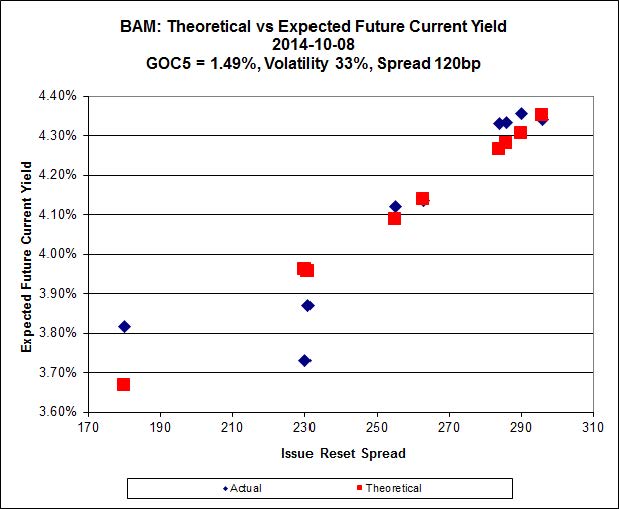
The Implied Volatility calculation for the BAM FixedResets is interesting, partly because of the very high level of Implied Volatility, but mainly because it highlights a huge gap that has opened up between BAM.PR.R (FixedReset 5.40%+230, commenced trading January, 2010) and BAM.PR.T (FixedReset 4.50%+231, commenced trading October, 2010). These are now bid at 25.4 and 24.55, respectively, despite having virtually identical Issue Reset Spreads. The next Exchange Dates for these issues differ by only nine months, which is really to short a time to introduce complicated arguments about the expected path of interest rates which would be wrong anyway. There should be some pricing difference due to the difference in the dividends currently paid, but the BAM.PR.R has only 7 payments to go until reset – the total dividend advantage is just under forty cents; one might reasonably expect the price difference to be a little under forty cents (given discounting of the dividend stream and the effect of price on post-reset expected dividend yield). But it ain’t.

ImpVol_BAM_FR_141008
Market Action

October 7, 2014

Europe isn’t looking very good:

U.K. 10-year government bonds rose with their German counterparts as a report showed factory orders in Europe’s largest economy plunged the most since 2009 in August, underlining risks to the euro area’s recovery.

Five-year gilts advanced for the fifth time in six days. The yield fell last week to the lowest level since February as reports signaled the U.K. economy was losing momentum, fueling speculation the Bank of England will delay interest-rate increases. The pound declined versus the euro as Business Secretary Vince Cable said Britain’s currency was still too strong and stifling exports.

U.K. house prices fell for the first time in almost a year and a half in September, Nationwide Building Society said on Sept. 30, while a Markit Economics report on Oct. 3 showed services growth cooled more than economists forecast, further signs that the recovery may be losing enough momentum for the Bank of England to refrain from increasing borrowing costs. That has fueled gains in government bonds and slowed the rally in the pound.

and there are renewed deflation fears:

Inflation in the euro area has fallen yet again and now stands at 0.3 percent. Prices are already falling in several of the European Union’s weaker economies. Even so-called core inflation, which excludes temporary factors and reveals the underlying trend, stands at less than 1 percent, a full percentage point below the ECB’s target.

… which is causing some to criticize Draghi and the ECB:

European Central Bank President Mario Draghi has disappointed investors and economists by failing to detail the size of the expansion he’s seeking in the central bank’s balance sheet. This much is clear from today’s investment bank research reports. Parsing Draghi’s comments from yesterday, as his favorite inflation measure fell to a record today, raises the chilling prospect that it may already be too late to avert deflation in the euro region — and that he knows it.

For the first time, Draghi has abandoned the incantation he’s used for months against the perceived evils of falling prices: “Inflation expectations for the euro area over the medium to long term continue to be firmly anchored.” That’s how he put it in his opening remarks at the August monetary policy press conference, and then followed it up, at the question-and-answer session, with, “Long-term expectations remain anchored at 2 percent.”

Yesterday, in addition to dropping the mantra from his speech, Draghi also demurred when he was directly asked if he thought inflationary expectations were anchored:

Well, first of all, the inflation expectations — first of all, we don’t use — let me get this clear, because there has been a certain amount of misunderstanding in the last few weeks — we don’t use one single measure of inflation expectations. We use a broad range of indicators. And our inflation expectations measures have gone down especially on the short horizons and are now around 8 points below 2 percent on the five-year on five-year, and so we look at that with — definitely with great attention. I would say that the measures we’ve taken have been determined exactly because our medium-term outlook on inflation expectation has worsened and we see that the risks have increased.

Lena Komileva, the chief economist at G Plus Economics in London, a research company, interpreted the absence as a sign the ECB is aware that the euro region risks what she calls “Japanification.” Annual inflation was just 0.3 percent last month; it hasn’t touched 2 percent since January 2013.

All this gloom had an effect:

Stocks tumbled and bonds rallied, sending yields to the lowest since May 2013, as the International Monetary Fund cut its global outlook and German industrial production plunged. Oil slid to a 17-month low.

The Standard & Poor’s 500 Index (SPX) fell 1.5 percent to 1,935.10 at 4 p.m. in New York, the lowest level since Aug. 12. The Dow Jones Industrial Average lost 1.6 percent, the most since July. The yield on 30-year Treasuries retreated 8 basis points to 3.05 percent as investors sought safety. Oil tumbled 1.7 percent to the lowest since April 2013, while gold futures climbed 0.4 percent. Volatility rose, with the VIX jumping to the highest since March.

The IMF cut its outlook for global growth in 2015 and warned about the risks of rising geopolitical tensions and a financial-market correction as stocks reach “frothy” levels. German industrial production dropped 4 percent in August in the biggest decline since 2009.

With Hallowe’en fast approaching, I would be remiss if I didn’t alert Assiduous Readers to the BEST PRANK EVER:

A lewd statue of the devil that seemingly popped up overnight in East Vancouver has been taken down by city officials after raising eyebrows — among other things.

The statue stood about eight to nine feet tall on a pedestal near the intersection of 4th Avenue and Clark Drive for several hours Tuesday.

It was removed by city crews at around 3:15 p.m.

The statue also appeared to sport a full erection, a detail that likely raised hell with some of the commuters who use the station.

satanStatue
Click for … um … big

It was a positive day for the Canadian preferred share market, with PerpetualDiscounts winning 18bp, FixedResets gaining 1bp and DeemedRetractibles up 2bp. Volatility was minimal. Volume was low.

HIMIPref™ Preferred Indices
These values reflect the December 2008 revision of the HIMIPref™ Indices

Values are provisional and are finalized monthly
Index Mean
Current
Yield
(at bid)
Median
YTW
Median
Average
Trading
Value
Median
Mod Dur
(YTW)
Issues Day’s Perf. Index Value
Ratchet 3.12 % 3.11 % 24,499 19.46 1 0.0416 % 2,677.1
FixedFloater 0.00 % 0.00 % 0 0.00 0 0.1513 % 4,130.2
Floater 2.88 % 3.03 % 58,295 19.68 4 0.1513 % 2,773.3
OpRet 4.04 % 1.67 % 116,196 0.08 1 -0.0788 % 2,732.5
SplitShare 4.29 % 4.03 % 91,336 3.85 5 0.2738 % 3,152.4
Interest-Bearing 0.00 % 0.00 % 0 0.00 0 -0.0788 % 2,498.6
Perpetual-Premium 5.46 % 2.11 % 78,060 0.08 18 0.1157 % 2,451.6
Perpetual-Discount 5.31 % 5.15 % 96,080 15.12 18 0.1817 % 2,592.1
FixedReset 4.21 % 3.73 % 171,024 16.38 73 0.0061 % 2,554.7
Deemed-Retractible 5.01 % 2.10 % 102,459 0.23 42 0.0200 % 2,563.6
FloatingReset 2.57 % -6.56 % 65,011 0.08 6 -0.0261 % 2,553.6
Performance Highlights
Issue Index Change Notes
PWF.PR.R Perpetual-Premium 1.43 % YTW SCENARIO
Maturity Type : Call
Maturity Date : 2021-04-30
Maturity Price : 25.00
Evaluated at bid price : 26.31
Bid-YTW : 4.77 %
Volume Highlights
Issue Index Shares
Traded
Notes
SLF.PR.E Deemed-Retractible 108,841 National crossed 78,800 at 22.21.
YTW SCENARIO
Maturity Type : Hard Maturity
Maturity Date : 2025-01-31
Maturity Price : 25.00
Evaluated at bid price : 22.29
Bid-YTW : 5.97 %
MFC.PR.A OpRet 56,550 TD crossed two blocks of 26,000 each, both at 25.39.
YTW SCENARIO
Maturity Type : Call
Maturity Date : 2014-11-06
Maturity Price : 25.25
Evaluated at bid price : 25.35
Bid-YTW : 1.67 %
BMO.PR.W FixedReset 52,939 TD crossed 40,000 at 25.08.
YTW SCENARIO
Maturity Type : Limit Maturity
Maturity Date : 2044-10-07
Maturity Price : 23.18
Evaluated at bid price : 25.08
Bid-YTW : 3.71 %
ENB.PF.G FixedReset 40,120 Recent new issue.
YTW SCENARIO
Maturity Type : Limit Maturity
Maturity Date : 2044-10-07
Maturity Price : 23.11
Evaluated at bid price : 25.00
Bid-YTW : 4.21 %
HSE.PR.A FixedReset 28,350 Nesbitt crossed 25,000 at 22.92.
YTW SCENARIO
Maturity Type : Limit Maturity
Maturity Date : 2044-10-07
Maturity Price : 22.45
Evaluated at bid price : 22.85
Bid-YTW : 3.71 %
FTS.PR.M FixedReset 28,344 Recent new issue.
YTW SCENARIO
Maturity Type : Limit Maturity
Maturity Date : 2044-10-07
Maturity Price : 23.19
Evaluated at bid price : 25.12
Bid-YTW : 3.95 %
There were 19 other index-included issues trading in excess of 10,000 shares.
Wide Spread Highlights
Issue Index Quote Data and Yield Notes
TRP.PR.A FixedReset Quote: 22.35 – 22.65
Spot Rate : 0.3000
Average : 0.1872

YTW SCENARIO
Maturity Type : Limit Maturity
Maturity Date : 2044-10-07
Maturity Price : 21.87
Evaluated at bid price : 22.35
Bid-YTW : 3.92 %

MFC.PR.C Deemed-Retractible Quote: 22.68 – 22.95
Spot Rate : 0.2700
Average : 0.1837

YTW SCENARIO
Maturity Type : Hard Maturity
Maturity Date : 2025-01-31
Maturity Price : 25.00
Evaluated at bid price : 22.68
Bid-YTW : 5.77 %

TD.PR.Q Deemed-Retractible Quote: 25.91 – 26.19
Spot Rate : 0.2800
Average : 0.2001

YTW SCENARIO
Maturity Type : Call
Maturity Date : 2014-11-06
Maturity Price : 25.75
Evaluated at bid price : 25.91
Bid-YTW : -6.35 %

PWF.PR.P FixedReset Quote: 23.00 – 23.22
Spot Rate : 0.2200
Average : 0.1572

YTW SCENARIO
Maturity Type : Limit Maturity
Maturity Date : 2044-10-07
Maturity Price : 22.56
Evaluated at bid price : 23.00
Bid-YTW : 3.56 %

BAM.PF.E FixedReset Quote: 24.51 – 24.78
Spot Rate : 0.2700
Average : 0.2080

YTW SCENARIO
Maturity Type : Limit Maturity
Maturity Date : 2044-10-07
Maturity Price : 22.96
Evaluated at bid price : 24.51
Bid-YTW : 4.21 %

MFC.PR.F FixedReset Quote: 22.41 – 22.79
Spot Rate : 0.3800
Average : 0.3205

YTW SCENARIO
Maturity Type : Hard Maturity
Maturity Date : 2025-01-31
Maturity Price : 25.00
Evaluated at bid price : 22.41
Bid-YTW : 4.52 %

New Issues

New Issue: BPO FixedReset, 4.75%+315

Brookfield Office Properties Inc. has announced:

that it has agreed to issue to a syndicate of underwriters led by RBC Capital Markets, CIBC, Scotia Capital Inc. and TD Securities Inc., for distribution to the public, ten million Cumulative Rate Reset Class AAA Preference Shares, Series AA (the “Preferred Shares, Series AA”). The Preferred Shares, Series AA will be issued at a price of C$25.00 per share, for aggregate proceeds of C$250 million. Holders of the Preferred Shares, Series AA will be entitled to receive a cumulative quarterly fixed dividend yielding 4.75% annually for the initial period ending December 31, 2019. Thereafter, the dividend rate will be reset every five years at a rate equal to the five-year Government of Canada bond yield plus 3.15%.

Holders of Preferred Shares, Series AA will have the right, at their option, to convert their shares into Cumulative Floating Rate Class AAA Preference Shares, Series BB (the “Preferred Shares, Series BB”), subject to certain conditions, on December 31, 2019 and on December 31 every five years thereafter. Holders of Preferred Shares, Series BB will be entitled to receive cumulative quarterly floating dividends at a rate equal to the 90-day Government of Canada Treasury Bill yield plus 3.15%.

Brookfield Office Properties has granted the underwriters an option, exercisable in whole or in part anytime up to two business days prior to closing, to purchase an additional 1,500,000 Preferred Shares, Series AA at the same offering price. Should the option be fully exercised, the total gross proceeds of the financing will be C$287.5 million.

The Preferred Shares, Series AA will be offered in Canada pursuant to a short form prospectus to be filed with the securities commissions and other similar regulatory authorities in each of the provinces of Canada, pursuant to National Instrument 44-101 – Short Form Prospectus Distributions.

The net proceeds of the issue will be used for general corporate purposes.

They later announced:

that as a result of strong investor demand for its previously announced public offering of 4.75% Cumulative Rate Reset Class AAA Preference Shares, Series AA (the “Preferred Shares, Series AA”), it has agreed to increase the size of the offering from C$250 million to C$300 million with no underwriters’ option, or from 10,000,000 to 12,000,000 Preferred Shares, Series AA.

They look as if they might be a little cheap compared to other BPO FixedResets, but it’s hard to tell.

ImpVol_BPO_FR_141007
Click for Big

Update, 2014-10-21: Rated Pfd-3 [Stable] by DBRS

Market Action

October 6, 2014

Nothing happened today, but there was a nice column from Megan McArdle of Bloomberg regarding the Intregity case before SCOTUS that I mentioned on October 3:

But the law is never simple and intuitive, in large part because case law is made by the difficulty of hard corner cases. The briefs run through some of this history. For example: Does your employer have to pay you for your commuting time? That doesn’t seem reasonable; employees could relocate to the far exurbs and get themselves time and a half for hours spent driving and singing along to “Free Fallin’.” Okay, but what if you work in an airport, and at the end of your commute is a lengthy trip through the Transportation Security Administration lines? Should you get paid for what is essentially a mandatory 15 minutes added to your commute? A court said no; the TSA line is not part of your primary duties. Okay, how about if you work in a nuclear power plant, where, for the sake of the neighbors, everyone is rigorously searched and subject to radiation screenings? I can see the workers’ argument there, but a court ruled against them.

The workers’ brief tries to distinguish those cases from the Amazon case. The TSA case seems pretty easy: The security screening is not there for the benefit of the employer; it’s there because it’s required by law. You can’t demand that your employer pay you for commuting just because they’re located in the middle of an extended 15-mph zone. The security checks at the Amazon warehouse, on the other hand, are exclusively for the benefit of the employer, who is trying to prevent theft.

It was a positive day for the Canadian preferred share market, with PerpetualDiscounts winning 11bp, FixedResets gaining 3bp and DeemedRetractibles up 5bp. Volatility was minimal. Volume was very low.

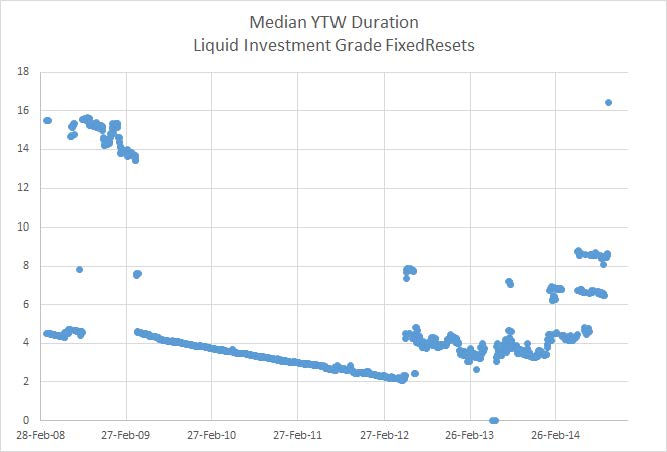
Interestingly, due to microscopic pricing changes, the median YTW-Duration (the YTW-Duration is the duration of the Yield-to-Worst scenario) of the FixedReset subindex is now in the ‘perpetual’ range, for the first time since April, 2009. After recovering from the pricing slump that gave rise to that scenario, there followed a long period during which the bulk of the issues in the index were the huge-spread bank FixedResets, which reduced their expected term by one day every day. In May, 2012, new issuance started making things more interesting with a series in the range of four (median expectation was a call of a relatively new issue at the first opportunity), a series starting at eight and declining to about 6.5 (median expectation is the Deemed Maturity of a bank issue 2022-1-31) and a third, relatively recent series at about 8.5 (median expectation is the Deemed Maturity of an insurance issue, 2025-1-31). And today … continued low yields for the Government of Canada 5-year bond, massive issuance of relatively low-spread FixedResets and calls of the higher-spread issues have tipped the balance to perpetuity. Fun times! This median YTW-Duration figure will almost certainly be volatile for the next year or so.

J10_MedianYTWDuration_141006
Click for Big

For those who are obsessive about such things, the median issue is BAM.PF.F, which at its bid of 25.25, HIMIPref™ calculates as having a 4.32% yield to Call 2019-9-30 and (given a GOC-5 yield of 1.58%), has a yield to perpetuity of 4.31%. At its closing bid of 25.26 on Friday, its YTW scenario was the call 2019-9-30 to yield 4.30%; I was using 1.61% as the GOC-5 yield on Friday. I told you the changes were microscopic!

HIMIPref™ Preferred Indices
These values reflect the December 2008 revision of the HIMIPref™ Indices

Values are provisional and are finalized monthly
Index Mean
Current
Yield
(at bid)
Median
YTW
Median
Average
Trading
Value
Median
Mod Dur
(YTW)
Issues Day’s Perf. Index Value
Ratchet 3.12 % 3.11 % 23,252 19.46 1 0.0833 % 2,675.9
FixedFloater 0.00 % 0.00 % 0 0.00 0 0.0138 % 4,123.9
Floater 2.89 % 3.04 % 59,187 19.66 4 0.0138 % 2,769.1
OpRet 4.04 % 0.57 % 107,599 0.08 1 0.1975 % 2,734.6
SplitShare 4.30 % 4.04 % 90,913 3.86 5 -0.0558 % 3,143.8
Interest-Bearing 0.00 % 0.00 % 0 0.00 0 0.1975 % 2,500.5
Perpetual-Premium 5.47 % 0.12 % 79,085 0.08 18 0.0852 % 2,448.8
Perpetual-Discount 5.32 % 5.14 % 95,476 15.09 18 0.1149 % 2,587.4
FixedReset 4.21 % 3.74 % 174,527 16.41 73 0.0256 % 2,554.6
Deemed-Retractible 5.02 % 2.29 % 103,280 0.23 42 0.0477 % 2,563.1
FloatingReset 2.57 % -7.01 % 80,929 0.08 6 0.0704 % 2,554.3
Performance Highlights
Issue Index Change Notes
CIU.PR.C FixedReset -1.49 % YTW SCENARIO
Maturity Type : Limit Maturity
Maturity Date : 2044-10-06
Maturity Price : 20.51
Evaluated at bid price : 20.51
Bid-YTW : 3.71 %
Volume Highlights
Issue Index Shares
Traded
Notes
TD.PF.A FixedReset 48,112 YTW SCENARIO
Maturity Type : Limit Maturity
Maturity Date : 2044-10-06
Maturity Price : 23.17
Evaluated at bid price : 25.05
Bid-YTW : 3.70 %
TD.PF.B FixedReset 41,338 Scotia crossed 10,000 at 25.08.
YTW SCENARIO
Maturity Type : Limit Maturity
Maturity Date : 2044-10-06
Maturity Price : 23.19
Evaluated at bid price : 25.04
Bid-YTW : 3.70 %
RY.PR.A Deemed-Retractible 41,292 TD crossed 35,000 at 25.40.
YTW SCENARIO
Maturity Type : Call
Maturity Date : 2015-05-24
Maturity Price : 25.00
Evaluated at bid price : 25.40
Bid-YTW : 2.70 %
FTS.PR.M FixedReset 37,510 Recent new issue.
YTW SCENARIO
Maturity Type : Limit Maturity
Maturity Date : 2044-10-06
Maturity Price : 23.19
Evaluated at bid price : 25.12
Bid-YTW : 3.95 %
BAM.PF.C Perpetual-Discount 30,497 RBC crossed 24,700 at 21.50.
YTW SCENARIO
Maturity Type : Limit Maturity
Maturity Date : 2044-10-06
Maturity Price : 21.48
Evaluated at bid price : 21.48
Bid-YTW : 5.69 %
ENB.PR.F FixedReset 29,824 YTW SCENARIO
Maturity Type : Limit Maturity
Maturity Date : 2044-10-06
Maturity Price : 23.04
Evaluated at bid price : 24.35
Bid-YTW : 4.13 %
There were 18 other index-included issues trading in excess of 10,000 shares.
Wide Spread Highlights
Issue Index Quote Data and Yield Notes
CIU.PR.C FixedReset Quote: 20.51 – 21.24
Spot Rate : 0.7300
Average : 0.5827

YTW SCENARIO
Maturity Type : Limit Maturity
Maturity Date : 2044-10-06
Maturity Price : 20.51
Evaluated at bid price : 20.51
Bid-YTW : 3.71 %

BAM.PR.E Ratchet Quote: 24.04 – 24.45
Spot Rate : 0.4100
Average : 0.2970

YTW SCENARIO
Maturity Type : Limit Maturity
Maturity Date : 2044-10-06
Maturity Price : 23.75
Evaluated at bid price : 24.04
Bid-YTW : 3.11 %

PWF.PR.R Perpetual-Premium Quote: 25.94 – 26.30
Spot Rate : 0.3600
Average : 0.2499

YTW SCENARIO
Maturity Type : Call
Maturity Date : 2021-04-30
Maturity Price : 25.00
Evaluated at bid price : 25.94
Bid-YTW : 5.03 %

POW.PR.C Perpetual-Premium Quote: 25.35 – 25.58
Spot Rate : 0.2300
Average : 0.1589

YTW SCENARIO
Maturity Type : Call
Maturity Date : 2014-11-05
Maturity Price : 25.00
Evaluated at bid price : 25.35
Bid-YTW : -12.47 %

BAM.PF.B FixedReset Quote: 24.67 – 24.95
Spot Rate : 0.2800
Average : 0.2098

YTW SCENARIO
Maturity Type : Limit Maturity
Maturity Date : 2044-10-06
Maturity Price : 23.08
Evaluated at bid price : 24.67
Bid-YTW : 4.18 %

BAM.PF.D Perpetual-Discount Quote: 21.68 – 21.89
Spot Rate : 0.2100
Average : 0.1458

YTW SCENARIO
Maturity Type : Limit Maturity
Maturity Date : 2044-10-06
Maturity Price : 21.36
Evaluated at bid price : 21.68
Bid-YTW : 5.68 %

MAPF

MAPF Performance: September, 2014

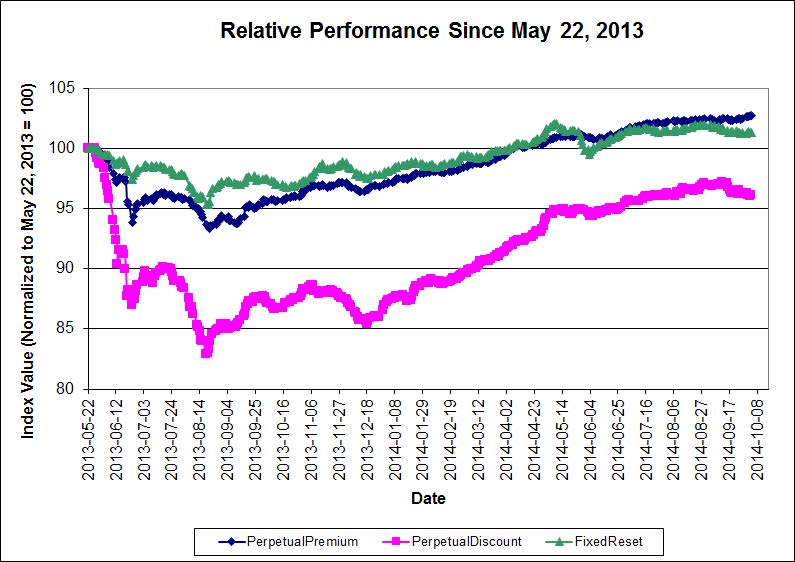
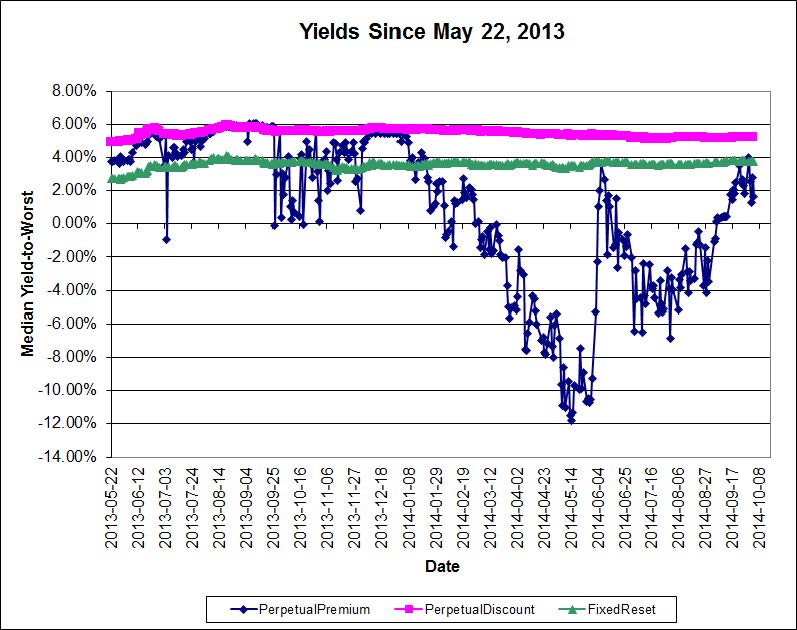
The fund outperformed slightly in September

relPerf_141003
Click for Big

relYield_141003
Click for Big

I continue to believe that the decline in the preferred share market remains overdone; the following table shows the increase in yields since May 22, 2013, of some fixed income sectors:

Yield Changes
May 22, 2013
to
October 3, 2014
Sector Yield
May 22
2013
Yield
September 30
2014
Change
Five-Year Canadas 1.38% 1.63% +25bp
Long Canadas 2.57% 2.67% +10bp
Long Corporates 4.15% 4.20% +5bp
FixedResets
Investment Grade
(Interest Equivalent)
3.51% 4.88% +137bp
Perpetual-Discounts
Investment Grade
(Interest Equivalent)
6.34% 6.72% +38bp
The change in yield of PerpetualDiscounts is understated due a massive influx of issues from the PerpetualPremium sub-index over the period, which improved credit quality. When the four issues that comprised the PerpetualDiscount sub-index as of May 22, 2013 are evaluated as of September 30, 2014, the interest-equivalent yield is 7.30% and thus the change is +96bp.

ZPR, is an ETF comprised of FixedResets and Floating Rate issues and a very high proportion of junk issues, returned +%, +% and +% over the past one-, three- and twelve-month periods, respectively (according to the fund’s data), versus returns for the TXPL index of -0.79%, +0.26% and +4.78% respectively. The fund has been able to attract assets of about $1,074-million since inception in November 2012; AUM increased by $19-million in September; given an index return of -0.79% a decrease of $8-million was expected, indicating that money is still flowing into the fund. I feel that the flows into and out of this fund are very important in determining the performance of its constituents.

TXPR had returns over one- and three-months of -0.62% and +0.38%, respectively with CPD performance within expectations.

Returns for the HIMIPref™ investment grade sub-indices for September were as follows:

HIMIPref™ Indices
Performance to September 30, 2014
Sub-Index 1-Month 3-month
Ratchet N/A N/A
FixFloat -1.09% +3.75%
Floater +1.64% +1.52%
OpRet +0.00% +0.33%
SplitShare +0.32% +1.20%
Interest N/A N/A
PerpetualPremium +0.13% +1.12%
PerpetualDiscount -0.85% +0.88%
FixedReset -0.64% -0.03%
DeemedRetractible -0.21% +0.62%
FloatingReset +0.38% +1.37%

Malachite Aggressive Preferred Fund’s Net Asset Value per Unit as of the close September 30, 2014, was $10.4601 after a dividend distribution of 0.129948.

Returns to September 30, 2014
Period MAPF BMO-CM “50” Index TXPR
Total Return
CPD – according to Blackrock
One Month -0.66% -0.76% -0.62% N/A
Three Months +0.02% -0.11% +0.38% N/A
One Year +9.64% +4.14% +5.48% +4.96%
Two Years (annualized) +4.09% +2.31% +2.21% N/A
Three Years (annualized) +6.88% +3.67% +3.62% +3.14%
Four Years (annualized) +5.84% +4.72% +4.03% N/A
Five Years (annualized) +7.71% +5.74% +5.00% +4.36%
Six Years (annualized) +15.27% +6.48% +5.67%  
Seven Years (annualized) +12.35% +4.50% +3.59%  
Eight Years (annualized) +10.89% +3.66%    
Nine Years (annualized) +10.33% +3.70%    
Ten Years (annualized) +10.00% +3.85%    
Eleven Years (annualized) +10.49% +3.96%    
Twelve Years (annualized) +12.13% +4.22%    
Thirteen Years (annualized) +10.73% +4.15%    
MAPF returns assume reinvestment of distributions, and are shown after expenses but before fees.
CPD Returns are for the NAV and are after all fees and expenses.
* CPD does not directly report its two- or four-year returns.
Figures for National Bank Preferred Equity Income Fund (formerly Omega Preferred Equity) (which are after all fees and expenses) for 1-, 3- and 12-months are -0.28%, +0.55% and +5.72%, respectively, according to Morningstar after all fees & expenses. Three year performance is +4.02%; five year is +5.33%
Figures for Jov Leon Frazer Preferred Equity Fund Class I Units (which are after all fees and expenses) for 1-, 3- and 12-months are -0.69%, -0.30% and +2.33% respectively, according to Morningstar. Three Year performance is +1.26%; five-year is +2.61%
Figures for Manulife Preferred Income Fund (formerly AIC Preferred Income Fund) (which are after all fees and expenses) for 1-, 3- and 12-months are -1.07%, +0.15% & +3.07%, respectively. Three Year performance is +1.48%; five-year is +2.91%
Figures for Horizons AlphaPro Preferred Share ETF (which are after all fees and expenses) for 1-, 3- and 12-months are -0.42%, +0.47% & +5.49%, respectively. Three year performance is +4.49%
Figures for National Bank Preferred Equity Fund (formerly Altamira Preferred Equity Fund) are -0.56%, +0.20% and +4.01% for one-, three- and twelve months, respectively.
The figure for BMO S&P/TSX Laddered Preferred Share Index ETF is -0.78%, +0.21% and +4.27% for one-, three- and twelve-months, respectively.
Figures for NexGen Canadian Preferred Share Tax Managed Fund (Dividend Tax Credit Class, the best performing) are +0.8%, +2.0% and +8.3% for one-, three- and twelve-months, respectively.
Figures for BMO Preferred Share Fund are +0.40% and +3.21% for the past three- and twelve-months, respectively.

MAPF returns assume reinvestment of dividends, and are shown after expenses but before fees. Past performance is not a guarantee of future performance. You can lose money investing in Malachite Aggressive Preferred Fund or any other fund. For more information, see the fund’s main page. The fund is available either directly from Hymas Investment Management or through a brokerage account at Odlum Brown Limited.

A problem that has bedevilled the market over the past two years has been the OSFI decision not to grandfather Straight Perpetuals as Tier 1 bank capital, and their continued foot-dragging regarding a decision on insurer Straight Perpetuals has segmented the market to the point where trading has become much more difficult. The fund occasionally finds an attractive opportunity to trade between GWO issues, which have a good range of annual coupons (but in which trading is now hampered by the fact that the low-coupon issues are trading near par and are callable at par in the near term), but is “stuck” in the MFC and SLF issues, which have a much narrower range of coupon, while the IAG DeemedRetractibles are quite illiquid. Until the market became so grossly segmented, this was not so much of a problem – but now banks are not available to swap into (because they are so expensive) and non-regulated companies are likewise deprecated (because they are not DeemedRetractibles; they should not participate in the increase in value that will follow the OSFI decision I anticipate and, in addition, are analyzed as perpetuals). The fund’s portfolio is, in effect ‘locked in’ to the MFC & SLF issues due to projected gains from a future OSFI decision, to the detriment of trading gains particularly in May, 2013, when the three lowest-coupon SLF DeemedRetractibles (SLF.PR.C, SLF.PR.D and SLF.PR.E) were the worst performing DeemedRetractibles in the sub-index, and in June, 2013, when the insurance-issued DeemedRetractibles behaved like PerpetualDiscounts in a sharply negative market.

However, it will be noted, as discussed in the August report on Portfolio Composition that the month saw some swaps from the low-coupon SLF Straights to a low-spread SLF FixedReset … so there are some opportunities to trade, although they don’t happen often! There were similar swaps executed in June and July.

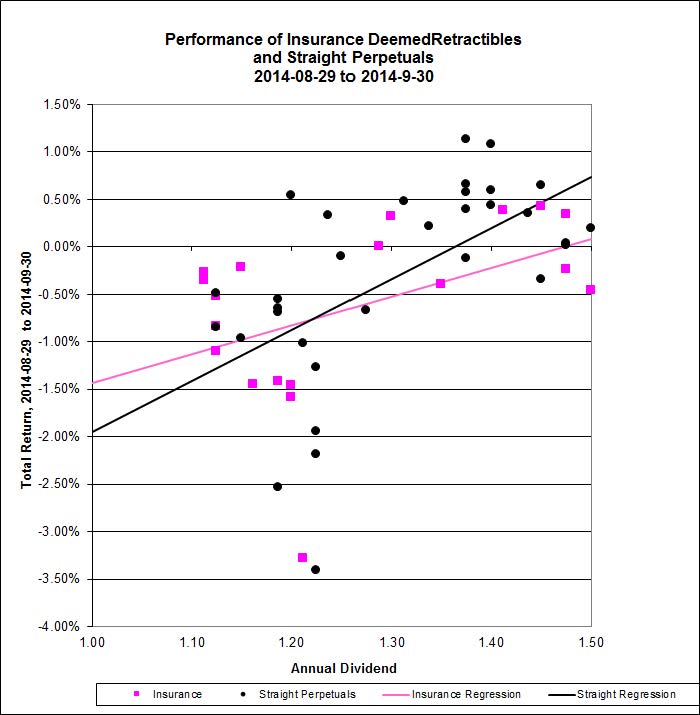
In August, insurance DeemedRetractibles underperformed bank DeemedRetractibles:

bankInsDRPerf_140930
Click for Big

… and were about equal to Unregulated Straight Perpetuals.

insStraightPerf_140930
Click for Big

Of the regressions shown in the above two charts, the Adjusted Correlation of the Bank DeemedRetractible performance is a mere 6%, Straight Perpetuals come in at 31% and Insurance DeemedRetractibles are at 17%.

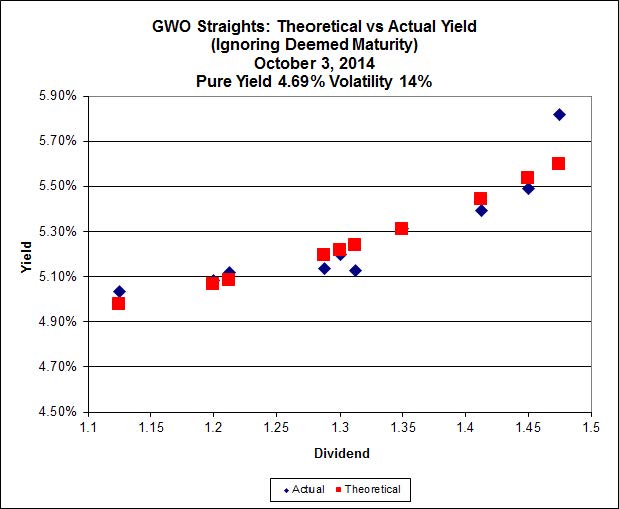
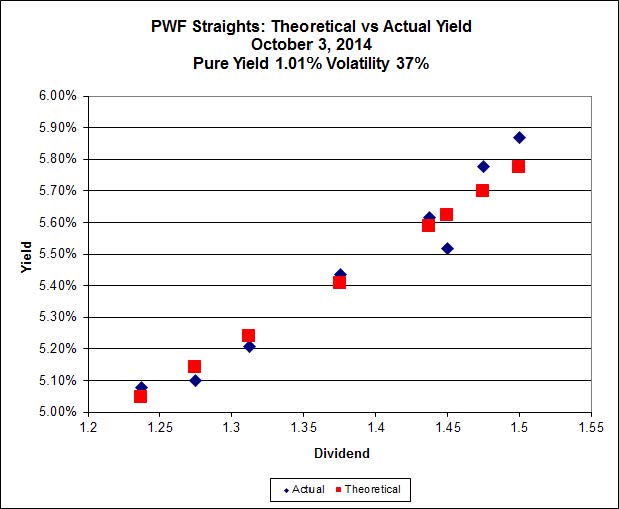
A lingering effect of the downdraft of 2013 has been the return of measurable Implied Volatility (all Implied Volatility calculations use bids from October 3):

ImpVol_GWO_SP_141003
Click for Big

ImpVol_PWF_SP_141003
Click for Big

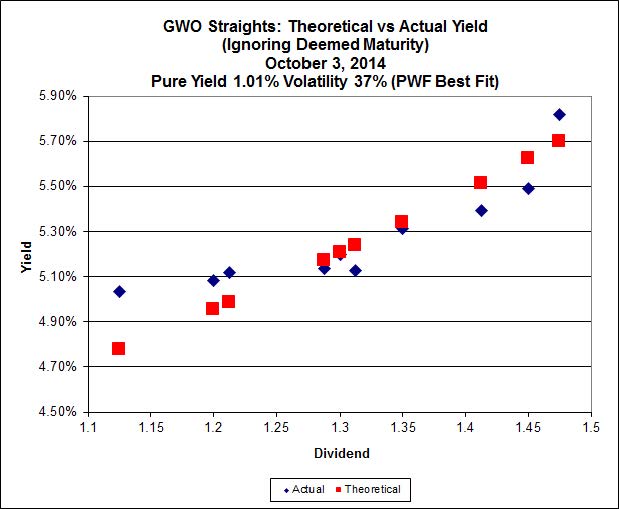
However, while the fit for PWF is good, all that can really be told from the data is that the Implied Volatility is high:

ImpVol_PWF_SP_141003_VarVol
Click for Big

ImpVol_PWF_SP_141003_VarSpread>
Click for Big

Given that there are only three BNS straights left, it is no longer informative to calculate Implied Volatility.

Implied Volatility of
Two Series of Straight Perpetuals
October 3, 2014
Issuer Pure Yield Implied Volatility
GWO 4.69% (+0.89) 14% (-8)
PWF 1.01% (+0.75) 37% (-3)
Bracketted figures are changes since August month-end

It is disconcerting to see the difference between GWO and PWF; if anything, we would expect the implied volatility for GWO to be higher, given that the DeemedRetraction – not yet given significant credence by the market – implies a directionality in prices. On the other hand, the PWF issues are mostly trading above par, which tends to add directionality. The GWO data with the best fit derived for PWF is distinguishable from the best fit; the best fit has a lower Sum of Squared Errors (1.56 vs. 3.53):

ImpVol_GWO_PWF_SP_141003
Click for Big

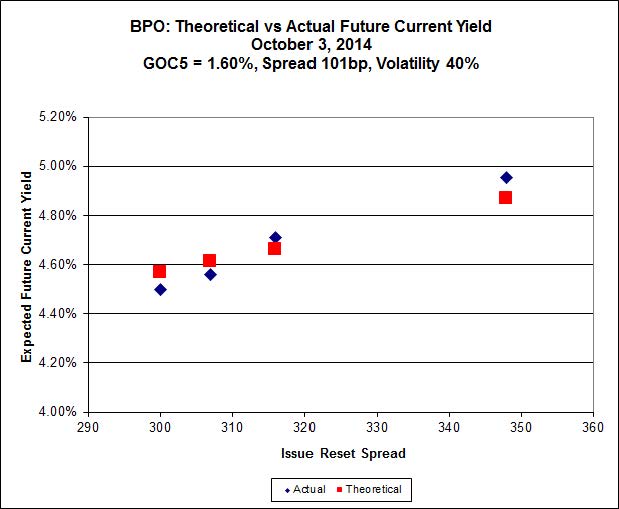
In the September, 2013, edition of PrefLetter, I extended the theory of Implied Volatility to FixedResets – relating the option feature of the Issue Reset Spreads to a theoretical non-callable Market Spread.

ImpVol_BPO_141003
Click for Big

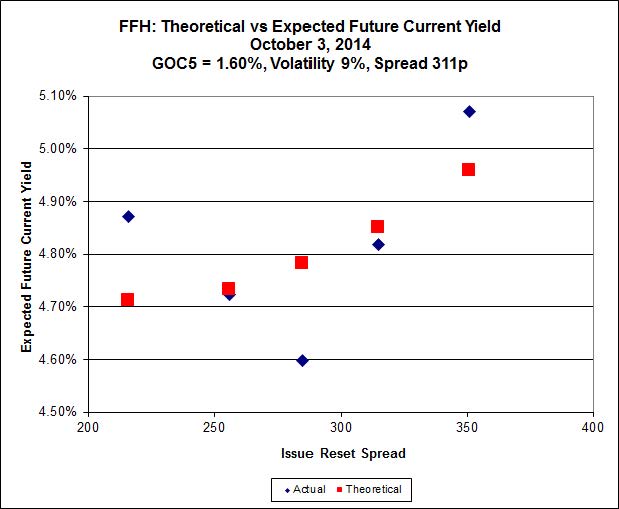
ImpVol_FFH_141003
Click for Big

Implied Volatility of
Two Series of FixedResets
August 29, 2014
Issuer Market Reset Spread
(Non-Callable)
Implied Volatility
BPO 101bp (-5) 40% (0)
FFH 311bp (+7) 9% (+1)
Bracketted figures are changes since July month-end

These are very interesting results: The BPO issues are trading as if calls are a certainty, while FFH issues are trading as if calls are much less likely; this is probably due to the market’s over-reacting to the fact that all of the BPO issues are trading above par, while only one of the five FFH issues shares that happy status. The FFH series continues to be perplexing, this time with the four lower-coupon issues showing virtually no implied volatility – with the highest coupon issue (FFH.PR.K) being well off the mark … all I can think of is that the market has decided that FFH.PR.K, with an Issue Reset Spread of 351bp, is sure to be called in 2017, while the other four (highest spread is FFH.PR.C, +315) are not at all likely to be called.

Those of you who have been paying attention will remember that in a “normal” market (which we have not seen in well over a year) the slope of this line is related to the implied volatility of yields in Black-Scholes theory, as discussed in the January, 2010, edition of PrefLetter. As has been previously noted, very high levels of Implied Volatility (in the 40% range, at which point the calculation may be considered virtually meaningless) imply a very strong expectation of directionality in future prices – i.e, an expectation that all issues will be redeemed at par.

It is significant that the preferred share market knows no moderation. I suggest that a good baseline estimate for Volatility over a three year period is 15% but the observed figure is generally higher in a rising market and lower in a declining one … with, of course, a period of adjustment in between, which I suspect we are currently experiencing.

Sometimes everything works … sometimes it’s 50-50 … sometimes nothing works. The fund seeks to earn incremental return by selling liquidity (that is, taking the other side of trades that other market participants are strongly motivated to execute), which can also be referred to as ‘trading noise’ – although for quite some time, noise trading has taken a distant second place to the sectoral play on insurance DeemedRetractibles; something that dismays me, particularly given that the market does not yet agree with me regarding the insurance issues! There were a lot of strongly motivated market participants during the Panic of 2007, generating a lot of noise! Unfortunately, the conditions of the Panic may never be repeated in my lifetime … but the fund will simply attempt to make trades when swaps seem profitable, without worrying about the level of monthly turnover.

There’s plenty of room for new money left in the fund. I have shown in PrefLetter that market pricing for FixedResets is very often irrational and I have lots of confidence – backed up by my bond portfolio management experience in the markets for Canadas and Treasuries, and equity trading on the NYSE & TSX – that there is enough demand for liquidity in any market to make the effort of providing it worthwhile (although the definition of “worthwhile” in terms of basis points of outperformance changes considerably from market to market!) I will continue to exert utmost efforts to outperform but it should be borne in mind that there will almost inevitably be periods of underperformance in the future.

The yields available on high quality preferred shares remain elevated, which is reflected in the current estimate of sustainable income.

Calculation of MAPF Sustainable Income Per Unit
Month NAVPU Portfolio
Average
YTW
Leverage
Divisor
Securities
Average
YTW
Capital
Gains
Multiplier
Sustainable
Income
per
current
Unit
June, 2007 9.3114 5.16% 1.03 5.01% 1.3240 0.3524
September 9.1489 5.35% 0.98 5.46% 1.3240 0.3773
December, 2007 9.0070 5.53% 0.942 5.87% 1.3240 0.3993
March, 2008 8.8512 6.17% 1.047 5.89% 1.3240 0.3938
June 8.3419 6.034% 0.952 6.338% 1.3240 $0.3993
September 8.1886 7.108% 0.969 7.335% 1.3240 $0.4537
December, 2008 8.0464 9.24% 1.008 9.166% 1.3240 $0.5571
March 2009 $8.8317 8.60% 0.995 8.802% 1.3240 $0.5872
June 10.9846 7.05% 0.999 7.057% 1.3240 $0.5855
September 12.3462 6.03% 0.998 6.042% 1.3240 $0.5634
December 2009 10.5662 5.74% 0.981 5.851% 1.1141 $0.5549
March 2010 10.2497 6.03% 0.992 6.079% 1.1141 $0.5593
June 10.5770 5.96% 0.996 5.984% 1.1141 $0.5681
September 11.3901 5.43% 0.980 5.540% 1.1141 $0.5664
December 2010 10.7659 5.37% 0.993 5.408% 1.0298 $0.5654
March, 2011 11.0560 6.00% 0.994 5.964% 1.0298 $0.6403
June 11.1194 5.87% 1.018 5.976% 1.0298 $0.6453
September 10.2709 6.10%
Note
1.001 6.106% 1.0298 $0.6090
December, 2011 10.0793 5.63%
Note
1.031 5.805% 1.0000 $0.5851
March, 2012 10.3944 5.13%
Note
0.996 5.109% 1.0000 $0.5310
June 10.2151 5.32%
Note
1.012 5.384% 1.0000 $0.5500
September 10.6703 4.61%
Note
0.997 4.624% 1.0000 $0.4934
December, 2012 10.8307 4.24% 0.989 4.287% 1.0000 $0.4643
March, 2013 10.9033 3.87% 0.996 3.886% 1.0000 $0.4237
June 10.3261 4.81% 0.998 4.80% 1.0000 $0.4957
September 10.0296 5.62% 0.996 5.643% 1.0000 $0.5660
December, 2013 9.8717 6.02% 1.008 5.972% 1.0000 $0.5895
March, 2014 10.2233 5.55% 0.998 5.561% 1.0000 $0.5685
June 10.5877 5.09% 0.998 5.100% 1.0000 $0.5395
September, 2014 10.4601 5.28% 0.997 5.296% 1.0000 $0.5540
NAVPU is shown after quarterly distributions of dividend income and annual distribution of capital gains.
Portfolio YTW includes cash (or margin borrowing), with an assumed interest rate of 0.00%
The Leverage Divisor indicates the level of cash in the account: if the portfolio is 1% in cash, the Leverage Divisor will be 0.99
Securities YTW divides “Portfolio YTW” by the “Leverage Divisor” to show the average YTW on the securities held; this assumes that the cash is invested in (or raised from) all securities held, in proportion to their holdings.
The Capital Gains Multiplier adjusts for the effects of Capital Gains Dividends. On 2009-12-31, there was a capital gains distribution of $1.989262 which is assumed for this purpose to have been reinvested at the final price of $10.5662. Thus, a holder of one unit pre-distribution would have held 1.1883 units post-distribution; the CG Multiplier reflects this to make the time-series comparable. Note that Dividend Distributions are not assumed to be reinvested.
Sustainable Income is the resultant estimate of the fund’s dividend income per current unit, before fees and expenses. Note that a “current unit” includes reinvestment of prior capital gains; a unitholder would have had the calculated sustainable income with only, say, 0.9 units in the past which, with reinvestment of capital gains, would become 1.0 current units.
DeemedRetractibles are comprised of all Straight Perpetuals (both PerpetualDiscount and PerpetualPremium) issued by BMO, BNS, CM, ELF, GWO, HSB, IAG, MFC, NA, RY, SLF and TD, which are not exchangable into common at the option of the company (definition refined in May, 2011). These issues are analyzed as if their prospectuses included a requirement to redeem at par on or prior to 2022-1-31 (banks) or 2025-1-31 (insurers and insurance holding companies), in addition to the call schedule explicitly defined. See OSFI Does Not Grandfather Extant Tier 1 Capital, CM.PR.D, CM.PR.E, CM.PR.G: Seeking NVCC Status and the January, February, March and June, 2011, editions of PrefLetter for the rationale behind this analysis.
Yields for September, 2011, to January, 2012, were calculated by imposing a cap of 10% on the yields of YLO issues held, in order to avoid their extremely high calculated yields distorting the calculation and to reflect the uncertainty in the marketplace that these yields will be realized. From February to September 2012, yields on these issues have been set to zero. All YLO issues held were sold in October 2012.

Significant positions were held in DeemedRetractible, SplitShare and FixedReset issues on August 29; all of these currently have their yields calculated with the presumption that they will be called by the issuers at par prior to 2022-1-31 (banks) or 2025-1-31 (insurers and insurance holding companies) or on a different date (SplitShares). This presents another complication in the calculation of sustainable yield. The fund also holds positions in various SplitShare issues which also have their yields calculated with the expectation of a maturity at par.

I no longer show calculations that assume the conversion of the entire portfolio into PerpetualDiscounts, as the fund has only a small position in these issues.

I will also note that the sustainable yield calculated above is not directly comparable with any yield calculation currently reported by any other preferred share fund as far as I am aware. The Sustainable Yield depends on:
i) Calculating Yield-to-Worst for each instrument and using this yield for reporting purposes;
ii) Using the contemporary value of Five-Year Canadas (set at 1.61% for the September 30 calculation) to estimate dividends after reset for FixedResets.

Most funds report Current Yield. For instance, ZPR reports a “Dividend Yield” of 4.5% as of August 29, 2014, but this is the Current Yield, a meaningless number. The Current Yield of MAPF was 4.89% as of August 29, but I will neither report that with any degree of prominence nor take any great pleasure in the fact that it’s a little higher than the ZPR number. It’s meaningless; to discuss it in the context of portfolio reporting is misleading.

However, BMO has taken a significant step forward in that they are no longer reporting the “Portfolio Yield” directly on their website; the information is taken from the “Enhanced Fund Profile” which is available only as a PDF link. CPD doesn’t report this metric on the CPD fact sheet or on their website. I may have one less thing to mock the fundcos about!

It should be noted that the concept of this Sustainable Income calculation was developed when the fund’s holdings were overwhelmingly PerpetualDiscounts – see, for instance, the bottom of the market in November 2008. It is easy to understand that for a PerpetualDiscount, the technique of multiplying yield by price will indeed result in the coupon – a PerpetualDiscount paying $1 annually will show a Sustainable Income of $1, regardless of whether the price is $24 or $17.

Things are not quite so neat when maturity dates and maturity prices that are different from the current price are thrown into the mix. If we take a notional Straight Perpetual paying $5 annually, the price is $100 when the yield is 5% (all this ignores option effects). As the yield increases to 6%, the price declines to 83.33; and 83.33 x 6% is the same $5. Good enough.

But a ten year bond, priced at 100 when the yield is equal to its coupon of 5%, will decline in price to 92.56; and 92.56 x 6% is 5.55; thus, the calculated Sustainable Income has increased as the price has declined as shown in the graph:
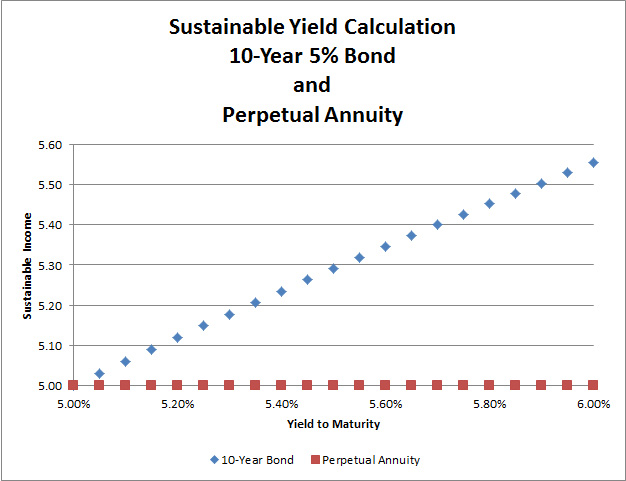

Click for Big

The difference is because the bond’s yield calculation includes the amortization of the discount; therefore, so does the Sustainable Income estimate.

Different assumptions lead to different results from the calculation, but the overall positive trend is apparent. I’m very pleased with the long-term results! It will be noted that if there was no trading in the portfolio, one would expect the sustainable yield to be constant (before fees and expenses). The success of the fund’s trading is showing up in

  • the very good performance against the index
  • the long term increases in sustainable income per unit

As has been noted, the fund has maintained a credit quality equal to or better than the index; outperformance has generally been due to exploitation of trading anomalies.

Again, there are no predictions for the future! The fund will continue to trade between issues in an attempt to exploit market gaps in liquidity, in an effort to outperform the index and keep the sustainable income per unit – however calculated! – growing.

Better Communication, Please!

BCE To Force Exchange Of Remaining BAF Preferreds

BCE Inc. has announced (emphasis added):

BCE has entered into an agreement with Bell Aliant Preferred Equity Inc. (TSX: BAF) (Prefco) to effect an amalgamation of Prefco with a newly incorporated, wholly owned subsidiary of BCE. Upon implementation:

  • holders of Prefco preferred shares (other than shareholders who properly exercise their right of dissent in respect of the amalgamation) will receive for their shares the same consideration as was paid by BCE for preferred shares pursuant to the preferred share offer; and
  • Prefco will become a wholly owned subsidiary of BCE.

A special meeting of the Prefco preferred shareholders will be held on October 31, 2014 at 9:30 am Atlantic to consider the amalgamation. BCE intends to vote all of the preferred shares that it owned as of September 30, 2014, the record date for the meeting, in favour of the amalgamation, which will be sufficient to approve the amalgamation and complete the privatization of Prefco.

The notice of meeting, accompanying management information circular and related meeting material, which contain full details of the amalgamation, will be mailed to Prefco preferred shareholders on or about October 7, 2014. The meeting materials will also be available on SEDAR at www.sedar.com and on EDGAR at www.sec.gov.

Subject to the terms and conditions of the amalgamation agreement, the amalgamation is expected to become effective on or about October 31, 2014. Prefco preferred shareholders will receive the same newly issued BCE preferred shares, with the same financial terms as the existing Prefco preferred shares, that were received by preferred shareholders who tendered to the preferred share offer.

The old and new symbols, as laboriously determined since BCE is too lazy to communicate them to investors are:

BCE / BAF Preferred Share Exchange
BCE Ticker Description BAF Ticker
BCE.PR.M FixedReset
4.85%+209
BAF.PR.A
BCE.PR.O FixedReset
4.55%+309
BAF.PR.C
BCE.PR.Q FixedReset
4.25%+264
BAF.PR.E

The dim bulbs at BCE have not yet updated their preferred share information page to reflect the existence of their three new issues.

Indices and ETFs

TXPR & TXPL Index Revision, 14Q4

S&P Dow Jones Indices Canadian Index Operations has announced:

the following index changes as a result of the quarterly S&P/TSX Preferred Share Index and S&P/TSX Preferred Share Laddered Index Reviews. These changes will be effective at the open on Monday, October 20, 2014.

S&P/TSX Preferred Share Index [TXPR]
ADDITIONS
Symbol Issue Name CUSIP
ALA.PR.G ALTAGAS LTD. 5YR RESET SERIES ‘G’ PR 021361 88 6
AQN.PR.D ALGONQUIN POWER & UTILITIES CORP. SER ‘D’ PR 015857 50 1
BMO.PR.W BANK OF MONTREAL 5-YR RESET CL ‘B’ PR SER 31 063679 88 0
ENB.PF.E ENBRIDGE INC. PR SER ’13’ 29250N 57 6
ENB.PF.G ENBRIDGE INC. PR SER ’15’ 29250N 55 0
FTS.PR.M FORTIS INC. 1ST PR SERIES ‘M’ 349553 76 8
MFC.PR.M MANULIFE FINANCIAL CORP. CL 1 PR SER ’17’ 56501R 69 2
PPL.PR.G PEMBINA PIPELINE CORPORATION CL ‘A’ PR SER 7 706327 60 8
PWF.PR.H POWER FINANCIAL CORP. 5.75% SERIES ‘H’ 1ST PR 73927C 86 0
TA.PR.J TRANSALTA CORPORATION 1ST PR SER ‘G’
89346D 67 7
TD.PF.B TORONTO-DOMINION BANK(THE) CL ‘A’1ST PR SER 3 891145 67 4
DELETIONS
Symbol Issue Name CUSIP
BCE.PR.Y BCE INC. 1ST PR SERIES ‘Y’ 05534B 85 1
BPO.PR.H BROOKFIELD OFFICE PROP INC. CL AAA PR SER ‘H’ 112900 80 8
CCS.PR.C CO-OPERATORS GENERAL INSURANCE CO CL E PR ‘C’ 189906 40 7
CU.PR.D CANADIAN UTILITIES LIMITED 2ND PR SER ‘AA’ 136717 67 5
EMA.PR.E EMERA INCORPORATED PR SERIES ‘E’ 290876 70 5
NPI.PR.C NORTHLAND POWER INC. CUMLTV RST SERIES 3 PR 666511 60 5
REI.PR.C RIOCAN REAL ESTATE INVEST TR PR UNITS SER ‘C’ 766910 12 9
TD.PR.S TORONTO-DOMINION BANK (THE) 5-YR RESET PR S 891145 60 9

S&P/TSX Preferred Share Laddered Index [TXPL]
ADDITIONS
Symbol Issue Name CUSIP
ALA.PR.G ALTAGAS LTD. 5YR RESET SERIES ‘G’ PR 021361 88 6
AQN.PR.D ALGONQUIN POWER & UTILITIES CORP. SER ‘D’ PR 015857 50 1
BMO.PR.W BANK OF MONTREAL 5-YR RESET CL ‘B’ PR SER 31 063679 88 0
FTS.PR.M FORTIS INC. 1ST PR SERIES ‘M’ 349553 76 8
MFC.PR.M MANULIFE FINANCIAL CORP. CL 1 PR SER ’17’ 56501R 69 2
PPL.PR.G PEMBINA PIPELINE CORPORATION CL ‘A’ PR SER 7 706327 60 8
TA.PR.J TRANSALTA CORPORATION 1ST PR SER ‘G’ 89346D 67 7
TD.PF.B TORONTO-DOMINION BANK(THE) CL ‘A’1ST PR SER 3 891145 67 4
Market Action

October 3, 2014

Jobs, jobs, jobs!

A surprisingly powerful surge in hiring pushed unemployment to a six-year low of 5.9 percent in September as the U.S. labor market showed renewed vigor.

The 248,000 gain in payrolls followed a 180,000 increase in August that was bigger than previously estimated, the Labor Department reported in Washington. Revisions boosted the job count by 69,000 over the previous two months. The jobless rate fell from 6.1 percent to the lowest level since July 2008.

Another report today showed the U.S. trade deficit shrank in August to the lowest level in seven months as exports edged up to a record. The gap decreased 0.5 percent to $40.1 billion, the smallest since January, from $40.3 billion in July, the Commerce Department reported.

The narrowing deficit prompted economists at Barclays PLC in New York to boost their tracking estimate of third-quarter gross domestic product to a 3.3 percent gain at an annualized rate from 2.7 percent.

Also today, another report showed service industries grew in September to cap the strongest quarter of expansion in more than 10 years. While the Institute for Supply Management’s non-manufacturing index fell to 58.6 from the prior month’s 59.6, the third-quarter average was the highest since the first three months of 2004, the Tempe, Arizona-based group said.

The quarterly average for the group’s factory index was the highest since early 2011, a report showed earlier this week.

Meanwhile, in Canada:

Canada swung to an unexpected merchandise trade deficit in August as imports surged to a record and exports fell for the first time in four months.

The C$610 million ($543 million) deficit followed a July surplus that was pared to C$2.20 billion from the initial C$2.58 billion estimate. None of the 14 economists in a Bloomberg survey predicted that Ottawa-based Statistics Canada would report a trade deficit today, and the median estimate was for a C$1.6 billion surplus.

The report is another setback in a week that saw Statistics Canada report the world’s 11th-largest economy stalled in July after a second-quarter expansion that was led by a jump in exports. Bank of Canada Governor Stephen Poloz said last month he saw early signs of a needed rotation toward growth led by exports and business investment.

And problems in moving exportable goods don’t seem to be getting any better:

Even with a grain harvest falling below last year’s record, Western Canadian farmers can’t find enough rail cars in the right places to move their crops.

Wet, cool weather across parts of the Canadian prairies has reduced the amount of high quality grain available, helping to fuel another showdown between shippers and the nation’s largest railways. While the crop is 20 percent smaller than last year’s, it will be harder to find and move the right grades to match export sales.

Grain shippers said railways haven’t been supplying enough cars, and about 24,000 orders for transport on the prairies haven’t been filled. Canadian National Railway Co. (CNR), facing a fine for failing to meet its minimum weekly grain shipping target, said farmers haven’t been delivering enough grain to country elevators to comply with the government order.

People are borrowing for more than just houses:

If stock investors are any guide, the $1.3 trillion U.S. junk-bond market is being inflated by a growing amount of leverage being used by buyers.

Both stock and junk-bond managers tend to deploy more leverage when markets are booming, and more than ever is being used to purchase U.S. equities, based on levels of margin debt on the New York Stock Exchange, according to UBS AG (UBSN) analysts. That suggests junk-debt buyers are engaging in similar financing activities.

As investors use more borrowed cash, they increase the potential for bigger losses in a downturn. This trend adds to concern that six years of unprecedented Federal Reserve stimulus has produced a bubble in the junk-bond market — and one that will be all the more painful when it eventually pops.

Margin debt has surged to more than 2.5 percent of U.S. gross domestic product, about the highest level in data going back to the early 1990s, the UBS analysts [Stephen Caprio and Matthew Mish] wrote. The measure of leverage tends to be a leading indicator of relative yields on speculative-grade bonds, with a rising level of margin debt increasing the odds of future spread widening.

Investors are demanding 4.42 percentage points more than benchmark rates to own dollar-denominated high-yield bonds, compared with 5.9 percentage points on average over the past decade, Bank of America Merrill Lynch index data show.

… and Rob Carrick writes about Corporate bond ETFs: More than meets the eye:

Determined to avoid future catastrophes, the world’s regulators, central banks, investment strategists and money managers are asking questions and raising concerns about all kinds of investment trends and products. One of the latest to be scrutinized is a useful and seemingly innocuous category of exchange-traded fund that holds corporate bonds.

The concern starts with a lack of liquidity in the corporate bond market today. A liquid asset can be easily traded, without concern that you’ll have to pay a premium to acquire it or accept a discount when selling. Corporate bond liquidity has been negatively affected by a combination of a changing regulatory environment for the banks that dominate trading of these securities, and strong demand for these bonds from investors.

Today, the lack of liquidity means investors have to pay up to buy corporate bonds. When interest rates rise, it could mean they’ll take a hit if they sell. ETFs, which hold baskets of corporate bonds, complicate things. If investors dumped corporate bonds en masse, would these ETFs be able to efficiently sell their holdings as needed?

He then spoils this excellent question by allowing disingenuous salesmen to slip off the hook really easily:

If you did submit a sell order for your corporate bond ETF, it would be matched with a buy order from another investor. Even if corporate bonds turn toxic, there are investment dealers designated to maintain an orderly market in ETF trading. They’re supposed to put in a bid for the ETF units you’re selling, even if the price would reflect prevailing market conditions.

These dealers would have the option of exchanging the ETF units they’ve accumulated for the underlying securities. At BlackRock Canada, they say that’s not a problem. “You can’t make an ETF if you don’t have liquid underlying [investments],” said Noel Archard, the company’s head and managing director.

Alfred Lee, vice-president and portfolio manager at BMO Mutual Funds, said corporate bond ETFs give investors more liquidity than if they tried to sell an individual bond. “Given a liquidity event, liquidity is not going to be as good as in a normal environment. But we’re going to be owning the most liquid bonds out there.”

To sum up, problems in the corporate bond market will be reflected in the price of bond ETFs. However, ETF industry people say their funds will not exacerbate things.

(The article is also spoilt by the inclusion of the old nonsense about how risk and return are magically changed by putting the raw materials into a box.[ETF] Disadvantages: No maturity date, which means prices subject to interest rate trends. See Bond ETFs demystified for an explanation of what is really going on.)

Anyway, I hope that Noel Archard was misquoted, or quoted out of context, or severely shortened, or something, because his statement is nonsense. Synthetic ETFs can be a threat to financial stability; I’ll agree that there aren’t many of these in Canada, but we do have some, we could have more, and the underlying investments can be illiquid.

Alfred Lee also evades the question, by claiming that his firm (? Does this mean BMO ETFs? BMO Mutual Funds? BMO as principal?) will ‘be owning the most liquid bonds out there’. Who cares, in a crisis (and, I might ask, does he have a mandate to focus on liquidity?)? The issue is the price sensitivity of these bonds.

There are three main problems that I see:

  • Firstly, in a crisis, people are going to want to get out faster than they got in; i.e., we could see one month’s redemptions equal to X month’s current purchases. This will pressure dealer inventories and hence prices.
  • Secondly, we can expect risk aversion to increase in a crisis, which will increase the price sensitivity to this picked up selling, and
  • Thirdly, there is the structural issue … ETFs are meant to increase the liquidity of an investment in their underlying. That’s their whole point! The implication is that you have investors in a particular asset class (e.g., the corporate bonds currently being discussed) whose holdings would be reduced, or non-existent, if they had to invest directly in the underlying (i.e., the liquidity provided by the ETF is a critical contributor to their decision to invest in the asset class). Therefore, on top of the increase in risk aversion due to the crisis, you’ve also got a structural increase in risk aversion.

It could be ugly, by which I mean a beautiful time to be trading.

There’s a strange story on US employment law:

On Oct. 8 the Supreme Court will hear arguments about whether that time counts as work. In 2010 two former employees of Integrity Staffing Solutions, a temp agency that supplies workers at many of Amazon’s U.S. warehouses, sued the company demanding back pay for the time they spent in security lines after clocking out at Amazon warehouses in Nevada. The security checks, the plaintiffs argued, were required by Integrity and therefore part of the job. (Amazon-employed workers go through the same checks.)

At issue is the scope of a 1947 amendment to the Fair Labor Standards Act that says employers don’t have to pay for time spent on work-related activities like getting to or from the office. Nine years later, the Supreme Court established in a pair of rulings that the key is whether the activity in question is “integral and indispensable” to the principal activities workers are paid to do. Butchers at a meatpacking plant, the court found, had to be paid for time spent sharpening their knives, and workers at a battery plant deserved compensation for time spent showering after work to wash off traces of sulfuric acid and lead.

The question in the Integrity case is whether security checks are more like those showers or more like commuting. With screenings increasingly common, the case could have implications for a wide range of workplaces….

Integrity says it doesn’t owe the workers money because the screenings weren’t directly related to their jobs. “No court has ever held that ‘not breaking the law’ is a principal job activity for which compensation must be paid,” the company’s lawyers wrote in a brief last May.

To me, this is open and shut. Of course time spent going through a security check should be compensated, if the employer insists you do it. I can reduce my commute by living in a tent at the warehouse’s front door, but reducing the time spent proving I’m not a crook is beyond my power (unless I quit my job, which I would). But not only has this case made it to the Supreme Court, but the Comrade Peace Prize administration is supporting the employers!

The Departments of Justice and Labor also submitted on Integrity’s behalf. There is, Solicitor General Donald Verrilli Jr. wrote, “no clear-cut distinction—either in terms of purpose or effect—between petitioner’s screenings and those that are routine at countless government and private-sector buildings.”

Crazy world. The forces of fear have won.

As an aside, I went to hotair.com to see what this week’s official Republican talking points on the issue are, but couldn’t find a mention of the SCOTUS Integrity case. I did find this complaint about a subtraction algorithm in the Common Core, though; as I often am when reading HotAir, I was perplexed by the level of annoyance shown. I use this algorithm all the time when doing mental subtraction. What’s the big deal?

It was a mixed day for the Canadian preferred share market, with PerpetualDiscounts gaining 5bp, FixedResets off 1bp and DeemedRetractibles down 4bp. Volatility was minimal. Volume was low.

HIMIPref™ Preferred Indices
These values reflect the December 2008 revision of the HIMIPref™ Indices

Values are provisional and are finalized monthly
Index Mean
Current
Yield
(at bid)
Median
YTW
Median
Average
Trading
Value
Median
Mod Dur
(YTW)
Issues Day’s Perf. Index Value
Ratchet 3.12 % 3.11 % 24,215 19.46 1 -0.6617 % 2,673.7
FixedFloater 0.00 % 0.00 % 0 0.00 0 0.0413 % 4,123.4
Floater 2.89 % 3.04 % 59,780 19.67 4 0.0413 % 2,768.7
OpRet 4.05 % 2.58 % 108,040 0.08 1 0.0000 % 2,729.3
SplitShare 4.30 % 4.03 % 93,948 3.87 5 -0.2147 % 3,145.5
Interest-Bearing 0.00 % 0.00 % 0 0.00 0 0.0000 % 2,495.6
Perpetual-Premium 5.47 % 1.62 % 74,462 0.08 18 0.0393 % 2,446.7
Perpetual-Discount 5.33 % 5.18 % 97,840 15.11 18 0.0455 % 2,584.4
FixedReset 4.21 % 3.75 % 176,558 8.53 73 -0.0112 % 2,553.9
Deemed-Retractible 5.01 % 2.48 % 102,022 0.39 42 -0.0437 % 2,561.9
FloatingReset 2.56 % -6.56 % 64,696 0.09 6 0.4549 % 2,552.5
Performance Highlights
Issue Index Change Notes
MFC.PR.F FixedReset 1.59 % YTW SCENARIO
Maturity Type : Hard Maturity
Maturity Date : 2025-01-31
Maturity Price : 25.00
Evaluated at bid price : 22.41
Bid-YTW : 4.54 %
Volume Highlights
Issue Index Shares
Traded
Notes
IFC.PR.C FixedReset 73,270 RBC crossed 70,000 at 25.54.
YTW SCENARIO
Maturity Type : Call
Maturity Date : 2016-09-30
Maturity Price : 25.00
Evaluated at bid price : 25.50
Bid-YTW : 3.19 %
BNS.PR.Z FixedReset 69,827 National bought blocks of 10,000 shares, 25,000 and 10,700 from TD, all at 24.55.
YTW SCENARIO
Maturity Type : Hard Maturity
Maturity Date : 2022-01-31
Maturity Price : 25.00
Evaluated at bid price : 24.26
Bid-YTW : 3.52 %
RY.PR.H FixedReset 67,800 Scotia crossed 60,000 at 25.33.
YTW SCENARIO
Maturity Type : Call
Maturity Date : 2019-08-24
Maturity Price : 25.00
Evaluated at bid price : 25.33
Bid-YTW : 3.72 %
TRP.PR.A FixedReset 63,600 TD crossed 25,000 at 22.45.
YTW SCENARIO
Maturity Type : Limit Maturity
Maturity Date : 2044-10-03
Maturity Price : 21.91
Evaluated at bid price : 22.42
Bid-YTW : 3.93 %
TRP.PR.E FixedReset 53,200 TD crossed 50,000 at 25.02.
YTW SCENARIO
Maturity Type : Limit Maturity
Maturity Date : 2044-10-03
Maturity Price : 23.16
Evaluated at bid price : 25.01
Bid-YTW : 3.90 %
ENB.PF.C FixedReset 35,321 RBC crossed 25,000 at 25.12.
YTW SCENARIO
Maturity Type : Limit Maturity
Maturity Date : 2044-10-03
Maturity Price : 23.17
Evaluated at bid price : 25.11
Bid-YTW : 4.19 %
There were 22 other index-included issues trading in excess of 10,000 shares.
Wide Spread Highlights
Issue Index Quote Data and Yield Notes
BNS.PR.A FloatingReset Quote: 25.80 – 26.32
Spot Rate : 0.5200
Average : 0.3172

YTW SCENARIO
Maturity Type : Call
Maturity Date : 2014-11-02
Maturity Price : 25.50
Evaluated at bid price : 25.80
Bid-YTW : -13.74 %

MFC.PR.F FixedReset Quote: 22.41 – 23.00
Spot Rate : 0.5900
Average : 0.4035

YTW SCENARIO
Maturity Type : Hard Maturity
Maturity Date : 2025-01-31
Maturity Price : 25.00
Evaluated at bid price : 22.41
Bid-YTW : 4.54 %

RY.PR.L FixedReset Quote: 26.26 – 26.56
Spot Rate : 0.3000
Average : 0.1810

YTW SCENARIO
Maturity Type : Call
Maturity Date : 2019-02-24
Maturity Price : 25.00
Evaluated at bid price : 26.26
Bid-YTW : 3.15 %

IAG.PR.G FixedReset Quote: 26.05 – 26.33
Spot Rate : 0.2800
Average : 0.1728

YTW SCENARIO
Maturity Type : Call
Maturity Date : 2017-06-30
Maturity Price : 25.00
Evaluated at bid price : 26.05
Bid-YTW : 2.73 %

GWO.PR.I Deemed-Retractible Quote: 22.35 – 22.72
Spot Rate : 0.3700
Average : 0.2778

YTW SCENARIO
Maturity Type : Hard Maturity
Maturity Date : 2025-01-31
Maturity Price : 25.00
Evaluated at bid price : 22.35
Bid-YTW : 5.92 %

CGI.PR.D SplitShare Quote: 25.04 – 25.34
Spot Rate : 0.3000
Average : 0.2093

YTW SCENARIO
Maturity Type : Soft Maturity
Maturity Date : 2023-06-14
Maturity Price : 25.00
Evaluated at bid price : 25.04
Bid-YTW : 3.77 %