PrefLetter

April PrefLetter Released!

The April, 2017, edition of PrefLetter has been released and is now available for purchase as the “Previous edition”. Those who subscribe for a full year receive the “Previous edition” as a bonus.

PrefLetter may now be purchased by all Canadian residents.

Until further notice, the “Previous Edition” will refer to the April, 2017, issue, while the “Next Edition” will be the May, 2017, issue, scheduled to be prepared as of the close May 12 and eMailed to subscribers prior to market-opening on May 15.

PrefLetter is intended for long term investors seeking issues to buy-and-hold. At least one recommendation from each of the major preferred share sectors is included and discussed.

Note: My verbosity has grown by such leaps and bounds that it is no longer possible to deliver PrefLetter as an eMail attachment – it’s just too big for my software! Instead, I have sent passwords – click on the link in your eMail and your copy will download.

Note: The PrefLetter website has a Subscriber Download Feature. If you have not received your copy, try it!

Note: PrefLetter eMails sometimes runs afoul of spam filters. If you have not received your copy within fifteen minutes of a release notice such as this one, please double check your (company’s) spam filtering policy and your spam repository – there are some hints in the post Sympatico Spam Filters out of Control. If it’s not there, contact me and I’ll get you your copy … somehow!

Note: There have been scattered complaints regarding inability to open PrefLetter in Acrobat Reader, despite my practice of including myself on the subscription list and immediately checking the copy received. I have had the occasional difficulty reading US Government documents, which I was able to resolve by downloading and installing the latest version of Adobe Reader. Also, note that so far, all complaints have been from users of Yahoo Mail. Try saving it to disk first, before attempting to open it.

Note: There have been other scattered complaints that double-clicking on the links in the “PrefLetter Download” email results in a message that the password has already been used. I have been able to reproduce this problem in my own eMail software … the problem is double-clicking. What happens is the first click opens the link and the second click finds that the password has already been used and refuses to work properly. So the moral of the story is: Don’t be a dick! Single Click!

Note: Assiduous Reader DG informs me:

In case you have any other Apple users: you need to install a free App from the apple store called “FileApp”. It comes with it’s own tutorial and allows you to download and save a PDF file.

However, Assiduous Reader Adrian informs me in the comments to the January 2015 release:

Some nitpicking for DG:
FileApp costs $1.19 in the Apple Store.

But Adrian2 now advises:

Well, as of now, FileApp is free (again?).

So cross your fingers!

Market Action

April 17, 2017

HIMIPref™ Preferred Indices
These values reflect the December 2008 revision of the HIMIPref™ Indices

Values are provisional and are finalized monthly
Index Mean
Current
Yield
(at bid)
Median
YTW
Median
Average
Trading
Value
Median
Mod Dur
(YTW)
Issues Day’s Perf. Index Value
Ratchet 0.00 % 0.00 % 0 0.00 0 -0.4406 % 2,182.6
FixedFloater 0.00 % 0.00 % 0 0.00 0 -0.4406 % 4,005.0
Floater 3.49 % 3.57 % 43,583 18.36 4 -0.4406 % 2,308.1
OpRet 0.00 % 0.00 % 0 0.00 0 0.2156 % 3,027.6
SplitShare 4.93 % 3.82 % 57,412 0.63 6 0.2156 % 3,615.6
Interest-Bearing 0.00 % 0.00 % 0 0.00 0 0.2156 % 2,821.1
Perpetual-Premium 5.28 % -6.63 % 71,416 0.09 23 -0.1150 % 2,788.4
Perpetual-Discount 5.06 % 5.05 % 110,785 15.38 13 0.0935 % 3,009.1
FixedReset 4.33 % 3.90 % 246,072 6.66 94 -0.0794 % 2,384.6
Deemed-Retractible 4.97 % 4.14 % 141,505 0.11 31 -0.0065 % 2,899.3
FloatingReset 2.54 % 3.05 % 52,907 4.52 9 -0.0521 % 2,548.1
Performance Highlights
Issue Index Change Notes
BAM.PF.F FixedReset -1.14 % YTW SCENARIO
Maturity Type : Limit Maturity
Maturity Date : 2047-04-17
Maturity Price : 23.23
Evaluated at bid price : 24.37
Bid-YTW : 4.03 %
CU.PR.H Perpetual-Premium 1.01 % YTW SCENARIO
Maturity Type : Call
Maturity Date : 2024-09-01
Maturity Price : 25.00
Evaluated at bid price : 26.01
Bid-YTW : 4.73 %
TRP.PR.B FixedReset 1.36 % YTW SCENARIO
Maturity Type : Limit Maturity
Maturity Date : 2047-04-17
Maturity Price : 14.96
Evaluated at bid price : 14.96
Bid-YTW : 3.86 %
Volume Highlights
Issue Index Shares
Traded
Notes
BNS.PR.R FixedReset 251,900 YTW SCENARIO
Maturity Type : Hard Maturity
Maturity Date : 2022-01-31
Maturity Price : 25.00
Evaluated at bid price : 24.85
Bid-YTW : 3.35 %
BMO.PR.C FixedReset 74,201 YTW SCENARIO
Maturity Type : Call
Maturity Date : 2022-05-25
Maturity Price : 25.00
Evaluated at bid price : 25.64
Bid-YTW : 4.06 %
BMO.PR.L Deemed-Retractible 71,300 YTW SCENARIO
Maturity Type : Call
Maturity Date : 2017-05-25
Maturity Price : 25.00
Evaluated at bid price : 25.33
Bid-YTW : 0.89 %
RY.PR.Z FixedReset 60,335 YTW SCENARIO
Maturity Type : Limit Maturity
Maturity Date : 2047-04-17
Maturity Price : 22.25
Evaluated at bid price : 22.55
Bid-YTW : 3.72 %
IAG.PR.A Deemed-Retractible 60,000 YTW SCENARIO
Maturity Type : Hard Maturity
Maturity Date : 2025-01-31
Maturity Price : 25.00
Evaluated at bid price : 23.42
Bid-YTW : 5.68 %
BMO.PR.K Deemed-Retractible 43,893 YTW SCENARIO
Maturity Type : Call
Maturity Date : 2017-05-17
Maturity Price : 25.00
Evaluated at bid price : 25.29
Bid-YTW : 0.05 %
There were 12 other index-included issues trading in excess of 10,000 shares.
Wide Spread Highlights
Issue Index Quote Data and Yield Notes
GRP.PR.A SplitShare Quote: 25.56 – 25.87
Spot Rate : 0.3100
Average : 0.2089

YTW SCENARIO
Maturity Type : Call
Maturity Date : 2017-05-17
Maturity Price : 25.00
Evaluated at bid price : 25.56
Bid-YTW : -19.32 %

IFC.PR.A FixedReset Quote: 18.90 – 19.16
Spot Rate : 0.2600
Average : 0.1744

YTW SCENARIO
Maturity Type : Hard Maturity
Maturity Date : 2025-01-31
Maturity Price : 25.00
Evaluated at bid price : 18.90
Bid-YTW : 7.06 %

BAM.PF.F FixedReset Quote: 24.37 – 24.61
Spot Rate : 0.2400
Average : 0.1677

YTW SCENARIO
Maturity Type : Limit Maturity
Maturity Date : 2047-04-17
Maturity Price : 23.23
Evaluated at bid price : 24.37
Bid-YTW : 4.03 %

CU.PR.I FixedReset Quote: 26.32 – 26.58
Spot Rate : 0.2600
Average : 0.1907

YTW SCENARIO
Maturity Type : Call
Maturity Date : 2020-12-01
Maturity Price : 25.00
Evaluated at bid price : 26.32
Bid-YTW : 3.13 %

BMO.PR.Q FixedReset Quote: 21.72 – 21.95
Spot Rate : 0.2300
Average : 0.1617

YTW SCENARIO
Maturity Type : Hard Maturity
Maturity Date : 2022-01-31
Maturity Price : 25.00
Evaluated at bid price : 21.72
Bid-YTW : 5.03 %

RY.PR.N Perpetual-Premium Quote: 25.44 – 25.65
Spot Rate : 0.2100
Average : 0.1463

YTW SCENARIO
Maturity Type : Call
Maturity Date : 2024-11-24
Maturity Price : 25.00
Evaluated at bid price : 25.44
Bid-YTW : 4.76 %

PrefLetter

DeemedRetractible Review: September, 2016

As an example of DeemedRetractible analysis, and as an aid to PrefLetter subscribers who are referred to previous issues, I am publishing the PrefLetter DeemedRetractible Review September 2016. It’s rather a large file!

This is notable for its lengthy argument justifying my belief that the NVCC rules currently applied to banks will be extended by OSFI to preferred shares issued by insurers and insurance holding companies. This argument has recently been buttressed by OSFI’s public commentary on the revision of the global insurance rules, as reported in the post OSFI Dovish on Insurance Tier 1 Eligibility Rule.

Update, 2018-11-3: Consultations continue as we slowly grind to a resolution of this issue. See Comment Period Expires for IAIS Public Consultation on ICS 2.0.

Update, 2018-12-5: The IAIS has released its November / December 2018 newsletter, which reiterates its intentions regarding ICS 2.0:

In a session moderated by Secretary General Jonathan Dixon, the Chairs of the Policy Development, Macroprudential, and Implementation and Assessment Committees [Elise Liebers, Alberto Corinti and Jose (Pepe) Lopez Hoyo, respectively] provided updates on key IAIS initiatives within their respective areas, including revisions to the ICPs and ComFrame, along with progress in developing ICS Version 2.0, and the holistic framework for systemic risk. These projects are all on track, with delivery slated for year-end 2019.

Update, 2018-12-26: ‘Deemed Maturity’ Date for Insurance Issues Changed to 2030-1-31.

Update, 2019-3-22: The International Association of Insurance Supervisors has announced:

The CSFWG will host an ICS Stakeholder Meeting in Orlando on 10 April. The stakeholder meeting is intended to provide a forum for constructive feedback on ICS Version 2.0. Stakeholders who wish to provide presentations on key issues related to the ICS should contact danita.pattemore@bis.org and becky.easland@bis.org by 22 March 2019 indicating the topics they wish to cover. Presentation materials should be provided no later than 29 March 2019. To register, please click here.

Update, 2019-4-6: Responses to the 2018 call for comments on the IAIS Public Consultation on ICS 2.0 have been released.

Update, 2019-5-27: Schedule update consistent with previous estimates.

Update, 2019-11-17: The IAIS has decided against requiring a Principal Loss Absorbency Mechanism in its testing phase. Although such a requirement is still within the bounds of possibility once the testing has been completed and final adjustments are made to the capital requirements rules, such a reversal should not be considered likely without additional supporting evidence.

Issue Comments

OSP.PR.A : Annual Report, 2016

Brompton Oil Split Corp. has released its Annual Report to December 31, 2016.

OSP / OSP.PR.A Performance
Instrument One
Year
Since
Inception
Whole Unit +26.3% -1.0%
OSP.PR.A +5.1% +5.1%
OSP +57.8% -4.9%
S&P/TSX Capped Energy Index +39.6% +2.0%

Figures of interest are:

MER: 1.37% of the whole unit value, excluding one time initial offering expenses.

Average Net Assets: We need this to calculate portfolio yield. NAV of 52.2-million in 2016, 47.7-million in 2015, average is 50.0-million.

Underlying Portfolio Yield: Dividends received (net of withholding) of 1.243-million divided by average net assets of 50-million is 2.49%

Income Coverage: Net Investment Income (dividends, withholding, expenses) of 0.502-million divided by Preferred Share Distributions of 1.331-million is 38%.

Regulatory Capital

OSFI Dovish on Insurance Tier 1 Eligibility Rule

OSFI has disgraced itself yet again with its response to the International Association of Insurance Supervisors’ 2016 Insurance Capital Standard Consultation.

The question is:

Q70 Section 5.3.1: Should Tier 1 Limited financial instruments be required to have a principal loss absorbency mechanism?

OSFI’s answer, found in the document “Section 5 Capital resources (Public)” that is linked on the above page, is “No”.

The follow-up question is:

Q70.1 Section 5.3.1 If “no” to Q70, should the principal be considered to provide loss absorbency on a going concern basis? Please explain how the instrument demonstrates loss absorbency on a going concern basis.

OSFI answers “Yes”, with the explanation:

Tier 1 Limited and Unlimited instruments provide loss absorbency on a going concern basis through the discretion the issuer has to not pay or cancel coupons on the instrument and the non-cumulative nature of such payments. The principal amount of such claims is only extinguished in resolution (regardless of accounting).

OSFI does not support principal loss absorbency mechanisms whereby instruments can be written down or converted into equity under going concern/early triggers (and that are not at the discretion of the supervisory authority) due to concerns that such triggers can lead to financial instability and adverse signalling regarding the issuer’s financial condition (as observed with CoCos issued by European banks earlier this year, for example). OSFI would only support such mechanisms where they result in a full and permanent write-off of the instrument at the point of non-viability where the IAIG has entered into resolution.

Note: What is an “IAIG”?:

An IAIG is a term under ComFrame for insurance groups or financial conglomerates that exceed thresholds on international activity and size. The IAIS defines an IAIG as a large, internationally active group that includes at least one sizeable insurance entity. There are two criteria for an insurance group to be identified as an IAIG: 1) International Activity — premiums are written in not fewer than three jurisdictions, and percentage of gross premiums written outside the home jurisdiction is not less than 10% of the group’s total gross written premium; and 2) Size —based on a rolling three-year average, total assets of not less than USD 50 Billion, or gross written premiums of not less than USD 10 Billion.

However, it is heartening to observe that the other four IAIS full members who provided public answers (European Insurance and Occupational Pensions Authority (Europe; the developers of the “Solvency 2” regime), BaFin (Germany), Financial Supervisory Service (Korea) and the National Association of Insurance Commissioners (USA)) all answered question 70 with “Yes”.

So I continue to believe that “Deemed Retractions” will eventually apply to Insurers and Insurance Holding Companies; I believe that while OSFI may well continue its ridiculous insistence on “low-trigger” conversions, it will adopt a global standard once the rest of the world agrees on conversion.

I will also note that in Canada, forcible conversion of Tier 1 capital for banks is also low-trigger, but this did not stop OSFI from demanding NVCC compliance for bank preferred share issues, which in turn led to “Deemed Retraction” for bank issues.

Now, is all that clear as mud? Sorry, but I’ve got PrefLetter to get out and don’t have much time for linking to previous material on this issue.

Update, 2017-4-19: As noted above, OSFI’s response included:

such triggers can lead to financial instability and adverse signalling regarding the issuer’s financial condition (as observed with CoCos issued by European banks earlier this year, for example).

For a review of the performance – and reasons behind this performance of European CoCos, see Europe’s CoCos Provide a Lesson on Uncertainty:

Contingent convertible bonds (CoCos) issued by European global systemically important banks (G-SIBs) as part of their total loss-absorbing capacity (TLAC) are meant to enhance financial stability by forcing investors to absorb losses when a bank is under stress. Coupon payments are made at issuers’ discretion while loss absorption can be triggered at regulators’ discretion. This study investigates price effects of four press releases by Deutsche Bank AG in February 2016 related to the bank’s willingness and ability to make its upcoming CoCo coupon payments. Expected cash flow models capture changes in CoCo default risk, while event dates capture uncertainty effects. The price of a European G-SIB peer group portfolio declined a statistically significant 2.0-2.5 percent over two days in response to Deutsche Bank’s first press release. Deutsche Bank’s efforts to allay its own CoCo investors’ concerns appeared to increase concerns among CoCo investors generally. The results show potential negative effects of regulatory discretion.

cocopx_170419
Click for Big
Market Action

April 13, 2017

HIMIPref™ Preferred Indices
These values reflect the December 2008 revision of the HIMIPref™ Indices

Values are provisional and are finalized monthly
Index Mean
Current
Yield
(at bid)
Median
YTW
Median
Average
Trading
Value
Median
Mod Dur
(YTW)
Issues Day’s Perf. Index Value
Ratchet 0.00 % 0.00 % 0 0.00 0 -0.0184 % 2,192.3
FixedFloater 0.00 % 0.00 % 0 0.00 0 -0.0184 % 4,022.8
Floater 3.47 % 3.56 % 43,704 18.39 4 -0.0184 % 2,318.3
OpRet 0.00 % 0.00 % 0 0.00 0 -0.2801 % 3,021.1
SplitShare 4.94 % 4.20 % 57,037 0.64 6 -0.2801 % 3,607.9
Interest-Bearing 0.00 % 0.00 % 0 0.00 0 -0.2801 % 2,815.0
Perpetual-Premium 5.28 % -7.34 % 72,848 0.09 23 -0.0186 % 2,791.6
Perpetual-Discount 5.07 % 5.06 % 111,308 15.40 13 0.0032 % 3,006.3
FixedReset 4.33 % 3.88 % 249,860 6.67 94 -0.1192 % 2,386.5
Deemed-Retractible 4.97 % 3.75 % 142,522 0.12 31 -0.0026 % 2,899.4
FloatingReset 2.54 % 3.03 % 52,829 4.53 9 0.0938 % 2,549.4
Performance Highlights
Issue Index Change Notes
TRP.PR.B FixedReset -1.80 % YTW SCENARIO
Maturity Type : Limit Maturity
Maturity Date : 2047-04-13
Maturity Price : 14.76
Evaluated at bid price : 14.76
Bid-YTW : 3.91 %
IAG.PR.G FixedReset -1.40 % YTW SCENARIO
Maturity Type : Hard Maturity
Maturity Date : 2025-01-31
Maturity Price : 25.00
Evaluated at bid price : 23.27
Bid-YTW : 5.02 %
TRP.PR.C FixedReset -1.27 % YTW SCENARIO
Maturity Type : Limit Maturity
Maturity Date : 2047-04-13
Maturity Price : 16.28
Evaluated at bid price : 16.28
Bid-YTW : 3.88 %
TRP.PR.A FixedReset -1.17 % YTW SCENARIO
Maturity Type : Limit Maturity
Maturity Date : 2047-04-13
Maturity Price : 19.50
Evaluated at bid price : 19.50
Bid-YTW : 3.87 %
CCS.PR.C Deemed-Retractible 1.24 % YTW SCENARIO
Maturity Type : Hard Maturity
Maturity Date : 2025-01-31
Maturity Price : 25.00
Evaluated at bid price : 24.50
Bid-YTW : 5.38 %
Volume Highlights
Issue Index Shares
Traded
Notes
TRP.PR.H FloatingReset 123,600 YTW SCENARIO
Maturity Type : Limit Maturity
Maturity Date : 2047-04-13
Maturity Price : 14.12
Evaluated at bid price : 14.12
Bid-YTW : 3.31 %
BMO.PR.C FixedReset 97,788 YTW SCENARIO
Maturity Type : Call
Maturity Date : 2022-05-25
Maturity Price : 25.00
Evaluated at bid price : 25.70
Bid-YTW : 4.00 %
BNS.PR.O Deemed-Retractible 97,480 YTW SCENARIO
Maturity Type : Call
Maturity Date : 2017-05-26
Maturity Price : 25.00
Evaluated at bid price : 24.99
Bid-YTW : 3.75 %
MFC.PR.R FixedReset 70,082 YTW SCENARIO
Maturity Type : Call
Maturity Date : 2022-03-19
Maturity Price : 25.00
Evaluated at bid price : 25.98
Bid-YTW : 4.06 %
BMO.PR.B FixedReset 63,868 YTW SCENARIO
Maturity Type : Call
Maturity Date : 2022-02-25
Maturity Price : 25.00
Evaluated at bid price : 26.67
Bid-YTW : 3.51 %
TD.PF.H FixedReset 57,597 YTW SCENARIO
Maturity Type : Call
Maturity Date : 2021-10-31
Maturity Price : 25.00
Evaluated at bid price : 26.41
Bid-YTW : 3.47 %
There were 23 other index-included issues trading in excess of 10,000 shares.
Wide Spread Highlights
Issue Index Quote Data and Yield Notes
IAG.PR.G FixedReset Quote: 23.27 – 23.62
Spot Rate : 0.3500
Average : 0.2483

YTW SCENARIO
Maturity Type : Hard Maturity
Maturity Date : 2025-01-31
Maturity Price : 25.00
Evaluated at bid price : 23.27
Bid-YTW : 5.02 %

PVS.PR.D SplitShare Quote: 25.00 – 25.30
Spot Rate : 0.3000
Average : 0.2041

YTW SCENARIO
Maturity Type : Hard Maturity
Maturity Date : 2021-10-08
Maturity Price : 25.00
Evaluated at bid price : 25.00
Bid-YTW : 4.64 %

CU.PR.H Perpetual-Premium Quote: 25.75 – 26.11
Spot Rate : 0.3600
Average : 0.2710

YTW SCENARIO
Maturity Type : Call
Maturity Date : 2024-09-01
Maturity Price : 25.00
Evaluated at bid price : 25.75
Bid-YTW : 4.89 %

NA.PR.W FixedReset Quote: 22.16 – 22.45
Spot Rate : 0.2900
Average : 0.2046

YTW SCENARIO
Maturity Type : Limit Maturity
Maturity Date : 2047-04-13
Maturity Price : 21.88
Evaluated at bid price : 22.16
Bid-YTW : 3.78 %

IFC.PR.C FixedReset Quote: 22.00 – 22.25
Spot Rate : 0.2500
Average : 0.1661

YTW SCENARIO
Maturity Type : Hard Maturity
Maturity Date : 2025-01-31
Maturity Price : 25.00
Evaluated at bid price : 22.00
Bid-YTW : 5.43 %

SLF.PR.H FixedReset Quote: 20.17 – 20.50
Spot Rate : 0.3300
Average : 0.2536

YTW SCENARIO
Maturity Type : Hard Maturity
Maturity Date : 2025-01-31
Maturity Price : 25.00
Evaluated at bid price : 20.17
Bid-YTW : 6.18 %

Issue Comments

Calculator: FixedResetPremium Tax Effects

Assiduous Reader prefhound recently commented:

With recent strength in the Pref market, some Fixed Resets are priced north of $27 with YTW of 2-4%. What is your take on how sustainable that is and how far up they could go – north of $28?? Negative YTW??.

Two Examples are:
BPO.PR.C $27.35 YTW (first call) of 3.73% when the other BPO fixed resets average 4.86% (including BPO.PR.E, which is also likely to be called).
MFC.PR.O $27.61 YTW (first call) of 2.4% when the other MFC fixed resets average 3.99% (including MFC.PR.R, which is also likely to be called).

I had been thinking of highlighting this, but it took the comment to rouse me from my lethargy.

The interesting thing about FixedResets with very large premia is that there will be some investors who should definitely not hold them in taxable accounts due to differential tax rates. For most taxable investors a normal yield calculation will be just fine, since tax payments on larger-than-normal dividends will be offset by a recovery of taxes on the capital loss on the (presumed) call date – but this approximation is not exact and at worst can be completely wrong.

Some investors might be sitting on massive capital losses; an additional capital loss expected in the future might not be claimable immediately or, in the worst case scenario, at all. These problems were discussed in the post Tax Impact on FixedResetPremium Yields; and John Heinzl was kind enough to quote me in the Globe in his article Beware the tax trap of these tempting preferreds.

A long time ago I published a spreadsheet automating the calculation of tax effects on these issues; I’m pretty sure I noted the link in PrefLetter, but I don’t believe I ever posted about it on PrefBlog.

The calculator is an Excel Spreadsheet and is linked in the right-hand navigation panel under the heading “Calculators”.

So let’s look at four issues – the two highlighted by Prefhound and the two highest priced FixedResets:

Attribute
Attribute BPO.PR.C MFC.PR.O RY.PR.R CWB.PR.C
Bid Price 27.30 27.26 27.50 27.45
Call Price 25.00
Settle Date 2017-4-11
End Date 2021-6-30 2021-6-19 2021-8-24 2021-7-31
Quarterly
Dividend
0.375 0.35 0.34375 0.390625
Cycle 3 3 2 1
Pay Date 30 19 24 30
Include first div? Yes Yes Yes Yes
Reset Date 2021-6-30 2021-6-19 2021-8-24 2021-07-31
Q’ly Div after reset 0.39125 0.378125 0.3675 0.409375
Marginal Div Tax 29.52%
Marginal Cap Gain Tax 23.20%
Results  
Non-Taxable 3.68% 3.36% 3.21% 4.07%
TaxableClaimLoss 2.44% 2.22% 2.10% 2.70%
TaxableNoClaim 1.98% 1.76% 1.62% 2.22%

Tax Data is from Ernst & Young’s calculator, Ontario, 2017, taxable income of $150,000. “Dividend Rate after reset” has been input according to a constant GOC-5 yield of 1.08%, but is irrelevant to the calculation.

So to get back to Prefhound‘s questions: is this sustainable? Well not in the medium- to long-term, obviously, because one must assume that these high-spread, high-price issues are going to be called at the first opportunity. And one must also anticipate the price dropping towards 25.00 with every dividend paid. But the yields are probably sustainable – there are some investors who view issues of this type as substitutes for GICs, given the high call probability, and they’re just fine with 2%+ yields. Could these issues go over $28? Well, I won’t say anything’s impossible, but I consider it unlikely. A lot of people really don’t like paying such a high premium.

Market Action

April 12, 2017

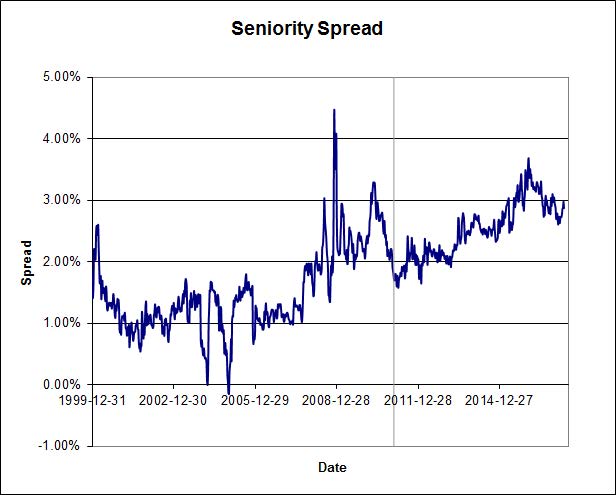
PerpetualDiscounts now yield 5.06%, equivalent to 6.58% interest at the standard equivalency factor of 1.3x. Long corporates now yield just a bit more than 3.8% so the pre-tax interest-equivalent spread (in this context, the “Seniority Spread”) is now about 275bp, a slight (and perhaps spurious) widening from the 270bp reported March 29.

HIMIPref™ Preferred Indices
These values reflect the December 2008 revision of the HIMIPref™ Indices

Values are provisional and are finalized monthly
Index Mean
Current
Yield
(at bid)
Median
YTW
Median
Average
Trading
Value
Median
Mod Dur
(YTW)
Issues Day’s Perf. Index Value
Ratchet 0.00 % 0.00 % 0 0.00 0 0.5537 % 2,192.7
FixedFloater 0.00 % 0.00 % 0 0.00 0 0.5537 % 4,023.5
Floater 3.47 % 3.56 % 40,361 18.41 4 0.5537 % 2,318.8
OpRet 0.00 % 0.00 % 0 0.00 0 0.0391 % 3,029.6
SplitShare 4.93 % 4.04 % 57,650 0.65 6 0.0391 % 3,618.0
Interest-Bearing 0.00 % 0.00 % 0 0.00 0 0.0391 % 2,822.9
Perpetual-Premium 5.28 % -8.91 % 73,787 0.09 23 -0.0287 % 2,792.2
Perpetual-Discount 5.07 % 5.06 % 115,306 15.38 13 -0.0934 % 3,006.2
FixedReset 4.33 % 3.95 % 241,189 6.66 94 0.0984 % 2,389.3
Deemed-Retractible 4.97 % 3.67 % 142,040 0.12 31 -0.0456 % 2,899.5
FloatingReset 2.52 % 3.01 % 53,532 4.53 9 0.0887 % 2,547.0
Performance Highlights
Issue Index Change Notes
SLF.PR.I FixedReset 1.06 % YTW SCENARIO
Maturity Type : Hard Maturity
Maturity Date : 2025-01-31
Maturity Price : 25.00
Evaluated at bid price : 23.82
Bid-YTW : 4.58 %
PWF.PR.T FixedReset 1.26 % YTW SCENARIO
Maturity Type : Limit Maturity
Maturity Date : 2047-04-12
Maturity Price : 23.02
Evaluated at bid price : 23.39
Bid-YTW : 3.76 %
TRP.PR.C FixedReset 1.54 % YTW SCENARIO
Maturity Type : Limit Maturity
Maturity Date : 2047-04-12
Maturity Price : 16.49
Evaluated at bid price : 16.49
Bid-YTW : 3.90 %
Volume Highlights
Issue Index Shares
Traded
Notes
RY.PR.Q FixedReset 112,655 YTW SCENARIO
Maturity Type : Call
Maturity Date : 2021-05-24
Maturity Price : 25.00
Evaluated at bid price : 27.32
Bid-YTW : 3.28 %
RY.PR.R FixedReset 110,275 YTW SCENARIO
Maturity Type : Call
Maturity Date : 2021-08-24
Maturity Price : 25.00
Evaluated at bid price : 27.50
Bid-YTW : 3.23 %
TRP.PR.B FixedReset 95,650 YTW SCENARIO
Maturity Type : Limit Maturity
Maturity Date : 2047-04-12
Maturity Price : 15.03
Evaluated at bid price : 15.03
Bid-YTW : 3.92 %
CU.PR.I FixedReset 78,497 YTW SCENARIO
Maturity Type : Call
Maturity Date : 2020-12-01
Maturity Price : 25.00
Evaluated at bid price : 26.45
Bid-YTW : 2.97 %
MFC.PR.L FixedReset 74,933 YTW SCENARIO
Maturity Type : Hard Maturity
Maturity Date : 2025-01-31
Maturity Price : 25.00
Evaluated at bid price : 21.71
Bid-YTW : 5.62 %
NA.PR.X FixedReset 73,592 YTW SCENARIO
Maturity Type : Call
Maturity Date : 2021-05-15
Maturity Price : 25.00
Evaluated at bid price : 27.20
Bid-YTW : 3.17 %
There were 32 other index-included issues trading in excess of 10,000 shares.
Wide Spread Highlights
Issue Index Quote Data and Yield Notes
BIP.PR.D FixedReset Quote: 25.52 – 25.75
Spot Rate : 0.2300
Average : 0.1528

YTW SCENARIO
Maturity Type : Call
Maturity Date : 2022-03-31
Maturity Price : 25.00
Evaluated at bid price : 25.52
Bid-YTW : 4.59 %

BNS.PR.Y FixedReset Quote: 22.45 – 22.65
Spot Rate : 0.2000
Average : 0.1313

YTW SCENARIO
Maturity Type : Hard Maturity
Maturity Date : 2022-01-31
Maturity Price : 25.00
Evaluated at bid price : 22.45
Bid-YTW : 4.29 %

SLF.PR.J FloatingReset Quote: 15.92 – 16.23
Spot Rate : 0.3100
Average : 0.2501

YTW SCENARIO
Maturity Type : Hard Maturity
Maturity Date : 2025-01-31
Maturity Price : 25.00
Evaluated at bid price : 15.92
Bid-YTW : 8.43 %

CU.PR.C FixedReset Quote: 22.74 – 22.95
Spot Rate : 0.2100
Average : 0.1538

YTW SCENARIO
Maturity Type : Limit Maturity
Maturity Date : 2047-04-12
Maturity Price : 22.12
Evaluated at bid price : 22.74
Bid-YTW : 3.84 %

ELF.PR.F Perpetual-Discount Quote: 24.88 – 25.05
Spot Rate : 0.1700
Average : 0.1154

YTW SCENARIO
Maturity Type : Limit Maturity
Maturity Date : 2047-04-12
Maturity Price : 24.62
Evaluated at bid price : 24.88
Bid-YTW : 5.34 %

POW.PR.B Perpetual-Premium Quote: 25.39 – 25.64
Spot Rate : 0.2500
Average : 0.1958

YTW SCENARIO
Maturity Type : Call
Maturity Date : 2017-05-12
Maturity Price : 25.00
Evaluated at bid price : 25.39
Bid-YTW : -13.56 %

Issue Comments

TA Outlook Downgraded To Negative By S&P

Standard & Poor’s has announced:

  • •TransAlta Corp.’s (TAC) reduction of contractedness via the expiry of Alberta power purchase agreements in 2018 and 2020 increases the company’s business risk.
  • •TAC’s financial metrics, although improving, may not sufficiently offset the potential increase in business risk.
  • •As a result, we are revising our outlook on the company to negative from stable.


“The outlook revision reflects our view that although TAC’s financial metrics have improved, they might not sufficiently offset the potential increase in business risk as a result of the reduction of contractedness via the expiry of the Alberta power purchase agreements in 2018 and 2020,” said S&P Global Ratings credit analyst Stephen Goltz.

Underpinning TAC’s strong business risk profile is the strength of the company’s contractual framework, in particular Alberta coal PPAs, which currently cover approximately 50% of TAC’s total capacity. The PPAs’ structure has mitigated Alberta’s volatile electricity prices, particularly in the past two years.

The company has made strong inroads into deleveraging its balance sheet amid Alberta’s very difficult power market. For the outlook period we forecast adjusted funds from operations (AFFO)-to-debt to improve to around 20%. However, while financial metrics have improved and are forecast to continue to do so, we see some headwinds that might impede the company’s ability to further raise them to a level that would mitigate the PPAs’ loss. We believe that the difficult operating environment will persist through the outlook period, with power prices likely to remain at their current depressed levels.

The negative outlook reflects our expectation that TAC’s business risk may increase as the company’s Alberta PPAs mature without TAC having an offsetting replacement mechanism that provides equivalent support to business risk or without continued improvement to financial metrics. We forecast that FFO-to-debt will be in the 18%-20% range and that contractedness will fall to about 73% in 2018 and to approximately 35% at the end of 2020 absent replacement contracts.

We could take a negative rating action if we believe that the factors that support a positive comparable rating assessment modifier will not continue. This could result from a reduction of contractedness without the replacement equivalent mechanisms and adjusted FFO-to-debt remaining at about 20%.

Affected issues are TA.PR.D, TA.PR.E, TA.PR.F, TA.PR.H and TA.PR.J.

This announcement follows last’s week’s downgrade to Pfd-3(low) by DBRS.