MAPF

MAPF Portfolio Composition : May, 2017

Turnover picked up in May, to about 12%.

There is extreme segmentation in the marketplace, with OSFI’s NVCC rule changes in February 2011 having had the effect of splitting the formerly relatively homogeneous Straight Perpetual class of preferreds into three parts:

  • Unaffected Straight Perpetuals
  • DeemedRetractibles explicitly subject to the rules (banks)
  • DeemedRetractibles considered by me, but not (yet!) by the market, to be likely to be explicitly subject to the rules in the future (insurers and insurance holding companies)

This segmentation, and the extreme valuation differences between the segments, has cut down markedly on the opportunities for trading.

To make this more clear, it used to be that there were 70-odd Straight Perpetuals and I was more or less indifferent as to which ones I owned (subject, of course, to issuer concentration concerns and other risk management factors). Thus, if any one of these 70 were to go down in price by – say – $0.25, I would quite often have something in inventory that I’d be willing to swap for it. The segmentation means that I am no longer indifferent; in addition to checking the valuation of a potential buy to other Straights, I also have to check its peer group. This cuts down on the potential for trading.

And, of course, the same segmentation has the same effect on trading opportunities between FixedReset issues.

There is no real hope that this situation will be corrected in the near-term. OSFI has indicated that the long-promised “Draft Definition of Capital” for insurers will not be issued “for public consultation in late 2012 or early 2013”, as they fear that it might encourage speculation in the marketplace. It is not clear why OSFI is so afraid of informed speculation, since the constant speculation in the marketplace is currently less informed than it would be with a little bit of regulatory clarity. While the framework has been updated, the modifications focus on the amount of capital required, not the required characteristics of that capital. However, OSFI has recently indicated that it would support a mechanism similar to the NVCC rule for banks, so we may see some developments as the IAIS deliberations regarding insurance capital continue.

As a result of this delay, I have extended the Deemed Maturity date for insurers and insurance holding companies by three years (to 2025-1-31), in the expectation that when OSFI finally does provide clarity, they will allow the same degree of lead-in time for these companies as they did for banks. This had a major effect on the durations of preferred shares subject to the change but, fortunately, not much on their calculated yields as most of these issues were either trading near par when the change was made or were trading at sufficient premium that a par call was expected on economic grounds. However, with the declines in the market over the past nine months, the expected capital gain on redemption of the insurance-issued DeemedRetractibles has become an important component of the calculated yield.

Due to the footdragging by OSFI, I will be extending the DeemedMaturity date for insurance issues by another few years in the near future.

Sectoral distribution of the MAPF portfolio on May 31 was as follows:

MAPF Sectoral Analysis 2017-5-31
HIMI Indices Sector Weighting YTW ModDur
Ratchet 0% N/A N/A
FixFloat 0% N/A N/A
Floater 0% N/A N/A
OpRet 0% N/A N/A
SplitShare 2.2% 4.44% 5.79
Interest Rearing 0% N/A N/A
PerpetualPremium 0% N/A N/A
PerpetualDiscount 6.3% 5.00% 15.51
Fixed-Reset 72.1% 6.60% 9.00
Deemed-Retractible 1.0% 6.04% 6.39
FloatingReset 8.3% 8.86% 6.82
Scraps (Various) 9.6% 6.08% 14.31
Cash +0.5% 0.00% 0.00
Total 100% 6.55% 9.59
Totals and changes will not add precisely due to rounding. Cash is included in totals with duration and yield both equal to zero.
DeemedRetractibles are comprised of all Straight Perpetuals (both PerpetualDiscount and PerpetualPremium) issued by BMO, BNS, CM, ELF, GWO, HSB, IAG, MFC, NA, RY, SLF and TD, which are not exchangable into common at the option of the company. These issues are analyzed as if their prospectuses included a requirement to redeem at par on or prior to 2022-1-31 (banks) or 2025-1-3 (insurers and insurance holding companies), in addition to the call schedule explicitly defined. See OSFI Does Not Grandfather Extant Tier 1 Capital, CM.PR.D, CM.PR.E, CM.PR.G: NVCC Status Confirmed and the January, February, March and June, 2011, editions of PrefLetter for the rationale behind this analysis.

Note that the estimate for the time this will become effective for insurers and insurance holding companies was extended by three years in April 2013, due to the delays in OSFI’s providing clarity on the issue.

Calculations of resettable instruments are performed assuming a constant GOC-5 rate of 0.95% and a constant 3-Month Bill rate of 0.54%

The “total” reflects the un-leveraged total portfolio (i.e., cash is included in the portfolio calculations and is deemed to have a duration and yield of 0.00.). MAPF will often have relatively large cash balances, both credit and debit, to facilitate trading. Figures presented in the table have been rounded to the indicated precision.

Credit distribution is:

MAPF Credit Analysis 2017-5-31
DBRS Rating Weighting
Pfd-1 0
Pfd-1(low) 0
Pfd-2(high) 39.4%
Pfd-2 33.6%
Pfd-2(low) 17.0%
Pfd-3(high) 0.8%
Pfd-3 4.6%
Pfd-3(low) 3.4%
Pfd-4(high) 0%
Pfd-4 0%
Pfd-4(low) 0%
Pfd-5(high) 0.7%
Pfd-5 0.0%
Cash +0.5%
Totals will not add precisely due to rounding.
The fund holds a position in AZP.PR.C, which is rated P-5(high) by S&P and is unrated by DBRS; it is included in the Pfd-5(high) total.
A position held in INE.PR.A is not rated by DBRS, but has been included as “Pfd-3” in the above table on the basis of its S&P rating of P-3.
A position held in BIP.PR.A is not rated by DBRS, but has been included as “Pfd-2(low)” in the above table on the basis of its S&P rating of P-2(low).

Liquidity Distribution is:

MAPF Liquidity Analysis 2017-5-31
Average Daily Trading Weighting
<$50,000 9.2%
$50,000 – $100,000 27.7%
$100,000 – $200,000 44.7%
$200,000 – $300,000 9.7%
>$300,000 8.2%
Cash +0.5%
Totals will not add precisely due to rounding.

MAPF is, of course, Malachite Aggressive Preferred Fund, a “unit trust” managed by Hymas Investment Management Inc. Further information and links to performance, audited financials and subscription information are available the fund’s web page. The fund may be purchased either directly from Hymas Investment Management or through a brokerage account at Odlum Brown Limited. A “unit trust” is like a regular mutual fund, but is sold by offering memorandum rather than prospectus. This is cheaper, but means subscription is restricted to “accredited investors” (as defined by the Ontario Securities Commission). Fund past performances are not a guarantee of future performance. You can lose money investing in MAPF or any other fund.

A similar portfolio composition analysis has been performed on the Claymore Preferred Share ETF (symbol CPD) (and other funds) as of August 31, 2012, and published in the October (mainly methodology), November (most funds), and December (ZPR) 2012, PrefLetter. While direct comparisons are difficult due to the introduction of the DeemedRetractible class of preferred share (see above) it is fair to say:

  • MAPF credit quality is better
  • MAPF liquidity is a bit lower
  • MAPF Yield is higher
  • Weightings
    • MAPF is less exposed to Straight Perpetuals (including DeemedRetractibles)
    • MAPF is less exposed to Operating Retractibles
    • MAPF is usually, but not currently, more exposed to SplitShares
    • MAPF is less exposed to FixFloat / Floater / Ratchet
    • MAPF is overweighted in FixedResets
Market Action

June 2, 2017

Jobs, jobs, jobs!

Nonfarm payrolls rose by a seasonally adjusted 138,000 in May from the prior month, the Labor Department said Friday, and job gains in the prior two months were revised down. The unemployment rate fell to 4.3%, the lowest reading since May 2001. Economists surveyed by The Wall Street Journal had expected 184,000 new jobs to be added in May and a jobless rate of 4.4%.

The drop in unemployment suggests that the labor market is at or very near full employment, or the point when virtually all workers who are seeking a job have found one. Federal Reserve officials projected in March the jobless rate will average 4.7% to 5% over the long run.

Average hourly earnings for private-sector workers increased by 4 cents to $26.22 an hour in May. From a year earlier, wages rose 2.5%. Annual wage gains have stayed near the 2.5% pace since late 2015, despite a steady decrease in the unemployment rate.

Typically, economists would expect falling unemployment to coincide with better wage gains. When the unemployment rate was 4.4% in May 2007, wages for nonsupervisory workers were growing better than 4% annually. In May 2001, those wages were up 4% from a year earlier. Nonsupervisory wages rose 2.4% last month, from a year earlier.

Maybe people have lost the habit of paying more:

Robert Barbera, co-director for the Center for Financial Economics at Johns Hopkins University, suggests it is important to not just look at the unemployment rate’s level, but how long it took to get there

It took a long seven years for the unemployment rate to get to 4.3% from the peak of 10% in October 2009. Because of the sluggish growth, businesses never had to scramble, and pay more, to add workers. And at no point did workers feel they were awash in opportunity.

This slow growth doesn’t give people confidence to ask for higher wages. And plenty of workers have never experienced that kind of environment: The 2000s were a bit of a dud outside of housing. Only workers in their 40s and older remember the 1990s boom. Maybe the U.S. labor market is turning a bit like Japan’s, where the unemployment has fallen to its lowest level in nearly a quarter-century, but after so many years of disappointment, workers are hesitant to demand higher wages, and employers are hesitant to give them.

Meanwhile Illinois is in big trouble!

Illinois had its bond rating downgraded to one step above junk by Moody’s Investors Service and S&P Global Ratings, the lowest ranking on record for a U.S. state, as the long-running political stalemate over the budget shows no signs of ending.

S&P warned that Illinois will likely lose its investment-grade status, an unprecedented step for a state, around July 1 if leaders haven’t agreed on a budget that chips away at the government’s chronic deficits. Moody’s followed S&P’s downgrade Thursday, citing Illinois’s underfunded pensions and the record backlog of bills that are equivalent to about 40 percent of its operating budget.

“Legislative gridlock has sidetracked efforts not only to address pension needs but also to achieve fiscal balance,” Ted Hampton, Moody’s analyst, said in a statement. “During the past year of fruitless negotiations and partisan wrangling, fundamental credit challenges have intensified enough to warrant a downgrade, regardless of whether a fiscal compromise is reached.”

“The rating actions largely reflect the severe deterioration of Illinois’ fiscal condition, a byproduct of its stalemated budget negotiations,” S&P analyst Gabriel Petek said in a statement. “The unrelenting political brinkmanship now poses a threat to the timely payment of the state’s core priority payments.”

Meanwhile, Picton Mahoney has gotten some ink for investing in ‘Deemed Retractible bonds’

Phil Mesman and his colleagues at Picton Mahoney Asset Management have been scooping up subordinated debt issued by the likes of JPMorgan Chase & Co., Barclays Plc, and Credit Agricole SA in the 1980s and 1990s that is trading at a discount to face value. The goal is to get repaid early at a premium to the current price. This strategy, which began almost two years ago with a spreadsheet plotting the rather tiny universe of the asset class, has handed the firm’s funds returns of more than 20 percent, Mesman said.

These legacy hybrid capital notes were originally issued to convert to equity in the event of a bank failure. They trade at a discount primarily because of the low coupon, which is based on a spread over the London interbank offered rate, and uncertainty around whether or not they will be repaid early, Mesman said.

The bonds, which also have a liquidity discount, have a maturity of 25 years or longer in most cases, and some are perpetual bonds, he said. The bond covenants and structures are good for investors, because they make it difficult for a bank to convert the bonds to equity in the event it needs to shore up capital levels. Regulators have said that banks need to take out the bonds before Jan. 1, 2022, Mesman said, putting a deadline on opportunities in the trade.

HIMIPref™ Preferred Indices
These values reflect the December 2008 revision of the HIMIPref™ Indices

Values are provisional and are finalized monthly
Index Mean
Current
Yield
(at bid)
Median
YTW
Median
Average
Trading
Value
Median
Mod Dur
(YTW)
Issues Day’s Perf. Index Value
Ratchet 0.00 % 0.00 % 0 0.00 0 -0.8136 % 2,090.9
FixedFloater 0.00 % 0.00 % 0 0.00 0 -0.8136 % 3,836.7
Floater 3.75 % 3.79 % 84,386 17.80 3 -0.8136 % 2,211.1
OpRet 0.00 % 0.00 % 0 0.00 0 0.0158 % 3,041.4
SplitShare 4.73 % 4.30 % 69,297 1.55 5 0.0158 % 3,632.1
Interest-Bearing 0.00 % 0.00 % 0 0.00 0 0.0158 % 2,833.9
Perpetual-Premium 5.28 % -0.69 % 71,623 0.09 25 0.1314 % 2,792.1
Perpetual-Discount 5.07 % 5.06 % 103,880 15.33 12 0.1058 % 3,012.9
FixedReset 4.53 % 4.15 % 194,604 6.55 95 -0.3398 % 2,288.1
Deemed-Retractible 4.97 % 4.94 % 125,317 6.28 30 0.1115 % 2,907.1
FloatingReset 2.52 % 3.15 % 47,391 4.40 10 -0.1214 % 2,527.4
Performance Highlights
Issue Index Change Notes
TRP.PR.C FixedReset -2.44 % YTW SCENARIO
Maturity Type : Limit Maturity
Maturity Date : 2047-06-02
Maturity Price : 15.19
Evaluated at bid price : 15.19
Bid-YTW : 4.07 %
TRP.PR.B FixedReset -2.02 % YTW SCENARIO
Maturity Type : Limit Maturity
Maturity Date : 2047-06-02
Maturity Price : 14.06
Evaluated at bid price : 14.06
Bid-YTW : 3.95 %
PWF.PR.P FixedReset -1.90 % YTW SCENARIO
Maturity Type : Limit Maturity
Maturity Date : 2047-06-02
Maturity Price : 15.50
Evaluated at bid price : 15.50
Bid-YTW : 4.08 %
TRP.PR.A FixedReset -1.45 % YTW SCENARIO
Maturity Type : Limit Maturity
Maturity Date : 2047-06-02
Maturity Price : 18.30
Evaluated at bid price : 18.30
Bid-YTW : 4.00 %
MFC.PR.J FixedReset -1.43 % YTW SCENARIO
Maturity Type : Hard Maturity
Maturity Date : 2025-01-31
Maturity Price : 25.00
Evaluated at bid price : 21.44
Bid-YTW : 5.94 %
TRP.PR.H FloatingReset -1.34 % YTW SCENARIO
Maturity Type : Limit Maturity
Maturity Date : 2047-06-02
Maturity Price : 13.22
Evaluated at bid price : 13.22
Bid-YTW : 3.43 %
BMO.PR.Q FixedReset -1.20 % YTW SCENARIO
Maturity Type : Hard Maturity
Maturity Date : 2022-01-31
Maturity Price : 25.00
Evaluated at bid price : 21.32
Bid-YTW : 5.47 %
IFC.PR.A FixedReset -1.19 % YTW SCENARIO
Maturity Type : Hard Maturity
Maturity Date : 2025-01-31
Maturity Price : 25.00
Evaluated at bid price : 17.37
Bid-YTW : 8.41 %
BAM.PF.B FixedReset -1.14 % YTW SCENARIO
Maturity Type : Limit Maturity
Maturity Date : 2047-06-02
Maturity Price : 20.81
Evaluated at bid price : 20.81
Bid-YTW : 4.45 %
BAM.PR.C Floater -1.10 % YTW SCENARIO
Maturity Type : Limit Maturity
Maturity Date : 2047-06-02
Maturity Price : 12.56
Evaluated at bid price : 12.56
Bid-YTW : 3.80 %
CM.PR.Q FixedReset -1.06 % YTW SCENARIO
Maturity Type : Limit Maturity
Maturity Date : 2047-06-02
Maturity Price : 22.07
Evaluated at bid price : 22.46
Bid-YTW : 4.15 %
BAM.PR.X FixedReset -1.05 % YTW SCENARIO
Maturity Type : Limit Maturity
Maturity Date : 2047-06-02
Maturity Price : 16.08
Evaluated at bid price : 16.08
Bid-YTW : 4.35 %
RY.PR.H FixedReset -1.04 % YTW SCENARIO
Maturity Type : Limit Maturity
Maturity Date : 2047-06-02
Maturity Price : 20.90
Evaluated at bid price : 20.90
Bid-YTW : 3.95 %
Volume Highlights
Issue Index Shares
Traded
Notes
CM.PR.R FixedReset 2,454,817 YTW SCENARIO
Maturity Type : Limit Maturity
Maturity Date : 2047-06-02
Maturity Price : 23.14
Evaluated at bid price : 24.98
Bid-YTW : 4.25 %
PWF.PR.Z Perpetual-Premium 171,302 YTW SCENARIO
Maturity Type : Limit Maturity
Maturity Date : 2047-06-02
Maturity Price : 24.67
Evaluated at bid price : 25.07
Bid-YTW : 5.15 %
MFC.PR.N FixedReset 101,200 YTW SCENARIO
Maturity Type : Hard Maturity
Maturity Date : 2025-01-31
Maturity Price : 25.00
Evaluated at bid price : 20.35
Bid-YTW : 6.60 %
TRP.PR.K FixedReset 91,577 YTW SCENARIO
Maturity Type : Call
Maturity Date : 2022-05-31
Maturity Price : 25.00
Evaluated at bid price : 25.86
Bid-YTW : 4.16 %
MFC.PR.R FixedReset 86,691 YTW SCENARIO
Maturity Type : Call
Maturity Date : 2022-03-19
Maturity Price : 25.00
Evaluated at bid price : 25.60
Bid-YTW : 4.26 %
TRP.PR.J FixedReset 68,103 YTW SCENARIO
Maturity Type : Call
Maturity Date : 2021-05-31
Maturity Price : 25.00
Evaluated at bid price : 26.68
Bid-YTW : 3.70 %
There were 42 other index-included issues trading in excess of 10,000 shares.
Wide Spread Highlights
Issue Index Quote Data and Yield Notes
IAG.PR.A Deemed-Retractible Quote: 22.85 – 23.25
Spot Rate : 0.4000
Average : 0.2807

YTW SCENARIO
Maturity Type : Hard Maturity
Maturity Date : 2025-01-31
Maturity Price : 25.00
Evaluated at bid price : 22.85
Bid-YTW : 5.99 %

TRP.PR.B FixedReset Quote: 14.06 – 14.39
Spot Rate : 0.3300
Average : 0.2449

YTW SCENARIO
Maturity Type : Limit Maturity
Maturity Date : 2047-06-02
Maturity Price : 14.06
Evaluated at bid price : 14.06
Bid-YTW : 3.95 %

MFC.PR.J FixedReset Quote: 21.44 – 21.67
Spot Rate : 0.2300
Average : 0.1550

YTW SCENARIO
Maturity Type : Hard Maturity
Maturity Date : 2025-01-31
Maturity Price : 25.00
Evaluated at bid price : 21.44
Bid-YTW : 5.94 %

CM.PR.Q FixedReset Quote: 22.46 – 22.67
Spot Rate : 0.2100
Average : 0.1424

YTW SCENARIO
Maturity Type : Limit Maturity
Maturity Date : 2047-06-02
Maturity Price : 22.07
Evaluated at bid price : 22.46
Bid-YTW : 4.15 %

CU.PR.D Perpetual-Discount Quote: 24.64 – 24.85
Spot Rate : 0.2100
Average : 0.1517

YTW SCENARIO
Maturity Type : Limit Maturity
Maturity Date : 2047-06-02
Maturity Price : 24.35
Evaluated at bid price : 24.64
Bid-YTW : 4.99 %

SLF.PR.D Deemed-Retractible Quote: 22.38 – 22.61
Spot Rate : 0.2300
Average : 0.1754

YTW SCENARIO
Maturity Type : Hard Maturity
Maturity Date : 2025-01-31
Maturity Price : 25.00
Evaluated at bid price : 22.38
Bid-YTW : 6.16 %

Issue Comments

CM.PR.R Firm On Excellent Volume

The Canadian Imperial Bank of Commerce has announced:

that it has completed the offering of 32 million Basel III-compliant Non-cumulative Rate Reset Class A Preferred Shares Series 45 (Non-Viability Contingent Capital (NVCC)) (the “Series 45 Shares”) priced at $25.00 per share to raise gross proceeds of $800 million.

The offering was made through a syndicate of underwriters led by CIBC World Markets Inc. The Series 45 Shares commence trading on the Toronto Stock Exchange today under the ticker symbol CM.PR.R.

The Series 45 Shares were issued under a prospectus supplement dated May 26, 2017, to CIBC’s short form base shelf prospectus dated March 16, 2016.

CM.PR.R is a FixedReset, 4.40%+338, NVCC Compliant issue announced 2017-05-25. It will be tracked by HIMIPref™ and has been added to the FixedResets subindex.

The issue traded 2,454,817 shares today in a range of 24.96-07 before closing at 24.98-00. This volume places it eighteenth on the all-time (well, back until 1993-12-31, anyway) list, just behind TD.PR.H on 2004-4-6 and just ahead of BCE.PR.P on 2002-6-13. Vital statistics are:

CM.PR.R FixedReset YTW SCENARIO
Maturity Type : Limit Maturity
Maturity Date : 2047-06-02
Maturity Price : 23.14
Evaluated at bid price : 24.98
Bid-YTW : 4.25 %

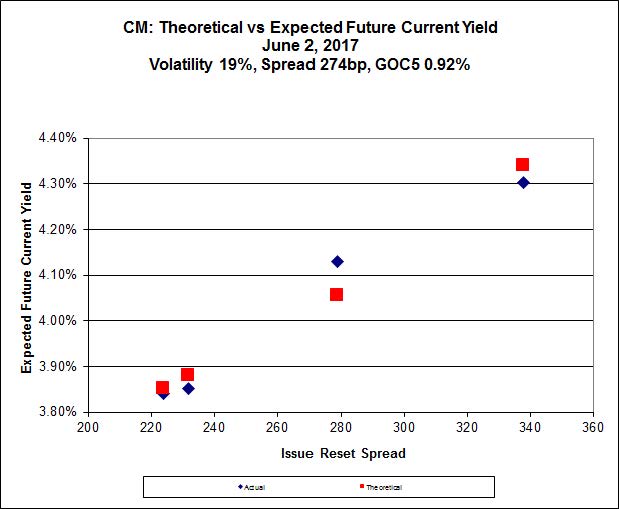
Implied Volatility analysis for FixedResets continues to suggest the issue may be a little expensive:

impvol_cm_170602
Click for Big

The theoretical price implied by the above calculation is 24.77.

Issue Comments

ENB.PR.C Debuts With No Trading

Assiduous Readers will remember that there was an 8% Conversion from the FixedReset ENB.PR.B to the FloatingReset ENB.PR.C, which the company treated as top secret information. I advised readers not to convert, but to continue holding the ENB.PR.B, which have reset to 3.415%.

ENB.PR.C will pay dividends at a rate of 3-Month Canada Treasury Bills plus 240bp, reset quarterly.

The issue was listed yesterday, but didn’t trade – this is largely due to the banks’ hegemony over the Canadian financial system (approved by both securities regulators and the Competition-haha Board) and their total lack of interest in providing competent service to stinking investor scum such as yourselves. These exchanges do not hit client accounts until the day after the company gives effect to them – however, investors can complain to the bank-owned CDS and the (mostly) bank-owned brokerages about this lackadaisical attitude toward client assets and see how far it gets them.

The issue also did not trade today, but at least the spread on the quote narrowed considerably from yesterday’s value.

Vital Statistics are:

ENB.PR.C FloatingReset YTW SCENARIO
Maturity Type : Limit Maturity
Maturity Date : 2047-06-02
Maturity Price : 17.00
Evaluated at bid price : 17.00
Bid-YTW : 4.36 %

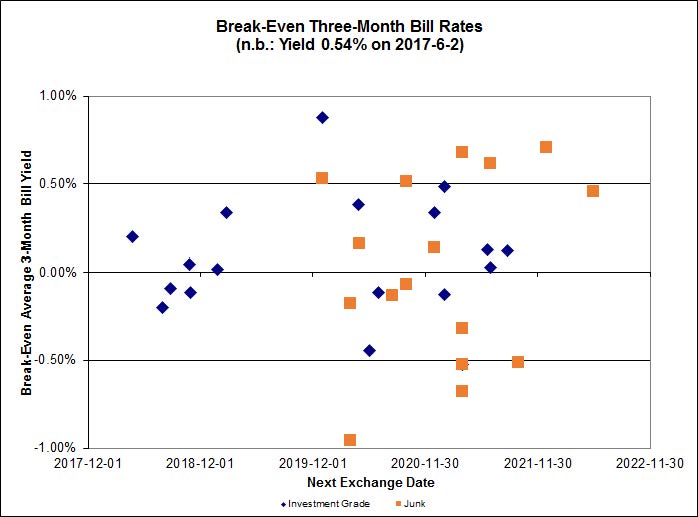
The most logical way to analyze the relative value of ENB.PR.C vs ENB.PR.B through the theory of Preferred Pairs, for which a calculator is available. Briefly, a Strong Pair is defined as a pair of securities that can be interconverted in the future (e.g., IAG.PR.G and the FloatingReset that will exist if enough holders convert). Since they will be interconvertible on this future date, it may be assumed that they will be priced identically on this date (if they aren’t then holders will simply convert en masse to the higher-priced issue). And since they will be priced identically on a given date in the future, any current difference in price must be offset by expectations of an equal and opposite value of dividends to be received in the interim. And since the dividend rate on one element of the pair is both fixed and known, the implied average rate of the other, floating rate, instrument can be determined. Finally, we say, we may compare these average rates and take a view regarding the actual future course of that rate relative to the implied rate, which will provide us with guidance on which element of the pair is likely to outperform the other until the next interconversion date, at which time the process will be repeated.

We can show the break-even rates for each FixedReset / FloatingReset Strong Pair graphically by plotting the implied average 3-month bill rate against the next Exchange Date (which is the date to which the average will be calculated).

pairs_fr_170602
Click for Big

The break-even T-Bill yield for the ENB.PR.B / ENB.PR.C pair is now 0.46% (given bid prices of 17.56 and 17.00, respectively), well above the junk-pair average of -0.16%, but slightly below the current actual bill rate of 0.54%.

New Issues

New Issue: NA FixedReset, 4.45%+343, NVCC

National Bank of Canada has announced:

that it has entered into an agreement with a group of underwriters led by National Bank Financial Inc. for the issuance on a bought deal basis of 12 million non-cumulative 5-year rate reset first preferred shares series 38 (non-viability contingent capital (NVCC)) (the “Series 38 Preferred Shares”) at a price of $25.00 per share, to raise gross proceeds of $300 million.

National Bank has granted the underwriters an option to purchase, on the same terms, up to an additional 4 million Series 38 Preferred Shares. This option is exercisable in whole or in part by the underwriters at any time up to two business days prior to closing. The gross proceeds raised under the offering will be $400 million should this option be exercised in full.

The Series 38 Preferred Shares will yield 4.45% annually, payable quarterly, as and when declared by the Board of Directors of National Bank, for the initial period ending November 15, 2022. The first of such dividends, if declared, shall be payable on November 15, 2017. Thereafter, the dividend rate will reset every five years at a level of 343 basis points over the then 5-year Government of Canada bond yield. Subject to regulatory approval, National Bank may redeem the Series 38 Preferred Shares in whole or in part at par on November 15, 2022 and on November 15 every five years thereafter.

Holders of the Series 38 Preferred Shares will have the right to convert their shares into an equal number of non-cumulative floating rate first preferred shares series 39 (non-viability contingent capital (NVCC)) (the “Series 39 Preferred Shares”), subject to certain conditions, on November 15, 2022, and on November 15 every five years thereafter. Holders of the Series 39 Preferred Shares will be entitled to receive quarterly floating dividends, as and when declared by the Board of Directors of National Bank, equal to the 90-day Government of Canada Treasury Bill rate plus 343 basis points.

The net proceeds of the offering will be used for general corporate purposes and added to National Bank’s capital base. The expected closing date is on or about June 13, 2017. National Bank intends to file in Canada a prospectus supplement to its November 21, 2016 base shelf prospectus in respect of this issue.

They later announced:

that as a result of strong investor demand for its previously announced domestic public offering of non-cumulative 5-year rate reset first preferred shares series 38 (non-viability contingent capital (NVCC)) (the “Series 38 Preferred Shares”), the underwriters have exercised their option to purchase an additional 4,000,000 Series 38 Preferred Shares. The size of the offering has been increased to 16 million shares for gross proceeds of $400 million. The offering will be underwritten by a syndicate led by National Bank Financial Inc. The expected closing date is on or about June 13, 2017.

The net proceeds of the offering will be used for general corporate purposes and added to National Bank’s capital base.

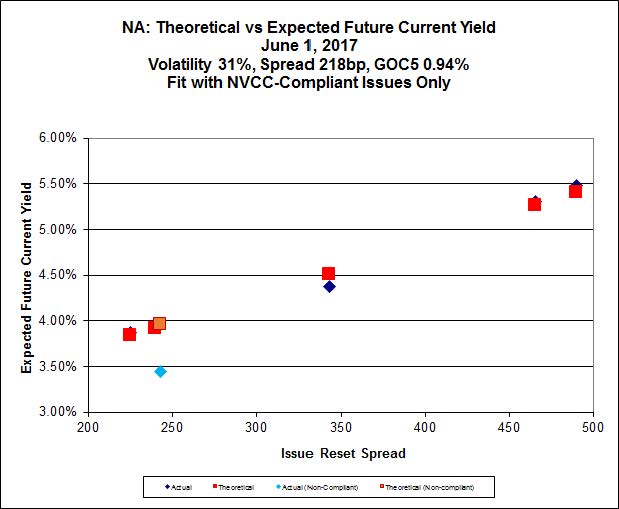
Implied Volatility analysis for FixedResets suggests that this issue should be regarded as expensive:

impvol_na_170601
Click for Big

The theoretical price of the new issue is 24.25.

Market Action

June 1, 2017

HIMIPref™ Preferred Indices
These values reflect the December 2008 revision of the HIMIPref™ Indices

Values are provisional and are finalized monthly
Index Mean
Current
Yield
(at bid)
Median
YTW
Median
Average
Trading
Value
Median
Mod Dur
(YTW)
Issues Day’s Perf. Index Value
Ratchet 0.00 % 0.00 % 0 0.00 0 -1.7535 % 2,108.0
FixedFloater 0.00 % 0.00 % 0 0.00 0 -1.7535 % 3,868.1
Floater 3.72 % 3.76 % 83,942 17.86 3 -1.7535 % 2,229.2
OpRet 0.00 % 0.00 % 0 0.00 0 -0.3850 % 3,040.9
SplitShare 4.73 % 4.38 % 70,349 3.94 5 -0.3850 % 3,631.5
Interest-Bearing 0.00 % 0.00 % 0 0.00 0 -0.3850 % 2,833.5
Perpetual-Premium 5.29 % 0.02 % 71,435 0.09 25 -0.0313 % 2,788.5
Perpetual-Discount 5.07 % 5.08 % 107,709 15.30 12 0.2084 % 3,009.7
FixedReset 4.51 % 4.11 % 194,832 6.55 94 -0.1675 % 2,295.9
Deemed-Retractible 4.98 % 4.95 % 127,298 6.28 30 -0.1046 % 2,903.8
FloatingReset 2.52 % 3.19 % 48,144 4.41 10 -0.1632 % 2,530.5
Performance Highlights
Issue Index Change Notes
BAM.PR.B Floater -1.85 % YTW SCENARIO
Maturity Type : Limit Maturity
Maturity Date : 2047-06-01
Maturity Price : 12.70
Evaluated at bid price : 12.70
Bid-YTW : 3.76 %
BAM.PR.K Floater -1.78 % YTW SCENARIO
Maturity Type : Limit Maturity
Maturity Date : 2047-06-01
Maturity Price : 12.70
Evaluated at bid price : 12.70
Bid-YTW : 3.76 %
PVS.PR.E SplitShare -1.67 % YTW SCENARIO
Maturity Type : Hard Maturity
Maturity Date : 2022-10-31
Maturity Price : 25.00
Evaluated at bid price : 25.92
Bid-YTW : 4.73 %
BAM.PR.C Floater -1.63 % YTW SCENARIO
Maturity Type : Limit Maturity
Maturity Date : 2047-06-01
Maturity Price : 12.70
Evaluated at bid price : 12.70
Bid-YTW : 3.76 %
BAM.PR.Z FixedReset -1.59 % YTW SCENARIO
Maturity Type : Limit Maturity
Maturity Date : 2047-06-01
Maturity Price : 21.35
Evaluated at bid price : 21.63
Bid-YTW : 4.61 %
SLF.PR.G FixedReset -1.47 % YTW SCENARIO
Maturity Type : Hard Maturity
Maturity Date : 2025-01-31
Maturity Price : 25.00
Evaluated at bid price : 16.08
Bid-YTW : 8.81 %
IFC.PR.C FixedReset -1.42 % YTW SCENARIO
Maturity Type : Hard Maturity
Maturity Date : 2025-01-31
Maturity Price : 25.00
Evaluated at bid price : 20.85
Bid-YTW : 6.33 %
BAM.PF.F FixedReset -1.37 % YTW SCENARIO
Maturity Type : Limit Maturity
Maturity Date : 2047-06-01
Maturity Price : 22.00
Evaluated at bid price : 22.25
Bid-YTW : 4.43 %
IFC.PR.A FixedReset -1.35 % YTW SCENARIO
Maturity Type : Hard Maturity
Maturity Date : 2025-01-31
Maturity Price : 25.00
Evaluated at bid price : 17.58
Bid-YTW : 8.22 %
IAG.PR.G FixedReset -1.22 % YTW SCENARIO
Maturity Type : Hard Maturity
Maturity Date : 2025-01-31
Maturity Price : 25.00
Evaluated at bid price : 21.78
Bid-YTW : 5.89 %
GWO.PR.N FixedReset -1.21 % YTW SCENARIO
Maturity Type : Hard Maturity
Maturity Date : 2025-01-31
Maturity Price : 25.00
Evaluated at bid price : 15.45
Bid-YTW : 9.27 %
BAM.PF.G FixedReset -1.19 % YTW SCENARIO
Maturity Type : Limit Maturity
Maturity Date : 2047-06-01
Maturity Price : 22.05
Evaluated at bid price : 22.42
Bid-YTW : 4.40 %
BAM.PR.R FixedReset -1.13 % YTW SCENARIO
Maturity Type : Limit Maturity
Maturity Date : 2047-06-01
Maturity Price : 18.43
Evaluated at bid price : 18.43
Bid-YTW : 4.41 %
BAM.PF.C Perpetual-Discount 1.04 % YTW SCENARIO
Maturity Type : Limit Maturity
Maturity Date : 2047-06-01
Maturity Price : 22.84
Evaluated at bid price : 23.24
Bid-YTW : 5.29 %
BAM.PR.N Perpetual-Discount 1.10 % YTW SCENARIO
Maturity Type : Limit Maturity
Maturity Date : 2047-06-01
Maturity Price : 22.70
Evaluated at bid price : 22.94
Bid-YTW : 5.25 %
CM.PR.Q FixedReset 1.20 % YTW SCENARIO
Maturity Type : Limit Maturity
Maturity Date : 2047-06-01
Maturity Price : 22.23
Evaluated at bid price : 22.70
Bid-YTW : 4.10 %
PWF.PR.P FixedReset 1.28 % YTW SCENARIO
Maturity Type : Limit Maturity
Maturity Date : 2047-06-01
Maturity Price : 15.80
Evaluated at bid price : 15.80
Bid-YTW : 4.00 %
TRP.PR.A FixedReset 1.64 % YTW SCENARIO
Maturity Type : Limit Maturity
Maturity Date : 2047-06-01
Maturity Price : 18.57
Evaluated at bid price : 18.57
Bid-YTW : 3.94 %
Volume Highlights
Issue Index Shares
Traded
Notes
MFC.PR.R FixedReset 123,294 YTW SCENARIO
Maturity Type : Call
Maturity Date : 2022-03-19
Maturity Price : 25.00
Evaluated at bid price : 25.53
Bid-YTW : 4.33 %
TD.PF.A FixedReset 60,581 YTW SCENARIO
Maturity Type : Limit Maturity
Maturity Date : 2047-06-01
Maturity Price : 21.00
Evaluated at bid price : 21.00
Bid-YTW : 3.95 %
BMO.PR.C FixedReset 44,447 YTW SCENARIO
Maturity Type : Limit Maturity
Maturity Date : 2047-06-01
Maturity Price : 23.32
Evaluated at bid price : 25.49
Bid-YTW : 4.19 %
PWF.PR.Z Perpetual-Premium 40,885 YTW SCENARIO
Maturity Type : Limit Maturity
Maturity Date : 2047-06-01
Maturity Price : 24.61
Evaluated at bid price : 25.00
Bid-YTW : 5.17 %
PWF.PR.T FixedReset 40,057 YTW SCENARIO
Maturity Type : Limit Maturity
Maturity Date : 2047-06-01
Maturity Price : 22.44
Evaluated at bid price : 22.81
Bid-YTW : 3.74 %
GWO.PR.T Deemed-Retractible 32,383 YTW SCENARIO
Maturity Type : Hard Maturity
Maturity Date : 2025-01-31
Maturity Price : 25.00
Evaluated at bid price : 25.20
Bid-YTW : 5.09 %
There were 22 other index-included issues trading in excess of 10,000 shares.
Wide Spread Highlights
Issue Index Quote Data and Yield Notes
BAM.PF.F FixedReset Quote: 22.25 – 22.70
Spot Rate : 0.4500
Average : 0.2652

YTW SCENARIO
Maturity Type : Limit Maturity
Maturity Date : 2047-06-01
Maturity Price : 22.00
Evaluated at bid price : 22.25
Bid-YTW : 4.43 %

PVS.PR.E SplitShare Quote: 25.92 – 26.48
Spot Rate : 0.5600
Average : 0.4216

YTW SCENARIO
Maturity Type : Hard Maturity
Maturity Date : 2022-10-31
Maturity Price : 25.00
Evaluated at bid price : 25.92
Bid-YTW : 4.73 %

CM.PR.O FixedReset Quote: 20.91 – 21.24
Spot Rate : 0.3300
Average : 0.2114

YTW SCENARIO
Maturity Type : Limit Maturity
Maturity Date : 2047-06-01
Maturity Price : 20.91
Evaluated at bid price : 20.91
Bid-YTW : 4.04 %

SLF.PR.H FixedReset Quote: 18.68 – 18.99
Spot Rate : 0.3100
Average : 0.1963

YTW SCENARIO
Maturity Type : Hard Maturity
Maturity Date : 2025-01-31
Maturity Price : 25.00
Evaluated at bid price : 18.68
Bid-YTW : 7.30 %

BAM.PR.Z FixedReset Quote: 21.63 – 21.92
Spot Rate : 0.2900
Average : 0.1896

YTW SCENARIO
Maturity Type : Limit Maturity
Maturity Date : 2047-06-01
Maturity Price : 21.35
Evaluated at bid price : 21.63
Bid-YTW : 4.61 %

NA.PR.X FixedReset Quote: 26.65 – 26.90
Spot Rate : 0.2500
Average : 0.1516

YTW SCENARIO
Maturity Type : Call
Maturity Date : 2021-05-15
Maturity Price : 25.00
Evaluated at bid price : 26.65
Bid-YTW : 3.87 %

Issue Comments

CF.PR.C To Reset At 4.993%

Canaccord Genuity Group Inc. has announced:

the applicable dividend rates for its Cumulative 5-Year Rate Reset First Preferred Shares, Series C (the “Series C Preferred Shares”) and its Cumulative Floating Rate First Preferred Shares, Series D (the “Series D Preferred Shares”), further to its press release dated May 24, 2017 announcing that it does not intend to exercise its right to redeem all or any part of the currently outstanding Series C Preferred Shares and, as a result of which, subject to certain conditions, the holders of the Series C Preferred Shares have the right to convert all or any part of their Series C Preferred Shares into Series D Preferred Shares on a one-for-one basis.

With respect to any Series C Preferred Shares that remain outstanding after June 30, 2017, holders thereof will be entitled to receive quarterly fixed, cumulative, preferential cash dividends, if, as and when declared by the Board of Directors of the Company, subject to the provisions of the Business Corporations Act (British Columbia). The dividend rate for the five-year period commencing on July 1, 2017 and ending on and including June 30, 2022 will be 4.993% per annum, being equal to the sum of the five year Government of Canada bond yield determined as of today, plus 4.03%, in accordance with the terms of the Series C Preferred Shares.

With respect to any Series D Preferred Shares that may be issued on June 30, 2017, holders thereof will be entitled to receive quarterly floating rate, cumulative, preferential cash dividends, if, as and when declared by the Board of Directors of the Company, subject to the provisions of the Business Corporations Act (British Columbia). The dividend rate for the three-month period commencing on July 1, 2017 and ending on and including September 30, 2017 will be 4.559% per annum, being equal to the sum of the three-month Government of Canada Treasury Bill yield determined as of today, plus 4.03% (calculated on the basis of the actual number of days elapsed during such quarterly period divided by 365), in accordance with the terms of the Series D Preferred Shares. The quarterly floating dividend rate will be reset every quarter.

Beneficial owners of Series C Preferred Shares who wish to exercise their conversion right should communicate as soon as possible with their broker or other nominee to ensure their instructions are followed for exercising such right on or prior to the deadline for exercise, which is 5:00 p.m. (Toronto time) on June 15, 2017.

CF.PR.C is a FixedReset, 5.75%+403 that commenced trading 2012-4-10 after being announced 2012-3-22. It has been relegated to the Scraps subindex since inception on credit concerns.

The most logical way to analyze the question of whether or not to convert is through the theory of Preferred Pairs, for which a calculator is available. Briefly, a Strong Pair is defined as a pair of securities that can be interconverted in the future (e.g., IAG.PR.G and the FloatingReset that will exist if enough holders convert). Since they will be interconvertible on this future date, it may be assumed that they will be priced identically on this date (if they aren’t then holders will simply convert en masse to the higher-priced issue). And since they will be priced identically on a given date in the future, any current difference in price must be offset by expectations of an equal and opposite value of dividends to be received in the interim. And since the dividend rate on one element of the pair is both fixed and known, the implied average rate of the other, floating rate, instrument can be determined. Finally, we say, we may compare these average rates and take a view regarding the actual future course of that rate relative to the implied rate, which will provide us with guidance on which element of the pair is likely to outperform the other until the next interconversion date, at which time the process will be repeated.

We can show the break-even rates for each FixedReset / FloatingReset Strong Pair graphically by plotting the implied average 3-month bill rate against the next Exchange Date (which is the date to which the average will be calculated).

pairs_fr_170601
Click for Big

The market appears to have a distaste at the moment for floating rate product; most of the implied rates until the next interconversion are lower than the current 3-month bill rate and the averages for investment-grade and junk issues are both well below current market rates, at +0.07% and -0.33%, respectively! Whatever might be the result of the next few Bank of Canada overnight rate decisions, I suggest that it is unlikely that the average rate over the next five years will be lower than current – but if you disagree, of course, you may interpret the data any way you like.

Since credit quality of each element of the pair is equal to the other element, it should not make any difference whether the pair examined is investment-grade or junk, although we might expect greater variation of implied rates between junk issues on grounds of lower liquidity, and this is just what we see.

If we plug in the current bid price of the CF.PR.C FixedReset, we may construct the following table showing consistent prices for its soon-may-be-issued FloatingReset counterpart given a variety of Implied Breakeven yields consistent with issues currently trading:

Estimate of FloatingReset CF.PR.? (received in exchange for CF.PR.C) Trading Price In Current Conditions
  Assumed FloatingReset
Price if Implied Bill
is equal to
FixedReset Bid Price Spread 0.50% 0.00% -0.50%
CF.PR.C 16.90 403bp 16.48 16.02 15.56

Based on current market conditions, I suggest that the FloatingResets that will result from conversion are likely to be cheap and trading below the price of their FixedReset counterparts. Therefore, it seems likely that I will recommend that holders of CF.PR.C continue to hold the issue and not to convert, but I will wait until it’s closer to the June 15 notification deadline before making a final pronouncement. I will note that, given the apparent cheapness of the FloatingResets, it may be a good trade to swap the FixedReset for the FloatingReset in the market once both elements of each pair are trading and you can – presumably, according to this analysis – do it with a reasonably good take-out in price, rather than doing it through the company on a 1:1 basis. But that, of course, will depend on the prices at that time and your forecast for the path of policy rates over the next five years. There are no guarantees – my recommendation is based on the assumption that current market conditions with respect to the pairs will continue until the FloatingResets commence trading and that the relative pricing of the two new pairs will reflect these conditions

Issue Comments

TA.PR.F To Reset At 4.027%

TransAlta Corporation has announced:

that it does not intend to exercise its right to redeem all or any part of the currently outstanding Cumulative Redeemable Rate Reset First Preferred Shares, Series C (“Series C Shares”) (TSX: TA.PR.F) on June 30, 2017 (the “Conversion Date”).

As a result and subject to certain conditions set out in the prospectus supplement dated November 23, 2011 relating to the issuance of the Series C Shares, the holders of the Series C Shares will have the right to elect to convert all or any of their Series C Shares into Cumulative Redeemable First Preferred Shares, Series D of the Company (“Series D Shares”) on the basis of one Series D Share for each Series C Share on the Conversion Date.

With respect to any Series C Shares that remain outstanding after June 30, 2017, holders thereof will be entitled to receive quarterly fixed cumulative preferential cash dividends, if, as and when declared by the Board of Directors of TransAlta. The annual dividend rate for the Series C Shares for the five-year period from and including June 30, 2017 to but excluding June 30, 2022, will be 4.027%, being equal to the five-year Government of Canada bond yield of 0.927% determined as of today plus 3.10%, in accordance with the terms of the Series C Shares.

With respect to any Series D Shares that may be issued on June 30, 2017, holders thereof will be entitled to receive quarterly floating rate cumulative preferential cash dividends, if, as and when declared by the Board of Directors of TransAlta. The annual dividend rate for the 3-month floating rate period from and including June 30, 2017 to but excluding September 30, 2017 will be 3.629%, being equal to the annual rate for the most recent auction of 90-day Government of Canada Treasury Bills of 0.529% plus 3.10%, in accordance with the terms of the Series D Shares (the “Floating Quarterly Dividend Rate”). The Floating Quarterly Dividend Rate will be reset every quarter.

As provided in the share conditions of the Series C Shares: (i) if TransAlta determines that there would remain outstanding on June 30, 2017, less than 1,000,000 Series C Shares, all remaining Series C Shares shall be converted automatically into Series D Shares on a one-for one basis effective June 30, 2017; or (ii) if TransAlta determines that there would remain outstanding after June 30, 2017, less than 1,000,000 Series D Shares, Series C Shares shall not be entitled to convert their shares into Series D Shares effective June 30, 2017. There are currently 11,000,000 Series C Shares outstanding.

The Series C Shares are issued in “book entry only” form and must be purchased or transferred through a participant in the CDS depository service (“CDS Participant”). All rights of holders of Series C Shares must be exercised through CDS or the CDS Participant through which the Series C Shares are held. The deadline for the registered shareholder to provide notice of exercise of the right to convert Series C Shares into Series D Shares is 3:00 p.m. (MST) / 5:00 p.m. (EST) on June 15, 2017. Any notices received after this deadline will not be valid. As such, holders of Series C Shares who wish to exercise their right to convert their shares should contact their broker or other intermediary for more information and it is recommended that this be done well in advance of the deadline in order to provide the broker or other intermediary with time to complete the necessary steps.

If TransAlta does not receive an election notice from a holder of Series C Shares during the time fixed therefor, then the Series C Shares shall be deemed not to have been converted (except in the case of an automatic conversion). Holders of the Series C Shares and the Series D Shares will have the opportunity to convert their shares again on June 30, 2022, and every five years thereafter as long as the shares remain outstanding.

The Toronto Stock Exchange (TSX) has conditionally approved the listing of the Series D Shares effective upon conversion. Listing of the Series D Shares is subject to TransAlta fulfilling all the listing requirements of the TSX.

TA.PR.F is a FixedReset 4.60%+310 that commenced trading 2011-11-30 after being announced 2011-11-22. It has been relegated to the Scraps subindex since inception on credit concerns.

The most logical way to analyze the question of whether or not to convert is through the theory of Preferred Pairs, for which a calculator is available. Briefly, a Strong Pair is defined as a pair of securities that can be interconverted in the future (e.g., IAG.PR.G and the FloatingReset that will exist if enough holders convert). Since they will be interconvertible on this future date, it may be assumed that they will be priced identically on this date (if they aren’t then holders will simply convert en masse to the higher-priced issue). And since they will be priced identically on a given date in the future, any current difference in price must be offset by expectations of an equal and opposite value of dividends to be received in the interim. And since the dividend rate on one element of the pair is both fixed and known, the implied average rate of the other, floating rate, instrument can be determined. Finally, we say, we may compare these average rates and take a view regarding the actual future course of that rate relative to the implied rate, which will provide us with guidance on which element of the pair is likely to outperform the other until the next interconversion date, at which time the process will be repeated.

We can show the break-even rates for each FixedReset / FloatingReset Strong Pair graphically by plotting the implied average 3-month bill rate against the next Exchange Date (which is the date to which the average will be calculated).

pairs_fr_170601
Click for Big

The market appears to have a distaste at the moment for floating rate product; most of the implied rates until the next interconversion are lower than the current 3-month bill rate and the averages for investment-grade and junk issues are both well below current market rates, at +0.07% and -0.33%, respectively! Whatever might be the result of the next few Bank of Canada overnight rate decisions, I suggest that it is unlikely that the average rate over the next five years will be lower than current – but if you disagree, of course, you may interpret the data any way you like.

Since credit quality of each element of the pair is equal to the other element, it should not make any difference whether the pair examined is investment-grade or junk, although we might expect greater variation of implied rates between junk issues on grounds of lower liquidity, and this is just what we see.

If we plug in the current bid price of the TA.PR.F FixedReset, we may construct the following table showing consistent prices for its soon-may-be-issued FloatingReset counterpart given a variety of Implied Breakeven yields consistent with issues currently trading:

Estimate of FloatingReset TA.PR.? (received in exchange for TA.PR.F) Trading Price In Current Conditions
  Assumed FloatingReset
Price if Implied Bill
is equal to
FixedReset Bid Price Spread 0.50% 0.00% -0.50%
TA.PR.F 16.67 310bp 16.26 15.78 15.30

Based on current market conditions, I suggest that the FloatingResets that will result from conversion are likely to be cheap and trading below the price of their FixedReset counterparts. Therefore, it seems likely that I will recommend that holders of TA.PR.F continue to hold the issue and not to convert, but I will wait until it’s closer to the June 15 notification deadline before making a final pronouncement. I will note that, given the apparent cheapness of the FloatingResets, it may be a good trade to swap the FixedReset for the FloatingReset in the market once both elements of each pair are trading and you can – presumably, according to this analysis – do it with a reasonably good take-out in price, rather than doing it through the company on a 1:1 basis. But that, of course, will depend on the prices at that time and your forecast for the path of policy rates over the next five years. There are no guarantees – my recommendation is based on the assumption that current market conditions with respect to the pairs will continue until the FloatingResets commence trading and that the relative pricing of the two new pairs will reflect these conditions.

Issue Comments

IAG.PR.G To Reset At 3.777%

Industrial Alliance Insurance and Financial Services Inc. has announced:

that it does not intend to exercise its right to redeem all or any part of its currently outstanding Non-Cumulative 5-Year Rate Reset Class A Preferred Shares Series G (the “Series G Shares”) (TSX: IAG.PR.G) on June 30, 2017. As a result and subject to certain conditions set out in the short form prospectus dated April 29, 2011 as supplemented by a prospectus supplement dated May 25, 2012 and a prospectus supplement dated June 20, 2012 (collectively, the “Prospectus”) relating to the issuance of the Series G Shares, the holders of the Series G Shares have the right, at their option, to convert all or any of their Series G Shares into Non-Cumulative Floating Rate Class A Preferred Shares Series H of Industrial Alliance (the “Series H Shares”) on June 30, 2017 on a one-for-one basis. Holders of Series G Shares are not required to elect to convert all or any of their Series G Shares into Series H Shares. Holders who do not exercise their right to convert their Series G Shares into Series H Shares on such date will continue to hold their Series G Shares, unless automatically converted in accordance with the terms of the Series G Shares as summarized in the Prospectus and below.

The foregoing conversion right is subject to the conditions that: (i) if Industrial Alliance determines that there would be less than 1,000,000 Series H Shares outstanding after June 30, 2017, then holders of Series G Shares will not be entitled to convert their shares into Series H Shares, and (ii) alternatively, if Industrial Alliance determines that there would remain outstanding less than 1,000,000 Series G Shares after June 30, 2017, then all remaining Series G Shares will automatically be converted into Series H Shares on June 30, 2017 on a one-for-one basis. In either case, Industrial Alliance will give written notice to that effect to the registered holder of Series G Shares on or before June 22, 2017.

With respect to any Series G Shares that remain outstanding after June 30, 2017, holders of the Series G Shares will be entitled to receive fixed non-cumulative preferential cash dividends, as and when declared by the Board of Directors of Industrial Alliance, payable on a quarterly basis and subject to the provisions of An Act respecting Insurance (Québec). The dividend rate for the five-year period from and including June 30, 2017 to but excluding June 30, 2022 will be 3.777% per annum or $0.2360625 per share per quarter, being equal to the five-year Government of Canada bond yield as at May 31, 2017 plus 2.85%, as determined in accordance with the terms of the Series G Shares as summarized in the Prospectus.

With respect to any Series H Shares that may be issued on June 30, 2017, holders of the Series H Shares will be entitled to receive floating rate, non-cumulative, preferential cash dividends, as and when declared by the Board of Directors of Industrial Alliance, payable on a quarterly basis and subject to the provisions of An Act respecting Insurance (Québec). The dividend rate for the floating rate period from and including June 30, 2017 to but excluding September 30, 2017 will be 0.85169% (3.379% on an annualized basis) and the dividend for such period, if and when declared, will be $0.2129225 per share, being equal to the three month Government of Canada Treasury Bill yield plus 2.85% (calculated on the basis of the actual number of days elapsed in such quarterly period divided by 365), as determined in accordance with the terms of the Series H Shares as summarized in the Prospectus.

The Series G Shares are issued in “book entry only” form and all rights of holders of Series G Shares must be exercised through CDS or the CDS participant through which the Series G Shares are held. Beneficial owners of Series G Shares who wish to exercise their conversion right should communicate as soon as possible with their broker or other nominee to obtain instructions for exercising such right on or prior to the deadline for exercise, which is 5:00 p.m. (Montreal time) on June 15, 2017.

An application will be made to list the Series H Shares on the Toronto Stock Exchange (“TSX”).

IAG.PR.G is a FixedReset 4.30%+285 that commenced trading 2012-6-1 (and was, unusually, re-opened on 2012-6-19) after being announced 2012-5-24. It has been a member of the FixedReset subindex since inception.

As this issue is not NVCC compliant, it is analyzed as having a Deemed Retraction.

The most logical way to analyze the question of whether or not to convert is through the theory of Preferred Pairs, for which a calculator is available. Briefly, a Strong Pair is defined as a pair of securities that can be interconverted in the future (e.g., IAG.PR.G and the FloatingReset that will exist if enough holders convert). Since they will be interconvertible on this future date, it may be assumed that they will be priced identically on this date (if they aren’t then holders will simply convert en masse to the higher-priced issue). And since they will be priced identically on a given date in the future, any current difference in price must be offset by expectations of an equal and opposite value of dividends to be received in the interim. And since the dividend rate on one element of the pair is both fixed and known, the implied average rate of the other, floating rate, instrument can be determined. Finally, we say, we may compare these average rates and take a view regarding the actual future course of that rate relative to the implied rate, which will provide us with guidance on which element of the pair is likely to outperform the other until the next interconversion date, at which time the process will be repeated.

We can show the break-even rates for each FixedReset / FloatingReset Strong Pair graphically by plotting the implied average 3-month bill rate against the next Exchange Date (which is the date to which the average will be calculated).

pairs_fr_170601
Click for Big

The market appears to have a distaste at the moment for floating rate product; most of the implied rates until the next interconversion are lower than the current 3-month bill rate and the averages for investment-grade and junk issues are both well below current market rates, at +0.07% and -0.33%, respectively! Whatever might be the result of the next few Bank of Canada overnight rate decisions, I suggest that it is unlikely that the average rate over the next five years will be lower than current – but if you disagree, of course, you may interpret the data any way you like.

Since credit quality of each element of the pair is equal to the other element, it should not make any difference whether the pair examined is investment-grade or junk, although we might expect greater variation of implied rates between junk issues on grounds of lower liquidity, and this is just what we see.

If we plug in the current bid price of the IAG.PR.G FixedReset, we may construct the following table showing consistent prices for its soon-may-be-issued FloatingReset counterpart given a variety of Implied Breakeven yields consistent with issues currently trading:

Estimate of FloatingReset IAG.PR.? (received in exchange for IAG.PR.G) Trading Price In Current Conditions
  Assumed FloatingReset
Price if Implied Bill
is equal to
FixedReset Bid Price Spread 0.50% 0.00% -0.50%
IAG.PR.G 21.78 285bp 21.34 20.82 20.29

Based on current market conditions, I suggest that the FloatingResets that will result from conversion are likely to be cheap and trading below the price of their FixedReset counterparts. Therefore, it seems likely that I will recommend that holders of IAG.PR.G continue to hold the issue and not to convert, but I will wait until it’s closer to the June 15 notification deadline before making a final pronouncement. I will note that, given the apparent cheapness of the FloatingResets, it may be a good trade to swap the FixedReset for the FloatingReset in the market once both elements of each pair are trading and you can – presumably, according to this analysis – do it with a reasonably good take-out in price, rather than doing it through the company on a 1:1 basis. But that, of course, will depend on the prices at that time and your forecast for the path of policy rates over the next five years. There are no guarantees – my recommendation is based on the assumption that current market conditions with respect to the pairs will continue until the FloatingResets commence trading and that the relative pricing of the two new pairs will reflect these conditions.

Issue Comments

BAM.PR.X To Reset At 2.727%

Brookfield Asset Management Inc. has announced:

that it has determined the fixed dividend rate on its Cumulative Class A Preference Shares, Series 28 (“Series 28 Shares”) (TSX: BAM.PR.X) for the five years commencing July 1, 2017 and ending June 30, 2022 …

Series 28 Shares and Series 29 Shares

If declared, the fixed quarterly dividends on the Series 28 Shares during the five years commencing July 1, 2017 will be $0.1704375 per share per quarter, which represents a yield of 4.177% on the most recent trading price, similar to the current yield. The new fixed dividend rate that will apply for the five years commencing July 1, 2017 represents a yield of 2.727% based on the redemption price of $25 per share.

Holders of Series 28 Shares have the right, at their option, exercisable not later than 5:00 p.m. (Toronto time) on June 15, 2017, to convert all or part of their Series 28 Shares, on a one-for-one basis, into Cumulative Class A Preference Shares, Series 29 (the “Series 29 Shares”), effective June 30, 2017.

The quarterly floating rate dividends on the Series 29 Shares will be paid at an annual rate, calculated for each quarter, of 1.80% over the annual yield on three-month Government of Canada treasury bills. The actual quarterly dividend rate in respect of the July 1, 2017 to September 30, 2017 dividend period for the Series 29 Shares will be 0.58704% (2.329% on an annualized basis) and the dividend, if declared, for such dividend period will be $0.14676 per share, payable on September 29, 2017.

Holders of Series 28 Shares are not required to elect to convert all or any part of their Series 28 Shares into Series 29 Shares.

As provided in the share conditions of the Series 28 Shares, (i) if Brookfield determines that there would be fewer than 1,000,000 Series 28 Shares outstanding after June 30, 2017, all remaining Series 28 Shares will be automatically converted into Series 29 Shares on a one-for-one basis effective June 30, 2017; and (ii) if Brookfield determines that there would be fewer than 1,000,000 Series 29 Shares outstanding after June 30, 2017, no Series 28 Shares will be permitted to be converted into Series 29 Shares. There are currently 9,394,373 Series 28 Shares outstanding.

The Toronto Stock Exchange (“TSX”) has conditionally approved the listing of the Series 29 Shares effective upon conversion. Listing of the Series 29 Shares is subject to Brookfield fulfilling all the listing requirements of the TSX and, upon approval, the Series 29 Shares will be listed on the TSX under the trading symbol “BAM.PR.Y”.

BAM.PR.X is a FixedReset 4.60%+180 that commenced trading 2011-2-8 after being announced 2011-1-19. It has been a member of the FixedReset subindex since inception.

Thus, the new rate represents a dividend reduction of 41%. Ouch!

The most logical way to analyze the question of whether or not to convert is through the theory of Preferred Pairs, for which a calculator is available. Briefly, a Strong Pair is defined as a pair of securities that can be interconverted in the future (e.g., BAM.PR.X and the FloatingReset BAM.PR.Y that will exist if enough holders convert). Since they will be interconvertible on this future date, it may be assumed that they will be priced identically on this date (if they aren’t then holders will simply convert en masse to the higher-priced issue). And since they will be priced identically on a given date in the future, any current difference in price must be offset by expectations of an equal and opposite value of dividends to be received in the interim. And since the dividend rate on one element of the pair is both fixed and known, the implied average rate of the other, floating rate, instrument can be determined. Finally, we say, we may compare these average rates and take a view regarding the actual future course of that rate relative to the implied rate, which will provide us with guidance on which element of the pair is likely to outperform the other until the next interconversion date, at which time the process will be repeated.

We can show the break-even rates for each FixedReset / FloatingReset Strong Pair graphically by plotting the implied average 3-month bill rate against the next Exchange Date (which is the date to which the average will be calculated).

pairs_fr_170601
Click for Big

The market appears to have a distaste at the moment for floating rate product; most of the implied rates until the next interconversion are lower than the current 3-month bill rate and the averages for investment-grade and junk issues are both well below current market rates, at +0.07% and -0.33%, respectively! Whatever might be the result of the next few Bank of Canada overnight rate decisions, I suggest that it is unlikely that the average rate over the next five years will be lower than current – but if you disagree, of course, you may interpret the data any way you like.

Since credit quality of each element of the pair is equal to the other element, it should not make any difference whether the pair examined is investment-grade or junk, although we might expect greater variation of implied rates between junk issues on grounds of lower liquidity, and this is just what we see.

If we plug in the current bid price of the BAM.PR.X FixedReset, we may construct the following table showing consistent prices for its soon-may-be-issued FloatingReset counterpart given a variety of Implied Breakeven yields consistent with issues currently trading:

Estimate of FloatingReset BAM.PR.Y (received in exchange for BAM.PR.X) Trading Price In Current Conditions
  Assumed FloatingReset
Price if Implied Bill
is equal to
FixedReset Bid Price Spread 0.50% 0.00% -0.50%
BAM.PR.X 16.50 180bp 15.80 15.28 14.76

Based on current market conditions, I suggest that the FloatingResets that will result from conversion are likely to be cheap and trading below the price of their FixedReset counterparts. Therefore, it seems likely that I will recommend that holders of BAM.PR.X continue to hold the issue and not to convert, but I will wait until it’s closer to the June 15 notification deadline before making a final pronouncement. I will note that, given the apparent cheapness of the FloatingResets, it may be a good trade to swap the FixedReset for the FloatingReset in the market once both elements of each pair are trading and you can – presumably, according to this analysis – do it with a reasonably good take-out in price, rather than doing it through the company on a 1:1 basis. But that, of course, will depend on the prices at that time and your forecast for the path of policy rates over the next five years. There are no guarantees – my recommendation is based on the assumption that current market conditions with respect to the pairs will continue until the FloatingResets commence trading and that the relative pricing of the two new pairs will reflect these conditions.