Market Action

December 9, 2014

Securities market participants will be gratified to learn that the tradition of administrative efficiency in Canadian securities regulation will be continued by the national securities regulator:

Canada’s new securities regulator is facing another delay on the bumpy road to its launch in 2015.

The group of participating provinces announced Friday that the regulations to outline the operating details of the new Cooperative Capital Markets Regulator will now be delayed until early spring and will not be out by Dec. 19, as previously anticipated.

Greek markets are beginning to resemble Canadian ones:

Greek stocks suffered their steepest daily fall in more than a quarter century on Tuesday and its bond yields jumped after Prime Minister Antonis Samaras brought forward a presidential election in a gamble over his, and the country’s future.

If Mr. Samaras fails to secure victory in parliament for his presidential candidate, snap national elections will be called that the leftist Syriza party – a fierce opponent of Greece’s bailout deal with the European Union and IMF – is likely to win.

The Athens general stock index tumbled 12.8 pe rcent, its biggest loss in a day since 1987. An index of Greece’s listed banks fell 14.7 per cent, with Attica Bank down 27.5 per cent.

The decision sent 10-year Greek government bond yields up 74 basis points to 8.09 per cent.

Canadian preferred share investors are currently looking for indicators to guide them through current market turmoil:

imagesQWLPGS53

The Canadian preferred share market took another good whacking today, with PerpetualDiscounts losing 41bp, FixedResets down 39bp and DeemedRetractibles off 20bp. The performance highlights table contains its usual lengthy list of FixedReset losers, but it is of interest to note that a large number of the credit-uncertain Enbridge issues were included. Volume was above average.

For as long as the FixedReset market is so violently unsettled, I’ll keep publishing updates of the more interesting and meaningful series of FixedResets’ Implied Volatilities. This doesn’t include Enbridge because although Enbridge has a large number of issues outstanding, all of which are quite liquid, the range of Issue Reset Spreads is too small for decent conclusions. The low is 212bp (ENB.PR.H; second-lowest is ENB.PR.D at 237bp) and the high is a mere 268 for ENB.PF.G.

Remember that all rich /cheap assessments are
» based on Implied Volatility Theory only
» are relative only to other FixedResets from the same issuer
» assume constant GOC-5 yield
» assume constant Implied Volatility
» assume constant spread

Here’s TRP:
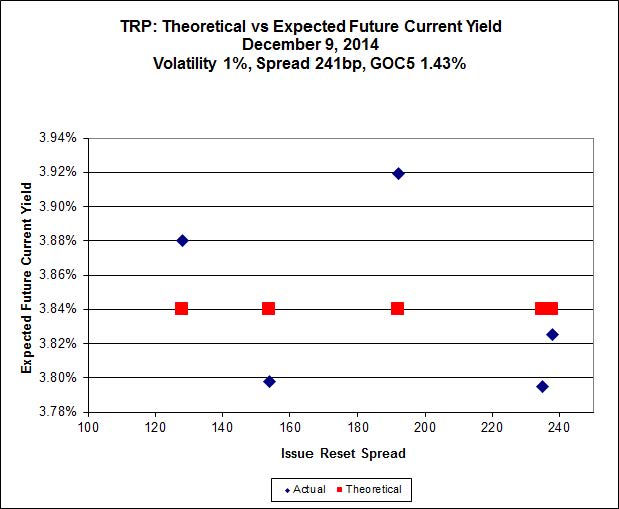
ImpVol_TRP_141209
Click for Big

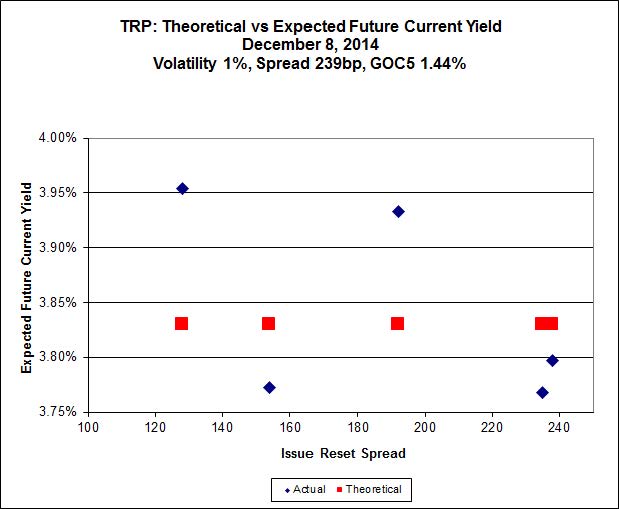
So according to this, TRP.PR.A, bid at 21.37, is $0.44 cheap, but it has already reset. TRP.PR.B, bid at 17.46, is $0.18 cheap, but it resets 2015-6-30. TRP.PR.C, bid at 19.55, is $0.21 expensive, but it resets 2016-1-30. The TRP issues seem to be steadily rationalizing.

The MFC series is just weird.

ImpVol_MFC_141209
Click for Big

Clearly MFC.PR.F, resetting at +141 on 2016-06-19, is out of step with the others and is screwing up the calculation. To the extent that one can trust both Implied Volatility Theory AND the market’s reasonably more-or-less consistent application of it, MFC.PR.F should be bid significantly higher than its current 20.00 and the calculated Implied Volatility should be higher than the distorted value of 28%. The fit is pretty poor – all one can really tell is that the Spread is more than about 80bp and the Implied Volatility is more than about 13%.
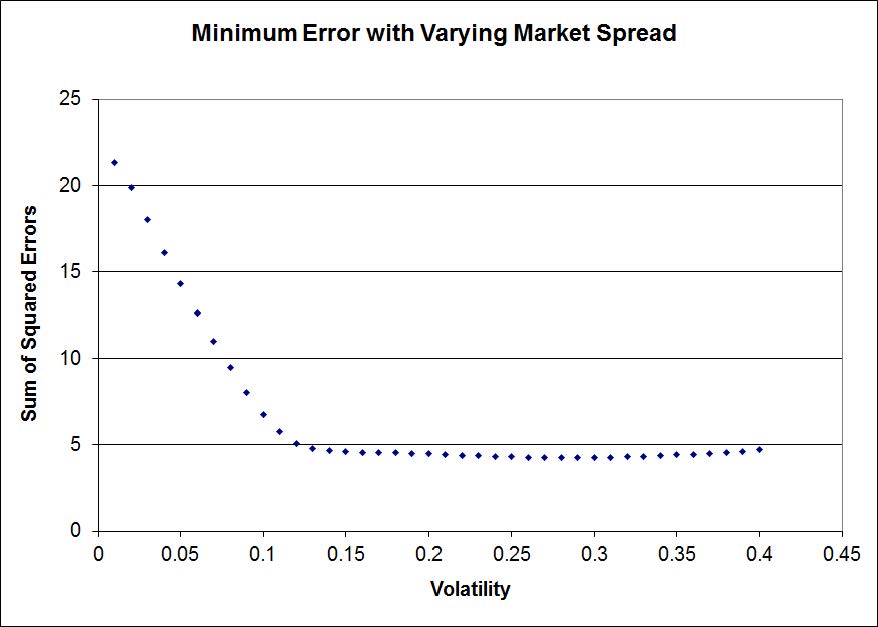
ImpVol_MFC_varSpread_141209

Click for Big
ImpVol_MFC_varVol_141209
Click for Big

The BAM series is now also a little out of whack:
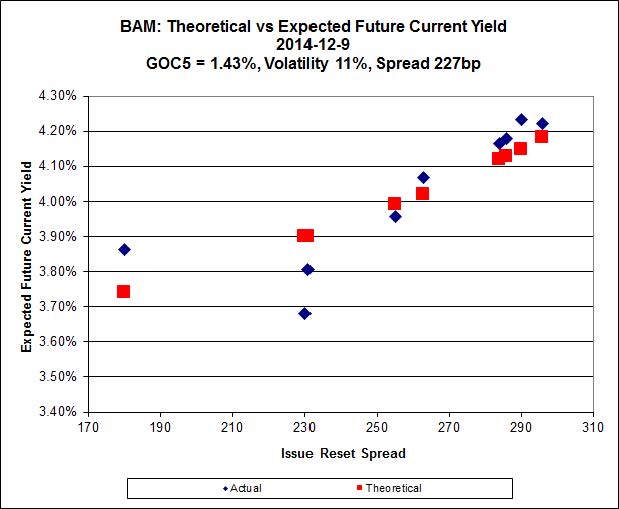
ImpVol_BAM_141209
Click for Big

BAM.PR.X, with a +180bp spread, bid at 20.91, looks $0.68 cheap and doesn’t reset until 2017-6-30 – but Implied Volatility continues to drop rapidly (a reduction in Implied Volatility flattens the curve and causes low-spread issues to underperform). BAM.PR.R, with a +230bp spread, bid at 25.34, looks $1.43 rich and resets 2016-6-30. So go figure that one out, wise guy.
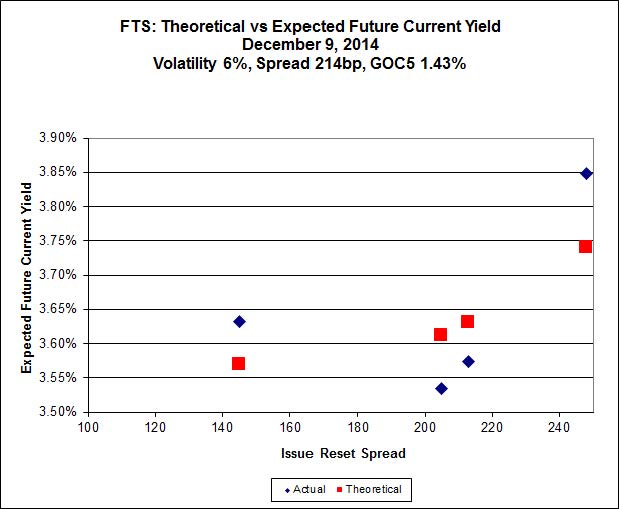
ImpVol_FTS_141209

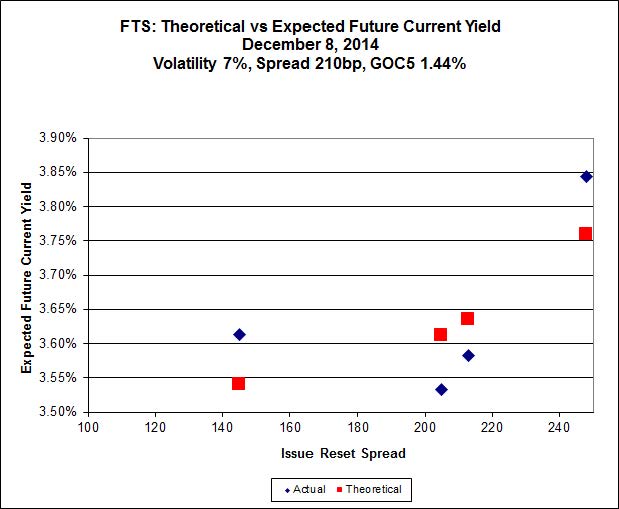
This is just weird because the middle is expensive and the ends are cheap but anyway … FTS.PR.H, with a spread of +145bp, and bid at 19.82, looks $0.35 cheap and resets 2015-6-1. FTS.PR.K, with a spread of +205bp, and bid at 24.62, looks $0.53 expensive and resets 2019-3-1

HIMIPref™ Preferred Indices
These values reflect the December 2008 revision of the HIMIPref™ Indices

Values are provisional and are finalized monthly
Index Mean
Current
Yield
(at bid)
Median
YTW
Median
Average
Trading
Value
Median
Mod Dur
(YTW)
Issues Day’s Perf. Index Value
Ratchet 0.00 % 0.00 % 0 0.00 0 -0.2129 % 2,523.2
FixedFloater 0.00 % 0.00 % 0 0.00 0 -0.2129 % 3,994.7
Floater 2.99 % 3.11 % 62,134 19.38 4 -0.2129 % 2,682.3
OpRet 4.41 % -6.18 % 28,767 0.08 2 -0.2345 % 2,752.0
SplitShare 4.29 % 4.01 % 39,096 3.73 5 0.0202 % 3,178.5
Interest-Bearing 0.00 % 0.00 % 0 0.00 0 -0.2345 % 2,516.4
Perpetual-Premium 5.44 % -1.52 % 72,150 0.09 20 0.0196 % 2,476.9
Perpetual-Discount 5.19 % 5.12 % 112,430 15.22 15 -0.4110 % 2,639.6
FixedReset 4.27 % 3.74 % 199,857 16.40 75 -0.3933 % 2,520.7
Deemed-Retractible 5.00 % 1.77 % 102,744 0.21 40 -0.2029 % 2,598.2
FloatingReset 2.54 % 1.89 % 60,996 3.47 5 0.0000 % 2,550.6
Performance Highlights
Issue Index Change Notes
MFC.PR.L FixedReset -3.99 % YTW SCENARIO
Maturity Type : Hard Maturity
Maturity Date : 2025-01-31
Maturity Price : 25.00
Evaluated at bid price : 24.06
Bid-YTW : 4.22 %
MFC.PR.F FixedReset -3.61 % YTW SCENARIO
Maturity Type : Hard Maturity
Maturity Date : 2025-01-31
Maturity Price : 25.00
Evaluated at bid price : 20.00
Bid-YTW : 5.72 %
ENB.PR.H FixedReset -3.18 % YTW SCENARIO
Maturity Type : Limit Maturity
Maturity Date : 2044-12-09
Maturity Price : 20.68
Evaluated at bid price : 20.68
Bid-YTW : 4.45 %
ENB.PF.C FixedReset -2.09 % YTW SCENARIO
Maturity Type : Limit Maturity
Maturity Date : 2044-12-09
Maturity Price : 22.73
Evaluated at bid price : 23.93
Bid-YTW : 4.31 %
ENB.PR.Y FixedReset -2.05 % YTW SCENARIO
Maturity Type : Limit Maturity
Maturity Date : 2044-12-09
Maturity Price : 21.65
Evaluated at bid price : 22.00
Bid-YTW : 4.40 %
ENB.PF.G FixedReset -2.01 % YTW SCENARIO
Maturity Type : Limit Maturity
Maturity Date : 2044-12-09
Maturity Price : 22.68
Evaluated at bid price : 23.86
Bid-YTW : 4.36 %
ENB.PF.A FixedReset -1.85 % YTW SCENARIO
Maturity Type : Limit Maturity
Maturity Date : 2044-12-09
Maturity Price : 22.73
Evaluated at bid price : 23.90
Bid-YTW : 4.33 %
ENB.PF.E FixedReset -1.69 % YTW SCENARIO
Maturity Type : Limit Maturity
Maturity Date : 2044-12-09
Maturity Price : 22.71
Evaluated at bid price : 23.90
Bid-YTW : 4.33 %
ENB.PR.F FixedReset -1.48 % YTW SCENARIO
Maturity Type : Limit Maturity
Maturity Date : 2044-12-09
Maturity Price : 22.53
Evaluated at bid price : 23.25
Bid-YTW : 4.24 %
ENB.PR.P FixedReset -1.38 % YTW SCENARIO
Maturity Type : Limit Maturity
Maturity Date : 2044-12-09
Maturity Price : 22.21
Evaluated at bid price : 22.80
Bid-YTW : 4.33 %
MFC.PR.B Deemed-Retractible -1.37 % YTW SCENARIO
Maturity Type : Hard Maturity
Maturity Date : 2025-01-31
Maturity Price : 25.00
Evaluated at bid price : 23.00
Bid-YTW : 5.72 %
CU.PR.C FixedReset -1.36 % YTW SCENARIO
Maturity Type : Call
Maturity Date : 2017-06-01
Maturity Price : 25.00
Evaluated at bid price : 25.30
Bid-YTW : 3.55 %
BAM.PR.R FixedReset -1.36 % YTW SCENARIO
Maturity Type : Limit Maturity
Maturity Date : 2044-12-09
Maturity Price : 23.83
Evaluated at bid price : 25.34
Bid-YTW : 3.79 %
CU.PR.D Perpetual-Discount -1.36 % YTW SCENARIO
Maturity Type : Limit Maturity
Maturity Date : 2044-12-09
Maturity Price : 23.61
Evaluated at bid price : 24.00
Bid-YTW : 5.12 %
GWO.PR.I Deemed-Retractible -1.35 % YTW SCENARIO
Maturity Type : Hard Maturity
Maturity Date : 2025-01-31
Maturity Price : 25.00
Evaluated at bid price : 22.69
Bid-YTW : 5.71 %
BAM.PR.X FixedReset -1.32 % YTW SCENARIO
Maturity Type : Limit Maturity
Maturity Date : 2044-12-09
Maturity Price : 20.91
Evaluated at bid price : 20.91
Bid-YTW : 4.18 %
TRP.PR.C FixedReset -1.26 % YTW SCENARIO
Maturity Type : Limit Maturity
Maturity Date : 2044-12-09
Maturity Price : 19.55
Evaluated at bid price : 19.55
Bid-YTW : 3.97 %
SLF.PR.B Deemed-Retractible -1.20 % YTW SCENARIO
Maturity Type : Hard Maturity
Maturity Date : 2025-01-31
Maturity Price : 25.00
Evaluated at bid price : 23.92
Bid-YTW : 5.35 %
ENB.PR.J FixedReset -1.17 % YTW SCENARIO
Maturity Type : Limit Maturity
Maturity Date : 2044-12-09
Maturity Price : 22.71
Evaluated at bid price : 23.74
Bid-YTW : 4.28 %
ENB.PR.N FixedReset -1.13 % YTW SCENARIO
Maturity Type : Limit Maturity
Maturity Date : 2044-12-09
Maturity Price : 22.67
Evaluated at bid price : 23.60
Bid-YTW : 4.28 %
CU.PR.E Perpetual-Discount -1.07 % YTW SCENARIO
Maturity Type : Limit Maturity
Maturity Date : 2044-12-09
Maturity Price : 23.61
Evaluated at bid price : 24.00
Bid-YTW : 5.12 %
SLF.PR.D Deemed-Retractible -1.01 % YTW SCENARIO
Maturity Type : Hard Maturity
Maturity Date : 2025-01-31
Maturity Price : 25.00
Evaluated at bid price : 22.60
Bid-YTW : 5.71 %
CGI.PR.D SplitShare 1.09 % YTW SCENARIO
Maturity Type : Soft Maturity
Maturity Date : 2023-06-14
Maturity Price : 25.00
Evaluated at bid price : 25.09
Bid-YTW : 3.71 %
MFC.PR.M FixedReset 1.37 % YTW SCENARIO
Maturity Type : Call
Maturity Date : 2019-12-19
Maturity Price : 25.00
Evaluated at bid price : 25.15
Bid-YTW : 3.76 %
TRP.PR.B FixedReset 1.51 % YTW SCENARIO
Maturity Type : Limit Maturity
Maturity Date : 2044-12-09
Maturity Price : 17.46
Evaluated at bid price : 17.46
Bid-YTW : 3.95 %
SLF.PR.G FixedReset 3.40 % YTW SCENARIO
Maturity Type : Hard Maturity
Maturity Date : 2025-01-31
Maturity Price : 25.00
Evaluated at bid price : 19.75
Bid-YTW : 5.66 %
Volume Highlights
Issue Index Shares
Traded
Notes
HSE.PR.C FixedReset 619,946 New issue settled today.
YTW SCENARIO
Maturity Type : Limit Maturity
Maturity Date : 2044-12-09
Maturity Price : 23.16
Evaluated at bid price : 25.01
Bid-YTW : 4.46 %
BMO.PR.P FixedReset 133,054 YTW SCENARIO
Maturity Type : Call
Maturity Date : 2015-02-25
Maturity Price : 25.00
Evaluated at bid price : 25.32
Bid-YTW : 0.37 %
IAG.PR.E Deemed-Retractible 125,050 YTW SCENARIO
Maturity Type : Call
Maturity Date : 2015-01-30
Maturity Price : 26.00
Evaluated at bid price : 25.97
Bid-YTW : 4.17 %
TRP.PR.A FixedReset 113,648 YTW SCENARIO
Maturity Type : Limit Maturity
Maturity Date : 2044-12-09
Maturity Price : 21.37
Evaluated at bid price : 21.37
Bid-YTW : 3.95 %
ENB.PR.D FixedReset 83,910 YTW SCENARIO
Maturity Type : Limit Maturity
Maturity Date : 2044-12-09
Maturity Price : 22.41
Evaluated at bid price : 23.00
Bid-YTW : 4.17 %
TD.PF.B FixedReset 77,745 YTW SCENARIO
Maturity Type : Limit Maturity
Maturity Date : 2044-12-09
Maturity Price : 23.21
Evaluated at bid price : 25.07
Bid-YTW : 3.63 %
There were 39 other index-included issues trading in excess of 10,000 shares.
Wide Spread Highlights
Issue Index Quote Data and Yield Notes
MFC.PR.L FixedReset Quote: 24.06 – 25.06
Spot Rate : 1.0000
Average : 0.5532

YTW SCENARIO
Maturity Type : Hard Maturity
Maturity Date : 2025-01-31
Maturity Price : 25.00
Evaluated at bid price : 24.06
Bid-YTW : 4.22 %

PVS.PR.C SplitShare Quote: 25.61 – 26.83
Spot Rate : 1.2200
Average : 0.8660

YTW SCENARIO
Maturity Type : Hard Maturity
Maturity Date : 2017-12-10
Maturity Price : 25.00
Evaluated at bid price : 25.61
Bid-YTW : 4.01 %

ELF.PR.H Perpetual-Premium Quote: 25.35 – 26.00
Spot Rate : 0.6500
Average : 0.4410

YTW SCENARIO
Maturity Type : Limit Maturity
Maturity Date : 2044-12-09
Maturity Price : 24.88
Evaluated at bid price : 25.35
Bid-YTW : 5.49 %

GWO.PR.N FixedReset Quote: 19.36 – 19.99
Spot Rate : 0.6300
Average : 0.4257

YTW SCENARIO
Maturity Type : Hard Maturity
Maturity Date : 2025-01-31
Maturity Price : 25.00
Evaluated at bid price : 19.36
Bid-YTW : 5.81 %

TRP.PR.C FixedReset Quote: 19.55 – 20.14
Spot Rate : 0.5900
Average : 0.4054

YTW SCENARIO
Maturity Type : Limit Maturity
Maturity Date : 2044-12-09
Maturity Price : 19.55
Evaluated at bid price : 19.55
Bid-YTW : 3.97 %

TRP.PR.D FixedReset Quote: 24.90 – 25.34
Spot Rate : 0.4400
Average : 0.2816

YTW SCENARIO
Maturity Type : Limit Maturity
Maturity Date : 2044-12-09
Maturity Price : 23.18
Evaluated at bid price : 24.90
Bid-YTW : 3.80 %

Issue Comments

HSE.PR.C Closes Firm On Decent Volume

Husky Energy has announced that it:

has completed its recently announced public offering of 10 million Cumulative Rate Reset Preferred Shares, Series 3 (the “Series 3 Shares”).

The aggregate gross proceeds to Husky from the completed upsized offering is $250 million.

The net proceeds from this offering will be used to further support the Company’s strong balance sheet and business plan as well as for general corporate purposes, which may include, among other things, the partial repayment of the 3.75% medium-term notes due in 2015.

The Series 3 Shares were offered by way of prospectus supplement dated December 2, 2014 under Husky’s existing short form base shelf prospectus.

Holders of the Series 3 Shares are entitled to receive a cumulative quarterly fixed dividend yielding 4.50 percent annually for the initial period ending December 31, 2019. Thereafter, the dividend rate will be reset every five years at a rate equal to the five-year Government of Canada bond yield plus 3.13 percent.

Holders of Series 3 Shares will have the right, at their option, to convert their shares into Cumulative Rate Reset Preferred Shares, Series 4 (the “Series 4 Shares”), subject to certain conditions, on December 31, 2019 and on December 31 every five years thereafter. Holders of the Series 4 Shares will be entitled to receive cumulative quarterly floating dividends at a rate equal to the 90-day Government of Canada Treasury Bill yield plus 3.13 percent.

The Series 3 Shares are listed on the Toronto Stock Exchange under the symbol HSE.PR.C.

HSE.PR.C is a FixedReset, 4.50%+313, announced December 1. The issue will be tracked by HIMIPref™ and has been assigned to the FixedResets subindex.

The issue traded 764,846 shares today (consolidated exchanges) in a range of 24.70-05 before closing at 25.01-05. Vital statistics are:

HSE.PR.C FixedReset YTW SCENARIO
Maturity Type : Limit Maturity
Maturity Date : 2044-12-09
Maturity Price : 23.16
Evaluated at bid price : 25.01
Bid-YTW : 4.46 %
Market Action

December 8, 2014

Assiduous Reader JP, who often sends me interesting snippets, unlike youse other bums, brings to my attention a small preferred share issue from China:

Industrial and Commercial Bank of China will issue US$5.7 billion worth of preferred shares in three currencies in what will be the largest offshore issuance of hybrid securities from a mainland firm.

ICBC proposed issuing US$2.94 billion in dollar-denominated shares, €600 million (HK$5.73 billion) and 12 billion yuan (HK$15.13 billion) all priced at 6 per cent, according to a regulatory filing.

The shares will count as additional tier-1 capital, boosting the bank’s capital adequacy ratio as defined by Basel III, an international accord aimed at raising the viability of banks and avoiding public bailouts.

The record deal also marked the first time a mainland bank issued offshore preferred shares denominated in three currencies.

ICBC International was the sole global coordinator and UBS, Bank of America Merrill Lynch and Goldman Sachs were joint book-runners on the deal.

It’s nice to see some real progress on solar power efficiency:

UNSW’s solar researchers have converted over 40% of the sunlight hitting a solar system into electricity, the highest efficiency ever reported.

The world-beating efficiency was achieved in outdoor tests in Sydney, before being independently confirmed by the National Renewable Energy Laboratory (NREL) at their outdoor test facility in the United States.

The work was funded by the Australian Renewable Energy Agency (ARENA) and supported by the Australia–US Institute for Advanced Photovoltaics (AUSIAPV).

“This is the highest efficiency ever reported for sunlight conversion into electricity,” UNSW Scientia Professor and Director of the Australian Centre for Advanced Photovoltaics (ACAP) Professor Martin Green said.

The price wasn’t mentioned, but the basic idea comes first, right? Then give it to the engineers to make it cheap. Too bad this research wasn’t done in Ontari-ari-ari-owe, but we blew our solar budget on political grandstanding.

After posting the MAPF November statements, I posted the following on the Canada Post Facebook Page:

I just sent a batch of letters with Madonna & Child stamps when a thought struck me and caused me to check your website.

I see your “Holiday 2014” collection is dominated by Santa Claus – rather childish in my view, but the important thing is that they are stamps and you stick them on letters and they get delivered.

But why are there no stamps with an Islamic theme? No Jewish stamps? No stamps for Kwanzai, Bohdi Day, Pancha Ganapati or Yule? It would make things more interesting.

It was an awful day for equities:

Oil, bank and raw-materials are the biggest laggards in Canada for the first time since at least 1988, fueling concern the nation’s economy is fading just as the U.S. is taking off.

The three industries, which collectively account for two-thirds of the Standard & Poor’s/TSX Composite Index, are the worst performers among 10 groups this year, according to data compiled by Bloomberg. The nation’s largest banks joined oil and materials in a rout that erased 4.1 percent from the benchmark index in three days, including the biggest one-day retreat since June 2013.

The selloff in the biggest pillars of the Canadian equity market comes as data showing a weaker jobs market coupled with slowing exports suggest a tentative economic recovery. Banks have slumped as earnings last week collectively missed estimates amid declining trading revenue and sluggish consumer borrowing. Meanwhile, the S&P 500 Index has reached all-time highs on signs of accelerating growth.

The S&P 500/TSX tumbled 329.53 points, or 2.3 percent, to 14,144.17 yesterday as the selloff in oil accelerated, with energy companies plunging the most since August 2011 as crude dropped to a five-year low.

The Canadian benchmark equity gauge has plunged 9.7 percent since reaching a record on Sept. 3, wiping out more than C$270 billion in market value and reducing its gain for the year to 3.8 percent. The S&P/TSX, which was the second-best performing market among developed nations through the first half of the year, now ranks 16th.

Happy crowds of preferred share investors held parades for their portfolios today.

funeralProcession
Click for Big

And with TXPR and TXPL down 0.76% and 0.96%, why not?

It was an appallingly poor day for the Canadian preferred share market, with PerpetualDiscounts off 24bp, FixedResets losing 85bp and DeemedRetractibles down 36bp. There is a very lengthy list of losers, dominated by FixedResets. Volume was high.

And given these massive changes, let’s have another look at some pictures of Implied Volatility. Remember that all rich /cheap assessments are

  • based on Implied Volatility Theory only
  • are relative only to other FixedResets from the same issuer
  • assume constant GOC-5 yield
  • assume constant Implied Volatility
  • assume constant spread

Here’s TRP:

ImpVol_TRP_141208A
Click for Big

So according to this, TRP.PR.A, bid at 21.36, is $0.57 cheap, but it has already reset. TRP.PR.B, bid at 17.20, is $0.55 cheap, but it resets 2015-6-30. TRP.PR.C, bid at 19.75, is $0.30 expensive, but it resets 2016-1-30. It looks like the market is beginning to realize that TRP.PR.C is overpriced.

ImpVol_MFC_141208
Click for Big

MFC implied volatility is still very high. The low-spread MFC.PR.F looks a little cheap … and it doesn’t reset until 2016-6-19.

ImpVol_BAM_141208
Click for Big

BAM.PR.X, with a +180bp spread, bid at 21.15, looks $0.79 cheap and doesn’t reset until 2017-6-30 – but Implied Volatility is still a little high and is dropping rapidly (a reduction in Implied Volatility flattens the curve and causes low-spread issues to underperform). BAM.PR.R, with a +230bp spread, bid at 25.51, looks $1.56 rich and resets 2016-6-30. So go figure that one out, wise guy.

ImpVol_FTS_141208
Click for Big

This is just weird because the middle is expensive and the ends are cheap but anyway … FTS.PR.H, with a spread of +145bp, and bid at 20.00, looks $0.41 cheap and resets 2015-6-1. FTS.PR.K, with a spread of +205bp, and bid at 24.70, looks $0.54 expensive and resets 2019-3-1

HIMIPref™ Preferred Indices
These values reflect the December 2008 revision of the HIMIPref™ Indices

Values are provisional and are finalized monthly
Index Mean
Current
Yield
(at bid)
Median
YTW
Median
Average
Trading
Value
Median
Mod Dur
(YTW)
Issues Day’s Perf. Index Value
Ratchet 0.00 % 0.00 % 0 0.00 0 -0.3254 % 2,528.6
FixedFloater 0.00 % 0.00 % 0 0.00 0 -0.3254 % 4,003.2
Floater 2.98 % 3.09 % 62,509 19.42 4 -0.3254 % 2,688.0
OpRet 4.40 % -11.74 % 26,639 0.08 2 -0.0195 % 2,758.5
SplitShare 4.30 % 3.92 % 40,711 3.73 5 -0.2697 % 3,177.9
Interest-Bearing 0.00 % 0.00 % 0 0.00 0 -0.0195 % 2,522.4
Perpetual-Premium 5.44 % -1.70 % 70,645 0.08 20 -0.4542 % 2,476.4
Perpetual-Discount 5.17 % 5.11 % 113,618 15.27 15 -0.2392 % 2,650.5
FixedReset 4.25 % 3.71 % 182,150 16.54 74 -0.8512 % 2,530.6
Deemed-Retractible 4.99 % 0.67 % 103,056 0.14 40 -0.3755 % 2,603.5
FloatingReset 2.54 % 1.89 % 60,065 0.08 5 -0.0861 % 2,550.6
Performance Highlights
Issue Index Change Notes
TRP.PR.C FixedReset -3.51 % YTW SCENARIO
Maturity Type : Limit Maturity
Maturity Date : 2044-12-08
Maturity Price : 19.80
Evaluated at bid price : 19.80
Bid-YTW : 3.92 %
ENB.PR.T FixedReset -3.49 % YTW SCENARIO
Maturity Type : Limit Maturity
Maturity Date : 2044-12-08
Maturity Price : 22.28
Evaluated at bid price : 22.95
Bid-YTW : 4.30 %
PWF.PR.P FixedReset -3.36 % YTW SCENARIO
Maturity Type : Limit Maturity
Maturity Date : 2044-12-08
Maturity Price : 20.40
Evaluated at bid price : 20.40
Bid-YTW : 3.87 %
MFC.PR.F FixedReset -3.35 % YTW SCENARIO
Maturity Type : Hard Maturity
Maturity Date : 2025-01-31
Maturity Price : 25.00
Evaluated at bid price : 20.75
Bid-YTW : 5.27 %
SLF.PR.G FixedReset -3.05 % YTW SCENARIO
Maturity Type : Hard Maturity
Maturity Date : 2025-01-31
Maturity Price : 25.00
Evaluated at bid price : 19.10
Bid-YTW : 6.06 %
ENB.PR.P FixedReset -2.49 % YTW SCENARIO
Maturity Type : Limit Maturity
Maturity Date : 2044-12-08
Maturity Price : 22.39
Evaluated at bid price : 23.12
Bid-YTW : 4.26 %
MFC.PR.I FixedReset -2.38 % YTW SCENARIO
Maturity Type : Call
Maturity Date : 2017-09-19
Maturity Price : 25.00
Evaluated at bid price : 25.42
Bid-YTW : 3.73 %
GWO.PR.N FixedReset -2.37 % YTW SCENARIO
Maturity Type : Hard Maturity
Maturity Date : 2025-01-31
Maturity Price : 25.00
Evaluated at bid price : 19.33
Bid-YTW : 5.83 %
HSE.PR.A FixedReset -2.27 % YTW SCENARIO
Maturity Type : Limit Maturity
Maturity Date : 2044-12-08
Maturity Price : 19.35
Evaluated at bid price : 19.35
Bid-YTW : 4.21 %
ENB.PR.J FixedReset -2.16 % YTW SCENARIO
Maturity Type : Limit Maturity
Maturity Date : 2044-12-08
Maturity Price : 22.84
Evaluated at bid price : 24.02
Bid-YTW : 4.21 %
ENB.PR.F FixedReset -1.87 % YTW SCENARIO
Maturity Type : Limit Maturity
Maturity Date : 2044-12-08
Maturity Price : 22.72
Evaluated at bid price : 23.60
Bid-YTW : 4.17 %
ENB.PF.E FixedReset -1.86 % YTW SCENARIO
Maturity Type : Limit Maturity
Maturity Date : 2044-12-08
Maturity Price : 22.88
Evaluated at bid price : 24.31
Bid-YTW : 4.24 %
ENB.PF.G FixedReset -1.85 % YTW SCENARIO
Maturity Type : Limit Maturity
Maturity Date : 2044-12-08
Maturity Price : 22.88
Evaluated at bid price : 24.35
Bid-YTW : 4.25 %
ENB.PF.A FixedReset -1.81 % YTW SCENARIO
Maturity Type : Limit Maturity
Maturity Date : 2044-12-08
Maturity Price : 22.92
Evaluated at bid price : 24.35
Bid-YTW : 4.22 %
MFC.PR.M FixedReset -1.74 % YTW SCENARIO
Maturity Type : Hard Maturity
Maturity Date : 2025-01-31
Maturity Price : 25.00
Evaluated at bid price : 24.81
Bid-YTW : 3.95 %
MFC.PR.C Deemed-Retractible -1.67 % YTW SCENARIO
Maturity Type : Hard Maturity
Maturity Date : 2025-01-31
Maturity Price : 25.00
Evaluated at bid price : 22.41
Bid-YTW : 5.89 %
BNS.PR.Y FixedReset -1.62 % YTW SCENARIO
Maturity Type : Hard Maturity
Maturity Date : 2022-01-31
Maturity Price : 25.00
Evaluated at bid price : 23.67
Bid-YTW : 3.44 %
IGM.PR.B Perpetual-Premium -1.52 % YTW SCENARIO
Maturity Type : Call
Maturity Date : 2018-12-31
Maturity Price : 25.00
Evaluated at bid price : 26.00
Bid-YTW : 5.00 %
ENB.PF.C FixedReset -1.45 % YTW SCENARIO
Maturity Type : Limit Maturity
Maturity Date : 2044-12-08
Maturity Price : 22.94
Evaluated at bid price : 24.44
Bid-YTW : 4.19 %
SLF.PR.A Deemed-Retractible -1.39 % YTW SCENARIO
Maturity Type : Hard Maturity
Maturity Date : 2025-01-31
Maturity Price : 25.00
Evaluated at bid price : 24.11
Bid-YTW : 5.20 %
GWO.PR.Q Deemed-Retractible -1.37 % YTW SCENARIO
Maturity Type : Hard Maturity
Maturity Date : 2025-01-31
Maturity Price : 25.00
Evaluated at bid price : 25.15
Bid-YTW : 5.06 %
BAM.PR.T FixedReset -1.36 % YTW SCENARIO
Maturity Type : Limit Maturity
Maturity Date : 2044-12-08
Maturity Price : 23.36
Evaluated at bid price : 24.61
Bid-YTW : 3.88 %
SLF.PR.E Deemed-Retractible -1.34 % YTW SCENARIO
Maturity Type : Hard Maturity
Maturity Date : 2025-01-31
Maturity Price : 25.00
Evaluated at bid price : 22.77
Bid-YTW : 5.66 %
ENB.PR.D FixedReset -1.33 % YTW SCENARIO
Maturity Type : Limit Maturity
Maturity Date : 2044-12-08
Maturity Price : 22.44
Evaluated at bid price : 23.05
Bid-YTW : 4.16 %
POW.PR.G Perpetual-Premium -1.30 % YTW SCENARIO
Maturity Type : Call
Maturity Date : 2021-04-15
Maturity Price : 25.00
Evaluated at bid price : 26.65
Bid-YTW : 4.57 %
ENB.PR.H FixedReset -1.25 % YTW SCENARIO
Maturity Type : Limit Maturity
Maturity Date : 2044-12-08
Maturity Price : 21.36
Evaluated at bid price : 21.36
Bid-YTW : 4.30 %
ELF.PR.H Perpetual-Premium -1.17 % YTW SCENARIO
Maturity Type : Limit Maturity
Maturity Date : 2044-12-08
Maturity Price : 24.83
Evaluated at bid price : 25.30
Bid-YTW : 5.50 %
PWF.PR.T FixedReset -1.16 % YTW SCENARIO
Maturity Type : Limit Maturity
Maturity Date : 2044-12-08
Maturity Price : 23.39
Evaluated at bid price : 25.50
Bid-YTW : 3.71 %
SLF.PR.B Deemed-Retractible -1.14 % YTW SCENARIO
Maturity Type : Hard Maturity
Maturity Date : 2025-01-31
Maturity Price : 25.00
Evaluated at bid price : 24.21
Bid-YTW : 5.20 %
PWF.PR.R Perpetual-Premium -1.10 % YTW SCENARIO
Maturity Type : Call
Maturity Date : 2021-04-30
Maturity Price : 25.00
Evaluated at bid price : 26.06
Bid-YTW : 4.85 %
GWO.PR.I Deemed-Retractible -1.08 % YTW SCENARIO
Maturity Type : Hard Maturity
Maturity Date : 2025-01-31
Maturity Price : 25.00
Evaluated at bid price : 23.00
Bid-YTW : 5.53 %
SLF.PR.I FixedReset -1.04 % YTW SCENARIO
Maturity Type : Call
Maturity Date : 2016-12-31
Maturity Price : 25.00
Evaluated at bid price : 25.78
Bid-YTW : 2.56 %
BAM.PF.C Perpetual-Discount -1.01 % YTW SCENARIO
Maturity Type : Limit Maturity
Maturity Date : 2044-12-08
Maturity Price : 21.27
Evaluated at bid price : 21.56
Bid-YTW : 5.72 %
Volume Highlights
Issue Index Shares
Traded
Notes
BMO.PR.P FixedReset 259,575 Desjardins crossed 200,000 at 25.32. TD crossed 53,600 at the same price.
YTW SCENARIO
Maturity Type : Call
Maturity Date : 2015-02-25
Maturity Price : 25.00
Evaluated at bid price : 25.30
Bid-YTW : 0.73 %
TRP.PR.A FixedReset 182,016 Will reset to 3.266% effective December 31. Nesbitt crossed 30,000 at 21.36. TD crossed 25,000 at the same price and Scotia crossed 30,000 at the same price again.
YTW SCENARIO
Maturity Type : Limit Maturity
Maturity Date : 2044-12-08
Maturity Price : 21.36
Evaluated at bid price : 21.36
Bid-YTW : 3.95 %
ENB.PR.T FixedReset 102,709 RBC crossed 50,700 at 23.15 and 21,800 at 23.00.
YTW SCENARIO
Maturity Type : Limit Maturity
Maturity Date : 2044-12-08
Maturity Price : 22.28
Evaluated at bid price : 22.95
Bid-YTW : 4.30 %
BAM.PF.F FixedReset 87,304 Desjardins crossed 75,000 at 25.70.
YTW SCENARIO
Maturity Type : Call
Maturity Date : 2019-09-30
Maturity Price : 25.00
Evaluated at bid price : 25.68
Bid-YTW : 4.09 %
FTS.PR.M FixedReset 73,932 RBC crossed 70,000 at 25.60.
YTW SCENARIO
Maturity Type : Call
Maturity Date : 2019-12-01
Maturity Price : 25.00
Evaluated at bid price : 25.50
Bid-YTW : 3.69 %
MFC.PR.M FixedReset 54,843 Scotia crossed 35,000 at 25.25.
YTW SCENARIO
Maturity Type : Hard Maturity
Maturity Date : 2025-01-31
Maturity Price : 25.00
Evaluated at bid price : 24.81
Bid-YTW : 3.95 %
There were 41 other index-included issues trading in excess of 10,000 shares.
Wide Spread Highlights
Issue Index Quote Data and Yield Notes
PWF.PR.A Floater Quote: 19.20 – 20.20
Spot Rate : 1.0000
Average : 0.6772

YTW SCENARIO
Maturity Type : Limit Maturity
Maturity Date : 2044-12-08
Maturity Price : 19.20
Evaluated at bid price : 19.20
Bid-YTW : 2.75 %

MFC.PR.I FixedReset Quote: 25.42 – 25.95
Spot Rate : 0.5300
Average : 0.3221

YTW SCENARIO
Maturity Type : Call
Maturity Date : 2017-09-19
Maturity Price : 25.00
Evaluated at bid price : 25.42
Bid-YTW : 3.73 %

IGM.PR.B Perpetual-Premium Quote: 26.00 – 26.46
Spot Rate : 0.4600
Average : 0.2744

YTW SCENARIO
Maturity Type : Call
Maturity Date : 2018-12-31
Maturity Price : 25.00
Evaluated at bid price : 26.00
Bid-YTW : 5.00 %

MFC.PR.M FixedReset Quote: 24.81 – 25.23
Spot Rate : 0.4200
Average : 0.2506

YTW SCENARIO
Maturity Type : Hard Maturity
Maturity Date : 2025-01-31
Maturity Price : 25.00
Evaluated at bid price : 24.81
Bid-YTW : 3.95 %

MFC.PR.F FixedReset Quote: 20.75 – 21.20
Spot Rate : 0.4500
Average : 0.2812

YTW SCENARIO
Maturity Type : Hard Maturity
Maturity Date : 2025-01-31
Maturity Price : 25.00
Evaluated at bid price : 20.75
Bid-YTW : 5.27 %

MFC.PR.C Deemed-Retractible Quote: 22.41 – 23.10
Spot Rate : 0.6900
Average : 0.5286

YTW SCENARIO
Maturity Type : Hard Maturity
Maturity Date : 2025-01-31
Maturity Price : 25.00
Evaluated at bid price : 22.41
Bid-YTW : 5.89 %

New Issues

New Issue: CM FixedReset, 3.75%+224

The Canadian Imperial Bank of Commerce has announced:

that it had entered into an agreement with a group of underwriters led by CIBC World Markets Inc. for an issue of 10 million Basel III-compliant non-cumulative Rate Reset Class A Preferred Shares, Series 41 (the “Series 41 Shares”) priced at $25.00 per Series 41 Share to raise gross proceeds of $250 million.

CIBC has granted the underwriters an option to purchase up to an additional two million Series 41 Shares at the same offering price, exercisable at any time up to two days prior to closing. Should the underwriters’ option be fully exercised, the total gross proceeds of the financing will be $300 million.

The Series 41 Shares will yield 3.75% per annum, payable quarterly, as and when declared by the Board of Directors of CIBC, for an initial period ending January 31, 2020. On January 31, 2020, and on January 31 every five years thereafter, the dividend rate will reset to be equal to the then current five-year Government of Canada bond yield plus 2.24%.

Subject to regulatory approval and certain provisions of the Series 41 Shares, on January 31, 2020 and on January 31 every five years thereafter, CIBC may, at its option, redeem all or any part of the then outstanding Series 41 Shares at par.

Subject to the right of redemption, holders of the Series 41 Shares will have the right to convert their shares into non-cumulative Floating Rate Class A Preferred Shares, Series 42 (the “Series 42 Shares”), subject to certain conditions, on January 31, 2020 and on January 31 every five years thereafter. Holders of the Series 42 Shares will be entitled to receive a quarterly floating rate dividend, as and when declared by the Board of Directors of CIBC, equal to the three-month Government of Canada Treasury Bill yield plus 2.24%.

Holders of the Series 42 Shares may convert their Series 42 Shares into Series 41 Shares, subject to certain conditions, on January 31, 2025 and on January 31 every five years thereafter.

The expected closing date is December 16, 2014. CIBC will make an application to list the Series 41 Shares as of the closing date on the Toronto Stock Exchange. The net proceeds of this offering will be used for general purposes of CIBC.

CM has only one other FixedReset outstanding, CM.PR.O, which is a NVCC-compliant FixedReset, 3.90%+232, which commenced trading 2014-6-11 after being announced 2014-6-2.

Issue Comments

CM.PR.E To Be Redeemed

The Canadian Imperial Bank of Commerce has announced:

its intention to redeem all of its issued and outstanding Non-cumulative Class A Preferred Shares Series 27 (TSX: CM.PR.E), for cash. The redemption will occur on January 31, 2015. The redemption price is $25.00 per Series 27 share.

The $0.350000 quarterly dividend announced on December 4, 2014 will be the final dividend on the Series 27 shares and will be paid on January 28, 2015, covering the period to January 31, 2015, to shareholders of record on December 29, 2014.

Holders of the Series 27 shares should contact the financial institution, broker or other intermediary through which they hold the shares to confirm how they will receive their redemption proceeds.

CM.PR.E is a NVCC-compliant Straight Perpetual paying 5.60% of par. It has been tracked by HIMIPref™ and is currently assigned to the PerpetualPremium index.

New Issues

New Issue: TD FixedReset, 3.75%+225

The Toronto-Dominion Bank has announced:

a domestic public offering of Non-Cumulative 5-Year Rate Reset Preferred Shares, Series 5 (the “Series 5 Shares”).

TD has entered into an agreement with a group of underwriters led by TD Securities Inc. to issue, on a bought deal basis, 12 million Series 5 Shares at a price of $25.00 per share to raise gross proceeds of $300 million. TD has also granted the underwriters an option to purchase, on the same terms, up to an additional 2 million Series 5 Shares. This option is exercisable in whole or in part by the underwriters at any time up to two business days prior to closing.

The Series 5 Shares will yield 3.75% annually, payable quarterly, as and when declared by the Board of Directors of TD, for the initial period ending January 31, 2020. Thereafter, the dividend rate will reset every five years at a level of 2.25% over the then five-year Government of Canada bond yield.

Subject to regulatory approval, on January 31, 2020 and on January 31 every 5 years thereafter, TD may redeem the Series 5 Shares, in whole or in part, at $25.00 per share. Subject to TD’s right of redemption, holders of the Series 5 Shares will have the right to convert their shares into Non-Cumulative Floating Rate Preferred Shares, Series 6 (the “Series 6 Shares”), subject to certain conditions, on January 31, 2020, and on January 31 every five years thereafter. Holders of the Series 6 Shares will be entitled to receive quarterly floating dividends, as and when declared by the Board of Directors of TD, equal to the three-month Government of Canada Treasury bill yield plus 2.25%.

The expected closing date is December 16, 2014. TD will make an application to list the Series 5 Shares as of the closing date on the Toronto Stock Exchange. The net proceeds of the offering will be used for general corporate purposes.

Later, they announced:

that as a result of strong investor demand for its previously announced domestic public offering of Non-Cumulative 5-Year Rate Reset Preferred Shares, Series 5 (the “Series 5 Shares”), the size of the offering has been increased to 20 million Series 5 Shares. The gross proceeds of the offering will now be $500 million. The offering will be underwritten by a group of underwriters led by TD Securities Inc.

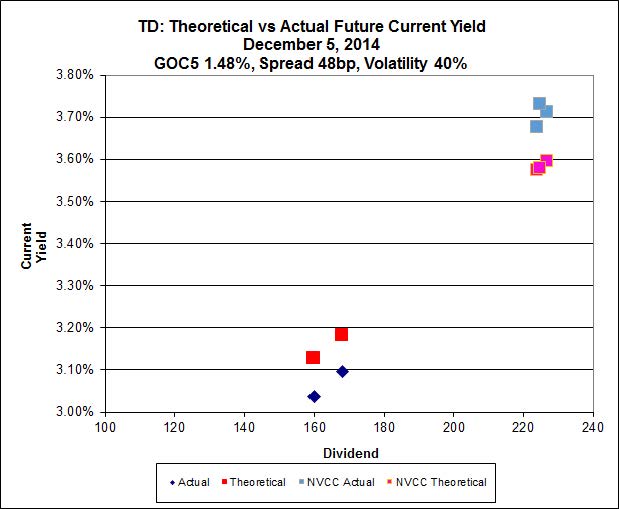
I can’t say the Implied Volatility calculation is particularly helpful, but I’ll show it anyway:

impVol_TD_141205
Click for Big
Market Action

December 5, 2014

Jobs, jobs, jobs!

A November surprise that included a jump in wages as well as the biggest hiring surge in almost three years suggests the world’s largest economy is putting aside doubts about the strength of the expansion.

The 321,000 advance in payrolls followed a 243,000 increase in October that was stronger than previously reported, Labor Department figures showed today in Washington. The jobless rate held at a six-year low of 5.8 percent and earnings rose by the most since June of last year.

The breadth of industries hiring last month was the broadest since 1998, a sign the benefits of the expansion were rippling through the economy.

Factory payrolls rose by the most in a year, professional and business services companies took on more employees than at any time since November 2010, financial firms boosted payrolls by the most since early 2012 and hiring at retailers picked up.

The yield on the benchmark 10-year Treasury note rose to 2.31 percent at 2:47 p.m. in New York from 2.24 percent late yesterday. The Bloomberg Dollar Spot Index, which tracks the greenback against 10 trading partners, gained 0.8 percent, and the Standard & Poor’s 500 Index advanced 0.2 percent.

Up north, not so much:

The Canadian dollar reached a five-year low as data showed the economy lost jobs in November while U.S. payrolls swelled, adding to speculation the Federal Reserve will raise interest rates before the Bank of Canada.

The currency erased a weekly gain as the report showed employment fell by 10,700 jobs. The drop bolstered a Bank of Canada statement this week that, while the recovery shows signs of broadening, the labor market “continues to indicate significant slack in the economy.” The nation added 117,200 jobs over the previous two months.

Canadian government bonds fell, pushing the yield on the benchmark 10-year security up five basis points, or 0.05 percentage point, to 1.96 percent. It reached 1.98 percent, the highest level since Nov. 25. The price of the debt dropped 46 cents to C$104.67.

Employment declined after jumps of 43,100 and 74,100 the last two months, Statistics Canada said today from Ottawa. The unemployment rate rose to 6.6 percent from a six-year low of 6.5 percent. Economists surveyed by Bloomberg News projected employment would be unchanged and the jobless rate would rise to 6.6 percent, according to median forecasts.

And things are still sluggish in Germany:

But Germany’s Bundesbank halved its 2015 growth forecast for Germany to 1.0 per cent and also cut its estimate for this year to 1.4 per cent from a forecast of 1.9 per cent made in June. It also trimmed its prediction for 2016 to 1.6 per cent.

“However, there is reason to hope that the current sluggish phase will prove to be short-lived,” Bundesbank President Jens Weidmann said in a statement, adding that opportunities abroad would likely increase again next year.

He also said that if crude oil prices remained subdued for a longer period, gross domestic product (GDP) could expand by an additional 0.1-0.2 percentage points in both 2015 and 2016.

… and in Italy:

Standard & Poor’s cut Italy’s sovereign credit rating on Friday from triple-B to triple-B-minus, just one notch above junk, saying weak growth and poor competitiveness undermined the sustainability of its huge public debt.

The downgrade is a blow for Prime Minister Matteo Renzi, who came to office in February pledging an ambitious reform agenda to lift Italy out of recession, but has seen the economy continue to shrink.

S&P said the new triple-B-minus rating carried a stable outlook. It forecast Italian economic growth would be just 0.2 per cent in 2015 and would average 0.5 per cent in 2014-2017.

As recently as June, the agency had confirmed Italy’s triple-B rating and forecast average growth of 1.0 per cent over the three-year period.

Italy’s economy is expected to shrink in 2014 for the third consecutive year.

There’s an interesting paper by Gregory Thwaites titled Why are real interest rates so low? Secular stagnation and the relative price of investment goods:

Over the past four decades, real interest rates have risen then fallen across the industrialised world. Over the same period, nominal investment rates are down, while house prices and household debt are up. I explain these four trends with a fifth – the widespread fall in the relative price of investment goods. I present a simple closed-economy OLG model in which households finance retirement in part by selling claims on the corporate sector (capital goods) accumulated over their working lives. As capital goods prices fall, the interest rate must fall to reflect capital losses. And in the long run, a given quantity of saving buys more capital goods. This has ambiguous effects on interest rates in the long run: if the production function is inelastic, in line with most estimates in the literature, interest rates stay low even after relative prices have stopped falling. Lower interest rates reduce the user cost of housing, raising house prices and, given that housing is bought early in life, increasing household debt. I extend the model to allow for a heterogeneous bequest motive, and show that wealth inequality rises but consumption inequality falls. I test the model on cross-country data and find support for its assumptions and predictions. The analysis in this paper shows recent debates on macroeconomic imbalances and household and government indebtedness in a new light. In particular, low real interest rates may be the new normal. The debt of the young provides an alternative outlet for the retirement savings of the old; preventing the accumulation of debt, for example through macroprudential policy, leads to a bigger fall in interest rates.

This paper fleshes out a new, complementary explanation for the falls in real interest rates, rises in household debt and falling investment rates across the industrialised world. The story is based on the widespread fall in the price of investment goods – the machines, equipment and buildings that firms buy – relative to the prices of other things the economy produces. This fall has reduced the demand for savings, rather than the supply.

This makes sense to me. When you’re starting a business, you don’t (usually) need $100-million for a new factory any more; $10,000 for a couple of new computers will (often) do the trick. Thanks to Ian McGugan of the Globe for writing a review.

It’s a black day … the UK is redeeming some perps:

U.K. Chancellor George Osborne is to repay the state’s century-old war debt. By current standards, the undated stock is expensive for the government to service. Terms give holders of the hard-to-trade bond a decent payoff. It looks like a win-win. Time could prove a harsher judge of the deal.

The British government issued its War Loan in 1917. At first, the undated debt offered a yield of 5 per cent. It was restructured in 1947 to pay 3.5 per cent. Even that lower figure looks expensive by current standards. Weak economic growth and low inflation have suppressed long-dated yields. Ten-year UK government debt gives only 2 per cent at present.

I’ve always been fond of the British perps … fortunately, my all-time favourite, the 2.5% annuities issued in 1853 are still outstanding … all £1-million of them!

BSD.PR.A was confirmed at Pfd-4(low) by DBRS:

As of December 1, 2014, the Portfolio consisted of 72.0% Canadian common stock, 22.0% REITs, 4.0% limited partnerships and 2.0% Canadian preferred stock. The rating was last confirmed in December 2013 and performance has been generally positive in the first half year of 2014, but has since been volatile. Downside protection available to holders of the Preferred Securities rose to 29.9% in June 2014, but has since been volatile, dropping to approximately 20.0% at the end of November 2014 (similar to November 2013 levels). The yield on the Portfolio has decreased slightly, causing the distribution coverage ratio to drop to 0.70 times (as of November 28, 2014). The rating on the Preferred Securities continues to be constrained by the large percentage of underlying securities in the Portfolio that are not rated by any rating agency and the grind on the Portfolio due to distributions exceeding income.

I suggest that preferred share investors stop looking at their monitors and go for a nice walk … like this guy:

endOfTheWorld

It was another awful day for the Canadian preferred share market, with PerpetualDiscounts losing 38bp, FixedResets down 36bp and DeemedRetractibles off 5bp. Another lengthy Performance Report is – again – dominated by losing FixedResets which are – again – predominantly lower spread and Enbridge issues. Despite four issues (recent heavy losers) breaking the 100,000 share barrier, volume was slightly below average.

All this poor performance by the lower-reset issues should imply a decrease in Implied Volatility, so here are some pictures:

impVol_TRP_141205
Click for Big

So according to this, TRP.PR.A, bid at 21.40, is $0.74 cheap, but it has already reset. TRP.PR.B, bid at 17.37, is $0.60 cheap, but it resets 2015-6-30. TRP.PR.C, bid at 20.52, is $0.86 expensive, but it resets 2016-1-30. So an alternative way of resolving the differences between these three issues is to expect the GOC-5 yield to stay at 1.48% until TRP.PR.B resets, but to increase to about 1.72% prior to TRP.PR.C resetting.

impVol_MFC_141205
Click for Big

MFC volatility is still very high. The low-spread MFC.PR.F looks a little cheap … and it doesn’t reset until 2016-6-19.

impVol_BAM_141205
Click for Big

BAM.PR.X, with a +180bp spread, bid at 21.40, looks $1.06 cheap and doesn’t reset until 2017-6-30. BAM.PR.R, with a +230bp spread, bid at 25.71, looks $1.48 rich and resets 2016-6-30. So go figure that one out, wise guy.

impVol_FTS_141205
Click for Big

This is just weird because the middle is expensive and the ends are cheap but anyway … FTS.PR.H, with a spread of +145bp, and bid at 20.01, looks $0.39 cheap and resets 2015-6-1. FTS.PR.K, with a spread of +205bp, and bid at 24.81, looks $0.56 expensive and resets 2019-3-1.

HIMIPref™ Preferred Indices
These values reflect the December 2008 revision of the HIMIPref™ Indices

Values are provisional and are finalized monthly
Index Mean
Current
Yield
(at bid)
Median
YTW
Median
Average
Trading
Value
Median
Mod Dur
(YTW)
Issues Day’s Perf. Index Value
Ratchet 0.00 % 0.00 % 0 0.00 0 0.7412 % 2,536.8
FixedFloater 0.00 % 0.00 % 0 0.00 0 0.7412 % 4,016.3
Floater 2.97 % 3.08 % 62,774 19.45 4 0.7412 % 2,696.8
OpRet 4.40 % -11.75 % 26,721 0.08 2 -0.0195 % 2,759.0
SplitShare 4.28 % 3.84 % 40,220 3.74 5 -0.3663 % 3,186.5
Interest-Bearing 0.00 % 0.00 % 0 0.00 0 -0.0195 % 2,522.8
Perpetual-Premium 5.41 % -2.53 % 73,249 0.09 20 0.0117 % 2,487.7
Perpetual-Discount 5.16 % 5.06 % 114,478 15.34 15 -0.3773 % 2,656.8
FixedReset 4.21 % 3.63 % 194,795 16.75 74 -0.3560 % 2,552.4
Deemed-Retractible 4.97 % -0.83 % 102,250 0.15 40 -0.0505 % 2,613.3
FloatingReset 2.53 % 1.87 % 59,644 3.48 5 0.3221 % 2,552.8
Performance Highlights
Issue Index Change Notes
SLF.PR.G FixedReset -2.48 % YTW SCENARIO
Maturity Type : Hard Maturity
Maturity Date : 2025-01-31
Maturity Price : 25.00
Evaluated at bid price : 19.70
Bid-YTW : 5.60 %
GWO.PR.N FixedReset -2.46 % YTW SCENARIO
Maturity Type : Hard Maturity
Maturity Date : 2025-01-31
Maturity Price : 25.00
Evaluated at bid price : 19.80
Bid-YTW : 5.46 %
TRP.PR.B FixedReset -2.14 % YTW SCENARIO
Maturity Type : Limit Maturity
Maturity Date : 2044-12-05
Maturity Price : 17.37
Evaluated at bid price : 17.37
Bid-YTW : 3.85 %
PWF.PR.P FixedReset -1.81 % YTW SCENARIO
Maturity Type : Limit Maturity
Maturity Date : 2044-12-05
Maturity Price : 21.11
Evaluated at bid price : 21.11
Bid-YTW : 3.65 %
ENB.PR.B FixedReset -1.54 % YTW SCENARIO
Maturity Type : Limit Maturity
Maturity Date : 2044-12-05
Maturity Price : 22.92
Evaluated at bid price : 23.73
Bid-YTW : 3.96 %
CGI.PR.D SplitShare -1.51 % YTW SCENARIO
Maturity Type : Soft Maturity
Maturity Date : 2023-06-14
Maturity Price : 25.00
Evaluated at bid price : 24.85
Bid-YTW : 3.84 %
TRP.PR.C FixedReset -1.44 % YTW SCENARIO
Maturity Type : Limit Maturity
Maturity Date : 2044-12-05
Maturity Price : 20.52
Evaluated at bid price : 20.52
Bid-YTW : 3.68 %
MFC.PR.C Deemed-Retractible -1.43 % YTW SCENARIO
Maturity Type : Hard Maturity
Maturity Date : 2025-01-31
Maturity Price : 25.00
Evaluated at bid price : 22.79
Bid-YTW : 5.67 %
ENB.PR.H FixedReset -1.28 % YTW SCENARIO
Maturity Type : Limit Maturity
Maturity Date : 2044-12-05
Maturity Price : 21.33
Evaluated at bid price : 21.63
Bid-YTW : 4.15 %
ENB.PR.N FixedReset -1.27 % YTW SCENARIO
Maturity Type : Limit Maturity
Maturity Date : 2044-12-05
Maturity Price : 22.90
Evaluated at bid price : 24.10
Bid-YTW : 4.10 %
ENB.PR.D FixedReset -1.27 % YTW SCENARIO
Maturity Type : Limit Maturity
Maturity Date : 2044-12-05
Maturity Price : 22.62
Evaluated at bid price : 23.36
Bid-YTW : 4.02 %
PWF.PR.S Perpetual-Discount 1.16 % YTW SCENARIO
Maturity Type : Limit Maturity
Maturity Date : 2044-12-05
Maturity Price : 24.10
Evaluated at bid price : 24.50
Bid-YTW : 4.93 %
BAM.PR.B Floater 1.54 % YTW SCENARIO
Maturity Type : Limit Maturity
Maturity Date : 2044-12-05
Maturity Price : 17.18
Evaluated at bid price : 17.18
Bid-YTW : 3.08 %
Volume Highlights
Issue Index Shares
Traded
Notes
HSE.PR.A FixedReset 145,346 Nesbitt crossed 127,800 at 19.63.
YTW SCENARIO
Maturity Type : Limit Maturity
Maturity Date : 2044-12-05
Maturity Price : 19.80
Evaluated at bid price : 19.80
Bid-YTW : 4.02 %
TRP.PR.A FixedReset 132,032 Will reset at 3.266%. Nesbitt crossed 50,000 at 21.36.
YTW SCENARIO
Maturity Type : Limit Maturity
Maturity Date : 2044-12-05
Maturity Price : 21.40
Evaluated at bid price : 21.40
Bid-YTW : 3.85 %
ENB.PF.G FixedReset 122,942 RBC crossed blocks of 77,600 shares, 15,000 and 21,100, all at 24.85.
YTW SCENARIO
Maturity Type : Limit Maturity
Maturity Date : 2044-12-05
Maturity Price : 23.05
Evaluated at bid price : 24.81
Bid-YTW : 4.08 %
ENB.PF.C FixedReset 102,155 Desjardins sold blocks of 49,200 and 46,300 to anonymous, both at 24.90.
YTW SCENARIO
Maturity Type : Limit Maturity
Maturity Date : 2044-12-05
Maturity Price : 23.08
Evaluated at bid price : 24.80
Bid-YTW : 4.05 %
TD.PR.S FixedReset 98,336 TD crossed 90,000 at 25.42.
YTW SCENARIO
Maturity Type : Hard Maturity
Maturity Date : 2022-01-31
Maturity Price : 25.00
Evaluated at bid price : 25.35
Bid-YTW : 3.03 %
TRP.PR.E FixedReset 67,400 RBC crossed 62,000 at 25.55.
YTW SCENARIO
Maturity Type : Limit Maturity
Maturity Date : 2044-12-05
Maturity Price : 23.30
Evaluated at bid price : 25.40
Bid-YTW : 3.67 %
There were 24 other index-included issues trading in excess of 10,000 shares.
Wide Spread Highlights
Issue Index Quote Data and Yield Notes
PVS.PR.C SplitShare Quote: 25.90 – 26.90
Spot Rate : 1.0000
Average : 0.8043

YTW SCENARIO
Maturity Type : Call
Maturity Date : 2015-12-10
Maturity Price : 25.50
Evaluated at bid price : 25.90
Bid-YTW : 3.17 %

TD.PR.R Deemed-Retractible Quote: 26.27 – 26.88
Spot Rate : 0.6100
Average : 0.4440

YTW SCENARIO
Maturity Type : Call
Maturity Date : 2015-01-04
Maturity Price : 25.75
Evaluated at bid price : 26.27
Bid-YTW : -12.23 %

ENB.PR.B FixedReset Quote: 23.73 – 24.23
Spot Rate : 0.5000
Average : 0.3427

YTW SCENARIO
Maturity Type : Limit Maturity
Maturity Date : 2044-12-05
Maturity Price : 22.92
Evaluated at bid price : 23.73
Bid-YTW : 3.96 %

MFC.PR.H FixedReset Quote: 25.90 – 26.45
Spot Rate : 0.5500
Average : 0.4146

YTW SCENARIO
Maturity Type : Call
Maturity Date : 2017-03-19
Maturity Price : 25.00
Evaluated at bid price : 25.90
Bid-YTW : 2.90 %

MFC.PR.C Deemed-Retractible Quote: 22.79 – 23.27
Spot Rate : 0.4800
Average : 0.3517

YTW SCENARIO
Maturity Type : Hard Maturity
Maturity Date : 2025-01-31
Maturity Price : 25.00
Evaluated at bid price : 22.79
Bid-YTW : 5.67 %

FTS.PR.F Perpetual-Discount Quote: 24.51 – 25.00
Spot Rate : 0.4900
Average : 0.3672

YTW SCENARIO
Maturity Type : Limit Maturity
Maturity Date : 2044-12-05
Maturity Price : 24.07
Evaluated at bid price : 24.51
Bid-YTW : 5.01 %

Issue Comments

Deriving Reset Yields: Mystery Partially Resolved

In the post Deriving a Reset Yield, I noted a huge difference in the GOC-5 Yield used as a base for the resets of TRP.PR.A, AZP.PR.A and FFH.PR.C.

As it turns out, the calculation for TRP.PR.A was correctly based on the December 1 GOC-5 yield at 10am, while the calculations for the FFH was correctly based on the December 2 figure. AZP is still a bit of a mystery.

If we look at TRP.PR.A: SEDAR TransCanada Corporation Sep 23 2009 16:14:12 ET Prospectus supplement – English PDF 127 K, we find the definitions (emphasis added):

‘‘Fixed Rate Calculation Date’’ means, for any Subsequent Fixed Rate Period, the 30th day prior to the first day of such Subsequent Fixed Rate Period.

‘‘Subsequent Fixed Rate Period’’ means, for the initial Subsequent Fixed Rate Period, the period from and including December 31, 2014, to but excluding December 31, 2019, and for each succeeding Subsequent Fixed Rate Period means the period from and including the day immediately following the last day of the immediately preceding Subsequent Fixed Rate Period to but excluding December 31 in the fifth year thereafter.

… while for FFH.PR.C, SEDAR Fairfax Financial Holdings Limited Sep 29 2009 18:40:58 ET Prospectus supplement – English PDF 419 K, we find (emphasis added):

“Fixed Rate Calculation Date” means, for any Subsequent Fixed Rate Period, the 30th day prior to the first day of such Subsequent Fixed Rate Period.

“Subsequent Fixed Rate Period” means for the initial Subsequent Fixed Rate Period, the period commencing on January 1, 2015 and ending on and including December 31, 2019 and for each succeeding Subsequent Fixed Rate Period, the period commencing on the day immediately following the end of the immediately preceding Subsequent Fixed Rate Period and ending on and including December 31 in the fifth year thereafter.

… while for AZP.PR.B, SEDAR Atlantic Power Preferred Equity Ltd. Oct 21 2009 17:20:19 ET Final short form prospectus – English PDF 229 K, we find (emphasis added):

“Fixed Rate Calculation Date” means, for any Subsequent Fixed Rate Period, the 30th day prior to the first day of such Subsequent Fixed Rate Period.

“Subsequent Fixed Rate Period” means the period from and including December 31, 2014 to, but excluding, December 31, 2019 and each five year period thereafter from and including the day immediately following the end of the immediately preceding Subsequent Fixed Rate Period to, but excluding, December 31 in the fifth year thereafter.

So as it turns out, the critical element is the precise definition of the “Subsequent Fixed Rate Period”; TRP was quite correct in calculating their figure on December 1 and FFH was quite correct in calculating their figure on December 2.

Investor Relations at TRP (who are now my favourite people) sent me the following screenshot justifying their calculation:

GOC5_TRP_141201_10am
Click for Big

So that number of 1.346% that I calculated in the original post was justified. I have good reason to hope that I will shortly be receiving the screenshot for the December 2 calculation; if I get it, I’ll update this post.

I’ll have to call Atlantic Power again, since I continue to have problems with AZP: the calculation was performed on December 1, the same as TRP. As previously reported on PrefBlog, Atlantic Power stated:

The Reset Dividend Rate will be calculated on December 1, 2014

… but it looks like they used 1.39% as the GOC-5 rate and I don’t know where that number comes from.

Update, 2014-12-5: Here’s the screenshot for the FFH reset … 1.428%, as determined earlier:

prefFFHReset
Click for Big

… and a big THANK YOU for John Varnell at Fairfax!

Issue Comments

What Is The Yield Of HSE.PR.A?

Assiduous Reader B writes in and says:

I am a subscriber to your monthly newsletter but haven’t notice anything recent on this issue

My question is why would investors embrace the new issue at a yield of 4.50% while selling down the existing A issue which is now paying a yield that is a full percentage point higher.

I recognize the higher reset rate but the yield spread still seems excessive.

Thanks for your assistance

So, since he’s a customer I answered; and I said:

I will address your question in a post on prefblog.com tonight, but in the meantime can you tell me why you believe that HSE.PR.A is yielding a full percentage point higher?

… and he responded:

Thanks James for getting back to me – according to my screen on TD, HSE PR A is yielding 5.68 – the new issue is yielding 4.50% – I know there is something to be said for the extra reset pickup but the difference in current yield seems excessive

… and he included a picture:

HSEPRAquote
Click for Big

OK, so his first mistake is getting advice – even advice on such a simple thing as yield – from a bank. You should never seek advice or analysis from a bank, because they’re all domeless wonderboys, with about enough brains to say “We’re big!” and not much else.

In this particular case, TD has told him that the yield on HSE.PR.A, when quoted at 19.56-59, is 5.6789%, which a little experimentation tells us, is the Current Yield Ask, that is to say, the Current Dividend, 1.1125, divided by the Ask Price of 19.59, equals 5.6789178%, where I have tacked another three decimal places on to their reported figure just to sneer at the bank and their precious four decimal places of meaningless precision.

Never Use Current Yield When Analyzing Preferreds

It isn’t even accurate when evaluating Straight Perpetuals (since the relationship between the calculation date and the next payment date is a significant source of error), and is absolutely hopeless when evaluating something that may be called (which is not important in this case) or which is expected to experience a change in dividend (which is very important in this case).

Assiduous Reader B has made the mistake of assuming that the Issue Reset Spread is of minor importance, a mere adjustment to Current Yield, but in this case the projected dividend is so different from the current dividend that he’s wrong.

HSE.PR.A is a FixedReset, 4.45%+173, that commenced trading 2011-3-18 after being announced 2011-3-10. It resets in March, 2016, and if the GOC-5 yield continues to be at its yield of 1.45%, the reset rate will be 3.18%, a 29% drop from current levels.

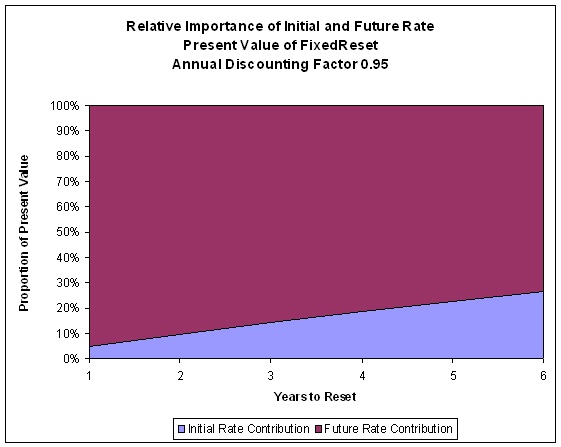
One chart I am particularly fond of illustrates the relative importance of the Current Dividend vs. the Issue Reset Spread for FixedResets that may be assumed to be perpetual (which is a pretty good bet in this case):

PL_141114_App_FR_Chart_17
Click For Big

Given that HSE.PR.A resets in a little over one year, we see that the headline figure, 4.45%, contributes less than 10% of the valuation of the instrument – all the rest is entirely up to the Issue Reset Spread.

So, given that we know the importance of the Issue Reset Spread, how can we work out the all in yield of the issue in order to allow us to compare HSE.PR.A to the new issue, which is a FixedReset, 4.50%+313?

The answer is to use the Yield Calculator for Resets, which is an Excel Spreadsheet I have made available to the public, linked on the Right-Hand Navigation Panel under the heading “Calculators”. [Update: Note that this calculator has been improved since this post was written; the input of the data has been simplified. … JH 2015-8-7] It should be noticed that this is not a magic black box, nor is it particularly sophisticated. It’s simply a tool to allow a schedule of cash flows to be input into a spreadsheet easily. So to use the tool, we input our data into the yellow boxes. We’ll get the results of the calculation in the green boxes and the calculation is performed in the turquoise boxes;; we don’t touch them. Only touch the yellow boxes:

  • Current Price: we’ll put in 19.59, because that’s what the bank used.
  • Call Price: You can put in the call price here, but we’re not expecting the issue to be called – we expect it to remain outstanding in 25 years. So what will the price be in 25 years? There are various approaches to this, one of which is discussed in PrefLetter, but it’s reasonable to assume that in 25 years it will be priced the same as it is now, so we’ll put in 19.59. If you don’t like 19.59, put in some other number. It’s not magic. The Yield Calculation Police won’t take you away if you put in some other number. But your calculation is only as good as your assumptions, so if you calculate a very high yield by inputting some silly price – like $50.00 – as the end-price, well, your calculation is only as good as your assumptions.
  • Settlement Date: Strictly speaking, we should put in the date that a trade executed today will settle (2014-12-9), but I usually use the Trade Date, on the grounds that the bank won’t even let you enter the order unless you’ve got money available RIGHT NOW to pay for it. So I’ll input 2014-12-4.
  • Call Date: If it was priced at $26.00 and I was expecting it to be called, I would put in the call date. But I expect it to be around in twenty-five years (the maximum allowable in this spreadsheet) so I’ll put in 2039-12-4. Again, it’s up to you. If detailed examination of the numerological code embedded in The Gospel According To St. Mark has convinced you that it will be priced at 21.13 on 2028-7-8, go ahead and put in that call price and that date. Don’t worry about the Yield Calculation Police, I’ve paid them off.
  • Quarterly Dividend: So what dividend does it pay right now, expressed as a quarterly amount? I hate using a calculator to calculate six decimal places, so I will input a tiny Excel formula “=25 * 0.0445 / 4”, that is, “equal to the par value times the annual coupon rate divided by four”.
  • Cycle: This gets a little tricky, because we need to know the pay-date of each dividend. A little research tells us it’s paid on the last day of each quarter, March / June / September / December, which is cycle 3. So plug in “3”
  • Pay Date: So what day of these months? It’s the last day, so plug in “31”. In the cash flow schedule, the calculated date “June 31” will be transformed to “July 1”, as you can see in the turquoise area to the right of the data input area. This is a bit of an error, but a very tiny one.
  • Include First Dividend: This is quite important. As the spreadsheet tells you, the next dividend payment is December 31, based on the information you’ve input above. If you buy it today, will you earn that dividend? You’ll have to look up the ex-dividend date for the issue; in this case the ex-dividend date was 2014-11-25, which is now in the past, so you WON’T get the next dividend, so input “0”
  • First Dividend Value: For most issues, the first dividend payment is for a different amount from the others, since it’s adjusted to reflect the time from the security’s issue to the pay date, rather than pay-date to pay-date. HSE.PR.A has been around for a long time, so this does not apply and we’re not even earning the next dividend anyway, so it doubly doesn’t matter. Leave this field blank.
  • Reset Date: The issue resets 2016-3-31. Plug in this date
  • Quarterly Dividend After Reset: This is the moment we’ve all been waiting for! We have to estimate what the dividend will be after the reset, while bearing in mind that the yield we calculate will only be as good as our estimates. It’s generally best to assume that major market yields will not change; that on the reset calculation date the 5-year GOC yield will be the same as it is today, 1.45%. But if you feel this is unreasonable, put in another number you’re more comfortable with. If you think that 1.45% is ridiculous and that GOC-5 will be 2.00% on recalculation day, use 2.00%. You have to use some kind of assumption, there’s no way around that. We will note that TD’s calculation, in using Current Yield, assumed the dividend would not change; i.e., that the dividend would reset to be equal to the 4.45% it is currently, i.e., that GOC-5 on reset calculation date will be 2.72%. Well, if that’s the number you want to use, go ahead. It’s a free country and you can assume anything you like. Just remember that the quality of your yield estimate will reflect the quality of your assumptions; and also remember that consistency is a virtue, so if two issues are resetting at the same time, you should use the same estimate for GOC-5. But I will assume a future GOC-5 rate of 1.45%, so I’ll input the Excel formula “=25 * (0.0145 + 0.0173) / 4” = par value * (sum of assumed GOC-5 rate and Issue Reset Spread [expressed annually]) divided by 4 [quarters per year]. We should also note that the spreadsheet makes no provision for changes in GOC-5, so if you feel that GOC-5 will be 2.00% on the 2016 reset calculation date, but 3.00% on the 2021 reset calculation date, you’ll have to develop your own elaboration of this spreadsheet.

And that’s the end of our input and our answer pops up in the green boxes! Current Yield, 5.68%, just as advertised by TD, but an Annualized Quarterly Yield To Call of 4.17%. That’s quite a difference! And, I will note, it is substantially less than the New Issue FixedReset, 4.50%+313. Implied Volatility Theory tells us to expect less for a deeply discounted issue compared to one at or near par value, but just how much less it should be is a whole ‘nuther issue.

And, I suggest, you should always think of this number as “4.17%, assuming an end-price of 19.59 and a constant GOC-5 of 1.45%”, just to remind yourself of the two critical assumptions you made.

So there you have it. I suggest that those interested in using this spreadsheet as an adjunct to their trading first check all the calculations – Trust But Verify! – and second, play around with it a bit. Change the assumptions of end-price and GOC-5 estimate on reset, see how sensitive the answers are to the inputs. The better you understand your data, the better an investor you’ll be.

Market Action

December 4, 2014

Europe is inching towards quantitative easing:

Mario Draghi dragged the European Central Bank toward more monetary stimulus with a pledge to assess the need early next year, disappointing some investors seeking faster action.

Even as he unveiled “substantially” lower forecasts for euro-area inflation and economic growth, the ECB president said officials will wait to evaluate whether they’re doing enough to revive the weakest consumer-price growth in five years. They are already intensifying preparations for further measures, including studying the merits of buying government debt.

If policy makers do see a need to combat a prolonged period of low inflation then “this would imply altering early next year the size, pace and composition of our measures,” Draghi told reporters in Frankfurt after his Governing Council met to set policy for the last time in 2014. “We don’t need unanimity” on the 24-member council to act, he said.

The ECB Governing Council expects to consider a proposal for a broad-based asset program including sovereign debt next month, according to two euro-area central-bank officials familiar with deliberations who asked not to be identified because the discussion is private. The package is envisaged to include various types of bonds, but no equities, and has yet to be designed, the people said.

Canadian equities got hammered:

Canadian stocks fell the most in more than a year as the nation’s biggest banks posted results that missed estimates and energy shares resumed a selloff with the price of crude.

Toronto-Dominion Bank (TD), the country’s largest lender by assets, tumbled the most in more than five years after posting fourth-quarter profit short of estimates. Energy stocks tumbled 2.1 percent as a group as oil fell. Canadian Oil Sands Ltd. (COS) sank 16 percent to a decade low after slashing its dividend. Enbridge Inc. jumped 10 percent to a record on plans to transfer C$17 billion ($14.9 billion) in assets to a fund.

The Standard & Poor’s/TSX Composite Index (SPTSX) slumped 284.11 points, or 1.9 percent, to 14,469.95 at 4 p.m. in Toronto, the biggest drop since June 2013. The equities benchmark pared its gain to 6.2 percent this year.

All of the 10 industries in the S&P/TSX dropped at least 0.6 percent on trading volume 45 percent higher than the 30-day average today. Global equities slumped after the European Central Bank said policy makers will reassess stimulus next quarter, damping hopes for additional bond purchases this year.

And whenever there’s a big market move there’s only one party at fault:

A nearly 1 per cent drop in the S&P/TSX composite index in the final hour of trading Thursday was due to a large order from Goldman Sachs to sell a basket of Canadian stocks, according to a note from the Bank of Montreal.

Canada’s main stock index recorded one of its biggest declines of the year on Thursday, as investors reacted to another push lower in the price of crude oil as well as a disappointing earnings report from Toronto-Dominion Bank.

According to BMO, the Goldman Sachs sell order was for approximately $600-million in a broad selection of Canadian stocks, but many were in the banking and energy sectors. The heaviest volumes sold by Goldman were shares in Royal Bank of Canada, TD Bank, Bank of Nova Scotia, Bank of Montreal, Canadian Natural Resources, Enbridge and Suncor.

The TSX closed down 284.1 points, or 1.93 per cent, at 14,469.95, far outpacing the 0.12 per cent fall in the S&P 500. The Canadian index had been down nearly 1 per cent prior to 3 p.m. (ET), which is around when the Goldman order was believed to be transacted.

The feds are shilling for the Toronto Exchange:

The Canadian government has approved Burger King Worldwide Inc.’s purchase of Tim Hortons Inc. on condition it maintains employment levels and list the company in Toronto.

To win approval under the nation’s foreign takeover law, Burger King has agreed to “work with Tim Hortons (THI) franchisees” to maintain employment levels across Canada, and accelerate expansion of new restaurants outside Canada at a “significantly greater pace than currently planned,” Industry Minister James Moore said in a statement.

Burger King has also agreed to establish the new company’s headquarters in Oakville, Ontario and list on the Toronto Stock Exchange, according to the statement. Other commitments include managing Tim Hortons as a “distinct brand” that won’t be co-branded with Burger King and the maintenance of franchise rent and royalty structure at current levels for the next five years.

Yay! Micromanagement and central planning! Soon we’ll all be RICH!

Bond salesmen won’t be rich, though (emphasis added):

Four of Canada’s six biggest banks have posted quarterly declines in trading, dragged down by plunging bond markets in October and one-time changes to how lenders value uncollaterized derivatives.

Toronto-Dominion Bank’s trading revenue dropped 14 percent to C$296 million ($260 million) in the period ended Oct. 31 from a year earlier, led by declines in interest-rate and credit trading, the company said today. The lender recorded a C$65 million pretax charge in its wholesale bank tied to the valuation adjustment.

Bank of Montreal (BMO) trading revenue tumbled 21 percent to C$186 million as fixed-income trading plunged 79 percent from a year earlier, the bank said in a Dec. 2 statement. The valuation adjustment reduced revenue by C$39 million.

CIBC trading revenue fell 81 percent to C$27 million, with a C$98 million loss in interest-rates trading, the Toronto-based bank said today in a statement. The lender said it recorded an C$82 million after-tax charge tied to funding valuation adjustments.

Trimming Capital

Royal Bank’s total trading revenue slid 43 percent to C$371 million, fueled by a 70 percent drop in trading of interest-rate and credit securities, the Toronto-based bank said yesterday. Royal Bank had a C$51 million after-tax charge tied to the adjustments.

Royal Bank has been trimming the capital devoted to bond trading as global regulations meant to prevent another credit crisis make it one of the lender’s most costly businesses, CFO Janice Fukakusa said.

So bond market liquidity just got a little worse. Just in time for the long-awaited crash due to policy rate changes!

I try to restrain myself from ranting on non-preferred share issues on this soap-box, but every now and then something irritates me enough that I think it would be a shame to deprive you of my views. Today’s rant is about a Bloomberg story titled Princeton Has a Shadow Fraternity System Nobody Controls. So in the first place, the headline is nonsense. The ‘shadow fraternity system’ certainly is under control by somebody, how could it be otherwise? The writer is merely upset that it’s not controlled by people of whom he approves.

When Princeton officials learned that a student had mass-emailed a photo of a woman performing oral sex at one of its 11 eating clubs (social clubs that resemble fraternities), it quietly began investigating the matter. Despite the fact that passing around a photo of a sex act without the consent of those pictured is a crime in New Jersey, the university did not inform local police. The school’s squeamish approach to the incident raises questions about how it can discipline its students — and abide by stricter government guidelines for handling sexual assault — when so much of social life at the institution lives outside the walls of campus.

“Our investigation began as soon as we received a report, just days after the alleged incident,” says Martin Mbugua, a University spokesman. The Princeton Police Department only found out about the email three weeks later, when an anonymous third party notified the police chief. Any misbehavior at the Tiger Inn, headquartered in a stately mansion on a street just off the main campus, technically falls under the jurisdiction of local police.

In November, the Department of Education found that Princeton botched its response to reports of sexual assault and the University formally agreed to tighten its handling of alleged sexual crimes. New guidelines implemented by the government require schools to investigate sexual violence reports that occur outside of school grounds if the incident has “continuing effects on campus.”

So the university is on the defensive about not being an official informer, and are expected to be Junior Policemen with respect to sexual violence. Sorry, buddies: these are university students we are talking about here – young men and young women. If they want something to be a police matter, they should be expected to know how to contact the police themselves. Junior Police and a Junior Justice System with the power to expel students are not the answer to anything. But meanwhile, the politicians bleat that 20-year olds are old enough to die in Afghanistan, but not old enough to take responsibility for themselves, and drip crocodile tears over the rising cost of tuition due to administrative overload.

There was one cry on the lips of FixedReset investors today:

clobberinTime

One thing I can’t help but highlighting, given the horrible (second-worst) performance of TRP.PR.C today, is the Implied Volatility analysis for the TRP FixedResets:

impVol_TRP_141204
Click for Big

Assiduous Readers will recognize that the overall appearance of the graph has not changed from the chart published as of the close on December 2, but Alert Assiduous Readers will notice that the fit to theory is much better. On Tuesday I asserted that:

Prices for the TRP issues are very strange: consider that TRP.PR.A, bid at 21.15, is priced lower than TRP.PR.C, which is a FixedReset, 4.40%+154, resetting 2016-1-30, bid at 21.77. … TRP.PR.A is now $1.44 cheap while TRP.PR.C is $1.73 expensive

Well, that was then. Now I say that TRP.PR.A is bid at 21.39 and is $0.89 cheap, while TRP.PR.C is bid at 20.82 and is $1.06 expensive. So according to me, there’s more adjustment yet to come!

Despite that – and despite a reported 42bp decline in TXPR and a 79bp hit for TXPL – it was a mixed day for the Canadian preferred share market today, with PerpetualDiscounts off 6bp, FixedResets down 62bp and DeemedRetractibles gaining 4bp. There is a very lengthy list of performance highlights, just like the old days of 2008, dominated of course by FixedReset losers with a large contingent of Enbridge issues, spooked by the credit muttering. Volume was average.

HIMIPref™ Preferred Indices
These values reflect the December 2008 revision of the HIMIPref™ Indices

Values are provisional and are finalized monthly
Index Mean
Current
Yield
(at bid)
Median
YTW
Median
Average
Trading
Value
Median
Mod Dur
(YTW)
Issues Day’s Perf. Index Value
Ratchet 0.00 % 0.00 % 0 0.00 0 0.0285 % 2,518.1
FixedFloater 0.00 % 0.00 % 0 0.00 0 0.0285 % 3,986.7
Floater 2.99 % 3.10 % 63,408 19.41 4 0.0285 % 2,677.0
OpRet 4.39 % -11.90 % 27,137 0.08 2 -0.0390 % 2,759.6
SplitShare 4.27 % 3.63 % 41,879 3.75 5 0.0791 % 3,198.2
Interest-Bearing 0.00 % 0.00 % 0 0.00 0 -0.0390 % 2,523.3
Perpetual-Premium 5.41 % -2.69 % 73,001 0.09 20 0.0605 % 2,487.4
Perpetual-Discount 5.14 % 5.03 % 115,315 15.40 15 -0.0652 % 2,666.9
FixedReset 4.20 % 3.58 % 196,880 8.57 74 -0.6162 % 2,561.5
Deemed-Retractible 4.97 % -0.69 % 94,662 0.15 40 0.0446 % 2,614.7
FloatingReset 2.54 % 1.88 % 60,146 3.48 5 -0.1569 % 2,544.6
Performance Highlights
Issue Index Change Notes
HSE.PR.A FixedReset -4.34 % YTW SCENARIO
Maturity Type : Limit Maturity
Maturity Date : 2044-12-04
Maturity Price : 19.61
Evaluated at bid price : 19.61
Bid-YTW : 4.06 %
TRP.PR.C FixedReset -3.92 % YTW SCENARIO
Maturity Type : Limit Maturity
Maturity Date : 2044-12-04
Maturity Price : 20.82
Evaluated at bid price : 20.82
Bid-YTW : 3.63 %
PWF.PR.P FixedReset -3.41 % YTW SCENARIO
Maturity Type : Limit Maturity
Maturity Date : 2044-12-04
Maturity Price : 21.50
Evaluated at bid price : 21.50
Bid-YTW : 3.58 %
GWO.PR.N FixedReset -3.20 % YTW SCENARIO
Maturity Type : Hard Maturity
Maturity Date : 2025-01-31
Maturity Price : 25.00
Evaluated at bid price : 20.30
Bid-YTW : 5.16 %
ENB.PR.Y FixedReset -2.49 % YTW SCENARIO
Maturity Type : Limit Maturity
Maturity Date : 2044-12-04
Maturity Price : 22.14
Evaluated at bid price : 22.75
Bid-YTW : 4.17 %
ENB.PR.H FixedReset -2.45 % YTW SCENARIO
Maturity Type : Limit Maturity
Maturity Date : 2044-12-04
Maturity Price : 21.63
Evaluated at bid price : 21.91
Bid-YTW : 4.09 %
FTS.PR.H FixedReset -1.87 % YTW SCENARIO
Maturity Type : Limit Maturity
Maturity Date : 2044-12-04
Maturity Price : 19.97
Evaluated at bid price : 19.97
Bid-YTW : 3.57 %
SLF.PR.G FixedReset -1.70 % YTW SCENARIO
Maturity Type : Hard Maturity
Maturity Date : 2025-01-31
Maturity Price : 25.00
Evaluated at bid price : 20.20
Bid-YTW : 5.30 %
ENB.PR.B FixedReset -1.67 % YTW SCENARIO
Maturity Type : Limit Maturity
Maturity Date : 2044-12-04
Maturity Price : 23.10
Evaluated at bid price : 24.10
Bid-YTW : 3.89 %
ENB.PR.D FixedReset -1.62 % YTW SCENARIO
Maturity Type : Limit Maturity
Maturity Date : 2044-12-04
Maturity Price : 22.78
Evaluated at bid price : 23.66
Bid-YTW : 3.95 %
BAM.PR.X FixedReset -1.61 % YTW SCENARIO
Maturity Type : Limit Maturity
Maturity Date : 2044-12-04
Maturity Price : 21.45
Evaluated at bid price : 21.45
Bid-YTW : 3.98 %
ENB.PR.J FixedReset -1.60 % YTW SCENARIO
Maturity Type : Limit Maturity
Maturity Date : 2044-12-04
Maturity Price : 23.08
Evaluated at bid price : 24.60
Bid-YTW : 4.02 %
ENB.PF.E FixedReset -1.47 % YTW SCENARIO
Maturity Type : Limit Maturity
Maturity Date : 2044-12-04
Maturity Price : 23.07
Evaluated at bid price : 24.82
Bid-YTW : 4.06 %
ENB.PF.A FixedReset -1.39 % YTW SCENARIO
Maturity Type : Limit Maturity
Maturity Date : 2044-12-04
Maturity Price : 23.11
Evaluated at bid price : 24.86
Bid-YTW : 4.05 %
ENB.PR.N FixedReset -1.29 % YTW SCENARIO
Maturity Type : Limit Maturity
Maturity Date : 2044-12-04
Maturity Price : 23.03
Evaluated at bid price : 24.41
Bid-YTW : 4.04 %
ENB.PR.T FixedReset -1.28 % YTW SCENARIO
Maturity Type : Limit Maturity
Maturity Date : 2044-12-04
Maturity Price : 22.78
Evaluated at bid price : 23.92
Bid-YTW : 4.01 %
ENB.PR.P FixedReset -1.28 % YTW SCENARIO
Maturity Type : Limit Maturity
Maturity Date : 2044-12-04
Maturity Price : 22.80
Evaluated at bid price : 23.92
Bid-YTW : 4.01 %
BAM.PF.B FixedReset -1.19 % YTW SCENARIO
Maturity Type : Limit Maturity
Maturity Date : 2044-12-04
Maturity Price : 23.20
Evaluated at bid price : 24.96
Bid-YTW : 3.99 %
TRP.PR.B FixedReset -1.17 % YTW SCENARIO
Maturity Type : Limit Maturity
Maturity Date : 2044-12-04
Maturity Price : 17.75
Evaluated at bid price : 17.75
Bid-YTW : 3.77 %
BAM.PF.A FixedReset -1.16 % YTW SCENARIO
Maturity Type : Call
Maturity Date : 2018-09-30
Maturity Price : 25.00
Evaluated at bid price : 25.55
Bid-YTW : 4.13 %
ENB.PF.G FixedReset -1.15 % YTW SCENARIO
Maturity Type : Limit Maturity
Maturity Date : 2044-12-04
Maturity Price : 23.09
Evaluated at bid price : 24.92
Bid-YTW : 4.06 %
FTS.PR.J Perpetual-Discount 1.03 % YTW SCENARIO
Maturity Type : Limit Maturity
Maturity Date : 2044-12-04
Maturity Price : 24.04
Evaluated at bid price : 24.45
Bid-YTW : 4.86 %
IAG.PR.A Deemed-Retractible 1.24 % YTW SCENARIO
Maturity Type : Hard Maturity
Maturity Date : 2025-01-31
Maturity Price : 25.00
Evaluated at bid price : 23.75
Bid-YTW : 5.23 %
Volume Highlights
Issue Index Shares
Traded
Notes
ENB.PR.P FixedReset 521,700 Desjardins sold 18,500 to Scotia at 24.10, then blocks of 125,500 shares, 241,000 shares, 15,600 and 16,000 to anonymous, all at 24.00, and finally crossed 65,200 at 24.00. Nice tickets!
YTW SCENARIO
Maturity Type : Limit Maturity
Maturity Date : 2044-12-04
Maturity Price : 22.80
Evaluated at bid price : 23.92
Bid-YTW : 4.01 %
ENB.PF.C FixedReset 199,713 Desjardins sold blocks of 111,200 and 55,200 to anonymous at 25.00.
YTW SCENARIO
Maturity Type : Limit Maturity
Maturity Date : 2044-12-04
Maturity Price : 23.13
Evaluated at bid price : 24.96
Bid-YTW : 4.01 %
TRP.PR.A FixedReset 157,332 TD crossed 14,300 at 21.40 and 20,000 at 21.35. RBC crossed 37,300 at 21.40.
YTW SCENARIO
Maturity Type : Limit Maturity
Maturity Date : 2044-12-04
Maturity Price : 21.39
Evaluated at bid price : 21.39
Bid-YTW : 3.85 %
MFC.PR.N FixedReset 120,750 Recent new issue.
YTW SCENARIO
Maturity Type : Hard Maturity
Maturity Date : 2025-01-31
Maturity Price : 25.00
Evaluated at bid price : 25.06
Bid-YTW : 3.73 %
ENB.PF.E FixedReset 67,617 National crossed 26,000 at 25.10.
YTW SCENARIO
Maturity Type : Limit Maturity
Maturity Date : 2044-12-04
Maturity Price : 23.07
Evaluated at bid price : 24.82
Bid-YTW : 4.06 %
ENB.PF.G FixedReset 37,700 RBC bought 11,500 from anonymous at 25.10.
YTW SCENARIO
Maturity Type : Limit Maturity
Maturity Date : 2044-12-04
Maturity Price : 23.09
Evaluated at bid price : 24.92
Bid-YTW : 4.06 %
There were 29 other index-included issues trading in excess of 10,000 shares.
Wide Spread Highlights
Issue Index Quote Data and Yield Notes
PVS.PR.C SplitShare Quote: 25.90 – 26.90
Spot Rate : 1.0000
Average : 0.5898

YTW SCENARIO
Maturity Type : Call
Maturity Date : 2015-12-10
Maturity Price : 25.50
Evaluated at bid price : 25.90
Bid-YTW : 3.16 %

BAM.PF.E FixedReset Quote: 25.25 – 26.25
Spot Rate : 1.0000
Average : 0.5928

YTW SCENARIO
Maturity Type : Limit Maturity
Maturity Date : 2044-12-04
Maturity Price : 23.22
Evaluated at bid price : 25.25
Bid-YTW : 3.93 %

HSE.PR.A FixedReset Quote: 19.61 – 20.36
Spot Rate : 0.7500
Average : 0.4868

YTW SCENARIO
Maturity Type : Limit Maturity
Maturity Date : 2044-12-04
Maturity Price : 19.61
Evaluated at bid price : 19.61
Bid-YTW : 4.06 %

PWF.PR.P FixedReset Quote: 21.50 – 22.19
Spot Rate : 0.6900
Average : 0.4603

YTW SCENARIO
Maturity Type : Limit Maturity
Maturity Date : 2044-12-04
Maturity Price : 21.50
Evaluated at bid price : 21.50
Bid-YTW : 3.58 %

ENB.PR.Y FixedReset Quote: 22.75 – 23.10
Spot Rate : 0.3500
Average : 0.2344

YTW SCENARIO
Maturity Type : Limit Maturity
Maturity Date : 2044-12-04
Maturity Price : 22.14
Evaluated at bid price : 22.75
Bid-YTW : 4.17 %

BAM.PR.T FixedReset Quote: 25.02 – 25.49
Spot Rate : 0.4700
Average : 0.3566

YTW SCENARIO
Maturity Type : Limit Maturity
Maturity Date : 2044-12-04
Maturity Price : 23.52
Evaluated at bid price : 25.02
Bid-YTW : 3.73 %