Market Action

August 19, 2008

Fannie and Freddie continue to be the focus of attention; Accrued Interest reminds us of an important point:

FRE and FNM preferreds are down another 20% or so today, threatening the $10 area on FRE Z. One trader told me he’s started to see bottom fishing here, which seems incredibly stupid to me. Bottom fishing can work as a strategy, but no one can put odds on whether the impending GSE nationalization will make preferred shareholders whole or not. This isn’t about financial analysis anymore.

Lacker just wants the damn things privatized:

Richmond Federal Reserve Bank President Jeffrey Lacker called for “demonstrably” privatizing Fannie Mae and Freddie Mac, becoming the first Fed official to publicly clash with the Bush administration’s strategy of keeping them as federally backed firms.

“I would prefer to see them credibly and demonstrably privatized,” Lacker said today in an interview with Bloomberg Television. He agreed with former Fed Chairman Alan Greenspan’s view that the two largest U.S. mortgage finance firms ought to be nationalized, then split up and sold off.

Amidst all this, there is speculation that Lehman will write off $4-billion this quarter and Naked Capitalism passes on reports that the Lehman delevering process continues:

From the New York Times

There has been widespread speculation that Lehman was contemplating a sale of Neuberger Berman, whose value is estimated by analysts to vary from less than $7 billion to as high as $13 billion (Lehman’s entire market capitalization is about $10.5 billion).

And here’s a report from the front lines:

“I’ve been at National City for 30 years and a month and for 29 of those we’ve seen nothing like it,” Thomas Richlovsky, National City’s 57-year-old treasurer, said in a telephone interview. “In past cycles certainly lending, or credit, has gotten more difficult. The cost of credit would go up. In this particular phenomenon of the last year it’s not like you can borrow money and the price went up. No, the market’s closed.”

National City on July 24 reported a $1.76 billion second- quarter loss and increased its 2008 forecast for uncollectible debt to as much as $2.9 billion. The Cleveland-based bank raised $7 billion of capital in April, which Richlovsky said is more than enough to weather the seizure in the credit markets.

The stock sale wasn’t enough to stop National City’s bonds from tumbling. Its $700 million of 6.875 percent notes due in 2019 traded last week at 61 cents on the dollar, down from 77.5 cents in June and 99 cents at the beginning of the year, according to Trace, the bond-price reporting system of the Financial Industry Regulatory Authority.

The Ontario judgement on non-bank ABCP will be challenged by Ivanhoe, perhaps with others.

Amidst all this certainty, we can be glad that one thing in life is constant – there’s a lot of regulatory posturing on the US Auction rate market:

U.S. Securities and Exchange Commission Chairman Christopher Cox said investigations into the collapse of the auction-rate bond market extend beyond the banks that created the debt and settled with regulators to include brokerages that sold the investments.

“Nobody is getting a pass,” Cox said at a news conference in Washington today.

Regulators should force Wall Street banks to buy back all the auction-rate securities they created instead of investigating brokers that sold the debt, the Washington-based Regional Bond Dealers Association said in a letter to the SEC and other regulators last week.

Regulators focused first on the biggest underwriters, claiming they pitched securities as safe alternatives to money- market investments, even as the risk grew that the market would freeze.

Safe? What does “safe” mean? Are they talking about credit risk, liquidity risk, term risk, taxation risk, inflation risk, or one of the other million things that can go wrong? My view is that it should be treated in the same way as Canadian non-Bank ABCP should have been treated: brokers should be held liable for recommending overexposure to the asset class, but not for reasonable exposure. The credit was fine – and, as far as I know, remains fine (there are two exceptions to this generalization, I think). Liquidity … not so good.

However, consideration of more than one kind of risk – and genuine acceptance of the fact that black swans happen and all you can hope for is loss limitation by diversification – will make news reports longer than 500 words and involve a little judgement, so it won’t happen.

Amazingly, PerpetualDiscounts were weak today, losing 0.14% in their second down-day since July 16. From the close July 16 to the close today, they’ve gained 8.60%, with yields dropping from 6.63% to 6.13%. So … er … let me see … one month at 6.63% is about 0.55%, call it, so capital gain is 8.60-0.55 = call it 8% on a yield drop of 0.5% … the effective modified duration was about 16 years. Give or take. Remember, HIMIPref™ under-calculates modified duration (which is precisely 1/YTM) as a matter of computational and reporting convenience.

Today’s closing yield of 6.13% is equivalent to 8.58% interest at the standard conversion factor of 1.4x. Long Corporates currently yield a little under 6.1% … I think we can say the spread is maintaining itself around 250bp without anybody fussing too much. That used to be a long-term record!

Note that these indices are experimental; the absolute and relative daily values are expected to change in the final version. In this version, index values are based at 1,000.0 on 2006-6-30
Index Mean Current Yield (at bid) Mean YTW Mean Average Trading Value Mean Mod Dur (YTW) Issues Day’s Perf. Index Value
Ratchet N/A N/A N/A N/A 0 N/A N/A
Fixed-Floater 4.62% 4.37% 56,740 16.44 7 +0.0601% 1,106.9
Floater 4.06% 4.09% 45,547 17.17 3 +0.2643% 910.1
Op. Retract 4.97% 4.24% 112,227 2.62 17 +0.1193% 1,047.6
Split-Share 5.34% 5.93% 56,315 4.43 14 -0.1164% 1,039.2
Interest Bearing 6.19% 6.55% 48,715 5.25 2 -0.1500% 1,131.8
Perpetual-Premium 6.17% 6.11% 65,153 2.24 1 -0.3542% 990.4
Perpetual-Discount 6.08% 6.13% 195,866 13.54 70 -0.1361% 875.6
Major Price Changes
Issue Index Change Notes
IAG.PR.A PerpetualDiscount -2.3974% Now with a pre-tax bid-YTW of 6.39% based on a bid of 18.32 and a limitMaturity.
ELF.PR.G PerpetualDiscount -1.4077% Now with a pre-tax bid-YTW of 6.89% based on a bid of 17.51 and a limitMaturity.
BNA.PR.C SplitShare -1.0983% Asset coverage of 3.3+:1 as of July 31, according to the company. Now with a pre-tax bid-YTW of 9.34% based on a bid of 17.11 and a hardMaturity 2019-1-10 at 25.00. Compare with BNA.PR.A (6.05% to 2010-9-30) and BNA.PR.B (8.72% to 2016-3-25). Oddly, this issue did rather poorly on its last cum-dividend day. Did somebody misread their calendar?
TD.PR.O PerpetualDiscount -1.0402% Now with a pre-tax bid-YTW of 5.86% based on a bid of 20.93 and a limitMaturity.
BAM.PR.K Floater +1.0892%  
LBS.PR.A SplitShare +1.3917% Asset coverage of 2.2+:1 as of August 15 according to the company. Now with a pre-tax bid-YTW of 4.95% based on a bid of 10.20 and a hardMaturity 2013-11-29 at 10.00.
GWO.PR.G PerpetualDiscount +1.3953% Now with a pre-tax bid-YTW of 6.05% based on a bid of 21.80 and a limitMaturity.
Volume Highlights
Issue Index Volume Notes
RY.PR.B PerpetualDiscount 82,850 RBC crossed 40,000 at 19.50. Now with a pre-tax bid-YTW of 6.10% based on a bid of 19.40 and a limitMaturity.
BAM.PR.J OpRet 34,450 CIBC crossed 31,400 at 23.50. Now with a pre-tax bid-YTW of 6.41% based on a bid of 23.46 and a softMaturity 2018-3-30 at 25.00. Compare with BAM.PR.H (6.34% to 2012-3-30), BAM.PR.I (6.61% to 2013-12-30) and BAM.PR.O (7.34% to 2013-6-30).
CM.PR.H PerpetualDiscount 27,910 TD crossed 13,000 at 18.48. Now with a pre-tax bid-YTW of 6.61% based on a bid of 18.38 and a limitMaturity.
PWF.PR.K PerpetualDiscount 26,614 TD crossed 12,000 at 20.68. Now with a pre-tax bid-YTW of 6.13% based on a bid of 20.42 and a limitMaturity.
RY.PR.G PerpetualDiscount 23,860 Now with a pre-tax bid-YTW of 6.09% based on a bid of 18.60 and a limitMaturity.

There were twenty-one other index-included $25-pv-equivalent issues trading over 10,000 shares today.
Market Action

August 18, 2008

Rumours swirled around Fannie and Freddie today, after a gloomy story in Barrons:

It is growing increasingly likely that the Treasury will recapitalize Fannie and Freddie in the months ahead on the taxpayer’s dime, availing itself of powers granted it under the new housing bill signed into law last month. Such a move almost certainly would wipe out existing holders of the agencies’ common stock, with preferred shareholders and even holders of the two entities’ $19 billion of subordinated debt also suffering losses.

Bloomberg’s rumours are more detailed:

Both Fannie and Freddie slid as much as 12 percent after Barron’s said government officials anticipate the companies will fail to raise the equity capital they need, prompting the U.S. Treasury to step in. Fannie is down 82 percent this year. Freddie has fallen 85 percent.

A rescue would include preferred stock with a seniority, dividend preference and convertibility right that would wipe out common stockholders, Barron’s reported, citing an unidentified source in the Bush administration. Treasury Secretary Henry Paulson, who received the authority he requested from Congress to help the companies, has said a bailout won’t be needed.

Standard & Poor’s cut Fannie and Freddie’s preferred stock and subordinated debt ratings by three levels last week to A- from AA-. S&P affirmed the companies’ AAA senior debt rating, reflecting perceived government support.

At the close, Accrued Interest made some good observations:

GSE securities of all types getting hit hard today. Interestingly, both the common and preferred shares are down ~20%. Sub debt some 200bps wider with poor liquidity.

The ultimate problem here is best described by Merrill Lynch’s Ken Bruce. You can dive into Freddie Mac or Fannie Mae’s balance sheet and make a good case that they don’t need new capital, at least under current forecasts for housing. You’d therefore conclude that if they were a truly private company, they’d best serve shareholders by trying to stick it out. But they aren’t a truly private company. As the perception of their capital strength wanes, policy makers are going to conclude that we are better off nationalizing the GSEs.

As for wiping out preferred shareholders… Remember that the big preferred shareholders are smaller banks. I don’t think it would make sense for the Administration to bolster one part of the banking system (Fannie and Freddie) at the expense of another part of the banking system (regional banks). And besides, I don’t think its necessary to protect tax-payers interests.

The trade is to be long senior Agency debt. There is just no way the Treasury allows anything to happen to senior debt holders. I don’t know who is playing in sub notes or preferred shares in here. No amount of investment analysis is going to help you figure what the Treasury’s next move is.

There was some discussion of the Fannie and Freddie prefs on August 8.

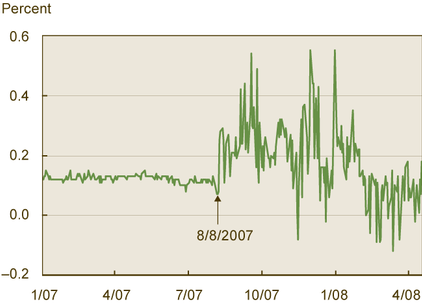
There was a great graph published by the Cleveland Fed in a discussion of the Student Loans Market:

Note: The spread is the three-month LIBOR rate minus the three-month financial commercial paper rate.
Sources: The Board of Governors of the Federal Reserve System; Financial Times.

The enormous volatility seems much more illustrative to me of the credit crunch than the more usual graphs of enormous spread increases:

Sunlife issues did very well today – it would appear that nobody noticed they went ex-Dividend today. PerpetualDiscounts had yet another up-day today, but the total return index is still a fraction under the June 30 value of 877.24. The fact that there has been a gain of almost exactly 8.75% since the July 16 nadir – with only one down-day in that period – should really rub it in about just how bad the first half of July was!

Note that these indices are experimental; the absolute and relative daily values are expected to change in the final version. In this version, index values are based at 1,000.0 on 2006-6-30
Index Mean Current Yield (at bid) Mean YTW Mean Average Trading Value Mean Mod Dur (YTW) Issues Day’s Perf. Index Value
Ratchet N/A N/A N/A N/A 0 N/A N/A
Fixed-Floater 4.63% 4.37% 57,333 16.44 7 -0.0803% 1,106.2
Floater 4.07% 4.10% 46,155 17.15 3 +0.1471% 907.7
Op. Retract 4.98% 4.45% 112,445 3.06 17 -0.0824% 1,046.3
Split-Share 5.33% 5.90% 55,570 4.43 14 -0.1441% 1,040.5
Interest Bearing 6.18% 6.51% 48,553 5.26 2 +0.1011% 1,133.5
Perpetual-Premium 6.15% 5.94% 65,413 2.24 1 +0.6337% 994.0
Perpetual-Discount 6.07% 6.12% 197,523 13.55 70 +0.2551% 876.8
Major Price Changes
Issue Index Change Notes
BMO.PR.H PerpetualDiscount -1.1236% Now with a pre-tax bid-YTW of 6.04% based on a bid of 22.00 and a limitMaturity.
BAM.PR.H OpRet -1.0000% Now with a pre-tax bid-YTW of 6.35% based on a bid of 24.75 and a softMaturity 2012-3-30 at 25.00. Compare with BAM.PR.I (6.64% to 2013-12-30), BAM.PR.J (6.31% to 2018-3-30) and BAM.PR.O (7.33% to 2013-6-30).
SLF.PR.E PerpetualDiscount +1.0338% Now with a pre-tax bid-YTW of 6.11% based on a bid of 18.41 and a limitMaturity.
IAG.PR.A PerpetualDiscount +1.1315% Now with a pre-tax bid-YTW of 6.23% based on a bid of 18.77 and a limitMaturity.
SLF.PR.C PerpetualDiscount +1.1932% Now with a pre-tax bid-YTW of 6.10% based on a bid of 18.22 and a limitMaturity.
ELF.PR.F PerpetualDiscount +1.2301% Now with a pre-tax bid-YTW of 6.81% based on a bid of 19.75 and a limitMaturity.
MFC.PR.C PerpetualDiscount +1.3171% Now with a pre-tax bid-YTW of 5.63% based on a bid of 20.00 and a limitMaturity.
SLF.PR.B PerpetualDiscount +1.3740% Now with a pre-tax bid-YTW of 6.11% based on a bid of 19.62 and a limitMaturity.
ENB.PR.A PerpetualDiscount +1.7811% Now with a pre-tax bid-YTW of 5.88% based on a bid of 23.43 and a limitMaturity.
CM.PR.P PerpetualDiscount +1.9277% Now with a pre-tax bid-YTW of 6.58% based on a bid of 21.15 and a limitMaturity.
Volume Highlights
Issue Index Volume Notes
SLF.PR.A PerpetualDiscount 81,620 TD crossed 74,600 at 19.35. Now with a pre-tax bid-YTW of 6.12% based on a bid of 19.40 and a limitMaturity.
CM.PR.H PerpetualDiscount 34,460 Now with a pre-tax bid-YTW of 6.61% based on a bid of 18.38 and a limitMaturity.
HSB.PR.D PerpetualDiscount 17,500 Now with a pre-tax bid-YTW of 6.12% based on a bid of 20.78 and a limitMaturity.
BMO.PR.K PerpetualDiscount 16,750 Now with a pre-tax bid-YTW of 6.08% based on a bid of 21.65 and a limitMaturity.
CM.PR.J PerpetualDiscount 15,850 Now with a pre-tax bid-YTW of 6.48% based on a bid of 17.57 and a limitMaturity.

There were seventeen other index-included $25-pv-equivalent issues trading over 10,000 shares today.

Issue Comments

RF.PR.A Sweetens Deal

C.A.Bancorp has announced:

a change to the exercise price of the warrants being offered under a preliminary prospectus dated July 21, 2008.

Each Warrant will entitle the holder to purchase one Preferred Share at a subscription price of $23.75 at any time on or before 4:00 p.m. (Toronto time) on September 30, 2011. Previously, as filed in the preliminary prospectus, the subscription price was set at $24.50. The revised subscription price will be changed to $23.75 upon filing of the final prospectus.

The offering has been previously noted on PrefBlog. It would appear that they’re having a little difficulty selling it!

Sub-Prime!

Canadian Non-Bank ABCP: Appealed, But Court Passes!

The judgement has been released:

[121] For the foregoing reasons, I would grant leave to appeal from the decision of Justice Campbell, but dismiss the appeal.

This affirms the earlier decision by Mr. Justice Colin Campbell.

The National Post reports:

Yesterday three Alberta oil companies abandoned their opposition to the workout after reaching agreements with ABCP dealers.

… but provides no details.

Market Action

August 15, 2008

James Hamilton of Econbrowser takes a brief look at the US Inflation numbers and concludes:

there is a clear need to net out the May-to-July energy price increase– it’s already been reversed. The US national average gas price is back to $3.78/gallon, right where it was in mid-May. Thus, even without any further drop in the price of gasoline– and personally, I do expect further drops– the 4-1/2% number is a better summary of where we stand right at the moment than 5-1/2%.

So no, I don’t think that yesterday’s CPI numbers will cause the Fed to panic. Because yesterday’s news is already way of out of date.

Stephen Foley of The Independent looks at the Fed/SEC turf battle (hat tip: Naked Capitalism):

But [SEC Chairman Christopher Cox] starts an important battle for the soul of US financial regulation several laps behind the Federal Reserve and opponents on Wall Street who see this as the perfect time to take a few teeth out of the SEC.

A blueprint for regulatory reform by Mr Paulson, which envisages the Fed as a super-regulator with only a narrow role for the SEC, was forged out of Wall Street’s frustration with SEC red tape and what investment banks complained was their diminishing competitive advantage over London. Britain, they argued, had a risk-based approach to regulation that was light-touch in day-to-day matters and only descended on institutions regarded as risking damage to the financial system. The SEC, with its raft of rules, would be wrapped into a much-diminished third-tier regulator responsible for protecting investors and market participants from fraud and market manipulation.

Now, I don’t want it to seem as if I’m defending the SEC and its regulatory approach – for one thing, I’m simply not familiar enough with the issues. But although there are some very good arguments to be made that central banks should combine the regulatory and lender of last resort functions, I’m not sure how well this works in practice. Particularly when applied to investment banking – which is supposed to be wilder and riskier than regular banking, by design! – this simply places too much power in the hands of a single agency. Many nations separate the regulatory and lending functions (Canada, to name but one) without huge problems; it seems to me that separation of function is Good.

After all, isn’t this what the regulators are always telling us about separation of function when they pontificate? Bookkeepers should not cut cheques. Internal Audit should not sell IPOs. And lenders should not be regulators.

We may, eventually, be getting towards the end of the ABCP legal saga:

Investors in the frozen $32-billion asset-backed commercial paper market will find out on Monday what will happen to the money they put into the troubled paper when an appeals court renders its decision.

The Ontario Court of Appeal says it will release its decision on the restructuring plan on Monday at 5 p.m. ET.

An Ontario Superior Court judge accepted the plan, but the decision also left open a 21-day window for individual and corporate investors to file appeals on the case.

Several corporations with the paper filed appeals claiming that the plan wrongfully granted immunity from litigation to the banks, brokers and the rating agency involved in ABCP.

The decision will be posted on the court’s website …

The Canadian Press reporter was good enough to note that the decision will be posted on the court’s website, but got the address wrong. The announcement is here.

PerpetualDiscounts continued their recovery today, but the total return index remains a hair below its level of June 30. The weighted average yield to maturity for these issues is currently 6.13%, compared to 6.07% on June 30 and a high of 6.63% on July 16.

The fund is doing quite well this month; trading volume has been quite heavy since mid-July (when chaos and confusion reigned unchallenged in the sector) and these relative-value trades are starting to pay off handsomely. How handsomely? I’d better keep my mouth shut, but I will say that I’m feeling a lot happier halfway through August than I was halfway through July!

Volume was light today.

Note that these indices are experimental; the absolute and relative daily values are expected to change in the final version. In this version, index values are based at 1,000.0 on 2006-6-30
Index Mean Current Yield (at bid) Mean YTW Mean Average Trading Value Mean Mod Dur (YTW) Issues Day’s Perf. Index Value
Ratchet N/A N/A N/A N/A 0 N/A N/A
Fixed-Floater 4.63% 4.37% 58,923 16.45 7 -0.0637% 1,104.6
Floater 4.07% 4.11% 47,256 17.15 3 -0.0163% 906.4
Op. Retract 4.97% 4.30% 114,408 2.92 17 +0.0460% 1,047.2
Split-Share 5.32% 5.86% 56,047 4.44 14 +0.3404% 1,042.0
Interest Bearing 6.18% 6.52% 48,923 5.26 2 -0.1008% 1,132.4
Perpetual-Premium 6.19% 6.20% 67,910 2.25 1 0.0000% 987.7
Perpetual-Discount 6.08% 6.13% 199,080 13.53 70 +0.2117% 874.6
Major Price Changes
Issue Index Change Notes
ENB.PR.A PerpetualDiscount -2.2505% Now with a pre-tax bid-YTW of 5.98% based on a bid of 23.02 and a limitMaturity.
ELF.PR.F PerpetualDiscount -1.4646% Now with a pre-tax bid-YTW of 6.89% based on a bid of 19.51 and a limitMaturity.
PWF.PR.K PerpetualDiscount +1.0412% Now with a pre-tax bid-YTW of 6.14% based on a bid of 20.38 and a limitMaturity.
BAM.PR.N PerpetualDiscount +1.0753% Now with a pre-tax bid-YTW of 7.15% based on a bid of 16.92 and a limitMaturity.
HSB.PR.D PerpetualDiscount +1.1214% Now with a pre-tax bid-YTW of 6.13% based on a bid of 20.74 and a limitMaturity.
FTN.PR.A SplitShare +1.1236% Asset coverage of just under 2.0:1 as of July 31 according to the company. Now with a pre-tax bid-YTW of 5.49% based on a bid of 9.90 and a hardMaturity 2015-12-1 at 10.00.
BNA.PR.C SplitShare +1.1696% Asset coverage of 3.3+:1 as of July 31, according to the company. Now with a pre-tax bid-YTW of 9.18% based on a bid of 17.30 and a hardMaturity 2019-1-10 at 25.00. Compare with BNA.PR.A (6.02% to 2010-9-30) and BNA.PR.B (8.55% to 2016-3-25).
PWF.PR.L PerpetualDiscount +1.2328% Now with a pre-tax bid-YTW of 6.03% based on a bid of 21.35 and a limitMaturity.
TD.PR.R PerpetualDiscount +1.2679% Now with a pre-tax bid-YTW of 5.70% based on a bid of 24.76 and a limitMaturity.
TD.PR.Q PerpetualDiscount +1.2700% Now with a pre-tax bid-YTW of 5.71% based on a bid of 24.72 and a limitMaturity.
WFS.PR.A SplitShare +1.2807% Asset coverage of 1.6+:1 as of August 7, according to Mulvihill. Now with a pre-tax bid-YTW of 7.57% based on a bid of 9.49 and a limitMaturity.
BAM.PR.M PerpetualDiscount +1.3814% Now with a pre-tax bid-YTW of 7.17% based on a bid of 16.88 and a limitMaturity.
PWF.PR.G PerpetualDiscount +1.4493% Now with a pre-tax bid-YTW of 6.07% based on a bid of 24.50 and a limitMaturity.
Volume Highlights
Issue Index Volume Notes
CM.PR.G PerpetualDiscount 211,700 Nesbitt crossed 200,000 at 20.00. Now with a pre-tax bid-YTW of 6.75% based on a bid of 20.24 and a limitMaturity.
TD.PR.P PerpetualDiscount 77,900 National crossed 75,000 at 23.10. Now with a pre-tax bid-YTW of 5.73% based on a bid of 23.08 and a limitMaturity.
BCE.PR.G FixFloat 69,200 Desjardins crossed 66,900 at 24.60.
BCE.PR.Z FixFloat 36,606 Nesbitt crossed 36,400 at 24.40
RY.PR.B PerpetualDiscount 21,890 Now with a pre-tax bid-YTW of 6.06% based on a bid of 19.51 and a limitMaturity.

There were eleven other index-included $25-pv-equivalent issues trading over 10,000 shares today.

Issue Comments

DBRS Withdraws Ratings for IQW.PR.C / IQW.PR.D

DBRS has announced that it:

has today discontinued its ratings coverage of Quebecor World Inc. (Quebecor World).

Quebecor World’s North American subsidiaries have been operating under the Companies’ Creditors Arrangement Act in Canada and under Chapter 11 of the United States Bankruptcy Code in the United States since January 21, 2008.

Short and sweet, eh? S&P withdrew their ratings on June 10. Moody’s withdrew theirs on February 6.

Quebecor World was last mentioned on PrefBlog in connection with the continuing conversion of IQW.PR.C to common.

Administration

PrefBlog Hacked!

My query

A similar query

A good explanation. I had one of these. I took the call to “wp_footer()” out of my footer.php file, and that stopped that nonsense. I couldn’t find any of the files noted in this articles example; I can only hope it gets weeded out on a re-install.

An even better explanation … I got one of those “active_ plugins”, but the option value is “a:0:{}”. I have no idea what it means … it looks like a placeholder. What I do have is one with “option_name” equal to “wp_links”, with the “freemacwareDOTcom” address conspicuously highlighted. This was causing popups on closure. I have uploaded the value of the memo field for scientific purposes. NOTE: I removed all of the left-angle brackets (“<") from this file to disable the code. Not indexed by Technocrati … How wonderful! Now I’ll have to reinstall the current version of WordPress and cross my fingers that I can still understand it!

Capturing $_POST commands … I just might try this, you know. PrefBlog has been under heavy attack lately by spam comments.

So anyway … my apologies to all readers who have been inconvenienced – or simply puzzled – by the recent popups. Please let me know of any odd behavior by PrefBlog (I mean odd behavior that is system-related, of course!) in the future and I’ll be that much quicker tracking things down.

Update, 2008-8-16: The database has a table, wp_postmeta, which tracks attachments. One record in this table has the values: meta_id=8474, post_id=2181, meta_key = ‘_wp_attached_file’, meta_value=’/services1/webpages/p/r/prefblog.com
/public//../../../../../../../../../../../../../../../../../tmp/10bum.txt’

There is also: meta_id=8472, post_id=2180, meta_key = ‘__wp_attached_file’, meta_value = ‘/services1/webpages/p/r/prefblog.com
/public//../../../../../../../../../../../../../../../../../tmp/2newbum.txt’

These records have been removed.

I have also deleted some entries in the wp_posts table. As far as I can make out from the WordPress codex the value of ‘post_parent’ should reference a ‘post_id’ in the same table, which are all positive integers.

After noting some odd entries, I queried the database: ‘select * from wp_posts where post_parent < 0' and came up with seven records. Two have post_parent set to numbers that are large and negative; the 'guid' field indicates that this is stuff that I did, in fact, upload but somehow screwed up. The remaining 5 records all have post_parent set to -1, with 'guid' having a variety of values: the first one, with 'post_modifed' = '2008-03-25 05:26:58' has 'guid' = 'http://www.prefblog.com
//../../../../../../../../../../../../../../../../../tmp/3rbsmag.txt’. The other entries are similar, with filenames 10bum.txt (three times) and 2newbum.txt.

All these records have been deleted. Note that with these long field values, I have added a HTML line-break to make the full field look nice on this post.

I note that the first of these highly suspicious entries occurred within a week of my WP 2.3.3 installation! I have requested database validation for forthcoming releases of WordPress.

Update, 2008-8-16: Problems with the file 3rbsmag.txt have been discussed on WordPress.

Market Action

August 14, 2008

Accrued Interest comments on the extraordinary new-issue concession for Citigroup 5-years:

The new issue was sold at a yield spread of 337.5bps over the 5-year Treasury. Prior to the announcement of the new issue, Citigroup’s 5.5% bond due in April 2013 was bid at +275.

First, this is an extreme concession for a plain vanilla debt sale of a Aa3 rated bank. In 2006, the concession might have been 5 or 10bps at the most for a new issue. Alternatively, Baa-rated Deutsche Telecom recently brought a new 10-year issue, and the concession was around 15bps. This tells you that while there are buyers of Citigroup debt, they pretty much have to give it away.

Second, at a spread to Treasuries of +337.5, the deal has a very large negative basis to credit default swaps. This means that buyers of Citi bonds could also buy CDS and realize an arbitrage. Citi CDS closed Tuesday at 160bps and 5-year swap spreads closed at +98.5.

Meanwhile, in an incident that doesn’t have the credit rating agencies looking all that good, Bluepoint’s gone BK:

Wachovia Corp.’s BluePoint Re Ltd. unit, which insures structured finance and municipal transactions, filed for bankruptcy protection, citing defaults on securitized mortgages.

BluePoint filed a petition in Manhattan yesterday, saying it has more than $100 million in debt.

Wachovia, the fourth-biggest U.S. bank, reported a $330 million charge in the second half of 2007 related to BluePoint’s losses on credit default swaps on collateralized debt obligations, or CDOs. BluePoint decided to liquidate after failing to negotiate a restructuring with banks including UBS AG that were counterparties to its swaps, according to court papers.

BluePoint Re, the smallest reinsurer in the bond-insurance industry according to Moody’s Investors Service, had its credit rating cut 14 levels to Ca from A2 by the agency yesterday. Moody’s had lowered its rating two notches from Aa3 on July 11.

The only possible excuse I can find for such a swift downgrade is found in Moody’s press release:

In contrast to most other financial guarantors, BluePoint Re is much more exposed to liquidity risk in its CDS contracts due to payment and settlement terms, including market value termination rating triggers that take effect below the single-A rating level.

… but it doesn’t look good! S&P said:

it lowered its financial strength and financial enhancement ratings on BluePoint Re Ltd. to ‘R’ from ‘A’. An insurer rated ‘R’ is under regulatory supervision because of its financial condition.

According to a S&P request for comment, the lowest 3-year projected rating for an issue currently rated A is B:

Under the proposal, when assigning and monitoring ratings, we would consider whether we believe an issuer or security has a high likelihood of experiencing unusually large adverse changes in credit quality under conditions of moderate stress (for example, recessions of moderate severity, such as the U.S. recessions of 1960 and 1991 and the European recession of 1991 or appropriate sector-specific stress scenarios). In such cases, we would assign the issuer or security a lower rating than we would have otherwise.

I don’t like the proposal, by the way. I prefer a volatility modifier.

Yet another day of recovery for PerpetualDiscounts; their total return index has returned to above that of July 2, but still below the June 30 close. Average yield is 6.14%, equivalent to 8.60% interest (with the 1.4x equivalency factor), which is long corporates +250bp.

Note that these indices are experimental; the absolute and relative daily values are expected to change in the final version. In this version, index values are based at 1,000.0 on 2006-6-30
Index Mean Current Yield (at bid) Mean YTW Mean Average Trading Value Mean Mod Dur (YTW) Issues Day’s Perf. Index Value
Ratchet N/A N/A N/A N/A 0 N/A N/A
Fixed-Floater 4.63% 4.36% 57,640 16.46 7 +0.0474% 1,105.3
Floater 4.07% 4.11% 48,114 17.15 3 -0.4531% 906.6
Op. Retract 4.97% 4.40% 116,135 2.92 17 -0.0308% 1,046.7
Split-Share 5.34% 5.93% 56,262 4.44 14 +0.0600% 1,038.4
Interest Bearing 6.18% 6.50% 49,936 5.27 2 -0.3007% 1,133.5
Perpetual-Premium 6.19% 6.20% 68,827 2.25 1 -0.3945% 987.7
Perpetual-Discount 6.09% 6.14% 200,778 13.51 70 +0.3788% 872.7
Major Price Changes
Issue Index Change Notes
CM.PR.P PerpetualDiscount -1.1005% Now with a pre-tax bid-YTW of 6.73% based on a bid of 20.67 and a limitMaturity.
TRI.PR.B Floater -1.0549%  
ELF.PR.G PerpetualDiscount +1.1429% Now with a pre-tax bid-YTW of 6.81% based on a bid of 17.70 and a limitMaturity.
IAG.PR.A PerpetualDiscount +1.1475% Now with a pre-tax bid-YTW of 6.32% based on a bid of 18.51 and a limitMaturity.
GWO.PR.G PerpetualDiscount +1.1732% Now with a pre-tax bid-YTW of 6.13% based on a bid of 21.56 and a limitMaturity.
SLF.PR.E PerpetualDiscount +1.1924% Now with a pre-tax bid-YTW of 6.13% based on a bid of 18.67 and a limitMaturity.
BMO.PR.H PerpetualDiscount +1.2385% Now with a pre-tax bid-YTW of 6.01% based on a bid of 22.07 and a limitMaturity.
PWF.PR.H PerpetualDiscount +1.2925% Now with a pre-tax bid-YTW of 6.16% based on a bid of 23.51 and a limitMaturity.
SLF.PR.C PerpetualDiscount +1.3201% Now with a pre-tax bid-YTW of 6.14% based on a bid of 18.42 and a limitMaturity.
BNA.PR.B SplitShare +1.3480% Asset coverage of 3.3+:1 as of July 31, according to the company. Now with a pre-tax bid-YTW of 8.59% based on a bid of 20.30 and a hardMaturity 2016-3-25 at 25.00. Compare with BNA.PR.A (6.03% to 2010-9-30) and BNA.PR.C (9.33% to 2019-1-10).
RY.PR.A PerpetualDiscount +1.3691% Now with a pre-tax bid-YTW of 6.05% based on a bid of 18.51 and a limitMaturity.
BAM.PR.H OpRet +1.4610% Now with a pre-tax bid-YTW of 6.01% based on a bid of 25.00 and a softMaturity 2012-3-30 at 25.00. Compare with BAM.PR.I (6.76% to 2013-12-30), BAM.PR.J (6.31% to 2018-3-30) and BAM.PR.O (7.29% to 2013-6-30).
POW.PR.B PerpetualDiscount +1.6355% Now with a pre-tax bid-YTW of 6.23% based on a bid of 21.75 and a limitMaturity.
HSB.PR.D PerpetualDiscount +1.7361% Now with a pre-tax bid-YTW of 6.20% based on a bid of 20.51 and a limitMaturity.
Volume Highlights
Issue Index Volume Notes
CM.PR.J PerpetualDiscount 54,450 Nesbitt crossed 50,000 at 17.70. Now with a pre-tax bid-YTW of 6.47% based on a bid of 17.60 and a limitMaturity.
SLF.PR.E PerpetualDiscount 53,100 National Bank bought 46,000 from Nesbitt at 18.50. Now with a pre-tax bid-YTW of 6.13% based on a bid of 18.67 and a limitMaturity.
TD.PR.R PerpetualDiscount 43,500 (Three different?) anonymouses bought three tranches of 10,000 each from Scotia, all at 24.50. Now with a pre-tax bid-YTW of 5.77% based on a bid of 24.45 and a limitMaturity.
SLF.PR.A PerpetualDiscount 29,750 Now with a pre-tax bid-YTW of 6.18% based on a bid of 19.53 and a limitMaturity.
BAM.PR.O OpRet 25,050 Now with a pre-tax bid-YTW of 7.29% based on a bid of 22.90 and a optionCertainty 2013-6-30 at 25.00. See above for comparators.

There were sixteen other index-included $25-pv-equivalent issues trading over 10,000 shares today.

Interesting External Papers

Bank of Canada Review, Summer 2008

The Summer 2008 edition of the BoC Review has been released. The table of contents is:

  • The Canadian Debt-Strategy Model
  • China’s Integration into the Global Financial System
  • House Prices and Consumer Spending
  • A Tool for Assessing Financial Vulnerabilities in the Household Sector
  • A Money and Credit Real-Time Database for Canada

I very quickly reviewed the articles, but must confess I didn’t find any of them particularly fascinating. The first article, on Canadian debt strategy (how should the feds split up their issuance in order to minimize both cost and risk? How do you define risk, anyway?) was a little disappointing; I felt that there should have been more discussion of the crowding-out effects of short term government debt (I don’t much like the government’s policy of issuing short term bonds. Leave that area for the private sector!) and a greater emphasis on apocalyptic scenarios exacerbated by fiscal boneheadism (I was on the ‘phone with my main man back in 1994, and he was telling me there were serious concerns that the Bank of Canada 10-year auction could fail. I don’t EVER want to hear that again).