Market Action

October 9, 2007

Worry over the fate of the USD continues to be a theme in the markets, and Menzie Chinn of Econbrowser has posted a review of the issues. I will admit, this post is notable mainly for its links to definitions and prior reviews of the issue, but these are good links. The 2005 post includes a link to a paper showing the futility of forecasting: it’s always gratifying to get some agreement with one’s prejudices! The examination of the interest-rate parity predictions are interesting, if only because I have seen it claimed – by a sophisticated retail investor – that carry trades are intrinsically unsound because interest-rate parity is guaranteed. Well … not in this world!

Accrued Interest reviewed the jobs numbers on the weekend, with a view to discussing the investment difference between “lawyers” and “detectives” – the former seeking evidence to support a particular view; the latter (greatly favoured) seeking to examine evidence to form a view.

What’s a good name for those, such as myself, who feel that the process is pointless because natural chaos will destroy any prediction as soon as it’s made? Weatherman, perhaps? I’m not going to predict a hurricane, but I will say that if there is a hurricane, you should have a good solid house; but if it’s sunny and pleasant, you’ll want nice windows; so build your house with the objective of surviving hurricanes with not too much damage while being able to enjoy the sunny times.

Perhaps this is stretching a metaphor too far! The markets can be outperformed, but you have to get your hands dirty and examine a wide variety of scenarios. And – assuming you are a rational investor and avoid the One Big Bet school of thought – you’re not going to double your money while everyone else goes broke, either! Ideally, you’ll outperform by a constant, small-but-worthwhile amount, irregardless of economic conditions.

The Northern Rock Saga continues:

Northern Rock, based in Newcastle, England, said in a statement today that money deposited after Sept. 19 will now be covered by the Bank of England, the U.K. Treasury and Financial Services Authority. The authorities previously only protected deposits made before then.

“This may make Northern Rock easier to sell,” said Philip Shaw, chief European economist at Investec Bank in London.

The case has been “damaging” for the reputation of the U.K., Financial Services Authority Chairman Callum McCarthy told the Treasury Select Committee of lawmakers today. Still, it was “impossible” to predict closure of the markets both for securitization and for short-term repurchase agreements, he said.

“We didn’t identify the probability of that happening,” McCarthy said. “No regulator anywhere around the world succeeded in predicting that.”

Sion Simon, a Labour Party member of the committee, said he had heard that relations between the FSA and the Bank of England were “poisonous” and compared McCarthy to a boxer.

“You are the Sugar Ray Leonard of the financial-services sector. You are a world-class ducker and diver.” Simon told McCarthy. “There was a run on the bank, the nation was a global laughing stock, and you say the provisions worked?”

Instead of saying ‘We didn’t predict it and neither did anybody else’, McCarthy should have blamed the credit rating agencies. That technique is working beautifully in North America!

Speaking of credit rating agencies, I see in the Globe today that State Street (among other Money-Market-Fund sponsors) is seeing a big uptick in business:

Executives at many small to mid-sized companies across Canada woke up in mid-August to find a portion of their supposedly liquid cash holdings were frozen, as a $30-billion segment of the asset-backed commercial paper market (ABCP) collapsed. Airline Transat A.T. Inc., for example, has $154-million of its $340-million in cash reserves stuck in a holding pattern.

“Corporate treasurers suddenly became aware that they face risks in their cash holdings, and they’re rushing to deal with these risks,” said Gregory Chrispin, president of State Street’s Canadian arm and former treasurer of Export Development Canada.

It is nice to see that some companies are taking my advice to stick to what they’re good at and pay for portfolio management. Whether or not there will be a surge of CFO replacements to accompany the sudden discovery that treasury departments have been speculating with shareholder assets remains to be seen! 

Treasuries drifted downwards, attributed to a ‘no-recession’ indication by the Fed, though today’s retail sales number provided no indication of a huge economic boom. Canadas fell, as a strong housing number decreased chances for a rate cut. US equities rose (no recession!) while Canadian equities were pretty quiet.

The news in the preferred share market today was that the TD New Issue and the closing of the BMO new issue combined to drive the PerpetualDiscount index to a new low. The prior low (since the temporary index was started, as of 2006-6-30, that is) was set on June 12, 2007. The four main indices since then have returned:

Total Return
2007-6-12 to 2007-10-9
Index Return
OpRet +0.82%
SplitShare +1.56%
PerpetualPremium +1.05%
Perpetual Discount -0.48%

If we look at returns for CPD …

CPD Returns for period of interest
After all fees and Expenses
Date NAV Distribution Period Return
June 12, 2007 $18.97 N/A N/A
June 26 18.97 $0.1998 +1.05%
Sept 25 18.76 $0.2185 +0.04%
October 9, 2007 $18.49 $0.00 -1.44%
Total (after fees & expenses) -0.37%

So, speculating on price movements in prefs has not been a jolly time for the past four months! Fortunately, the investments are paying the same income as they have done in the past, so income – which is the entire reason for investing in prefs, right? – is unaffected. Market timers may wish to kick themselves for getting it wrong, but an honest market timer is always kicking himself anyway, so there’s not much difference there.

It was nice to see some good volume in the pref market today, with a few good-sized crosses courtesy of Scotia.

Note that these indices are experimental; the absolute and relative daily values are expected to change in the final version. In this version, index values are based at 1,000.0 on 2006-6-30
Index Mean Current Yield (at bid) Mean YTW Mean Average Trading Value Mean Mod Dur (YTW) Issues Day’s Perf. Index Value
Ratchet 4.68% 4.62% 769,935 16.01 1 +0.0408% 1,044.1
Fixed-Floater 4.89% 4.77% 104,381 15.82 7 -0.1098% 1,036.7
Floater 4.50% 3.01% 76,099 10.71 3 -0.1365% 1,043.9
Op. Retract 4.86% 3.98% 78,046 3.27 15 +0.0216% 1,028.9
Split-Share 5.13% 4.80% 85,029 4.05 15 -0.0962% 1,047.0
Interest Bearing 6.33% 6.48% 56,152 3.62 4 -0.1268% 1,045.3
Perpetual-Premium 5.64% 5.40% 94,703 8.28 17 -0.2043% 1,018.0
Perpetual-Discount 5.36% 5.40% 264,377 14.84 46 -0.6242% 938.8
Major Price Changes
Issue Index Change Notes
ELF.PR.G PerpetualDiscount -2.8558% Now with a pre-tax bid-YTW of 5.75% based on a bid of 20.75 and a limitMaturity.
POW.PR.D PerpetualDiscount -2.0478% Now with a pre-tax bid-YTW of 5.47% based on a bid of 22.96 and a limitMaturity.
TD.PR.O PerpetualDiscount -1.9624% Now with a pre-tax bid-YTW of 5.17% based on a bid of 23.48 and a limitMaturity.
SLF.PR.B PerpetualDiscount -1.8893% Now with a pre-tax bid-YTW of 5.41% based on a bid of 22.33 and a limitMaturity.
NA.PR.L PerpetualDiscount -1.6529% Now with a pre-tax bid-YTW of 5.44% based on a bid of 22.61 and a limitMaturity.
CM.PR.J PerpetualDiscount -1.6355% Now with a pre-tax bid-YTW of 5.36% based on a bid of 21.05 and a limitMaturity.
SLF.PR.A PerpetualDiscount -1.5894% Now with a pre-tax bid-YTW of 5.37% based on a bid of 22.29 and a limitMaturity.
CM.PR.P PerpetualPremium -1.4168% Now with a pre-tax bid-YTW of 5.40% based on a bid of 25.05 and a limitMaturity.
PWF.PR.F PerpetualDiscount -1.4061% Now with a pre-tax bid-YTW of 5.50% based on a bid of 23.84 and a limitMaturity.
TCA.PR.Y PerpetualDiscount -1.2159% Now with a pre-tax bid-YTW of 5.57% based on a bid of 49.56 and a limitMaturity.
RY.PR.B PerpetualDiscount -1.1404% Now with a pre-tax bid-YTW of 5.28% based on a bid of 22.54 and a limitMaturity.
MFC.PR.B PerpetualDiscount -1.1106% Now with a pre-tax bid-YTW of 5.27% based on a bid of 22.26 and a limitMaturity.
HSB.PR.C PerpetualDiscount -1.1034% Now with a pre-tax bid-YTW of 5.30% based on a bid of 24.20 and a limitMaturity.
CM.PR.G PerpetualPremium (for now!) -1.0334% Now with a pre-tax bid-YTW of 5.43% based on a bid of 24.90 and a limitMaturity.
GWO.PR.I PerpetualDiscount -1.0223% Now with a pre-tax bid-YTW of 5.33% based on a bid of 21.30 and a limitMaturity.
PWF.PR.K PerpetualDiscount +1.1379% Now with a pre-tax bid-YTW of 5.36% based on a bid of 23.11 and a limitMaturity.
SLF.PR.D PerpetualDiscount +1.1759% Now with a pre-tax bid-YTW of 5.22% based on a bid of 21.51 and a limitMaturity.
ENB.PR.A PerpetualDiscount +1.5208% Now with a pre-tax bid-YTW of 5.63% based on a bid of 24.70 and a limitMaturity.
Volume Highlights
Issue Index Volume Notes
NTL.PR.F Scraps (would be ratchet, but there are credit concerns) 153,926 Scotia crossed 150,000 at 15.50.
BMO.PR.K PerpetualDiscount 84,620 New issue closed today. Now with a pre-tax bid-YTW of 5.38% based on a bid of 24.50 and a limitMaturity.
BNS.PR.L PerpetualDiscount 83,925 Now with a pre-tax bid-YTW of 5.25% based on a bid of 21.47 and a limitMaturity.
RY.PR.G PerpetualDiscount 63,200 Scotia crossed 49,000 at 21.55. Now with a pre-tax bid-YTW of 5.34% based on a bid of 21.40 and a limitMaturity.
SLF.PR.D PerpetualDiscount 59,776 Now with a pre-tax bid-YTW of 5.22% based on a bid of 21.51 and a limitMaturity.
BMO.PR.J PerpetualDiscount 58,600 Scotia crossed 50,000 at 21.55. Now with a pre-tax bid-YTW of 5.32% based on a bid of 21.45 and a limitMaturity.

There were sixteen other index-included $25.00-equivalent issues trading over 10,000 shares today.
Data Changes

BMO.PR.K Slithers onto Market

This new issue, announced on September 27 initially looked pretty good … but market yields kept increasing and it looked less and less like a good thing as time went on.

The new issue announcement by TD today probably didn’t help a lot either.

Opening day wasn’t very good, but was at least better than the EPP.PR.A, BAM.PR.N and CCS.PR.A opening days of late last spring. 84,620 shares traded in a range of 24.50-70, closing at 24.50-55, 10×32.

As of the close, HIMIPref™ estimates the fair value of this issue to be 24.67. The issue has been entered into the HIMIPref™ database with a securityCode of A40007. A reorgDataEntry has been created to reflect the change from the preIssue code of P25008.

Update: This issue has been added to the PerpetualDiscount Index.

Data Changes

TD New Issue : 5.25% Perp

Well, TD responded to my plea for TD Perps, but I suppose I should have specified that I want a decent coupon! Come on, guys! 5.25% was a great coupon, back in the old days of late September when comparables were trading to yield 5%, but it doesn’t cut the mustard today. This issue, which joins the 5.25% BNS Perps and the 5.25% BMO Perps is expensive compared to comparables and cannot be recommended at the issue price, given the recent increase in market yields.

Description: Toronto Dominion Bank Non-cumulative Class A First Preferred Shares, Series P

Size: 10-million shares (=$250-million); underwriters option (hah!) for another 2-million shares (=$50-million)

Ratings: DBRS Pfd-1; S&P P-1(low); Moodys Aa2. Another Moodys rating! I remarked on this when posting about the BMO new issue. This is an interesting development … is Moody’s making a big push into the Canadian preferred market? Are the underwriters hearing whispers that retail doesn’t like DBRS any more? Is there rating-shopping going on? A less exciting possibility is that both BMO and TD have relationships with Moody’s due to their US operations and therefore the marginal cost of having another rating for the preferred is negligible. It will be fascinating to see how this unfolds.

Dividends: 5.25% = 1.3125 per annum, payable quarterly, last day of Jan., April, July, October. First dividend of $0.327226, assuming November 1 closing.

Redemption: Redeemable at $26.00 commencing November 1, 2012; redemption price declines by $0.25 annually until October 31, 2016; redeemable at $25.00 thereafter.

Seniority: Parri passu with all other Class A First Preferred Shares; senior to common; junior to everything else.

Distribution: Bought deal with “disaster out”, “regulatory out”, “rating change out” and “material adverse change out” clauses. TD Securities is underwriting

Closing: November 1, 2007.

This issue has been added to the HIMIPref™ database with a preIssue securityCode of P75006.

When priced against the HIMIPref™ universe as of the close, October 5, fair value is estimated at $24.71.

Update: There has been a query regarding the “material adverse change out” clause:

I wonder if TD might re-price these if brokers pressure and threaten to exercise (if they can) the “material adverse change out” 

The answer is – I really don’t think so. The underwriting agreement for this particular issue has not yet been released on SEDAR, but I will presume for a moment that it will be very similar to the one for the BMO New Issue (in SEDAR, the Bank of Montreal “Underwriting or Agency Agreement” is filed under “Other”, with a date of September 28). The “material adverse change out” clause” in this agreement reads:

In addition to any other remedies which may be available to the Underwriters, any Underwriter shall be entitled, at the Underwriter’s option, to terminate and cancel, without any liability on the Underwriter’s part, the Underwriter’s obligations under this Agreement:

(b) if, during the period from the date of this Agreement to the Closing Time, there has occurred any material adverse change, financial or otherwise, in the business, financial condition, affairs, operations, assets, liabilities (contingent or otherwise) or capital of the Bank and its subsidiaries, taken together, or there should be discovered any previously undisclosed material fact (other than a material fact related solely to any of the Underwriters) required to be disclosed in the Shelf Prospectus, and such material change, in the sole opinion of the Underwriters, acting reasonably, would be expected to have a significant adverse effect on the market price or value of the Securities;


In other words, it’s a material change to the company, not to the markets. If the underwriters had permission to cancel just because the markets had gone down and they didn’t want to be left holding the baby, this would be referred to as a “market out clause”.

I don’t know of any instances of a major pref issue having had any “out” clauses exercised at all. If somebody knows better – let me know!

Update, 2007-10-10: As of the close today, fair value is estimated at 24.45.

Update, 2007-10-11: As of the close today, fair value is estimated at 24.36.

Update, 2007-10-22: As of the close today, fair value is estimated at 24.05.

Update, 2007-10-26: As of the close today, fair value is estimated at 23.77.

Update, 2007-10-31: As of the close today, fair value is estimated at 23.77. It starts trading tomorrow with the symbol TD.PR.P.

Market Action

October 5, 2007

Remember last month’s US jobs number? Don’t. It’s been revised upwards with an entirely solid number reported for September, which has been enthusiastically greeted by most economists, ( including JDH of Econbrowser) although Noriel Roubini sees the devil in the details. There was much the same thing in Canada. So, basically, bad news for bonds.

But in a reminder that, yes, sub-prime is really still a concern, both Merrill Lynch and Washington Mutual took big housing-related write-downs amidst reports of fire-sale liquidations and horrifying lack of quality in 2007-vintage sub-prime loans. Concern, yes; end of the world, no. For sure, $150-billion in sub-prime losses ($50-billion? $100-billion?) sounds like a very big number, but I’ll just take a moment to remind readers of Nortel’s market cap in 2000: almost $400-billion. So by all means, worry. But don’t try to tell me that this is an unprecedented disaster requiring extensive regulation. Accrued Interest has taken a look at contagion in non-RMBS asset-backed paper.

There’s entirely too much speculation that the credit crunch is over. Accrued Interest is concerned that the pendulum, having swung too far one way, will promply over-correct in the other direction. Panic, ecstasy … just another day in the markets. Those who wish to profit from panic without having access to institutional markets might wish to take a look at DG.UN, which was mentioned here on August 28 when it suspended redemptions (ABCP financing dried up). According to their September 26 Press Release:

its net asset value (“NAV”) per unit as at August 31, 2007 was $7.92 based on an indicative price received from a large international bank (the “Bank”) as of August 28, 2007.

The NAV on a particular date is equal to the aggregate value of the assets of the Trust, less the aggregate value of its liabilities (calculated in conformity with Generally Accepted Accounting Principles (GAAP)). The NAV does not reflect any eventual write-down resulting from the interruption of payments that MMAI is required to make to Global DIGIT under the swaps, nor does it reflect any potential impairment in the value of the assets of Global DIGIT from any eventual restructuring of MMAI debts, as it not possible at present to determine if, when and to what extent such payments to Global DIGIT under the swaps will resume or the effect of any eventual restructuring of any such MMAI debts.

So … there’s some warnings there and there could be legal problems and all sorts of things. But from what I could make out with a VERY brief look, the underlying credit was fine – it’s just liquidity that causes concern … and it’s quoted today on the TSX at 2.80-00, 8×23; so it seems to me it’s worth closer inspection by those willing to rip apart the books and make a few ‘phone calls prior to a decision.

The Economist has published a commentary on bank liquidity that echoes Dodge’s comments on the seemingly very high level of liquidity guarantees given by the banks. I suggest that one thing that be considered is a sliding scale of capital charges for liquidity guarantees: the charge is now a 10% CCF across the board; perhaps something like … “10% on the first capital-equivalent, 15% on the next, 20%…” might permit the market to operate efficiently while keeping the number of lines under control.

Brad Setser continues to worry about the USD, which has been a topic of some concern lately.

I added an ad to the recent reader inquiry; you don’t really need to do it all yourselves, you know! I’m willing to help!

The jobs numbers crushed bonds in both the US and Canada today.

It was an interesting day for prefs! The yield on PerpetualPremiums is finally back below PerpetualDiscounts, which is only sensible given the greater interest rate risk on the latter. Operating Retractibles and SplitShares have been virtually immune to the recent declines in perpetuals … this makes sense up to a point, but only up to that point.

Note that these indices are experimental; the absolute and relative daily values are expected to change in the final version. In this version, index values are based at 1,000.0 on 2006-6-30
Index Mean Current Yield (at bid) Mean YTW Mean Average Trading Value Mean Mod Dur (YTW) Issues Day’s Perf. Index Value
Ratchet 4.67% 4.61% 801,880 16.03 1 0.0000% 1,043.7
Fixed-Floater 4.88% 4.76% 106,122 15.83 7 +0.1472% 1,037.8
Floater 4.49% 1.35% 76,979 10.70 3 +0.1101% 1,045.3
Op. Retract 4.86% 4.22% 78,850 3.35 15 +0.0146% 1,028.6
Split-Share 5.13% 4.78% 85,731 4.06 15 +0.0266% 1,048.0
Interest Bearing 6.32% 6.44% 55,585 3.64 4 +0.1296% 1,046.7
Perpetual-Premium 5.63% 5.28% 95,732 6.99 17 +0.1899% 1,020.0
Perpetual-Discount 5.33% 5.36% 208,578 14.90 45 -0.1066% 944.7
Major Price Changes
Issue Index Change Notes
ENB.PR.A PerpetualDiscount -1.5777% Now with a pre-tax bid-YTW of 5.71% based on a bid of 24.33 and a limitMaturity.
SLF.PR.D PerpetualDiscount -1.5741% Now with a pre-tax bid-YTW of 5.27% based on a bid of 21.26 and a limitMaturity.
TCA.PR.X PerpetualDiscount -1.4000% Now with a pre-tax bid-YTW of 5.60% based on a bid of 49.30 and a limitMaturity.
SLF.PR.E PerpetualDiscount -1.3755% Now with a pre-tax bid-YTW of 5.27% based on a bid of 21.50 and a limitMaturity.
RY.PR.A PerpetualDiscount -1.1132% Now with a pre-tax bid-YTW of 5.29% based on a bid of 21.32 and a limitMaturity.
PWF.PR.H PerpetualPremium (for now!) +1.0818% Now with a pre-tax bid-YTW of 5.79% based on a bid of 24.81 and a limitMaturity.
PWF.PR.J OpRet +1.1801% Now with a pre-tax bid-YTW of 4.07% based on a bid of 25.75 and a softMaturity 2013-7-30 at 25.00.
Volume Highlights
Issue Index Volume Notes
NTL.PR.F Scraps (would be ratchet, but there are credit concerns) 361,040  
EPP.PR.A Scraps (would be PerpetualDiscount but there are credit concerns) 196,050 Now with a pre-tax bid-YTW of 6.70% based on a bid of 18.28 and a limitMaturity.
BCE.PR.R FixFloat 53,000 Scotia crossed 50,000 at 24.67.
BCE.PR.C FixFloat 52,700 Nesbitt crossed two lots of 25,000 at 24.85 each.
BCE.PR.A FixFloat 51,010 Nesbitt crossed 50,000 at 24.81.
TD.PR.N OpRet 35,400 Nesbitt crossed 15,700 at 26.25, then another 15,000 at the same price. Now with a pre-tax bid-YTW of 3.98% based on a bid of 25.80 and a softMaturity 2014-1-30 at 25.00
GWO.PR.X OpRet 31,477 This one, in the “Volume Leaders”, again? Something’s up. Maybe. Scotia crossed 25,000 at 26.70. Now with a pre-tax bid-YTW of 3.42% based on a bid of 26.65 and a call 2009-10-30 at 26.00 … the after-tax equivalent interest yield is 4.79% … most corporate bonds will get you more than that.

There were four other index-included $25.00-equivalent issues trading over 10,000 shares today.

Better Communication, Please!

BBD.PR.C / BBD.PR.D Dividends

Why is it that Bombardier updates its shareholder information dividend pages only after pay-date, instead of immediately after declaration date, the way a company might if, you know, it thought about what it was doing?

Memo to the Bombardier Board and Webmaster: when redesigning your Investor Relations section, please remember that while past dividend dates are of great interest to historians, your actual investors will be more interested in the current dividend and the specifics of its ex-date, record-date, pay-date and amount.

Anyway … the current BBD.PR.C / BBD.PR.D dividend has a record date of 10/19 and a pay-date of 10/31. You heard it here first.

Issue Comments

IQW.PR.C / IQW.PR.D Downgraded by DBRS … Again

It was only about five weeks ago that these issues were last downgraded and now DBRS has announced:

DBRS has today downgraded the long-term debt of Quebecor World Inc. (Quebecor World or the Company) and its debt-issuing subsidiaries to B from B (high) and the preferred share ratings to Pfd-5 from Pfd-5 (high). The trend on all ratings remains Negative.

The downgrade is a result of DBRS’s concern over the significance and nature of security pledged as part of the Company’s renegotiated bank agreement, which may have reduced the future financial flexibility of Quebecor World. Additionally, DBRS notes continued concern over the Company’s near-term liquidity constraints which could restrict its ability to execute on its longer-term business and financing plans.

The issues continue to be rated P-5 (Watch Negative) by S&P.

IQW.PR.C was mentioned as an arbitrage possibility on September 11 when it closed at 23.35-50, but potential profits have been greatly reduced in the last three-weeks-odd: it closed today at 24.36-98.

Market Action

October 4, 2007

There was a report today of another sub-prime winner:

Harbinger Capital Partners, the hedge fund firm run by former Barclays Capital trader Philip Falcone, generated returns of more than 65 percent this year, helped by bets against subprime-mortgage bonds and gains on commodities.Harbinger’s $2.5 billion Special Situations fund increased 9.9 percent last month and more than 100 percent in 2007, said two of the firm’s investors. The $11 billion Harbinger Capital Partners fund rose 5.4 percent last month and 65 percent this year.

Lucky or smart? Does it matter?

The Fed released Commercial Paper Outstandings today; it would appear the situation is normalizing rapidly. ABCP outstanding was down about $6-billion on the week, a nice chunk of change but relatively small in the context of the $906-billion total outstanding. Quality spreads, while still high compared to the last six years, are in decline.

The following posts were either written or updated today:

… which should go a long way towards explaining the brevity of today’s round-up!

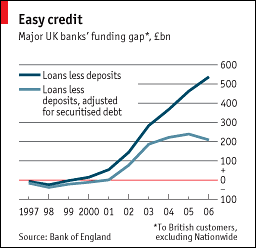
There are some very thoughtful essays regarding the Northern Rock bail-out in the WSG Economics Blog and the Economist. There’s another link to an Economist article about the funding gap in British banking … there is an increased reliance on commercial paper, as opposed to deposits, to fund bank loans:


Meanwhile, the preferred share market showed a little stability today. There were some rather violent individual moves, but most of these were reversals of previous silliness.

Note that these indices are experimental; the absolute and relative daily values are expected to change in the final version. In this version, index values are based at 1,000.0 on 2006-6-30
Index Mean Current Yield (at bid) Mean YTW Mean Average Trading Value Mean Mod Dur (YTW) Issues Day’s Perf. Index Value
Ratchet 4.67% 4.61% 835,153 16.04 1 0.0000% 1,043.7
Fixed-Floater 4.89% 4.76% 102,176 15.82 7 +0.2812% 1,036.3
Floater 4.50% 2.84% 78,528 10.72 3 +0.0275% 1,044.2
Op. Retract 4.85% 4.04% 78,762 3.16 15 +0.0129% 1,028.5
Split-Share 5.13% 4.78% 86,372 4.06 15 +0.0997% 1,047.7
Interest Bearing 6.33% 6.40% 55,359 3.63 3 +0.1539% 1,045.3
Perpetual-Premium 5.62% 5.38% 96,670 8.30 17 +0.2682% 1,018.1
Perpetual-Discount 5.32% 5.35% 211,463 14.90 45 +0.0100% 945.7
Major Price Changes
Issue Index Change Notes
MFC.PR.C PerpetualDiscount -1.5730% Now with a pre-tax bid-YTW of 5.18% based on a bid of 21.90 and a limitMaturity.
BAM.PR.J OpRet -1.3514% Now with a pre-tax bid-YTW of 5.17% based on a bid of 25.55 and a softMaturity 2018-3-30 at 25.00.
RY.PR.C PerpetualDiscount -1.0816% Now with a pre-tax bid-YTW of 5.31% based on a bid of 21.95 and a limitMaturity.
ELF.PR.G PerpetualDiscount +1.1848% Now with a pre-tax bid-YTW of 5.59% based on a bid of 21.35 and a limitMaturity.
PWF.PR.I PerpetualPremium +1.4769% This has just gone ex-dividend for $0.375, so expect to see a drop in trading price on October 5. Now with a pre-tax bid-YTW of 5.21% based on a bid of 26.11 and a call 2012-5-30 at 25.00.
POW.PR.C PerpetualPremium (for now!) +2.0483% Now with a pre-tax bid-YTW of 5.84% based on a bid of 24.91 and a limitMaturity.
Volume Highlights
Issue Index Volume Notes
BCE.PR.Z FixFloat 153,168  
BAM.PR.N PerpetualDiscount 115,690 Now with a pre-tax bid-YTW of 6.03% based on a bid of 19.85 and a limitMaturity.
GWO.PR.E OpRet 105,732 Now with a pre-tax bid-YTW of 3.62% based on a bid of 25.91 and a call 2009-4-30 at 26.00.
RY.PR.K OpRet 84,864 Scotia crossed 25,000 at 25.15. Now with a pre-tax bid-YTW of 4.87% based on a bid of 25.10 and a softMaturity 2008-8-23 at 25.00.
GWO.PR.I PerpetualDiscount 62,980 Scotia crossed 50,000 at 21.60. Now with a pre-tax bid-YTW of 5.23% based on a bid of 21.60 and a limitMaturity.

There were eleven other index-included $25.00-equivalent issues trading over 10,000 shares today.

Reader Initiated Comments

Query from a Reader: Time to Buy?

I received the following communication recently:

new BMO & BNS preferred shares
These are apparently bought issues, but if you recommend them I would  consider a purchase. I have taken an interest and a position in  various preferred since reading your articles in the Canadian Money  Saver. Until then, I was nothing more than a passive observer. I am  76 years old, wife is 71 this year and our pensions are inadequate to replace my income before retiring more than 10 years ago. Now a  considerable portion of my investments are in bank, insurance and  utility companies common and more recently preferred shares.  Unfortunately I also have about 10% in BCE bonds in RRIF. Would you consider the new issues at 5.25% a good investment in a non- registered account? Except for CU all other preferred shares that I  have are below par with approx 4.5% coupon. I have more than 10% cash  to invest. Would it be prudent to wait?

Well, I’ll take a stab at it, but I have the horrible sinking feeling that I am not only going to frustrate my inquirer, but I’ll probably offend him as well.

The basic problem with the query is the implicit assumption that market-timing is possible – if you recommend them I would  consider a purchase … Would it be prudent to wait?.

I can’t time the markets. Neither can anybody else. There is no shortage of bozos who will claim that they can time the markets on behalf of their clients – and even believe it themselves – but when you look at their justification for such belief, you will invariably find that they have been looking at the past with rose-coloured glasses and making excuses for the times that they got it wrong. The way to unmask these people is to ask them for a “CFA Institute compliant composite performance report from inception to present”. Information about what this means is readily available. Essentially, the standards insist that every single dollar under management be assigned to a particular composite and that clients be informed of the existence of each composite. You won’t find many stockbrokers or advisors who have such a thing – and most of those guys will get fairly huffy when asked.

Market-timing is not possible, but this does not mean investors should just buy a generic batch of index funds and forget about it. There are two mechanisms whereby professional money management can add value:

  • Tayloring of asset allocation to suit the client’s specific needs
  • Outperformance within each asset class

And yes, this discourse is relevant to the original question! My correspondent is asking for advice on market timing, but he should really be asking himself two questions:

  • How much of my portfolio should be allocated to preferred shares?
  • Once I’ve made that decision, which preferred shares should I buy?

Let’s try to answer the first part of that question. The couple is retired; in their seventies; they have at least some investments; they need income. There is a fair bit of detail missing from the query:

  • How big is the investment portfolio?
  • How much income do they need (as opposed to “want”, which is another matter entirely)?
  • What are their plans for the capital – are they planning to run it down to zero, or do they have bequests in mind that are important to them?
  • And finally, the distasteful question: what’s their health like? Is it prudent to plan for 25 years, or can we get away with ten?

It is impossible, for me or anybody else, to provide investment advice without knowledge of these issues … well, I shouldn’t say “impossible”, because it’s done all the time. A better word is “reckless”.

So lets make a few generic points:

  • A 10% position in BCE bonds? The remaining term to maturity of these bonds is not given in the eMail, but the client is now learning the purpose of diversification the hard way. Bell Canada and BCE have been “A” credits for the past ten years. My correspondent is most assuredly not the only person to find himself in this predicament, but a client who is
    • Retail, and therefore subject to the tender mercies of the retail bonds desk at his brokers, and therefore highly illiquid
    • With insufficient portfolio size to diversify properly
    • Unable or unwilling to devote a lot of time to watching the market

    …should stick to names rated “AA” or better.

  • The “bank, insurance and utility companies common” is a good, high quality, high yielding equity allocation, but there is no indication of the percentage allocation. Using the famous “100 minus your age” formula indicates an allocation of 20-25%, but there are other variables. Basically, this allocation should be as high as possible, subject to:
    • generating sufficient income from the portfolio that there will not be forced sales to raise cash
    • a maximum desired portfolio volatility based on needs – the chance that a major liquidation will be required
    • a maximum desired portfolio volatility based on wants – how much sleep will you lose if these stocks go down 30%?
  • The allocation to preferred shares should be no more than half the allocation to fixed income generally. Preferred shares do, indeed, provide a significantly greater after-tax income than bonds, but they also have special risks of their own. Most of the ones worth buying are perpetuals, with a potentially volatile price; and the universe of investors is smaller than with bonds, which brings with it liquidity risk.
  • Given that
    • The bond portfolio is – probably – of relatively low quality (due to its exposure to BCE), and
    • the allocation to preferred shares will probably be of insufficient size to allow for efficient diversification, and
    • the inquirer is not a professional investor

    I recommend that investments in preferred shares be restricted to those names rated Pfd-1(low) or better.

Which, at long last, brings us back to the subject of the inquiry: the BMO & BNS new issues. My correspondent notes that they are “bought issues”, but this indicates nothing more than that the underwriters have guaranteed to the issuers that the issue will be sold … in other words, they have agreed to buy the entire issue for resale, rather than acting on an agency ‘best efforts’ basis.

They are both highly rated, meeting the quality needs I outlined above. And when they were first announced, they were far superior to most issues on the market … but then the market fell. At present, I estimate the fair value of both of these issues to be a little above $24.80, which means there is other stuff out there that might yield a little bit more with comparable risk.

My correspondent is in the unfortunate position of being protected from rapacious Ontario-based portfolio managers by the brave heroes of his provincial securities commission – and I have not yet been able to extract sufficient expressions of interest in his province to make it worth my while to register with his commission. So, unfortunately, I cannot offer him a subscription to PrefLetter, which was developed to be useful to investors finding themselves in precisely his position – that is, having money allocated to preferred shares, but not sure which ones.

I suggest, however, that he may wish to keep an eye on this blog, watch the commentaries for mention of good yields, check out the characteristics of the issues of interest on PrefInfo … and to get some professional advice on asset allocation, based on his own particular circumstances.

Update, 2007-10-5: I forgot the ad for the fund! While PrefLetter is designed for do-it-yourself investors who want a place to start, there are funds available: I reviewed three funds last year and another last spring … but I trust I won’t be criticized too severely for recommending my own fund for those investors who seek to outperform the indices and  are either “accredited” or have $150,000 to invest. Unlike PrefLetter, Malachite Aggressive Preferred Fund is available to all such investors in Canada.

Update, 2007-10-19: I should also link to two of my other posts on this general topic: One Bull Checks in and Reflections on a Bull

Market Action

October 3, 2007

The latest passion on the Street is telling everybody how lousy everything is! PIMCO & TIAA-CREF hate the market, Greenspan hates the market, Credit Suisse hates the market … there’s no shortage. But it takes two to make a market! James Hamilton at Econbrowser takes a look at recent indicators and points out that – so far, anyway – the problems in the US housing market haven’t spread to other areas of the US economy. So take your choice!

The BIS Quarterly Review has a good review of the credit crunch.

I’ve updated the post about the Globe’s reporting of Dickson’s speech with a link and extract from the National Post’s article, which is much more reflective of what was actually said. You almost wonder if the reporters are reporting the same speech!

Fitch Ratings has announced that it completed its review of 2006-vintage sub-prime issues:

For first- and second-lien transactions combined, Fitch has affirmed 2,228 classes with a par balance of $155.1 billion and downgraded 1,003 classes with a par balance of $18.4 billion. While Fitch’s reviewed all rating categories, downgrades were most heavily concentrated among classes originally rated ‘BBB+’ or lower. Fitch believes that those classes that have been downgraded to below-investment grade have substantial risk of principal loss. However those bonds remaining investment grade still exhibit the ability to withstand the higher projected collateral default and loss expectations without principal loss. Those classes affirmed at ‘AAA’ are able to withstand a substantial multiple of expected collateral performance without experiencing loss.

This action was gleefully reported by Bloomberg and commented upon by Joseph Mason, an associate professor at Drexel University. Mr. Mason has testified to the Subcommittee on  Capital Markets, Insurance, and Government … woo-hoo! I haven’t read his testimony thoroughly yet, but a quick skim suggests that he doesn’t like the Credit Rating Agencies very much! I’d better get cracking on my reading, because his faculty web-page pointed me to a paper on the value of recourse which has implications for bank-sponsored ABCP. Briefly, it would appear – the authors claim – that the market is implicitly assuming that there will be support for conduits even when there doesn’t need to be; this is very similar to the US mortgage GSEs and implicit ‘off-balance-sheet’ Treasury backing.

By providing recourse in cases where none is explicitly required, the sponsor demonstrates the presence of de facto recourse and therefore previously unreported contingent liabilities. The present paper examines the effects of these revelations on the sponsor. On the face of it, one might expect that revealing previously unreported contingent liabilities could heighten asymmetric information about firm conditions, resulting in poor short- and long-term stock price performance, poor long-term financial performance, and reduced proceeds from subsequent loan sales. However, we find that, conditional on being in a position where honoring implicit recourse has become necessary and conditional on actually providing that recourse, the sponsors, on average, exhibit improved short- and long-term stock price performance, improved long-term financial performance, and similar proceeds from subsequent loan sales.

This is of interest in terms of assessing market discipline and credit analysis of the banks. For example, note 5 of the 2006 BMO Financials discloses that almost CAD 80-billion of liquidity guarantees had been extended, none of which found its way into risk-weighted assets (that’s none. N-U-N. none). Given the bank’s capital of CAD 16,641-billion, reported risk-weighted assets of CAD 162,794 and a CCF of 10%, this would not make a huge difference to the tier 1 capital ratio. But – given recent experience – is the CCF of 10% high enough? Eighty-billion landing suddenly on their balance sheet might give them collywobbles – and Rule #1 states that Everything Bad Happens at the Same Time.

Market discipline is something of a worry, despite the investment industry’s constant reiteration that we’re such a bunch of tough guys. However, Beloved Leader And Economic Genius for Life Stephen Harper is taking care of an oversight, and reminding investors that they are stupid:

Sources told The Canadian Press on Tuesday that Industry Minister Jim Prentice is concerned about foreign state-owned entities snapping up Canadian resource firms.

Among those currently being reviewed, sources said, is the PrimeWest acquisition, part of TAQA’s stated goal of dramatically growing its presence in Canada’s energy sector.

At a late Wednesday news conference in Ottawa, Prime Minister Stephen Harper said his government will address the lack of a national security test for foreign takeovers of Canadian companies.

It’s about time this country was protected from foreigners offering enormous bundles of cash! If such sums ever reach Canadian hands, we’ll just blow it on beer and prostitutes.

Volume picked up today, but perpetuals continued their slide. I confess that I find this continued weakness somewhat odd … but market volatility brings trading opportunities, and the passage of time brings dividends, so my curiosity is somewhat muted.

Note that these indices are experimental; the absolute and relative daily values are expected to change in the final version. In this version, index values are based at 1,000.0 on 2006-6-30
Index Mean Current Yield (at bid) Mean YTW Mean Average Trading Value Mean Mod Dur (YTW) Issues Day’s Perf. Index Value
Ratchet 4.67% 4.61% 869,811 16.05 1 -2.0000% 1,043.7
Fixed-Floater 4.90% 4.78% 103,642 15.81 7 +0.2704% 1,033.4
Floater 4.50% 2.84% 79,333 10.71 3 -0.1093% 1,043.9
Op. Retract 4.85% 4.24% 78,184 3.35 15 +0.0310% 1,028.4
Split-Share 5.13% 4.86% 87,498 4.06 15 +0.0134% 1,046.6
Interest Bearing 6.34% 6.44% 55,061 3.63 3 +0.2054% 1,043.7
Perpetual-Premium 5.64% 5.41% 95,431 8.33 17 -0.2414% 1,015.4
Perpetual-Discount 5.32% 5.35% 211,430 14.90 45 -0.1464% 945.6
Major Price Changes
Issue Index Change Notes
POW.PR.C PerpetualPremium (for now!) -2.3990% Closed at 24.41-28, but the low for the day was actually 25.05. Now with a pre-tax bid-YTW of 5.96% based on a bid of 24.41 and a limitMaturity.
RY.PR.G PerpetualDiscount -2.2727% This one actually came back from its low of 21.25, the price at which about one-third of the day’s volume traded. It was one of the big gainers yesterday, but gave all that up and more. Now with a pre-tax bid-YTW of 5.30% based on a bid of 21.50 and a limitMaturity.
BCE.PR.B Ratchet -2.0000%  
RY.PR.C PerpetualDiscount -1.5965% Now with a pre-tax bid-YTW of 5.25% based on a bid of 22.19 and a limitMaturity.
GWO.PR.I PerpetualDiscount -1.2844% Now with a pre-tax bid-YTW of 5.25% based on a bid of 21.52 and a limitMaturity.
SLF.PR.B PerpetualDiscount -1.1648% Giving up most of yesterday’s gain. Now with a pre-tax bid-YTW of 5.27% based on a bid of 22.91 and a limitMaturity.
RY.PR.A PerpetualDiscount -1.1537% Now with a pre-tax bid-YTW of 5.26% based on a bid of 21.42 and a limitMaturity.
CM.PR.J PerpetualDiscount -1.0152% Now with a pre-tax bid-YTW of 5.25% based on a bid of 21.45 and a limitMaturity.
Volume Highlights
Issue Index Volume Notes
NTL.PR.F Scraps (would be ratchet, but there are credit concerns) 224,419 Nesbitt crossed 198,500 at 15.25.
BNS.PR.M PerpetualDiscount 99,715 Nesbitt crossed 25,000 at 21.63. Now with a pre-tax bid-YTW of 5.20% based on a bid of 21.60 and a limitMaturity.
BMO.PR.J PerpetualDiscount 64,500 Now with a pre-tax bid-YTW of 5.26% based on a bid of 21.60 and a limitMaturity.
GWO.PR.E OpRet 51,432 Scotia crossed 48,800 at 25.95. Now with a pre-tax bid-YTW of 3.78% based on a bid of 25.80 and a call 2011-4-30 at 25.00.
GWO.PR.X OpRet 50,598 Scotia crossed 50,000 at 26.70. The appearance of both GWO retractibles in the volume-leader list leads me to suspect that something’s up. Now with a pre-tax bid-YTW of 3.41% based on a bid of 26.65 and a call 2009-10-30 at 26.00.
MFC.PR.A OpRet 50,545 Scotia crossed 50,000 at 25.80. Now with a pre-tax bid-YTW of 3.76% based on a bid of 25.66 and a softMaturity 2015-12-18 at 25.00.

There were nineteen other index-included $25.00-equivalent issues trading over 10,000 shares today.