Market Action

September 10, 2007

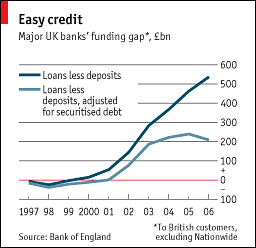
The Economist points out that mark-to-market accounting (which is a hallmark of securitization) can be destabilizing; it can turn bankers from rather dry borrow-short-lend-long types into market speculators. I believe we are seeing this effect in the CPDO market where the deleterious effects of spread widening on capital have been observed, but the benefits of realizing on those spreads over the mid-term have not yet materialized.

It is also possible that cooler heads will prevail and avoid rushing for the exits – a possible example is:

Washington Mutual plans to hold more loans for investment, citing potential for strong risk-adjusted returns.

And it would appear that some shops have resolved their funding issues:

Thornburg Mortgage Inc., the home lender that sold $20.5 billion of mortgage bonds at a loss last month to ease a cash shortage, now plans $3 billion to $4 billion of purchases to take advantage of low prices.

The AAA-rated securities could yield 1.25 to 2.25 percentage points over Thornburg’s cost of funds, President Larry Goldstone said in an interview. That compares with an average of 0.5 points for securities now in the Santa Fe, New Mexico-based company’s portfolio. The purchases will occur “over the next month or two,” presuming mortgage markets begin to stabilize, he said.

Goldstone said $546 million of fresh capital from a preferred-stock sale last week will help the company pounce on opportunities that cash-starved rivals can’t afford.

Some of my more fanatical readers may remember my post about BSABST 2005-1, in which I attempted to demonstrate that the S&P downgrade of one particular ABS wasn’t as scary as it sounded when one looked at the actual dollar values. I’m a little late reporting this, but I’ve found a S&P press release about subprime that puts a little meat on those bones:

Our July 2007 downgrades affect around 1% (by value) of the US subprime first lien mortgage tranches we rate:
• 85% of the ratings downgraded were BBB and below (ie, the weakest quality subprime securities)
• no AAA ratings on these securities were downgraded
• between July 1 and August 24, 2007, S&P received reports of only three defaults from approximately 15,000 current first lien subprime mortgage tranches rated by S&P globally (two of the defaulted tranches were issued in 2002, the other was issued in 2004).

We’ll see how it all turns out. We’ll probably find that the ratings agencies acted in a less than perfect way – I haven’t yet found an analytical system or an analyst who’s perfect. But I’ll bet a nickel that in ten years we’ll be saying that the pendulum of sentiment swung from “Everything is perfect” to “The world is about to end” and that hedgies as a group are attempting to deflect criticism of their own performance towards the agencies; aided by the regulators, who can’t stand to see anything happen in the capital markets that doesn’t involve a kow-tow to the regulators; abetted by the reporters, who don’t care what they say as long as it sells papers; and encouraged by the politicians, who need to show Concern and Judicious Thought.

Like, for instance, Flaherty:

Finance Minister Jim Flaherty says the summer credit crunch is indisputable proof of the need for a single Canadian securities regulator: one that could better guard against, and fend off, shocks buffeting this country’s capital markets.

Such nonsense – and Flaherty doesn’t do anything but wring his hands at the horrifying idea that something might happen in this country without federal regulation.

Regulation of the securities markets in Canada can clearly be improved – see my summary of sales restrictions applying to my firm, for instance – but not, I believe, in terms of the end product. There will be the same good points and bad points about the effects of the application of regulation whether we have one regulator or five hundred. The effects of regulatory unification will be noticable only in the cost – in terms of actual dollars, time and elimination of basically arbitrary selling restrictions – and should be pursued for that end alone.

There is considerable debate regarding what the Fed should be doing at their September 18 meeting. James Hamilton view is:

They can clearly communicate they’re not panicked by the market or bullied by the politicians by waiting until the scheduled September 18 meeting before announcing a cut, and even then one or two members could cast a dissenting vote. Markets would see a 25-basis-point cut delivered in that manner as a splash of pretty cold water. If next month’s data show the same trends as last week (some comforting and some alarming numbers), the Fed could cut another 25 basis points at the end-of-October meeting, adding another dissenting vote. That would leave them free to move any way they want, up or down, in December.

If we get stronger confirmation that the August employment and LA home sales numbers are not an anomaly, the Fed should be prepared to make that a 50-basis-point cut for October.

I agree; I’d like to see some language in the statement that they’re still worried about inflation, jobs number or no jobs number … monthly data can vary significantly. As JDH notes, the increase in LIBOR has done a lot of the anti-inflation heavy lifting on the Fed’s behalf.

Brad Setser notes that:

At least part of the dollar’s August rally seems – at least to me – to have been tied to deleveraging (including deleveraging by European banks) rather than safe haven flows.  Selling rubles and Asian equities to pay back borrowed dollars isn’t quite the same as seeking out the dollar because you expect it to rally in times of stress.

… and sees interesting times ahead for countries with currencies tied – explicitly or implicitly – to the dollar.

US equities looked like they were going to have a horrible day until Thornburg announced its plans to rebuild a position in some high-grade sub-prime tranches. Then they recovered, followed by Canadian equities.

Treasuries continued to roar, yields falling 6bp in a parallel shift, but it’s not doing the dealers much good and reports of foreign selling into the rally continue to accumulate. Canadas were listless.

There were a few good sized crosses in the preferred market today, but the increase in volume wasn’t very broadly based. PerpetualDiscounts continued to recover; they have had only one (minor) down day since August 16 and are up 2.05% since that date.

Note that these indices are experimental; the absolute and relative daily values are expected to change in the final version. In this version, index values are based at 1,000.0 on 2006-6-30
Index Mean Current Yield (at bid) Mean YTW Mean Average Trading Value Mean Mod Dur (YTW) Issues Day’s Perf. Index Value
Ratchet 4.93% 4.88% 1,728,774 15.54 1 +0.0000% 1,043.7
Fixed-Floater 4.85% 4.76% 108,007 15.84 8 -0.0038% 1,032.0
Floater 4.44% 3.12% 88,443 10.74 4 -0.2023% 1,046.5
Op. Retract 4.82% 3.92% 76,015 2.96 15 +0.0164% 1,028.4
Split-Share 5.10% 4.66% 99,509 3.69 15 +0.0305% 1,051.0
Interest Bearing 6.30% 6.87% 66,969 4.54 3 +0.1734% 1,030.8
Perpetual-Premium 5.47% 4.99% 91,567 4.99 24 -0.0345% 1,032.3
Perpetual-Discount 5.05% 5.09% 260,791 15.06 38 +0.1514% 984.0
Major Price Changes
Issue Index Change Notes
BAM.PR.M PerpetualDiscount -1.1888% Now with a pre-tax bid-YTW of 5.84% based on a bid of 20.78 and a limitMaturity. Closed at 20.78-87, 4×2. The almost-equivalent-slightly-better BAM.PR.N closed at 20.40-54, 2×1.
CIU.PR.A PerpetualDiscount +1.3333% Now with a pre-tax bid-YTW of 5.08% based on a bid of 22.80 and a limitMaturity.
Volume Highlights
Issue Index Volume Notes
NA.PR.K PerpetualPremium 209,800 Desjardins crossed 50,000 at 25.90; Scotia crossed 50,000 at the same price. Now with a pre-tax bid-YTW of 5.22% based on a bid of 25.80 and a call 2012-6-14 at 25.00.
TD.PR.O PerpetualDiscount 105,900 Desjardins crossed 74,900 at 24.87, followed by 25,000 at the same price. Now with a pre-tax bid-YTW of 4.93% based on a bid of 24.86 and a limitMaturity.
TD.PR.N OpRet 100,850 Scotia crossed 90,000 at 26.25, then 10,000 at the same price. Now with a pre-tax bid-YTW of 3.89% based on a bid of 26.15 and softMaturity 2014-1-30 at 25.00.
NA.PR.L PerpetualDiscount 53,507 TD crossed 44,400 at 23.41. Now with a pre-tax bid-YTW of 5.23% based on a bid of 23.40 and a limitMaturity.
SLF.PR.E PerpetualDiscount 50,250 Scotia crossed 50,000 at 22.85. Now with a pre-tax bid-YTW of 4.95% based on a bid of 22.76 and a limitMaturity.

There were nine other $25-equivalent index-included issues trading over 10,000 shares today.

Regulation

Rating Agency Regulation: Levitt Weighs in

The Globe and Mail astonished me today by publishing a reasonably balanced review of what ratings agencies do and why they do it. They also published a precis of Levitt’s op-ed in the Wall Street Journal.

There were three snippets in the G&M piece worthy of comment, the first from Brian Neysmith, former head of DBRS (and boy, I bet he’s happy he’s retired!):

Pretend you’re a park ranger, and a camper wants to cross a big lake. He tells you he’s got a canoe, a paddle and a lifejacket, and asks what his chances are of crossing safely. You ask him what his canoeing experience is, and conclude that his chances are decent.

But then the camper asks what he would have to do for you to conclude that his chances were excellent. And so you tell him that he needs to add a flotation device, heavy weather gear and an extra set of paddles, just in case one falls out. And you say that if he does all that, you’ll give him a 100 per cent chance of success.

This is, essentially, what the ratings agencies are doing when they are retained by issuers to consult on the structure of new securities – with the notable exception that they never, ever give anybody a 100% chance of success. All they will ever do is (as the reporter noted at the beginning of the paragraph, but forgot by the end) conclude that the chances are excellent.

The second snippet comes courtesy of an ABCP investor:

“When you’ve got cash sitting around, you phone your banker, or you phone your money desk, and you say ‘I’ve got cash, what can you show me?’ ” said Richard Gusella, chairman of Calgary-based Petrolifera Petroleum Ltd. “And they tell you, ‘I’ve got 30-day Apsley Trust R1-high rated paper, per DBRS, and other people are buying it.’ And they say this is better than bank paper, and so you buy it,” he said.

The company had invested about $37.7-million, or more than half its total cash, in asset-backed securities. Its cash management policy had been to invest in short-term securities with DBRS’s highest rating, R1-High. On Aug. 15, $31.4-million of the notes became due but were not repaid. Mr. Gusella says the company is not in financial difficulty now – but he wants his money.

More than half its total cash in this stuff? Mr. Gusella may well be a very skilled oil & gas operator – and the front-line decision to gamble may not have been his, but rather his treasury group’s – but if I were a shareholder in Petrolifera, I’d be asking some rather pointed questions about prudent cash management.

A relatively small company such as Petrolifera (shareholders’ equity of about $120-million, according to its most recent financials) should not be doing its own money market investing anyway. Pay the fee and concentrate on what you’re good at … most (if not all) of the banks have institutional money market funds; some investment counsellors do; it’s not really all that expensive.

I will point out as well that the quote makes him sound a little pompous (talking about ‘phoning his money desk’). Perhaps his remarks were misconstrued for brevity, but:

  • all dealers will have a range of products
  • if you don’t like one dealers offerings or prices, you call another
  • it certainly sounds as if he bought whatever the friendly salesman told him to buy

I’ve emphasized in the past and will emphasize again: dealers are not your friends, no matter how many social functions they invite you to – or how much of a big-shot they make you feel like.

And one last snippet:

For instance, the Canada Marine Act sets minimum ratings on investments that port authorities can buy. And in a stroke of good luck or prescient planning, the act says authorities can only buy investments rated by two bond-rating companies – meaning that authorities couldn’t touch the asset-backed commercial paper that’s run into trouble because there was only one rating agency that graded it (DBRS).

No. Not “good luck”. Not “prescient planning”. Merely a reasonable, if rather mechanical, application of the Prudent Man Rule.

So, finally, we get to Arthur Levitt’s proposals (bolded, with my comments in italics).

  • The SEC needs to set standards for agencies and punish transgressions. Too vague for much commentary! It makes my hackles rise a bit because it implies that the SEC should be regulating agencies, but I’m willing to wait for the specifies and will attempt to retain an open mind. Note that Mr. Levitt is a former head of the SEC … when you have a hammer, everything looks like a nail!
  • Ratings agency employees shouldn’t be able to jump to investment banks they have helped to structure transactions.: This suggestion came up in the September 4 commentary. No! A thousand times, no! In the first place, there is no indication that this is, in fact, a problem. Secondly, it will enforce draconian restrictions on the career choices of analysts. And thirdly, it is inappropriate because agency analysts have no power to force anybody to do anything; they give advice. Full stop. This sort of restriction is appropriate for regulators but is not even applied to them. Regulation Services trumpetted the fact that their employees were jumping to the banks for fat paycheques as evidence of the impressive skill of their employees; let’s fix up this aspect of revolving-door regulation before going after mere advisors! I will, perhaps, give a certain amount of additional credence to a particular agency if they tell me that each analyst has “gardening leave” in their contracts; to give such a matter of judgement the full force of law would be abuse of regulatory authority. I would be much more impressed if the agencies reacted in the same way every single brokerage firm in the world reacts when an employee leaves: devote a lot of time to reviewing the employee’s work. In the brokerage’s case, this is in order to retain the clients for the firm; in an agency’s case, it should be to double-check the ratings assigned to the instruments reviewed by that employee. The ratings should never be the responsibility of a single employee in any event. I recently reported the DBRS downgrade of little rinky-dink ES.PR.B – that report has two names on it.
  • Issuers should disclose any consulting services provided by ratings agencies. I’m of two minds about this one. Disclosure is a good thing, but too much disclosure leads to the voluminous and unread state of modern prospectuses. I’m more against it that for it, but don’t think it makes a lot of difference either way.
  • Investors should be able to hold ratings agencies “liable for malfeasance that is more than mere negligence.” No! Investors do not pay ratings agencies any money; there is no fiduciary relationship between investors and agencies. I can buy something solely on the basis of its rating; I can buy something solely because I got an anonymous eMail telling me it was good. If investors want a fiduciary relationship, there are many shops out there (like CreditSights, discussed here recently) who are more than willing to fill that need.
  • Investors must stop blindly relying on credit ratings, and instead do more research on structured products to determine their safety. Hey! Finally, something I agree with completely! I will also note that one or two errors won’t hurt you (much) as long as you’re well diversified.

Update, 2007-09-19: Douglas W. Elmendorf has published a commentary on current policy issues, in which he endorses

additional oversight by the SEC, a one-year waiting period for a ratings agency employee wanting to join a security issuer, and disclosure in debt-offering documents of any related advice provided by the rater to the issuer.

without further argument.

Update, 2007-09-24: The WSJ has reported on an interview of Greenspan by FAZ:

In an interview with Sunday’s Frankfurter Allgemeine Zeitung, one of Germany’s most prominent newspapers, former Federal Reserve Chairman Alan Greenspan sharply criticized ratings agencies for their role in the current credit crisis. “People believed they knew what they were doing,” Mr. Greenspan says in today’s FAZ. “And they don’t.”

Still, he doesn’t think it’s necessary to strengthen rating-agency regulation. Essentially, they’re “already regulated,” he says, because investors’ loss of trust means the agencies are likely to lose business. “There’s no point regulating this. The horse is out of the barn, as we like to say.” Greenspan also said he believes that the volume of structured-finance products will decrease. “What kept them in place is a belief on the part of those who invested in that, that they were properly priced. Now everyone knows that they weren’t. And they know that they can’t really be properly priced,” said Greenspan.

Market Action

September 7, 2007

Well – a short week, but not entirely devoid of interest!

Today’s big news was that the US Jobs number was negative, which hasn’t happened in a while. Politicians reacted according to their stripe; economists hastily revised downwards their expectations for both growth and rates. Greenspan sounds very happy it’s not his problem. There is general agreement chances of a recession have increased.

I’ve previously mentioned Deutsche Bank’s success at Credit Anticipation in betting against sub-prime. Another winner emerged today:

The $4.5 billion Credit Opportunities fund, started last year, gained 26.7 percent in August, according to a Paulson investor. Credit Opportunities II, a newer $2.3 billion fund, is up more than threefold after a 32 percent return last month.

I feel quite sure that a lot of these massive losses we’re reading about are just hedge funds transferring money back and forth … when you share 20% of winnings and 0% of losses, why not bet the firm?

The Canadian bank-operated ABCP market is having major problems. Three-month BAs are yielding about 5% … ABCP is yielding about about 5.60% … when three-month bills are at 4.04%. That kind of spread is … well, let’s just say that banks are not having a nice time. Mind you, it’s even worse in the States, with bills at 4.07% and financial paper at 5.48% (US ABCP at 6.18%). While we’re on the topic of ABCP, the outstandings in America continue to shrivel, which indicates a ferocious combination of deleveraging and transfer to bank lines. The ‘transfer to bank lines’ part is dangerous – there is some concern regarding the banks’ committments and whether regulators need to step in. I don’t know, frankly, if line committments are added in any way to risk-adjusted capital. They should be! Especially since laying off risk is, to an extent, boomeranging.

Countrywide Credit is having a mass layoff, trying to survive in environment where it’s difficult, to say the least, to securitize mortgages that it originates. Citigroup is reportedly refusing to accept new mortgage clients. But maybe they’re just providing bigger lines to fewer clients.

Centex Corp., a Dallas-based homebuilder and lender, said in a regulatory filing today it replaced a warehouse credit line with a larger one arranged by JPMorgan Chase & Co. that may provide as much as $1 billion. Centex increased the credit line because the global credit crunch made it hard to rely on selling short-term notes to finance mortgages, the filing said.

US equities went splat on the jobs number. Recessions aren’t generally good for profits! Canadian equities also fell.

Treasuries had such a good day on the back of the jobs number it has to be referred to as panic-buying (possibly sending a lot of profit to foreign central banks, since boneheaded fiscal policies have sent a lot of money abroad). Why not, when Fed Fund Futures are predicting a rate of 4.5% by December? Well, perhaps because Fed officials are watching the economy, not marketsCanadas had a super day, with the ten-years’ yield declining about 13bp.

Note that these indices are experimental; the absolute and relative daily values are expected to change in the final version. In this version, index values are based at 1,000.0 on 2006-6-30
Index Mean Current Yield (at bid) Mean YTW Mean Average Trading Value Mean Mod Dur (YTW) Issues Day’s Perf. Index Value
Ratchet 4.94% 4.89% 1,800,839 15.54 1 +0.0000% 1,043.7
Fixed-Floater 4.85% 4.76% 110,120 15.85 8 +0.4523% 1,032.1
Floater 4.43% 3.06% 89,111 10.77 4 +0.4089% 1,048.6
Op. Retract 4.83% 3.91% 76,509 3.03 15 -0.0474% 1,028.2
Split-Share 5.11% 4.62% 100,629 3.70 15 +0.2704% 1,050.6
Interest Bearing 6.31% 6.90% 65,636 4.55 3 -0.3771% 1,029.0
Perpetual-Premium 5.47% 5.00% 91,498 5.00 24 +0.0058% 1,032.7
Perpetual-Discount 5.06% 5.10% 262,025 15.06 38 +0.0996% 982.5
Major Price Changes
Issue Index Change Notes
MFC.PR.A OpRet -1.0828% Now with a pre-tax bid-YTW of 3.77% based on a bid of 25.58 and a softMaturity 2015-12-18 at 25.00. That’s about 5.25% yield equivalent – bonds are a better bet than this.
LFE.PR.E SplitShare +1.0348% Now with a pre-tax bid-YTW of 3.71% based on a bid of 10.74 and a hardMaturity 2012-12-1 at 10.00. Again – bonds look like a better idea at levels like this!
BCE.PR.T FixFloat +1.1066%  
RY.PR.E PerpetualDiscount +1.2849% Now with a pre-tax bid-YTW of 4.95% based on a bid of 22.86 and a limitMaturity.
Volume Highlights
Issue Index Volume Notes
GWO.PR.I PerpetualDiscount 353,675 Nesbitt crossed 24,300 at 22.70. Now with a pre-tax bid-YTW of 4.96% based on a bid of 22.68 and a limitMaturity
PWF.PR.F PerpetualPremium 38,626 National Bank crossed 35,000 at 24.95. Now with a pre-tax bid-YTW of 5.29% based on a bid of 25.05 and a limitMaturity.
SLF.PR.A PerpetualDiscount 32,950 Now with a pre-tax bid-YTW of 4.99% based on a bid of 23.80 and a limitMaturity.
MFC.PR.C PerpetualDiscount 27,825 Now with a pre-tax bid-YTW of 4.86% based on a bid of 23.20 and a limitMaturity.
POW.PR.A PerpetualPremium 27,550 Scotia crossed 25,000 at 25.11. Now with a pre-tax bid-YTW of 5.67% based on a bid of 25.10 and a limitMaturity.

There were ten other $25-equivalent index-included issues trading over 10,000 shares today.

Issue Comments

BSC.PR.A : Partial Call for Redemption

Scotia Managed Companies has announced that BNS Split Corp II:

has called 192,141 Preferred Shares for cash redemption on September 21, 2007 (in accordance with the Company’s Articles) as a result of the special annual retraction of 1,296,280 Capital Shares by the holders thereof. The Preferred Shares shall be redeemed on a pro rata basis, so that each holder of Preferred Shares of record on September 20, 2007 will have approximately 6.863% of their Preferred Shares redeemed. The redemption price for the Preferred Shares will be $20.83 per share.

The underlying security for BSC.PR.A is shares in the Bank of Nova Scotia. Asset coverage is 2.5:1.

The issue is rated Pfd-2(low) by DBRS, which looks very low to me. Their initial and as yet unchanged rating report for the company dated October 11, 2005, states:

The rating of the Preferred Shares is based on:
(1) The available downside protection, which is approximately 50% to the principal amount of the outstanding Preferred Shares at closing;
(2) The credit quality and consistency of BNS’s dividend distributions; and
(3) Portfolio shares that could be sold to provide liquidity and certainty of dividends to Preferred Shares.

The main constraint to the rating is the dependence of the entire portfolio on the shares of BNS for downside protection and dividend income.

The redemption date for both classes of shares will be September 22, 2010.

ScotiaBank preferreds are rated Pfd-1, this represents the upper limit for a split share corporation based on the common. As of last year’s Tier 1 analysis, Scotiabank had … call it $4,000-million of non-equity tier 1 capital covered by $16,000-million-odd equity. So call it 4:1 on the Scotiabank preferreds that are issued directly.

I don’t think Pfd-1 is appropriate until coverage exceeds 3:1 in any event … but I would be comfortable with a Pfd-2(high) rating on BSC.PR.A, given the 2.5:1 coverage.

BSC.PR.A is not tracked by HIMIPref™

Better Communication, Please!

George Weston Directors: Please Buy a Calendar!

On July 30, George Weston announced:

NOTICE IS HEREBY GIVEN THAT a quarterly dividend on George Weston Limited Common Shares, Preferred Shares, Series I, Preferred Shares, Series II, Preferred Shares, Series III, Preferred Shares, Series IV and Preferred Shares, Series V is payable as follows:

Preferred Shares, Series II    –  $0.321875 per share payable October 1, 2007, to shareholders of record September 15, 2007;

Will somebody please buy a calendar and send it to the George Weston board? September 15 is a Saturday.

In such cases, the way to think about the problem for purposes of calculating the ex-Dividend Date is to say … OK. It’s calculated as of 5pm on Saturday. The transfer agent is closed, so there won’t have been any changes to the books between 5pm Friday and 5pm Saturday. Therefore the real record date is Friday September 14; therefore the ex-Date is September 12.

I can understand that, due to sloppiness in preparation of the prospectus, the pay-date must be declared as the first of the month, even when that’s not a business day. But record dates are not even mentioned in the prospectus; there would appear to be no reason not to say the 14th when you mean the 14th … and this would make life a lot simpler, especially for retail.

Update: This goes for you, too, Brookfield!

Issue Comments

Best & Worst Monthly Performances : August, 2007

These are total returns, with dividends presumed to have been reinvested at the bid price on the ex-date. The list has been restricted to issues in the HIMIPref™ indices.

Issue Index DBRS Rating Monthly Performance Notes (“Now” means “August 31”)
BAM.PR.M PerpetualDiscount Pfd-2(low) -4.01% Now with a pre-tax bid-YTW of 5.95% based on a bid of 20.35 and a limitMaturity.
BAM.PR.N PerpetualDiscount Pfd-2(low) -3.75% Now with a pre-tax bid-YTW of 5.97% based on a bid of 20.27 and a limitMaturity.
BAM.PR.B Floater Pfd-2(low) -3.64%  
BNA.PR.C SplitShare Pfd-2 (low) -2.22% Backed by BAM.A shares. Now with a pre-tax bid-YTW of 5.59% based on a bid of 22.46 and a hardMaturity 2019-1-10 at 25.00.
BAM.PR.K Floater Pfd-2(low) -2.10%  
RY.PR.A PerpetualDiscount Pfd-1 +2.52% Now with a pre-tax bid-YTW of 4.90% based on a bid of 22.81 and a limitMaturity.
IGM.PR.A OpRet Pfd-2(high) +2.55% Now with a pre-tax bid-YTW of 3.26% based on a bid of 26.98 and a call 2009-7-30 at 26.00.
CU.PR.B PerpetualPremium Pfd-2(high) +2.66% Now with a pre-tax bid-YTW of 5.17% based on a bid of 25.91 and a call 2012-7-1 at 25.00.
BMO.PR.H PerpetualPremium Pfd-1 +3.61% Now with a pre-tax bid-YTW of 4.16% based on a bid of 26.44 and a call 2013-3-27 at 25.00.
MFC.PR.A OpRet Pfd-1(low) +4.22% Now with a pre-tax bid-YTW of 3.74% based on a bid of 25.61 and a softMaturity 2015-12-18 at 25.00.

Not a stellar month for the BAM issues! These issues were discussed in the comments to the August 15 Market Action report; the basic story is that to a certain extent the BAM issues will trade as Pfd-3’s, a notch or two below their actual credit ratings of Pfd-2(low) (DBRS) and P-2 (S&P).

There are various explanations of why they should trade this way:

  • BAM simply has too many issues on the market. There will be some participants who are attracted by the risk/reward profile, but have already bought all the BAM that they’re comfortable with having in the name [Note: This is very often a situation that applies to MAPF]
  • The issue suffers from a conglomerate discount. Not very sensible, perhaps, but who ever told you the markets have to be sensible?
  • Credit Anticipation. Some people believe that BAM is over-rated by the ratings agencies and explicitly trade it as a Pfd-3

Evidence from the world of bonds is available in some indications I have of 5-year CDS levels (see the Primer Links if you don’t know how a Credit Default Swap works). BAM is quoted at 39-44bp, +11 on the month; Enbridge (issuer of ENB.PR.A) is at 48-54bp (+1); Bombardier (BBD.PR.B / C / D) at 162-179 (-62); Alcan (until recently AL.PR.E / F) at 24-28 (+5); TransCanada (TCA.PR.X / Y) at 23-27 (-1); and finally BCE (lots!) at 397-418 (+54). Make of this what you will!

Update: It should be noted that there were a lot of Pfd-3 and other issues that did worse than the BAM issues. The list, as noted above, was restricted to issues included in the HIMIPref™ issues.

Index Construction / Reporting

HIMIPref™ Index Performance, August 2007

Performance of the HIMI Indices for August was:

Total Return, August 2007
Index Performance
Ratchet +0.48%
FixFloat +0.21%
Floater -1.11%
OpRet +0.43%
SplitShare -0.19%
Interest +0.89%
PerpetualPremium +0.72%
PerpetualDiscount +0.24%

Things look relatively normal this month, as opposed to the huge variances in the July returns

As has been discussed elsewhere, the Claymore ETF returned +0.47% on the month; this number is after all fees and expenses.
The linked post also shows the approximate return for the other major passive preferred share fund listed on the TSX, DPS.UN. This fund returned (approximately; they do not report month-end NAVs) +0.22% on the month

Malachite Aggressive Preferred Fund (MAPF), managed by my firm returned -0.34% on the month. Returns assume reinvestment of dividends and are reported after expenses but before fees. Past performance is not  a guarantee of future performance. You can lose money investing in Malachite Aggressive Preferred Fund or any other fund.

As discussed, I’m not particularly pleased about the month’s underperformance – but I’m still earning my fees over a three month period, so I’ll just have to take the bad with the good.

The return of the “BMO Capital Markets 50” in August was +0.57%, but this will not be analyzed in detail due to the proprietary nature of this index.

Market Action

September 6, 2007

Month-end is taking its dreaded toll … there will be no indices AGAIN today and precious little commentary.

My sole comment for today is that DBRS is sounding very defensive! They have released a “commentary” titled Rating Volatility in Structured Credit and a press release titled DBRS Approach to Canadian ABCP Surveillance – neither of which I can link to because ratings agencies, for all their good points, are complete dorks when it comes to public relations. So visit their web site and poke around for a few hours until you find their precious commentary.

If we do manage to avoid government regulation and control of the credit ratings process – the prospect that fills me with dread – it won’t be because of the slick publicity campaign managed by the agencies, that’s for sure.

The S&P equivalent was published August 23 and titled Structured Finance Commentary.

Major Price Changes
Issue Index Change Notes
RY.PR.E PerpetualDiscount -1.4410% Now with a pre-tax bid-YTW of 5.02% based on a bid of 22.57 and a limitMaturity.
BCE.PR.G FixFloat -1.1475%  
SLF.PR.E PerpetualDiscount -1.0503% Now with a pre-tax bid-YTW of 4.98% based on a bid of 22.61 and a limitMaturity.
IAG.PR.A PerpetualDiscount +1.0989% Now with a pre-tax bid-YTW of 5.00% based on a bid of 23.00 and a limitMaturity.
BAM.PR.M PerpetualDiscount +1.1154% Now with a pre-tax bid-YTW of 5.81% based on a bid of 20.85 and a limitMaturity. BAM.PR.N closed at 20.40-50.
BNS.PR.L PerpetualDiscount +1.5106% Now with a pre-tax bid-YTW of 4.83% based on a bid of 23.52 and a limitMaturity.
Volume Highlights
Issue Index Volume Notes
TD.PR.M OpRet 102,400 Nesbitt crossed 100,000 at 26.35. Now with a pre-tax bid-YTW of 3.94% based on a bid of 26.17 and a softMaturity 2013-10-30 at 25.00.
GWO.PR.X OpRet 101,665 Nesbitt crossed 100,000 at 26.65. Now with a pre-tax bid-YTW of 3.49% based on a bid of 26.54 and a call 2009-10-30 at 26.00.
GWO.PR.I PerpetualDiscount 83,850 RBC crossed 40,000 at 22.70, then another(?) 40,000 at the same price. Now with a pre-tax bid-YTW of 4.96% based on a bid of 22.68 and a limitMaturity.
RY.PR.B PerpetualDiscount 57,400 National Bank crossed 50,000 at 23.90. Now with a pre-tax bid-YTW of 4.93% based on a bid of 23.98 and a limitMaturity.
BNS.PR.L PerpetualDiscount 31,220 Now with a pre-tax bid-YTW of 4.83% based on a bid of 23.52 and a limitMaturity.

There were eleven other $25-equivalent index-included issues trading over 10,000 shares today.

Update, 2007-09-07

Note that these indices are experimental; the absolute and relative daily values are expected to change in the final version. In this version, index values are based at 1,000.0 on 2006-6-30
Index Mean Current Yield (at bid) Mean YTW Mean Average Trading Value Mean Mod Dur (YTW) Issues Day’s Perf. Index Value
Ratchet 4.95% 4.90% 1,875,505 15.53 1 0.0000% 1,043.7
Fixed-Floater 4.87% 4.78% 109,627 15.82 8 -0.1107% 1,027.4
Floater 4.45% 2.56% 89,455 10.65 4 +0.2857% 1,044.4
Op. Retract 4.82% 3.61% 77,249 3.03 15 +0.1984% 1,028.7
Split-Share 5.12% 4.78% 102,166 3.90 13 +0.0391% 1,047.8
Interest Bearing 6.28% 6.84% 67,013 4.56 3 +0.1733% 1,032.9
Perpetual-Premium 5.47% 5.00% 92,141 5.71 24 +0.1507% 1,032.6
Perpetual-Discount 5.06% 5.10% 262,140 15.05 38 +0.2591% 981.5

Primers

Downgrades Coming in CPDO Market?

The agencies are under attack again!

CreditSights, a New York based Credit Research Firm has launched another attack on its Credit Rating Agency competitors with the release of a report “Distressed CPDOs: We’re Doomed!”. It should be noted that by “Credit Research Firm”, I mean that they are paid by their subscribers; as opposed to “Credit Rating Agencies” which are paid by the issuers.

In other words, to make a living they have to convince the buy-side that the CRA ratings are worthless and that the buy-side should therefore pay them for their analysis. Which is not to say they’re wrong, but it’s always a good idea to follow the money.

Anyway, the new battleground is CPDO Ratings. There has been something of a crisis of confidence in these ratings since the recent kerfuffle began.

There may be one or two people in the galaxy who are unaware of just what is meant by CPDO (it’s not a Star Wars character). The Default Risk site has republished a case study, First Generation CPDO: Case Study on Performance and Ratings and a UBS Primer on the topic.

Basically, the idea is … well, we we all know what a CDS is, right?

consider, on one hand, a portfolio composed of (1) a short position (i.e. selling protection) in the CDS of a company and (2) a long position in a risk free bond. On the other, consider an outright long position in the company’s corporate bond, all with the same maturity and par and notional values of $100. These two investments should provide identical returns, resulting in the CDS spread equaling the corporate bond spread.

Essentially, what a CPDO does is (synthetically) purchase a portfolio of five year bonds (5 years is the standard CDS term), lever the hell out of it (with leverage financing at, essentially, the risk-free rate due to the definition of a CDS) and aim to capture the spread on such a portfolio over a ten year term.

The critical point is that the investment horizon is longer than the term of the assets. To a first approximation, therefore, you don’t really care what happens to spreads, since if they increase then you get to reinvest less money (since there’s a capital loss) at the higher spread.

As the UBS primer points out, the three major CPDO risks are:

  • credit events in the underlying portfolio
  • costs of exiting the old off-the-run index
  • low premium on the new on-the-run index

They conclude, after examining a representative hypothetical product, that the CPDO can withstand 7% annual losses, which will result from 0.8% of the underlying portfolio defaulting with 67% severity every year, while leveraged 13X. Such a loss may also result from the old off-the-run index rising in premium by 12.5 bp per year every year.

A low premium on the new index may result from migration … the CDSs in the index are replaced if the credit rating falls below investment grade. Therefore, the old index may include junk credits at a high premium while the new index will not contain these elements. Therefore, there will be a yield give-up when rolling the index. As Fitch says in their review:

This migration historically shows a downward trend for investment grade assets, which means that they are more likely to get downgraded than upgraded. Every quarter, the negative trend in the migration process leads to an increase in the portfolio spread relative to the underlying driving spread. For a CPDO, this idiosyncratic spread widening will cause MtM losses, which are crystallised on each roll date or following a de-leveraging event. The impact on NAV is significant. For instance, a widening of 5bp every six months in a transaction leveraged 15x on a five-year index with 4.3 years of duration equates to 5 x 4.3 x 15 = 322bp or 3.22% NAV decrease.

This post comes about because of a Bloomberg story: CPDOs Rated AAA May Risk Default, CreditSights Says:

To make matters worse, the CPDOs are likely to earn a lower premium on the new CDX Series 9 index because the credit risk will be lower as the downgraded companies drop out. At least five companies in the CDX and iTraxx indexes have lost investment grade ratings and will have to be replaced, according to Watts. Without the downgraded companies, the new CDX index may be priced 11 basis points tighter than the current benchmark, JPMorgan Chase & Co. analysts led by Eric Beinstein in New York said in a report published this week.

which is discussed in the Fitch paper under the heading “Migration Driven Spread Movements”:

The average migration causes around 2.4% of spread widening over a six-month period or around 2bp for a spread of 80bp. Fitch’s model for migration is not constant but stochastic. It also generates extreme migration scenarios that would cause 20 to 30bp of spread widening over six months. The impact of credit migration is also relative and increases when spreads are high in the model.

So, it’s not as if Fitch didn’t consider this risk, anyway! CreditSights is simply claiming that the risk has been miscalculated.

The CreditSights paper is available for 150 USD. Tom Graff wants a free copy

Market Action

September 5, 2007

It was an interesting day, with a number of cross-currents resulting in a strong day for bonds at the expense of stocks.

The day started with a thump, as the Financial Post reported a gloomy sentiment from Edward Devlin of PIMCO:

The vast majority of about $35-billion of non-bank ABCP is backed by risky bets on credit default rates that are now so far underwater that investors could be looking at losses as high as 50 on the dollar

With all respect to Mr. Devlin, I’ll repeat my tired old refrain of “I wanna see more detail”! Readers will remember the sad story of Global DIGIT’s suspension of redemptions, which fits his story quite well – they’re leveraged to hell and gone on credit-default-swaps on the dreaded sub-prime (senior tranches only, so they claim). Global Digit issued a press release on August 28, stating:

The Trustee has now received from the Bank the indicative price which will be used to calculate the NAV as at August 31, 2007. If that indicative price, which was based on market conditions known on August 28, 2007, had been used to calculate the NAV as at July 31, 2007, the NAV would be $7.92, representing a reduction of about 12.5% from the NAV calculated based on the July 16, 2007 market conditions.

So, on the cheerful side, we can say that August 28 was pretty close to the height of the hysteria and the loss, while not likely to make the equity holders very happy, are not yet eating into the security of the ABCP holders. Now, there’s problems with this statement. In the first place, “indicative prices” don’t necessarily mean very much, as most rookie bond guys find to their consternation sometime before their tenth trade. And, of course, many many bad things can happen before those CDSs in the DG.UN portfolio unwind. And there’s no indication that DG.UN is representative of the kind of problem that Mr. Devlin refers to. Lots of uncertainty … but uncertainty with respect to Mr. Devlin’s statement as well. Details! Give me details!

This topic arose during a lunch I had today with a PrefLetter subscriber (He bought! I wish to take this opportunity, firstly to thank him, and secondly to encourage subscribers and others to buy me lunch at every opportunity!). We were talking about Tier 1 Capital Ratios, and the National Bank’s purchase of ABCP, preferred shares and how all those things related. My friend made the comment that ABCP buyers – buying assets that were levered 10+:1 – got everything they deserved. But, as I have now confirmed, such leverage is normal! Royal Bank’s financials reveal $537-billion in assets supported by $22-billion in equity, a gearing of 24:1.

They have a perfectly adequate Tier 1 Capital Ratio nonetheless, because not all assets are created equal. I’ve looked at a document from BIS that gives a few formulae and rules of thumb for calculating capital adequacy … on Page 160 of the document, for instance, we get the risk weights for various terms of bonds, while Page 156 gives the risks weights for various grades of issuer. As may be understood by comparing RBC’s asset-to-equity gearing with its Tier 1 Capital Ratio, the RBC assets have an average risk-weight of about-maybe 33%.

So – I’m not drawing any conclusions about the riskiness of ABCP or of RBC paper, but I’m just pointing out … there’s risk and then there’s risk; the leveraging factor in and of itself conveys some of the answer, but not all.

In news today with implications on the FedFunds rate, the Beige Book was released:

“Outside of real estate, reports that the turmoil in financial markets had affected economic activity during the survey period were limited,” the Fed said in the survey, which concluded before Aug. 27 and was released today in Washington. “Economic activity has continued to expand” nationwide, the Fed said in the Beige Book, named for the color of its cover.

Another perspective is available from the WSJ Economics Blog which also produced a summary by district. ADP is projecting a lousy jobs number for Friday’s release.

Longer term, the OECD released a report stating that in the US:

slower job creation, mortgage-rate resets and tighter credit standards will prompt a slowdown in the second half of the year that will drag annual growth down to 1.9%, from 2.1% forecast previously

The author does not believe a US recession is imminent.

A suggestion that banks pool and securitize their LBO debt caught Tom Graff’s attention, but another solution was implemented by AstroZeneca:

AstraZeneca Plc, the U.K.’s second- largest pharmaceutical company, sold $6.9 billion of bonds in the biggest U.S. debt offering in more than five years.

AstraZeneca will use proceeds from the sale to pay back commercial paper that financed the $15.2 billion purchase of U.S. biotechnology firm MedImmune Inc. in June

That’s the way to reduce liquidity risk on your balance sheet! Bite the bullet and extend term, even if it hurts.

The five-year 5.4 percent debt priced to yield 130 basis points more than Treasuries of similar maturity; the 10-year 5.9 percent securities have a yield premium of 145 basis points; and the 30-year 6.45 percent bonds paid a spread of 170 basis points.

AstraZeneca’s debt is rated A1 by Moody’s Investors Service, the fifth-highest investment grade and AA- by Standard & Poor’s, the fourth-highest ranking.

In this context, it’s worth noting that the Treasury 10-year to Baa spread, highlighted by James Hamilton a while ago, doesn’t appear to have moved much: the Fed is now showing Baa paper at 6.60%, which is actually less than each of the three most recent monthly observations. Granted, Treasury 10-years are down a lot but while spread-to-treasuries is important, spread-to-business risk is even more important. This looks like good insurance for the issuer.

Citigroup is closing a poorly performing hedge fund; it should be noted that while it underperformed its peers, it’s down only slightly on the year. It’s not all hedge funds that will blow up over the next few months … only some of them. Particularly those who are forced to sell their assets at whatever they will fetch in this environment.

The losers will be replaced:

The amount of debt in the Merrill Lynch distressed bond index tripled in July to $13.8 billion, and about doubled again in August to $24.8 billion. In addition to Residential Capital and WCI, the debt of New York-based amusement park operator Six Flags Inc., and pizza chain Uno Restaurant Corp. of West Roxbury, Massachusetts, is distressed based on their yields.

Investors specializing in distressed debt are gearing up for more opportunities. They raised $23 billion this year through Aug. 17, breaking 2006’s record of more than $16 billion, according to London-based Private Equity Intelligence Ltd.

There’s another good quote in that story too, that will help give some perspective on the Credit Rating Agency controversy:

Moody’s in January 2005 predicted the default rate would rise to 2.7 percent by the end of that year from 2.2 percent. Instead, it fell to 1.8 percent. Moody’s then forecast it would rise to 3.3 percent by the end of 2006. It fell again, to 1.7 percent, the lowest year-end level in a decade.

“The last couple of years we always used to say `Gee, isn’t it crazy, we’re seeing top of market behavior and this can’t be sustained,”’ Marshella said. “It did go on longer and we were wrong. You always thought there’d be an inflection point and, finally, an inflection point came,” he said, referring the increase in financing costs caused by the contamination of asset- backed securities by subprime mortgages.

US equities fell, as financials are now out of favour; Canadian stocks also fell on fears of a credit crunch. LIBOR just won’t go down!

Treasuries had a banner day; Canada didn’t do quite so well but there was a major steepening.

I wasn’t able to update the index values today, although I did update the index constituents. Tomorrow, I promise! 

Note: Somehow … don’t ask me how … I managed to screw up the input of the Volume and Price Change tables so completely that my software has given up. Sorry.

Update, 2007-09-07

Note that these indices are experimental; the absolute and relative daily values are expected to change in the final version. In this version, index values are based at 1,000.0 on 2006-6-30
Index Mean Current Yield (at bid) Mean YTW Mean Average Trading Value Mean Mod Dur (YTW) Issues Day’s Perf. Index Value
Ratchet 4.95% 4.90% 1,953,508 15.52 1 0.0000% 1,043.7
Fixed-Floater 4.87% 4.77% 111,825 15.83 8 +0.4181% 1,028.6
Floater 4.46% 3.19% 89,009 10.68 4 +0.2733% 1,041.4
Op. Retract 4.83% 3.79% 76,720 2.97 15 +0.1418% 1,026.6
Split-Share 5.12% 4.69% 102,728 3.90 13 +0.0614% 1,047.4
Interest Bearing 6.29% 6.84% 66,115 4.56 3 -0.8367% 1,031.1
Perpetual-Premium 5.47% 5.03% 92,494 6.21 24 +0.2696% 1,031.0
Perpetual-Discount 5.08% 5.11% 262,414 15.31 38 +0.1613% 979.0