Issue Comments

FFN.PR.A 11H1 Semi-Annual Report

Financial 15 Split Corp. II has released its Semi-Annual Report to May 31, 2011.

Figures of interest are:

MER: 1.16% of the whole unit value

Average Net Assets: We need this to calculate portfolio yield. No change in Number of Units Outstanding, so just calculate as [83.1-million (NAV at beginning of period) + 84.6-million (NAV at end of period)] / 2 = 84-million, more or less.

Underlying Portfolio Yield: Dividends received (net of withholding) of 1,203,296 times two because it’s only half a year divided by average net assets of 84-million is 2.86%

Income Coverage: Net Investment Income of 703,329 divided by Preferred Share Distributions of 1,493,166 is 47%.

Market Action

July 28, 2011

According to the chatterati, credit rating agencies are heroes this week:

At a House subcommittee hearing yesterday, U.S. financial regulators acknowledged that the rating companies lately have been doing a better job. Alarmed by Greece’s unsustainable borrowing, the companies have slashed Greek debt to below investment grade. Troubles in Ireland, Portugal and Spain aren’t as severe, but those countries are under appropriately close scrutiny by rating services. Even the U.S. has been tagged for a downgrade if it can’t sort out its debt-ceiling and spending problems — and maybe even if it does.

It was a quiet, slightly negative day for the Canadian preferred share market, with PerpetualDiscounts up 2bp, FixedResets losing 6bp and DeemedRetractibles down 3bp. Big volume continued for BNS.PR.Z, but was otherwise volume was only average.

HIMIPref™ Preferred Indices
These values reflect the December 2008 revision of the HIMIPref™ Indices

Values are provisional and are finalized monthly
Index Mean
Current
Yield
(at bid)
Median
YTW
Median
Average
Trading
Value
Median
Mod Dur
(YTW)
Issues Day’s Perf. Index Value
Ratchet 0.00 % 0.00 % 0 0.00 0 -0.0942 % 2,449.4
FixedFloater 0.00 % 0.00 % 0 0.00 0 -0.0942 % 3,683.9
Floater 2.48 % 2.24 % 35,654 21.68 4 -0.0942 % 2,644.7
OpRet 4.84 % 1.74 % 56,737 0.17 9 0.1965 % 2,457.7
SplitShare 5.24 % 2.23 % 52,602 0.58 6 0.0265 % 2,511.5
Interest-Bearing 0.00 % 0.00 % 0 0.00 0 0.1965 % 2,247.4
Perpetual-Premium 5.68 % 4.83 % 132,372 0.81 13 -0.1535 % 2,094.1
Perpetual-Discount 5.41 % 5.41 % 110,846 14.76 17 0.0222 % 2,215.2
FixedReset 5.15 % 3.11 % 217,641 2.63 58 -0.0551 % 2,326.1
Deemed-Retractible 5.06 % 4.67 % 275,572 7.82 47 -0.0271 % 2,177.5
Performance Highlights
Issue Index Change Notes
PWF.PR.O Perpetual-Premium -1.16 % YTW SCENARIO
Maturity Type : Call
Maturity Date : 2018-10-31
Maturity Price : 25.00
Evaluated at bid price : 25.50
Bid-YTW : 5.49 %
SLF.PR.G FixedReset -1.12 % YTW SCENARIO
Maturity Type : Hard Maturity
Maturity Date : 2022-01-31
Maturity Price : 25.00
Evaluated at bid price : 25.56
Bid-YTW : 3.61 %
PWF.PR.F Perpetual-Discount 1.08 % YTW SCENARIO
Maturity Type : Limit Maturity
Maturity Date : 2041-07-28
Maturity Price : 24.18
Evaluated at bid price : 24.44
Bid-YTW : 5.39 %
FTS.PR.E OpRet 1.26 % YTW SCENARIO
Maturity Type : Call
Maturity Date : 2013-06-01
Maturity Price : 25.75
Evaluated at bid price : 27.35
Bid-YTW : 1.74 %
Volume Highlights
Issue Index Shares
Traded
Notes
BNS.PR.Z FixedReset 901,885 TD crossed two blocks of 100,000 each and one of 30,000, all at 24.25. RBC crossed blocks of 500,000 shares, 112,000 and 50,000, all at 24.25.
YTW SCENARIO
Maturity Type : Hard Maturity
Maturity Date : 2022-01-31
Maturity Price : 25.00
Evaluated at bid price : 24.25
Bid-YTW : 3.90 %
BNS.PR.T FixedReset 108,993 RBC crossed 100,000 at 27.20.
YTW SCENARIO
Maturity Type : Call
Maturity Date : 2014-04-25
Maturity Price : 25.00
Evaluated at bid price : 27.17
Bid-YTW : 2.94 %
BNS.PR.P FixedReset 80,961 Nesbitt crossed blocks of 50,000 and 26,000, both at 26.05.
YTW SCENARIO
Maturity Type : Call
Maturity Date : 2013-04-25
Maturity Price : 25.00
Evaluated at bid price : 25.85
Bid-YTW : 2.99 %
CM.PR.K FixedReset 80,960 RBC crossed 18,300 at 27.00; Nesbitt crossed 50,000 at 26.95.
YTW SCENARIO
Maturity Type : Call
Maturity Date : 2014-07-31
Maturity Price : 25.00
Evaluated at bid price : 26.90
Bid-YTW : 2.70 %
TD.PR.N OpRet 80,275 Desjardins crossed blocks of 60,000 and 15,000, both at 25.55.
YTW SCENARIO
Maturity Type : Call
Maturity Date : 2011-08-27
Maturity Price : 25.50
Evaluated at bid price : 25.61
Bid-YTW : -1.18 %
SLF.PR.C Deemed-Retractible 78,904 Desjardins crossed 75,000 at 22.10.
YTW SCENARIO
Maturity Type : Hard Maturity
Maturity Date : 2022-01-31
Maturity Price : 25.00
Evaluated at bid price : 22.09
Bid-YTW : 6.04 %
There were 34 other index-included issues trading in excess of 10,000 shares.
Wide Spread Highlights
Issue Index Quote Data and Yield Notes
IAG.PR.C FixedReset Quote: 26.95 – 27.27
Spot Rate : 0.3200
Average : 0.2020

YTW SCENARIO
Maturity Type : Call
Maturity Date : 2013-12-31
Maturity Price : 25.00
Evaluated at bid price : 26.95
Bid-YTW : 3.06 %

CIU.PR.C FixedReset Quote: 24.90 – 25.49
Spot Rate : 0.5900
Average : 0.4754

YTW SCENARIO
Maturity Type : Limit Maturity
Maturity Date : 2041-07-28
Maturity Price : 23.14
Evaluated at bid price : 24.90
Bid-YTW : 3.41 %

POW.PR.C Perpetual-Discount Quote: 25.06 – 25.43
Spot Rate : 0.3700
Average : 0.2581

YTW SCENARIO
Maturity Type : Call
Maturity Date : 2011-12-06
Maturity Price : 25.00
Evaluated at bid price : 25.06
Bid-YTW : 5.72 %

POW.PR.D Perpetual-Discount Quote: 23.87 – 24.24
Spot Rate : 0.3700
Average : 0.2691

YTW SCENARIO
Maturity Type : Limit Maturity
Maturity Date : 2041-07-28
Maturity Price : 23.59
Evaluated at bid price : 23.87
Bid-YTW : 5.27 %

IAG.PR.E Deemed-Retractible Quote: 25.92 – 26.25
Spot Rate : 0.3300
Average : 0.2353

YTW SCENARIO
Maturity Type : Call
Maturity Date : 2018-12-31
Maturity Price : 25.00
Evaluated at bid price : 25.92
Bid-YTW : 5.50 %

FTS.PR.H FixedReset Quote: 25.35 – 25.80
Spot Rate : 0.4500
Average : 0.3671

YTW SCENARIO
Maturity Type : Limit Maturity
Maturity Date : 2041-07-28
Maturity Price : 23.38
Evaluated at bid price : 25.35
Bid-YTW : 3.48 %

Issue Comments

YLO Closes Trader Corporation Sale

Yellow Media has announced:

the successful completion of the sale of Trader Corporation’s automotive segment to Funds advised by Apax Partners. The transaction, previously announced on March 25, 2011, was completed for a net purchase consideration of $708 million, net of expenses and estimated working capital, fees and other adjustments.

This divestiture will enable the Company to strengthen its capital structure and focus all of its efforts on YPG’s digital transformation and organic execution in its core business. The proceeds from the sale will be largely used to reduce indebtedness and for general corporate purposes.

I’ve been checking every day since the Trader Corp. debt issue closed on July 22! As noted on July 27, their 11Q2 financials will be released on August 4.

This is not the kind of thing I usually report on PrefBlog … but the YLO issues have been … somewhat volatile in recent months. YLO has four issues outstanding, the retractibles YLO.PR.A and YLO.PR.B; and the FixedResets YLO.PR.C and YLO.PR.D. All are tracked by HIMIPref™; all are relegated to the Scraps index on credit concerns.

The June edition of PrefLetter contained a short appendix on YLO; I won’t decide until I look at the financials, but I suspect that the August edition will have another.

Market Action

July 27, 2011

The Bank of America takes wealth destruction seriously:

Bank of America Corp. (BAC), faced with a glut of foreclosed and abandoned houses it can’t sell, has a new tool to get rid of the most decrepit ones: a bulldozer.

The biggest U.S. mortgage servicer will donate 100 foreclosed houses in the Cleveland area and in some cases contribute to their demolition in partnership with a local agency that manages blighted property. The bank has similar plans in Detroit and Chicago, with more cities to come, and Wells Fargo & Co. (WFC), Citigroup Inc. (C), JPMorgan Chase & Co. (JPM) and Fannie Mae are conducting or considering their own programs.

The lender will pay as much as $7,500 for demolition or $3,500 in areas eligible to receive funds through the federal Neighborhood Stabilization Program. Uses for the land include development, open space and urban farming, according to the statement

Speaking of wealth destruction, S&P downgraded Greece:

Greece will partially default on its debt once European officials push through a plan that will see bondholders foot part of the bill of a second bailout agreed to last week in Brussels, Standard & Poor’s said.

The rating company also cut its ranking for Greece to CC, two steps above default, from CCC, according to a statement published in London today. The outlook on the debt is negative.

“The proposed restructuring of Greek government debt would amount to a selective default under our rating methodology,” S&P said. “We view the proposed restructuring as a ‘distressed exchange’ because, based on public statements by European policy makers, it is likely to result in losses for commercial creditors.”

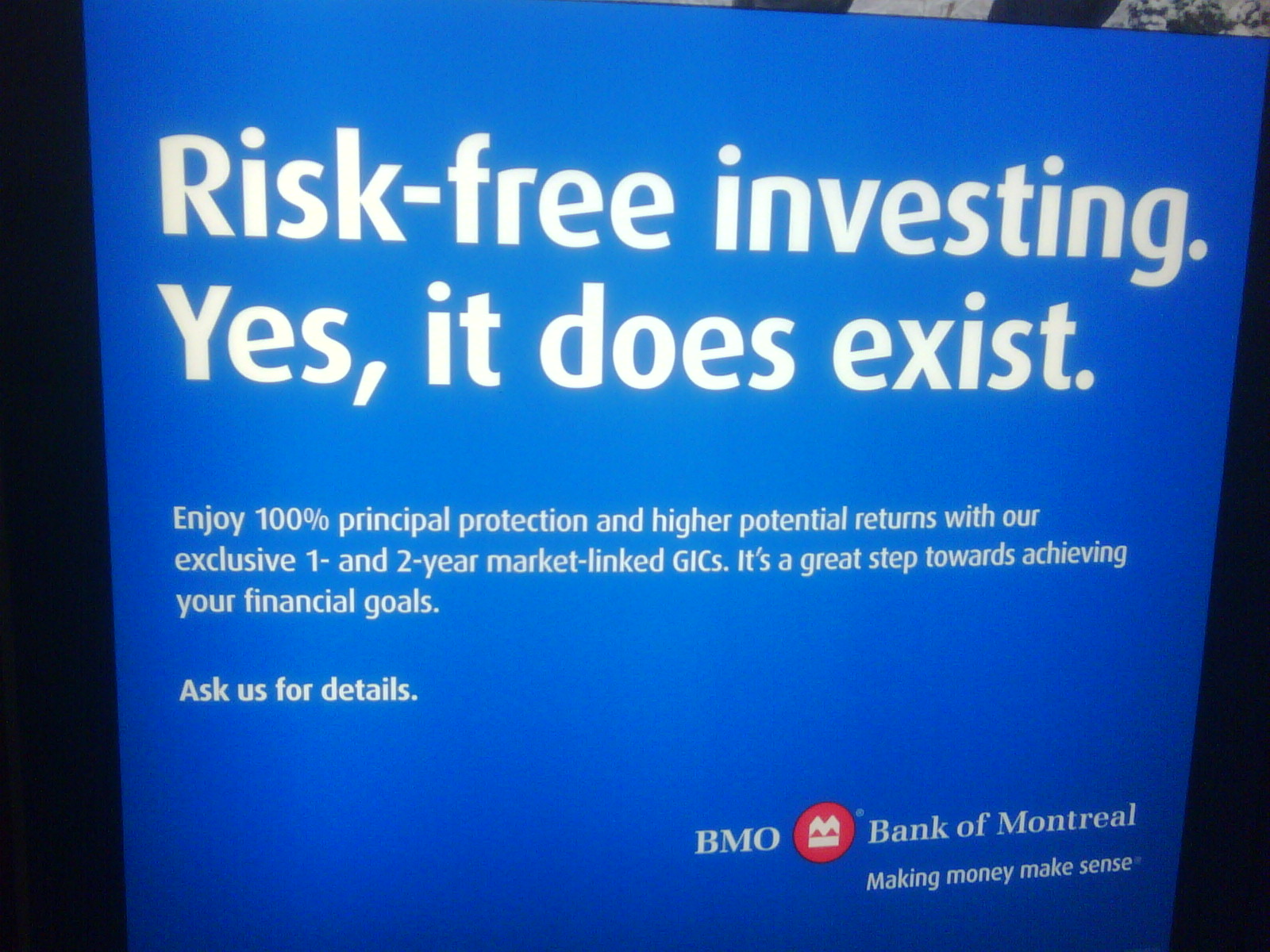
But stupid people can relax – the authorities are taking steps to ensure that nobody will ever lose money in the PPN market:

These are a way for banks to get cheap funding by packaging an unsecured debt security with an equity/credit/commodity/whatever derivative and selling it to customers who don’t have ISDAs or otherwise aren’t down with OTC derivatives. They’re called “principal protected” because even if the linked index goes down, you still get all your money back (albeit at zero yield). But that only happens if the issuer doesn’t go bankrupt – if they go bankrupt, you’re hosed just like other noteholders.

Which, duh, or so we thought. The notes after all said that they were Lehman’s unsecured obligations and that “an investment in the Notes will be subject to the credit risk of Lehman Brothers Holdings Inc, and the actual and perceived creditworthiness of Lehman Brothers Holdings Inc. may affect the market value of the Notes.” But that wasn’t enough for these plaintiffs, or for the judge, who is going to let the structured notes claims go to trial:

So the advice to structured notes desks is (1) put everything on the first page and (2) don’t assume that your customers are “careful and intelligent readers.”

Canadians, on the other hand, are indeed “careful and intelligent readers.”. I proved this on January 5:

Click for Big

In the States, though the SEC must be vigilant:

Among other things, the staff observed that broker-dealers might have:

  • recommended unsuitable structured securities products to retail investors;
  • traded at prices disadvantageous to retail investors;
  • omitted material facts about structured securities products offered to retail investors;
  • engaged in questionable sales practices with customers.

YLO will release 11Q2 results on August 4.

It was a mixed day for the Canadian preferred share market, with PerpetualDiscounts losing 6bp, FixedResets off 2bp and DeemedRetractibles up 10bp. Volatility was muted (but all negative); volume was average, but with massive volume in BNS.PR.Z (which had a “last” quote with a gigantic spread) on the back of some very nice tickets by RBC.

PerpetualDiscounts now yield 5.38%, equivalent to 6.99% interest at the standard equivalency factor of 1.3x. Long corporates now yield 5.15% (!!) so the pre-tax interest-equivalent spread is now about 185bp, a tightening from the 200bp reported on July 20 as the PerpetualDiscounts played catch-up to the prior downward move in bond yields.

HIMIPref™ Preferred Indices
These values reflect the December 2008 revision of the HIMIPref™ Indices

Values are provisional and are finalized monthly
Index Mean
Current
Yield
(at bid)
Median
YTW
Median
Average
Trading
Value
Median
Mod Dur
(YTW)
Issues Day’s Perf. Index Value
Ratchet 0.00 % 0.00 % 0 0.00 0 -0.3871 % 2,451.7
FixedFloater 0.00 % 0.00 % 0 0.00 0 -0.3871 % 3,687.3
Floater 2.47 % 2.24 % 36,117 21.68 4 -0.3871 % 2,647.2
OpRet 4.85 % 2.28 % 56,903 0.18 9 -0.0512 % 2,452.9
SplitShare 5.25 % 2.14 % 52,709 0.58 6 -0.0800 % 2,510.9
Interest-Bearing 0.00 % 0.00 % 0 0.00 0 -0.0512 % 2,243.0
Perpetual-Premium 5.67 % 4.94 % 133,387 0.82 13 0.0791 % 2,097.3
Perpetual-Discount 5.41 % 5.38 % 111,636 14.77 17 -0.0617 % 2,214.7
FixedReset 5.14 % 3.11 % 210,351 2.63 58 -0.0196 % 2,327.3
Deemed-Retractible 5.05 % 4.65 % 269,754 7.82 47 0.0951 % 2,178.1
Performance Highlights
Issue Index Change Notes
NA.PR.P FixedReset -1.15 % YTW SCENARIO
Maturity Type : Call
Maturity Date : 2014-02-15
Maturity Price : 25.00
Evaluated at bid price : 26.69
Bid-YTW : 3.69 %
FTS.PR.F Perpetual-Discount -1.09 % YTW SCENARIO
Maturity Type : Limit Maturity
Maturity Date : 2041-07-27
Maturity Price : 24.17
Evaluated at bid price : 24.46
Bid-YTW : 5.07 %
BAM.PR.N Perpetual-Discount -1.07 % YTW SCENARIO
Maturity Type : Limit Maturity
Maturity Date : 2041-07-27
Maturity Price : 21.84
Evaluated at bid price : 22.14
Bid-YTW : 5.41 %
TRI.PR.B Floater -1.06 % YTW SCENARIO
Maturity Type : Limit Maturity
Maturity Date : 2041-07-27
Maturity Price : 22.98
Evaluated at bid price : 23.25
Bid-YTW : 2.24 %
Volume Highlights
Issue Index Shares
Traded
Notes
BNS.PR.Z FixedReset 1,402,675 RBC crossed blocks of 575,000 shares, 100,000 and 413,300, all at 24.25. TD crossed 300,000 at the same price.
YTW SCENARIO
Maturity Type : Hard Maturity
Maturity Date : 2022-01-31
Maturity Price : 25.00
Evaluated at bid price : 24.26
Bid-YTW : 3.89 %
BNS.PR.Q FixedReset 81,413 RBC crossed 65,000 at 26.05.
YTW SCENARIO
Maturity Type : Call
Maturity Date : 2013-10-25
Maturity Price : 25.00
Evaluated at bid price : 26.01
Bid-YTW : 3.13 %
TD.PR.I FixedReset 71,667 RBC crossed blocks of 25,000 and 40,000, both at 27.39.
YTW SCENARIO
Maturity Type : Call
Maturity Date : 2014-07-31
Maturity Price : 25.00
Evaluated at bid price : 27.37
Bid-YTW : 2.93 %
TD.PR.O Deemed-Retractible 49,737 Desjardins crossed 27,000 at 25.45.
YTW SCENARIO
Maturity Type : Call
Maturity Date : 2013-10-31
Maturity Price : 25.25
Evaluated at bid price : 25.45
Bid-YTW : 4.42 %
RY.PR.R FixedReset 41,243 Scotia crossed 35,000 at 27.05.
YTW SCENARIO
Maturity Type : Call
Maturity Date : 2014-02-24
Maturity Price : 25.00
Evaluated at bid price : 26.85
Bid-YTW : 3.07 %
BMO.PR.L Deemed-Retractible 34,356 YTW SCENARIO
Maturity Type : Call
Maturity Date : 2013-05-25
Maturity Price : 26.00
Evaluated at bid price : 27.02
Bid-YTW : 3.89 %
There were 33 other index-included issues trading in excess of 10,000 shares.
Wide Spread Highlights
Issue Index Quote Data and Yield Notes
BNS.PR.Z FixedReset Quote: 24.26 – 25.50
Spot Rate : 1.2400
Average : 0.7346

YTW SCENARIO
Maturity Type : Hard Maturity
Maturity Date : 2022-01-31
Maturity Price : 25.00
Evaluated at bid price : 24.26
Bid-YTW : 3.89 %

CIU.PR.C FixedReset Quote: 25.00 – 25.49
Spot Rate : 0.4900
Average : 0.3497

YTW SCENARIO
Maturity Type : Limit Maturity
Maturity Date : 2041-07-27
Maturity Price : 23.17
Evaluated at bid price : 25.00
Bid-YTW : 3.39 %

TRI.PR.B Floater Quote: 23.25 – 23.70
Spot Rate : 0.4500
Average : 0.3322

YTW SCENARIO
Maturity Type : Limit Maturity
Maturity Date : 2041-07-27
Maturity Price : 22.98
Evaluated at bid price : 23.25
Bid-YTW : 2.24 %

PWF.PR.H Perpetual-Premium Quote: 25.05 – 25.41
Spot Rate : 0.3600
Average : 0.2449

YTW SCENARIO
Maturity Type : Call
Maturity Date : 2011-12-10
Maturity Price : 25.00
Evaluated at bid price : 25.05
Bid-YTW : 5.04 %

BAM.PR.T FixedReset Quote: 24.87 – 25.20
Spot Rate : 0.3300
Average : 0.2177

YTW SCENARIO
Maturity Type : Limit Maturity
Maturity Date : 2041-07-27
Maturity Price : 23.08
Evaluated at bid price : 24.87
Bid-YTW : 4.34 %

BAM.PR.N Perpetual-Discount Quote: 22.14 – 22.47
Spot Rate : 0.3300
Average : 0.2216

YTW SCENARIO
Maturity Type : Limit Maturity
Maturity Date : 2041-07-27
Maturity Price : 21.84
Evaluated at bid price : 22.14
Bid-YTW : 5.41 %

Issue Comments

DW.PR.A to Vote on Redemption

DundeeWealth Inc. has announced:

that it has called a special meeting of shareholders of DundeeWealth for September 7, 2011 to consider a special resolution authorizing an amendment to the Company’s articles to permit the Company to redeem all of the issued and outstanding first preference shares, series 1 (the “Series 1 Shares”) at a price of $26.50 plus accrued and unpaid dividends up to but excluding the redemption date. If the proposed amendment is approved, the redemption will occur on September 8, 2011 (or, if the special meeting is adjourned or postponed, on the business day immediately following any such adjourned or postponed meeting).

The Series 1 Shares are currently redeemable by DundeeWealth at a price of $26.25 per Series 1 Share plus accrued and unpaid dividends thereon up to but excluding the redemption date, provided that circumstances exist where holders of the Series 1 Shares are entitled to vote separately as a class or series by law. Commencing on March 13, 2012, DundeeWealth will have the right to redeem the Series 1 Shares at a price of $26.00 per Series 1 Share plus accrued and unpaid dividends thereon, without any requirement for a vote.

The proposal provides holders of Series 1 Shares with an opportunity to realize on their investment in DundeeWealth at a premium of $0.25 over the current redemption price and a premium of $0.50 over the redemption price that will apply commencing on March 13, 2012. In addition, the redemption price contemplated by the proposal represents a premium of $0.50 over the 20-day volume weighted average trading price for the Series 1 Shares for the period ended July 26, 2011.

The Series 1 Shares are listed for trading on the Toronto Stock Exchange under the symbol “DW.PR.A”. If the special resolution is approved by shareholders, DundeeWealth intends to apply to delist the Series 1 Shares from trading on the Toronto Stock Exchange and to exercise its right to redeem its $200 million 5.10% series 1 notes due September 25, 2014. Upon the redemption of the Series 1 Shares and the series 1 notes, DundeeWealth will apply to cease to be a reporting issuer under the securities laws of each province of Canada in which it is currently a reporting issuer.

In order to become effective, the special resolution must be approved by: (i) two-thirds of the votes cast together by all holders of common shares, special shares, series C and first preference shares, series X present in person or represented by proxy at the meeting; and (ii) two-thirds of the votes cast by the holders of Series 1 Shares present in person or represented by proxy at the meeting voting as a class. The Bank of Nova Scotia owns all of the outstanding common shares, special shares, series C and first preference shares, series X as well as approximately 1.6% of the outstanding Series 1 Shares and has indicated that it intends to vote in favour of the special resolution. Accordingly, the approval referred to in (i) above is assured.

Details of the proposal will be outlined in an information circular to be sent to shareholders in connection with the special meeting. Copies of the information circular will be available on the SEDAR website at www.sedar.com.

DW.PR.A was last mentioned on PrefBlog when it was upgraded to P-2(high) by S&P.

The proposed redemption price of $26.50 to be paid 2011-9-8 implies a yield of 3.52% (quarterly compounding) until the par call date of 2016-3-13. Note that:

Any redemption before March 13, 2012 is limited to circumstances where the Series 1 Shares are entitled to vote separately as a class or series by law.

If redeemed 2012-3-13 at 26.00, the yield to par call would be 3.92%.

So basically, although 3.52% seems like a fat yield for the company (compared to, say, the 1.98% that National got on its tender offer) or the YTWs on investment grade operating retractibles, it’s probably as good as you’re gonna get. I recommend voting ‘Yes’.

Interesting External Papers

Financial Stability Oversight Council Publishes 2011 Report

The Financial Stability Oversight Council (comprised of an alphabet soup of US financial regulators) has released its 2011 Annual Report.

There are many items of interest in this excellent report; one issue that I find interesting is the regulation of money market funds:

The stable, rounded $1 NAV fosters an expectation that MMF share prices will not fluctuate. However, when shareholders perceive that a fund may suffer losses, each shareholder has an incentive to redeem shares before other shareholders, causing a run on the fund. Such redemptions can accelerate the likelihood of a break-the-buck event to the extent that the fund’s asset sales to meet redemptions significantly depress the market value of the fund’s remaining assets. In such a scenario, the ability of early redeemers to receive the full $1 NAV is essentially subsidized by the losses absorbed by remaining shareholders.


Click for Big

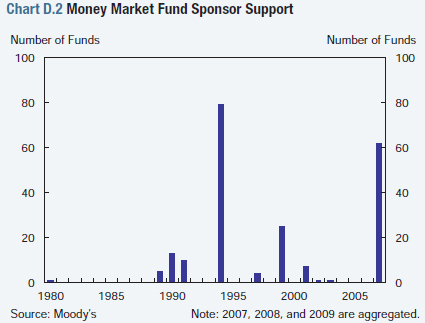
MMFs invest in assets that may lose value, but funds have no formal capital buffers or insurance to absorb loss and maintain their stable NAV. When losses do occur, MMFs have historically relied on discretionary sponsor support to maintain a stable NAV and preserve the franchise value of fund management businesses (Chart D.2). That support may come in the form of capital contributions or the purchase of assets that have lost value, for example.

Sponsors do not commit to support an MMF in advance, however, because an explicit commitment may require the sponsor to consolidate the fund on its balance sheet. Thus, although investors ostensibly bear the risk of an MMF breaking the buck, sponsors have in the past borne that risk themselves, fostering the perceived safety of MMF investments. Moreover, the uncertainty about the availability and sufficiency of such support during crises, and the fact that many MMFs lack deep-pocketed sponsors, contribute to their susceptibility to runs.

Expectation of Government Support

Given the unprecedented government support of MMFs during the crisis in 2008 and 2009, even sophisticated institutional investors and fund managers may have the impression that the government would be ready to support the industry again with the same tools.

Although these new rules are a positive first step, the SEC recognizes that they address only some of the features that make MMFs susceptible to runs, and that more should be done to address systemic risks posed by MMFs and their structural vulnerabilities.

The report takes a much more reasonable view of the Flash Crash than did the highly politicized SEC report:

During periods of violent price movements, market liquidity can evaporate as hedging strategies to protect against market risk become strained or directly amplify the price movements. For example, in the October 1987 equity market crash, portfolio insurance programs were designed to sell when prices declined; in fact, they were set to sell at an increasing rate, thereby accelerating the market decline. Similarly, in the flash crash of May 6, 2010, liquidity evaporated and market functioning deteriorated rapidly. Regulators have added circuit breakers in equity markets to mitigate such dynamics (see Section 5.3.4), but this event illustrated the potential fragility of market liquidity, particularly in areas characterized by rapid innovation and change in market behaviors.

The role of exchange traded funds (ETFs) during the flash crash has focused attention on these products. The rapid rise of ETFs has been driven by the attraction of gaining liquid exposure to less liquid asset classes—such as commodities and certain emerging markets—without having to execute trades directly in less liquid markets (Chart E.1). However, the liquidity of ETFs depends heavily on the support of market makers and on market functioning in the underlying asset. The relationship between ETF turnover and market volatility bears further analysis, and regulators must continue to monitor the development of more complex products in both U.S. and foreign-domiciled funds that might heighten liquidity concerns.

One item of great interest to me was developments in the idea that insurance companies should be regulated at the consolidated level – there is not a single mention of this in the report, so for the moment I will assume that this highly desirable reform has been dropped. Instead, the report discusses the new Federal Insurance Office (FIO), which is just another micromanaging job-creation scheme.

Publications

Opinion: IIROC's Slush Fund

Why does IIROC have so much money to spend? Where does it go? What changes are necessary?

Look for the opinion link!

See also the draft version with footnotes.

Update, 2011-8-29: Janet McFarland of the Globe published a piece today titled Regulators mum on plans for ABCP settlement payments. It focussed on the delays in spending the new money rather than past improprieties, but there was one nugget of new information:

In an e-mailed statement, IIROC said it is working with the OSC “on a co-ordinated and consistent approach” for the money, and “public disclosure will be made at an appropriate time.”

Hmm … they’ve never ‘worked with the OSC’ before to determine how to spend their cash … one wonders what is going on in the background.

Market Action

July 26, 2011

The SEC has invented more paperwork:

The rule contains the following requirements:

Filing a Form: Traders who engage in a substantial level of trading activity will be required to identify themselves to the SEC by filing a form, Form 13H, with the Commission. A “large trader” will be defined as a person whose transactions in exchange-listed securities equal or exceed two million shares or $20 million during any calendar day, or 20 million shares or $200 million during any calendar month.

The rule provides guidance on certain types of transactions that can be excluded for purposes of calculating trading levels.

Getting an Identification Number: After it files Form 13H to register with the Commission, the SEC will then assign each large trader a unique large trader identification number (LTID), which will allow the agency to efficiently identify and analyze trading activity by the large trader. A large trader will be required to disclose to its broker-dealers its LTID and highlight all of the accounts at the broker-dealer through which the large trader trades.

Recordkeeping, Reporting, and Monitoring: The rule requires broker-dealers to maintain and report data that is largely identical to the information covered by the Commission’s Electronic Blue Sheets (EBS) system – the system the SEC currently uses to collect transaction data from broker-dealers. The only additional items that broker-dealers will be required to maintain and report are the LTID and the time a transaction occurs. Accordingly, the rule leverages the existing EBS system, with modifications, to accommodate the specific requirements of the new rule. In addition, the rule requires broker-dealers to monitor whether their customers meet the threshold levels that define a “large trader” (based on transactions handled at the broker-dealer) in order to encourage compliance by their customers with the requirement to identify themselves as large traders to the SEC.

Ready Access to Data: The rule requires transaction data to be available for reporting on the morning after the day the transactions were effected. When the SEC requests data from broker-dealers, it would not under normal circumstances require responses earlier than the opening of business on the day after it makes its request. Prompt access to this data will assist the SEC in reconstructing market activity and performing other trading analyses, and also will assist in investigations of manipulative, abusive, and other illegal trading activity.

The Ontario Ministry of Pretending to Do Things So We Can All Feel Good has:

released comprehensive teacher guidelines that identify places in the Grade 4 through 12 curriculum where financial literacy can be inserted into classes as varied as mathematics, computer science and native studies.

Ontario, for example, suggests that in high school, “when studying classical civilizations, students could address aspects of trade, economics and use of money in ancient times,” according to the new teacher guidelines.

It was another positive day on the Canadian preferred share market, with PerpetualDiscounts winning 20bp, FixedResets up 2bp and DeemedRetractibles gaining 5bp. Volatility was low; volume was below average.

HIMIPref™ Preferred Indices
These values reflect the December 2008 revision of the HIMIPref™ Indices

Values are provisional and are finalized monthly
Index Mean
Current
Yield
(at bid)
Median
YTW
Median
Average
Trading
Value
Median
Mod Dur
(YTW)
Issues Day’s Perf. Index Value
Ratchet 0.00 % 0.00 % 0 0.00 0 0.2234 % 2,461.2
FixedFloater 0.00 % 0.00 % 0 0.00 0 0.2234 % 3,701.7
Floater 2.46 % 2.24 % 37,409 21.69 4 0.2234 % 2,657.5
OpRet 4.85 % 2.47 % 57,713 0.75 9 -0.0896 % 2,454.2
SplitShare 5.24 % 2.13 % 51,044 0.58 6 0.0657 % 2,512.9
Interest-Bearing 0.00 % 0.00 % 0 0.00 0 -0.0896 % 2,244.1
Perpetual-Premium 5.67 % 4.89 % 133,803 0.82 13 -0.0760 % 2,095.6
Perpetual-Discount 5.40 % 5.34 % 110,240 14.79 17 0.2003 % 2,216.1
FixedReset 5.14 % 3.10 % 205,110 2.64 58 0.0163 % 2,327.8
Deemed-Retractible 5.06 % 4.68 % 271,058 7.86 47 0.0497 % 2,176.0
Performance Highlights
Issue Index Change Notes
TRP.PR.B FixedReset -1.17 % YTW SCENARIO
Maturity Type : Limit Maturity
Maturity Date : 2041-07-26
Maturity Price : 23.35
Evaluated at bid price : 25.30
Bid-YTW : 3.28 %
BAM.PR.N Perpetual-Discount 1.36 % YTW SCENARIO
Maturity Type : Limit Maturity
Maturity Date : 2041-07-26
Maturity Price : 22.02
Evaluated at bid price : 22.38
Bid-YTW : 5.34 %
Volume Highlights
Issue Index Shares
Traded
Notes
BNS.PR.Z FixedReset 163,952 National crossed 78,000 at 24.20.
YTW SCENARIO
Maturity Type : Hard Maturity
Maturity Date : 2022-01-31
Maturity Price : 25.00
Evaluated at bid price : 24.25
Bid-YTW : 3.90 %
HSB.PR.E FixedReset 107,279 RBC crossed blocks of 49,500 and 50,000, both at 27.68.
YTW SCENARIO
Maturity Type : Call
Maturity Date : 2014-06-30
Maturity Price : 25.00
Evaluated at bid price : 27.58
Bid-YTW : 3.08 %
MFC.PR.B Deemed-Retractible 58,042 RBC crossed 50,000 at 22.75.
YTW SCENARIO
Maturity Type : Hard Maturity
Maturity Date : 2022-01-31
Maturity Price : 25.00
Evaluated at bid price : 22.72
Bid-YTW : 5.92 %
RY.PR.G Deemed-Retractible 56,470 Nesbitt crossed 30,000 at 24.45.
YTW SCENARIO
Maturity Type : Hard Maturity
Maturity Date : 2022-01-31
Maturity Price : 25.00
Evaluated at bid price : 24.52
Bid-YTW : 4.72 %
HSB.PR.D Deemed-Retractible 52,654 RBC crossed 49,400 at 24.85.
YTW SCENARIO
Maturity Type : Hard Maturity
Maturity Date : 2022-01-31
Maturity Price : 25.00
Evaluated at bid price : 24.82
Bid-YTW : 5.16 %
SLF.PR.E Deemed-Retractible 51,120 Nesbitt crossed 46,400 at 22.25.
YTW SCENARIO
Maturity Type : Hard Maturity
Maturity Date : 2022-01-31
Maturity Price : 25.00
Evaluated at bid price : 22.17
Bid-YTW : 6.04 %
There were 27 other index-included issues trading in excess of 10,000 shares.
Wide Spread Highlights
Issue Index Quote Data and Yield Notes
TCA.PR.Y Perpetual-Premium Quote: 50.15 – 50.64
Spot Rate : 0.4900
Average : 0.3203

YTW SCENARIO
Maturity Type : Call
Maturity Date : 2014-03-05
Maturity Price : 50.00
Evaluated at bid price : 50.15
Bid-YTW : 5.46 %

FTS.PR.C OpRet Quote: 26.00 – 26.49
Spot Rate : 0.4900
Average : 0.3288

YTW SCENARIO
Maturity Type : Call
Maturity Date : 2011-08-25
Maturity Price : 25.50
Evaluated at bid price : 26.00
Bid-YTW : -8.42 %

TRP.PR.A FixedReset Quote: 25.90 – 26.19
Spot Rate : 0.2900
Average : 0.1924

YTW SCENARIO
Maturity Type : Call
Maturity Date : 2014-12-31
Maturity Price : 25.00
Evaluated at bid price : 25.90
Bid-YTW : 3.60 %

GWO.PR.L Deemed-Retractible Quote: 25.20 – 25.42
Spot Rate : 0.2200
Average : 0.1543

YTW SCENARIO
Maturity Type : Hard Maturity
Maturity Date : 2022-01-31
Maturity Price : 25.00
Evaluated at bid price : 25.20
Bid-YTW : 5.64 %

BNS.PR.T FixedReset Quote: 27.15 – 27.35
Spot Rate : 0.2000
Average : 0.1411

YTW SCENARIO
Maturity Type : Call
Maturity Date : 2014-04-25
Maturity Price : 25.00
Evaluated at bid price : 27.15
Bid-YTW : 2.97 %

PWF.PR.A Floater Quote: 23.01 – 23.60
Spot Rate : 0.5900
Average : 0.5361

YTW SCENARIO
Maturity Type : Limit Maturity
Maturity Date : 2041-07-26
Maturity Price : 22.72
Evaluated at bid price : 23.01
Bid-YTW : 2.24 %

Market Action

July 25, 2011

This is getting monotonous:

Greece’s sovereign credit rating was cut three steps by Moody’s Investors Service, which said the European Union’s financing package for the debt-laden nation implies “substantial economic losses” for private creditors.

Greece’s long-term foreign currency debt was downgraded to Ca from Caa1, the ratings company said in a statement in London today. Moody’s assigned a developing outlook to the ratings and said it will re-assess the credit risk profile of any outstanding or new securities issued by the Greek government after Greece’s debt exchange has been completed.

It occurs to me … one way that the Greek government hid debt was to enter into currency swaps with a present value far different from zero at trade-time. This was not just allowable under the rules at that time, but even encouraged and everybody knew they were doing it; this made it a little harder for the politicians to say it was all the brokers’ (Goldman Sachs’) fault, but somehow they managed.

I haven’t seen anything about these things for a while. Could it be possible that lenders through a swap facility will get off scot-free?

Who wants to take responsibility for this bond market effect?

A cut in the U.S. government’s AAA grade could force investors to sell asset-backed securities tied to student loans, causing spreads to widen “significantly,” according to Citigroup Inc.

“A ratings downgrade would be a significant blow” to the $250 billion government-guaranteed sector, Citigroup analysts led by Mary Kane said in a July 22 report. “The likelihood of forced selling is elevated.”

Citigroup sees a 50 percent chance of a ratings cut this year as the U.S. struggles to reduce its long-term debt. Many investors buy student-loan securities specifically because they’re so highly rated and a U.S. government credit risk, according to analysts at the New York-based lender. Money managers with rating-based guidelines would be forced to sell into a sinking market, affecting the sector more than other asset-backed debt tied to consumers, commercial mortgages and corporate loans, they wrote.

The situation worries me. I don’t think there’s any imminent danger, and I’ve written about this before … but remember the last days of the Roman Republic. You had two parties: the “good men” and the “populists”, nominally representing basically the old traditional oligarchy and the new guys looking in, respectively. Their main political purpose was to ensure that the other party couldn’t do anything – so little got done and everybody got frustrated and angry. Then along came Julius Caesar: smart, ambitious and ruthless, who staged a coup. All the US needs is another two decades or so of log-jam, and I’ll start taking bets.

S&P revised its outlook on BAM:

  • We are revising our outlook on Brookfield Asset Management to stable from negative.
  • At the same time, we are affirming our ratings on the company, including our ‘A-‘ corporate credit and ‘A-2’ short-term ratings.
  • We base the outlook revision on the improved operating performance and outlook in Brookfield’s operating subsidiaries. It also reflects the
    company’s continued ability to execute its asset management strategy by attracting external investment capital, while maintaining company-level cash flow coverage measures in line with our expectation for the ratings.

It was a good day for the Canadian preferred share market, with PerpetualDiscounts winning 19bp, FixedResets up 1bp and DeemedRetractibles gaining 17bp. Volatility was minimal; volume was low.

HIMIPref™ Preferred Indices
These values reflect the December 2008 revision of the HIMIPref™ Indices

Values are provisional and are finalized monthly
Index Mean
Current
Yield
(at bid)
Median
YTW
Median
Average
Trading
Value
Median
Mod Dur
(YTW)
Issues Day’s Perf. Index Value
Ratchet 0.00 % 0.00 % 0 0.00 0 0.3066 % 2,455.7
FixedFloater 0.00 % 0.00 % 0 0.00 0 0.3066 % 3,693.4
Floater 2.47 % 2.24 % 38,826 21.69 4 0.3066 % 2,651.6
OpRet 4.84 % 1.99 % 57,920 0.18 9 0.1110 % 2,456.4
SplitShare 5.23 % 1.44 % 51,791 0.59 6 -0.1330 % 2,511.2
Interest-Bearing 0.00 % 0.00 % 0 0.00 0 0.1110 % 2,246.1
Perpetual-Premium 5.67 % 4.96 % 134,826 0.58 13 0.0806 % 2,097.2
Perpetual-Discount 5.42 % 5.42 % 109,456 14.75 17 0.1858 % 2,211.7
FixedReset 5.14 % 3.08 % 198,269 2.64 58 0.0130 % 2,327.4
Deemed-Retractible 5.06 % 4.69 % 268,234 7.88 47 0.1725 % 2,174.9
Performance Highlights
Issue Index Change Notes
GWO.PR.I Deemed-Retractible 1.07 % YTW SCENARIO
Maturity Type : Hard Maturity
Maturity Date : 2022-01-31
Maturity Price : 25.00
Evaluated at bid price : 22.76
Bid-YTW : 5.71 %
Volume Highlights
Issue Index Shares
Traded
Notes
BMO.PR.M FixedReset 511,230 An extraordinary number of block trades went through today, every single one of them at 26.23! Nesbitt crossed 157,900 and RBC bought 25,000 and 10,000 from anonymous. RBC then bought 16,400 and 23,600 from Nesbitt; then crossed another 50,000. Scotia crossed 10,000; TD bought 10,000 from Nesbitt. RBC bought 43,400 from Nesbitt. TD crossed 25,000; RBC crossed blocks of 25,000 shares, 10,000 and 24,100; and TD closed off proceedings by crossing 26,700.
YTW SCENARIO
Maturity Type : Call
Maturity Date : 2013-08-25
Maturity Price : 25.00
Evaluated at bid price : 26.26
Bid-YTW : 2.92 %
BNS.PR.Z FixedReset 135,688 National sold 10,000 to TD at 24.20, then 10,000 to anonymous at 24.08, then blocks of 20,000 and 11,500 to RBC at 24.00; then 36,900 to TD at 24.05. TD crossed 25,000 at 24.16.
YTW SCENARIO
Maturity Type : Hard Maturity
Maturity Date : 2022-01-31
Maturity Price : 25.00
Evaluated at bid price : 24.20
Bid-YTW : 3.92 %
TD.PR.M OpRet 101,500 Nesbitt crossed 50,000 at 25.55; Desjardins and RBC both crossed 25,000 at the same price.
YTW SCENARIO
Maturity Type : Call
Maturity Date : 2011-08-24
Maturity Price : 25.50
Evaluated at bid price : 25.56
Bid-YTW : 0.82 %
BAM.PR.X FixedReset 78,495 National crossed 60,000 at 24.98.
YTW SCENARIO
Maturity Type : Limit Maturity
Maturity Date : 2041-07-25
Maturity Price : 23.06
Evaluated at bid price : 24.85
Bid-YTW : 4.00 %
BMO.PR.N FixedReset 72,800 RBC crossed 65,000 at 27.61.
YTW SCENARIO
Maturity Type : Call
Maturity Date : 2014-02-25
Maturity Price : 25.00
Evaluated at bid price : 27.60
Bid-YTW : 2.76 %
TD.PR.K FixedReset 71,274 Nesbitt crossed 67,000 at 27.33.
YTW SCENARIO
Maturity Type : Call
Maturity Date : 2014-07-31
Maturity Price : 25.00
Evaluated at bid price : 27.34
Bid-YTW : 2.97 %
There were 22 other index-included issues trading in excess of 10,000 shares.
Wide Spread Highlights
Issue Index Quote Data and Yield Notes
POW.PR.B Perpetual-Discount Quote: 24.40 – 24.74
Spot Rate : 0.3400
Average : 0.2172

YTW SCENARIO
Maturity Type : Limit Maturity
Maturity Date : 2041-07-25
Maturity Price : 24.15
Evaluated at bid price : 24.40
Bid-YTW : 5.51 %

FTS.PR.F Perpetual-Discount Quote: 24.60 – 24.98
Spot Rate : 0.3800
Average : 0.2921

YTW SCENARIO
Maturity Type : Limit Maturity
Maturity Date : 2041-07-25
Maturity Price : 24.31
Evaluated at bid price : 24.60
Bid-YTW : 5.04 %

RY.PR.N FixedReset Quote: 26.81 – 27.13
Spot Rate : 0.3200
Average : 0.2411

YTW SCENARIO
Maturity Type : Call
Maturity Date : 2014-02-24
Maturity Price : 25.00
Evaluated at bid price : 26.81
Bid-YTW : 3.12 %

RY.PR.E Deemed-Retractible Quote: 24.31 – 24.71
Spot Rate : 0.4000
Average : 0.3242

YTW SCENARIO
Maturity Type : Hard Maturity
Maturity Date : 2022-01-31
Maturity Price : 25.00
Evaluated at bid price : 24.31
Bid-YTW : 4.82 %

FTS.PR.E OpRet Quote: 27.15 – 27.52
Spot Rate : 0.3700
Average : 0.2962

YTW SCENARIO
Maturity Type : Call
Maturity Date : 2013-06-01
Maturity Price : 25.75
Evaluated at bid price : 27.15
Bid-YTW : 2.15 %

W.PR.H Perpetual-Discount Quote: 24.74 – 24.99
Spot Rate : 0.2500
Average : 0.1830

YTW SCENARIO
Maturity Type : Limit Maturity
Maturity Date : 2041-07-25
Maturity Price : 23.64
Evaluated at bid price : 24.74
Bid-YTW : 5.55 %

Issue Comments

Almost 25% of BCE.PR.I Converted to Ratchet Rate

BCE Inc. has announced:

that 3,245,010 of its 14,000,000 fixed-rate Cumulative Redeemable First Preferred Shares, Series AI (series AI preferred shares) have been tendered for conversion on August 1, 2011, on a one-for-one basis, into floating-rate Cumulative Redeemable First Preferred Shares, Series AJ (series AJ preferred shares). Consequently, BCE will issue 3,245,010 new series AJ preferred shares on August 1, 2011.

The remaining series AI preferred shares will continue to be listed on The Toronto Stock Exchange under the symbol BCE.PR.I. The series AI preferred shares will pay on a quarterly basis, for the five-year period beginning on August 1, 2011, as and when declared by the Board of Directors of BCE, a fixed dividend based on an annual dividend rate of 4.15%.

The series AJ preferred shares will pay a monthly floating adjustable cash dividend for the five-year period beginning on August 1, 2011, as and when declared by the Board of Directors of BCE. The monthly floating adjustable dividend for any particular month will be calculated based on the prime rate for such month and using the Designated Percentage for such month representing the sum of the adjustment factor (based on the market price of the series AJ preferred shares in the preceding month) and the Designated Percentage for the preceding month. The series AJ preferred shares will be listed on The Toronto Stock Exchange under the symbol BCE.PR.J and will start trading at the opening of the market on August 2, 2011.

BCE.PR.I is tracked by HIMIPref™, but is assigned to the Scraps index on credit concerns. BCE.PR.J will be tracked by HIMIPref™ when it commences trading. The issues and exchange potential were discussed on PrefBlog in the post BCE.PR.I: Rate Change to 4.15%; Exchangeable to Ratchets