Issue Comments

PWF.PR.P Closes Firm on Heavy Volume

Power Financial Corp. has announced:

the successful completion and closing of an offering of 11,200,000 4.40% Non-Cumulative 5-Year Rate Reset First Preferred Shares, Series P (the “Series P Shares”) priced at $25.00 per share to raise gross proceeds of $280 million.

The issue was bought by an underwriting group co-led by BMO Capital Markets, RBC Capital Markets and Scotia Capital Inc. Following the successful sale of the initially announced 8,000,000 Series P Shares, the underwriters exercised an option to purchase an additional 3,200,000 Series P Shares.

The Series P Shares will be listed and posted for trading on the Toronto Stock Exchange under the symbol “PWF.PR.P”. Proceeds from the issue will be used to supplement Power Financial’s financial resources and for general corporate purposes.

PWF.PR.P is a FixedReset, 4.40%+160, announced June 17. It traded 563,942 shares today in a range of 24.85-02 before closing at 25.00-14.

The greenshoe was for 4-million shares, so 80% was exercised.

Given the Power Group’s reputation for extremely tight pricing of their new preferred issues, I can bet the CFO has already received a sternly worded memo about leaving too much money on the table!

Vital statistics are:

PWF.PR.P FixedReset YTW SCENARIO
Maturity Type : Limit Maturity
Maturity Date : 2040-06-29
Maturity Price : 23.12
Evaluated at bid price : 25.00
Bid-YTW : 4.06 %

PWF.PR.P is tracked by HIMIPref™ and has been assigned to the FixedReset index.

Issue Comments

TRP.PR.C Closes Below Par on Heavy Volume

TransCanada Corp. has announced:

that it has completed its public offering of cumulative redeemable first preferred shares, series 5 (the “Series 5 Preferred Shares”). As the underwriters fully exercised their option to acquire an additional two million Series 5 Preferred Shares, the size of the offering increased to a total of 14 million shares resulting in gross proceeds of $350 million.

The offering was first announced on June 17, 2010 when TransCanada entered into an agreement with a syndicate of underwriters in Canada led by Scotia Capital Inc., RBC Capital Markets, and BMO Capital Markets.

The net proceeds of the offering will be used to partially fund capital projects, for general corporate purposes and to reduce short term indebtedness of TransCanada and its affiliates, which short term indebtedness was used to fund TransCanada’s capital program and for general corporate purposes.

TRP.PR.C traded 567,818 shares today in a range of 24.75-90 before closing at 24.83-88. This issue is a FixedReset, 4.40%+154, announced June 17.

Vital statistics are:

TRP.PR.C FixedReset YTW SCENARIO
Maturity Type : Limit Maturity
Maturity Date : 2040-06-29
Maturity Price : 23.07
Evaluated at bid price : 24.83
Bid-YTW : 4.05 %

TRP.PR.C is tracked by HIMIPref™ and has been added to the FixedReset index.

Market Action

June 28, 2010

The Federal Reserve Bank of Boston has released a Public Policy Brief by Jeffrey C. Fuhrer and Giovanni P. Olivei titled The Role of Expectations and Output in the Inflation Process: An Empirical Assessment:

This brief examines two issues of current interest concerning inflation: (1) whether “well-anchored” expectations will help to restrain inflation’s decline and whether an “un-anchoring” of expectations could lead to undesirably high inflation and (2) to what extent output (or utilization) gaps are useful components of empirical models of inflation and, if they are useful, to what extent current gaps might counterbalance the effect of expectations on inflation. The goals of conducting this examination are to articulate a reasonably coherent framework for the discussion, highlight the key areas of uncertainty, and provide new empirical evidence that sheds some light on these areas.

Nothing much happened in the credit markets, so I’ll discuss Toronto politics. Why not?

I am pleased to see that Queers Against Israeli Apartheid is being readmitted to the Pride Parade:

Pride Toronto has announced that its recent resolution to restrict the use of certain language during the 2010 Parade has been replaced by the requirement that each participating group read, sign and agree to abide by the City of Toronto’s Declaration of a Non-Discrimination Policy, and that all groups that uphold this policy are welcome to participate in the 2010 Pride Parade.

The requirement to “read, sign and agree to abide by the City of Toronto’s Declaration of a Non-Discrimination Policy” is more than just a little bit precious, but if Pride wants to jump through those hoops, that’s their business. To me, it just shows there’s not much point in getting involved with any sponsored civic activity.

Two mayoral hopefuls seem to think this is an issue in which the city should be involved:

“I want to express my disappointment and disgust with Pride Toronto’s decision to allow this hateful group to march,” said mayoral hopeful Rob Ford.

Giorgio Mammoliti, who is also running for mayor, will introduce a motion at council demanding that Pride return all city funding, about $250,000.

Pride’s done a lot more to bring money into the city than either of those two clowns ever have! I think they should concentrate a little more on how to get a souvlaki cart licensed in less than three years.

PerpetualDiscounts gained 14bp today to keep the streak alive – two more days and they will have gone the entire month of June without a loss. FixedResets were flat; volume was moderate; volatility was almost non-existent.

HIMIPref™ Preferred Indices
These values reflect the December 2008 revision of the HIMIPref™ Indices

Values are provisional and are finalized monthly
Index Mean
Current
Yield
(at bid)
Median
YTW
Median
Average
Trading
Value
Median
Mod Dur
(YTW)
Issues Day’s Perf. Index Value
Ratchet 2.80 % 2.91 % 30,248 20.37 1 -2.3621 % 2,048.0
FixedFloater 5.08 % 3.25 % 21,722 19.87 1 0.5164 % 3,151.1
Floater 2.40 % 2.80 % 77,029 20.22 3 -0.0914 % 2,258.4
OpRet 4.87 % 3.49 % 86,042 0.42 11 -0.2502 % 2,334.2
SplitShare 6.33 % 6.22 % 88,425 3.47 2 -0.2829 % 2,191.6
Interest-Bearing 0.00 % 0.00 % 0 0.00 0 -0.2502 % 2,134.4
Perpetual-Premium 0.00 % 0.00 % 0 0.00 0 0.1369 % 1,916.3
Perpetual-Discount 5.93 % 6.01 % 194,811 13.93 77 0.1369 % 1,813.9
FixedReset 5.42 % 3.97 % 318,296 3.46 45 -0.0050 % 2,185.3
Performance Highlights
Issue Index Change Notes
BAM.PR.E Ratchet -2.36 % YTW SCENARIO
Maturity Type : Limit Maturity
Maturity Date : 2040-06-28
Maturity Price : 21.67
Evaluated at bid price : 20.75
Bid-YTW : 2.91 %
BAM.PR.O OpRet -2.30 % YTW SCENARIO
Maturity Type : Option Certainty
Maturity Date : 2013-06-30
Maturity Price : 25.00
Evaluated at bid price : 25.50
Bid-YTW : 4.30 %
GWO.PR.J FixedReset -1.22 % YTW SCENARIO
Maturity Type : Call
Maturity Date : 2014-01-30
Maturity Price : 25.00
Evaluated at bid price : 26.62
Bid-YTW : 4.06 %
Volume Highlights
Issue Index Shares
Traded
Notes
TD.PR.O Perpetual-Discount 44,405 Nesbitt crossed blocks of 10,500 and 16,500, both at 21.30.
YTW SCENARIO
Maturity Type : Limit Maturity
Maturity Date : 2040-06-28
Maturity Price : 21.24
Evaluated at bid price : 21.24
Bid-YTW : 5.82 %
TD.PR.K FixedReset 31,754 RBC crossed 24,800 at 27.50.
YTW SCENARIO
Maturity Type : Call
Maturity Date : 2014-08-30
Maturity Price : 25.00
Evaluated at bid price : 27.45
Bid-YTW : 3.98 %
RY.PR.A Perpetual-Discount 29,747 RBC crossed 15,000 at 19.68.
YTW SCENARIO
Maturity Type : Limit Maturity
Maturity Date : 2040-06-28
Maturity Price : 19.68
Evaluated at bid price : 19.68
Bid-YTW : 5.73 %
POW.PR.A Perpetual-Discount 28,800 RBC crossed 28,800 (yes, every share that traded) at 23.15.
YTW SCENARIO
Maturity Type : Limit Maturity
Maturity Date : 2040-06-28
Maturity Price : 22.69
Evaluated at bid price : 22.93
Bid-YTW : 6.12 %
TD.PR.M OpRet 26,336 RBC crossed 20,000 at 26.31.
YTW SCENARIO
Maturity Type : Call
Maturity Date : 2010-07-28
Maturity Price : 25.75
Evaluated at bid price : 25.99
Bid-YTW : 2.18 %
RY.PR.X FixedReset 21,760 YTW SCENARIO
Maturity Type : Call
Maturity Date : 2014-09-23
Maturity Price : 25.00
Evaluated at bid price : 27.35
Bid-YTW : 4.03 %
There were 25 other index-included issues trading in excess of 10,000 shares.
Issue Comments

FIG.PR.A: Warrant Exercise Minimal

Faircourt Asset Management has announced:

that approximately 1 million Warrants outstanding have been exercised at an exercise price of $4.00 per Trust Unit for aggregate gross proceeds raised approximating $4 million. Warrants not exercised expired on June 25th, 2010.

There were 4.9-million outstanding, so take-up was just a little over 20%.

FIG.PR.A was last mentioned on PrefBlog when the mass retraction of 6.4-million units was announced.

FIG.PR.A is tracked by HIMIPref™, but is relegated to the Scraps index on credit concerns.

Issue Comments

PWF.PR.J to be Redeemed

Power Financial Corporation has announced:

that it intends to redeem all $150 million of its outstanding 4.70% Non-Cumulative First Preferred Shares, Series J on July 30, 2010.

In accordance with the terms of the Series J Shares, the redemption price will be $25.50 for each Series J share plus an amount equal to all declared and unpaid dividends, net of any tax required to be withheld by the Corporation.

A notice of the redemption of the Series J Shares will be provided in accordance with the rights, privileges and conditions attached to the Series J Shares.

PWF.PR.J commenced trading in March, 2003, and was scheduled to become callable at par commencing 2012-4-30. It was last mentioned on PrefBlog in early 2007, after GWO bought Putnam.

PWF.PR.J is a member of the rapidly shrinking Operating Retractible index and closed last night at 25.80-85, with a negative Yield-to-Worst.

Regulation

G-20: Better Living Through Increased Regulation

The G-20 Statement

We are taking strong steps toward increasing the stability and strength of our financial systems. Significantly increased resources for international financial institutions are helping stabilise and address the impact of the crisis on the world’s most vulnerable. Ongoing governance and management reforms, which must be completed, will also enhance the effectiveness and relevance of these institutions.

Further progress is also required on financial repair and reform to increase the transparency and strengthen the balance sheets of our financial institutions, and support credit availability and rapid growth, including in the real economy. We took new steps to build a better regulated and more resilient financial system that serves the needs of our citizens. There is also a pressing need to complete the reforms of the international financial institutions.

The G-20’s highest priority is to safeguard and strengthen the recovery and lay the foundation for strong, sustainable and balanced growth, and strengthen our financial systems against risks. We therefore welcome the actions taken and commitments made by a number of G-20 countries to boost demand and rebalance growth, strengthen our public finances, and make our financial systems stronger and more transparent.

That sounds like a lot of “highest” priorities to me!

We are building a more resilient financial system that serves the needs of our economies, reduces moral hazard, limits the build up of systemic risk, and supports strong and stable economic growth. We have strengthened the global financial system by fortifying prudential oversight, improving risk management, promoting transparency, and reinforcing international cooperation. A great deal has been accomplished. We welcome the full implementation of the European Stabilization Mechanism and Facility, the EU decision to publicly release the results of ongoing tests on European banks, and the recent US financial reform bill

The first pillar is a strong regulatory framework. We took stock of the progress of the Basel Committee on Banking Supervision (BCBS) towards a new global regime for bank capital and liquidity and we welcome and support its work. Substantial progress has been made on reforms that will materially raise levels of resilience of our banking systems. The amount of capital will be significantly higher and the quality of capital will be significantly improved when the new reforms are fully implemented. This will enable banks to withstand – without extraordinary government support – stresses of a magnitude associated with the recent financial crisis. We support reaching agreement at the time of the Seoul Summit on the new capital framework. We agreed that all members will adopt the new standards and these will be phased in over a timeframe that is consistent with sustained recovery and limits market disruption, with the aim of implementation by end-2012, and a transition horizon informed by the macroeconomic impact assessment of the Financial Stability Board (FSB) and BCBS. Phase-in arrangements will reflect different national starting points and circumstances, with initial variance around the new standards narrowing over time as countries converge to the new global standard.

We agreed to strengthen financial market infrastructure by accelerating the implementation of strong measures to improve transparency and regulatory oversight of hedge funds, credit rating agencies and over-the-counter derivatives in an internationally consistent and non-discriminatory way. We re-emphasized the importance of achieving a single set of high quality improved global accounting standards and the implementation of the FSB’s standards for sound compensation.

Naturally enough, credit rating agencies are a favourite whipping boy. But hedge funds? None were bailed out, although many went bust.

The second pillar is effective supervision. We agreed that new, stronger rules must be complemented with more effective oversight and supervision. We tasked the FSB, in consultation with the International Monetary Fund (IMF), to report to our Finance Ministers and Central Bank Governors in October 2010 on recommendations to strengthen oversight and supervision, specifically relating to the mandate, capacity and resourcing of supervisors and specific powers which should be adopted to proactively identify and address risks, including early intervention.

The third pillar is resolution and addressing systemic institutions. We are committed to design and implement a system where we have the powers and tools to restructure or resolve all types of financial institutions in crisis, without taxpayers ultimately bearing the burden, and adopted principles that will guide implementation. We called upon the FSB to consider and develop concrete policy recommendations to effectively address problems associated with, and resolve, systemically important financial institutions by the Seoul Summit. To reduce moral hazard risks, there is a need to have a policy framework including effective resolution tools, strengthened prudential and supervisory requirements, and core financial market infrastructures. We agreed the financial sector should make a fair and substantial contribution towards paying for any burdens associated with government interventions, where they occur, to repair the financial system or fund resolution, and reduce risks from the financial system. We recognized that there are a range of policy approaches to this end. Some countries are pursuing a financial levy. Other countries are pursuing different approaches.

The fourth pillar is transparent international assessment and peer review. We have strengthened our commitment to the IMF/World Bank Financial Sector Assessment Program (FSAP) and pledge to support robust and transparent peer review through the FSB. We are addressing non-cooperative jurisdictions based on comprehensive, consistent, and transparent assessment with respect to tax havens, the fight against money laundering and terrorist financing and the adherence to prudential standards.

The financial crisis has imposed huge costs. This must not be allowed to happen again.

They lose a huge amount of credibility here. There have been financial crises since the invention of money; there will be financial crises for as long as the human race exists. Optimisim and irrational exuberance is embedded in our genes.

The recent financial volatility has strengthened our resolve to work together to complete financial repair and reform. We need to build a more resilient financial system that serves the needs of our economies, reduces moral hazard, limits the build-up of systemic risk and supports strong and stable economic growth.

We took stock of the progress of the Basel Committee on Banking Supervision (BCBS) towards a new global regime for bank capital and liquidity and we welcome and support its work. Substantial progress has been made on reforms that will materially raise levels of resilience of our banking systems.

  • The amount of capital will be significantly higher when the new reforms are fully implemented.
  • The quality of capital will be significantly improved to reinforce banks’ ability to absorb losses.


We reiterated support for the introduction of a leverage ratio as a supplementary measure to the Basel II risk-based framework with a view to migrating to Pillar I treatment after an appropriate transition period based on appropriate review and calibration. To ensure comparability, the details of the leverage ratio will be harmonized internationally, fully adjusting for differences in accounting.

That part, about the leverage ratio, is significant.

We support the BCBS’ work to consider the role of contingent capital in strengthening market discipline and helping to bring about a financial system where the private sector fully bears the losses on their investments. Consideration of contingent capital should be included as part of the 2010 reform package.

A sop for Canadian simpletons.

We are following through on our commitment to reduce moral hazard in the financial system. We are committed to design and implement a system where we have the powers and tools to restructure or resolve all types of financial institutions in crisis, without taxpayers ultimately bearing the burden. These powers should facilitate ‘going concern’ capital and liquidity restructuring as well as “gone concern” restructuring and wind-down measures. We endorsed and have committed to implement our domestic resolution powers and tools in a manner that preserves financial stability and are committed to implement the ten key recommendations on cross-border bank resolution issued by the BCBS in March 2010. In this regard, we support changes to national resolution and insolvency processes and laws where needed to provide the relevant national authorities with the capacity to cooperate and coordinate resolution actions across borders.

We welcomed the FSB’s interim report on reducing the moral hazard risks posed by systemically important financial institutions. We recognized that more must be done to address these risks. Prudential requirements for such firms should be commensurate with the cost of their failure. We called upon the FSB to consider and develop concrete policy recommendations to effectively address problems associated with and resolve systemically important financial institutions by the Seoul Summit. This should include more intensive supervision along with consideration of financial instruments and mechanisms to encourage market discipline, including contingent capital, bail-in options, surcharges, levies, structural constraints, and methods to haircut unsecured creditors.

Also significant, and possibly what Carney’s Ban the Bond speech was all about. In other words, our esteemed leaders want to bypass bankruptcy courts and degrade creditors’ rights.

We pledged to work in a coordinated manner to accelerate the implementation of over-the-counter (OTC) derivatives regulation and supervision and to increase transparency and standardization. We reaffirm our commitment to trade all standardized OTC derivatives contracts on exchanges or electronic trading platforms, where appropriate, and clear through central counterparties (CCPs) by end-2012 at the latest.

I wish somebody could explain to me why a system emphasizing single-point failure is superior to a network. My fearless prediction is that the next crisis will be preciptitated by a sovereign default that wipes out a bunch of banks and makes a huge chunk of the collateral in the CCPs worthless. There will, of course, be endless political games regarding what constitutes eligible collateral (see, for example the ECB and Greek bonds, as well as the outright buying highlighted on June 21). And, of course, the banks will have a huge incentive to pledge the lowest grade of eligible collateral possible.

OTC derivative contracts should be reported to trade repositories (TRs). We will work towards the establishment of CCPs and TRs in line with global standards and ensure that national regulators and supervisors have access to all relevant information. In addition we agreed to pursue policy measures with respect to haircut-setting and margining practices for securities financing and OTC derivatives transactions that will reduce procyclicality and enhance financial market resilience. We recognized that much work has been done in this area. We will continue to support further progress in implementing these measures.

We committed to accelerate the implementation of strong measures to improve transparency and regulatory oversight of hedge funds, credit rating agencies and over-the-counter derivatives in an internationally consistent and non-discriminatory way. We also committed to improve the functioning and transparency of commodities markets. We call on credit rating agencies to increase transparency and improve quality and avoid conflicts of interest, and on national supervisors to continue to focus on these issues in conducting their oversight.

We committed to reduce reliance on external ratings in rules and regulations. We acknowledged the work underway at the BCBS to address adverse incentives arising from the use of external ratings in the regulatory capital framework, and at the FSB to develop general principles to reduce authorities’ and financial institutions’ reliance on external ratings. We called on them to report to our Finance Ministers and Central Bank Governors in October 2010.

Not many surprises, but disappointing nevertheless.

Update, 2010-8-9: According to the FSB:

The FSB will set out the key features and powers of effective national resolution regimes as well as a menu of resolution tools that authorities should have at their disposal, with the ability to act at an early stage. These should include tools of burden sharing among stakeholders of financial firms such as powers to dilute or extinguish equity to absorb the losses and, if equity is extinguished, impose losses on unsecured creditors as appropriate, and to hold management accountable. The proposed resolution tools should include powers that facilitate a “going concern” capital and liability restructuring as well as “gone concern” restructuring and wind-down measures, including arrangements for the provision of temporary funding and the establishment of a temporary bridge bank to take over and continue operating certain essential functions. We are examining viable mechanisms to convert debt into equity: some of these may be contractual with the conversion triggers and terms set out in the debt instrument; however they might need to be buttressed by statutory powers in the resolution regime.

In other words: who needs bankruptcy courts, when you’ve got regulators?

Market Action

June 25, 2010

It looks like tranche retention will become law, as proposed by the SEC and supported by John Hull, among others:

Private lenders will be required to keep at least a 5 percent stake in loans they package and sell under an agreement reached by House and Senate lawmakers who are negotiating the financial-regulatory bill.

Lawmakers said the goal of the risk retention rule, also known as the skin-in-the-game provision, is to raise the quality of loans by keeping companies tied to the loans they make. Lax underwriting on subprime mortgages helped fuel the mortgage market collapse in 2007.

The measure would affect credit-card debt, auto loans, mortgages and other securitized debt. Issuers of asset-backed debt and the originators who supply them with pools of loans would be forced to retain at least 5 percent of the credit risk.

Lawmakers exempted many mortgages from the rules after lobbying by brokers and community banks, who said forcing lenders to keep loans on their books would tie up capital and lead to higher interest rates.

So higher interest rates is OK for credit-card debt, auto loans and other things, but not for Holy Mortgages? Haven’t I heard this song before?

The basic problem with the proposal is that tranche retention was the actual problem during the crisis – if the investment banks had be forced to sell their holdings to arms-length third parties, price discovery and lack of appetite would have been apparent much, much sooner.

I have even more disdain for the proposed underwriting rules:

Dodd proposed adding language based on the Merkley-Levin proposal to curb conflicts of interest by preventing firms that underwrite an asset-backed security from placing bets against the security.

The conflict-of-interest provision is aimed at addressing the fraudulent activity alleged in the Securities and Exchange Commission’s lawsuit against Goldman Sachs Group Inc. The SEC is alleging the bank created and sold collateralized debt obligations linked to subprime mortgages without disclosing that hedge fund Paulson & Co. helped pick the underlying securities and bet against the vehicles.

Every time a dealer sells me something as principal, he’s betting against it. Every single time! What’s the big deal here?

The congressional panel has approved a reconciled bill; most is as reported above, but there’s another thing:

An amendment introduced by Senator Susan Collins, the Maine Republican who joined Democrats in voting for the broader bill, will bar bank holding companies from keeping less capital than their bank subsidiaries. That will have an impact on the use of trust preferred securities, known as TruPS. Lawmakers bowed to pressure from banks, agreeing to a transition period for large firms and grandfathering of the securities for smaller lenders.

Banks with assets of at least $15 billion will get five years to replace TruPS with common stock or other securities that count as capital. Community banks that have raised cash through TruPS since 2000 will, in effect, get 20 years to make the switch because most of the securities have 30-year maturities. Smaller lenders sold roughly $45 billion of the $150 billion in TruPS issued by U.S. banks, which packaged them into collateralized debt obligations.

I’m not sure yet, but I think that this outlaws double leverage, at least as far as banks are concerned.

Importantly, there is a job-creation scheme for ex-regulators:

Large hedge and private equity funds will be forced to register with the SEC, subjecting them to mandatory federal oversight for the first time. Venture capital funds were exempted from the registration rule.

Any firm with $150 million or more in assets, such as ESL Investments Inc. and Soros Fund Management, will be covered by the law. Funds also must hire a chief compliance officer and set up policies to avoid conflicts of interest.

Complying with registration rules may cost hedge funds as much as $500 million in the first year, said Judith Gross, founder of JG Advisory Services LLC, a New York-based consulting firm to the hedge-fund industry. The estimate is based on 2,000 new registrants and reflects the cost of implementing necessary compliance procedures.

Salesmen are still salesmen, at least for a while:

Lawmakers scrapped a proposal that would have made securities firms more accountable to individual investors. Instead, the SEC is required to study whether changes are necessary.

The debate focused on whether stock brokers who offer clients investment advice should have a fiduciary duty that requires disclosure of all conflicts and restricts marketing to products that are in customers’ best interests. Currently, brokers must only ensure that a stock or bond is suitable before selling it to a client.

There is a States-rights turf battle brewing over insurance:

The bill creates a new Federal Insurance Office within the Treasury to monitor insurers, and requires a study that will recommend ways to further overhaul regulation of the industry. Industry groups say a new layer of oversight may complicate compliance and increase costs.

Insurers, which are mainly regulated by states, will now have to deal with a national watchdog. State insurance commissioners are concerned federal oversight will interfere with rules already in place. Insurers are concerned that they will have to devote more resources to answer to multiple officials.

Morningstar is rating fundcos on how precious they are. To hell with performance!

Today’s lesson is on “getting it”, as explained by Kenneth Feinberg:

New government oversight should avert a return to the “good old days” of outsize bonuses and lavish perks on Wall Street even if bankers still don’t “get it,” Obama administration paymaster Kenneth Feinberg said.

Earlier this week, Feinberg said he will step down from his Treasury Department pay post by the end of August to focus on his new job as the government-appointed administrator of BP Plc’s $20 billion fund to pay claims stemming from the Gulf of Mexico oil spill.

Feinberg gets it!

Turkey has announced that Mustafa Kemal Ataturk’s reputation is so dubious it requires special protection:

Furious over Internet insults of the country’s beloved founder, Turkey has gone on the offensive against Google, tightening a ban on YouTube and cutting public access to a host of Google-owned sites.

The country began blocking access to websites in 2007, after parliament adopted an a law against cyber crime in an effort to curb child porn, prevent the dissemination of terrorist propaganda and stamp out illegal gambling. Websites deemed to be disrespectful of Turkey’s founder, Mustafa Kemal Ataturk, and of religious beliefs were also outlawed.

Under court order, Turkey’s telecommunications authority banned access to YouTube, the video-sharing site, in May 2008, after users complained that some videos insulted Ataturk. Earlier this month, Turkey expanded the ban to include some Google pages that use the same Internet Protocol addresses as YouTube, to prevent users from circumventing the ban. The search giant Google Inc. is YouTube’s parent company.

Volume was light today as all the part-timers stayed home to play with their dollies (though, to be fair, it is possible that somebody might be wearing a T-shirt with a slogan that might have made them uncomfortable (see May 18)). PerpetualDiscounts made another gain, 7bp this time, to keep the streak alive, while FixedResets gained 8bp.

HIMIPref™ Preferred Indices
These values reflect the December 2008 revision of the HIMIPref™ Indices

Values are provisional and are finalized monthly
Index Mean
Current
Yield
(at bid)
Median
YTW
Median
Average
Trading
Value
Median
Mod Dur
(YTW)
Issues Day’s Perf. Index Value
Ratchet 2.73 % 2.79 % 30,017 20.48 1 0.0000 % 2,097.6
FixedFloater 5.11 % 3.27 % 21,388 19.86 1 0.1881 % 3,134.9
Floater 2.40 % 2.80 % 80,158 20.24 3 0.0000 % 2,260.5
OpRet 4.86 % 1.86 % 85,166 0.08 11 -0.0845 % 2,340.0
SplitShare 6.31 % 6.16 % 91,670 3.48 2 0.1089 % 2,197.8
Interest-Bearing 0.00 % 0.00 % 0 0.00 0 -0.0845 % 2,139.7
Perpetual-Premium 0.00 % 0.00 % 0 0.00 0 0.0657 % 1,913.7
Perpetual-Discount 5.94 % 6.01 % 195,599 13.93 77 0.0657 % 1,811.4
FixedReset 5.42 % 3.99 % 323,227 3.47 45 0.0816 % 2,185.4
Performance Highlights
Issue Index Change Notes
POW.PR.A Perpetual-Discount -1.20 % YTW SCENARIO
Maturity Type : Limit Maturity
Maturity Date : 2040-06-25
Maturity Price : 22.73
Evaluated at bid price : 23.02
Bid-YTW : 6.09 %
MFC.PR.C Perpetual-Discount 1.12 % YTW SCENARIO
Maturity Type : Limit Maturity
Maturity Date : 2040-06-25
Maturity Price : 18.96
Evaluated at bid price : 18.96
Bid-YTW : 5.98 %
GWO.PR.J FixedReset 1.24 % YTW SCENARIO
Maturity Type : Call
Maturity Date : 2014-01-30
Maturity Price : 25.00
Evaluated at bid price : 26.95
Bid-YTW : 3.67 %
Volume Highlights
Issue Index Shares
Traded
Notes
BMO.PR.O FixedReset 35,560 YTW SCENARIO
Maturity Type : Call
Maturity Date : 2014-06-24
Maturity Price : 25.00
Evaluated at bid price : 27.56
Bid-YTW : 3.93 %
BNS.PR.T FixedReset 33,747 TD bought 13,100 from Nesbitt at 27.40.
YTW SCENARIO
Maturity Type : Call
Maturity Date : 2014-05-25
Maturity Price : 25.00
Evaluated at bid price : 27.61
Bid-YTW : 3.70 %
BMO.PR.N FixedReset 25,685 YTW SCENARIO
Maturity Type : Call
Maturity Date : 2014-03-27
Maturity Price : 25.00
Evaluated at bid price : 27.50
Bid-YTW : 3.79 %
MFC.PR.E FixedReset 23,824 YTW SCENARIO
Maturity Type : Call
Maturity Date : 2014-10-19
Maturity Price : 25.00
Evaluated at bid price : 26.44
Bid-YTW : 4.19 %
RY.PR.B Perpetual-Discount 22,148 YTW SCENARIO
Maturity Type : Limit Maturity
Maturity Date : 2040-06-25
Maturity Price : 20.56
Evaluated at bid price : 20.56
Bid-YTW : 5.79 %
BNS.PR.K Perpetual-Discount 16,062 YTW SCENARIO
Maturity Type : Limit Maturity
Maturity Date : 2040-06-25
Maturity Price : 20.85
Evaluated at bid price : 20.85
Bid-YTW : 5.86 %
There were 21 other index-included issues trading in excess of 10,000 shares.
Market Action

June 24, 2010

How ’bout them Greek swaps, eh?:

Credit-default swaps on Greece rose 38 basis points to an all-time high of 970 basis points, according to CMA DataVision. Contracts on Portuguese government securities climbed 16 basis points to a two-week high of 336.5, while Spain rose 4 to 269.

The politicians have come up with a solution of how to solve their GSE mess: make the banks pay:

Bank executives were panicking last night over a proposed fix to Title II of financial reform literally penciled in at the last minute. The fear is that that the proposed change to the orderly liquidation authority could leave banks on the hook for a possible wind-down of Fannie Mae and Freddie Mac that could cost as much as $400 billion. In the House counter-offer below, Fannie and Freddie are penciled in as falling under the definition of ‘financial company,’ meaning they could be resolved by the orderly liquidation process. This process is paid for by the sale of the failing company’s assets and/or through assessments on other financial companies, possibly putting the Street in line to pay for the liquidation of the troubled housing giants.

Competition between Treasury and the FDIC to deal with private equity purchasers of banks was mentioned on April 30. That trend is continuing:

Buyout firms thwarted by regulators from taking over failed banks have found a solution: Acquire lenders that are still in business.

Moelis Capital Partners LLC, Thomas H. Lee Partners LP and the Carlyle Group are among firms that agreed to buy stakes in at least five U.S. banks since April. While most are small, with assets of less than $1 billion, their status as banks means they can buy more distressed lenders that can be merged and sold later — a tactic that made some private-equity investors billionaires in the 1990s.

In at least three cases, the shift in tactics requires approval from the Treasury, which owns stakes in small banks through its injection of U.S. bailout funds. Capital infusions for Pacific Capital, Hampton Roads and Sterling are all contingent on the government writing down its investment.

The Canadian preferred share market continued to move ahead on lower than average volume today, with PerpetualDiscounts and FixedResets both gaining 7bp.

HIMIPref™ Preferred Indices
These values reflect the December 2008 revision of the HIMIPref™ Indices

Values are provisional and are finalized monthly
Index Mean
Current
Yield
(at bid)
Median
YTW
Median
Average
Trading
Value
Median
Mod Dur
(YTW)
Issues Day’s Perf. Index Value
Ratchet 2.72 % 2.79 % 31,245 20.49 1 0.0000 % 2,097.6
FixedFloater 5.12 % 3.27 % 21,669 19.86 1 0.4726 % 3,129.0
Floater 2.40 % 2.80 % 78,917 20.24 3 0.7369 % 2,260.5
OpRet 4.86 % 2.47 % 88,391 0.43 11 0.1938 % 2,342.0
SplitShare 6.32 % 6.21 % 95,256 3.49 2 -0.2173 % 2,195.5
Interest-Bearing 0.00 % 0.00 % 0 0.00 0 0.1938 % 2,141.5
Perpetual-Premium 0.00 % 0.00 % 0 0.00 0 0.0739 % 1,912.4
Perpetual-Discount 5.94 % 6.02 % 196,472 13.92 77 0.0739 % 1,810.2
FixedReset 5.42 % 4.03 % 327,124 3.47 45 0.0722 % 2,183.6
Performance Highlights
Issue Index Change Notes
GWO.PR.M Perpetual-Discount -1.48 % YTW SCENARIO
Maturity Type : Limit Maturity
Maturity Date : 2040-06-24
Maturity Price : 23.85
Evaluated at bid price : 24.04
Bid-YTW : 6.06 %
TD.PR.C FixedReset -1.01 % YTW SCENARIO
Maturity Type : Call
Maturity Date : 2014-03-02
Maturity Price : 25.00
Evaluated at bid price : 26.53
Bid-YTW : 4.07 %
CM.PR.L FixedReset 1.04 % YTW SCENARIO
Maturity Type : Call
Maturity Date : 2014-05-30
Maturity Price : 25.00
Evaluated at bid price : 27.40
Bid-YTW : 3.74 %
TRI.PR.B Floater 1.51 % YTW SCENARIO
Maturity Type : Limit Maturity
Maturity Date : 2040-06-24
Maturity Price : 23.20
Evaluated at bid price : 23.50
Bid-YTW : 1.82 %
POW.PR.A Perpetual-Discount 1.53 % YTW SCENARIO
Maturity Type : Limit Maturity
Maturity Date : 2040-06-24
Maturity Price : 23.03
Evaluated at bid price : 23.30
Bid-YTW : 6.01 %
BAM.PR.O OpRet 2.06 % YTW SCENARIO
Maturity Type : Option Certainty
Maturity Date : 2013-06-30
Maturity Price : 25.00
Evaluated at bid price : 26.25
Bid-YTW : 3.24 %
Volume Highlights
Issue Index Shares
Traded
Notes
BMO.PR.J Perpetual-Discount 138,025 Desjardins crossed 30,200 at 19.88.
YTW SCENARIO
Maturity Type : Limit Maturity
Maturity Date : 2040-06-24
Maturity Price : 19.82
Evaluated at bid price : 19.82
Bid-YTW : 5.75 %
TD.PR.O Perpetual-Discount 127,971 Nesbitt crossed 11,000 at 21.25.
YTW SCENARIO
Maturity Type : Limit Maturity
Maturity Date : 2040-06-24
Maturity Price : 21.30
Evaluated at bid price : 21.30
Bid-YTW : 5.79 %
RY.PR.A Perpetual-Discount 68,060 YTW SCENARIO
Maturity Type : Limit Maturity
Maturity Date : 2040-06-24
Maturity Price : 19.64
Evaluated at bid price : 19.64
Bid-YTW : 5.74 %
SLF.PR.F FixedReset 55,790 YTW SCENARIO
Maturity Type : Call
Maturity Date : 2014-07-30
Maturity Price : 25.00
Evaluated at bid price : 26.85
Bid-YTW : 4.05 %
BMO.PR.O FixedReset 44,752 YTW SCENARIO
Maturity Type : Call
Maturity Date : 2014-06-24
Maturity Price : 25.00
Evaluated at bid price : 27.56
Bid-YTW : 3.93 %
RY.PR.R FixedReset 33,710 YTW SCENARIO
Maturity Type : Call
Maturity Date : 2014-03-26
Maturity Price : 25.00
Evaluated at bid price : 27.19
Bid-YTW : 3.95 %
There were 23 other index-included issues trading in excess of 10,000 shares.
Market Action

June 23, 2010

American real estate agents are going hungry:

Purchases of U.S. new homes fell in May to the lowest level on record after a tax credit expired, showing the market remains dependent on government support.

Sales collapsed an unprecedented 33 percent from April to an annual pace of 300,000, less than the median estimate of economists surveyed by Bloomberg News and the fewest in data going back to 1963, figures from the Commerce Department showed today in Washington. Demand in prior months was revised down.

Like the Fed says:

Business spending on equipment and software has risen significantly; however, investment in nonresidential structures continues to be weak and employers remain reluctant to add to payrolls. Housing starts remain at a depressed level. Financial conditions have become less supportive of economic growth on balance, largely reflecting developments abroad. Bank lending has continued to contract in recent months.

The Committee will maintain the target range for the federal funds rate at 0 to 1/4 percent and continues to anticipate that economic conditions, including low rates of resource utilization, subdued inflation trends, and stable inflation expectations, are likely to warrant exceptionally low levels of the federal funds rate for an extended period.

But fear not! Fannie Mae is tightening standards:

Borrowers who have the means to make mortgage payments and don’t work with lenders to restructure loans will be banned from obtaining new mortgages backed by Fannie Mae for seven years from the date of foreclosure, the company said today in a statement.

Homeowners walking away from mortgages they can afford accounted for about 12 percent of U.S. mortgage defaults in February, New York-based Morgan Stanley said in an April report.

It would be much more to the point if non-recourse mortgages carried a penalty rate; but that would be too logical.

Argentina is showing Greece how it’s done:

The results of Argentina’s debt swap offer exceeded the government’s expectations and will help close a chapter on the country’s record $95 billion default in 2001, Economy Minister Amado Boudou said.

Creditors holding about $12.1 billion of $18.3 billion in defaulted debt tendered their securities in the restructuring, which Boudou said was the result of “hard” negotiating on the part of Argentina. Combined with the results of a 2005 restructuring, a total of 92.4 percent of the defaulted debt has been swapped for a mix of new bonds, he said.

The government has no fiscal need to issue debt and can wait until it is able to sell bonds that yield less than 10 percent, Boudou said.

Yields on the country’s benchmark dollar bonds due in 2015 rose 11 basis points, or 0.11 percentage point, to 12.86 percent at 10:59 a.m. New York time.

The question is … will a serial defaulter ever be able to issue bonds at less than 10%?

All the money that’s being dropped on the G-20 is having an effect.

PerpetualDiscounts kept the streak alive in the Canadian preferred share market, gaining 11bp, while FixedResets were down 11bp. Volume was moderate.

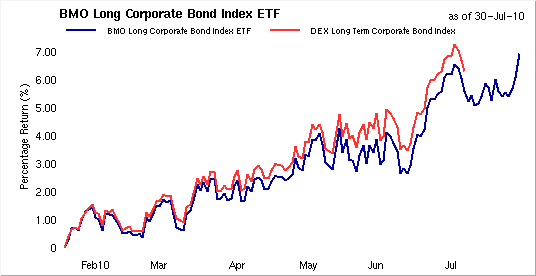
PerpetualDiscounts now yield 6.02%, equivalent to 8.43% interest at the standard equivalency factor of 1.4x. Long Corporates are now at about 5.55% so the pre-tax interest equivalent spread (also called the Seniority Spread) is now about 290bp, a significant widening from the +270bp reported on June 16 due to the sharp decline in long yields.


Click for big
HIMIPref™ Preferred Indices
These values reflect the December 2008 revision of the HIMIPref™ Indices

Values are provisional and are finalized monthly
Index Mean
Current
Yield
(at bid)
Median
YTW
Median
Average
Trading
Value
Median
Mod Dur
(YTW)
Issues Day’s Perf. Index Value
Ratchet 2.72 % 2.78 % 32,522 20.51 1 -0.9302 % 2,097.6
FixedFloater 5.14 % 3.29 % 21,636 19.84 1 0.2369 % 3,114.3
Floater 2.42 % 2.79 % 76,717 20.26 3 -0.2939 % 2,243.9
OpRet 4.86 % 2.45 % 89,246 0.08 11 0.2081 % 2,337.5
SplitShare 6.30 % 6.25 % 95,689 3.49 2 0.1088 % 2,200.2
Interest-Bearing 0.00 % 0.00 % 0 0.00 0 0.2081 % 2,137.4
Perpetual-Premium 0.00 % 0.00 % 0 0.00 0 0.1109 % 1,911.0
Perpetual-Discount 5.94 % 6.02 % 196,645 13.88 77 0.1109 % 1,808.9
FixedReset 5.42 % 4.01 % 331,957 3.46 45 -0.1098 % 2,182.0
Performance Highlights
Issue Index Change Notes
MFC.PR.B Perpetual-Discount -1.08 % YTW SCENARIO
Maturity Type : Limit Maturity
Maturity Date : 2040-06-23
Maturity Price : 19.21
Evaluated at bid price : 19.21
Bid-YTW : 6.10 %
BAM.PR.R FixedReset -1.05 % YTW SCENARIO
Maturity Type : Limit Maturity
Maturity Date : 2040-06-23
Maturity Price : 23.22
Evaluated at bid price : 25.35
Bid-YTW : 4.92 %
BAM.PR.N Perpetual-Discount 1.07 % YTW SCENARIO
Maturity Type : Limit Maturity
Maturity Date : 2040-06-23
Maturity Price : 17.95
Evaluated at bid price : 17.95
Bid-YTW : 6.66 %
GWO.PR.M Perpetual-Discount 1.41 % YTW SCENARIO
Maturity Type : Limit Maturity
Maturity Date : 2040-06-23
Maturity Price : 24.20
Evaluated at bid price : 24.40
Bid-YTW : 5.97 %
Volume Highlights
Issue Index Shares
Traded
Notes
SLF.PR.D Perpetual-Discount 87,336 RBC crossed 72,200 at 18.35.
YTW SCENARIO
Maturity Type : Limit Maturity
Maturity Date : 2040-06-23
Maturity Price : 18.34
Evaluated at bid price : 18.34
Bid-YTW : 6.10 %
BMO.PR.J Perpetual-Discount 57,838 Desjardins crossed 30,200 at 19.88.
YTW SCENARIO
Maturity Type : Limit Maturity
Maturity Date : 2040-06-23
Maturity Price : 19.82
Evaluated at bid price : 19.82
Bid-YTW : 5.75 %
BNS.PR.T FixedReset 42,768 TD bought 13,100 from Nesbitt at 27.40.
YTW SCENARIO
Maturity Type : Call
Maturity Date : 2014-05-25
Maturity Price : 25.00
Evaluated at bid price : 27.28
Bid-YTW : 4.04 %
CM.PR.K FixedReset 38,545 RBC crossed 30,000 at 26.48.
YTW SCENARIO
Maturity Type : Call
Maturity Date : 2014-08-30
Maturity Price : 25.00
Evaluated at bid price : 26.60
Bid-YTW : 3.88 %
IAG.PR.E Perpetual-Discount 37,730 Desjardins crossed 20,000 at 25.00.
YTW SCENARIO
Maturity Type : Limit Maturity
Maturity Date : 2040-06-23
Maturity Price : 24.78
Evaluated at bid price : 25.00
Bid-YTW : 6.03 %
BNA.PR.C SplitShare 32,700 YTW SCENARIO
Maturity Type : Hard Maturity
Maturity Date : 2019-01-10
Maturity Price : 25.00
Evaluated at bid price : 20.00
Bid-YTW : 7.65 %
There were 27 other index-included issues trading in excess of 10,000 shares.
Regulation

Swiss Support Progressive Bank Capital Requirements

Mr Thomas Jordan, Vice-Chairman of the Governing Board of the Swiss National Bank, provided introductory remarks at the half-yearly media news conference, Geneva, 17 June 2010:

It is essential that capital requirements be significantly increased and that they rise in line with the degree of systemic importance of a bank. This is the only way to ensure that the banks internalise the risks which, until now, they have been able to pass on to the general public, to some extent. Moreover, progressive capital requirements should create an incentive for banks to reduce their systemic importance, with its associated risk potential.

Bravo! Capital surchages have long been advocated on PrefBlog and will serve not just to discourage banks from becoming too big, but will also act as a countercyclical buffer … and the question of countercyclical buffers is one that seems to have been relatively neglected lately.

Bank capital surcharges were last discussed on PrefBlog in the post Bank Capital Surcharge Proposals Gaining Ground.