Market Action

November 20, 2008

Lasse Heje Pedersen writes a good review piece on VoxEU, Liquidity risk and the current crisis:

the meaning of liquidity risk is clear.

  • Market liquidity risk is the risk that the market liquidity worsens when you need to trade.
  • Funding liquidity risk is the risk that a trader cannot fund his position and is forced to unwind.

For instance, a levered hedge fund may lose its access to borrowing from its bank and must sell its securities as a result. Or, from the bank’s perspective, depositors may withdraw their funds, the bank may lose its ability to borrow from other banks, or raise funds via debt issues.

If we have learned one thing from the current crisis, it is that trading through organised exchanges with centralised clearing is better than trading over-the-counter derivatives because trading derivatives increases co-dependence, complexity, counterparty risk, and reduces transparency. Said simply, when you buy a stock, your ownership does not depend on who you bought it from. If you buy a “synthetic stock” through a derivative, on the other hand, your ownership does depends on who you bought it from – and that dependence may prevail even after you sell the stock (if you sell through another bank). Hence, when people start losing confidence in the bank with which they trade, they may start to unwind their derivatives positions and this hurts the bank’s funding, and a liquidity spiral unfolds.

Banning short selling is a bad idea

Tobin taxes are a bad idea

TD Bank pre-announced some losses that will show up in the fourth quarter:

Credit trading losses of approximately $350 million (after-tax) for the quarter in Wholesale Banking, leading to a net loss of $228 million on an adjusted basis for that segment

The first significant item relates to the credit trading business in TDBFG’s Wholesale Banking segment. As previously disclosed, due to global liquidity issues, the widening in the pricing relationship between asset and credit protection markets (basis) has negatively impacted credit trading-related revenues for the first three quarters of 2008. The dramatic absence of liquidity in global credit markets in September and October has produced an unprecedented widening of the basis, causing larger losses in Wholesale Banking in the fourth quarter.

Hmmm … basis widening? It sounds like the Credit Default Swap Basis they’re talking about. So – I think – what happened is this:

  • TD has a large corporate bond inventory (that they trade)
  • The hedge it by buying protection (via Credit Default Swaps) … not necessarily on each individual name, it might be, f’rinstance IG 11)
  • TD might even have deliberately put on a big negative basis trade
  • Funding cash bonds has become a chancy thing. Liquidity is NIL (or close enough). The CDS basis becomes even more negative.
  • On a mark-to-market basis, TD Bank loses money

Like I said, maybe. There’s not a lot of detail in the press release.

Teck Cominco eliminated its dividend. The market wasn’t very happy.

Preferred share investors shaken by the carnage can console themselves that they have a front-row seat on history while avoiding the brunt of the unwind. I will lift two quotes from the excellent Across the Curve today … Treasuries & Swaps:

The Long Bond is trading at a yield of 3.43 percent and the dollar price has exploded 9 points today. I have done this for nearly 30 years. I have never witnessed this before. Even more incredible is the 30 year swap spread and swap rate. The 30 year swap rate is 2.84. It has dropped about 80 basis points on the day and is about 60 basis points rich to the 30 year Treasury.I just spoke with an options trader about this historic move. He said that there structured product trades buried in trading books all over the world which are melting. There is a massive short in the 30 year sector (in Treasury paper and in the swap market) which resulted from sales of cheap volatility. Some of these positions have been on the books of various entities for years and it is only recently that the chickens have come home to roost. Each time the spread turns more negative, that movement forces some one to receive in swaps to hedge there position. There are short the long end trades in every permutation and combination along the curve. The receiving creates a self fulfilling prophecy which compels someone else to receive. He had no opinion on when this would end.

… and CMBS:

Cash AAAs widened 325 basis points. The email author wanted to put the recent carnage into stark relief for the non aficionados in the room. He noted that GSMS 07-GG 10- A4 is a benchmark deal. Two weeks ago it traded at 83. Today it traded at 48.

CMBX AAAs wider by 130 basis points.

Look at the CMBS basis move! Cash moved 325bp … the CDS index moved by 130. The basis moved nearly 200bp! While I am not a specialist in the field, I would suggest that a move of 2 (two) basis points in the basis would be a pretty good day … in normal times.

The longer term moves? Bloomberg reports:

Yields on the safest category of AAA rated commercial- mortgage bonds rose 3.34 percentage points, the biggest gain ever, to a record 15.29 percentage points more than interest- rate swaps, according to Bank of America Corp. data.

The spread on the AAA commercial-mortgage securities, which entered this year at 0.82 percentage point, has climbed from 5.88 percentage points on Nov. 4.

The move in basis is indicative that even those who are willing to take some risk and lever up a position in CMBS … can’t get, or can’t trust, funding. So they have to take a synthetic position by selling protection. Lots of money to be made there, buying cash bonds and protecting them … if you can trust your financing … and your counterparties.

So, after a horrible day that was the fourth horrible day in a row (defining “horrible” as a loss of more than 1%), PerpetualDiscounts yield 7.95% as pre-tax dividends, equivalent to 11.13% pre-tax interest. Long Corporates are still at 7.50% so the Pre-Tax Interest-Equivalent Spread is … (drum-roll, please) … 363bp. Incredible.

Holy smokes. On a day like this, what would I do without Dealbreaker?

Note that these indices are experimental; the absolute and relative daily values are expected to change in the final version. In this version, index values are based at 1,000.0 on 2006-6-30.
The Fixed-Reset index was added effective 2008-9-5 at that day’s closing value of 1,119.4 for the Fixed-Floater index.
Index Mean Current Yield (at bid) Mean YTW Mean Average Trading Value Mean Mod Dur (YTW) Issues Day’s Perf. Index Value
Ratchet N/A N/A N/A N/A 0 N/A N/A
Fixed-Floater 5.06% 5.00% 70,972 15.62 6 -1.6230% 1,036.7
Floater 9.43% 9.67% 54,872 9.72 2 -4.0215% 372.8
Op. Retract 5.35% 6.35% 135,628 3.90 15 -0.4634% 994.6
Split-Share 7.42% 15.33% 61,279 3.80 12 -7.2657% 819.7
Interest Bearing 9.48% 18.65% 55,109 2.79 3 -8.1449% 757.3
Perpetual-Premium N/A N/A N/A N/A N/A N/A N/A
Perpetual-Discount 7.85% 7.95% 179,463 11.50 71 -4.7611% 698.5
Fixed-Reset 5.60% 5.27% 887,144 14.83 12 -0.4732% 1,047.6
Major Price Changes
Issue Index Change Notes
LFE.PR.A SplitShare -40.8235% Asset coverage of 1.6-:1 as of November 14 according to the company. Now with a pre-tax bid-YTW of 26.33% based on a bid of 5.03 and a hardMaturity 2012-12-1 at 10.00. Retraction formula is (96%NAV) – C [I think] but they want 20 days notice! Capital Units closed at $4 today. Preferred Closing quote 5.03-7.56, 16×9. Day’s range 7.56-45. So the good news is: it’s not as bad as it looks. The bad news is: I had to check.
FIG.PR.A

InterestBearing -19.8473% See cancellation of rights offering. Now with a pre-tax bid-YTW of 20.72% based on a bid of 5.25 and a hardMaturity 2014-12-31. Closing quote of 5.25-95, 2×3. Day’s range of 5.25-6.55.
POW.PR.B PerpetualDiscount -14.4082% Now with a pre-tax bid-YTW of 9.12% based on a bid of 14.97 and a limitMaturity. Closing quote 14.97-49, 10×3. Day’s range 14.90-17.49 (!).
BNA.PR.C SplitShare -12.2449% Asset coverage currently 1.5+:1 based on BAM.A at 15.93 and 2.4 BAM.A per preferred. Now with a pre-tax bid-YTW of 15.90% based on a bid of 10.75 and a hardMaturity 2019-1-10 at 25.00. Closing quote of 10.75-11.59, 2×7. Day’s range of 10.01-12.25 (!)
ALB.PR.A SplitShare -11.3953% Asset coverage of 1.5-:1 as of November 13 according to Scotia Managed Companies. Now with a pre-tax bid-YTW of 17.39% based on a bid of 19.05 and a hardMaturity 2011-2-28. Closing quote of 19.05-97, 1×1. Day’s range of 19.63-21.5 (!)
POW.PR.A PerpetualDiscount -11.3866% Now with a pre-tax bid-YTW of 8.15% based on a bid of 17.51 and a limitMaturity. Closing quote 17.51-19.00, 10×5. Day’s range of 19.50-75.
CM.PR.G PerpetualDiscount -9.9613% Now with a pre-tax bid-YTW of 8.43% based on a bid of 16.27 and a limitMaturity. Closing Quote 16.27-74, 4X2. Day’s range of 16.50-18.11.
ELF.PR.G PerpetualDiscount -9.8746% Now with a pre-tax bid-YTW of 10.56% based on a bid of 11.50 and a limitMaturity. Closing Quote 11.50-48, 5X5. Day’s range of 11.50-12.75.
RY.PR.F PerpetualDiscount -9.4216% Now with a pre-tax bid-YTW of 7.39% based on a bid of 15.19 and a limitMaturity. Closing Quote 15.19-16.25, 1×11. Day’s range of 16.50-76.
CM.PR.J PerpetualDiscount -9.1096% Now with a pre-tax bid-YTW of 8.62% based on a bid of 13.27 and a limitMaturity. Closing Quote 13.27-50, 5×2. Day’s range of 13.26-14.60.
FBS.PR.B SplitShare -9.0909% Asset coverage of 1.4-:1 as of November 13, according to the company. Now with a pre-tax bid-YTW of 18.49% based on a bid of 7.00 and a hardMaturity 2011-12-15 at 10.00. Closing quote of 7.00-40, 20×11. Day’s range of 7.25-90. Monthly retraction formula is (95%NAV) – C – $0.40 = about 7.20 … not supportive yesterday, but supportive now … but NAV has probably changed substantially!
W.PR.H PerpetualDiscount -9.0303% Now with a pre-tax bid-YTW of 9.35% based on a bid of 15.01 and a limitMaturity. Closing Quote 15.01-16.49. Day’s range of 16.50-51.
POW.PR.C PerpetualDiscount -8.6022% Now with a pre-tax bid-YTW of 8.70% based on a bid of 17.00 and a limitMaturity. Closing Quote 17.00-86, 6×1. Day’s range of 17.30-18.50.
PWF.PR.H PerpetualDiscount -8.5873% Now with a pre-tax bid-YTW of 8.85% based on a bid of 16.50 and a limitMaturity. Closing Quote 16.50-00, 10×22. Day’s range of 17.00-18.60.
BNS.PR.R Fixed-Reset -8.5106%  
SLF.PR.D PerpetualDiscount -8.4919% Now with a pre-tax bid-YTW of 8.91% based on a bid of 12.50 and a limitMaturity. Closing Quote 12.50-25, 8×8. Day’s range of 12.50-13.79.
RY.PR.G PerpetualDiscount -8.2840% Now with a pre-tax bid-YTW of 7.32% based on a bid of 15.50 and a limitMaturity. Closing Quote 15.50-70, 14×1. Day’s range of 15.12-17.00.
BAM.PR.B Floater -8.1250% Poor old BAM floaters can’t seem to catch a break. No matter how highly they’re touted.
BNS.PR.L PerpetualDiscount -8.1238% Now with a pre-tax bid-YTW of 8.01% based on a bid of 14.25 and a limitMaturity. Closing Quote 14.25-15.50, 1×27. Day’s range of 15.00-75.
W.PR.J PerpetualDiscount -8.0048% Now with a pre-tax bid-YTW of 9.28% based on a bid of 15.40 and a limitMaturity. Closing Quote 15.40-16.47, 1×4. Day’s range of 15.50-16.75.
NA.PR.N FixedReset +11.8916% Partial recovery from yesterday’s fiasco.
Volume Highlights
Issue Index Volume Notes
BNA.PR.B SplitShare 130,650 Desjardins crossed two blocks of 25,000 each at 18.00, then another 75,000 at the same price. See BNA.PR.C, above. Now with a pre-tax bid-YTW of 10.81% based on a bid of 17.73 and a hardMaturity 2016-3-25. Monthly Retraction formula of $25.00 – 5%NAV – $1 = $25.00 – 5%($38.23) – 1 = $22.09 Extremely Supportive!
FTS.PR.C Scraps (Would be OpRet but there are credit concerns) -6.4016% CIBC crossed 49,000 at 25.05, then another 50,000 at the same price. Now with a pre-tax bid-YTW of 6.92% based on a bid of 23.54 and a softMaturity 2013-8-31 at 25.00
TD.PR.C FixedReset 88,150 Scotia crossed 12,000 at 24.95, then another 11,000 at the same price.
RY.PR.L FixedReset 71,100 Scotia crossed 15,000 at 24.95.
CM.PR.A OpRet 62,980 RBC crossed 57,000 at 25.25. Now with a pre-tax bid-YTW of 5.07% based on a bid of 25.25 and a softMaturity 2011-7-30 at 25.00.
BCE.PR.G FixFloat 46,012 CIBC crossed 41,000 at 22.75.

There were fifty-seven other index-included $25-pv-equivalent issues trading over 10,000 shares today.
Issue Comments

FIG.PR.A : Capital Units Rights Offering Cancelled

Faircourt Asset Management has announced:

that due to recent market conditions, it has decided to cancel its previously announced rights offering. Due to the current market conditions it was determined by the Manager, not to be in the best interests of Unitholders to proceed with the proposed rights
offering.

The Rights offering was finalized and discussed on PrefBlog on November 18 which, if my calender is still working, was TWO DAYS AGO! This is an epic crash, to be sure.

As of November 19, NAV per Capital Unit was $2.46 according to Faircourt and at 0.71 Capital Units per Pref, asset coverage of the prefs was – yesterday – 1.2-:1.

Issue Comments

CFS.PR.A Enters Protection Plan

Canadian Utilities & Financials Split Corp. has announced:

The leveraging and de-leveraging mechanism offers the ability to increase leverage when the Company’s portfolio appreciates in value and reduce leverage when the portfolio declines in value. Leverage is actively managed by RBC Dominion Securities Inc. (“RBC”) in its capacity as the Company’s Leverage Agent. The value of the Company’s portfolio has declined significantly in recent months, a period characterized by extreme and unprecedented market conditions and economic weakness, and has declined by more than 34% since its inception. As a result, under the terms of the prospectus, RBC is required to sell portfolio securities and invest the proceeds in cash or cash equivalents in order to provide additional assurance that the Company’s objective to repay the $10.00 issue price of the Preferred Shares at maturity will be met and that the Preferred Shares continue to have a high rating from DBRS. Following the sale of portfolio securities, the Class A Shares will continue to have exposure to the portfolio on a non-leveraged basis and distributions on the Class A Shares will be suspended beginning in December. Should the portfolio continue to decline in value, the removal of leverage will lessen the impact of any further decline on the performance of the Class A Shares.

The Company has the ability to re-establish leverage as the portfolio’s value increases. If the remaining portfolio subsequently appreciates in value and the net asset value per Class A Share grew to approximately $7.37, RBC will be instructed to re-invest the cash raised in securities of the portfolio which will restore leverage on the Class A Shares and likely result in the resumption of distributions to holders of Class A Shares.

CFS.PR.A is tracked by HIMIPref™, but is a tiny issue. It was moved from the SplitShare index to Scraps in August 2007 on volume concerns.

Interesting External Papers

Slow Moving Capital

I rather like academic papers that reinforce everything I’ve been saying throughout my career!

This paper is by Mark Mitchell of CNH Partners, Lasse Heje Pedersen of the Stern School of Business and Todd Pulvino of CNH Partners:

We first study the convertible bond market in 2005 when convertible hedge funds faced large redemptions of capital from investors.

We also study merger targets during the 1987 market crash.

Our findings do not support the frictionless economic paradigm. Under this paradigm, a shock to the capital of a relatively small subset of agents should have a trivial effect on security prices, since new capital would immediately flow into the market and prices would be bid up to fundamental values. Rather, the findings support an alternate view that market frictions are of first-order importance. Shocks to capital matter if arbitrageurs with losses face the prospect of investor redemptions (Andrei Shleifer and Robert W. Vishny 1997), particularly when margin constraints tighten during liquidity crises (Markus K. Brunnermeier and Pedersen 2006), when other agents lack both infrastructure and information to trade the affected securities (Robert C. Merton 1987), and when agents require a return premium to compensate for liquidity risk (Viral V. Acharya and Pedersen 2005).

After going through the evidence, the authors conclude:

However, in situations where external capital shocks force liquidity providers to reverse order and become liquidity demanders, it can take months to restore equilibrium to the dislocated market. This is because (a) information barriers separate investors from money managers; (b) it is costly to maintain dormant capital, infrastructure, and talent for long periods of time, while waiting for profitable opportunities; and (c) markets become highly illiquid when liquidity providers are constrained and traders demand higher expected returns as compensation for this lack of liquidity. The result is that profit opportunities for unconstrained firms can persist for months. Given the relative ease of estimating deviations from fundamentals in the convertible and merger markets, the time required to restore equilibrium is likely to be longer in other markets. We view our results as evidence that real world frictions impede arbitrage capital.

Interesting External Papers

Bank of Canada Releases Autumn 2008 Review

The Bank of Canada has announced the release of the Autumn 2008 Review, a special issue focussing on “Structural Factors, Adjustment and productivity”:

This special issue covers a variety of topics dealing with how structural factors or developments affect the economic performance of an advanced economy such as Canada.

I can’t say I spent a lot of time with it, since the articles are not particularly well related to the nitty-gritty of financial markets that I follow keenly – but doubtless some regulator will come along some time and require me to correct my negligence.

The articles are:

  • Productivity in Canada: Does Firm Size Matter?
  • Offshoring and Its Effects on the Labour Market and Productivity: A Survey of Recent Literature
  • Adjusting to the Commodity-Price Boom: The Experiences of Four Industrialized Countries
  • The Effects of Recent Relative Price Movements on the Canadian Economy
  • The Bank of Canada’s Senior Loan Officer Survey

It’s nice, however, to look at the titles and see that everything’s spelt properly (very rare in internationally available economic papers), but I’m afraid I must deprecate their use of “Can$” as the identifier for our currency.

Market Action

November 19, 2008

Accrued Interest leads off with some thoughts on the collapsing CMBS market. CMBS opened 40bp wider this morning – panic is the only appropriate word.

Meanwhile, US CPI is normalizing:

Consumer prices plunged 1 percent last month, more than forecast and the most since records began in 1947, after being unchanged the prior month, the Labor Department said in Washington. Excluding food and energy, so-called core prices unexpectedly fell for the first time since 1982.

Prices increased 3.7 percent in the 12 months to October, the smallest year-over-year gain since October 2007. They were forecast to climb 4 percent from a year earlier, according to the survey median.

The core rate increased 2.2 percent from October 2007, after a 2.5 percent year-over-year increase the prior month.

Citigroup is taking on a whack of SIV assets:

Citigroup Inc., the fourth-biggest U.S. bank by market value, agreed to acquire $17.4 billion of assets held by structured investment vehicles advised by the company.

Citigroup said today in a statement that the value fell from $21.5 billion as of Sept. 30, reflecting market declines of $1.1 billion and $3 billion in debt that matured or was sold.

This continues the re-intermediation process that has culminated in this cycle with the Fed grossing up its balance sheet and is also hitting the leveraged loans market:

The price of the average actively traded leveraged loan fell 2.6 cents to 71.2 cents on the dollar since Nov. 13, according to Standard & Poor’s LCD. Prices have slumped 4.4 cents since Nov. 4, reversing a rally of more than 8 cents on the dollar since the all-time low last month.

This is not a good sign for consumation of the BCE deal – even if the banks like the deal (even when properly risk-adjusted!) they might not have room for it.

There’s a report (h/t: Financial Webring Forum) from the Globe & Mail that the BCE buying consortium is issuing capital calls:

That means the two funds are asking institutional investors to pony up cash that was previously committed to each group, in order to pay for BCE.

These calls are routine in buyouts, and speak to the fact that the private equity funds are doing what’s needed to close the long-delayed transaction by Dec. 11. The move follows on BCE’s push last week to buy back some of its outstanding bonds.

Capital calls are to be expected at this stage in the BCE buyout. The issue is whether the limited partners -typically pension funds – will step up with cash. Under certain circumstances, backers can refuse to fund a deal that the private equity fund has agreed to.The penalty for pulling out is typically 8 per cent of the value of the contribution that was requested.

Well, maybe I’m a cynic, but I don’t see this as meaning anything one way or another. Of course everybody’s pretending the deal will go through and making sure they go through all the motions, carefully vetted by an expensive team of lawyers. The last thing you want is to be on the hook for the break-up fee! Any speculation as to whether the deal will actually close or not remains speculative.

Assiduous Reader MP – who, I think, makes something of a hobby of SEDAR’s New Prospectus Page – alerts me to some massive, massive shelf prospectuses, including $4.5-billion in debt and preferreds from National Bank. There’s also some very hopeful filings for proposed Brompton Group Split Share corporations … whethere anything comes of them is another matter!

Triple A CMBS widened another 100bp today. US Corporates have reached an all-time wide, with continued term inversion for credit product.

What can I say? It was a lousy day. It was a sloppy day. Long Corporates in Canada have come back in to 7.50%; PerpetualDiscounts now yield 7.56% pre-tax dividend, equivalent to 10.58% pre-tax interest … which means spreads have rocketted out to 308bp. All in the blink of an eye.

Note that these indices are experimental; the absolute and relative daily values are expected to change in the final version. In this version, index values are based at 1,000.0 on 2006-6-30.
The Fixed-Reset index was added effective 2008-9-5 at that day’s closing value of 1,119.4 for the Fixed-Floater index.
Index Mean Current Yield (at bid) Mean YTW Mean Average Trading Value Mean Mod Dur (YTW) Issues Day’s Perf. Index Value
Ratchet N/A N/A N/A N/A 0 N/A N/A
Fixed-Floater 4.98% 4.92% 69,652 15.77 6 -1.7486% 1,053.8
Floater 9.03% 9.25% 55,430 10.09 2 -3.9307% 388.4
Op. Retract 5.32% 6.25% 134,652 3.92 15 -0.5313% 999.2
Split-Share 6.78% 12.58% 60,759 3.84 12 -2.7327% 883.9
Interest Bearing 8.65% 15.99% 54,983 3.01 3 -4.7965% 824.4
Perpetual-Premium N/A N/A N/A N/A N/A N/A N/A
Perpetual-Discount 7.46% 7.56% 177,845 11.93 71 -2.9963% 733.4
Fixed-Reset 5.57% 5.24% 903,059 14.90 12 -2.1167% 1,052.6
Major Price Changes
Issue Index Change Notes
NA.PR.N Fixed-Reset -26.5339% Not as exciting as it looks – just a total lack of bids in a nasty market, with a late trade taking out the last bid while the market maker … was having a coffee, or something. Closing quote of 18.08-24.55 (!), 3×7 [Geez, you think a guy with the chutzpah to put in a bid 25% below market would at least make it in worthwhile size!]. Day’s range 23.77-24.80.
POW.PR.C PerpetualDiscount -10.8341% Now with a pre-tax bid-YTW of 7.94% based on a bid of 18.60 and a limitMaturity. Closing quote 18.60-20.49 (!) 10×12. Day’s range 18.50-20.89. No mistake about this one, I’m afraid – 2,000 shares traded at 19.00 just after 3:30. Not only that, but it’s only trading to yield 2bp more than POW.PR.D. So this was really just a catch-up move in a sloppy, sloppy market.. Now, listen up and listen up good: POW.PR.A now yields 7.20% at the 19.76 bid and traded above 20.00 all day. There’s a reason why I tell you guys this stuff, y’know?
FIG.PR.A

InterestBearing -9.7796% See discussion of rights offering. Now with a pre-tax bid-YTW of 15.53% based on a bid of 6.55 and a hardMaturity 2014-12-31. Closing quote of 6.55-75, 4×1. Day’s range of 6.55-7.26.
BAM.PR.K Floater -9.2010% Poor old BAM floaters can’t seem to catch a break. No matter how highly they’re touted.
PWF.PR.E PerpetualDiscount -8.7368% Now with a pre-tax bid-YTW of 8.04% based on a bid of 17.34 and a limitMaturity. Closing Quote 17.34-18.34, 1×5. Day’s range of 17.49-19.00.
BNS.PR.O PerpetualDiscount -7.3135% Now with a pre-tax bid-YTW of 7.47% based on a bid of 19.01 and a limitMaturity. Closing Quote 19.01-70, 2X7. Day’s range of 19.15-20.75.
DFN.PR.A SplitShare -7.0922% Asset coverage of 1.9-:1 as of November 14 according to the company. Now with a pre-tax bid-YTW of 10.23% based on a bid of 7.86 and a hardMaturity 2014-12-1 at 10.00. Closing quote of 7.86-00, 3×24. Day’s range of 8.00-95.
BSD.PR.A InterestBearing -7.0053% Asset coverage of 0.9+:1 as of November 14 according to Brookfield Funds. Now with a pre-tax bid-YTW of 19.70% based on a bid of 5.31 and a hardMaturity 2015-3-31 at 10.00. Closing quote of 5.31-77, 2×1. Day’s range of 5.30-71.
FFN.PR.A SplitShare -6.6116% Asset coverage of 1.4+:1 as of November 14, according to the company. Now with a pre-tax bid-YTW of 17.41% based on a bid of 5.65 and a hardMaturity 2014-12-1 at 10.00. Closing quote of 5.65-99, 10×2. Day’s range of 5.64-6.50.
BAM.PR.J OpRet -6.5798% Now with a pre-tax bid-YTW of 13.14% based on a bid of 15.05 and a softMaturity 2018-3-30 at 25.00. Closing quote of 15.05-50, 20×5. Day’s range of 15.50-11.
BMO.PR.J PerpetualDiscount -6.4798% Now with a pre-tax bid-YTW of 7.55% based on a bid of 15.01 and a limitMaturity. Closing Quote 15.01-39, 10×3. Day’s range of 15.00-16.09.
BNS.PR.N PerpetualDiscount -6.4582% Now with a pre-tax bid-YTW of 7.29% based on a bid of 18.25 and a limitMaturity. Closing Quote 18.25-75, 1×16. Day’s range of 18.20-19.51.
NA.PR.M PerpetualDiscount -6.4500% Now with a pre-tax bid-YTW of 7.98% based on a bid of 19.00 and a limitMaturity. Closing Quote 19.00-69, 10×32. Day’s range of 18.72-20.75 (!).
CM.PR.D PerpetualDiscount -5.8262% Now with a pre-tax bid-YTW of 7.78% based on a bid of 18.75 and a limitMaturity. Closing Quote 18.75-15. Day’s range of 19.15-19.91.
PWF.PR.H PerpetualDiscount -5.7933% Now with a pre-tax bid-YTW of 8.08% based on a bid of 18.05 and a limitMaturity. Closing Quote 18.05-19.22. Day’s range of 18.50-00.
NA.PR.L PerpetualDiscount -5.5728% Now with a pre-tax bid-YTW of 8.04% based on a bid of 15.25 and a limitMaturity. Closing Quote 15.25-60, 10×16. Day’s range of 15.50-16.68.
POW.PR.D PerpetualDiscount -5.5294% Now with a pre-tax bid-YTW of 7.92% based on a bid of 16.06 and a limitMaturity. Closing Quote 16.06-54. Day’s range of 16.55-00.
FBS.PR.B SplitShare -5.5215% Asset coverage of 1.4-:1 as of November 13, according to the company. Now with a pre-tax bid-YTW of 14.78% based on a bid of 7.70 and a hardMaturity 2011-12-15 at 10.00. Closing quote of 7.70-75, 20×1. Day’s range of 7.40-8.70 (!). Monthly retraction formula is (95%NAV) – C – $0.40 = only about 7.20 … not supportive!
SLF.PR.A PerpetualDiscount -5.4509% Now with a pre-tax bid-YTW of 8.45% based on a bid of 14.05 and a limitMaturity. Closing Quote 14.05-38, 2×10. Day’s range of 14.04-80.
HSB.PR.D PerpetualDiscount -5.4286% Now with a pre-tax bid-YTW of 7.71% based on a bid of 16.55 and a limitMaturity. Closing Quote 16.55-99, 15×1. Day’s range of 16.60-51.
PWF.PR.F PerpetualDiscount -5.1724% Now with a pre-tax bid-YTW of 8.07% based on a bid of 16.50 and a limitMaturity. Closing Quote 16.50-45, 2×18. Day’s range of 15.83-17.80 (!).
PWF.PR.K PerpetualDiscount -5.0746% Now with a pre-tax bid-YTW of 7.89% based on a bid of 15.90 and a limitMaturity. Closing Quote 15.90-00, 3×30. Day’s range of 15.50-16.50.
PWF.PR.G PerpetualDiscount -5.0450% Now with a pre-tax bid-YTW of 7.87% based on a bid of 19.01 and a limitMaturity. Closing Quote 19.01-99, 2×10. Day’s range of 18.52-20.00.
Volume Highlights
Issue Index Volume Notes
PWF.PR.J OpRet 403,245 Nesbitt crossed 400,000 at 24.80. Now with a pre-tax bid-YTW of 5.03% based on a bid of 24.75 and a softMaturity 2013-7-30 at 25.00.
GWO.PR.H PerpetualDiscount 331,138 TD crossed 127,000 at 14.95, then 100,000 & 98,800 at 14.60. Now with a pre-tax bid-YTW of 8.50% based on a bid of 14.60 and a limitMaturity.
BNS.PR.P FixedReset 217,675 Scotia bought 12,000 from anonymous at 23.75, then Nesbitt crossed 200,000 at the same price.
BNA.PR.B SplitShare 106,067 CIBC crossed 30,000 at 18.50, then Desjardins crossed 75,000 at the same price. Asset coverage of 2.0+:1 as of October 31 according to the company. Asset coverage currently 1.7+:1 based on BAM.A at 17.92 and 2.4 BAM.A per preferred. Now with a pre-tax bid-YTW of 10.31% based on a bid of 18.24 and a hardMaturity 2016-3-25. Monthly Retraction formula of $25.00 – 5%NAV – $1 = $25.00 – 5%($43.08) – 1 = $25.00 – $2.15 – $1.00 = $21.85 Extremely Supportive!
TD.PR.R PerpetualDiscount 68,000 RBC crossed 62,000 at 20.50. Now with a pre-tax bid-YTW of 7.14% based on a bid of 19.85 and a limitMaturity.

There were forty-four other index-included $25-pv-equivalent issues trading over 10,000 shares today.

Issue Comments

XMF.PR.A : Capital Unit Distribution Suspended

M-Split Corp. has announced:

its regular monthly distribution $0.04375 for each Preferred share ($0.525 annually). Distributions are payable December 10, 2008 to shareholders on record as of November 28, 2008. There will not be a distribution paid to M-Split Class A Shares for November 28, 2008 as per the Prospectus which states no regular monthly dividends or other distributions will be paid on the Class A Shares in any month as long as the net asset value per unit is equal to or less than $12.50. The Net Asset Value as of November 14, 2008 was $10.13.

Since inception (April 18, 2007) Class A shareholders have received a total of $0.90 per share and Preferred shareholders have received a total of $0.85 per share inclusive of this distribution, for a combined total of $1.75 per share.

M-Split invests in common shares of Manulife Financial Corporation, the largest life insurer in Canada offering financial products and wealth management services.

The prospectus gives details of the Monthly Retraction option:

Priority Equity Shares may be surrendered at any time for retraction and will be retracted on a monthly basis on the last business day of each month (a ‘‘Retraction Date’’), provided such Priority Equity Shares are surrendered for retraction not less than 20 business days prior to the Retraction Date. Payment for any Priority Equity Shares so retracted will be made within 15 business days of the applicable Retraction Date.

Holders retracting a Priority Equity Share will be entitled to receive an amount per Priority Equity Share equal to the lesser of (i) $10.00; and (ii) 96% of the net asset value per Unit determined as of the Retraction Date less the cost to the Company of the purchase of a Class A Share in the market for cancellation. For this purpose, the cost of the purchase of a Class A Share will include the purchase price of the Class A Share and commissions and costs, if any, related to the liquidation of any portion of the assets of the Company to fund the purchase of the Class A Share (to a maximum of 1% of the net asset value per Unit).

It isn’t clear to me whether

R = 96% (NAV-C)
or
R = (96%NAV) – C

Interested Assiduous Readers will have to call the company! Whatever it is, Capital Units closed today at 1.41-50, 50×30 and Preferreds closed at 7.23-50, 50×120. On the November 14th NAV date, MFC closed at 23.08 and it closed today at 20.97, implying a November 19 NAV of about
10.13 * 20.97 / 23.08 = 9.20 … so the Monthly Retraction is

R = (96%NAV) – C …. [guessing at the proper form of the equation]
= (96%*9.20) – 1.50
= 8.83 – 1.50
= 7.33

So the preferreds are trading around estimated retraction price.

XMF.PR.A was last mentioned on PrefBlog when it entered the Protection Plan.

XMF.PR.A is not tracked by HIMIPref™.

Issue Comments

GFV.PR.A : Dividends on Capital Units Suspended

First Asset has announced:

Global 45 Split Corp. (TSX:GFV) the “Company”) announces that it will not pay a monthly distribution on its Class A Shares for the month-ended November 30, 2008.

As set out in the Company’s articles of incorporation, the Company may not pay a distribution on the Class A Shares if, after the payment of the distribution by the Company, the Net Asset Value per Unit would be less than $15.00.

The Manager will assess the ability to pay distributions, and the amount thereof, on a monthly basis.

GFV.PR.A had asset coverage of 1.5+:1 as of November 13. The issue has a monthly retraction feature:

Preferred Shares may be surrendered at any time for retraction by the Company and will be retracted on a monthly basis on the second last business day of each month (a “Valuation Date”). Preferred Shares surrendered for retraction by a holder of Preferred Shares at least ten business days prior to a Valuation Date will be retracted on such Valuation Date and payment of proceeds will be made on or before the tenth business day following such Valuation Date. Except in the case
of the Annual Concurrent Retraction described below, holders retracting a Preferred Share will be entitled to receive an amount per Preferred Share equal to the lesser of: (i) 96% of the Net Asset Value per Unit (as defined herein) determined as of the relevant Valuation Date less the cost to the Company of the purchase of a Class A Share in the market for cancellation; and (ii) $10.00. The cost of the purchase of a Class A Share will include the purchase price of the Class A Share, commission and such other costs, if any, related to the liquidation of any portion of the Portfolio required to fund such purchase (not exceeding 1% of Net Asset Value per Unit). See “Details of the Offering – Certain Provisions of the Preferred Shares – Retraction
Privileges”.

The Annual Concurrent Retraction is in September.

The first trade of the Capital Units after the November 13 NAV was on Nov. 17, when they closed at 5.01. The Preferred Shares closed at $8.75 on November 14.

The estimated monthly retraction price using the last valuation data is:
R = 96% (NAV – C)
R = 96% (15.42 – 5.01)
R = 96% (10) … [Maximum Value]
R = $9.60

The monthly retraction feature is supportive … but mind you, the capital units closed today at 4.95-65, 62×2 and presumably the NAV is now below $15.00. The Preferreds closed at 8.86-54, 7×5.

GFV.PR.A was last mentioned on PrefBlog in the report that it had been caught up in the DBRS Mass Review of Splits. GFV.PR.A is not tracked by HIMIPref™.

Issue Comments

Sloppy, Sloppy Markets!

Assiduous readers will be well aware of my disdain for market timing. The market goes up, the market goes down … the characteristics of the asset class don’t change very quickly and the steady drip, drip, drip of dividends eventually overwhelms the transient excitement of day to day noise. You just have to make sure you’re well diversified, invest in companies of good, solid investment grade, don’t get excited … and did I mention diversification? Lightning can strike at any time and you should never be in a position where it can wipe you out.

Up, down, piffle, that’s what I say!

But I do get highly annoyed when I see the market behaving in a stupid way. You wan’t to say a proper risk premium is 20bp – that’s fine. You want to say the risk premium should be 1000bp – that’s fine too. I don’t have any problems with that. We all have our individual investment objectives, risk tolerances, views on predicted apocalypses … overall market spreads, their proper levels and interpretation are always open for discussion and analysis.

But let’s not be stupid, OK? Let’s not be like the June 2008 market when it appeared that the market assigned a negative value to embedded call options. And let’s have similar issues from a single issuer at least trade within shouting distance of each other!

Almost a year ago, I wrote a post on yield differences, amazed that the market for Weston Prefs could be so inefficient. It’s true, of course, that there are fewer players in the Pfd-3 playground and so a certain lack of efficiency is to be expected … but never-the-less, a 34bp spread between the high- and low-yielding Weston Pref was rather extreme. I also looked at the spreads on investment-grade issuers at that time, just to show what a more efficient market looked like.

And now I’m going to update that table to last night’s close:

Yield Spreads of
Perpetual Discount Issues
of the Same Name
Name DBRS
Rating
Yield
Range
2007-12-6
Yield
Range
2008-11-18
BMO Pfd-1 N/A 29bp
BNS Pfd-1 6bp 32bp
CM Pfd-1 11bp 47bp
CU Pfd-2(high) N/A 25bp
ELF Pfd-2(low) 3bp 25bp
GWO Pfd-1(low) 11bp 121bp
HSB Pfd-1 N/A 28bp
LB Pfd-3 12bp N/A
MFC Pfd-1(low) 1bp 24bp
NA Pfd-1(low) 26bp 48bp
POW Pfd-2(high) 14bp 46bp
PWF Pfd-1(low) 17bp 37bp
RY Pfd-1 11bp 74bp
SLF Pfd-1(low) 9bp 14bp
TCA Pfd-2(low) N/A 16bp
TD Pfd-1 6bp 15bp
W Pfd-2(low) 17bp 19bp

The fund I manage, Malachite Aggressive Preferred Fund, has been doing quite a bit of intra-issuer trading in the past several months – I highlighted an example of this for August 2008. These wide intra-issuer spreads are symptiomatic of a market starved for liquidity – suppliers of that liquidity can (if patient) very often get an extremely good price for it.

Issue Comments

FFN.PR.A : Dividends on Capital Units Suspended

Financial 15 Split Corp. II has announced:

its regular monthly distribution of $0.04375 for each Preferred share ($0.525 annually). Distributions are payable December 10, 2008 to shareholders on record as at November 28, 2008. There will not be a distribution paid to Financial 15 II Class A Shares for November 28, 2008 as per the Prospectus which states no regular monthly dividends or other distributions will be paid on the Class A Shares in any month as long as the net asset value per unit is equal to or less than $15.00. The Net Asset Value as of November 14, 2008 was $14.06.

FFN.PR.A was last mentioned on PrefBlog when it implored unitholders NOT TO PANIC!!!!. There was a query regarding possible suspension of dividends on this thread; I concurred with the querant’s suggestion; both comments were posted *ahem* after the time-stamp of the press release. Well, it still hasn’t been posted on the fund’s website as of noon, that’s all I can say!

The monthly retraction feature for FFN.PR.A is supportive:

Holders retracting a Preferred Share will be entitled to receive an amount per Preferred Share equal to the lesser of (a) $10.00 and (b) 96% of the Net Asset Value per Unit determined as of the Retraction Date less the cost to the Company of the purchase of a Class A Share in the market for cancellation and less any related commissions and other costs (to a maximum of 1% of the Net Asset Value per Unit). Payment for any shares so retracted will be made within 15 days of the Retraction Date.

NAV on November 14 was $14.06. The capital units closed that day at $7.01; the preferreds closed at $7.00. Support was only mild as of that day’s prices (what on earth were the capital units doing, trading at a 75% premium to their NAV?) but today looks much better.

As I write this, FFN is quoted at 4.75-99 (still way above NAV!) and FFN.PR.A is quoted at $6.06-24. Using XFN as a proxy (not a particularly good proxy, since it’s all Canadian, and FFN is 1/3 American) … it closed at $18.60 on the 14th and is now trading at $17.12. That’s a loss on XFN of 8% in the period, so estimate the current NAV of FFN + FFN.PR.A units at $14.06 * 0.92 = 12.93.

Estimated Retraction Price:
R = 96% (NAV – C)
R = 96% (12.93 – 4.93) …. [cheating on the price a little bit!]
R = 96% (8.00)
R = $7.68.

So even with grossly over-valued capital units (although option players might have something to say about the value of the capital unitholders’ options) the monthly retraction is now looking extremely profitable.

Update, 2008-11-20: I have received the following communication from a very nervous Assiduous Reader:

I noticed your post on prefblog.com yesterday about FFN.PR.A. With coverage of the preferreds at 1.4:1 now and with today’s sharp declines in the price of Canadian financials, which make up the bulk of FFN’s assets, isn’t there a danger that it won’t pay dividends on the preferreds next month? Wouldn’t that also lead to a downward revision of
the NAV for the next monthly retraction?

Asset coverage of 1.4:1 is a lot. Maybe not when considering the long term, and maybe not when the underlying security is Consolidated Internet Mines & Telecom, Inc., but when the time scale is a matter of days and the underlying is blue-chip (well … as blue as they get, nowadays!) financials, it’s a lot. Asset coverage of 1.4:1 means the the underlying has to drop by 1 – (1/1.4) = 29% before the preferred shareholders become exposed to loss … and remember, that’s EXPOSED to loss, I’m talking about! At that point (asset coverage of 1:1), they basically own the portfolio of underlying equities.

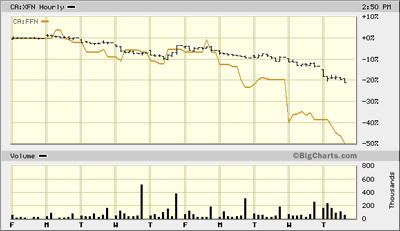
My XFN proxy is now trading at 15.66, down a lot from the 17.12 I used above. That’s a loss of
about 8.5%, so estimate the current NAV of FFN + FFN.PR.A units at $12.93 * 0.915 = 11.83. This is incredible. Look at the 10-day chart:

This is epic. I pointed out the epic nature of this crash on October 31 and now it’s even … um … more epic.

And you STILL have asset coverage of just under 1.2:1; the underlying can STILL go down ANOTHER 15%-odd; the capital unit-holders can lose even more money – before the preferred shareholders even have direct exposure. They haven’t lost anything at that point, not even on paper; but it takes all this before they can even become exposed.

So while the cushion is being eroded, there’s still a cushion.

As far as the preferred share dividends are concerned … well, the company can suspend them any time they like. That would be an enormous step and I consider it highly unlikely. Now that the capital unit dividends have been suspended, the company is cash-flow positive after expenses and dividends (assuming constancy of incoming dividends) and their assets are easy to sell if they need some money. I can remember only one case in which a split-shares’ preferred dividends were suspended … that was GT.PR.A a few years back. I suspect that they wanted to suspend dividends to the capital units when their NAV got low, but there was no mechanism in the prospectus regarding an NAV test – so they left one single dividend on the preferreds unpaid, restarted preferred payments and left capital units hanging out to dry … because capital unitholders, under the terms of GT.PR.A’s prospectus, could not receive dividends if the company was in default to the preferreds.

Your concerns about a dividend cut on the preferreds are … well, nothing’s impossible, but the probability is miniscule. And anyway, the dividends are cumulative. On windup of the company, the preferred shareholders would get their $10 principal and all unpaid dividends before the capital unitholders saw a single penny.

However, non-payment of preferred dividends would have no effect on NAV. The cash would remain in the company, but so would a liability for unpaid dividends. There could well be an effect on market price, however!

You seem extremely worried about the FFN.PR.A position you hold. Although your worries seem overblown to me, it’s your money, not mine! You may wish to consider reducing your position to the point where you can sleep again … but I earnestly suggest that if you do reduce, you give consideration to retraction rather than market sale, because selling into this market is a highly unpleasant experience.