Market Action

August 26, 2008

The Fannie & Freddie reporters highlighted what they believe to be startlingly new information today – sub-debt does not default with deferred dividends:

Buyers of credit-default swap contracts that protect against losses on Fannie Mae or Freddie Mac subordinated debt may not get paid immediately if the mortgage-finance companies were to defer interest payments as part of a government bailout, according to Bank of America Corp.

While a failure to make the payments permits credit-default swap buyers to cash in on their protection, Freddie and Fannie subordinated bond indentures allow interest to be deferred for as long as five years, or until maturity, if capital cushions breach certain thresholds, Bank of America strategist Glen Taksler in New York wrote in a note to clients yesterday.

Bank sub-debt has been discussed on PrefBlog before, as have Credit Default Swaps. The place of sub-debt in a bank’s capital structure has been mentioned in a review article.

But Citigroup says ‘calm down, people!’:

Fannie Mae and Freddie Mac can withstand losses through the end of the year and still keep a cushion above their minimum capital requirements, according to Citigroup Inc. analysts.

Freddie of McLean, Virginia, will have $12.7 billion of capital above the minimum requirement, according to slides provided by Citigroup for a conference call with investors. Washington-based Fannie will have $20.3 billion.

The bank’s interest rate strategists led by Scott Peng in New York said last week that the beleaguered mortgage-finance companies don’t need to be nationalized and the U.S. should resist being “stampeded” into a bailout.

Speaking of Fannie, I am thrilled to announce that I have finally seen a definition of “wiped out”, as used in the phrase “Fannie Mae preferred shareholders may get wiped out!!!!!”. According to Dealbreaker:

There had been widespread fear that a government rescue of Freddie would wipe out the preferred shareholders, possibly by subordinating them to new government-owned preferred shares.

I fail to see how the simple fact of subordination to another series of prefs can be equated to a “wipe out”. They’re already subordinated to sub-debt and ordinary liabilities. Would the phrase “wipe out” continue to apply if it was simply more sub-debt being loaded on to the balance sheet? As I discussed on August 22, in the absence of (a credible threat of) liquidation or expropriation, any talk of a preferred share wipe-out at Fannie Mae is simply hysterical nonsense.

If you want to say that Fannie Mae will be liquidated with little or no value to the preferred shareholders, that’s one thing to argue. Or Treasury making an offer they can’t refuse with the threat of liquidation, that’s another. Or Treasury simply expropriating the preferred shares, that’s a third avenue of argument. But simple, straightforward subordination is not equivalent to wipe-out unless one of those arguments holds.

Freddie was downgraded by S&P today:

Standard & Poor’s Ratings Services said today that it affirmed its ‘AAA/A-1+’ senior unsecured debt rating on Freddie Mac with a stable outlook. At the same time, we lowered the risk-to-the-government stand-alone issuer credit rating to ‘A-‘ from ‘A’, the subordinated debt rating to ‘BBB+’, and the preferred stock rating to ‘BBB-‘ from ‘A-‘. The ratings that were lowered are all placed on CreditWatch Negative.

It could be straightforward funding support through expansion of the Treasury line, buying Freddie Mac’s debt or its agency mortgage-backed securities, or it could consider an equity investment. The possibility of an equity investment is driving Freddie Mac’s equity price lower and the yield on its preferred stock higher. An equity investment by
Treasury could be accompanied by the consideration of nonpayment of existing preferred stock and common dividends.

The subordinated notes pose incremental risk to investors because of an interest deferral feature given certain trigger events tied to Freddie Mac’s regulatory capital levels. The subordinated debt covenant language also states that a deferral of the subordinated debt interest payment triggers the nonpayment of all preferred stock and common dividends, arguing for a close alignment of preferred stock and subordinated debt ratings. However, we now rate the preferred stock two notches below the subordinated debt to reflect the increased risk of nonpayment of dividends as a means of capital preservation. Furthermore, there are no covenants restricting the payment of interest on the subordinated debentures, while the preferred dividends are suspended.

The language is fairly similar in the release announcing the downgrade of Fannie Mae. I must say, a downgrade from A- to BBB- for the preferred stock given the potential for a suspension of the preferred dividend seems to me to be a far more appropriate response than hysterical screaming about wipe-outs.

But!

Wait a minute!

I just remembered!

S&P, in its role as Evil Credit Rating Agency, is paid by the issuer! Geez, that sounds terrible.

And there’s a somewhat related story that Lehman is trying to sell or spin-out-for-cash its Commercial Mortgage assets.

Accrued Interest has engaged in some blue-sky thinking about the GSEs; there’s much with which I disagree:

its looking more and more like a bailout isn’t imminent (meaning its a matter of weeks or months, not days). I expect an interim step, probably some kind of purchase of MBS, to come before any actual injection of cash.

I don’t think there will be any interim step; I think such action would be economically and idealogically indefensible.

A big part of the inherent problem in the GSEs’ current business model is that it requires substantial leverage to generate a reasonable return on equity. Think about it. They collect a relatively small fee in exchange for guaranteeing MBS. The de facto leverage created is huge, evidenced by the fact that foreclosure rates in Fannie and Freddie’s guarantee portfolio remain fairly low, and yet both GSEs are facing capital problems. There is just no way around the leverage issue if the current business model remains in tact.

Well … yes there is. The fee can become larger. And structural reforms in US mortgages are urgently needed:

Americans should also be taking a hard look at the ultimate consumer friendliness of their financial expectations. They take as a matter of course mortgages that are:

  • 30 years in term
  • refinancable at little or no charge (usually; this may apply only to GSE mortgages; I don’t know all the rules)
  • non-recourse to borrower (there may be exceptions in some states)
  • guaranteed by institutions that simply could not operate as a private enterprise without considerably more financing
  • Added 2008-3-8: How could I forget? Tax Deductible

But Accrued Interest‘s main suggestion is:

Covered bonds have been advanced as a long-term solution for the mortgage market. But covered bonds, as currently conceived, would not be a good replacement for agency MBS. This is because covered bonds would not trade generically, meaning that a covered bond from smaller banks would trade as well as those from larger banks. We’d wind up with large banks dominating the mortgage market, which has its own systemic risk problems.

So what if in the future the GSEs provided some limited guarantee on covered bonds?

This a plan combines the best parts of both the covered bond idea (alignment of incentives) and the original mission of the GSEs (lowering mortgage rates). It would also kick-start the emergence of a covered bond market, because it would give investors a known set of outcomes when buying the new bond sector.

It’s a very interesting idea … I’ll have to think about it a bit more. My first thought is that covered bonds are generally AAA anyway – how much could the GSEs charge for adding another layer of protection?

Covered bonds have been recently approved by the FDIC and were discussed on PrefBlog last fall.

When reviewing the 3Q08 BMO Financials, I noted that they were keeping assets constant while beefing up their capital – thus engaging in some gentle delevering. Bank borrowing is getting expensive:

Banks, securities firms and lenders have a record $871 billion of bonds maturing through 2009, according to JPMorgan Chase & Co., just as yields are at their most punitive compared with Treasuries. The increase in yields may cost them as much as $23 billion more in annual interest versus a year ago based on Merrill Lynch index data.

Higher refinancing expenses will restrict the ability of banks to borrow in the capital markets and lend, further cutting off credit to consumers and businesses and curbing what is already the slowest growing economy since 2001. Standard & Poor’s said last week that it had a “negative” outlook on almost half of the 50 highest-rated financial institutions in the U.S. as of June 30, the highest proportion in 15 years.

PerpetualDiscounts eased off a bit today, on reasonably average volume. What should I say? According to “Investment Punditry for Dummies”, I could say “profit taking”, “concern about this week’s bank earnings announcements”, “making room for a new BNS issue” … there’s lots of choices! I think I’ll just say “I have no idea. Ask a priest!” and leave it at that.

Note that these indices are experimental; the absolute and relative daily values are expected to change in the final version. In this version, index values are based at 1,000.0 on 2006-6-30
Index Mean Current Yield (at bid) Mean YTW Mean Average Trading Value Mean Mod Dur (YTW) Issues Day’s Perf. Index Value
Ratchet N/A N/A N/A N/A 0 N/A N/A
Fixed-Floater 4.61% 4.36% 57,351 16.42 7 +0.0643% 1,111.4
Floater 4.06% 4.10% 42,481 17.15 3 -0.5301% 909.6
Op. Retract 4.96% 4.02% 110,410 2.54 17 +0.2351% 1,054.2
Split-Share 5.35% 5.93% 54,295 4.42 14 +0.0413% 1,040.3
Interest Bearing 6.25% 6.76% 46,703 5.22 2 -0.5059% 1,120.6
Perpetual-Premium 6.15% 6.02% 64,903 2.22 1 +0.3953% 993.6
Perpetual-Discount 6.06% 6.12% 189,615 13.54 70 -0.0676% 878.5
Major Price Changes
Issue Index Change Notes
POW.PR.D PerpetualDiscount -1.9404% Now with a pre-tax bid-YTW of 6.13% based on a bid of 20.72 and a limitMaturity.
SLF.PR.E PerpetualDiscount -1.8858% Now with a pre-tax bid-YTW of 6.18% based on a bid of 18.21 and a limitMaturity.
BAM.PR.B Floater -1.4948%  
FBS.PR.B SplitShare -1.0246% Asset coverage of just under 1.5:1 as of August 21, according to TD Securities. Now with a pre-tax bid-YTW of 6.26% based on a bid of 9.66 and a hardMaturity 2011-12-15 at 10.00.
CM.PR.G PerpetualDiscount -1.0140% Now with a pre-tax bid-YTW of 6.68% based on a bid of 20.50 and a limitMaturity.
BAM.PR.I OpRet +2.6348% Now with a pre-tax bid-YTW of 5.44% based on a bid of 25.32 and a softMaturity 2013-12-30 at 25.00. Compare with BAM.PR.H (6.08% to 2012-3-30), BAM.PR.J (6.41% to 2018-3-30) and BAM.PR.O (7.37% to 2013-6-30).
Volume Highlights
Issue Index Volume Notes
SLF.PR.C PerpetualDiscount 108,100 CIBC crossed 105,000 at 18.31. Now with a pre-tax bid-YTW of 6.08% based on a bid of 18.31 and a limitMaturity.
CM.PR.R OpRet 83,450 TD crossed 25,000 at 25.80, then another 25,000 at 25.90. CIBC crossed 25,000 at 25.80. Now with a pre-tax bid-YTW of 4.57% based on a bid of 25.65 and a softMaturity 2013-4-29 at 25.00.
ENB.PR.A PerpetualDiscount 42,050 CIBC crossed 38,700 at 23.60. Now with a pre-tax bid-YTW of 5.85% based on a bid of 23.59 and a limitMaturity.
SLF.PR.B PerpetualDiscount 41,835 Desjardins crossed 25,000 at 19.71. Now with a pre-tax bid-YTW of 6.10% based on a bid of 19.70 and a limitMaturity.
TD.PR.O PerpetualDiscount 37,975 Desjardins crossed 25,000 at 21.05. Now with a pre-tax bid-YTW of 5.80% based on a bid of 21.14 and a limitMaturity.

There were twenty-three other index-included $25-pv-equivalent issues trading over 10,000 shares today.
Issue Comments

BAM Perps vs. BNA.PR.C … How Long is Forever?

Remember the old days, when retractible issues yielded less than perpetuals? That inspired one of my first articles, in which I examined the question of just how bad things had to get before the tortoise outpaced the hare.

And, Assiduous Readers will recall, BNA.PR.C often exhibits puzzling behavior.

These two concepts have now met, with (at the closing bid) BNA.PR.C priced below BAM.PR.N.

BNA.PR.C yields 9.37%, based on a bid of 16.83 and a hardMaturity 2019-1-10 at 25.00, while BAM.PR.N yields 7.13% based on a bid of 17.00 and a limitMaturity. The former issue is a split share based solely on BAM.A, with asset coverage of 3.3+:1 as of July 31, according to the company. As of March 31, 2008, there were 19,032,000 Units outstanding, each unit comprised of one capital share and one preferred share – each series of preferreds has a $25 liquidation value. The company owns 46,161,000 shares of BAM.A, so the BAM.A:Unit ratio is 2.4:1, so at today’s closing price of $31.52, asset coverage is a hair over 3.0:1. Give or take.

Now, one thing that makes the BNA issues intrinsically fascinating is the fact that they are so well covered by a relatively poor credit. I wish I could be as poor a credit as Brookfield, at Pfd-2(low) according to DBRS, but it’s still worse than the banks! This means that the credit rating of BNA is constrained by the rating of the BAM prefs – which makes all kinds of sense. As a rough approximation – for conceptual purposes only – we can say that BNA prefholders get hurt when the common is below $10, while the BAM prefholders get hurt when the common is below $0.

Anyway, the upshot is:

  • the BNA prefs may be thought of as being junior to the BAM prefs, but
  • the BNA prefs have a fixed maturity date, while the BAM perps are … perps

I invite criticism on this point, but I suggest that the two influences cancel out, leaving credit quality of the two issues approximately equal for investment purposes.

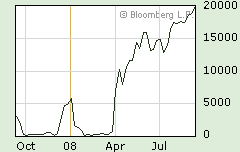
But the spread between these issues has varied all over the place:

The wideness of the current spread really is most peculiar. The fund has recently swapped its BAM.PR.N holding for BNA.PR.C … we shall see how well it works out!

Update, 2008-09-06: BAM.PR.N was recently affirmed at Pfd-2(low) by DBRS.

Interesting External Papers

FDIC Releases 2Q08 Report

The full report is available on their website … which, by the way, highlights the amusingly exasperated notice:

The FDIC creates reports on problem or troubled banks in the aggregate. We do not make the details of this list publicly available. The FDIC does not, at any time, comment on open financial institutions.

The “problem list” is highlighted in stories on Bloomberg and Dealbreaker. So go there for that story – it’s interesting enough, but there are other interesting things.

The FDIC highlights a steep decline in net income:

Insured commercial banks and savings institutions reported net income of $5.0 billion for the second quarter of 2008. This is the second-lowest quarterly total since 1991 and is $31.8 billion (86.5 percent) less than the industry earned in the second quarter of 2007. Higher loan-loss provisions were the most significant factor in the earnings decline. Loss provisions totaled $50.2 billion, more than four times the $11.4 billion quarterly total of a year ago. Second-quarter provisions absorbed almost one-third (31.9 percent) of the industry’s net operating revenue (net interest income plus total noninterest income), the highest proportion since the third quarter of 1989.

Almost 18 percent of all insured institutions were unprofitable in the second quarter, compared to only 9.8 percent in the second quarter of 2007.

Noninterest income of $60.8 billion was $7.4 billion (10.9 percent) lower than in the second quarter of 2007. The decline in noninterest income was attributable to lower trading income (down $5.5 billion, or 88.6 percent); smaller gains from sales of loans, foreclosed properties, and other assets (down $1.7 billion, or 41.2 percent); and lower income from securitization activities (down $1.5 billion, or 28.3 percent). In addition to the decline in noninterest income, securities sales yielded $2.3 billion in net losses in the second quarter, compared to $573 million in net gains a year earlier. Expenses for goodwill and other intangibles totaled $4.5 billion, more than double the $2.1 billion incurred by the industry in the second quarter of 2007. Net interest income was one of the few bright spots in industry revenues, rising by $8.2 billion (9.3 percent) over year-earlier levels. Servicing fee income increased by $1.9 billion (35.9 percent). Service charges on deposit accounts increased by $853 million (8.6 percent) at insured commercial banks and state-chartered savings banks.

The average net interest margin (NIM) improved slightly compared to the first quarter, from 3.33 percent to 3.37 percent.

Net charge-offs of loans and leases totaled $26.4 billion in the second quarter, almost triple the $8.9 billion that was charged off in the second quarter of 2007. The annualized net charge-off rate in the second quarter was 1.32 percent, compared to 0.49 percent a year earlier. This is the highest quarterly charge-off rate for the industry since the fourth quarter of 1991.

For the third consecutive quarter, insured institutions added almost twice as much in loan-loss provisions to their reserves for losses as they charged-off for bad loans. Provisions exceeded charge-offs by $23.8 billion in the second quarter, and industry reserves rose by $23.1 billion (19.1 percent). The industry’s ratio of reserves to total loans and leases increased from 1.52 percent to 1.80 percent, its highest level since the middle of 1996. However, for the ninth consecutive quarter, increases in noncurrent loans surpassed growth in reserves, and the industry’s “coverage ratio” fell very slightly, from 88.9 cents in reserves for every $1.00 in noncurrent loans, to 88.5 cents, a 15-year low for the ratio.

The industry added $10.6 billion to its total regulatory capital in the second quarter, the smallest quarterly increase since the fourth quarter of 2003. A majority of institutions (60.0 percent) reported declines in their total risk-based capital ratios during the quarter. More than half (50.9 percent) of the 4,056 institutions that paid dividends in the second quarter of 2007 reported smaller dividend payments in the second quarter of 2008, including 673 institutions that paid no quarterly dividend. Dividend payments in the second quarter totaled $17.7 billion, less than half the $40.9 billion insured institutions paid a year earlier.

I also found it interesting that this highly touted ‘117 institutions on the problem list’ represents an increase of exactly one from the 2003 figure … though, to be fair, assets at 2003’s problem banks were only $30-billion, compared to $78-billion now.

New Issues

New Issue: BNS Fixed-Reset 5.00%+188bp

And now there are eight. Two more and I’ll add them to the HIMIPref™ database.

BNS has announced:

a domestic public offering of 8 million non-cumulative 5-year rate reset preferred shares Series 22 (the “Preferred Shares Series 22”) at a price of $25.00 per share, for gross proceeds of $200 million.

Holders of Preferred Shares Series 22 will be entitled to receive a non-cumulative quarterly fixed dividend for the initial period ending January 25, 2014 yielding 5.00% per annum, as and when declared by the Board of Directors of Scotiabank. Thereafter, the dividend rate will reset every five years at a rate equal to 1.88% over the 5-year Government of Canada bond yield.

Holders of Preferred Shares Series 22 will, subject to certain conditions, have the right to convert all or any part of their shares to non-cumulative floating rate preferred shares Series 23 (the “Preferred Shares Series 23”) of Scotiabank on January 26, 2014 and on January 26 every five years thereafter.

Holders of the Preferred Shares Series 23 will be entitled to receive a non-cumulative quarterly floating dividend at a rate equal to the 3-month Government of Canada Treasury Bill yield plus 1.88%, as and when declared by the Board of Directors of Scotiabank. Holders of Preferred Shares Series 23 will, subject to certain conditions, have the right to convert all or any part of their shares to Preferred Shares Series 22 on January 26, 2019 and on January 26 every five years thereafter.

The Bank has agreed to sell the Preferred Shares Series 22 to a syndicate of underwriters led by Scotia Capital Inc. on a bought deal basis. The Bank has granted to the underwriters an option to purchase up to an additional 2 million Preferred Shares Series 22 at closing, which option is exercisable by the underwriters any time up to 48 hours before closing.

Closing is expected to occur on or after September 9, 2008.

Issue: Bank of Nova Scotia Non-Cumulative 5-Year Rate Reset Preferred Shares Series 22

Size: 8-million shares (=$200-million), greenshoe for 2-million shares (=$50-million) exercisable before closing.

Initial Dividend: 5.00% p.a., paid quarterly, until the first Exchange Date

Subsequent Dividends: 5-year Canadas +188bp, reset on Exchange Dates

Exchange Date: January 26, 2014 and every five years thereafter.

Exchange Option: Exchangeable to and from Series 23, which pays 3-month bills + 188bp, on Exchange Dates, reset quarterly.

Redemption: Series 22 (5-year-rate) redeemable every Exchange Date at $25.00. Series 23 (floater) is redeemable every Exchange Date at $25.00 and at all other times at $25.50.

Scotia’s second issue paid 5.00%+170; their first issue paid 5.00%+205. Well … if I do add them to HIMIPref™, at least I’ll have a variety of resets to analyze! And this is a Good Thing.

I have written an article on the analysis of Fixed-Resets.

Regulatory Capital

BNS Capitalization: 3Q08

BNS has released its Third Quarter 2008 Report and Supplementary Package, so it’s time to recalculate how much room they have to issue new preferred shares – assuming they want to!

Step One is to analyze their Tier 1 Capital, reproducing the prior format:

BNS Capital Structure
October, 2007
& July, 2008
  4Q07 3Q08
Total Tier 1 Capital 20,225 22,075
Common Shareholders’ Equity 81.5% 85.9%
Preferred Shares 8.1% 11.6%
Innovative Tier 1 Capital Instruments 13.6% 12.5%
Non-Controlling Interests in Subsidiaries 2.5% 2.1%
Goodwill -5.6% -9.7%
Miscellaneous NA -2.3%

Next, the issuance capacity (from Part 3 of the introductory series):

BNS
Tier 1 Issuance Capacity
October 2007
& July 2008
  4Q07 3Q08
Equity Capital (A) 15,840 16,310
Non-Equity Tier 1 Limit (B=A/3), 4Q07
(B=0.428*A), 2Q08
5,280 6,981
Innovative Tier 1 Capital (C) 2,750 2,750
Preferred Limit (D=B-C) 2,530 4,231
Preferred Actual (E) 1,635 2,560
New Issuance Capacity (F=D-E) 895 1,671
Items A, C & E are taken from the table
“Regulatory Capital”
of the supplementary information;
Note that Item A includes Goodwill, FX losses, “Other Capital Deductions” and non-controlling interest


Item B is as per OSFI Guidelines; the limit was recently increased.
Items D & F are my calculations

and the all important Risk-Weighted Asset Ratios!

BNS
Risk-Weighted Asset Ratios
October 2007
& July 2008
  Note 2007 3Q08
Equity Capital A 15,840 16,310
Risk-Weighted Assets B 218,300 225,800
Equity/RWA C=A/B 7.26% 7.22%
Tier 1 Ratio D 9.3% 9.8%
Capital Ratio E 10.5% 11.5%
Assets to Capital Multiple F 18.22x 17.75x
A is taken from the table “Issuance Capacity”, above
B, D & E are taken from BNS’s Supplementary Report
C is my calculation.
F is from OSFI (4Q07) and BNS’s Supplementary Report (3Q08) of total assets ($462.4-billion) divided by total capital ($26.044-billion)
(see below)

The calculations for the Assets-to-Capital multiple are not comparable; the OSFI figure will include an allowance for off-balance-sheet exposure. It should be noted that, according to the Supplementary Report, The “Tangible Common Equity” ratio, calculated according to Basel I, has declined to 6.5% in 3Q08 from 7.2% in 4Q07.

The Basel I “Tier 1” and “Total Capital” ratios also show a declining trend for the year to date. As has been noted before, Scotia does not adequately disclose its “Expected Losses” under Basel II, as distinct from its “General Allowances”.

It is apparent from the Quarterly Trend in the Basel I data that Scotia has been bulking up on its Risk Weighted Assets big-time, largely through “Loans and Acceptances” (which includes Securities Purchased under Resale Agreements”. This has been financed largely through deposits. To some extent, this reflects Scotia’s acquisition of Banco del Desarrollo in 2Q08:

The Bank completed the acquisition of Chile’s Banco del Desarrollo on November 26, 2007, through the acquisition of 99.5 per cent of the outstanding shares for $1.0 billion Canadian dollar equivalent (CDE). Total assets at acquisition were approximately CDE $5.6 billion, mainly comprised of loans. The Bank will combine the operations of Banco del Desarrollo with its existing Scotiabank Sud Americano banking operations. Based on acquisition date fair values, approximately CDE $797 million has been allocated to the estimated value of goodwill acquired. The purchase price allocation may be refined as the Bank completes its valuation of the assets acquired and liabilities assumed.

According to the 3Q08 Report:

The Bank’s total assets at July 31, 2008, were $462 billion, up $50 billion or 12% from October 31, 2007, including a $16 billion positive impact from foreign currency translation and the acquisition of Banco del Desarrollo. Growth was widespread across most asset categories, including retail, commercial and corporate lending. Compared to the prior quarter, assets grew by $9 billion.

The Bank’s loan portfolio grew $45 billion or 20% from October 31, 2007, including $7 billion from foreign currency translation. On the retail lending side, domestic residential mortgage growth was $15 billion, before securitization of $3 billion. The International acquisition of Banco del Desarrollo in Chile contributed $1 billion to the increase in mortgages. Personal loans were up $7 billion, with all regions experiencing positive growth.

Business and government loans increased $26 billion from October 31, 2007, or $21 billion excluding the impact of foreign currency translation. Loans in Scotia Capital were up $11 billion on the corporate lending side as well as to support trading operations. In International Banking,
business and government loans increased $13 billion. The acquisition of Banco del Desarrollo contributed $3 billion, and loans in Asia and the Caribbean grew $5 billion and $2 billion, respectively.

Update: Right on cue, Scotia announced a new issue of Tier 1-eligible preferreds after releasing the results; this will help their Tier 1 and Total Capital ratios.

Regulatory Capital

BMO Capitalization: 3Q08

BMO has released its Third Quarter 2008 Report and Supplementary Package, so it’s time to recalculate how much room they have to issue new preferred shares – assuming they want to, in this environment!

Step One is to analyze their Tier 1 Capital, reproducing the prior format:

BMO Capital Structure
October, 2007
& July, 2008
  4Q07 3Q08
Total Tier 1 Capital 16,994 18,047
Common Shareholders’ Equity 83.8% 83.8%
Preferred Shares 8.5% 11.1%
Innovative Tier 1 Capital Instruments 14.3% 13.5%
Non-Controlling Interests in Subsidiaries 0.2% 0.2%
Goodwill -6.7% -8.0%
Miscellaneous NA -0.5%

Next, the issuance capacity (from Part 3 of the introductory series):

BMO
Tier 1 Issuance Capacity
October 2007
& July 2008
  4Q07 3Q08
Equity Capital (A) 13,126 13,609
Non-Equity Tier 1 Limit (B=A/3), 4Q07
(B=0.428*A), 2Q08
4,375 5,824
Innovative Tier 1 Capital (C) 2,422 2,442
Preferred Limit (D=B-C) 1,953 3,382
Preferred Actual (E) 1,446 1,996
New Issuance Capacity (F=D-E) 507 1,386
Items A, C & E are taken from the table
“Capital and Risk Weighted Assets”
of the supplementary information;
Note that Item A includes Goodwill and non-controlling interest


Item B is as per OSFI Guidelines; the limit was recently increased.
Items D & F are my calculations

and the all important Risk-Weighted Asset Ratios!

BMO
Risk-Weighted Asset Ratios
October 2007
& July 2008
  Note 2007 3Q08
Equity Capital A 13,126 13,609
Risk-Weighted Assets B 178,687 182,258
Equity/RWA C=A/B 7.35% 7.47%
Tier 1 Ratio D 9.51% 9.90%
Capital Ratio E 11.74% 12.29%
Assets to Capital Multiple F 17.17x 15.87x
A is taken from the table “Issuance Capacity”, above
B, D & E are taken from BMO’s Supplementary Report
C is my calculation.
F is from OSFI (4Q07) and BMO’s Supplementary Report (2Q08)

BMO’s supplementary data discloses a “Tangible common equity-to-risk-weighted-assets” figure that sounds like it should be equal to my “Equity/RWA” in the table. Their figure is 7.44%; it is not immediately clear to me how this figure is calculated.

Of interest is the improvement in their capital ratios, including the Assets-to-Capital multiple. It appears that their earnings are being used to displace borrowings, rather than being levered up.

I note as well that there is no adjustment to capital for “Expected loss in excess of allowance”, indicating that their ALLL is again equal to the EL which is indicative of conservative approach to assessing credit write-offs.

Market Action

August 25, 2008

Freddie Mac had a gushing review on Bloomberg today:

Freddie Mac rose 17 percent in New York trading after a $2 billion sale of short-term debt stoked confidence the second-largest U.S. mortgage-finance company can still attract investors.

Freddie Mac sold $1 billion of three-month notes at a yield of 2.58 percent, the company said today. That translates to about 90 basis points more than similar-maturity U.S. Treasuries and 23 basis points less than the three-month London interbank offered rate. The spreads from last week’s sale were 61 basis points over Treasuries and 32 basis points below Libor, according to Stone & McCarthy Research Associates.

The company also sold $1 billion of six-month debt at a yield of 2.858 percent, a spread of about 92 basis points above Treasuries and 25.5 basis points below Libor; compared with 80 basis points and 32 basis points last week. A basis point is 0.01 percentage point.

Well … it’s nice that they were able to finance through LIBOR, but let’s not get carried away! Let’s see how well they can finance the next month’s needs:

Fannie has about $120 billion of debt maturing through Sept. 30, while Freddie has $103 billion, according to figures provided by the companies and data compiled by Bloomberg.

… on the bond market, rather than the Money-Market, before breaking out the champagne. Unless my trusty calculator has let me down, $2-billion is less than half their daily quota until September 30 … each.

Fortunately for oenophiles, there is an excuse for some bubbly. PerpetualDiscounts were up 21bp today, bringing the total return index back to slightly above its June 30 levels … OK now it’s time to start working on June (a really, really lousy month).

The perpetualDiscount index now has a weighted average mean yield to maturity of 6.11%, equivalent to 8.55% interest at the standard 1.4x equivalency factor. Long corporates now yield in the 6.15-6.20% range, so the pre-tax interest-equivalent spread is now about 235bp.

Note that these indices are experimental; the absolute and relative daily values are expected to change in the final version. In this version, index values are based at 1,000.0 on 2006-6-30
Index Mean Current Yield (at bid) Mean YTW Mean Average Trading Value Mean Mod Dur (YTW) Issues Day’s Perf. Index Value
Ratchet N/A N/A N/A N/A 0 N/A N/A
Fixed-Floater 4.61% 4.37% 56,503 16.42 7 +0.1918% 1,110.7
Floater 4.04% 4.08% 43,581 17.20 3 +0.1628% 914.5
Op. Retract 4.97% 4.08% 110,301 2.50 17 +0.1482% 1,051.7
Split-Share 5.35% 5.92% 54,270 4.36 14 +0.1608% 1,039.9
Interest Bearing 6.22% 6.66% 46,417 5.23 2 +0.2035% 1,126.3
Perpetual-Premium 6.18% 6.19% 64,697 2.22 1 -0.1579% 989.7
Perpetual-Discount 6.05% 6.11% 189,896 13.55 70 +0.2129% 879.1
Major Price Changes
Issue Index Change Notes
MFC.PR.C PerpetualDiscount -1.6741% Now with a pre-tax bid-YTW of 5.65% based on a bid of 19.97 and a limitMaturity.
BMO.PR.K PerpetualDiscount -1.3303% Now with a pre-tax bid-YTW of 6.15% based on a bid of 21.51 and a limitMaturity.
DFN.PR.A SplitShare -1.0700% Asset coverage of just under 2.4:1 as of August 15, according to the company. Now with a pre-tax bid-YTW of 5.02% based on a bid of 10.17 and a hardMaturity 2014-12-01 at 10.00.
RY.PR.E PerpetualDiscount +1.0259% Now with a pre-tax bid-YTW of 6.06% based on a bid of 18.71 and a limitMaturity.
NA.PR.L PerpetualDiscount +1.1640% Now with a pre-tax bid-YTW of 6.12% based on a bid of 19.99 and a limitMaturity.
WFS.PR.A SplitShare +1.1715% Asset coverage of 1.6+:1 as of August 14, according to Mulvihill. Now with a pre-tax bid-YTW of 7.61% based on a bid of 9.50 and a hardMaturity 2011-6-30 at 10.00.
RY.PR.D PerpetualDiscount +1.1866% Now with a pre-tax bid-YTW of 6.04% based on a bid of 18.76 and a limitMaturity.
FBS.PR.B SplitShare +1.5609% Asset coverage of just under 1.5:1 as of August 21 according to the company. Now with a pre-tax bid-YTW of 5.91% based on a bid of 9.76 and a hardMaturity 2011-12-15 at 10.00.
CM.PR.G PerpetualDiscount +1.5694% Now with a pre-tax bid-YTW of 6.61% based on a bid of 20.71 and a limitMaturity.
IAG.PR.A PerpetualDiscount +1.7382% Now with a pre-tax bid-YTW of 6.26% based on a bid of 18.73 and a limitMaturity.
ELF.PR.F PerpetualDiscount +1.7803% Now with a pre-tax bid-YTW of 6.73% based on a bid of 20.01 and a limitMaturity.
POW.PR.D PerpetualDiscount +2.7724% Now with a pre-tax bid-YTW of 6.01% based on a bid of 21.13 and a limitMaturity.
Volume Highlights
Issue Index Volume Notes
HSB.PR.C PerpetualDiscount 54,790 Nesbitt crossed 50,000 at 20.90. Now with a pre-tax bid-YTW of 6.23% based on a bid of 20.85 and a limitMaturity.
PWF.PR.K PerpetualDiscount 52,400 Nesbitt crossed 50,000 at 20.55. Now with a pre-tax bid-YTW of 6.11% based on a bid of 20.51 and a limitMaturity.
RY.PR.D PerpetualDiscount 44,795 TD bought 11,700 from anonymous at 18.75. Now with a pre-tax bid-YTW of 6.04% based on a bid of 18.76 and a limitMaturity.
BAM.PR.O OpRet 43,590 Now with a pre-tax bid-YTW of 7.40% based on a bid of 22.85 and optionCertainty 2013-6-30 at 25.00. Compare with BAM.PR.H (6.07% to 2012-3-30), BAM.PR.I (6.02% to 2013-12-30) and BAM.PR.J (6.41% to 2018-3-30).
GWO.PR.G PerpetualDiscount 34,040 Now with a pre-tax bid-YTW of 6.10% based on a bid of 21.66 and a limitMaturity.

There were fifteen other index-included $25-pv-equivalent issues trading over 10,000 shares today.

Update: Dealbreaker passes on a rumour that Fed Pressures Treasury Not To Wipe Out Fannie Mae Preferreds:

The Federal Reserve has been quietly pressuring the Treasury Department not to adopt a rescue plan for Fannie Mae and Freddie Mac that would wipe out the value of their preferred shares, according to a source familiar with the matter. The Fed fears that any move that hurt the preferred could worsen the crisis in regional banks that is already under way.

The situation is complicated, however, by the large share of preferred stock held by regional banks, many of which are viewed as possible candidates for failure in these credit crunched times. As the Financial Times reported over the weekened regional banks and US insurers hold the majority of Fannie and Freddie’soutstanding preferred stock. The Fed has begun advocating against wiping out these shares, saying the threat to stability of the banks is greater than the ‘moral hazard’ argument, a source familiar with the matter says.

As usual, it’s not clear what is meant by “wiping out”.

Interesting External Papers

BoC External Review

The Globe and Mail reported on an external review of the Bank of Canada’s research quality; this report has been published by the Bank on its website. Both the report itself and the BoC response are available.

The Globe and Mail’s emphasis on “micromanagement” is not borne out by the actual report. The term is used in the section “Strategic Principles for Promoting Research”:

Although the operational work of the Bank must be planned and directed by policymakers and managers (with an essential role for strategic plans and short-term deadlines), longer-term research should generally be initiated and self-directed by individual economists. This approach to research is essential for fostering higher-quality research output, because substantial creativity and flexibility are needed to ensure that the focus and direction of the research project can be adjusted in response to preliminary findings, unanticipated obstacles, new methodological developments, and results from other academic and central bank researchers working on related topics. Furthermore, by giving researchers sufficient freedom to pursue longer-term research projects, the Bank will encourage and will attract and retain new economists with strong analytical abilities in both research and policy analysis. We see no alternative to this approach for achieving the Bank’s “second-to-none” objective.

While avoiding “micro-management” of longer-term research, the senior staff does have a crucial role in promoting high-quality research that informs the Bank’s short-term analysis and policy decisions. The Bank should establish and reinforce the incentive system—in terms of financial rewards and promotion opportunities—for conducting high-quality research on policy-relevant issues. In addition, senior staff should identify broad topics and policy questions on which the state of knowledge is currently insufficient but could be significantly expanded by long-term research that stretches over a few years, which is the relevant horizon over which the research is likely to be successful in addressing such issues. Finally, the senior staff should incorporate these considerations in initiating and managing medium-term projects; as noted above, such projects are not directly aimed at producing publishable research output, but in many cases, the economists working on a given medium-term project will end up pursuing new longer-term research that contributes to the broader state of knowledge on that topic.

… which isn’t anything more than a statement of good management practice, particularly in an intellectual environment.
Some justification for the label is found in the “Summary of Recommendations”:

Other initiatives call for increasing the efficiency with which existing resources are deployed. Principal among this set of recommendations is that researchers should be given more freedom to select their own topics and manage their own research agendas. Today, research is managed to an important degree to meet the objectives set out in the medium-term plan for policy relevant research. This policy not only interferes with the staff’s ability to produce publishable research, but is also not the best approach for generating analysis to inform policy decisions.

Thus, the Globe’s statement that researchers are stifled by micromanagement is clearly unsupported by the actual report. Currently, research at the Bank is guided with a focus on policy concerns; to achieve the Bank’s objective of being “second to none” in research, they will have to:

  • Hire top people
  • Pay them well
  • Tell them to think smart thoughts and write them down

I see no indictment of Bank management in the actual report. To the extent that there is direct criticism of the Bank, it is regarding pay scales:

The Committee perceived a substantial inconsistency between the “second-to-none” objective and the Bank’s current pay structure, which clearly hampers the Bank’s ability to recruit and retain highly-talented economists.

In recent years, the Bank’s salary for entry-level economists has been aligned with the median pay for second-tier Canadian universities—a level which is substantially below that of top-tier Canadian universities and even further below that of comparable positions at U.S. universities or international institutions such as the IMF. This salary structure seems like a clear recipe for mediocrity rather than excellence. Indeed, in its interviews with some recently-hired staff economists, the Committee heard several comments like “I didn’t receive any other job offers, so I accepted the position at the Bank of Canada.”

I, for one, feel that the BoC should be a centre for excellence in the economic field, perhaps in the same manner as the Perimeter Institute is for Physics, with cross-appointments to the purely academic community.

Market Action

August 22, 2008

An Assiduous Reader sent me an article from Barrons today The Endgame Nears for Fannie and Freddie:

Should the agencies fail to raise fresh capital, the administration is likely to mount its own recapitalization, with Treasury infusing taxpayer money into the enterprises, according to our source. The infusion would take the form of a preferred stock with such seniority, dividend preference and convertibility rights that Fannie’s and Freddie’s existing common shares effectively would be wiped out, and their preferred shares left bereft of dividends. Then again, the administration might show minimal kindness to preferred shareholders; local and regional bankers have been lobbying the Bushies not to wipe out the preferred since the bankers own a lot of that paper and rely on the bank preferred-stock market for much of their own equity capital.

This is similar to the scary-scenario-base-case I outlined yesterday … but the airy assertion that the result would be “preferred shares left bereft of dividends” is more than just a little vague. Left bereft for how long? That’s the key.

As with all investing, it’s important to look behind the headlines and put actual numbers together … to date, I’ve seen no actual analysis that goes beyond “The sky is falling!”.

As an illustration – a very rough one! – of what I mean, let’s work out the value of FNMPRG under the scenario above – and let’s say that the dividend is halted for five years. Given the uncertainty in the market, we’ll say we want a yield of 10%.

FNMPRG pays a dividend of $2.29 annually; we’ll assume that this is in one payment, due exactly one year from now. At ten percent, this would imply a value of $22.90 for these prefs, before accounting for five years of missed dividends.

The five years of missed dividends, discounted at 10%, have a present value of $8.44. Subtracting this from the $22.90 that the perpetual annuity is worth, we arrive at a fair value of $14.46 for the prefs, compared to their market value of $9.76. Under this scenario, the prefs are a bargain.

This, at least, represents an attempt to put numbers on the table. Is the scenario too harsh? Too lax? Change it. Put some percentage chances on it and stick it in a pot with all your other scenarios, come up with a range of values and – if it turns out to be an attractive speculation – put a little bit of money into it, with all the other little bets in your portfolio. And, if you’ve done your homework properly, and you have kept all your bets sufficiently small that a run of bad luck or bad analysis won’t hurt you – you’ll do fine.

Naturally, if you do your homework and decide that …

  • Dividends will be stopped immediately, probability 100%
  • There will be no recovery, ever, probability 100%

… then your analysis will result in a fair value estimate of the prefs of $0 and you will consider them expensive. But at least you will have done your homework and put your assumptions and scenarios on the table where you can look at them.

You can let the yumps who cry Oh, the dividend might be stopped and everything is worthless boo-hoo-hoo run along home to play with their dollies.

Amidst all this, I will stress again that I am not taking a view, one way or another, on the investment merits of the GSE prefs. I haven’t done my homework. All I’ve done is try to find an actual reference to actual analysis in the press reports and been disappointed.

Accrued Interest has passed on some GSE speculation from Merrill.

Moody’s downgraded Fannie’s prefs today:

The preferred stock ratings and BFSRs remain on review for possible further downgrade. Fannie Mae’s and Freddie Mac’s Aaa senior long-term debt and Prime-1 short-term debt ratings were affirmed with stable outlooks. The firms’ Aa2 subordinated debt ratings were affirmed, but the outlook was changed to negative from stable.

Moody’s believes these firms currently have limited access to common and preferred equity capital at economically attractive terms.

The downgrade and continued review for further downgrade of the preferred stock ratings reflects a greater risk of dividend omission on the preferred stock.

Should a capital injection result in the subordination of the existing preferred stock, or should it result in any missed preferred dividends, then the preferred stock rating would be lowered further.

I will point out that the Moody’s downgrade still leaves the prefs at investment grade, although not by much; I will further point out that the rating is an opinion on the probability of the prefs not deferring any dividends at all – in which case, the yield will be about 25%, not the 10% net that I demanded in my scenario.

All this is reminiscent of my musings on the proper analysis of FTU.PR.A; there is some doubt as to whether this will be able to pay all its dividends and 100% of principal, so its credit rating has suffered; but it’s so cheap right now that that particular scenario results in a phenomenal return. Formally, the asset coverage is only about 1.2:1, as of August 15 according to the company – but that asset coverage figure is based on the par value of $10 and the unit value of $12. Based on the current market price of the preferreds of about $7.50, asset coverage is 1.6:1 of the amount invested, a much nicer number! Even if the underlying US Financials do terribly over the next few years and the prefs eventually recover only the current price of $7.50 (which counts as a default), interim dividends (if actually received, of course) of $0.525 p.a. will have resulted in a yield of 7%, which some might consider to be rather good. There are other scenarios, which result in returns being “extremely good” … and yet other scenarios, which result in returns ranging from “lousy” to “disastrous”. Do yer homework, gents, and place yer bets! Small ones!

Oh! And I like to keep abreast of the Thornburg Mortgage situation, since that’s been the most spectacular flame-out so far into the current crunch or preferreds in North America. Investing Thoughts brings to my attention a press release on the story so far:

As of 5:00 p.m., New York City time, on August 19, 2008, holders of Preferred Stock had tendered approximately (i) 88.7% (5,786,035 shares) of the Series C Preferred Stock; (ii) 83.5% (3,340,873 shares) of the Series D Preferred Stock; (iii) 91.7% (2,900,546 shares) of the Series E Preferred Stock and (iv) 96.2% (29,161,031 shares) of the Series F Preferred Stock.

Shareholders who participate in the Exchange Offer will receive $5.00 in cash and 3.5 shares of the company’s common stock for each share of Preferred Stock validly tendered and accepted. Holders of the Preferred Stock who have previously tendered their shares of Preferred Stock continue to have the right to revoke such tenders at any time prior to the new expiration date by complying with the revocation procedures set forth in the Offering Circular relating to the Exchange Offer.

Total book value of all series of Thornburg’s preferreds was around $832-million as of Dec. 31/07.

I suppose that every now and then I should mention something about the Canadian preferred market, seeing as that’s what this blog is supposed to be about … although the market has rationalized itself somewhat over the past month, there’s still plenty of craziness left. For instance, good old BAM.PR.O, which had a very poorly received underwriting in June and performed poorly in the last half of July. Credit concerns, possibly? Well, riddle me this: Why does it yield more than the perps? It is bid at 22.90 to yield 7.33% until optionCertainty 2013-6-30, while the perpetuals BAM.PR.M and BAM.PR.N are both bid at 16.90 to yield 7.17%.

An extremely quiet day on the preferred share market today, but PerpetualDiscounts did creep up and have almost repaired July’s damage.

Note that these indices are experimental; the absolute and relative daily values are expected to change in the final version. In this version, index values are based at 1,000.0 on 2006-6-30
Index Mean Current Yield (at bid) Mean YTW Mean Average Trading Value Mean Mod Dur (YTW) Issues Day’s Perf. Index Value
Ratchet N/A N/A N/A N/A 0 N/A N/A
Fixed-Floater 4.62% 4.38% 56,112 16.42 7 +0.0524% 1,108.6
Floater 4.04% 4.08% 44,187 17.19 3 -0.2417% 913.0
Op. Retract 4.96% 4.23% 109,641 2.54 17 +0.1153% 1,050.1
Split-Share 5.36% 5.98% 54,760 4.37 14 -0.2364% 1,038.2
Interest Bearing 6.23% 6.69% 46,702 5.23 2 +0.3071% 1,124.0
Perpetual-Premium 6.17% 6.09% 64,676 2.23 1 -0.2362% 991.2
Perpetual-Discount 6.07% 6.12% 190,656 13.54 70 +0.0937% 877.2
Major Price Changes
Issue Index Change Notes
FBS.PR.B SplitShare -1.9388% Asset coverage of just under 1.5:1 as of August 21, according to the company. Now with a pre-tax bid-YTW of 6.41% based on a bid of 9.61 and a hardMaturity 2011-12-15 at 10.00.
MFC.PR.B PerpetualDiscount -1.2573% Now with a pre-tax bid-YTW of 5.70% based on a bid of 20.42 and a limitMaturity.
ELF.PR.G PerpetualDiscount -1.2493% Now with a pre-tax bid-YTW of 6.94% based on a bid of 17.39 and a limitMaturity.
WFS.PR.A SplitShare -1.1579% Asset coverage of 1.6+:1 as of August 14, according to Mulvihill. Now with a pre-tax bid-YTW of 8.05% based on a bid of 9.39 and a hardMaturity 2011-6-30 at 10.00.
POW.PR.D PerpetualDiscount +1.0319% Now with a pre-tax bid-YTW of 6.17% based on a bid of 20.56 and a limitMaturity.
BNS.PR.L PerpetualDiscount +1.0433% Now with a pre-tax bid-YTW of 5.88% based on a bid of 19.37 and a limitMaturity.
BAM.PR.I OpRet +1.1979% Now with a pre-tax bid-YTW of 6.16% based on a bid of 24.50 and a softMaturity 2013-12-30 at 25.00. Compare with BAM.PR.H (6.05% to 2012-3-30), BAM.PR.J (6.39% to 2018-3-30) and BAM.PR.O (7.33% to 2013-6-30).
BNS.PR.M PerpetualDiscount +1.3082% Now with a pre-tax bid-YTW of 5.88% based on a bid of 19.36 and a limitMaturity.
NA.PR.L PerpetualDiscount +1.5416% Now with a pre-tax bid-YTW of 6.19% based on a bid of 19.76 and a limitMaturity.
HSB.PR.D PerpetualDiscount +1.5686% Now with a pre-tax bid-YTW of 6.14% based on a bid of 20.72 and a limitMaturity.
GWO.PR.H PerpetualDiscount +1.8786% Now with a pre-tax bid-YTW of 5.83% based on a bid of 21.15 and a limitMaturity.
MFC.PR.C PerpetualDiscount +2.0090% Now with a pre-tax bid-YTW of 5.55% based on a bid of 20.31 and a limitMaturity.
Volume Highlights
Issue Index Volume Notes
BAM.PR.O OpRet 38,187 See above
NA.PR.L PerpetualDiscount 17,900 Anonymous bought 10,000 from Penson at 19.60. Now with a pre-tax bid-YTW of 6.19% based on a bid of 19.76 and a limitMaturity.
BNS.PR.L PerpetualDiscount 13,580 Now with a pre-tax bid-YTW of 5.88% based on a bid of 19.37 and a limitMaturity.
BNS.PR.M PerpetualDiscount 12,750 Now with a pre-tax bid-YTW of 5.88% based on a bid of 19.36 and a limitMaturity.
RY.PR.D PerpetualDiscount 12,000 Now with a pre-tax bid-YTW of 6.11% based on a bid of 18.54 and a limitMaturity.

There were four other index-included $25-pv-equivalent issues trading over 10,000 shares today.

Issue Comments

CXC.PR.A Briefly Halted on News

Trading in CXC.PR.A was halted at 9:40am today on pending news; trading resumed at 10:30am.

The cause for the halt was “pending news” – CI Financial has announced:

At the request of the Investment Industry Regulatory Organization of Canada, on behalf of the Toronto Stock Exchange, CI Financial Income Fund (“CI”) today confirmed that over the past several months, CI has had discussions with a number of parties concerning possible strategic combinations involving CI and its subsidiaries. At the present time, there is no certainty that any transaction will be completed. As per company policy, CI will not comment further on rumours and speculation.

Amazing timing! There’s a story on Bloomberg today about what a lousy time it is to sell asset managers:

Their timing couldn’t be worse as prices for fund companies have fallen to the lowest in six years.

The market’s weakness can be measured by the ratio of stock prices to earnings of publicly traded asset managers such as BlackRock Inc. and Legg Mason Inc. A basket of 50 companies worldwide traded at an average of 11 times earnings in the second quarter, meaning investors were willing to pay $11 for each $1 of operating profit. That’s down from 17.7 times in the second quarter of 2003, according to data compiled by the Putnam Lovell unit of New York-based Jefferies Group Inc.

It’s the lowest valuation for the group since 2002, driven by a 17 percent decline in world stock prices since Jan. 1, as tracked by the MSCI World Index. Also dragging prices lower has been a selloff of publicly traded hedge funds, buyout firms and managers based outside of the U.S.

CIX recently announced:

Net income (adjusted for equity-based compensation) for the quarter ended June 30, 2008 was $135.8 million, down 11% from the three-month period ended June 30, 2007. On a per unit basis, adjusted earnings for the quarter were $0.49, down from $0.54 per unit for the three months ended June 30, 2007.

CIX.UN closed today at 22.11, up $1.14. The 52-week high/low is 28.49 / 19.20.

CXC.PR.A had asset coverage of 1.7+:1 as of August 21, according to CI Investments.

CXC.PR.A is not tracked by HIMIPref™