Interesting External Papers

Investor Flows and Fragility in Corporate Bond Funds

Itay Goldstein, Hao Jiang and David T. Ng have released a preliminary paper titled Investor Flows and Fragility in Corporate Bond Funds:

Investment in bond mutual funds has grown rapidly in recent years. With it, there is a growing concern that they are a new source of potential fragility. While there is a vast literature on flows in equity mutual funds, relatively little research has been done on bond mutual funds. In this paper, we explore flow patterns in corporate-bond mutual funds. We show that their flows behave very differently than those of equity mutual funds. While we confirm the well-known convex shape for equity funds’ flow-to-performance over the period of our study (1992-2014), we show that during the same time, corporate bond funds exhibit a very clear concave shape: their outflows are sensitive to bad performance much more than their inflows are sensitive to good performance. Funds have more concave flow-performance relationships when they have more illiquid assets and when the overall market illiquidity is high. Overall, our empirical results suggest that corporate bond funds are prone to fragility. The illiquidity of their assets seems to create strategic complementarities that amplify the response of investors to bad performance or other bad news.

So that’s interesting, and echoes the old stockbroker adage that people hate losing money on bonds. In fact, the “concave shape” they refer to in the abstract suggests that the market might be imposing a sort of ‘negative convexity’ on bond yields.

Observing this trend [of increasing flows to bond funds], several commentators have argued that bond funds pose a new threat to financial stability. What will happen when the current trend of loose monetary policy changes? Will massive flows out of bond funds and massive sales of assets by these funds destabilize debt markets with potential adverse consequences for the real economy? Feroli, Kashyap, Schoenholtz, and Shin (2014) use evidence from the dynamics of bond funds to show that flows into and out of funds seem to aggravate and be aggravated by changes in bond prices. They conclude that this suggests the potential for instability to come out of this industry. They analyze the market “tantrum” around the announcement of the possible tightening of monetary policy in 2013, and suggest that events like this can put the bond market under stress due to amplification coming from bond mutual funds.

Further, the nature of funds can cause bad returns to accelerate:

Indeed, corporate bond funds are in many cases illiquid. Unlike equity, which typically trades many times throughout the day, corporate bonds may not trade for weeks and trading costs in them can be very large. Despite the illiquidity of their holdings, corporate bond funds quote their net asset values and prices to investors on a daily basis. As a result, there is a mismatch between the illiquidity of the fund’s holdings and the liquidity that investors holding the fund get: they are able to redeem their shares at any moment and get the quoted net asset value. This implies that investors’ outflows may lead to costly liquidation by the funds, where the costs could be borne by remaining investors. This creates a ‘run’ dynamic which amplifies the reaction of outflows to bad performance, suggesting that the potential for fragility indeed exists in bond funds.

So does this self-destructive behaviour apply to retail or institutional investors, or both?

Third, following the model and empirical results in Chen, Goldstein, and Jiang (2010), we expect that strategic complementarities will be less important in determining fund outflows if the fund ownership is mostly composed of institutional investors. This is because institutional investors are large and so are more likely to internalize the negative externalities generated by their outflows. Indeed, consistent with this hypothesis, we find that the effect of illiquidity on the sensitivity of outflow to bad performance diminishes when the fund is held mostly by institutional investors.

My first thought on reading the above was ‘so what about the run on Money Market Funds following the Lehman bankruptcy?’ They’ve thought about it too:

These ‘run’ dynamics are very familiar from the banking context, and recently were on display in the run on money market mutual funds following the collapse of Lehmann Brothers.[Footnote] Attempts to prevent such runs are at the core of long-standing government intervention and regulation in the banking sector and now also in the money-market funds industry. It is likely that the surge in activity in corporate bond funds is a response to the restrictions in these sectors, and so the run problem can shift into the corporate bond funds arena. Hence, regulators should be on the alert and consider steps to achieve the value from intermediation by corporate bond funds while minimizing the damage from fragility.

[Footnote reads:]For an empirical study of the run on money market funds, see Schmidt, Timmerman, and Wermers (2014).

The hint that regulators should ‘consider steps’ scares me, since in general investors need protection from regulators!

But, bless their hearts, they acknowledge the argument that MMFs require a capital buffer:

Indeed, many argue that imposing a floating net asset value is not a perfect fix to the problems in money market funds, but other solutions such as holding a capital buffer or putting restrictions on redemptions are likely more appropriate.[Footnote]

[Footnote reads]See, for example, Hanson, Scharfstein, and Sunderam (2014).

In discussing their hypotheses, they make an interesting claim:

As Moneta (2015) documents, the average turnover rate of corporate bond funds is much higher than that of equity funds. For instance, from 1996 to 2007 the average turnover rate of general corporate bond funds is approximately twice as large as that of equity funds, which suggests more active trading and relatively shorter investment horizons of corporate bond funds. Considering the relatively low liquidity in corporate bond markets, the high trading activities of corporate bond funds are likely to generate substantial market impact.

I’ll have to look at that Moneta paper! In a world of long-term value investors who have no particular need to tell a story to potential investors, one would expect higher turnover in a bond fund, since income receipts will generally be higher and the portfolio is directly affected by the passage of time; but I confess I would have thought that turnover would be higher with the equity cowboys.

They also make a more serious charge:

Indeed, Cici, Gibson and Merrick (2011) document substantial dispersions of month-end valuations placed on identical corporate bonds by different mutual funds. Their tests reveal that such dispersion of valuations is consistent with returns smoothing behavior by managers, which involves marking positions such that the net asset value is set above or below the true value of fund shares, resulting in wealth transfers across existing, new, and redeeming fund investors. They find that the returns smoothing is particularly serious for corporate bond funds with hard-to-mark assets and not as much for Treasury bond funds; furthermore, when a fund’s return is low, the fund is more likely to mark the bond positions higher than the true value. Under this situation, existing shareholders would have particularly high incentives to withdraw their money while the mark is good.

Naughty, naughty! This usually becomes known only when such behaviour is egregious – see the market post of June 22, 2011 for one example.

The authors are clearly not fans of behavioural economics!

Why do bond funds experience much higher outflows during negative performance compared to stock funds? Our leading explanation is the presence of strategic complementarities. Corporate bond funds invest in more illiquid assets. Investors’ outflows may lead to costly liquidation by bond funds, where the costs would be borne by the remaining investors. This creates a ‘run’ dynamic which amplifies the reaction of outflows to bad performance. Under this explanation, outflows should be much more sensitive to bad performance among bond funds that are more illiquid.

I think this hypothesis is simply too sophisticated for the market to bear. I would be more interested in an explanation based on risk aversion of the investors, where “risk” is defined as “absolute performance over the past M months”, which refers back to the ‘investors hate losing money on bonds’ adage noted above. This would apply to funds, rather than direct bond holdings by retail, since there is also a persistent belief that a portfolio of bonds held directly is somehow fundamentally different from a fund since direct holdings can be held until they mature at par.

After disaggregating their data to distinguish institutional from retail behaviour, they conclude:

From a policy perspective, it is good news that institutional-oriented funds face less runlike behavior at low performance times. Such funds tend to be larger; and weaker run tendency implies more stability during low performance periods. The retail-oriented funds can still create big problems, as retail investors engage in run-like behavior.

Sadly, their concluding paragraph is a plea for increased employment of box-tickers:

This suggests that bond funds are prone to fragility. Bad events may lead to amplified outflows and these may have adverse consequences for bond prices and ultimately for firms’ financing and real activities. These issues have to be taken into account in the broad scheme of regulation of the financial sector. While it is well understood that banks, and now money-market funds, are prone to such run dynamics, these usually are not associated with bond funds, but our empirical results show that similar forces operate for them as well.

Hat tip for bringing this paper to my attention: Lisa Abramowicz, Bloomberg, You call this a bond rout? Wait until the real selling starts.

Market Action

June 3, 2015

SEC Commissioner Daniel M. Gallagher has updated his Crazy Quilt Chart of Regulation:

quilt
Click for Full Version

SEC Chair Mary Jo White touts efforts to open up the market to smaller IPOs … but instead of simplifying the rules, they’re trying to create a web of exceptions:

Indeed, more than 20 states have enacted some form of intrastate crowdfunding legislation or rules, and a number of others are considering similar initiatives. As states are seeking to expand the avenues in which issuers may conduct intrastate offerings, we have focused on the fact that some of our laws and rules were put into place years ago prior to widespread use of the internet and may present challenges to the states’ efforts.

For example, Securities Act Rule 147, which you will be discussing today, created a safe harbor that issuers often rely on for intrastate offerings. Rule 147 was adopted in 1974, and how an issuer might conduct an intrastate offering using the internet was not contemplated at that time. The staff in the Division of Corporation Finance is currently considering ways to improve the rule, by looking at, among other things, the conditions included in the rule for an offering to be considered intrastate. Securities Act Rule 504, an exemption that could be used to facilitate regional crowdfunding offerings for up to $1 million that are registered in one or more states, is another rule that may benefit from modernization and the staff is considering ways to do that. We look forward to having your input on these topics and to hearing your thoughts on whether there are aspects of these or other rules that could be usefully updated or changed.

The global bond rout is becoming a headline standard:

The global bond rout gathered pace, with Japanese notes slipping a fourth day after Mario Draghi forecast faster euro-area inflation and continued market volatility. Australia’s dollar dropped as most Asian shares rose and oil held losses.

Yields on 10-year Japanese government bonds climbed 3 basis points to 0.49 percent by 11:51 a.m. in Tokyo, the highest level since November, while Australian yields increased for a third day. The Aussie declined 0.8 percent after data showed the nation’s exports slid in April. A measure of Chinese shares in Hong Kong and Japanese stocks advanced while U.S. index futures fell 0.1 percent. U.S. oil held below $60 a barrel before Friday’s OPEC meeting.

This year’s gains in global bonds evaporated as the European Central Bank chief inflamed a selloff in German bunds, saying price growth in the region would pick up further. Greece’s premier claimed to be near agreement with creditors, adding there was no need to worry about an International Monetary Fund payment due Friday.

Meanwhile – and related to the discussion on liquidity, below – there are dark mutterings about taper tantrum redux:

Prices on U.S. investment-grade bonds have fallen 1.1 percent in the first two days of June, a pace so fast it’s reminiscent of the notes’ 5 percent selloff in two months in 2013 when speculation emerged that the Federal Reserve was poised to scale back its bond buying. Bank of America Corp. strategists see the pain deepening from here.

The reason? Investors who like these bonds tend to prize safety and reliable returns above all. They plowed into corporate bonds, often instead of more-creditworthy notes such as U.S. Treasuries, for higher yields as the Fed purchased debt and held interest rates at record lows to ignite growth.

These buyers, in particular, don’t like to see losses on their monthly mutual-fund statements. When the prospects for their debt look shaky, they’ve often responded by yanking their money. And that’s what they’ll likely do now, according to Bank of America analysts.

“We expect high-grade fund flows to turn generally negative in line with the initial experience during the Taper Tantrum,” Hans Mikkelsen, a strategist in New York, wrote in a June 2 report. “Corporate bond prices are declining at a pace eerily similar to what we saw” during that selloff of 2013.

That year, U.S. bond funds reported record withdrawals as investors girded for a period of steadily rising debt yields — or, in other words, losses. Investors pulled more than $70 billion from bond mutual funds in 2013, according to TrimTabs Investment Research.

Matt Levine is one of my favourite columnists, if for no other reason than disproving the idea that PrefBlog hates everybody. He’s written a great column on bond market liquidity:

People are worried about bond market liquidity, is the point I’m trying to make here.

Should they be? I don’t know. I don’t even entirely know what the question means; it is really an assortment of interrelated questions. (What even is the “bond market”? Corporates? Treasuries? Loan ETFs?) Still I figured I would make a series of disconnected observations here, since this stuff keeps coming up.

The risk, it seems to me, can’t be located in the dealers (i.e. the banks). Volcker, capital requirements, etc., drive up the cost of immediacy, but they don’t increase the risk of a crash, because bond dealers were never in the business of buying all the bonds all the way down. If there’s a bond crash, the banks won’t be buying bonds, but they would never have been buying bonds in a crash. That was never their job.

People are also really worried about liquidity in the Treasury market, in ways that seem to me to be mostly unrelated to the worries about the corporate market. One obvious thing here is: Treasuries look much more like stocks than corporates do. Treasuries trade a lot on electronic exchanges, and banks are relatively unimportant in intermediating Treasury trades. “For Treasuries, the share of transactions by primary dealers has dwindled by more than half to 4 percent since the end of 2008,” with electronic traders like Citadel expanding their role as dealers, and the complaints about the Treasury market sound a lot like the complaints in the equity markets about human market makers being replaced by algorithmic traders.

The worries about the Treasury market seem to be largely microstructural; Pimco uses words like “flash crashes” and “air pockets,” not “crises” or “crashes.” The latest Treasury-market news is from ICAP, which “is studying the possibility of temporarily halting Treasurys trading following large price moves,” a classic idea imported from the equity markets. The idea is that sometimes algorithms lose their cool, and rather than letting markets chase the algorithms all the way down, you turn off the whole market for five minutes until human investors can get to their desks and realize that Treasuries are going for bargain prices. People hate flash crashes, and obviously they cause some people to lose money, but they have always struck me as sort of non-systemic, a technical glitch rather than a major fear. A sharp permanent drop in asset prices is scary. A sharp temporary drop in asset prices is kind of funny, honestly.

His first point, distinguishing the role of dealers in terms of liquidity provision vs. crash prevention, echoes the point I made yesterday when I mocked Nouriel Roubini.

Bloomberg published another illustration of the shift in holdings:

bondHoldings
Click For Big

It was a mixed day for the Canadian preferred share market, with PerpetualDiscounts up 7bp, FixedResets off 24bp and DeemedRetractibles gaining 4bp. The Performance Highlights table is dominated by losing FixedResets. Volume was slightly below average.

PerpetualDiscounts now yield 5.07%, equivalent to 6.59% interest at the standard equivalency factor of 1.3x. Long corporates now yield about 4.05%, so the pre-tax interest-equivalent spread (in this context, the “Seniority Spread”) is now about 255bp, a meaningful narrowing from the 265bp reported May 27.

For as long as the FixedReset market is so violently unsettled, I’ll keep publishing updates of the more interesting and meaningful series of FixedResets’ Implied Volatilities. This doesn’t include Enbridge because although Enbridge has a large number of issues outstanding, all of which are quite liquid, the range of Issue Reset Spreads is too small for decent conclusions. The low is 212bp (ENB.PR.H; second-lowest is ENB.PR.D at 237bp) and the high is a mere 268 for ENB.PF.G.

Remember that all rich /cheap assessments are:
» based on Implied Volatility Theory only
» are relative only to other FixedResets from the same issuer
» assume constant GOC-5 yield
» assume constant Implied Volatility
» assume constant spread

Here’s TRP:

impVol_TRP_150603
Click for Big

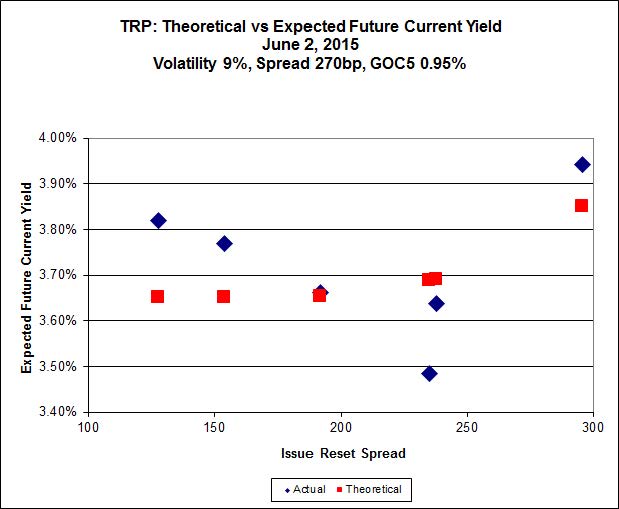
TRP.PR.E, which resets 2019-10-30 at +235, is bid at 23.50 to be $1.23 rich, while TRP.PR.B, which will reset June 30 at 2.152% (GOC5 + 128bp), is $0.64 cheap at its bid price of 14.57.

impVol_MFC_150603
Click for Big

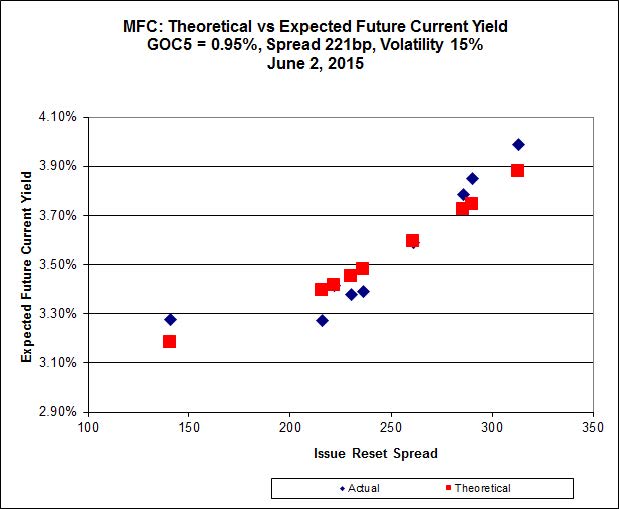
Another excellent fit, but the numbers are perplexing. Implied Volatility for MFC continues to be a conundrum. It is still too high if we consider that NVCC rules will never apply to these issues; it is still too low if we consider them to be NVCC non-compliant issues (and therefore with Deemed Maturities in the call schedule). It is clear that the lowest spread issue, MFC.PR.F, is well off the relationship defined by the other issues, but this doesn’t resolve the conundrum – it just makes it more conundrous.

Most expensive is MFC.PR.L, resetting at +216 on 2019-6-19, bid at 23.75 to be $0.88 rich, while MFC.PR.H, resetting at +313bp on 2017-3-19, is bid at 25.42 to be $0.85 cheap.

impVol_BAM_150603
Click for Big

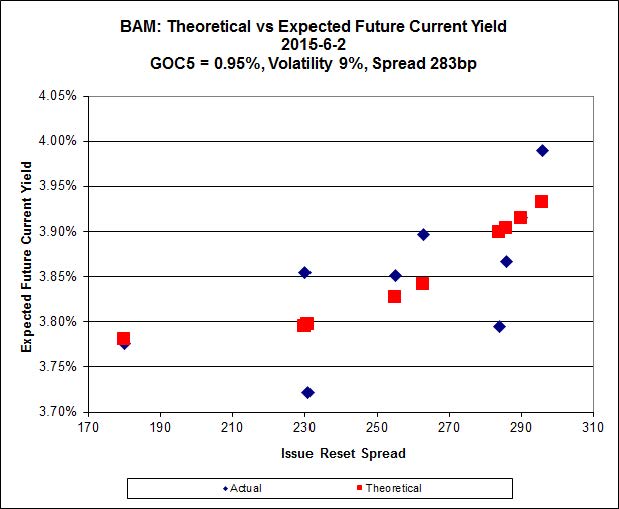
The cheapest issue relative to its peers is BAM.PR.Z, resetting at +296bp on 2017-12-31, bid at 24.50 to be $0.40 cheap. BAM.PF.G, resetting at +284bp 2020-6-30 is bid at 24.91 and appears to be $0.59 rich.

impVol_FTS_150603
Click for Big

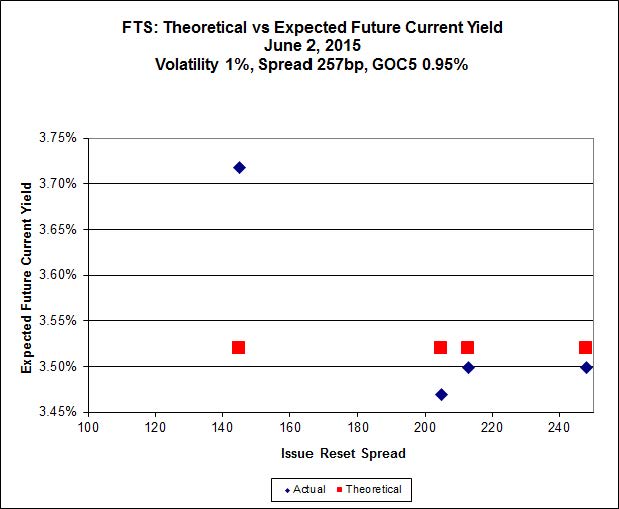
FTS.PR.H, with a spread of +145bp, and bid at 16.10, looks $0.89 cheap and resets 2020-6-1. FTS.PR.K, with a spread of +205bp and resetting 2019-3-1, is bid at 21.62 and is $0.45 rich.

pairs_FR_150603
Click for Big

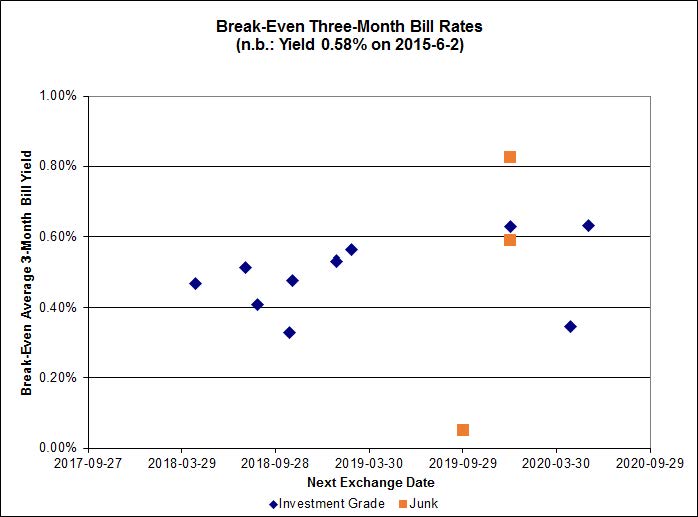
Investment-grade pairs predict an average three-month bill yield over the next five-odd years of about 0.65%, including TRP.PR.A / TRP.PR.F at 1.12% and FTS.PR.H / FTS.PR.I at 1.43%. On the junk side, four pairs are outside the range of the graph: FFH.PR.E / FFH.PR.F at -1.01%; AIM.PR.A / AIM.PR.B at -1.38%; BRF.PR.A / BRF.PR.B at -1.26%; and DC.PR.B / DC.PR.D at -1.75%.

pairs_FF_150603
Click for Big

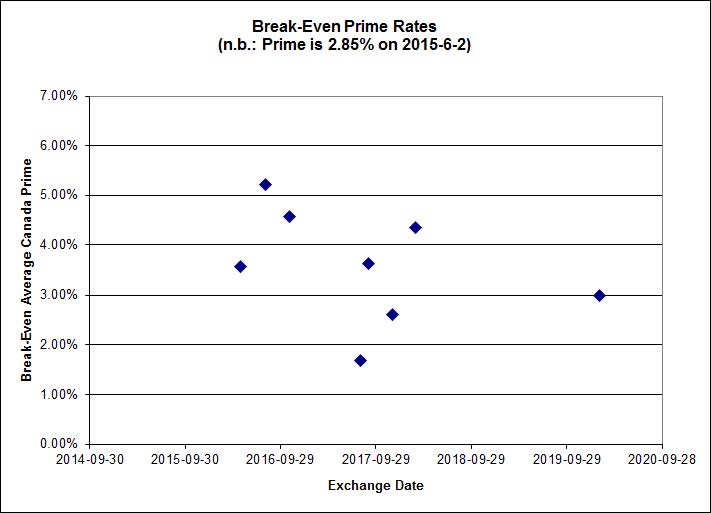
Shall we just say that this exhibits a high level of confidence in the continued rapacity of Canadian banks?

HIMIPref™ Preferred Indices
These values reflect the December 2008 revision of the HIMIPref™ Indices

Values are provisional and are finalized monthly
Index Mean
Current
Yield
(at bid)
Median
YTW
Median
Average
Trading
Value
Median
Mod Dur
(YTW)
Issues Day’s Perf. Index Value
Ratchet 0.00 % 0.00 % 0 0.00 0 0.9476 % 2,185.6
FixedFloater 0.00 % 0.00 % 0 0.00 0 0.9476 % 3,821.5
Floater 3.51 % 3.55 % 61,508 18.34 3 0.9476 % 2,323.5
OpRet 4.44 % -13.94 % 27,689 0.09 2 0.0000 % 2,782.9
SplitShare 4.57 % 4.36 % 72,102 3.32 3 0.6847 % 3,264.5
Interest-Bearing 0.00 % 0.00 % 0 0.00 0 0.0000 % 2,544.7
Perpetual-Premium 5.45 % 4.72 % 64,310 1.50 19 0.0538 % 2,518.5
Perpetual-Discount 5.07 % 5.07 % 116,220 15.37 14 0.0694 % 2,773.0
FixedReset 4.46 % 3.75 % 257,019 16.63 86 -0.2377 % 2,379.3
Deemed-Retractible 4.98 % 3.30 % 110,465 0.71 34 0.0404 % 2,634.5
FloatingReset 2.48 % 2.89 % 54,135 6.15 9 0.4976 % 2,343.9
Performance Highlights
Issue Index Change Notes
CIU.PR.C FixedReset -3.85 % YTW SCENARIO
Maturity Type : Limit Maturity
Maturity Date : 2045-06-03
Maturity Price : 15.75
Evaluated at bid price : 15.75
Bid-YTW : 3.72 %
TD.PF.B FixedReset -2.14 % YTW SCENARIO
Maturity Type : Limit Maturity
Maturity Date : 2045-06-03
Maturity Price : 22.52
Evaluated at bid price : 23.35
Bid-YTW : 3.51 %
FTS.PR.M FixedReset -2.08 % YTW SCENARIO
Maturity Type : Limit Maturity
Maturity Date : 2045-06-03
Maturity Price : 22.81
Evaluated at bid price : 24.00
Bid-YTW : 3.61 %
GWO.PR.N FixedReset -1.72 % YTW SCENARIO
Maturity Type : Hard Maturity
Maturity Date : 2025-01-31
Maturity Price : 25.00
Evaluated at bid price : 17.10
Bid-YTW : 6.84 %
TD.PF.C FixedReset -1.62 % YTW SCENARIO
Maturity Type : Limit Maturity
Maturity Date : 2045-06-03
Maturity Price : 22.37
Evaluated at bid price : 23.14
Bid-YTW : 3.54 %
VNR.PR.A FixedReset -1.53 % YTW SCENARIO
Maturity Type : Limit Maturity
Maturity Date : 2045-06-03
Maturity Price : 22.95
Evaluated at bid price : 23.74
Bid-YTW : 3.99 %
TRP.PR.A FixedReset -1.53 % YTW SCENARIO
Maturity Type : Limit Maturity
Maturity Date : 2045-06-03
Maturity Price : 19.30
Evaluated at bid price : 19.30
Bid-YTW : 3.80 %
GWO.PR.P Deemed-Retractible -1.20 % YTW SCENARIO
Maturity Type : Hard Maturity
Maturity Date : 2025-01-31
Maturity Price : 25.00
Evaluated at bid price : 25.45
Bid-YTW : 5.14 %
TD.PF.A FixedReset -1.09 % YTW SCENARIO
Maturity Type : Limit Maturity
Maturity Date : 2045-06-03
Maturity Price : 22.60
Evaluated at bid price : 23.53
Bid-YTW : 3.48 %
ENB.PR.B FixedReset -1.07 % YTW SCENARIO
Maturity Type : Limit Maturity
Maturity Date : 2045-06-03
Maturity Price : 18.56
Evaluated at bid price : 18.56
Bid-YTW : 4.58 %
HSE.PR.A FixedReset 1.00 % YTW SCENARIO
Maturity Type : Limit Maturity
Maturity Date : 2045-06-03
Maturity Price : 16.64
Evaluated at bid price : 16.64
Bid-YTW : 4.09 %
BAM.PR.N Perpetual-Discount 1.03 % YTW SCENARIO
Maturity Type : Limit Maturity
Maturity Date : 2045-06-03
Maturity Price : 22.13
Evaluated at bid price : 22.54
Bid-YTW : 5.34 %
PVS.PR.D SplitShare 1.40 % YTW SCENARIO
Maturity Type : Hard Maturity
Maturity Date : 2021-10-08
Maturity Price : 25.00
Evaluated at bid price : 24.60
Bid-YTW : 4.81 %
BAM.PF.D Perpetual-Discount 2.09 % YTW SCENARIO
Maturity Type : Limit Maturity
Maturity Date : 2045-06-03
Maturity Price : 23.12
Evaluated at bid price : 23.44
Bid-YTW : 5.30 %
BAM.PR.K Floater 2.16 % YTW SCENARIO
Maturity Type : Limit Maturity
Maturity Date : 2045-06-03
Maturity Price : 14.20
Evaluated at bid price : 14.20
Bid-YTW : 3.55 %
FTS.PR.I FloatingReset 5.10 % There was real trading today, with 4,636 shares changing hands, as opposed to yesterday’s quote, which was just a reasonable guess.
YTW SCENARIO
Maturity Type : Limit Maturity
Maturity Date : 2045-06-03
Maturity Price : 16.50
Evaluated at bid price : 16.50
Bid-YTW : 3.09 %
Volume Highlights
Issue Index Shares
Traded
Notes
ENB.PR.B FixedReset 227,636 Scotia crossed 205,700 at 18.50.
YTW SCENARIO
Maturity Type : Limit Maturity
Maturity Date : 2045-06-03
Maturity Price : 18.56
Evaluated at bid price : 18.56
Bid-YTW : 4.58 %
CM.PR.Q FixedReset 87,491 RBC crossed two blocks of 40,000 each, both at 24.91.
YTW SCENARIO
Maturity Type : Limit Maturity
Maturity Date : 2045-06-03
Maturity Price : 23.08
Evaluated at bid price : 24.80
Bid-YTW : 3.64 %
BMO.PR.Q FixedReset 62,859 TD Crossed blocks of 22,600 and 30,000, both at 23.50.
YTW SCENARIO
Maturity Type : Hard Maturity
Maturity Date : 2022-01-31
Maturity Price : 25.00
Evaluated at bid price : 23.50
Bid-YTW : 3.44 %
BNS.PR.M Deemed-Retractible 55,025 Nesbitt crossed 15,000 at 25.45; TD crossed 31,300 at the same price.
YTW SCENARIO
Maturity Type : Call
Maturity Date : 2015-07-27
Maturity Price : 25.25
Evaluated at bid price : 25.45
Bid-YTW : 1.89 %
TRP.PR.B FixedReset 50,563 Desjardins crossed 35,000 at 14.60.
YTW SCENARIO
Maturity Type : Limit Maturity
Maturity Date : 2045-06-03
Maturity Price : 14.57
Evaluated at bid price : 14.57
Bid-YTW : 3.77 %
ENB.PR.Y FixedReset 46,616 Scotia crossed 40,000 at 18.55.
YTW SCENARIO
Maturity Type : Limit Maturity
Maturity Date : 2045-06-03
Maturity Price : 18.53
Evaluated at bid price : 18.53
Bid-YTW : 4.68 %
There were 28 other index-included issues trading in excess of 10,000 shares.
Wide Spread Highlights
Issue Index Quote Data and Yield Notes
FTS.PR.M FixedReset Quote: 24.00 – 24.74
Spot Rate : 0.7400
Average : 0.4625

YTW SCENARIO
Maturity Type : Limit Maturity
Maturity Date : 2045-06-03
Maturity Price : 22.81
Evaluated at bid price : 24.00
Bid-YTW : 3.61 %

CIU.PR.C FixedReset Quote: 15.75 – 16.40
Spot Rate : 0.6500
Average : 0.4967

YTW SCENARIO
Maturity Type : Limit Maturity
Maturity Date : 2045-06-03
Maturity Price : 15.75
Evaluated at bid price : 15.75
Bid-YTW : 3.72 %

ENB.PR.B FixedReset Quote: 18.56 – 18.99
Spot Rate : 0.4300
Average : 0.2971

YTW SCENARIO
Maturity Type : Limit Maturity
Maturity Date : 2045-06-03
Maturity Price : 18.56
Evaluated at bid price : 18.56
Bid-YTW : 4.58 %

RY.PR.M FixedReset Quote: 24.37 – 24.74
Spot Rate : 0.3700
Average : 0.2544

YTW SCENARIO
Maturity Type : Limit Maturity
Maturity Date : 2045-06-03
Maturity Price : 22.90
Evaluated at bid price : 24.37
Bid-YTW : 3.59 %

MFC.PR.K FixedReset Quote: 23.32 – 23.74
Spot Rate : 0.4200
Average : 0.3070

YTW SCENARIO
Maturity Type : Hard Maturity
Maturity Date : 2025-01-31
Maturity Price : 25.00
Evaluated at bid price : 23.32
Bid-YTW : 4.23 %

RY.PR.K FloatingReset Quote: 24.31 – 24.61
Spot Rate : 0.3000
Average : 0.2041

YTW SCENARIO
Maturity Type : Hard Maturity
Maturity Date : 2022-01-31
Maturity Price : 25.00
Evaluated at bid price : 24.31
Bid-YTW : 2.92 %

Market Action

June 2, 2015

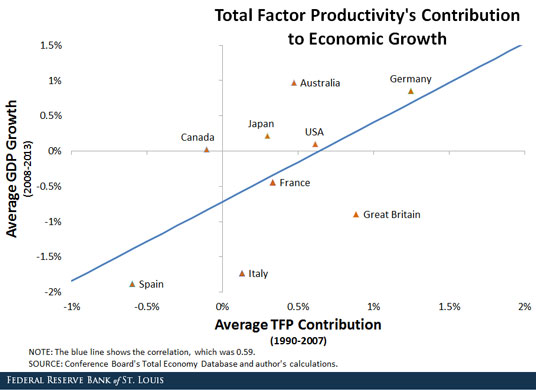
YiLi Chien of the St. Louis Fed writes a piece titled What Drives Long-Run Economic Growth?:

It has been shown, both theoretically and empirically, that technological progress is the main driver of long-run growth. The explanation is actually quite straightforward. Holding other input factors constant, the additional output obtained when adding one extra unit input of capital or labor will eventually decline, according to the law of diminishing returns. As a result, a country cannot maintain its long-run growth by simply accumulating more capital or labor. Therefore, the driver of long-run growth has to be technological progress.

ProductivityAndGrowth
Click for Legible

Good work by Canada, eh? We managed to beat Spain!

Nouriel Roubini, aka “Dr. Doom”, showed his total ignorance of markets:

So what accounts for the combination of macro liquidity and market illiquidity?

For starters, in equity markets, high-frequency traders (HFTs), who use algorithmic computer programs to follow market trends, account for a larger share of transactions. This creates, no surprise, herding behavior. Indeed, trading in the US nowadays is concentrated at the beginning and the last hour of the trading day, when HFTs are most active; for the rest of the day, markets are illiquid, with few transactions.

A second cause lies in the fact that fixed-income assets – such as government, corporate, and emerging-market bonds – are not traded in more liquid exchanges, as stocks are. Instead, they are traded mostly over the counter in illiquid markets.

Third, not only is fixed income more illiquid, but now most of these instruments – which have grown enormously in number, owing to the mushrooming issuance of private and public debts before and after the financial crisis – are held in open-ended funds that allow investors to exit overnight. Imagine a bank that invests in illiquid assets but allows depositors to redeem their cash overnight: if a run on these funds occurs, the need to sell the illiquid assets can push their price very low very fast, in what is effectively a fire sale.

Fourth, before the 2008 crisis, banks were market makers in fixed-income instruments. They held large inventories of these assets, thus providing liquidity and smoothing excess price volatility. But, with new regulations punishing such trading (via higher capital charges), banks and other financial institutions have reduced their market-making activity. So, in times of surprise that move bond prices and yields, the banks are not present to act as stabilizers.

This is the paradoxical result of the policy response to the financial crisis. Macro liquidity is feeding booms and bubbles; but market illiquidity will eventually trigger a bust and collapse.

With respect to his second point: exchange trading harms liquidity. It’s been shown time and time again … on an exchange, you get tighter spreads, but much less depth.

With respect to his fourth point … true enough as far as it goes, but it doesn’t go very far. Banks have been willing to keep large inventories for a few days, but not for much longer than that; and even then, only when their market intelligence gives them cause to believe that it’s just a greater than usual dose of greed or fear that’s causing a transient market move. When things are wild, they increase their spreads just as much as anybody else; when something fundamental is happening, they don’t stand in the way of the freight train. Their ability to smooth out transient spikes has been impaired by post-crisis regulation; they never had any ability to do more.

My own view is that post-crisis regulation has directly harmed liquidity of corporate bonds by the restrictions on inventory; but that it is financial repression that has harmed liquidity of Treasuries. New regulation has both increased the requirement for banks to hold treasuries, while the Fed’s low policy yields have decreased the incentive for anybody else to hold them. In fact, I will suggest that there are exactly two classes of investor holding US and Canadian government debt in significant size at the moment:

  • Regulated entities
  • Idiots

Remember the quotation from April 20:

Moreover, Gluskin Sheff + Associates chief economist David Rosenberg pointed out in a note to clients that 80 per cent of the new Treasuries supply over the past year have been bought by foreign central banks, pension funds, insurers, banks, and insurance companies.

If you want a liquid market, the most efficacious way of getting it is to ensure that the population of potential investors is heterogeneous … as much as possible, you want to ensure that no matter what is going on in the economy or in the marketplace, there is a broad group of participants who have a good reason to sell and a broad group of participants who have a good reason to buy. Treasury and Canada markets don’t have that at the moment.

But, on cue, there is some bearish growling from Europe:

Another bond market meltdown is brewing where the initial one began in April, in signs of a reinflating European economy.

Traders piled on sell orders from Germany to Italy on Tuesday as the first increase in consumer prices in the euro zone in six months suggests growth in the 19-nation economy and the risk of the return of the main nemesis of fixed-income investors: inflation.

SEC Commissioner Michael S. Piwowar made an interesting speech titled Capital Unbound: Remarks at the Cato Summit on Financial Regulation:

Over thirty years ago, economist Bruce Yandle famously coined the term “Bootleggers and Baptists” to describe a public choice theory of economics, which observes that, for regulation to endure, groups that otherwise have opposite points of view choose a regulatory structure that results in private benefits for both but perhaps is suboptimal for society.[1] In Yandle’s illustration, Baptists support laws that shut down all bars and liquor stores on Sundays. Bootleggers are also in favor of such laws, but for entirely different reasons. If Sunday closing laws are in place, both parties get their preferred outcome, and the rules are easy to administer. But if the problem is consumption of alcohol, Sunday closing laws merely shift the production and distribution of alcohol from one group — bars and liquor stores — to bootleggers, while giving a false impression that the public interest is being served. No pun intended.

Yandle described this regulatory approach as making complete sense, when viewed from the regulator’s perspective. A regulator, Yandle reasoned, is most focused on minimizing its costs, rather than the overall costs of the regulation. One example is the regulator’s cost of enforcement. A regulator may be inclined to favor rules that minimize the number of circumstances in which a mistake can be made; for instance, unless a lawmaker confuses the day of the week, it is clear under a Sunday closing law whether a bar or liquor store is required to be closed. It is less costly for a regulator to adopt simple, across-the-board rules that are easy to monitor and enforce than alternatives that take into account economic efficiency and distributional effects — how costs and benefits are distributed among different groups. One area where we see this result is private securities offerings.

I hadn’t realized that this concept was a formal economic theory!

I want to move beyond the artificial distinction between so-called “accredited” and “non-accredited” investors and challenge the notion that non-accredited investors are “being protected” when the government prohibits them from investing in high-risk securities. Here, I appeal to two well-known concepts from the field of financial economics. The first is the risk-return tradeoff. Because most investors are risk averse, riskier securities must offer investors higher returns. This means that prohibiting non-accredited investors from investing in high-risk securities is the same thing as prohibiting them from investing in high-return securities.

The second economic concept is modern portfolio theory. By holding a diversified portfolio of assets, investors reap the benefits of diversification; that is, the risk of the portfolio as a whole is lower than the risk of any individual asset. I do not have the time today to give a full lecture on the mathematics and statistics of portfolio diversification, so I will just assure you the correlation of returns is key. When adding higher-risk, higher-return securities to an existing portfolio, as long as the returns from the new securities are not perfectly positively correlated with (move in exactly the same direction as) the existing portfolio, investors can reap higher returns with little or no change in overall portfolio risk. In fact, if the correlations are low enough, the overall portfolio risk could actually decrease.

These two concepts show how even a well-intentioned investor protection policy can ultimately harm the very investors the policy is intended to protect. Moreover, restricting the number of accredited investors in the “privileged class” can have additional (or what economists call “second-order”) effects. The accredited investors may enjoy even higher returns because the non-accredited investors are prohibited from buying and bidding up the price of, high-risk, high-return securities. Remarkably, if you think about it, by allowing only high-income and high-net-worth individuals to reap the risk and return benefits from investing in certain securities, the government may actually exacerbate wealth inequality.

It was a mixed day for the Canadian preferred share market, with PerpetualDiscounts gaining 23bp, FixedResets off 7bp and DeemedRetractibles down 9bp. Floaters got hammered (and, unusually, featured in the Volume Highlights, suggesting that somebody really wanted out!), but otherwise the Performance Highlights table is much shorter than has been the norm for the past six months! Volume was well below average.

For as long as the FixedReset market is so violently unsettled, I’ll keep publishing updates of the more interesting and meaningful series of FixedResets’ Implied Volatilities. This doesn’t include Enbridge because although Enbridge has a large number of issues outstanding, all of which are quite liquid, the range of Issue Reset Spreads is too small for decent conclusions. The low is 212bp (ENB.PR.H; second-lowest is ENB.PR.D at 237bp) and the high is a mere 268 for ENB.PF.G.

Remember that all rich /cheap assessments are:
» based on Implied Volatility Theory only
» are relative only to other FixedResets from the same issuer
» assume constant GOC-5 yield
» assume constant Implied Volatility
» assume constant spread

Here’s TRP:

impVol_TRP_150602
Click for Big

TRP.PR.E, which resets 2019-10-30 at +235, is bid at 23.68 to be $1.30 rich, while TRP.PR.G, resetting 2020-11-30 at +296, is $0.59 cheap at its bid price of 24.80.

impVol_MFC_150602
Click for Big

Another excellent fit, but the numbers are perplexing. Implied Volatility for MFC continues to be a conundrum. It is still too high if we consider that NVCC rules will never apply to these issues; it is still too low if we consider them to be NVCC non-compliant issues (and therefore with Deemed Maturities in the call schedule). It is clear that the lowest spread issue, MFC.PR.F, is well off the relationship defined by the other issues, but this doesn’t resolve the conundrum – it just makes it more conundrous.

Most expensive is MFC.PR.L, resetting at +216 on 2019-6-19, bid at 23.75 to be $0.84 rich, while MFC.PR.G, resetting at +290bp on 2016-12-19, is bid at 25.00 to be $0.72 cheap.

impVol_BAM_150602
Click for Big

The cheapest issue relative to its peers is BAM.PR.Z, resetting at +296bp on 2017-12-31, bid at 24.50 to be $0.36 cheap. BAM.PF.G, resetting at +284bp 2020-6-30 is bid at 24.97 and appears to be $0.67 rich.

impVol_FTS_150602
Click for Big

FTS.PR.H, with a spread of +145bp, and bid at 16.14, looks $0.91 cheap and resets 2020-6-1. FTS.PR.K, with a spread of +205bp and resetting 2019-3-1, is bid at 21.62 and is $0.31 rich.

pairs_FR_150602
Click for Big

Investment-grade pairs predict an average three-month bill yield over the next five-odd years of about 0.50%, and are very nicely clustered today. On the junk side, three pairs are outside the range of the graph: FFH.PR.E / FFH.PR.F at -0.97%; AIM.PR.A / AIM.PR.B at -1.43%; and BRF.PR.A / BRF.PR.B at -1.38%.

pairs_FF_150602
Click for Big

Shall we just say that this exhibits a high level of confidence in the continued rapacity of Canadian banks?

HIMIPref™ Preferred Indices
These values reflect the December 2008 revision of the HIMIPref™ Indices

Values are provisional and are finalized monthly
Index Mean
Current
Yield
(at bid)
Median
YTW
Median
Average
Trading
Value
Median
Mod Dur
(YTW)
Issues Day’s Perf. Index Value
Ratchet 0.00 % 0.00 % 0 0.00 0 -2.8091 % 2,165.1
FixedFloater 0.00 % 0.00 % 0 0.00 0 -2.8091 % 3,785.6
Floater 3.54 % 3.60 % 60,998 18.24 3 -2.8091 % 2,301.7
OpRet 4.44 % -14.09 % 28,776 0.09 2 0.0000 % 2,782.9
SplitShare 4.60 % 4.47 % 70,145 3.32 3 -0.2545 % 3,242.3
Interest-Bearing 0.00 % 0.00 % 0 0.00 0 0.0000 % 2,544.7
Perpetual-Premium 5.45 % 4.72 % 64,156 1.50 19 -0.1406 % 2,517.2
Perpetual-Discount 5.07 % 5.04 % 115,590 15.44 14 0.2329 % 2,771.1
FixedReset 4.45 % 3.74 % 260,257 16.56 86 -0.0721 % 2,385.0
Deemed-Retractible 4.98 % 3.42 % 110,781 0.88 34 -0.0902 % 2,633.5
FloatingReset 2.49 % 2.90 % 54,947 6.16 9 -0.1656 % 2,332.3
Performance Highlights
Issue Index Change Notes
BAM.PR.K Floater -3.34 % YTW SCENARIO
Maturity Type : Limit Maturity
Maturity Date : 2045-06-02
Maturity Price : 13.90
Evaluated at bid price : 13.90
Bid-YTW : 3.63 %
BAM.PR.B Floater -3.12 % YTW SCENARIO
Maturity Type : Limit Maturity
Maturity Date : 2045-06-02
Maturity Price : 14.29
Evaluated at bid price : 14.29
Bid-YTW : 3.53 %
BAM.PR.C Floater -1.96 % YTW SCENARIO
Maturity Type : Limit Maturity
Maturity Date : 2045-06-02
Maturity Price : 14.02
Evaluated at bid price : 14.02
Bid-YTW : 3.60 %
BAM.PF.E FixedReset -1.22 % YTW SCENARIO
Maturity Type : Limit Maturity
Maturity Date : 2045-06-02
Maturity Price : 22.12
Evaluated at bid price : 22.72
Bid-YTW : 4.08 %
HSE.PR.A FixedReset -1.18 % YTW SCENARIO
Maturity Type : Limit Maturity
Maturity Date : 2045-06-02
Maturity Price : 16.75
Evaluated at bid price : 16.75
Bid-YTW : 4.16 %
TRP.PR.C FixedReset -1.08 % YTW SCENARIO
Maturity Type : Limit Maturity
Maturity Date : 2045-06-02
Maturity Price : 16.52
Evaluated at bid price : 16.52
Bid-YTW : 3.83 %
ENB.PF.E FixedReset -1.06 % YTW SCENARIO
Maturity Type : Limit Maturity
Maturity Date : 2045-06-02
Maturity Price : 20.48
Evaluated at bid price : 20.48
Bid-YTW : 4.65 %
ENB.PF.A FixedReset -1.06 % YTW SCENARIO
Maturity Type : Limit Maturity
Maturity Date : 2045-06-02
Maturity Price : 20.59
Evaluated at bid price : 20.59
Bid-YTW : 4.60 %
TRP.PR.F FloatingReset 1.01 % YTW SCENARIO
Maturity Type : Limit Maturity
Maturity Date : 2045-06-02
Maturity Price : 18.91
Evaluated at bid price : 18.91
Bid-YTW : 3.29 %
BAM.PF.C Perpetual-Discount 1.33 % YTW SCENARIO
Maturity Type : Limit Maturity
Maturity Date : 2045-06-02
Maturity Price : 22.48
Evaluated at bid price : 22.88
Bid-YTW : 5.37 %
BAM.PR.M Perpetual-Discount 1.94 % YTW SCENARIO
Maturity Type : Limit Maturity
Maturity Date : 2045-06-02
Maturity Price : 22.24
Evaluated at bid price : 22.54
Bid-YTW : 5.35 %
Volume Highlights
Issue Index Shares
Traded
Notes
ENB.PR.T FixedReset 86,200 RBC crossed blocks of 35,000 and 34,700, both at 19.35.
YTW SCENARIO
Maturity Type : Limit Maturity
Maturity Date : 2045-06-02
Maturity Price : 19.31
Evaluated at bid price : 19.31
Bid-YTW : 4.60 %
ENB.PR.F FixedReset 71,061 Nesbitt crossed 60,000 at 19.00.
YTW SCENARIO
Maturity Type : Limit Maturity
Maturity Date : 2045-06-02
Maturity Price : 18.97
Evaluated at bid price : 18.97
Bid-YTW : 4.66 %
BAM.PR.C Floater 54,189 TD crossed 47,400 at 14.15.
YTW SCENARIO
Maturity Type : Limit Maturity
Maturity Date : 2045-06-02
Maturity Price : 14.02
Evaluated at bid price : 14.02
Bid-YTW : 3.60 %
RY.PR.D Deemed-Retractible 52,290 RBC crossed 50,000 at 25.30.
YTW SCENARIO
Maturity Type : Call
Maturity Date : 2016-02-24
Maturity Price : 25.00
Evaluated at bid price : 25.26
Bid-YTW : 3.20 %
BAM.PR.B Floater 39,484 TD crossed 24,500 at 14.58.
YTW SCENARIO
Maturity Type : Limit Maturity
Maturity Date : 2045-06-02
Maturity Price : 14.29
Evaluated at bid price : 14.29
Bid-YTW : 3.53 %
ENB.PF.A FixedReset 28,475 Nesbitt crossed 12,000 at 20.50.
YTW SCENARIO
Maturity Type : Limit Maturity
Maturity Date : 2045-06-02
Maturity Price : 20.59
Evaluated at bid price : 20.59
Bid-YTW : 4.60 %
There were 20 other index-included issues trading in excess of 10,000 shares.
Wide Spread Highlights
Issue Index Quote Data and Yield Notes
CM.PR.O FixedReset Quote: 24.13 – 24.65
Spot Rate : 0.5200
Average : 0.3823

YTW SCENARIO
Maturity Type : Limit Maturity
Maturity Date : 2045-06-02
Maturity Price : 22.90
Evaluated at bid price : 24.13
Bid-YTW : 3.43 %

BAM.PF.D Perpetual-Discount Quote: 22.96 – 23.47
Spot Rate : 0.5100
Average : 0.4108

YTW SCENARIO
Maturity Type : Limit Maturity
Maturity Date : 2045-06-02
Maturity Price : 22.56
Evaluated at bid price : 22.96
Bid-YTW : 5.41 %

PVS.PR.D SplitShare Quote: 24.26 – 24.62
Spot Rate : 0.3600
Average : 0.2639

YTW SCENARIO
Maturity Type : Hard Maturity
Maturity Date : 2021-10-08
Maturity Price : 25.00
Evaluated at bid price : 24.26
Bid-YTW : 5.07 %

CU.PR.E Perpetual-Discount Quote: 24.58 – 24.85
Spot Rate : 0.2700
Average : 0.1743

YTW SCENARIO
Maturity Type : Limit Maturity
Maturity Date : 2045-06-02
Maturity Price : 24.12
Evaluated at bid price : 24.58
Bid-YTW : 4.99 %

CM.PR.P FixedReset Quote: 23.49 – 23.89
Spot Rate : 0.4000
Average : 0.3051

YTW SCENARIO
Maturity Type : Limit Maturity
Maturity Date : 2045-06-02
Maturity Price : 22.56
Evaluated at bid price : 23.49
Bid-YTW : 3.46 %

ELF.PR.F Perpetual-Premium Quote: 25.05 – 25.36
Spot Rate : 0.3100
Average : 0.2170

YTW SCENARIO
Maturity Type : Limit Maturity
Maturity Date : 2045-06-02
Maturity Price : 24.83
Evaluated at bid price : 25.05
Bid-YTW : 5.36 %

Issue Comments

FTS.PR.I Debuts with Reasonable Bid, Zero Volume

Fortis Inc. has announced:

that 2,975,154 of its 10,000,000 issued and outstanding Cumulative Redeemable Five-Year Fixed Rate Reset First Preference Shares, Series H (“Series H Shares”) were tendered for conversion, on a one‑for‑one basis into Cumulative Redeemable Floating Rate First Preference Shares, Series I (“Series I Shares”). As a result of the conversion, Fortis has 7,024,846 Series H Shares and 2,975,154 Series I Shares issued and outstanding. The Series H Shares will continue to be listed on the Toronto Stock Exchange (TSX) under the symbol FTS.PR.H. The Series I Shares will begin trading on the TSX today under the symbol FTS.PR.I.

The Series H Shares will pay on a quarterly basis, for the five-year period beginning on June 1, 2015, as and when declared by the Board of Directors of Fortis, a fixed dividend based on an annual fixed dividend rate of 2.50 per cent.

The Series I Shares will pay a floating quarterly dividend for the five-year period beginning on June 1, 2015, as and when declared by the Board of Directors of Fortis. The floating quarterly dividend rate for the Series I Shares for the first quarterly floating rate period (being the period from June 1, 2015 to but excluding September 1, 2015) is 2.10 per cent and will be reset every quarter based on the applicable 3-month Government of Canada Treasury Bill rate plus 1.45%.

For more information on the terms of, and risks associated with an investment in, the Series H Shares and the Series I Shares, please see the Corporation’s prospectus dated January 18, 2010 which can be found under the Corporation’s profile on SEDAR at www.sedar.com and on the Corporation’s website at www.fortisinc.com.

I am very pleased to see this news release, following the earlier policy of minimal communication.

The 30% conversion rate of FixedReset into FloatingReset is lower than it has been for most issues lately; perhaps the persistently poor pricing of FloatingResets is beginning to seep into the market’s consciousness!

Vital statistics for the two elements of the Strong Pair are:

FTS.PR.I FloatingReset YTW SCENARIO
Maturity Type : Limit Maturity
Maturity Date : 2045-06-02
Maturity Price : 15.70
Evaluated at bid price : 15.70
Bid-YTW : 3.25 %
FTS.PR.H FixedReset YTW SCENARIO
Maturity Type : Limit Maturity
Maturity Date : 2045-06-02
Maturity Price : 16.14
Evaluated at bid price : 16.14
Bid-YTW : 3.73 %
pairs_FR_150602
Click for Big

The FTS.PR.H / FTS.PR.I pair is at the high end of break-even T-Bill rates, but not impossibly so at 0.63% compared with an average of 0.49% for all investment-grade pairs. There are three junk pairs implying a negative three-month bill rate over the next five-odd years.

Market Action

June 1, 2015

Fed Vice Chairman Stanley Fischer reiterated Fed caution:

When it comes to describing how the Federal Reserve will exit the zero-rate era, “liftoff” is all wrong, says Vice Chairman Stanley Fischer.

The term, dear to investors and headline writers, “is the most misleading word you can imagine,” he said on Monday in Toronto.

“Liftoff says we’re going straight up with the interest rate,” Fischer said during a question-and-answer session after a speech on financial crises. “Well, we’re going up with the interest rate, then along, and then another little jump. That’s not liftoff, that’s crawling.”

His remarks underline a theme hammered home by Fed officials in recent weeks: They won’t follow a predictable path in raising rates, and instead will be guided by the latest economic data.

This is a nice try – a very nice try – but only one shift? Regrettably, it belongs in the “stunt” category:

After Starboard Value took over the board of Darden Restaurants Inc., the hedge fund wanted its newly minted directors to have a feel for the business. So it put them to work.

Every board member worked a night in a restaurant, said Starboard Chief Executive Officer Jeff Smith, who also is Darden’s chairman. Smith said he waited on tables and served food in the kitchen.

“It was not undercover — everyone knew,” Smith said in an interview on Bloomberg Television’s “Market Makers” with Stephanie Ruhle and Erik Schatzker. “It was an amazing experience. We felt we could not make the decisions without knowing what was happening in the restaurants.”

Hopefully, the directors are spending a lot of time in the restaurants, talking to staff, even if they’re not trying to prove they’re mennathepeople.

I have more education complaints, this time about attracting foreign students to Canada:

Canadian officials are finding it difficult to keep up with the increasing demand from international students, leading to waiting times for visas that are weeks longer than those in Britain or the United States, and reducing the program’s competitiveness.

The lengthy timelines are contained in a report from Citizenship and Immigration Canada (CIC), obtained by The Globe and Mail through freedom of information legislation. While the federal government wants to double the number of students from abroad by 2022, it has not provided sufficient resources to process the increased numbers, the report says. CIC blames this “lack of coordination” between federal departments for an increase of 30 per cent in processing times for study permits and a doubling of the time for temporary resident visas.

The report also recommends clarifying what role international students play in Canada’s overall immigration strategy. The goal of doubling student numbers was set by a 2012 panel as a way to fill labour-market shortages and increase global economic links. But those economic needs can’t be met without government co-ordination, said the panel’s chair.

Foreign students are great! They pay high fees (and therefore probably come from reasonably well-off families), they may well immigrate – with Canadian qualifications, which will help get a first job – and if they don’t immigrate, then they’ll at least live their lives not only knowing that we don’t all live in igloos, but (with luck) having a soft spot for us. I cannot understand why this programme is understaffed.

It was another disappointing day for the Canadian preferred share market, with PerpetualDiscounts down 2bp, FixedResets losing 19bp and DeemedRetractibles off 1bp. The lengthy Performance Highlights table is dominated by losing FixedResets. Volume was average.

For as long as the FixedReset market is so violently unsettled, I’ll keep publishing updates of the more interesting and meaningful series of FixedResets’ Implied Volatilities. This doesn’t include Enbridge because although Enbridge has a large number of issues outstanding, all of which are quite liquid, the range of Issue Reset Spreads is too small for decent conclusions. The low is 212bp (ENB.PR.H; second-lowest is ENB.PR.D at 237bp) and the high is a mere 268 for ENB.PF.G.

Remember that all rich /cheap assessments are:
» based on Implied Volatility Theory only
» are relative only to other FixedResets from the same issuer
» assume constant GOC-5 yield
» assume constant Implied Volatility
» assume constant spread

Here’s TRP:

impVol_TRP_150601
Click for Big

TRP.PR.E, which resets 2019-10-30 at +235, is bid at 23.50 to be $1.10 rich, while TRP.PR.G, resetting 2020-11-30 at +296, is $0.68 cheap at its bid price of 24.76.

impVol_MFC_150601
Click for Big

Another excellent fit, but the numbers are perplexing. Implied Volatility for MFC continues to be a conundrum. It is still too high if we consider that NVCC rules will never apply to these issues; it is still too low if we consider them to be NVCC non-compliant issues (and therefore with Deemed Maturities in the call schedule).

Most expensive is MFC.PR.L, resetting at +216 on 2019-6-19, bid at 23.60 to be $0.64 rich, while MFC.PR.G, resetting at +290bp on 2016-12-19, is bid at 25.01 to be $0.69 cheap.

impVol_BAM_150601
Click for Big

The cheapest issue relative to its peers is BAM.PF.B, resetting at +263bp on 2019-3-31, bid at 22.90 to be $0.43 cheap. BAM.PF.G, resetting at +284bp 2020-6-30 is bid at 24.91 and appears to be $0.56 rich.

impVol_FTS_150601
Click for Big

FTS.PR.H, with a spread of +145bp, and bid at 16.06, looks $0.92 cheap and resets 2015-6-1. FTS.PR.K, with a spread of +205bp and resetting 2019-3-1, is bid at 21.79 and is $0.47 rich.

pairs_FR_150601
Click for Big

Investment-grade pairs predict an average three-month bill yield over the next five-odd years of about 0.50%, and are very nicely clustered today. On the junk side, four pairs are outside the range of the graph: FFH.PR.E / FFH.PR.F at -1.02%; AIM.PR.A / AIM.PR.B at -0.91%; BRF.PR.A / BRF.PR.B at -1.83%; and FFH.PR.C / FFH.PR.D at +1.00%.

pairs_FF_150601
Click for Big

Shall we just say that this exhibits a high level of confidence in the continued rapacity of Canadian banks?

HIMIPref™ Preferred Indices
These values reflect the December 2008 revision of the HIMIPref™ Indices

Values are provisional and are finalized monthly
Index Mean
Current
Yield
(at bid)
Median
YTW
Median
Average
Trading
Value
Median
Mod Dur
(YTW)
Issues Day’s Perf. Index Value
Ratchet 0.00 % 0.00 % 0 0.00 0 -1.4746 % 2,227.7
FixedFloater 0.00 % 0.00 % 0 0.00 0 -1.4746 % 3,895.1
Floater 3.45 % 3.50 % 56,594 18.45 3 -1.4746 % 2,368.2
OpRet 4.44 % -14.24 % 29,960 0.09 2 0.0395 % 2,782.9
SplitShare 4.59 % 4.47 % 68,554 3.33 3 -0.2005 % 3,250.6
Interest-Bearing 0.00 % 0.00 % 0 0.00 0 0.0395 % 2,544.7
Perpetual-Premium 5.45 % 3.99 % 61,593 0.41 19 0.0434 % 2,520.7
Perpetual-Discount 5.08 % 5.06 % 115,767 15.38 14 -0.0151 % 2,764.7
FixedReset 4.44 % 3.76 % 264,096 16.58 86 -0.1933 % 2,386.7
Deemed-Retractible 4.98 % 3.41 % 107,115 0.88 34 -0.0059 % 2,635.8
FloatingReset 2.43 % 2.91 % 54,502 6.14 8 -0.0907 % 2,336.2
Performance Highlights
Issue Index Change Notes
TRP.PR.B FixedReset -3.48 % YTW SCENARIO
Maturity Type : Limit Maturity
Maturity Date : 2045-06-01
Maturity Price : 14.71
Evaluated at bid price : 14.71
Bid-YTW : 3.73 %
TRP.PR.A FixedReset -2.95 % YTW SCENARIO
Maturity Type : Limit Maturity
Maturity Date : 2045-06-01
Maturity Price : 19.41
Evaluated at bid price : 19.41
Bid-YTW : 3.78 %
SLF.PR.G FixedReset -2.12 % YTW SCENARIO
Maturity Type : Hard Maturity
Maturity Date : 2025-01-31
Maturity Price : 25.00
Evaluated at bid price : 16.63
Bid-YTW : 7.19 %
FTS.PR.H FixedReset -1.95 % YTW SCENARIO
Maturity Type : Limit Maturity
Maturity Date : 2045-06-01
Maturity Price : 16.06
Evaluated at bid price : 16.06
Bid-YTW : 3.70 %
BAM.PR.K Floater -1.84 % YTW SCENARIO
Maturity Type : Limit Maturity
Maturity Date : 2045-06-01
Maturity Price : 14.38
Evaluated at bid price : 14.38
Bid-YTW : 3.50 %
ENB.PR.F FixedReset -1.66 % YTW SCENARIO
Maturity Type : Limit Maturity
Maturity Date : 2045-06-01
Maturity Price : 19.01
Evaluated at bid price : 19.01
Bid-YTW : 4.65 %
ENB.PR.B FixedReset -1.52 % YTW SCENARIO
Maturity Type : Limit Maturity
Maturity Date : 2045-06-01
Maturity Price : 18.76
Evaluated at bid price : 18.76
Bid-YTW : 4.53 %
TRP.PR.F FloatingReset -1.47 % YTW SCENARIO
Maturity Type : Limit Maturity
Maturity Date : 2045-06-01
Maturity Price : 18.72
Evaluated at bid price : 18.72
Bid-YTW : 3.33 %
BAM.PR.C Floater -1.38 % YTW SCENARIO
Maturity Type : Limit Maturity
Maturity Date : 2045-06-01
Maturity Price : 14.30
Evaluated at bid price : 14.30
Bid-YTW : 3.52 %
ENB.PR.J FixedReset -1.22 % YTW SCENARIO
Maturity Type : Limit Maturity
Maturity Date : 2045-06-01
Maturity Price : 20.30
Evaluated at bid price : 20.30
Bid-YTW : 4.54 %
BAM.PR.B Floater -1.21 % YTW SCENARIO
Maturity Type : Limit Maturity
Maturity Date : 2045-06-01
Maturity Price : 14.75
Evaluated at bid price : 14.75
Bid-YTW : 3.41 %
ENB.PR.Y FixedReset -1.18 % YTW SCENARIO
Maturity Type : Limit Maturity
Maturity Date : 2045-06-01
Maturity Price : 18.46
Evaluated at bid price : 18.46
Bid-YTW : 4.70 %
CU.PR.D Perpetual-Discount -1.17 % YTW SCENARIO
Maturity Type : Limit Maturity
Maturity Date : 2045-06-01
Maturity Price : 24.14
Evaluated at bid price : 24.60
Bid-YTW : 4.98 %
ENB.PR.P FixedReset -1.13 % YTW SCENARIO
Maturity Type : Limit Maturity
Maturity Date : 2045-06-01
Maturity Price : 19.28
Evaluated at bid price : 19.28
Bid-YTW : 4.60 %
ENB.PR.H FixedReset -1.11 % YTW SCENARIO
Maturity Type : Limit Maturity
Maturity Date : 2045-06-01
Maturity Price : 17.75
Evaluated at bid price : 17.75
Bid-YTW : 4.53 %
IAG.PR.G FixedReset -1.04 % YTW SCENARIO
Maturity Type : Hard Maturity
Maturity Date : 2025-01-31
Maturity Price : 25.00
Evaluated at bid price : 24.82
Bid-YTW : 3.95 %
BAM.PR.X FixedReset -1.03 % YTW SCENARIO
Maturity Type : Limit Maturity
Maturity Date : 2045-06-01
Maturity Price : 18.21
Evaluated at bid price : 18.21
Bid-YTW : 4.07 %
BAM.PF.F FixedReset -1.01 % YTW SCENARIO
Maturity Type : Limit Maturity
Maturity Date : 2045-06-01
Maturity Price : 23.03
Evaluated at bid price : 24.50
Bid-YTW : 3.97 %
GWO.PR.S Deemed-Retractible 1.28 % YTW SCENARIO
Maturity Type : Hard Maturity
Maturity Date : 2025-01-31
Maturity Price : 25.00
Evaluated at bid price : 26.20
Bid-YTW : 4.60 %
BAM.PF.C Perpetual-Discount 1.35 % YTW SCENARIO
Maturity Type : Limit Maturity
Maturity Date : 2045-06-01
Maturity Price : 22.23
Evaluated at bid price : 22.58
Bid-YTW : 5.45 %
MFC.PR.F FixedReset 1.40 % YTW SCENARIO
Maturity Type : Hard Maturity
Maturity Date : 2025-01-31
Maturity Price : 25.00
Evaluated at bid price : 18.10
Bid-YTW : 6.40 %
GWO.PR.N FixedReset 1.53 % YTW SCENARIO
Maturity Type : Hard Maturity
Maturity Date : 2025-01-31
Maturity Price : 25.00
Evaluated at bid price : 17.30
Bid-YTW : 6.69 %
MFC.PR.L FixedReset 1.72 % YTW SCENARIO
Maturity Type : Hard Maturity
Maturity Date : 2025-01-31
Maturity Price : 25.00
Evaluated at bid price : 23.60
Bid-YTW : 4.15 %
Volume Highlights
Issue Index Shares
Traded
Notes
CU.PR.F Perpetual-Discount 174,900 Desjardins crossed 166,700 at 22.70.
YTW SCENARIO
Maturity Type : Limit Maturity
Maturity Date : 2045-06-01
Maturity Price : 22.29
Evaluated at bid price : 22.65
Bid-YTW : 4.97 %
MFC.PR.A OpRet 100,240 Called for redemption 2015-6-19.
YTW SCENARIO
Maturity Type : Call
Maturity Date : 2015-07-19
Maturity Price : 25.00
Evaluated at bid price : 24.98
Bid-YTW : 3.19 %
ENB.PR.D FixedReset 29,342 YTW SCENARIO
Maturity Type : Limit Maturity
Maturity Date : 2045-06-01
Maturity Price : 18.68
Evaluated at bid price : 18.68
Bid-YTW : 4.56 %
SLF.PR.G FixedReset 26,478 YTW SCENARIO
Maturity Type : Hard Maturity
Maturity Date : 2025-01-31
Maturity Price : 25.00
Evaluated at bid price : 16.63
Bid-YTW : 7.19 %
BAM.PR.T FixedReset 24,862 YTW SCENARIO
Maturity Type : Limit Maturity
Maturity Date : 2045-06-01
Maturity Price : 21.49
Evaluated at bid price : 21.85
Bid-YTW : 3.85 %
BNS.PR.Z FixedReset 24,065 YTW SCENARIO
Maturity Type : Hard Maturity
Maturity Date : 2022-01-31
Maturity Price : 25.00
Evaluated at bid price : 23.73
Bid-YTW : 3.33 %
There were 30 other index-included issues trading in excess of 10,000 shares.
Wide Spread Highlights
Issue Index Quote Data and Yield Notes
POW.PR.A Perpetual-Premium Quote: 25.54 – 26.49
Spot Rate : 0.9500
Average : 0.5414

YTW SCENARIO
Maturity Type : Call
Maturity Date : 2015-07-01
Maturity Price : 25.00
Evaluated at bid price : 25.54
Bid-YTW : -11.39 %

PWF.PR.P FixedReset Quote: 18.32 – 18.99
Spot Rate : 0.6700
Average : 0.4250

YTW SCENARIO
Maturity Type : Limit Maturity
Maturity Date : 2045-06-01
Maturity Price : 18.32
Evaluated at bid price : 18.32
Bid-YTW : 3.57 %

TRP.PR.A FixedReset Quote: 19.41 – 19.93
Spot Rate : 0.5200
Average : 0.3772

YTW SCENARIO
Maturity Type : Limit Maturity
Maturity Date : 2045-06-01
Maturity Price : 19.41
Evaluated at bid price : 19.41
Bid-YTW : 3.78 %

VNR.PR.A FixedReset Quote: 24.10 – 24.56
Spot Rate : 0.4600
Average : 0.3233

YTW SCENARIO
Maturity Type : Limit Maturity
Maturity Date : 2045-06-01
Maturity Price : 23.13
Evaluated at bid price : 24.10
Bid-YTW : 3.92 %

TRP.PR.B FixedReset Quote: 14.71 – 15.13
Spot Rate : 0.4200
Average : 0.3101

YTW SCENARIO
Maturity Type : Limit Maturity
Maturity Date : 2045-06-01
Maturity Price : 14.71
Evaluated at bid price : 14.71
Bid-YTW : 3.73 %

ENB.PR.J FixedReset Quote: 20.30 – 20.60
Spot Rate : 0.3000
Average : 0.2103

YTW SCENARIO
Maturity Type : Limit Maturity
Maturity Date : 2045-06-01
Maturity Price : 20.30
Evaluated at bid price : 20.30
Bid-YTW : 4.54 %

New Issues

New Issue: Loblaw 5.30% Straight

Loblaw Companies Limited has announced:

a domestic public offering of 6 million cumulative Second Preferred Shares, Series B (the “Preferred Shares Series B”) at a price of $25.00 per share, to yield 5.30% per annum, for an aggregate gross amount of $150 million.

Loblaw has agreed to sell the Preferred Shares Series B to a syndicate of underwriters co-led by RBC Capital Markets, Scotiabank and TD Securities Inc. on a bought deal basis. Loblaw has granted to the underwriters an option to purchase an additional $50 million of the Preferred Shares Series B at any time up to 48 hours prior to closing.

The Preferred Shares Series B will be offered by way of prospectus supplement under the short form base shelf prospectus of Loblaw dated March 19, 2015. The prospectus supplement will be filed with securities regulatory authorities in all provinces of Canada.

Loblaw also announced that it intends to redeem all of its outstanding Second Preferred Shares, Series A (TSX:L.PR.A) (the “Preferred Shares Series A”) for cash on July 31, 2015 (“redemption date”). The redemption price for each Preferred Share Series A will be $25.00. Holders of Preferred Shares Series A will separately receive all accrued and unpaid dividends outstanding on the redemption date. Loblaw intends to use the net proceeds of the issue of Preferred Shares Series B to partially fund the redemption of its Preferred Shares Series A. The offering is expected to close on or about June 9, 2015.

Later, they announced:

that as a result of strong investor demand for its offering that was announced earlier today, it has agreed to increase the size of the offering from 6 million to 9 million cumulative Second Preferred Shares, Series B (the “Preferred Shares Series B”) at a price of $25.00 per share, to yield 5.30% per annum, for an aggregate gross amount of $225 million. In addition, there will not be an underwriters’ option as was previously granted.

Loblaw has agreed to sell the Preferred Shares Series B to a syndicate of underwriters co-led by RBC Capital Markets, Scotiabank and TD Securities Inc. on a bought deal basis.

The Preferred Shares Series B will be offered by way of prospectus supplement under the short form base shelf prospectus of Loblaw dated March 19, 2015. The prospectus supplement will be filed with securities regulatory authorities in all provinces of Canada.

Loblaw also announced that it intends to redeem all of its outstanding Second Preferred Shares, Series A (TSX: L.PR.A) (the “Preferred Shares Series A”) for cash on July 31, 2015 (“redemption date”). The redemption price for each Preferred Share Series A will be $25.00. Holders of Preferred Shares Series A will separately receive all accrued and unpaid dividends outstanding on the redemption date. Loblaw intends to use the net proceeds of the issue of Preferred Shares Series B to partially fund the redemption of its Preferred Shares Series A. The offering is expected to close on or about June 9, 2015.

The redemption of L.PR.A has been reported previously.

It’s quite a treat to see another Straight issue being issued hard on the heels of the last one, although there are some among us who might mutter darkly that 40bp isn’t much of a spread for such a wide credit jump (Loblaw is Pfd-3 vs. Royal Bank’s Pfd-2, according to DBRS; P-3(high) vs. P-2, according to S&P).

This issue also looks a little rich when compared to the closest comparables – Straights from its parent, Weston:

WN Straights
Ticker Dividend Quote
2015-6-1
Bid YTW
WN.PR.A 1.45 25.29-35 Negative
(immediate call)
WN.PR.C 1.30 24.39-83 5.41%
WN.PR.D 1.30 24.79-95 5.32%
WN.PR.E 1.1875 23.68-71 5.08%

WN.PR.C appears to have lost its bid today; it was quoted at 24.81-90 on Friday May 29. Still, I think a 5.40% or 5.45% coupon would have been more appropriate, giving a tiny bit of compensation for a tiny amount of extra call risk, and 10bp as a new issue concession … but, with a 3% commission on sales, it’s doing well anyway!

Update, 2015-6-3: Rated Pfd-3 by DBRS.

Issue Comments

TRP.PR.B To Reset At 2.152%

TransCanada Corporation has announced:

that it has notified the registered shareholder of its Cumulative Redeemable First Preferred Shares, Series 3 (Series 3 Shares) of the Conversion Privilege and Dividend Rate Notice.

Beginning on June 1, 2015 and ending on June 15, 2015, holders of the Series 3 Shares will have the right to choose one of the following options with regard to their shares:
1.To retain any or all of their Series 3 Shares and continue to receive a fixed quarterly dividend; or
2.To convert, on a one-for-one basis, any or all of their Series 3 Shares into Cumulative Redeemable First Preferred Shares, Series 4 (Series 4 Shares) of TransCanada and receive a floating quarterly dividend.

Holders of the Series 3 Shares and the Series 4 Shares will have the opportunity to convert their shares again on June 30, 2020, and every five years thereafter as long as the shares remain outstanding.

Effective June 1, 2015, the Annual Fixed Dividend Rate for the Series 3 shares was set for the next five year period at 2.152%.

Effective June 1, 2015, the Floating Quarterly Dividend for the Series 4 Shares was set for the first Quarterly Floating Rate Period (being the period from and including June 30, 2015, to but excluding September 30, 2015) at 1.945%. The Floating Quarterly Dividend Rate will be reset every quarter.

The Series 3 Shares are issued in “book entry only” form and, as such, the sole registered holder of the Series 3 Shares is the Canadian Depositary for Securities Limited (CDS). All rights of beneficial holders of Series 3 Shares must be exercised through CDS or the CDS participant through which the Series 3 Shares are held. The deadline for the registered shareholder to provide notice of exercise of the right to convert Series 3 Shares into Series 4 Shares is 3 p.m. (MDT)/ 5 p.m. (EDT) on June 15, 2015. Any notices received after this deadline will not be valid. As such, holders of Series 3 Shares who wish to exercise their right to convert their shares should contact their broker or other intermediary for more information and it is recommended that this be done well in advance of the deadline in order to provide the broker or other intermediary with time to complete the necessary steps.

For more information on the terms of, and risks associated with an investment in, the Series 3 Shares and the Series 4 Shares, please see the Corporation’s prospectus supplement dated March 4, 2010 which is available on sedar.com or on the Corporation’s website.

TRP.PR.B has paid 4.00% over the past five years, so the change in dividend represents a cut of 46%. Ouch! +128 is a pretty skinny spread!

TRP.PR.B was announced 2010-3-4 and commenced trading 2010-3-11. It is tracked by HIMIPref™ and is assigned to the FixedReset subindex.

Note that holders of TRP.PR.B have the right, until 5:00 p.m. (ET) on Monday, June 15, 2015, to notify the company that they wish to convert to the new FloatingReset series – the two series will be interconvertible every five years for as long as they exist. Note that brokers will have earlier internal deadlines.

I will post regarding my opinion on whether to retain or convert TRP.PR.B closer to the deadline; until then, contemplate today’s graph of FixedReset/FloatingReset Strong Pairs:

pairs_FR_150601
Click for Big

The Investment Grade pairs are very well-behaved today, with implied break-even 3-Month T-Bill rates in a nice cluster between 0.31% and 0.63%, with an average of 0.48%.

Estimate of TRP.PR.? FloatingReset Trading Price In Current Conditions
  Assumed FloatingReset
Price if Implied Bill
is equal to
FixedReset Bid Price Spread 0.30% +0.45% +0.60%
TRP.PR.B 14.71 128bp 14.10 14.26 14.42

So at this point, it appears that holders of TRP.PR.B who wish to own the FloatingReset issue would be better advised not to convert, but to swap on the market; this will result in a small cash take-out provided that the new pair trades in line with extant pairs, which is by no means guaranteed.

Issue Comments

SLF.PR.G To Reset At 2.275%

Sun Life Financial Inc. has announced:

the applicable dividend rates for its Class A Non-Cumulative Rate Reset Preferred Shares Series 8R (the “Series 8R Shares”) and Class A Non-Cumulative Floating Rate Preferred Shares Series 9QR (the “Series 9QR Shares”).

With respect to any Series 8R Shares that remain outstanding after June 30, 2015, commencing as of such date, holders thereof will be entitled to receive non-cumulative preferential cash dividends on a quarterly basis, as and when declared by the Board of Directors of Sun Life Financial and subject to the Insurance Companies Act (Canada). The dividend rate for the five-year period commencing on June 30, 2015 to but excluding June 30, 2020 will be 2.275 % per annum or $0.142188 per share per quarter, being equal to the sum of the Government of Canada Yield, as defined in the terms of the Series 8R Shares, on Monday, June 1, 2015 plus 1.41%, as determined in accordance with the terms of the Series 8R Shares.

With respect to any Series 9QR Shares that may be issued on June 30, 2015, holders thereof will be entitled to receive floating rate non-cumulative preferential cash dividends on a quarterly basis, as and when declared by the Board of Directors of Sun Life Financial and subject to the Insurance Companies Act (Canada), based on a dividend rate equal to the sum of the T-Bill Rate, as defined in the terms of the Series 9QR Shares, plus 1.41% (calculated on the basis of the actual number of days elapsed in such Quarterly Floating Rate Period divided by 365 days), subject to certain adjustments in accordance with the terms of the Series 9QR Shares. The dividend rate for the period commencing on June 30, 2015 to but excluding September 30, 2015 will be equal to 2.075 % per annum or $0.130753 per share, as determined in accordance with the terms of the Series 9QR Shares.

Beneficial owners of Series 8R Shares who wish to exercise their right of conversion should communicate as soon as possible with their broker or other nominee and ensure that they follow their instructions in order to meet the deadline to exercise such right, which is 5:00 p.m. (ET) on Monday, June 15, 2015.

An application will be made to list the Series 9QR Shares on the Toronto Stock Exchange.

SLF.PR.G has paid 4.35% over the past five years, so the change in dividend represents a cut of 48%. Ouch!

SLF.PR.G was announced 2010-5-13 and commenced trading 2010-5-25. It is tracked by HIMIPref™ and is assigned to the FixedReset subindex. As it is an insurance issue, it is my opinion that OSFI will – eventually – apply the NVCC rules to it and as it is not NVCC-compliant, it is my further opinion that it will be redeemed on or before a certain date. For analytical purposes, I have currently set that date to be 2025-1-31; it will probably be pushed back a year or two as OSFI’s foot-dragging with respect to the Life Insurance Regulatory Framework continues. You may agree or disagree with me as you wish; at present, the performance of insurance issues suggests the market as a whole disagrees.

Note that holders of SLF.PR.G have the right, until 5:00 p.m. (ET) on Monday, June 15, 2015, to notify the company that they wish to convert to the new FloatingReset series – the two series will be interconvertible every five years for as long as they exist. Note that brokers will have earlier internal deadlines.

I will post regarding my opinion on whether to retain or convert SLF.PR.G closer to the deadline; until then, contemplate today’s graph of FixedReset/FloatingReset Strong Pairs:

pairs_FR_150601
Click for Big

The Investment Grade pairs are very well-behaved today, with implied break-even 3-Month T-Bill rates in a nice cluster between 0.31% and 0.63%, with an average of 0.48%.

Estimate of SLF.PR.? FloatingReset Trading Price In Current Conditions
  Assumed FloatingReset
Price if Implied Bill
is equal to
FixedReset Bid Price Spread 0.30% +0.45% +0.60%
SLF.PR.G 16.63 141bp 16.02 16.18 16.34

So at this point, it appears that holders of SLF.PR.G who wish to own the FloatingReset issue would be better advised not to convert, but to swap on the market; this will result in a small cash take-out provided that the new pair trades in line with extant pairs, which is by no means guaranteed.

Issue Comments

L.PR.A To Be Redeemed

Loblaw Companies Limited has announced (as part of their new issue announcement):

that it intends to redeem all of its outstanding Second Preferred Shares, Series A (TSX:L.PR.A) (the “Preferred Shares Series A”) for cash on July 31, 2015 (“redemption date”). The redemption price for each Preferred Share Series A will be $25.00. Holders of Preferred Shares Series A will separately receive all accrued and unpaid dividends outstanding on the redemption date. Loblaw intends to use the net proceeds of the issue of Preferred Shares Series B to partially fund the redemption of its Preferred Shares Series A. The offering is expected to close on or about June 9, 2015.

This is not really the biggest surprise in the world – L.PR.A is an OperatingRetractible paying 5.95% which becomes redeemable at par on 2015-7-31 and also becomes retractible for shares on that date.

How times change! When this issue was announced 2008-6-11 I opined that it looked expensive and when it commenced trading 2008-6-20 it turned out that the market agreed with me.

Doubtless this will cause a certain amount of angst for some investors … given the imminent redemption of MFC.PR.A the ranks of OperatingRetractibles are dwindling quickly!

MAPF

MAPF Performance: May 2015

The fund slightly outperformed the TXPR index in May (the BMO-CM “50” index returns are not yet available), a month marked by a good upswing in the first half and steady losses in the second half.

ZPR, is an ETF comprised of FixedResets and Floating Rate issues and a very high proportion of junk issues, returned +%, +% and +% over the past one-, three- and twelve-month periods, respectively (according to the fund’s data), versus returns for the TXPL index of -0.20%, -1.52% and -7.38% respectively. The fund has been able to attract assets of about $1,099-million $1,111-million since inception in November 2012; AUM declined by $12-million in May; given an index return of -0.20% a decrease of about $2-million was expected, so in May 2015 the fund had a relatively rare cash outflow. I feel that the flows into and out of this fund are very important in determining the performance of its constituents.

TXPR had returns over one-, three- and twelve-months of -0.49%, -1.39% and -3.11% respectively with CPD performance within expectations.

Returns for the HIMIPref™ investment grade sub-indices for the month were as follows:

HIMIPref™ Indices
Performance to May 29, 2015
Sub-Index 1-Month 3-month
Ratchet N/A N/A
FixFloat N/A N/A
Floater -0.59% -1.81%
OpRet +0.58% +0.90%
SplitShare +0.78% +1.41%
Interest N/A N/A
PerpetualPremium +0.05% +0.14%
PerpetualDiscount -0.45% -1.35%
FixedReset -0.11% -0.48%
DeemedRetractible -0.42% -0.58%
FloatingReset +0.66% +0.50%

Malachite Aggressive Preferred Fund’s Net Asset Value per Unit as of the close May 29, 2015, was $9.8993

Returns to May 29, 2015
Period MAPF BMO-CM “50” Index TXPR
Total Return
CPD – according to Blackrock
One Month -0.37% -0.52% -0.49% N/A
Three Months +0.37% -0.72% -1.31% N/A
One Year -1.69% -3.36% -3.11% -3.36%
Two Years (annualized) +0.41% -1.49% -1.68% N/A
Three Years (annualized) +3.47% +0.66% +0.69% +0.24%
Four Years (annualized) +2.46% +1.47% +1.34% N/A
Five Years (annualized) +6.97% +4.49% +3.81% +3.25%
Six Years (annualized) +9.05% +5.60% +4.56%  
Seven Years (annualized) +11.43% +3.99% +3.06%  
Eight Years (annualized) +10.30% +3.23%    
Nine Years (annualized) +9.72% +2.98%    
Ten Years (annualized) +9.26% +2.99%    
Eleven Years (annualized) +9.35% +3.33%    
Twelve Years (annualized) +10.30% +3.40%    
Thirteen Years (annualized) +10.00% +3.74%    
Fourteen Years (annualized) +10.45% +3.60%    
MAPF returns assume reinvestment of distributions, and are shown after expenses but before fees.
CPD Returns are for the NAV and are after all fees and expenses.
Figures for National Bank Preferred Equity Income Fund (formerly Omega Preferred Equity) (which are after all fees and expenses) for 1-, 3- and 12-months are +0.10%, -0.93% and -0.68%, respectively, according to Morningstar after all fees & expenses. Three year performance is +1.84%; five year is +4.65%
Figures for Manulife Preferred Income Class Adv [into which was merged Manulife Preferred Income Fund (formerly AIC Preferred Income Fund)] (which are after all fees and expenses) for 1-, 3- and 12-months are -0.42%, -1.76% & N/A, respectively.
Figures for Horizons AlphaPro Preferred Share ETF (which are after all fees and expenses) for 1-, 3- and 12-months are -0.36%, -1.02% & -2.16%, respectively. Three year performance is +1.49%
Figures for National Bank Preferred Equity Fund (formerly Altamira Preferred Equity Fund) are -0.46%, -1.32% and -3.46% for one-, three- and twelve months, respectively.
The figure for BMO S&P/TSX Laddered Preferred Share Index ETF is -0.21%, -1.41% and -7.75% for one-, three- and twelve-months, respectively. Two year performance is -4.95%.
Figures for NexGen Canadian Preferred Share Tax Managed Fund (Dividend Tax Credit Class, the best performing) are +%, +% and +% for one-, three- and twelve-months, respectively.
Figures for BMO Preferred Share Fund are -1.64% and -3.03% for the past three- and twelve-months, respectively.
Figures for PowerShares Canadian Preferred Share Index Class, Series Fare -0.36%, -2.46% and -4.49% for the past one, three and twelve months, respectively. The three- and five-year figures are -1.03% and +2.18%, respectively.
Figures for the First Asset Preferred Share Investment Trust (PSF.UN) are -0.22%, -2.27% and -4.93% for the past one, three and twelve months, respectively. The two-, three-, four- and five-year figures are -3.43%, -1.11%, -0.67% and +1.26%, respectively.

MAPF returns assume reinvestment of dividends, and are shown after expenses but before fees. Past performance is not a guarantee of future performance. You can lose money investing in Malachite Aggressive Preferred Fund or any other fund. For more information, see the fund’s main page. The fund is available either directly from Hymas Investment Management or through a brokerage account at Odlum Brown Limited.

A problem that has bedevilled the market over the past four years has been the OSFI decision not to grandfather Straight Perpetuals as Tier 1 bank capital, and their continued foot-dragging regarding a decision on insurer Straight Perpetuals has segmented the market to the point where trading has become much more difficult. Until the market became so grossly segmented, there were many comparables for any given issue – but now banks are not available to swap into (because they are so expensive) and non-regulated companies are likewise deprecated (because they are not DeemedRetractibles; they should not participate in the increase in value that will follow the OSFI decision I anticipate and, in addition, are analyzed as perpetuals). The fund’s portfolio was, in effect ‘locked in’ to the low coupon DeemedRetractibles due to projected long-term gains from a future OSFI decision to the detriment of trading gains, particularly in May, 2013, when the three lowest-coupon SLF DeemedRetractibles (SLF.PR.C, SLF.PR.D and SLF.PR.E) were the worst performing DeemedRetractibles in the sub-index, and in June, 2013, when the insurance-issued DeemedRetractibles behaved like PerpetualDiscounts in a sharply negative market. Nowadays, the fund is ‘locked-in’ to the low-spread FixedResets from these companies: GWO.PR.N, MFC.PR.F, and SLF.PR.G.

In May, insurance DeemedRetractibles performed worse than bank DeemedRetractibles:

DR_1MoPerf_150529
Click for Big

… and a little worse than Unregulated Straight Perpetuals.

insPerp_1MoPerf_150529
Click for Big

Correlations were very poor for banks (5%; not shown), not much good for insurance (9%; not shown) but quite reasonable for unregulated issues (52%).

A lingering effect of the downdraft of 2013 has been the return of measurable Implied Volatility but given my recent updates in recent daily market reports, I will not discuss them further in this post.

Sometimes everything works … sometimes it’s 50-50 … sometimes nothing works. The fund seeks to earn incremental return by selling liquidity (that is, taking the other side of trades that other market participants are strongly motivated to execute), which can also be referred to as ‘trading noise’ – although for quite some time, noise trading has taken a distant second place to the sectoral play on insurance DeemedRetractibles; something that dismays me, particularly given that the market does not yet agree with me regarding the insurance issues! There were a lot of strongly motivated market participants during the Panic of 2007, generating a lot of noise! Unfortunately, the conditions of the Panic may never be repeated in my lifetime … but the fund will simply attempt to make trades when swaps seem profitable, without worrying about the level of monthly turnover.

There’s plenty of room for new money left in the fund. I have shown in PrefLetter that market pricing for FixedResets is very often irrational and I have lots of confidence – backed up by my bond portfolio management experience in the markets for Canadas and Treasuries, and equity trading on the NYSE & TSX – that there is enough demand for liquidity in any market to make the effort of providing it worthwhile (although the definition of “worthwhile” in terms of basis points of outperformance changes considerably from market to market!) I will continue to exert utmost efforts to outperform but it should be borne in mind that there will almost inevitably be periods of underperformance in the future.

The yields available on high quality preferred shares remain elevated, which is reflected in the current estimate of sustainable income.

Calculation of MAPF Sustainable Income Per Unit
Month NAVPU Portfolio
Average
YTW
Leverage
Divisor
Securities
Average
YTW
Capital
Gains
Multiplier
Sustainable
Income
per
current
Unit
June, 2007 9.3114 5.16% 1.03 5.01% 1.3240 0.3524
September 9.1489 5.35% 0.98 5.46% 1.3240 0.3773
December, 2007 9.0070 5.53% 0.942 5.87% 1.3240 0.3993
March, 2008 8.8512 6.17% 1.047 5.89% 1.3240 0.3938
June 8.3419 6.034% 0.952 6.338% 1.3240 $0.3993
September 8.1886 7.108% 0.969 7.335% 1.3240 $0.4537
December, 2008 8.0464 9.24% 1.008 9.166% 1.3240 $0.5571
March 2009 $8.8317 8.60% 0.995 8.802% 1.3240 $0.5872
June 10.9846 7.05% 0.999 7.057% 1.3240 $0.5855
September 12.3462 6.03% 0.998 6.042% 1.3240 $0.5634
December 2009 10.5662 5.74% 0.981 5.851% 1.1141 $0.5549
March 2010 10.2497 6.03% 0.992 6.079% 1.1141 $0.5593
June 10.5770 5.96% 0.996 5.984% 1.1141 $0.5681
September 11.3901 5.43% 0.980 5.540% 1.1141 $0.5664
December 2010 10.7659 5.37% 0.993 5.408% 1.0298 $0.5654
March, 2011 11.0560 6.00% 0.994 5.964% 1.0298 $0.6403
June 11.1194 5.87% 1.018 5.976% 1.0298 $0.6453
September 10.2709 6.10%
Note
1.001 6.106% 1.0298 $0.6090
December, 2011 10.0793 5.63%
Note
1.031 5.805% 1.0000 $0.5851
March, 2012 10.3944 5.13%
Note
0.996 5.109% 1.0000 $0.5310
June 10.2151 5.32%
Note
1.012 5.384% 1.0000 $0.5500
September 10.6703 4.61%
Note
0.997 4.624% 1.0000 $0.4934
December, 2012 10.8307 4.24% 0.989 4.287% 1.0000 $0.4643
March, 2013 10.9033 3.87% 0.996 3.886% 1.0000 $0.4237
June 10.3261 4.81% 0.998 4.80% 1.0000 $0.4957
September 10.0296 5.62% 0.996 5.643% 1.0000 $0.5660
December, 2013 9.8717 6.02% 1.008 5.972% 1.0000 $0.5895
March, 2014 10.2233 5.55% 0.998 5.561% 1.0000 $0.5685
June 10.5877 5.09% 0.998 5.100% 1.0000 $0.5395
September 10.4601 5.28% 0.997 5.296% 1.0000 $0.5540
December, 2014 10.5701 4.83% 1.009 4.787% 1.0000 $0.5060
March, 2015 9.9573 4.99% 1.001 4.985% 1.0000 $0.4964
May, 2015 9.8993 5.25% 0.989 5.308% 1.0000 $0.5255
NAVPU is shown after quarterly distributions of dividend income and annual distribution of capital gains.
Portfolio YTW includes cash (or margin borrowing), with an assumed interest rate of 0.00%
The Leverage Divisor indicates the level of cash in the account: if the portfolio is 1% in cash, the Leverage Divisor will be 0.99
Securities YTW divides “Portfolio YTW” by the “Leverage Divisor” to show the average YTW on the securities held; this assumes that the cash is invested in (or raised from) all securities held, in proportion to their holdings.
The Capital Gains Multiplier adjusts for the effects of Capital Gains Dividends. On 2009-12-31, there was a capital gains distribution of $1.989262 which is assumed for this purpose to have been reinvested at the final price of $10.5662. Thus, a holder of one unit pre-distribution would have held 1.1883 units post-distribution; the CG Multiplier reflects this to make the time-series comparable. Note that Dividend Distributions are not assumed to be reinvested.
Sustainable Income is the resultant estimate of the fund’s dividend income per current unit, before fees and expenses. Note that a “current unit” includes reinvestment of prior capital gains; a unitholder would have had the calculated sustainable income with only, say, 0.9 units in the past which, with reinvestment of capital gains, would become 1.0 current units.
DeemedRetractibles are comprised of all Straight Perpetuals (both PerpetualDiscount and PerpetualPremium) issued by BMO, BNS, CM, ELF, GWO, HSB, IAG, MFC, NA, RY, SLF and TD, which are not exchangable into common at the option of the company (definition refined in May, 2011). These issues are analyzed as if their prospectuses included a requirement to redeem at par on or prior to 2022-1-31 (banks) or 2025-1-31 (insurers and insurance holding companies), in addition to the call schedule explicitly defined. See OSFI Does Not Grandfather Extant Tier 1 Capital, CM.PR.D, CM.PR.E, CM.PR.G: Seeking NVCC Status and the January, February, March and June, 2011, editions of PrefLetter for the rationale behind this analysis.

The same reasoning is also applied to FixedResets from these issuers, other than explicitly defined NVCC from banks.

Yields for September, 2011, to January, 2012, were calculated by imposing a cap of 10% on the yields of YLO issues held, in order to avoid their extremely high calculated yields distorting the calculation and to reflect the uncertainty in the marketplace that these yields will be realized. From February to September 2012, yields on these issues have been set to zero. All YLO issues held were sold in October 2012.
Calculations of resettable instruments are performed assuming constant contemporary GOC-5 and 3-Month Bill rates. For May, 2015, yields of 1.05% and 0.61%, respectively, were assumed.

Significant positions were held in DeemedRetractible, SplitShare and NVCC non-compliant regulated FixedReset issues on May 29; all of these currently have their yields calculated with the presumption that they will be called by the issuers at par prior to 2022-1-31 (banks) or 2025-1-31 (insurers and insurance holding companies) or on a different date (SplitShares) This presents another complication in the calculation of sustainable yield, which also assumes that redemption proceeds will be reinvested at the same rate.

I will also note that the sustainable yield calculated above is not directly comparable with any yield calculation currently reported by any other preferred share fund as far as I am aware. The Sustainable Yield depends on:
i) Calculating Yield-to-Worst for each instrument and using this yield for reporting purposes;
ii) Using the contemporary value of Five-Year Canadas (set at 1.40% for the December 31 calculation and 0.88% for the March 31 calculation) to estimate dividends after reset for FixedResets. The assumption regarding the five-year Canada rate has become more important as the proportion of low-spread FixedResets in the portfolio has increased.
iii) Making the assumption that deeply discounted NVCC non-compliant issues from both banks and insurers, both Straight and FixedResets will be redeemed at par on their DeemedMaturity date as discussed above.

I no longer show calculations that assume the conversion of the entire portfolio into PerpetualDiscounts, as the fund has only a small position in these issues.

Most funds report Current Yield. For instance, ZPR reports a “Dividend Yield” of 4.5% as of August 29, 2014, but this is the Current Yield, a meaningless number. The Current Yield of MAPF was 4.89% as of August 29, but I will neither report that with any degree of prominence nor take any great pleasure in the fact that it’s a little higher than the ZPR number. It’s meaningless; to discuss it in the context of portfolio reporting is misleading.

However, BMO has taken a significant step forward in that they are no longer reporting the “Portfolio Yield” directly on their website; the information is taken from the “Enhanced Fund Profile” which is available only as a PDF link. CPD doesn’t report this metric on the CPD fact sheet or on their website. I may have one less thing to mock the fundcos about!

It should be noted that the concept of this Sustainable Income calculation was developed when the fund’s holdings were overwhelmingly PerpetualDiscounts – see, for instance, the bottom of the market in November 2008. It is easy to understand that for a PerpetualDiscount, the technique of multiplying yield by price will indeed result in the coupon – a PerpetualDiscount paying $1 annually will show a Sustainable Income of $1, regardless of whether the price is $24 or $17.

Things are not quite so neat when maturity dates and maturity prices that are different from the current price are thrown into the mix. If we take a notional Straight Perpetual paying $5 annually, the price is $100 when the yield is 5% (all this ignores option effects). As the yield increases to 6%, the price declines to 83.33; and 83.33 x 6% is the same $5. Good enough.

But a ten year bond, priced at 100 when the yield is equal to its coupon of 5%, will decline in price to 92.56; and 92.56 x 6% is 5.55; thus, the calculated Sustainable Income has increased as the price has declined as shown in the graph:


Click for Big

The difference is because the bond’s yield calculation includes the amortization of the discount; therefore, so does the Sustainable Income estimate.

Different assumptions lead to different results from the calculation, but the overall positive trend is apparent. I’m very pleased with the long-term results! It will be noted that if there was no trading in the portfolio, one would expect the sustainable yield to be constant (before fees and expenses). The success of the fund’s trading is showing up in

  • the very good performance against the index
  • the long term increases in sustainable income per unit

As has been noted, the fund has maintained a credit quality equal to or better than the index; outperformance has generally been due to exploitation of trading anomalies.

Again, there are no predictions for the future! The fund will continue to trade between issues in an attempt to exploit market gaps in liquidity, in an effort to outperform the index and keep the sustainable income per unit – however calculated! – growing.