Issue Comments

BAM.PR.P To Be Redeemed

Brookfield Asset Management Inc. has announced:

that it intends to redeem all of its outstanding Class A Preferred Shares, Series 22 (TSX:BAM.PR.P) for cash on September 30, 2014. The redemption price for each Preferred Share, Series 22 will be C$25.00. Holders of Preferred Shares, Series 22 will separately receive all accrued and unpaid dividends outstanding on the redemption date.

No surprises here, since BAM.PR.P is a FixedReset, 7.00%+445, which commenced trading 2009-6-4 after having been announced May 27.

Issue Comments

BPO.PR.U, BPO.PR.H, BPO.PR.J, BPO.PR.K Reorg

The captioned series of Brookfield Properties Corp. Cl AAA Preferred shares will be voting on June 3 on a Plan of Arrangement. The company has published the Management Proxy Circular.

BPO.PR.U is USD denominated. We won’t worry about that.

In a nutshell:

The BPO Convertible Preferred Shares (being the BPO Preferred Shares, Series G, H, J and K) are currently convertible at the option of BPO into BPO Common Shares and redeemable for cash. In addition, starting on September 30, 2015, December 31, 2015, December 31, 2014 and December 31, 2016, respectively, each of the four series of BPO Convertible Preferred Shares will be convertible at the option of the holders into BPO Common Shares. If a holder exercises its conversion right, BPO has the overriding right to exercise its redemption right and redeem the shares for cash. In connection with the acquisition of the remaining BPO Common Shares and delisting from the TSX and NYSE, holders of outstanding BPO Convertible Preferred Shares are being given the option to elect either:

(a) to exchange their BPO Convertible Preferred Shares for BOP Split Senior Preferred Shares, subject to minimum listing requirements and a maximum of 1,000,000 BOP Split Senior Preferred Shares issued per series, pro-rated as set out in herein, or

(b) to continue holding their BPO Convertible Preferred Shares, the conditions of which will be modified in order to provide for the BPO Convertible Preferred Shares to be exchangeable into BPY Units rather than convertible into BPO Common Shares.

The BOP Split Senior Preferred Shares have been structured to provide a holder thereof with economic terms that are substantially equivalent to those of the BPO Convertible Preferred Shares. The four series of BOP Split Senior Preferred Shares will each have the same dividend and redemption rights as the corresponding series of BPO Convertible Preferred Shares. However, in lieu of being convertible into BPO Common Shares, the BOP Split Senior Preferred Shares will be retractable at any time by the holder. For further information on the BOP Split Senior Preferred Shares, see ‘‘— BOP Split Senior Preferred Shares’’.

With respect to the BPO Split Senior Preferred Shares, conversion will take place for each series only if at least 80,000 shares are converted, and only up to a limit of 1,000,000 shares. The following share numbers are now outstanding:

BPO Shares Outstanding
Ticker Shares
BPO.PR.U 4,400,000
BPO.PR.H 8,000,000
BPO.PR.J 8,000,000
BPO.PR.K 6,000,000

Clearly, therefore, most of the shares will be modified, as in option (b), above, and be convertible into BPY Units rather than convertible into BPO Common Shares.

So what’s interesting is option (a): should holders seek conversion into the Split Corp?

The interesting part of the deal is that

Each BOP Split Senior Preferred Share will be fully and unconditionally guaranteed, jointly and severally, by the Guarantors, including BPO, as to (i) the payment of dividends, as and when declared, on the BOP Split Senior Preferred Shares, (ii) the payment of amounts due on redemption of the BOP Split Senior Preferred Shares, and (iii) the payment of the amounts due on BOP Split Senior Preferred Shares on the liquidation, dissolution and winding-up of BOP Split (the ‘‘BOP Split Senior Preferred Share Guarantee’’). The BOP Split Senior Preferred Share Guarantee will be subordinated to all of the respective senior and subordinated debt of the Guarantors that is not expressly stated to be pari passu with or subordinate to the BOP Split Senior Preferred Share Guarantee and will rank senior to the equity securities of the Guarantors.

… and the Split Corp Preferred will be retractible:

Retraction

Subject to the restrictions imposed by applicable law, each series of the BOP Split Senior Preferred Shares is retractable by the holder at any time for the following amounts:

Series 1 [was BPO.PR.U]: $23.75 per share if redeemed before September 30, 2015 and $25.00 per share if redeemed thereafter;
Series 2 [was BPO.PR.H]: C$23.75 per share if redeemed before December 31, 2015 and C$25.00 per share if redeemed thereafter;
Series 3 [was BPO.PR.J]: C$23.75 per share if redeemed before December 31, 2014 and C$25.00 per share if redeemed thereafter;
Series 4 [was BPO.PR.K]: C$23.75 per share if redeemed before December 31, 2016 and C$25.00 per share if redeemed thereafter;

together with all accrued and unpaid dividends to the applicable retraction date. Retraction payments will be made on or before the last day of each month provided that the certificate(s) representing the BOP Split Senior Preferred Shares have been surrendered for retraction at least one business day before the last day of the preceding month.

What to decide? Holders of the split-shares will have the option of retraction prior to the scheduled date at 23.75, which will be a loss, but might conceivably come in useful if the company gets into extremely serious trouble in the extremely short term. This isn’t too likely, but the protection doesn’t cost any money. So that’s a plus.

It will likely cost liquidity, though, since a maximum of 1-million shares of each series will be outstanding – these things are going to trade by appointment only; therefore, those to whom liquidity is important should retain their BPO Convertible Preferred Shares. Additionally, those with small holdings and high transaction costs should also retain their BPO Convertible Preferred Shares, since there is a good chance they will be left holding some of each issue if the maximum conversion amount is reached. So these are minuses.

I make no recommendation. The decision will depend on each holders desire for a (miniscule) extra amount of credit protection (with the early retraction privilege) vs. what could potentially be a very severe loss of liquidity.

Market Action

May 26, 2014

There’s always a lot of political complaining about corporate short-term thinking, with the equity markets forcing managers to focus on the next quarter’s profit rather than investing for the long term. I’m never too sure about how seriously to take this. First, there seems to be quite a lot of technological advance anyway and second, long-range planning by it’s nature can often go astray and blow up the companies just as well as anything else. One way or another, there’s an interesting insight into the role of indexers:

Most of the more than $4-trillion (U.S.) that BlackRock oversees on behalf of clients is in index funds that passively track market benchmarks. Because it can’t sell individual stocks in index funds, BlackRock is, by necessity, in it for the long haul.

So instead of threatening, [Blackrock Chairman and CEO] Mr. [Larry] Fink cajoles. He writes letters. Very, very well-read letters. His latest went to the heads of all the biggest companies in the United States and Europe, hundreds of them, urging CEOs to think long term.

“As the largest index player in the world, we have to own companies, even if we hate ‘em,” Mr. Fink said in an interview on a recent visit to Toronto. “The most powerful component of our ownership is our vote, and we have to vote for what we think is in the best interests for the long term. Whether we like you or not, we are going to be an investor for the long term. We want leadership to focus on long-term strategies.”

In many ways, BlackRock’s fortunes are tied to long-run economic growth. That’s what drives stock indexes higher. It’s a rising-tide-lifts-all-boats game.

The Lapdog’s learning that sucking political arse is a risky career choice … the demands keep increasing and the promises keep accumulating:

Less than a year into his new job, Mr. Carney is getting decidedly mixed reviews from a much tougher crowd of critics. He’s already had one big flub, after he was forced to revise his stated plan to hold interest rates down until the unemployment rate fell below 7 per cent.

The jobless target was achieved two years ahead of Mr. Carney’s forecast, with unemployment hitting a five-year low of 6.8 per cent in March, and the latest jobs reports have been among the strongest in years. Still, Mr. Carney insists he won’t raise interest rates any time soon, although financial types in the City no longer find his “forward guidance” of much use. They have taken to calling it “fuzzy guidance.”

Some even label Mr. Carney a monetary “dove” who’s tempting fate. For the first time on his watch, members of the central bank’s monetary policy committee disagree over the course of action to take. The governor’s insistence that there is still too much slack in the economy to raise rates is challenged from within. His soon-to-leave deputy recently took a jab: “There is a real danger of spurious precision and the pretense of knowledge in this area.”

What’s the peak of the next interest rate cycle? Place yer bets, gents, place yer bets:

From bond yields to futures and swaps, traders see little chance the economy will strengthen enough over the course of its expansion to compel the Fed to lift its overnight rate beyond about 3.3 percent. That’s less than the historical average of 4.25 percent that New York Fed President William Dudley said would be consistent with the central bank’s current target for inflation and compares with its long-term estimate of 4 percent.

The divergence reflects deepening concern among bond investors that tepid wage growth and a lack of inflation will persist for years to come, and hold back growth as the Fed moves to end its unprecedented monetary stimulus. Lower peak rates will also reduce the likelihood of any selloff in longer-term Treasuries, which have rewarded holders this year with the biggest returns in two decades.

It was a day of modest movement for the Canadian preferred share market, with PerpetualDiscounts and DeemedRetractibles both gaining 2bp, while FixedResets were off 5bp. Volatility was low. Volume was below average.

HIMIPref™ Preferred Indices
These values reflect the December 2008 revision of the HIMIPref™ Indices

Values are provisional and are finalized monthly
Index Mean
Current
Yield
(at bid)
Median
YTW
Median
Average
Trading
Value
Median
Mod Dur
(YTW)
Issues Day’s Perf. Index Value
Ratchet 0.00 % 0.00 % 0 0.00 0 -0.4112 % 2,522.7
FixedFloater 4.50 % 3.74 % 31,559 17.91 1 0.4760 % 3,815.4
Floater 2.89 % 2.98 % 49,790 19.74 4 -0.4112 % 2,723.8
OpRet 4.38 % -10.34 % 34,449 0.10 2 -0.0971 % 2,713.7
SplitShare 4.81 % 4.08 % 63,426 4.18 5 0.1353 % 3,112.4
Interest-Bearing 0.00 % 0.00 % 0 0.00 0 -0.0971 % 2,481.4
Perpetual-Premium 5.50 % -10.64 % 90,105 0.09 15 0.1643 % 2,408.5
Perpetual-Discount 5.28 % 5.30 % 105,773 14.92 21 0.0182 % 2,552.5
FixedReset 4.51 % 3.54 % 201,762 4.37 75 -0.0482 % 2,557.3
Deemed-Retractible 4.98 % -3.16 % 146,985 0.09 43 0.0180 % 2,529.6
FloatingReset 2.65 % 2.38 % 152,408 4.02 6 -0.0857 % 2,492.4
Performance Highlights
Issue Index Change Notes
PWF.PR.A Floater -2.45 % YTW SCENARIO
Maturity Type : Limit Maturity
Maturity Date : 2044-05-26
Maturity Price : 19.51
Evaluated at bid price : 19.51
Bid-YTW : 2.70 %
PWF.PR.L Perpetual-Discount -1.06 % YTW SCENARIO
Maturity Type : Limit Maturity
Maturity Date : 2044-05-26
Maturity Price : 24.03
Evaluated at bid price : 24.31
Bid-YTW : 5.29 %
PWF.PR.O Perpetual-Premium 1.05 % YTW SCENARIO
Maturity Type : Call
Maturity Date : 2017-10-31
Maturity Price : 25.25
Evaluated at bid price : 26.10
Bid-YTW : 4.83 %
Volume Highlights
Issue Index Shares
Traded
Notes
ENB.PF.C FixedReset 188,913 Recent new issue.
YTW SCENARIO
Maturity Type : Limit Maturity
Maturity Date : 2044-05-26
Maturity Price : 23.12
Evaluated at bid price : 25.02
Bid-YTW : 4.16 %
MFC.PR.D FixedReset 155,193 Called for redemption.
YTW SCENARIO
Maturity Type : Call
Maturity Date : 2014-07-19
Maturity Price : 25.00
Evaluated at bid price : 24.97
Bid-YTW : 4.52 %
TRP.PR.D FixedReset 136,210 YTW SCENARIO
Maturity Type : Limit Maturity
Maturity Date : 2044-05-26
Maturity Price : 23.20
Evaluated at bid price : 25.10
Bid-YTW : 3.84 %
SLF.PR.F FixedReset 133,250 Called for redemption.
YTW SCENARIO
Maturity Type : Call
Maturity Date : 2014-06-30
Maturity Price : 25.00
Evaluated at bid price : 24.97
Bid-YTW : 1.26 %
ENB.PR.T FixedReset 114,933 YTW SCENARIO
Maturity Type : Limit Maturity
Maturity Date : 2044-05-26
Maturity Price : 23.03
Evaluated at bid price : 24.62
Bid-YTW : 4.02 %
MFC.PR.L FixedReset 97,730 YTW SCENARIO
Maturity Type : Hard Maturity
Maturity Date : 2025-01-31
Maturity Price : 25.00
Evaluated at bid price : 25.00
Bid-YTW : 3.80 %
There were 25 other index-included issues trading in excess of 10,000 shares.
Wide Spread Highlights
Issue Index Quote Data and Yield Notes
HSB.PR.D Deemed-Retractible Quote: 25.60 – 26.33
Spot Rate : 0.7300
Average : 0.4707

YTW SCENARIO
Maturity Type : Call
Maturity Date : 2014-06-25
Maturity Price : 25.25
Evaluated at bid price : 25.60
Bid-YTW : -2.80 %

PWF.PR.A Floater Quote: 19.51 – 20.30
Spot Rate : 0.7900
Average : 0.5875

YTW SCENARIO
Maturity Type : Limit Maturity
Maturity Date : 2044-05-26
Maturity Price : 19.51
Evaluated at bid price : 19.51
Bid-YTW : 2.70 %

PWF.PR.L Perpetual-Discount Quote: 24.31 – 24.65
Spot Rate : 0.3400
Average : 0.2622

YTW SCENARIO
Maturity Type : Limit Maturity
Maturity Date : 2044-05-26
Maturity Price : 24.03
Evaluated at bid price : 24.31
Bid-YTW : 5.29 %

ELF.PR.G Perpetual-Discount Quote: 22.30 – 22.57
Spot Rate : 0.2700
Average : 0.1974

YTW SCENARIO
Maturity Type : Limit Maturity
Maturity Date : 2044-05-26
Maturity Price : 21.89
Evaluated at bid price : 22.30
Bid-YTW : 5.37 %

CU.PR.C FixedReset Quote: 25.84 – 26.08
Spot Rate : 0.2400
Average : 0.1676

YTW SCENARIO
Maturity Type : Call
Maturity Date : 2017-06-01
Maturity Price : 25.00
Evaluated at bid price : 25.84
Bid-YTW : 2.82 %

ENB.PR.F FixedReset Quote: 24.46 – 24.66
Spot Rate : 0.2000
Average : 0.1280

YTW SCENARIO
Maturity Type : Limit Maturity
Maturity Date : 2044-05-26
Maturity Price : 23.05
Evaluated at bid price : 24.46
Bid-YTW : 4.07 %

New Issues

New Issue: TD FixedReset, 3.90%+224, NVCC-Compliant

The Toronto-Dominion Bank has announced:

an inaugural Basel III-compliant domestic public offering of Non-Cumulative 5-Year Rate Reset Preferred Shares, Series 1 (the “Series 1 Shares”).

TD has entered into an agreement with a group of underwriters led by TD Securities Inc. to issue, on a bought deal basis, 12 million Series 1 Shares at a price of $25.00 per share to raise gross proceeds of $300 million. TD has also granted the underwriters an option to purchase, on the same terms, up to an additional 2 million Series 1 Shares. This option is exercisable in whole or in part by the underwriters at any time up to two business days prior to closing.

The Series 1 Shares will yield 3.90% annually, payable quarterly, as and when declared by the Board of Directors of TD, for the initial period ending October 31, 2019. Thereafter, the dividend rate will reset every five years at a level of 2.24% over the then five-year Government of Canada bond yield.

Subject to regulatory approval, on October 31, 2019 and on October 31 every 5 years thereafter, TD may redeem the Series 1 Shares, in whole or in part, at $25.00 per share. Subject to TD’s right of redemption, holders of the Series 1 Shares will have the right to convert their shares into Non-Cumulative Floating Rate Preferred Shares, Series 2 (the “Series 2 Shares”), subject to certain conditions, on October 31, 2019, and on October 31 every five years thereafter. Holders of the Series 2 Shares will be entitled to receive quarterly floating dividends, as and when declared by the Board of Directors of TD, equal to the three-month Government of Canada Treasury bill yield plus 2.24%.

The expected closing date is June 4, 2014. TD will make an application to list the Series 1 Shares as of the closing date on the Toronto Stock Exchange. The net proceeds of the offering will be used for general corporate purposes.

They later announced:

that as a result of strong investor demand for its previously announced Basel III-compliant domestic public offering of Non-Cumulative 5-Year Rate Reset Preferred Shares, Series 1 (the “Series 1 Shares”), the size of the offering has been increased to 20 million Series 1 Shares. The gross proceeds of the offering will now be $500 million. The offering will be underwritten by a group of underwriters led by TD Securities Inc.

The expected closing date is June 4, 2014. TD will make an application to list the Series 1 Shares as of the closing date on the Toronto Stock Exchange. The net proceeds of the offering will be used for general corporate purposes.

Given that TD.PR.S and TD.PR.Y both have Issue Reset Spreads below 170bp and are trading well above par, this issue looks extremely cheap at first glance. But TD.PR.S and TD.PR.Y are not NVCC compliant, so there is considerable less likelihood that they’ll be outstanding after 2021-1-31. So make of it what you will.

ImpVol_TDFR_140526
Click For Big

Update: Pfd-2 from DBRS. Note that this is one notch below the NVCC-non-compliant issues.

Issue Comments

What Is The Final Dividend On BNA.PR.D?

Assiduous Reader BS writes in and says:

I am one of your newsletter subscribers. I currently own quite a bit of BNA.pr.D (on your advice, thank you!) and I see that it will be redeemed this July 9th. I have read through the prospectus but I’m quite new to preferred shares and I’m not exactly sure what will happen in July.

The Company will redeem all outstanding Series 4 Preferred Shares on July 9, 2014 for a cash amount per share equal to the lesser of (i) $25.00 plus any accrued and unpaid dividends and (ii) the Net Asset Value per Unit.

There is a dividend payable on June 7 (record date about May 19) and then on July 9th I will receive the $25.00 but is there any dividend payments that will accrue between June 7 and July 9 ?

If there is more dividend coming, would it be equal to about… $25 x 7.25%/year x 32 days/365days/year = $0.16

The shares are trading today at about $25.03 which seems too high if you’re only going to get $25 on July 9th and too low if you’re going to get $25.16 on July 9th. I’m confused!

If there’s no more dividend coming, should I be trying to sell now if I can get over $25.00?

Any advice you can give me would be greatly appreciated.

Geez, I hate these questions – and, as it turns out, I’ve answered this one before. You have to look at the prospectus, you have to determine what happened years ago, you have to do intricate day counts and if you get one little thing wrong you look like an idiot. So first off, I’ll say that since this is a factual question, you’re really better off asking the company’s Investor Relations department. They’re the ones who should not only know this, but really should be publicizing this well in advance. But they aren’t. So … once more into the breach, dear friends!

We first have a look at the prospectus, which is on the company’s website:

Holders of the Series 4 Preferred Shares will be entitled to receive quarterly fixed cumulative preferential dividends of $0.453125 per Series 4 Preferred Share. On an annualized basis, this would represent a yield on the offering price of the Series 4 Preferred Shares of 7.25%. Quarterly dividends on the Series 4 Preferred Shares will be paid by the Company on or about the 7th day of March, June, September and December in each year. Based on the anticipated closing date of July 9, 2009, the initial dividend (which covers the period from closing to August 31, 2009) is expected to be $0.26318 per Series 4 Preferred Share, and is expected to be paid on or about September 7, 2009 to holders of record on August 21, 2009.

Step 1: Understand the Initial Dividend

OK, there’s a lot of dates here, but only two of them are critical. The initial dividend covers the period from July 9, 2009, to August 31, 2009. That’s 53 days, and the amount paid is $0.26318, so we annualize that (365/53) * 0.26318 = 1.812466, which is a yield of 7.24986% on the $25 par value. To five significant figures everything works perfectly, so we’ve accomplished Step 1.

The dividend is paid in arrears, but we don’t care, at least not for this purpose. The main thing is that the first dividend was paid to include August 31, 2009, and on September 1, 2009, there was one day’s coupon accrued. On September 2, 2009, there were two day’s accrued. On September 3 …

Step 2: Understand the Most Recent Dividend

The last dividend paid had an ex-date of May 20, 2014 and was paid June 7; the dividend amount was $0.453 (according to the TMXMoney.com website) or $0.453125 (according to the prospectus). Now the thing is, dividends are paid quarterly and the first dividend took us up to the end of August, 2009. THEREFORE the last dividend took us up to the end of May, 2014. So we can say that the dividend which will be paid On or about the 7th day of Mar., Jun., Sep. and Dec. is the dividend that was earned up until May 31, 2014.

It is, again, paid in arrears and the ex-date was in advance, but for this purpose we don’t care.

Step 3: Understand the Final Dividend

Remember the last paragraph of Step 1? on September 1, 2009, there was one day’s coupon accrued. On September 2, 2009, there were two day’s accrued. On September 3? Well, we repeat that starting with …

On June 1, 2014, there will be one day’s coupon accrued. On June 2, 2014, there will be two day’s coupon accrued … On July 9, 2014, there will 39 day’s coupon accrued.

Thirty-Nine day’s accrual at 7.25% p.a. is (39/365) * 7.25% * 25.00 = 0.193664, to six decimal places. The initial dividend was rounded off to five decimal places, so the final dividend looks like it will be $0.193664 per share.

Step 4: Double-Check Everything

This is your money we’re talking about here, so make sure you don’t just understand the calculation, but that you agree with all the reasoning. And, as stated above, you’re best off if you contact Investor Relations and confirm everything with them.

Market Action

May 23, 2014

In a story picked up by the Globe, Renee Altom wrote a piece for the Richmond Fed titled Why was Canada exempt from the financial crisis?; she concludes that a

So to truly understand a country’s financial landscape, you have to go back — all the way back — to its beginning. Financial regulation in a new world typically starts with one question: Who has the authority to charter banks?

This seemingly small choice sets off a chain reaction, according to Michael Bordo and Angela Redish, Canadian economists at Rutgers University and the University of British Columbia, respectively, and Hugh Rockoff, a monetary expert also at Rutgers. They’ve studied the differences between Canada and the United States in several papers dating back to the 1990s.

They argue that the states here prohibited banks from branching, while Canada did not.

Many economists have argued that this “unit banking” in the United States made banks more fragile. For one thing, banks were rather undiversified.

According to the recent study by Calomiris and Haber, set out in their 2014 book Fragile By Design, united factions with an interest in keeping banks small succeeded in shooting down attempts at branching liberalization until the 1980s.

The U.S. Constitution gave all functions not explicitly handed to the federal government, such as regulatory policy, to the states. Interests needed only to win legislative fights at the local level, which was a far easier task than in today’s relatively more federalized system, Calomiris and Haber contended. Thus, they argued that the origins of a country’s financial stability — or lack thereof — are mainly political. Small farmers opposed branching because it would allow banks to take credit elsewhere after a bad harvest. Small banks wanted protection from competition. And many others opposed any signs of growing power concentrated in any one institution — or bank.

There have been many proposed explanations for why our financial system proved much less resilient than Canada’s in 2007 and 2008, from insufficient regulation, to lax mortgage lending, to our history of government rescues.

The longer lens of history shows, however, that any one explanation for financial instability — and therefore any one regulatory attempt to fix it — may be too simple. Even if unit banking is a relic of the past, it is still with us through its effects on the evolution of the U.S. financial system — just as reforms today will determine the shape and stability of the financial system of the future.

The slowdown in trading hasn’t hurt TD & RBC much:

Heading into the current bank earnings season, the worry was that Canadian investment banks would suffer from the same trading slowdown that hit so many global rivals. RBC was particularly in the spotlight, because it has the biggest trading operation of all the Canadian lenders.

Yet their results came in Thursday, and they were surprisingly good considering what the worst case scenarios looked like.

For RBC, the strength stems from its capital markets operations beyond Canada’s borders. “The growth is really focused in the U.S., and our [fixed income] Europe business has performed well in the last quarter as well. And I think really it’s just more origination in Europe and also the markets are much improved in Europe,” Mr. McGregor added.

TD benefited from origination as well, albeit mostly in the domestic market. Asked about the bank’s strong trading numbers in the first half of fiscal 2014, capital markets head Bob Dorrance said they’re “driven significantly by the origination markets.”

Coincidentally, S&P came out with a report titled Delving Deeper Into Global Trading Banks’ Risks And Rewards: A Study Of Public Disclosures. RBC is one of the top 15 global banks for trading, with a 1.8% market share.

Tougher regulatory requirements, particularly as they pertain to capital, have caused some of the biggest global banks to scale back their trading businesses to ensure that profitability clears their cost of capital. Although this has enabled a few select banks with scalable trading operations to increase their market share, the overall trend has been a decline in sales and trading as a percentage of banks’ total revenues–a development that has reduced some of the market risks related to banks’ trading operations from their 2007-2008 peaks, in our view. That said, we believe trading risks remain significant, and could destabilize banks that don’t manage them properly.

  • We have carried out a study of public disclosures by the 15 rated banks with the largest global trading operations to assess changes in the risk of their trading activities.
  • Trading as a percentage of overall revenue has declined for most of these banks over the past five years, and trading risks have subsided from their excessive precrisis levels, largely because of stricter regulation and lower market volumes. However, the risks are still significant, in our view, and could destabilize banks that don’t manage them well.
  • We don’t expect to take any imminent rating actions on these banks based on developments in their trading activities, but changes in their risk profiles, over time, could lead to positive or negative rating actions.


Assessing trading risk at banks can be a difficult endeavor because trading positions, especially derivatives and less-liquid securities, are very complex and opaque. Moreover, the value at risk (VaR) models and other internal models that aim to measure market risks can be inaccurate and inconsistent, particularly in relation to peers. And a significant market disruption may render fair values, which are the basis for many derivatives and securities, unreliable and difficult to measure.

Notably, two recent Bank for International Settlements (BIS) trading surveys that analyzed risk-weighted assets for market risk showed substantial discrepancies across banks in measuring VaR and also showed that regulatory capital requirements for market risk vary among global banks. An October 2013 BIS paper (“Fundamental Review of The Trading Book—Second Consultative Document”) outlines, among other things, certain proposals to improve the accuracy and consistency of bank trading risk-weighted assets, in order to make them more commensurate with risk. We believe this is a step toward further consistency across banks, but more clarity is necessary (see “Basel’s Proposed Overhaul Of Capital Requirement Calculations For Banks’ Trading Risk Is Only A Step Toward Greater Consistency,” published Jan. 31, 2014). Although VaR has certain limitations–and thus, in isolation, may provide an incomplete picture of a bank’s trading risk–we still believe it has value when considered with other factors in determining market risk. That said, we do not base our analysis on ratios alone, not least because some can be the result of a multitude of different influences, some positive and some negative, which we detail in Appendix 3.

The BIS document is titled Consultative Document: Fundamental review of the trading book: A revised market risk framework. To my astonishment, it does not mention ageing as a test for whether or not something is legitimately in the trading book, but:

Having reflected on feedback from the first consultative paper, the Committee has developed a revised boundary that retains the link between the regulatory trading book and the set of instruments that banks deem to hold for trading purposes, but seeks to address weaknesses in the boundary by reducing the possibility of arbitrage and by providing more supervisory tools. As such, this boundary is more likely to be aligned with banks’ own risk management practices relative to the valuation-based approach.

The Committee remains concerned about the risk of arbitrage. To reduce the incentives for arbitrage, the Committee is seeking a less permeable boundary with stricter limits on switching between books and measures to prevent “capital benefit” in instances where switching is permitted. The Committee is also aiming to reduce the materiality of differences in capital requirements against similar types of risk on either side of the boundary. For example, the Committee has decided that the calibration of capital charges against default risk in the trading book will be closely aligned to the banking book treatment, especially for securitisations. The Committee is also investigating the development of Pillar 1 charges for interest rate and credit spread risk in the banking book.

Main differences between the current and proposed definition of the boundary

Intent-based boundary (current) Revised boundary
Requirement for reports to supervisors to make the boundary easier to supervise: N/A Requirement for reports to supervisors to make the boundary easier to supervise: Banks must prepare, evaluate and have available specified reports used by banks in their boundary determination decision, including reports on inventory ageing, daily limits, intraday limits (banks with active intraday trading), market liquidity and any deviations from the presumption lists.

So there will be reports! Lots and lots of lovely reports, requiring the employment of an army of regulators to read and another army of ex-regulators to prepare. Super!

It was a mixed day for the Canadian preferred share market, with PerpetualDiscounts up 18bp, FixedResets down 5bp and DeemedRetractibles off 1bp. Volatility was average. Volume was below average.

HIMIPref™ Preferred Indices
These values reflect the December 2008 revision of the HIMIPref™ Indices

Values are provisional and are finalized monthly
Index Mean
Current
Yield
(at bid)
Median
YTW
Median
Average
Trading
Value
Median
Mod Dur
(YTW)
Issues Day’s Perf. Index Value
Ratchet 0.00 % 0.00 % 0 0.00 0 0.1510 % 2,533.1
FixedFloater 4.52 % 3.76 % 32,842 17.88 1 -0.2374 % 3,797.3
Floater 2.88 % 2.98 % 49,779 19.72 4 0.1510 % 2,735.1
OpRet 4.37 % -10.94 % 32,936 0.11 2 -0.0388 % 2,716.3
SplitShare 4.81 % 4.19 % 58,931 4.19 5 -0.0874 % 3,108.2
Interest-Bearing 0.00 % 0.00 % 0 0.00 0 -0.0388 % 2,483.8
Perpetual-Premium 5.51 % -8.89 % 90,224 0.09 15 0.0052 % 2,404.5
Perpetual-Discount 5.28 % 5.29 % 106,596 14.89 21 0.1798 % 2,552.0
FixedReset 4.53 % 3.49 % 191,923 4.38 76 -0.0548 % 2,558.6
Deemed-Retractible 4.98 % -3.61 % 145,983 0.09 43 -0.0129 % 2,529.1
FloatingReset 2.66 % 2.36 % 153,832 4.02 6 0.0198 % 2,494.6
Performance Highlights
Issue Index Change Notes
CU.PR.E Perpetual-Discount -1.19 % YTW SCENARIO
Maturity Type : Limit Maturity
Maturity Date : 2044-05-23
Maturity Price : 23.64
Evaluated at bid price : 24.01
Bid-YTW : 5.10 %
PWF.PR.O Perpetual-Premium -1.07 % YTW SCENARIO
Maturity Type : Call
Maturity Date : 2018-10-31
Maturity Price : 25.00
Evaluated at bid price : 25.83
Bid-YTW : 5.08 %
BAM.PR.X FixedReset -1.05 % YTW SCENARIO
Maturity Type : Limit Maturity
Maturity Date : 2044-05-23
Maturity Price : 22.14
Evaluated at bid price : 22.56
Bid-YTW : 3.97 %
PWF.PR.L Perpetual-Discount 1.53 % YTW SCENARIO
Maturity Type : Limit Maturity
Maturity Date : 2044-05-23
Maturity Price : 24.27
Evaluated at bid price : 24.57
Bid-YTW : 5.23 %
Volume Highlights
Issue Index Shares
Traded
Notes
ENB.PF.C FixedReset 293,263 Recent new issue.
YTW SCENARIO
Maturity Type : Limit Maturity
Maturity Date : 2044-05-23
Maturity Price : 23.12
Evaluated at bid price : 25.02
Bid-YTW : 4.15 %
BMO.PR.S FixedReset 174,289 Recent new issue.
YTW SCENARIO
Maturity Type : Call
Maturity Date : 2019-05-25
Maturity Price : 25.00
Evaluated at bid price : 25.48
Bid-YTW : 3.66 %
GWO.PR.S Deemed-Retractible 156,145 Recent new issue.
YTW SCENARIO
Maturity Type : Hard Maturity
Maturity Date : 2025-01-31
Maturity Price : 25.00
Evaluated at bid price : 25.28
Bid-YTW : 5.15 %
RY.PR.B Deemed-Retractible 127,241 Nesbitt crossed 125,000 at 25.70.
YTW SCENARIO
Maturity Type : Call
Maturity Date : 2014-06-22
Maturity Price : 25.50
Evaluated at bid price : 25.67
Bid-YTW : -3.61 %
RY.PR.I FixedReset 115,210 Scotia crossed 100,000 at 25.63.
YTW SCENARIO
Maturity Type : Call
Maturity Date : 2019-02-24
Maturity Price : 25.00
Evaluated at bid price : 25.61
Bid-YTW : 2.97 %
MFC.PR.D FixedReset 100,707 Called for redemption.
YTW SCENARIO
Maturity Type : Call
Maturity Date : 2014-07-19
Maturity Price : 25.00
Evaluated at bid price : 24.97
Bid-YTW : 4.28 %
There were 25 other index-included issues trading in excess of 10,000 shares.
Wide Spread Highlights
Issue Index Quote Data and Yield Notes
BNA.PR.E SplitShare Quote: 25.62 – 26.00
Spot Rate : 0.3800
Average : 0.2472

YTW SCENARIO
Maturity Type : Hard Maturity
Maturity Date : 2017-12-10
Maturity Price : 25.00
Evaluated at bid price : 25.62
Bid-YTW : 4.05 %

CU.PR.E Perpetual-Discount Quote: 24.01 – 24.45
Spot Rate : 0.4400
Average : 0.3182

YTW SCENARIO
Maturity Type : Limit Maturity
Maturity Date : 2044-05-23
Maturity Price : 23.64
Evaluated at bid price : 24.01
Bid-YTW : 5.10 %

PWF.PR.O Perpetual-Premium Quote: 25.83 – 26.19
Spot Rate : 0.3600
Average : 0.2525

YTW SCENARIO
Maturity Type : Call
Maturity Date : 2018-10-31
Maturity Price : 25.00
Evaluated at bid price : 25.83
Bid-YTW : 5.08 %

BNA.PR.C SplitShare Quote: 25.15 – 25.40
Spot Rate : 0.2500
Average : 0.1645

YTW SCENARIO
Maturity Type : Hard Maturity
Maturity Date : 2019-01-10
Maturity Price : 25.00
Evaluated at bid price : 25.15
Bid-YTW : 4.19 %

CM.PR.G Perpetual-Premium Quote: 25.50 – 25.70
Spot Rate : 0.2000
Average : 0.1213

YTW SCENARIO
Maturity Type : Call
Maturity Date : 2014-06-22
Maturity Price : 25.00
Evaluated at bid price : 25.50
Bid-YTW : -14.09 %

MFC.PR.J FixedReset Quote: 25.82 – 26.06
Spot Rate : 0.2400
Average : 0.1632

YTW SCENARIO
Maturity Type : Call
Maturity Date : 2018-03-19
Maturity Price : 25.00
Evaluated at bid price : 25.82
Bid-YTW : 3.02 %

New Issues

New Issue: RBC FixedReset, 3.90%+226, NVCC-Compliant

Royal Bank of Canada has announced:

a domestic public offering of $250 million of Non-Cumulative, 5-Year Rate Reset Preferred Shares Series BB.

Royal Bank of Canada will issue 10 million Preferred Shares Series BB priced at $25 per share and holders will be entitled to receive a non-cumulative quarterly fixed dividend for the initial period ending August 24, 2014 in the amount of $0.2190 per share, to yield 3.90 per cent annually. The bank has granted the Underwriters an option, exercisable in whole or in part, to purchase up to an additional 2 million Preferred Shares Series BB at the same offering price.

Subject to regulatory approval, on or after August 24, 2019, the bank may redeem the Preferred Shares Series BB in whole or in part at par. Thereafter, the dividend rate will reset every five years at a rate equal to 2.26 per cent over the 5-year Government of Canada bond yield. Holders of Preferred Shares Series BB will, subject to certain conditions, have the right to convert all or any part of their shares to Non-Cumulative Floating Rate Preferred Shares Series BC on August 24, 2019 and on August 24 every five years thereafter.

Holders of the Preferred Shares Series BC will be entitled to receive a non-cumulative quarterly floating dividend at a rate equal to the 3-month Government of Canada Treasury Bill yield plus 2.26 per cent. Holders of Preferred Shares Series BC will, subject to certain conditions, have the right to convert all or any part of their shares to Preferred Shares Series BB on August 24, 2024 and on August 24 every five years thereafter.

The offering will be underwritten by a syndicate led by RBC Capital Markets. The expected closing date is June 3, 2014.

We routinely undertake funding transactions to maintain strong capital ratios and a cost effective capital structure. Net proceeds from this transaction will be used for general business purposes.

They later announced:

that as a result of strong investor demand for its previously announced domestic public offering of Non-Cumulative, 5-Year Rate Reset Preferred Shares Series BB, the size of the offering has been increased to 20 million shares. The gross proceeds of the offering will now be $500 million.

ImpVol_RY_140523
Market Action

May 22, 2014

Bank of America is closing its internal market-making unit:

Bank of America Corp. is dismantling an electronic market-making unit created last year to serve the lender’s Merrill Lynch wealth-management division, said two people with knowledge of the decision.

Increased regulatory scrutiny of U.S. equity markets and managers’ concerns for the potential perception of a conflict of interest killed the project, said the people. The desk advanced to a testing phase before being abandoned in recent weeks and two executives hired to run it, Jonathan Wang and Steven Sadoff, were told to seek new jobs within the firm, the people said, requesting anonymity because the matter is private.

Businesses such as the shuttered Bank of America unit usually execute equity orders internally, rather than sending them to the public stock market. Critics including Kor Group LLC’s Dave Lauer say the practice may cause harm by keeping some supply and demand private, distorting prices. Bank of America’s decision coincides with a renewed examination by regulators of whether trading in the $22 trillion U.S. stock market is fair.

For Bank of America, “this is either not a profitable business anymore or they don’t want to deal with the regulatory scrutiny that’s coming,” said Joe Saluzzi, co-head of equity trading at Themis Trading LLC in Chatham, New Jersey. “It definitely tells you they’re concerned and maybe they’re hearing things we haven’t.”

Kor Group LLC’s Dave Lauer’s argument is, essentially:

This structure is not dissimilar to something called Payment for Order Flow (PFOF), in which a wholesaler (such as Knight Getco or Citadel) will pay a retail broker for its order flow and then either internalize that flow or send it along to the broader market. In the case of PFOF, it is very profitable for the wholesalers to buy retail order flow and lucrative for brokers to sell this flow – so much so that it is generally referred to as “uninformed” or even “juicy” order flow. These terms describe the willingness of retail traders to pay the spread and the associated fees without a short-term view as to what will happen to the stock price over the next few milliseconds and seconds because of their long-term investment outlook or for swing/day-trading. For wholesalers, the profits from trading against this flow more than offset the fees that they pay to the retail brokers.

However, the PFOF model does a disservice to the market at large, as removing this order flow can theoretically inhibit price discovery, discouraging market makers from posting orders if they know that the only orders that make it to the exchange are the so-called “toxic” or “professional” flow. Internalizers and wholesalers are free-riding the public quote, and in essence “queue jumping” (a loaded term, to be sure) orders on lit exchanges that may have price-time priority from an absolute perspective.

So why can’t we count on the market and competitive forces to fix these issues? Because maker-taker creates a fundamental conflict of interest and a puts exchanges between a rock and a hard place. It makes no difference to an exchange’s revenue what its rebates/fees are – as the exchange makes money on the difference between the two. However, exchanges are unable to lower their rebates and fees because doing so would chase away resting orders to those exchanges that do not lower their rebates.

This is why regulatory intervention is required, and the Notre Dame study quantitatively shows that. In order to move forward, this intervention should be in the form of a pilot study – as advocated by Royal Bank of Canada (RBC) and others – that eliminates rebates in a set of symbols, and requires the trade-at rule in those names, as Canada and Australia do. This rule simply states that in order to execute a trade of less than 5,000 shares off-exchange (in a dark pool or internalization system), there must be significant price improvement (at least a tick, or half a tick if the spread is a tick wide). High-frequency trading (HFT) proponents explain, quite reasonably, that maker rebates are necessary to compensate them for adverse selection (as explained earlier, only the “toxic” flow actually makes it to exchanges now). The trade-at rule will reduce adverse selection and improve price discovery on public venues, ultimately benefitting all investors and providing compensation to market makers.

He also used as evidence the study by Robert Battalio, Shane Corwin, and Robert Jennings, Can Brokers Have It All?, referred to here on April 21, 2014. Seems to me that if the spread’s too wide, there’s money to be made by improving it.

TRACE? SchmACE!

The world’s biggest bond dealers, including JPMorgan Chase & Co. (JPM) and Morgan Stanley, failed to properly report trades to the industry’s price-tracking system more than 11,000 times. JPMorgan’s penalty: About three minutes of its annual profit.

Fines levied in settlements disclosed last month by the Financial Industry Regulatory Authority amounted to a fraction of what the two New York-based firms generated from trading debt during the two-year reviews. JPMorgan’s $95,000 penalty was the biggest imposed by Finra as it cited at least three other dealers in the past five months for similar types of violations.

Regulators are seeking to uphold the integrity of the bond-price reporting system known as Trace, the biggest window into a market that’s grown about 78 percent since 2008 as investors poured money into debt securities. Holding back information on trades can give Wall Street dealers an advantage over customers seeking a fair price, undermining Finra’s stated goal of equal access for all participants to real-time data.

JPMorgan racked up the most Trace-related violations disclosed this year, the result of five separate reviews, according to a settlement released in April. The bank, which ranks as the biggest bond trader and top underwriter of corporate debt, neglected to post trades or missed deadlines in at least 6,300 instances from March 2010 through May 2012, at times omitting a quarter of required reporting, Finra said.

In one review, Finra found the violations accounted for almost 20 percent of corporate debt transactions the bank was required to report over three months in 2011. In another, JPMorgan didn’t report 24 percent of new-issue offerings over five months, the regulator said.

Sometimes the bank didn’t report the correct volume, time or date of transactions, and the firm inadequately supervised compliance, according to the documents.

Moody’s sounded a warning on the provinces:

Both parties should take note of the latest from Moody’s, which puts [Ontario] net debt as a percentage of revenue at 237.7 in the 2014-15 fiscal year, the highest in the country.

Not only the highest, actually, but far and away above the next in line, Quebec, at 189.5.

The lowest is Alberta, at 31.9.

Alberta and British Columbia are alone among the provinces in holding a triple-A rating with Moody’s, the former deemed “stable” and the latter “negative.”

“Most Canadian provinces maintained their ratings and stable credit outlook through the financial crisis and subsequent slow recovery,” Moody’s said in its report.

“However, the continued accumulation of debt and difficulty in returning to balanced budgets is increasing negative credit pressure for some provinces.”

Revenue-to-debt, I can’t help with. But there’s a a good idea for improving debt-to-GDP!

Italy will include prostitution and illegal drug sales in the gross domestic product calculation this year, a boost for its chronically stagnant economy and Prime Minister Matteo Renzi’s effort to meet deficit targets.

Drugs, prostitution and smuggling will be part of GDP as of 2014 and prior-year figures will be adjusted to reflect the change in methodology, the Istat national statistics office said today. The revision was made to comply with European Union rules, it said.

Renzi, 39, is committed to narrowing Italy’s deficit to 2.6 percent of GDP this year, a task that’s easier if output is boosted by portions of the underground economy that previously went uncounted.

The administrators of the TMXMoney.com website got back to me this morning about the problem with the pricing data, as discussed on May 20 and May 21

Hello,

Thank you for your comment. We have forwarded your inquiry to marketdata@tmx.com. They will contact you shortly.

In the future, for any inquiries relating to market data, please reach out to marketdata@tmx.com directly or call (416) 947-4778.

If you have any suggestions for new functionality/features please feel free to use the “Suggest an Idea” box on TMXmoney.com.

Thank you,

This was followed shortly afterwards with:

Status update

An idea you voted for has been closed!

3 votes have been returned to you Go spend your votes on more ideas…

In other words … ‘Shee-it, man, if we had a clue we wouldn’t have to work for a bank!’ Well, it was worth a try! Thanks to all those who voted for the suggestion.

Assiduous Reader GA writes in and says:

AMBest withdrew their rating of CCS.PR.C and CCS.PR.D

IS this an indication that shares will be called for redemption by the end of the month? CCS.PR.D should certainly be redeemed and they have until the end of the month to announce it!

So, first of all, it’s true: A.M. Best Affirms Ratings of Co-operators General Insurance Company, Its Subsidiary and Co-operators Life Insurance Company:

A.M. Best has affirmed the financial strength rating (FSR) of A- (Excellent) and issuer credit ratings (ICR) of “a-” of Co-operators General Insurance Company (Co-operators General) and its subsidiary, The Sovereign General Insurance Company (Sovereign) (Alberta).

In addition, A.M. Best has affirmed the FSR of A (Excellent) and ICR of “a” of Co-operators Life Insurance Company (Co-operators Life) (Saskatchewan). The outlook for all ratings is stable.

Concurrently, A.M. Best has withdrawn the debt ratings of “bbb-” of the preferred shares of CAD 100 million 5% non-cumulative redeemable Class E preference shares, Series C [TSX: CCS.PR.C] and CAD 115 million 7.25% non-cumulative five-year reset Class E preference shares, Series D [TSX: CCS.PR.D] issued by Co-operators General.

But I think that it indicates only that Cooperators is tired of paying for ratings that don’t really make a lot of difference to their ability to sell preferred shares. Only ratings by DBRS and S&P are important; during the crisis it looked as if Moody’s was going to become a third player, but there doesn’t seem to be much of a rush for three ratings other than the initial handful of banks and insurers.

I continue to visit the Cooperators media page regularly to check whether they’ve finally pulled the trigger on the expected CCS.PR.D redemption (redeemable on 2014-6-30; Issue Reset Spread of 521bp) but it hasn’t happened yet.

It was a good day for the Canadian preferred share market, with PerpetualDiscounts winning 17bp, FixedResets gaining 4bp and DeemedRetractibles up 11bp. Volatility would have been low if it had not been for fine performance from the (generally very volatile) Floaters. Volume was very low, considering the boost that should have resulted from the two new issues settling today.

HIMIPref™ Preferred Indices
These values reflect the December 2008 revision of the HIMIPref™ Indices

Values are provisional and are finalized monthly
Index Mean
Current
Yield
(at bid)
Median
YTW
Median
Average
Trading
Value
Median
Mod Dur
(YTW)
Issues Day’s Perf. Index Value
Ratchet 0.00 % 0.00 % 0 0.00 0 1.6750 % 2,529.3
FixedFloater 4.51 % 3.75 % 33,076 17.90 1 -0.1422 % 3,806.4
Floater 2.88 % 2.99 % 50,251 19.70 4 1.6750 % 2,730.9
OpRet 4.37 % -12.00 % 33,077 0.11 2 0.0777 % 2,717.4
SplitShare 4.81 % 4.15 % 59,265 4.19 5 0.0557 % 3,110.9
Interest-Bearing 0.00 % 0.00 % 0 0.00 0 0.0777 % 2,484.8
Perpetual-Premium 5.51 % -9.85 % 93,663 0.09 15 0.0052 % 2,404.4
Perpetual-Discount 5.29 % 5.31 % 107,938 14.91 21 0.1721 % 2,547.4
FixedReset 4.53 % 3.50 % 196,232 4.38 76 0.0363 % 2,560.0
Deemed-Retractible 4.98 % -3.79 % 146,140 0.09 43 0.1147 % 2,529.5
FloatingReset 2.66 % 2.34 % 155,771 4.03 6 -0.0659 % 2,494.1
Performance Highlights
Issue Index Change Notes
BAM.PR.C Floater 1.14 % YTW SCENARIO
Maturity Type : Limit Maturity
Maturity Date : 2044-05-22
Maturity Price : 17.69
Evaluated at bid price : 17.69
Bid-YTW : 2.99 %
ELF.PR.G Perpetual-Discount 1.27 % YTW SCENARIO
Maturity Type : Limit Maturity
Maturity Date : 2044-05-22
Maturity Price : 21.87
Evaluated at bid price : 22.28
Bid-YTW : 5.37 %
BAM.PR.K Floater 1.39 % YTW SCENARIO
Maturity Type : Limit Maturity
Maturity Date : 2044-05-22
Maturity Price : 17.53
Evaluated at bid price : 17.53
Bid-YTW : 3.02 %
BAM.PR.B Floater 1.56 % YTW SCENARIO
Maturity Type : Limit Maturity
Maturity Date : 2044-05-22
Maturity Price : 17.62
Evaluated at bid price : 17.62
Bid-YTW : 3.00 %
PWF.PR.A Floater 2.51 % YTW SCENARIO
Maturity Type : Limit Maturity
Maturity Date : 2044-05-22
Maturity Price : 20.00
Evaluated at bid price : 20.00
Bid-YTW : 2.63 %
Volume Highlights
Issue Index Shares
Traded
Notes
ENB.PF.C FixedReset 1,260,098 New issue settled today.
YTW SCENARIO
Maturity Type : Limit Maturity
Maturity Date : 2044-05-22
Maturity Price : 23.13
Evaluated at bid price : 25.04
Bid-YTW : 4.14 %
GWO.PR.S Deemed-Retractible 753,041 New issue settled today.
YTW SCENARIO
Maturity Type : Hard Maturity
Maturity Date : 2025-01-31
Maturity Price : 25.00
Evaluated at bid price : 25.10
Bid-YTW : 5.23 %
CU.PR.C FixedReset 303,665 RBC crossed 294,500 at 25.70.
YTW SCENARIO
Maturity Type : Call
Maturity Date : 2017-06-01
Maturity Price : 25.00
Evaluated at bid price : 25.65
Bid-YTW : 3.07 %
BMO.PR.S FixedReset 108,865 Recent new issue.
YTW SCENARIO
Maturity Type : Call
Maturity Date : 2019-05-25
Maturity Price : 25.00
Evaluated at bid price : 25.55
Bid-YTW : 3.60 %
ENB.PR.J FixedReset 81,798 Nesbitt crossed 70,000 at 25.12.
YTW SCENARIO
Maturity Type : Limit Maturity
Maturity Date : 2044-05-22
Maturity Price : 23.20
Evaluated at bid price : 25.07
Bid-YTW : 4.07 %
BAM.PR.N Perpetual-Discount 36,728 RBC probably did something. The public TMX reports aren’t clear.
YTW SCENARIO
Maturity Type : Limit Maturity
Maturity Date : 2044-05-22
Maturity Price : 21.82
Evaluated at bid price : 21.82
Bid-YTW : 5.53 %
There were 18 other index-included issues trading in excess of 10,000 shares.
Wide Spread Highlights
Issue Index Quote Data and Yield Notes
FTS.PR.F Perpetual-Discount Quote: 23.75 – 24.23
Spot Rate : 0.4800
Average : 0.2821

YTW SCENARIO
Maturity Type : Limit Maturity
Maturity Date : 2044-05-22
Maturity Price : 23.48
Evaluated at bid price : 23.75
Bid-YTW : 5.16 %

RY.PR.A Deemed-Retractible Quote: 25.71 – 25.89
Spot Rate : 0.1800
Average : 0.1054

YTW SCENARIO
Maturity Type : Call
Maturity Date : 2014-06-23
Maturity Price : 25.25
Evaluated at bid price : 25.71
Bid-YTW : -15.82 %

RY.PR.E Deemed-Retractible Quote: 25.89 – 26.10
Spot Rate : 0.2100
Average : 0.1379

YTW SCENARIO
Maturity Type : Call
Maturity Date : 2014-06-21
Maturity Price : 25.50
Evaluated at bid price : 25.89
Bid-YTW : -13.86 %

PWF.PR.K Perpetual-Discount Quote: 23.53 – 23.84
Spot Rate : 0.3100
Average : 0.2416

YTW SCENARIO
Maturity Type : Limit Maturity
Maturity Date : 2044-05-22
Maturity Price : 23.24
Evaluated at bid price : 23.53
Bid-YTW : 5.30 %

PWF.PR.E Perpetual-Premium Quote: 25.22 – 25.45
Spot Rate : 0.2300
Average : 0.1621

YTW SCENARIO
Maturity Type : Call
Maturity Date : 2014-06-21
Maturity Price : 25.00
Evaluated at bid price : 25.22
Bid-YTW : -1.17 %

CU.PR.G Perpetual-Discount Quote: 22.12 – 22.35
Spot Rate : 0.2300
Average : 0.1691

YTW SCENARIO
Maturity Type : Limit Maturity
Maturity Date : 2044-05-22
Maturity Price : 21.81
Evaluated at bid price : 22.12
Bid-YTW : 5.09 %

Issue Comments

GWO.PR.S Firm on Good Volume

Great-West Lifeco Inc. has announced:

the completion of its offering of 8,000,000 5.25% Non-Cumulative First Preferred Shares, Series S through a syndicate of underwriters co-led by BMO Capital Markets and Scotiabank for gross proceeds of $200 million. The Series S Shares will be listed for trading on the Toronto Stock Exchange under the symbol “GWO.PR.S”.

GWO.PR.S is a Straight Perpetual, 5.25%, announced May 13. Note that since it is issued by an insurance holding company, I have assumed that it will be not be NVCC-compliant when (I expect, but cannot guarantee!) the NVCC rules are applied to insurers and insurance holding companies. I have therefore added a “Deemed Maturity” to the call schedule, meaning that analysis assumes it will be called for redemption 2025-1-31 at the latest. This issue will be tracked by HIMIPref™ and assigned to the DeemedRetractible subindex.

The issue traded 879,041 shares today in a range of 25.005-13 before closing at 25.10-13, 132×3. Vital statistics are:

GWO.PR.S Deemed-Retractible YTW SCENARIO
Maturity Type : Hard Maturity
Maturity Date : 2025-01-31
Maturity Price : 25.00
Evaluated at bid price : 25.10
Bid-YTW : 5.23 %

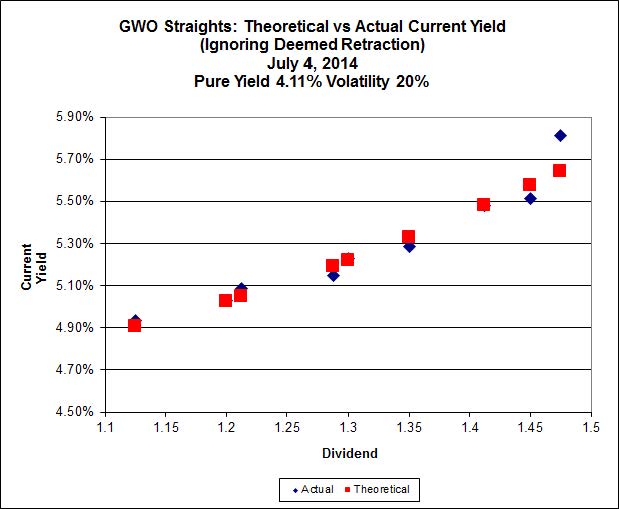
According to Implied Volatility Theory (inasmuch as it applies to DeemedRetractibles!) GWO.PR.S is priced right in line with expectations:

ImpVol_GWO_140522
Click for Big
Issue Comments

ENB.PF.C Firm on Excellent Volume

Enbridge Inc. has announced:

that it has closed its previously announced public offering of Cumulative Redeemable Preference Shares, Series 11 (the “Series 11 Preferred Shares”) by a syndicate of underwriters led by Scotiabank, CIBC, RBC Capital Markets, and TD Securities. Enbridge issued 20 million Series 11 Preferred Shares for gross proceeds of $500 million. The Series 11 Preferred Shares will begin trading on the TSX today under the symbol ENB.PF.C. Proceeds will be used to partially fund capital projects, reduce existing indebtedness and for other general corporate purposes of the Corporation and its affiliates.

ENB.PF.C is a FixedReset, 4.40%+264, announced May 12. It will be tracked by HIMIPref™ and has been assigned to the FixedReset subindex.

The issue traded 1,653,748 shares today in a range of 24.97-06 before closing at 25.04-06, 168×180. Vital statistics are:

ENB.PF.C FixedReset YTW SCENARIO
Maturity Type : Limit Maturity
Maturity Date : 2044-05-22
Maturity Price : 23.13
Evaluated at bid price : 25.04
Bid-YTW : 4.14 %