New Issues

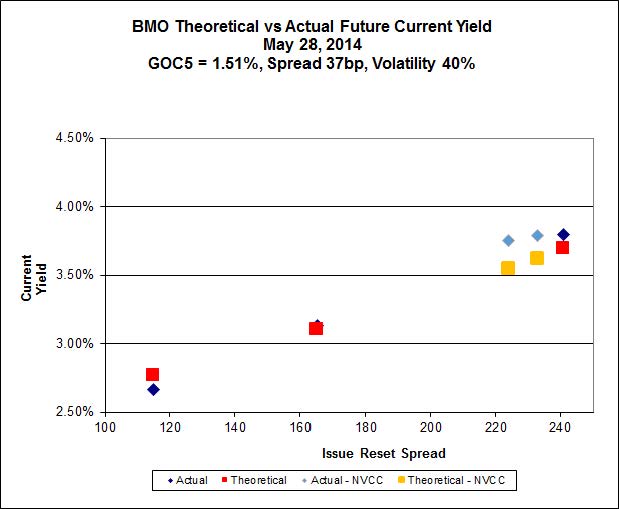
New Issue: BMO FixedReset, 4.00%+233, NVCC-Compliant

Bank of Montreal has announced:

an inaugural Basel III-compliant domestic public offering of $300 million of Non-Cumulative 5-year Rate Reset Class B Preferred Shares Series 27 (the “Preferred Shares Series 27”). The offering will be underwritten on a bought deal basis by a syndicate led by BMO Capital Markets. The Bank has granted to the underwriters an option to purchase up to an additional $50 million of the Preferred Shares Series 27 exercisable at any time up to two days before closing.

The Preferred Shares Series 27 will be issued to the public at a price of $25.00 per Preferred Share Series 27 and holders will be entitled to receive non-cumulative preferential fixed quarterly dividends for the initial period ending May 25, 2019 as and when declared by the board of directors of the Bank, payable in the amount of $0.25 per Preferred Share Series 27, to yield 4.00 per cent annually.

Subject to regulatory approval, on or after May 25, 2019, the Bank may redeem the Preferred Shares Series 27, in whole or in part at par. Thereafter, the dividend rate will reset every five years to be equal to the 5-Year Government of Canada Bond Yield plus 2.33 per cent. Subject to certain conditions, holders may elect to convert any or all of their Preferred Shares Series 27 into an equal number of Non-Cumulative Floating Rate Class B Preferred Shares Series 28 (“Preferred Shares Series 28”) on May 25, 2019 and on May 25 of every fifth year thereafter. Holders of the Preferred Shares Series 28 will be entitled to receive non-cumulative preferential floating rate quarterly dividends, as and when declared by the board of directors of the Bank, equal to the then 3-month Government of Canada Treasury Bill yield plus 2.33 per cent. Subject to certain conditions, holders may elect to convert any or all of their Preferred Shares Series 28 into an equal number of Preferred Shares Series 27 on May 25, 2024 and on May 25 of every fifth year thereafter.

The anticipated closing date is April 23, 2014. The net proceeds from the offering will be used by the Bank for general corporate purposes.

This was quickly followed up by:

Bank of Montreal (TSX:BMO)(NYSE:BMO) today announced that as a result of strong investor demand for its previously announced Basel III-compliant domestic public offering of $300 million of Non-Cumulative 5-year Rate Reset Class B Preferred Shares Series 27 (the “Preferred Shares Series 27”), the size of the offering has been increased to $500 million. As announced earlier today, the revised offering will be underwritten on a bought deal basis by a syndicate led by BMO Capital Markets.

To my chagrin, they did not announce the redemption of BMO.PR.O, a FixedReset, 6.50%+458 which is callable on May 25. Given the fat Issue Reset Spread, a call is as close to certain as one ever gets in this business … but I guess I’ll just have to keep checking their news releases every day.

The new issue is provisionally rated Pfd-2 by DBRS:

DBRS has today provisionally rated Bank of Montreal’s (the Bank) Non-Cumulative 5-Year Rate Reset Class B Preferred Shares, Series 27 (NVCC Preferred Shares Series 27 or Series 27) at Pfd-2 with a Stable trend.

DBRS assigned the NVCC Preferred Shares Series 27 a rating equal to the Bank’s intrinsic assessment less four rating notches because the Series 27 has only an Office of the Superintendent of Financial Institutions (OSFI)-compliant non-viable contingent capital (NVCC) trigger, which is consistent with the OSFI requirements for NVCC instruments, and no additional triggers.

The rating is consistent with DBRS’s criteria titled, “Rating Bank Capital Securities — Subordinated, Hybrid, Preferred & Contingent Capital Securities.”

… and P-2(low) by S&P:

Standard & Poor’s Ratings Services today said it assigned its ‘BBB-‘ global scale and ‘P-2(Low)’ Canada scale ratings to Bank of Montreal’s (BMO) C$300 million non-cumulative five-year rate reset class B preferred shares series 27. The issuer credit rating on BMO is A+/Stable/A-1.

The ‘BBB-/P-2(Low)’ ratings stand three notches below BMO’s stand-alone credit profile (SACP), incorporating:

  • •A deduction of two notches the minimum downward notching from the SACP under our criteria for hybrid capital instruments; and
  • •A deduction of an additional notch to reflect that the preferred shares feature a non-viability contingent conversion trigger provision. Should a trigger event occur (as defined by the Office of the Superintendent of Financial Institutions’ [OSFI] guideline for Capital Adequacy Requirements, Chapter 2), each preferred share outstanding will automatically and immediately be converted, without the holder’s consent, into a number of fully paid and freely tradable common shares of the bank determined in accordance with a conversion formula.
Issue Comments

LFE.PR.B Monthly Retraction Price

The calculation of the monthly retraction price stated in the Annual Information Form:

Except as noted below, holders of Preferred Shares whose Shares are surrendered for retraction will be entitled to receive a price per Share (the “Preferred Share Retraction Price”) equal to the sum of (i) the sum of (A) the lesser of (x) $10.00 and (y) 98% of the net asset value per Unit determined as of the Retraction Date, less in either case the cost to the Company of the purchase of a Class A Share in the market for cancellation and less any other applicable costs, plus (B) an amount equal to any accrued and unpaid dividends on each Preferred Share to but excluding the applicable Retraction Date, plus (ii) all declared and unpaid dividends (“Dividends Owing”) on a Preferred Share to be retracted to but excluding the applicable Retraction Date.

… differs from that specified in the prospectus:

Holders retracting a Preferred Share will be entitled to receive an amount per Preferred Share equal to the lesser of (i) $10.00; and (ii) 96% of the Net Asset Value determined as of the Retraction Date less the cost to the Company of the purchase of a Class A Share in the market for cancellation.

Complicating matters – there’s always a complication! – was the 2012 Capital Reorganization, in which:

amend the Articles of the Company to decrease the discount to net asset value applicable to monthly redemptions of shares from 4% to 2% and provide for the amount of this reduced discount to be paid to Quadravest, and not retained by the Company;

I sent an inquiry to the company:

I am concerned regarding the phrase ” less in either case ” found in the AIF version. If, for instance, there was a situation in which NAVPU was $12 and the market price of a Class A Share was $1, it would appear that this $1 for the Class A share would be deducted from ” (x) $10.00 ” and thus [assuming that amount (ii) = 0] the Preferred Share Retraction Price would be $9.00, whereas under the prospectus language, the Preferred Share Retraction Price would be $10.00.

To but it another way, the AIF phrase “less in either case” appears to apply to both case (x) and case (y), which differs from the prospectus language, unamended by the reorganization, and which doesn’t make a lot of sense anyway.

Can you clarify the calculation of the Preferred Share Retraction Price?

The company responded very quickly and efficiently:

Payment for LFE.PR.B shares retracted would be the lessor of (a) $10 or (b) 98% of the net asset value per unit, less the cost to buy a LFE share in the market for cancellation.

In your example below, based on a net asset value per unit of $12, the calculation (b) above would be: (98% x $12) less $1 = $10.76. Please note there could also be a maximum of 1% charged should the fund have to unwind securities in the event of a large volume of retractions in a particular month.

Therefore the lessor of (a) and (b) would still be $10.

I don’t expect the monthly retraction option to be viable unless there is another market crash, but it’s always nice to have these things nailed down in advance.

PrefLetter

April PrefLetter Released!

The April, 2014, edition of PrefLetter has been released and is now available for purchase as the “Previous edition”. Those who subscribe for a full year receive the “Previous edition” as a bonus.

The regular appendices reporting on DeemedRetractibles and FixedResets are included.

PrefLetter may now be purchased by all Canadian residents.

Until further notice, the “Previous Edition” will refer to the April, 2014, issue, while the “Next Edition” will be the May, 2014, issue, scheduled to be prepared as of the close May 9 and eMailed to subscribers prior to market-opening on May 12.

PrefLetter is intended for long term investors seeking issues to buy-and-hold. At least one recommendation from each of the major preferred share sectors is included and discussed.

It appears that the server problems that have bedevilled the site recently have been solved … well, perhaps, not so much ‘solved’ as ‘worked around’. If you deserve a link but did not get a link, please let me know.

Note: My verbosity has grown by such leaps and bounds that it is no longer possible to deliver PrefLetter as an eMail attachment – it’s just too big for my software! Instead, I have sent passwords – click on the link in your eMail and your copy will download.

Note: The PrefLetter website has a Subscriber Download Feature. If you have not received your copy, try it!

Note: PrefLetter eMails sometimes runs afoul of spam filters. If you have not received your copy within fifteen minutes of a release notice such as this one, please double check your (company’s) spam filtering policy and your spam repository – there are some hints in the post Sympatico Spam Filters out of Control. If it’s not there, contact me and I’ll get you your copy … somehow!

Note: There have been scattered complaints regarding inability to open PrefLetter in Acrobat Reader, despite my practice of including myself on the subscription list and immediately checking the copy received. I have had the occasional difficulty reading US Government documents, which I was able to resolve by downloading and installing the latest version of Adobe Reader. Also, note that so far, all complaints have been from users of Yahoo Mail. Try saving it to disk first, before attempting to open it.

Note: There have been other scattered complaints that double-clicking on the links in the “PrefLetter Download” email results in a message that the password has already been used. I have been able to reproduce this problem in my own eMail software … the problem is double-clicking. What happens is the first click opens the link and the second click finds that the password has already been used and refuses to work properly. So the moral of the story is: Don’t be a dick! Single Click!

Note: Assiduous Reader DG informs me:

In case you have any other Apple users: you need to install a free App from the apple store called “FileApp”. It comes with it’s own tutorial and allows you to download and save a PDF file.

Issue Comments

BK.PR.A 2013 Annual Report

Canadian Banc Corp. has released its Annual Report to November 30, 2013.

BK / BK.PR.A Performance
Instrument One
Year
Three
Years
Five
Years
Whole Unit +18.69% +9.18% +14.91%
BK +32.42% +13.51% +26.83%
BK.PR.A +5.12% +5.12% +5.12%
S&P/TSX Financial Index +25.17% +12.64% +15.34%

Figures of interest are:

MER: 1.43% of the whole unit value, excluding one time initial offering expenses.

Average Net Assets: We need this to calculate portfolio yield; unfortunately the number of units changesd, which makes it more approximate. The Total Assets of the fund at year end was $134.0-million, compared to $129.5-million a year prior, so call it an average of $132.25-million. Total Preferred Share Distribution in 2013 was $3.152-million, at $0.50/share implies an average of 6.304-million units, at an average NAV of ((22.33 + 19.93) / 2 = 20.83, so call it $131.3-million. Close enough! Call the Average Net Assets $132-million.

Underlying Portfolio Yield: Investment income of $4.905-million received divided by average net assets of $132-million is 3.7%.

Income Coverage: Net investment income of $4.905-million less expenses before issuance fees of $1.868-million is $3.038-million, to cover preferred dividends of 3.152-million is about 96%.

Issue Comments

FFN.PR.A to Vote on Term Extension

Financial 15 Split Corp. II has announced:

that a special meeting of shareholders will be held at 12:00 p.m. (Eastern standard time) on May 14, 2014.

The primary purpose of the meeting is to consider a special resolution to allow shareholders to continue their investment beyond the currently scheduled termination date of December 1, 2014. Under the primary proposal, the initial termination date would be extended by 5 years to December 1, 2019 (subject to further extensions of 5 years each thereafter).

Full details of the meeting will be contained in the Notice of Meeting and Management Information Circular which will be mailed on April 17, 2014 to all shareholders of record on April 9, 2014.

The Company invests in a high quality portfolio consisting of 15 financial services companies made up of Canadian and U.S. issuers as follows: Bank of Montreal, The Bank of Nova Scotia, Canadian Imperial Bank of Commerce, Royal Bank of Canada, Toronto-Dominion Bank, National Bank of Canada, Manulife Financial Corporation, Sun Life Financial, Great-West Lifeco, CI Financial Income Fund, Bank of America, Citigroup Inc., Goldman Sachs Group, JP Morgan Chase & Co. and Wells Fargo & Co.

I will discuss the matter further when more details are available.

Issue Comments

FTN.PR.A to Vote on Term Extension

Financial 15 Split Corp has announced:

that a special meeting of shareholders will be held at 11:30 a.m. (Eastern standard time) on May 14, 2014.

The primary purpose of the meeting is to consider a special resolution to allow shareholders to continue their investment beyond the currently scheduled termination date of December 1, 2015. Under the primary proposal, the initial termination date would be extended by 5 years to December 1, 2020 (subject to further extensions of 5 years each thereafter).

Full details of the meeting will be contained in the Notice of Meeting and Management Information Circular which will be mailed on April 17, 2014 to all shareholders of record on April 9, 2014.

The Company invests in a high quality portfolio consisting of 15 financial services companies made up of Canadian and U.S. issuers as follows: Bank of Montreal, The Bank of Nova Scotia, Canadian Imperial Bank of Commerce, Royal Bank of Canada, Toronto-Dominion Bank, National Bank of Canada, Manulife Financial Corporation, Sun Life Financial, Great-West Lifeco, CI Financial Income Fund, Bank of America, Citigroup Inc., Goldman Sachs Group, JP Morgan Chase & Co. and Wells Fargo & Co.

I will discuss this vote further when more details become available.

Issue Comments

DF.PR.A 2013 Annual Report

Dividend 15 Split Corp. II has released its Annual Report to November 30, 2013.

DF / DF.PR.A Performance
Instrument One
Year
Three
Years
Five
Years
Whole Unit +22.09% +11.10% +13.73%
DF.PR.A +5.38% +5.38% +5.38%
DF +56.13% +21.48% 29.46%
S&P/TSX 60 Index +13.40% +4.36% +9.65%

Using the S&P TSX 60 index rather than “Dividend Aristocrats” seems a little odd to me – but we’ll let them choose their benchmark!

Figures of interest are:

MER: 1.28% of the whole unit value (estimated from 2012 values; the 2013 figure is not comparable due to a secondary share offering that spanned 2013 year end).

Average Net Assets: We need this to calculate portfolio yield. No change in Number of Units Outstanding, so the average of the beginning and end of year figures can be used: $81.2-million

Underlying Portfolio Yield: Dividends received of 3,075,803 divided by average net assets of 81.2-million is 3.8%

Income Coverage: Net Investment Income of 1,757,682 divided by Preferred Share Distributions of 2,670,393 is 66%.

Market Action

April 11, 2014

5Banc Split Inc., proud issuer of FBS.PR.C, was confirmed at Pfd-2 by DBRS:

The Preferred Shares pay a quarterly fixed, cumulative, preferential distribution of $0.11875 per Preferred Share yielding 4.75% per annum on their initial issue price. Based on the current dividend yields on the underlying banks, the Preferred Share dividend coverage ratio is approximately 2.2 times. Holders of the Capital Shares are expected to receive all excess dividend income after the Preferred Share distributions and other expenses of the Company have been paid.

Since the rating was upgraded in April 2013, the Company’s performance has been positive, with net asset values increasing steadily. Downside protection available to holders of the Preferred Shares was 68.6% as of April 3, 2014.

It was a mixed day for the Canadian preferred share market, with PerpetualDiscounts gaining 3bp, while FixedResets and DeemedRetractibles were both off 5bp. Volatility was minimal. Volume was low, but the highlights are comprised entirely of FixedResets.

HIMIPref™ Preferred Indices
These values reflect the December 2008 revision of the HIMIPref™ Indices

Values are provisional and are finalized monthly
Index Mean
Current
Yield
(at bid)
Median
YTW
Median
Average
Trading
Value
Median
Mod Dur
(YTW)
Issues Day’s Perf. Index Value
Ratchet 0.00 % 0.00 % 0 0.00 0 0.3830 % 2,452.4
FixedFloater 4.71 % 4.25 % 34,316 17.96 1 0.3810 % 3,647.3
Floater 2.97 % 3.09 % 49,764 19.53 4 0.3830 % 2,647.9
OpRet 4.36 % -4.15 % 32,066 0.14 2 -0.0388 % 2,691.1
SplitShare 4.81 % 4.42 % 60,253 4.25 5 0.0239 % 3,084.9
Interest-Bearing 0.00 % 0.00 % 0 0.00 0 -0.0388 % 2,460.7
Perpetual-Premium 5.54 % -5.86 % 106,003 0.09 13 0.0181 % 2,386.6
Perpetual-Discount 5.43 % 5.36 % 122,435 14.60 23 0.0262 % 2,483.7
FixedReset 4.68 % 3.63 % 203,923 4.20 79 -0.0484 % 2,531.4
Deemed-Retractible 5.03 % -0.19 % 146,820 0.13 42 -0.0469 % 2,489.9
FloatingReset 2.64 % 2.46 % 206,782 4.11 5 0.0159 % 2,480.2
Performance Highlights
Issue Index Change Notes
BAM.PR.X FixedReset 1.12 % YTW SCENARIO
Maturity Type : Limit Maturity
Maturity Date : 2044-04-11
Maturity Price : 21.36
Evaluated at bid price : 21.67
Bid-YTW : 4.20 %
PWF.PR.A Floater 1.70 % YTW SCENARIO
Maturity Type : Limit Maturity
Maturity Date : 2044-04-11
Maturity Price : 19.75
Evaluated at bid price : 19.75
Bid-YTW : 2.68 %
Volume Highlights
Issue Index Shares
Traded
Notes
BAM.PR.R FixedReset 189,665 RBC crossed blocks of 140,800 and 25,000, both at 25.30.
YTW SCENARIO
Maturity Type : Limit Maturity
Maturity Date : 2044-04-11
Maturity Price : 23.65
Evaluated at bid price : 25.33
Bid-YTW : 3.96 %
TRP.PR.E FixedReset 101,900 Scotia crossed 80,000 at 25.45.
YTW SCENARIO
Maturity Type : Limit Maturity
Maturity Date : 2044-04-11
Maturity Price : 23.26
Evaluated at bid price : 25.42
Bid-YTW : 3.86 %
RY.PR.Z FixedReset 57,135 TD crossed 50,000 at 25.65.
YTW SCENARIO
Maturity Type : Call
Maturity Date : 2019-05-24
Maturity Price : 25.00
Evaluated at bid price : 25.64
Bid-YTW : 3.63 %
MFC.PR.L FixedReset 53,680 Nesbitt crossed 50,000 at 24.80.
YTW SCENARIO
Maturity Type : Hard Maturity
Maturity Date : 2025-01-31
Maturity Price : 25.00
Evaluated at bid price : 24.81
Bid-YTW : 4.02 %
BNS.PR.Z FixedReset 37,683 TD crossed 25,000 at 24.37.
YTW SCENARIO
Maturity Type : Hard Maturity
Maturity Date : 2022-01-31
Maturity Price : 25.00
Evaluated at bid price : 24.36
Bid-YTW : 3.53 %
BAM.PR.X FixedReset 34,899 RBC crossed 30,200 at 21.60.
YTW SCENARIO
Maturity Type : Limit Maturity
Maturity Date : 2044-04-11
Maturity Price : 21.36
Evaluated at bid price : 21.67
Bid-YTW : 4.20 %
There were 18 other index-included issues trading in excess of 10,000 shares.
Wide Spread Highlights
Issue Index Quote Data and Yield Notes
BAM.PR.R FixedReset Quote: 25.33 – 25.55
Spot Rate : 0.2200
Average : 0.1356

YTW SCENARIO
Maturity Type : Limit Maturity
Maturity Date : 2044-04-11
Maturity Price : 23.65
Evaluated at bid price : 25.33
Bid-YTW : 3.96 %

CU.PR.G Perpetual-Discount Quote: 21.80 – 22.10
Spot Rate : 0.3000
Average : 0.2218

YTW SCENARIO
Maturity Type : Limit Maturity
Maturity Date : 2044-04-11
Maturity Price : 21.51
Evaluated at bid price : 21.80
Bid-YTW : 5.21 %

IAG.PR.E Deemed-Retractible Quote: 26.07 – 26.25
Spot Rate : 0.1800
Average : 0.1198

YTW SCENARIO
Maturity Type : Call
Maturity Date : 2017-12-31
Maturity Price : 25.25
Evaluated at bid price : 26.07
Bid-YTW : 5.06 %

GWO.PR.H Deemed-Retractible Quote: 23.01 – 23.25
Spot Rate : 0.2400
Average : 0.1811

YTW SCENARIO
Maturity Type : Hard Maturity
Maturity Date : 2025-01-31
Maturity Price : 25.00
Evaluated at bid price : 23.01
Bid-YTW : 5.91 %

FTS.PR.F Perpetual-Discount Quote: 24.30 – 24.47
Spot Rate : 0.1700
Average : 0.1127

YTW SCENARIO
Maturity Type : Limit Maturity
Maturity Date : 2044-04-11
Maturity Price : 24.00
Evaluated at bid price : 24.30
Bid-YTW : 5.09 %

IFC.PR.C FixedReset Quote: 25.70 – 25.99
Spot Rate : 0.2900
Average : 0.2336

YTW SCENARIO
Maturity Type : Call
Maturity Date : 2016-09-30
Maturity Price : 25.00
Evaluated at bid price : 25.70
Bid-YTW : 3.08 %

Market Action

April 10, 2014

Let’s all give three cheers for increased regulation:

New rules aimed at making the world safer from blowups in the $693 trillion derivatives market are poised to drive up costs so much for retirement funds and other users that bankers say they do just the opposite.

The toughened standards, hatched five years ago after derivative losses almost crashed the global economy, are meant to safeguard trades and bring more openness to a market whose secrecy and sheer size overwhelmed regulators in 2008. Where swaps had been one-on-one deals before, now they would be backstopped by third parties in clearinghouses that ensure everyone can pay, with the aim of avoiding emergency bailouts and panic.

Rules being finalized by the Basel Committee on Banking Supervision in Switzerland will require banks to set aside more money in the event the swaps go bad. And not just a little bit more — as much as 92 times, or 9,100 percent, more, according to calculations by three banks shared with Bloomberg News. The higher costs in turn may cause market participants to flee rather than take advantage of the clearinghouses, making it more difficult for those third-party guarantors.

Since banks act as customers’ gatekeepers to the clearinghouses, the Basel committee wants them to protect themselves — and the global financial system — by matching every dollar they contribute to the default fund with a dollar of capital.

If the rules were adopted, swaps dealers say that only the wealthiest investors would be able to use clearinghouses. Fewer members would mean eroded financial support for the clearinghouses, which are the last backstop before losses are borne by taxpayers.

Executives in a bank’s treasury department don’t allocate the firm’s money to trading desks without a guarantee that the profit on it will be about 10 percent to 15 percent a year after taxes, depending on the bank. In many cases, banks earn these returns by charging fees to clients.

In one bank’s internal model, a $100 million interest-rate swap between a dealer and its customer prior to the new Basel proposal would have meant that, before taxes, $14,750 in capital had to be set aside.

When the bank’s trading desk asks the firm’s treasury for $14,750 as part of the trade, the traders would have to earn $3,404 per year before taxes for as long as the swap was active. That’s in the old days.

The same $100 million swap would look different under the new proposal. As part of accepting that trade, the clearinghouse would require the bank to deposit $1.2 million into its default fund. Under the Basel committee proposal, the bank would have to have $1.2 million more capital.

According to the dealer bank, it would be required to generate more than $276,000 a year before taxes for that amount of capital. When charges such as the cost of funding and others are added to the trade, the tab balloons to $307,327 a year, the dealer said.

Fortunately, these new rules have been softened:

The Basel Committee on Banking Supervision’s final rule, released today, would require swaps dealers to hold less cash to protect against defaults than did a proposal published last year. The plan now applies a minimum 20 percent risk weighting to money deposited at clearinghouses, which are third parties that guarantee the transactions, down from 1,250 percent in the original proposal. The change takes effect on Jan. 1, 2017.

But central clearing is still a dumb idea.

Here’s yet another indicator that the HFT panic is a marketing gimmick:

Royal Bank has emerged as a leader against predatory high-frequency trading at a time of increasing scrutiny from both regulators and the public after the release of Lewis’s book, which claims the stock market is “rigged” against investors. The bank is described by Lewis as fostering an “RBC nice” culture with its “no asshole rule” on hiring.

High-frequency trading isn’t inherently good or bad, Mills said. The problem arises when certain market players use technology to take advantage of others.

“That’s what we need as an industry, to see regulation mature to the point where it can begin to eliminate those predatory practices, and that’s where we’ll level the playing field,” Mills said in a telephone interview yesterday.

Royal Bank, along with seven partners, owns a stake in and helped found Aequitas, a market with similar goals to IEX. The Toronto-based bank is Canada’s second-largest lender by assets.

“One thing that’s clear is that RBC is the common denominator between IEX and Aequitas,” said Jos Schmitt, chief executive officer at Toronto-based Aequitas, in an April 1 interview at the company’s headquarters in Royal Bank Plaza. “It tells you something about where they come from, what they stand for and what they seek to achieve. They translated that to being the spark in a change on Wall Street and on Bay Street.”

High-frequency trading firms have been accused of ripping off investors in the $22 trillion U.S. stock market by using tactics including paying for the right to trade in dark pools and placing their servers as close to the exchange as possible to speed up trading.

Royal Bank saw what its competitors were doing and decided to go in a different direction, Mills said.

I’ve been saying for a while that the economy’s still no good, and that while government yields are clearly unsustainable, there is not yet a clear trigger of impending doom. Looks like there’s some support for that idea:

Federal Reserve Chair Janet Yellen and her international counterparts are suffering from a case of what psychologists call confirmation bias: They keep insisting inflation will accelerate even as it continues to ebb.

That’s the diagnosis of Ethan Harris, co-head of global economics research at Bank of America Corp. in New York. He says central bankers are seeing what they want to see by blaming subpar inflation in their countries on temporary, partly home-grown forces. That risks ignoring more lasting, global influences ranging from weak worldwide demand and more emerging-market competition to cheap labor in developing nations, cooling commodity prices and technological breakthroughs.

“There is much lower-than-expected inflation showing up in too many places in the world to dismiss it as transitory,” said Allen Sinai, chief executive officer at consultant Decision Economics Inc. in New York.

Almost two-thirds of the 121 economies tracked by Bloomberg are experiencing smaller gains in consumer prices than a year ago, with many undershooting their goals. Global inflation was just 2 percent in February, the lowest since late 2009, when the world was struggling with recession, according to a tally by economists at JPMorgan Chase & Co.

Greece and Ireland were in the bond market today:

Italian bonds gained for a second day and Belgian, French and German securities also rallied. Greek bonds fell, pushing 10-year yields up from near the lowest level since February 2010, as the nation agreed to sell 3 billion euros ($4.17 billion) of five-year notes via banks. Greece received about 600 orders for a total of around 20 billion euros, a person familiar with the sale said. Ireland auctioned 1 billion euros of 10-year debt at a record-low yield.

“Bond markets have woken up on a positive note on the back of a dovish set of Fed minutes,” said Richard McGuire, a fixed-income strategist at Rabobank International in London. “This is a classic case of an improving liquidity outlook raising all boats. The strong demand for Greece’s five-year issue is symptomatic of a positive liquidity outlook trumping more fundamental concern.”

It was another positive day for the Canadian preferred share market, with PerpetualDiscounts winning 16bp, FixedResets up 5bp and DeemedRetractibles gaining 2bp. It is interesting to note that the median YTW on DeemedRetractibles remained negative for the second straight day and the fifth time on record, joining 2012-12-28, 2013-1-4 and 2013-1-10. Volatility was negligible. Volume was below average.

HIMIPref™ Preferred Indices
These values reflect the December 2008 revision of the HIMIPref™ Indices

Values are provisional and are finalized monthly
Index Mean
Current
Yield
(at bid)
Median
YTW
Median
Average
Trading
Value
Median
Mod Dur
(YTW)
Issues Day’s Perf. Index Value
Ratchet 0.00 % 0.00 % 0 0.00 0 -0.5222 % 2,443.1
FixedFloater 4.67 % 3.96 % 35,745 17.45 1 0.0000 % 3,633.5
Floater 2.98 % 3.08 % 49,680 19.55 4 -0.5222 % 2,637.8
OpRet 4.36 % -4.07 % 33,382 0.14 2 -0.0969 % 2,692.1
SplitShare 4.81 % 4.41 % 62,652 4.26 5 -0.1588 % 3,084.2
Interest-Bearing 0.00 % 0.00 % 0 0.00 0 -0.0969 % 2,461.7
Perpetual-Premium 5.54 % -6.57 % 102,763 0.09 13 0.0030 % 2,386.2
Perpetual-Discount 5.43 % 5.37 % 123,448 14.61 23 0.1557 % 2,483.0
FixedReset 4.68 % 3.64 % 210,169 4.20 79 0.0530 % 2,532.6
Deemed-Retractible 5.03 % -0.19 % 146,496 0.13 42 0.0211 % 2,491.1
FloatingReset 2.63 % 2.38 % 213,546 4.12 5 -0.0239 % 2,479.8
Performance Highlights
Issue Index Change Notes
BAM.PR.K Floater -1.22 % YTW SCENARIO
Maturity Type : Limit Maturity
Maturity Date : 2044-04-10
Maturity Price : 16.94
Evaluated at bid price : 16.94
Bid-YTW : 3.11 %
SLF.PR.G FixedReset 1.02 % YTW SCENARIO
Maturity Type : Hard Maturity
Maturity Date : 2025-01-31
Maturity Price : 25.00
Evaluated at bid price : 22.81
Bid-YTW : 4.33 %
Volume Highlights
Issue Index Shares
Traded
Notes
TRP.PR.E FixedReset 252,250 Scotia crossed one block of 50,000 and two of 100,000 each, all at 25.45.
YTW SCENARIO
Maturity Type : Call
Maturity Date : 2019-10-30
Maturity Price : 25.00
Evaluated at bid price : 25.43
Bid-YTW : 3.88 %
TRP.PR.A FixedReset 68,622 Nesbitt crossed 50,000 at 23.75.
YTW SCENARIO
Maturity Type : Limit Maturity
Maturity Date : 2044-04-10
Maturity Price : 22.95
Evaluated at bid price : 23.60
Bid-YTW : 3.87 %
RY.PR.I FixedReset 59,705 RBC crossed 50,000 at 25.60.
YTW SCENARIO
Maturity Type : Call
Maturity Date : 2019-02-24
Maturity Price : 25.00
Evaluated at bid price : 25.60
Bid-YTW : 3.10 %
TRP.PR.B FixedReset 55,765 Nesbitt crossed 50,000 at 20.65.
YTW SCENARIO
Maturity Type : Limit Maturity
Maturity Date : 2044-04-10
Maturity Price : 20.61
Evaluated at bid price : 20.61
Bid-YTW : 3.74 %
BAM.PR.R FixedReset 52,959 RBC crossed 49,900 at 25.30.
YTW SCENARIO
Maturity Type : Limit Maturity
Maturity Date : 2044-04-10
Maturity Price : 23.64
Evaluated at bid price : 25.30
Bid-YTW : 4.04 %
TD.PR.T FloatingReset 42,475 Scotia crossed 40,000 at 24.95.
YTW SCENARIO
Maturity Type : Call
Maturity Date : 2018-07-31
Maturity Price : 25.00
Evaluated at bid price : 24.97
Bid-YTW : 2.51 %
There were 28 other index-included issues trading in excess of 10,000 shares.
Wide Spread Highlights
Issue Index Quote Data and Yield Notes
ENB.PR.D FixedReset Quote: 24.41 – 24.70
Spot Rate : 0.2900
Average : 0.1746

YTW SCENARIO
Maturity Type : Limit Maturity
Maturity Date : 2044-04-10
Maturity Price : 23.04
Evaluated at bid price : 24.41
Bid-YTW : 4.13 %

CU.PR.E Perpetual-Discount Quote: 23.79 – 24.23
Spot Rate : 0.4400
Average : 0.3289

YTW SCENARIO
Maturity Type : Limit Maturity
Maturity Date : 2044-04-10
Maturity Price : 23.44
Evaluated at bid price : 23.79
Bid-YTW : 5.20 %

CU.PR.C FixedReset Quote: 25.66 – 25.99
Spot Rate : 0.3300
Average : 0.2316

YTW SCENARIO
Maturity Type : Call
Maturity Date : 2017-06-01
Maturity Price : 25.00
Evaluated at bid price : 25.66
Bid-YTW : 3.27 %

PWF.PR.A Floater Quote: 19.42 – 20.00
Spot Rate : 0.5800
Average : 0.4991

YTW SCENARIO
Maturity Type : Limit Maturity
Maturity Date : 2044-04-10
Maturity Price : 19.42
Evaluated at bid price : 19.42
Bid-YTW : 2.72 %

BNS.PR.P FixedReset Quote: 25.15 – 25.35
Spot Rate : 0.2000
Average : 0.1222

YTW SCENARIO
Maturity Type : Call
Maturity Date : 2018-04-25
Maturity Price : 25.00
Evaluated at bid price : 25.15
Bid-YTW : 3.15 %

MFC.PR.L FixedReset Quote: 24.74 – 24.92
Spot Rate : 0.1800
Average : 0.1093

YTW SCENARIO
Maturity Type : Hard Maturity
Maturity Date : 2025-01-31
Maturity Price : 25.00
Evaluated at bid price : 24.74
Bid-YTW : 4.09 %

PrefLetter

PrefLetter.com Unaffected by "Heartbleed" Vulnerability

Many people will have heard of the so-called “Heartbleed Vulnerability” that has afflicted many organizations:

The plain truth is that many organizations spend far more on touting their wares and services online and making their web sites as user friendly as possible than they do on safeguarding information. The Heartbleed bug underscores the dangers that lurk in the underbrush, ready to ambush even the most sophisticated of Internet players. And it ought to prompt much more serious investment in strong security measures and the capacity to quickly detect flaws and squelch breaches.

Unlike the malware attack that resulted in the stunning theft from Target Corp. of about 40 million payment card numbers and some 70 million customer records, the Heartbleed bug was not concocted by some clever teenage hacker for criminal clients. It’s a critical software programming glitch in a data encription standard called OpenSSL, one that has existed for the past two years. OpenSSL is widely used to safeguard traffic between web users and a vast number of servers storing data for a majority of web sites.

This has extended even to the Canada Revenue Agency:

A major cybersecurity flaw that exposes encrypted information to hackers has forced the Canada Revenue Agency to shut down its filing system and push back the deadline for online returns.

I am pleased to advise that as part of the migration of PrefLetter to a new server, the operating system changed from Linux to MS-Windows. Windows is unaffected by the Heartbleed Vulnerability:

Windows comes with its own encryption component called Secure Channel (a.k.a. SChannel), which is not susceptible to the Heartbleed vulnerability.