Banking Crisis 2008

IMF: World Economic Outlook, October 2008

This would have been a better post yesterday, but I’ve never claimed to be much good at market timing!

The IMF has published its World Economic Outlook, October 2008, Financial Stress, Downturns, and Recoveries. There’s some very interesting data in Chapter Four, discussing “The Current Financial Crisis in Historical Context”.

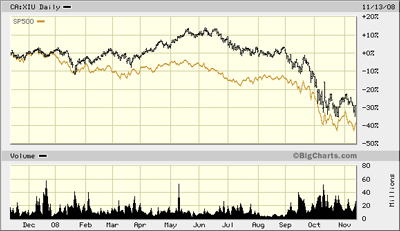
The global nature of the crisis as illustrated by this report has been discussed on FT-Alphaville on November 3, so I won’t repeat that stuff. Instead, I’ll show a chart of XIU vs. the S&P 500 for the past year:
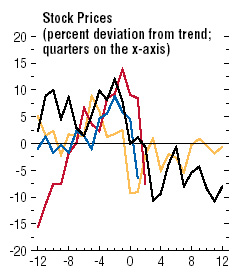
… and the IMF chart of equity returns …
… and a table from Stock Market Bubbles: Some Historical Perspective, by Achla Marathe and Edward Renshaw:

Declines of Three Percent or More in the S&P 500 Stock Price Index After it
Has Achieved a New All Time High Since September 7, 1929


                                          % Change S&P
      Date of         Value S&P Index   -----------------------------------------       Trading
-------------------   ---------------    Peak to   Peak to                            Day
   Peak      Trough    Peak    Trough    Peak      Trough      Duration
                        (1)      (2)      (3)        (4)       (5)n

 9/ 7/29    6/ 1/32   31.92     4.40**    ---      -86.2

10/ 6/54   10/29/54   32.76    31.68      2.6      - 3.3        10
 1/ 3/55    1/17/55   36.75    34.58     12.2$     - 5.9#       40H
 3/ 4/55    3/14/55   37.52    34.96      2.1$     - 6.8        19
 4/21/55    5/17/55   38.32*   36.97      2.1      - 3.5         7
 7/27/55    8/10/55   43.76    41.74     14.2      - 4.6#       37
 9/23/55   10/11/55   45.63    40.80      4.3      -10.6        13
11/14/55    1/23/56   46.41    43.11      1.7$     - 7.1         0
 3/20/56    5/28/56   48.87    44.10      5.3$     - 9.8         7
 8/ 2/56   10/22/57   49.74    38.98**    1.8      -21.6        13

11/17/58   11/25/58   53.24    51.02      7.0      - 4.2#       37
 1/21/59    2/ 9/59   56.04    53.58      5.3$     - 4.4#       27
 5/29/59    6/10/59   58.68    56.36      4.7      - 4.0#       61H
 8/ 3/59   10/25/60   60.71*   52.30**    3.5      -13.9        22

 4/17/61    4/24/61   66.68    64.40      9.8      - 3.4#       54H
 5/17/61    7/18/61   67.39E   64.41D     1.1      - 4.4         2
 9/ 6/61    9/25/61   68.46E   65.77D     1.6      - 3.9        22
12/12/61    6/26/62   72.64E*  52.32D**   6.1      -28.0        35

10/28/63   11/22/63   74.48    69.61      2.5      - 6.5        39
 5/12/64    6/ 8/64   81.16    78.64      9.0      - 3.1#      101H
 7/17/64    8/26/64   84.01    81.32      3.5      - 3.2#       15
11/20/64   12/15/64   86.28*   83.22      2.7      - 3.5        17
 5/13/65    6/28/65   90.27    81.60      4.6      - 9.6        81
 2/ 9/66   10/ 7/66   94.06    73.20**    4.2      -22.2        94

 5/ 8/67    6/ 5/67   94.58    88.43       .6      - 6.5         2
 8/ 4/67    8/28/67   95.83    92.64      1.3      - 3.3         4
 9/25/67    3/ 5/68   97.59    87.72      1.8$     -10.1         8
 7/11/68    8/ 2/68  102.39*   96.63      4.9      - 5.6        44H
11/29/68    5/26/70  108.37    69.29**    5.8      -36.1        38

 4/12/72    5/ 9/72  110.18   104.74D     1.7      - 4.9        24
 5/26/72    7/20/72  110.66   105.81D      .4      - 4.4         2
 8/14/72   10/16/72  112.55   106.77D     1.7      - 5.1         4
12/11/72   12/21/72  119.12*  115.11D     5.8      - 3.4#       26H
 1/11/73P  10/ 3/74  120.24    62.28D**    .9      -48.2         6
 8/22/80P   8/28/80  126.02   122.08      4.8$     - 3.1#       26H
 9/22/80P   9/29/80  130.40   123.54      3.5$     - 5.3        13
10/15/80P  10/30/80  133.70   126.29      2.5$     - 5.5         7
11/28/80P   8/12/82  140.52*  102.42**    5.1$     -27.1        11

11/ 9/82   11/23/82  143.02   132.93      1.8$     - 7.1         4
 1/10/83    1/24/83  146.78   139.97      2.6$     - 4.6         2
 6/22/83    8/ 8/83  170.99   159.18     16.5      - 6.9#       94H
10/10/83    7/24/84  172.65*  147.82**    1.0$     -14.4         0

 2/13/85    3/15/85  183.35   176.53      6.2$     - 3.7#       17
 6/ 6/85    6/13/85  191.06   185.33      4.2      - 3.0#       29
 7/17/85    9/25/85  195.65   180.66      2.4      - 7.7        13
 1/ 7/86    1/22/86  213.80*  203.49      9.3$     - 4.8#       37
 3/27/86    4/ 7/86  238.97   228.63     11.8      - 4.3#       37
 4/21/86    5/16/86  244.74   232.76      2.4$     - 4.9         3
 5/29/86    6/10/86  247.98   239.58      1.3$     - 3.4         2
 7/ 2/86    7/15/86  252.70   233.66      1.9      - 7.5         5
 9/ 4/86    9/29/86  253.83   229.91       .4$     - 9.4         6
12/ 2/86   12/31/86  254.00   242.17       .1$     - 4.7         0
 3/24/87    3/30/87  301.64   289.20     18.8      - 4.1#       53H
 4/ 6/87    5/20/87  301.95   278.21D      .1      - 7.9         0
 8/25/87   12/ 4/87  336.77   223.92**   11.5      -33.5        50

 9/ 1/89    9/14/89  353.73   343.16      5.0$     - 3.0#       27H
10/ 9/89    1/30/90  359.80   322.98      1.7$     -10.2         4
 6/ 4/90P   6/26/90  367.40   352.06      2.1$     - 4.2         4
 7/16/90P  10/11/90  368.95*  295.46**     .4      -19.9         0

 4/17/91    5/15/91  390.45   368.57      5.8      - 5.6#       43
 8/ 6/91    8/19/91  390.62   376.47       .0$     - 3.6         0
 8/28/91   10/ 9/91  396.64   376.80      1.5      - 5.0         4
11/13/91   11/29/91  397.41E* 375.22       .2      - 5.6         1
 1/15/92    4/ 8/92  420.77E  394.50      5.9      - 6.2        14
 8/ 3/92    8/24/92  425.09E  410.72      1.0$     - 3.4         3
 9/14/92   10/ 9/92  425.27E  402.66D      .0$     - 5.3         0
 2/ 4/93    2/18/93  449.56E  431.90      5.7      - 3.9#       51
 3/10/93    4/26/93  456.33E  433.54D     1.5$     - 5.0         2
 2/ 2/94    4/ 4/94  482.00E  438.92D     5.6      - 8.9       116
12/13/95    1/10/96  621.69   598.48D    29.0      - 3.7#      210H
 2/12/96    4/11/96  661.45   631.18D     6.4      - 4.6#       10
 5/24/96    7/24/96  678.51   626.65D     2.6$     - 7.6         9
11/18/96   12/16/96  757.03   720.98D    15.1G$    - 4.8#       51
 2/18/97             816.29         D     7.8G         ?        26

Footnotes for Table 20.1

(5)n. Number of additional trading days after the recovery to a first new
high to the last new high or peak date.

* Fourth new high to be followed by a three percent decline for the bull
market in question.

**A major bear market low.

$ identifies cases where the first new high was associated with a daily gain
of 1.1 percent or more.

#Cases where the peak to trough decline in column (4) is less than the
preceding peak to peak increase in column (3).

D identifies cases where the first new high occurred after a month when the
dividend yield for the S&P index was equal to 3.0 percent or less.

E identifies cases where the first new high occurred after a quarter when
the P/E ratio for the S&P index was equal to 20.50 or more.

G identifies peak to peak gains that may have encouraged Fed Chairman Alan
Greenspan to warn investors about the possibility of irrational exuberance.

H identifies the trading day duration record, without a cumulative decline
of three percent or more, for each bull market separated by cumulative
declines of 13 percent or more.

P identifies declines of three percent or more that occurred during years
containing a recessionary peak designated by the National Bureau of Economic
Research.

Source of basic data: The Practical Forecasters’ Almanac(Burr Ridge,
Illinois: Irwin, 1992), Table 3.05 and Standard and Poor’s Security
Price Index Record
.

Update: See also this source:

S&P 500 Index:

March 24, 2000 closes at 1527.46 (Peak)
July 23, 2002 closes at 797.70 (Trough)
Percentage decline from Peak to Trough: 47.78%

and

from FAC Wealth Management.

Market Action

November 12, 2008

The Fed and other US regulators have released a motherhood statement on banking practices:

  • DO lend to your regular customers
  • DON’T pay excessive dividends
  • DON’T be unnecessarily mean to delinquent mortgagees
  • DON’T pay dumb bonuses to management

A nod’s as good as a wink to a blind man, eh?

On September 25 I predicted that TARP would fail for the same reason MLEC failed: disagreement over valuation of assets. So I pleased to see that Paulson has abandoned the asset-buying idea:

U.S. Secretary Henry Paulson plans to use the second half of the $700 billion financial rescue program to help relieve pressures on consumer credit, scrapping an effort to buy devalued mortgage assets.

Paulson’s remarks are an acknowledgement that the centerpiece of the $700 billion bailout request to lawmakers was ill-conceived. Neel Kashkari, the Treasury official who heads the rescue program, told legislators last month that officials shifted to buying stakes in banks because it was a faster way revive capital markets and the economy.

“I will never apologize for changing a strategy or an approach if the facts change,” Paulson said.

The nice part about being part of a lame-duck administration – or working out your notice at McDonalds, or whatever – is the joyous feeling of being able to tell the truth and behave intelligently! Accrued Interest mourns the plan’s failure.

Spend-every-Penny has announced a $50-billion mortgage swap with Canadian Banks:

The Honourable Jim Flaherty, Minister of Finance, today announced the Government will purchase up to an additional $50 billion of insured mortgage pools by the end of the fiscal year as part of its ongoing efforts to maintain the availability of longer-term credit in Canada.

This action will increase to $75 billion the maximum value of securities purchased through Canada Mortgage and Housing Corporation (CMHC) under this program.

Also announced was:

Jon Danielsson reviews the Icelandic situation on VoxEU:

A third of the population is considering emigration.

Does anybody remember Richard Rohmer’s book, Exodus UK?

The first main cause of the crisis was the use of inflation targeting. Throughout the period of inflation targeting, inflation was generally above its target rate. In response, the central bank keep rates high, exceeding 15% at times.

In a small economy like Iceland, high interest rates encourage domestic firms and households to borrow in foreign currency; it also attracts carry traders speculating against ‘uncovered interest parity’. The result was a large foreign-currency inflow. This lead to a sharp exchange rate appreciation that gave Icelanders an illusion of wealth and doubly rewarding the carry traders. The currency inflows also encouraged economic growth and inflation; outcomes that induced the Central Bank to raise interest rates further.

The end result was a bubble caused by the interaction of high domestic interest rates, currency appreciation, and capital inflows. While the stylized facts about currency inflows suggest that they should lead to lower domestic prices, in Iceland the impact was opposite.

Note that these indices are experimental; the absolute and relative daily values are expected to change in the final version. In this version, index values are based at 1,000.0 on 2006-6-30.
The Fixed-Reset index was added effective 2008-9-5 at that day’s closing value of 1,119.4 for the Fixed-Floater index.
Index Mean Current Yield (at bid) Mean YTW Mean Average Trading Value Mean Mod Dur (YTW) Issues Day’s Perf. Index Value
Ratchet N/A N/A N/A N/A 0 N/A N/A
Fixed-Floater 4.97% 4.93% 68,727 15.72 6 -0.7563% 1,054.3
Floater 7.21% 7.34% 52,104 12.06 2 -2.9500% 483.7
Op. Retract 5.27% 5.99% 137,280 3.85 15 -0.0078% 1,003.7
Split-Share 6.32% 10.80% 56,532 3.90 12 -0.2896% 935.1
Interest Bearing 8.10% 15.22% 56,536 3.25 3 -1.4779% 876.9
Perpetual-Premium N/A N/A N/A N/A N/A N/A N/A
Perpetual-Discount 6.88% 6.96% 176,297 12.62 71 -0.4212% 792.7
Fixed-Reset 5.37% 5.11% 949,807 15.15 12 -0.2776% 1,084.7
Major Price Changes
Issue Index Change Notes
MFC.PR.C PerpetualDiscount -4.2806% Now with a pre-tax bid-YTW of 7.13% based on a bid of 16.10 and a limitMaturity. Closing quote 16.10-50, 4×5. Day’s range 16.07-50.
PWF.PR.G PerpetualDiscount -3.0937% Now with a pre-tax bid-YTW of 7.00% based on a bid of 21.30 and a limitMaturity. Closing Quote 21.30-24, 2×3. Day’s range of 21.28-97.
BCE.PR.I FixFloat -3.0638%  
BAM.PR.J OpRet -3.0405% Now with a pre-tax bid-YTW of 10.98% based on a bid of 17.22 and a softMaturity 2018-3-30 at 25.00. Compare with BAM.PR.H (8.40% to 2012-3-30), BAM.PR.I (9.49% to 2013-12-30) and BAM.PR.O (11.46% to 2013-6-30). Closing quote of 17.22-83, 3×11. Day’s range of 17.17-00.
BAM.PR.B Floater -2.9592%  
PWF.PR.H PerpetualDiscount -2.9484% Now with a pre-tax bid-YTW of 7.36% based on a bid of 19.75 and a limitMaturity. Closing Quote 19.75-74, 5×1. No Trades.
BAM.PR.K Floater -2.9412%  
FBS.PR.B SplitShare -2.9240% Asset coverage of 1.4+:1 as of November 6 according to TD Securities. Now with a pre-tax bid-YTW of 11.85% based on a bid of 8.30 and a hardMaturity 2011-12-15 at 10.00. Closing quote of 8.30-94, 20×10. Day’s range of 8.40-55.
BCE.PR.R FixFloat -2.7484%  
HSB.PR.C PerpetualDiscount -2.7322% Now with a pre-tax bid-YTW of 7.30% based on a bid of 17.80 and a limitMaturity. Closing Quote 17.80-38, 9×2. Day’s range of 17.50-18.90.
W.PR.J PerpetualDiscount -2.4051% Now with a pre-tax bid-YTW of 7.79% based on a bid of 18.26 and a limitMaturity. Closing Quote 18.26-35, 2×4. Day’s range of 18.25-70.
BAM.PR.O OpRet -2.3500% See BAM.PR.J, above.
PWF.PR.E PerpetualDiscount -2.3256% Now with a pre-tax bid-YTW of 6.62% based on a bid of 21.00 and a limitMaturity. Closing Quote 21.00-25, 2×4. Day’s range of 21.01-50.
FIG.PR.A InterestBearing -2.1935% Asset coverage of 1.3-:1 as of November 11, based on a Capital Unit NAV of 3.92 and 0.71 Capital Units per Preferred. Now with a pre-tax bid-YTW of 12.25% based on a bid of 7.58% and a hardMaturity 2014-12-31 at 10.00. Closing quote of 7.58-80, 2×1. Day’s range of 7.58-75.
BNA.PR.C SplitShare -2.1480% Asset coverage of just under 2.8:1 as of September 30 according to the company. Coverage now of 2.0+:1 based on BAM.A at 21.04 and 2.4 BAM.A held per preferred. Now with a pre-tax bid-YTW of 14.15% based on a bid of 12.30 and a hardMaturity 2019-1-10 at 25.00. Compare with BNA.PR.A (16.58% to 2010-9-30) and BNA.PR.B (9.38% to 2016-3-25). Closing quote 12.30-56, 2×5. Day’s range 12.27-41.
MFC.PR.B PerpetualDiscount +2.1690% Now with a pre-tax bid-YTW of 6.62% based on a bid of 17.90 and a limitMaturity. Closing Quote 17.90-15, 5X3. Day’s range of 17.75-29.
RY.PR.A PerpetualDiscount +2.9994% Now with a pre-tax bid-YTW of 6.14% based on a bid of 18.20 and a limitMaturity. Closing Quote 18.20-35, 7×3. Day’s range of 17.50-35.
Volume Highlights
Issue Index Volume Notes
GWO.PR.X OpRet 248,528 CIBC crossed 175,000 at 25.00, then another 68,500 at the same price. Now with a pre-tax bid-YTW of 4.73% based on a bid of 25.25 and a softMaturity 2013-9-29 at 25.00.
PWF.PR.D OpRet 93,600 CIBC crossed 89,000 at 25.25. Now with a pre-tax bid-YTW of 5.00% based on a bid of 25.25 and a softMaturity 2012-10-30 at 25.00.
PWF.PR.J OpRet 85,781 CIBC crossed 85,000 at 25.00. Now with a pre-tax bid-YTW of 5.05% based on a bid of 24.71 and a softMaturity 2013-7-30 at 25.00.
TD.PR.C Fixed-Reset 76,840 CIBC crossed 50,000 at 25.00.
RY.PR.L FixedReset 65,850  

There were thirty-one other index-included $25-pv-equivalent issues trading over 10,000 shares today.

Interesting External Papers

BIS Releases OTC Derivative Statistics

The BIS Semi-Annual OTC Derivatives Package has been released … and CAD interest rate options got a mention!

Concentration in options on Canadian dollar interest rates rose to the highest level recorded so far.

The Herfindahl index represents a measure of market concentration and is defined as the sum of the squares of the market shares of each individual institution. It ranges from 0 to 10,000. The more concentrated the market, the higher the measure becomes. If the market is fully concentrated (only one institution), the measure will have the (maximum) value of 10,000.

The Herfindahl Index for CAD Interest Rate options was 3,314.

The press release summarizes:

The notional amounts outstanding of over-the-counter (OTC) derivatives continued to expand in the first half of 2008. Notional amounts of all types of OTC contracts stood at $683.7 trillion at the end of June, 15% higher than six months before. Multilateral terminations of outstanding contracts resulted in the first ever decline of 1% in the volume of outstanding credit default swaps (CDS) since the first publication of CDS statistics in December 2004. The average growth rate for outstanding CDS contracts over the last three years has been 45%. In contrast to CDS markets, markets for interest rate derivatives and FX derivatives both recorded significant growth. Open positions in interest rate derivatives contracts rose by 17%, while those in FX contracts expanded by 12%. Gross market values, which measure the cost of replacing all existing contracts and are thus a better gauge of market risk than notional amounts, increased by 29% to $20.4 trillion at the end of June 2008.

Issue Comments

CBU.PR.A Initial Public Offering Closes

First Asset has announced:

the closing today of its initial public offering. The Company raised gross proceeds of $33 million through the issuance of 1,320,000 Preferred Shares and 1,320,000 Class A Shares. The Preferred Shares and the Class A Shares are listed on the Toronto Stock Exchange (“TSX”) under the symbols CBU.PR.A and CBU, respectively.

The Company will acquire and hold, on an approximately equally weighted basis initially, a portfolio (the “Portfolio”) of common shares of the six largest Canadian banks – Bank of Montreal; Canadian Imperial Bank of Commerce; National Bank of Canada; Royal Bank of Canada; The Bank of Nova Scotia; and The Toronto-Dominion Bank.

The Company’s investment objectives with respect to the Preferred Shares are:

(a) to provide Preferred Shareholders with fixed cumulative preferential quarterly cash distributions in the amount of $0.1625 per Preferred Share ($0.65 per annum representing an annual yield of 6.5% based on the original $10 issue price of a Preferred Share); and

(b) to return the original issue price to Preferred Shareholders at the time of redemption of such shares on or about January 15, 2016.

The Preferred Shares have been provisionally rated Pfd-2 (low) by DBRS Limited.

The Company’s investment objectives with respect to the Class A Shares are to provide Class A Shareholders with the opportunity:

(a) to participate in the performance of the Portfolio on a leveraged basis; and

(b) to benefit from any increase in the dividends from the securities in the Portfolio.

The Manager will reimburse the Company for the expenses of the offering and accordingly, it is anticipated that the initial NAV per Unit will be $25. The Manager has issued a note (“Note”) to the Company in an amount equal to the agents’ fees and expenses associated with the Offering. The Note bears interest at the prime rate and will be repaid in quarterly instalments equal to one quarter of 1.00% of NAV.

The Company has granted the agents for the offering an over-allotment option to acquire additional shares exercisable at any time during the next thirty days.

CBU.PR.A will not be tracked by HIMIPref™. It’s a shame, given the fat coupon and the 2.5:1 asset coverage, but it’s just too small to trade efficiently.

Issue Comments

MUH.PR.A Announces Issuer Bid

Mulvihill Premium Split Share has announced:

that today, the Toronto Stock Exchange has accepted its Notice of Intention to make a normal course issuer bid. The Fund will have the right to purchase under the bid up to a maximum of 196,678 Class A Shares and 196,678 Priority Equity Shares (respectively representing approximately 10% of the Fund’s public float of 1,966,779 Class A Shares and 1,966,779 Priority Equity Shares, both as of October 30, 2008), together in units (each consisting of one Class A Share and one Priority Equity Share), commencing November 13, 2008. The Fund may not purchase more than 39,986 of its units (representing approximately 2% of the Fund’s 1,999,279 issued and outstanding Class A Shares and approximately 2% of the Fund’s 1,999,279 issued and outstanding Priority Equity Shares, both as of October 30, 2008) in any 30-day period under the bid. Purchases made pursuant to the normal course issuer bid will be made in the open market through the facilities of the Toronto Stock Exchange. The normal course issuer bid will remain in effect until the earlier of November 12, 2009, the termination of the bid by the Fund or the Fund purchasing the maximum number of units permitted under the bid. Class A Shares and Priority Equity Shares purchased by the Fund pursuant to the issuer bid will be cancelled. The Fund has not purchased any Class A Shares or Priority Equity Shares during the previous year pursuant to any issuer bid.

Directors of the Fund believe that units of the Fund may become available during the proposed purchase period at prices that would make such purchases in the best interests of the Fund.

Assiduous Readers are reminded that approved issuer bids do not necessarily get executed. They have authorization to do it, that’s all.

MUH.PR.A is tracked by HIMIPref™. Its term extension in December 2007 was reported on PrefBlog. The issue is included in the “Scraps” sub-index, on both volume and credit concerns.

Issue Comments

WFS.PR.A Announces Issuer Bid

World Financial Split Corp. has announced:

that today, the Toronto Stock Exchange has accepted its Notice of Intention to make a normal course issuer bid. The Fund will have the right to purchase under the bid up to a maximum of 1,275,271 Class A Shares and 1,275,271 Preferred Shares (respectively representing approximately 10% of the Fund’s public float of 12,752,706 Class A Shares and 12,752,706 Preferred Shares, both as of October 30, 2008), together in units (each consisting of one Class A Share and one Preferred Share), commencing November 13, 2008. The Fund may not purchase more than 255,054 of its units (representing approximately 2% of the Fund’s 12,752,706 issued and outstanding Class A Shares and approximately 2% of the Fund’s 12,752,706 issued and outstanding Preferred Shares, both as of October 30, 2008) in any 30-day period under the bid. Purchases made pursuant to the normal course issuer bid will be made in the open market through the facilities of the Toronto Stock Exchange. The normal course issuer bid will remain in effect until the earlier of November 12, 2009, the termination of the bid by the Fund or the Fund purchasing the maximum number of units permitted under the bid. Class A Shares and Preferred Shares purchased by the Fund pursuant to the issuer bid will be cancelled. The Fund has not purchased any Class A Shares or Preferred Shares during the previous year pursuant to any issuer bid.

Directors of the Fund believe that units of the Fund may become available during the proposed purchase period at prices that would make such purchases in the best interests of the Fund.

The possibility of a WFS buy-back has been discussed – inconclusively – on PrefBlog. Assiduous Readers should remember that getting authority for a buy back is one thing; putting cash money down on the table is another.

WFS.PR.A is tracked by HIMIPref™. It is currently a member of the SplitShare index … but is under credit review negative by DBRS and I suspect a downgrade is imminent.

Issue Comments

PFD.PR.A to become Mutual Fund

JovFunds has announced:

its intention to proceed with a merger of Charterhouse into a new open-end mutual fund trust (the “Merger”). The primary investment objective of the new fund will be to generate high dividend income while protecting capital by investing primarily in preferred shares of Canadian companies and other income generating securities.

The Merger is expected to be completed within 90 days and is subject to all required regulatory and third party approvals. JovFunds has the authority to delay or terminate the proposed Merger if it determines that it would be necessary or desirable to do so, including if holders of a significant percentage of preferred shareholders of Charterhouse elect to exercise the annual retraction right prior to the November 15, 2008 deadline.

The success of the resolution to do this was reported on PrefBlog.

Market Action

November 11, 2008

The Fed appears to be winning the bureaucratic turf-fight over the nascent CDS Clearinghouse industry:

The Federal Reserve is working on a plan that would give it authority to regulate the clearing of trades for the $33 trillion credit-default swap market, according to people with knowledge of the proposal.

The Fed, the U.S. Securities and Exchange Commission, the Treasury Department and the Commodity Futures Trading Commission are discussing a memorandum of understanding that lays out oversight of clearinghouses that would become the central counterparty to credit-default swap trades, said the people who asked not to be named because the discussions are private.

VoxEU has announced a new collection of essays titled “What G20 leaders must do to stabilise our economy and fix the financial system”. The article “Returning to narrow banking” by Paul De Grauwe looks most interesting, but I have not yet been able to read it:

Bubbles and crashes have been part of financial markets for centuries. Allowing banks – which inevitably borrow short and lend long – to get deeply involved in financial markets is a recipe for disaster. The solution is to restrict banks to traditional, narrow banking with traditional oversight and guarantees while requiring firms operating in financial markets to more closely match the average maturities of their assets and liabilities.

The Globe and Mail reported further evidence that Canada’s political leadership has the collective intelligence of a peanut:

The premiers also want Ottawa to delay the age at which seniors must begin taking money out of their Registered Retirement Income Funds. Several premiers expressed concern that, in the current economic climate, forcing Canadians at 71 to begin liquidating their RRIFs would cause significant losses on portions of their earnings that depend on stock holdings.

Um … bozos? Nobody says they have to sell their holdings. They just have to withdraw the holdings from the RRIF, stick them in a regular account and declare the withdrawal as income. Collapsing their RRIFs with the least amount of declared income is a Good Thing.

SunLife’s common got whacked:

Manulife Financial, Canada’s biggest insurance company, slid 3.4 percent to C$25.75. Sun Life Financial Inc., the third- largest, fell 6.7 percent to C$27.24.

Goldman Sachs Group Inc. reduced its rating on the life- insurance industry to “cautious” from “neutral,” saying investment losses may force insurers to raise more capital and threaten credit ratings.

… and their prefs were caught in the downdraft. SunLife’s 3Q08 Financials show they took a $636-million hit on credit-related and $326-million on equity-related issues. SLF does not yet know the effect of OSFI’s MCCSR Rule-Change on capital. They have $69.0-billion in segregated fund assets, compared to $16.6-billion in equity including preferred shares.

A description of the equity risk associated with policyholder obligations is included in Note 9 of the 2007 annual consolidated financial statements. The estimated impact from these obligations on the Company from an immediate 10% increase across all equity markets would be an increase in net income of $159 [-million]; conversely, the impact of an immediate 10% drop across all equity markets would be an estimated decrease in net income of $222 [-million]

Note that these indices are experimental; the absolute and relative daily values are expected to change in the final version. In this version, index values are based at 1,000.0 on 2006-6-30.
The Fixed-Reset index was added effective 2008-9-5 at that day’s closing value of 1,119.4 for the Fixed-Floater index.
Index Mean Current Yield (at bid) Mean YTW Mean Average Trading Value Mean Mod Dur (YTW) Issues Day’s Perf. Index Value
Ratchet N/A N/A N/A N/A 0 N/A N/A
Fixed-Floater 4.93% 4.89% 68,516 15.76 6 +1.5855% 1,062.4
Floater 7.00% 7.12% 51,799 12.33 2 +0.3010% 498.4
Op. Retract 5.27% 5.94% 137,052 3.97 15 -0.3439% 1,003.8
Split-Share 6.30% 10.69% 57,224 3.93 12 +0.0400% 937.8
Interest Bearing 7.98% 14.28% 57,081 3.26 3 -1.1096% 890.0
Perpetual-Premium N/A N/A N/A N/A N/A N/A N/A
Perpetual-Discount 6.85% 6.93% 176,448 12.66 71 -0.7914% 796.0
Fixed-Reset 5.36% 5.09% 962,801 15.18 12 -0.0238% 1,087.7
Major Price Changes
Issue Index Change Notes
SLF.PR.A PerpetualDiscount -5.2976% Now with a pre-tax bid-YTW of 7.61% based on a bid of 15.91 and a limitMaturity. Closing quote 15.91-30, 18×16. Day’s range 15.31-16.80.
SBN.PR.A SplitShare -4.9945% Asset coverage of 1.9+:1 as of October 31 according to Mulvihill. Now with a pre-tax bid-YTW of 8.36% based on a bid of 8.56 and a hardMaturity 2014-12-1 at 10.00. Closing quote of 8.56-04, 13×3. Three trades at 9.00 today.
PWF.PR.F PerpetualDiscount -4.6012% Now with a pre-tax bid-YTW of 7.11% based on a bid of 18.66 and a limitMaturity. Closing Quote 18.66-40, 2×5. Day’s range of 18.50-19.80.
BSD.PR.A InterestBearing -4.0323% Asset coverage of 1.0+:1 as of October 31, according to Brookfield Funds. Now with a pre-tax bid-YTW of 17.02% based on a bid of 5.95 and a hardMaturity 2015-3-31 at 10.00. Closing quote of 5.95-15, 112×1. Day’s range of 5.96-20.
BNA.PR.C SplitShare -3.9725% Asset coverage of just under 2.8:1 as of September 30 according to the company. Coverage now of 2.1-:1 based on BAM.A at 21.73 and 2.4 BAM.A held per preferred. Now with a pre-tax bid-YTW of 13.81% based on a bid of 12.57 and a hardMaturity 2019-1-10 at 25.00. Compare with BNA.PR.A (17.28% to 2010-9-30) and BNA.PR.B (9.38% to 2016-3-25). Closing quote 12.57-62, 4×27. Day’s range 12.62-45.
POW.PR.B PerpetualDiscount -3.9634% Now with a pre-tax bid-YTW of 7.18% based on a bid of 18.90 and a limitMaturity. Closing Quote 18.90-24, 2×7. Day’s range of 18.68-50.
SLF.PR.B PerpetualDiscount -3.8576% Now with a pre-tax bid-YTW of 7.55% based on a bid of 16.20 and a limitMaturity. Closing Quote 16.20-62, 13×4. Day’s range of 16.20-86.
GWO.PR.G PerpetualDiscount -3.5806% Now with a pre-tax bid-YTW of 7.02% based on a bid of 18.85 and a limitMaturity. Closing Quote 18.85-98, 4×4. Day’s range of 18.85-55.
SLF.PR.C PerpetualDiscount -3.3722% Now with a pre-tax bid-YTW of 7.61% based on a bid of 14.90 and a limitMaturity. Closing Quote 14.90-27, 2×5. Day’s range of 14.81-37.
SLF.PR.D PerpetualDiscount -2.9928% Now with a pre-tax bid-YTW of 7.60% based on a bid of 14.91 and a limitMaturity. Closing Quote 14.91-25, 4×10. Day’s range of 15.00-91.
SLF.PR.E PerpetualDiscount -2.7599% Now with a pre-tax bid-YTW of 7.57% based on a bid of 15.15 and a limitMaturity. Closing Quote 15.15-56, 3×10. Day’s range of 15.05-75.
ENB.PR.A PerpetualDiscount -2.5424% Now with a pre-tax bid-YTW of 6.09% based on a bid of 23.00 and a limitMaturity. Closing Quote 23.00-35, 11×4. Day’s range of 22.86-46.
BNS.PR.L PerpetualDiscount -2.5071% Now with a pre-tax bid-YTW of 6.64% based on a bid of 17.11 and a limitMaturity. Closing Quote 17.11-30, 12×19. Day’s range of 17.20-35.
BAM.PR.O OpRet -2.4390% Now with a pre-tax bid-YTW of 10.84% based on a bid of 20.00 and optionCertainty 2013-6-30 at 25.00. Compare with BAM.PR.H (8.69% to 2012-3-30), BAM.PR.I (9.36% to 2013-12-30) and BAM.PR.J (2018-3-30). Closing quote of 20.00-15, 9×2. Day’s range of 20.00-75.
POW.PR.A PerpetualDiscount -2.3798% Now with a pre-tax bid-YTW of 6.92% based on a bid of 20.51 and a limitMaturity. Closing Quote 20.51-99, 1×3. Day’s range of 10.51-90.
RY.PR.A PerpetualDiscount -2.3757% Now with a pre-tax bid-YTW of 6.33% based on a bid of 17.67 and a limitMaturity. Closing Quote 17.67-75, 8×23. Day’s range of 17.69-01.
IAG.PR.A PerpetualDiscount -2.2262% Now with a pre-tax bid-YTW of 7.21% based on a bid of 16.25 and a limitMaturity. Closing Quote 16.25-49, 10×8. Day’s range of 16.25-60.
MFC.PR.B PerpetualDiscount -2.0682% Now with a pre-tax bid-YTW of 6.77% based on a bid of 17.52 and a limitMaturity. Closing Quote 17.52-10, 8×3. Day’s range of 17.70-14.
CIU.PR.A PerpetualDiscount +2.3706% Now with a pre-tax bid-YTW of 7.04% based on a bid of 16.41 and a limitMaturity. Closing Quote 16.41-65, 1×10. Two trades at 16.72.
BCE.PR.R FixFloat +2.8261%  
BCE.PR.A FixFloat +3.7952%  
BCE.PR.I FixFloat +4.4444%  
BNA.PR.B SplitShare +5.0081% See BNA.PR.C, above.
Volume Highlights
Issue Index Volume Notes
IGM.PR.A OpRet 96,050 CIBC crossed 20,000 at 25.15, then another 68,000 at the same price. Now with a pre-tax bid-YTW of 5.86% based on a bid of 25.10 and a softMaturity 2013-6-29 at 25.00.
BMO.PR.I OpRet 80,100 Nesbitt crossed 80,000 at 25.00. Called for Redemption.
TD.PR.O PerpetualDiscount 76,932 Nesbitt crossed 30,000 at 18.30; CIBC crossed 33,100 at the same price. Now with a pre-tax bid-YTW of 6.68% based on a bid of 18.34 and a limitMaturity.
GWO.PR.E PerpetualDiscount 52,281 TD crossed 50,000 at 24.75. Now with a pre-tax bid-YTW of 5.19% based on a bid of 24.60 and a limitMaturity.
TD.PR.M OpRet 51,216 Nesbitt crossed 45,600 at 25.32. Now with a pre-tax bid-YTW of 4.48% based on a bid of 25.31 and a softMaturity 2013-10-30 at 25.00.

There were twenty-seven other index-included $25-pv-equivalent issues trading over 10,000 shares today.

Regulation

OSFI Debases Bank Capital Quality

OSFI has yet again kicked investors in the teeth with a new advisory and accompanying letter. The advisory states:

As set out in the CAR and MCCSR guidelines and related advisories, OSFI currently allows certain high quality preferred shares to be included in Tier 1 capital (Tier 1 capital is the highest quality capital and includes retained earnings, common shares, high quality preferred shares such as perpetual preferred shares, as well as innovative instruments). As set out in the January 2008 Advisory, the sum of Tier 1-qualifying preferred shares and innovative instruments included in Tier 1 capital is limited to no more than 30% of net Tier 1 capital.

To provide FREs with added flexibility to maintain their strong capital positions, OSFI is increasing this 30% limit to 40%, effective immediately. The requirements that preferred shares must meet to qualify as Tier 1 capital, as per the MCCSR or CAR Guidelines and related advisories, (e.g. permanence, subordination and absence of fixed charges) remain unchanged and are fully compliant with the principles enunciated by the Basel Committee on Banking Supervision for Tier 1 capital.

Should the 40% limit be exceeded at any time, FREs must notify OSFI and provide a detailed plan, acceptable to OSFI, to regain compliance with such limit5. At a minimum, such a plan should work towards the restoration of the desired balance between Tier 1 capital components by not increasing dividends or buying back common shares, unless OSFI otherwise agrees.

… and this is highlighted by the letter:

Second, the aggregate limit on Tier 1-qualifying preferred shares and innovative instruments included in Tier 1 capital is being increased from 30% to 40%, effective immediately. This advisory will update the January 2008 Advisory: Aggregate Limit on Tier 1-qualifying Preferred Shares and Innovative Instruments.

These initiatives reflect recent developments in global financial markets. These changes should assist Canada’s financial institutions in maintaining their position of strength when compared to their international competition.

This appears to degrade the quality of Canadian Tier 1 capital relative to the the United States, where, in 2005:

The final Fed rule allows BHCs to “explicitly” include outstanding and prospective issuance of these securities in their Tier 1 capital. However, the Fed will also subject these instruments and other “restricted core capital elements” to tighter quantitative limits within Tier 1, and more stringent qualitative standards. Trust preferred securities and other restricted elements will continue to be limited to 25% ceiling within Tier 1. A lower ceiling of 15% will be set for internationally active BHCs. Previously this 15% ceiling had only been a recommendation not a firm rule.

Much of what is in the final rule is unchanged from the Fed’s proposal of last May (see June issue of Global Risk Regulator), when public comments were sought. The Federal Reserve notes that, of the 38 comment letters received, the letter from the FDIC is the only one to oppose the rule. For its part, however, the FDIC does not pull its punches. “Trust preferred securities do not provide the degree of capital support that is consistent with their receiving the Tier 1 designation that is reserved for high-quality capital instruments,” writes Chairman Powell. “We are also concerned that the Federal Reserve has, in effect, used its exclusive authority over BHC capital requirements to confer a competitive advantage on BHC subsidiaries relative to stand-alone banks,” Powell adds.

OSFI’s action may be intended as a counter to the Interim Final Rule of October 16:

The Federal Reserve Board on Thursday announced the adoption of an interim final rule that will allow bank holding companies to include in their Tier 1 capital without restriction the senior perpetual preferred stock issued to the Treasury Department under the capital purchase program announced by the Treasury on October 14, 2008.

The interim rule will be effective as of October 17, 2008. The Board is, however, seeking public comment on the interim rule. Comments must be submitted within 30 days of publication of the interim rule in the Federal Register, which is expected soon.

The draft Federal Register notice states:

The aggregate amount of Senior Perpetual Preferred Stock that may be issued by a banking organization to Treasury must be (i) not less than one percent of the organization’s risk-weighted assets, and (ii) not more than the lesser of (A) $25 billion and (B) three percent of its risk-weighted assets. Treasury expects the issuance and purchase of the Senior Perpetual Preferred Stock to be completed no later than December 31, 2008.

To be eligible for the Capital Purchase Program, the Senior Perpetual Preferred Stock must include several features, which are designed to make it attractive to a wide array of generally sound banking organizations and encourage such banking organizations to replace the Senior Perpetual Preferred Stock with private capital once the financial markets return to more normal
conditions.

In particular, the Senior Perpetual Preferred Stock will have an initial dividend rate of five percent per annum, which will increase to nine percent per annum five years after issuance. In addition, the stock will be callable by the banking organization at par after three years from issuance and may be called at an earlier date if the stock will be redeemed with cash proceeds from the banking organization’s issuance of common stock or perpetual preferred stock that (i) qualifies as Tier 1 capital of the organization and (ii) the proceeds of which are no less than 25 percent of the aggregate issue price of the Senior Perpetual Preferred Stock. In all cases, the redemption of the Senior Perpetual Preferred Stock will be subject to the approval of the banking organization’s appropriate Federal banking agency. In addition, following the redemption of all the Senior Perpetual Preferred Stock, a banking organization shall have the right to repurchase any other equity security of the organization (such as warrants or equity securities acquired through the exercise of such warrants) held by Treasury.

There is a commentary by Jones, Day on the web.

OSFI’s astonishing action has the potential to decrease the subordination of Preferred Shares in the capital structure; exposing them to higher risk of loss and making them more equity-like. Investors will have to pay increased attention to the Equity / Risk Weighted Assets Ratio than they have in the past.

Regulation

Notes on MFC-inspired OSFI Seg-Fund MCCSR Requirements

Moody’s discussion of original rules:

Canadian guaranteed seg funds, like guaranteed variable annuities in the U.S., expose their issuers to catastrophe risk – namely, the low frequency, but potentially high severity risk of a prolonged downturn in the equity markets, resulting in reduced seg fund asset values and potential losses on guaranteed benefit payments. In Canada, this risk is magnified by the prevalence of maturity guarantees, which, unlike death benefits, pay out with certainty at a specified contract maturity date (assuming no previous lapsation). We believe that significant individual guaranteed seg fund exposures exist, given the recent retreatof reinsurers from this market, and in the absence of effective hedging techniques.

In 1999, OSFI, with the collaboration of the Canadian Institute of Actuaries (CIA), began to seek a solution to the industry’s growing exposure to guaranteed seg fund risk from a capital and reserving standpoint. In August 2000, a special CIA task force produced a report9 with a recommended framework for establishing total minimum balance sheet requirements (i.e., capital plus reserves, rather than just capital or reserves). Following a review and modification by OSFI, the recommendations culminated in the introduction of a new Mandatory Minimum Continuing Capital and Surplus (MCCSR)10 guideline in December 2000. The new requirements are being phased into the MCCSR capital of Canadian seg fund providers with 50% of the new standards required at year-end 2000, and the full standards required by year-end 2001.

At that time, MFC had seg-fund AUM of $6,767-million. According to MFC’s 3Q08 Earnings Release, segregated funds at 2008-9-30 were $165,488-million, comprised largely of $101,301-million in the US and $29,851 in Canada.

OSFI’s Revisions to Segregated Fund Guarantee MCCSR Rules:

Minimum Capital Dependent on Expected Payment Date: Currently SFG capital is established based on a confidence level of CTE(95) over the term of a contract, regardless of whether the payments are expected to be due next quarter or in 30 years. OSFI believes that the confidence level and the capital requirement should reflect the proximity of the expected cash flows. Therefore, cash flows would be grouped into 3 categories according to expected dates and the following minimum confidence levels would apply: i) due in 1 year or less, CTE(98); ii) due between 1 and 5 years, CTE(95); and iii) due after 5 years, CTE(90).

2. >5 Yr Capital Increases Towards Capital Based On CTE(95): To help ensure sufficient capital is methodically accumulated for cash flows beyond 5 years and to allow such capital to grow towards a CTE(95) capital requirement, a calculation will be performed to measure the amount (the “Adjustment Amount”) that would, if accumulated over the next 20 quarters (and no other changes occur – i.e. all parts of the equation remain the same), be required to adjust the actual >5 year capital at the end of the prior quarter (the “>5Yr Previous Q Required Capital”) to equal the capital required at the end of the current quarter measured at a CTE(95) confidence level (the “Current Q >5Yr CTE(95) Capital). The Adjustment Amount would equal 5% of the amount obtained when the >5Yr Previous Q Required Capital is subtracted from the Current Q >5Yr CTE(95) Capital.

Globe & Mail story Shaken Manulife goes to banks for loan:

During a conference call with analysts, Mr. D’Alessandro acknowledged he had asked the Office of the Superintendent of Financial Institutions, which regulates banks and insurers in Canada, to change certain capital rules as the firm faced the prospect of having to tap equity markets for an infusion

Conference call transcript:

As you can see on this slide in the box in the middle, we are expecting to close the third quarter in our target MCCSR range of 180% to 200% albeit at the lower end of that range.

As you can see, the required capital has increased and the primary driver of the increase in required capital is the impact of the equity markets on the segregated fund guarantees. Available capital has also increased through the notches by expected earnings but also by some capital re-positioning whereby we’ve moved excess capital from other components of the organization into Manulife.

I would just caution at this stage that the Q3 numbers are still estimated as we’re still preparing our final close of the books so all the Q3 numbers that you see in this report are preliminary.

Our segregated fund guarantee offerings are primarily in three jurisdictions: our US business, our Canadian business, and our Japanese business, and we have approximately $72 billion of net in force of guarantees.

MFC Slideshow, Impact of Equity Markets on Capital Position.

Update, 2008-11-12: Comparison of US & Canadian practice.

Discussion of Internal Models

Update, 2008-11-13: OSFI’s Framework for a New Standard Approach to Setting Capital Requirements.

Update, 2008-11-13:OSFI’s 2001-12-20 Letter to the OSC re Financial Reporting in Canada’s Capital Markets

subsection 22(6) of the OSFI Act requires that the Superintendent report annually “respecting the disclosure of information by financial institutions and describing the state of progress made in enhancing the disclosure of information in the financial services industry.” Prudential regulators, such as OSFI, take an interest in improving disclosure by financial institutions, not only to better serve the interests of their depositors and policyholders but also to promote the application of market discipline as a governance tool. As you are aware, this concept underlies Pillar 3 of the revised Basel Accord and also features in the international supervisory framework for insurance enterprises.