Interesting External Papers

FRBNY Staff Examine Sub-Prime RMBS Credit Ratings

The Federal Reserve Bank of New York has released Staff Report #449 by Adam Ashcraft, Paul Goldsmith-Pinkham and James Vickery titled MBS Ratings and the Mortgage Credit Boom:

We study credit ratings on subprime and Alt-A mortgage-backed-securities (MBS) deals issued between 2001 and 2007, the period leading up to the subprime crisis. The fraction of highly rated securities in each deal is decreasing in mortgage credit risk (measured either ex ante or ex post), suggesting that ratings contain useful information for investors. However, we also find evidence of significant time variation in risk-adjusted credit ratings, including a progressive decline in standards around the MBS market peak between the start of 2005 and mid-2007. Conditional on initial ratings, we observe underperformance (high mortgage defaults and losses and large rating downgrades) among deals with observably higher risk mortgages based on a simple ex ante model and deals with a high fraction of opaque lowdocumentation loans. These findings hold over the entire sample period, not just for deal cohorts most affected by the crisis.

Click for Big

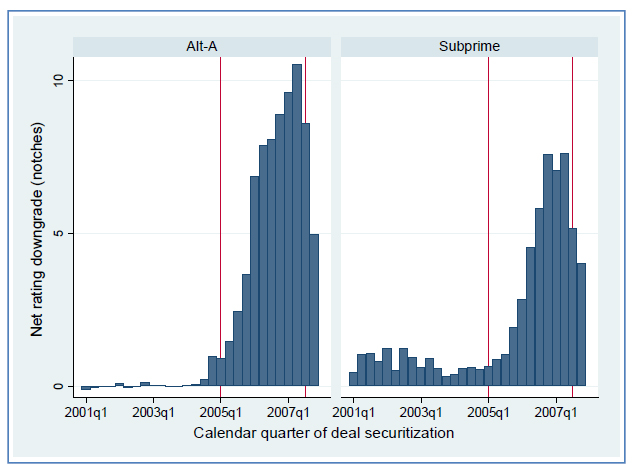
Figure plots average net nonprime MBS ratings revisions by calendar quarter of deal issuance. Covers subprime and Alt-A deals in our sample issued between Q1:2001 and Q4:2007. Y-axis measures the average net number of rating notches that securities issued in calendar quarter have been downgraded between issuance and August 2009, weighted by security original face value.

Figure 1 plots net rating revisions on subprime and Alt-A MBS issued since 2001. While net rating revisions are small for earlier vintages, MBS issued since 2005 have experienced historically large downgrades, by 3-10 rating notches on average, depending on the vintage. Critics interpret these facts as evidence of important flaws in the credit rating process, either due to incentive problems associated with the “issuer-pays” rating model, or simply insufficient diligence or competence (e.g. US Senate, 2010; White, 2009; Fons, 2008).1 In their defense however, rating agencies argue that recent MBS performance primarily reflects a set of large, unexpected shocks, including an unprecedented decline in home prices, and a financial crisis, events which surprised most market participants.

They look at the problem of relative risk:

The second part of our analysis examines how well credit ratings order relative risks across MBS deals from within a given cohort. Here we focus on studying variation in realized performance. If credit ratings are informative, mortgages underlying deals rated more optimistically (i.e. lower subordination, or equivalently a larger fraction of highly-rated securities), should perform better expost, in terms of lower mortgage default and loss rates. Furthermore, prior information available when the deal was initially rated should not be expected to systematically predict deal performance, after controlling for credit ratings. This is because this prior information should already be reflected in the ratings themselves, to the extent it is informative about default risk.

I strongly disagree with their assertions in thelast two sentences, which is simply a variation on the Efficient Market Hypothesis. As I have repeatedly stressed, financial markets represent a chaotic system, which is a system in which various factors leading to the result can interact in unusual ways – a small difference at time 0 can eventually be shown to lead to an enormous difference at time t.

If I work for a garden center and predict fine planting weather for the following weekend – which turns out to be disastrously wrong – the discovery that I neglected to account for a butterfly flapping its wings in China an extra time does not make me incompetent and does not prove that the conflict of interest presented by the nature of my employment corrupted my obectivity. Either conclusion could be true, but require a lot more proof than the premises stated.

Mind you, the authors’ data is much more obviously relevant to the problem than in the garden-centre scenario:

We find higher subordination is generally correlated with worse ex-post mortgage performance, as expected. However, conditional on subordination, time dummies and credit enhancement features, we also find significant variation in performance across different types of deals. First, MBS deals backed by loans with observably risky characteristics such as low FICO scores and high leverage (summarized by the projected default rate from our simple ex-ante model) perform poorly relative to initial subordination levels. Moreover, deals with a high share of low- and no-documentation loans (“low doc”), perform disproportionately poorly, even relative to other types of observably risky deals. This suggests such deals were not rated conservatively enough ex-ante.

Importantly, they show that these correlations are robust throughout the period of interest:

These findings hold robustly across several different measures of deal performance: (i) early-payment defaults; (ii) rating downgrades; (iii) cumulative losses; (iv) cumulative defaults. In some cases, our results are magnified for deals issued during the period of peak MBS issuance from the start of 2005 to mid-2007. However, perhaps most notably, we repeat our analysis separately for each annual deal cohort between 2001 and 2007. We find that the underperformance of low-doc and observably high risk deals holds surprisingly robustly over the entire sample period, including earlier deal vintages not significantly affected by the crisis. Indeed, these differences in performance can be observed even only based on performance data publicly available before the crisis starts.

This is an important test, but still does not prove incompetence or corruption. It is important to consider what information was available during the peak period – had these correlations shown up at that time? They address this question in the section “Loan Level Model”:

While we are careful to estimate the model parameters only using prior available data, a “look-back” bias may also arise if our choice of explanatory variables or model structure is influenced by knowledge of the evolution of the crisis. To minimize these concerns, we deliberately choose a simple model structure (a basic logit), and consider only explanatory variables that CRAs also used in the rating process. For example, Moody’s (2003) description of their primary subprime ratings model lists as inputs all the main variables included in our default model specification.8 We emphasize that this default model is intentionally simple, to avoid look-back biases, and in several respects is less complex than the models used by rating agencies themselves.9 Any shortcomings of our model lower the benchmark against which credit ratings are compared as a predictor of deal performance (see Section 7 for further discussion).

The literature review is CRA-hostile, ranging from the trivial:

Bolton et al. (2008) assume each CRA has a private signal of the quality of a security to be rated, which can be either reported truthfully or misreported. Misreporting leads to an exogenous reputation cost if detected, but generates higher fee income from security issuers in the current period. Bolton et al show ratings inflation is more severe when reputation costs are low relative to current rating profits, suggesting CRAs are more likely to misreport risk during booms.

… to the more interesting:

Turning to structured finance ratings, Benmelech and Dlugosz (2010) document the wave of recent downgrades across different types of collateralized debt obligations (CDOs). They find evidence that securities rated by only one CRA are downgraded more frequently, which is interpreted as evidence of rating shopping. Griffin and Tang (2009) find that published CDO ratings by a CRA are less accurate than the direct output of that CRA’s internal model, suggesting judgmental adjustments were applied to model-generated ratings that worsened rating quality. Coval, Jurek and Stafford (2009) show default probabilities for structured finance bonds are very sensitive to correlation assumptions. Studying MBS, He, Qian and Strahan (2009) present evidence that large security issuers receive more generous ratings, particularly for securities issued from 2004-06. (Unlike this paper, however, these authors are not able to control for information on deal structure or underlying mortgage collateral). Cohen (2010) finds evidence that measures of rating shopping incentives, such as the market share of each CRA, affects commercial MBS subordination.

Kisgen and Strahan (2009) present evidence that ratings influence prices through their role in financial regulation. They show the certification of DBRS by the SEC shifts prices in the direction of their DBRS rating amongst bonds already rated by DBRS. Adelino (2009) finds performance of junior triple-A MBS bonds is uncorrelated with initial prices, suggesting triple-A investors relied excessively on credit ratings, rather than conducting due diligence. Chernenko and Sunderam (2009) find ratings variation around the investment grade boundary creates market segmentation that affects credit supply and firm investment.

It is interesting to contrast Kisgen and Strahan’s point with the prior adoration of the Efficient Market Hypothesis!

The authors conclude in part:

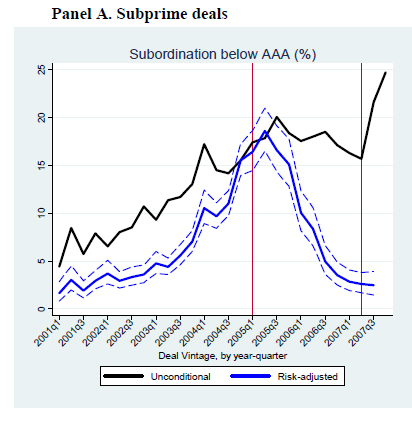
Our evidence does suggest that ratings are informative, and also rejects a simple story that credit rating standards deteriorate uniformly over the pre-crisis period. However, we find evidence of apparently significant time-series variation in subordination levels; most robustly, we observe a significant decline in risk-adjusted subordination levels between the start of 2005 and mid-2007.

Our analysis also suggests MBS ratings did not fully reflect publicly available data. Observably high-risk deals, measured by a simple ex-ante model, significantly underperform relative to their initial subordination levels. Deals with a high share of low-documentation mortgages also perform disproportionately worse compared to other types of risky deals. These two results are evident even for earlier vintages, and can be identified even only using pre-crisis data.

Our results are not conclusive about the role of explicit agency frictions in the rating process. However, two of our results appear consistent with recent theoretical literature modeling these frictions: (i) the poor performance relative to ratings of deals backed by opaque low-documentation loans, and (ii) the observed decline in risk-adjusted subordination around the peak of MBS issuance, when incentive problems are likely most severe. Further analysis of the importance of explicit rating shopping and other incentive problems is, we believe, an important topic for future research.

Click for Big

[The above chart presents] conditional and risk-adjusted AAA subordination for subprime and Alt-A deals, respectively. Risk-adjusted subordination reflects residual changes in credit ratings after controlling for the variables in Table 5 (such as the model-projected default rate, insurance dummy etc.)
Market Action

June 2, 2010

The Financial Crisis Inquiry Commission kicks off its hearings on credit ratings today, including testimony from Raymond W. McDaniel, Chairman and Chief Executive Officer, Moody’s Corporation:

  • Credit Rating Agencies are commenters, not gatekeepers
  • Credit Ratings are not investment advice
  • Rating analysts do not structure or underwrite securities
  • Investors should not rely on rely on ratings to buy, sell or hold securities (investors must do their own work – you cannot outsource responsibility)
  • Every business model has conflicts of interest that must be managed
  • Concerns about rating shopping do not stem from the business model

Commission Chairman Angelidies, determined to display his prejudice, has been quoted:

In his opening remarks, Chairman Phil Angelides said, “To be blunt, the picture is not pretty.” He added that “Moody’s did very well. The investors who relied on Moody’s ratings did not do so well.”

Angelides characterized the ratings service as a “triple-A factory,” saying that it assigned the top grade to 42,625 residential mortgage-backed securities from 2000 to 2007.

“In 2006 alone, Moody’s gave 9,029 mortgage-backed securities a triple-A rating,” said Angelides, whose panel was created to investigate the causes of the financial crisis as Congress debates the most sweeping overhaul of banking regulations since the Great Depression. “To put that in perspective, Moody’s currently bestows its triple-A rating on just four American corporations.”

Another day of fine returns in the Canadian preferred share market. “They” should “raise interest rates” more often! PerpetualDiscounts were up 31bp, while FixedResets gained 4bp as volume continued at slightly elevated levels.

No details of block trades are given today – the usual data source has been 404ed and it appears that the Financial Post has not yet completed implementation of the new publication mechanism – either that, or I can’t figure out the easy-to-use intuitive interface!

PerpetualDiscounts now yield 6.23%, equivalent to 8.72% interest at the standard equivalency factor of 1.4x. Long corporates are now at about 5.65%, so the pre-tax interest-equivalent spread (also called the Seniority Spread) now stands at about 305bp, a 10bp tightening from the 315bp recorded at month end.

HIMIPref™ Preferred Indices
These values reflect the December 2008 revision of the HIMIPref™ Indices

Values are provisional and are finalized monthly
Index Mean
Current
Yield
(at bid)
Median
YTW
Median
Average
Trading
Value
Median
Mod Dur
(YTW)
Issues Day’s Perf. Index Value
Ratchet 2.62 % 2.77 % 43,910 20.89 1 1.1765 % 2,117.3
FixedFloater 5.24 % 3.31 % 30,220 19.94 1 -0.4317 % 3,055.4
Floater 2.41 % 2.79 % 96,134 20.20 3 -0.0734 % 2,239.6
OpRet 4.90 % 3.84 % 97,954 0.96 11 0.1279 % 2,307.1
SplitShare 6.44 % 5.88 % 106,610 0.08 2 -0.0888 % 2,151.9
Interest-Bearing 0.00 % 0.00 % 0 0.00 0 0.1279 % 2,109.6
Perpetual-Premium 0.00 % 0.00 % 0 0.00 0 0.3124 % 1,833.8
Perpetual-Discount 6.18 % 6.23 % 207,937 13.56 77 0.3124 % 1,735.9
FixedReset 5.47 % 4.23 % 430,364 3.53 45 0.0404 % 2,158.9
Performance Highlights
Issue Index Change Notes
ENB.PR.A Perpetual-Discount -1.98 % YTW SCENARIO
Maturity Type : Limit Maturity
Maturity Date : 2040-06-02
Maturity Price : 23.01
Evaluated at bid price : 23.28
Bid-YTW : 5.94 %
BAM.PR.E Ratchet 1.18 % YTW SCENARIO
Maturity Type : Limit Maturity
Maturity Date : 2040-06-02
Maturity Price : 22.87
Evaluated at bid price : 21.50
Bid-YTW : 2.77 %
CIU.PR.A Perpetual-Discount 1.20 % YTW SCENARIO
Maturity Type : Limit Maturity
Maturity Date : 2040-06-02
Maturity Price : 19.35
Evaluated at bid price : 19.35
Bid-YTW : 5.99 %
GWO.PR.F Perpetual-Discount 1.22 % YTW SCENARIO
Maturity Type : Limit Maturity
Maturity Date : 2040-06-02
Maturity Price : 23.02
Evaluated at bid price : 23.30
Bid-YTW : 6.33 %
PWF.PR.G Perpetual-Discount 1.26 % YTW SCENARIO
Maturity Type : Limit Maturity
Maturity Date : 2040-06-02
Maturity Price : 23.14
Evaluated at bid price : 23.39
Bid-YTW : 6.39 %
PWF.PR.H Perpetual-Discount 1.33 % YTW SCENARIO
Maturity Type : Limit Maturity
Maturity Date : 2040-06-02
Maturity Price : 22.53
Evaluated at bid price : 22.80
Bid-YTW : 6.38 %
Volume Highlights
Issue Index Shares
Traded
Notes
RY.PR.X FixedReset 313,475 YTW SCENARIO
Maturity Type : Call
Maturity Date : 2014-09-23
Maturity Price : 25.00
Evaluated at bid price : 27.00
Bid-YTW : 4.31 %
IGM.PR.B Perpetual-Discount 95,285 YTW SCENARIO
Maturity Type : Limit Maturity
Maturity Date : 2040-06-02
Maturity Price : 22.83
Evaluated at bid price : 22.96
Bid-YTW : 6.51 %
CM.PR.J Perpetual-Discount 33,126 YTW SCENARIO
Maturity Type : Limit Maturity
Maturity Date : 2040-06-02
Maturity Price : 18.30
Evaluated at bid price : 18.30
Bid-YTW : 6.24 %
POW.PR.D Perpetual-Discount 30,100 YTW SCENARIO
Maturity Type : Limit Maturity
Maturity Date : 2040-06-02
Maturity Price : 20.02
Evaluated at bid price : 20.02
Bid-YTW : 6.35 %
CM.PR.H Perpetual-Discount 27,345 YTW SCENARIO
Maturity Type : Limit Maturity
Maturity Date : 2040-06-02
Maturity Price : 19.43
Evaluated at bid price : 19.43
Bid-YTW : 6.27 %
CM.PR.I Perpetual-Discount 26,900 YTW SCENARIO
Maturity Type : Limit Maturity
Maturity Date : 2040-06-02
Maturity Price : 19.15
Evaluated at bid price : 19.15
Bid-YTW : 6.22 %
There were 32 other index-included issues trading in excess of 10,000 shares.
Issue Comments

EMA.PR.A Slides on Opening Day with Derisory Volume

Emera has announced:

that it has completed its public offering of six million Cumulative 5-Year Rate Reset First Preferred Shares, Series A for aggregate gross proceeds of $150 million. The offering was first announced on May 25, 2010 when Emera entered into an agreement with a syndicate of underwriters in Canada led by Scotia Capital Inc., RBC Capital Markets and CIBC World Markets Inc.

The net proceeds of the offering will be used for general corporate purposes.

The aggregate gross proceeds of $150-million implies that the $50-million greenshoe was not exercised, while the low volume implies the underwriters had trouble flogging the issue.

EMA.PR.A is a FixedReset, 4.40%+184, announced May 25.

It traded 26,700 shares today in a range of 24.70-00 before closing at 24.75-89, 27×10.

Vital statistics are:

EMA.PR.A FixedReset YTW SCENARIO
Maturity Type : Limit Maturity
Maturity Date : 2040-06-02
Maturity Price : 24.70
Evaluated at bid price : 24.75
Bid-YTW : 4.53 %

EMA.PR.A is tracked by HIMIPref™, but has been relegated to the Scraps index on credit concerns.

Index Construction / Reporting

Index Performance: May 2010

Performance of the HIMIPref™ Indices for May, 2010, was:

Total Return
Index Performance
Mayl 2010
Three Months
to
May 31, 2010
Ratchet -3.08% +4.62%
FixFloat -4.77% +3.41%
Floater -6.61% -4.88%
OpRet 0.00% -0.22%
SplitShare +0.78% +0.69%
Interest 0.00%**** -0.22%****
PerpetualPremium -0.17% -4.04%
PerpetualDiscount +1.31% -4.41%
FixedReset +1.27% -1.34%
**** The last member of the InterestBearing index was transferred to Scraps at the June, 2009, rebalancing; subsequent performance figures are set equal to the OperatingRetractible index
Passive Funds (see below for calculations)
CPD +0.93% -2.17%
DPS.UN +0.22% -0.82%
Index
BMO-CM 50 +0.30% -2.30%
TXPR Total Return +0.97% -2.07%

The pre-tax interest equivalent spread of PerpetualDiscounts over Long Corporates (which I also refer to as the Seniority Spread) ended the month at +315bp, a slight (an possibly spurious) decline from the +320bp recorded on April 30.

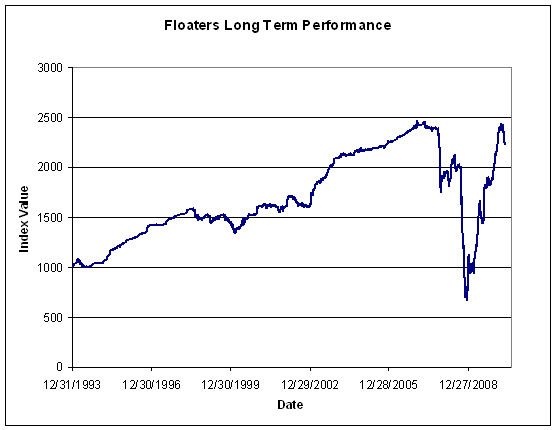
The trailing year returns are starting to look a bit more normal, as the Floater index has now lost the value of the incredible +33.18% return recorded in May 2009 and replaced it with this month’s total return of -6.61%.


Click for big

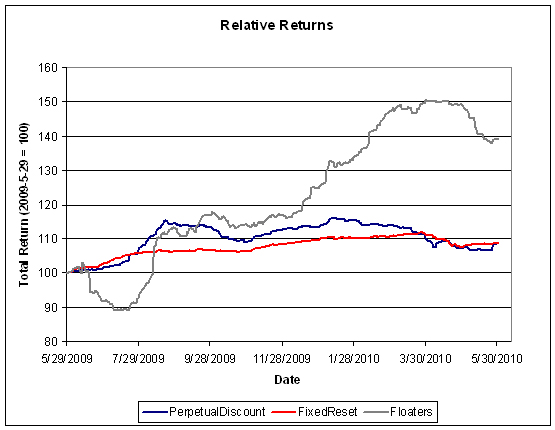
Floaters have had a wild ride, with May 2010 being their worst month since June 2009:


Click for big

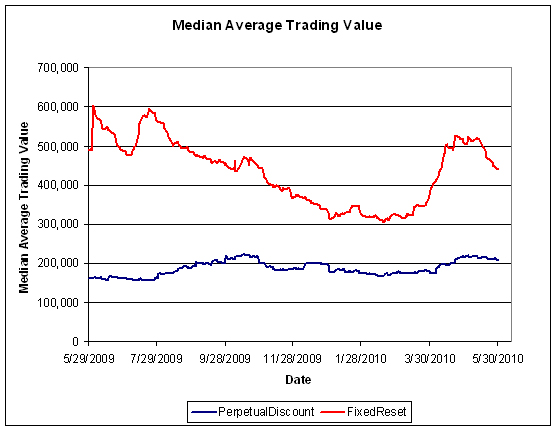
FixedReset volume declined during the month after their burst of activity in April when they performed poorly. Volume may be under-reported due to the influence of Alternative Trading Systems (as discussed in the November PrefLetter), but I am biding my time before incorporating ATS volumes into the calculations, to see if the effect is transient or not.


Click for big

Compositions of the passive funds were discussed in the September, 2009, edition of PrefLetter.

Claymore has published NAV and distribution data (problems with the page in IE8 can be kludged by using compatibility view) for its exchange traded fund (CPD) and I have derived the following table:

CPD Return, 1- & 3-month, to May 31, 2010
Date NAV Distribution Return for Sub-Period Monthly Return
February 26, 2010 16.83      
March 26 16.64 0.21 +0.12% -0.96%
March 31, 2010 16.46 0.00 -1.08%
April 30 16.11     -2.13%
May 31, 2010 16.26     +0.93%
Quarterly Return -2.17%

Claymore currently holds $431,929,434 (advisor & common combined) in CPD assets, up about $3-million from the $428,556,482 reported last month and up about $58-million from the $373,729,364 reported at year-end. The monthly increase in AUM of about 0.77% is smaller than the total return of +0.93%, implying that the ETF experienced a small net redemption in May.

The DPS.UN NAV for May 26 has been published so we may calculate the approximate May returns.

DPS.UN NAV Return, May-ish 2010
Date NAV Distribution Return for sub-period Return for period
April 28, 2010 19.45      
May 26, 2010 19.34     -0.57%
Estimated April Ending Stub +0.06% *
Estimated May Ending Stub +0.74% **
Estimated May Return +0.22% ***
*CPD had a NAVPU of 16.12 on April 28 and 16.11 on April 30, hence the total return for the period for CPD was -0.06%. The return for DPS.UN in this period is presumed to be equal.
**CPD had a NAVPU of 16.14 on May 26 and 16.26 on May 31, hence the total return for the period for CPD was +0.74%. The return for DPS.UN in this period is presumed to be equal.
*** The estimated April return for DPS.UN’s NAV is therefore the product of three period returns, -0.57%, +0.06% and +0.74% to arrive at an estimate for the calendar month of +0.22%

Now, to see the DPS.UN quarterly NAV approximate return, we refer to the calculations for March and April:

DPS.UN NAV Returns, three-month-ish to end-May-ish, 2010
March-ish +1.47%
April-ish -2.47%
May-ish +0.22%
Three-months-ish -0.82%
Issue Comments

Best & Worst Performers: May 2010

These are total returns, with dividends presumed to have been reinvested at the bid price on the ex-date. The list has been restricted to issues in the HIMIPref™ indices.

May 2010
Issue Index DBRS Rating Monthly Performance Notes (“Now” means “May 31”)
BAM.PR.K Floater Pfd-2(low) -10.17%  
BAM.PR.B Floater Pfd-2(low) -9.56%  
BAM.PR.G FixFloat Pfd-2(low) -4.77% The third-best performer in April and a regular guest on this table – as have been all Floating Rate issues throughout the Credit Crunch! Strong Pair with BAM.PR.E
BAM.PR.E Ratchet Pfd-2(low) -3.08% Strong Pair with BAM.PR.G
IAG.PR.A Perpetual-Discount Pfd-2(high) -2.26% Now with a pre-tax bid-YTW of 6.52% based on a bid of 17.66 and a limitMaturity.
POW.PR.A Perpetual-Discount Pfd-2(high) +3.33% Now with a pre-tax bid-TTW of 6.37% based on a bid of 22.33 and a limitMaturity.
POW.PR.C Perpetual-Discount Pfd-2(high) +3.87% Now with a pre-tax bid-TTW of 6.38% based on a bid of 23.07 and a limitMaturity.
CIU.PR.A Perpetual-Discount Pfd-2(high) +4.20% Now with a pre-tax bid-TTW of 6.06% based on a bid of 19.12 and a limitMaturity.
CL.PR.B Perpetual-Discount Pfd-1(low) +4.36% Now with a pre-tax bid-TTW of 6.30% based on a bid of 24.78 and a limitMaturity.
ELF.PR.F Perpetual-Discount Pfd-2(low) +5.31% The worst performer in April, so this is merely bounce-back. Now with a pre-tax bid-YTW of 7.01% based on a bid of 19.25 and a limitMaturity.

There’s a crashing to earth of the Floating Rate sector!

Market Action

June 1, 2010

The Kansas City Fed has published the Spring 2010 edition of TEN Magazine with articles on:

  • A PIVOTAL INDUSTRY: Energy’s ups and downs drive economies
  • A COMMUNITY AFFAIR: Kansas City Fed programs take policymakers to the front lines
  • CONFERENCE ROOM TO CLASSROOM: Financial education in the workplace benefits employees, employers
  • FINANCIAL STABILITY REPORTS: How useful during a financial crisis?
  • REGIONAL CONNECTIONS TO NATIONAL POLICY: The directors of the Federal Reserve Bank of Kansas City

Corporate bond sales are slow:

There were no corporate bond sales in the U.S. today, compared with $2.2 billion on the corresponding day following the holiday weekend in 2009, according to data compiled by Bloomberg. In Europe, 1.35 billion euros ($1.66 billion) was raised from two sales of covered bonds, versus 6.5 billion euros of bond issuance a year earlier, Bloomberg data show.

The global new issue market failed to revive after declining to $70 billion last month, less than half of April’s tally and the least since August 2003, Bloomberg data show. The Frankfurt-based European Central Bank forecast that banks will have to write off 195 billion euros of bad debts by 2011, according to a biannual report published May 31.

I just read John Mortimer’s Rumpole Misbehaves, an entertaining if rather lightweight romp, in which the UK’s Anti-Social Behaviour Orders figure in the plot. I’m surprised they haven’t been discussed much here, as they unite many elements of current fashion: the ability to denounce your neighbors to the police and the ability of bureaucrats to invent new crimes and punish transgressors. Anyway, in the course of poking around to see what ASBOs are all about, I found this story which may – but probably won’t – give pause to those who self-righteously exercise their right to draw pictures of Mohammed, since apparently 1,000 years of trespassing precedents aren’t enough to protect property right:

Harry Taylor, 59, of Salford, left images of religious figures in sexual poses on three occasions in 2008.

Jurors found him guilty of causing religiously aggravated intentional harassment, alarm or distress in March.

He was also given a five-year Anti-social Behaviour Order (Asbo) at Liverpool Crown Court.

Among the posters, one image showed a smiling crucified Christ next to an advert for a brand of “no nails” glue.

In another, Islamic suicide bombers at the gates of paradise were told: “Stop, stop, we’ve run out of virgins.”

The chaplain at the airport was “severely distressed” by the discoveries, the court heard.

Well, well! We can’t have chaplains being “severely distressed”, now, can we? Let’s put somebody in jail instead.

The first day of the Dreaded Rise in Interest Rates didn’t interupt the recent rally in the Canadian preferred share market, with PerpetualDiscounts up 47bp on the day and FixedResets up 14 bp. Volume returned to average-to-elevated levels.

HIMIPref™ Preferred Indices
These values reflect the December 2008 revision of the HIMIPref™ Indices

Values are provisional and are finalized monthly
Index Mean
Current
Yield
(at bid)
Median
YTW
Median
Average
Trading
Value
Median
Mod Dur
(YTW)
Issues Day’s Perf. Index Value
Ratchet 2.65 % 2.71 % 43,704 20.74 1 0.7109 % 2,092.7
FixedFloater 5.22 % 3.28 % 31,479 19.97 1 -0.4773 % 3,068.7
Floater 2.17 % 2.52 % 96,459 20.95 3 -0.3473 % 2,241.3
OpRet 4.90 % 3.91 % 99,001 1.71 11 0.0284 % 2,302.0
SplitShare 6.44 % 5.64 % 110,459 0.08 2 0.1779 % 2,153.9
Interest-Bearing 0.00 % 0.00 % 0 0.00 0 0.0284 % 2,105.0
Perpetual-Premium 0.00 % 0.00 % 0 0.00 0 0.4687 % 1,825.5
Perpetual-Discount 6.20 % 6.25 % 209,589 13.55 77 0.4687 % 1,729.8
FixedReset 5.47 % 4.25 % 436,981 3.53 45 0.1406 % 2,156.6
Performance Highlights
Issue Index Change Notes
CU.PR.B Perpetual-Discount -1.06 % YTW SCENARIO
Maturity Type : Limit Maturity
Maturity Date : 2040-06-01
Maturity Price : 23.93
Evaluated at bid price : 24.30
Bid-YTW : 6.20 %
BAM.PR.K Floater -1.01 % YTW SCENARIO
Maturity Type : Limit Maturity
Maturity Date : 2040-06-01
Maturity Price : 15.74
Evaluated at bid price : 15.74
Bid-YTW : 2.52 %
NA.PR.K Perpetual-Discount 1.07 % YTW SCENARIO
Maturity Type : Limit Maturity
Maturity Date : 2040-06-01
Maturity Price : 23.40
Evaluated at bid price : 23.70
Bid-YTW : 6.22 %
POW.PR.A Perpetual-Discount 1.07 % YTW SCENARIO
Maturity Type : Limit Maturity
Maturity Date : 2040-06-01
Maturity Price : 22.30
Evaluated at bid price : 22.57
Bid-YTW : 6.30 %
BNS.PR.Y FixedReset 1.15 % YTW SCENARIO
Maturity Type : Limit Maturity
Maturity Date : 2040-06-01
Maturity Price : 24.56
Evaluated at bid price : 24.61
Bid-YTW : 3.80 %
NA.PR.L Perpetual-Discount 1.18 % YTW SCENARIO
Maturity Type : Limit Maturity
Maturity Date : 2040-06-01
Maturity Price : 19.72
Evaluated at bid price : 19.72
Bid-YTW : 6.22 %
IAG.PR.A Perpetual-Discount 1.25 % YTW SCENARIO
Maturity Type : Limit Maturity
Maturity Date : 2040-06-01
Maturity Price : 17.88
Evaluated at bid price : 17.88
Bid-YTW : 6.44 %
SLF.PR.E Perpetual-Discount 1.25 % YTW SCENARIO
Maturity Type : Limit Maturity
Maturity Date : 2040-06-01
Maturity Price : 17.75
Evaluated at bid price : 17.75
Bid-YTW : 6.35 %
PWF.PR.L Perpetual-Discount 1.26 % YTW SCENARIO
Maturity Type : Limit Maturity
Maturity Date : 2040-06-01
Maturity Price : 20.16
Evaluated at bid price : 20.16
Bid-YTW : 6.42 %
GWO.PR.M Perpetual-Discount 1.27 % YTW SCENARIO
Maturity Type : Limit Maturity
Maturity Date : 2040-06-01
Maturity Price : 22.96
Evaluated at bid price : 23.10
Bid-YTW : 6.28 %
SLF.PR.B Perpetual-Discount 1.29 % YTW SCENARIO
Maturity Type : Limit Maturity
Maturity Date : 2040-06-01
Maturity Price : 18.89
Evaluated at bid price : 18.89
Bid-YTW : 6.36 %
ELF.PR.G Perpetual-Discount 1.31 % YTW SCENARIO
Maturity Type : Limit Maturity
Maturity Date : 2040-06-01
Maturity Price : 17.02
Evaluated at bid price : 17.02
Bid-YTW : 7.11 %
PWF.PR.K Perpetual-Discount 1.44 % YTW SCENARIO
Maturity Type : Limit Maturity
Maturity Date : 2040-06-01
Maturity Price : 19.71
Evaluated at bid price : 19.71
Bid-YTW : 6.37 %
PWF.PR.F Perpetual-Discount 1.46 % YTW SCENARIO
Maturity Type : Limit Maturity
Maturity Date : 2040-06-01
Maturity Price : 20.80
Evaluated at bid price : 20.80
Bid-YTW : 6.40 %
GWO.PR.I Perpetual-Discount 1.47 % YTW SCENARIO
Maturity Type : Limit Maturity
Maturity Date : 2040-06-01
Maturity Price : 17.90
Evaluated at bid price : 17.90
Bid-YTW : 6.30 %
PWF.PR.J OpRet 1.49 % YTW SCENARIO
Maturity Type : Call
Maturity Date : 2010-07-01
Maturity Price : 25.50
Evaluated at bid price : 25.90
Bid-YTW : -9.24 %
POW.PR.D Perpetual-Discount 1.57 % YTW SCENARIO
Maturity Type : Limit Maturity
Maturity Date : 2040-06-01
Maturity Price : 20.08
Evaluated at bid price : 20.08
Bid-YTW : 6.33 %
Volume Highlights
Issue Index Shares
Traded
Notes
CM.PR.J Perpetual-Discount 165,785 Nesbitt crossed blocks of 40,000 and 60,000, both at 18.25.
YTW SCENARIO
Maturity Type : Limit Maturity
Maturity Date : 2040-06-01
Maturity Price : 18.27
Evaluated at bid price : 18.27
Bid-YTW : 6.25 %
PWF.PR.D OpRet 91,900 RBC crossed 50,000 at 25.70 and bought 28,000 from Nesbitt at the same price.
YTW SCENARIO
Maturity Type : Call
Maturity Date : 2010-11-30
Maturity Price : 25.40
Evaluated at bid price : 25.70
Bid-YTW : 3.63 %
TD.PR.E FixedReset 63,430 Nesbitt crossed 50,000 at 26.95.
YTW SCENARIO
Maturity Type : Call
Maturity Date : 2014-05-30
Maturity Price : 25.00
Evaluated at bid price : 26.95
Bid-YTW : 4.33 %
SLF.PR.G FixedReset 52,855 Recent new issue.
YTW SCENARIO
Maturity Type : Limit Maturity
Maturity Date : 2040-06-01
Maturity Price : 24.31
Evaluated at bid price : 24.36
Bid-YTW : 4.27 %
TD.PR.O Perpetual-Discount 40,947 YTW SCENARIO
Maturity Type : Limit Maturity
Maturity Date : 2040-06-01
Maturity Price : 20.42
Evaluated at bid price : 20.42
Bid-YTW : 6.02 %
TRP.PR.B FixedReset 37,200 RBC crossed 25,000 at 24.20.
YTW SCENARIO
Maturity Type : Limit Maturity
Maturity Date : 2040-06-01
Maturity Price : 24.14
Evaluated at bid price : 24.18
Bid-YTW : 4.15 %
There were 31 other index-included issues trading in excess of 10,000 shares.
Issue Comments

BNA Releases Semi-Annual Financials

BAM Split Corp. has released its Semi-Annual Financial Statements for the six months ended March 31, 2010.

A somewhat non-standard feature of these financial statement is explained in note 4 of the 2009 Annual Financials:

As at September 30, 2009 the following Preferred Shares were issued and outstanding and have been included in liabilities, net of $6.2 million (September 30, 2008 – $3.8 million) of associated transaction costs which are amortized using the effective interest method of amortization.

On September 30, 2009, the company had $367.825-million par value of preferreds outstanding which was stated on the books as a liability of $361.592-million. When calculating Asset Coverage, use the par value, not the book value! Ideally, the analyst will reduce the net assets of the firm by the unamortized costs, but in the great scheme of things (total assets of $1.371-billion) it’s only a rounding error.

The amortization of this expense makes the income statement look less good than it is, but if we add back the six-months’ amortization of ($923,000) to the net income as stated ($13,702,000) we get $14,625,000 to cover preferred dividends of $9,968,000, for income coverage of 1.5-:1, a slight improvement from the 1H09 figure of 1.4+:1.

BAM Split Corp. has three series of prefereds outstanding, BNA.PR.B, BNA.PR.C and BNA.PR.D. All are tracked by HIMIPref™. The first is relegated to the Scraps index on volume concerns, but the latter two are the sole constituents of the SplitShare index. These issues were last mentioned on PrefBlog during the Summer 2009 reorganization.

Canada Prime

BoC Raises O/N Rate 25bp to 0.50%; Prime Follows

The Bank of Canada has announced:

that it is raising its target for the overnight rate by one-quarter of one percentage point to 1/2 per cent. The Bank Rate is correspondingly raised to 3/4 per cent and the deposit rate is kept at 1/4 per cent, thus re-establishing the normal operating band of 50 basis points for the overnight rate.

Activity in Canada is unfolding largely as expected. The economy grew by a robust 6.1 per cent in the first quarter, led by housing and consumer spending. Employment growth has resumed. Going forward, household spending is expected to decelerate to a pace more consistent with income growth. The anticipated pickup in business investment will be important for a more balanced recovery.

CPI inflation has been in line with the Bank’s April projections. The outlook for inflation reflects the combined influences of strong domestic demand, slowing wage growth, and overall excess supply.

In this context, the Bank has decided to raise the target for the overnight rate to 1/2 per cent and to re-establish the normal functioning of the overnight market.

This decision still leaves considerable monetary stimulus in place, consistent with achieving the 2 per cent inflation target in light of the significant excess supply in Canada, the strength of domestic spending, and the uneven global recovery.

Given the considerable uncertainty surrounding the outlook, any further reduction of monetary stimulus would have to be weighed carefully against domestic and global economic developments.

The re-establishment of normal operating conditions is explained separately:

The Bank will conduct Special Purchase and Resale Agreement (SPRA) and Sale and Repurchase Agreement (SRA) operations as necessary to reinforce the target for the overnight rate (see Terms and Conditions). The targeted level of settlement balances will be gradually reduced to the typical level of $25 million according to the following schedule:

  • 2 June 2010 – targeted settlement balances will be lowered from $3 billion to $1 billion;
  • 9 June 2010 – targeted settlement balances will be further lowered from $1 billion to $200 million; and
  • 16 June 2010 – targeted settlement balances will be lowered from $200 million to $25 million.

The Overnight Standing Purchase and Resale Agreement (PRA) Facility, under which Primary Dealers have access to an overnight standing PRA facility at the Bank rate, will be made a permanent part of the standard operating framework

The banks have followed:

  • BMO +25bp to 2.50%
  • RY +25bp to 2.50%
  • BNS +25bp to 2.50%
  • NA +25bp to 2.50%
  • CM +25bp to 2.50%
  • TD +25bp to 2.50
Index Construction / Reporting

HIMIPref™ Index Rebalancing: May, 2010

HIMI Index Changes, May 31, 2010
Issue From To Because
GWL.PR.O PerpetualPremium Scraps Volume

The PerpetualPremium index has finally become an empty set with the volume-based move to Scraps index of GWL.PR.O, a chimerical issue which can sometimes be a straight, sometimes a FixedFloater, depending on where Prime is.

There were the following intra-month changes:

HIMI Index Changes during May 2010
Issue Action Index Because
SLF.PR.G Add FixedReset New Issue
Market Action

May 31, 2010

There’s a scuffle brewing over FASB’s proposal that bank loans be marked-to-market:

A U.S. accounting board’s proposal that would require banks to report the fair value of loans on their books will lead to reduced lending, a former chairman of the Federal Deposit Insurance Corp. said.

“This is a terribly destructive idea to even propose,” William Isaac said in a telephone interview today. Just by making the proposal, the Financial Accounting Standards Board will lead banks to quit making loans without an easily discernable market value, and keep the ones they do make to shorter maturities, Isaac said.

The proposal comes “in the face of worldwide condemnation,” Isaac said. It conflicts with the recommendations of the Group of 20 nations, the Basel Committee on Banking Supervision and the International Accounting Standards Board, according to the American Bankers Association, which also opposes the plan.

David Larsen, who serves on FASB’s Valuation Resource Group, said the volatility created by markets and fair value “is there whether or not it is measured.”

“It comes down to the question, is greater transparency of help to users of financial statements?” said Larsen, a managing director at New York-based Duff & Phelps Corp.

Mark-to-market accounting destroyed $500 billion of bank capital as traders marked down all assets during the crisis by a total of 27 percent, and many of those values have now returned to near par, Isaac said. “Now FASB is going to spread this disease throughout the system,” he said.

The trouble with mark-to-market is that it assumes an infinitely liquid market. Sometimes, this embedded assumption gets a little frayed around the edges.

Congrats to my nephew Sam Arfin:

TORONTO INVITATIONAL

Rowing – Champions … Boys’ – 1000 m T1x – Sam Arfin, Birchmount Park, 4:39; 1000 m T2x – Sam Arfin and Oscar Kahu, Birchmount Park, 4:15;

It was a quiet but positive day for Canadian preferred shares, with PerpetualDiscounts gaining 15bp and FixedResets up 8bp.

PerpetualDiscounts now yield 6.29%, equivalent to 8.81% interest at the standard equivalency factor of 1.4x. Long corporates now yield 5.65% (maybe a hair more?) after scoring a total return of +0.46% for the month, so the pre-tax interest-equivalent spread (also called the Seniority Spread) now stands at 315bp, a 10bp tightening from the 325bp recorded on May 26.

And that’s it for another month!

HIMIPref™ Preferred Indices
These values reflect the December 2008 revision of the HIMIPref™ Indices

Values are provisional and are finalized monthly
Index Mean
Current
Yield
(at bid)
Median
YTW
Median
Average
Trading
Value
Median
Mod Dur
(YTW)
Issues Day’s Perf. Index Value
Ratchet 2.67 % 2.74 % 45,481 20.70 1 0.0000 % 2,077.9
FixedFloater 5.19 % 3.26 % 31,917 20.00 1 0.6728 % 3,083.4
Floater 2.16 % 2.49 % 97,678 21.01 3 0.1281 % 2,249.1
OpRet 4.90 % 4.00 % 95,458 1.71 11 -0.0568 % 2,301.4
SplitShare 6.45 % 5.40 % 110,905 0.08 2 -0.3325 % 2,150.0
Interest-Bearing 0.00 % 0.00 % 0 0.00 0 -0.0568 % 2,104.4
Perpetual-Premium 5.55 % 4.80 % 22,322 15.73 1 0.0000 % 1,817.0
Perpetual-Discount 6.22 % 6.29 % 208,177 13.50 77 0.1451 % 1,721.8
FixedReset 5.48 % 4.28 % 439,196 3.53 45 0.0762 % 2,153.6
Performance Highlights
Issue Index Change Notes
ENB.PR.A Perpetual-Discount -1.82 % YTW SCENARIO
Maturity Type : Limit Maturity
Maturity Date : 2040-05-31
Maturity Price : 23.38
Evaluated at bid price : 23.67
Bid-YTW : 5.83 %
GWO.PR.M Perpetual-Discount -1.15 % YTW SCENARIO
Maturity Type : Limit Maturity
Maturity Date : 2040-05-31
Maturity Price : 22.69
Evaluated at bid price : 22.81
Bid-YTW : 6.36 %
POW.PR.A Perpetual-Discount 1.04 % YTW SCENARIO
Maturity Type : Limit Maturity
Maturity Date : 2040-05-31
Maturity Price : 22.11
Evaluated at bid price : 22.33
Bid-YTW : 6.37 %
ELF.PR.F Perpetual-Discount 1.32 % YTW SCENARIO
Maturity Type : Limit Maturity
Maturity Date : 2040-05-31
Maturity Price : 19.25
Evaluated at bid price : 19.25
Bid-YTW : 7.01 %
CL.PR.B Perpetual-Discount 1.62 % YTW SCENARIO
Maturity Type : Limit Maturity
Maturity Date : 2040-05-31
Maturity Price : 24.54
Evaluated at bid price : 24.78
Bid-YTW : 6.30 %
Volume Highlights
Issue Index Shares
Traded
Notes
GWO.PR.I Perpetual-Discount 65,944 TD crossed blocks of 30,000 and 25,000 at 17.70.
YTW SCENARIO
Maturity Type : Limit Maturity
Maturity Date : 2040-05-31
Maturity Price : 17.64
Evaluated at bid price : 17.64
Bid-YTW : 6.39 %
TD.PR.O Perpetual-Discount 55,871 Nesbitt crossed 30,000 at 20.20.
YTW SCENARIO
Maturity Type : Limit Maturity
Maturity Date : 2040-05-31
Maturity Price : 20.22
Evaluated at bid price : 20.22
Bid-YTW : 6.08 %
TD.PR.M OpRet 32,900 TD crosse 30,000 at 25.88.
YTW SCENARIO
Maturity Type : Call
Maturity Date : 2011-05-30
Maturity Price : 25.50
Evaluated at bid price : 25.80
Bid-YTW : 3.82 %
MFC.PR.A OpRet 24,225 TD crossed 20,000 at 25.25.
YTW SCENARIO
Maturity Type : Soft Maturity
Maturity Date : 2015-12-18
Maturity Price : 25.00
Evaluated at bid price : 25.10
Bid-YTW : 4.00 %
GWO.PR.G Perpetual-Discount 22,884 YTW SCENARIO
Maturity Type : Limit Maturity
Maturity Date : 2040-05-31
Maturity Price : 20.60
Evaluated at bid price : 20.60
Bid-YTW : 6.32 %
SLF.PR.G FixedReset 20,221 YTW SCENARIO
Maturity Type : Limit Maturity
Maturity Date : 2040-05-31
Maturity Price : 24.40
Evaluated at bid price : 24.45
Bid-YTW : 4.25 %
There were 16 other index-included issues trading in excess of 10,000 shares.