Market Action

December 9, 2008

With all this rate-cutting, here’s a little bit of history for you: Four-Week US T-Bills were auctioned off at 0% today. A big fat zero, to three decimal places.

Preferred share volume remained heavy today (well … heavy for the preferred market, I mean!) while prices eased off after yesterday’s gains.

Note that these indices are experimental; the absolute and relative daily values are expected to change in the final version. In this version, index values are based at 1,000.0 on 2006-6-30.
The Fixed-Reset index was added effective 2008-9-5 at that day’s closing value of 1,119.4 for the Fixed-Floater index.
Index Mean Current Yield (at bid) Mean YTW Mean Average Trading Value Mean Mod Dur (YTW) Issues Day’s Perf. Index Value
Ratchet N/A N/A N/A N/A 0 N/A N/A
Fixed-Floater 7.19% 7.52% 90,573 13.08 6 -1.2930% 735.2
Floater 9.85% 10.16% 69,970 9.28 2 -2.9216% 359.9
Op. Retract 5.50% 6.88% 145,387 4.04 15 +0.5511% 983.5
Split-Share 6.93% 13.28% 72,752 3.95 14 +0.3167% 888.7
Interest Bearing 9.67% 21.42% 56,961 2.82 3 -5.0826% 758.1
Perpetual-Premium N/A N/A N/A N/A N/A N/A N/A
Perpetual-Discount 7.80% 7.92% 209,091 11.50 71 -0.4855% 709.4
Fixed-Reset 6.05% 5.41% 1,106,660 14.44 16 +0.3609% 990.8
Major Price Changes
Issue Index Change Notes
FIG.PR.A InterestBearing -8.5308% Asset coverage of 1.0+:1 as of December 4, based on Capital Unit NAV of 0.39 according to Faircourt and 0.71 Capital Units per preferred. Now with a pre-tax bid-YTW of 18.60% based on a bid of 5.79 and a hardMaturity 2014-12-31 at 10.00. Closing quote of 5.79-09, 2×2. Day’s range of 5.02-6.21.
STW.PR.A InterestBearing -5.1592% Asset coverage of 1.3-:1 as of December 4 according to Middlefield. Assiduous Reader erikd advises that there has been a rather large stealth-redemption; as of 4:30 pm, Middlefield’s Investor Relations department was unable to confirm or deny the report. A note on the November 30 NAV states “(Redemption Price Payable December 12, 2008)” Now with a pre-tax bid-YTW of 22.27% based on a bid of 8.64 and a hardMaturity 2009-12-31. Closing quote of 8.64-87, 60×1. Day’s range of 8.79-83.
BAM.PR.B Floater -4.0761%  
DFN.PR.A SplitShare -4.0586% Asset coverage of 1.7+:1 as of November 28 according to the company. Now with a pre-tax bid-YTW of 8.58% based on a bid of 8.51 and a hardMaturity 2014-12-1 at 10.00. Closing quote of 8.51-06, 3×1. Day’s range of 8.72-85.
GWO.PR.G PerpetualDiscount -4.0219% Now with a pre-tax bid-YTW of 8.30% based on a bid of 15.75 and a limitMaturity. Closing quote 15.75-17, 7×5. Day’s range of 15.67-48.
FBS.PR.B SplitShare -3.6765% Asset coverage of 1.0+:1 as of December 4 according to TD Securities. Now with a pre-tax bid-YTW of 13.71% based on a bid of 7.86 and a hardMaturity 2011-12-15 at 10.00. Closing quote of 7.86-00, 32×17. Day’s range of 7.76-00.
SBN.PR.A SplitShare -3.0879% Asset coverage of 1.7-:1 as of December 4 according to Mulvihill. Now with a pre-tax bid-YTW of 9.48% based on a bid of 8.16 and a hardMaturity 2014-12-1 at 10.00. Closing quote of 8.16-39, 3×1. Day’s range of 8.28-30.
BCE.PR.G FixFloat -2.9375%  
GWO.PR.I PerpetualDiscount -2.7465% Now with a pre-tax bid-YTW of 8.19% based on a bid of 13.81 and a limitMaturity. Closing quote 13.81-90, 4×12. Day’s range of 13.61-25.
SLF.PR.A PerpetualDiscount -2.6756% Now with a pre-tax bid-YTW of 8.20% based on a bid of 14.55 and a limitMaturity. Closing quote 14.55-65, 1×8. Day’s range of 14.27-19.
ALB.PR.A SplitShare -2.6366% Asset coverage of 1.2-:1 as of December 4 according to Scotia Managed Companies. Now with a pre-tax bid-YTW of 14.56% based on a bid of 20.31 and a hardMaturity 2011-2-28 at 25.00. Closing quote of 20.31-48, 46×1. Day’s range of 20.31-86.
FTN.PR.A SplitShare -2.6277% Asset coverage of 1.6-:1 as of November 28 according to the company. Now with a pre-tax bid-YTW of 12.73% based on a bid of 12.73% based on a bid of 6.67 and a hardMaturity 2015-12-1 at 10.00.
BCE.PR.C FixFloat -2.5215%  
PWF.PR.I PerpetualDiscount -2.2857% Now with a pre-tax bid-YTW of 8.13% based on a bid of 18.81 and a limitMaturity. Closing quote 18.81-00, 4×7. Day’s range of 18.75-25.
CM.PR.D PerpetualDiscount -2.1476% Now with a pre-tax bid-YTW of 8.25% based on a bid of 17.77 and a limitMaturity. Closing quote 17.77-99, 3×3. Day’s range of 17.87-30.
BCE.PR.Z FixFloat -2.0888%  
SLF.PR.E PerpetualDiscount -2.0863% Now with a pre-tax bid-YTW of 8.31% based on a bid of 13.61 and a limitMaturity. Closing quote 13.61-75, 2×16. Day’s range of 13.52-90.
MFC.PR.A OpRet -2.0317% Now with a pre-tax bid-YTW of 4.71% based on a bid of 24.11 and a softMaturity 2015-12-18 at 25.00. Closing quote of 24.11-66, 3×3. Day’s range of 24.05-99.
BNS.PR.N PerpetualDiscount -2.0157% Now with a pre-tax bid-YTW of 7.64% based on a bid of 17.50 and a limitMaturity. Closing quote 17.50-67, 10×9. Day’s range of 17.55-25.
RY.PR.F PerpetualDiscount +2.0653% Now with a pre-tax bid-YTW of 7.35% based on a bid of 15.32 and a limitMaturity. Closing quote 15.32-48. Day’s range of 15.03-75.
BAM.PR.H OpRet +2.2500% Now with a pre-tax bid-YTW of 13.24% based on a bid of 20.45 and a softMaturity 2012-3-30 at 25.00. Closing quote of 20.45-00, 5×10. Day’s range of 20.20-50.
NA.PR.N FixedReset +3.1630%  
LFE.PR.A SplitShare +3.9744% Asset coverage of 1.7-:1 as of November 28 according to the company. Now with a pre-tax bid-YTW of 11.41% based on a bid of 8.11 and a hardMaturity 2012-12-1 at 10.00. Closing quote of 8.11-23, 7×1. Day’s range of 7.91-24.
LBS.PR.A SplitShare +4.2802% Asset coverage of 1.4-:1 as of December 4 according to Brompton Group. Now with a pre-tax bid-YTW of 10.72% based on a bid of 8.04 and a hardMaturity 2013-11-29 at 10.00. Closing quote of 8.04-24, 24×3. Day’s range of 7.70-25.
BAM.PR.O OpRet +10.3333% Now with a pre-tax bid-YTW of 16.17% based on a bid of 16.55 and optionCertainty 2013-6-30 at 25.00. Closing quote of 16.55-17.60, 5×1. Day’s range of 15.65-17.25.
BNA.PR.B SplitShare +13.4089% Asset coverage of 1.6+:1 as of December 4 based on BAM.A at 16.72 and 2.4 BAM.A per unit. Now with a pre-tax bid-YTW of 11.67% based on a bid of 17.00 and a hardMaturity 2016-3-25 at 25.00. Closing quote of 17.00-50, 10×11. Day’s range of 16.19-18.00.
Volume Highlights
Issue Index Volume Notes
WN.PR.B Scraps (would be OpRet but there are credit concerns) 386,360 Desjardins crossed a block of 300,000, then 50,000, then 28,400 all at 25.05. Now with a pre-tax bid-YTW of 6.57% based on a bid of 25.06 and OptionCertainty 2009-6-30.
BNS.PR.J PerpetualDiscount 247,193 Nesbitt crossed 110,600 at 18.00. Now with a pre-tax bid-YTW of 7.43% based on a bid of 17.98 and a limitMaturity.
RY.PR.N FixedReset 109,740 Nesbitt bought 12,900 from Canaccord at 25.00. Recent new issue
MFC.PR.A OpRet 53,035 TD crossed 24,300 at 24.05. See above
RY.PR.I FixedReset 50,961 RBC crossed 23,700 at 21.40.
RY.PR.B PerpetualDiscount 49,197 Desjardins bought 26,300 from anonymous at 16.15. Now with a pre-tax bid-YTW of 7.39% based on a bid of 16.10 and a limitMaturity.

There were seventy-four index-included $25-pv-equivalent issues trading over 10,000 shares today
Banking Crisis 2008

Bank Rate Cut 75bp; Prime 50bp. Canada Prime Now 3.50%

The Bank of Canada cut by 75bp today:

The Bank of Canada today announced that it is lowering its target for the overnight rate by three-quarters of a percentage point to 1 1/2 per cent. The operating band for the overnight rate is correspondingly lowered, and the Bank Rate is now 1 3/4 per cent.

The outlook for the world economy has deteriorated significantly and the global recession will be broader and deeper than previously anticipated. Global financial markets remain severely strained. Measures taken by major governments are beginning to encourage credit flows, although it will take some time before conditions in financial markets normalize. In addition, a series of recently announced monetary and fiscal policy actions will also support global economic growth.

While Canada’s economy evolved largely as expected during the summer and early autumn, it is now entering a recession as a result of the weakness in global economic activity. The recent declines in terms of trade, real income growth, and confidence are prompting more cautious behaviour by households and businesses.

All of these factors imply a lower profile for core inflation than had been projected at the time of the last Monetary Policy Report in October.

Several factors are helping to counterbalance the negative drag from the global economic and financial developments. The depreciation of the Canadian dollar will continue to provide an important offset to the effects of weaker global demand and lower commodity prices. As well, money markets and overall credit conditions in Canada are responding to significant and ongoing efforts to provide liquidity to the Canadian financial system.

In light of the weakening outlook for growth and inflation, the Bank of Canada lowered its policy interest rate by a total of 75 basis points in October and by an additional 75 basis points today. These monetary policy actions provide timely and significant support to the Canadian economy.

The Bank will continue to monitor carefully economic and financial developments in judging to what extent further monetary stimulus will be required to achieve the 2 per cent inflation target over the medium term.

The banks did not fully participate:

  • TD, down 50bp, now 3.50%
  • CIBC, down 50bp, now 3.50%
  • Scotia, down 50bp, now 3.50%
  • Royal, down 50bp, now 3.50
  • BMO, down 50bp, now 3.50%

At the penultimate cut, TD threw down the gauntlet by not maintaining the spread; this resulted in a $25-billion liquidity injection, later increased to $75-billion which maintained the historical relationship.

The most recent cut in the overnight rate maintained the spread.

Given that What-Debt? has run away from Parliament, it will be most interesting to see if there is any political reaction to this turn of events. Quick! Call Duceppe so Spend-Every-Penny will know what to oppose!

Issue Comments

RY.PR.N Settles Without Incident

The Royal Bank Fixed-Reset 6.25%+350 announced November 24 settled today on good volume and little price movement – a departure from recent norms for which the underwriters will doubtless be grateful!

It traded 389,932 shares in a range of 24.85-05, closing at 25.00-03, 40×177. From the bid of 25.00, the YTW is 5.89% to the limitMaturity, while the yield to the five year call is 6.27%.

Regulatory Capital

RY Raising Significant Equity Capital

When reviewing RY’s 4Q08 Capitalization, I commented:

Royal Bank needs to do some delevering – an equity issue is indicated, since the Equity / RWA ratio is below that of its peers.

Royal Bank has announced:

it has entered into an underwriting agreement with a syndicate of underwriters for the sale of 56,750,000 common shares at $35.25 per share for total gross proceeds of $2.0 billion. The offering is expected to close on December 22, 2008.

The bank has also granted to the underwriters an over-allotment option to purchase, on the same terms, up to a further 8,512,500 common shares. The option is exercisable, in whole or in part, up to 30 days after the closing. The maximum gross proceeds raised under the offering will be $2.3 billion if the option is exercised in full.

As announced on December 5, 2008, the bank’s Tier 1 capital ratio was 9% as of October 31, 2008. Earlier this fiscal quarter, we issued $525 million of Series AL and Series AN Preferred Shares. On a pro forma basis, adjusting for the issue of Series AL and Series AN Preferred Shares and this issue of common shares, the bank expects its Tier 1 capital ratio will be approximately 9.9%, or 10.1% if the over-allotment option is exercised in full.

This is great news!

Market Action

December 8, 2008

American pension funds begged for relief from having to top up their accounts:

Pension funds at Pfizer Inc., International Business Machines Corp., United Parcel Service Inc. and dozens of other companies have joined the parade of businesses seeking relief from Congress amid this year’s economic meltdown.

Instead of money, they want legislation to suspend a federal law that would make them pump billions of dollars into retirement plans to offset stock-market losses as many struggle to find enough cash just to stay in business. They’re pressing Congress to consider the issue this week before this year’s session adjourns.

It’s another difficult question of mark-to-market vs. whatever-other accounting! Frankly, I think the entire defined-benefit paradigm is dead – or if not dead, should be.

In a rather chilling development, specific bank credit decisions are being politicized:

Illinois Governor Rod Blagojevich said today the state would suspend its business with Bank of America Corp. until the lender restores credit to the shuttered Republic Windows & Doors company in Chicago where workers are staging a sit-in.

Blagojevich commented at a news conference after meeting with employees who have stayed at the factory since Dec. 5, when it closed after the bank canceled its line of credit. Illinois does “hundreds of millions of dollars” in business with the bank, he said.

Three-month US T-Bills are now trading at less than a beep:

The Treasury sold $27 billion in three-month bills at the lowest rate since it starting auctioning the securities in 1929 amid record demand for the safety of U.S. debt during the worst financial crisis since the Great Depression.

The bills were sold at a high discount rate of 0.005 percent, the Treasury said today in Washington. At last week’s auction, the bills drew a rate of 0.05 percent. The government received bids for the bills totaling more than triple the amount sold.

There is a report of another chapter in the BCE saga:

BCE Inc. told would-be acquirers that it received an auditor’s opinion showing the company would be solvent after the C$52 billion purchase by Ontario Teachers’ Pension Plan and a group of U.S. private-equity firms, according to two people briefed on the matter.

The opinion, delivered by PricewaterhouseCoopers LLP, is contrary to an analysis by rival accounting firm KPMG LLC.

Hmm … I wonder if the same deal can go the Supreme Court twice!

Sorry, folks! I’m just plain out of time, so there is no volume or price-change table today. I will point out though, that the SplitShare sector was on fire today, with strength pretty much across the board.

Note that these indices are experimental; the absolute and relative daily values are expected to change in the final version. In this version, index values are based at 1,000.0 on 2006-6-30.
The Fixed-Reset index was added effective 2008-9-5 at that day’s closing value of 1,119.4 for the Fixed-Floater index.
Index Mean Current Yield (at bid) Mean YTW Mean Average Trading Value Mean Mod Dur (YTW) Issues Day’s Perf. Index Value
Ratchet N/A N/A N/A N/A 0 N/A N/A
Fixed-Floater 7.09% 7.43% 87,773 13.18 6 +1.6424% 744.9
Floater 9.56% 9.85% 68,374 9.53 2 +0.4077% 370.8
Op. Retract 5.53% 6.99% 141,821 4.05 15 -0.1799% 978.1
Split-Share 6.94% 13.23% 71,831 3.94 14 +6.0720% 885.9
Interest Bearing 9.17% 18.04% 56,659 2.87 3 +2.7985% 798.7
Perpetual-Premium N/A N/A N/A N/A N/A N/A N/A
Perpetual-Discount 7.76% 7.88% 206,837 11.55 71 +1.7398% 712.9
Fixed-Reset 6.07% 5.42% 1,125,193 14.41 16 +1.3936% 987.2
Interesting External Papers

IMF Releases December 2008 Issue of Finance & Development

The IMF has released its December 2008 Issue of Finance & Development. Articles are:

  • Cracks in the System: Repairing th Damaged Global Economy
  • F&D on Financial Crisis Origins
  • Preventing Future Crises
  • When Crises Collide
  • A Crisis to Remember
  • Global Financial Turmoil Tests Asia
  • The Crisis through the Lens of History
  • Ensuring Food Security
  • Stockholm Solutions
  • Neighborly Investments
  • The Road to Recovery: A View from Japan
  • Nigeria’s Shot at Redemption
  • The Catch-Up Game
  • The Economic Geography of Regional Integration

To be frank, I wasn’t much impressed by the Stockholm Solutions article about the Nordic crisis. It was very general.

A topic more suited to generality was The Crisis through the Lens of History:

A second important lesson is the value of providing macroeconomic support in parallel with financial actions. With the effectiveness of monetary policy limited by financial disruptions, fiscal stimulus must play an important role to help maintain the momentum of the real economy and curtail negative feedbacks between the financial and real sectors. Indeed, increasing interest is now being paid to boosting infrastructure spending, akin to the public work programs of the Depression era. But, as the Japanese example makes clear, macroeconomic support by itself provides only breathing room, not a cure; it is essential to use the space provided to address the underlying financial problems or the outcome will be a series of fiscal packages with diminishing impact. And it should also be recognized that there will be limited space for macroeconomic responses in countries where the weakness of public sector management has been an integral source of the problem, as has often been the case in emerging market crises.

Additionally, the article on Preventing Future Crises contains many of the familiar old nostrums but, as a saving grace, adds an element I’ve been harping on:

Safeguarding diversity to promote systemic complementarities
The degree to which financial institutions with long maturing liabilities (for example, pension funds and life insurance companies) should be subject to mark-to-market requirements or to risk management standards based on risk models focused on short-run price volatility in managing
their assets could be reconsidered. Regulations could increase the scope for such institutions to play the role of long-term, hold-to-maturity investors. But low-leverage financial institutions with limited systemic importance may need only light, if any, regulation, thus allowing them to play a potentially stabilizing role in taking more risky or contrarian positions compared with other market participants (Nugée and Persaud, 2006).

I’ve said it before … I’ll say it again. The current crisis has shown significant cracks in bank regulation, but let’s not throw the baby out with the bathwater. What we should be aiming for is a rock solid banking system core, surrounded in turn by more exciting investment banks, which are in turn surrounded by a wild-n-wooly world of hedge funds, SIVs, and whatever else gets dreamed up to make a buck.

Issue Comments

RPQ.PR.A, RPB.PR.A, RPA.PR.A, PRF.PR.A : Expected Credit Event

Connor Clark & Lunn has announced:

that Tribune Company’s decision to voluntarily restructure its debt obligations under the protection of Chapter 11 of the U.S. Bankruptcy Code in the United States Bankruptcy Court for the District of Delaware is expected to constitute a credit event under the credit linked note (“CLN”) issued by their respective counterparties.

When it was chosen for inclusion in the Reference Portfolios, Tribune was in a stable industry with ample cash flow generation and rated A- by Standard & Poor’s. In December 2007, Tribune was acquired in a leveraged buy-out which reduced its rating to B- and it needed to sell off assets in order to raise cash to pay down its large debt load. Following the acquisition, a precipitous decline in revenue and a tough economy coupled with the credit crisis that makes it extremely difficult to support its current level of debt.

When Connor, Clark & Lunn Capital Markets Inc. receives further information regarding the credit event and the recovery rate we will provide an update on the impact on the companies.

A very defensive sounding press release! Bloomberg has a story on the Tribune filing.

Guys, guys, guys! I’m an old bond guy. I’ve been there. Bad things happen. The problem is not your selection of Tribune Company as one of your 125-odd names. The problem is your decision to concentrate your investment (by the terms of the credit note) to such an extent that a single default becomes a major problem. Such a note can make sense to both the buyer and the seller, as long as both realize that it’s disaster insurance; the buyer of the note gets a small premium and assumes the very small risk of a very large payout. But … that risk is increasing.

RPQ.PR.A was last mentioned on PrefBlog when the dividend was suspended and the rating withdrawn.

RPB.PR.A was last mentioned on PrefBlog when the dividend was suspended and the rating withdrawn.

RPA.PR.A was last mentioned on PrefBlog when S&P downgraded it to P-2.

PRF.PR.A was last mentioned on PrefBlog with respect to the Lehman credit event.

None of these issues is tracked by HIMIPref™.

Interesting External Papers

BIS Quarterly Review Released

The Bank for International Settlements has released its Quarterly Review, December 2008.

Articles include:

  • Global financial crisis spurs unprecedented policy actions
  • Highlights of international banking and financial market activity
  • Developments in repo markets during the financial turmoil
  • Commodity prices and inflation dynamics
  • Bank health and lending to emerging markets
  • How many in negative equity? The role of mortgage contract characteristics

Repos and the Treasury Market Practices Group were briefly mentioned on November 24. The following is from the BIS article on repos:

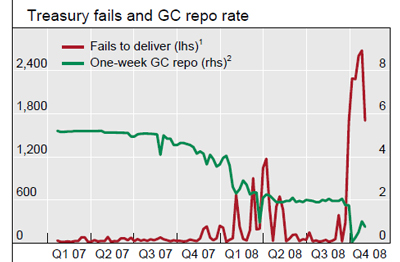
By March 2008, however, the financial turmoil reached a point where heightened risk aversion coupled with uncertainty over valuations of particularly risky products led participants in the repo market to abruptly stop accepting anything other than Treasury and agency collateral. As a result, investment banks such as Bear Stearns suddenly found themselves short of funding, as a large part of their collateral pool was no longer accepted by the US repo market. This change led to a sharp increase in the demand for government securities for repo transactions, which was compounded by significantly higher safe haven demand for US Treasuries and the increased unwillingness to lend such securities in repo transactions. As the crisis unfolded, this combination resulted in US government collateral becoming extremely scarce. As the available supply of Treasury collateral dropped, those market participants willing to lend out Treasuries were able to borrow cash at increasingly cheap rates. At times, this effect pushed US GC repo rates down to levels only a few basis points above zero.

The scarcity of US Treasuries for repo transactions also manifested itself in a sharp increase in the number of Treasury settlement fails. Whereas fails to deliver Treasuries had averaged around $90 billion per week during the two years preceding the crisis, they rose to above $1 trillion during the Bear Stearns episode and then soared to record highs of almost $2.7 trillion
following the Lehman default (Graph 5).

MAPF

MAPF Performance: November 2008

The fund handsomely outperfomed its benchmark in November, but was dragged down by an unprecedented decline in preferred share prices. The immense volatility of the market is leading to most unusual trading opportunities.

How bad and how unprecedented was November? The BMOCM-50 Index was down 10.70%. Taking data from the BMOCM-50, I can say it was the worst month I have on record, with records beginning on December 31, 1992. And, you might well ask, what was the second-worst month? October 2008, down 8.16%. Third-worst? August, 1998 (Russian crisis) down a mere 4.51%.

In fact, of the twelve worst months since 1992-12-31, six have been in the last year.

The fund’s price at November 28, 2008 was $7.0106, after expenses, but before fees (which are billed individually to each client).

Returns to November 28, 2008
Period MAPF Index CPD
according to
Claymore
One Month -9.24% -10.70% -11.06%
Three Months -17.07% -20.11% -19.85%
One Year -14.15% -20.93% -22.79%
Two Years (annualized) -9.69% -14.04%  
Three Years (annualized) -4.55% -8.29%  
Four Years (annualized) -1.92% -5.19%  
Five Years (annualized) +1.23% -3.03%  
Six Years (annualized) +5.62% -1.33%  
Seven Years (annualized) +4.56% -0.78%  
The Index is the BMO-CM “50”
CPD Returns are for the NAV and are after all fees and expenses.

Returns assume reinvestment of dividends, and are shown after expenses but before fees. Past performance is not a guarantee of future performance. You can lose money investing in Malachite Aggressive Preferred Fund or any other fund. For more information, see the fund’s main page.

The yields available on high quality preferred shares remain elevated, which is reflected in the current estimate of sustainable income.

Calculation of MAPF Sustainable Income Per Unit
Month NAVPU Portfolio
Average
YTW
Leverage
Divisor
Securities
Average
YTW
Sustainable
Income
June, 2007 9.3114 5.16% 1.03 5.01% 0.4665
September 9.1489 5.35% 0.98 5.46% 0.4995
December, 2007 9.0070 5.53% 0.942 5.87% 0.5288
March, 2008 8.8512 6.17% 1.047 5.89% 0.5216
June 8.3419 6.034% 0.952 6.338% $0.5287
September 8.1886 7.108% 0.969 7.335% $0.6006
November, 2008 7.0106 11.000% 1.001 11.001% $0.7712
NAVPU is shown after quarterly distributions.
“Portfolio YTW” includes cash (or margin borrowing), with an assumed interest rate of 0.00%
“Securities YTW” divides “Portfolio YTW” by the “Leverage Divisor” to show the average YTW on the securities held; this assumes that the cash is invested in (or raised from) all securities held, in proportion to their holdings.
“Sustainable Income” is the best available estimate of the fund’s dividend income per unit, before fees and expenses.

The fund has positions in three “Split Share” preferreds – terribly out of fashion at this time and trading at yields higher than the perpetuals – which, as explained in August results in the calculation being rendered somewhat suspect. If these positions were sold – at the closing bid on 11/28 – and all cash reinvested in rest of the portfolio, the resultant portfolio would yield 8.22% and the estimated sustainable dividend per unit (before fees and expenses) would be $0.5763; significantly less than the figure calculated above, but still an increase from last month’s adjusted figure and continuing the long-term upward trend.

The current situation whereby investment-grade SplitShare preferreds yield more than PerpetualDiscounts cannot last forever, and it may be anticipated that the calculated Sustainable will fall towards the adjusted figure of $0.5763 … the current calculation assumes that the yield will last forever, rather than the two or three years remaining until the maturity of the SplitShares. On the other hand, it is possible – unlikely, perhaps, in the current climate, but possible – that the yield on the split shares will fall so rapidly that profits may be taken as a capital gain in the near term and reinvested at sustainable yields close to the assumed level of 8.22%, which would lock in the currently estimated sustainable yield. I am not sure how the analysis may be best presented; perhaps at some point I will recalculate all the data using a sustainable yield equal to the PerpetualDiscount index.

It will be noted that if there was no trading in the portfolio, one would expect the sustainable yield to be constant (before fees and expenses). The success of the fund’s trading is showing up in

  • the very good performance against the index
  • the long term increases in sustainable income per unit

As has been noted, the fund has maintained a credit quality equal to or better than the index; outperformance is due to constant exploitation of trading anomalies.

Trading in November continued to be heavy, with portfolio turnover at about 175%. Most of these trades were not just intra-sector, but intra-issuer; that is, between similar issues of the same issuer, notably the PerpetualDiscount issues of CM, BMO and SLF. These trades were, in aggregate, highly profitable.

A major trade was executed from PerpetualDiscounts into SplitShares when – against all reason – the split share with a short term maturity and well-buffered against default underperformed the PerpetualDiscount index. This trade – into FFN.PR.A; discussed in the post on portfolio composition – is not yet profitable, but I am confident that it will become so in the near future.

Of greater interest – and greater profitability, so far – was the November 24 trade from WFS.PR.A to FBS.PR.B:

Post-Mortem
WFS.PR.A to FBS.PR.B
Date WFS.PR.A FBS.PR.B
10/31 7.71
Yield: 16.57%
8.70
Yield: 9.99%
Trade, 11/24
Net of Commission
7.735 7.024
11/28 7.80
Yield: 16.59%
No Dividends
7.49
Yield: 15.39%
Earned Dividend $0.11875

The position in WFS.PR.A was largely established in July, with smaller purchases and sales since then. The largest single day’s trade was a purchase of 6,800 shares on July 9, funded by a sale of GWO.PR.G:

Post-Mortem:
GWO.PR.G to WFS.PR.A
Date GWO.PR.G WFS.PR.A
Trade
2008-7-9
Sold
21.31
Bought
9.08
Closing
Bid
11/24
14.51 7.88
Dividends Missed
$0.325
Earned
$0.13125

Most satisfactory! It should be noted that trades both in and out of GWO.PR.G have been performed against different issues as the market allowed in the interim.

At some point – and I won’t guess when that time will be! – the market will cease its decline and, probably, return to its normal levels of between 100bp and 150bp above long term corporates, which in turn will return to more normal levels against long term Canadas. This could happen extremely quickly and attempting to time the market is folly. At the moment, however, people are scared, the market is sloppy and trading opportunities abound.

The absolute performance of the fund is terrible, but the performance relative to the index and tradeable benchmark is superb. The sustainable yield – however calculated – is increasing. As the market recovers – or even stabilizes! – the steady drip, drip, drip of dividends will make itself felt in long-term returns.

New Issues

New Issue (Maybe) [Continued]: BNS Fixed-Reset 6.25%+384

I have some more information on the new issue of BNS Fixed-Resets that was previously discussed when Scotia announced the issuance as partial settlement of their purchase of a big chunk of CI from SunLife.

This comes from the Bank’s recent filing on SEDAR of a Material Change Reporte dated 2008-12-5: an “Amending Agreement” dated 2008-12-3, schedule 2.03.

Issue: Preferred Shares Series 24

Dividends: Initial Rate 6.25% until the first Exchange Date, 5-Year Canadas + 384bp thereafter. First Dividend $0.5865 [unless the closing date changes] payable 2009-4-28. The closing date is specified in the Amending Agreement only as:

“Closing Date” means the date that is six (6) Business Days after all conditions to the purchase and sale of the Securities set out in Sections 5.01 and 5.02 (other than those conditions that by their nature can only be satisfied on the Closing Date) having been satisfied or waived or (ii) such other date as may be agreed to in writing by the Vendors and the Purchaser.

… but $0.5685 is 137 days’ coupon at 6.25%, implying a projected Closing Date of 2008-12-12 … assuming that the dividend is payable on the last day of its accrual. Floaters pay 3-Month Bills + 384bp, reset quarterly.

Size: 10-million shares (=$250-million).

Exchange Dates: 2014-1-26 and every five years thereafter.

Redemption: Every Exchange Date at $25.00. Floaters redeemable every exchange date at $25.00 and at $25.50 at all other times.

Convertable: Every Exchange Date to and from Series 25 (“Floaters”)

There is nothing specific about the plan of distribution, but Section 2.11 of the Amended Agreement states:

The Purchase Agreement is amended by (i) deleting “and” at the end of Section 5.02(d), (ii) deleting the period at the end of Section 5.02(e) and substituting therefor “;”, and (iii) adding the following immediately after Section 5.02(e) thereof:

“(f) The Purchaser will have (i) prepared and filed with the Ontario Securities Commission, as principal regulator, and with the securities regulatory authorities in each of the other provinces and territories of Canada (together with the Province of Ontario, “Qualifying Jurisdictions”) and received a receipt or other decision document therefor, an amendment to the Purchaser’s short form base shelf prospectus dated April 16, 2008 (the “Prospectus”), and (ii) prepared and filed a prospectus supplement to the Prospectus (together, the “Prospectus Supplement”) with the Ontario Securities Commission, as principal regulator, and with securities regulatory authorities in each of the other Qualifying Jurisdictions, qualifying the distribution to the Vendors, as applicable, of the BNS Common Shares and BNS Preferred Shares contemplated by Section 2.06; and

(g) The BNS Common Shares and BNS Preferred Shares contemplated by Section 2.06 will be listed on the Toronto Stock Exchange and the Series 25 Preferred Shares will be conditionally listed on the Toronto Stock Exchange.”

Update, 2008-12-11: There is a prospectus supplement describing these shares on SEDAR, filed by Bank of Nova Scotia on 2008-12-9.