Interesting External Papers

Adverse Selection, Liquidity and Market Breakdown

The Bank of Canada has released a working paper by Koralai Kirabaeva titled Adverse Selection, Liquidity, and Market Breakdown:

This paper studies the interaction between adverse selection, liquidity risk and beliefs about systemic risk in determining market liquidity, asset prices and welfare. Even a small amount of adverse selection in the asset market can lead to fire-sale pricing and possibly to a market breakdown if it is accompanied by a flight-to-liquidity, a misassessment of systemic risk, or uncertainty about asset values. The ability to trade based on private information improves welfare if adverse selection does not lead to a market breakdown. Informed trading allows financial institutions to reduce idiosyncratic risks, but it exacerbates their exposure to systemic risk. Further, I show that in a market equilibrium, financial institutions overinvest into risky illiquid assets (relative to the constrained efficient allocation), which creates systemic externalities. Also, I explore possible policy responses and discuss their effectiveness.

He makes the point (tangentially) that the Efficient Market Hypothesis is dependent, in part, on an assumption of infinite liquidity:

Market liquidity is characterized by the cost (in terms of the foregone payo¤) of selling a long-term asset before its maturity.1 Two factors contribute to illiquidity in the market:a shortage of safe assets and adverse selection (characterized by the fraction of low quality assets in the market). On one hand, market liquidity depends on the amount of the safe asset held by investors that is available to buy risky assets from liquidity traders. Following the Allen and Gale ([9], [11]) “cash-in-the-market” framework, the market price is determined by the lesser of the following two amounts: expected payo¤ and the amount of the safe asset available from buyers per unit of assets sold. Therefore, this “cash-in-the-market” pricing may lead to market prices below fundamentals if there is not enough cash (safe assets) to absorb asset trades. On the other hand, market liquidity depends on the quality of assets traded in the market. In particular, adverse selection can cause market illiquidity if assets sold in the market are likely to be of low quality (as in Eisfeldt [25]).

He also explicitly considers liquidity risk as part of his model:

The long-term investment is risky not only because of its uncertain quality but also because of the cost associated with its premature liquidation or sale. Therefore, investors are exposed to the market liquidity risk through their holding of long-term assets. Holdings of the safe asset provide partial insurance against the possibility of a liquidity shock as well as against low asset quality realizations. In addition to the value as means of storage, the safe asset has value as means for reallocating risky assets from investors who have experienced a liquidity shock to those who have not. This is similar to the concept of liquidity value for ability to transfer resources in Kiyotaki and Moore [35].

In the course of determining the implications of his model the author examines the relative roles of private information and liquidity:

As a benchmark, I examine portfolio choice when investors have private information about their investment quality but the identity of investors hit by a liquidity shock is public information. Then I analyze the situation when the investor’s type (both liquidity needs and asset quality) is private information. In the latter case investors can take advantage of their private information by selling the low-payo¤ investments and keeping the high quality ones. This generates the lemons problem: buyers do not know whether an asset is sold because of its low quality or because the seller experienced a sudden need for liquidity.

His playing with the model leads to policy recommendations:

There are policy implications for government interventions during a crisis as well as for preemptive policy regulations. The e¤ectiveness of policy responses during crises depends on which ampli…cation e¤ect contributes to a market breakdown. If it is due to an increase in liquidity preferences or to a small probability of the crisis then liquidity provision can restore the trading. However, if the no-trade outcome is caused by a large fraction of lemons or by the Knightian uncertainty about it, then it is more e¤ective to remove these low quality assets from the market. The preemptive policy response is an ex-ante requirement of larger liquidity holdings, which prevents market breakdowns during crises, especially if the economy is in the multiple equilibria range.

This last point is presumably part of the intellectual underpinnings of the Global Liquidity Standard in Basel III: A global regulatory framework for more resilient banks and banking systems. Other elements of this standard were discussed in the post Basel III.

He also provides intellectual underpinnings for a tax (deposit insurance premia?) on risky assets:

It should be noted that there is a moral hazard problem associated with government interventions during crises. If market participants anticipate government interventions then the optimal holdings of risky assets are larger. Therefore, a larger intervention is required. The moral hazard problem can be corrected if the liquidity provision at date t = 1 is …nanced by a tax τ per unit of investment, which is imposed at date t = 0. The tax τx should be equal to the amount of liquidity λ that is required to restore market price to the level of p2,

[formula]

Imposing such tax increases liquidity holdings at t = 0 and prevents market breakdowns at t = 1, leading to a higher expected utility

I find it very disappointing that the author only examines a broad tax on risky holdings at time t=0. It would be more in line with the traditional role of a central bank to determine – given plausible assumptions – the required penalty rate for liquidity provision that would optimize welfare. Additionally, the welfare cost of a higher amount of liquid holdings is not addressed. And finally, investors – and the government – are assumed to know with perfect foresight which holdings are “risky” and which holdings are “liquid”. Holders of long-term Greek government bonds might be forgiven for questioning this assumption!

This last point is acknowledged by the author in his discussion of the Panic of 2007:

Financial institutions were exposed to systemic risk through securities holdings which had skewed payo¤s: they produced high returns in normal times but incurred substantial losses during the crisis. Before the crisis, many of these created securities were rated AAA, which implied a minimal risk of default. In particular, these assets were considered very liquid: if needed, these securities could be sold at a fair market price. During the crisis, the value of securities became more sensitive to private information.
Market Action

January 7, 2011

Willem Buiter of Citibank is predicting a bail-out of Portugal:

“Now that the Irish government has reached an agreement with the EU/IMF on a financial support package and associated conditionality, the market’s attention will turn to Portugal, whose sovereign, at current levels of interest rates and growth rates, we judge to be less dramatically, but quietly insolvent,” Buiter wrote in a research note Friday.

“We consider it likely that Portugal, too, will need to access the EFSF/EFSM soon.” Buiter said.

Buiter said the current size of the liquidity facilities in place within the European Union is sufficient to deal with another speculative attack or as he puts it “even fund Spain completely for three years”

I don’t normally report brokerage analysis on considerations of quality – but I was quoting Buiter before he got the cushy job, so why not?

But Portugal’s not shut out just yet:

The Portuguese government issued 1 billion euros ($1.29 billion) of 2.5-year notes through a private placement as the nation seeks to narrow its budget gap.

Portugal sold zero-coupon debt due July 2012 in a transaction led by Deutsche Bank AG, according to data compiled by Bloomberg. The Finance Ministry confirmed the medium-term note offering in an e-mail today without providing more details.

Portugal sold 500 million euros of six-month bills on Jan. 5, according to the country’s debt agency. The yield on the bills jumped to 3.686 percent from 2.045 percent at a sale of similar-maturity securities in September. A year ago, the country paid just 0.592 percent to borrow for six months.

The FDIC’s attempt to risk-weight deposit insurance premia, discussed in the post FDIC Addresses Systemic Risk is having some interesting knock-on effects:

Increased FDIC fees may cut into banks’ interest income and drive money market rates lower, the strategists said. The volume weighted average for overnight fed funds, the so-called effective rate, may slide by as much as 0.1 percentage point if the FDIC change is implemented, according to Wrightson ICAP LLC, a Jersey City, New Jersey research unit of ICAP Plc.

Even lower short-term interest rates will potentially make it even harder for the $2.8 trillion money-market fund industry to retain customer assets. The FDIC changes will add to catalysts for lower money-market rates, chiefly the Fed siphoning of about $1 trillion in Treasuries from the market through its debt purchases by June, according to New-York based Brian Smedley, a strategist at Bank of America Merrill Lynch, a unit of Bank of America Corp.

“The Fed will likely achieve lower short-term rates even without lowering the 25 basis points it currently pays on banks’ excess reserve balances,” said Smedley, a former senior trader at the Federal Reserve Bank of New York. With short-term interest rates likely to decline this year, “it will make money- market mutual fund managers lives more difficult and could lead to further consolidation of the industry.”

Deborah Cunningham, chief investment officer in Pittsburgh for taxable money markets at Federated Investors Inc., which manages more than $336 billion in money-market investments, said a fall in overnight rates would at most be only about five basis points and wouldn’t be sufficient to speed any consolidation of the money-fund industry.

OSFI reports that Jean-Claude Ménard, Chief Actuary, gave a speech on mortality and the CPP:

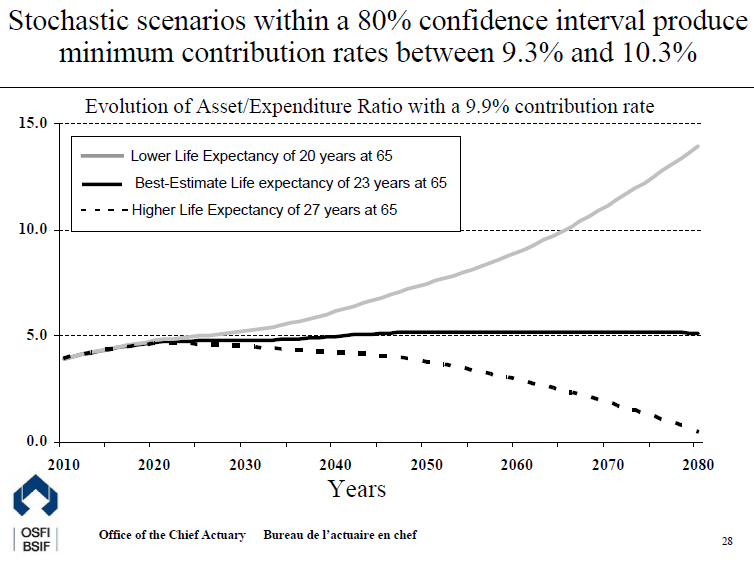
The actuarial report on the Canada Pension Plan is based on the projection of its revenues and expenditures over a long period of time. Under a set of best-estimate assumptions, the most recent actuarial report confirms that the legislated contribution rate of 9.9% is sufficient to pay future expenditures and accumulate assets of $275 billion in 2020, or 4.7 times the expenditures. Having said that, both the length of the projection period and the number of assumptions required ensure that actual future experience will not develop precisely in accordance with the best-estimate assumptions. For the second time, in the most recent actuarial reports, many of the sensitivity tests are determined based on stochastic modeling techniques that estimate the probability distribution of the outcome for each of the main assumptions.

This chart shows the evolution of the asset to expenditure ratio under three scenarios: the best-estimate assumption and the two stochastically determined scenarios based on a 80% confidence interval. The result is that the minimum contribution rate required to finance the plan over a 75-year period could fall between 9.3% and 10.3%.


Click for big

It was a relatively quiet, but nevertheless profitable day on the Canadian preferred share market, with PerpetualDiscounts up 10bp and FixedResets gaining 5bp on average volume.

HIMIPref™ Preferred Indices
These values reflect the December 2008 revision of the HIMIPref™ Indices

Values are provisional and are finalized monthly
Index Mean
Current
Yield
(at bid)
Median
YTW
Median
Average
Trading
Value
Median
Mod Dur
(YTW)
Issues Day’s Perf. Index Value
Ratchet 0.00 % 0.00 % 0 0.00 0 0.1230 % 2,318.4
FixedFloater 4.81 % 3.54 % 28,332 18.91 1 0.0000 % 3,497.2
Floater 2.58 % 2.37 % 45,052 21.28 4 0.1230 % 2,503.2
OpRet 4.80 % 3.34 % 62,055 2.33 8 -0.1681 % 2,393.7
SplitShare 5.34 % 1.62 % 657,951 0.92 4 -0.1658 % 2,449.1
Interest-Bearing 0.00 % 0.00 % 0 0.00 0 -0.1681 % 2,188.9
Perpetual-Premium 5.66 % 5.27 % 122,584 5.06 20 0.0848 % 2,025.1
Perpetual-Discount 5.42 % 5.45 % 230,981 14.75 57 0.0987 % 2,040.7
FixedReset 5.24 % 3.44 % 292,058 3.09 52 0.0476 % 2,270.7
Performance Highlights
Issue Index Change Notes
GWO.PR.F Perpetual-Premium -1.71 % YTW SCENARIO
Maturity Type : Call
Maturity Date : 2012-10-30
Maturity Price : 25.00
Evaluated at bid price : 25.31
Bid-YTW : 5.27 %
GWO.PR.L Perpetual-Discount -1.21 % YTW SCENARIO
Maturity Type : Limit Maturity
Maturity Date : 2041-01-07
Maturity Price : 24.29
Evaluated at bid price : 24.50
Bid-YTW : 5.80 %
RY.PR.H Perpetual-Premium 1.01 % YTW SCENARIO
Maturity Type : Call
Maturity Date : 2017-06-23
Maturity Price : 25.00
Evaluated at bid price : 26.06
Bid-YTW : 5.03 %
HSB.PR.C Perpetual-Discount 1.03 % YTW SCENARIO
Maturity Type : Limit Maturity
Maturity Date : 2041-01-07
Maturity Price : 23.25
Evaluated at bid price : 23.50
Bid-YTW : 5.46 %
PWF.PR.P FixedReset 2.66 % YTW SCENARIO
Maturity Type : Limit Maturity
Maturity Date : 2041-01-07
Maturity Price : 25.05
Evaluated at bid price : 25.10
Bid-YTW : 4.04 %
Volume Highlights
Issue Index Shares
Traded
Notes
BNS.PR.Q FixedReset 114,493 RBC crossed 14,500 at 26.10. TD crossed blocks of 57,200 and 25,000 at the same price.
YTW SCENARIO
Maturity Type : Call
Maturity Date : 2013-11-24
Maturity Price : 25.00
Evaluated at bid price : 26.06
Bid-YTW : 3.28 %
TD.PR.I FixedReset 109,620 Nesbitt crossed 99,300 at 27.35.
YTW SCENARIO
Maturity Type : Call
Maturity Date : 2014-08-30
Maturity Price : 25.00
Evaluated at bid price : 27.35
Bid-YTW : 3.41 %
TD.PR.A FixedReset 67,900 TD crossed 60,000 at 26.25.
YTW SCENARIO
Maturity Type : Call
Maturity Date : 2014-03-02
Maturity Price : 25.00
Evaluated at bid price : 26.20
Bid-YTW : 3.24 %
TD.PR.K FixedReset 64,200 RBC crossed 56,300 at 27.45.
YTW SCENARIO
Maturity Type : Call
Maturity Date : 2014-08-30
Maturity Price : 25.00
Evaluated at bid price : 27.45
Bid-YTW : 3.31 %
SLF.PR.B Perpetual-Discount 49,944 Desjardins bought 37,000 from RBC at 22.20.
YTW SCENARIO
Maturity Type : Limit Maturity
Maturity Date : 2041-01-07
Maturity Price : 21.82
Evaluated at bid price : 22.17
Bid-YTW : 5.44 %
BNS.PR.T FixedReset 25,885 TD crossed 25,000 at 27.35.
YTW SCENARIO
Maturity Type : Call
Maturity Date : 2014-05-25
Maturity Price : 25.00
Evaluated at bid price : 27.30
Bid-YTW : 3.29 %
There were 26 other index-included issues trading in excess of 10,000 shares.
Market Action

January 6, 2011

On December 14 I highlighted Hoenig’s dissent from the FOMC decision and speculated:

It occurs to me that Mr. Hoenig is being used – probably with his enthusiastic cooperation – as a straw man. The Fed wants to send an explicit signal that they’ve thought about this, discussed this and reached a concensus to reject this. There’s no shortage of blogs out there claiming hyperinflation is imminent! Given the increased public discussion of economic data, with various levels of competence, one wonders if more public pronouncements by governments and their agencies will set up straw men in their releases and recognize that forecasts are necessarily imprecise.

Hoenig has delivered a speech on the topic, titled Monetary policy and the role of dissent:

Based on audience questions, news coverage and pundit columns throughout the year, it has become obvious to me that the role of dissent in the FOMC is misunderstood and viewed without context. The idea that a dissenting vote is confusing, counterproductive, and generally undesirable is unhealthy. It is also historically inaccurate.

In my remaining time today, I will discuss why dissenting views at the FOMC are critical to the success of the Federal Reserve System and that public debate was the intent of its congressional founders. I will also describe how open debate and dissent are fundamental to achieving transparency of FOMC deliberations and to supporting the credibility of the committee in difficult economic times.
..
As an economist, I cannot be certain that my views are correct. Certainly, a majority of my counterparts on the FOMC last year did not agree with my views. But it is important to recognize that in the face of uncertainty, arriving at the best policy decision is built on divergent opinions and vigorous debate.

Because of this, the role of open dissent is at least as critical to FOMC monetary policy decisions as it is to deliberations by the Supreme Court, the United States Congress or any other body with important public responsibilities from the local through the federal level. If you find it unusual to consider the FOMC as being similar to these other deliberative bodies, it is perhaps because many–including some former Federal Reserve officials–tend to speak of Fed policy as being done by a single actor.

A deliberative body does not gain credibility by concealing dissent when decision making is most difficult. In fact, credibility is sacrificed as those on the outside realize that unanimity – difficult in any environment – simply may not be a reasonable expectation when the path ahead is the most confounding.

As for me, I recognize that the committee’s majority might be correct. In fact, I hope that it is. However, I have come to my policy position based on my experience, current data and economic history. If I had failed to express my views with my vote, I would have failed in my duty to you and to the committee.

In these days of political obsession with staying “on message”, and puerile voters who want a simple story just like mommy used to tell them, Hoenig’s expression of his views is rather refreshing!

Contingent Capital as a concept has often been criticized on the basis that it might be difficult to sell – but banks have been selling this type of issue with gusto:

Barclays Plc, based in London, and UBS AG in Zurich led more than a dozen banks selling reverse convertibles, which are short-term bonds generally marketed to individuals that convert into stock if a company’s share price plummets.

Structured note sales rose 46 percent last year to a record $49.4 billion in the U.S., Bloomberg data show. The securities fed demand from individual investors frustrated with record low rates on everything from certificates of deposit to money market funds with the Federal Reserve holding its target interest rate for overnight loans between banks in a range of zero to 0.25 percent since 2008. Banks issued $33.9 billion in 2009, according to StructuredRetailProducts.com, a database used by the industry.

Royal Bank of Scotland Group Plc sold $1.15 million in three-month notes tied to Rochester, New York-based Eastman Kodak Co. on June 10 that paid 24 percent annualized interest, a filing with the U.S. Securities and Exchange Commission shows. That’s 24 times the average rate on one-year certificates of deposit, according to data from Bankrate Inc. in North Palm Beach, Florida.

Buyers couldn’t lose money unless shares of the camera maker fell to below $3.54 from $5.06. Kodak dropped to $3.50 on Aug. 31 in New York trading. RBS converted the bonds into stock and investors lost about 18 percent even with the high interest rate.

I will admit, however, that the perpetual nature of Contingent Capital is another difficulty in flogging it.

Regular debt is selling pretty well, too!

Company bond sales in the U.S. surged to the most on record this week and relative yields on investment-grade debt shrank to the narrowest since May as investors boosted bets that economic growth is gaining momentum.

Issuance soared to $48.2 billion, eclipsing the $46.9 billion raised in the week ended May 8, 2009, as General Electric Co.’s finance unit sold $6 billion of notes in the largest sale in 11 months, according to data compiled by Bloomberg. Investment-grade bond spreads narrowed to 162 basis points, or 1.62 percentage points, the tightest since May 4, 2010, Bank of America Merrill Lynch index data show.

Investors’ appetite for company debt is growing even after annual sales topped $1 trillion for the second consecutive year as the securities outperform Treasuries.

Offerings from foreign borrowers dominated U.S. sales this week, with transactions by companies from Sydney-based Macquarie Group Ltd. to the U.K.’s Barclays Plc accounting for 57 percent of the total, Bloomberg data show. Relative yields on U.S. corporate bonds became narrower than those on company debt worldwide last month for the first time on record, Bank of America Merrill Lynch index data show.

The Canadian preferred share market had a good day on average volume, with PerpetualDiscounts gaining 21bp and FixedResets up 10bp. Sun Life PerpetualDiscounts saw some good volume.

HIMIPref™ Preferred Indices
These values reflect the December 2008 revision of the HIMIPref™ Indices

Values are provisional and are finalized monthly
Index Mean
Current
Yield
(at bid)
Median
YTW
Median
Average
Trading
Value
Median
Mod Dur
(YTW)
Issues Day’s Perf. Index Value
Ratchet 0.00 % 0.00 % 0 0.00 0 0.1725 % 2,315.5
FixedFloater 4.81 % 3.54 % 29,489 18.92 1 0.0442 % 3,497.2
Floater 2.58 % 2.37 % 46,908 21.28 4 0.1725 % 2,500.1
OpRet 4.80 % 3.33 % 64,571 2.33 8 -0.1142 % 2,397.8
SplitShare 5.33 % 1.30 % 668,053 0.92 4 0.2620 % 2,453.2
Interest-Bearing 0.00 % 0.00 % 0 0.00 0 -0.1142 % 2,192.5
Perpetual-Premium 5.66 % 5.28 % 124,399 5.21 20 0.1087 % 2,023.4
Perpetual-Discount 5.42 % 5.48 % 232,597 14.72 57 0.2055 % 2,038.7
FixedReset 5.24 % 3.41 % 297,153 3.09 52 0.1036 % 2,269.7
Performance Highlights
Issue Index Change Notes
PWF.PR.P FixedReset -2.70 % YTW SCENARIO
Maturity Type : Limit Maturity
Maturity Date : 2041-01-06
Maturity Price : 24.40
Evaluated at bid price : 24.45
Bid-YTW : 4.15 %
TRP.PR.B FixedReset -1.63 % YTW SCENARIO
Maturity Type : Limit Maturity
Maturity Date : 2041-01-06
Maturity Price : 24.69
Evaluated at bid price : 24.74
Bid-YTW : 3.76 %
FTS.PR.F Perpetual-Discount -1.52 % YTW SCENARIO
Maturity Type : Limit Maturity
Maturity Date : 2041-01-06
Maturity Price : 22.58
Evaluated at bid price : 22.75
Bid-YTW : 5.45 %
HSB.PR.D Perpetual-Discount 1.04 % YTW SCENARIO
Maturity Type : Limit Maturity
Maturity Date : 2041-01-06
Maturity Price : 23.03
Evaluated at bid price : 23.25
Bid-YTW : 5.41 %
PWF.PR.I Perpetual-Premium 1.08 % YTW SCENARIO
Maturity Type : Call
Maturity Date : 2011-05-30
Maturity Price : 25.25
Evaluated at bid price : 25.30
Bid-YTW : 4.48 %
W.PR.J Perpetual-Discount 1.20 % YTW SCENARIO
Maturity Type : Limit Maturity
Maturity Date : 2041-01-06
Maturity Price : 24.23
Evaluated at bid price : 24.52
Bid-YTW : 5.73 %
ELF.PR.F Perpetual-Discount 1.23 % YTW SCENARIO
Maturity Type : Limit Maturity
Maturity Date : 2041-01-06
Maturity Price : 21.95
Evaluated at bid price : 22.25
Bid-YTW : 5.97 %
MFC.PR.B Perpetual-Discount 1.32 % YTW SCENARIO
Maturity Type : Limit Maturity
Maturity Date : 2041-01-06
Maturity Price : 21.56
Evaluated at bid price : 21.56
Bid-YTW : 5.45 %
TD.PR.E FixedReset 1.34 % YTW SCENARIO
Maturity Type : Call
Maturity Date : 2014-05-30
Maturity Price : 25.00
Evaluated at bid price : 27.66
Bid-YTW : 2.87 %
NA.PR.O FixedReset 1.97 % YTW SCENARIO
Maturity Type : Call
Maturity Date : 2014-03-17
Maturity Price : 25.00
Evaluated at bid price : 27.70
Bid-YTW : 2.85 %
Volume Highlights
Issue Index Shares
Traded
Notes
BAM.PR.N Perpetual-Discount 158,604 RBC crossed five blocks: 22,900 shares, 25,000 shares, 40,000 and two of 25,300 each, all at 20.63.
YTW SCENARIO
Maturity Type : Limit Maturity
Maturity Date : 2041-01-06
Maturity Price : 20.56
Evaluated at bid price : 20.56
Bid-YTW : 5.83 %
SLF.PR.D Perpetual-Discount 125,402 Desjardins crossed blocks of 70,900 at 20.40 and 49,700 at 20.45.
YTW SCENARIO
Maturity Type : Limit Maturity
Maturity Date : 2041-01-06
Maturity Price : 20.43
Evaluated at bid price : 20.43
Bid-YTW : 5.49 %
SLF.PR.A Perpetual-Discount 84,690 Desjardins crossed 71,400 at 21.88.
YTW SCENARIO
Maturity Type : Limit Maturity
Maturity Date : 2041-01-06
Maturity Price : 21.81
Evaluated at bid price : 21.81
Bid-YTW : 5.49 %
BNS.PR.Q FixedReset 74,651 RBC crossed 50,000 at 26.10.
YTW SCENARIO
Maturity Type : Call
Maturity Date : 2013-11-24
Maturity Price : 25.00
Evaluated at bid price : 26.06
Bid-YTW : 3.28 %
CM.PR.H Perpetual-Discount 70,352 Desjardins crossed blocks of 38,300 and 15,000, both at 22.65.
YTW SCENARIO
Maturity Type : Limit Maturity
Maturity Date : 2041-01-06
Maturity Price : 22.43
Evaluated at bid price : 22.62
Bid-YTW : 5.31 %
SLF.PR.C Perpetual-Discount 51,660 TD crossed 25,000 at 20.50.
YTW SCENARIO
Maturity Type : Limit Maturity
Maturity Date : 2041-01-06
Maturity Price : 20.43
Evaluated at bid price : 20.43
Bid-YTW : 5.49 %
There were 29 other index-included issues trading in excess of 10,000 shares.
Index Construction / Reporting

HIMIPref™ Index Performance: December 2010

Performance of the HIMIPref™ Indices for December, 2010, was:

Total Return
Index Performance
December 2010
Three Months
to
December 30, 2010
Ratchet +2.00% *** +7.46% ***
FixFloat -0.35% ** +7.19% **
Floater +2.00% +7.46%
OpRet +0.68% +1.10%
SplitShare -0.84% +3.65%
Interest +0.68%**** +1.10%****
PerpetualPremium +0.50% +1.25%
PerpetualDiscount -0.47% +2.55%
FixedReset +0.03% +0.49%
** The last member of the FixedFloater index was transferred to Scraps at the June, 2010, rebalancing; subsequent performance figures are set equal to the Floater index. The index was repopulated at the October, 2010, rebalancing
*** The last member of the RatchetRate index was transferred to Scraps at the July, 2010, rebalancing; subsequent performance figures are set equal to the Floater index
**** The last member of the InterestBearing index was transferred to Scraps at the June, 2009, rebalancing; subsequent performance figures are set equal to the OperatingRetractible index
Passive Funds (see below for calculations)
CPD -0.01% +1.44%
DPS.UN +0.14% +1.19%
Index
BMO-CM 50 -0.04% +2.64%
TXPR Total Return 0.00% +1.86%

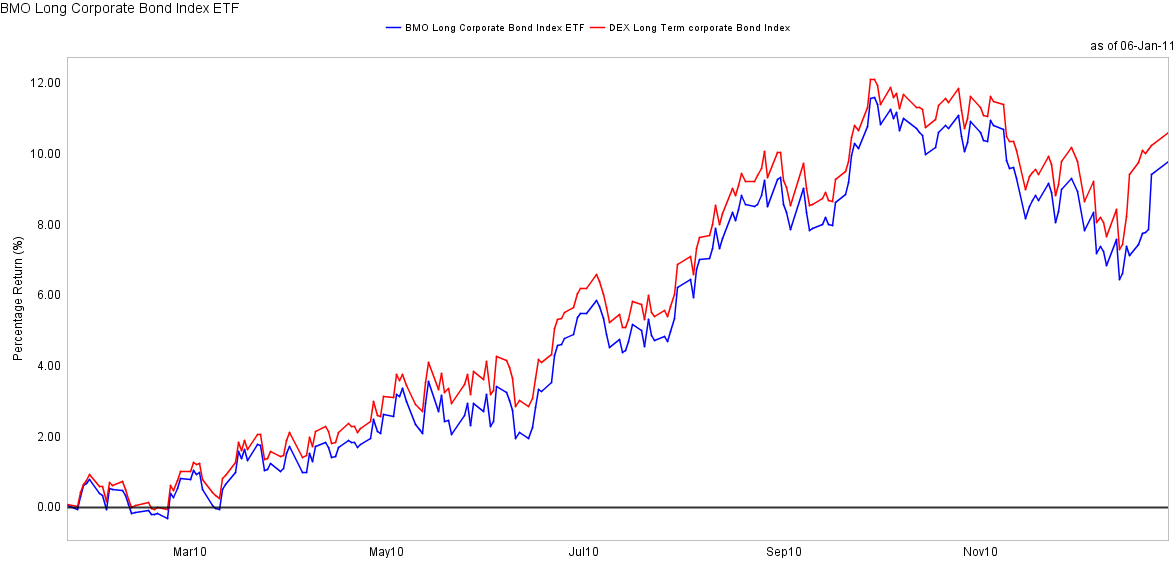
The pre-tax interest equivalent spread of PerpetualDiscounts over Long Corporates (which I also refer to as the Seniority Spread) ended the year at 225bp, a slight increase from the 220bp reported at November month end. Long corporate yields remained constant 5.4% during the period (albeit with interesting things happening in the interim) while PerpetualDiscounts increased slightly to 5.48% from 5.41% dividend yield. I would be happier with long corporates in the 6.00-6.25% range with a seniority spread in the range of 100-150bp, but what do I know? The market has never shown any particular interest in my happiness.

The wild ride of long corporates during the month is illustrated by the BMO Long Corporate Bond Index ETF tracking error chart:


Click for Big

Charts related to the Seniority Spread and the Bozo Spread (PerpetualDiscount Current Yield less FixedReset Current Yield) are published in PrefLetter.

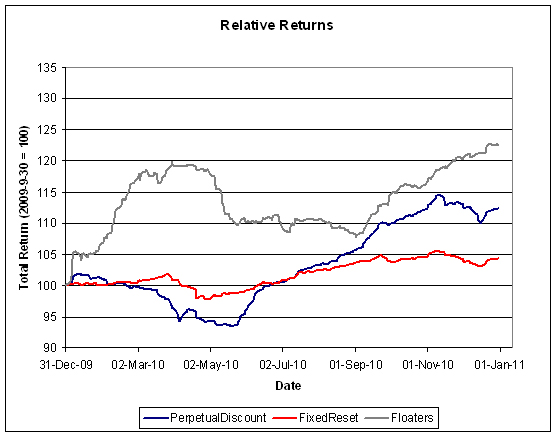
The trailing year returns are starting to look a bit more normal.


Click for big

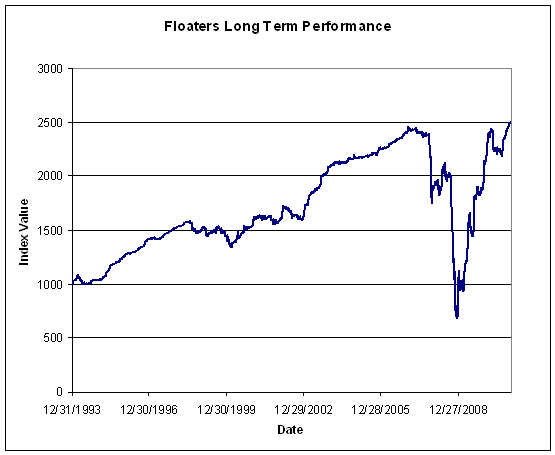
Floaters have had a wild ride; the latest decline is presumably due to the idea that the BoC will be slower rather than faster in hiking the overnight rate. I’m going to keep publishing updates of this graph until the one-year trailing return for the sector no longer looks so gigantic:


Click for big

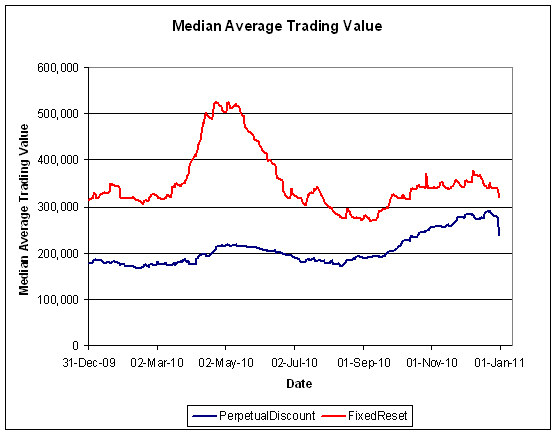
Volumes are on their way back up Volume may be under-reported due to the influence of Alternative Trading Systems (as discussed in the November PrefLetter), but I am biding my time before incorporating ATS volumes into the calculations, to see if the effect is transient or not. The droop at year end is quite pronounced.


Click for big

Compositions of the passive funds were discussed in the September, 2010, edition of PrefLetter.

Claymore has published NAV and distribution data (problems with the page in IE8 can be kludged by using compatibility view) for its exchange traded fund (CPD) and I have derived the following table:

CPD Return, 1- & 3-month, to December 30, 2010
Date NAV Distribution Return for Sub-Period Monthly Return
September 30 17.07      
October 26 17.21 0.069 +1.22% +1.40%
October 29, 2010 17.24   +0.17%
November 25 17.25 0.069 +0.46% +0.23%
November 30 17.21   -0.23%
December 24 17.09 0.069 -0.30% -0.01%
December 31 17.14   +0.29%
Quarterly Return +1.44%

Claymore currently holds $596,621,272 (advisor & common combined) in CPD assets, up about $14-million (2.47%) from the $582,195,003 reported at November month-end and up about $223-million (+59.64%) from the $373,729,364 reported at year-end 2009. Their tracking error does not seem to be affecting their ability to gather assets!

The DPS.UN NAV for December 29 has been published so we may calculate the approximate December returns.

DPS.UN NAV Return, December-ish 2010
Date NAV Distribution Return for sub-period Return for period
December 1 21.33      
December 29 21.01 0.30   -0.09%
Estimated December Beginning Stub *
Estimated December Ending Stub +0.29% *****
Estimated December Return +0.14% ******
**CPD had a NAVPU of 17.21 on November 30 and 17.20 on December 1, therefore the return for the day was -0.06%. The return for DPS.UN in this period is presumed to be equal.
*****CPD had a NAVPU of 17.09 on December 29 and 17.14 on December 31, hence the total return for the period for CPD was +0.29%. The return for DPS.UN in this period is presumed to be equal.
**** The estimated December return for DPS.UN’s NAV is therefore the product of three period returns, -0.06%, -0.09%, +0.29% to arrive at an estimate for the calendar month of +0.14%

Now, to see the DPS.UN quarterly NAV approximate return, we refer to the calculations for October and November:

DPS.UN NAV Returns, three-month-ish to end-December-ish, 2010
October-ish +0.17%
November-ish +0.88%
December-ish +0.14%
Three-months-ish +1.19%

Sentry Select is now publishing performance data for DPS.UN, but this appears to be price-based, rather than NAV-based. I will continue to report NAV-based figures.

Issue Comments

BSD.PR.A to Allow Retractions

Brookfield Soundvest Funds has announced:

that the annual redemption rights attributable to the Capital Units and the Combined Securities (being one Capital Unit and a $10.00 principal amount of Preferred Securities) of the Brookfield Soundvest Split Trust (TSX:BSD.UN)(TSX:BSD.PR.A) (the “Trust”) are being reinstated. The Trust’s annual redemption rights were suspended in October 2008 as a result of provisions in the Declaration of Trust that are applicable where it is anticipated that, after giving effect to redemptions, the Combined Value (NAV plus the Repayment Price which is the $10.00 principal amount of a Preferred Security plus all accrued and unpaid interest on such $10.00 principal amount of a Preferred Security) determined as of the Redemption Date would fall below 1.4 times the Repayment Price determined as of the Redemption Date (“the 1.4 times coverage ratio”). The Trust has performed strongly over the past several months and it is now anticipated that redemptions may be processed without violating the 1.4 times coverage ratio.

Consequently, the Trust intends to reinstate the suspended redemption rights with a specified redemption date of February 14, 2011. This date provides for the notice period required by CDS and the provisions of the Declaration of Trust relevant to the redemption process that apply. Accordingly, each Unitholder who has requested a redemption by depositing Capital Units or Combined Securities with the Registrar and Transfer Agent at least 15 business days prior to February 14, 2011 and in accordance with their deposit requirements will be entitled to receive redemption proceeds calculated and paid in accordance with the Declaration of Trust no later than 15 business days after February 14, 2011.

When Capital Units alone are surrendered for redemption, an equal number of Preferred Securities must be acquired for cancellation, either in the market or, in limited circumstances, pursuant to the Call Right as defined in the Trust Indenture. If the average cost of acquiring Preferred Securities for cancellation exceeds their $10.00 face value plus accrued and unpaid interest thereon, the amount the Capital Unit holder will be entitled to receive will be reduced. If any Capital Unit holder chooses to tender just Capital Units, then he or she will take the risk that their redemption proceeds will be reduced by an uncertain amount. Anyone planning to surrender Capital Units alone is encouraged to read the Trust Indenture and the Amended and Restated Declaration of Trust that are available at www.SEDAR.com and to consult with their financial adviser.

Notwithstanding any other provision in the Declaration of Trust, redemption of Trust Units and Combined Securities may be suspended or payment of redemption proceeds postponed, even if units have been tendered for redemption, if, after giving effect to the redemptions, the 1.4 times coverage ratio cannot be maintained. The Trust will continue to closely monitor its NAV and will make a further announcement in the event that such a suspension or postponement is required.

Cash distributions cannot be paid on the Capital Units of the Trust if, immediately after giving effect to the proposed distribution, the Combined Value determined as of the declaration date will be less than 1.4 times the Repayment Price determined as of the declaration date. The Trust will continue to monitor its net asset value to determine when it will be able to make future distributions on its Capital Units and will issue a news release if such distributions are declared.

Brookfield Soundvest Funds give investors access to tax-advantaged distributions while focusing on capital preservation and long-term total return. The manager and investment advisor and portfolio manager for the Funds is Brookfield Soundvest Capital Management Ltd. (the “Manager”), an established investment advisor, providing investment management services to trusts, foundations, corporations and high net worth individuals.

The manager’s incompetence is such that this press release, dated 2011-1-5, is not yet available on the fund’s press release page.

It will be noted that the press release’s first paragraph contains what is basically a lie. According to the prospectus (emphasis added):

The Trust may suspend the redemption of Capital Units and the repayment of Preferred Securities or postpone repayment of redemption proceeds: (i) during any period when the Investment Advisor advises the Manager that normal trading is suspended on a market where more than 50% of the securities in the Portfolio (in terms of dollar value) trade and, if those securities are not traded on any other exchange that represents a reasonably practical alternative for the Trust; (ii) with the permission of the securities regulatory authorities (if required), for any period not exceeding 120 days during which the Manager determines that conditions exist which render impractical the sale of assets of the Trust or which impair the ability of the Trustee to determine the value of the assets of the Trust, (iii) if, after giving effect to redemptions, the Combined Value would be less than 1.4 times the Repayment Price, or (iv) if the Trust would be insolvent or otherwise unable to pay its liabilities as they become due after giving effect to such redemptions (and repayment, if applicable). The suspension shall apply to all requests for redemption or repayment received prior to the suspension date but for which payment has not been made, as well as to all requests received while the suspension is in effect. All Unitholders or Securityholders making such requests will be advised by the Manager of the suspension and that the redemption or repayment will be effected at a price determined following the resumption of redemptions and repayments. All such Unitholders and Securityholders will have, and will be advised that they have, the right to withdraw their requests for redemption or repayment if such requests were submitted prior to a suspension and payment has not been made, or if such requests were submitted during a period of suspension. Redemptions and repayments will resume in any event on the first day on which the condition giving rise to the suspension has ceased to exist, provided that no other circumstances under which a suspension is authorized then exists. To the extent it is not inconsistent with rules and regulations promulgated by any government body having jurisdiction over the Trust, any declaration of suspension made by the Manager will be conclusive.

See that word? “May”? The Manager has discretion.

The combined unit NAV as of December 31 is $14.41. Asset coverage has indeed recovered to within shouting distance of my usual comfort zone and the 6% coupon (as interest) is indeed nice and fat …. but I have lost confidence in this manager and my comfort zone for Asset Coverage is now more than usual. Suspending the retraction right was abusive to shareholders, and underperformance against the benchmark since inception has been egregious.

Therefore, I recommend retraction.

BSD.PR.A was last mentioned on PrefBlog when it was upgraded to Pfd-4(low) by DBRS. BSD.PR.A is tracked by HIMIPref™ but is relegated to the Scraps index on credit concerns.

Thanks to Assiduous Reader cal for bringing this to my attention.

Update, 2011-1-11: The Material Change Report filed on SEDAR dated 2011-1-5 is a little more honest in its wording (emphasis added):

The Amended and Restated Declaration of Trust dated April 30, 2010 (the “Declaration of Trust”) for Brascan Soundvest Split Trust permits the temporary suspension of the redemption of Capital Units and Combined Securities (being one Capital Unit and a $10.00 principal amount of Preferred Securities) if, after giving effect to the redemptions, the Combined Value would be less than 1.4 times the Repayment Price….As a result, the Declaration of Trust permits the suspension of redemptions when the net asset value per Capital Unit is less than approximately $4.00

Market Action

January 5, 2011

Manulife has announced that:

Between October 1, 2010 and December 31, 2010, the Company:

  • Shorted approximately $5 billion of equity futures contracts as part of the Company’s macro hedging program.
  • Modestly increased its dynamic variable annuity hedging program by adding $800 million of in-force variable annuity guaranteed value to the program.
  • Sold $200 million of on-balance sheet public equities backing insurance liabilities

The WSJ has a story today titled Bondholders Are Rattled by Prepayment Covenants, republished by the Globe, but not on-line. It seems there are a lot of calls for redemption in the junk bond world, surprising many managers … I tell you, it’s a good thing so few of my competitors read prospectuses; that would make outperformance more difficult.

Assiduous Reader DW brings to my attention a working paper by Zhiwu Chen, Roger G. Ibbotson and Wendy Hu titled Liquidity as an Investment Style:

We first show that liquidity, as measured by stock turnover or trading volume, is an economically significant investment style that is distinct from traditional investment styles such as size, value/growth, and momentum. We then introduce and examine the performance of several portfolio strategies, including a Volume Weighted Strategy, an Earnings Weighted Strategy, an Earnings-Based Liquidity Strategy, and a Market Cap-Based Liquidity Strategy. Our backtest research shows that the Earnings-Based Liquidity Strategy offers the highest return and the best risk-return tradeoff, while the Volume Weighted Strategy does the worst. The superior performance of the liquidity strategies are due to equilibrium, macro, and micro reasons. In equilibrium, liquid stocks sell at a liquidity premium and illiquid stocks sell at a liquidity discount. Investing in less liquid stocks thus pays. Second, at the macro level, the growing level of financialization of assets in the world makes today’s less liquid securities increasingly more liquid over time. Finally, at the micro level, the strategy avoids, or invests less, in popular, heavily traded glamour stocks and favors out-of-favor stocks, both of which tend to revert to more normal trading volume over time.

The negative relation between liquidity and stock returns is not always straight forward. Lee and Swaminathan (1998) show that the return spread between past winners and past losers (i.e., the momentum premium) is much higher among high-volume stocks. Trading volume serves as an indicator of demand for a stock. When a stock falls into disfavor, the number of sellers dominates buyers, leading to low prices and low volume. When a stock becomes popular or glamorous, buyers dominate sellers, resulting in higher prices and higher volume. Thus, relatively low turnover is indicative of a stock near the bottom of its expectation cycle, while a relatively high turnover is indicative of a firm close to the top of its expectation cycle.

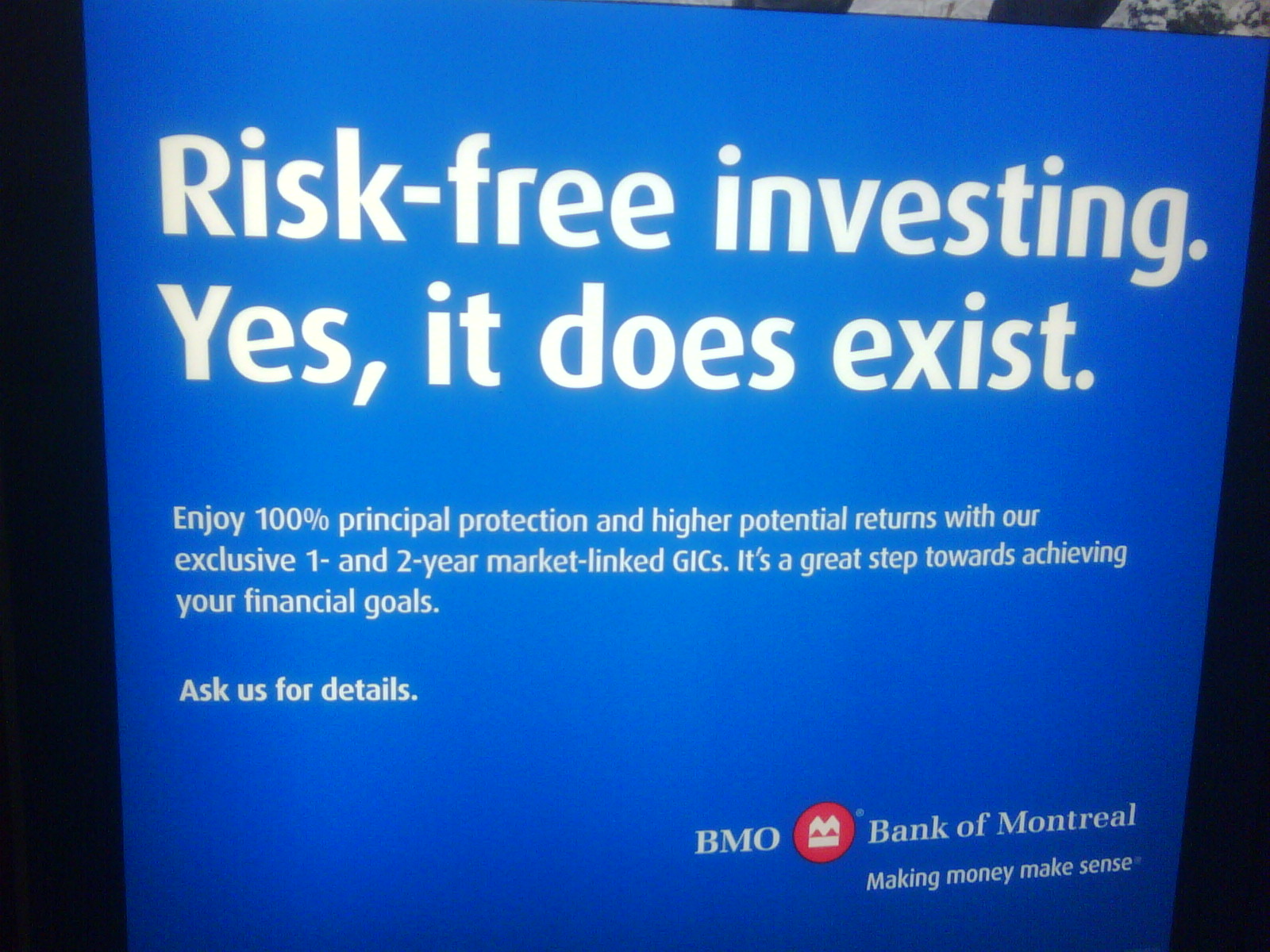
Today’s installment in the “Incredible Bullshit Banks are Allowed To Get Away With” series features the Bank of Montreal:


Click for Big

Risk Free! Lehman should have thought of that line, they would have been able to sell a great many more of their PPNs.

A mixed day on the Canadian preferred share market, with PerpetualDiscounts gaining 10bp and FixedResets losing 16bp. Volume was on the high side of average.

PerpetualDiscounts now yield 5.43%, equivalent to 7.60% interest at the standard equivalency factor of 1.4x. Long corporates now yield about 5.5%, so the pre-tax interest-equivalent spread (also known, around here, as the Seniority Spread) is now about 210bp, a dramatic tightening from the 225bp reported on December 31.

HIMIPref™ Preferred Indices
These values reflect the December 2008 revision of the HIMIPref™ Indices

Values are provisional and are finalized monthly
Index Mean
Current
Yield
(at bid)
Median
YTW
Median
Average
Trading
Value
Median
Mod Dur
(YTW)
Issues Day’s Perf. Index Value
Ratchet 0.00 % 0.00 % 0 0.00 0 0.2099 % 2,311.5
FixedFloater 4.81 % 3.54 % 29,719 18.92 1 0.0000 % 3,495.6
Floater 2.59 % 2.38 % 47,327 21.27 4 0.2099 % 2,495.8
OpRet 4.78 % 3.27 % 65,364 2.33 8 -0.1290 % 2,400.5
SplitShare 5.34 % 1.30 % 692,021 0.92 4 0.3945 % 2,446.8
Interest-Bearing 0.00 % 0.00 % 0 0.00 0 -0.1290 % 2,195.0
Perpetual-Premium 5.64 % 5.31 % 124,903 5.31 20 0.1120 % 2,021.2
Perpetual-Discount 5.43 % 5.49 % 233,261 14.71 57 0.1049 % 2,034.5
FixedReset 5.23 % 3.46 % 304,306 3.08 52 -0.1590 % 2,267.3
Performance Highlights
Issue Index Change Notes
BAM.PR.O OpRet -1.33 % YTW SCENARIO
Maturity Type : Option Certainty
Maturity Date : 2013-06-30
Maturity Price : 25.00
Evaluated at bid price : 26.05
Bid-YTW : 3.27 %
BNS.PR.Y FixedReset -1.03 % YTW SCENARIO
Maturity Type : Limit Maturity
Maturity Date : 2041-01-05
Maturity Price : 24.85
Evaluated at bid price : 24.90
Bid-YTW : 3.46 %
NA.PR.O FixedReset -1.01 % YTW SCENARIO
Maturity Type : Call
Maturity Date : 2014-03-17
Maturity Price : 25.00
Evaluated at bid price : 27.57
Bid-YTW : 3.53 %
BNA.PR.C SplitShare 1.10 % YTW SCENARIO
Maturity Type : Hard Maturity
Maturity Date : 2019-01-10
Maturity Price : 25.00
Evaluated at bid price : 22.10
Bid-YTW : 6.31 %
GWO.PR.F Perpetual-Premium 1.30 % YTW SCENARIO
Maturity Type : Call
Maturity Date : 2011-02-04
Maturity Price : 25.50
Evaluated at bid price : 25.75
Bid-YTW : -5.08 %
HSB.PR.C Perpetual-Discount 1.34 % YTW SCENARIO
Maturity Type : Limit Maturity
Maturity Date : 2041-01-05
Maturity Price : 23.21
Evaluated at bid price : 23.45
Bid-YTW : 5.47 %
IAG.PR.A Perpetual-Discount 1.94 % YTW SCENARIO
Maturity Type : Limit Maturity
Maturity Date : 2041-01-05
Maturity Price : 21.01
Evaluated at bid price : 21.01
Bid-YTW : 5.52 %
Volume Highlights
Issue Index Shares
Traded
Notes
TD.PR.I FixedReset 95,421 TD crossed four blocks; 20,000 shares, 41,900 shares, 12,600 and 12,400, all at 27.75.
YTW SCENARIO
Maturity Type : Call
Maturity Date : 2014-08-30
Maturity Price : 25.00
Evaluated at bid price : 27.56
Bid-YTW : 3.61 %
GWO.PR.H Perpetual-Discount 76,071 Desjardins crossed three blocks, one of 11,400 and two of 25,000 each, all at 23.50.
YTW SCENARIO
Maturity Type : Limit Maturity
Maturity Date : 2041-01-05
Maturity Price : 23.07
Evaluated at bid price : 23.30
Bid-YTW : 5.23 %
PWF.PR.M FixedReset 71,772 Nesbitt crossed 50,000 at 27.00; RBC crossed 20,700 at the same price.
YTW SCENARIO
Maturity Type : Call
Maturity Date : 2014-03-02
Maturity Price : 25.00
Evaluated at bid price : 27.00
Bid-YTW : 3.64 %
TRP.PR.A FixedReset 61,113 RBC crossed 38,000 at 25.96.
YTW SCENARIO
Maturity Type : Call
Maturity Date : 2015-01-30
Maturity Price : 25.00
Evaluated at bid price : 25.94
Bid-YTW : 3.61 %
TRP.PR.C FixedReset 46,815 RBC crossed 40,000 at 25.43.
YTW SCENARIO
Maturity Type : Limit Maturity
Maturity Date : 2041-01-05
Maturity Price : 25.30
Evaluated at bid price : 25.35
Bid-YTW : 3.95 %
BNS.PR.Q FixedReset 38,522 YTW SCENARIO
Maturity Type : Call
Maturity Date : 2013-11-24
Maturity Price : 25.00
Evaluated at bid price : 26.03
Bid-YTW : 3.32 %
There were 33 other index-included issues trading in excess of 10,000 shares.
New Issues

New Issue: FN FixedReset 4.65%+207

First National Financial Corporation has announced:

a Canadian public offering of Cumulative 5-Year Rate Reset Class A Preference Shares, Series 1 (“Series 1 Preferred Shares”). First National will issue 4 million Series 1 Preferred Shares priced at $25 per share to raise gross proceeds of C$100 million. The offering will be underwritten by a syndicate of investment dealers led by RBC Capital Markets and Scotia Capital Inc.

The offering is being made in all the provinces of Canada by means of a prospectus and the expected closing date is on or about January 25, 2011. The net proceeds of the offering will be used to repay current indebtedness as well as for general corporate purposes.

Holders of the Series 1 Preferred Shares will be entitled to receive a cumulative quarterly fixed dividend yielding 4.65% annually for the initial period ending March 31, 2016. Thereafter, the dividend rate will be reset every five years at a rate equal to the 5-year Government of Canada yield plus 2.07%.

Holders of Series 1 Preferred Shares will have the right, at their option, to convert their shares into Cumulative, Floating Rate Class A Preference Shares, Series 2 (“Series 2 Preferred Shares”), subject to certain conditions, on March 31, 2016 and on March 31 every five years thereafter. Holders of the Series 2 Preferred Shares will be entitled to receive cumulative quarterly floating dividends at a rate equal to the 3-month Government of Canada Treasury Bill yield plus 2.07%.

This is interesting because First National is a shadow-bank:

First National is Canada’s largest non-bank lender, offering both commercial and residential mortgage solutions.

Through a combination of our innovative mortgage solutions, Merlin our industry leading mortgage approval and tracking system, and the experts we have on our team, First National has earned trust with Mortgage Brokers, Commercial Clients as well as Residential Customers.

These strong relationships are thanks to an unwavering commitment to delivering excellent service. A Commitment shared by Senior Management and every member of the First National team

Since it’s not regulated as a bank, FN doesn’t have to worry about formal definitions of Tier 1 Capital, so it can make its preferred shares cumulative. Theoretically, this should result in less “equity credit” for the shares and hence detract from the credit quality of issues senior to it. Theoretically.

Update, 2011-1-19: DBRS rates Pfd-3

Market Action

January 4, 2010

European bank regulation may become far more intrusive:

National regulators of cross-border banks may be able to require “changes to legal or operational structures” if the lender would need “extraordinary public financial support” during a crisis, according to draft proposals obtained by Bloomberg News.

The plan also envisages measures “requiring the credit institution to limit its maximum individual and aggregate exposures” or forcing banks to “limit or cease” some activities, according to the document, dated December 2010.

Regulators should assess lenders and “satisfy themselves that critical functions could be legally and economically separated from other functions” during a crisis, according to the draft proposals.

I can’t think of a better way to reinforce structural groupthink.

Japan has interesting bond sales methods:

Japan will sell a record 144.9 trillion yen ($1.8 trillion) of debt in the fiscal year starting April 1, it said in a budget plan on Dec. 24 that also detailed the changes in its retail bonds. The Ministry of Finance tried to find new buyers for the debt last year with magazine advertisements saying, “Men who hold JGBs are popular with women!”

An investor who decided to buy floating-rate retail notes after reading the ads would have seen yields shrink to a range of 0.25 percent to 0.53 percent at the twice-yearly coupon payouts for the 10-year securities.

I mentioned the Greg Walsh kerfuffle briefly on December 30 – he’s the Peterborough hockey coach who had hysterics when one of his players was called a nasty name. The blog dahn batchelor’s opinions also posted on the topic in a post titled A foul-mouthed brat caused this problem; I left a comment on the moderated blog, but it hasn’t appeared yet, possibly due to a technical problem. So I’ll publish it here:

I am surprised that someone with such a lengthy profile would publish such a shoddy analysis.

You acknowledge that the players were in an on-ice confrontation and that they heckled each other in the penalty box. You profess dismay at the idea that the heckling included the word “nigger” and substitute “brat” as your own politically correct childish insult of choice – both in the headline and the text.

These kids are 16-17 years old – more balls than brains if my own recollections of adolescence can be trusted. Sometimes they say stupid things. Surprise! Not everybody invariably chooses their words as carefully as a retired lawyer tapping away at his keyboard in his surroundings of choice.

What should the punishment be for such a breach of public dignity in the context of a schoolyard yelling match? A three game suspension sounds harsh to me, but it’s not so harsh that I care much one way or the other.

What should the punishment be? Walsh seems to think it should involve a public apology – at best a lesson in hypocrisy, at worst a public humiliation of the kind civilized nations have eliminated from the criminal code.

Your own rather incoherent response seems to include coaches – the ones who should support their players – imposing extra-judicial punishment, benching them for the rest of the game. Unable to find any other support in today’s world for your thesis, you are forced to dredge up a case from thirty-seven years ago, and the recollections of a 54-year old man speculating on what he thinks he would have done differently.

The PMHA seems to think that penalties should include a criminal record.

In a year or two, these kids will be eligible to go to Afghanistan, where the Taliban may well call them nasty names and even – gasp! – hit them with sticks. It really is too bad that Greg Walsh, Dahn Batchelor and others are attempting to prepare them for the rigors and conflicts of adulthood by telling them that the way to deal with adversity is to run home crying to mommy.

Jackie Robinson would never even have been able to watch major league baseball with that attitude.

I hadn’t known that the PMHA had gone to the police about this. My lord, don’t they realize that when there are horrific penalties for minor transgressions, you simply get selective reporting? Or don’t they care? Or do they, in their heart of hearts, believe that this shouting match is worthy of police time and a possible criminal record? But then, we live in a world with some very strange priorities – or, at least, one in which very strange rationales are given credence by the press.

The Canadian preferred share market had a good day as volume returned to more normal levels. PerpetualDiscounts gained 15bp and FixedResets lost 3bp.

HIMIPref™ Preferred Indices
These values reflect the December 2008 revision of the HIMIPref™ Indices

Values are provisional and are finalized monthly
Index Mean
Current
Yield
(at bid)
Median
YTW
Median
Average
Trading
Value
Median
Mod Dur
(YTW)
Issues Day’s Perf. Index Value
Ratchet 0.00 % 0.00 % 0 0.00 0 0.0247 % 2,306.7
FixedFloater 4.81 % 3.54 % 29,863 18.93 1 0.3107 % 3,495.6
Floater 2.59 % 2.39 % 47,834 21.24 4 0.0247 % 2,490.6
OpRet 4.77 % 3.14 % 60,796 2.34 8 0.2442 % 2,403.6
SplitShare 5.36 % 1.29 % 719,531 0.92 4 -0.3930 % 2,437.2
Interest-Bearing 0.00 % 0.00 % 0 0.00 0 0.2442 % 2,197.9
Perpetual-Premium 5.64 % 5.29 % 126,768 5.30 20 -0.0255 % 2,018.9
Perpetual-Discount 5.43 % 5.49 % 235,000 14.69 57 0.1544 % 2,032.4
FixedReset 5.22 % 3.42 % 310,251 3.08 52 -0.0302 % 2,270.9
Performance Highlights
Issue Index Change Notes
BNS.PR.X FixedReset -1.23 % YTW SCENARIO
Maturity Type : Call
Maturity Date : 2014-05-25
Maturity Price : 25.00
Evaluated at bid price : 27.32
Bid-YTW : 3.27 %
BNA.PR.E SplitShare -1.22 % YTW SCENARIO
Maturity Type : Hard Maturity
Maturity Date : 2017-12-10
Maturity Price : 25.00
Evaluated at bid price : 24.35
Bid-YTW : 5.38 %
CM.PR.L FixedReset -1.19 % YTW SCENARIO
Maturity Type : Call
Maturity Date : 2014-05-30
Maturity Price : 25.00
Evaluated at bid price : 27.37
Bid-YTW : 3.43 %
FTS.PR.G FixedReset -1.17 % YTW SCENARIO
Maturity Type : Call
Maturity Date : 2013-10-01
Maturity Price : 25.00
Evaluated at bid price : 26.26
Bid-YTW : 3.45 %
NA.PR.N FixedReset 1.16 % YTW SCENARIO
Maturity Type : Call
Maturity Date : 2013-09-14
Maturity Price : 25.00
Evaluated at bid price : 27.01
Bid-YTW : 2.48 %
SLF.PR.G FixedReset 1.18 % YTW SCENARIO
Maturity Type : Limit Maturity
Maturity Date : 2041-01-04
Maturity Price : 23.42
Evaluated at bid price : 25.75
Bid-YTW : 3.62 %
GWO.PR.M Perpetual-Discount 1.20 % YTW SCENARIO
Maturity Type : Call
Maturity Date : 2019-04-30
Maturity Price : 25.00
Evaluated at bid price : 25.20
Bid-YTW : 5.73 %
TD.PR.N OpRet 1.36 % YTW SCENARIO
Maturity Type : Call
Maturity Date : 2011-02-03
Maturity Price : 25.75
Evaluated at bid price : 26.15
Bid-YTW : -4.90 %
SLF.PR.A Perpetual-Discount 1.63 % YTW SCENARIO
Maturity Type : Limit Maturity
Maturity Date : 2041-01-04
Maturity Price : 21.85
Evaluated at bid price : 21.85
Bid-YTW : 5.48 %
BAM.PR.T FixedReset 1.76 % YTW SCENARIO
Maturity Type : Limit Maturity
Maturity Date : 2041-01-04
Maturity Price : 23.04
Evaluated at bid price : 24.84
Bid-YTW : 4.55 %
SLF.PR.E Perpetual-Discount 3.16 % YTW SCENARIO
Maturity Type : Limit Maturity
Maturity Date : 2041-01-04
Maturity Price : 20.54
Evaluated at bid price : 20.54
Bid-YTW : 5.52 %
Volume Highlights
Issue Index Shares
Traded
Notes
PWF.PR.M FixedReset 93,800 National bought blocks of 15,000 and 10,000 from Nesbitt, both at 27.00; then crossed 45,000 at the same price.
YTW SCENARIO
Maturity Type : Call
Maturity Date : 2014-03-02
Maturity Price : 25.00
Evaluated at bid price : 27.00
Bid-YTW : 3.64 %
RY.PR.E Perpetual-Discount 63,526 RBC crossed 39,500 at 22.07.
YTW SCENARIO
Maturity Type : Limit Maturity
Maturity Date : 2041-01-04
Maturity Price : 21.92
Evaluated at bid price : 22.04
Bid-YTW : 5.17 %
RY.PR.A Perpetual-Discount 54,930 RBC crossed 25,500 at 22.00, then crossed 15,000 at 22.04.
YTW SCENARIO
Maturity Type : Limit Maturity
Maturity Date : 2041-01-04
Maturity Price : 21.97
Evaluated at bid price : 22.10
Bid-YTW : 5.09 %
TD.PR.M OpRet 34,000 RBC crossed 25,000 at 25.85.
YTW SCENARIO
Maturity Type : Call
Maturity Date : 2011-05-30
Maturity Price : 25.50
Evaluated at bid price : 25.86
Bid-YTW : 3.14 %
SLF.PR.A Perpetual-Discount 31,230 Desjardins crossed 16,000 at 21.85.
YTW SCENARIO
Maturity Type : Limit Maturity
Maturity Date : 2041-01-04
Maturity Price : 21.85
Evaluated at bid price : 21.85
Bid-YTW : 5.48 %
BNS.PR.T FixedReset 29,924 rBC crossed 25,000 at 27.40.
YTW SCENARIO
Maturity Type : Call
Maturity Date : 2014-05-25
Maturity Price : 25.00
Evaluated at bid price : 27.27
Bid-YTW : 3.31 %
There were 25 other index-included issues trading in excess of 10,000 shares.
MAPF

MAPF Performance: December 2010

The fund had a sub-par, but hardly disastrous, month in December, due mostly to its large holdings in deeply discounted Straight Perpetuals, which underperformed. Results for the quarter and the year look pretty good.

The fund’s Net Asset Value per Unit as of the close December 31 was $10.7659 after a Capital Gains distribution of $0.882239 and a Dividend Distribution of $0.159708.

Returns to December 31, 2010
Period MAPF Index CPD
according to
Claymore
One Month -0.35% -0.04% -0.02%
Three Months +3.66% +2.64% +1.63%
One Year +16.30% +10.11% +6.58%
Two Years (annualized) +39.07% +19.37% N/A
Three Years (annualized) +22.97% +6.00% +3.66%
Four Years (annualized) +16.30% +2.81%  
Five Years (annualized) +14.35% +3.10%  
Six Years (annualized) +12.90% +3.23%  
Seven Years (annualized) +12.98% +3.62%  
Eight Years (annualized) +15.36% +4.08%  
Nine Years (annualized) +13.69% +4.11%  
The Index is the BMO-CM “50”
MAPF returns assume reinvestment of distributions, and are shown after expenses but before fees.
CPD Returns are for the NAV and are after all fees and expenses.
* CPD does not directly report its two-year returns.
Figures for Omega Preferred Equity (which are after all fees and expenses) for 1-, 3- and 12-months are +0.19%, +1.94% and +8.96%, respectively, according to Morningstar after all fees & expenses. Three year performance is +5.04%.
Figures for Jov Leon Frazer Preferred Equity Fund Class I Units (which are after all fees and expenses) for 1-, 3- and 12-months are -1.27%, -0.24% & +4.83% respectively, according to Morningstar
Figures for Manulife Preferred Income Fund (formerly AIC Preferred Income Fund) (which are after all fees and expenses) for 1-, 3- and 12-months are +0.12%, +1.11% & +4.38%, respectively
Figures for Horizons AlphaPro Preferred Share ETF are not yet available (inception date 2010-11-23)

MAPF returns assume reinvestment of dividends, and are shown after expenses but before fees. Past performance is not a guarantee of future performance. You can lose money investing in Malachite Aggressive Preferred Fund or any other fund. For more information, see the fund’s main page. The fund is available either directly from Hymas Investment Management or through a brokerage account at Odlum Brown Limited.

Sometimes everything works … sometimes the trading works, but sectoral shifts overwhelm the increment … sometimes nothing works. The fund seeks to earn incremental return by selling liquidity (that is, taking the other side of trades that other market participants are strongly motivated to execute), which can also be referred to as ‘trading noise’. There were a lot of strongly motivated market participants during the Panic of 2007, generating a lot of noise! Unfortunately, the conditions of the Panic may never be repeated in my lifetime … but the fund will simply attempt to make trades when swaps seem profitable, whether that implies monthly turnover of 10% or 100%.

The fund’s returns were diminished this month by the overweighting in deeply discounted PerpetualDiscounts in which the fund is still overweighted (see MAPF Portfolio Composition: December 2010) although not as overweighted as it has been for much of the year.


Click for Big

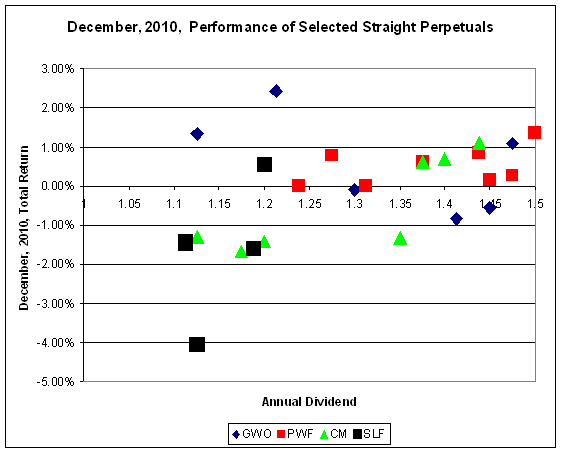
The relative performances are interesting. SLF.PR.E had the worst performance of the selected issues (in fact, it had the worst performance of all the HIMIPref™ index constituents), clocking in at -4.05% – and the fund had a 7.0% weighting in this issue as of November 30. The position was not traded during the month, so we can estimate that all by itself this position cost the fund 28bp of performance. Even if we say the position “should have” returned -2.00%, in line with comparable issues, that’s still 14bp of underperformance, a significant chunk of the fund’s relative performance.

Even worse, the last bid price on this issue declined from 20.52 on December 30 to 19.91 on December 31, a decline of 2.97% on the day; and the last quote was 19.91-20.60. Its bid yield on 12/31 was significantly above its peers, so this is is almost certainly a glitch – albeith not certainly enough and not significant enough for me to take the rather awesome step of substituting a different price for fund valuation purposes.

It’s not really a big deal – the issue still pays 1.125 and still has exactly the same credit quality as the other SLF issues. Its undervaluation relative to its peers provides the fund with something of a tailwind for January!

There’s plenty of room for new money left in the fund. I have shown in recent issues of PrefLetter that market pricing for FixedResets is demonstrably stupid and I have lots of confidence – backed up by my bond portfolio management experience in the markets for Canadas and Treasuries, and equity trading on the NYSE & TSX – that there is enough demand for liquidity in any market to make the effort of providing it worthwhile (although the definition of “worthwhile” in terms of basis points of outperformance changes considerably from market to market!) I will continue to exert utmost efforts to outperform but it should be borne in mind that there will almost inevitably be periods of underperformance in the future.

The yields available on high quality preferred shares remain elevated, which is reflected in the current estimate of sustainable income.

Calculation of MAPF Sustainable Income Per Unit
Month NAVPU Portfolio
Average
YTW
Leverage
Divisor
Securities
Average
YTW
Capital
Gains
Multiplier
Sustainable
Income
per
current
Unit
June, 2007 9.3114 5.16% 1.03 5.01% 1.2857 0.3628
September 9.1489 5.35% 0.98 5.46% 1.2857 0.3885
December, 2007 9.0070 5.53% 0.942 5.87% 1.2857 0.4112
March, 2008 8.8512 6.17% 1.047 5.89% 1.2857 0.4672
June 8.3419 6.034% 0.952 6.338% 1.2857 $0.4112
September 8.1886 7.108% 0.969 7.335% 1.2857 $0.4672
December, 2008 8.0464 9.24% 1.008 9.166% 1.2857 $0.5737
March 2009 $8.8317 8.60% 0.995 8.802% 1.2857 $0.6046
June 10.9846 7.05% 0.999 7.057% 1.2857 $0.6029
September 12.3462 6.03% 0.998 6.042% 1.2857 $0.5802
December 2009 10.5662 5.74% 0.981 5.851% 1.0819 $0.5714
March 2010 10.2497 6.03% 0.992 6.079% 1.0819 $0.5759
June 10.5770 5.96% 0.996 5.984% 1.0819 $0.5850
September 11.3901 5.43% 0.980 5.540% 1.0819 $0.5832
December 2010 10.7659 5.37% 0.993 5.408% 1.0000 $0.5822
NAVPU is shown after quarterly distributions of dividend income and annual distribution of capital gains.
Portfolio YTW includes cash (or margin borrowing), with an assumed interest rate of 0.00%
The Leverage Divisor indicates the level of cash in the account: if the portfolio is 1% in cash, the Leverage Divisor will be 0.99
Securities YTW divides “Portfolio YTW” by the “Leverage Divisor” to show the average YTW on the securities held; this assumes that the cash is invested in (or raised from) all securities held, in proportion to their holdings.
The Capital Gains Multiplier adjusts for the effects of Capital Gains Dividends. On 2009-12-31, there was a capital gains distribution of $1.989262 which is assumed for this purpose to have been reinvested at the final price of $10.5662. Thus, a holder of one unit pre-distribution would have held 1.1883 units post-distribution; the CG Multiplier reflects this to make the time-series comparable. Note that Dividend Distributions are not assumed to be reinvested.
Sustainable Income is the resultant estimate of the fund’s dividend income per current unit, before fees and expenses. Note that a “current unit” includes reinvestment of prior capital gains; a unitholder would have had the calculated sustainable income with only, say, 0.9 units in the past which, with reinvestment of capital gains, would become 1.0 current units.

Significant positions were held in Fixed-Reset issues on December 31; all of which (with the exception of YLO.PR.C) currently have their yields calculated with the presumption that they will be called by the issuers at par at the first possible opportunity. This presents another complication in the calculation of sustainable yield. The fund also holds a position in a SplitShare (BNA.PR.C) which also has its yield calculated with the expectation of a maturity.

However, if the entire portfolio except for the PerpetualDiscounts were to be sold and reinvested in these issues, the yield of the portfolio would be the 5.60% shown in the MAPF Portfolio Composition: December 2010 analysis (which is in excess of the 5.46% index yield on December 31). Given such reinvestment, the sustainable yield would be $10.7659 * 0.0560 = $0.6029, basically unchanged from the (adjusted for capital gains) $0.6034 reported last month.

Note that there will be a drag on the calculation in up-markets due to presence of shorter-term issues (or, at least, presumed shorter term issues!); the question is whether the positive effect of these issues in down markets will outweight their negative effect in up-markets – all I can say is … it has in the past!

Different assumptions lead to different results from the calculation, but the overall positive trend is apparent. I’m very pleased with the results! It will be noted that if there was no trading in the portfolio, one would expect the sustainable yield to be constant (before fees and expenses). The success of the fund’s trading is showing up in

  • the very good performance against the index
  • the long term increases in sustainable income per unit

As has been noted, the fund has maintained a credit quality equal to or better than the index; outperformance is due to constant exploitation of trading anomalies.

Again, there are no predictions for the future! The fund will continue to trade between issues in an attempt to exploit market gaps in liquidity, in an effort to outperform the index and keep the sustainable income per unit – however calculated! – growing.

Update: The SLF.PR.E is a legitimate closing quote, although it does mean that the market-maker fell down on the job.

SLF.PR.E, 2010-12-31 (partial)
Time Quote Size Trade
3:54:21     200 @ 20.55
3:54:21     50 @ 20.55
3:54:21 20.50-55 5×8  
3:54:34 20.50-55 5×6  
3:54:34     300 @ 20.50
3:54:34 20.50-55 2×3  
3:54:34 20.50-60 2×28  
3:54:34 20.50-59 2×3  
3:59:40 20.50-60 2×28  
3:59:51     100 @ 20.60
3:59:53 20.50-60 2×27  
3:59;53 20.39-60 5×27  
3:59:53 19.91-60 2×27  

I have sent the following eMail to info@tsx.com:

According to information reported by DataLinx for December 31, the closing quotation for SLF.PR.E was 19.91-60, 2×27.

I have four questions that arise from the closing quotation:

i) Who is the market-maker for this security?

ii) Will the TMX be investigating the circumstances that led to the wide spread on this closing quotation?

iii) Will the TMX be announcing the results of such an investigation?

iv) Will the TMX be implementing any sanctions against the market maker for this security?

Update, 2011-01-13: The TMX response to the eMail, and my follow-up, are reported in the post TMX: Close, Schmose!.

MAPF

MAPF Portfolio Composition: December 2010

Turnover remained fairly constant in December, at about 27%.

Trades were, as ever, triggered by a desire to exploit transient mispricing in the preferred share market (which may be thought of as “selling liquidity”), rather than any particular view being taken on market direction, sectoral performance or credit anticipation.

MAPF Sectoral Analysis 2010-12-31
HIMI Indices Sector Weighting YTW ModDur
Ratchet 0% N/A N/A
FixFloat 0% N/A N/A
Floater 0% N/A N/A
OpRet 0% N/A N/A
SplitShare 2.1% (-0.1) 6.47% 6.58
Interest Rearing 0% N/A N/A
PerpetualPremium 8.7% (-10.2) 5.82% 10.50
PerpetualDiscount 72.3% (+7.2) 5.60% 14.54
Fixed-Reset 12.6% (+2.4) 3.44% 3.10
Scraps (FixedReset) 3.6% (0) 6.90% 12.62
Cash 0.7% (+0.5) 0.00% 0.00
Total 100% 5.37% 12.41
Totals and changes will not add precisely due to rounding. Bracketted figures represent change from November month-end. Cash is included in totals with duration and yield both equal to zero.

The “total” reflects the un-leveraged total portfolio (i.e., cash is included in the portfolio calculations and is deemed to have a duration and yield of 0.00.). MAPF will often have relatively large cash balances, both credit and debit, to facilitate trading. Figures presented in the table have been rounded to the indicated precision.

The increase in PerpetualDiscount holdings at the expense of PerpetualPremiums is largely due to migration of two positions, CM.PR.P and GWO.PR.M, from the latter class to the former. Both accrued dividends during the month.

Analysis of the data using the Straight Perpetual Implied Volatility Calculator produces the following table:

Fits to Implied Volatility
Issuer 2010-12-31 2010-11-30
Yield Volatility Yield Volatility
PWF 4.75% 21% 4.45% 25%
CM 4.90% 18% 4.13% 24%
GWO 4.40% 25% 3.60% 30%
Calculations are performed with a time horizon of three years for all issues

The decline in volatility is interesting and probably reflects a market view on the future direction of market yields. Given the high level of uninformed emotion in the preferred share market – particularly the Straight Preferred sector – this could be a fruitful area of research.

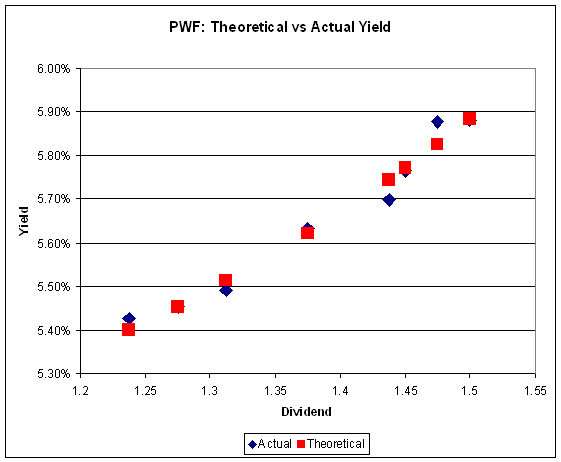
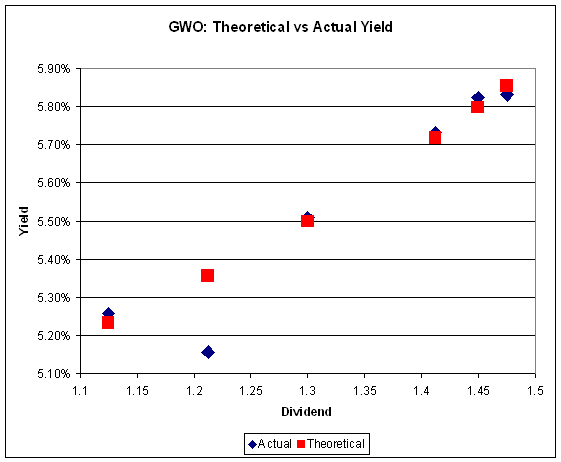
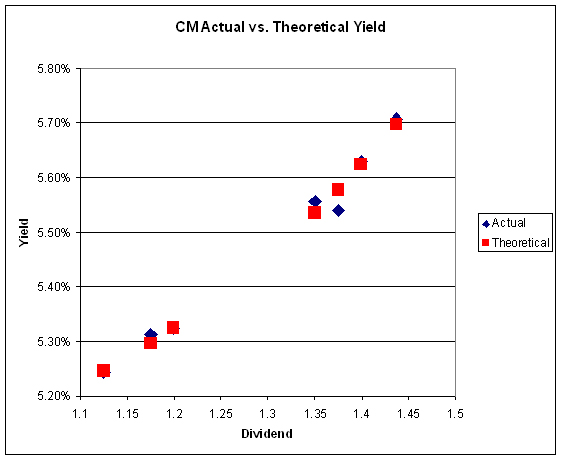
Graphs from the Straight Perpetual Volatility Calculator for December 31 are:


Click for Big
 

Click for Big
 

Click for Big

The yield pick-up for holding high-coupon Straights remains such that one should no longer automatically buy the deepest-discount issue in a series!

Credit distribution is:

MAPF Credit Analysis 2010-12-31
DBRS Rating Weighting
Pfd-1 0 (0)
Pfd-1(low) 55.2% (+0.7)
Pfd-2(high) 21.0% (-0.9)
Pfd-2 0 (0)
Pfd-2(low) 19.6% (-0.3)
Pfd-3(high) 3.6% (0)
Cash 0.7% (+0.5)
Totals will not add precisely due to rounding. Bracketted figures represent change from November month-end.

Liquidity Distribution is:

MAPF Liquidity Analysis 2010-12-31
Average Daily Trading Weighting
<$50,000 0.0% (0)
$50,000 – $100,000 11.5% (-0.1)
$100,000 – $200,000 18.8% (-0.1)
$200,000 – $300,000 31.6% (+11.3)
>$300,000 37.4% (-11.7)
Cash 0.7% (+0.5)
Totals will not add precisely due to rounding. Bracketted figures represent change from November month-end.

As was the case with the sector distribution, the large shift from the $300,000+ liquidity bucket to the $200,000-$300,000 was not due to trading, but rather to migration, as positions were held in BAM.PR.N, SLF.PR.B and YLO.PR.C which all experienced declines in Average Trading Value over the month.

MAPF is, of course, Malachite Aggressive Preferred Fund, a “unit trust” managed by Hymas Investment Management Inc. Further information and links to performance, audited financials and subscription information are available the fund’s web page. The fund may be purchased either directly from Hymas Investment Management or through a brokerage account at Odlum Brown Limited. A “unit trust” is like a regular mutual fund, but is sold by offering memorandum rather than prospectus. This is cheaper, but means subscription is restricted to “accredited investors” (as defined by the Ontario Securities Commission) or those who subscribe for $150,000+. Fund past performances are not a guarantee of future performance. You can lose money investing in MAPF or any other fund.

A similar portfolio composition analysis has been performed on the Claymore Preferred Share ETF (symbol CPD) as of August 31, 2010, and published in the September, 2010, PrefLetter. When comparing CPD and MAPF:

  • MAPF credit quality is better
  • MAPF liquidity is a higher
  • MAPF Yield is higher
  • Weightings in
    • MAPF is much more exposed to Straight Perpetuals
    • MAPF is much less exposed to Operating Retractibles
    • MAPF is slightly more exposed to SplitShares
    • MAPF is less exposed to FixFloat / Floater / Ratchet
    • MAPF weighting in FixedResets is much lower