Market Action

December 22, 2010

Americans are paying their bills:

Loans at least 30 days overdue, a signal of future write- offs, dropped for the 13th consecutive month to 4.38 percent, the lowest since December 2007, Moody’s said today in a report. Loans delinquent 30 to 59 days, the earliest sign of trouble, declined to 1.14 percent, near an all-time low. Write-offs for loans deemed uncollectible, a lagging indicator, fell to 8.58 percent from October’s 8.79 percent.

The drop in new delinquencies bolsters the firm’s “expectation that charge-offs will ultimately break below the 7 percent mark later in 2011,” Jeffrey Hibbs, a Moody’s analyst, wrote in the report.

The S&P / Experian indices show the improvement to be broadly based – and dramatic!

There’s an interesting twist in the Goldman / Greece derivative imbroglio:

The notes show how Greece used swaps to hide its borrowings, according to a March 3 cover page attached to the papers obtained by Bloomberg News.

ECB President Jean-Claude Trichet withheld the documents after the EU and International Monetary Fund led a 110 billion- euro bailout ($144 billion) for Greece. The dossier should be disclosed to stop governments from employing the derivatives in a similar way again and to show how EU authorities acted on information they had on the swaps, according to the suit, filed by Bloomberg Finance LP, the parent of Bloomberg News.

Ha-ha! The notes will show, I’ll bet a nickel, that everybody knew about it and ignored it.

TD is still looking for deals:

Toronto-Dominion’s bid for the auto-finance company “doesn’t really alter” the Toronto-based bank’s appetite for smaller transactions, Chief Executive Officer Edmund Clark said.

“We’re not deal junkies, but we keep saying what we’re looking for,” Clark said yesterday in a telephone interview. “We want $10 billion (in assets) or less deals; tuck-ins that add to our franchise and meet our strategy.”

Towers Perrin reports:

Near-zero equity returns and slight increases in interest rates translated into stable pension funding in November. The Towers Watson Pension Index remained unchanged for the month at 68.3. The index remains down 4.6% for the year.

They have also published Towers Watson–Forbes Insights 2010 Pension Risk Survey:

There is a strong desire on the part of plan sponsors to reduce the risk of their pension plans. Many plans are signifi cantly underfunded in the aftermath of the financial crisis, and their sponsors have experienced the resulting pressure on corporate cash flows. Rather than rushing to seek higher investment returns to close this funding gap, however, the majority of sponsors attach greater importance to reducing risk. The most favored strategy is to seek a better alignment of assets with liabilities — for example, through liability-driven investment programs. Executives expect to increasingly utilize swaps, options and other hedging derivatives to achieve better risk management. More plan sponsors today are setting formal funding policies in place of ad hoc decisions. Over time, lump sum payments and annuity purchases are also expected to be vehicles for settling DB obligations on a wholesale basis.

There is trouble in the state of Denmark:

Denmark says the Basel Committee on Banking Supervision’s rules will force the country’s lenders to dump top-rated mortgage debt to meet new requirements on holdings and may destroy the world’s third-biggest covered-bond market.

The Nordic country is planning to challenge the rules, published on Dec. 16. and Economy Minister Brian Mikkelsen has already taken Denmark’s grievances to the European Commission.

Denmark’s lenders, which hold more than half the country’s $490 billion of mortgage bonds, would be forced to sell off holdings to comply with Basel’s 40 percent cap on using the securities as liquid assets, [director of the Association of Danish Mortgage Banks] Arnth Jensen said.

Denmark’s mortgage bond market is about 1 1/2 times the size of the country’s economy and more than seven times the size of the government bond market, according to the central bank.

The regulation of Money Market Funds is attracting renewed notice:

Federal Reserve Chairman Ben S. Bernanke said investor speculation over which money market mutual funds are likely to be bailed out by their parent companies during a crisis can undermine the stability of the industry that manages $2.79 trillion.

Bernanke, in a Dec. 9 letter to Anthony J. Carfang, partner in Chicago consulting firm Treasury Strategies, said market developments that reinforce speculation whether money funds may be bailed out are a “concern” and sponsor support should be addressed in the context of planned reforms of the industry.

Carfang in November criticized a proposal by Moody’s Corp. that its ratings of money funds take into account the likelihood of a parent bailout in the event of losses. Bernanke, in the letter, encouraged Carfang to submit his views of the Moody’s proposal to the Securities and Exchange Commission.

Carfang has called the Moody’s proposal “fundamentally disruptive,” saying the ratings firm would have no objective way of gauging whether a money manager would prop up a fund in trouble.

Well, no. A credit rating is a prediction about probabilities, inherently subjective on two counts. CRAs are paid to use their judgement; and when they’re wrong, all the backseat drivers can point out they’re being paid by the issuers. That’s the way the game is played.

I woule much prefer explicit credit support, but the industry prefers boxticking; regulators so far have endorsed boxticking, becaue it requires more manpower to check.

The rally in the Canadian preferred share market continued today, on easing but still elevated volume. PerpetualDiscounts gained 31bp, while Fixed Resets were up 25bp.

PerpetualDiscounts now yield 5.42%, equivalent to 7.59% interest at the standard equivalency factor of 1.4x. Long corporates yields have plumetted to about 5.4% (maybe just a bit over) so the pre-tax interest-equivalent spread now stans at about 220bp, a significant widening from the 210bp reported on December 15, as the improvement in tone in the bond market has not been matched by the preferred market.

But big rallies can tend to be sloppy affairs, as the guys running the BMO Long Corporate ETF can tell you:
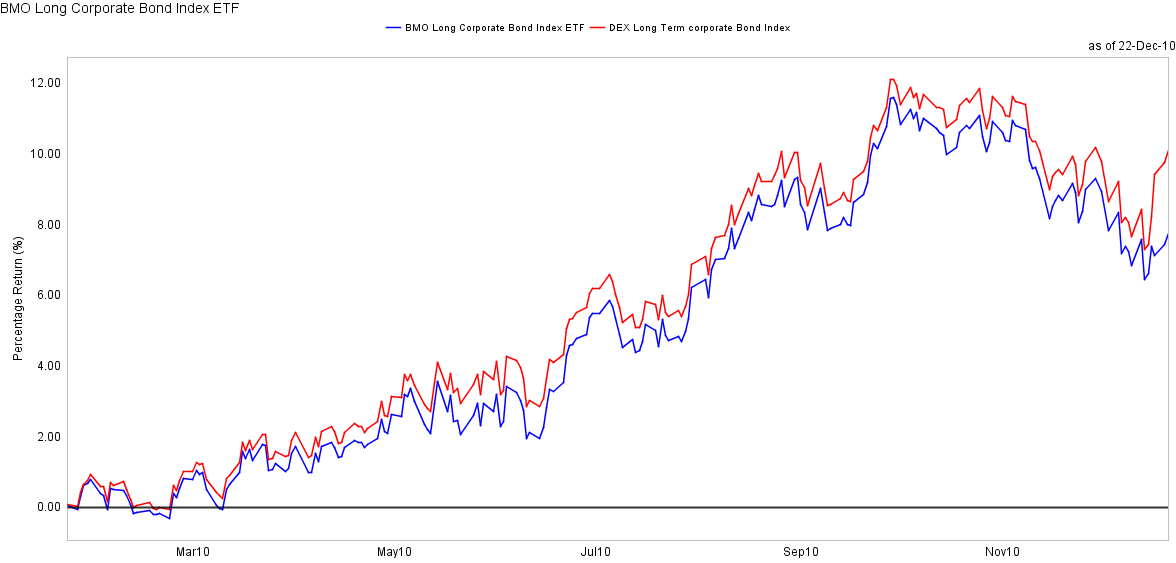

Click for big
HIMIPref™ Preferred Indices
These values reflect the December 2008 revision of the HIMIPref™ Indices

Values are provisional and are finalized monthly
Index Mean
Current
Yield
(at bid)
Median
YTW
Median
Average
Trading
Value
Median
Mod Dur
(YTW)
Issues Day’s Perf. Index Value
Ratchet 0.00 % 0.00 % 0 0.00 0 0.5837 % 2,306.1
FixedFloater 4.75 % 3.26 % 31,847 18.91 1 0.4386 % 3,542.0
Floater 2.59 % 2.36 % 57,166 21.33 4 0.5837 % 2,490.0
OpRet 4.79 % 3.28 % 72,188 2.38 8 -0.0480 % 2,392.6
SplitShare 5.35 % 1.25 % 917,290 0.96 4 0.1719 % 2,442.1
Interest-Bearing 0.00 % 0.00 % 0 0.00 0 -0.0480 % 2,187.8
Perpetual-Premium 5.70 % 5.60 % 156,558 5.41 27 0.1966 % 2,011.5
Perpetual-Discount 5.40 % 5.42 % 287,802 14.71 51 0.3071 % 2,020.6
FixedReset 5.22 % 3.43 % 342,724 3.08 52 0.2508 % 2,264.8
Performance Highlights
Issue Index Change Notes
BAM.PR.I OpRet -1.68 % YTW SCENARIO
Maturity Type : Call
Maturity Date : 2011-01-21
Maturity Price : 25.50
Evaluated at bid price : 25.70
Bid-YTW : -5.66 %
MFC.PR.D FixedReset -1.60 % YTW SCENARIO
Maturity Type : Call
Maturity Date : 2014-07-19
Maturity Price : 25.00
Evaluated at bid price : 27.05
Bid-YTW : 4.17 %
PWF.PR.E Perpetual-Discount -1.22 % YTW SCENARIO
Maturity Type : Limit Maturity
Maturity Date : 2040-12-22
Maturity Price : 23.25
Evaluated at bid price : 24.29
Bid-YTW : 5.70 %
FTS.PR.G FixedReset -1.10 % YTW SCENARIO
Maturity Type : Call
Maturity Date : 2013-10-01
Maturity Price : 25.00
Evaluated at bid price : 26.06
Bid-YTW : 3.69 %
GWO.PR.H Perpetual-Discount 1.08 % YTW SCENARIO
Maturity Type : Limit Maturity
Maturity Date : 2040-12-22
Maturity Price : 23.07
Evaluated at bid price : 23.30
Bid-YTW : 5.22 %
PWF.PR.K Perpetual-Discount 1.11 % YTW SCENARIO
Maturity Type : Limit Maturity
Maturity Date : 2040-12-22
Maturity Price : 22.58
Evaluated at bid price : 22.77
Bid-YTW : 5.51 %
TD.PR.O Perpetual-Discount 1.14 % YTW SCENARIO
Maturity Type : Limit Maturity
Maturity Date : 2040-12-22
Maturity Price : 23.79
Evaluated at bid price : 24.05
Bid-YTW : 5.10 %
IAG.PR.F Perpetual-Premium 1.16 % YTW SCENARIO
Maturity Type : Call
Maturity Date : 2019-04-30
Maturity Price : 25.00
Evaluated at bid price : 25.30
Bid-YTW : 5.74 %
SLF.PR.A Perpetual-Discount 1.18 % YTW SCENARIO
Maturity Type : Limit Maturity
Maturity Date : 2040-12-22
Maturity Price : 21.50
Evaluated at bid price : 21.50
Bid-YTW : 5.55 %
TRP.PR.C FixedReset 1.18 % YTW SCENARIO
Maturity Type : Limit Maturity
Maturity Date : 2040-12-22
Maturity Price : 23.38
Evaluated at bid price : 25.75
Bid-YTW : 3.72 %
BMO.PR.L Perpetual-Premium 1.36 % YTW SCENARIO
Maturity Type : Call
Maturity Date : 2017-06-24
Maturity Price : 25.00
Evaluated at bid price : 26.01
Bid-YTW : 5.18 %
PWF.PR.A Floater 1.38 % YTW SCENARIO
Maturity Type : Limit Maturity
Maturity Date : 2040-12-22
Maturity Price : 21.86
Evaluated at bid price : 22.10
Bid-YTW : 2.36 %
ELF.PR.G Perpetual-Discount 1.47 % YTW SCENARIO
Maturity Type : Limit Maturity
Maturity Date : 2040-12-22
Maturity Price : 20.00
Evaluated at bid price : 20.00
Bid-YTW : 6.06 %
MFC.PR.C Perpetual-Discount 3.66 % YTW SCENARIO
Maturity Type : Limit Maturity
Maturity Date : 2040-12-22
Maturity Price : 20.95
Evaluated at bid price : 20.95
Bid-YTW : 5.41 %
Volume Highlights
Issue Index Shares
Traded
Notes
CM.PR.I Perpetual-Discount 59,025 YTW SCENARIO
Maturity Type : Limit Maturity
Maturity Date : 2040-12-22
Maturity Price : 22.10
Evaluated at bid price : 22.23
Bid-YTW : 5.36 %
RY.PR.B Perpetual-Discount 54,485 YTW SCENARIO
Maturity Type : Limit Maturity
Maturity Date : 2040-12-22
Maturity Price : 22.45
Evaluated at bid price : 22.61
Bid-YTW : 5.25 %
GWO.PR.I Perpetual-Discount 41,460 TD crossed 20,000 at 21.08.
YTW SCENARIO
Maturity Type : Limit Maturity
Maturity Date : 2040-12-22
Maturity Price : 21.01
Evaluated at bid price : 21.01
Bid-YTW : 5.38 %
MFC.PR.D FixedReset 35,020 Desjardins bought 13,400 from Nesbitt at 27.34.
YTW SCENARIO
Maturity Type : Call
Maturity Date : 2014-07-19
Maturity Price : 25.00
Evaluated at bid price : 27.05
Bid-YTW : 4.17 %
TD.PR.O Perpetual-Discount 31,438 YTW SCENARIO
Maturity Type : Limit Maturity
Maturity Date : 2040-12-22
Maturity Price : 23.79
Evaluated at bid price : 24.05
Bid-YTW : 5.10 %
BAM.PR.K Floater 29,290 YTW SCENARIO
Maturity Type : Limit Maturity
Maturity Date : 2040-12-22
Maturity Price : 18.19
Evaluated at bid price : 18.19
Bid-YTW : 2.88 %
There were 44 other index-included issues trading in excess of 10,000 shares.
Market Action

December 21, 2010

The TD / Chrysler deal got done:

Toronto-Dominion Bank agreed to buy Chrysler Financial Corp. from Cerberus Capital Management LP for $6.3 billion in cash, adding an auto-finance company in its second-largest acquisition.

The purchase includes $5.9 billion in assets and about $400 million in goodwill, Canada’s second-biggest bank said today in a statement. Toronto-Dominion doesn’t intend to issue stock.

and Cerberus investors are relieved:

Cerberus Capital Management LP will recoup about 90 percent of its initial investment in Chrysler after the sale of the automaker’s former lending unit to Toronto-Dominion Bank, according to two people with knowledge of the transaction.

Cerberus will get about 75 cents on the dollar in cash when the sale of Chrysler Financial Corp. closes, said the people, asking not to be identified because the New York-based firm is private. Including about $900 million of assets Cerberus is retaining as part of the deal, the company will be left with a loss of 10 percent on the initial investment in the automaker and its finance arm.

So basically, Chrysler was a finance company with a captive manufacturing arm. I love it.

DBRS commented:

that TD Bank US Holding Company’s (TD Bank US or the Company) ratings, including its Issuer & Senior Debt rating of AA (low), are unaffected by its announced acquisition of Chrysler Financial’s U.S. operations. The trend on all ratings is Stable.

DBRS believes the acquisition of Chrysler Financial will not have a material impact on the earnings and only a modest impact on the capital of the Company’s parent, The Toronto-Dominion Bank (TD; Deposits & Senior Debt rated AA with a Stable trend). Specifically, TD’s Tier 1 capital ratio is expected to decline by 55 to 60 basis points on a pro forma basis from the 12.2% TD reported at October 31, 2010. Consequently, the risk profile for TD remains solid, notwithstanding the execution risk concerns of growing in the auto finance business. DBRS notes that TD continues to have the resources, motivation and ability to support the Company, if needed. As such, there are no rating implications at this time.

Ernst & Young’s in trouble over Repo 105:

New York Attorney General Andrew Cuomo sued Ernst & Young LLP, accusing the firm of facilitating a “major accounting fraud” by helping Lehman Brothers Holdings Inc. deceive the public about its financial condition.

The state seeks to recover more than $150 million in fees collected by Ernst & Young for work performed for Lehman from 2001 to 2008, plus investor damages and equitable relief, Cuomo said. He will be sworn in as New York governor on Jan. 1. His successor will be New York Democratic state Senator Eric T. Schneiderman.

Lehman, once the fourth-largest investment bank, failed in September 2008 because of risky real estate bets and too much debt, which it tried to hide from investors, partly by using so- called Repo 105 trades, according to bankruptcy examiner Anton Valukas’s report.

Responding to the Valukas report in March, Ernst & Young said leverage ratios reported in Lehman’s management discussion and analysis “were the responsibility of management, not the auditor. They are not part of the audited financial statements.”

Responding to one suit, filed in April on behalf of retirement funds including the Alameda County Employees’ Retirement Association in Oakland, California, Ernst & Young said in court papers that even Valukas “did not find that Lehman’s accounting for the Repo 105 transactions was wrong.”

In his report, Valukas faulted the accounting firm because it “did not evaluate the possibility that Repo 105 transactions were accounting-motivated transactions that lacked a business purpose,” and didn’t take a stand on whether Lehman’s extensive use of the device was “material” and should be reported.

“Financial statements may be materially misleading even when they do not violate GAAP,” he wrote in his report.

Cuomo, who has powers to bring criminal charges, brought a civil suit against Ernst & Young. Arthur Andersen LLP, the accounting firm that was accused of destroying Enron Corp. documents, was convicted of obstructing justice in 2002 and is now largely defunct.

“Regulators are concerned there will be no competitors left” to audit U.S. companies, [accountant Barry] Epstein said.

The Valukas report and Repo 105 was discussed on PrefBlog on March 12, 2010.

Patrick Jenkins of the Financial Times points out a rather obvious knock-on effect about the obsession with bonuses … obvious, that is, to all but politicians:

Many US and Swiss banks are considering paying higher salaries and lower bonuses to top bankers based in the European Union, mostly in London, to ensure they comply with new instructions from the Committee of European Banking Supervisors (CEBS), the pan-EU regulator, limiting cash pay-outs.

Some European politicians had expected that non-EU banks would apply their rules globally on a voluntary basis.

But one senior European banker said: “Politicians are naïve if they think we will impose EU rules on a global basis. The ironic effect will be another hike in salaries, which is a fixed cost, which rather makes a nonsense of the idea of pay for performance.”

Speaking of banks, there is some thought that Deutsche is playing a moral hazard game:

Deutsche Bank’s core capital ratio, a buffer against possible losses, may fall to the lowest level among eight competitors under new Basel III rules in 2012, even after it raised 10.2 billion euros ($13.4 billion) in a share sale in October, according to Christopher Wheeler, an analyst at Mediobanca SpA.

[CEO Josef] Ackermann, who shunned German government aid during the credit crisis, warned at a Frankfurt conference in September against a “dangerous race to the top” among banks seeking to lift reserves above Basel III requirements years before the rules kick in. Deutsche Bank, the largest German bank, may be able to hold less capital than peers, and borrow more to enhance returns, because its clients are convinced the government would never let it fail, analysts and investors said.

Deutsche Bank also relies more than competitors on borrowed funds, or leverage, to increase returns. Its assets amounted to 51 times shareholders’ equity on Sept. 30, up from 48 times at the end of 2006, based on International Financial Reporting Standards. Only Brussels-based Dexia SA has higher leverage among Europe’s 15 biggest listed banks. Investment banks’ extensive use of borrowed funds, which can exaggerate risks, was blamed by Federal Reserve Chairman Ben S. Bernanke for contributing to the financial crisis.

Deutsche Bank prefers to use U.S. Generally Accepted Accounting Principles, which net out derivatives positions, to measure its leverage. By that standard, its assets at the end of September matched its goal of 25 times equity, up from 23 times a year earlier and down from 38 times in mid-2008, company reports show. By comparison, Goldman Sachs assets were 12 times capital at the end of September.

And the Canadian preferred share market was on wheels … again! PerpetualDiscounts were up 34bp and FixedResets gained 26bp. Volume eased off a little, but remains elevated.

HIMIPref™ Preferred Indices
These values reflect the December 2008 revision of the HIMIPref™ Indices

Values are provisional and are finalized monthly
Index Mean
Current
Yield
(at bid)
Median
YTW
Median
Average
Trading
Value
Median
Mod Dur
(YTW)
Issues Day’s Perf. Index Value
Ratchet 0.00 % 0.00 % 0 0.00 0 0.3615 % 2,292.7
FixedFloater 4.77 % 3.47 % 32,068 19.05 1 0.0000 % 3,526.6
Floater 2.61 % 2.39 % 52,926 21.23 4 0.3615 % 2,475.5
OpRet 4.79 % 3.22 % 71,304 2.37 8 0.0816 % 2,393.7
SplitShare 5.36 % 1.24 % 954,424 0.96 4 -0.3778 % 2,437.9
Interest-Bearing 0.00 % 0.00 % 0 0.00 0 0.0816 % 2,188.9
Perpetual-Premium 5.71 % 5.57 % 156,568 5.41 27 0.2662 % 2,007.5
Perpetual-Discount 5.42 % 5.45 % 288,596 14.72 51 0.3374 % 2,014.4
FixedReset 5.24 % 3.49 % 338,426 3.09 52 0.2580 % 2,259.1
Performance Highlights
Issue Index Change Notes
IAG.PR.A Perpetual-Discount -2.07 % YTW SCENARIO
Maturity Type : Limit Maturity
Maturity Date : 2040-12-21
Maturity Price : 21.25
Evaluated at bid price : 21.25
Bid-YTW : 5.44 %
ELF.PR.G Perpetual-Discount -1.45 % YTW SCENARIO
Maturity Type : Limit Maturity
Maturity Date : 2040-12-21
Maturity Price : 19.71
Evaluated at bid price : 19.71
Bid-YTW : 6.15 %
FTS.PR.F Perpetual-Discount -1.13 % YTW SCENARIO
Maturity Type : Limit Maturity
Maturity Date : 2040-12-21
Maturity Price : 22.50
Evaluated at bid price : 22.66
Bid-YTW : 5.45 %
POW.PR.D Perpetual-Discount -1.08 % YTW SCENARIO
Maturity Type : Limit Maturity
Maturity Date : 2040-12-21
Maturity Price : 22.19
Evaluated at bid price : 22.35
Bid-YTW : 5.60 %
FTS.PR.G FixedReset 1.15 % YTW SCENARIO
Maturity Type : Call
Maturity Date : 2013-10-01
Maturity Price : 25.00
Evaluated at bid price : 26.35
Bid-YTW : 3.26 %
TD.PR.C FixedReset 1.16 % YTW SCENARIO
Maturity Type : Call
Maturity Date : 2014-03-02
Maturity Price : 25.00
Evaluated at bid price : 26.94
Bid-YTW : 3.25 %
BAM.PR.B Floater 1.28 % YTW SCENARIO
Maturity Type : Limit Maturity
Maturity Date : 2040-12-21
Maturity Price : 18.23
Evaluated at bid price : 18.23
Bid-YTW : 2.87 %
PWF.PR.E Perpetual-Discount 1.36 % YTW SCENARIO
Maturity Type : Limit Maturity
Maturity Date : 2040-12-21
Maturity Price : 23.38
Evaluated at bid price : 24.59
Bid-YTW : 5.62 %
SLF.PR.E Perpetual-Discount 1.46 % YTW SCENARIO
Maturity Type : Limit Maturity
Maturity Date : 2040-12-21
Maturity Price : 20.19
Evaluated at bid price : 20.19
Bid-YTW : 5.60 %
BAM.PR.J OpRet 1.51 % YTW SCENARIO
Maturity Type : Call
Maturity Date : 2014-04-30
Maturity Price : 26.00
Evaluated at bid price : 26.85
Bid-YTW : 4.12 %
SLF.PR.C Perpetual-Discount 1.57 % YTW SCENARIO
Maturity Type : Limit Maturity
Maturity Date : 2040-12-21
Maturity Price : 20.02
Evaluated at bid price : 20.02
Bid-YTW : 5.59 %
GWO.PR.I Perpetual-Discount 1.64 % YTW SCENARIO
Maturity Type : Limit Maturity
Maturity Date : 2040-12-21
Maturity Price : 21.13
Evaluated at bid price : 21.13
Bid-YTW : 5.35 %
SLF.PR.D Perpetual-Discount 1.78 % YTW SCENARIO
Maturity Type : Limit Maturity
Maturity Date : 2040-12-21
Maturity Price : 20.05
Evaluated at bid price : 20.05
Bid-YTW : 5.58 %
NA.PR.L Perpetual-Discount 2.67 % YTW SCENARIO
Maturity Type : Limit Maturity
Maturity Date : 2040-12-21
Maturity Price : 23.53
Evaluated at bid price : 23.80
Bid-YTW : 5.14 %
Volume Highlights
Issue Index Shares
Traded
Notes
FTS.PR.E OpRet 232,500 Nesbitt bought three blocks from TD, two of 10,000 and one of 20,000, all at 26.80. TD crossed 21,900 at 26.75. Nesbitt bought two more blocks from TD, 25,000 at 26.80 and 15,000 at 26.75. TD crossed 81,200 at 26.76. Desjardins bought three blocks from TD, each of 15,000 shares, all at 26.80.
YTW SCENARIO
Maturity Type : Call
Maturity Date : 2013-07-01
Maturity Price : 25.75
Evaluated at bid price : 26.78
Bid-YTW : 3.22 %
SLF.PR.D Perpetual-Discount 124,072 RBC crossed 116,200 at 19.93.
YTW SCENARIO
Maturity Type : Limit Maturity
Maturity Date : 2040-12-21
Maturity Price : 20.05
Evaluated at bid price : 20.05
Bid-YTW : 5.58 %
MFC.PR.C Perpetual-Discount 94,565 RBC crossed 67,800 at 20.35.
YTW SCENARIO
Maturity Type : Limit Maturity
Maturity Date : 2040-12-21
Maturity Price : 20.21
Evaluated at bid price : 20.21
Bid-YTW : 5.61 %
IGM.PR.B Perpetual-Premium 64,410 Nesbitt crossed 50,000 at 25.20.
YTW SCENARIO
Maturity Type : Call
Maturity Date : 2019-01-30
Maturity Price : 25.00
Evaluated at bid price : 25.29
Bid-YTW : 5.89 %
BMO.PR.H Perpetual-Premium 62,278 Nesbitt crossed 50,000 at 25.25.
YTW SCENARIO
Maturity Type : Call
Maturity Date : 2013-03-27
Maturity Price : 25.00
Evaluated at bid price : 25.21
Bid-YTW : 5.11 %
CM.PR.D Perpetual-Premium 59,382 Nesbitt crossed 50,000 at 25.50.
YTW SCENARIO
Maturity Type : Call
Maturity Date : 2012-05-30
Maturity Price : 25.00
Evaluated at bid price : 25.54
Bid-YTW : 4.80 %
There were 44 other index-included issues trading in excess of 10,000 shares.
Documentation

TMX DataLinx: "Last" != "Close"

Like the old man said … “If you go out and buy financial data and you assume something, you make an ASS out of U and ME both.”

Assiduous Readers will recall that on December 2 I reported a stupid quote for GWO.PR.J and indulged in a rant; I also sent a note of inquiry to the TSX:

According to information reported on TMXMoney.com for December 2, GWO.PR.J traded 2,831 shares in a range of 27.41-64 and the last of the eleven trades was at 3:33pm. The closing quote was 24.81-27.54, 4×9.

I have four questions that arise from the closing quotation:

i) Who is the market-maker for this security?

ii) Will the TMX be investigating the circumstances that led to this ridiculous closing quote?

iii) Will the TMX be announcing the results of such an investigation?

iv) Will the TMX be implementing any sanctions against the market maker for this security?

I eventually received a reply:

A closing quote is considered to be the quote at the close of the regular trading session at 4pm. Market Maker responsibilities end at 4pm. The actual closing quote at 4pm on Dec.2 for this issue was 27.04 – 27.54.

After frothing at the mouth a bit, I sent the following eMail to my data provider, TMX DataLinx, who get a fat cheque every month for providing me with data:

As you will be aware, I have been a purchaser of your historical data for about ten years; and was a customer prior to then through my previous employer, Greydanus Boeckh & Associates Inc.

Amongst the data I purchase from you are the “last bid price” and the “last ask price”.

On December 2, 2010, you reported to me that these values were 24.81 and 27.54 for GWO.PR.J.

An inquiry to the exchange regarding this quote elicited the information that “A closing quote is considered to be the quote at the close of the regular trading session at 4pm. Market Maker responsibilities end at 4pm. The actual closing quote at 4pm on Dec.2 for this issue was 27.04 – 27.54.” as shown in the forwarded eMail, below.

(i) What is the difference between the data you have been selling me and the “closing quote”?

(ii) How may I purchase the “closing quote” from you?

Finally, after a fair number of reminders, a few telephone conversations and a conference call, I have sent the following eMail to the Product Manager at TMX DataLinx:

I write to you to request a new product be made available for data download through your “TMX DataLinx Market Data” facility.

This product would be accessed by entering the password-protected page http://marketdata.tsx.com/MOTD/ clicking “Custom Queries”, “New Query” and “Stock Prices” (or, after the first run, via “Saved Queries”).

Options for “Closing Bid” and “Closing Ask” would be added to the list of “Data Items”.

These data would provide the last quotation of the day at which one board lot of the security in question could be transacted; i.e. a snapshot of the market quotation immediately before the close of the regular trading session.

They would be distinct from the extant “Last Bid” and “Last Ask” data items currently available, since these two items represent the quotation at the end of the extended trading session. They will not necessarily reflect the market quotation at the close of the regular trading session since:
(i) Orders in the book at the close of the regular trading session may have been cancelled in the interim
(ii) Orders entered in the interim will not be included in the book unless they are at the Last Sale Price; they will be rejected by the Exchange.

It has been suggested that I could recover these data by clicking “Trades and Quotes” instead of “Custom Queries” and downloading the file for a period of time near the close. The “Closing Bid” and “Closing Ask” could then be determined through inspection of the downloaded data.

Such a solution is not practical because:
(i) Time resolution in this facility is limited to increments of one minute. There could, conceivably, be thousands of quotes for each security during this time frame and the cost of these data could be enormous
(ii) Data will only be recovered if the quote changes during the specified time. Thus, for some subset of the security list not known in advance, a prior time increment would need to be queried, which, in addition to being time consuming, would still bring with it the risk of enormous cost as specified in objection (i).

Therefore, I request that the “Closing Bid” and “Closing Ask”, which would together comprise the last quotation of the day at which an investor could execute at least one board lot on either side during the regular trading session, be made available as downloadable data under the same terms and conditions as your extant “Last Bid” and “Last Ask” data items.

I venture to suggest that most purchasers of the “Last Bid” and “Last Ask” data (including myself, until recently!) are under the impression that they are, in fact, purchasing the “Closing Bid” and “Closing Ask”. If you should find a customer who is not only aware of the difference, but prefers the “Last Bid” and “Last Ask” data, I would very much appreciate it if you could ask him to call me (416 604 4204) and explain, since I can see no possible use for these items which do not necessarily represent actionable bids and offers.

Prior correspondene on this issue is appended to this eMail

I don’t think I’m the only one who does not appreciate the difference between “Last” and “Close”; this is particularly important at this time of the year, when funds are required to provide a reconciliation between their normal method of reporting NAV and the new standards, as elucidated in the 2009 Financial Statements for PIC:

Net Assets per unit is the difference between the aggregate value of the assets of the Fund and the aggregate value of the liabilities excluding Preferred shares of the Fund on that date and including the valuation of securities at bid prices divided by the number of units then outstanding. For years prior to 2007, securities were valued at closing prices. The change to the use of bid prices is due to accounting standards set out by the Canadian Institute of Chartered Accountants adopted November 1, 2007 relating to Financial Instruments.

The Fund has adopted, effective November 1, 2008, Canadian Institute of Chartered Accountants (“CICA”) amendments to Handbook Section 3862, “Financial Instruments – Disclosures”. The revised disclosure requirements are intended to improve disclosures about fair value and liquidity risk. The amendments establish a three-tier hierarchy as a framework for disclosing fair value based on inputs used to value the Fund’s investments. The hierarchy of inputs is summarized below: (1) Level 1 – for unadjusted quoted prices in active markets for identical assets or liabilities

Securities are valued at fair value, which is determined by the closing bid price on the recognized stock exchange on which the securities are listed or principally traded. If no bid prices are available, the securities are valued at the closing sale price.

These rules have been discussed by Price-Waterhouse.

Naturally, it may be that I am the only investment manager in the world to have made this error. But, given the ubiquitous nature of the “Last Bid” and “Last Ask” on the web (fed to QuoteStream, for instance, which republishes it on the TSX’s own TMX Money website), I’ll bet I have lots of company.

Fortunately, this can only have a positive effect on the presumed efficiency of the HIMIPref™ simulations, which define the parameterization of the analytics; the programme sells at the presumed bid and buys at the offer; in nearly all cases the “Last” will be worse than the “Close” – the only exception will be when the Last Sale Price is the bid (ask) at the close and becomes the ask (bid) at the end of the extended session. Thus, simulations may have executed notional trades at worse prices than those actually available, or have missed opportunities; both of which will have resulted in underestimation of the value of the analytics.

For your further reading pleasure, here are some extracts from the TSX Trading Rules:

Rule 4-901 states:

Rule 4-901 General Provisions (Amended)
(1) All listed securities shall be eligible for trading during the Special Trading Session, provided that a MOC Security shall not be eligible for trading until the completion of the Closing Call in respect of that MOC Security.
(2) Except as otherwise provided, all transactions in the Special Trading Session shall be at the Last Sale Price for each security.
(3) Except as otherwise provided, the normal rules of priority and allocation and all other Exchange Requirements shall apply to the Special Trading Session.

Amended (March 29, 2004)

Rule 1-101 states:

“Last Sale Price” means:
(a) in respect of a MOC Security, the calculated closing price; and
(b) in respect of any other listed security, the last board lot sale price of the security on the Exchange in the Regular Session.
Amended (March 10, 2006)

Update, 2010-12-23: I do not believe that the extended session (whence the “last bid” and “last ask” quotes are obtained) meets the CICA definition of an active market:

[CICA Handbook] Para. 3855.A44. “A financial instrument is regarded as quoted in an active market when quoted prices are readily and regularly available from an exchange, dealer, broker, industry group, pricing service or regulatory agency, and those prices reflect actual and regularly occurring market transactions on an arm’s length basis. Fair value is defined in terms of a price agreed upon by a willing buyer and a willing seller in an arm’s length transaction. The objective of determining fair value for an instrument that is traded in an active market is to arrive at the price at which a transaction would occur at the balance sheet date in that instrument (i.e., without repackaging the instrument) in the most advantageous active market for that instrument to which the entity has immediate access. The existence of published price quotations in an active market is the best evidence of fair value, and when they exist they are used to measure the financial asset or financial liability.”

The “last” quotes do not reflect “actual and regularly occurring” (or even possible) market transactions, since any transactions in the extended session must occur at the Last Sale Price.

Issue Comments

TCL.PR.D Upgraded to P-3(high) by S&P

Standard & Poors has announced:

it raised its long-term corporate credit rating on Montreal-based Transcontinental Inc. to ‘BBB’ from ‘BBB-‘. The outlook is stable.

“The upgrade reflects our expectation of the continued improvement in Transcontinental’s financial risk profile stemming from lower debt levels, increased profitability, and significant financial flexibility due to management’s focus on streamlining the business and cutting costs,” said Standard & Poor’s credit analyst Lori Harris. “These actions have resulted in a material strengthening of credit protection measures, with our expectation that Transcontinental will maintain an adjusted debt to EBITDA in the 2x area in the medium term,” Ms. Harris added.

Highlights are:

  • We are raising our long-term corporate credit rating on Montreal-based Transcontinental Inc. to ‘BBB’ from ‘BBB-‘.
  • We base the upgrade on Transcontinental’s improved operating performance and credit metrics, as reflected in its fiscal 2010 results.
  • The stable outlook is based on our expectation that Transcontinental’s financial policy will be moderate, operating performance will remain good, and the company will manage its credit measures in line with our expectations in the medium term, including maintaining adjusted debt to EBITDA in the 2x area

TCL.PR.D was last mentioned on PrefBlog at the time of issue. TCL.PR.D is tracked by HIMIPref™ but is relegated to the Scraps index on credit concerns.

Market Action

December 20, 2010

TD is rumoured to be close to a Chrysler Financial deal:

Toronto-Dominion Bank is near an agreement to buy Chrysler Financial, the lender once owned by the third-largest U.S. automaker, from Cerberus Capital Management LP, said three people with knowledge of the matter.

Toronto-Dominion may announce a deal as soon as tomorrow morning, said the people, who spoke on the condition of anonymity because the talks are private. Toronto-Dominion and Cerberus had been discussing a price of about $6 billion to $7 billion, other people with knowledge of the situation said earlier this month.

There are also rumours of a French downgrade:

Costs to insure French government debt trebled this year, rising to an all-time high of 105.5 basis points today, according to data provider CMA. Credit default swaps tied to Czech securities gained 1 basis point to 91 and Chilean swaps were little changed at 89 basis points.

The credit default swaps tied to the French bonds imply a rating of Baa1, seven steps below its actual top ranking of Aaa at Moody’s, according to the New York-based firm’s capital markets research group.

Contracts on Portugal imply a B2 rating, 10 levels below its A1 grade, while swaps tied to Spanish bonds trade at Ba3, 11 steps below its Aa1 ranking, data from the Moody’s research group show. Derivatives protecting Belgian debt imply a rating of Ba1, nine steps below its current rating of Aa1.

It took a while, but it looks as if the IIROC case against TD-Burlington, discussed in March, 2008, has finally reached a conclusion. Yawn. What an abysmal waste of time. If somebody’s putting in silly bids just before the close, then you just programme an algorithm to hit it instantly. The way to get rid of incompetent fools in the industry is by encouraging market efficiency and competition, not more rules. Just ensure retail has access to algorithms, that’s all … a “pounce” algorithm (that will hit any bid over a given price, with or without showing an offer at a higher price) in the hands of retail would have nipped this nonsense in the bud admirably. Or, by not doing so, have showed the breach of UMIR to be inconsequential.

The Canadian preferred share market was on fire today, with PerpetualDiscounts rocketting up 73bp and FixedResets gaining 28bp. Volume continued to be on the heavy side. All the entries on the Volume Highlights table were PerpetualDiscounts; all entries on the Performance Highlights table were winners. Nesbitt did very well on the block trading, but was not quite able to shut out the competition from the Volume report.

HIMIPref™ Preferred Indices
These values reflect the December 2008 revision of the HIMIPref™ Indices

Values are provisional and are finalized monthly
Index Mean
Current
Yield
(at bid)
Median
YTW
Median
Average
Trading
Value
Median
Mod Dur
(YTW)
Issues Day’s Perf. Index Value
Ratchet 0.00 % 0.00 % 0 0.00 0 0.0998 % 2,284.5
FixedFloater 4.77 % 3.46 % 31,544 19.06 1 0.8850 % 3,526.6
Floater 2.62 % 2.39 % 50,770 21.24 4 0.0998 % 2,466.6
OpRet 4.79 % 3.03 % 71,783 2.38 8 0.6475 % 2,391.8
SplitShare 5.34 % 1.14 % 991,472 0.97 4 0.0202 % 2,447.2
Interest-Bearing 0.00 % 0.00 % 0 0.00 0 0.6475 % 2,187.1
Perpetual-Premium 5.72 % 5.61 % 147,135 6.42 27 0.1569 % 2,002.2
Perpetual-Discount 5.43 % 5.44 % 289,356 14.70 51 0.7317 % 2,007.6
FixedReset 5.25 % 3.58 % 343,379 3.09 52 0.2826 % 2,253.3
Performance Highlights
Issue Index Change Notes
BNS.PR.L Perpetual-Discount 1.02 % YTW SCENARIO
Maturity Type : Limit Maturity
Maturity Date : 2040-12-20
Maturity Price : 21.50
Evaluated at bid price : 21.82
Bid-YTW : 5.22 %
GWO.PR.I Perpetual-Discount 1.07 % YTW SCENARIO
Maturity Type : Limit Maturity
Maturity Date : 2040-12-20
Maturity Price : 20.79
Evaluated at bid price : 20.79
Bid-YTW : 5.44 %
MFC.PR.D FixedReset 1.07 % YTW SCENARIO
Maturity Type : Call
Maturity Date : 2014-07-19
Maturity Price : 25.00
Evaluated at bid price : 27.32
Bid-YTW : 3.85 %
RY.PR.E Perpetual-Discount 1.08 % YTW SCENARIO
Maturity Type : Limit Maturity
Maturity Date : 2040-12-20
Maturity Price : 21.60
Evaluated at bid price : 21.60
Bid-YTW : 5.27 %
TD.PR.P Perpetual-Discount 1.09 % YTW SCENARIO
Maturity Type : Limit Maturity
Maturity Date : 2040-12-20
Maturity Price : 24.86
Evaluated at bid price : 25.10
Bid-YTW : 5.30 %
BAM.PR.P FixedReset 1.11 % YTW SCENARIO
Maturity Type : Call
Maturity Date : 2014-10-30
Maturity Price : 25.00
Evaluated at bid price : 27.21
Bid-YTW : 4.44 %
RY.PR.D Perpetual-Discount 1.12 % YTW SCENARIO
Maturity Type : Limit Maturity
Maturity Date : 2040-12-20
Maturity Price : 21.35
Evaluated at bid price : 21.62
Bid-YTW : 5.24 %
BNS.PR.K Perpetual-Discount 1.12 % YTW SCENARIO
Maturity Type : Limit Maturity
Maturity Date : 2040-12-20
Maturity Price : 23.15
Evaluated at bid price : 23.40
Bid-YTW : 5.19 %
CIU.PR.A Perpetual-Discount 1.15 % YTW SCENARIO
Maturity Type : Limit Maturity
Maturity Date : 2040-12-20
Maturity Price : 21.89
Evaluated at bid price : 22.00
Bid-YTW : 5.27 %
RY.PR.C Perpetual-Discount 1.15 % YTW SCENARIO
Maturity Type : Limit Maturity
Maturity Date : 2040-12-20
Maturity Price : 21.62
Evaluated at bid price : 21.98
Bid-YTW : 5.27 %
SLF.PR.A Perpetual-Discount 1.20 % YTW SCENARIO
Maturity Type : Limit Maturity
Maturity Date : 2040-12-20
Maturity Price : 21.09
Evaluated at bid price : 21.09
Bid-YTW : 5.66 %
RY.PR.G Perpetual-Discount 1.21 % YTW SCENARIO
Maturity Type : Limit Maturity
Maturity Date : 2040-12-20
Maturity Price : 21.40
Evaluated at bid price : 21.69
Bid-YTW : 5.23 %
RY.PR.W Perpetual-Discount 1.25 % YTW SCENARIO
Maturity Type : Limit Maturity
Maturity Date : 2040-12-20
Maturity Price : 23.20
Evaluated at bid price : 23.45
Bid-YTW : 5.27 %
SLF.PR.F FixedReset 1.28 % YTW SCENARIO
Maturity Type : Call
Maturity Date : 2014-07-30
Maturity Price : 25.00
Evaluated at bid price : 27.00
Bid-YTW : 3.60 %
BAM.PR.J OpRet 1.38 % YTW SCENARIO
Maturity Type : Soft Maturity
Maturity Date : 2018-03-30
Maturity Price : 25.00
Evaluated at bid price : 26.45
Bid-YTW : 4.46 %
CM.PR.H Perpetual-Discount 1.40 % YTW SCENARIO
Maturity Type : Limit Maturity
Maturity Date : 2040-12-20
Maturity Price : 22.33
Evaluated at bid price : 22.51
Bid-YTW : 5.40 %
CM.PR.K FixedReset 1.52 % YTW SCENARIO
Maturity Type : Call
Maturity Date : 2014-08-30
Maturity Price : 25.00
Evaluated at bid price : 26.75
Bid-YTW : 3.49 %
IAG.PR.C FixedReset 1.54 % YTW SCENARIO
Maturity Type : Call
Maturity Date : 2014-01-30
Maturity Price : 25.00
Evaluated at bid price : 27.01
Bid-YTW : 3.37 %
SLF.PR.B Perpetual-Discount 1.56 % YTW SCENARIO
Maturity Type : Limit Maturity
Maturity Date : 2040-12-20
Maturity Price : 21.46
Evaluated at bid price : 21.46
Bid-YTW : 5.62 %
TD.PR.O Perpetual-Discount 1.63 % YTW SCENARIO
Maturity Type : Limit Maturity
Maturity Date : 2040-12-20
Maturity Price : 23.42
Evaluated at bid price : 23.66
Bid-YTW : 5.19 %
CM.PR.J Perpetual-Discount 1.65 % YTW SCENARIO
Maturity Type : Limit Maturity
Maturity Date : 2040-12-20
Maturity Price : 21.34
Evaluated at bid price : 21.61
Bid-YTW : 5.27 %
CM.PR.I Perpetual-Discount 1.65 % YTW SCENARIO
Maturity Type : Limit Maturity
Maturity Date : 2040-12-20
Maturity Price : 22.02
Evaluated at bid price : 22.15
Bid-YTW : 5.38 %
BMO.PR.K Perpetual-Discount 1.77 % YTW SCENARIO
Maturity Type : Limit Maturity
Maturity Date : 2040-12-20
Maturity Price : 24.46
Evaluated at bid price : 24.69
Bid-YTW : 5.36 %
MFC.PR.C Perpetual-Discount 2.08 % YTW SCENARIO
Maturity Type : Limit Maturity
Maturity Date : 2040-12-20
Maturity Price : 20.16
Evaluated at bid price : 20.16
Bid-YTW : 5.62 %
IAG.PR.A Perpetual-Discount 2.12 % YTW SCENARIO
Maturity Type : Limit Maturity
Maturity Date : 2040-12-20
Maturity Price : 21.70
Evaluated at bid price : 21.70
Bid-YTW : 5.32 %
BAM.PR.I OpRet 2.63 % YTW SCENARIO
Maturity Type : Call
Maturity Date : 2011-01-19
Maturity Price : 25.50
Evaluated at bid price : 26.14
Bid-YTW : -25.06 %
MFC.PR.B Perpetual-Discount 2.79 % YTW SCENARIO
Maturity Type : Limit Maturity
Maturity Date : 2040-12-20
Maturity Price : 21.00
Evaluated at bid price : 21.00
Bid-YTW : 5.58 %
Volume Highlights
Issue Index Shares
Traded
Notes
GWO.PR.I Perpetual-Discount 115,510 Nesbitt crossed 100,000 at 20.65.
YTW SCENARIO
Maturity Type : Limit Maturity
Maturity Date : 2040-12-20
Maturity Price : 20.79
Evaluated at bid price : 20.79
Bid-YTW : 5.44 %
RY.PR.F Perpetual-Discount 108,016 Nesbitt crossed 100,000 at 21.85.
YTW SCENARIO
Maturity Type : Limit Maturity
Maturity Date : 2040-12-20
Maturity Price : 21.51
Evaluated at bid price : 21.85
Bid-YTW : 5.13 %
MFC.PR.B Perpetual-Discount 82,267 Nesbitt crossed 49,300 at 21.00.
YTW SCENARIO
Maturity Type : Limit Maturity
Maturity Date : 2040-12-20
Maturity Price : 21.00
Evaluated at bid price : 21.00
Bid-YTW : 5.58 %
CM.PR.J Perpetual-Discount 75,365 Nesbitt crossed 50,000 at 21.55.
YTW SCENARIO
Maturity Type : Limit Maturity
Maturity Date : 2040-12-20
Maturity Price : 21.34
Evaluated at bid price : 21.61
Bid-YTW : 5.27 %
CM.PR.I Perpetual-Discount 75,315 RBC crossed 25,000 at 22.05 and 32,500 at 22.15.
YTW SCENARIO
Maturity Type : Limit Maturity
Maturity Date : 2040-12-20
Maturity Price : 22.02
Evaluated at bid price : 22.15
Bid-YTW : 5.38 %
RY.PR.D Perpetual-Discount 64,780 Nesbitt crossed 50,000 at 21.60.
YTW SCENARIO
Maturity Type : Limit Maturity
Maturity Date : 2040-12-20
Maturity Price : 21.35
Evaluated at bid price : 21.62
Bid-YTW : 5.24 %
There were 48 other index-included issues trading in excess of 10,000 shares.
Regulation

BIS Releases Central Counterparty Risk Weighting Consultation

The Banking Subcommittee of the Bank for International Settlements has released a consultation paper titled Capitalisation of bank exposures to central counterparties:

Generally speaking, the Committee proposes that trade exposures to a qualifying CCP will receive a 2% risk weight. In addition, default fund exposures to a CCP will, in accordance with a risk sensitive waterfall approach (based on a CCP’s actual financial resources and hypothetical capital requirements), be capitalised according to a method that consistently and simply estimates risk arising from such default fund.

As has been discussed on PrefBlog, the purpose of Central Counterparties is to increase the vulnerability of the global financial system to single-point failure, and to provide additional extra-judicial power to bureaucrats who will be empowered to decide who gets to be a member of the Clearing Corporation.

This is considered to be far superior to a system in which the bank at risk makes a credit assessment and, when a trade is going their way, either gets collateral for the exposure or accepts an increment to Risk-Weighted Assets. Such a system would require banks such as CIBC to be as thoughtful about their counterparty exposure as Goldman Sachs; decent risk-management procedures in the industry would leave regulators with less to do.

With the new system, CIBC will be able to load up the Central Counterparty with billions in exposure to the Bank of Downtown Medicine Hat, without having to worry overmuch about its credit quality – the exposure will be covered by the other clearinghouse members.

One of the great problems with the Panic of 2007, we are told, was moral hazard. What I initially misunderstood was the regulators’ attitude: it’s not that they feel there was too much of it; they feel that there wasn’t enough, so they have designed a system to create more.

Sic transit gloria mundi.

Google Docs

Preferred Share Spreadsheets on GoogleDocs: Yield Calculator

I am pleased to announce that the Yield-to-Call Calculator spreadsheet, originally developed by Keith Betty in MS-Excel format, has been reformatted to Google Docs format by Rob Vassov and made available publicly by Hymas Investment Management Inc.

An explanation of the use of the MS-Excel version has been written by James Hymas and republished by Hymas Investment Management Inc.

Please feel free to contact me with any spreadsheets you would like to have published in this manner.

Note that you must copy the spreadsheet to your own Google Docs account in order to use it.

Google Docs Yield-to-Call Calculator

Market Action

December 17, 2010

Bank of Montreal is buying Marshall & Ilsley:

Bank of Montreal agreed to buy Marshall & Ilsley Corp. for about $4.1 billion in stock to double its U.S. deposits and branches in the largest takeover by Canada’s fourth-biggest bank.

Bank of Montreal will pay 0.1257 of its own share for each share of Marshall & Ilsley, the Toronto-based bank said today in a statement. The deal values Marshall & Ilsley at $7.75 a share, 34 percent higher than yesterday’s closing price of $5.79 on the New York Stock Exchange.

Toronto-Dominion Bank, the country’s second-biggest lender, may reach an agreement to acquire Chrysler Financial Corp., the auto-loan company owned by Cerberus Capital Management LP, three people with knowledge of the matter said this month.

Marshall & Ilsley has posted eight straight quarterly losses while Bank of Montreal has reported six consecutive quarters of profit growth, a streak unmatched by Canada’s five other large lenders. Marshall & Ilsley traded as high as $40 in 2007.

The takeover has a price-to-book ratio of 0.61 for Marshall & Ilsley, less than half of the median ratio of 1.4 for 33 regional, commercial bank deals since the start of 2009, according to Bloomberg merger data.

Australian Banc Capital Securities Trust, briefly discussed here on November 30, and best known for having a kangaroo as part of its logo, which is really, like, awesome, you know? has closed its initial public offering:

The Fund raised gross proceeds of $145,815,760 from the sale of 14 million Class A Units and 581,576 Class F Units, respectively, at a price of $10.00 per Unit. The Fund has granted to the agents an over-allotment option, exercisable for a period of 30 days from the closing date, to offer an additional 2.1 million Class A Units.

The Class A Units are listed on the Toronto Stock Exchange (“TSX”) under the symbol AUZ.UN. Class F Units will not be listed on a stock exchange but may be converted into Class A Units on a weekly basis.

$146-million. With total agents’ fees, by my calculation, of nearly $7.5-million. Sometimes all one can do is shake one’s head.

Moody’s downgraded Ireland:

The yield on the Irish 10- year Irish bond rose to 8.60 percent, the highest since Dec. 2, and German bund yields fell. Credit-default swaps insuring Irish debt climbed for a third day, the longest streak this month.

Portuguese bonds also fell as Ireland’s credit rating was cut five levels to Baa1 from Aa2 by Moody’s, with further downgrades possible, as the government struggled to contain losses in the country’s banking system. European Union leaders are meeting in Brussels after agreeing yesterday to create a permanent crisis-management mechanism.

It was a good day on the Canadian preferred share market today, as preferreds finally caught a bid after a long string of losses. TXPR total return is still down about 1.46% on the month-to-date, though, so don’t upgrade your New Year’s champagne plans just yet. PerpetualDiscounts were up 34bp and FixedResets gained 13bp on continued elevated volume.

HIMIPref™ Preferred Indices
These values reflect the December 2008 revision of the HIMIPref™ Indices

Values are provisional and are finalized monthly
Index Mean
Current
Yield
(at bid)
Median
YTW
Median
Average
Trading
Value
Median
Mod Dur
(YTW)
Issues Day’s Perf. Index Value
Ratchet 0.00 % 0.00 % 0 0.00 0 0.1124 % 2,282.2
FixedFloater 4.81 % 3.51 % 29,648 19.01 1 -0.7030 % 3,495.6
Floater 2.62 % 2.40 % 50,834 21.23 4 0.1124 % 2,464.2
OpRet 4.83 % 3.46 % 71,155 2.39 8 -0.0965 % 2,376.4
SplitShare 5.34 % 1.13 % 1,030,650 0.97 4 0.1211 % 2,446.7
Interest-Bearing 0.00 % 0.00 % 0 0.00 0 -0.0965 % 2,173.0
Perpetual-Premium 5.73 % 5.66 % 148,741 6.43 27 0.1305 % 1,999.0
Perpetual-Discount 5.47 % 5.49 % 274,737 14.67 51 0.3420 % 1,993.0
FixedReset 5.27 % 3.64 % 347,736 3.10 52 0.1277 % 2,246.9
Performance Highlights
Issue Index Change Notes
NA.PR.M Perpetual-Premium -1.35 % YTW SCENARIO
Maturity Type : Call
Maturity Date : 2017-06-14
Maturity Price : 25.00
Evaluated at bid price : 25.65
Bid-YTW : 5.66 %
BAM.PR.I OpRet -1.16 % YTW SCENARIO
Maturity Type : Call
Maturity Date : 2011-07-30
Maturity Price : 25.25
Evaluated at bid price : 25.47
Bid-YTW : 3.70 %
GWO.PR.M Perpetual-Premium 1.02 % YTW SCENARIO
Maturity Type : Limit Maturity
Maturity Date : 2040-12-17
Maturity Price : 24.58
Evaluated at bid price : 24.80
Bid-YTW : 5.86 %
CM.PR.M FixedReset 1.05 % YTW SCENARIO
Maturity Type : Call
Maturity Date : 2014-08-30
Maturity Price : 25.00
Evaluated at bid price : 27.89
Bid-YTW : 3.43 %
SLF.PR.B Perpetual-Discount 1.10 % YTW SCENARIO
Maturity Type : Limit Maturity
Maturity Date : 2040-12-17
Maturity Price : 21.13
Evaluated at bid price : 21.13
Bid-YTW : 5.71 %
BNS.PR.N Perpetual-Discount 1.12 % YTW SCENARIO
Maturity Type : Limit Maturity
Maturity Date : 2040-12-17
Maturity Price : 24.25
Evaluated at bid price : 24.48
Bid-YTW : 5.43 %
GWO.PR.G Perpetual-Discount 1.13 % YTW SCENARIO
Maturity Type : Limit Maturity
Maturity Date : 2040-12-17
Maturity Price : 23.05
Evaluated at bid price : 23.30
Bid-YTW : 5.59 %
RY.PR.A Perpetual-Discount 2.31 % YTW SCENARIO
Maturity Type : Limit Maturity
Maturity Date : 2040-12-17
Maturity Price : 21.47
Evaluated at bid price : 21.74
Bid-YTW : 5.15 %
Volume Highlights
Issue Index Shares
Traded
Notes
BMO.PR.L Perpetual-Premium 214,100 Desjardins crossed three blocks, of 100,000 shares, 50,000 and 54,800, all at 25.55.
YTW SCENARIO
Maturity Type : Call
Maturity Date : 2017-06-24
Maturity Price : 25.00
Evaluated at bid price : 25.51
Bid-YTW : 5.53 %
TD.PR.M OpRet 116,200 Desjardins crossed 100,000 at 25.85.
YTW SCENARIO
Maturity Type : Call
Maturity Date : 2011-05-30
Maturity Price : 25.50
Evaluated at bid price : 25.78
Bid-YTW : 3.50 %
RY.PR.A Perpetual-Discount 59,550 rBC crossed 49,200 at 21.50.
YTW SCENARIO
Maturity Type : Limit Maturity
Maturity Date : 2040-12-17
Maturity Price : 21.47
Evaluated at bid price : 21.74
Bid-YTW : 5.15 %
CM.PR.M FixedReset 53,083 RBC crossed 25,000 at 27.75.
YTW SCENARIO
Maturity Type : Call
Maturity Date : 2014-08-30
Maturity Price : 25.00
Evaluated at bid price : 27.89
Bid-YTW : 3.43 %
TD.PR.O Perpetual-Discount 39,752 Nesbitt crossed 25,000 at 23.32.
YTW SCENARIO
Maturity Type : Limit Maturity
Maturity Date : 2040-12-17
Maturity Price : 23.06
Evaluated at bid price : 23.28
Bid-YTW : 5.27 %
RY.PR.I FixedReset 34,300 RBC crossed 24,100 at 26.20.
YTW SCENARIO
Maturity Type : Call
Maturity Date : 2014-03-26
Maturity Price : 25.00
Evaluated at bid price : 26.10
Bid-YTW : 3.63 %
There were 41 other index-included issues trading in excess of 10,000 shares.
Issue Comments

ASC.PR.A to Seek Term Extension

Manulife Asset Management Limited, the manager of AIC Global Financial Split Corp. has announced:

that it intends to extend the termination date of the Corporation which is currently set for May 31, 2011 for another five years, with a new termination date scheduled to be on May 31, 2016.

The proposed extension would provide securityholders the potential to benefit from a more complete market recovery of the Corporation’s Net Asset Value.

A special meeting of holders of the Class A Shares and Preferred Shares of the Corporation will be held to consider and vote upon the extension. Further details of the extension will be outlined in a management information circular to be prepared and delivered to holders of the Class A Shares and Preferred Shares in connection with the special meeting. Such extension would be subject to any required regulatory approvals.

This must be the most ridiculous attempt to extend term ever. The NAV as of Dec. 17 is $9.98 – that is, the $10 p.v. preferred shares are actualy underwater right now. I feel quite safe in saying that the only reason they’re quoted at 9.19-27 is due to the imminence of the scheduled redemption date.

The press release does not mention who is going to pay the expenses of the special meeting – I’ll bet a nickel that expenses will be borne by the Split Share Corp., not the manager.

The fund started in 2004, and there is nothing unusual about its terms. As can be surmised from the name of the fund, it simply ran into a train wreck; there’s no shame in that.

There is shame, however, in such a grossly abusive waste of shareholder time and money as to seek a term extension. I can think of no inducement that could possibly be offered to the preferred shareholders that would cause an alert and prudent preferred shareholder to vote in favour of a term extension. As with the reorganization of XCM.PR.A and XMF.PR.A, any value at all that is offered to the Capital Unitholders comes directly out of the preferred shareholders’ pockets.

I am surprised that Manulife is putting its name such a sleazy exercise, simply in an attempt to keep fourteen lousy million dollars under management – assuming there are no retractions on the scheduled wind-up date date. And trust me, if this obscenity somehow passes I’ll be recommending retraction.

Vote no.

ASC.PR.A was last mentioned on PrefBlog when DBRS withdrew its rating at the request of the manager. ASC.PR.A is tracked by HIMIPref™, but is relegated to the Scraps index on credit concerns.

Regulation

Basel III

The Basel Committee on Banking Supervision has released the Basel III: A global regulatory framework for more resilient banks and banking systems:

To address the systemic risk arising from the interconnectedness of banks and other financial institutions through the derivatives markets, the Committee is supporting the efforts of the Committee on Payments and Settlement Systems (CPSS) and the International Organization of Securities Commissions (IOSCO) to establish strong standards for financial market infrastructures, including central counterparties. The capitalisation of bank exposures to central counterparties (CCPs) will be based in part on the compliance of the CCP with such standards, and will be finalised after a consultative process in 2011. A bank’s collateral and mark-to-market exposures to CCPs meeting these enhanced principles will be subject to a low risk weight, proposed at 2%; and default fund exposures to CCPs will be subject to risk-sensitive capital requirements. These criteria, together with strengthened capital requirements for bilateral OTC derivative exposures, will create strong incentives for banks to move exposures to such CCPs. Moreover, to address systemic risk within the financial sector, the Committee also is raising the risk weights on exposures to financial institutions relative to the non-financial corporate sector, as financial exposures are more highly correlated than non-financial ones.

It is worthwhile thinking about how the CCP exposure will blow up – because it will, never fear! I have often stressed the poor design inherent in developing a system so exposed to long-term single point failure, but the desperate need of the regulators to be seen as doing something has overwhelmed such antiquated notions as common sense.

On the other hand, it is good to see that risk-weights on exposure to financial institutions is being raised, but the details need to be examined. Unfortunately, they appear to apply only to collateralized derivative transactions, not to bank paper itself.

They also tout the introduction of a leverage ratio cap:

One of the underlying features of the crisis was the build up of excessive on- and off-balance sheet leverage in the banking system. The build up of leverage also has been a feature of previous financial crises, for example leading up to September 1998. During the most severe part of the crisis, the banking sector was forced by the market to reduce its leverage in a manner that amplified downward pressure on asset prices, further exacerbating the positive feedback loop between losses, declines in bank capital, and the contraction in credit availability. The Committee therefore is introducing a leverage ratio requirement that is intended to achieve the following objectives:

  • constrain leverage in the banking sector, thus helping to mitigate the risk of the destabilising deleveraging processes which can damage the financial system and the economy; and
  • introduce additional safeguards against model risk and measurement error by supplementing the risk-based measure with a simple, transparent, independent measure of risk.

    17. The leverage ratio is calculated in a comparable manner across jurisdictions, adjusting for any differences in accounting standards. The Committee has designed the leverage ratio to be a credible supplementary measure to the risk-based requirement with a view to migrating to a Pillar 1 treatment based on appropriate review and calibration.

The previously agreed capital requirements are confirmed:

All elements above are net of the associated regulatory adjustments and are subject to the following restrictions (see also Annex 1):

  • Common Equity Tier 1 must be at least 4.5% of risk-weighted assets at all times.
  • Tier 1 Capital must be at least 6.0% of risk-weighted assets at all times.
  • Total Capital (Tier 1 Capital plus Tier 2 Capital) must be at least 8.0% of risk-weighted assets at all times.

Of greatest interest to preferred share investors are the rules regarding eligibility for inclusion in “Additional Tier 1 Capital”. Most of this is a simple continuation of extant rules, but:

Dividend/coupon discretion:
a. the bank must have full discretion at all times to cancel distributions/payments(footnote)
b. cancellation of discretionary payments must not be an event of default
c. banks must have full access to cancelled payments to meet obligations as they fall due
d. cancellation of distributions/payments must not impose restrictions on the bank except in relation to distributions to common stockholders.

footnote: A consequence of full discretion at all times to cancel distributions/payments is that “dividend pushers” are prohibited. An instrument with a dividend pusher obliges the issuing bank to make a dividend/coupon payment on the instrument if it has made a payment on another (typically more junior) capital instrument or share. This obligation is inconsistent with the requirement for full discretion at all times. Furthermore, the term “cancel distributions/payments” means extinguish these payments. It does not permit features that require the bank to make distributions/payments in kind.

Heretofore, it has been possible (unlikely, but possible) that preferred shares could default while Innovative Tier 1 Capital pays in full. If I’m reading this section correctly, the footnote means that, in principle if not necessarily in practice, all elements of Tier 1 Capital will be parri passu.

The footnote nearly gave me a heart attack, as in and of itself it appears to prohibit the preference of dividends; however, such an interpretation conflicts with point (d), which explicitly allows seniority to common.

Also of interest is section 12:

Neither the bank nor a related party over which the bank exercises control or significant influence can have purchased the instrument, nor can the bank directly or indirectly have funded the purchase of the instrument.

This would appear to prohibit margining in stock accounts. Come to think of it, I’m not sure if this has ever been addressed: can you buy TD common on margin in your TDW account?

The discussion of subordinated debt is interesting:

May be callable at the initiative of the issuer only after a minimum of five years:
a. To exercise a call option a bank must receive prior supervisory approval;
b. A bank must not do anything that creates an expectation that the call will be exercised;(19) and
c. Banks must not exercise a call unless:
i. They replace the called instrument with capital of the same or better quality and the replacement of this capital is done at conditions which are sustainable for the income capacity of the bank(20); or
ii. The bank demonstrates that its capital position is well above the minimum capital requirements after the call option is exercised.(21)

Footnotes:

(19) An option to call the instrument after five years but prior to the start of the amortisation period will not be viewed as an incentive to redeem as long as the bank does not do anything that creates an expectation that the call will be exercised at this point.

(20) Replacement issues can be concurrent with but not after the instrument is called.

(21) Minimum refers to the regulator’s prescribed minimum requirement, which may be higher than the Basel III Pillar 1 minimum requirement.

In Canada, one wonders whether footnote (19) will prohibit bank-owned brokerages from quoting the yields on sub-debt to a presumed maturity due to a call at the start of the amortization period. It should; but this might damage the long term career prospects of OSFI personnel, so I’m not holding my breath.

Market pressures – due to the way sub-debt is sold – are so extreme as to make the call de facto mandatory; it is very disappointing that BIS is not addressing this problem.

Given the abuses that have ocdurred in the sub-debt market over the past few years due to market expectation of such a call, I am rather disappointed to see that such calls are still allowable.

Of interest to Citigroup is:

69. Deferred tax assets (DTAs) that rely on future profitability of the bank to be realised are to be deducted in the calculation of Common Equity Tier 1.

Citigroup now has a Tier 1 Capital Common Ratio of 2.16% and a Tier 1 Capital Ratio of 11.92%; although it looks like they’re playing games in the press release:

Citi remained one of the best capitalized banks with $125.4 billion of Tier 1 Capital and a Tier 1 Common ratio of 10.3% at the end of the third quarter 2010.

When in doubt, invent a new non-GAAP, non-BIS ratio, that’s what I say! The 2009 Annual Report is more forthcoming with calculation methodologies:

Of Citi’s approximately $46 billion of net deferred tax assets at December 31, 2009, approximately $15 billion of such assets were includable without limitation in regulatory capital pursuant to risk-based capital guidelines, while approximately $26 billion of such assets exceeded the limitation imposed by these guidelines and, as “disallowed deferred tax assets,” were deducted in arriving at Tier 1 Capital. Citigroup’s other approximately $5 billion of net deferred tax assets primarily represented approximately $3 billion of deferred tax effects of unrealized gains and losses on available-for-sale debt securities and approximately $2 billion of deferred tax effects of the pension liability adjustment, which are permitted to be excluded prior to deriving the amount of net deferred tax assets subject to limitation under the guidelines. Citi had approximately $24 billion of disallowed deferred tax assets at December 31, 2008.

Back to BIS … I’m very pleased to see this:

Banks are also required to make available on their websites the full terms and conditions of all instruments included in regulatory capital. The Basel Committee will issue more detailed Pillar 3 disclosure requirements in 2011.

Also of interest are the specifics of the Capital Conservation Buffer:

131. The table below shows the minimum capital conservation ratios a bank must meet at various levels of the Common Equity Tier 1 (CET1) capital ratios. For example, a bank with a CET1 capital ratio in the range of 5.125% to 5.75% is required to conserve 80% of its earnings in the subsequent financial year (ie payout no more than 20% in terms of dividends,share buybacks and discretionary bonus payments). If the bank wants to make payments in excess of the constraints imposed by this regime, it would have the option of raising capital in the private sector equal to the amount above the constraint which it wishes to distribute. This would be discussed with the bank’s supervisor as part of the capital planning process. The Common Equity Tier 1 ratio includes amounts used to meet the 4.5% minimum Common Equity Tier 1 requirement, but excludes any additional Common Equity Tier 1 needed to meet the 6% Tier 1 and 8% Total Capital requirements. For example, a bank with 8% CET1 and no Additional Tier 1 or Tier 2 capital would meet all minimum capital requirements, but would have a zero conservation buffer and therefore by subject to the 100% constraint on capital distributions.

Individual bank minimum capital conservation standards
Common Equity Tier 1 Ratio Minimum Capital Conservation Ratios (expressed as a percentage of earnings)
4.5% – 5.125% 100%
5.125% – 5.75% 80%
>5.75% – 6.375% 60%
>6.375% – 7.0% 40%
> 7.0% 0%

Unfortunately, the Countercyclical Buffer remains a matter of regulatory discretion:

Each Basel Committee member jurisdiction will identify an authority with the responsibility to make decisions on the size of the countercyclical capital buffer. If the relevant national authority judges a period of excess credit growth to be leading to the build up of system-wide risk, they will consider, together with any other macroprudential tools at their disposal, putting in place a countercyclical buffer requirement. This will vary between zero and 2.5% of risk weighted assets, depending on their judgement as to the extent of the build up of system-wide risk.

The leverage cap looks pretty loose

The Committee will test a minimum Tier 1 leverage ratio of 3% during the parallel run period from 1 January 2013 to 1 January 2017.

161. Banks should calculate derivatives, including where a bank sells protection using a credit derivative, for the purposes of the leverage ratio by applying:

  • the accounting measure of exposure plus an add-on for potential future exposure calculated according to the Current Exposure Method as identified in paragraphs 186, 187 and 317 of the Basel II Framework. This ensures that all derivatives are converted in a consistent manner to a “loan equivalent” amount; and
  • the regulatory netting rules based on the Basel II Framework.

(iii) Off-balance sheet items
162. This section relates to off-balance sheet (OBS) items in paragraphs 82-83, (including 83(i)), 84(i-iii), 85-86, and 88-89) of the Basel II Framework. These include commitments (including liquidity facilities), unconditionally cancellable commitments, direct credit substitutes, acceptances, standby letters of credit, trade letters of credit, failed transactions and unsettled securities. The treatment of the items included in 83(ii) and 84, ie repurchase agreements and securities financing transactions is addressed above.

163. The Committee recognises that OBS items are a source of potentially significant leverage. Therefore, banks should calculate the above OBS items for the purposes of the leverage ratio by applying a uniform 100% credit conversion factor (CCF).

164. For any commitments that are unconditionally cancellable at any time by the bank without prior notice, banks should apply a CCF of 10%. The Committee will conduct further review to ensure that the 10% CCF is appropriately conservative based on historical experience.

It’s going to take quite a while to digest all this!