MAPF

MAPF Performance: January, 2013

The fund underperformed in January, as DeemedRetractibles (+0.04%) were greatly outperformed by FixedResets (+0.67%) and PerpetualPremiums (+0.75%). Additionally, there was strong performance by junk issues (rated Pfd-3(high) or lower by DBRS).

For example, of the sixteen BCE issues tracked by HIMIPref™ (which are heavily weighted in the indices, but which are not held at all by the fund):

Performance of BCE Issues
January, 2013
Performance
Range
Number of
Issues
>4% 3
3% – 4% 4
2% – 3% 2
1% – 2% 4
0% – 1% 3

Another illustration of relative returns in January was provided by ZPR, an ETF comprised of FixedResets and Floating Rate issues, with a very high proportion of junk issues, which returned a stellar +1.03% for the month.

Malachite Aggressive Preferred Fund’s Net Asset Value per Unit as of the close January 31, 2013, was 10.8931.

Returns to January 31, 2013
Period MAPF BMO-CM “50” Index TXPR
Total Return
CPD – Calculations by JH Blackrock figures not available
One Month +0.58% +0.37% +0.65% +0.60%
Three Months +2.47% +1.56% +1.79% +1.64%
One Year +7.00% +4.12% +4.37% +3.91%
Two Years (annualized) +5.79% +5.98% +5.52% +4.44%
Three Years (annualized) +9.65% +7.70% +6.66% +5.92%
Four Years (annualized) +19.23% +11.83% +10.42% +10.00
Five Years (annualized) +16.21% +6.15% +5.01% +3.93%
Six Years (annualized) +13.45% +4.15%    
Seven Years (annualized) +12.29% +4.16%    
Eight Years (annualized) +11.45% +4.07%    
Nine Years (annualized) +11.47% +4.13%    
Ten Years (annualized) +12.95% +4.58%    
Eleven Years (annualized) +11.99% +4.41%    
MAPF returns assume reinvestment of distributions, and are shown after expenses but before fees.
CPD Returns are for the NAV and are after all fees and expenses.
* CPD does not directly report its two- or four-year returns.
Figures for Omega Preferred Equity (which are after all fees and expenses) for 1-, 3- and 12-months are +0.56%, +1.30% and +3.94%, respectively, according to Morningstar after all fees & expenses. Three year performance is +6.51%; five year is +5.26%
Figures for Jov Leon Frazer Preferred Equity Fund Class I Units (which are after all fees and expenses) for 1-, 3- and 12-months are +0.44%, +0.86% and +1.49% respectively, according to Morningstar. Three Year performance is +3.86%
Figures for Manulife Preferred Income Fund (formerly AIC Preferred Income Fund) (which are after all fees and expenses) for 1-, 3- and 12-months are +0.91%, +1.82% & +4.10%, respectively. Three Year performance is +5.22%
Figures for Horizons AlphaPro Preferred Share ETF (which are after all fees and expenses) for 1-, 3- and 12-months are +%, +% & +%, respectively.
Figures for Altamira Preferred Equity Fund are +0.80% and +1.26% for one- and three- months, respectively.
The figure for BMO S&P/TSX Laddered Preferred Share Index ETF is +1.03% for one-month. [calculation by JH]

MAPF returns assume reinvestment of dividends, and are shown after expenses but before fees. Past performance is not a guarantee of future performance. You can lose money investing in Malachite Aggressive Preferred Fund or any other fund. For more information, see the fund’s main page. The fund is available either directly from Hymas Investment Management or through a brokerage account at Odlum Brown Limited.

A problem that has bedevilled the market over the past year has been the OSFI decision not to grandfather Straight Perpetuals as Tier 1 bank capital, and their continued foot-dragging regarding a decision on insurer Straight Perpetuals has segmented the market to the point where trading has become much more difficult. The fund has done well by trading between GWO issues, which have a good range of annual coupons (but in which trading is now hampered by the fact that the low-coupon issues are trading near par and are callable at par in the near term), but is “stuck” in the MFC and SLF issues, which have a much narrower range of coupon, while the IAG DeemedRetractibles are quite illiquid. Until the market became so grossly segmented, this was not so much of a problem – but now banks are not available to swap into (because they are so expensive) and non-regulated companies are likewise deprecated (because they are not DeemedRetractibles; they should not participate in the increase in value that will follow the OSFI decision I anticipate and, in addition, are analyzed as perpetuals). The fund’s portfolio is, in effect ‘locked in’ to the MFC & SLF issues due to projected gains from a future OSFI decision, to the detriment of trading gains.

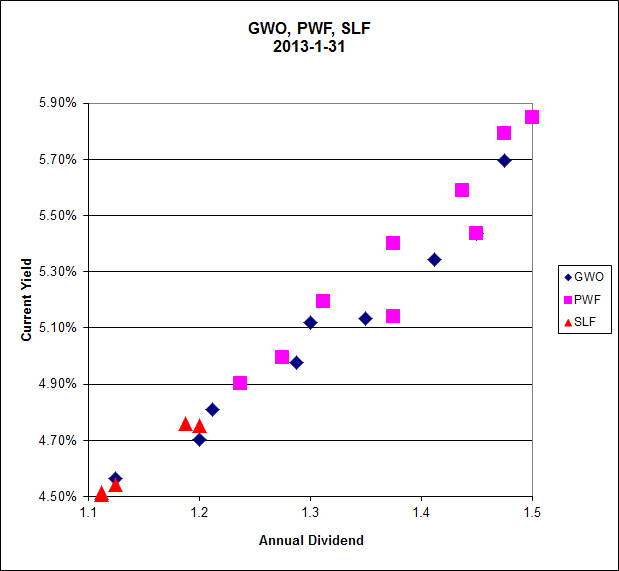
SLF DeemedRetractibles may be compared with PWF and GWO:

Click for Big

It is quite apparent that that the market continues to treat regulated insurance issues (SLF, GWO) no differently from unregulated issues (PWF) – despite the fact that the PWF issues are much more subject to unfavourable calls in the near term and should, logically, be deprecated on those grounds alone without any fancy-pants arguments about imposition of the NVCC rule!

Those of you who have been paying attention will remember that in a “normal” market (which we have not seen in well over a year) the slope of this line is related to the implied volatility of yields in Black-Scholes theory, as discussed in the January, 2010, edition of PrefLetter. The relationship is still far too large to be explained by Implied Volatility – the numbers still indicate an overwhelming degree of directionality in the market’s price expectations.

Sometimes everything works … sometimes it’s 50-50 … sometimes nothing works. The fund seeks to earn incremental return by selling liquidity (that is, taking the other side of trades that other market participants are strongly motivated to execute), which can also be referred to as ‘trading noise’ – although for quite some time, noise trading has taken a distant second place to the sectoral play on insurance DeemedRetractibles. There were a lot of strongly motivated market participants during the Panic of 2007, generating a lot of noise! Unfortunately, the conditions of the Panic may never be repeated in my lifetime … but the fund will simply attempt to make trades when swaps seem profitable, without worrying about the level of monthly turnover. A large chunk of the month’s trading was triggered by a market participant whose poorly executed portfolio rebalancing roiled the market mid-month.

There’s plenty of room for new money left in the fund. I have shown in recent issues of PrefLetter that market pricing for FixedResets is demonstrably stupid and I have lots of confidence – backed up by my bond portfolio management experience in the markets for Canadas and Treasuries, and equity trading on the NYSE & TSX – that there is enough demand for liquidity in any market to make the effort of providing it worthwhile (although the definition of “worthwhile” in terms of basis points of outperformance changes considerably from market to market!) I will continue to exert utmost efforts to outperform but it should be borne in mind that there will almost inevitably be periods of underperformance in the future.

The yields available on high quality preferred shares remain elevated, which is reflected in the current estimate of sustainable income.

Calculation of MAPF Sustainable Income Per Unit
Month NAVPU Portfolio
Average
YTW
Leverage
Divisor
Securities
Average
YTW
Capital
Gains
Multiplier
Sustainable
Income
per
current
Unit
June, 2007 9.3114 5.16% 1.03 5.01% 1.3240 0.3524
September 9.1489 5.35% 0.98 5.46% 1.3240 0.3773
December, 2007 9.0070 5.53% 0.942 5.87% 1.3240 0.3993
March, 2008 8.8512 6.17% 1.047 5.89% 1.3240 0.3938
June 8.3419 6.034% 0.952 6.338% 1.3240 $0.3993
September 8.1886 7.108% 0.969 7.335% 1.3240 $0.4537
December, 2008 8.0464 9.24% 1.008 9.166% 1.3240 $0.5571
March 2009 $8.8317 8.60% 0.995 8.802% 1.3240 $0.5872
June 10.9846 7.05% 0.999 7.057% 1.3240 $0.5855
September 12.3462 6.03% 0.998 6.042% 1.3240 $0.5634
December 2009 10.5662 5.74% 0.981 5.851% 1.1141 $0.5549
March 2010 10.2497 6.03% 0.992 6.079% 1.1141 $0.5593
June 10.5770 5.96% 0.996 5.984% 1.1141 $0.5681
September 11.3901 5.43% 0.980 5.540% 1.1141 $0.5664
December 2010 10.7659 5.37% 0.993 5.408% 1.0298 $0.5654
March, 2011 11.0560 6.00% 0.994 5.964% 1.0298 $0.6403
June 11.1194 5.87% 1.018 5.976% 1.0298 $0.6453
September 10.2709 6.10%
Note
1.001 6.106% 1.0298 $0.6090
December, 2011 10.0793 5.63%
Note
1.031 5.805% 1.0000 $0.5851
March, 2012 10.3944 5.13%
Note
0.996 5.109% 1.0000 $0.5310
June 10.2151 5.32%
Note
1.012 5.384% 1.0000 $0.5500
September 10.6703 4.61%
Note
0.997 4.624% 1.0000 $0.4934
December, 2012 10.8307 4.24% 0.989 4.287% 1.0000 $0.4643
January, 2013 10.8931 4.22% 0.998 4.228% 1.0000 $0.4606
NAVPU is shown after quarterly distributions of dividend income and annual distribution of capital gains.
Portfolio YTW includes cash (or margin borrowing), with an assumed interest rate of 0.00%
The Leverage Divisor indicates the level of cash in the account: if the portfolio is 1% in cash, the Leverage Divisor will be 0.99
Securities YTW divides “Portfolio YTW” by the “Leverage Divisor” to show the average YTW on the securities held; this assumes that the cash is invested in (or raised from) all securities held, in proportion to their holdings.
The Capital Gains Multiplier adjusts for the effects of Capital Gains Dividends. On 2009-12-31, there was a capital gains distribution of $1.989262 which is assumed for this purpose to have been reinvested at the final price of $10.5662. Thus, a holder of one unit pre-distribution would have held 1.1883 units post-distribution; the CG Multiplier reflects this to make the time-series comparable. Note that Dividend Distributions are not assumed to be reinvested.
Sustainable Income is the resultant estimate of the fund’s dividend income per current unit, before fees and expenses. Note that a “current unit” includes reinvestment of prior capital gains; a unitholder would have had the calculated sustainable income with only, say, 0.9 units in the past which, with reinvestment of capital gains, would become 1.0 current units.
DeemedRetractibles are comprised of all Straight Perpetuals (both PerpetualDiscount and PerpetualPremium) issued by BMO, BNS, CM, ELF, GWO, HSB, IAG, MFC, NA, RY, SLF and TD, which are not exchangable into common at the option of the company (definition refined in May, 2011). These issues are analyzed as if their prospectuses included a requirement to redeem at par on or prior to 2022-1-31, in addition to the call schedule explicitly defined. See OSFI Does Not Grandfather Extant Tier 1 Capital, CM.PR.D, CM.PR.E, CM.PR.G: Seeking NVCC Status and the January, February, March and June, 2011, editions of PrefLetter for the rationale behind this analysis.
Yields for September, 2011, to January, 2012, were calculated by imposing a cap of 10% on the yields of YLO issues held, in order to avoid their extremely high calculated yields distorting the calculation and to reflect the uncertainty in the marketplace that these yields will be realized. From February to September 2012, yields on these issues have been set to zero. All YLO issues held were sold in October 2012.

Significant positions were held in DeemedRetractible and FixedReset issues on January 31; all of these currently have their yields calculated with the presumption that they will be called by the issuers at par prior to 2022-1-31. This presents another complication in the calculation of sustainable yield. The fund also holds a position various SplitShare issues which also have their yields calculated with the expectation of a maturity at par.

I will no longer show calculations that assume the conversion of the entire portfolio into PerpetualDiscounts, as there are currently only four such issues of investment grade, from only two issuer groups. Additionally, the fund has no holdings of these issues.

It should be noted that the concept of this Sustainable Income calculation was developed when the fund’s holdings were overwhelmingly PerpetualDiscounts – see, for instance, the bottom of the market in November 2008. It is easy to understand that for a PerpetualDiscount, the technique of multiplying yield by price will indeed result in the coupon – a PerpetualDiscount paying $1 annually will show a Sustainable Income of $1, regardless of whether the price is $24 or $17.

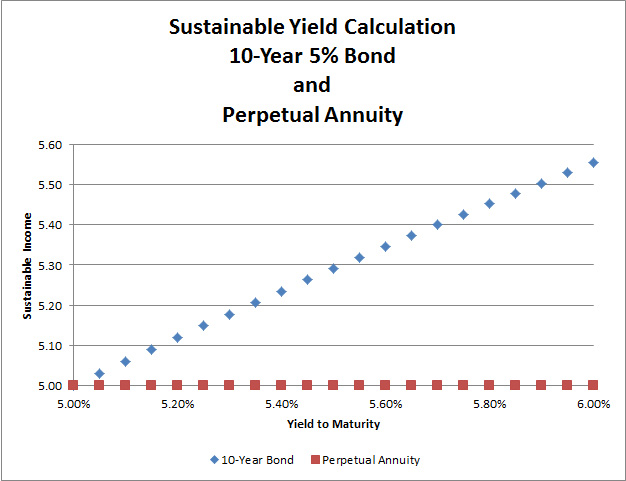
Things are not quite so neat when maturity dates and maturity prices that are different from the current price are thrown into the mix. If we take a notional Straight Perpetual paying $5 annually, the price is $100 when the yield is 5% (all this ignores option effects). As the yield increases to 6%, the price declines to 83.33; and 83.33 x 6% is the same $5. Good enough.

But a ten year bond, priced at 100 when the yield is equal to its coupon of 5%, will decline in price to 92.56; and 92.56 x 6% is 5.55; thus, the calculated Sustainable Income has increased as the price has declined as shown in the graph:

Click for Big

The difference is because the bond’s yield calculation includes the amortization of the discount; therefore, so does the Sustainable Income estimate.

Thus, the decline in the MAPF Sustainable Income from $0.5500 per unit in June to $0.4606 per unit in January should be looked at as a simple consequence of the fund’s holdings; virtually all of which have their yields calculated in a manner closer to bonds than to Perpetual Annuities.

Different assumptions lead to different results from the calculation, but the overall positive trend is apparent. I’m very pleased with the long-term results! It will be noted that if there was no trading in the portfolio, one would expect the sustainable yield to be constant (before fees and expenses). The success of the fund’s trading is showing up in

  • the very good performance against the index
  • the long term increases in sustainable income per unit

As has been noted, the fund has maintained a credit quality equal to or better than the index; outperformance is due to exploitation of trading anomalies.

Again, there are no predictions for the future! The fund will continue to trade between issues in an attempt to exploit market gaps in liquidity, in an effort to outperform the index and keep the sustainable income per unit – however calculated! – growing.

MAPF

MAPF Portfolio Composition: January, 2013

Turnover remained above 2012 averages in January, at about 11%.

There is extreme segmentation in the marketplace, with OSFI’s NVCC rule changes in February 2011 having had the effect of splitting the formerly relatively homogeneous Straight Perpetual class of preferreds into three parts:

  • Unaffected Straight Perpetuals
  • DeemedRetractibles explicitly subject to the rules (banks)
  • DeemedRetractibles considered by me, but not (yet!) by the market, to be likely to be explicitly subject to the rules in the future (insurers and insurance holding companies)

This segmentation, and the extreme valuation differences between the segments, has cut down markedly on the opportunities for trading. Another trend that hasn’t helped has been the migration of PerpetualDiscounts into PerpetualPremiums (due to price increases) – many of the PerpetualPremiums have negative Yields-to-Worst and those that don’t aren’t particularly thrilling; speaking very generally, PerpetualPremiums are to be avoided, not traded! This effect has caused the first of the three segments noted above to be untradeable for most practical purposes.

To make this more clear, since I’ve been asked the question recently, it used to be that there were 70-odd Straight Perpetuals and I was more or less indifferent as to which ones I owned (subject, of course, to issuer concentration concerns and other risk management factors). Thus, if any one of these 70 were to go down in price by – say – $0.25, I would quite often have something in inventory that I’d be willing to swap for it. The segmentation means that I am no longer indifferent; in addition to checking the valuation of a potential buy to its peers, I also have to check its peer group. This cuts down on the potential for trading.

However, there have been some hopeful signs: trading picked up a little in December and has remained at this elevated level in January; there was some frenzied trading on January 14; and the low-reset FixedResets are showing good volatility. Additionally, the long promised OSFI Draft Definition of Capital for Insurers may clarify the status of the Insurer-issued DeemedRetractibles and make them homogeneous with Bank-issued DeemedRetractibles (as I expect) or with unregulated Straight Perpetuals (which would surprise me … but a lot of things happen that surprise me).

Sectoral distribution of the MAPF portfolio on January 31 was as follows:

MAPF Sectoral Analysis 2013-1-31
HIMI Indices Sector Weighting YTW ModDur
Ratchet 0% N/A N/A
FixFloat 0% N/A N/A
Floater 0% N/A N/A
OpRet 0% N/A N/A
SplitShare 9.9% (+0.3) 4.80% 5.16
Interest Rearing 0% N/A N/A
PerpetualPremium 0.0% (0) N/A N/A
PerpetualDiscount 0.0% (0) N/A N/A
Fixed-Reset 25.5% (+3.5) 2.30% 1.45
Deemed-Retractible 57.9% (-1.5) 4.74% 7.27
Scraps (Various) 6.4% (-1.4) 6.46% 9.50
Cash 0.2% (-0.9) 0.00% 0.00
Total 100% 4.22% 5.70
Totals and changes will not add precisely due to rounding. Bracketted figures represent change from December month-end. Cash is included in totals with duration and yield both equal to zero.
DeemedRetractibles are comprised of all Straight Perpetuals (both PerpetualDiscount and PerpetualPremium) issued by BMO, BNS, CM, ELF, GWO, HSB, IAG, MFC, NA, RY, SLF and TD, which are not exchangable into common at the option of the company. These issues are analyzed as if their prospectuses included a requirement to redeem at par on or prior to 2022-1-31, in addition to the call schedule explicitly defined. See OSFI Does Not Grandfather Extant Tier 1 Capital, CM.PR.D, CM.PR.E, CM.PR.G: NVCC Status Confirmed and the January, February, March and June, 2011, editions of PrefLetter for the rationale behind this analysis. (all recent editions have a short summary of the argument included in the “DeemedRetractible” section)

The “total” reflects the un-leveraged total portfolio (i.e., cash is included in the portfolio calculations and is deemed to have a duration and yield of 0.00.). MAPF will often have relatively large cash balances, both credit and debit, to facilitate trading. Figures presented in the table have been rounded to the indicated precision.

Credit distribution is:

MAPF Credit Analysis 2013-1-31
DBRS Rating Weighting
Pfd-1 0 (0)
Pfd-1(low) 55.6% (+2.7)
Pfd-2(high) 27.9% (-0.7)
Pfd-2 0 (0)
Pfd-2(low) 9.9% (+0.3)
Pfd-3(high) 1.0% (-0.4)
Pfd-3 1.7% (-0.9)
Pfd-3(low) 0.3% (0)
Pfd-4(high) 0.4% (0)
Pfd-4 1.7% (-0.1)
Pfd-4(low) 1.2% (-0.1)
Cash 0.2% (-0.9)
Totals will not add precisely due to rounding. Bracketted figures represent change from December month-end.

Liquidity Distribution is:

MAPF Liquidity Analysis 2013-1-31
Average Daily Trading Weighting
<$50,000 0.8% (-8.5)
$50,000 – $100,000 21.7% (+7.7)
$100,000 – $200,000 34.1% (-3.4)
$200,000 – $300,000 31.7% (+10.1)
>$300,000 11.5% (-5.1)
Cash 0.2% (-0.9)
Totals will not add precisely due to rounding. Bracketted figures represent change from December month-end.

MAPF is, of course, Malachite Aggressive Preferred Fund, a “unit trust” managed by Hymas Investment Management Inc. Further information and links to performance, audited financials and subscription information are available the fund’s web page. The fund may be purchased either directly from Hymas Investment Management or through a brokerage account at Odlum Brown Limited. A “unit trust” is like a regular mutual fund, but is sold by offering memorandum rather than prospectus. This is cheaper, but means subscription is restricted to “accredited investors” (as defined by the Ontario Securities Commission) or those who subscribe for $150,000+. Fund past performances are not a guarantee of future performance. You can lose money investing in MAPF or any other fund.

A similar portfolio composition analysis has been performed on the Claymore Preferred Share ETF (symbol CPD) (and other funds) as of August 31, 2012, and published in the October (mainly methodology), November (most funds), and December (ZPR) 2012, PrefLetter. While direct comparisons are difficult due to the introduction of the DeemedRetractible class of preferred share (see above) it is fair to say:

  • MAPF credit quality is better
  • MAPF liquidity is a lower
  • MAPF Yield is higher
  • Weightings in
    • MAPF is much more exposed to DeemedRetractibles
    • MAPF is much less exposed to Operating Retractibles
    • MAPF is much more exposed to SplitShares
    • MAPF is less exposed to FixFloat / Floater / Ratchet
    • MAPF weighting in FixedResets is much lower
Market Action

February 1, 2013

There was a decent US jobs number:

Hiring increased in January after accelerating more than previously estimated at the end of 2012, evidence the U.S. labor market was making progress even as lawmakers quarreled over the federal budget.

Payrolls rose 157,000 following a revised 196,000 advance in the prior month and a 247,000 surge in November, Labor Department figures showed today in Washington. The revisions added a total of 127,000 jobs to the employment count in November and December. The jobless rate increased to 7.9 percent from 7.8 percent.

The BooHooHoo brigade is in full cry, as MBIA sues Credit Suisse for facilitating MBIA’s incompetence:

Credit Suisse Group AG (CS) bundled hundreds of mortgages into a single set of securities sold to investors in 2007 even after it had found flaws with the loans and asked the lenders to repurchase the debt, bond insurer MBIA Inc. (MBI) said in a court filing.

That practice was one way Zurich-based Credit Suisse maximized profit as the U.S. mortgage market melted down, while exposing investors and guarantors to losses, MBIA said in an amended complaint filed Jan. 30 in New York State Supreme Court as part of its 2009 suit against the bank. The filing cites documents obtained through the pretrial exchange of evidence.

Even while Credit Suisse maintained a “watch list” of problem loan sellers, it never stopped including their loans in securitizations, MBIA said. More than 2,600 of the loans securitized in the transaction MBIA insured, or 15 percent, were from originators on the watch list, according to the amended complaint.

I mentioned Indalex briefly on June 23, 2011, when Moody’s expressed concern regarding an apparent shuffling of creditor priorities in bankruptcy.

Moody’s said a review of 84 Canadian industrial companies it rates found two companies — Air Canada and Essar Steel Algoma Inc. — whose debt might be vulnerable to downgrade if the Ontario court decision is upheld by the Supreme Court of Canada. The report said the impact would likely be limited and would affect ratings of specific debt instruments rather than a company’s overall credit rating.

Now the Supreme Court has ruled for a much smaller shuffling:

The Supreme Court of Canada has ruled that the U.S. parent of an insolvent Toronto company is entitled to the Canadian entity’s last $6.75-million, instead of a group of the firm’s retirees, whose pensions were cut after their employer went under.

The court’s ruling in the case of Indalex Ltd., which plunged into bankruptcy protection in 2009, was is expected to have broad implications for other companies and pension plans across the country.

While many cheered that Ontario ruling as a breakthrough victory for pensioners, bankruptcy law experts warned the decision would radically reorder Canada’s insolvency regime. They said it could make it more difficult for struggling companies with large defined-benefit pension plans to borrow the money they need to weather financial storms.

Normally, in the scramble for money after a company has filed for bankruptcy protection under the federal Companies’ Creditors Arrangements Act, pension plans rank far below the banks and hedge funds that lend last-ditch money to distressed companies. These “debtor-in-possession” or DIP loans usually come on the condition of a court-ordered guarantee they will be repaid first.

Indalex, an aluminum processor, had a $6.75-million pension shortfall when it entered bankruptcy protection. But all of the cash from the sale of its assets was bound for the company’s U.S. parent, Sun Indalex Finance LLC, to cover some of its costs for paying back DIP loans made to Indalex by a group of banks.

It seems entirely reasonable to me that DIP loans should have priority. Who would make DIP loans otherwise?

Although it ultimately determined that the DIP lenders rank first because the court orders that grant them priority come under a federal law, the court also surprised observers by ruling the full amount of a pension shortfall at a plan’s windup should be considered a “deemed trust” under Ontario’s pension law. That could push pensioners’ demands further ahead in the line of creditors, but still second to DIP lenders.

I got a little curious – it seems that at least one of the two plans was underfunded back in 2007:

On December 31, 2006, Indalex Limited, an aluminum extrusions manufacturer, wound up the retirement plan for its salaried employees (the “Salaried Plan”). Seven members of the Salaried Plan were members of the United Steelworkers. At the time of the plan windup, the Plan was underfunded. Indalex made special payments in 2007, 2008 and 2009 to partially pay down the deficiency, but at the end of 2008, the deficiency in the Salaried Plan was $1,795,600.

But here’s the thing that interests me: The 2004 Collective Agreement negotiated by Steelworkers only mentions the pension plan in terms of current contributions; there is no language that addresses the underfunded status of the plan (I’m not sure if it was, in fact, underfunded in 2004). Further, a 2007 Steelworkers press release trumpets the 2007 negotiations in terms of wage increases and call-out times, but again there is no mention of the underfunded status of the plan.

So I’m curious: do the unhappy pensioners have cause to be angry with their union? The Steelworkers have issued a press release calling for legislation to put pensions ahead of even DIP financers (so who would ever make a DIP loan?) but what did the union do or what could the union have done to be more proactive?

It was a day of uneven gains for the Canadian preferred share market, with PerpetualPremiums up 2bp, FixedResets winning 27bp and DeemedRetractibles gaining 3bp. The Performance Highlights table, though short, was suitably skewed towards winning FixedResets. Volume was average.

HIMIPref™ Preferred Indices
These values reflect the December 2008 revision of the HIMIPref™ Indices

Values are provisional and are finalized monthly
Index Mean
Current
Yield
(at bid)
Median
YTW
Median
Average
Trading
Value
Median
Mod Dur
(YTW)
Issues Day’s Perf. Index Value
Ratchet 0.00 % 0.00 % 0 0.00 0 -0.0695 % 2,550.2
FixedFloater 4.20 % 3.52 % 27,748 18.31 1 -0.5712 % 3,874.1
Floater 2.61 % 2.93 % 68,027 19.89 5 -0.0695 % 2,753.6
OpRet 4.76 % 1.28 % 33,825 0.37 5 0.0613 % 2,602.3
SplitShare 4.57 % 4.40 % 41,124 4.28 2 0.0000 % 2,914.1
Interest-Bearing 0.00 % 0.00 % 0 0.00 0 0.0613 % 2,379.6
Perpetual-Premium 5.25 % -2.14 % 87,991 0.15 29 0.0167 % 2,349.7
Perpetual-Discount 4.85 % 4.91 % 145,721 15.62 4 0.1527 % 2,643.9
FixedReset 4.90 % 2.83 % 264,248 3.39 78 0.2657 % 2,488.1
Deemed-Retractible 4.88 % 3.41 % 139,841 0.31 45 0.0293 % 2,431.3
Performance Highlights
Issue Index Change Notes
PWF.PR.P FixedReset 1.73 % YTW SCENARIO
Maturity Type : Limit Maturity
Maturity Date : 2043-02-01
Maturity Price : 23.66
Evaluated at bid price : 25.89
Bid-YTW : 2.96 %
FTS.PR.H FixedReset 2.00 % YTW SCENARIO
Maturity Type : Limit Maturity
Maturity Date : 2043-02-01
Maturity Price : 23.81
Evaluated at bid price : 25.96
Bid-YTW : 2.79 %
VNR.PR.A FixedReset 2.06 % YTW SCENARIO
Maturity Type : Call
Maturity Date : 2017-10-15
Maturity Price : 25.00
Evaluated at bid price : 26.73
Bid-YTW : 2.83 %
Volume Highlights
Issue Index Shares
Traded
Notes
BMO.PR.O FixedReset 130,265 Scotia crossed 49,600 at 26.40. Nesbitt crossed blocks of 50,000 and 17,100 at the same price.
YTW SCENARIO
Maturity Type : Call
Maturity Date : 2014-05-25
Maturity Price : 25.00
Evaluated at bid price : 26.39
Bid-YTW : 1.87 %
TD.PR.S FixedReset 108,400 Scotia crossed 35,000 at 25.08. National crossed 60,000 at 25.09.
YTW SCENARIO
Maturity Type : Hard Maturity
Maturity Date : 2022-01-31
Maturity Price : 25.00
Evaluated at bid price : 25.09
Bid-YTW : 3.13 %
HSE.PR.A FixedReset 77,744 Desjardins crossed blocks of 25,000 and 50,000 at 26.53.
YTW SCENARIO
Maturity Type : Call
Maturity Date : 2016-03-31
Maturity Price : 25.00
Evaluated at bid price : 26.54
Bid-YTW : 2.55 %
FTS.PR.H FixedReset 61,030 TD crossed 50,000 at 25.78.
YTW SCENARIO
Maturity Type : Limit Maturity
Maturity Date : 2043-02-01
Maturity Price : 23.81
Evaluated at bid price : 25.96
Bid-YTW : 2.79 %
FTS.PR.J Perpetual-Premium 53,719 TD crossed 50,000 at 26.00.
YTW SCENARIO
Maturity Type : Call
Maturity Date : 2021-12-01
Maturity Price : 25.00
Evaluated at bid price : 25.93
Bid-YTW : 4.40 %
RY.PR.N FixedReset 48,011 Scotia crossed 40,000 at 26.00.
YTW SCENARIO
Maturity Type : Call
Maturity Date : 2014-02-24
Maturity Price : 25.00
Evaluated at bid price : 25.95
Bid-YTW : 2.27 %
There were 31 other index-included issues trading in excess of 10,000 shares.
Wide Spread Highlights
Issue Index Quote Data and Yield Notes
BAM.PR.C Floater Quote: 18.00 – 19.00
Spot Rate : 1.0000
Average : 0.6744

YTW SCENARIO
Maturity Type : Limit Maturity
Maturity Date : 2043-02-01
Maturity Price : 18.00
Evaluated at bid price : 18.00
Bid-YTW : 2.94 %

PWF.PR.K Perpetual-Premium Quote: 25.14 – 25.94
Spot Rate : 0.8000
Average : 0.6223

YTW SCENARIO
Maturity Type : Call
Maturity Date : 2014-10-31
Maturity Price : 25.00
Evaluated at bid price : 25.14
Bid-YTW : 4.66 %

IGM.PR.B Perpetual-Premium Quote: 26.55 – 26.95
Spot Rate : 0.4000
Average : 0.2746

YTW SCENARIO
Maturity Type : Call
Maturity Date : 2014-12-31
Maturity Price : 26.00
Evaluated at bid price : 26.55
Bid-YTW : 4.55 %

CIU.PR.C FixedReset Quote: 24.76 – 25.05
Spot Rate : 0.2900
Average : 0.1992

YTW SCENARIO
Maturity Type : Limit Maturity
Maturity Date : 2043-02-01
Maturity Price : 23.24
Evaluated at bid price : 24.76
Bid-YTW : 2.90 %

RY.PR.D Deemed-Retractible Quote: 25.70 – 25.89
Spot Rate : 0.1900
Average : 0.1302

YTW SCENARIO
Maturity Type : Call
Maturity Date : 2014-02-24
Maturity Price : 25.50
Evaluated at bid price : 25.70
Bid-YTW : 3.42 %

W.PR.J Perpetual-Premium Quote: 25.42 – 25.70
Spot Rate : 0.2800
Average : 0.2231

YTW SCENARIO
Maturity Type : Call
Maturity Date : 2013-03-03
Maturity Price : 25.00
Evaluated at bid price : 25.42
Bid-YTW : -11.22 %

Market Action

January 31, 2013

ZeroHedge squared its rot for a good booHooHoo about the Litvak charges mentioned on January 28:

Since for the most part, the buyside traders operated with other people’s money, they were largely indiscriminate on the fine pricing nuances of the acquisition (or disposition) of the securities at hand, and while to the “other people’s money” under management whether a given bond was bought for 55 or 55.75, or a given MBS was sold for 72-6 or 72-16 meant little (after all the trade was driven by a big picture view that the security would go up or down much more and certainly enough to cover the bid/ask spread, resulting in much larger profits upon unwind), the transaction price had a huge impact for the bank traders-cum-salesmen arranging said deals. Because when one is selling a $40 million MBS block, a 1 point price swing equals a difference of $400,000. Make 15 such deals per year, and one’s $1,000,000 bonus (assuming a ~15% cut on the profits) is in the bag.

Golly! Whoever would have thought that the sell-side exists to make money?

I once had a buy-side trader tell me he didn’t care much about the pennies – if he got the direction right, he’d do just fine. His intention was to impress me with how much of a gun he was – and to sneer at my scrabbling in the dirt for pennies – but it didn’t work out that way.

Sadly, we have not yet been informed regarding the identities grossly incompetent (or negligent. One of the two.) buy-side traders in the Litvak case; nor does it appear that action will be taken against them for their dereliction of duty. Performance, schmerformance.

The Canadian preferred share market ended the month on a downbeat, with PerpetualPremiums dipping 2bp, FixedResets down 8bp and DeemedRetractibles off 1bp. Volatility was low. Volume was very heavy.

HIMIPref™ Preferred Indices
These values reflect the December 2008 revision of the HIMIPref™ Indices

Values are provisional and are finalized monthly
Index Mean
Current
Yield
(at bid)
Median
YTW
Median
Average
Trading
Value
Median
Mod Dur
(YTW)
Issues Day’s Perf. Index Value
Ratchet 0.00 % 0.00 % 0 0.00 0 -0.1685 % 2,552.0
FixedFloater 4.17 % 3.50 % 28,868 18.36 1 0.0440 % 3,896.4
Floater 2.73 % 2.92 % 68,934 19.92 4 -0.1685 % 2,755.5
OpRet 4.62 % 1.38 % 59,944 0.38 4 0.2100 % 2,600.7
SplitShare 4.57 % 4.40 % 42,671 4.28 2 0.0597 % 2,914.1
Interest-Bearing 0.00 % 0.00 % 0 0.00 0 0.2100 % 2,378.1
Perpetual-Premium 5.25 % 0.45 % 91,070 0.09 30 -0.0219 % 2,349.3
Perpetual-Discount 4.86 % 4.91 % 145,393 15.61 4 0.1734 % 2,639.9
FixedReset 4.92 % 2.93 % 262,058 3.55 78 -0.0782 % 2,481.5
Deemed-Retractible 4.88 % 2.82 % 139,006 0.31 45 -0.0052 % 2,430.6
Performance Highlights
Issue Index Change Notes
FTS.PR.H FixedReset -2.00 % YTW SCENARIO
Maturity Type : Limit Maturity
Maturity Date : 2043-01-31
Maturity Price : 23.66
Evaluated at bid price : 25.45
Bid-YTW : 2.88 %
PWF.PR.P FixedReset -1.17 % YTW SCENARIO
Maturity Type : Limit Maturity
Maturity Date : 2043-01-31
Maturity Price : 23.53
Evaluated at bid price : 25.45
Bid-YTW : 3.04 %
Volume Highlights
Issue Index Shares
Traded
Notes
BNS.PR.Z FixedReset 135,281 TD crossed 50,000 at 25.15. Desjardins crossed blocks of 43,000 and 26,500, both at 25.03.
YTW SCENARIO
Maturity Type : Hard Maturity
Maturity Date : 2022-01-31
Maturity Price : 25.00
Evaluated at bid price : 25.01
Bid-YTW : 3.12 %
ENB.PR.T FixedReset 124,763 TD and Scotia both crossed 25,000 at 25.55; TD bought 10,000 from Nesbitt at the same price.
YTW SCENARIO
Maturity Type : Call
Maturity Date : 2019-06-01
Maturity Price : 25.00
Evaluated at bid price : 25.52
Bid-YTW : 3.76 %
BAM.PF.C Perpetual-Discount 100,300 RBC crossed 50,000 at 25.00; TD crossed 34,600 at the same price, then bought 10,000 from CIBC at the same price again.
YTW SCENARIO
Maturity Type : Limit Maturity
Maturity Date : 2043-01-31
Maturity Price : 24.61
Evaluated at bid price : 25.00
Bid-YTW : 4.91 %
HSE.PR.A FixedReset 83,800 Desjardins crossed 35,000 at 26.40. RBC crossed 19,900 and Desjardins crossed 25,000, both at 26.45.
YTW SCENARIO
Maturity Type : Call
Maturity Date : 2016-03-31
Maturity Price : 25.00
Evaluated at bid price : 26.48
Bid-YTW : 2.63 %
MFC.PR.D FixedReset 81,343 Desjardins crossed 12,600 at 26.60; RBC crossed 22,600 at 26.79.
YTW SCENARIO
Maturity Type : Call
Maturity Date : 2014-06-19
Maturity Price : 25.00
Evaluated at bid price : 26.72
Bid-YTW : 2.13 %
BNS.PR.M Deemed-Retractible 72,839 RBC crossed 35,400 at 25.88.
YTW SCENARIO
Maturity Type : Call
Maturity Date : 2016-07-27
Maturity Price : 25.00
Evaluated at bid price : 25.82
Bid-YTW : 3.52 %
There were 58 other index-included issues trading in excess of 10,000 shares.
Wide Spread Highlights
Issue Index Quote Data and Yield Notes
PWF.PR.K Perpetual-Premium Quote: 25.25 – 26.00
Spot Rate : 0.7500
Average : 0.4275

YTW SCENARIO
Maturity Type : Call
Maturity Date : 2014-10-31
Maturity Price : 25.00
Evaluated at bid price : 25.25
Bid-YTW : 4.38 %

TCA.PR.Y Perpetual-Premium Quote: 52.45 – 53.25
Spot Rate : 0.8000
Average : 0.5283

YTW SCENARIO
Maturity Type : Call
Maturity Date : 2014-03-05
Maturity Price : 50.00
Evaluated at bid price : 52.45
Bid-YTW : 1.06 %

PWF.PR.P FixedReset Quote: 25.45 – 25.88
Spot Rate : 0.4300
Average : 0.2820

YTW SCENARIO
Maturity Type : Limit Maturity
Maturity Date : 2043-01-31
Maturity Price : 23.53
Evaluated at bid price : 25.45
Bid-YTW : 3.04 %

FTS.PR.H FixedReset Quote: 25.45 – 25.80
Spot Rate : 0.3500
Average : 0.2339

YTW SCENARIO
Maturity Type : Limit Maturity
Maturity Date : 2043-01-31
Maturity Price : 23.66
Evaluated at bid price : 25.45
Bid-YTW : 2.88 %

TRI.PR.B Floater Quote: 22.95 – 24.00
Spot Rate : 1.0500
Average : 0.9480

YTW SCENARIO
Maturity Type : Limit Maturity
Maturity Date : 2043-01-31
Maturity Price : 22.71
Evaluated at bid price : 22.95
Bid-YTW : 2.27 %

CU.PR.C FixedReset Quote: 26.49 – 26.75
Spot Rate : 0.2600
Average : 0.1714

YTW SCENARIO
Maturity Type : Call
Maturity Date : 2017-06-01
Maturity Price : 25.00
Evaluated at bid price : 26.49
Bid-YTW : 2.71 %

Market Action

January 30, 2013

It was a mixed day for the Canadian preferred share market, with PerpetualPremiums down 2bp, FixedResets up 11bp and DeemedRetractibles off 1bp. Volatility was low. Volume was well above average.

HIMIPref™ Preferred Indices
These values reflect the December 2008 revision of the HIMIPref™ Indices

Values are provisional and are finalized monthly
Index Mean
Current
Yield
(at bid)
Median
YTW
Median
Average
Trading
Value
Median
Mod Dur
(YTW)
Issues Day’s Perf. Index Value
Ratchet 0.00 % 0.00 % 0 0.00 0 -0.0906 % 2,556.3
FixedFloater 4.18 % 3.50 % 28,179 18.36 1 0.4859 % 3,894.6
Floater 2.72 % 2.92 % 69,501 19.91 4 -0.0906 % 2,760.2
OpRet 4.63 % 1.57 % 57,426 0.38 4 -0.0191 % 2,595.3
SplitShare 4.57 % 4.42 % 43,219 4.29 2 0.2792 % 2,912.4
Interest-Bearing 0.00 % 0.00 % 0 0.00 0 -0.0191 % 2,373.1
Perpetual-Premium 5.24 % 0.07 % 88,815 0.15 30 -0.0232 % 2,349.8
Perpetual-Discount 4.87 % 4.91 % 139,940 15.57 4 0.3377 % 2,635.3
FixedReset 4.91 % 2.88 % 263,289 3.40 78 0.1110 % 2,483.4
Deemed-Retractible 4.88 % 3.30 % 134,367 0.32 45 -0.0083 % 2,430.7
Performance Highlights
Issue Index Change Notes
TRI.PR.B Floater -1.54 % YTW SCENARIO
Maturity Type : Limit Maturity
Maturity Date : 2043-01-30
Maturity Price : 22.76
Evaluated at bid price : 23.04
Bid-YTW : 2.26 %
FTS.PR.H FixedReset 1.25 % YTW SCENARIO
Maturity Type : Limit Maturity
Maturity Date : 2043-01-30
Maturity Price : 23.81
Evaluated at bid price : 25.97
Bid-YTW : 2.79 %
Volume Highlights
Issue Index Shares
Traded
Notes
TD.PR.S FixedReset 97,890 TD crossed 39,400 at 25.10; National crossed 50,000 at the same price.
YTW SCENARIO
Maturity Type : Hard Maturity
Maturity Date : 2022-01-31
Maturity Price : 25.00
Evaluated at bid price : 25.08
Bid-YTW : 3.13 %
MFC.PR.D FixedReset 70,517 TD crossed 25,100 at 26.72; Scotia bought blocks of 14,200 and 10,800 from Nesbitt at 26.70.
YTW SCENARIO
Maturity Type : Call
Maturity Date : 2014-06-19
Maturity Price : 25.00
Evaluated at bid price : 26.65
Bid-YTW : 2.32 %
MFC.PR.I FixedReset 64,270 National crossed 50,000 at 26.17.
YTW SCENARIO
Maturity Type : Call
Maturity Date : 2017-09-19
Maturity Price : 25.00
Evaluated at bid price : 26.19
Bid-YTW : 3.42 %
TCA.PR.Y Perpetual-Premium 58,825 Desjardins crossed 57,000 at 52.60.
YTW SCENARIO
Maturity Type : Call
Maturity Date : 2014-03-05
Maturity Price : 50.00
Evaluated at bid price : 52.45
Bid-YTW : 1.06 %
MFC.PR.G FixedReset 58,770 National crossed 50,000 at 26.33.
YTW SCENARIO
Maturity Type : Call
Maturity Date : 2016-12-19
Maturity Price : 25.00
Evaluated at bid price : 26.30
Bid-YTW : 3.12 %
BAM.PR.P FixedReset 53,850 Desjardins crossed 45,000 at 26.93.
YTW SCENARIO
Maturity Type : Call
Maturity Date : 2014-09-30
Maturity Price : 25.00
Evaluated at bid price : 26.90
Bid-YTW : 2.69 %
There were 43 other index-included issues trading in excess of 10,000 shares.
Wide Spread Highlights
Issue Index Quote Data and Yield Notes
BAM.PR.C Floater Quote: 18.00 – 18.64
Spot Rate : 0.6400
Average : 0.3474

YTW SCENARIO
Maturity Type : Limit Maturity
Maturity Date : 2043-01-30
Maturity Price : 18.00
Evaluated at bid price : 18.00
Bid-YTW : 2.93 %

PWF.PR.R Perpetual-Premium Quote: 26.68 – 27.00
Spot Rate : 0.3200
Average : 0.1922

YTW SCENARIO
Maturity Type : Call
Maturity Date : 2021-04-30
Maturity Price : 25.00
Evaluated at bid price : 26.68
Bid-YTW : 4.54 %

TRI.PR.B Floater Quote: 23.04 – 24.00
Spot Rate : 0.9600
Average : 0.8362

YTW SCENARIO
Maturity Type : Limit Maturity
Maturity Date : 2043-01-30
Maturity Price : 22.76
Evaluated at bid price : 23.04
Bid-YTW : 2.26 %

HSB.PR.C Deemed-Retractible Quote: 25.70 – 25.98
Spot Rate : 0.2800
Average : 0.2059

YTW SCENARIO
Maturity Type : Call
Maturity Date : 2013-03-01
Maturity Price : 25.50
Evaluated at bid price : 25.70
Bid-YTW : 0.45 %

W.PR.J Perpetual-Premium Quote: 25.38 – 25.61
Spot Rate : 0.2300
Average : 0.1616

YTW SCENARIO
Maturity Type : Call
Maturity Date : 2013-03-01
Maturity Price : 25.00
Evaluated at bid price : 25.38
Bid-YTW : -9.75 %

BMO.PR.O FixedReset Quote: 26.44 – 26.64
Spot Rate : 0.2000
Average : 0.1349

YTW SCENARIO
Maturity Type : Call
Maturity Date : 2014-05-25
Maturity Price : 25.00
Evaluated at bid price : 26.44
Bid-YTW : 1.71 %

Issue Comments

DBRS Reiterates Nervousness Regarding BAM

DBRS has announced that it:

has today assigned a provisional rating of A (low) to a proposed $350 million Unsecured Medium Term Notes (the Notes) to be issued by Brookfield Asset Management Inc. (Brookfield or the Company). The trend is Stable. The provisional rating is based on draft term sheets provided by the Company on January 28, 2013. The assignment of a final rating is subject to receipt by DBRS of final documentation that is consistent with that which DBRS has already reviewed.

The proposed Notes, a $175 million tranche maturing April 2019 and a $175 million tranche maturing March 2023, will be an unsecured obligation and will rank equally and ratably with all of the Company’s other unsecured and unsubordinated obligations. Proceeds of the Notes will be used for the redemption of the $150 million unsecured debt maturing June 2014 (including related costs), refinancing of the US$75 million unsecured debt maturing October 2013 and reduction of short-term borrowing outstanding. DBRS understands that the transaction will not result in any material increase in the level of corporate borrowing at Brookfield.

In assigning the provisional instrument rating, DBRS reiterates that there remains minimal room for further deterioration, as indicated in our most recent commentary on the Company, published on October 19, 2012. DBRS expects that Brookfield’s corporate-level financial metrics for 2012 will reach our targets (funds from operations (FFO) to debt of 30% or higher and FFO interest coverage of 5.0 times) for the ratings and will maintain them at these levels going forward. The ratings could come under pressure if these metrics fall materially short of the targets or if there is a material deterioration or rating downgrade in one or more of the core businesses (including Brookfield Office Properties Inc.).

Brookfield Asset Management is the proud issuer of:

  • FixedResets BAM.PF.A, BAM.PF.B, BAM.PR.P, BAM.PR.R, BAM.PR.T, BAM.PR.X, BAM.PR.Z
  • Floaters BAM.PR.B, BAM.PR.C, BAM.PR.K
  • RatchetRate BAM.PR.E
  • FixedFloater BAM.PR.G
  • OperatingRetractible BAM.PR.J, BAM.PR.O
  • Straight Perpetual BAM.PR.M, BAM.PR.N

A downgrade of BAM would also have an immediate effect on the SplitShares issued by BAM Split Corp.: BNA.PR.B, BNA.PR.C, BNA.PR.D and BNA.PR.E.

It also seems likely that a BAM downgrade would involve collateral or related damage to the ratings of Brookfield Properties Corp (BPO.PR.F, BPO.PR.H, BPO.PR.J, BPO.PR.K, BPO.PR.L, BPO.PR.N, BPO.PR.P, BPO.PR.R, BPO.PR.T), Brookfield Office Properties (BPP.PR.G, BPP.PR.J, BPP.PR.M), Brookfield Renewable Power Preferred Equity Inc (BRF.PR.A, BRF.PR.C, BRF.PR.E) and Brookfield Investments Corporation (BRN.PR.A).

DBRS’ increasing discomfort with the rating on BAM has been reported on PrefBlog in several posts: BAM To Slow Balance Sheet Deterioration and DBRS: BAM is Not-Quite-Trend-Negative. S&P assigned Outlook Negative to BAM last spring, Outlook Negative to BPO in the summer and, most recently, DBRS Increasingly Nervous About BAM.

Issue Comments

SLS.PR.A Redemption Price Announced

Scotia Managed Companies has announced:

The Board of Directors of SL Split Corp.(the “Company”) has announced today that the redemption prices for all outstanding Capital Shares and Preferred Shares to be paid on
January 31, 2013 are as follows:

Redemption Price per Preferred Share: $25.78

Redemption Price per Capital Share: $1.55

Holders of 189,000 Capital Shares requested delivery of and will receive their pro rata share of portfolio shares in payment for their Capital Shares.

Capital Shares and Preferred Shares of SL Split Corp. are listed for trading on The Toronto Stock Exchange under the symbols SLS and SLS.PR.A respectively. The Capital Shares and Preferred Shares will be de-listed from The Toronto Stock Exchange as at the close of trading on January 31, 2013.

The intention to redeem was reported on PrefBlog. SLS.PR.A was not tracked by HIMIPref™.

New Issues

New Issue: BAF FixedReset, 4.25%+264

Bell Aliant has announced:

that its subsidiary Bell Aliant Preferred Equity Inc. (the “Company”) will be issuing 8,000,000 Cumulative 5-Year Rate Reset Preferred Shares, Series E (the “Series E Preferred Shares”), at a price of $25.00 per Series E Preferred Share, for aggregate gross proceeds of $200 million on a bought-deal basis to a syndicate of underwriters led by Scotiabank, TD Securities Inc., and CIBC.

The underwriters have been granted an over-allotment option to purchase an additional 1,200,000 Series E Preferred Shares at the offering price. Should the over-allotment option be fully exercised, the total gross proceeds of the Series E Preferred Share offering will be $230 million.

The Series E Preferred Shares will pay cumulative dividends of $1.0625 per share per annum, yielding 4.25 per cent, payable quarterly if, as and when declared by the Company’s board of directors (with the first quarterly dividend to be paid on June 30, 2013), for the initial five and a half year period ending September 30, 2018. The dividend rate will be reset on September 30, 2018 and every five years thereafter at a rate equal to the five-year Government of Canada bond yield plus 2.64 per cent. The Series E Preferred Shares will be redeemable by the issuer on or after September 30, 2018, in accordance with their terms.

Holders of the Series E Preferred Shares will have the right, at their option, to convert their shares into Cumulative Floating Rate Preferred Shares, Series F, (the “Series F Preferred Shares”) subject to certain conditions, on September 30, 2018 and on September 30 every five years thereafter. Holders of the Series F Preferred Shares will be entitled to receive cumulative quarterly floating dividends at a rate equal to the three-month Government of Canada Treasury Bill yield plus 2.64 per cent, if, as and when declared by the Company’s board of directors.

The Series E Preferred Shares will be offered for sale to the public in each of the provinces and territories of Canada pursuant to a short form prospectus to be filed with Canadian securities regulatory authorities in all Canadian provinces and territories. The offering is scheduled to close on or about February 14, 2013, subject to certain conditions, including obtaining all necessary regulatory approvals.

The net proceeds of this offering will be used for repayment of short term debt and general corporate purposes.

Update, 2013-2-6: Rated Pfd-3 by DBRS.

Market Action

January 29, 2013

Everything you ever suspected about municipal employees is true:

The City of Hamilton fired 29 public-works employees Monday for time theft, breach of trust and neglect of duties.

The employees, frontline road-maintenance workers whose main duties involve filling potholes, used company time and vehicles to “go to shopping malls, go to coffee shops, go have a snooze in the park,” according to Councillor Lloyd Ferguson, chair of the public-works committee.

On one work day, the private investigators found one crew only worked for 30 minutes, Mr. Ferguson said.

he investigation isn’t over yet; now the city’s public-works managers and internal auditing staff are interviewing supervisors and doing a full forensic of work records to understand how this alleged deception took place. Supervisors could face discipline, too.

“The supervisors should know what they assign in the morning and what’s done at the end of the day. They should be going around to these job sites and checking on their crews,” Mr. Ferguson said.

But that still leaves the question of what happened to the asphalt the crews were to use to repair roads. “If they took 10 tons of asphalt in the morning and brought back nine and a half at the end of the day, it would draw attention to them,” Mr. Ferguson said. “So that’s one of the other things we’re investigating is the dumping of asphalt.”

It was another mixed day for the Canadian preferred share market, with PerpetualPremiums up 9bp, FixedResets off 5bp and DeemedRetractibles gaining 4bp. Volatility was above average and skewed to the upside, but there was no clear pattern. Volume was quite heavy.

HIMIPref™ Preferred Indices
These values reflect the December 2008 revision of the HIMIPref™ Indices

Values are provisional and are finalized monthly
Index Mean
Current
Yield
(at bid)
Median
YTW
Median
Average
Trading
Value
Median
Mod Dur
(YTW)
Issues Day’s Perf. Index Value
Ratchet 0.00 % 0.00 % 0 0.00 0 0.4683 % 2,558.6
FixedFloater 4.20 % 3.52 % 27,646 18.32 1 1.2522 % 3,875.8
Floater 2.72 % 2.93 % 68,772 19.88 4 0.4683 % 2,762.7
OpRet 4.63 % 1.56 % 53,167 0.38 4 -0.0095 % 2,595.8
SplitShare 4.59 % 4.44 % 43,779 4.29 2 -0.1990 % 2,904.2
Interest-Bearing 0.00 % 0.00 % 0 0.00 0 -0.0095 % 2,373.6
Perpetual-Premium 5.24 % -2.27 % 82,228 0.15 30 0.0858 % 2,350.3
Perpetual-Discount 4.89 % 4.92 % 140,409 15.54 4 -0.2144 % 2,626.4
FixedReset 4.91 % 2.90 % 256,266 3.56 78 -0.0535 % 2,480.6
Deemed-Retractible 4.87 % 2.86 % 132,076 0.31 45 0.0422 % 2,430.9
Performance Highlights
Issue Index Change Notes
BAM.PR.R FixedReset -1.31 % YTW SCENARIO
Maturity Type : Limit Maturity
Maturity Date : 2043-01-29
Maturity Price : 23.70
Evaluated at bid price : 26.31
Bid-YTW : 3.68 %
CU.PR.C FixedReset 1.11 % YTW SCENARIO
Maturity Type : Call
Maturity Date : 2017-06-01
Maturity Price : 25.00
Evaluated at bid price : 26.44
Bid-YTW : 2.76 %
BAM.PR.G FixedFloater 1.25 % YTW SCENARIO
Maturity Type : Limit Maturity
Maturity Date : 2043-01-29
Maturity Price : 22.98
Evaluated at bid price : 22.64
Bid-YTW : 3.52 %
PWF.PR.P FixedReset 1.26 % YTW SCENARIO
Maturity Type : Limit Maturity
Maturity Date : 2043-01-29
Maturity Price : 23.61
Evaluated at bid price : 25.73
Bid-YTW : 2.98 %
TRI.PR.B Floater 1.30 % YTW SCENARIO
Maturity Type : Limit Maturity
Maturity Date : 2043-01-29
Maturity Price : 23.14
Evaluated at bid price : 23.40
Bid-YTW : 2.23 %
Volume Highlights
Issue Index Shares
Traded
Notes
IFC.PR.C FixedReset 236,939 Nesbitt crossed blocks of 150,000 shares, 50,000 and 17,200, all at 26.10.
YTW SCENARIO
Maturity Type : Call
Maturity Date : 2016-09-30
Maturity Price : 25.00
Evaluated at bid price : 26.11
Bid-YTW : 3.03 %
HSE.PR.A FixedReset 124,745 Desjardins crossed three blocks, of 35,000 shares, 24,900 and 40,000, all at 26.40.
YTW SCENARIO
Maturity Type : Call
Maturity Date : 2016-03-31
Maturity Price : 25.00
Evaluated at bid price : 26.36
Bid-YTW : 2.78 %
ENB.PR.T FixedReset 93,759 Nesbitt crossed 50,000 at 25.50; Scotia crossed 25,000 at 25.48.
YTW SCENARIO
Maturity Type : Call
Maturity Date : 2019-06-01
Maturity Price : 25.00
Evaluated at bid price : 25.50
Bid-YTW : 3.77 %
BAM.PR.X FixedReset 80,754 Nesbitt crossed 21,100 at 25.25; Scotia crossed 50,000 at 25.29.
YTW SCENARIO
Maturity Type : Limit Maturity
Maturity Date : 2043-01-29
Maturity Price : 23.30
Evaluated at bid price : 25.27
Bid-YTW : 3.37 %
GWO.PR.N FixedReset 69,423 National crossed 50,000 at 24.15.
YTW SCENARIO
Maturity Type : Hard Maturity
Maturity Date : 2022-01-31
Maturity Price : 25.00
Evaluated at bid price : 24.10
Bid-YTW : 3.58 %
BNS.PR.L Deemed-Retractible 66,487 TD crossed 54,000 at 25.80.
YTW SCENARIO
Maturity Type : Call
Maturity Date : 2013-04-26
Maturity Price : 25.75
Evaluated at bid price : 25.84
Bid-YTW : 2.75 %
There were 51 other index-included issues trading in excess of 10,000 shares.
Wide Spread Highlights
Issue Index Quote Data and Yield Notes
ELF.PR.H Perpetual-Premium Quote: 26.21 – 26.98
Spot Rate : 0.7700
Average : 0.4721

YTW SCENARIO
Maturity Type : Call
Maturity Date : 2021-04-17
Maturity Price : 25.00
Evaluated at bid price : 26.21
Bid-YTW : 4.84 %

MFC.PR.C Deemed-Retractible Quote: 24.61 – 25.00
Spot Rate : 0.3900
Average : 0.2458

YTW SCENARIO
Maturity Type : Hard Maturity
Maturity Date : 2022-01-31
Maturity Price : 25.00
Evaluated at bid price : 24.61
Bid-YTW : 4.81 %

CM.PR.K FixedReset Quote: 26.15 – 26.56
Spot Rate : 0.4100
Average : 0.2706

YTW SCENARIO
Maturity Type : Call
Maturity Date : 2014-07-31
Maturity Price : 25.00
Evaluated at bid price : 26.15
Bid-YTW : 2.23 %

BAM.PR.R FixedReset Quote: 26.31 – 26.60
Spot Rate : 0.2900
Average : 0.2100

YTW SCENARIO
Maturity Type : Limit Maturity
Maturity Date : 2043-01-29
Maturity Price : 23.70
Evaluated at bid price : 26.31
Bid-YTW : 3.68 %

IAG.PR.A Deemed-Retractible Quote: 24.65 – 24.90
Spot Rate : 0.2500
Average : 0.1745

YTW SCENARIO
Maturity Type : Hard Maturity
Maturity Date : 2022-01-31
Maturity Price : 25.00
Evaluated at bid price : 24.65
Bid-YTW : 4.87 %

FTS.PR.H FixedReset Quote: 25.65 – 25.91
Spot Rate : 0.2600
Average : 0.1904

YTW SCENARIO
Maturity Type : Limit Maturity
Maturity Date : 2043-01-29
Maturity Price : 23.72
Evaluated at bid price : 25.65
Bid-YTW : 2.85 %

Issue Comments

BRF.PR.E Firm On Good Volume

Brookfield Renewable Energy Partners has announced:

the completion of its previously announced 5% perpetual Class A Preferred Shares, Series 5 (“Preferred Shares”) issue in the amount of CDN$175,000,000. Brookfield Renewable issued, through a wholly-owned subsidiary, 7,000,000 Preferred Shares at a price of CDN$25.00 per share, for total gross proceeds of CDN$175,000,000.

The offering was underwritten by a syndicate led by RBC Capital Markets, CIBC, Scotiabank, and TD Securities Inc.

The Series 5 Preferred Shares will commence trading on the Toronto Stock Exchange this morning under the ticker symbol BRF.PR.E.

BRF.PR.E is a Straight Perpetual, 5.00%, announced January 21. It has been rated Pfd-3(high) by DBRS.

The issue traded 560,718 shares in a range of 24.94-03 before closing at 24.99-01, 25×14. Vital statistics are:

BRF.PR.E Perpetual-Discount YTW SCENARIO
Maturity Type : Limit Maturity
Maturity Date : 2043-01-29
Maturity Price : 24.60
Evaluated at bid price : 24.99
Bid-YTW : 5.01 %