Market Action

September 22, 2010

Lord Adair Turner, of Turner Report fame, has some things to say about bank regulation:

“If we were philosopher kings designing a banking system entirely anew for a greenfield economy, should we have set still higher capital ratios than in the Basel III regime? Yes I believe we should,” the Financial Services Authority’s Adair Turner told bankers at the Mansion House dinner in London’s financial district. “But starting from where we actually are, the Basel III reforms will significantly improve the resilience of our banking systems.”

Turner said inadequate regulation was more to blame for the near collapse of the banking system than excessive leverage and bonuses.

“We do need appropriate regulation of bonuses to reduce incentives for excessive risk taking,” Turner said. “We also need to move beyond the demonization of overpaid traders and their unnecessary CDO-squareds.”

The CBOE is attempting to resurrect Credit Default Options:

CBOE Holdings Inc. is seeking to resurrect credit-default options, or contracts that pay off when companies fail to repay their debt, as regulators try to shift some trading of over-the-counter derivatives onto exchanges.

The owner of the largest U.S. options exchange first created the derivatives in 2007. Trading volume amounted to 56 contracts in 2007 and 2008, and none changed hands last year, CBOE said. To generate interest, the settlement price for contracts would be less than the $100,000 value on the original options, according to a proposal filed with the U.S. Securities and Exchange Commission.

CBOE is trying to win business from the $29.6 trillion credit-default swap market, where contracts are traded over the counter. Among changes mandated by the Dodd-Frank Act, signed into law in July, are requirements that standardized interest- rate, credit-default and other swaps be processed by clearinghouses and traded on exchanges or similar systems.

We don’t have to worry about another bank crisis, because the Basel Committee did a great job! We know that, because they say so themselves:

The new rules are “extremely demanding” and “radically transform the regulatory capital framework,” Nout Wellink, chairman of the Basel Committee on Banking Supervision and president of the Bank of the Netherlands, said at a meeting in Singapore of officials who regulate the financial industry.

“If, prior to the crisis, banks had the levels of capital we are asking for, we likely would not have experienced such a deep crisis,” Mr. Wellink said, according to the text of his speech.

I continue to believe that the problem is not so much with capital, the numerator of the Pillar 1 ratios, but with the denominator – mainly risk-weighted assets. But those fixes would be harder to explain politically.

Daniel K Tarullo, Member of the Board of Governors of the Federal Reserve System, gave a speech at the Brookings Panel on Economic Activity, Washington DC, 17 September 2010. In contrast to my complaint about the Bail Outs and Financial Fragility paper, he draws a clear distinction between “illiquid” and “insolvent”:

But when the value of whole classes of the underlying collateral was drawn into serious question, initially by the collapse of the subprime housing market, participants’ lack of information about the collateral they held led to a shattering of confidence in all the collateral.

In the absence of the regulation and government backstop that have applied to the traditional banking system since the Depression, a run on assets in the entire repo market ensued. The resulting forced sale of assets into an illiquid market turned many illiquid institutions into insolvent ones. The fallout has been such that, to this day, the amount of repo funding available for non-agency, mortgage-backed securities, commercial mortgage-backed securities, high-yield corporate bonds, and other instruments backed by assets with any degree of risk remains substantially below its pre-Lehman levels.

He’s concerned about the potential for crowding out of the banks:

Where competition from unregulated entities is permitted, explicitly or de facto, capital and other requirements imposed on regulated firms may shrink margins enough to make them unattractive to investors. The result, as we have seen in the past, will be some combination of regulatory arbitrage, assumption of higher risk in permitted activities, and exit from the industry. Each of these outcomes at least potentially undermines the original motivation for the regulation.

Government apologist and sycophant Mark Carney gave a variation of the standard precious handwringing speech about productivity last March:

There are two imperatives–one domestic, one international–to secure strong, sustainable, and balanced economic growth for Canada. Both recall Aesop’s fable of the ant and the grasshopper, the moral of which can be best summed up as “idleness brings want.” In short, in a wicked world, Canada needs productive virtue.

I filled in yet another government form today – which took time away from programming – and found out that the super-cool fillable form was encrypted: which meant I could not save the completed version electronically or print it to a PDF. Instead I have to print it onto paper, fax it to the recipient, fax it to myself and (since I try to be productive and receive my faxes electronically) save the fax, then dispose of the idiotic and unnecessary paper.

Do you want to know the first step to productivity, Mr. Carney? How about morons on the government payroll thinking about what they’re doing?

The Globe’s in a tizzy about the potential cost of dementia care, but I don’t know what they’re worried about. Here’s the plan:

  • Hire the cheapest caregivers (nurses, health aides) you possibly can
  • Then cut their pay even more (make sure they’re all part-timers!)
  • Give them more beds to look after than even the most competent practitioner could handle
  • Keep the patients drugged up so they’re less work (make sure the doctor knows which side his bread’s buttered on!)
  • Have a huge number of extremely detailed rules about patient care, endorsed by big-name practitioners
  • Talk about the rules incessantly.
  • Ensure all employees sign a statement that they have read, understood and will comply with all rules.
  • Ignore the rules (ridiculous even to try, given patient load, staff and facilities)
  • Every now and then, hang some poor sucker of a nurse who gave standard treatment to the wrong person. Wring your hands. Talk about the rules

I’m not saying it’s a good plan, but we all know that that’s what will happen eventually so why not start getting used to it now?

How ’bout that Canadian preferred share market, eh? It continues to move from strength to strength, with PerpetualDiscounts gaining 21bp today while FixedResets managed to eke out a 1bp win. Volume was very heavy. Nesbitt wrote some very nice tickets today, but that’s not necessarily the same thing as making good money. It depends on what kind of crosses they were.

PerpetualDiscounts now yield 5.54%, equivalent to 7.76% interest at the standard equivalency factor of 1.4x. Long Corporates now yield about 5.3% so the pre-tax interest-equivalent spread (also called the Seniority Spread) now stands at about 245bp, a continued tightening from the 255bp reported September 15

HIMIPref™ Preferred Indices
These values reflect the December 2008 revision of the HIMIPref™ Indices

Values are provisional and are finalized monthly
Index Mean
Current
Yield
(at bid)
Median
YTW
Median
Average
Trading
Value
Median
Mod Dur
(YTW)
Issues Day’s Perf. Index Value
Ratchet 0.00 % 0.00 % 0 0.00 0 0.0182 % 2,120.5
FixedFloater 0.00 % 0.00 % 0 0.00 0 0.0182 % 3,212.2
Floater 2.87 % 3.32 % 80,056 18.95 3 0.0182 % 2,289.5
OpRet 4.85 % -0.21 % 80,063 0.19 9 0.0256 % 2,386.0
SplitShare 5.93 % -27.57 % 62,852 0.09 2 -0.9927 % 2,372.4
Interest-Bearing 0.00 % 0.00 % 0 0.00 0 0.0256 % 2,181.8
Perpetual-Premium 5.66 % 5.05 % 144,221 5.34 14 0.0946 % 1,998.9
Perpetual-Discount 5.49 % 5.54 % 200,622 14.52 63 0.2111 % 1,983.6
FixedReset 5.21 % 2.95 % 300,698 3.29 47 0.0116 % 2,280.7
Performance Highlights
Issue Index Change Notes
BNA.PR.C SplitShare -1.83 % YTW SCENARIO
Maturity Type : Hard Maturity
Maturity Date : 2019-01-10
Maturity Price : 25.00
Evaluated at bid price : 22.00
Bid-YTW : 6.29 %
MFC.PR.C Perpetual-Discount -1.22 % YTW SCENARIO
Maturity Type : Limit Maturity
Maturity Date : 2040-09-22
Maturity Price : 19.50
Evaluated at bid price : 19.50
Bid-YTW : 5.81 %
BMO.PR.J Perpetual-Discount -1.16 % YTW SCENARIO
Maturity Type : Limit Maturity
Maturity Date : 2040-09-22
Maturity Price : 22.06
Evaluated at bid price : 22.18
Bid-YTW : 5.12 %
NA.PR.K Perpetual-Premium -1.00 % YTW SCENARIO
Maturity Type : Call
Maturity Date : 2010-10-22
Maturity Price : 25.50
Evaluated at bid price : 25.71
Bid-YTW : 2.97 %
BMO.PR.L Perpetual-Premium 1.00 % YTW SCENARIO
Maturity Type : Call
Maturity Date : 2017-06-24
Maturity Price : 25.00
Evaluated at bid price : 26.23
Bid-YTW : 5.05 %
CM.PR.J Perpetual-Discount 1.02 % YTW SCENARIO
Maturity Type : Limit Maturity
Maturity Date : 2040-09-22
Maturity Price : 21.50
Evaluated at bid price : 21.84
Bid-YTW : 5.21 %
CM.PR.D Perpetual-Premium 1.18 % YTW SCENARIO
Maturity Type : Call
Maturity Date : 2010-10-22
Maturity Price : 25.50
Evaluated at bid price : 25.80
Bid-YTW : 1.26 %
ELF.PR.G Perpetual-Discount 1.23 % YTW SCENARIO
Maturity Type : Limit Maturity
Maturity Date : 2040-09-22
Maturity Price : 20.55
Evaluated at bid price : 20.55
Bid-YTW : 5.90 %
POW.PR.D Perpetual-Discount 1.36 % YTW SCENARIO
Maturity Type : Limit Maturity
Maturity Date : 2040-09-22
Maturity Price : 22.80
Evaluated at bid price : 23.00
Bid-YTW : 5.44 %
Volume Highlights
Issue Index Shares
Traded
Notes
BNS.PR.N Perpetual-Discount 506,720 Nesbitt crossed blocks of 241,200 and 250,000, both at 24.65.
YTW SCENARIO
Maturity Type : Limit Maturity
Maturity Date : 2040-09-22
Maturity Price : 24.39
Evaluated at bid price : 24.62
Bid-YTW : 5.41 %
BNS.PR.P FixedReset 337,570 Nesbitt crossed 321,400 at 26.75.
YTW SCENARIO
Maturity Type : Call
Maturity Date : 2013-05-25
Maturity Price : 25.00
Evaluated at bid price : 26.71
Bid-YTW : 2.57 %
TRP.PR.C FixedReset 156,190 Scotia crossed 29,300 at 26.30; then crossed blocks of 54,500 shares, 20,000 shares, 26,000 shares and 14,400 shares, all at 26.20.
YTW SCENARIO
Maturity Type : Limit Maturity
Maturity Date : 2040-09-22
Maturity Price : 23.48
Evaluated at bid price : 26.20
Bid-YTW : 3.54 %
CM.PR.I Perpetual-Discount 145,645 Nesbitt crossed 25,000 at 22.53 and 100,000 at 22.50.
YTW SCENARIO
Maturity Type : Limit Maturity
Maturity Date : 2040-09-22
Maturity Price : 22.30
Evaluated at bid price : 22.44
Bid-YTW : 5.31 %
BNS.PR.R FixedReset 126,350 Nesbitt crossed blocks of 15,000 and 99,900, both at 26.95.
YTW SCENARIO
Maturity Type : Call
Maturity Date : 2014-02-25
Maturity Price : 25.00
Evaluated at bid price : 26.82
Bid-YTW : 2.93 %
BAM.PR.K Floater 109,550 Nesbitt crossed 100,000 at 15.80.
YTW SCENARIO
Maturity Type : Limit Maturity
Maturity Date : 2040-09-22
Maturity Price : 15.77
Evaluated at bid price : 15.77
Bid-YTW : 3.32 %
BAM.PR.B Floater 104,475 Desjardins crossed 100,100 at 15.80.
YTW SCENARIO
Maturity Type : Limit Maturity
Maturity Date : 2040-09-22
Maturity Price : 15.80
Evaluated at bid price : 15.80
Bid-YTW : 3.32 %
There were 64 other index-included issues trading in excess of 10,000 shares.
Issue Comments

BSC.PR.B Offering Completed

BNS Split Corp II has announced:

that it has completed its public offering of 1,238,954 Class B Preferred Shares, Series 1 (“Series 1 Preferred Shares”), raising approximately $23.4 million. The Series 1 Preferred Shares were offered to the public by a syndicate of agents led by Scotia Capital Inc. In addition, the Company has redeemed all of its outstanding Class A Preferred Shares and 1,105,950 of its Class A Capital Shares.

The Series 1 Preferred Shares were offered in order to maintain the leveraged “split share” structure of the Company following the successful reorganization of the Company approved at a special meeting of holders of Class A Capital Shares on July 5, 2010, which among other things, extended the redemption date of the Class A Capital Shares for an additional five year term. At the close of business on September 22, 2010 there will be 2,477,908 Class A Capital Shares and 1,238,954 Series 1 Preferred Shares issued and outstanding.

The refunding was reported on PrefBlog in the post BSC.PR.A Refunding Approved. BSC.PR.B will not be tracked by HIMIPref™ – too small! The company has published the prospectus for the issue.

Update, 2010-9-23: DBRS Rates BNS Split Corp. II Class B Preferred Shares, Series 1 Pfd-2 (low):

As of September 14, 2010, the downside protection available to the holders of the Class B Preferred Shares was 62%. Based on the current dividend yield on the Portfolio, the initial Class B Preferred Share dividend coverage ratio is approximately 1.9 times.

The Pfd-2 (low) rating of the Class B Preferred Shares is primarily based on the downside protection and dividend coverage available, as well as on the credit quality and consistency of dividend distributions of the Portfolio holdings.

The main constraints to the rating are the following:

1) The downside protection provided to holders of the Class B Preferred Shares is dependent on the value of the shares in the Portfolio.

2) Volatility of price and changes in the dividend policies of The Bank of Nova Scotia (BNS) may result in significant reductions in downside protection from time to time.

3) The concentration of the entire Portfolio in the common shares of BNS.

Interesting External Papers

Bail-Outs and Financial Fragility

The Federal Reserve Bank of New York has released a staff report by Todd Keister titled Bailouts and Financial Fragility:

How does the belief that policymakers will bail out investors in the event of a crisis affect the allocation of resources and the stability of the financial system? I study this question in a model of financial intermediation with limited commitment. When a crisis occurs, the efficient policy response is to use public resources to augment the private consumption of those investors facing losses. The anticipation of such a “bailout” distorts ex ante incentives, leading intermediaries to choose arrangements with excessive illiquidity and thereby increasing financial fragility. Prohibiting bailouts is not necessarily desirable, however: it induces intermediaries to become too liquid from a social point of view and may, in addition, leave the economy more susceptible to a crisis. A policy of taxing short-term liabilities, in contrast, can correct the incentive problem while improving financial stability.

I can’t help but think that the author – and perhaps the entire Fed and US political establishment – has lost his way a little:

The optimal response to this situation is to decrease public consumption and transfer resources to these investors – a “bailout.” The efficient bailout policy thus provides investors with (partial) insurance against the losses associated with a financial crisis.

In a decentralized setting, the anticipation of this type of bailout distorts the ex ante incentives of investors and their intermediaries. As a result, intermediaries choose to perform more maturity transformation, and hence become more illiquid, than in the benchmark allocation. This excessive illiquidity, in turn, implies that the financial system is more fragile in the sense that a self-fulfilling run can occur in equilibrium for a strictly larger set of parameter values. The incentive problem created by the anticipated bailout thus has two negative effects in this environment: it both distorts the allocation of resources in normal times and increases the financial system’s susceptibility to a crisis.

A policy of committing to no bailouts is not necessarily desirable, however. Such a policy would require intermediaries to completely self-insure against the possibility of a crisis, which would lead them to become more liquid (by performing less maturity transformation) than in the benchmark efficient allocation.

I am disturbed that the above does not distinguish between a bail-out (which would apply to insolvent institutions) and use of the discount window (which applies to illiquid institutions). It is becoming apparent that the Panic of 2007 was more of a liquidity crisis than a solvency crisis; but questions of solvency were exacerbated by regulatory requirements that minimum capital be kept on hand at all times (as has been said before, on at least one occasion by Willem Buiter, having a fixed capital requirement doesn’t really help in a crisis, because breaching that barrier means you’re bust, no matter what that fixed requirement might have been).

An optimal policy arrangement in the environment studied here requires permitting bailouts to occur, so that investors benefit from the efficient level of insurance, while offsetting the negative effects on ex ante incentives. One way this can be accomplished is by placing a Pigouvian tax on intermediaries’ short-term liabilities, which can also be interpreted as a tax on the activity of maturity transformation. In the simple environment studied here, the appropriate choice of tax rate will implement the benchmark efficient allocation and will decrease the scope for financial fragility relative to either the discretionary or the no-bailouts regime.

I would say that another way of accomplishing the same thing (albeit ex-post rather than ex-ante) would be to ensure that draws from the discount window are done at a penalty rate; but the opposite tack was taken during the crisis by providing the banks with sovereign guarantees for their debt.

Market Action

September 21, 2010

Ireland looks like it’s heading for the debt trap:

Ireland will today try to sell as much as 1.5 billion euros ($1.96 billion) in bonds as the government tries to convince investors the country can avoid a European Union bailout.

One day after the premium on Irish 10-year debt over German equivalents rose to a record, the Dublin-based National Treasury Management Agency is offering between 1 billion euros and 1.5 billion euros of four- and eight-year bonds. The auction results will be announced after 10 a.m.

Investors’ concerns about the fiscal health of some euro nations are resurfacing four months after the EU announced an almost $1 trillion rescue package to stamp out contagion from Greece’s fiscal crisis. The spread on Irish debt over bunds yesterday exceeded 400 basis points as the government struggles to cap the cost of bailing out its banking system. In Portugal, the spread climbed as high as 399 basis points.

The Bank Act review cycle has started again:

The Honourable Jim Flaherty, Minister of Finance, today launched the scheduled review of legislation governing federally regulated financial institutions.

“The Government reviews the statutes that govern federally regulated financial institutions every five years to ensure Canada remains a global leader in financial services,” said Minister Flaherty. “This practice sets Canada apart from almost every other country in the world.”

“Some fine-tuning to the system may be required, but wholesale change is not necessary,” he said. “The Government would like to hear the views of all Canadians on how to improve our financial system.”

My wish-list includes greater clarity on the status of Bankers’ Acceptances in bankruptcy (are they covered bonds? Can investors look through the bank guarantee to the actual issuer of the paper?) and a requirement that the seniority of instruments within the “general” bucket be specified … if I own a BDN, is that more or less senior than a BA?

The FOMC Statement was gloomy:

Information received since the Federal Open Market Committee met in August indicates that the pace of recovery in output and employment has slowed in recent months. Household spending is increasing gradually, but remains constrained by high unemployment, modest income growth, lower housing wealth, and tight credit. Business spending on equipment and software is rising, though less rapidly than earlier in the year, while investment in nonresidential structures continues to be weak. Employers remain reluctant to add to payrolls. Housing starts are at a depressed level. Bank lending has continued to contract, but at a reduced rate in recent months. The Committee anticipates a gradual return to higher levels of resource utilization in a context of price stability, although the pace of economic recovery is likely to be modest in the near term.

and accordingly:

The Committee will maintain the target range for the federal funds rate at 0 to 1/4 percent and continues to anticipate that economic conditions, including low rates of resource utilization, subdued inflation trends, and stable inflation expectations, are likely to warrant exceptionally low levels for the federal funds rate for an extended period. The Committee also will maintain its existing policy of reinvesting principal payments from its securities holdings.

This had an effect:

Gold rose to a record, Treasury two-year yields slid to an all-time low while the dollar weakened as the Federal Reserve said it’s willing to ease monetary policy further if needed to boost the economy. Most U.S. stocks fell.

Gold futures surged as much as 0.9 percent to $1,292.40 an ounce as of 4 p.m. in New York as the dollar depreciated against 15 of 16 major counterparts. The 10-year Treasury yield lost 13 basis points to 2.58 percent and the 2-year yield slid to a record low of 0.4155 percent.

Quadravest, purveyor of SplitShare funds, has announced:

Dividend Select 15 Corp. (“The Company”) is pleased to announce the filing of a preliminary prospectus dated September 17, 2010 for a proposed new offering of equity shares at $10.00 per share.
The Company has been created to provide investors with an opportunity to invest in a portfolio (the “Portfolio”) of 15 high quality Canadian companies (the “Portfolio Companies”) whose shares provide an attractive dividend yield, and which have shown solid earnings growth and have a history of capital appreciation. The Company will employ a covered call writing strategy to generate additional income to the Portfolio. The 15 Portfolio Companies will be selected from among the following 20 companies listed on the Toronto Stock Exchange: [Usual suspects – JH]

Interestingly, the prospectus makes the flat statement:

The Company will not borrow money or use leverage as part of its investment strategies.

In accordance with the usual state of affairs, the prospectus fully discloses the investment managers’ experience, but is completely silent regarding the investment managers’ performance.

The Canadian preferred share market continued to move from strength to strength on heavy volume today, with PerpetualDiscounts up 27bp and FixedResets gaining 18bp.

HIMIPref™ Preferred Indices
These values reflect the December 2008 revision of the HIMIPref™ Indices

Values are provisional and are finalized monthly
Index Mean
Current
Yield
(at bid)
Median
YTW
Median
Average
Trading
Value
Median
Mod Dur
(YTW)
Issues Day’s Perf. Index Value
Ratchet 0.00 % 0.00 % 0 0.00 0 0.5688 % 2,120.1
FixedFloater 0.00 % 0.00 % 0 0.00 0 0.5688 % 3,211.7
Floater 2.87 % 3.30 % 74,074 18.98 3 0.5688 % 2,289.1
OpRet 4.86 % 0.83 % 82,825 0.19 9 0.2522 % 2,385.4
SplitShare 5.88 % -30.85 % 62,709 0.09 2 -0.1012 % 2,396.2
Interest-Bearing 0.00 % 0.00 % 0 0.00 0 0.2522 % 2,181.2
Perpetual-Premium 5.67 % 5.23 % 149,005 5.35 14 0.2512 % 1,997.1
Perpetual-Discount 5.50 % 5.60 % 197,520 14.51 63 0.2694 % 1,979.4
FixedReset 5.21 % 2.94 % 292,739 3.30 47 0.1778 % 2,280.4
Performance Highlights
Issue Index Change Notes
BAM.PR.K Floater 1.16 % YTW SCENARIO
Maturity Type : Limit Maturity
Maturity Date : 2040-09-21
Maturity Price : 15.70
Evaluated at bid price : 15.70
Bid-YTW : 3.34 %
NA.PR.M Perpetual-Premium 1.18 % YTW SCENARIO
Maturity Type : Call
Maturity Date : 2017-06-14
Maturity Price : 25.00
Evaluated at bid price : 26.51
Bid-YTW : 5.08 %
MFC.PR.B Perpetual-Discount 1.25 % YTW SCENARIO
Maturity Type : Limit Maturity
Maturity Date : 2040-09-21
Maturity Price : 20.25
Evaluated at bid price : 20.25
Bid-YTW : 5.78 %
SLF.PR.A Perpetual-Discount 1.48 % YTW SCENARIO
Maturity Type : Limit Maturity
Maturity Date : 2040-09-21
Maturity Price : 21.21
Evaluated at bid price : 21.21
Bid-YTW : 5.63 %
POW.PR.B Perpetual-Discount 1.69 % YTW SCENARIO
Maturity Type : Limit Maturity
Maturity Date : 2040-09-21
Maturity Price : 23.74
Evaluated at bid price : 24.00
Bid-YTW : 5.67 %
MFC.PR.C Perpetual-Discount 1.70 % YTW SCENARIO
Maturity Type : Limit Maturity
Maturity Date : 2040-09-21
Maturity Price : 19.74
Evaluated at bid price : 19.74
Bid-YTW : 5.74 %
BAM.PR.I OpRet 1.70 % YTW SCENARIO
Maturity Type : Call
Maturity Date : 2010-10-21
Maturity Price : 25.50
Evaluated at bid price : 26.30
Bid-YTW : -31.13 %
Volume Highlights
Issue Index Shares
Traded
Notes
CM.PR.I Perpetual-Discount 208,169 RBC crossed blocks of 55,000 and 40,000, both at 22.35. Nesbitt crossed 23,600 at 22.40. RBC crossed 42,600 at 22.35.
YTW SCENARIO
Maturity Type : Limit Maturity
Maturity Date : 2040-09-21
Maturity Price : 22.20
Evaluated at bid price : 22.33
Bid-YTW : 5.34 %
CM.PR.L FixedReset 159,704 Desjardins crossed 119,000 at 28.40 and 25,000 at 28.41.
YTW SCENARIO
Maturity Type : Call
Maturity Date : 2014-05-30
Maturity Price : 25.00
Evaluated at bid price : 28.36
Bid-YTW : 2.92 %
TD.PR.P Perpetual-Discount 151,890 TD crossed 100,000 at 24.41; RBC crossed 40,000 at 24.55.
YTW SCENARIO
Maturity Type : Limit Maturity
Maturity Date : 2040-09-21
Maturity Price : 24.25
Evaluated at bid price : 24.48
Bid-YTW : 5.44 %
TD.PR.O Perpetual-Discount 140,375 RBC crossed blocks of 65,000 and 54,100, both at 23.35.
YTW SCENARIO
Maturity Type : Limit Maturity
Maturity Date : 2040-09-21
Maturity Price : 23.12
Evaluated at bid price : 23.34
Bid-YTW : 5.26 %
BMO.PR.K Perpetual-Discount 139,631 TD crossed blocks of 100,000 and 25,000, both at 24.60.
YTW SCENARIO
Maturity Type : Limit Maturity
Maturity Date : 2040-09-21
Maturity Price : 24.35
Evaluated at bid price : 24.58
Bid-YTW : 5.39 %
BMO.PR.P FixedReset 85,232 Desjardins crossed 50,000 at 27.92.
YTW SCENARIO
Maturity Type : Call
Maturity Date : 2015-03-27
Maturity Price : 25.00
Evaluated at bid price : 27.96
Bid-YTW : 2.66 %
There were 56 other index-included issues trading in excess of 10,000 shares.
Miscellaneous News

European FixedReset Bonds

RWE AG, a German utility sold some hybrids:

RWE AG, Germany’s second-biggest utility, sold 1.75 billion euros ($2.3 billion) of hybrid bonds in the biggest offering of the equity-like securities in Europe since 2006.

RWE’s perpetual notes were priced to yield 265 basis points more than the five-year benchmark swap rate, according to a banker involved in the sale. The Essen-based company can redeem the fixed-rate notes in 2015 and 2020. If the notes aren’t called within 10 years, the coupon changes to a floating rate equal to the initial spread plus 100 basis points more than the euro interbank offered rate.

In another Euro deal Scottish and Southern Energy plc issued a big whack of similar instruments:

The Euro Securities will bear interest from (and including) the Issue Date to (but excluding) 1 October 2015 at a rate of 5.025 per cent. per annum, payable annually in arrear on 1 October in each year. The first payment of interest, to be made on 1 October 2011, will be in respect of the period from (and including) the Issue Date to (but excluding) 1 October 2011 and will amount to A51.76 per A1,000 in principal amount of the Euro Securities. Thereafter, unless previously redeemed, the Euro Securities will bear interest from (and including) 1 October 2015 to (but excluding) 1 October 2020 at a rate per annum which shall be 3.150 per cent. above the then prevailing euro 5 year Swap Rate, payable annually in arrear on 1 October in each year. From (and including) 1 October 2020, the Euro Securities will bear interest at a rate reset annually of 4.150 per cent. per annum above the Euro interbank offered rate for 12-month deposits in euro, payable annually in arrear on the Interest Payment Date falling in October in each year, all as more particularly described in ‘‘Terms and Conditions of the Euro Securities — Interest Payments’’.

The Issuer may redeem all, but not some only, of the relevant Securities on the First Call Date, the Second Call Date or any Interest Payment Date thereafter at their principal amount together with any accrued and unpaid interest up to (but excluding) the redemption date and any outstanding Arrears of Interest.

Index Construction / Reporting

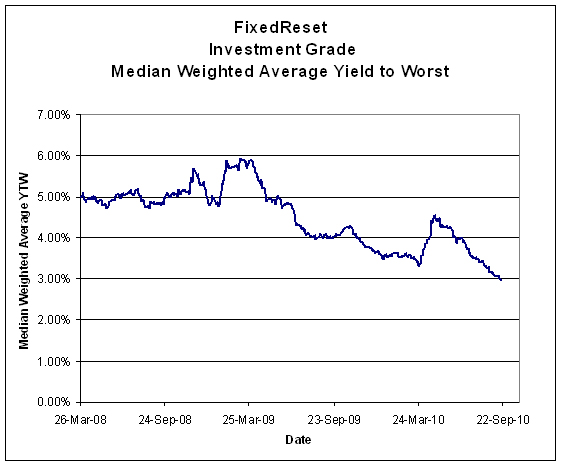
FixedReset Index YTW Now Through 3.00%

It seems like only yesterday that I was excited that the FixedReset Index YTW had hit an all-time low of 3.26% … but no, that happened on August 19. It only took another month to hop over the next milestone, as the median weighted average Yield-to-Worst of the FixedReset index is now firmly below 3.00%.


Click for Big

To celebrate, I am publishing the FixedReset index constituent list, sorted three ways:

Short corporates now yield about 2.7%, so one can certainly make a case for the idea that a yield below 3.0% for FixedResets is fair and reasonable – that allows 150bp for extension and credit risk on a pre-tax interest-equivalent basis – but I don’t think the market thinks like that and I think the market will receive a rude shock when the issuers start calling these things.

I was interviewed today by a reporter for a major Canadian newspaper and talked about what I liked for 15 minutes … then told her ‘wait a minute, you have to put something about FixedResets in this article or you’ll get about 100 eMails following publication, because a lot of people love these things.’ Not to worry – apparently the other experts she interviewed for the piece strongly recommended FixedResets. Hopefully, I’ll get a look at the article later this week.

How about that PWF.PR.P, eh? It’s a 4.40%+160 FixedReset issued in June …. now trading at 26.23-34, but given a 5-Year GOC yield of 2.11%, it’s not expected to be called 2016-1-31.

Market Action

September 20, 2010

Stub quotes will be butted out:

NYSE Euronext, Nasdaq OMX Group Inc. and Bats Global Markets sought permission from regulators yesterday to eliminate stub quotes, or bids and offers as low as pennies or as high as thousands of dollars provided by market makers that were blamed for worsening the May 6 crash.

Stub quotes are placeholders provided by market makers at prices as low as 1 cent to satisfy a regulatory obligation to submit both bids and offers. Transactions aren’t meant to occur at those levels.

I don’t understand why stub quotes were ever allowed in the first place. As some HFT firms have pointed out:

In exchange for meeting stricter obligations, market makers are generally given advantages over other market participants, which act like subsidies,” RGM, Hudson River, Allston and Quantlab said in their letter. “These advantages have typically involved preferential access to the markets, lower fees and informational advantages. These advantages come at a substantial cost for all investors as they degrade competition and raise barriers to entry for new participants.”

Why market makers would be permitted to pay for these presumably valuable privileges with stub quotes is quite beyond me.

The pointless nature of financial journalism was well illustrated by two stories published back to back. The first was Fed Will Retain Policy on Assets, Low-Rate Pledge, Survey Shows:

The Federal Reserve next week is likely to affirm its pledge to keep interest rates low for an “extended period” and maintain the floor on its holdings of securities, say economists surveyed by Bloomberg News.

The Fed’s Open Market Committee at its Sept. 21 meeting will hold off from expanding the balance sheet by purchasing securities, according to 60 of 64 analysts surveyed Sept. 16-17. Fifty-four of 63 economists said the Fed will leave unchanged a sentence saying high unemployment and low inflation warrant “exceptionally low” rates for an “extended period.”

… and the second was Treasury Notes Gain on Bets Fed’s Statement Will Signal More Accommodation:

Treasury 10-year notes rose for the first time in four weeks as traders speculated the Federal Reserve will be more accommodative in its policy statement next week as the economic recovery showed signs of stalling.

A rally in two-year notes pushed yields down this week the most since May after the central bank bought shorter-maturity government debt and as investors bet that Japan’s purchases of securities will favor the front end of the U.S. yield curve after it sold the yen to weaken its currency. Notes climbed before the Sept. 21 Fed meeting as the annual rate of inflation excluding food and energy stayed at a 44-year low.

There’s a negative CDS basis in bank bonds:

Gaps between credit-default swaps and bonds have widened to 25 basis points from less than 2 basis points about three months ago, according to Citigroup Inc. Pimco, the manager of the world’s largest bond fund is finding as much as 1 percent of extra yield even after paying to insure bank debt, said Mark Kiesel, a managing director at the Newport Beach, California- based firm.

A rally that started in June may gain momentum as the divergence between swaps and yields gives investors extra incentive to own corporate debt. The increase in the so-called negative basis is attracting buyers that seek to profit by buying the debt while also purchasing credit swaps.

The 100-basis-point gaps Pimco is identifying in bank bonds and 25 basis points in the broader market compare with the average difference of more than 250 basis points after the bankruptcy of Lehman Brothers Holdings Inc. two years ago, just before bonds posted a record rally. The all-time wide gaps emerged as credit markets seized up, causing bond spreads to soar while demand for swap protection failed to keep up.

“When capital is scarce, the basis becomes more negative,” said Alberto Gallo, a New York-based strategist at Goldman Sachs Group Inc. He said the basis should narrow as monetary policy and regulation reduce risk in the financial system and stabilize funding costs.

Negative-basis CDS spreads were discussed in Canadian Bond Liquidity Premia

I have sent the following communication to Canada Post and True North Public Affairs, where James Roche, Chairman of the Canada Post Foundation for Mental Health, has his day-job:

Sirs,

One of your clerks advised me that you were “collecting for mental health” today while I was purchasing stamps and requested a donation.

I strongly object to being importuned by beggars while going about my business and wish to advise you that I will have my first class mail serviced by your competitors in future.

I have often observed that precious little do-gooders tend to behave as thugs and therefore have a question: do you make it clear to your front-line staff that participation in this disgraceful exhibition of poor manners is entirely voluntary and there will be no repercussions on those who do not wish to humiliate themselves by begging? Or are they forced to participate as a condition of employment?

Sincerely,

Beggars! It’s enough to make a strong man go postal!

Hellzapoppin’ on the Canadian preferred share market today, with PerpetualDiscounts up 55bp and FixedResets gaining 12bp on heavy volume.

HIMIPref™ Preferred Indices
These values reflect the December 2008 revision of the HIMIPref™ Indices

Values are provisional and are finalized monthly
Index Mean
Current
Yield
(at bid)
Median
YTW
Median
Average
Trading
Value
Median
Mod Dur
(YTW)
Issues Day’s Perf. Index Value
Ratchet 0.00 % 0.00 % 0 0.00 0 0.6278 % 2,108.1
FixedFloater 0.00 % 0.00 % 0 0.00 0 0.6278 % 3,193.5
Floater 2.89 % 3.33 % 74,914 18.92 3 0.6278 % 2,276.2
OpRet 4.87 % -0.20 % 85,589 0.19 9 -0.4130 % 2,379.4
SplitShare 5.87 % -27.57 % 63,073 0.09 2 -0.0809 % 2,398.6
Interest-Bearing 0.00 % 0.00 % 0 0.00 0 -0.4130 % 2,175.8
Perpetual-Premium 5.68 % 5.29 % 137,820 5.35 14 0.1649 % 1,992.1
Perpetual-Discount 5.51 % 5.60 % 194,338 14.47 63 0.5511 % 1,974.1
FixedReset 5.22 % 2.96 % 294,601 3.30 47 0.1158 % 2,276.4
Performance Highlights
Issue Index Change Notes
BAM.PR.I OpRet -4.15 % YTW SCENARIO
Maturity Type : Call
Maturity Date : 2010-10-20
Maturity Price : 25.50
Evaluated at bid price : 25.86
Bid-YTW : -13.04 %
BNS.PR.K Perpetual-Discount 1.01 % YTW SCENARIO
Maturity Type : Limit Maturity
Maturity Date : 2040-09-20
Maturity Price : 22.86
Evaluated at bid price : 23.08
Bid-YTW : 5.27 %
BAM.PR.K Floater 1.04 % YTW SCENARIO
Maturity Type : Limit Maturity
Maturity Date : 2040-09-20
Maturity Price : 15.52
Evaluated at bid price : 15.52
Bid-YTW : 3.38 %
PWF.PR.K Perpetual-Discount 1.04 % YTW SCENARIO
Maturity Type : Limit Maturity
Maturity Date : 2040-09-20
Maturity Price : 22.15
Evaluated at bid price : 22.30
Bid-YTW : 5.63 %
RY.PR.D Perpetual-Discount 1.07 % YTW SCENARIO
Maturity Type : Limit Maturity
Maturity Date : 2040-09-20
Maturity Price : 21.49
Evaluated at bid price : 21.81
Bid-YTW : 5.19 %
CU.PR.B Perpetual-Premium 1.10 % YTW SCENARIO
Maturity Type : Call
Maturity Date : 2010-10-20
Maturity Price : 25.50
Evaluated at bid price : 25.69
Bid-YTW : 0.53 %
PWF.PR.F Perpetual-Discount 1.13 % YTW SCENARIO
Maturity Type : Limit Maturity
Maturity Date : 2040-09-20
Maturity Price : 23.01
Evaluated at bid price : 23.29
Bid-YTW : 5.71 %
BMO.PR.J Perpetual-Discount 1.13 % YTW SCENARIO
Maturity Type : Limit Maturity
Maturity Date : 2040-09-20
Maturity Price : 22.17
Evaluated at bid price : 22.30
Bid-YTW : 5.09 %
PWF.PR.L Perpetual-Discount 1.15 % YTW SCENARIO
Maturity Type : Limit Maturity
Maturity Date : 2040-09-20
Maturity Price : 22.72
Evaluated at bid price : 22.90
Bid-YTW : 5.65 %
POW.PR.C Perpetual-Discount 1.16 % YTW SCENARIO
Maturity Type : Call
Maturity Date : 2012-01-05
Maturity Price : 25.00
Evaluated at bid price : 25.35
Bid-YTW : 5.56 %
BAM.PR.B Floater 1.16 % YTW SCENARIO
Maturity Type : Limit Maturity
Maturity Date : 2040-09-20
Maturity Price : 15.73
Evaluated at bid price : 15.73
Bid-YTW : 3.33 %
GWO.PR.H Perpetual-Discount 1.16 % YTW SCENARIO
Maturity Type : Limit Maturity
Maturity Date : 2040-09-20
Maturity Price : 21.75
Evaluated at bid price : 21.75
Bid-YTW : 5.60 %
BNS.PR.M Perpetual-Discount 1.19 % YTW SCENARIO
Maturity Type : Limit Maturity
Maturity Date : 2040-09-20
Maturity Price : 21.95
Evaluated at bid price : 22.06
Bid-YTW : 5.17 %
BNS.PR.L Perpetual-Discount 1.29 % YTW SCENARIO
Maturity Type : Limit Maturity
Maturity Date : 2040-09-20
Maturity Price : 21.95
Evaluated at bid price : 22.06
Bid-YTW : 5.17 %
HSB.PR.D Perpetual-Discount 1.29 % YTW SCENARIO
Maturity Type : Limit Maturity
Maturity Date : 2040-09-20
Maturity Price : 23.32
Evaluated at bid price : 23.55
Bid-YTW : 5.32 %
MFC.PR.C Perpetual-Discount 1.30 % YTW SCENARIO
Maturity Type : Limit Maturity
Maturity Date : 2040-09-20
Maturity Price : 19.41
Evaluated at bid price : 19.41
Bid-YTW : 5.84 %
HSB.PR.C Perpetual-Discount 1.63 % YTW SCENARIO
Maturity Type : Limit Maturity
Maturity Date : 2040-09-20
Maturity Price : 23.45
Evaluated at bid price : 23.70
Bid-YTW : 5.39 %
RY.PR.A Perpetual-Discount 1.92 % YTW SCENARIO
Maturity Type : Limit Maturity
Maturity Date : 2040-09-20
Maturity Price : 22.11
Evaluated at bid price : 22.25
Bid-YTW : 5.05 %
POW.PR.D Perpetual-Discount 2.05 % YTW SCENARIO
Maturity Type : Limit Maturity
Maturity Date : 2040-09-20
Maturity Price : 22.66
Evaluated at bid price : 22.85
Bid-YTW : 5.57 %
Volume Highlights
Issue Index Shares
Traded
Notes
BNS.PR.Q FixedReset 212,890 TD crossed 65,000 at 26.70; RBC crossed two blocks of 64,800 each, both at 26.65.
YTW SCENARIO
Maturity Type : Call
Maturity Date : 2013-11-24
Maturity Price : 25.00
Evaluated at bid price : 26.65
Bid-YTW : 2.98 %
CM.PR.G Perpetual-Discount 78,219 RBC bought 12,600 from Scotia at 24.64; TD crossed 29,200 at 24.61. Desjardins bought 12,000 from Scotia at 24.63.
YTW SCENARIO
Maturity Type : Limit Maturity
Maturity Date : 2040-09-20
Maturity Price : 24.34
Evaluated at bid price : 24.62
Bid-YTW : 5.56 %
MFC.PR.B Perpetual-Discount 69,698 RBC sold 11,100 to anonymous at 19.98; ITG Canada (who?) crossed 13,500 at 20.08.
YTW SCENARIO
Maturity Type : Limit Maturity
Maturity Date : 2040-09-20
Maturity Price : 20.00
Evaluated at bid price : 20.00
Bid-YTW : 5.86 %
RY.PR.I FixedReset 59,500 TD crossed 50,000 at 26.73.
YTW SCENARIO
Maturity Type : Call
Maturity Date : 2014-03-26
Maturity Price : 25.00
Evaluated at bid price : 26.70
Bid-YTW : 3.00 %
RY.PR.A Perpetual-Discount 55,145 Scotia crossed 14,000 at 21.81.
YTW SCENARIO
Maturity Type : Limit Maturity
Maturity Date : 2040-09-20
Maturity Price : 22.11
Evaluated at bid price : 22.25
Bid-YTW : 5.05 %
SLF.PR.F FixedReset 51,400 Nesbitt crossed 49,900 at 27.65.
YTW SCENARIO
Maturity Type : Call
Maturity Date : 2014-07-30
Maturity Price : 25.00
Evaluated at bid price : 27.60
Bid-YTW : 3.09 %
There were 68 other index-included issues trading in excess of 10,000 shares.
Issue Comments

FIG.PR.A Holders Approve Merger; Now up To FIG.UN

Faircourt Asset Management has announced:

The adjourned special meetings of preferred securityholders of Faircourt Income & Growth Split Trust (“FIG”) and Faircourt Split Trust (“FCS”), which were originally held on September 13, 2010 but were adjourned for lack of quorum, were held today at which the preferred securityholders of FIG approved the merger of FIG into FCS (the “Merger”) and the exchange of preferred securities of FIG for a new class of preferred securities of FCS (the “Exchange”), and the preferred securityholders of FCS approved various amendments to the FCS declaration of trust and FCS trust indenture (the “FCS Proposals”), as described in the joint management information circular dated August 13, 2010 (the “Circular”). The Merger Proposal remains subject to approval by the unitholders of FIG.

The Merger and FCS Proposals are a response to expected changes in the taxation of income funds. As a result of these changes, there are now an insufficient number of “income funds” for FIG and FCS to continue to meet its investment restrictions. Consequently, upon implementation of the FCS Proposals, the investment mandate of FCS, as the continuing trust, will be expanded to remedy this situation and FCS will be able to invest in a broader range of securities and adjust its portfolio in the future as and when required to respond to market movements.

The Merger will also be considered by unitholders of FIG the funds at the adjourned special meeting of such unitholders to be held on September 27, 2010, and implementation of the Merger and the FCS Proposals are conditional on the approval of the unitholders of FIG at such meeting, all as described in the Circular.

FIG.PR.A was last mentioned on PrefBlog when the first attempt to approve the merger did not get quorum. FIG.PR.A is tracked by HIMIPref™ but is relegated to the Scraps Index on credit concerns.

Issue Comments

NEW.PR.C To Get Bigger

NewGrowth Corp. has announced:

that the Company has issued one warrant for each Capital Share held by holders of Capital Shares of the Company of record as at the close of business on September 17, 2010.

Each warrant will entitle the holder to purchase one Unit, each Unit consisting of one Capital Share and one Preferred Share, for a subscription price of $41.57 per Unit. Commencing September 20, 2010, warrants may be exercised at any time on or before 5:00 p.m. (Toronto time) on March 31, 2011. The warrants are listed on the Toronto Stock Exchange under the ticker symbol NEW.WT.

Holders of the Preferred Shares are entitled to receive quarterly fixed cumulative dividends equal to $0.2055 per Preferred Share. The Company’s Capital Share dividend policy is to pay holders of Capital Shares quarterly dividends in an amount equal to the revenue received by the Company on the underlying portfolio securities minus the dividends payable on the Preferred Shares and all administrative and operating expenses provided the net asset value per Unit at the time of declaration, after giving effect to the dividend, would be greater than the original issue price of the Preferred Shares.

NewGrowth Corp. is a mutual fund corporation whose investment portfolio consists of publicly-listed securities of selected Canadian chartered banks, telecommunication, pipeline and utility issuers. The Capital Shares and Preferred Shares of NewGrowth Corp. are both listed for trading on The Toronto Stock Exchange under the symbols NEW.A and NEW.PR.C respectively.

The warrants will be outstanding for more than six months!

NEW.PR.C was last mentioned on PrefBlog when it started trading 2009-6-26. There are only 2.2-million of the $13.70 preferreds outstanding, so the issue won’t be tracked by HIMIPref™ any time soon.

Issue Comments

DBRS Discontinues ELF Rating

DBRS has announced that it:

has today announced that it will discontinue its public rating on the First Preference Shares, Series 1 of E-L Financial Corporation Limited (E-L) on October 20, 2010 (30 days from today).

DBRS notes that this action is unrelated to E-L’s credit profile.

ELF has two issues of preferreds outstanding, both PerpetualDiscounts: ELF.PR.F & ELF.PR.G. The issues have been rated Pfd-2(low) by DBRS for a long time, contrasted with S&P’s ratings of P-2(high)/BBB+.

I don’t see any other news – and remember, ELF is probably the largest public company in Canada, if not North America, that doesn’t have a website – so it’s hard to guess what this might mean. It could be a signal that a new issue is on its way and ELF didn’t feel like cutting more cheques to DBRS.