Market Action

May 14, 2010

Econbrowser‘s James Hamilton writes a good piece on Greece:

I suspect that the key fear has to do with the consequences of a default or restructuring of the debt itself. Willem Buiter estimates that French and German banks have &#8364 110 billion exposure to Greek debt, and total exposure to a potential domino effect could be huge. The WSJ today has further breakdowns, and Dow Jones reports that JP Morgan’s holdings of non-U.S. government bonds increased by $36.5 billion in 2009, while Citigroup’s increased by almost $40 B.

And, as was the case in the 2008 difficulties, one can either view this primarily as a liquidity problem, for which we simply need the central banks to step in boldly to arrest the jitters, or as a solvency problem, in which case the policy decision is how to allocate the unavoidable capital losses among bank owners, bank creditors, and the government so as to minimize collateral damage to innocent bystanders. The fundamentals facing Greece suggest there is an overwhelming solvency component to the current problems. And the policy response so far seems to be choosing to allocate 100% of losses to the European and U.S. taxpayers.

Chatter about the potential disintegration of the Euro is starting to be heard from respected sources:

“You have the great problem of a potential disintegration of the euro,” former Federal Reserve Chairman Paul Volcker, 82, said yesterday in London. “The essential element of discipline in economic policy and in fiscal policy that was hoped for” has “so far not been rewarded in some countries.”

That story, by the way, leads off with an anecdote about dairy products:

Romano Prodi recalls how he persuaded Germany to allow debt-swamped Italy into the euro: support our membership and we’ll buy your milk, he said.

When Prodi toured Germany’s agricultural heartland after becoming Italian leader in 1996, he pitched “a big milk pipeline from Bavaria,” pointing to a three-year, 40 percent plunge in the Italian lira that was hurting dairy sales.

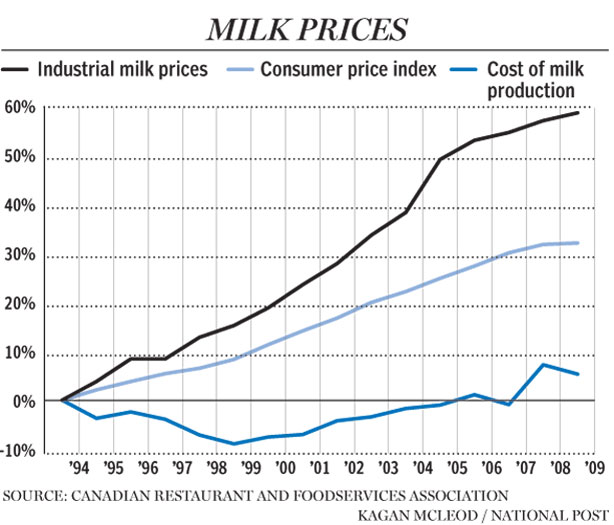
See? That’s the source of the problem! Here in smug Canada, we know how to do it properly … charge single mums and their kids extortionate prices for dairy products, so quota owners may continue to enjoy a bucolic lifestyle.


Click for Big

OSFI’s Mark White gave a speech reviewing the P&C industry.

A little more detail has emerged regarding the futures sale suspected to be the proximate cause of last week’s bungee jump.

Comrade Peace Prize’s administration has made it clear that it regards Swap pricing to be a public utility and that the role of government is to ensure that incompetent portfolio managers may continue to earn a good living:

Removing the Derivatives Trading Requirement to Protect Wall Street Profits. Under the current bill, standard derivatives would have to be traded on exchanges or other electronic trading platforms. Expect amendments to eliminate this trading requirement. Why? Because not everyone likes transparency. Today, the big derivatives dealers make big profits by charging end-users extra spreads and hidden fees, and they don’t want that to change.

This administration has learned nothing from TRACE. As soon as you get transparency, liquidity disappears. An ultimately, you will create more bungee jumps. On a positive note, however, it appears that regulatory capture is becoming an issue, albeit in a different field:

Obama said the federal government also shares some of the blame [for the Gulf of Mexico underwater oil blowout]. He faulted the Minerals Management Service for having too close a relationship with the industry it regulates. BP got an exclusion from a National Environmental Policy Act review by the agency for its damaged well in the Gulf.

“It seems as if permits were too often issued based on little more than assurances of safety from the oil companies,” Obama said. “That cannot and will not happen anymore.”

He ordered Interior Secretary Ken Salazar to “conduct a top-to-bottom reform” of the agency, including a review of its procedures for assessing the environmental impact of an offshore drilling plans.

Salazar said in a statement that will be “an important part of the ongoing comprehensive and thorough investigation of this incident.”

Obama previously announced plans to split the service’s responsibilities, which now include both enforcing rig safety rules and joining with companies such as BP and Exxon Mobil Corp. to develop oil and gas reserves while collecting royalties.

Volume on the Canadian preferred share market was way down today, reaching normal levels, as PerpetualDiscounts gained 4bp and FixedResets lost 8bp.

HIMIPref™ Preferred Indices
These values reflect the December 2008 revision of the HIMIPref™ Indices

Values are provisional and are finalized monthly
Index Mean
Current
Yield
(at bid)
Median
YTW
Median
Average
Trading
Value
Median
Mod Dur
(YTW)
Issues Day’s Perf. Index Value
Ratchet 2.62 % 2.77 % 42,832 20.86 1 0.0000 % 2,112.6
FixedFloater 5.13 % 3.19 % 40,557 20.11 1 -0.1413 % 3,120.2
Floater 2.14 % 2.46 % 105,392 21.13 3 -1.2710 % 2,267.6
OpRet 4.91 % 4.15 % 94,607 1.76 11 -0.1349 % 2,300.6
SplitShare 6.41 % 6.40 % 120,294 3.53 2 0.4661 % 2,130.0
Interest-Bearing 0.00 % 0.00 % 0 0.00 0 -0.1349 % 2,103.7
Perpetual-Premium 5.53 % 4.77 % 24,187 15.82 1 0.0000 % 1,824.2
Perpetual-Discount 6.31 % 6.38 % 212,539 13.36 77 0.0360 % 1,692.5
FixedReset 5.51 % 4.27 % 513,929 3.58 44 -0.0775 % 2,147.6
Performance Highlights
Issue Index Change Notes
BAM.PR.K Floater -2.42 % YTW SCENARIO
Maturity Type : Limit Maturity
Maturity Date : 2040-05-14
Maturity Price : 16.10
Evaluated at bid price : 16.10
Bid-YTW : 2.46 %
MFC.PR.E FixedReset -2.13 % YTW SCENARIO
Maturity Type : Call
Maturity Date : 2014-10-19
Maturity Price : 25.00
Evaluated at bid price : 25.70
Bid-YTW : 5.15 %
BAM.PR.B Floater -1.66 % YTW SCENARIO
Maturity Type : Limit Maturity
Maturity Date : 2040-05-14
Maturity Price : 16.04
Evaluated at bid price : 16.04
Bid-YTW : 2.47 %
MFC.PR.D FixedReset -1.43 % YTW SCENARIO
Maturity Type : Call
Maturity Date : 2014-07-19
Maturity Price : 25.00
Evaluated at bid price : 26.80
Bid-YTW : 5.01 %
ELF.PR.F Perpetual-Discount -1.33 % YTW SCENARIO
Maturity Type : Limit Maturity
Maturity Date : 2040-05-14
Maturity Price : 18.50
Evaluated at bid price : 18.50
Bid-YTW : 7.27 %
MFC.PR.A OpRet -1.02 % YTW SCENARIO
Maturity Type : Soft Maturity
Maturity Date : 2015-12-18
Maturity Price : 25.00
Evaluated at bid price : 25.24
Bid-YTW : 4.05 %
PWF.PR.K Perpetual-Discount 1.06 % YTW SCENARIO
Maturity Type : Limit Maturity
Maturity Date : 2040-05-14
Maturity Price : 19.00
Evaluated at bid price : 19.00
Bid-YTW : 6.59 %
Volume Highlights
Issue Index Shares
Traded
Notes
SLF.PR.D Perpetual-Discount 58,915 RBC crossed blocks of 17,000 and 15,000, both at 17.35.
YTW SCENARIO
Maturity Type : Limit Maturity
Maturity Date : 2040-05-14
Maturity Price : 17.33
Evaluated at bid price : 17.33
Bid-YTW : 6.53 %
BNS.PR.Y FixedReset 39,150 Desjardins crossed 24,000 at 24.16.
YTW SCENARIO
Maturity Type : Limit Maturity
Maturity Date : 2040-05-14
Maturity Price : 23.96
Evaluated at bid price : 24.00
Bid-YTW : 3.83 %
BNS.PR.K Perpetual-Discount 19,480 YTW SCENARIO
Maturity Type : Limit Maturity
Maturity Date : 2040-05-14
Maturity Price : 19.61
Evaluated at bid price : 19.61
Bid-YTW : 6.19 %
BAM.PR.B Floater 19,345 YTW SCENARIO
Maturity Type : Limit Maturity
Maturity Date : 2040-05-14
Maturity Price : 16.04
Evaluated at bid price : 16.04
Bid-YTW : 2.47 %
TRP.PR.A FixedReset 18,646 YTW SCENARIO
Maturity Type : Call
Maturity Date : 2015-01-30
Maturity Price : 25.00
Evaluated at bid price : 25.31
Bid-YTW : 4.45 %
TRP.PR.B FixedReset 18,495 YTW SCENARIO
Maturity Type : Limit Maturity
Maturity Date : 2040-05-14
Maturity Price : 24.58
Evaluated at bid price : 24.63
Bid-YTW : 4.01 %
There were 27 other index-included issues trading in excess of 10,000 shares.
Issue Comments

SBC.PR.A to Get Bigger

Brompton Split Banc Corp. has announced:

that it has filed a preliminary prospectus relating to an offering of warrants to Class A shareholders of the Company. Each Class A shareholder will receive one half warrant for each Class A share held on a record date which will be set upon filing of the final prospectus.

One warrant will entitle the holder to purchase a Unit (consisting of one Class A share and one Preferred share of the Company) upon payment of the subscription price, which will be determined as the lesser of: (i) $22.36 (which is the sum of (a) the most recently calculated NAV per Unit prior to the date hereof and (b) the estimated per Unit fees and expenses of the offering), and (ii) the most recently calculated NAV per Unit prior to the date of filing the final prospectus plus the estimated per Unit fees and expenses of the offering. The Company has applied to list the warrants and the Class A shares and Preferred shares issuable on the exercise thereof on the TSX.

Successful completion of the warrants offering will provide the Company with additional capital that can be used to take advantage of attractive investment opportunities and it is also expected to increase the trading liquidity of the Class A shares and Preferred shares and reduce the ongoing management expense ratio of the Company.

A 50% increase in size – if the offering is fully subscribed – will be a welcome addition to the $53-million-odd outstanding at year end according to the fund’s 2009 Annual Report.

SBC.PR.A was last mentioned on PrefBlog when I reported the April 2009 reinstatement of the Capital Units dividend. SBC.PR.A is tracked by HIMIPref™, but is relegated to the Scraps index on credit concerns.

Issue Comments

LBS.PR.A to Get Bigger

Life & Banc Split Corp. has announced:

that it has filed a preliminary prospectus relating to an offering of warrants to Class A shareholders of the Company. Each Class A shareholder will receive one half warrant for each Class A share held on a record date which will be set upon filing of the final prospectus.

One warrant will entitle the holder to purchase a Unit (consisting of one Class A share and one Preferred share of the Company) upon payment of the subscription price, which will be determined as the lesser of: (i) $19.31 (which is the sum of (a) the most recently calculated NAV per Unit prior to the date hereof and (b) the estimated per Unit fees and expenses of the offering), and (ii) the most recently calculated NAV per Unit prior to the date of filing the final prospectus plus the estimated per Unit fees and expenses of the offering. The Company has applied to list the warrants and the Class A shares and Preferred shares issuable on the exercise thereof on the TSX.

Successful completion of the warrants offering will provide the Company with additional capital that can be used to take advantage of attractive investment opportunities and it is also expected to increase the trading liquidity of the Class A shares and Preferred shares and reduce the ongoing management expense ratio of the Company.

If fully subscribed, the 50% increase in issue size will be a very welcome addition to the $100-million-odd reported in the 2009 Annual Report.

LBS.PR.A was last mentioned on PrefBlog when it was downgraded to Pfd-3 by DBRS. LBS.PR.A is tracked by HIMIPref™, but is relegated to the Scraps index on credit concerns.

New Issues

New Issue: SLF FixedReset 4.35%+141

Sun Life Financial has announced:

a Canadian public offering of $250 million of Class A Non-Cumulative Rate Reset Preferred Shares Series 8R (the “Series 8R Shares”). The Series 8R Shares will be issued to the public at a price of $25.00 per share and holders will be entitled to receive non-cumulative preferential fixed quarterly dividends for the initial period ending June 30, 2015, as and when declared by the Company’s board of directors, payable in the amount of $0.271875 per Preferred Share, to yield 4.35 per cent annually.

On June 30, 2015, and every five years thereafter, the dividend rate will reset at a rate equal to the 5-Year Government of Canada bond yield plus 1.41 per cent. Subject to certain conditions, holders may elect to convert any or all of their Series 8R Shares into an equal number of Class A Non-Cumulative Floating Rate Preferred Shares Series 9QR (the “Series 9QR Shares”) on June 30, 2015 and on the 30th of June every fifth year thereafter. Holders of the Series 9QR Shares will be entitled to receive non-cumulative preferential floating rate quarterly dividends, as and when declared by the Company’s board of directors, equal to the then 3-month Government of Canada Treasury Bill yield plus 1.41 per cent.

The net proceeds of the offering will be used for general corporate purposes. The offering will be underwritten by a syndicate led by Scotia Capital Inc., RBC Dominion Securities Inc. and TD Securities Inc. on a bought deal basis, and is expected to close on May 25, 2010. The proceeds from this domestic public offering are expected to qualify as Tier 1 capital of Sun Life Financial Inc. under current capital adequacy guidelines established by the Office of the Superintendent of Financial Institutions (OSFI).

The underwriters have been granted an option to purchase up to an additional $50 million of the Series 8R Shares exercisable at any time up to two business days before closing. The maximum gross proceeds raised under the offering will be $300 million if this option is exercised in full.

Subject to regulatory approval, Sun Life Financial Inc. may redeem the Series 8R Shares in whole or in part on June 30, 2015 and on the 30th of June every five years thereafter.

An application is being made to list the Series 8R Shares as of the closing date on the Toronto Stock Exchange.

This strikes me as being an extremely expensive issue. SLF PerpetualDiscounts (there are five of them, A-E) are tightly clustered in yield at about 6.50%, meaning that the spread for the FixedReset is -235bp. Plugging these numbers into the Breakeven Rate Shock Calculator (which I have discussed in a free publication and at greater length in a 2009 issue of PrefLetter), we find that the Break-Even Rate Shock is enormous, at 384bp. The last new FixedReset issue (BNS 3.85%+100, was comparatively cheap, with a shock of only (!) 318bp.

Nor has it escaped my notice that SLF.PR.F (which commenced trading about a year ago), at 6.00%+379 yields 4.40% to its expected call date and is much more likely to be called.

Market Action

May 13, 2010

Credit ratings may be politicized:

The Senate in a 64-35 vote today approved an amendment to the financial overhaul legislation that would create a ratings board overseen by the Securities and Exchange Commission. The panel would assign a credit-rating company to rank an offering.

Under Franken’s amendment, the SEC would determine the size of the board. The majority of members would be investors, at least one member would be from a credit-rating company and at least one member would be from an investment bank.

The board would conduct an annual assessment of each credit-rating company to scrutinize the firm’s accuracy in grading debt compared with competitors, according to the amendment. While credit-rating companies would set fees, the SEC would have authority to make sure payments are “reasonable.”

For the proposal to form a credit-rating board to become binding, lawmakers would have to approve the broader financial reform measure and President Barack Obama would have to sign the legislation.

Not quite as bad as the EU’s plan to create a government-run agency that won’t be so mean to poor old Greece, but close!

The Canadian preferred share market was quieter today, with PerpetualDiscounts gaining 4bp and FixedResets losing 1bp. Volume was down to levels only slightly above normal – whatever normal means! – but the day was enlivened by the announcement of a Sun Life Financial FixedReset, 4.35%+141, to settle May 25.

HIMIPref™ Preferred Indices
These values reflect the December 2008 revision of the HIMIPref™ Indices

Values are provisional and are finalized monthly
Index Mean
Current
Yield
(at bid)
Median
YTW
Median
Average
Trading
Value
Median
Mod Dur
(YTW)
Issues Day’s Perf. Index Value
Ratchet 2.62 % 2.77 % 44,471 20.87 1 0.0000 % 2,112.6
FixedFloater 5.12 % 3.18 % 40,563 20.12 1 -0.5621 % 3,124.6
Floater 2.11 % 2.40 % 102,084 21.30 3 -0.3568 % 2,296.8
OpRet 4.90 % 3.85 % 90,744 1.76 11 0.3170 % 2,303.7
SplitShare 6.44 % 6.44 % 124,665 3.53 2 0.3341 % 2,120.1
Interest-Bearing 0.00 % 0.00 % 0 0.00 0 0.3170 % 2,106.6
Perpetual-Premium 5.53 % 4.77 % 24,342 15.82 1 0.0000 % 1,824.2
Perpetual-Discount 6.32 % 6.39 % 213,425 13.34 77 0.0370 % 1,691.9
FixedReset 5.51 % 4.30 % 516,152 3.58 44 -0.0112 % 2,149.2
Performance Highlights
Issue Index Change Notes
HSB.PR.C Perpetual-Discount -1.71 % YTW SCENARIO
Maturity Type : Limit Maturity
Maturity Date : 2040-05-13
Maturity Price : 19.51
Evaluated at bid price : 19.51
Bid-YTW : 6.65 %
PWF.PR.O Perpetual-Discount -1.10 % YTW SCENARIO
Maturity Type : Limit Maturity
Maturity Date : 2040-05-13
Maturity Price : 22.39
Evaluated at bid price : 22.50
Bid-YTW : 6.51 %
ENB.PR.A Perpetual-Discount -1.08 % YTW SCENARIO
Maturity Type : Limit Maturity
Maturity Date : 2040-05-13
Maturity Price : 23.49
Evaluated at bid price : 23.76
Bid-YTW : 5.79 %
HSB.PR.D Perpetual-Discount -1.03 % YTW SCENARIO
Maturity Type : Limit Maturity
Maturity Date : 2040-05-13
Maturity Price : 19.30
Evaluated at bid price : 19.30
Bid-YTW : 6.59 %
TD.PR.M OpRet 1.09 % YTW SCENARIO
Maturity Type : Call
Maturity Date : 2010-06-12
Maturity Price : 25.75
Evaluated at bid price : 25.88
Bid-YTW : 0.39 %
ELF.PR.F Perpetual-Discount 1.19 % YTW SCENARIO
Maturity Type : Limit Maturity
Maturity Date : 2040-05-13
Maturity Price : 18.75
Evaluated at bid price : 18.75
Bid-YTW : 7.17 %
CIU.PR.A Perpetual-Discount 2.18 % YTW SCENARIO
Maturity Type : Limit Maturity
Maturity Date : 2040-05-13
Maturity Price : 18.75
Evaluated at bid price : 18.75
Bid-YTW : 6.16 %
Volume Highlights
Issue Index Shares
Traded
Notes
PWF.PR.M FixedReset 140,000 RBC crossed blocks of 25,000 shares, 24,500 and 50,000, all at 26.50. Nesbitt crossed 25,000 at the same price and bought 10,000 from National at 26.45.
YTW SCENARIO
Maturity Type : Call
Maturity Date : 2014-03-02
Maturity Price : 25.00
Evaluated at bid price : 26.50
Bid-YTW : 4.36 %
TRP.PR.B FixedReset 119,175 RBC crossed blocks of 25,000 shares, 40,000 and another 25,000, all at 24.65. RBC bought 13,000 from TD at the same price.
YTW SCENARIO
Maturity Type : Limit Maturity
Maturity Date : 2040-05-13
Maturity Price : 24.71
Evaluated at bid price : 24.76
Bid-YTW : 4.09 %
PWF.PR.K Perpetual-Discount 42,070 Desjardins sold 36,000 to anonymous at 19.10.
YTW SCENARIO
Maturity Type : Limit Maturity
Maturity Date : 2040-05-13
Maturity Price : 18.80
Evaluated at bid price : 18.80
Bid-YTW : 6.66 %
BNS.PR.Y FixedReset 41,280 YTW SCENARIO
Maturity Type : Limit Maturity
Maturity Date : 2040-05-13
Maturity Price : 24.01
Evaluated at bid price : 24.05
Bid-YTW : 3.93 %
BNS.PR.R FixedReset 34,345 National crossed 25,000 at 25.49.
YTW SCENARIO
Maturity Type : Call
Maturity Date : 2014-02-25
Maturity Price : 25.00
Evaluated at bid price : 25.50
Bid-YTW : 4.48 %
CM.PR.H Perpetual-Discount 33,043 YTW SCENARIO
Maturity Type : Limit Maturity
Maturity Date : 2040-05-13
Maturity Price : 18.85
Evaluated at bid price : 18.85
Bid-YTW : 6.43 %
There were 34 other index-included issues trading in excess of 10,000 shares.
Issue Comments

BXN.PR.B to be Redeemed

B Split II Corp. has announced:

The Capital Shares and Preferred Shares will be redeemed by the Company on June 1, 2010 (the “Redemption Date”) in accordance with the redemption provisions as detailed in the prospectus dated May 25, 2005. Pursuant to these provisions, the Preferred Shares will be redeemed at a price per share equal to the lesser of $9.75 and the net asset value per Unit. The Capital Shares will be redeemed at a price per share equal to the amount by which the net asset value per Unit exceeds $9.75. The net asset value per Unit was $21.30 as at May 12, 2010.

Holders of Capital Shares who requested to receive their redemption payment in BCE Inc. common shares (“BCE Shares”) and gave notice to this effect and tendered $9.75 for every Capital Share by May 3, 2010 will receive their pro rata share of the BCE Shares. The redemption of Capital Shares and Preferred Shares will constitute a taxable disposition of the Company’s shares at the time of the redemption whether the payment is received in the form of cash or BCE Shares.

A further press release will be issued by the Company in connection with the redemption prices on May 27, 2010. Payment of the amounts due to holders of Capital Shares and Preferred Shares will be made by the Company on June 1, 2010.

BXN.PR.B was last mentioned on PrefBlog when it was downgraded to Pfd-3 by DBRS. BXN.PR.B is not tracked by HIMIPref™.

Update, 2010-5-28: Redemption price announcement.

Market Action

May 12, 2010

Worries regarding Greek debt are affecting Argentina:

Argentine bonds tumbled last week, with the yield on 7 percent dollar bonds due in 2015 soaring 2.36 percentage points in three days, amid concern that Greece’s financial crisis would spread across Europe. The debt rallied since European leaders unveiled an almost $1 trillion bailout plan, climbing for a third day today as yields fell 17 basis points, or 0.17 percentage point, to 12.55 percent.

[Economy Minister Amado] Boudou, in New York to meet with creditors ahead of tomorrow’s deadline for institutional investors to tender their defaulted bonds without penalty, said the government is convinced the proposal for restructuring $20 billion of defaulted debt held out of a 2005 settlement is “the last opportunity” for investors.

Argentina hasn’t tapped international credit markets since defaulting on $95 billion of debt in 2001.

Argentina’s offer included securities due in 2033 worth 33.7 cents on the dollar, warrants linked to gross domestic product and past due interest with the 2017 bonds. The government didn’t offer to include past-due payments on the GDP warrants, and said it was considering a concurrent sale of $1 billion in additional 2017 bonds as part of the exchange.

Argentina’s offer — as measured in net-present value terms — is worth about 45.5 cents on the dollar for institutional investors, according to RBS Securities Inc. debt strategist Siobhan Morden. The value of the 2005 exchange was 59.63 cents on the dollar, Credit Suisse Group AG said.

Investigators of the May 6 Bungee Jump have identified a candidate trigger point:

Regulators examining the causes of the brief stock market free fall last Thursday are looking closely at heavy selling in the market for stock-index futures by a single trader, beginning 10 minutes before stock prices began to plummet.

Gary Gensler, the chairman of the Commodity Futures Trading Commission, said at a Congressional hearing on Tuesday that during that crucial time period, the futures trader, whom he would not identify, accounted for about 9 percent of trading volume in the most actively traded stock-index derivative contract, known as the 500 e-mini futures contract.

All of the trader’s orders were to sell, Mr. Gensler said, while most of the other 250 traders who were active in the same market that day were both buying and selling securities.

The identity of the trader remained unclear. Terrence A. Duffy, executive chairman of the CME Group, which operates the Chicago exchange, said on Tuesday: “We obviously won’t divulge that market information. We are in contact with the folks that did the trade. There is no question that it is a bona fide hedger” and not someone intending to disrupt the markets.

There have been previous reports that the proximate cause was a $7.5-million options trade.

SEC Commissioner Luis Aguilar has released statement on fiduciary responsibility which aims to “clarify” earlier remarks (discussed on PrefBlog on April 30:

Currently, investors are receiving investment advice from broker-dealers who are not fiduciaries. This has serious and real consequences for investors who may not receive advice that is in their best interest. Moreover, investors may not be told that the broker-dealer registered representative sitting across from them may receive undisclosed compensation from the investment option he or she just recommended.

The big problem I have is his earlier insistence that institutional investors need the protection of a fiduciary relationship – which simply adds another layer to costs. Retail investors, as well, should be allowed to invest for themselves (if they’re not fiduciary to themselves, who is?) if they want to; or choose a fiduciary relationship.

I highlighted the savage effects of credible action in Greece on April 30. Moody’s is expecting credit effects to be severe:

Moody’s Investors Service lowered 22 billion euros ($28 billion) of Greek bonds backed by loans to consumers and companies as the country adopts austerity measures to qualify for European aid, leaving the notes under review for further downgrades.

The cuts “were prompted by Moody’s expectations of significant pool performance deterioration due to the stressed economic environment in Greece as well as increased operational risk due to the weakened financial strength of Greek banks,” the New York-based ratings company said today in a statement.

The securities, which are part of 23 transactions, included 10.7 billion euro of notes backed by residential mortgages, 3.9 billion euro of collateralized loan obligations, and an additional 7.2 billion euro of other asset-backed debt, according to the statement. The bonds appear less creditworthy considering “Greece’s austerity package and the resulting impact on the Greek economy and collateral performance,” Moody’s said.

Continued heavy volume today and, wonder of wonders, PerpetualDiscounts gained 11bp, while FixedResets gained 29bp. Volatility was high.

PerpetualDiscounts now yield 6.40%, equivalent to 8.96% interest at the standard equivalency factor of 1.4x. Long corporates now yield about 5.7%, so the pre-tax interest-equivalent spread is now about 325bp, a mild (and perhaps spurious) decline from the 330bp reported on May 5.

HIMIPref™ Preferred Indices
These values reflect the December 2008 revision of the HIMIPref™ Indices

Values are provisional and are finalized monthly
Index Mean
Current
Yield
(at bid)
Median
YTW
Median
Average
Trading
Value
Median
Mod Dur
(YTW)
Issues Day’s Perf. Index Value
Ratchet 2.62 % 2.77 % 44,700 20.86 1 0.0000 % 2,112.6
FixedFloater 5.09 % 3.16 % 42,229 20.15 1 -1.7487 % 3,142.3
Floater 2.11 % 2.39 % 102,274 21.33 3 -1.4763 % 2,305.0
OpRet 4.92 % 4.02 % 91,863 2.88 11 0.1570 % 2,296.5
SplitShare 6.46 % 6.61 % 125,177 3.53 2 0.5599 % 2,113.1
Interest-Bearing 0.00 % 0.00 % 0 0.00 0 0.1570 % 2,099.9
Perpetual-Premium 5.53 % 4.77 % 24,637 15.82 1 0.0000 % 1,824.2
Perpetual-Discount 6.32 % 6.40 % 218,567 13.31 77 0.1078 % 1,691.2
FixedReset 5.51 % 4.29 % 521,629 3.58 44 0.2910 % 2,149.5
Performance Highlights
Issue Index Change Notes
BAM.PR.K Floater -2.53 % YTW SCENARIO
Maturity Type : Limit Maturity
Maturity Date : 2040-05-12
Maturity Price : 16.57
Evaluated at bid price : 16.57
Bid-YTW : 2.39 %
BAM.PR.B Floater -2.43 % YTW SCENARIO
Maturity Type : Limit Maturity
Maturity Date : 2040-05-12
Maturity Price : 16.44
Evaluated at bid price : 16.44
Bid-YTW : 2.41 %
BAM.PR.G FixedFloater -1.75 % YTW SCENARIO
Maturity Type : Limit Maturity
Maturity Date : 2040-05-12
Maturity Price : 25.00
Evaluated at bid price : 21.35
Bid-YTW : 3.16 %
PWF.PR.L Perpetual-Discount -1.68 % YTW SCENARIO
Maturity Type : Limit Maturity
Maturity Date : 2040-05-12
Maturity Price : 19.32
Evaluated at bid price : 19.32
Bid-YTW : 6.67 %
PWF.PR.K Perpetual-Discount -1.47 % YTW SCENARIO
Maturity Type : Limit Maturity
Maturity Date : 2040-05-12
Maturity Price : 18.78
Evaluated at bid price : 18.78
Bid-YTW : 6.66 %
MFC.PR.C Perpetual-Discount -1.42 % YTW SCENARIO
Maturity Type : Limit Maturity
Maturity Date : 2040-05-12
Maturity Price : 18.04
Evaluated at bid price : 18.04
Bid-YTW : 6.35 %
PWF.PR.F Perpetual-Discount -1.14 % YTW SCENARIO
Maturity Type : Limit Maturity
Maturity Date : 2040-05-12
Maturity Price : 19.89
Evaluated at bid price : 19.89
Bid-YTW : 6.67 %
RY.PR.T FixedReset 1.04 % YTW SCENARIO
Maturity Type : Call
Maturity Date : 2014-09-23
Maturity Price : 25.00
Evaluated at bid price : 27.13
Bid-YTW : 4.10 %
ELF.PR.G Perpetual-Discount 1.08 % YTW SCENARIO
Maturity Type : Limit Maturity
Maturity Date : 2040-05-12
Maturity Price : 16.80
Evaluated at bid price : 16.80
Bid-YTW : 7.17 %
PWF.PR.O Perpetual-Discount 1.20 % YTW SCENARIO
Maturity Type : Limit Maturity
Maturity Date : 2040-05-12
Maturity Price : 22.63
Evaluated at bid price : 22.75
Bid-YTW : 6.43 %
CL.PR.B Perpetual-Discount 1.28 % YTW SCENARIO
Maturity Type : Limit Maturity
Maturity Date : 2040-05-12
Maturity Price : 24.26
Evaluated at bid price : 24.57
Bid-YTW : 6.45 %
RY.PR.N FixedReset 1.36 % YTW SCENARIO
Maturity Type : Call
Maturity Date : 2014-03-26
Maturity Price : 25.00
Evaluated at bid price : 26.91
Bid-YTW : 4.06 %
PWF.PR.I Perpetual-Discount 1.40 % YTW SCENARIO
Maturity Type : Limit Maturity
Maturity Date : 2040-05-12
Maturity Price : 22.93
Evaluated at bid price : 23.22
Bid-YTW : 6.51 %
IAG.PR.A Perpetual-Discount 1.76 % YTW SCENARIO
Maturity Type : Limit Maturity
Maturity Date : 2040-05-12
Maturity Price : 17.92
Evaluated at bid price : 17.92
Bid-YTW : 6.52 %
IAG.PR.F Perpetual-Discount 2.44 % YTW SCENARIO
Maturity Type : Limit Maturity
Maturity Date : 2040-05-12
Maturity Price : 22.91
Evaluated at bid price : 23.05
Bid-YTW : 6.54 %
Volume Highlights
Issue Index Shares
Traded
Notes
PWF.PR.D OpRet 238,038 TD crossed 33,500 at 25.71; RBC crossed 50,000 at the same price. Nesbit crossed 89,600 and RBC crossed 62,000, both at 25.71.
YTW SCENARIO
Maturity Type : Call
Maturity Date : 2010-06-11
Maturity Price : 25.60
Evaluated at bid price : 25.70
Bid-YTW : 2.35 %
RY.PR.A Perpetual-Discount 138,484 Nesbitt crossed blocks of 32,000 and 75,000 at 18.65.
YTW SCENARIO
Maturity Type : Limit Maturity
Maturity Date : 2040-05-12
Maturity Price : 18.70
Evaluated at bid price : 18.70
Bid-YTW : 5.98 %
CM.PR.M FixedReset 104,290 RBC crossed 25,000 and TD crossed 20,000, both at 27.10. TD crossed 50,000 at 27.20.
YTW SCENARIO
Maturity Type : Call
Maturity Date : 2014-08-30
Maturity Price : 25.00
Evaluated at bid price : 27.15
Bid-YTW : 4.38 %
GWL.PR.O Perpetual-Premium 102,400 Nesbitt crossed 100,000 at 25.15.
YTW SCENARIO
Maturity Type : Limit Maturity
Maturity Date : 2040-05-12
Maturity Price : 24.66
Evaluated at bid price : 25.09
Bid-YTW : 4.77 %
PWF.PR.J OpRet 101,380 Nesbitt crossed 100,000 at 25.55.
YTW SCENARIO
Maturity Type : Call
Maturity Date : 2011-05-30
Maturity Price : 25.25
Evaluated at bid price : 25.52
Bid-YTW : 3.78 %
TD.PR.E FixedReset 84,545 Nesbitt crossed 75,000 at 27.00.
YTW SCENARIO
Maturity Type : Call
Maturity Date : 2014-05-30
Maturity Price : 25.00
Evaluated at bid price : 26.92
Bid-YTW : 4.30 %
There were 53 other index-included issues trading in excess of 10,000 shares.
Market Action

May 11, 2010

The Bank of Canada has released a working paper by Fousseni Chabi-Yo and Jun Yang titled Idiosyncratic Coskewness and Equity
Return Anomalies
:

In this paper, we show that in a model where investors have heterogeneous preferences, the expected return of risky assets depends on the idiosyncratic coskewness beta, which measures the co-movement of the individual stock variance and the market return. We find that there is a negative (positive) relation between idiosyncratic coskewness and equity returns when idiosyncratic coskewness betas are positive (negative). Standard risk factors, such as the market, size, book-to-market, and momentum cannot explain the findings. We construct two idiosyncratic coskewness factors to capture the market-wide effect of idiosyncratic coskewness. The two idiosyncratic coskewness factors can also explain the negative and significant relation between the maximum daily return over the past one month (MAX) and expected stock returns documented in Bali, Cakici, and Whitelaw (2009). In addition, when we control for these two idiosyncratic coskewness factors, the return difference for distress-sorted portfolios found in Campbell, Hilscher, and Szilagyi (2008) becomes insignificant. Furthermore, the two idiosyncratic coskewness factors help us understand the idiosyncratic volatility puzzle found in Ang, Hodrick, Xing, and Zhang (2006). They reduce the return difference between portfolios with the smallest and largest idiosyncratic volatility by more than 60%, although the difference is still statistically significant.

Cuomo’s suing Ivy Management, a unit of BONY-Mellon:

The damaging information that Ivy discovered about Madoff and then failed to disclose includes:

In 1997, Ivy learned that there were not enough options to support Madoff’s purported trading strategy.

  • Specifically, the volume of Standard and Poor’s 100 Index options (“OEX”) available would only support half of the amount of assets Ivy believed Madoff had under management. This strongly suggested that the trades Madoff had been reporting were not actually being made.
  • Between 1997 and 1998, Madoff gave Ivy three vastly different explanations as to where and with whom he traded OEX options, all of which were inconsistent with Ivy’s observations and understanding of OEX options.
  • Ivy received information from industry contacts indicating that Madoff was misusing client assets to fund his broker-dealer business instead of investing the money as he claimed he was doing.


Internal e-mails reveal that [former Chief Executive Officer Lawrence] Simon and [former Chief Investment Officer Howard] Wohl intentionally failed to disclose their doubts about Madoff to their clients with heavy Madoff-related investments:

On December 16, 1998, the day after Madoff gave Ivy his third explanation about his option trades, Wohl recommended to Simon that Ivy withdraw all of the funds they personally managed from Madoff, including some of their own money, writing:

  • “I’m concerned that he [Madoff] now admits that he does not execute all of the index options on the exchange that there are ‘unknown’ counterparties that if these options are not paid off he’d lose less than 100%. It remains a matter of faith based on great performance – this doesn’t justify any investment, let alone 3%.”
  • In response, Simon argued that Ivy should not withdraw the investment it had placed with Madoff because that could lead Ivy’s clients to withdraw their money from Madoff as well, which would significantly impact their total revenue, writing: “Amount we now have with Bernie in Ivy’s partnerships is probably less than $5 million. The bigger issue is the 190 mil or so that our relationships have with him which leads to two problems, we are on the legal hook in almost all of the relationships and the fees generated are estimated based on 17+% returns …. [to be] $1.275 Million… Are we prepared to take all the chips off the table, have assets decrease by over $300 million and our overall fees reduced by $1.6 million or more, and, one wonders if we ever “escape” the legal issue of being the asset allocator and introducer, even if we terminate all Madoff related relationships?”

Just like with SocGen, Barings and just about every other fraud: willful blindness.

To my astonishment, Trichet actually gave a thoughtful speech, titled What role for finance?, although his premises do not support his conclusions:

Sellers of securitised products must disclose all information about the underlying loan structure so that both investors and rating agencies can correctly price the risks embedded in these products. More transparency can also be achieved by central counterparty clearing of bilateral over-the-counter trading arrangements.

There was lots of transparency in the sub-prime market; it just wasn’t used and – in some cases – the math was wrong. Additionally, firms were hired as collateral managers on the basis of – as far as I can tell – complete lack of managerial skill. Come on, people. The sell-side has no brains at all – they’re not paid to have brains, they’re paid to have bright smiles and firm handshakes while telling clients how astute they are. Give me a break. Fortunately, however, the buy-side isn’t presenting much of a challenge:

JPMorgan Chase & Co.’s traders matched those at Goldman Sachs Group Inc. in making money every day of the first quarter, a first for both companies.

Bank of America did the same:

During the three months ended March 31, 2010, positive trading-related revenue was recorded for 100 percent of the trading days of which 95 percent were daily trading gains of over $25 million. This compares to the three months ended December 31, 2009, where positive trading-related revenue was recorded for 86 percent of the trading days of which 58 percent were daily trading gains of over $25 million, 10 percent of the trading days had losses greater than $25 million and the largest loss was $90 million.

Back to Trichet:

For instance, investors are currently allowed to buy credit defaults swaps without holding the underlying asset, typically a bond. By first buying the credit default swaps and then trying to affect market sentiment by going short on the underlying bond, investors can make large profits without a change in the fundamental value of the reference entity and, worse, to its detriment.

If there is truly no change in the fundamental value of the reference entity, then there will be plenty of people stepping up to buy it cheaply. This is merely a problem of liquidity.

I commented yesterday that the EU bail-out was only a stop-gap the relies on future reforms; Bernanke agrees:

Federal Reserve Chairman Ben S. Bernanke told U.S. senators today that the euro region’s almost $1 trillion aid package to stem its debt crisis isn’t a cure- all, according to a participant.

“He said, ‘This is basically not a panacea,’” and that the measures are “temporary,” Alabama Senator Richard Shelby, the senior Republican on the Banking Committee, told reporters in Washington after a closed-door briefing Bernanke held with the panel. “There’s got to be fundamental underlying changes in their economies, not just Greece, but a lot of other countries,” Shelby cited Bernanke as saying.

The Canadian preferred share market continued recent trends today, with PerpetualDiscounts losing 10bp while FixedResets gained 10bp. Volume returned to heavy levels. There was quite a bit of volatility.

HIMIPref™ Preferred Indices
These values reflect the December 2008 revision of the HIMIPref™ Indices

Values are provisional and are finalized monthly
Index Mean
Current
Yield
(at bid)
Median
YTW
Median
Average
Trading
Value
Median
Mod Dur
(YTW)
Issues Day’s Perf. Index Value
Ratchet 2.62 % 2.77 % 44,678 20.87 1 -1.4214 % 2,112.6
FixedFloater 5.00 % 3.07 % 42,647 20.26 1 1.0228 % 3,198.2
Floater 2.08 % 2.33 % 103,420 21.51 3 -0.2105 % 2,339.6
OpRet 4.92 % 4.24 % 91,418 2.97 11 -0.0464 % 2,292.9
SplitShare 6.49 % 6.83 % 126,763 3.53 2 0.0224 % 2,101.3
Interest-Bearing 0.00 % 0.00 % 0 0.00 0 -0.0464 % 2,096.6
Perpetual-Premium 5.53 % 4.77 % 22,814 15.83 1 0.0000 % 1,824.2
Perpetual-Discount 6.32 % 6.39 % 216,909 13.32 77 -0.1030 % 1,689.4
FixedReset 5.53 % 4.38 % 517,296 3.58 44 0.0985 % 2,143.2
Performance Highlights
Issue Index Change Notes
IAG.PR.F Perpetual-Discount -2.22 % YTW SCENARIO
Maturity Type : Limit Maturity
Maturity Date : 2040-05-11
Maturity Price : 22.39
Evaluated at bid price : 22.50
Bid-YTW : 6.71 %
IAG.PR.A Perpetual-Discount -2.17 % YTW SCENARIO
Maturity Type : Limit Maturity
Maturity Date : 2040-05-11
Maturity Price : 17.61
Evaluated at bid price : 17.61
Bid-YTW : 6.64 %
IGM.PR.B Perpetual-Discount -1.47 % YTW SCENARIO
Maturity Type : Limit Maturity
Maturity Date : 2040-05-11
Maturity Price : 22.69
Evaluated at bid price : 22.82
Bid-YTW : 6.52 %
BAM.PR.E Ratchet -1.42 % YTW SCENARIO
Maturity Type : Limit Maturity
Maturity Date : 2040-05-11
Maturity Price : 22.87
Evaluated at bid price : 21.50
Bid-YTW : 2.77 %
PWF.PR.E Perpetual-Discount -1.32 % YTW SCENARIO
Maturity Type : Limit Maturity
Maturity Date : 2040-05-11
Maturity Price : 20.97
Evaluated at bid price : 20.97
Bid-YTW : 6.63 %
ELF.PR.F Perpetual-Discount -1.29 % YTW SCENARIO
Maturity Type : Limit Maturity
Maturity Date : 2040-05-11
Maturity Price : 18.41
Evaluated at bid price : 18.41
Bid-YTW : 7.30 %
PWF.PR.G Perpetual-Discount -1.24 % YTW SCENARIO
Maturity Type : Limit Maturity
Maturity Date : 2040-05-11
Maturity Price : 21.95
Evaluated at bid price : 22.35
Bid-YTW : 6.65 %
HSB.PR.C Perpetual-Discount -1.23 % YTW SCENARIO
Maturity Type : Limit Maturity
Maturity Date : 2040-05-11
Maturity Price : 20.02
Evaluated at bid price : 20.02
Bid-YTW : 6.47 %
GWO.PR.J FixedReset 1.02 % YTW SCENARIO
Maturity Type : Call
Maturity Date : 2014-01-30
Maturity Price : 25.00
Evaluated at bid price : 26.70
Bid-YTW : 4.21 %
BAM.PR.G FixedFloater 1.02 % YTW SCENARIO
Maturity Type : Limit Maturity
Maturity Date : 2040-05-11
Maturity Price : 25.00
Evaluated at bid price : 21.73
Bid-YTW : 3.07 %
BNS.PR.N Perpetual-Discount 1.03 % YTW SCENARIO
Maturity Type : Limit Maturity
Maturity Date : 2040-05-11
Maturity Price : 21.50
Evaluated at bid price : 21.50
Bid-YTW : 6.17 %
GWO.PR.F Perpetual-Discount 1.09 % YTW SCENARIO
Maturity Type : Limit Maturity
Maturity Date : 2040-05-11
Maturity Price : 22.89
Evaluated at bid price : 23.15
Bid-YTW : 6.46 %
PWF.PR.O Perpetual-Discount 1.26 % YTW SCENARIO
Maturity Type : Limit Maturity
Maturity Date : 2040-05-11
Maturity Price : 22.37
Evaluated at bid price : 22.48
Bid-YTW : 6.51 %
RY.PR.R FixedReset 1.36 % YTW SCENARIO
Maturity Type : Call
Maturity Date : 2014-03-26
Maturity Price : 25.00
Evaluated at bid price : 26.91
Bid-YTW : 4.11 %
GWO.PR.M Perpetual-Discount 1.53 % YTW SCENARIO
Maturity Type : Limit Maturity
Maturity Date : 2040-05-11
Maturity Price : 23.10
Evaluated at bid price : 23.25
Bid-YTW : 6.37 %
MFC.PR.C Perpetual-Discount 2.06 % YTW SCENARIO
Maturity Type : Limit Maturity
Maturity Date : 2040-05-11
Maturity Price : 18.30
Evaluated at bid price : 18.30
Bid-YTW : 6.26 %
Volume Highlights
Issue Index Shares
Traded
Notes
BMO.PR.P FixedReset 102,724 RBC crossed blocks of 10,000 and 40,000 at 26.30. RBC sold 20,000 to Nesbitt at the same price.
YTW SCENARIO
Maturity Type : Call
Maturity Date : 2015-03-27
Maturity Price : 25.00
Evaluated at bid price : 26.23
Bid-YTW : 4.23 %
TRP.PR.A FixedReset 89,014 TD crossed 24,800 at 25.25; RBC crossed 40,000 at the same price.
YTW SCENARIO
Maturity Type : Call
Maturity Date : 2015-01-30
Maturity Price : 25.00
Evaluated at bid price : 25.25
Bid-YTW : 4.51 %
CM.PR.G Perpetual-Discount 67,350 National bought 10,000 from Scotia at 21.05.
YTW SCENARIO
Maturity Type : Limit Maturity
Maturity Date : 2040-05-11
Maturity Price : 21.05
Evaluated at bid price : 21.05
Bid-YTW : 6.48 %
RY.PR.R FixedReset 54,313 Nesbitt crossed 40,000 at 26.60.
YTW SCENARIO
Maturity Type : Call
Maturity Date : 2014-03-26
Maturity Price : 25.00
Evaluated at bid price : 26.91
Bid-YTW : 4.11 %
PWF.PR.D OpRet 50,000 RBC crossed two blocks of 25,000 each at 25.71.
YTW SCENARIO
Maturity Type : Soft Maturity
Maturity Date : 2012-10-30
Maturity Price : 25.00
Evaluated at bid price : 25.54
Bid-YTW : 4.36 %
BAM.PR.B Floater 47,839 Nesbitt crossed 25,000 at 17.00.
YTW SCENARIO
Maturity Type : Limit Maturity
Maturity Date : 2040-05-11
Maturity Price : 16.85
Evaluated at bid price : 16.85
Bid-YTW : 2.35 %
There were 51 other index-included issues trading in excess of 10,000 shares.
Market Action

May 10, 2010

We can expect regulators, polititicans and the media to trumpet the latest Economist piece on Canada … but how many will quote from the last two paragraphs?

How much of the Canadian model can, or should, be exported? Critics of the Canadian banks reckon that their conservatism was the flip side of a cosy oligopoly. The big five were barred from merging and partly protected from foreign interlopers. They shared out a profitable domestic market and gave up competing on price. And keeping tabs on the banks is much easier when all are relatively small by international standards and are based within a few hundred yards of each other and of regulators in Toronto.

The result is that Canadians pay more for financial services than others and there is little innovation. Even so, as taxpayers elsewhere dig deep to pay for their bankers’ wheezes they might think that Canadians got a bargain. Replicating Canadian banking elsewhere would be hard. But when Americans and Europeans press Mr Harper at the G20 meeting to accept a tax on banks to curb their riskiness, he has reason to retort that Canadian-style regulation does the job better.

Good article on High Frequency / Algorithmic trading and risk control from the Chicago Fed (hat tip: Financial Webring Forum):

Sometimes, these trading errors have been the result of the removal of pre-trade risk controls to decrease latency. For example, futures broker MF Global suffered $141.5 million in losses in February 2008, when a rogue trader initiated transactions during off hours using a terminal intended for the business of major customers. One breakdown in MF Global’s internal risk systems was the removal of trade limits, which had been done to increase trading speeds.

A well-built algorithm contains risk controls, such as price and quantity limits.

The Themis Trading blog has some good commentary on the May 6 Bungee Jump:

The story is a failed market structure. The market failed today.

The market melted down and “liquidity providers” quickly pulled all bids. According to today’s Wall Street Journal, high frequency firm, Tradebot, closed down its computer systems completely, as did New Jersey’s own Tradeworx, who was so critical of our silly market structure comments in their SEC comment letter. By the way, if you don’t know who or what Tradebot is, it is the proprietary trading engine that used to be part of the BATS exchange. In fact the reason BATS was rolled out as an exchange to begin with was to lower costs and facilitate trades for Tradebot (Tradebot’s 1251 NW Briarcliff Pkwy Kansas City address is next door to BATS’s North Mulberry Drive address fyi). In the WSJ article Mr. Cummings said his Tradebot system was designed to stop trading when the market becomes too volatile, because he “doesn’t want to compound the problem.” Too bad he doesn’t understand that that was and is the problem. To make matters worse, while some high frequency firms shut down yesterday and pulled their bids, as we warned they would do for over a year and a half, other high frequency firms turned from being liquidity providers to liquidity demanders, as they turned around and indiscriminately hit bids like Randolph and Mortimer Duke.

Today’s price swings in a great number of stocks highlight the inherent and systemic risk of our automated stock market, which has few checks and balances in place. Once the market sensed stress, the bids were cancelled and market sell orders chased prices down to the lowest possible point. Investors who thought they were protecting themselves with the prudent use of stop orders were left with fills that were far away from the closing price. In some stocks like our SAM example above, this was $0.01. We warned of the potential for HFT to behave this way when we met with and showed our regulators the NY Fed study that highlighted HFT’s vanishing act around stressful news announcements in the currency markets.

We read this in a recent comment letter to the SEC about HFT and couldn’t agree more: “When markets are in equilibrium these new participants increase available liquidity and tighten spreads. When markets face liquidity demands these new participants increase spreads and price volatility and savage investor confidence.”


The market action of May 6th has demonstrated that our equity market has major systemic risks built into it. There was a time today when folks didn’t know the true price and value of a stock. The price discovery process ceased to exist. High frequency firms have always insisted that their mini-scalping activities stabilized markets and provided liquidity, and on May 6th they just shut down. They pulled the plug, as we always said they would, and they even admit it in the papers this morning. We need a new mousetrap. This is not an isolated incident, and it will happen again.

Significant Movers This Morning:

It doesn’t matter; earnings don’t matter. Our regulators have decreed that stock valuation shall be determined by the whims of “liquidity providing” HFT firms armed by our new breed of exchanges.

Earnings Today:

It doesn’t matter; earnings don’t matter. Our regulators have decreed that stock valuation shall be determined by the whims of “liquidity providing” HFT firms armed by our new breed of exchanges.

Expected Earnings Later:

It doesn’t matter; earnings don’t matter. Our regulators have decreed that stock valuation shall be determined by the whims of “liquidity providing” HFT firms armed by our new breed of exchanges.

Significant Upgrades and Downgrades:

It doesn’t matter; earnings don’t matter. Our regulators have decreed that stock valuation shall be determined by the whims of “liquidity providing” HFT firms armed by our new breed of exchanges.

While I have not dealt with Themis Trading, I do have a certain amount of respect for them as traders – they have clearly studied market microstructure quite intensively and if I were putting together a major US equity trading operation, I would certainly take the time to find out more about them and what they might be able to do for me.

However, trading is not investing and their closing comments betray their bias. Even after allowing for a fair amount of hyperbole, earnings matter and valuations matter. Accenture pays a semi-annual dividend of $0.375 and made $0.60 per share in 2Q10 (note: I have not actually analyzed Accenture and have no idea of its value. It’s just an example, and I’m assuming the quoted figures are sustainable). If some idiot wants to sell me shares at $0.01 each, I have no problem buying them all day long … and if the value is good, why should I care what the price is? Increased volatility brings a lovely range of potential entry and exit points – an actual investor can make quite a bit of extra money punishing the bozos.

The SEC release of public comments on the Equity Market Structure concept release included the Themis Trading response. There is no public comment from Tradeworx – they just had a meeting.

In the Themis response, they note:

Traditionally, exchanges have competed for revenues in three different areas: listings, transaction fees and market data revenue. A recent study by Grant Thornton details what the firm refers to as “The Great Delisting Machine Timeline.” They detail how a progression of regulation (including order handling, decimalization and Sarbanes-Oxley) has destroyed the economic incentive for traditional market making, investment banking and research.

It is interesting to compare this (claimed) equity market structure effect with the corporate bond market, in which the greater transparency provided by TRACE has led to a market that is tighter but with significantly less depth.

All in all though, I will be most interested to learn what the SEC finds in their investigation of the bungee jump – the data will be very good, I’m sure, although it may be presented in such a way as to provide support for whatever conclusions they wish to draw.

I suspect that there will be a certain amount of evidence that stop-loss orders will be implicated to at least some degree. Stop loss orders are the most idiotic order type known to man (if you’re willing to sell something at $45, why the hell aren’t you selling at $50? It makes no sense!) but have immense popularity. There are so popular, in fact, that even if the evidence shows they were 100% responsible for the bungee jump (it won’t: ain’t nuthin in the markets ever so clear cut; but just say), there will be no talk of banning them.

James Hamilton of Econbrowser mentions stop-loss orders in his discussion of the bungee jump:

… if momentum-chasing algorithms come to rule the financial world, those who try to follow them will be the biggest losers.

Another notion that’s popular with many financial gurus these days is the claim that you can eliminate certain risks to your portfolio with the right strategy of automatic trading and stop-loss sell orders. Again that claim invites an economic question– if you are getting an insurance policy, who is selling it to you? I believe the implicit answer is, you are counting on the market-maker to insure you by taking the other side of your escape transactions. But the curious thing about such an insurance policy is that the market-maker gets to decide what premium to charge you after you ask to collect on the policy. You just might find that the state of the world when you and your buddies all most desperately want to cash in on your insurance is exactly the time when the premium proves to be ruinously expensive.

The SEC has held a meeting about the bungee jump:

This morning, SEC Chairman Mary Schapiro had a constructive meeting with the leaders of six exchanges — the New York Stock Exchange, NASDAQ, BATS, Direct Edge, ISE and CBOE — and the Financial Industry Regulatory Authority to discuss the causes of Thursday’s market events, the potential contributing factors, and possible market reforms.

“As a first step, the parties agreed on a structural framework, to be refined over the next day, for strengthening circuit breakers and handling erroneous trades.

Too bad investors weren’t represented at the meeting; but then, investor scum would only get in the way.

The Greek crisis is now worse than the Lehman crisis – at least by one measure:

The cost of insuring against losses on European bank bonds soared to a record, surpassing levels triggered by the collapse of Lehman Brothers Holdings Inc., as the sovereign debt crisis deepened.

The Markit iTraxx Financial Index of credit-default swaps on 25 banks and insurers soared as much as 40 basis points to 223, according to JPMorgan Chase & Co. The index closed at 212 basis points March 9, 2009. Swaps on Greece, Portugal, Spain and Italy rose to or near all-time high levels.

The spread between the three-month dollar London interbank offered rate and the overnight indexed swap rate, a barometer of the reluctance of banks to lend that’s known as the Libor-OIS spread, is at 18 basis points, up from 6 basis points on March 15 and near the highest level in more than five months. It’s still far from the record 364 basis points in October 2008, almost a month after Lehman’s bankruptcy.

Funny, isn’t it, that we are told that the Lehman crisis arose because of incompetent decision makers, while the Greek crisis is due to speculators and hedge funds. However, funding is sufficiently tight that the dollar swap line has been re-established:

In response to the re-emergence of strains in U.S. dollar short-term funding markets in Europe, the Bank of Canada, the Bank of England, the European Central Bank, the Federal Reserve, and the Swiss National Bank are announcing the re-establishment of temporary U.S. dollar liquidity swap facilities. These facilities are designed to help improve liquidity conditions in U.S. dollar funding markets and to prevent the spread of strains to other markets and financial centers. The Bank of Japan will be considering similar measures soon. Central banks will continue to work together closely as needed to address pressures in funding markets.

The Federal Open Market Committee has authorized temporary reciprocal currency arrangements (swap lines) with the Bank of Canada, the Bank of England, the European Central Bank (ECB), and the Swiss National Bank. The arrangements with the Bank of England, the ECB, and the Swiss National Bank will provide these central banks with the capacity to conduct tenders of U.S. dollars in their local markets at fixed rates for full allotment, similar to arrangements that had been in place previously. The arrangement with the Bank of Canada would support drawings of up to $30 billion, as was the case previously.

These swap arrangements have been authorized through January 2011. Further details on these arrangements will be available shortly.

The Bank of Canada states:

The Bank of Canada and the Federal Reserve have agreed to re-establishment of the US$30 billion swap facility (reciprocal currency arrangement) that had expired 1 February 2010. This facility would be accessed, should the need arise, to provide U.S.-dollar liquidity in Canada. If drawn on by the Bank of Canada, the swap would provide liquidity facilities for use by financial institutions in Canada that are similar in nature to those being announced today by the other central banks. This swap facility expires in January 2011.

This agreement provides the Bank of Canada with flexibility to address rapidly evolving developments in financial markets. The Bank judges that it is not necessary for it to draw on this swap facility at this time, but that it is prudent to have the agreement in place. Should the swap be drawn on, the details of the liquidity facilities provided would depend on the specific market circumstances at the time.

Additionally, the Fed has approved a practice session with the Term Deposit Facility, whereby banks can deposit free Fed Funds with the Fed on a competitive basis.

The EU was able to agree on a bail-out:

European policy makers unveiled an unprecedented loan package worth nearly $1 trillion and a program of securities purchases as they spearheaded a drive to stop a sovereign-debt crisis that threatened to shatter confidence in the euro. Jolted into action by last week’s slide in the currency to a 14-month low and soaring bond yields in Portugal and Spain, governments of the 16 euro nations agreed to make loans of as much as 750 billion euros ($962 billion) available to countries under attack from speculators.

The “attack from speculators” line means the reporter has drunk the Kool-aid. The fund is all very well and good, but it is not as simple a matter as providing funding for a solvent but illiquid financial firm until such time as markets recover and its assets mature. Unless Club Med takes credible actions, not just to reduce their deficits to 3%, not just to balance the budget, but to pay down some of their debt … it’s only delaying the inevitable.

Continued heavy volume today, with PerpetualDiscounts continuing their slide and finishing down 3bp, while FixedResets continued their recovery, gainng 12bp.

HIMIPref™ Preferred Indices
These values reflect the December 2008 revision of the HIMIPref™ Indices

Values are provisional and are finalized monthly
Index Mean
Current
Yield
(at bid)
Median
YTW
Median
Average
Trading
Value
Median
Mod Dur
(YTW)
Issues Day’s Perf. Index Value
Ratchet 2.58 % 2.66 % 45,121 20.92 1 0.0000 % 2,143.0
FixedFloater 5.06 % 3.12 % 43,008 20.20 1 -2.2273 % 3,165.8
Floater 2.07 % 2.33 % 104,115 21.52 3 -0.1051 % 2,344.5
OpRet 4.92 % 4.25 % 92,490 2.88 11 0.1214 % 2,293.9
SplitShare 6.50 % 6.95 % 128,045 3.53 2 -0.1789 % 2,100.8
Interest-Bearing 0.00 % 0.00 % 0 0.00 0 0.1214 % 2,097.6
Perpetual-Premium 5.53 % 4.77 % 23,758 15.83 1 0.0399 % 1,824.2
Perpetual-Discount 6.32 % 6.39 % 217,019 13.31 77 -0.0259 % 1,691.2
FixedReset 5.53 % 4.44 % 518,216 3.58 44 0.1151 % 2,141.1
Performance Highlights
Issue Index Change Notes
BAM.PR.G FixedFloater -2.23 % YTW SCENARIO
Maturity Type : Limit Maturity
Maturity Date : 2040-05-10
Maturity Price : 25.00
Evaluated at bid price : 21.51
Bid-YTW : 3.12 %
W.PR.H Perpetual-Discount -1.28 % YTW SCENARIO
Maturity Type : Limit Maturity
Maturity Date : 2040-05-10
Maturity Price : 20.90
Evaluated at bid price : 20.90
Bid-YTW : 6.67 %
GWO.PR.M Perpetual-Discount 1.46 % YTW SCENARIO
Maturity Type : Limit Maturity
Maturity Date : 2040-05-10
Maturity Price : 22.77
Evaluated at bid price : 22.90
Bid-YTW : 6.46 %
BAM.PR.I OpRet 2.48 % YTW SCENARIO
Maturity Type : Soft Maturity
Maturity Date : 2013-12-30
Maturity Price : 25.00
Evaluated at bid price : 25.25
Bid-YTW : 5.41 %
GWO.PR.H Perpetual-Discount 4.00 % YTW SCENARIO
Maturity Type : Limit Maturity
Maturity Date : 2040-05-10
Maturity Price : 19.23
Evaluated at bid price : 19.23
Bid-YTW : 6.41 %
Volume Highlights
Issue Index Shares
Traded
Notes
TRP.PR.A FixedReset 552,065 RBC crossed blocks of 100,000 and 300,000 at 25.25. Nesbitt crossed 100,000 at 25.25 and RBC crossed 13,900 at the same price.
YTW SCENARIO
Maturity Type : Call
Maturity Date : 2015-01-30
Maturity Price : 25.00
Evaluated at bid price : 25.20
Bid-YTW : 4.55 %
PWF.PR.H Perpetual-Discount 74,520 RBC crossed blocks of 36,900 and 20,000 at 22.00.
YTW SCENARIO
Maturity Type : Limit Maturity
Maturity Date : 2040-05-10
Maturity Price : 21.95
Evaluated at bid price : 21.95
Bid-YTW : 6.62 %
BMO.PR.M FixedReset 55,825 TD crossed 50,000 at 25.81.
YTW SCENARIO
Maturity Type : Call
Maturity Date : 2013-09-24
Maturity Price : 25.00
Evaluated at bid price : 25.80
Bid-YTW : 3.89 %
BMO.PR.P FixedReset 41,054 RBC crossed 25,000 at 26.30.
YTW SCENARIO
Maturity Type : Call
Maturity Date : 2015-03-27
Maturity Price : 25.00
Evaluated at bid price : 26.23
Bid-YTW : 4.23 %
CM.PR.H Perpetual-Discount 38,247 Desjardins crossed 12,400 at 18.80.
YTW SCENARIO
Maturity Type : Limit Maturity
Maturity Date : 2040-05-10
Maturity Price : 18.82
Evaluated at bid price : 18.82
Bid-YTW : 6.44 %
BNS.PR.K Perpetual-Discount 33,971 YTW SCENARIO
Maturity Type : Limit Maturity
Maturity Date : 2040-05-10
Maturity Price : 19.44
Evaluated at bid price : 19.44
Bid-YTW : 6.24 %
There were 48 other index-included issues trading in excess of 10,000 shares.
Market Action

May 7, 2010

Market fragmentation is being suggested as the cause of yesterday’s bungee jump:

Federal regulators reviewing yesterday’s stock plunge will try to determine if the fivefold increase in the number of American equity exchanges has left them unable to manage the biggest surges in volume.

The rout showed how the fragmentation of the U.S. equity market may suppress demand when it’s needed most, especially when the New York Stock Exchange attempts to calm trading, said James Angel, a finance professor at Georgetown University in Washington. NYSE Euronext Chief Operating Officer Larry Leibowitz said the Big Board prevented a bigger decline.

Rapid-fire orders trigger what the NYSE calls liquidity replenishment points, or LRPs, shifting the market into auctions. While the system is designed to restore order on the Big Board, trading is so fast during times of panic that orders routed past the exchange may swamp other venues and exhaust buy orders, said Angel at Georgetown.

That’s when prices may plummet as orders execute against so-called stub quotes from market makers. Brokers can set the quotes as low as a penny a share because they’re never expected to be used.

Computer programs that increase sell orders when stocks are falling may have exacerbated yesterday’s plunge, said Nick Colas, chief market strategist at BNY ConvergEx Group LLC in New York. Programs that may have smoothed out trading during periods of low volatility can “make market moves a lot worse” when equities are plunging, he said.

I beg to differ. Market fragmentation did not cause the bungee jump. Stupid dumb trading triggered the bungee jump. What kind of idiot sends in a market order to sell Accenture when it’s down 99.9% on the day on no news?

The way to eliminate stupid dumb trading is to ensure that stupid dumb traders lose all their money, go bankrupt and die.

There’s trouble in the German real-estate mutual fund sector:

Two German real estate mutual funds with properties worth 10.5 billion euros ($13 billion) closed for redemptions yesterday after government proposals to impose an industrywide writedown of assets spooked investors.

SEB Asset Management AG closed its ImmoInvest fund and KanAm Grund KAG closed Grundinvest Fonds after German Finance Minister Wolfgang Schaeuble released a draft bill May 3 that proposed to introduce a 10 percent cut in asset values.

In the past five years, Germany’s 89 billion-euro real estate mutual-fund industry has been rocked by unprecedented waves of redemptions by investors. The writedown proposal is accompanied by a mechanism to smooth out violent swings in appraisal values, which the government blames for the surge in redemptions.

Investors fled German property funds after Lehman Brothers Holdings Inc.’s bankruptcy in September 2008, which forced 12 to close for redemptions. That was only the second time in half a century that German funds had shut for redemptions.

Three closed in December 2005 and January 2006 after probes by Germany’s financial regulator and a Frankfurt prosecutor raised concern that property valuations had been inflated and led to the eventual withdrawal of 11.6 billion euros from all of the funds.

TMW Immobilien Weltfonds halted redemptions Feb. 8, just two months after reopening. That followed a 21 percent writedown in the assets of Aberdeen Asset Management’s DEGI Global Business, which also halted redemptions in November.

The New York Fed has released its Quarterly Research Review.

The SEC & CFTC have issued a joint statement:

Thursday’s unusual trading activity included extreme volatility for a number of individual securities. This is inconsistent with the effective functioning of our capital markets and we will make whatever structural or other changes are needed.

Extreme volatility is a good thing for long term investors, but I suppose that doesn’t matter when you’ve got to prove you’re Doing Something.

The Euro’s defense may include trading restrictions:

European leaders agreed to set up an emergency fund to halt the spread of Greece’s fiscal woes, seeking to prevent a sovereign debt crisis from shattering confidence in the 11-year-old euro.

European officials declined to disclose the size of the stabilization fund, to be made up of money borrowed by the European Union’s central authorities with guarantees by national governments. Finance ministers will meet at 4 p.m. tomorrow in Brussels to flesh out the details.

“It will be a very clear signal against those who want to speculate against the euro,” German Chancellor Angela Merkel said.

Asked whether steps against speculation would include restrictions on short sales or credit default swaps, [European Commission President Jose] Barroso said “some of the points you have mentioned will be contemplated.”

The extra yield that investors demand to hold Greek, Portuguese and Spanish debt instead of safer German bonds rose to euro-era highs yesterday. The premium on 10-year government bonds jumped as high as 973 basis points for Greece, 354 basis points for Portugal and 173 basis points for Spain.

Maybe Barroso can bring back the old Iron Curtain crimes of “economic sabotage” for trading foreign currency on the black market!

PerpetualDiscounts got whacked again, losing 30bp on continued heavy volume, while FixedResets fared better and lost only 5bp on the day.

HIMIPref™ Preferred Indices
These values reflect the December 2008 revision of the HIMIPref™ Indices

Values are provisional and are finalized monthly
Index Mean
Current
Yield
(at bid)
Median
YTW
Median
Average
Trading
Value
Median
Mod Dur
(YTW)
Issues Day’s Perf. Index Value
Ratchet 2.58 % 2.66 % 46,657 20.92 1 0.0000 % 2,143.0
FixedFloater 4.94 % 3.00 % 43,474 20.34 1 0.0000 % 3,237.9
Floater 2.07 % 2.33 % 104,673 21.52 3 -1.0231 % 2,347.0
OpRet 4.93 % 4.10 % 96,051 2.89 11 -0.1533 % 2,291.1
SplitShare 6.48 % 6.95 % 129,470 3.54 2 -0.4674 % 2,104.6
Interest-Bearing 0.00 % 0.00 % 0 0.00 0 -0.1533 % 2,095.0
Perpetual-Premium 5.53 % 4.77 % 23,937 15.84 1 0.0000 % 1,823.5
Perpetual-Discount 6.32 % 6.37 % 217,182 13.35 77 -0.3040 % 1,691.6
FixedReset 5.54 % 4.47 % 511,650 3.59 44 -0.0458 % 2,138.7
Performance Highlights
Issue Index Change Notes
GWO.PR.H Perpetual-Discount -3.95 % YTW SCENARIO
Maturity Type : Limit Maturity
Maturity Date : 2040-05-07
Maturity Price : 18.49
Evaluated at bid price : 18.49
Bid-YTW : 6.66 %
BAM.PR.K Floater -1.79 % YTW SCENARIO
Maturity Type : Limit Maturity
Maturity Date : 2040-05-07
Maturity Price : 17.00
Evaluated at bid price : 17.00
Bid-YTW : 2.33 %
BAM.PR.B Floater -1.73 % YTW SCENARIO
Maturity Type : Limit Maturity
Maturity Date : 2040-05-07
Maturity Price : 17.00
Evaluated at bid price : 17.00
Bid-YTW : 2.33 %
PWF.PR.O Perpetual-Discount -1.73 % YTW SCENARIO
Maturity Type : Limit Maturity
Maturity Date : 2040-05-07
Maturity Price : 22.02
Evaluated at bid price : 22.11
Bid-YTW : 6.62 %
GWO.PR.M Perpetual-Discount -1.66 % YTW SCENARIO
Maturity Type : Limit Maturity
Maturity Date : 2040-05-07
Maturity Price : 22.46
Evaluated at bid price : 22.57
Bid-YTW : 6.56 %
PWF.PR.G Perpetual-Discount -1.27 % YTW SCENARIO
Maturity Type : Limit Maturity
Maturity Date : 2040-05-07
Maturity Price : 22.12
Evaluated at bid price : 22.56
Bid-YTW : 6.58 %
GWO.PR.F Perpetual-Discount -1.22 % YTW SCENARIO
Maturity Type : Limit Maturity
Maturity Date : 2040-05-07
Maturity Price : 22.32
Evaluated at bid price : 22.72
Bid-YTW : 6.57 %
ELF.PR.G Perpetual-Discount -1.18 % YTW SCENARIO
Maturity Type : Limit Maturity
Maturity Date : 2040-05-07
Maturity Price : 16.70
Evaluated at bid price : 16.70
Bid-YTW : 7.21 %
BAM.PR.H OpRet -1.18 % YTW SCENARIO
Maturity Type : Soft Maturity
Maturity Date : 2012-03-30
Maturity Price : 25.00
Evaluated at bid price : 25.15
Bid-YTW : 5.76 %
BAM.PR.P FixedReset 1.17 % YTW SCENARIO
Maturity Type : Call
Maturity Date : 2014-10-30
Maturity Price : 25.00
Evaluated at bid price : 26.75
Bid-YTW : 5.45 %
TD.PR.Y FixedReset 1.19 % YTW SCENARIO
Maturity Type : Limit Maturity
Maturity Date : 2040-05-07
Maturity Price : 25.38
Evaluated at bid price : 25.43
Bid-YTW : 4.56 %
Volume Highlights
Issue Index Shares
Traded
Notes
TRP.PR.A FixedReset 163,789 Nesbitt crossed 40,000 at 25.25. RBC crossed 50,000 at the same price. Scotia crossed 43,100 at the same price again.
YTW SCENARIO
Maturity Type : Call
Maturity Date : 2015-01-30
Maturity Price : 25.00
Evaluated at bid price : 25.23
Bid-YTW : 4.52 %
RY.PR.X FixedReset 76,202 Desjardins bought 52,700 from CIBC at 26.70.
YTW SCENARIO
Maturity Type : Call
Maturity Date : 2014-09-23
Maturity Price : 25.00
Evaluated at bid price : 26.70
Bid-YTW : 4.53 %
RY.PR.D Perpetual-Discount 75,665 RBC crossed blocks of 25,000 and 18,300 at 18.55.
YTW SCENARIO
Maturity Type : Limit Maturity
Maturity Date : 2040-05-07
Maturity Price : 18.55
Evaluated at bid price : 18.55
Bid-YTW : 6.09 %
MFC.PR.E FixedReset 69,715 RBC crossed blocks of 12,300 and 12,800 at 26.25; bought 25,000 from anonymous at the same price; and crossed 12,500 at the same price again.
YTW SCENARIO
Maturity Type : Call
Maturity Date : 2014-10-19
Maturity Price : 25.00
Evaluated at bid price : 26.26
Bid-YTW : 4.57 %
TD.PR.G FixedReset 65,685 TD crossed 20,000 at 26.70; Desjardins crossed 26.75 at the same price; TD crossed 20,000 at 26.70.
YTW SCENARIO
Maturity Type : Call
Maturity Date : 2014-05-30
Maturity Price : 25.00
Evaluated at bid price : 26.65
Bid-YTW : 4.57 %
TD.PR.S FixedReset 61,557 TD crossed 50,000 at 25.60.
YTW SCENARIO
Maturity Type : Call
Maturity Date : 2013-08-30
Maturity Price : 25.00
Evaluated at bid price : 25.60
Bid-YTW : 4.27 %
There were 42 other index-included issues trading in excess of 10,000 shares.