Shaw Communications declared the 12Q2 dividend on SJR.PR.A with record date 2012-6-15.
So why does TMXMoney still report that the last ex-date was 2012-3-13?
Shaw Communications declared the 12Q2 dividend on SJR.PR.A with record date 2012-6-15.
So why does TMXMoney still report that the last ex-date was 2012-3-13?
Sorry this is so late, folks!
| HIMIPref™ Preferred Indices These values reflect the December 2008 revision of the HIMIPref™ Indices Values are provisional and are finalized monthly |
|||||||
| Index | Mean Current Yield (at bid) |
Median YTW |
Median Average Trading Value |
Median Mod Dur (YTW) |
Issues | Day’s Perf. | Index Value |
| Ratchet | 0.00 % | 0.00 % | 0 | 0.00 | 0 | -0.6599 % | 2,295.2 |
| FixedFloater | 4.57 % | 3.95 % | 20,998 | 17.36 | 1 | 0.0000 % | 3,448.4 |
| Floater | 3.17 % | 3.16 % | 70,371 | 19.33 | 3 | -0.6599 % | 2,478.2 |
| OpRet | 4.80 % | 2.47 % | 35,261 | 0.99 | 5 | -0.1157 % | 2,514.7 |
| SplitShare | 5.27 % | -5.11 % | 43,701 | 0.48 | 4 | -0.0696 % | 2,716.7 |
| Interest-Bearing | 0.00 % | 0.00 % | 0 | 0.00 | 0 | -0.1157 % | 2,299.5 |
| Perpetual-Premium | 5.41 % | 3.67 % | 87,844 | 0.55 | 27 | -0.0210 % | 2,239.1 |
| Perpetual-Discount | 5.05 % | 5.04 % | 117,414 | 15.39 | 7 | -0.2129 % | 2,450.5 |
| FixedReset | 5.03 % | 3.11 % | 191,978 | 7.77 | 71 | 0.0517 % | 2,399.1 |
| Deemed-Retractible | 5.00 % | 3.93 % | 143,359 | 1.91 | 45 | 0.1012 % | 2,311.2 |
| Performance Highlights | |||
| Issue | Index | Change | Notes |
| BAM.PR.C | Floater | -1.14 % | YTW SCENARIO Maturity Type : Limit Maturity Maturity Date : 2042-06-25 Maturity Price : 16.45 Evaluated at bid price : 16.45 Bid-YTW : 3.19 % |
| BAM.PR.M | Perpetual-Discount | -1.06 % | YTW SCENARIO Maturity Type : Limit Maturity Maturity Date : 2042-06-25 Maturity Price : 23.11 Evaluated at bid price : 23.37 Bid-YTW : 5.09 % |
| BAM.PR.R | FixedReset | -1.04 % | YTW SCENARIO Maturity Type : Limit Maturity Maturity Date : 2042-06-25 Maturity Price : 23.48 Evaluated at bid price : 25.75 Bid-YTW : 3.62 % |
| BAM.PR.T | FixedReset | 1.46 % | YTW SCENARIO Maturity Type : Limit Maturity Maturity Date : 2042-06-25 Maturity Price : 23.37 Evaluated at bid price : 25.63 Bid-YTW : 3.52 % |
| Volume Highlights | |||
| Issue | Index | Shares Traded |
Notes |
| BMO.PR.L | Deemed-Retractible | 56,160 | YTW SCENARIO Maturity Type : Call Maturity Date : 2013-05-25 Maturity Price : 26.00 Evaluated at bid price : 26.76 Bid-YTW : 2.83 % |
| IAG.PR.G | FixedReset | 51,548 | YTW SCENARIO Maturity Type : Hard Maturity Maturity Date : 2022-01-31 Maturity Price : 25.00 Evaluated at bid price : 25.05 Bid-YTW : 4.23 % |
| TD.PR.Q | Deemed-Retractible | 50,300 | YTW SCENARIO Maturity Type : Call Maturity Date : 2013-01-31 Maturity Price : 26.00 Evaluated at bid price : 26.81 Bid-YTW : 1.53 % |
| BMO.PR.M | FixedReset | 26,675 | YTW SCENARIO Maturity Type : Hard Maturity Maturity Date : 2022-01-31 Maturity Price : 25.00 Evaluated at bid price : 25.48 Bid-YTW : 2.97 % |
| NA.PR.K | Deemed-Retractible | 25,140 | YTW SCENARIO Maturity Type : Call Maturity Date : 2012-07-25 Maturity Price : 25.00 Evaluated at bid price : 25.48 Bid-YTW : -9.17 % |
| BMO.PR.O | FixedReset | 24,030 | YTW SCENARIO Maturity Type : Call Maturity Date : 2014-05-25 Maturity Price : 25.00 Evaluated at bid price : 26.89 Bid-YTW : 2.72 % |
| There were 12 other index-included issues trading in excess of 10,000 shares. | |||
| Wide Spread Highlights | ||
| Issue | Index | Quote Data and Yield Notes |
| BAM.PR.G | FixedFloater | Quote: 20.78 – 21.47 Spot Rate : 0.6900 Average : 0.4925 YTW SCENARIO |
| TCA.PR.X | Perpetual-Premium | Quote: 51.39 – 52.12 Spot Rate : 0.7300 Average : 0.6075 YTW SCENARIO |
| ENB.PR.A | Perpetual-Premium | Quote: 25.52 – 25.93 Spot Rate : 0.4100 Average : 0.2892 YTW SCENARIO |
| HSB.PR.C | Deemed-Retractible | Quote: 25.47 – 25.80 Spot Rate : 0.3300 Average : 0.2169 YTW SCENARIO |
| BAM.PR.C | Floater | Quote: 16.45 – 16.74 Spot Rate : 0.2900 Average : 0.1969 YTW SCENARIO |
| MFC.PR.C | Deemed-Retractible | Quote: 22.16 – 22.44 Spot Rate : 0.2800 Average : 0.1880 YTW SCENARIO |
US Financial 15 Split Corp. has announced:
the completion of the capital reorganization of the Preferred Shares of the Company (the “Reorganization”) that was approved at the special meeting of shareholders held on April 16, 2012, and the related consolidation of Class A Shares (the “Consolidation”).
As a result of the Reorganization, holders of Preferred Shares who did not exercise the 2012 Special Retraction Right, will receive the following securities for each Preferred Share:
1. one 2012 Preferred Share (Symbol: FTU.PR.B),
2. one 2013 Warrant (Symbol: FTU.WT.A); and
3. one 2014 Warrant (Symbol: FTU.WT.B).
The 2012 Preferred Share, 2013 Warrants and 2014 Warrants will be listed on the TSX and posted for trading at market open on June 25, 2012.The exercise prices for the 2013 Warrants and the 2014 Warrants are $5.15 and $5.40, respectively.
As previously announced, the Consolidation is necessary to maintain an equal number of Class A shares and 2012 Preferred Shares outstanding following the Reorganization. After the Reorganization and the Consolidation, there will be 2,207,399 2012 Preferred Shares and 2,207,399 Class A Shares outstanding with a net asset value per unit of $4.99 as of the opening of business on June 25, 2012. The increase in net asset value of the Company from its value as of the close of business on
June 22, 2012 is attributable to the amount of the cumulative dividend arrears for Preferred Shares that are retained by the Company and added back to the net asset value of the Company as part of the Reorganization.Additional information regarding the capital reorganization is contained in the Management Information Circular dated March 9, 2012 prepared in respect of the special meeting, available on SEDAR at www.sedar.com or on the Company’s website www.financial15.com.
FTU.PR.A was last mentioned on PrefBlog when the capital units were consolidated.
As discussed in the post FTU.PR.A Reorganization Details, FTU.PR.B will pay a dividend of 5.25% of the lesser of NAV and $10. FTU.PR.A used to be tracked by HIMIPref™, but no more, since the preferred share dividends will now be calculated as a percentage of NAV, rather than as a percentage of par. FTU.PR.B will not be tracked by HIMIPref™.
Canadian Life Companies Split Corp. has announced:
the completion of the capital reorganization of the Preferred Shares of the Company (the “Reorganization”) that was approved at the special meeting of shareholders held on April 16, 2012, and the related consolidation of Class A Shares (the “Consolidation”).
As a result of the Reorganization, holders of Preferred Shares who did not exercise the 2012 Special Retraction Right, will receive the following securities for each Preferred Share:
1. one 2012 Preferred Share (Symbol: LFE.PR.B),
2. one 2013 Warrant (Symbol: LFE.WT.A); and
3. one 2014 Warrant (Symbol: LFE.WT.B).The 2012 Preferred Share, 2013 Warrants and 2014 Warrants will be listed on the TSX and posted for trading at market open on June 25, 2012.
The exercise prices for the 2013 Warrants and the 2014 Warrants are $12.00 and $12.60, respectively. As previously announced, the Consolidation is necessary to maintain an equal number of Class A shares and 2012 Preferred Shares outstanding following the Reorganization. After the Reorganization and the Consolidation, there will be 7,776,613 2012 Preferred Shares and 7,776,613 Class A Shares outstanding with a net asset value per unit of $11.66 as of the opening of business on June 25, 2012.
Additional information regarding the capital reorganization is contained in the Management Information Circular dated March 14, 2012 prepared in respect of the special meeting, available on SEDAR at www.sedar.com or on the Company’s website www.lifesplit.com.
The NAVPU of $11.66 implies a small gain from the estimated pro-forma June 15 valuation of $11.55.
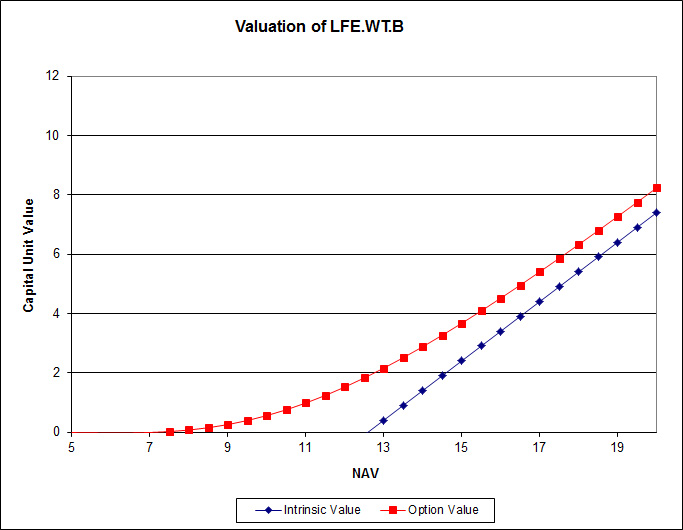
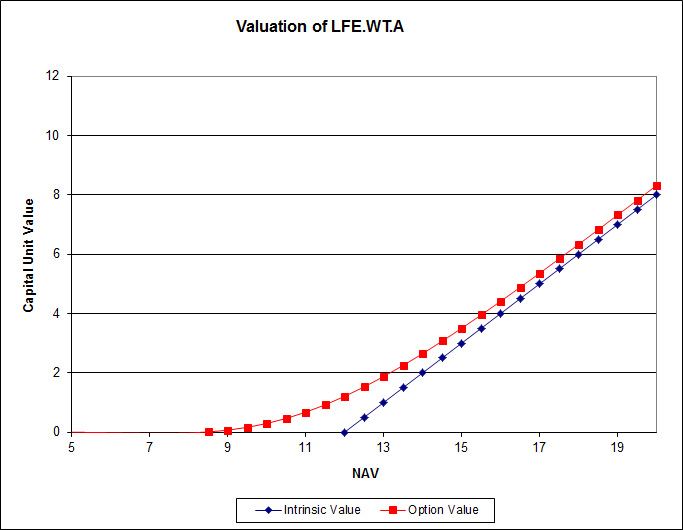
As discussed in the post LFE.PR.A Unveils Reorg Proposal, the “2013 Warrants” (LFE.WT.A), may be exercised at any time until 2013-6-3 and the “2014 Warrants” (LFE.WT.B) at any time until 2014-6-2. Note that these are the deadlines as far as the company is concerned; your custodial broker will probably have a deadline a day or two in advance of this. Your broker should be able to tell you its deadline a few weeks in advance of the company deadline.
The termination date for the company is 2018-12-1. Let’s take a shot at valuing the components!
The tricksy thing about valuing the options is that there is a very significant cash drag on the portfolio, since the dividend yield on the underlying portfolio is about 4.5% (of the whole unit value) while the preferred shares are getting a distribution of 6.25% (of their 10% par value) and the MER is about 1.00% (of the whole unit value, after the fee reduction that is part of the reorganization).
This means that at a NAVPU of 12.00, the portfolio has cash outflows of 0.625 (preferred shares) + 0.12 (1% of NAV) = $0.745, or about 6.21% of the NAV, with inflows of 0.045 * 12 = $0.54, for a net outflow of $0.205, or about 1.71% p.a. This is deducted from the Risk-Free Rate to get the Net Risk Free Rate to be used in Black-Scholes.
For Annual Volatility of the underlying portfolio, let’s use 30%
This gives rise to the following calculation when the NAVPU is $12:
| LFE Components Valuation at NAVPU = $12.00 |
|||
| Ticker | LFE | LFE.WT.A | LFE.WT.B |
| Time | 6.5 | 1.0 | 2.0 |
| Sigma | 30% | 30% | 30% |
| Gross Risk-Free | 2% | 2% | 2% |
| Net Risk-Free | 0.29% | 0.29% | 0.29% |
| Calculated Values | |||
| d1 | 0.6456 | 0.7675 | 0.6556 |
| d2 | -0.1193 | 0.4675 | 0.2314 |
| N(d1) | 0.7407 | 0.7786 | 0.7440 |
| N(d2) | 0.4525 | 0.6799 | 0.5915 |
| Option Value | 4.45 | 1.21 | 1.52 |
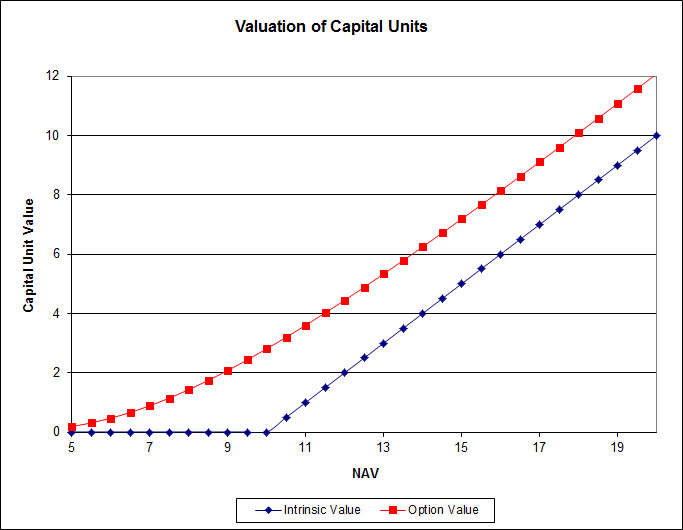
The calculation for the capital units, LFE, is dubious. In the first place, I’m not convinced Implied Volatilities for such relatively long periods are realistic; in the second place, the value will be highly path-dependent, as the end-value may be affected by dilution due to exercise of the warrants. [see note] Still, the results for the two warrants look relatively reasonable – although the quotes near the close on the day of issue are much, much, lower, this is on zero volume.
Click for big
Click for big
Update – Note: And in the third place, Sequence of Returns risk means that the cash drag is more harmful than is modelled by the Black-Scholes Risk-Free Rate Adjustment.
How about those inflation numbers, eh?:
Canada’s inflation rate tumbled to its lowest level in almost two years last month, falling to 1.2 per cent as Canadians paid less for gasoline, video equipment and some types of clothing, while price gains in many other consumer goods moderated.
…
May also saw prices fall outright on a month-to-month basis, meaning the basket of about 175 goods and services that Statistics Canada surveys cost 0.1 per cent less overall in May than it had in April.Bank of Canada governor Mark Carney said this week he expected prices to dip below his two per cent target in the short term, given the recent drop in world oil prices, but that the underlying core rate – which excludes volatile items such as energy – would hover near the target. He was right on both counts, as core slipped to 1.8 per cent from 2.1 per cent in April.
Spain may join the rest of Europe in discarding 500 years of bankruptcy law:
Spanish policy makers are considering forcing investors who hold equity and junior debt in banks to absorb losses in a restructuring, according to a person with knowledge of the plan.
Such burden sharing is among conditions being negotiated with the European Union in a 100 billion-euro ($126 billion) rescue for Spain’s financial industry, said the person, who asked not to be named as the conversations are private. Depositors who bought subordinated instruments such as preferred stock may be partially shielded from losses through a compensation plan being considered, the person said.
I think Credit Rating Agency bashing may become an Olympic sport!:
Moody’s Investors Service suffered a downgrade of its own as markets responded to the company’s rating cuts of 15 of the world’s largest banks by bidding up the value of their stocks and bonds.
…
“The ratings agencies themselves are looking for a raison d’etre” as regulations in the U.S. and Europe try to reduce investors’ dependence on the credit assessments, David Zervos, chief market strategist at Jefferies & Co., said in an interview on Bloomberg Television’s “Market Makers.” “They like to be noisy, and this is a way to be noisy. I don’t think the effects are big in the end.”
…
“We view the Moody’s downgrade as another overhyped story of 2012,” David Trone, analyst at JMP Securities LLC, wrote to his clients. “The corporate market thinks for itself and credit rating agencies are often lagging indicators.”
I saw a hummingbird moth in my back yard this evening, nectaring on my milkweed. I hadn’t even known there was such a thing!


It was a mildly positive day for the Canadian preferred share market, with PerpetualPremiums up 3bp and both FixedResets and DeemedRetractibles gaining 9bp. There was a surprising amount of volatility for such a quiet day, with no clear trend readily identifiable. Volume was extremely low.
| HIMIPref™ Preferred Indices These values reflect the December 2008 revision of the HIMIPref™ Indices Values are provisional and are finalized monthly |
|||||||
| Index | Mean Current Yield (at bid) |
Median YTW |
Median Average Trading Value |
Median Mod Dur (YTW) |
Issues | Day’s Perf. | Index Value |
| Ratchet | 0.00 % | 0.00 % | 0 | 0.00 | 0 | -0.1796 % | 2,310.5 |
| FixedFloater | 4.57 % | 3.95 % | 21,009 | 17.37 | 1 | -1.5632 % | 3,448.4 |
| Floater | 3.15 % | 3.15 % | 70,929 | 19.35 | 3 | -0.1796 % | 2,494.7 |
| OpRet | 4.79 % | 2.48 % | 36,247 | 1.00 | 5 | 0.3950 % | 2,517.7 |
| SplitShare | 5.27 % | -6.68 % | 44,100 | 0.49 | 4 | -0.2973 % | 2,718.6 |
| Interest-Bearing | 0.00 % | 0.00 % | 0 | 0.00 | 0 | 0.3950 % | 2,302.2 |
| Perpetual-Premium | 5.41 % | 3.65 % | 89,088 | 0.56 | 27 | 0.0253 % | 2,239.5 |
| Perpetual-Discount | 5.04 % | 5.02 % | 117,030 | 15.42 | 7 | 0.0947 % | 2,455.7 |
| FixedReset | 5.04 % | 3.12 % | 197,735 | 7.79 | 71 | 0.0948 % | 2,397.8 |
| Deemed-Retractible | 5.01 % | 3.93 % | 148,711 | 2.87 | 45 | 0.0881 % | 2,308.8 |
| Performance Highlights | |||
| Issue | Index | Change | Notes |
| BAM.PR.G | FixedFloater | -1.56 % | YTW SCENARIO Maturity Type : Limit Maturity Maturity Date : 2042-06-22 Maturity Price : 21.67 Evaluated at bid price : 20.78 Bid-YTW : 3.95 % |
| BNA.PR.C | SplitShare | -1.10 % | YTW SCENARIO Maturity Type : Hard Maturity Maturity Date : 2019-01-10 Maturity Price : 25.00 Evaluated at bid price : 22.50 Bid-YTW : 6.30 % |
| FTS.PR.H | FixedReset | -1.09 % | YTW SCENARIO Maturity Type : Limit Maturity Maturity Date : 2042-06-22 Maturity Price : 23.55 Evaluated at bid price : 25.47 Bid-YTW : 2.62 % |
| GWO.PR.M | Deemed-Retractible | -1.03 % | YTW SCENARIO Maturity Type : Hard Maturity Maturity Date : 2022-01-31 Maturity Price : 25.00 Evaluated at bid price : 26.05 Bid-YTW : 5.26 % |
| BAM.PR.R | FixedReset | 1.25 % | YTW SCENARIO Maturity Type : Limit Maturity Maturity Date : 2042-06-22 Maturity Price : 23.55 Evaluated at bid price : 26.02 Bid-YTW : 3.52 % |
| FTS.PR.E | OpRet | 1.25 % | YTW SCENARIO Maturity Type : Call Maturity Date : 2013-06-01 Maturity Price : 25.75 Evaluated at bid price : 26.66 Bid-YTW : 1.28 % |
| Volume Highlights | |||
| Issue | Index | Shares Traded |
Notes |
| BNA.PR.C | SplitShare | 166,045 | Nesbitt crossed 150,000 at 22.50. YTW SCENARIO Maturity Type : Hard Maturity Maturity Date : 2019-01-10 Maturity Price : 25.00 Evaluated at bid price : 22.50 Bid-YTW : 6.30 % |
| TD.PR.K | FixedReset | 106,985 | Nesbitt crossed 100,000 at 26.90. YTW SCENARIO Maturity Type : Call Maturity Date : 2014-07-31 Maturity Price : 25.00 Evaluated at bid price : 26.92 Bid-YTW : 2.94 % |
| BMO.PR.H | Deemed-Retractible | 87,542 | RBC crossed blocks of 51,500 and 25,000, both at 25.60. YTW SCENARIO Maturity Type : Call Maturity Date : 2013-02-25 Maturity Price : 25.00 Evaluated at bid price : 25.60 Bid-YTW : 2.31 % |
| TRP.PR.B | FixedReset | 63,107 | Desjardins crossed 48,600 at 25.15. YTW SCENARIO Maturity Type : Limit Maturity Maturity Date : 2042-06-22 Maturity Price : 23.41 Evaluated at bid price : 25.10 Bid-YTW : 2.49 % |
| PWF.PR.I | Perpetual-Premium | 56,004 | Nesbitt crossed 25,000 at 25.50; RBC crossed the same amount at the same price. YTW SCENARIO Maturity Type : Call Maturity Date : 2012-07-22 Maturity Price : 25.00 Evaluated at bid price : 25.50 Bid-YTW : -7.48 % |
| RY.PR.B | Deemed-Retractible | 52,846 | Desjardins crossed 50,000 at 25.70. YTW SCENARIO Maturity Type : Call Maturity Date : 2015-08-24 Maturity Price : 25.00 Evaluated at bid price : 25.68 Bid-YTW : 3.93 % |
| There were 14 other index-included issues trading in excess of 10,000 shares. | |||
| Wide Spread Highlights | ||
| Issue | Index | Quote Data and Yield Notes |
| W.PR.H | Perpetual-Premium | Quote: 26.05 – 27.50 Spot Rate : 1.4500 Average : 0.9282 YTW SCENARIO |
| FBS.PR.C | SplitShare | Quote: 10.80 – 11.48 Spot Rate : 0.6800 Average : 0.5527 YTW SCENARIO |
| BNA.PR.C | SplitShare | Quote: 22.50 – 22.83 Spot Rate : 0.3300 Average : 0.2200 YTW SCENARIO |
| SLF.PR.F | FixedReset | Quote: 26.15 – 26.44 Spot Rate : 0.2900 Average : 0.1835 YTW SCENARIO |
| TCA.PR.X | Perpetual-Premium | Quote: 51.56 – 52.13 Spot Rate : 0.5700 Average : 0.4731 YTW SCENARIO |
| GWO.PR.M | Deemed-Retractible | Quote: 26.05 – 26.39 Spot Rate : 0.3400 Average : 0.2470 YTW SCENARIO |
OSFI has released new mortgage paperwork creation rules:
Consequently, FRFIs should maintain complete documentation of the information that led to a mortgage approval. This should generally include:
• A description of the purpose of the loan (e.g., purchase, refinancing, renovation, debt consolidation);
• Employment status and verification of income (see Principle 3);
• Debt service ratio calculations, including verification documentation for key inputs (e.g., heating, taxes, and other debt obligations);
• LTV ratio, property valuation and appraisal documentation (see Principle 4);
• Credit bureau reports and any other credit enquiries;
• Documentation verifying the source of the down payment;
Purchase and sale agreements and other collateral supporting documents;
• An explanation of any mitigating criteria or other elements (e.g., “soft” information) for higher credit risk factors;
• A clearly stated rationale for the decision (including exceptions); and
• A record from the mortgage insurer validating approval to insure the mortgage where there may be an exception to the mortgage insurer’s underwriting policies.
The above documentation should be obtained at the origination of the mortgage and for any subsequent refinancing of the mortgage. FRFIs should update the borrower analysis periodically (not necessarily at renewal) in order to effectively evaluate their credit risk. In particular, FRFIs should review some of the aforementioned factors if the borrower’s condition or property risk changes materially.
Lap-dog Carney breathlessly reports that his boss is doing a great job:
The Canadian government’s latest move to tame the mortgage market will support the “long-term stability” of the housing market and guard against the economic risks posed by excessive borrowing, Bank of Canada Governor Mark Carney said Thursday.
Speaking in Halifax just hours after Finance Minister Jim Flaherty announced a series of changes that come into effect next month, Mr. Carney reiterated his concerns about the effects that his ultra-low interest rates have had on the behaviour of both borrowers and lenders, warning the economy cannot “depend indefinitely” on debt-fuelled spending, especially as incomes stagnate.
In a free market economy, the mortgage market would be cooled off by cutting back on government guarantees of mortgage debt (CMHC guarantees have exploded over the past five years) and increasing the risk-weight assessed on the banks for mortgages (which is justifiable as the proportion of bank assets represented by mortgages is way out of whack with historical norms). But it’s more fun to micro-manage. Gets more tough-sounding headlines, too.
Fortunately, there’s some movement on the first point:
The growth of CMHC had understandably worried Canadians who were paying attention. Here was a beast that ranks among the biggest financial institutions in Canada, larger than some of our smaller banks, expanding at an astounding pace with seemingly minimal oversight from regulators and the politicians in charge.
Year by year, it would blow past its sales targets, with the amount of insurance it was writing ballooning. The insurance book at CMHC grew from $345-billion at the end of the 2007 fiscal year to $567-billion in 2011. That’s a compound annual growth rate of a little more than 13 per cent.
…
As the insurance book grew, the government steadily raised the cap on what was allowed, in what looked suspiciously like a rubber-stamp process.
…
Earlier this year, Mr. Flaherty put OSFI in an official oversight role. He signaled in an interview with The Globe and Mail that the board was likely to be upgraded to something more appropriate for a financial institution of this scale. He refused to raise the cap on insurance in force beyond the current $600-billion.Now, the move to end insurance for high-ratio mortgages on homes valued at more than $1-million and to further curtail other loans that require insurance by demanding faster paydowns will enable the CMHC to further curtail its growth.
CMHC is actually planning to allow its book to shrink in the current year, to about $557-billion, as mortgages are paid off faster (about $60-billion a year) than new insurance is originated.
But Spend-Every-Penny just can’t resist central planning:
Jim Flaherty is singling out Toronto’s overheated condo market as one of the main reasons Ottawa is tightening the rules for insured mortgages.
Hard on the heels of the BoC paper lauding repo central counterparties comes a BoC Working Paper by Hajime Tomura titled On the Existence and Fragility of Repo Markets:
This paper presents a model of an over-the-counter bond market in which bond dealers and cash investors arrange repurchase agreements (repos) endogenously. If cash investors buy bonds to store their cash, then they suffer an endogenous bond-liquidation cost because they must sell their bonds before the scheduled times of their cash payments. This cost provides incentive for both dealers and cash investors to arrange repos with endogenous margins. As part of multiple equilibria, the bond-liquidation cost also gives rise to another equilibrium in which cash investors stop transacting with dealers all at once. Credit market interventions block this equilibrium.
…
In this paper, I take as given the OTC bond market structure. Thus, a question remains regarding the optimal market design, such as whether to introduce a centralized bond market or a set-up to ensure anonymity of cash investors. Also, the empirical implications of the model are yet to be tested. One of the testable implications is that a repo margin is increasing in the difference between the interdealer bond price and the repurchase bond price. Another implication is that spot transactions in a brokered bond market increase if a repo market collapses. Addressing these issues are left for future research.

Buckyballs are undoubtedly the coolest organic molecule extant. They might even be useful!
Experimental solar cells made with two types of pure carbon absorb infrared sunlight that traditional silicon panels ignore and may eventually be used to improve efficiency, according to researchers at the Massachusetts Institute of Technology.
MIT scientists used nanotubes and spherical molecules known as buckyballs to make the first all-carbon photovoltaic cell, the Cambridge, Massachusetts-based university said today in an e-mailed statement.
Infrared light makes up about 40 percent of the solar radiation that hits the earth. Solar cells that absorb that energy may produce more electricity than conventional panels that don’t, according to Michael Strano, a professor of chemical engineering at MIT.
If we here in Ontario had any brains, we would have been pouring money into solar energy research rather than trying to create an indigenous industry with not-ready-for-prime-time technology so that we could compete with the Chinese on the basis of our lower labour costs. Unfortunately, we don’t have any brains.
Moody’s cut Royal Bank of Canada:
Moody’s Investors Service today repositioned the ratings of 15 banks and securities firms with global capital markets operations. The long-term senior debt ratings of 4 of these firms were downgraded by 1 notch, the ratings of 10 firms were downgraded by 2 notches and 1 firm was downgraded by 3 notches. In addition, for four firms, the short-term ratings of their operating companies were downgraded to Prime-2. All four of those firms also now have holding company short-term ratings at Prime-2. The holding company short-term ratings of another two firms were downgraded to Prime-2 as well.
“All of the banks affected by today’s actions have significant exposure to the volatility and risk of outsized losses inherent to capital markets activities”, says Moody’s Global Banking Managing Director Greg Bauer. “However, they also engage in other, often market leading business activities that are central to Moody’s assessment of their credit profiles. These activities can provide important ‘shock absorbers’ that mitigate the potential volatility of capital markets operations, but they also present unique risks and challenges.” The specific credit drivers for each affected firm are summarized below.
…
Royal Bank of CanadaLong-term deposit rating to Aa3 from Aa1, outlook stable; Short-term P-1 affirmed
… but it was Credit Suisse that hogged the headlines:
Credit Suisse Group AG’s credit rating was cut three levels by Moody’s Investors Service, Morgan Stanley was reduced two levels and 13 other banks were downgraded in moves that may shake up competition among Wall Street’s biggest firms.
Credit Suisse, the second-largest Swiss bank, received the maximum reduction that Moody’s said in February it may make during a review of global banks with capital markets operations. Morgan Stanley and UBS AG (UBSN), the other firms singled out for such a steep cut, were lowered two steps instead.
Capital Power L.P. is the operating subsidiary of CPX, proud issuer of CPX.PR.A:
The Company’s power generation operations and assets are owned by Capital Power L.P. (CPLP), a subsidiary of the Company. As at December 31, 2011, the Company directly and indirectly held approximately 21.750 million general partnership units and 36.924 million common limited partnership units of CPLP which represented approximately 61% of CPLP’s total partnership units. EPCOR (in this MD&A, EPCOR refers to EPCOR Utilities Inc. collectively with its subsidiaries) held 38.216 million exchangeable common limited partnership units of CPLP representing approximately 39% of CPLP. CPLP’s exchangeable common limited partnership units are exchangeable for common shares of Capital Power Corporation on a one-for-one basis. The general partner of CPLP is wholly owned by Capital Power Corporation and EPCOR’s representation on the Board of Directors does not represent a controlling vote. Accordingly, Capital Power Corporation controls CPLP and the operations of CPLP have been
consolidated for financial statement purposes.
CPLP has been confirmed by DBRS at BBB:
DBRS has today confirmed the Senior Unsecured Debt rating of Capital Power L.P. (CPLP or the Partnership) at BBB with a Stable trend. The confirmation reflects (1) the Partnership’s balanced portfolio of contracted and merchant generation with reasonable fuel-hedging positions, (2) high plant availability and (3) increased geographical and fuel diversification.
…
…credit metrics are expected to remain reasonable for the current rating category, barring material debt-funded acquisitions in the foreseeable future. However, DBRS is increasingly concerned about the continued challenging merchant power market environment that could materially add to the Partnership’s existing challenges in the medium term.
Thomson Reuters Corporation, proud issuer of TRI.PR.B, has been confirmed at Pfd-2(low) by DBRS:
Thomson Reuters undertook 39 acquisitions for a total of $1.3 billion in 2011, with approximately two-thirds of investment occurring outside the U.S. Thomson Reuters also repurchased $326 million worth of shares during the period, its first share repurchase since 2008. As such, net debt increased moderately; however, net-debt to EBITDA decreased to 1.83x at the end of 2011, from 1.91x a year earlier.
Going forward, DBRS believes Thomson Reuters’ main challenge will be to achieve revenue and margin growth through the selection and integration of strategic acquisitions. The Company’s ability to grow profitably through this strategy remains to be proven.
It was a mixed day for the Canadian preferred share market, with PerpetualPremiums winning 11bp, FixedResets up 5bp and DeemedRetractibles off 4bp. Volatility was almost non-extistent. Volume was pathetic.
| HIMIPref™ Preferred Indices These values reflect the December 2008 revision of the HIMIPref™ Indices Values are provisional and are finalized monthly |
|||||||
| Index | Mean Current Yield (at bid) |
Median YTW |
Median Average Trading Value |
Median Mod Dur (YTW) |
Issues | Day’s Perf. | Index Value |
| Ratchet | 0.00 % | 0.00 % | 0 | 0.00 | 0 | -0.0798 % | 2,314.6 |
| FixedFloater | 4.50 % | 3.87 % | 21,321 | 17.50 | 1 | -0.8920 % | 3,503.1 |
| Floater | 3.14 % | 3.14 % | 70,660 | 19.38 | 3 | -0.0798 % | 2,499.2 |
| OpRet | 4.81 % | 2.64 % | 36,469 | 1.00 | 5 | -0.0929 % | 2,507.7 |
| SplitShare | 5.25 % | -9.11 % | 44,355 | 0.50 | 4 | 0.1439 % | 2,726.7 |
| Interest-Bearing | 0.00 % | 0.00 % | 0 | 0.00 | 0 | -0.0929 % | 2,293.1 |
| Perpetual-Premium | 5.41 % | 3.46 % | 88,583 | 0.09 | 27 | 0.1051 % | 2,239.0 |
| Perpetual-Discount | 5.05 % | 5.03 % | 118,587 | 15.42 | 7 | 0.2135 % | 2,453.4 |
| FixedReset | 5.04 % | 3.11 % | 199,005 | 7.76 | 71 | 0.0512 % | 2,395.6 |
| Deemed-Retractible | 5.01 % | 3.95 % | 151,114 | 2.56 | 45 | -0.0379 % | 2,306.8 |
| Performance Highlights | |||
| Issue | Index | Change | Notes |
| BAM.PR.M | Perpetual-Discount | 1.29 % | YTW SCENARIO Maturity Type : Limit Maturity Maturity Date : 2042-06-21 Maturity Price : 23.25 Evaluated at bid price : 23.61 Bid-YTW : 5.03 % |
| Volume Highlights | |||
| Issue | Index | Shares Traded |
Notes |
| RY.PR.I | FixedReset | 139,420 | Desjardins crossed blocks of 95,000 and 36,100, both at 25.57. YTW SCENARIO Maturity Type : Hard Maturity Maturity Date : 2022-01-31 Maturity Price : 25.00 Evaluated at bid price : 25.60 Bid-YTW : 3.21 % |
| RY.PR.R | FixedReset | 75,720 | Nesbitt crossed 65,000 at 26.41. YTW SCENARIO Maturity Type : Call Maturity Date : 2014-02-24 Maturity Price : 25.00 Evaluated at bid price : 26.41 Bid-YTW : 3.08 % |
| BNS.PR.Z | FixedReset | 67,647 | RBC crossed 20,000 at 25.15; Desjardins crossed 30,000 at the same price. YTW SCENARIO Maturity Type : Hard Maturity Maturity Date : 2022-01-31 Maturity Price : 25.00 Evaluated at bid price : 25.06 Bid-YTW : 3.04 % |
| RY.PR.L | FixedReset | 67,520 | Nesbitt crossed 65,000 at 26.15. YTW SCENARIO Maturity Type : Call Maturity Date : 2014-02-24 Maturity Price : 25.00 Evaluated at bid price : 26.17 Bid-YTW : 2.99 % |
| NA.PR.K | Deemed-Retractible | 58,665 | Desjardins crossed 46,200 at 25.50. YTW SCENARIO Maturity Type : Call Maturity Date : 2012-07-21 Maturity Price : 25.00 Evaluated at bid price : 25.51 Bid-YTW : -11.26 % |
| TD.PR.A | FixedReset | 52,400 | TD crossed 50,000 at 25.66. YTW SCENARIO Maturity Type : Hard Maturity Maturity Date : 2022-01-31 Maturity Price : 25.00 Evaluated at bid price : 25.66 Bid-YTW : 3.26 % |
| There were 19 other index-included issues trading in excess of 10,000 shares. | |||
| Wide Spread Highlights | ||
| Issue | Index | Quote Data and Yield Notes |
| FBS.PR.C | SplitShare | Quote: 10.80 – 11.44 Spot Rate : 0.6400 Average : 0.4131 YTW SCENARIO |
| MFC.PR.F | FixedReset | Quote: 23.51 – 23.93 Spot Rate : 0.4200 Average : 0.2486 YTW SCENARIO |
| BAM.PR.R | FixedReset | Quote: 25.70 – 26.19 Spot Rate : 0.4900 Average : 0.3649 YTW SCENARIO |
| NA.PR.O | FixedReset | Quote: 26.91 – 27.25 Spot Rate : 0.3400 Average : 0.2272 YTW SCENARIO |
| BAM.PR.O | OpRet | Quote: 25.61 – 26.00 Spot Rate : 0.3900 Average : 0.2894 YTW SCENARIO |
| FTS.PR.E | OpRet | Quote: 26.33 – 26.64 Spot Rate : 0.3100 Average : 0.2227 YTW SCENARIO |
Standard & Poor’s has announced:
- Industrial Alliance Insurance and Financial Services Inc. has announced that it will issue C$100 million in noncumulative preferred shares.
- We are revising our outlook on the company to negative and affirming all ratings.
- We could lower the rating in the next 18-24 months if leverage is not reduced to less than 35%, and debt service coverage does not improve to
more than 5x.NEW YORK (Standard & Poor’s) June 19, 2012–Standard & Poor’s Ratings Services said today that it affirmed its ‘A-‘ debt rating on Industrial Alliance Insurance and Financial Services Inc.’s. (Industrial Alliance) non-cumulative five-year rate reset Class A preferred share Series G after its C$100 million add on. The series does not have a fixed maturity date. At the same time, we have revised our outlook on the counterparty credit and financial strength ratings to negative from stable.
Although the issuance of these preferred shares strengthens the company’s capital base, it has also marginally weakened certain leverage and fixed-charge coverage metrics to levels marginally below those appropriate for the rating. The company’s announcement to issue C$100 million non-cumulative preferred shares follows the issuance of C$150 million of the same series of securities that closed on June 1, 2012.
Although we did not change our outlook on Industrial Alliance after the recent preferred share issuance, the company’s decision to issue an additional C$100 million of the same securities has resulted in a marginal weakening of certain pro forma financial metrics. Specifically, we expect similarly rated companies to maintain leverage (including debt, hybrids, and preferred shares) of less than 35% and debt service coverage of at least 5x. Although Industrial Alliance maintains a strong financial profile, the recent preferred share issues have marginally weakened these metrics on a pro forma basis, resulting
in the negative outlook.The capital raise reflects the company’s exposure to the current low interest rate environment. The bulk of this exposure is from the company’s relatively large exposure to long-duration individual life insurance products and the fair-value treatment that these liabilities receive under Canadian International Financial Reporting Standards and the Canadian regulatory capital rules. Although the company has a number of alternative means available to manage its Canadian regulatory capital adequacy position, it is choosing to supplement this with an additional preferred share issue to increase and optimize its options. Alternative options would include managing down new business strain, de-risking and repricing products to reduce capital strain, reinsuring on-balance-sheet mortality risk, or following the minimum guidelines for the ultimate reinvestment rate rather than accelerating the implementation of this by one year.
The outlook is negative. We could downgrade the company during the next 18-24 months if it does not reduce leverage to less than 35%, and improve its debt-service coverage to more than 5x. Alternatively, if the company were able to achieve these financial metrics, we would return the outlook to stable.
The reopening of IAG.PR.G has been discussed on PrefBlog. This news follows the DBRS announcement that the preferred shares and sub-debt of IAG are on Review-Negative.
IAG has the following preferred shares outstanding: IAG.PR.A, IAG.PR.E and IAG.PR.F (DeemedRetractible) and IAG.PR.C & IAG.PR.G (FixedReset). All are tracked by HIMIPref™ and all are assigned to the indicated indices.
The Fed has a new slogan – Twist & Shout!:
The Committee also decided to continue through the end of the year its program to extend the average maturity of its holdings of securities. Specifically, the Committee intends to purchase Treasury securities with remaining maturities of 6 years to 30 years at the current pace and to sell or redeem an equal amount of Treasury securities with remaining maturities of approximately 3 years or less. This continuation of the maturity extension program should put downward pressure on longer-term interest rates and help to make broader financial conditions more accommodative. The Committee is maintaining its existing policy of reinvesting principal payments from its holdings of agency debt and agency mortgage-backed securities in agency mortgage-backed securities. The Committee is prepared to take further action as appropriate to promote a stronger economic recovery and sustained improvement in labor market conditions in a context of price stability.
…
Voting against the action was Jeffrey M. Lacker, who opposed continuation of the maturity extension program.
With any luck, there will be increased pressure to end milkfare:
Canada has set an ambitious trade agenda that includes separate proposed deals with the EU, Japan and South Korea, along with entry into the Trans-Pacific Partnership negotiations. The issues on the table differ from negotiation to negotiation: Japan and South Korea want Canada to reduce or eliminate a 6.1 per cent tariff on imported automobiles and parts; The EU and United States are requesting a change in Canadian intellectual property laws.
One issue, however, is common to all negotiations: Our trading partners want to see an end to supply management of our dairy and poultry industries.
The tariffs that buttress the system range between 200 and 300 per cent on imported dairy products, with milk facing a 241 per cent tax and butter one of 298.5 per cent. These tariffs make foreign products prohibitively expensive and keep domestic prices among the highest in the world.
Spend-Every-Penny continues to micromanage the economy:
The federal government is moving again to tighten the rules on mortgage lending in Canada amid growing concerns that the housing market is overheated and household debt levels are climbing to perilous levels.
The country’s biggest banks were caught off guard on Wednesday night as the Department of Finance confirmed that it is clamping down on mortgages by reducing the maximum amortization for a government-insured mortgage to 25 years from 30.
Ottawa will also limit the amount of equity that can be borrowed against a home to 80 per cent of the property’s value, down from 85 per cent.
It was a mixed day for the Canadian preferred share market, with PerpetualPremiums gaining 21bp, FixedResets off 1bp and DeemedRetractibles gaining 3bp. There was a good dollop of volatility, with no clear pattern showing up in the Performance Highlights table. Volume was low.
PerpetualDiscounts now yield 5.06%, equivalent to 6.58% interest at the standard conversion factor of 1.3x. Long corporates continue to yield about 4.4%, so the pre-tax interest-equivalent spread (in this context, the “Seniority Spread”) is now about 220bp, a slight (and perhaps spurious) increase from the 215bp reported June 13.
| HIMIPref™ Preferred Indices These values reflect the December 2008 revision of the HIMIPref™ Indices Values are provisional and are finalized monthly |
|||||||
| Index | Mean Current Yield (at bid) |
Median YTW |
Median Average Trading Value |
Median Mod Dur (YTW) |
Issues | Day’s Perf. | Index Value |
| Ratchet | 0.00 % | 0.00 % | 0 | 0.00 | 0 | 0.8650 % | 2,316.5 |
| FixedFloater | 4.46 % | 3.85 % | 21,307 | 17.59 | 1 | -0.5138 % | 3,534.7 |
| Floater | 3.14 % | 3.14 % | 71,393 | 19.39 | 3 | 0.8650 % | 2,501.2 |
| OpRet | 4.81 % | 2.43 % | 36,761 | 1.00 | 5 | 0.0852 % | 2,510.1 |
| SplitShare | 5.26 % | -8.45 % | 44,292 | 0.50 | 4 | 0.4535 % | 2,722.8 |
| Interest-Bearing | 0.00 % | 0.00 % | 0 | 0.00 | 0 | 0.0852 % | 2,295.2 |
| Perpetual-Premium | 5.42 % | 3.27 % | 88,794 | 0.09 | 27 | 0.2126 % | 2,236.6 |
| Perpetual-Discount | 5.06 % | 5.06 % | 117,367 | 15.38 | 7 | 0.1082 % | 2,448.2 |
| FixedReset | 5.04 % | 3.18 % | 201,611 | 7.83 | 71 | -0.0131 % | 2,394.3 |
| Deemed-Retractible | 5.01 % | 3.95 % | 153,537 | 2.66 | 45 | 0.0317 % | 2,307.7 |
| Performance Highlights | |||
| Issue | Index | Change | Notes |
| IAG.PR.F | Deemed-Retractible | -1.49 % | YTW SCENARIO Maturity Type : Call Maturity Date : 2019-03-31 Maturity Price : 25.00 Evaluated at bid price : 25.71 Bid-YTW : 5.41 % |
| SLF.PR.H | FixedReset | -1.27 % | YTW SCENARIO Maturity Type : Hard Maturity Maturity Date : 2022-01-31 Maturity Price : 25.00 Evaluated at bid price : 24.15 Bid-YTW : 4.03 % |
| SLF.PR.I | FixedReset | -1.11 % | YTW SCENARIO Maturity Type : Hard Maturity Maturity Date : 2022-12-31 Maturity Price : 25.00 Evaluated at bid price : 25.00 Bid-YTW : 4.07 % |
| CIU.PR.A | Perpetual-Discount | -1.02 % | YTW SCENARIO Maturity Type : Limit Maturity Maturity Date : 2042-06-20 Maturity Price : 23.82 Evaluated at bid price : 24.25 Bid-YTW : 4.76 % |
| BAM.PR.K | Floater | 1.21 % | YTW SCENARIO Maturity Type : Limit Maturity Maturity Date : 2042-06-20 Maturity Price : 16.71 Evaluated at bid price : 16.71 Bid-YTW : 3.14 % |
| BAM.PR.B | Floater | 1.21 % | YTW SCENARIO Maturity Type : Limit Maturity Maturity Date : 2042-06-20 Maturity Price : 16.70 Evaluated at bid price : 16.70 Bid-YTW : 3.14 % |
| FBS.PR.C | SplitShare | 1.79 % | YTW SCENARIO Maturity Type : Call Maturity Date : 2012-12-15 Maturity Price : 10.00 Evaluated at bid price : 10.81 Bid-YTW : -10.93 % |
| Volume Highlights | |||
| Issue | Index | Shares Traded |
Notes |
| IAG.PR.G | FixedReset | 233,615 | Recent new issue and reopening. YTW SCENARIO Maturity Type : Hard Maturity Maturity Date : 2022-01-31 Maturity Price : 25.00 Evaluated at bid price : 25.12 Bid-YTW : 4.16 % |
| W.PR.H | Perpetual-Premium | 100,700 | Desjardins crossed blocks of 50,000 shares, 20,000 and 30,000, all at 26.00. YTW SCENARIO Maturity Type : Call Maturity Date : 2013-01-15 Maturity Price : 25.00 Evaluated at bid price : 25.90 Bid-YTW : 0.92 % |
| CU.PR.D | Perpetual-Premium | 73,050 | Recent new issue. YTW SCENARIO Maturity Type : Call Maturity Date : 2021-09-01 Maturity Price : 25.00 Evaluated at bid price : 25.09 Bid-YTW : 4.89 % |
| RY.PR.I | FixedReset | 50,252 | RBC crossed 50,000 at 25.57. YTW SCENARIO Maturity Type : Hard Maturity Maturity Date : 2022-01-31 Maturity Price : 25.00 Evaluated at bid price : 25.56 Bid-YTW : 3.23 % |
| BMO.PR.H | Deemed-Retractible | 46,508 | Nesbitt crossed 40,000 at 25.60. YTW SCENARIO Maturity Type : Call Maturity Date : 2013-02-25 Maturity Price : 25.00 Evaluated at bid price : 25.59 Bid-YTW : 2.35 % |
| TD.PR.O | Deemed-Retractible | 36,952 | Desjardins crossed 26,800 at 25.80. YTW SCENARIO Maturity Type : Call Maturity Date : 2012-10-31 Maturity Price : 25.50 Evaluated at bid price : 25.86 Bid-YTW : 2.68 % |
| There were 23 other index-included issues trading in excess of 10,000 shares. | |||
| Wide Spread Highlights | ||
| Issue | Index | Quote Data and Yield Notes |
| IAG.PR.C | FixedReset | Quote: 25.91 – 26.39 Spot Rate : 0.4800 Average : 0.3508 YTW SCENARIO |
| BNA.PR.E | SplitShare | Quote: 24.75 – 25.00 Spot Rate : 0.2500 Average : 0.1530 YTW SCENARIO |
| HSB.PR.D | Deemed-Retractible | Quote: 25.35 – 25.59 Spot Rate : 0.2400 Average : 0.1582 YTW SCENARIO |
| BNS.PR.Q | FixedReset | Quote: 25.52 – 25.79 Spot Rate : 0.2700 Average : 0.1883 YTW SCENARIO |
| RY.PR.N | FixedReset | Quote: 26.33 – 26.55 Spot Rate : 0.2200 Average : 0.1530 YTW SCENARIO |
| TCA.PR.Y | Perpetual-Premium | Quote: 51.90 – 52.20 Spot Rate : 0.3000 Average : 0.2365 YTW SCENARIO |
The insurance companies have figured out a new way to sell annuities:
General Motors Co. (GM)’s deal to cut pension obligations by $26 billion and shift plans to Prudential Financial Inc. (PRU) is poised to fuel more transfers as U.S. firms face a retirement-funding shortfall the size of Greece’s debt.
MetLife Inc. (MET) and Prudential are among insurers that expect the GM deal to encourage more corporations to offload plans. Pension liabilities exceed assets by more than $435 billion, according to a Bloomberg review of data disclosed by firms in the Russell 1000 Index of large U.S. companies. Greece, facing demands for austerity measures in exchange for rescue funds, had total debt of about $450 billion at the end of 2011.
Employers who endured two stock-market crashes in a decade and 10-year Treasury yields near a record low may be tempted to follow GM’s lead by paying insurers to take the risk that market returns are inadequate or that beneficiaries live longer than expected. Transferring the obligations can reduce swings in earnings tied to securities and relieve companies of the need to manage large pools of money.
There’s a very revealing quote out about High Frequency Trading:
The advocates argue that “ ‘It’s the way of the world, people who are in denial are Luddites,’ that whole school of thought,” [, chief executive officer of the Investment Industry Regulatory Organization of Canada ] Ms. Wolburgh Jenah says. “Then there’s the school of thought that is ‘We don’t understand the markets any more, this new breed of participant has come in and taken over.’ ”
The wickle boys don’t like the idea that they might have to learn something new, or the young and the hungry will eat their lunch. Boo Hoo Hoo. See the February 8 post for more mockery of the incompetent.
It was a mixed day for the Canadian preferred share market, with PerpetualPremiums down 3bp, FixedResets winning 17bp and DeemedRetractibles gaining 10bp. Volatility was minor. Volume was low, but with a few issues showing very good volume.
| HIMIPref™ Preferred Indices These values reflect the December 2008 revision of the HIMIPref™ Indices Values are provisional and are finalized monthly |
|||||||
| Index | Mean Current Yield (at bid) |
Median YTW |
Median Average Trading Value |
Median Mod Dur (YTW) |
Issues | Day’s Perf. | Index Value |
| Ratchet | 0.00 % | 0.00 % | 0 | 0.00 | 0 | -0.3208 % | 2,296.6 |
| FixedFloater | 4.44 % | 3.82 % | 21,321 | 17.63 | 1 | 0.5164 % | 3,552.9 |
| Floater | 3.17 % | 3.17 % | 72,336 | 19.30 | 3 | -0.3208 % | 2,479.7 |
| OpRet | 4.81 % | 2.50 % | 37,344 | 1.01 | 5 | 0.0310 % | 2,507.9 |
| SplitShare | 5.28 % | -7.34 % | 44,214 | 0.50 | 4 | 0.1797 % | 2,710.5 |
| Interest-Bearing | 0.00 % | 0.00 % | 0 | 0.00 | 0 | 0.0310 % | 2,293.3 |
| Perpetual-Premium | 5.42 % | 3.63 % | 89,267 | 0.56 | 27 | -0.0261 % | 2,231.9 |
| Perpetual-Discount | 5.05 % | 5.10 % | 118,370 | 15.32 | 7 | 0.1900 % | 2,445.5 |
| FixedReset | 5.04 % | 3.15 % | 204,283 | 7.84 | 71 | 0.1719 % | 2,394.7 |
| Deemed-Retractible | 5.01 % | 3.95 % | 159,032 | 2.66 | 45 | 0.1023 % | 2,306.9 |
| Performance Highlights | |||
| Issue | Index | Change | Notes |
| TCA.PR.X | Perpetual-Premium | -1.49 % | YTW SCENARIO Maturity Type : Call Maturity Date : 2013-10-15 Maturity Price : 50.00 Evaluated at bid price : 51.40 Bid-YTW : 4.04 % |
| MFC.PR.F | FixedReset | -1.36 % | YTW SCENARIO Maturity Type : Hard Maturity Maturity Date : 2022-01-31 Maturity Price : 25.00 Evaluated at bid price : 23.29 Bid-YTW : 4.19 % |
| Volume Highlights | |||
| Issue | Index | Shares Traded |
Notes |
| RY.PR.R | FixedReset | 279,691 | National crossed 273,200 at 26.33. YTW SCENARIO Maturity Type : Call Maturity Date : 2014-02-24 Maturity Price : 25.00 Evaluated at bid price : 26.34 Bid-YTW : 3.24 % |
| CU.PR.D | Perpetual-Premium | 231,790 | Recent new issue. YTW SCENARIO Maturity Type : Limit Maturity Maturity Date : 2042-06-19 Maturity Price : 24.65 Evaluated at bid price : 25.05 Bid-YTW : 4.90 % |
| BNS.PR.R | FixedReset | 156,976 | Desjardins crossed blocks of 50,000 shares, 25,000 and 42,500, all at 25.63. National crossed 25,000 at the same price. YTW SCENARIO Maturity Type : Hard Maturity Maturity Date : 2022-01-31 Maturity Price : 25.00 Evaluated at bid price : 25.65 Bid-YTW : 3.14 % |
| RY.PR.I | FixedReset | 108,150 | RBC crossed two blocks of 25,000 each, both at 25.57. Desjardins crossed 50,000 at the same price. YTW SCENARIO Maturity Type : Hard Maturity Maturity Date : 2022-01-31 Maturity Price : 25.00 Evaluated at bid price : 25.57 Bid-YTW : 3.22 % |
| RY.PR.N | FixedReset | 71,560 | RBC crossed 69,400 at 26.36. YTW SCENARIO Maturity Type : Call Maturity Date : 2014-02-24 Maturity Price : 25.00 Evaluated at bid price : 26.32 Bid-YTW : 3.29 % |
| BMO.PR.O | FixedReset | 56,170 | Desjardins crossed 50,000 at 26.75. YTW SCENARIO Maturity Type : Call Maturity Date : 2014-05-25 Maturity Price : 25.00 Evaluated at bid price : 26.73 Bid-YTW : 3.03 % |
| There were 26 other index-included issues trading in excess of 10,000 shares. | |||
| Wide Spread Highlights | ||
| Issue | Index | Quote Data and Yield Notes |
| W.PR.H | Perpetual-Premium | Quote: 25.90 – 28.13 Spot Rate : 2.2300 Average : 1.2304 YTW SCENARIO |
| TCA.PR.X | Perpetual-Premium | Quote: 51.40 – 52.00 Spot Rate : 0.6000 Average : 0.3662 YTW SCENARIO |
| BAM.PR.J | OpRet | Quote: 26.45 – 26.88 Spot Rate : 0.4300 Average : 0.3066 YTW SCENARIO |
| FTS.PR.H | FixedReset | Quote: 25.46 – 25.79 Spot Rate : 0.3300 Average : 0.2340 YTW SCENARIO |
| TRP.PR.A | FixedReset | Quote: 25.57 – 25.77 Spot Rate : 0.2000 Average : 0.1398 YTW SCENARIO |
| BNS.PR.Q | FixedReset | Quote: 25.56 – 25.71 Spot Rate : 0.1500 Average : 0.0987 YTW SCENARIO |
Industrial Alliance Insurance and Financial Services Inc. has announced:
that it has entered into an agreement to offer and sell, on a bought deal basis to a syndicate led by BMO Capital Markets, 4,000,000 Non-Cumulative 5-Year Rate Reset Class A Preferred Shares, Series G (the “Series G Preferred Shares”), at a price of $25.00 per share, for aggregate gross proceeds of $100 000 000. This offering constitutes an additional issuance to the 6,000,000 Series G Preferred Shares that Industrial Alliance initially issued on June 1, 2012.
The Series G Preferred Shares will have the same terms and conditions as the existing Series G Preferred Shares. Holders of the Series G Preferred Shares will be entitled to receive fixed non-cumulative preferential cash dividends, as and when declared by the board of directors of Industrial Alliance for the initial period from and including June 1, 2012 to but excluding June 30, 2017, payable quarterly on March 31, June 30, September 30 and December 31 in each year, at an annual rate equal to $1.0750 per Series G Preferred Share. The initial dividend, if declared, will be payable on September 30, 2012 and will amount to $0.3564 per Series G Preferred Share. On June 30, 2017 and on June 30 every five years thereafter, the dividend rate will reset to be equal to the then current five-year Government of Canada bond yield plus 2.85%. Holders of the Series G Preferred Shares have the right, at their option, to convert their shares into Non-Cumulative Floating Rate Class A Preferred Shares Series H (the “Series H Preferred Shares”), subject to certain conditions and the Company’s right to redeem the Series G Preferred Shares as described below, on June 30, 2017 and on June 30 every five years thereafter.
Holders of the Series H Preferred Shares will be entitled to receive a fixed non-cumulative preferential cash dividend, as and when declared by the Board of Directors of Industrial Alliance, equal to the 90-day Government of Canada Treasury Bill Rate plus 2.85%. Holders of the Series H Preferred Shares will have the right, at their option, to convert their shares into Series G Preferred Shares, subject to certain conditions and the Company’s right to redeem the Series H Preferred Shares as described below, on June 30, 2022 and on June 30 every five years thereafter. The Series G Preferred Shares will not be redeemable by Industrial Alliance prior to June 30, 2017. On June 30, 2017 and on June 30 every five years thereafter, Industrial Alliance may, subject to certain conditions (including regulatory approval), redeem all or any part of the Series G Preferred Shares at a cash redemption price per share of $25.00 together with all declared and unpaid dividends. The Company may redeem all or any part of the Series H Preferred Shares at a cash redemption price per share of $25.00 together with all declared and unpaid dividends in the case of redemptions on June 30, 2022 and on June 30 every five years thereafter or $25.50 together with all declared and unpaid dividends in the case of redemptions on any other date after June 30, 2017.
On a pro forma basis, after giving effect to both the June 1, 2012 issuance of Series G Preferred Shares and this additional issue, the Company estimates that, as at March 31, 2012, its solvency ratio would increase by 15 percentage points, from 186% to 201%.
The mention of the solvency ratio is unusual and interesting. Assiduous Readers will remember that the company’s preferreds and sub-debt were placed on Watch-Negative by DBRS very recently. The agency noted:
The Company’s total debt ratio has increased to 36.6% pro forma the $150 million preferred share issue completed in May 2012, which is above the range established by the DBRS rating methodology for the life insurance industry at the current rating category
We will have to wait and see whether this additional debt-like fixed-charge (if I say “debt issue”, I’ll get lots of scornful hate mail) tips the company down a rating notch.
IAG.PR.G is a FixedReset, 4.30%+285, for which the first tranche closed 2012-6-1. It is interesting that the five year GOC yield is now about 1.19%, which implies that the reset dividend in five years is forecast to decline. If it had been forecast to rise, using current GOC5 levels, the company might have had some difficulties persuading OSFI to grant the re-opening Tier 1 status and might have been forced to bring a new issue to market.
But why not bring new issues to market while forecasting declining resets? It hasn’t done BCE.PR.K, an egregious offender any harm!
IAG.PR.G is tracked by HIMIPref™ and is incorporated in the FixedReset index.
IIROC halted IAG.PR.G at 15:36 “pending news”, which was the reopening.