Market Action

March 18, 2013

Remember the old Traders’ Rule? “If you owe a million, you’ve got a problem. If you owe a billion, they’ve got a problem.” The EU has come up with a variation on this for sovereigns: If you owe €10-billion, you’ve got a problem:

Euro-area finance ministers agreed to an unprecedented tax on Cypriot bank deposits as officials unveiled a 10 billion-euro ($13 billion) rescue plan for the country, the fifth since Europe’s debt crisis broke out in 2009.

Cyprus will impose a levy of 6.75 percent on deposits of less than 100,000 euros — the ceiling for European Union account insurance — and 9.9 percent above that.

Officials have struggled to find an agreement that would rescue Cyprus, which accounts for just half of a percent of the euro region’s economy, without unsettling investors in larger countries and sparking a new round of market contagion.

While the tax on deposits carries some risks of setting a precedent for other countries in the euro area, the ECB has shown it’s prepared to do what it takes to preserve the currency union, said Holger Schmieding, chief economist at Berenberg Bank in London.

“We are optimistic that it will not spark massive contagion,” Schmieding said in a note. “Still, with the unprecedented haircut on Cypriot bank deposits we are in uncharted territory again.”

So my question is this: Why would anybody keep anything more than a month’s expenses in a European bank?

The plot thickened over the weekend:

Cyprus’s parliament postponed an emergency session called to approve a levy on bank deposits on Sunday after signs lawmakers could block the surprise move agreed in Brussels to help fund a bailout and avert national bankruptcy.

Early market reaction is unfriendly:

The levy is “a worrying precedent with potentially systemic consequences if depositors in other periphery countries fear a similar treatment in the future,” Joachim Fels, chief economist at Morgan Stanley in London, wrote in a note to clients.

Scenes of Cypriots lining up at cash machines raised the specter of capital flight elsewhere and threatened to disrupt a market calm that settled over the 17-member bloc since the ECB’s pledge in September to backstop troubled nations’ debt. With no government in Italy, Spain in the throes of a political scandal and Greece struggling to meet the terms of its own bailout, more turmoil could hamper efforts to end the crisis.

Anticipating gains in haven markets, Bill Gross, who runs the world’s biggest bond fund at Pacific Investment Management Co. in Newport Beach, California, said on Twitter that the concern in Cyprus “moves risk-on trade to backseat.”

“Sell euro as well,” he wrote.

Barclays Plc (BARC) said in a report today that the deposit levy is the latest erosion of bondholder protection at European banks and an “ominous” sign of how bailouts are being handled.

The ECB’s pledge to buy bonds should prevail over market panic, though the tax on deposits brings the euro area into “uncharted territory again,” Holger Schmieding, chief economist at Berenberg Bank in London, wrote in a note yesterday.

“Given the fragile state of the banking systems, especially in Greece and Spain, anything that can impede the needed rebuilding of confidence in these banking systems can potentially cause financial and economic damage,” he said.

Early indications were not promising:

The euro dropped to its lowest level this year against the dollar after an unprecedented levy on bank deposits in Cyprus threatened to derail the nation’s bailout and spark a new round in Europe’s debt crisis.

The 17-nation euro declined by the most in three weeks against the yen as investors sought haven assets after Cypriot President Nicos Anastasiades bowed to demands by euro-area finance ministers to raise 5.8 billion euros ($7.5 billion) by taking a piece of every bank account in Cyprus. The yen rose against all of its 16 major peers after Anastasiades delayed a vote on the measure in parliament until today.

It got worse as the day wore on:

The euro slid the most in 14 months against the dollar after a proposed levy on bank deposits in Cyprus threatened to worsen the European debt crisis.

The 17-nation currency fell to a two-week low versus the yen as the nation postponed a vote on meeting demands by regional finance ministers to raise 5.8 billion euros ($7.5 billion) by imposing losses on its depositors. The euro pared its drop as declines in Italian and Spanish government bonds were limited. The New Zealand dollar and Mexican peso weakened as investors sold higher-yielding currencies.

“The biggest fear right now is that there could be a domino effect, which is pushing the euro down,” Douglas Borthwick, a managing director and head of foreign exchange at Chapdelaine & Co. in New York, said in a telephone interview. “What the market doesn’t understand is that people who take out money may still put it elsewhere in the euro zone, so I would argue that it’s not euro-negative.”

So towards the end of the day, the EU suggested a novel adjustment – soak the rich:

European policy makers signaled flexibility on the application of an unprecedented bank tax in Cyprus, seeking to overcome outrage that threatens to derail the nation’s bailout. European shares and the euro fell.

While demanding that the levy raise the targeted 5.8 billion euros ($7.6 billion), finance officials said easing the cost to smaller savers was up to Cyprus. A vote on the tax, needed to secure 10 billion euros in rescue loans, was delayed for a second day until tomorrow. Banks will remain shut through March 20 after a holiday today, a government official said. Euro-area finance ministers plan a conference call at 7:30 p.m. Brussels time today to discuss the matter.

“If the government wants to change the structure of the solidarity levy for the banking sector, the government can decide as such,” European Central Bank Executive Board member Joerg Asmussen said today in Berlin. “What’s important is that the planned revenue of 5.8 billion euros remain.”

Russian President Vladimir Putin called the tax “unfair, unprofessional and dangerous,” according to a statement posted on the Kremlin website. Russian companies and individuals have $31 billion of deposits in Cyprus, according to Moody’s.

Cypriot banks had 68.4 billion euros in deposits from clients other than banks at the end of January. Of that, 21 billion euros, or 31 percent, were from clients outside the euro area, 63 percent were from domestic depositors, and 7 percent were from other nations within the euro region, according to data from the Central Bank of Cyprus.

Now it’s finger-pointing time:

As after German Chancellor Angela Merkel’s beach-front walk with France’s then-President Nicolas Sarkozy in Deauville, the Cypriot package set off a flurry of recriminations, with European and national officials alternately taking credit for and distancing themselves from the deal.

First up was German Finance Minister Wolfgang Schaeuble, who blamed the idea of a confiscatory tax — and by implication, the market fallout — on the unelected technocrats at the European Commission and the European Central Bank.

“We of course would have respected the deposit insurance that guarantees accounts up to 100,000 but those who opposed a bail-in — the Cypriot government, also the European Commission and the ECB — they decided on this solution and now they have to explain it to the Cypriot people,” Schaeuble said.

What he neglected to say, on ARD television late yesterday, was that Germany favored an even more radical “bail-in” that would have exploded Cyprus’s banking system and propelled the country toward a euro exit, potentially making for a bigger mess than the one that unfolded on the markets today.

Schaeuble drew criticism from the Cypriot side for heavy- handed tactics. At one point, a Cypriot official said under cover of anonymity, he demanded a 40 percent depositor tax. A Schaeuble aide contacted by Bloomberg didn’t immediately respond to that observation.

And now the US Treasury’s getting involved:

The U.S. called for a “responsible and fair” resolution to the financial crisis in Cyprus, where a proposed tax on bank deposits roiled global markets.

The Treasury Department is “monitoring the situation in Cyprus closely,” and Secretary Jacob J. Lew has been speaking with his European counterparts, the department said in an e- mailed statement today. “It is important that Cyprus and its euro-area partners work to resolve the situation in a way that is responsible and fair and ensures financial stability.”

Hands up whoever is in favour of responsibility and fairness!

Bloomberg wants in on the action:

Of all the many steps that the euro area has taken to contain its debt crisis, the decision to force ordinary savers in Cyprus to contribute to their country’s bailout is the worst.

Technically, the rescue package for Cyprus doesn’t violate the euro area’s guarantee that all deposits up to 100,000 ($130,000) are insured. That’s because the proposal for the Cypriot government to take 6.75 percent of all bank deposits less than 100,000 euros, and 9.9 percent above that amount, is defined as a tax. Depositors, however, will see this for what it is: a raid on their savings.

Megan Greene chimes in:

If there were a bank run in the euro area, the ECB would probably finance the run by allowing national central banks to provide emergency lending assistance. Such borrowing by banks is guaranteed by the government, further blurring the line between the finances of the commercial banks and the state.

Second, the Cyprus bailout deal makes a mockery of deposit insurance in Europe. This doesn’t bode well for the credibility of a European Union-wide deposit guarantee, one of the basic tenets of a banking union.

The bailout agreement will fail to deal with the Cyprus problem and may reintroduce the risk of a financial collapse in the region, which had been significantly reduced. If this is the case, then market pressure on the weaker economies in Europe could reach levels not seen since last August, only this time against a backdrop of much higher austerity fatigue. That is an explosive combination.

In a development that I would like to stress has NO RELATIONSHIP WHATSOEVER to the Cyprus mess, the Europeans are beating up on the Credit Rating Agencies again:

Credit rating companies are falling short of standards set by European Union, the bloc’s chief markets regulator said.

The regulator highlighted failings in the “process of disclosure and implementation of changes” to the methodology used to rate the creditworthiness of Europe’s banks, the Paris- based European Securities and Markets Authority said in an e- mailed statement today.

“Considering the continued importance of credit ratings in financial markets it is extremely important that credit rating agencies identify and remedy those issues in their businesses which may undermine the independence, objectivity and the quality of credit ratings,” Steven Maijoor, ESMA’s chairman said in the statement.

If you owe €80-billion, they’ve got a problem:

Euro-area finance ministers agreed to extend maturities on rescue loans to Ireland and Portugal, easing the terms on two recipients of European bailout aid in a show of support for their commitment to austerity.

The ministers gave no details on the extension. Those will be worked out by the so-called troika that oversees euro-area bailouts and the European Financial Stability Facility, the currency bloc’s temporary rescue fund, the finance chiefs said today. The details will be presented to euro ministers at the same time as the memorandum of understanding underlying a rescue program for Cyprus.

Dallas Fed President Richard W. Fisher made a speech titled Ending ‘Too Big to Fail’:

Their exalted status also emboldens a sense of immunity from the law. As Attorney General Eric Holder frankly admitted to the Senate Judiciary Committee on March 6, when banks are considered too big to fail, it is “difficult for us to prosecute them … if you do bring a criminal charge, it will have a negative impact on the national economy.”[Footnoted Link]

The 2010 Dodd–Frank Wall Street Reform and Consumer Protection Act was a well-intentioned response to the problem. However, its stated promise—to end too big to fail—rings hollow. Running 849 pages and with more than 9,000 pages of regulations written so far to implement it, Dodd–Frank is long on process and complexity but short on results.

Regulators cannot enforce rules that are not easily understood.

Nor can they enforce these rules without creating armies of new bureaucrats. Congress’s Financial Services Committee aggregates information from the Federal Register that estimates the cumulative hours needed for the affected agencies, like the Fed, to fulfill new requirements called for by Dodd–Frank. The committee presently estimates that it will take 24,180,856 hours each year to comply with new rules already finalized for implementation of the act.[7] And we have yet to complete the rulemaking process!

Fisher did not address the critique of the “TBTF Funding Advantage” discussed on March 11.

I mentioned Chesapeake Energy’s bonds on March 7 in connection with “Covenant Arbitrage”, a fancy way of saying “Reading the Prospectus”. That situation, in which some were betting that the company would be forced to redeem some bonds at a premium, appears to have been resolved:

Chesapeake Energy Corp. (CHK) issued a notice to redeem $1.3 billion in bonds early, at par, after a judge ruled that the gas producer would probably prevail in court over any demand to pay $400 million in extra interest.

The company said in a statement today that it will continue to pursue a federal lawsuit to confirm that it has met the deadline to redeem without triggering a “make-whole” provision that would require paying the extra interest. The 6.775 percent notes fell the most since May.

The $1.3 billion of 6.775 percent notes due March 2019 fell 2.75 cents on the dollar to 104.5 cents to yield 5.87 percent at 11:30 a.m. in New York, according to Trace, the bond-price reporting system of the Financial Industry Regulatory Authority. The shares rose 40 cents to $22.92 at 11:40 a.m. in New York Stock Exchange composite trading.

Chesapeake, the second-biggest natural gas producer in the U.S., argued that today is the deadline for it to issue a notice of early redemption and avoid the make-whole provision. BNY Mellon (BK) said the call would have to be completed today and it’s now too late. Payment will be made on May 13 subject to a court ruling that Chesapeake met its deadline, according to today’s statement.

Engelmayer, in his ruling, said the contract was ambiguous and he would need to see evidence about how it was drafted before deciding at a trial which side is correct.

Here’s a law of interest:

From July 1, parents in China can sue their kids who don’t visit often enough, under a broadened law mandating children take better care of the aged. With China’s elderly population forecast to more than double to 487 million in the next 40 years, the government needs to try and limit the cost of caring for seniors.

It was a mixed day for the Canadian preferred share market, with PerpetualPremiums gaining 3bp, FixedResets down 8bp and DeemedRetractibles off 5bp. Volatility was negligible. Volume was on the high side of average.

HIMIPref™ Preferred Indices
These values reflect the December 2008 revision of the HIMIPref™ Indices

Values are provisional and are finalized monthly
Index Mean
Current
Yield
(at bid)
Median
YTW
Median
Average
Trading
Value
Median
Mod Dur
(YTW)
Issues Day’s Perf. Index Value
Ratchet 0.00 % 0.00 % 0 0.00 0 -0.5915 % 2,609.1
FixedFloater 4.12 % 3.46 % 30,536 18.35 1 0.2174 % 3,946.0
Floater 2.56 % 2.83 % 89,038 20.17 5 -0.5915 % 2,817.1
OpRet 4.81 % 2.28 % 60,445 0.28 5 0.1551 % 2,604.0
SplitShare 4.28 % 4.05 % 711,847 4.20 4 -0.0403 % 2,938.3
Interest-Bearing 0.00 % 0.00 % 0 0.00 0 0.1551 % 2,381.1
Perpetual-Premium 5.20 % -5.07 % 92,360 0.12 31 0.0318 % 2,362.0
Perpetual-Discount 4.84 % 4.85 % 163,937 15.79 4 -0.0203 % 2,662.0
FixedReset 4.90 % 2.70 % 286,456 3.31 80 -0.0836 % 2,507.7
Deemed-Retractible 4.87 % 3.24 % 137,891 0.60 44 -0.0485 % 2,444.8
Performance Highlights
Issue Index Change Notes
TRI.PR.B Floater -3.21 % YTW SCENARIO
Maturity Type : Limit Maturity
Maturity Date : 2043-03-18
Maturity Price : 22.98
Evaluated at bid price : 23.25
Bid-YTW : 2.22 %
BAM.PF.B FixedReset -1.02 % YTW SCENARIO
Maturity Type : Limit Maturity
Maturity Date : 2043-03-18
Maturity Price : 23.19
Evaluated at bid price : 25.25
Bid-YTW : 3.80 %
Volume Highlights
Issue Index Shares
Traded
Notes
ENB.PR.T FixedReset 145,800 RBC crossed blocks of 50,000 at 24,500, both at 25.75. Scotia crossed 40,000 at 25.62.
YTW SCENARIO
Maturity Type : Limit Maturity
Maturity Date : 2043-03-18
Maturity Price : 23.28
Evaluated at bid price : 25.60
Bid-YTW : 3.60 %
ENB.PR.P FixedReset 122,473 Scotia crossed 39,000 at 25.69 and 56,000 at 25.66.
YTW SCENARIO
Maturity Type : Call
Maturity Date : 2019-03-01
Maturity Price : 25.00
Evaluated at bid price : 25.61
Bid-YTW : 3.59 %
CIU.PR.B FixedReset 117,823 Nesbitt crossed 100,000 at 26.50.
YTW SCENARIO
Maturity Type : Call
Maturity Date : 2014-06-01
Maturity Price : 25.00
Evaluated at bid price : 26.43
Bid-YTW : 2.15 %
CM.PR.L FixedReset 83,055 Nesbitt crossed 75,000 at 26.54.
YTW SCENARIO
Maturity Type : Call
Maturity Date : 2014-04-30
Maturity Price : 25.00
Evaluated at bid price : 26.51
Bid-YTW : 1.79 %
PWF.PR.S Perpetual-Discount 77,830 Recent new issue.
YTW SCENARIO
Maturity Type : Limit Maturity
Maturity Date : 2043-03-18
Maturity Price : 24.68
Evaluated at bid price : 25.08
Bid-YTW : 4.80 %
RY.PR.R FixedReset 70,469 RBC crossed 50,000 at 26.05.
YTW SCENARIO
Maturity Type : Call
Maturity Date : 2014-02-24
Maturity Price : 25.00
Evaluated at bid price : 26.03
Bid-YTW : 2.23 %
There were 36 other index-included issues trading in excess of 10,000 shares.
Wide Spread Highlights
Issue Index Quote Data and Yield Notes
TRI.PR.B Floater Quote: 23.25 – 24.30
Spot Rate : 1.0500
Average : 0.6721

YTW SCENARIO
Maturity Type : Limit Maturity
Maturity Date : 2043-03-18
Maturity Price : 22.98
Evaluated at bid price : 23.25
Bid-YTW : 2.22 %

BAM.PR.C Floater Quote: 18.49 – 19.00
Spot Rate : 0.5100
Average : 0.3481

YTW SCENARIO
Maturity Type : Limit Maturity
Maturity Date : 2043-03-18
Maturity Price : 18.49
Evaluated at bid price : 18.49
Bid-YTW : 2.83 %

RY.PR.W Perpetual-Premium Quote: 25.60 – 25.99
Spot Rate : 0.3900
Average : 0.2798

YTW SCENARIO
Maturity Type : Call
Maturity Date : 2013-04-17
Maturity Price : 25.25
Evaluated at bid price : 25.60
Bid-YTW : -8.21 %

BAM.PF.B FixedReset Quote: 25.25 – 25.56
Spot Rate : 0.3100
Average : 0.2004

YTW SCENARIO
Maturity Type : Limit Maturity
Maturity Date : 2043-03-18
Maturity Price : 23.19
Evaluated at bid price : 25.25
Bid-YTW : 3.80 %

ABK.PR.C SplitShare Quote: 32.06 – 32.42
Spot Rate : 0.3600
Average : 0.2724

YTW SCENARIO
Maturity Type : Call
Maturity Date : 2014-03-10
Maturity Price : 31.64
Evaluated at bid price : 32.06
Bid-YTW : 2.71 %

W.PR.H Perpetual-Premium Quote: 25.90 – 26.19
Spot Rate : 0.2900
Average : 0.2061

YTW SCENARIO
Maturity Type : Call
Maturity Date : 2013-04-17
Maturity Price : 25.00
Evaluated at bid price : 25.90
Bid-YTW : -24.47 %

New Issues

New Issue: ENB FixedReset, 4.00%+314 USD

Enbridge Inc. has announced:

that it has entered into an agreement with a group of underwriters to sell eight million Cumulative Redeemable Preference Shares, Series 1 (the “Series 1 Preferred Shares”) at a price of US$25.00 per share for distribution to the public. Closing of the offering is expected on March 27, 2013.

The holders of Series 1 Preferred Shares will be entitled to receive fixed cumulative dividends at an annual rate of US$1.00 per share, payable quarterly on the 1st day of March, June, September and December, as and when declared by the Board of Directors of Enbridge, yielding 4.00 per cent per annum, for the initial fixed rate period to but excluding June 1, 2018. The first quarterly dividend payment date is scheduled for June 1, 2013. The dividend rate will reset on June 1, 2018 and every five years thereafter at a rate equal to the sum of the then five-year United States Government bond yield plus 3.14 per cent. The Series 1 Preferred Shares are redeemable by Enbridge, at its option, on June 1, 2018 and on June 1 of every fifth year thereafter.

The holders of Series 1 Preferred Shares will have the right to convert their shares into Cumulative Redeemable Preference Shares, Series 2 (the “Series 2 Preferred Shares”), subject to certain conditions, on June 1, 2018 and on June 1 of every fifth year thereafter. The holders of Series 2 Preferred Shares will be entitled to receive quarterly floating rate cumulative dividends, as and when declared by the Board of Directors of Enbridge, at a rate equal to the sum of the then 3-month US Treasury Bill rate plus 3.14 per cent.

Enbridge has granted to the underwriters an option, exercisable at any time up to 48 hours prior to the closing of the offering, to purchase up to an additional two million Series 1 Preferred Shares at a price of US$25.00 per share.

The offering is being made only in Canada by means of a prospectus. Proceeds will be used to partially fund capital projects, to reduce existing indebtedness and for other general corporate purposes of the Corporation and its affiliates.

The syndicate of underwriters is led by Scotiabank, CIBC, RBC Capital Markets, and TD Securities Inc.

This issue will not be tracked by HIMIPref™, which follows only CAD preferreds.

Update, 2013-3-20: Rated Pfd-2(low) by DBRS.

Update, 2013-9-19: Ticker is ENB.PR.V

Market Action

March 15, 2013

Revolving door regulation is usually more subtle than this:

Lerner, 60, pleaded guilty this week to public-corruption charges. Commerzbank hired him from the Internal Revenue Service in 2011 while he was an examiner responsible for negotiating a tax-fraud settlement with the bank, according to the criminal complaint that prosecutors filed in September. Commerzbank paid the IRS $210 million one day before offering Lerner the job, which he accepted immediately. The figure was 62 percent of the potential taxes due. Bank employees later told federal investigators it had been willing to pay much more money to settle the audit.

The government’s complaint said Lerner met in New York with unidentified Commerzbank executives in July and August 2011 to discuss the IRS’s audit and his possible employment at the bank. After Lerner told the IRS he was resigning in August 2011, his supervisor there gave him a document describing his lifetime prohibition on attempting to influence IRS employees regarding matters he had worked on at the agency. Lerner’s resignation letter didn’t identify Commerzbank as his new employer. Later that month, Lerner participated in a meeting at the IRS about the bank’s settlement, according to the government’s complaint.

The $210 million tax settlement Lerner negotiated with Commerzbank was still pending final approval when he left the IRS. After Lerner began working at Commerzbank in September 2011, the government said he spoke repeatedly with IRS examiners involved in the audit, asking about the status of the case and arguing on Commerzbank’s behalf to bring it to a close. Some of the discussions took place with another Commerzbank employee present.

I have previously criticized Modigliani-Miller in the context of bank capitalization. Here’s another critique:

Capital gains on a private equity investment reflect any value added in restructuring the company, for example by raising revenues and increasing margins. These gains should, to a certain extent, be determined by the skill of the general partner in setting strategy and, in some cases, introducing new management. But they are also a function of deal leverage: in certain cases, the total cost of an acquisition will fall with the amount of debt funding used, implying that returns can be increased through greater leverage.[Footnote]

[Footnote reads:] This results from a failure of the Modigliani-Miller (M-M) Capital Irrelevance Theorem (1958). A failure of M-M rests on there being financial frictions that distort the relationship between the cost of debt and the amount of equity. If capital markets were fully efficient, the capital structure of a transaction would have no impact on its overall cost of funding. A variety of information and incentive problems and policy distortions (for example the tax deductibility of debt) are widely believed to cause deviations from this theoretical equilibrium.

That paper, by the way, had the usual things to say about private equity:

Private equity fund performance and leverage

Data published by trade bodies (for example, the British Venture Capital Association and European Venture Capital Association) show that buyout fund returns consistently outperform other forms of private equity investment, as well as other, alternative, asset classes.

Academic studies, however, reveal more mixed results. For example Kaplan and Schoar (2005) and Phalippou and Gottschalg (2009) show that private equity funds earn gross returns that exceed the S&P 500 average, but that once fees are taken into account, the net return is equal to or lower than S&P 500 average returns.

Axelson, Strömberg and Weisbach (2009) highlight the procyclical nature of the private equity industry, with a theoretical paper arguing that general partners have the incentive to invest in ‘bad deals’ in periods of loose credit conditions. A follow-up empirical paper by Axelson et al (2012) finds that variation in economy-wide credit conditions is the main determinant of leverage in buyouts, and that greater deal leverage is associated with higher deal values and lower investor returns.

That paper appeared in The Bank of England Quarterly Bulletin. One interesting point they made was:


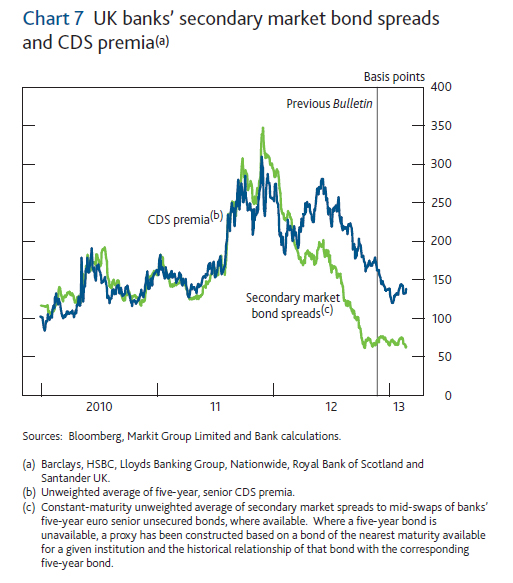
Click for Big

The lack of primary issuance has made it difficult to know for certain at what cost UK banks would be able to finance themselves were they to issue new debt. Available secondary market bond spreads imply that there has been little change in the cost of market funding over the period (Chart 7).

Meanwhile, UK bank credit default swap (CDS) premia, which represent the cost of insuring against default on bank debt, and are sometimes used as an indicative measure of long-term wholesale market funding costs, have fallen (Chart 7). But they remain well above comparable secondary market bond spreads. That gap reflects, in large part, the lack of supply of cash bonds, in conjunction with limited arbitrage between the cash and CDS markets. On balance, while contacts tend to consider secondary market spreads to be a better proxy of bank funding costs than CDS, it may be that secondary spreads would rise were banks to begin to issue more debt.

Stacey Anderson, Jean-Philippe Dion and Hector Perez Saiz have published a BoC Working Paper titled To Link or Not To Link? Netting and Exposures Between Central Counterparties:

This paper provides a framework to compare linked and unlinked CCP configurations in terms of total netting achieved by market participants and the total system default exposures that exist between participants and CCPs. A total system perspective, taking both market participant and CCP exposures into account, is required to answer an important policy question faced by some smaller jurisdictions: whether or not to consider linking a domestic CCP with one or more offshore CCPs. Generally, a single global CCP results in the lowest total system exposure as it allows for multilateral netting across all participants while avoiding the creation of inter-CCP exposures via links. However, global clearing may not be appropriate for all markets. Using a two country model, with a global CCP serving both markets and a local CCP clearing only domestic country participants’ transactions, we show that establishing links between two CCPs leads to higher exposures for the domestic CCP and can result in a decrease in overall netting efficiency and higher total system exposures when the number of participants at the local CCP is small relative to the number of participants at the global CCP. As the relative weight applied by decision makers to CCP exposures as compared to market participants’ exposures increases, so does the number of domestic participants required to make the linked case preferred from a total system perspective. Our results imply that the establishment of a link between a small domestic CCP and a larger global CCP is unlikely to be desirable from a total system perspective in the majority of cases.

Establishing links between CCPs in di¤erent jurisdictions could allow any of the above mentioned lost netting opportunities to be regained. Links are contractual agreements whereby two CCPs agree to multilaterally net exposures across their combined membership. Market participants, through their access to a linked domestic CCP, would therefore net exposures across a broader range of counterparties. The creation of links between CCPs does, however, pose challenges. By creating credit exposures between CCPs themselves, links create new channels for risk propagation. If a linked CCP were to default, the surviving CCP would need to ful…ll the contractual obligations of cleared contracts to its members. Although not the subject of this paper, links may also create oversight challenges due to additional operational, legal and liquidity risks and increase complexity while reducing the transparency of exposures in the clearing system (CGFS (2011)).

I am pleased to see an acknowledgement that placing all of one’s eggs in a single Too Big To Fail basket is not necessarily a wonderful idea. Perhaps at some point the Bank will sponsor research into risk propogation via CCPs, but I’m not holding my breath on that one.

There’s an interesting point in Rohinton Medhora’s Global rankings: Although inequality between countries is falling, inequality within countries is rising:

>First, integral to the rise of the South is the growth of a middle class the world over. Citing a Brookings Institution study, the UN report estimates that the middle class numbered 1.8 billion in 2009, about one billion of whom lived in Europe and North America. Globally, the number is expected to rise to 3.3 billion in 2020 and 4.9 billion in 2030, the entire growth occurring in Asia, Africa and Latin America.

At the same time, although inequality between countries is falling, inequality within countries – especially the growth success stories such as China and India – is rising.

Just like their counterparts in developed countries, policymakers in developing countries will increasingly be preoccupied with managing middle-class vulnerability. Their challenge will be to fight inequality, not poverty, so as to preserve political stability.

So now, instead of the also-rans in rich countries living well by sponging off the local hot-shots at the expense of everybody in poor countries, we now have more localized inequality that can’t be enforced militarily. It will be most interesting to see how the localized tension plays out…

On an obscurely related note, I had great fun today arguing in favour of a downtown casino in the Globe’s comments section. My comment is the most disliked comment of all – the place of honour!

DBRS confirmed Enbridge Gas Distribution at Pfd-2(low):

EGD’s low business risk profile is supported by a large customer base (approximately two million customers, the largest in Canada), which has allowed the Company to achieve operational efficiency and generate stable earnings and cash flow. In 2013, the rebasing year, EGD’s approved return on equity increased to 8.93% (8.39% in 2012) and distribution rates increased to $1,021 million ($1,004 million in 2012). However, the deemed equity component of the Company’s capital structure remained unchanged at 36%. The Company benefits from a stable regulatory system, having no exposure to gas price risk in Ontario, where it generates approximately 98% of its revenue. EGD’s franchise area (largely in the Greater Toronto Area) is viewed as one of the most rapidly growing and economically strong service areas in Canada. Approximately 94% of the Company’s earnings are generated from relatively stable regulated distribution, transportation and storage business. The remainder is generated from the unregulated storage business, which benefits from strong demand due to its strategic locations.

Note that Enbridge Gas Distribution is a different company than Enbridge Inc., which is its parent:

The Company owns 100% of the outstanding common shares of EGD; however, the four million Cumulative Redeemable EGD Preferred Shares held by third parties are entitled to a claim on the assets of EGD prior to the common shareholder. The preferred shares have no fixed maturity date and have floating adjustable cash dividends that are payable at 80% of the prime rate. EGD may, at is option, redeem all or a portion of the outstanding shares for $25 per share plus all accrued and unpaid dividends to the redemption date. As at December 31, 2012, no preferred shares have been redeemed.

EGD’s Annual Report (SEDAR) states these are:

Group 3, Series D, Fixed / Floating Cumulative Redeemable
Convertible

There are four million oustanding at $25.

It was a mixed day for the Canadian preferred share market, with PerpetualPremiums up 11bp, FixedResets down 13bp and DeemedRetractibles gaining 4bp. Volatility was low. Volume was below average.

HIMIPref™ Preferred Indices
These values reflect the December 2008 revision of the HIMIPref™ Indices

Values are provisional and are finalized monthly
Index Mean
Current
Yield
(at bid)
Median
YTW
Median
Average
Trading
Value
Median
Mod Dur
(YTW)
Issues Day’s Perf. Index Value
Ratchet 0.00 % 0.00 % 0 0.00 0 0.3698 % 2,624.6
FixedFloater 4.13 % 3.47 % 31,598 18.34 1 -0.4329 % 3,937.4
Floater 2.55 % 2.83 % 87,558 20.16 5 0.3698 % 2,833.9
OpRet 4.82 % 3.11 % 59,413 0.29 5 0.0466 % 2,600.0
SplitShare 4.28 % 4.04 % 719,064 4.21 4 -0.1200 % 2,939.5
Interest-Bearing 0.00 % 0.00 % 0 0.00 0 0.0466 % 2,377.4
Perpetual-Premium 5.20 % 1.81 % 90,030 0.13 31 0.1142 % 2,361.2
Perpetual-Discount 4.84 % 4.83 % 163,259 15.79 4 0.0610 % 2,662.5
FixedReset 4.90 % 2.67 % 288,073 3.47 80 -0.1263 % 2,509.8
Deemed-Retractible 4.87 % 2.31 % 135,994 0.36 44 0.0441 % 2,446.0
Performance Highlights
Issue Index Change Notes
MFC.PR.G FixedReset -1.13 % YTW SCENARIO
Maturity Type : Call
Maturity Date : 2016-12-19
Maturity Price : 25.00
Evaluated at bid price : 26.30
Bid-YTW : 2.93 %
CIU.PR.A Perpetual-Premium 1.12 % YTW SCENARIO
Maturity Type : Limit Maturity
Maturity Date : 2043-03-15
Maturity Price : 24.89
Evaluated at bid price : 25.23
Bid-YTW : 4.57 %
BAM.PR.C Floater 2.55 % YTW SCENARIO
Maturity Type : Limit Maturity
Maturity Date : 2043-03-15
Maturity Price : 18.47
Evaluated at bid price : 18.47
Bid-YTW : 2.83 %
Volume Highlights
Issue Index Shares
Traded
Notes
BNA.PR.C SplitShare 78,546 RBC crossed blocks of 23,400 and 50,000, both at 24.80.
YTW SCENARIO
Maturity Type : Hard Maturity
Maturity Date : 2019-01-10
Maturity Price : 25.00
Evaluated at bid price : 24.83
Bid-YTW : 4.53 %
BAM.PR.M Perpetual-Discount 46,799 Scotia crossed 35,600 at 24.52.
YTW SCENARIO
Maturity Type : Limit Maturity
Maturity Date : 2043-03-15
Maturity Price : 24.03
Evaluated at bid price : 24.50
Bid-YTW : 4.83 %
PWF.PR.S Perpetual-Discount 44,488 Recent new issue.
YTW SCENARIO
Maturity Type : Limit Maturity
Maturity Date : 2043-03-15
Maturity Price : 24.66
Evaluated at bid price : 25.06
Bid-YTW : 4.81 %
TRP.PR.D FixedReset 40,605 Recent new issue.
YTW SCENARIO
Maturity Type : Limit Maturity
Maturity Date : 2043-03-15
Maturity Price : 23.28
Evaluated at bid price : 25.58
Bid-YTW : 3.55 %
BAM.PR.R FixedReset 36,190 Scotia crossed 30,000 at 26.78.
YTW SCENARIO
Maturity Type : Call
Maturity Date : 2016-06-30
Maturity Price : 25.00
Evaluated at bid price : 26.67
Bid-YTW : 3.19 %
CM.PR.E Perpetual-Premium 32,759 Nesbitt crossed 25,000 at 25.82.
YTW SCENARIO
Maturity Type : Call
Maturity Date : 2013-04-14
Maturity Price : 25.00
Evaluated at bid price : 25.77
Bid-YTW : -21.90 %
There were 25 other index-included issues trading in excess of 10,000 shares.
Wide Spread Highlights
Issue Index Quote Data and Yield Notes
IAG.PR.F Deemed-Retractible Quote: 26.90 – 27.37
Spot Rate : 0.4700
Average : 0.2598

YTW SCENARIO
Maturity Type : Call
Maturity Date : 2015-03-31
Maturity Price : 26.00
Evaluated at bid price : 26.90
Bid-YTW : 3.78 %

MFC.PR.G FixedReset Quote: 26.30 – 26.58
Spot Rate : 0.2800
Average : 0.1774

YTW SCENARIO
Maturity Type : Call
Maturity Date : 2016-12-19
Maturity Price : 25.00
Evaluated at bid price : 26.30
Bid-YTW : 2.93 %

MFC.PR.F FixedReset Quote: 25.46 – 25.74
Spot Rate : 0.2800
Average : 0.1828

YTW SCENARIO
Maturity Type : Hard Maturity
Maturity Date : 2022-01-31
Maturity Price : 25.00
Evaluated at bid price : 25.46
Bid-YTW : 3.06 %

PWF.PR.H Perpetual-Premium Quote: 25.99 – 26.24
Spot Rate : 0.2500
Average : 0.1591

YTW SCENARIO
Maturity Type : Call
Maturity Date : 2013-04-14
Maturity Price : 25.00
Evaluated at bid price : 25.99
Bid-YTW : -30.90 %

RY.PR.Y FixedReset Quote: 26.77 – 26.99
Spot Rate : 0.2200
Average : 0.1372

YTW SCENARIO
Maturity Type : Call
Maturity Date : 2014-11-24
Maturity Price : 25.00
Evaluated at bid price : 26.77
Bid-YTW : 2.05 %

TRI.PR.B Floater Quote: 24.02 – 24.36
Spot Rate : 0.3400
Average : 0.2578

YTW SCENARIO
Maturity Type : Limit Maturity
Maturity Date : 2043-03-15
Maturity Price : 23.71
Evaluated at bid price : 24.02
Bid-YTW : 2.15 %

Market Action

March 14, 2013

To the astonishment of many, a Senate committee criticized a bank:

JPMorgan Chase & Co. (JPM) Chief Executive Officer Jamie Dimon sought to hide escalating trading losses that surpassed $6.2 billion, misled investors and dodged regulators as a “monstrous” derivatives bet deteriorated last year, a Senate probe found.

The largest U.S. bank “mischaracterized high-risk trading as hedging,” and withheld key information from its primary regulator, sometimes at Dimon’s behest, according to a report yesterday by the Senate Permanent Subcommittee on Investigations. The 301-page document also shows how managers manipulated internal risk models and pressured traders to overvalue their positions in an effort to hide growing losses in a credit derivatives portfolio in London.

“We found a trading operation that piled on risk, ignored limits on risk taking, hid losses, dodged oversight and misinformed the public,” Chairman Carl Levin, a Michigan Democrat, told reporters yesterday after his investigators spent nine months combing through 90,000 documents and interviewing current and former executives.

The full report is available on the committee’s website. The conclusion is fore-ordained:

The JPMorgan Chase whale trades provide a startling and instructive case history of how synthetic credit derivatives have become a multi-billion dollar source of risk within the U.S. banking system. They also demonstrate how inadequate derivative valuation practices enabled traders to hide substantial losses for months at a time; lax hedging practices obscured whether derivatives were being used to offset risk or take risk; risk limit breaches were routinely disregarded; risk evaluation models were manipulated to downplay risk; inadequate regulatory oversight was too easily dodged or stonewalled; and derivative trading and financial results were misrepresented to investors, regulators, policymakers, and the taxpaying public who, when banks lose big, may be required to finance multi-billion-dollar bailouts.

However, there are points of interest for the connoisseur. It appears that gross incompetence in back- and mid- offices is still just as much a problem as it ever was:

For five days, from March 12 to 16, 2012, Mr. Grout prepared a spreadsheet tracking the differences between the daily SCP values he was reporting and the values that would have been reported using midpoint prices. According to the spreadsheet, by March 16, 2012, the Synthetic Credit Portfolio had reported year-to-date losses of $161 million, but if midpoint prices had been used, those losses would have swelled by another $432 million to a total of $593 million.

One result of the CIO’s using more favorable valuations was that two different business lines within JPMorgan Chase, the Chief Investment Office and the Investment Bank, assigned different values to identical credit derivative holdings. Beginning in March 2012, as CIO counterparties learned of the price differences, several objected to the CIO’s values, resulting in collateral disputes peaking at $690 million. In May, the bank’s Deputy Chief Risk Officer Ashley Bacon directed the CIO to mark its books in the same manner as the Investment Bank, which used an independent pricing service to identify the midpoints in the relevant price ranges. That change in valuation methodology resolved the collateral valuation disputes in favor of the CIO’s counterparties and, at the same time, put an end to the mismarking.

According to Ina Drew, the large collateral disputes generated a series of questions internally about the CIO’s valuation process. She told the Subcommittee that Jamie Dimon “felt that one way to find out [about the validity of the disputes] was to ask [head of the CIO’s International Office] Mr. Macris, [head of the CIO’s equity and credit trading operation] Mr. Martin, and [senior CIO trader] Mr. Iksil to narrow the bid-offer spreads.

Two months to resolve a collateral deficiency? and at J.P. Morgan, collateral disputes being resolved by the trading department? Ridiculous.

Westjet hopes to have seen the last of Ottawa’s golden boys:

Competitor WestJet Airlines Ltd., which has a very different pension structure based on share purchase plans rather than Air Canada’s more traditional pension packages, opposed the arrangement. “While we recognize this has been a difficult decision for the government, we are disappointed with this announcement,” said WestJet president and chief executive officer Gregg Saretsky.

“We are supportive of a strong and competitive aviation industry in Canada. To that end, we trust this marks the end of special treatment for Air Canada as such treatment at the expense of other industry players has become too common,” he added in a written statement.

They (and we) will be lucky. Air Canada isn’t good at much, but it is good at sucking federal arse.

Capital Power Corporation, proud issuer of CPX.PR.A, CPX.PR.C and the new CPX.PR.E, was confirmed today at Pfd-3(low) by DBRS:

DBRS has today confirmed the ratings of the Preferred Shares of Capital Power Corporation (CPC or the Company) at Pfd-3 (low) with a Stable trend. CPC’s preferred shares rating is based on the credit quality of its subsidiary, Capital Power L.P. (CPLP; rated BBB). The one-notch differential in the ratings of CPC and CPLP reflects structural subordination at CPC, which is largely dependent on its own resources and dividends from CPLP. Dividends from CPLP could be curtailed if the viability of CPLP needs to be safeguarded.

CPC has no debt issued at the parent level and is not expected to issue any debt in the foreseeable future. In March 2013, CPC issued $200 million of preferred shares, with the net proceeds (approximately $194 million) to be lent to CPLP to repay the outstanding balance under its credit facilities and to finance growth projects, including the Shepard Energy Centre. Pro forma the $194 million issuance, CPC will have $462 million of preferred shares outstanding, $131 million of which is treated as debt by DBRS in CPC’s adjusted debt-to-capital calculation (with a pro forma adjusted debt-to-capital ratio of approximately 6%). In the adjusted debt-to-capital calculation, the amount of preferred shares over the 20% preferred shares-to-equity threshold (defined as the percentage of preferred shares outstanding divided by total equity, excluding preferreds and minority interest) is treated as debt. CPC’s adjusted debt-to-capital ratio remains in line with its rating category. In addition, the pro forma unconsolidated fixed charge coverage ratio is expected to remain high, at above five times.

It was a mixed day for the Canadian preferred share market, with PerpetualPremiums gaining 3bp, FixedResets down 8bp and DeemedRetractibles off 1bp. Volatility was minimal, but the floaters continue their usual gyrations. Volume was average.

HIMIPref™ Preferred Indices
These values reflect the December 2008 revision of the HIMIPref™ Indices

Values are provisional and are finalized monthly
Index Mean
Current
Yield
(at bid)
Median
YTW
Median
Average
Trading
Value
Median
Mod Dur
(YTW)
Issues Day’s Perf. Index Value
Ratchet 0.00 % 0.00 % 0 0.00 0 -0.0269 % 2,615.0
FixedFloater 4.11 % 3.45 % 31,310 18.37 1 -0.5168 % 3,954.6
Floater 2.55 % 2.84 % 88,192 20.16 5 -0.0269 % 2,823.5
OpRet 4.82 % 3.28 % 56,987 0.46 5 0.0311 % 2,598.7
SplitShare 4.28 % 4.00 % 719,575 4.22 4 0.2778 % 2,943.0
Interest-Bearing 0.00 % 0.00 % 0 0.00 0 0.0311 % 2,376.3
Perpetual-Premium 5.20 % 1.80 % 87,725 0.13 31 0.0300 % 2,358.5
Perpetual-Discount 4.84 % 4.83 % 154,227 15.79 4 -0.2028 % 2,660.9
FixedReset 4.89 % 2.64 % 289,627 3.31 80 -0.0758 % 2,513.0
Deemed-Retractible 4.87 % 2.23 % 136,940 0.44 44 -0.0123 % 2,444.9
Performance Highlights
Issue Index Change Notes
BAM.PR.C Floater -2.12 % YTW SCENARIO
Maturity Type : Limit Maturity
Maturity Date : 2043-03-14
Maturity Price : 18.01
Evaluated at bid price : 18.01
Bid-YTW : 2.91 %
FTS.PR.H FixedReset -1.07 % YTW SCENARIO
Maturity Type : Call
Maturity Date : 2015-06-01
Maturity Price : 25.00
Evaluated at bid price : 25.91
Bid-YTW : 2.63 %
TRI.PR.B Floater 1.09 % YTW SCENARIO
Maturity Type : Limit Maturity
Maturity Date : 2043-03-14
Maturity Price : 23.95
Evaluated at bid price : 24.20
Bid-YTW : 2.13 %
Volume Highlights
Issue Index Shares
Traded
Notes
RY.PR.T FixedReset 60,778 TD crossed 50,000 at 26.60.
YTW SCENARIO
Maturity Type : Call
Maturity Date : 2014-08-24
Maturity Price : 25.00
Evaluated at bid price : 26.61
Bid-YTW : 1.97 %
TRP.PR.D FixedReset 55,096 Recent new issue.
YTW SCENARIO
Maturity Type : Limit Maturity
Maturity Date : 2043-03-14
Maturity Price : 23.29
Evaluated at bid price : 25.61
Bid-YTW : 3.55 %
HSB.PR.E FixedReset 54,470 Desjardins crossed 16,200 at 26.37; RBC bought 19,800 from National at 26.40.
YTW SCENARIO
Maturity Type : Call
Maturity Date : 2014-06-30
Maturity Price : 25.00
Evaluated at bid price : 26.37
Bid-YTW : 2.06 %
RY.PR.X FixedReset 39,150 Scotia crossed 34,600 at 26.63.
YTW SCENARIO
Maturity Type : Call
Maturity Date : 2014-08-24
Maturity Price : 25.00
Evaluated at bid price : 26.63
Bid-YTW : 1.92 %
PWF.PR.S Perpetual-Discount 38,185 Recent new issue.
YTW SCENARIO
Maturity Type : Limit Maturity
Maturity Date : 2043-03-14
Maturity Price : 24.62
Evaluated at bid price : 25.01
Bid-YTW : 4.81 %
ENB.PR.T FixedReset 27,588 YTW SCENARIO
Maturity Type : Call
Maturity Date : 2019-06-01
Maturity Price : 25.00
Evaluated at bid price : 25.68
Bid-YTW : 3.55 %
There were 34 other index-included issues trading in excess of 10,000 shares.
Wide Spread Highlights
Issue Index Quote Data and Yield Notes
BAM.PR.C Floater Quote: 18.01 – 18.51
Spot Rate : 0.5000
Average : 0.3357

YTW SCENARIO
Maturity Type : Limit Maturity
Maturity Date : 2043-03-14
Maturity Price : 18.01
Evaluated at bid price : 18.01
Bid-YTW : 2.91 %

FTS.PR.H FixedReset Quote: 25.91 – 26.28
Spot Rate : 0.3700
Average : 0.2273

YTW SCENARIO
Maturity Type : Call
Maturity Date : 2015-06-01
Maturity Price : 25.00
Evaluated at bid price : 25.91
Bid-YTW : 2.63 %

PWF.PR.O Perpetual-Premium Quote: 26.66 – 26.96
Spot Rate : 0.3000
Average : 0.1988

YTW SCENARIO
Maturity Type : Call
Maturity Date : 2014-10-31
Maturity Price : 26.00
Evaluated at bid price : 26.66
Bid-YTW : 4.40 %

ENB.PR.A Perpetual-Premium Quote: 26.23 – 26.49
Spot Rate : 0.2600
Average : 0.1753

YTW SCENARIO
Maturity Type : Call
Maturity Date : 2013-04-13
Maturity Price : 25.00
Evaluated at bid price : 26.23
Bid-YTW : -44.72 %

ENB.PR.B FixedReset Quote: 25.88 – 26.10
Spot Rate : 0.2200
Average : 0.1380

YTW SCENARIO
Maturity Type : Call
Maturity Date : 2017-06-01
Maturity Price : 25.00
Evaluated at bid price : 25.88
Bid-YTW : 3.15 %

BNS.PR.R FixedReset Quote: 25.55 – 25.76
Spot Rate : 0.2100
Average : 0.1312

YTW SCENARIO
Maturity Type : Call
Maturity Date : 2014-01-26
Maturity Price : 25.00
Evaluated at bid price : 25.55
Bid-YTW : 3.11 %

Issue Comments

CPX.PR.E Soft On Moderate Volume

Capital Power Corporation has announced:

that it has closed its previously announced offering of 8,000,000 Cumulative Rate Reset Preference Shares, Series 5 (the “Series 5 Shares”) at a price of $25 per Series 5 Share for aggregate gross proceeds of $200 million on a bought deal basis with a syndicate of underwriters, led by RBC Capital Markets and Scotiabank.

The Series 5 Shares will begin trading today on the TSX under the symbol CPX.PR.E.

CPX.PR.E is a FixedReset, 4.50%+315, announced March 5. It will be tracked by HIMIPref™ but relegated to the Scraps index on credit concerns.

The issue traded 287,695 shares today in a range of 24.84-95 before closing at 24.88-89, 38×4.

Vital statistics are:

CPX.PR.E FixedReset YTW SCENARIO
Maturity Type : Limit Maturity
Maturity Date : 2043-03-14
Maturity Price : 23.10
Evaluated at bid price : 24.88
Bid-YTW : 4.41 %
Issue Comments

RON.PR.A Hammered In Wake Of Downgrade

Yesterday RON.PR.A closed at 25.61-71, with a YTW of 4.01%-3.98% to perpetuity.

After the close it was downgraded to Pfd-4(high) by DBRS.

Today it closed at 21.85-25, with a YTW of 4.77%-4.65% to perpetuity. It went ex-dividend for 0.328125, but this still represents a decline of 13.40%.

It is interesting to speculate as to whether this is all due to the normal reaction of retail to a downgrade, or whether it might reflect institutional players positioning themselves for the removal of this issue from the indices at the next rebalancing. There’s going to be an awful lot of forced selling – and for an issue rated Pfd-4(high) by DBRS, the field of potential buyers will be more restricted than is usually the case when issues are removed from the indices on grounds of volume.

ZPR is comprised 0.51% of RON.PR.A and is a $345.3-million fund, so that’s $1.76-million worth, or about 68,800 shares (at yesterday’s prices).

CPD is comprised 0.33% of RON.PR.A which the fund helpfully points out is worth $5,075,673, or 198,200 shares. (CPD is worth $1,453-million now. Wow!)

So that’s a total of 267,000 shares in these two funds alone and there are 6-million shares outstanding, so that’s about 4.5% of the entire issue. To put it another way, HIMIPref™ calculates that the Average Trading Value (which deprecates isolated block trades) is about $164,000 per day, or about 6,400 shares. In other words, over forty days worth of trading will hit the market on the next index rebalancing. Now, that’s what I call a flood!

It will be recalled that the Quebec government thinks RONA is a superb investment:

Pity the long-suffering Rona shareholder.

It’s been a rough descent for the stock from its $25 high nearly five years ago. And now the company’s board and the Quebec government have blocked investors’ quickest way out — a $14.50 per share non-binding bid by U.S.-based Lowe’s Companies Inc. [nb: RON closed today, 2013-3-13, at $11.04]

“It’s important that we build wealth in Quebec, that we reverse our poor standing in Canada,” CAQ leader François Legault said Tuesday, adding his party would support the PQ government agenda on a case by case basis.

During the campaign, [Parti Québécois leader] Ms. [Pauline] Marois proposed making the Caisse create a special $10-billion fund it would use to add to its existing stable of Quebec-based investments, which are worth some $43-billion. The PQ is taking as inspiration France’s Fonds stratégique d’investissement, a state sovereign fund created by former President Nicolas Sarkozy in 2008.

Mr. Legault wants the Caisse to invest $20-billion in 25 strategic Quebec companies with the goal of giving the pension fund a “blocking minority” stake sufficient to help counter any hostile takeover attempt.

Maybe the Caisse will buy the shares! Investing in declining companies sounds like a wonderful way to build wealth!

Market Action

March 13, 2013

Boyd Erman made some good points on mortgages yesterday:

Imagine the federal government lauding cellphone carriers for keeping rates high, or airlines for declining to match each other’s fare cuts. There would be an outcry. Yet Finance Minister Jim Flaherty congratulates banks for not competing to offer the best loan price on what will likely be the biggest purchase most Canadians’ ever make, their home, and nobody can gin up much outrage.

Mortgage debt seems to becoming one of those perceived ills, like booze and cigarettes, where the government not only regulates how they can be sold, but sets minimum prices aimed at preventing people from overindulging. If that’s the case, maybe the government ought to come right out and say it.

I don’t agree with everything he said, but by and large – well done, Mr. Erman!

I mentioned the Too-Big-To-Fail subsidy on March 11 and complained that the banks’ rebuttal of estimates of the subsidy’s size was not available. Well, it has finally been released:

the Financial Services Forum, the Financial Services Roundtable, The Clearing House, Securities Industry and Financial Markets Association, and the American Bankers Association, released the following policy brief in response to questionable assertions of a “taxpayer subsidy” to large banks. The following points should be kept in mind:

  • The recent estimation that large banking companies enjoy a subsidy worth $83 billion is based on a flawed methodology, and on the extrapolation of stale and unreliable financial market data collected before passage of the Dodd-Frank Act.
  • An IMF analysis completed in 2010 – before passage of Dodd-Frank – estimated the cost of funding advantage enjoyed by large banking companies to be only “about 20 basis points on average.”
  • Several more recent studies indicate that, since the passage of Dodd-Frank, any cost of funding advantage has been dramatically reduced or even eliminated. In fact, two recent studies conclude that markets are now imposing a cost of funding premium on large banks of up to 35 basis points.

Bloomberg’s editors continue the debate:

Finally, the two papers by Cyree and Balasubramnian represent good-faith efforts that the authors readily admit are far from ideal. They found that big banks’ borrowing costs increased relative to those of small banks in the second half of 2010, and attributed the change to Dodd-Frank’s elimination of the subsidy. They employed data on 30 banks, only 11 of which were not too big to fail, a small sample that might have skewed the estimated funding advantages of the bigger institutions. Also, their statistical controls could have missed important factors — such as the brewing European debt crisis — that might have had a differential effect on the borrowing costs of the biggest banks.

As Cyree put it: “I can’t tell you that this is strictly due to Dodd-Frank.”

Of course, no statistical study is perfect, particularly when dealing with something as difficult to estimate as the bank subsidy. That said, a paper by three economists — Viral Acharya of New York University, Deniz Anginer of Virginia Tech and A. Joseph Warburton of Syracuse University — looked at a larger sample of financial institutions and found that the too-big-to-fail subsidy amounted to almost $100 billion in 2010, the year Dodd-Frank was signed into law. The paper also included a separate test, which looked at bond yields immediately before and after the House and Senate reconciled their versions of the bill. It suggested that Dodd-Frank might have actually increased the subsidy.

One thing Bloomberg pointed out was a cheap-shot by the bank lobbyists:

Given these analytic shortcomings, it is not surprising that the title page of the paper bears a boxed disclaimer stating in bold font: “This working paper should not be reported as representing the views of the IMF.”

Bloomberg points out:

The disclaimer is standard boilerplate for IMF working papers.

I’m not aware of any central-bank-style research that does not carry such a disclaimer. The banks’ attempt to make it appear to be a deliberate distancing of the IMF from the research does nothing but harm their own credibility.

It would appear that there are now so many regulators they can’t all be hired by banks, so they’re widening the net:

A series of proposed rule changes from the country’s securities regulators would make hostile takeover bids harder to pull off, tightening a regime critics say has rendered corporate Canada easy hunting grounds for U.S. hedge funds.

On Wednesday, the Canadian Securities Administrators (CSA), which is the umbrella group for Canada’s provincial market watchdogs, officially unveiled its proposal to lower the “early warning” stock ownership threshold that forces would-be hostile takeover bidders to disclose their holdings in a target company. As previously reported in The Globe, bidders would have to go public after acquiring 5 per cent of a target company’s shares, down from 10 per cent. The CSA says the change would improve “market transparency.”

And on Thursday, the CSA will formally unveil a long-awaited proposal that would strengthen what are known as “poison pills”: tactics used by boards of directors to try to fend off hostile takeover bidders. The plan would see securities regulators allow companies to use poison pills indefinitely, provided they are approved by shareholders at the most recent annual meeting or at a special meeting held in the face of a hostile bid.

It was a mild day for the Canadian preferred share market (except for RON.PR.A!), with PerpetualPremiums flat, FixedResets off 4bp and DeemedRetractibles down 5bp. Volatility was muted. Volume was average.

PerpetualDiscounts now yield 4.82%, equivalent to 6.27% interest at the standard equivalency factor of 1.3x. Long corporates now yield about 4.35%, so the pre-tax interest-equivalent spread (in this context, the “Seniority Spread”) is now about 210bp, unchanged from the figure reported on March 6.

HIMIPref™ Preferred Indices
These values reflect the December 2008 revision of the HIMIPref™ Indices

Values are provisional and are finalized monthly
Index Mean
Current
Yield
(at bid)
Median
YTW
Median
Average
Trading
Value
Median
Mod Dur
(YTW)
Issues Day’s Perf. Index Value
Ratchet 0.00 % 0.00 % 0 0.00 0 -0.0157 % 2,615.7
FixedFloater 4.09 % 3.43 % 28,979 18.42 1 0.0862 % 3,975.1
Floater 2.55 % 2.84 % 88,453 20.15 5 -0.0157 % 2,824.2
OpRet 4.82 % 3.31 % 55,311 0.46 5 -0.0618 % 2,597.9
SplitShare 4.29 % 4.11 % 720,756 4.22 4 0.0227 % 2,934.8
Interest-Bearing 0.00 % 0.00 % 0 0.00 0 -0.0618 % 2,375.6
Perpetual-Premium 5.21 % 1.69 % 90,101 0.58 31 -0.0029 % 2,357.8
Perpetual-Discount 4.83 % 4.82 % 151,739 15.79 4 0.2565 % 2,666.3
FixedReset 4.89 % 2.55 % 291,039 3.31 80 -0.0374 % 2,514.9
Deemed-Retractible 4.87 % 2.86 % 137,140 0.62 44 -0.0492 % 2,445.2
Performance Highlights
Issue Index Change Notes
TRI.PR.B Floater -1.19 % YTW SCENARIO
Maturity Type : Limit Maturity
Maturity Date : 2043-03-13
Maturity Price : 23.82
Evaluated at bid price : 24.07
Bid-YTW : 2.17 %
PWF.PR.P FixedReset -1.07 % YTW SCENARIO
Maturity Type : Limit Maturity
Maturity Date : 2043-03-13
Maturity Price : 23.70
Evaluated at bid price : 25.97
Bid-YTW : 2.84 %
HSB.PR.D Deemed-Retractible 1.25 % YTW SCENARIO
Maturity Type : Call
Maturity Date : 2013-04-12
Maturity Price : 25.50
Evaluated at bid price : 25.90
Bid-YTW : -16.44 %
Volume Highlights
Issue Index Shares
Traded
Notes
TRP.PR.D FixedReset 105,804 Recent new issue.
YTW SCENARIO
Maturity Type : Limit Maturity
Maturity Date : 2043-03-13
Maturity Price : 23.27
Evaluated at bid price : 25.55
Bid-YTW : 3.56 %
PWF.PR.S Perpetual-Discount 73,424 Recent new issue.
YTW SCENARIO
Maturity Type : Limit Maturity
Maturity Date : 2043-03-13
Maturity Price : 24.61
Evaluated at bid price : 25.00
Bid-YTW : 4.82 %
TD.PR.G FixedReset 55,575 Scotia crossed 50,000 at 26.43.
YTW SCENARIO
Maturity Type : Call
Maturity Date : 2014-04-30
Maturity Price : 25.00
Evaluated at bid price : 26.45
Bid-YTW : 1.68 %
ENB.PR.F FixedReset 54,569 Nesbitt crossed 40,000 at 26.02.
YTW SCENARIO
Maturity Type : Call
Maturity Date : 2018-06-01
Maturity Price : 25.00
Evaluated at bid price : 25.87
Bid-YTW : 3.31 %
FTS.PR.C OpRet 36,755 Desjardins crossed 30,500 at 25.23.
YTW SCENARIO
Maturity Type : Soft Maturity
Maturity Date : 2013-08-31
Maturity Price : 25.00
Evaluated at bid price : 25.22
Bid-YTW : 3.93 %
RY.PR.P FixedReset 34,203 RBC crossed 25,000 at 26.05.
YTW SCENARIO
Maturity Type : Call
Maturity Date : 2014-02-24
Maturity Price : 25.00
Evaluated at bid price : 26.04
Bid-YTW : 2.16 %
There were 36 other index-included issues trading in excess of 10,000 shares.
Wide Spread Highlights
Issue Index Quote Data and Yield Notes
TCA.PR.X Perpetual-Premium Quote: 51.17 – 51.65
Spot Rate : 0.4800
Average : 0.3441

YTW SCENARIO
Maturity Type : Call
Maturity Date : 2013-10-15
Maturity Price : 50.00
Evaluated at bid price : 51.17
Bid-YTW : 2.70 %

TRI.PR.B Floater Quote: 24.07 – 24.40
Spot Rate : 0.3300
Average : 0.2310

YTW SCENARIO
Maturity Type : Limit Maturity
Maturity Date : 2043-03-13
Maturity Price : 23.82
Evaluated at bid price : 24.07
Bid-YTW : 2.17 %

IAG.PR.A Deemed-Retractible Quote: 24.88 – 25.11
Spot Rate : 0.2300
Average : 0.1312

YTW SCENARIO
Maturity Type : Hard Maturity
Maturity Date : 2022-01-31
Maturity Price : 25.00
Evaluated at bid price : 24.88
Bid-YTW : 4.66 %

ABK.PR.C SplitShare Quote: 32.00 – 32.24
Spot Rate : 0.2400
Average : 0.1474

YTW SCENARIO
Maturity Type : Call
Maturity Date : 2014-03-10
Maturity Price : 31.64
Evaluated at bid price : 32.00
Bid-YTW : 2.86 %

FTS.PR.E OpRet Quote: 26.37 – 26.66
Spot Rate : 0.2900
Average : 0.2105

YTW SCENARIO
Maturity Type : Call
Maturity Date : 2013-06-01
Maturity Price : 25.75
Evaluated at bid price : 26.37
Bid-YTW : -5.35 %

PWF.PR.P FixedReset Quote: 25.97 – 26.16
Spot Rate : 0.1900
Average : 0.1270

YTW SCENARIO
Maturity Type : Limit Maturity
Maturity Date : 2043-03-13
Maturity Price : 23.70
Evaluated at bid price : 25.97
Bid-YTW : 2.84 %

Market Action

March 12, 2013

The What-Debt? government has given more help to its buddies at Air Canada:

The federal government has approved Air Canada’s request for a reprieve from funding its pension deficit, but has imposed a host of conditions – including a freeze on executive pay and a ban on dividends or share repurchases.

The deal requires the airline to make contributions to the plan of at least $150-million a year totalling at least $1.4-billion over seven years. The special contributions would be on top of the current service payments required by the pension plan.

More micro-managing and more interference in labour relations! This follows a suspension of the right to strike and protection from competition.

It was a fine day for the Canadian preferred share market, with PerpetualPremiums up 9bp, FixedResets winning 20bp and DeemedRetractibles gaining 7bp. Volatility was minimal. Volume was high.

HIMIPref™ Preferred Indices
These values reflect the December 2008 revision of the HIMIPref™ Indices

Values are provisional and are finalized monthly
Index Mean
Current
Yield
(at bid)
Median
YTW
Median
Average
Trading
Value
Median
Mod Dur
(YTW)
Issues Day’s Perf. Index Value
Ratchet 0.00 % 0.00 % 0 0.00 0 0.2523 % 2,616.1
FixedFloater 4.09 % 3.44 % 28,906 18.41 1 -0.4292 % 3,971.7
Floater 2.54 % 2.86 % 88,982 20.01 5 0.2523 % 2,824.7
OpRet 4.80 % 2.34 % 51,224 0.30 5 -0.0540 % 2,599.5
SplitShare 4.29 % 4.04 % 727,784 4.22 4 -0.0299 % 2,934.2
Interest-Bearing 0.00 % 0.00 % 0 0.00 0 -0.0540 % 2,377.0
Perpetual-Premium 5.20 % -0.27 % 90,484 0.09 31 0.0949 % 2,357.9
Perpetual-Discount 4.81 % 4.85 % 150,511 15.63 4 0.0506 % 2,659.5
FixedReset 4.88 % 2.52 % 290,115 3.31 80 0.1955 % 2,515.8
Deemed-Retractible 4.86 % 3.31 % 139,108 0.62 44 0.0679 % 2,446.4
Performance Highlights
Issue Index Change Notes
TRI.PR.B Floater 1.04 % YTW SCENARIO
Maturity Type : Limit Maturity
Maturity Date : 2043-03-12
Maturity Price : 24.10
Evaluated at bid price : 24.36
Bid-YTW : 2.15 %
SLF.PR.G FixedReset 1.34 % YTW SCENARIO
Maturity Type : Hard Maturity
Maturity Date : 2022-01-31
Maturity Price : 25.00
Evaluated at bid price : 25.69
Bid-YTW : 2.78 %
Volume Highlights
Issue Index Shares
Traded
Notes
TRP.PR.D FixedReset 116,365 Recent new issue.
YTW SCENARIO
Maturity Type : Limit Maturity
Maturity Date : 2043-03-12
Maturity Price : 23.25
Evaluated at bid price : 25.47
Bid-YTW : 3.57 %
BNS.PR.T FixedReset 107,475 Nesbitt crossed blocks of 50,000 and 35,000, both at 26.40. TD crossed 15,000 at 26.43.
YTW SCENARIO
Maturity Type : Call
Maturity Date : 2014-04-25
Maturity Price : 25.00
Evaluated at bid price : 26.40
Bid-YTW : 1.80 %
BNS.PR.Q FixedReset 103,475 Desjardins crossed 45,500 at 25.40. RBC crossed 36,500 at the same price.
YTW SCENARIO
Maturity Type : Hard Maturity
Maturity Date : 2022-01-31
Maturity Price : 25.00
Evaluated at bid price : 25.39
Bid-YTW : 3.05 %
BNS.PR.P FixedReset 94,520 Desjardins crossed 50,000 at 25.15.
YTW SCENARIO
Maturity Type : Hard Maturity
Maturity Date : 2022-01-31
Maturity Price : 25.00
Evaluated at bid price : 25.17
Bid-YTW : 3.38 %
ENB.PR.P FixedReset 91,085 TD crossed 10,000 at 25.64; Scotia crossed 50,000 at 25.60.
YTW SCENARIO
Maturity Type : Call
Maturity Date : 2019-03-01
Maturity Price : 25.00
Evaluated at bid price : 25.68
Bid-YTW : 3.53 %
HSE.PR.A FixedReset 72,085 Nesbitt crossed blocks of 40,000 and 12,500, both at 26.85.
YTW SCENARIO
Maturity Type : Call
Maturity Date : 2016-03-31
Maturity Price : 25.00
Evaluated at bid price : 26.80
Bid-YTW : 1.94 %
There were 47 other index-included issues trading in excess of 10,000 shares.
Wide Spread Highlights
Issue Index Quote Data and Yield Notes
PWF.PR.A Floater Quote: 23.66 – 24.50
Spot Rate : 0.8400
Average : 0.7551

YTW SCENARIO
Maturity Type : Limit Maturity
Maturity Date : 2043-03-12
Maturity Price : 23.37
Evaluated at bid price : 23.66
Bid-YTW : 2.20 %

BMO.PR.N FixedReset Quote: 26.24 – 26.44
Spot Rate : 0.2000
Average : 0.1250

YTW SCENARIO
Maturity Type : Call
Maturity Date : 2014-02-25
Maturity Price : 25.00
Evaluated at bid price : 26.24
Bid-YTW : 1.58 %

BAM.PR.R FixedReset Quote: 27.07 – 27.27
Spot Rate : 0.2000
Average : 0.1268

YTW SCENARIO
Maturity Type : Call
Maturity Date : 2016-06-30
Maturity Price : 25.00
Evaluated at bid price : 27.07
Bid-YTW : 3.10 %

TCA.PR.X Perpetual-Premium Quote: 51.20 – 51.46
Spot Rate : 0.2600
Average : 0.1951

YTW SCENARIO
Maturity Type : Call
Maturity Date : 2013-10-15
Maturity Price : 50.00
Evaluated at bid price : 51.20
Bid-YTW : 2.58 %

TCA.PR.Y Perpetual-Premium Quote: 52.10 – 52.30
Spot Rate : 0.2000
Average : 0.1400

YTW SCENARIO
Maturity Type : Call
Maturity Date : 2014-03-05
Maturity Price : 50.00
Evaluated at bid price : 52.10
Bid-YTW : 1.89 %

HSB.PR.D Deemed-Retractible Quote: 25.89 – 26.47
Spot Rate : 0.5800
Average : 0.5231

YTW SCENARIO
Maturity Type : Call
Maturity Date : 2013-04-11
Maturity Price : 25.50
Evaluated at bid price : 25.89
Bid-YTW : -2.04 %

Issue Comments

RON.PR.A Downgraded to Pfd-4(high), Trend Negative by DBRS

DBRS has announced that it:

downgraded the Issuer Rating and Senior Unsecured Debt rating of RONA inc. (RONA or the Company) to BB (high) from BBB (low) and the Preferred Shares rating to Pfd-4 (high) from Pfd-3 (low), maintaining the Negative trend. DBRS has also assigned a recovery rating of RR2 to the Company’s Senior Unsecured Debt.

On May 30, 2012, DBRS confirmed RONA’s Senior Unsecured Debt and Preferred Shares ratings at BBB (low) and Pfd-3 (low), respectively, and maintained the Negative trend. Such rating actions considered the Company’s announced restructuring plans as well as the change in capital structure undertaken with the early repurchase of debentures, but also reflected continued uncertainty with respect to RONA’s ability to improve its operating performance in a challenging consumer and competitive environment. At that time (Q1 F2012), DBRS stated that should RONA not be successful in improving its credit metrics due to weakness in operating income and/or more aggressive-than-expected financial management, a downgrade would likely result.

Subsequent to that statement, RONA released year-end F2012 results, which delivered a net sales increase of 1.7%, flat same-store sales and a significant 40% decline in EBITDA to $171 million versus $285 million in 2011. EBITDA margins were negatively affected by weaker gross margins due to promotional activity in a highly competitive environment and higher selling, general and administrative costs. This marks the third consecutive year of declining EBITDA and EBITDA margins.

As such, combined with an increase in balance-sheet debt to approximately $328 million at year-end 2012 from $257 million the previous year (at least partially due to incremental debt used to complete $67 million of share repurchases in 2012), lease-adjusted debt-to-EBITDAR increased to approximately 3.77 times (x) versus 2.54x in 2011 and 2.80x in 2010 (the improvement in lease-adjusted debt-to-EBITDAR in 2011 was largely attributable to the Company’s repurchase of a portion of its outstanding debentures), while lease-adjusted EBIT coverage declined to 1.51x in 2012 versus 2.26x in 2011 and nearly 3.7x in 2010. Furthermore, the Company’s ability to deleverage over time has weakened considerably as indicated by its free cash flow as a percentage of debt (nearly 18% in 2012 versus approximately 42% in 2011 and 25% in 2010).

DBRS believes that the continued deterioration in operating performance, which has prevented the Company from delivering growth in sales (coupled with margin expansion and weakness in key credit metrics), has resulted in a credit risk profile that is no longer consistent with a BBB (low) Issuer Rating. DBRS believes that the consumer and competitive environment in Canada will remain difficult going forward as The Home Depot, Inc. (rated A (low), Stable) continues its strong performance (five consecutive quarters of positive comparable store sales in Canada) and Lowe’s Companies, Inc. examines continued expansion in Canada to gain necessary scale.

On February 21, 2013, RONA announced further restructuring efforts in the form of its Transformational Strategy, which is expected to span from 2013 to 2015. The plan builds on previous restructuring efforts and includes a rationalization of the Company’s administrative support model, which could ultimately benefit EBITDA by 15% in the near-to-medium term. In addition, RONA plans to enhance the customer experience by improving its merchandising, pricing strategy and in-store service. The Company also plans to optimize its stronger commercial and professional market division and rationalize its underperforming big-box network outside of Québec. Finally, the Company will seek to strengthen and better leverage core markets where profitability has been strong (i.e., distribution to dealers, proximity stores and banners in Québec).

In terms of outlook, DBRS has maintained the trend at Negative as we continue to believe meaningful recovery will remain challenging. RONA is expected to face intense competition in an environment that should remain highly promotional, with consumers facing significant challenges. Although DBRS recognized the merits of RONA’s Transformational Strategy and the cost savings that could result, DBRS expects that a significant improvement in performance will be difficult to realize over the near-to-medium term.

In order for the trend on its credit risk profile to stabilize, RONA would need to demonstrate signs of stabilizing and/or expanding same-store sales and margins leading to a recovery in operating income and return on invested capital, within the context of the Company’s consolidation efforts.

If the Company’s plans and performance lead to stabilization of same-store sales, operating income and key credit metrics, the ratings outlook could stabilize. Continued and meaningful deterioration in same-store sales and/or operating margins and key credit metrics (i.e., lease-adjusted EBIT coverage, free cash flow as a percentage of debt and lease-adjusted debt-to-EBITDAR over 4.0x) in the near-to-medium term could result in another downgrade to BB and Pfd-4.

RON.PR.A was last mentioned on PrefBlog when it was downgraded to Pfd-3(low) in November 2011. RON.PR.A is a FixedReset, 5.25%+265. It is tracked by HIMIPref™ but is relegated to the Scraps index on credit concerns. It closed on 2013-3-11 at 25.61-70 to yield 4.01%-3.99% to perpetuity.

It was also mentioned in the December, 2012, PrefLetter as being a rather peculiar issue for ZPR to be holding (0.51% of portfolio) since the TXPL methodology states:

Rating. Preferred shares must have a minimum rating of P-3 or its equivalent by Standard & Poor’s, Dominion Bank Ratings Service or Moody’s Investor Service.1 If more than one of the ratings agencies has issued a rating on the stock, the lowest rating is used to determine eligibility.

New Issues

New Issue: AX FixedReset 4.75%+330

Artis Real Estate Investment Trust has announced:

that it has entered into an agreement to sell to a syndicate of underwriters led by RBC Capital Markets and CIBC (the “Underwriters”), on a bought deal basis, 2,000,000 Cumulative Rate Reset Preferred Trust Units, Series E (“Series E Units”) at a price of $25.00 per Series E Unit for gross proceeds to Artis of $50,000,000 (the “Financing”). Artis has also granted the Underwriters an option, exercisable at any time up to 48 hours prior to the closing of the Financing, to purchase a further 300,000 Series E Units at the issue price which, if fully exercised, would result in additional gross proceeds of $7,500,000.

The Series E Units will pay fixed cumulative preferential distributions of $1.1875 per Series E Unit per annum, yielding 4.75% per annum, payable on the last day of March, June, September and December of each year, as and when declared by the board of trustees of Artis, for the initial period ending September 30, 2018. The first quarterly distribution, if declared, shall be payable on June 30, 2013 and shall be $0.3286 per Series E Unit, based on the anticipated closing of the offering of Series E Units of March 21, 2013. The distribution rate will be reset on September 30, 2018 and every five years thereafter at a rate equal to the sum of the then five-year Government of Canada bond yield and 3.30%. The Series E Units are redeemable by Artis, at its option, on September 30, 2018 and on September 30 of every fifth year thereafter.

Holders of Series E Units will have the right to reclassify all or any part of their Series E Units as Cumulative Floating Rate Preferred Trust Units, Series F (the “Series F Units”), subject to certain conditions, on September 30, 2018 and on September 30 of every fifth year thereafter. Such reclassification privilege may be subject to certain tax considerations (to be disclosed in the prospectus supplement). Holders of Series F Units will be entitled to receive a floating cumulative preferential distribution, payable on the last day of March, June, September and December of each year, as and when declared by the board of trustees of Artis, at a rate equal to the sum of the then 90-day Government of Canada Treasury Bill yield plus a spread of 3.30%.

DBRS Limited (“DBRS”) has assigned a provisional rating of Pfd-3 (low) to the Series E Units.

The Financing is being made pursuant to the REIT’s base shelf prospectus dated June 15, 2012. The terms of the offering will be described in a prospectus supplement to be filed with Canadian securities regulators. The Financing is expected to close on or about March 21, 2013 and is subject to regulatory approval.

Artis intends to use the net proceeds from the Financing to repay indebtedness, fund future acquisitions, and for general trust purposes.

This issue joins AX.PR.A, a 5.25%+406 FixedReset which was recently added to HIMIPref™ and which closed yesterday at 26.05-15, for a YTW of 4.50%-4.40% to its next Exchange Date.

There will probably be funny taxation of the distributions – see the last paragraph of the first post about AX.PR.A.

Update: As noted by Assiduous Reader adrian2 in the comments the deal has been super-sized to $100-million.

Update, 2013-3-13: Rated Pfd-3(low) by DBRS.