Press Clippings

Carrick: Rising inflation set to shake up sleepy preferreds

Rob Carrick was kind enough to quote me in his Portfolio Strategy column of February 20:

A different take on the appeal of perpetual and fixed reset preferreds is offered by James Hymas, president of Hymas Investment Management. He doesn’t believe perpetuals will fall in price as much as some people expect and, regardless, he still sees some benefits in them for investors who want income.

His argument begins with the point that there are two issues to consider when choosing income-producing investments – the safety level of the investment itself and the reliability of the income it produces.

Fixed resets do a good job of protecting investors when inflation’s on the rise and pushing up interest rates, Mr. Hymas [pontificated]. But they fall behind perpetuals when it comes to preserving a reliable flow of income. Let’s say you bought some fixed reset preferreds back in early 2009, when they were being issued with yields of 6 per cent or more. Those shares could be very well be redeemed in a few years, leaving you in the tough position of trying to replace a 6-per-cent yield.

With perpetuals, your income flow lasts indefinitely, if not in perpetuity, and it’s comparatively safe.

“If you’ve got something from one of the big banks paying $1 a year, you can be as sure as you can be of anything in the investing world that you’re going to get that $1 a year until the shares are called,” Mr. Hymas said.

Mr. Carrick had to deal with the journalist’s constant bugbear: how to address a complex question for a wide swath of the investing public in 1,000 words or less. One question I must always ask when responding to queries on “interest rates” is: “Which interest rates?”. Short term rates are different from long term rates; government rates are different from corporate rates. And that’s just where we start!

The article has eight comments so far – a good one that addresses the issue is:

The premise of the article is that inflation is rising. Without that assumption all of it become irrelevant.

But there is no argument presented to support that premise. Just because very-short-term-government-set rates are rising does NOT mean that inflation is rising.

And just because the current month’s CPI was closing on 2% does not mean the rate is rising either. That rise is just a reversal of last year’s deflation – both short term events.

And, of course, even if we grant that FixedResets are good at protecting principal (which is only true up to a point – they are subject to exactly the same long-term credit risk as Straights) there is the eternal Fixed Income tug-of-war to consider between Protection of Principal and Protection of Income. You can’t have both; money market instruments emphasize protection of principal; straight perpetuals emphasize protection of income. FixedResets are in between – but not so close to the Money Market side of the struggle as many people like to think.

Update: A few more comments: the first, a retail view of the case for FixedResets (subsequent editing note applied to quote)

Rate-reset preferreds eliminate the risk of rising interest rates while perpeptuals expose you to full risk. If you bought bank reset perpetuals preferreds, when first issued in 2009, you now have a 10% capital gain (on paper )but most importantly a guaranteed 6% dividend over the next five years. If economic growth is slow then rates will not rise much over that time and the dividend is gold. The rate reset will then kick in to protect you going forward.

If rates do rise substantially, the banks will redeem the shares and you can re-invest in a high interest savings account until another investment opportunity presents itself. In this way your capital is preserved.

On the other hand, if you bought perpetuals and rates rise substantially, the shares will be deeply discounted and you will have a substantial capital loss. If you choose not to sell you will be locked in and have inferior returns going forward.

On a risk-return basis the rate-reset perpetuals preferreds are the winners IMHO.

The commenter got it right first time: rate-reset (or FixedReset, in my nomenclature) are indeed perpetuals, a thing that is very often forgetten in good times. The credit risk is forever. While the FixedReset structure does indeed provide protection against inflation (to the extent that this is reflected in 5-Year Government bonds, which is a pretty large extent!), but provides no protection whatsoever against credit risk. If a particular issuer gets into trouble between now and the next reset and is not able to refinance at a lower rate, it will probably not call the issue – and the price of the issue will, almost (but not quite) by definition be lower than par.

Additionally, one should always remember that in this wicked world, nice things cost money. Inflation protection is nice. And it costs money, as I have discussed in my essays on break-even rate shock. Naturally, having calculated the cost, one can quite legitimately take the view that it’s cheap at the price – but I suspect many purchasers do not attempt to quantify the cost in any way whatsoever. Especially when the same protection is available for free with Government real return bonds (RRBs)! I’m willing to bet that there are a few investors out there who have nominal Canadas and FixedReset preferreds, when it be more logical to own RRBs and Straight Perpetuals.

But the crux of the argument is If rates do rise substantially, the banks will redeem the shares and you can re-invest in a high interest savings account until another investment opportunity presents itself. In this way your capital is preserved..

Well, in the first place the banks’ decision whether or not to redeem the shares will have little, if anythng, to do with the rate on 5-Year Canadas. If those rates are high, then to a first approximation we may assume that all other rates will be high as well; and (also to a first approximation) the decision will be made dependent upon the cost of refinancing options. It is the Reset Spread that is critical to the refinancing decision, not the five year rate.

And in the second place, even a high interest savings account (paying what? 1%?) will not replace the lost income on call. You may have your principal but – as is too often the case with investors being far more concerned than they should be with Preservation of Capital at the expense of the other objective of Preservation of Income – income will suffer.

I rather liked one of the other comments:

James Hymas Rocks!

… even with the “thumbs down” comment rating!
Interesting External Papers

Cleveland Fed Releases February Economic Trends

The Federal Reserve Bank of Cleveland has released the February 2010 edition of Economic Trends with articles:

  • December Price Statistics
  • Financial Markets, Money and Monetary Policy
  • What Is the Yield Curve Telling Us?…And Should We Have Listened?
  • A Sign of Normalization
  • Imports and Economic Growth
  • The Employment Situation, January 2010
  • Real GDP: Fourth-Quarter 2009 Advance Estimate
  • Fourth District Employment Conditions
  • Seriously Delinquent Mortgages in the Fourth District

There’s a fascinating note on used car prices:

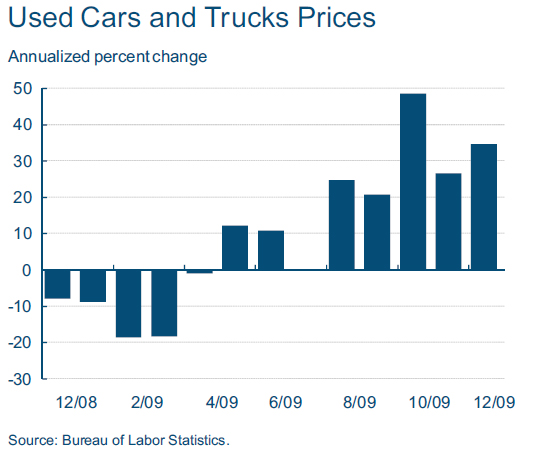
Roughly half of the overall increase in the core CPI in December was due to a 35 percent increase in used car and truck prices. Th e unusual strength in used car and truck prices over the past five months (up nearly 31 percent) has been somewhat of a mystery. Initially, the story read as if the CARS program negatively impacted used auto supply, driving up auction prices. However, it’s hard to imagine that this is still the case. Perhaps the story now is that there has been some substitution away from new vehicles recently, possibly due to credit constraints, as some used car purchases are cash transactions. Either way, new vehicle prices slipped down 3.1 percent in December.


Click for big

They also discuss the Fed’s gradual easing out of targetted intervention:

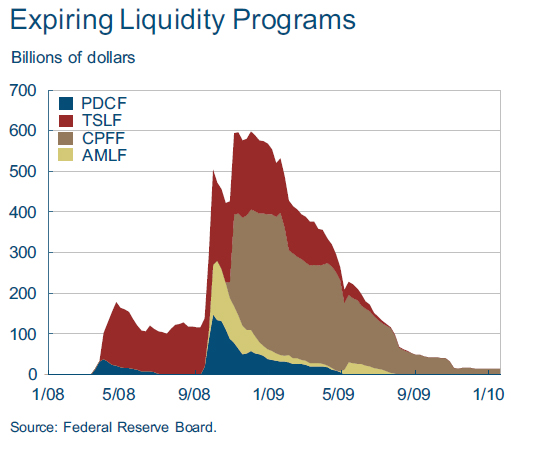
Four of the Federal Reserve’s new credit facilities were allowed to expire on February 1. These include the Asset-Backed Commercial Paper Money Market Mutual Fund Liquidity Facility (AMLF), the Commercial Paper Funding Facility (CPFF), the Primary Dealer Credit Facility (PDCF), and the Term Securities Lending Facility (TSLF). As financial market functioning improved, private sources of liquidity became sufficient and the demand for credit via the special facilities diminished. It is important to note that credit extended through these facilities required good collateral backing. Moreover, to limit the use of the facilities, the terms of lending were set to be less attractive than private sources. In this sense, the facilities mimicked the features of the Fed’s Discount Window—a facility available to qualified depositories in normal times.


Click for big

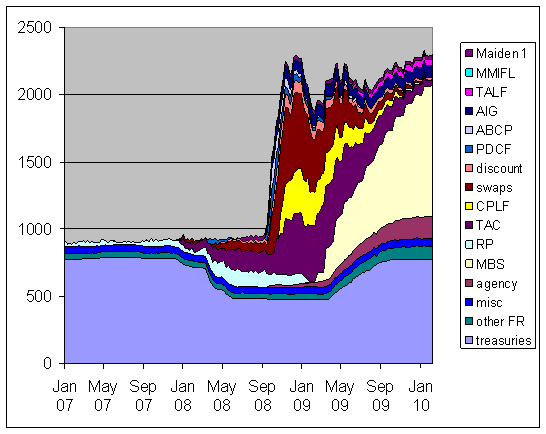
Mind you, the Fed’s balance sheet is still bloated by over a trillion dollars in mortgage paper, so hold off on plans for your end-of-crisis party. Econbrowser‘s James Hamilton provided some perspective in his post Bernanke on the Fed’s balance sheet:


Click for big
Market Action

February 19, 2010

What-Debt? does not support a tax on financial institutions – taxes can be discussed, quantified and challenged in court: true to his authoritarian instincts, he seeks instead a transfer of power to regulators:

Canada opposes efforts to impose a new global tax on financial services in the world’s major economies, according to a government document obtained by Bloomberg News.

Prime Minister Stephen Harper’s government, which will host a summit of Group of 20 leaders in June, instead is urging countries to adopt sound regulatory practices such as Canada’s, according to an internal document distributed today to lawmakers from the governing Conservative Party.

Meanwhile, Spend Every Penny is proud of his total inability to think ahead:

“We know that other countries do this type of analysis [of the effects of demographics on government finances]. The U.S. does it annually. The U.K. does it annually. Scandinavians do it annually. Other countries do it every three years. This … needs to become a regular pattern in Canada.”

Finance Minister Jim Flaherty’s office suggested Mr. Page’s report is speculative. Spokesman Chisholm Pothier said the government is concerned with immediate challenges.

“Making assumptions and calculations 75 years into the future may be an important academic exercise for some, but Canadians expect their government to focus on today’s economy and securing the fragile economic recovery,” Mr. Pothier said.

I guess they’re too busy bragging to the G-20 about how often they lecture the banks about forward planning!
The Philadelphia SEC is incorporating social networks into market surveillance, which makes all kinds of sense:

“Our focus is on conducting trader-based investigations, rather than going security by security,” said [Philadelphia SEC Director Daniel] Hawke, who has run the Philadelphia office since 2006 and will now also serve as director of the new market abuse unit.

The goal, he said was to discover “hard-to-detect frauds.”

Much of the initial detective work that Hawke’s group is doing relies heavily on computers. The team cross-checks trading data on dozens of stocks with personal information about individual traders, such as where they went to business school or where they used to work.

Hawke said his investigators are looking for patterns of “behavior by traders across multiple securities” and seeing if there are any common relationships or associations between those traders.

The Boston Fed has released a Public Policy Brief by Katharine Bradbury titled State Government Budgets and the Recovery Act:

State and local governments, with revenues reduced sharply by the recession, are responding by cutting services, increasing tax rates, and drawing down reserves; they are also receiving some relief in the form of stimulus funds provided by the federal government. The stimulus funds legislated in the American Recovery and Reinvestment Act only partly offset the recession‐induced shortfalls and are scheduled to phase out before most analysts believe state and local governments will see fiscal recovery well underway. Thus, observers are concerned that the state‐local sector will create a substantial drag on the overall economy during fiscal year 2011 and into 2012. This brief compiles data on state gaps, responses, and stimulus funding nationwide and discusses potential implications for the national economy.

Volume remained at good levels to close the week, but prices were mixed; PerpetualDiscounts lost 16bp while FixedResets gained 8bp.

HIMIPref™ Preferred Indices
These values reflect the December 2008 revision of the HIMIPref™ Indices

Values are provisional and are finalized monthly
Index Mean
Current
Yield
(at bid)
Median
YTW
Median
Average
Trading
Value
Median
Mod Dur
(YTW)
Issues Day’s Perf. Index Value
Ratchet 2.86 % 3.40 % 31,436 20.51 1 1.4902 % 1,927.9
FixedFloater 5.43 % 3.53 % 42,177 19.55 1 5.0394 % 2,909.1
Floater 1.99 % 1.71 % 43,612 23.28 4 -0.1640 % 2,310.3
OpRet 4.86 % -0.26 % 104,745 0.19 13 -0.2362 % 2,315.6
SplitShare 6.34 % -4.63 % 130,368 0.08 2 0.0657 % 2,151.7
Interest-Bearing 0.00 % 0.00 % 0 0.00 0 -0.2362 % 2,117.4
Perpetual-Premium 5.76 % 5.43 % 83,580 5.91 7 -0.0621 % 1,900.1
Perpetual-Discount 5.84 % 5.88 % 175,467 14.04 69 -0.1641 % 1,806.9
FixedReset 5.40 % 3.57 % 313,059 3.76 42 0.0811 % 2,188.0
Performance Highlights
Issue Index Change Notes
MFC.PR.B Perpetual-Discount -1.13 % YTW SCENARIO
Maturity Type : Limit Maturity
Maturity Date : 2040-02-19
Maturity Price : 20.13
Evaluated at bid price : 20.13
Bid-YTW : 5.89 %
POW.PR.D Perpetual-Discount -1.10 % YTW SCENARIO
Maturity Type : Limit Maturity
Maturity Date : 2040-02-19
Maturity Price : 20.77
Evaluated at bid price : 20.77
Bid-YTW : 6.11 %
MFC.PR.A OpRet -1.09 % YTW SCENARIO
Maturity Type : Soft Maturity
Maturity Date : 2015-12-18
Maturity Price : 25.00
Evaluated at bid price : 26.34
Bid-YTW : 3.23 %
BAM.PR.O OpRet -1.06 % YTW SCENARIO
Maturity Type : Option Certainty
Maturity Date : 2013-06-30
Maturity Price : 25.00
Evaluated at bid price : 26.02
Bid-YTW : 3.94 %
BAM.PR.E Ratchet 1.49 % This issue forms a Strong Pair with BAM.PR.G; an analytical framework for Strong Pairs was discussed in the February PrefLetter.
YTW SCENARIO
Maturity Type : Limit Maturity
Maturity Date : 2040-02-19
Maturity Price : 25.00
Evaluated at bid price : 19.75
Bid-YTW : 3.40 %
BAM.PR.G FixedFloater 5.04 % This issue forms a Strong Pair with BAM.PR.G; an analytical framework for Strong Pairs was discussed in the February PrefLetter. Today’s gain was entirely legitimate, as the issue traded 7,460 shares in a range of 19.30-00 before closing at 20.01-20, 1×9.
YTW SCENARIO
Maturity Type : Limit Maturity
Maturity Date : 2040-02-19
Maturity Price : 25.00
Evaluated at bid price : 20.01
Bid-YTW : 3.53 %
Volume Highlights
Issue Index Shares
Traded
Notes
CM.PR.K FixedReset 74,350 RBC crossed two blocks of 10,000 each, both at 26.83.
YTW SCENARIO
Maturity Type : Call
Maturity Date : 2014-08-30
Maturity Price : 25.00
Evaluated at bid price : 26.77
Bid-YTW : 3.69 %
TRP.PR.A FixedReset 67,564 Nesbitt crossed 50,000 at 26.10.
YTW SCENARIO
Maturity Type : Call
Maturity Date : 2015-01-30
Maturity Price : 25.00
Evaluated at bid price : 26.08
Bid-YTW : 3.78 %
TD.PR.P Perpetual-Discount 64,909 Nesbitt crossed 50,000 at 23.60.
YTW SCENARIO
Maturity Type : Limit Maturity
Maturity Date : 2040-02-19
Maturity Price : 23.37
Evaluated at bid price : 23.56
Bid-YTW : 5.62 %
ACO.PR.A OpRet 63,517 Called for redemption. National bought 10,000 from Laurentian at 25.65; RBC crossed 50,000 at 25.64. Both these prices are in excess of the call price (including final dividend) and we are past the last full-dividend ex-Date … so either there is some kind of dividend-capture game going on or the buyers are stupid; one or the other, maybe both.
YTW SCENARIO
Maturity Type : Call
Maturity Date : 2010-03-21
Maturity Price : 25.50
Evaluated at bid price : 25.62
Bid-YTW : -1.96 %
RY.PR.H Perpetual-Premium 44,110 National crossed 17,500 at 25.02.
YTW SCENARIO
Maturity Type : Limit Maturity
Maturity Date : 2040-02-19
Maturity Price : 24.67
Evaluated at bid price : 24.90
Bid-YTW : 5.70 %
BNS.PR.R FixedReset 37,516 RBC crossed 30,000 at 26.33.
YTW SCENARIO
Maturity Type : Call
Maturity Date : 2014-02-25
Maturity Price : 25.00
Evaluated at bid price : 26.31
Bid-YTW : 3.65 %
There were 35 other index-included issues trading in excess of 10,000 shares.
Issue Comments

IAG Confirmed at Pfd-2(high) by DBRS

I don’t usually highly rating agency confirmations, but this press release, DBRS Confirms Ratings on Industrial Alliance at “A”, Pfd-2 (high) was sufficiently meaty to warrant wider exposure.

DBRS has today confirmed its ratings on Industrial Alliance Insurance and Financial Services Inc. (IAG or the Company) and its related entities. All ratings have a Stable trend. The ratings reflect the Company’s consistently profitable operations and its sustainable and expanding market presence in the Canadian life insurance and wealth management industries, where it serves the financial planning and protection needs of individuals and groups. The Company’s market position is complemented by a conservative risk culture which has limited IAG’s earnings exposure to equity and credit market volatility through the recent credit/economic crisis.

Capitalization has become more aggressive, in line with that of the industry, with a total debt ratio of 32% at the end of 2009, increasing to 33.2% pro forma a $200 million preferred and common share issue in mid-February. Within the last two years, Canadian life insurance companies have been increasing their financial leverage to better maximize return on equity, while also optimizing regulatory capital in a low interest rate environment. The Company’s adjusted debt ratio, which gives some equity treatment to preferred shares, was 22.6% at year-end, falling to 22% following the February issues, which is within DBRS’s tolerance for the current credit rating. However, the Company’s use of hybrid capital instruments such as preferred shares has increased over the past two years, significantly reducing its fixed-charge coverage ratio, which has fallen from double digits in the pre-2008 period to 6.0 times in 2009, notwithstanding the return to normal profitability. The Company’s regulatory capital ratio, at 208% at the end of 2009, is currently above the top end of the Company’s targeted range of 175% to 200% and will rise further to 226%, pro forma the recent preferred and common share issues. The recent share issues have substantially improved IAG’s financial flexibility should it be required to augment its required capital or to fund another in a long line of acquisitions.

Given the existing conservative actuarial reserves and recent favourable experience in terms of interest rate and equity markets, there were no major net reserve adjustments required in 2009 as a result of changing actuarial assumptions or adverse experience. However, because the Company is more focused on the Canadian individual life insurance market than its peers, including its relatively strong market presence in the universal life market, it remains more exposed to the adverse impact of lower interest rates than its more diversified peers. Similarly, the Company retains a larger on-balance-sheet equity exposure to hedge the long-term liabilities under its life insurance products. A severe economic slowdown resulting in prolonged lower interest rates and equity markets would more seriously affect the Company than its peers, all other things being equal. To mitigate some of this risk, the Company remains very conservative in setting its policy reserves, including a recent reduction in the ultimate reinvestment rate assumption to 20 basis points below the Canadian Institute of Actuaries prescribed standard and relatively high reserves against equity market deterioration. In addition, the Company retains a higher proportion of mortality risk than its peers, rather than reinsuring it, since the long-term improvement in mortality ultimately accrues to the Company’s benefit, given its relatively large block of individual insurance.

The Company’s steady diversification of revenues and income across both product lines and geographical markets, combined with a conservative risk culture, has helped it to return to attractive levels of profitability before many of its larger competitors.

IAG has two Straight issues outstanding, IAG.PR.A and IAG.PR.E; and one FixedReset, IAG.PR.C. They are currently marketting a new issue of 5.90% Straights.

Regulation

BIS Schedule for Regulatory Reform

The Bank for International Settlements issued a press release on January 11 (sorry I’m so late reporting!) titled Group of Central Bank Governors and Heads of Supervision reinforces Basel Committee reform package setting a road map for the next elements of bank regulatory reform:

Provisioning: It is essential that accounting standards setters and supervisors develop a truly robust provisioning approach based on expected losses (EL)….The Basel Committee should translate these principles into a practical proposal by its March 2010 meeting for subsequent consideration by both supervisors and accounting standards setters.

Introducing a framework of countercyclical capital buffers: Such a framework could contain two key elements that are complementary. First, it is intended to promote the build-up of appropriate buffers at individual banks and the banking sector that can be used in periods of stress. This would be achieved through a combination of capital conservation measures, including actions to limit excessive dividend payments, share buybacks and compensation. Second, it would achieve the broader macroprudential goal of protecting the banking sector from periods of excess credit growth through a countercyclical capital buffer linked to one or more credit variables.

Addressing the risk of systemic banking institutions: Supervisors are working to develop proposals to address the risk of systemically important banks (SIBs). To this end, the Basel Committee has established a Macroprudential Group. The Committee should develop a menu of approaches using continuous measures of systemic importance to address the risk for the financial system and the broader economy. This includes evaluating the pros and cons of a capital and liquidity surcharge and other supervisory tools as additional possible policy options such as resolution mechanisms and structural adjustments. This forms a key input to the Financial Stability Board’s initiatives to address the “too-big-to-fail” problem.

Contingent capital: The Basel Committee is reviewing the role that contingent capital and convertible capital instruments could play in the regulatory capital framework. This includes possible entry criteria for such instruments in Tier 1 and/or Tier 2 to ensure loss absorbency and the role of contingent and convertible capital more generally both within the regulatory capital minimum and as buffers.

Liquidity….

Central Bank Governors and Heads of Supervision will review concrete proposals on each of these topics later this year.

The fully calibrated set of standards will be developed by the end of 2010 to be phased in as financial conditions improve and the economic recovery is assured with the aim of implementation by the end of 2012. This includes appropriate phase-in measures and grandfathering arrangements for a sufficiently long period to ensure a smooth transition to the new standards.

The practical effects of not paying your best producers top rates because other parts of the bank are losing money are even now being illustrated:

Bank of America, Merrill Lynch’s owner, raised London managing directors’ base pay to about 230,000 pounds, from 150,000 pounds in 2009, said the people, who declined to be identified because the terms are private.

“Some of these firms were hemorrhaging talent, and those gaps are being filled in a hurry,” said Simon Hayes, London- based head of financial services at Odgers Berndtson, a 45-year- old recruitment firm. “The likes of Merrill and UBS in London and elsewhere have been hiring very aggressively to deal with the losses of the previous 18 months.”

Both banks are no longer taxpayer owned, leaving them free to set pay themselves.

“In the world of investment banking, it’s a simple case of who pays wins,” said John Purcell, managing director of London- based executive search firm Purcell & Co. “Institutions that are fairly directly under political control are facing significant difficulties retaining staff.”

I am very pleased to see that BIS will officially be “evaluating the pros and cons of a capital and liquidity surcharge”. I have long advocated the imposition of surcharges on capital for size (although I feel this should be a surcharge on Risk Weighted Assets), rather than absolute caps or special regulatory regimes. This will allow the major banks to make decisions regarding asset growth to be made in a familiar business-like manner.

And finally, I’m very pleased to see contingent capital front-and-centre, although some indication of the committee’s thinking regarding triggers and conversion prices would have been very greatly appreciated. I can only suppose that this is a bone of contention.

Contingent Capital

BoC's Longworth Supports Contingent Capital

David Longworth, Deputy Governor of the Bank of Canada, delivered a speech to the C D Howe Institute, Toronto, 17 February 2010, titled Bank of Canada liquidity facilities – past, present, and future. It’s a good review of the actions taken by the BoC during the credit crunch to address liquidity problems, albeit lamentably short of meat.

For instance, he emphasizes the importance of penalty rates in avoiding moral hazard:

Fifth, and finally, the Bank should mitigate the moral hazard of its intervention. Such measures include limited, selective intervention; the promotion of the sound supervision of liquidity-risk management; and the use of penalty rates as appropriate.

but nowhere attempts to quantify the penalties that were actually applied.

One of the things that scares me about the regulatory response to the crisis is the central counterparty worship. Mr. Longworth lauds the BoC’s role in:

Encouraging and overseeing the implementation of liquidity-generating infrastructure, such as a central counterparty for repo trades, that help market participants self-insure against idiosyncratic shocks

Central counterparties reduce the role of market discipline in the interbank marketplace by offering a third party guarantee of repayment; I can therefore lend a billion to Dundee Bank with the same confidence that I lend to BNS. Additionally, they soak up bank capital; the counterparty has to be capitalized somehow and it may be taken as a given that the total bank capital devoted to the maintenance of the central counterparty will be greater than the bank capital devoted to the maintenance of a distributed system. Finally, while I agree that a central counterparty will decrease the incidence of systemic collapse, I assert that it will increase the severity; I claim that basic engineering good practice will seek to reduce the incidence of catastrophic single point failure, not increase it!

He also addressed the headline issue, noting the potential for:

Requiring the use of contingent capital or convertible capital instruments, perhaps in the form of a specific type of subordinated debt, to help ensure loss absorbency and thus reduce the likelihood of failure of a systemically important institution.

Footnote: The BCBS press release of 11 January 2010 entitled, “Group of Central Bank Governors and Heads of Supervision reinforces Basel Committee reform package,” announces that the “Basel Committee is reviewing the role that contingent capital and convertible capital instruments could play in the regulatory capital framework.” See also “Considerations along the Path to Financial Regulatory Reform,” remarks by Superintendent Julie Dickson, Office of the Superintendent of Financial Institutions, 28 October 2009

I have added a link in the above to the PrefBlog review of the Dickson speech; I will attend to the BIS press release shortly.

Most of the commentary I’ve seen discusses contingent capital solely as the concept applies to subordinated debt; I will assert that logically, if the subordinated debt is liable to become common equity, then more junior elements of capital such as preferred shares must also have this attribute.

Market Action

February 18, 2010

There are mutterings that maybe London isn’t as bad as all that, taxes and all:

Heavy tax demands on London’s under-fire hedge fund industry are unlikely to spark an exodus of operators to rival financial hubs such as Dublin or Geneva, a survey by property advisor Cushman & Wakefield showed.

The study into the impact of taxation on corporate locations showed only one in 10 UK-based companies considered national tax policy or government incentives as an “absolutely essential” factor when choosing a location for their businesses.

Instead, financial occupiers like hedge funds prize ease of international travel, good internal infrastructure and access to a diverse labour market over fiscal policy, putting London ahead of traditional rival Geneva on all counts, the report showed.

Volume moderated a little on a day enlivened by the ACO.PR.A redemption announcement and a a new FixedReset issue, 5.25%+262, from Brookfield Renewable Power Preferred Equity. PerpetualDiscounts lost 6bp and FixedResets were down 4bp.

HIMIPref™ Preferred Indices
These values reflect the December 2008 revision of the HIMIPref™ Indices

Values are provisional and are finalized monthly
Index Mean
Current
Yield
(at bid)
Median
YTW
Median
Average
Trading
Value
Median
Mod Dur
(YTW)
Issues Day’s Perf. Index Value
Ratchet 2.91 % 3.48 % 29,754 20.43 1 2.4211 % 1,899.6
FixedFloater 5.71 % 3.78 % 40,123 19.23 1 0.0000 % 2,769.5
Floater 1.99 % 1.71 % 45,044 23.28 4 0.1642 % 2,314.1
OpRet 4.85 % -1.20 % 106,626 0.09 13 -0.2503 % 2,321.1
SplitShare 6.35 % -8.01 % 131,490 0.08 2 0.7489 % 2,150.3
Interest-Bearing 0.00 % 0.00 % 0 0.00 0 -0.2503 % 2,122.4
Perpetual-Premium 5.75 % 5.34 % 84,518 5.91 7 -0.0790 % 1,901.2
Perpetual-Discount 5.83 % 5.86 % 168,668 14.09 69 -0.0588 % 1,809.9
FixedReset 5.41 % 3.56 % 304,917 3.76 42 -0.0375 % 2,186.2
Performance Highlights
Issue Index Change Notes
ACO.PR.A OpRet -2.29 % Called for redemption.
YTW SCENARIO
Maturity Type : Call
Maturity Date : 2010-03-20
Maturity Price : 25.50
Evaluated at bid price : 25.60
Bid-YTW : -1.20 %
BAM.PR.J OpRet -1.89 % YTW SCENARIO
Maturity Type : Soft Maturity
Maturity Date : 2018-03-30
Maturity Price : 25.00
Evaluated at bid price : 26.00
Bid-YTW : 4.94 %
TD.PR.Y FixedReset -1.43 % YTW SCENARIO
Maturity Type : Call
Maturity Date : 2013-11-30
Maturity Price : 25.00
Evaluated at bid price : 26.23
Bid-YTW : 3.72 %
BNS.PR.J Perpetual-Discount -1.19 % YTW SCENARIO
Maturity Type : Limit Maturity
Maturity Date : 2040-02-18
Maturity Price : 22.49
Evaluated at bid price : 23.23
Bid-YTW : 5.67 %
ELF.PR.G Perpetual-Discount 1.07 % YTW SCENARIO
Maturity Type : Limit Maturity
Maturity Date : 2040-02-18
Maturity Price : 18.01
Evaluated at bid price : 18.01
Bid-YTW : 6.69 %
BNA.PR.C SplitShare 1.09 % YTW SCENARIO
Maturity Type : Hard Maturity
Maturity Date : 2019-01-10
Maturity Price : 25.00
Evaluated at bid price : 19.45
Bid-YTW : 7.88 %
BAM.PR.E Ratchet 2.42 % YTW SCENARIO
Maturity Type : Limit Maturity
Maturity Date : 2040-02-18
Maturity Price : 25.00
Evaluated at bid price : 19.46
Bid-YTW : 3.48 %
Volume Highlights
Issue Index Shares
Traded
Notes
BNS.PR.L Perpetual-Discount 116,389 Nesbitt crossed 100,000 at 20.26.
YTW SCENARIO
Maturity Type : Limit Maturity
Maturity Date : 2040-02-18
Maturity Price : 20.24
Evaluated at bid price : 20.24
Bid-YTW : 5.62 %
MFC.PR.D FixedReset 114,382 Desjardins crossed 100,000 at 28.19.
YTW SCENARIO
Maturity Type : Call
Maturity Date : 2014-07-19
Maturity Price : 25.00
Evaluated at bid price : 28.19
Bid-YTW : 3.76 %
RY.PR.W Perpetual-Discount 105,620 Nesbitt crossed two blocks of 50,000 each at 21.80.
YTW SCENARIO
Maturity Type : Limit Maturity
Maturity Date : 2040-02-18
Maturity Price : 21.50
Evaluated at bid price : 21.76
Bid-YTW : 5.65 %
ACO.PR.A OpRet 90,207 Called for redemption. RBC bought 10,000 from Laurentian at 25.65. Desjardins crossed 41,000 at the same price.
YTW SCENARIO
Maturity Type : Call
Maturity Date : 2010-03-20
Maturity Price : 25.50
Evaluated at bid price : 25.60
Bid-YTW : -1.20 %
TD.PR.N OpRet 80,100 RBC crossed 75,000 at 26.21.
YTW SCENARIO
Maturity Type : Call
Maturity Date : 2010-03-20
Maturity Price : 26.00
Evaluated at bid price : 26.18
Bid-YTW : -1.48 %
TD.PR.O Perpetual-Discount 76,041 TD crossed 47,300 at 22.00.
YTW SCENARIO
Maturity Type : Limit Maturity
Maturity Date : 2040-02-18
Maturity Price : 21.60
Evaluated at bid price : 21.94
Bid-YTW : 5.56 %
There were 33 other index-included issues trading in excess of 10,000 shares.
Interesting External Papers

BoC Releases Winter 2009-10 Review

The Bank of Canada has released the Bank of Canada Review Winter 2009-2010, with articles:

  • Declining Inflation Persistence in Canada: Causes and Consequences
  • The Evolution of Capital Flows to Emerging-Market Economies
  • Making Bank Notes Accessible for Canadians Living with Blindness or Low Vision

Inflation persistence is defined as

the correlation between current and lagged inflation.

The article concludes that the low level of inflation persistence in Canada will facilitate Price Level Targetting, should be BoC implement such a policy:

For a central bank considering the relative merits of price-level versus inflation targeting, recent research suggests that low structural persistence in inflation will tend to favour the former. Moreover, the transition period to a price-level-targeting regime, when the private sector may still be learning about the precise nature of the change, appears to be less costly when structural infl ation persistence is low.

New Issues

New Issue: Brookfield Renewable Power Preferred Equity FixedReset 5.25%+262

Brookfield Renewable Power Fund has announced:

that the Corporation (as defined below) will issue in Canada a total of 7 million Class A Preference Shares, Series 1 (the “Series 1 Preferred Shares”) guaranteed by the Fund, at a price of $25.00 per share, for aggregate gross proceeds of $175 million, on a bought deal basis to a syndicate of underwriters in Canada led by Scotia Capital Inc., CIBC, RBC Capital Markets and TD Securities Inc.

The holders of Series 1 Preferred Shares will be entitled to receive fixed cumulative dividends at an annual rate of $1.3125 per share, payable quarterly, as and when declared by the Board of Directors of Brookfield Renewable Power Preferred Equity Inc. (the “Corporation”), a wholly-owned subsidiary of the Fund. The Series 1 Preferred Shares will yield 5.25% annually at the issue price, for the initial five-year period ending April 30, 2015 with the first dividend payment date scheduled for April 30, 2010, based on an anticipated closing date of March 10, 2010. The dividend rate will reset on April 30, 2015 and every five years thereafter at a rate equal to the then five-year Government of Canada Bond yield plus 2.62%. The Series 1 Preferred Shares are redeemable on or after April 30, 2015.

The holders of Series 1 Preferred Shares will have the right to convert their shares into Class A Preference Share, Series 2 (the “Series 2 Preferred Shares”), subject to certain conditions, on April 30, 2015 and on April 30 of every fifth year thereafter. The holders of Series 2 Preferred Shares will be entitled to receive quarterly floating rate cumulative dividends, as and when declared by the Board of Directors, at a rate equal to the then three month Government of Canada Treasury Bill yield plus 2.62%.

The Corporation has granted the underwriters an over-allotment option exercisable up to 30 days after closing to purchase up to an additional 1.05 million Series 1 Preferred Shares at the issue price on the same terms, for additional gross proceeds of up to $26.25 million.

The Corporation intends to lend the net proceeds of the offering to the Fund, which will repay in whole or in part the $200 million promissory note issued to Brookfield Renewable Power Inc. (“BRPI”) in connection with the Fund’s acquisition of substantially all of BRPI’s Canadian power generating assets in August 2009.

The Fund has previously announced its intention to convert to a corporation on or before January 1, 2011. It is expected that the Corporation will become the successor of the Fund through the conversion. If the Corporation does not become the successor, the successor entity will assume all the obligations of the Fund including those related to the Series 1 and Series 2 Preferred Shares.

The Series 1 and Series 2 Preferred Shares will be offered to the public in Canada pursuant to a short form prospectus that will be filed with securities regulatory authorities in each of the provinces of Canada.

Sorry for the lengthy headline, but I don’t think Brookfield Renewable Power Preferred Equity Inc. has a ticker symbol at this time. The parent and guarantor, Brookfield Renewable Power Fund, is BRC.UN.

Brookfield Asset Management (BAM) notes:

The Brookfield Renewable Power Fund (formerly Great Lakes Hydro Income Fund) was established in November 1999 as a publicly traded investment vehicle to acquire long-life, low cost generating assets which provide stable and sustainable cash distributions to unitholders. Brookfield owns 50.01% of the units on a fully-exchanged basis, with the remaining 49.99% owned by institutional and retail unitholders.

… so this issue should be counted as BAM for issuer concentration calculation purposes.

Update: I understand the deal size has been increased to $250-million.

Update, 2010-2-19: Brookfield press release on increase:

Brookfield Renewable Power Fund (the “Fund”) today announced that as a result of strong investor demand for its previously announced public offering of Class A Preference Shares, Series 1 (the “Series 1 Preferred Shares”), it has agreed to increase the size of the offering from $175 million to $250 million, or from 7 million Series 1 Preferred Shares to 10 million Series 1 Preferred Shares. The issue will be guaranteed by the Fund and will be completed on a bought deal basis to a syndicate of underwriters in Canada led by Scotia Capital Inc., CIBC, RBC Capital Markets and TD Securities Inc. There will not be an over-allotment option, as was previously granted.

DBRS maintains the Pfd-3(high) provisional rating.

Issue Comments

ACO.PR.A to be Redeemed

ATCO Ltd. has announced:

it will redeem on March 23, 2010 all of its outstanding 5.75% Cumulative Redeemable Preferred Shares, Series 3 at a price of $25.586644 (representing the $25.00 designated capital of each share and a prescribed premium of $0.50 per share plus $0.086644 of accrued and unpaid dividends per share). The total cost of this redemption is $153.5 million.

  Shares TSX Stock Redemption Price
Shares Outstanding Symbol Per Share ($)
5.75% Series 3 6,000,000 ACO.PR.A 25.586644

These dividends are eligible dividends for Canadian income tax purposes.

A formal notice and instructions for the redemption of the Series 3 Preferred Shares will be sent to preferred shareholders in accordance with the conditions attached to the Series 3 Preferred Shares.

ACO.PR.A closed last night at 26.20-38, so the risks of holding issues with negative yields-to-worst are illustrated yet again! Of course, one reason they are priced so high appears to be buying by CPD and other indexers in response to the issue’s addition to TXPR in the January rebalancing.

ACO.PR.A was last mentioned on PrefBlog in connection with the calculation of yield-to-issuer-best. It is tracked by HIMIPref™ and is a constituent of the Operating Retractible subindex.

Update: I have uploaded a Chart of the ACO.PR.A / CM.PR.A bid prices from 2009-12-31 to 2010-2-17 (CM.PR.A is the best comparator I can find, although not a very good one). There is a clear bump in the price of ACO.PR.A in the period in which it may be assumed CPD was buying. See the post POW.PR.C: Yes, CPD is the Buyer for another example.

Update, 2010-3-16: S&P announcement of removal from TXPR.