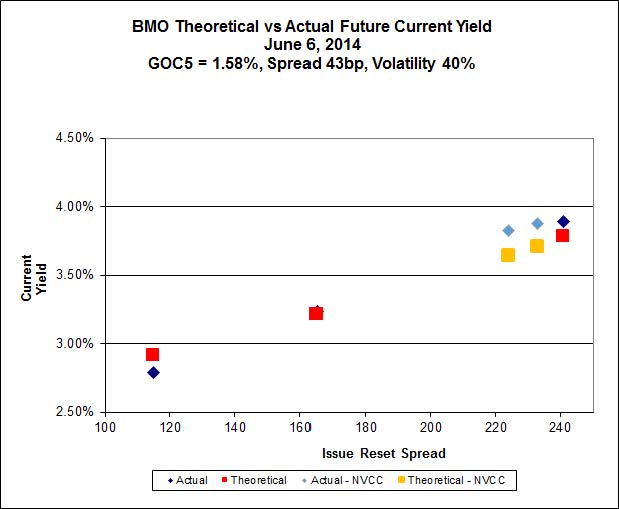
OK, so it looks like this series on power storage has turned into a three-day rant; particularly disconcerting because it has nothing whatsoever to do with Canadian preferred shares or even financial markets in general. Sorry, guys, but in the first place it’s interesting and in the second place Assiduous Reader JP keeps sending me interesting links, unlike youse other bums, who never send me NUTHIN’.
One thing I found myself was the 2011 Ontario Auditor General’s Report on Renewable Energy:
Since the prevalence of SBG events could threaten the reliability of the electricity system, the IESO has been taking action to ease the power surplus. However, there are technical difficulties and cost implications of these actions. Among them:
- • Storing surplus power is difficult because of the seasonal nature of renewable energy and the need for unrealistically large storage capacity.
- …
…
However, intermittent renewable energy sources such as wind and solar require fast-responding backup power and/or storage capacity to keep the supply of electricity steady when the skies are cloudy or the wind dies down. The OPA informed us that because viable large-scale energy storage is not available in Ontario, wind and solar power must be backed up by other forms of generation.
…
Despite these concerns, the cost and environmental impacts of such backup generation capacity were not formally analyzed to ensure that this information would be available to policy decision-makers. We noted that:
- • Prior to the passage of the Green Energy and Green Economy Act in 2009, the Ministry did not quantify how much backup power would be required. It was not until February 2011 that the Minister issued a new supply-mix directive that asked the OPA to consider backup options, such as converting coal-fired plants to gas-fired operation, importing power from other jurisdictions, and developing storage systems. The OPA has not yet made any recommendations to the Ministry.
- • The only analysis on backup power that the Ministry cited was a study done by a third party engaged by the OPA as part of its 2007 IPSP development. The study noted that 10,000 MW of wind would require an extra 47% of non-wind sources to handle extreme drops in wind. We noted that the third party who carried out this study also operated an Ontario wind farm, raising questions about the study’s objectivity. In spite of this, the OPA and the Ministry did not confirm or update
this study’s projections and did not determine how much backup power would be required.
The only question left in my mind is: Is Ontario energy policy determined by morons, or is it determined by dolts? Never mind. Don’t answer. I don’t want to know.
Assiduous Reader JP sends me a link to a US Department of Energy report: Grid Energy Storage:
At present, the U.S. has about 24.6GW (approx. 2.3% of total electric production capacity) of grid storage, 95% of which is pumped storage hydro. Europe and Japan have notably higher fractions of grid storage. Pursuit of a clean energy future is motivating significantly increased storage development efforts in Europe and Asia, as well as the U.S.
…
In the past few years, the urgency of energy storage requirements has become a greater, more pressing issue that is expected to continue growing over the next decade:
- California enacted a law in October 2010 requiring the California Public Utilities Commission (CPUC) to establish appropriate 2015 and 2020 energy storage procurement targets for California load serving entities, if cost effective and commercially viable by October 2013 (AB 2514). In February 2013, the CPUC determined that Southern California Edison must procure 50 MW of energy storage capacity by 2021 in Los Angeles area. Additionally, in June 2013, the CPUC proposed storage procurement targets and mechanisms totaling 1,325 MW of storage. Other States are looking to the example that California is setting, and Congress has introduced two bills that establish incentives for storage deployment.
…
New capabilities of pumped hydro, through the use of variable speed pumping, is opening up the potential for the provision of additional services that may be used to assist in the integration of variable generation sources. Projects may be practically sized up to 4,000 MW and operate at about 76%–85% efficiency, depending on design. Pumped hydro plants have long lives, on the order of 50-60 years. As a general rule, a reservoir one kilometer in diameter, 25 meters deep, and having an average head of 200 meters would hold enough water to generate 10,000 MWh.
Japan is an emerging storage powerhouse:
Japan is emerging as a hot-spot for energy storage projects, as utilities and technology companies look to battery-based solutions in response to the surge in solar PV installations.
Two new battery storage projects have been announced in the past week, with Toshiba to install a 20MWh/40MW lithium-ion battery project in Tohuku, and the island of Okinawa announcing a 2MW battery storage project on Tuesday.
Japan is expected to be the largest market for solar PV installations in 2013, with around 9GW to be installed following the introduction of feed in tariffs last year in response to the Fukushima nuclear disaster.
… and Israel’s getting in on the action:
Alstom has signed two contracts totaling around €120 million1 with PSP Investment Ltd for the supply of two 150 MW pump-turbines with the associated balance of plant equipment and Alstom’s Distributed Control System (DCS) for the 300 MW Gilboa pumped storage power plant in Israel.
Alstom also signed an eighteen-year operation & maintenance (O&M) agreement, covering day-to-day operation and maintenance of the power plant. The project represents Alstom’s first entry into the Israeli hydro market and will be the country’s first pumped storage power station, Alstom already has a proven track record in the Israeli power generation market with respect to existing steam plants and gas plants.
The power plant, located 60 km east of Haifa, will be commissioned in 2018, and will increase the country’s installed power generation capacity by 2.5%. It will contribute to increasing the reliability of electricity supply and will provide an important tool to control the demand and distribution of electricity.
During off-peak hours, pumped storage uses the energy from other power stations to transfer water to a high storage reservoir. The stored water will later be reused to generate electricity to cover temporary peaks. This helps lower the overall operation cost of power production and levels the fluctuating output of intermittent power sources.
And what are we doing here in Ontari-ari-ari-owe, barely years after the Auditor-General’s report? Flywheels!
There’s nothing like a 4,000-kilogram spinning steel cylinder to smooth out the ups and downs of the power system.
At least, that’s what Temporal Power is betting on.
The fledgling firm showed off its technology to Ontario energy minister Bob Chiarelli on Wednesday.
Temporal is betting on flywheels as a solution to an increasing problem on Ontario’s power system: With an increasing amount of wind and solar power flowing onto the grid, you need systems that can counterbalance the natural ebbs and flows of renewables.
…
Temporal has an agreement with Ontario Power Generation and NRStore — a firm headed by Annette Verschuren —– for a flywheel facility to counter-balance the minute-by-minute voltage variations on the power grid.
As far as I can tell – from the DoE report – flywheels are good for conditioning power. For load-shifting … not so much.
But fear not! Time-of-Use Billing with our billion dollar smart meter programme will save us! Right? Right?
The most significant result of those presented below is that both the conventional impact analysis and the elasticity analysis report the same result for the estimated residential summer weekday On-Peak reduction, 3.3%.
The following is not a figure, it’s a table, but never mind.
| Figure ES- 12: Approximate Impact on Average Residential Commodity Costs | |||||
| Season | On-Peak | Mid-Peak | Off-Peak Weekdays | Weekend | Total Within Season |
| Summer | -$2 | -$2 | $0 | $2 | -$2 |
| Summer Shoulder | -$2 | -$1 | $0 | $1 | -$2 |
| Winter | -$2 | -$2 | $0 | $0 | -$3 |
| Winter Shoulder | $0 | $0 | $1 | $0 | $0 |
| Total Across Seasons | -$6 | -$5 | $2 | $3 | -$6 |
Turning back to finance, just as a change of pace, it seems that while Canadian household income coverage is still lousy, asset coverage is much better:
In a new report from Merrill Lynch, economist Emanuella Enenajor says Canadian consumers have been undergoing a “stealth deleveraging” – a significant reduction in debt accumulation that has largely flown under the radar because of the focus on the market’s favoured measure of household debt loads, the debt-to-disposable-income ratio. This sat at a record 164 per cent at the end of 2013 – widely seen as evidence that Canadians simply can’t break their reckless and unsustainable debt habit.
…
Statistics Canada data show that household debt growth in the fourth quarter was just 4.5 per cent year over year, the slowest since 2001. Non-mortgage debt (credit plus loans) grew just 0.1 per cent last year.The problem is, the other half of the equation has slowed as well. Disposable income has grown 4.3 per cent annually, on average, since 2010, compared with 5.1 per cent annually in the decade before the financial crisis.
…
Canadian households’ debt-to-net-worth ratio – which takes into account the value of the assets acquired with much of that debt, such as real estate, and thus may be a more complete measure of the household debt burden – has been generally declining since the recession, and ended 2013 at its lowest level since the middle of 2008. Ms. Enenajor said that while rising asset values (namely, the continued strength in the residential real estate market) have helped, the key has been the slowdown in household debt growth. People are also saving more as their borrowing has slowed.
Bloomberg has a story about how the ECB’s negative interest rates are bringing back the carry trade, but I was more interested in the gorgeous collection of trite slogans and thought-substitutes embodied in a single quote:
“The ECB has signaled risk is on again,” Eric Busay, a Sacramento-based money manager at the California Public Employees’ Retirement System, the largest U.S. public pension fund with $294 billion in assets, said in a June 6 phone interview. “People are concerned when to exit the trade and they understand the rush to exit could be crowded. But at the same time, you have to be in it to win it.”
I love it! Say it with a straight face, win a CFA charter!
It was another positive day for the Canadian preferred share market, with PerpetualDiscounts winning 14bp, FixedResets up 8bp and DeemedRetractibles gaining 5bp. Volatility was virtually nonexistent. Volume was a little above average.
| HIMIPref™ Preferred Indices These values reflect the December 2008 revision of the HIMIPref™ Indices Values are provisional and are finalized monthly |
|||||||
| Index | Mean Current Yield (at bid) |
Median YTW |
Median Average Trading Value |
Median Mod Dur (YTW) |
Issues | Day’s Perf. | Index Value |
| Ratchet | 0.00 % | 0.00 % | 0 | 0.00 | 0 | 0.4974 % | 2,525.8 |
| FixedFloater | 4.56 % | 3.81 % | 29,955 | 17.78 | 1 | 0.0000 % | 3,768.4 |
| Floater | 2.89 % | 3.02 % | 45,131 | 19.60 | 4 | 0.4974 % | 2,727.2 |
| OpRet | 4.38 % | -10.11 % | 26,719 | 0.08 | 2 | -0.1167 % | 2,710.0 |
| SplitShare | 4.81 % | 4.24 % | 62,170 | 4.14 | 5 | 0.1273 % | 3,118.4 |
| Interest-Bearing | 0.00 % | 0.00 % | 0 | 0.00 | 0 | -0.1167 % | 2,478.0 |
| Perpetual-Premium | 5.52 % | 1.43 % | 82,308 | 0.08 | 17 | 0.0532 % | 2,400.0 |
| Perpetual-Discount | 5.26 % | 5.29 % | 115,809 | 14.95 | 20 | 0.1393 % | 2,545.8 |
| FixedReset | 4.51 % | 3.74 % | 220,218 | 6.78 | 78 | 0.0765 % | 2,527.9 |
| Deemed-Retractible | 5.00 % | 1.03 % | 147,343 | 0.14 | 43 | 0.0521 % | 2,527.6 |
| FloatingReset | 2.67 % | 2.51 % | 132,919 | 3.97 | 6 | 0.1525 % | 2,483.7 |
| Performance Highlights | |||
| Issue | Index | Change | Notes |
| PWF.PR.A | Floater | 1.24 % | YTW SCENARIO Maturity Type : Limit Maturity Maturity Date : 2044-06-10 Maturity Price : 20.40 Evaluated at bid price : 20.40 Bid-YTW : 2.59 % |
| MFC.PR.K | FixedReset | 1.77 % | YTW SCENARIO Maturity Type : Hard Maturity Maturity Date : 2025-01-31 Maturity Price : 25.00 Evaluated at bid price : 24.75 Bid-YTW : 3.94 % |
| Volume Highlights | |||
| Issue | Index | Shares Traded |
Notes |
| BMO.PR.T | FixedReset | 125,224 | Recent new issue. YTW SCENARIO Maturity Type : Limit Maturity Maturity Date : 2044-06-10 Maturity Price : 23.15 Evaluated at bid price : 25.01 Bid-YTW : 3.75 % |
| RY.PR.H | FixedReset | 120,030 | Recent new issue. YTW SCENARIO Maturity Type : Limit Maturity Maturity Date : 2044-06-10 Maturity Price : 23.16 Evaluated at bid price : 25.04 Bid-YTW : 3.76 % |
| TD.PF.A | FixedReset | 110,150 | Recent new issue. YTW SCENARIO Maturity Type : Limit Maturity Maturity Date : 2044-06-10 Maturity Price : 23.15 Evaluated at bid price : 25.04 Bid-YTW : 3.74 % |
| RY.PR.I | FixedReset | 82,215 | RBC crossed 73,200 at 25.20. YTW SCENARIO Maturity Type : Call Maturity Date : 2019-02-24 Maturity Price : 25.00 Evaluated at bid price : 25.17 Bid-YTW : 3.41 % |
| ENB.PR.T | FixedReset | 78,136 | Scotia crossed blocks of 35,000 and 25,000, both at 24.35. YTW SCENARIO Maturity Type : Limit Maturity Maturity Date : 2044-06-10 Maturity Price : 22.91 Evaluated at bid price : 24.30 Bid-YTW : 4.13 % |
| SLF.PR.A | Deemed-Retractible | 72,189 | RBC crossed 60,000 at 23.84. YTW SCENARIO Maturity Type : Hard Maturity Maturity Date : 2025-01-31 Maturity Price : 25.00 Evaluated at bid price : 23.88 Bid-YTW : 5.30 % |
| There were 37 other index-included issues trading in excess of 10,000 shares. | |||
| Wide Spread Highlights | ||
| Issue | Index | Quote Data and Yield Notes |
| CIU.PR.C | FixedReset | Quote: 20.93 – 21.69 Spot Rate : 0.7600 Average : 0.5882 YTW SCENARIO |
| GCS.PR.A | SplitShare | Quote: 24.90 – 25.24 Spot Rate : 0.3400 Average : 0.2200 YTW SCENARIO |
| IAG.PR.A | Deemed-Retractible | Quote: 22.66 – 22.95 Spot Rate : 0.2900 Average : 0.2018 YTW SCENARIO |
| PWF.PR.K | Perpetual-Discount | Quote: 23.66 – 23.88 Spot Rate : 0.2200 Average : 0.1478 YTW SCENARIO |
| CU.PR.F | Perpetual-Discount | Quote: 22.25 – 22.45 Spot Rate : 0.2000 Average : 0.1302 YTW SCENARIO |
| PWF.PR.E | Perpetual-Premium | Quote: 25.10 – 25.34 Spot Rate : 0.2400 Average : 0.1848 YTW SCENARIO |