Contingent Capital

Lloyds Bank to Issue Contingent Capital with Tier 1 Ratio Trigger?

Lloyds Banks has announced:

Lloyds Banking Group (Lloyds) notes recent media speculation regarding its proposed potential participation in the Government Asset Protection Scheme (GAPS). Lloyds is in advanced discussions with HM Treasury, UK Financial Investments and the Financial Services Authority regarding alternatives to participation in GAPS.

Lloyds believes that any alternative proposals to GAPS would be likely to include a substantial capital raising of core tier 1 and contingent core tier 1 capital to increase the Group’s capital ratios to an appropriate level of strength and flexibility, and would provide a strong capital base for the future stability and success of the Group. The alternative proposals would also meet the FSA’s requirements for stressed economic conditions.

Capital raising options currently under consideration include a combination of raising immediately available core tier 1 capital by way of a rights issue and generating contingent core tier 1 and/or core tier 1 capital through the exchange of certain existing Group capital securities.

Media speculation, indeed! Wealth Bulletin reports (note that the WSJ credits Duncan Kerr of Financial News for this interview):

Owen Murfin, global fixed-income manager at BlackRock in London, said that Lloyds’ plan to generate contingent capital through an exchange would only work at “attractive levels” but that if the transaction does go well, “it will probably form the template of the future of hybrid bank capital, or certainly the shape of capital going forward”.

Murfin added that for investors to get fully behind it, some key issues needed to be addressed, such as what will be used as the triggers, and who or what will decide when these measures have been breached.

He said: “Core tier-one is probably going to be the most likely trigger used. The existing regulatory minimum is around 4%, so the level would probably have to be above that and somewhere around 5%. Core tier-one capital would then be replenished at a far higher level as a result of the conversion.

Reuters also suggests a Tier 1 Ratio Trigger, but with no attribution:

The conversion trigger needs to be set low enough that it is unlikely to be reached, but high enough that it provides help before a bank hits crisis point. That could see it triggered when the Core Tier 1 equity falls below 5 or 6 percent, depending on new industry standards under discussion.

FT Alphaville quotes JPM analysts Carla Antunes da Silva and Amit Goel musing that:

What are the challenges? Several uncertainties surround these instruments including (i) setting appropriate trigger points; (ii) pricing the instruments such that they are attractive to both investors and the issuing institutions; and (iii) market treatment in terms of share count/equity.

I have real problems with using Tier 1 Capital Ratios as a trigger for conversion. Accrued Interest points out:

Look at Lehman. They had a Tier 1 ratio of 11 just weeks before they were bankrupt. Their problem was part their funding mix which was very reliant on repo and prime brokerage, and part the fact that the market didn’t believe their valuations on some illiquid assets. Maybe had either of those circumstances been different, i.e, the same leverage and assets but a more stable funding mix, they would have survived. Regardless, a regulator scheme based on leverage ratios never would have caught Lehman before it was too late. Nominally, they had plenty of capital.

This is why the idea of contingent capital makes so much sense to me. A bank has a ready set of equity investors whenever its needed. It instills market discipline, as the current stock price would reflect the potential for dilution, but the falling stock price wouldn’t prevent a capital raise. In effect, this is a little like a standard bankruptcy, where bond holders take control of a company, except that instead of the company actually going through such a disruptive process, ownership just transfers (in part) to the contingent capital bondholders automatically.

More generally than the anecdotal Lehman example, the IMF looked at various bail-out predictors in Chapter 3 of the April 09 GFSR:

The results in Table 3.1 show the following:

  • • Capital adequacy ratios were unable to clearly identify institutions requiring intervention. In fact, contrary to the common belief that low capital adequacy ratios would signal weakness for a FI, all four capital adequacy ratios examined for intervened commercial banks were significantly higher than (or similar to) the nonintervened commercial banks as a whole (Figure 3.1). There are, of course, regional differences among nonintervened commercial banks. During 2005:Q1–2007:Q2, the capital-to-assets ratio for nonintervened commercial banks in Asia and the euro area were higher than for intervened commercial banks. However this was not the case for FIs in the noneuro area. This suggests that regional differences can make direct comparisons problematic.
  • • Several basic indicators of leverage appear to be informative in identifying the differences in the institutions, although the reasons for this deserve further examination. The higher ratios of debt to common equity, and short term debt to total debt in the intervened commercial banks and intervened investment banks, all indicate that these measures of leverage are especially informative about the differences (Figure 3.2).
  • • Traditional liquidity ratios are not very indicative of the differences between intervened and nonintervened institutions. In part, this is because these liquidity ratios may not be able to fully measure wholesale funding risks.
  • • Asset quality indicators show a mixed picture. Similar to the capital adequacy ratios, the ratio of nonperforming loans (NPL) to total loans for the intervened commercial banks has been lower than for the nonintervened commercial banks, indicating that NPL ratios are not very reliable indicators of the deterioration in asset quality. However, the lower provisions for the loan-losses-to-total-loans ratio for the nonintervened commercial banks suggests that this is a better indicator
    than the NPL ratio.

  • • The standard measures of earnings and profits show a mixed picture. While return on assets (ROA) for the intervened institutions are much higher than those in the nonintervened commercial banks, suggesting that elevated risks are associated with higher returns, return on equity (ROE) has not captured any major differences between the FIs that were intervened or not (Figure 3.3). This contrast between the effectiveness in ROA and ROE may reflect the high leverage ratio of intervened FIs, which typically rely on higher levels of debt to produce profits.
  • • Stock market indicators are able to capture some differences. The price-to-earnings ratios, earning per share, and book value per share of the intervened investment banks have been generally higher than those in the nonintervened commercial banks, which suggest that the higher equity prices and earnings do not necessarily reflect healthier institutions, but perhaps concomitant higher risks.

I confess that I don’t understand the last point very well. Book value per share? Earnings per share? Surely these simply reflect the number of shares issued against the size of the bank. If they discussed Price-to-Book ratios, that would be one thing, but they don’t. They do, however, include Price/Earnings ratio in the various tests and find it does not discriminate between bailed-out and non-bailed-out banks.

My objection to using Capital Ratios as a trigger point is simply that they haven’t worked very well in this crisis: all the failed banks met the capital tests before being bailed out. This does not mean that I disdain Capital Ratios. On the contrary, I think they’re the single most valuable metric for quantifying the strength of a bank. “Single most”, however, has a different meaning from “Only required”. It is now accepted that a blunt leverage ratio – in Canada, the Assets to Capital multiple – is a very useful additional tool; I will not be at all surprised to see a metric based on liquidity introduced at some point.

Why do bank runs happen? Confidence. During the crisis, nobody trusted capital ratios because they are dependent upon the degree to which markdowns on bad assets had been taken; if you did not trust the accounting, you did not trust the capital ratio and – critically – you sold the stock.

I continue to believe that the most appropriate trigger is simply the common stock’s trading price. As I stated in my commentary on the HM Treasury response to the Turner Report, this has the advantage of being known in advance; no judgement by the regulatory authorities is required and therefore, in a crisis, there won’t be the chance of the market attempting to second-guess just what the authorities’ decision really means. The advantage of known conversion triggers will also allow a certain amount of arbitrage, which will boost liquidity for these instruments at a time when we may assume that such liquidity will be sorely needed.

For instance, to take my basic idea of a new issue of contingent-equity preferreds, issued at $25 at a time when the common is trading (for convenience in referring to the exchange ratio) at $50. The preferred converts to common on a one-to-one basis if the monthly (quarterly?) volume-weighted-average-price of the common dips below $25; that being the exchange price, set to one-half of the common’s price at the time when the preferred was issued.

Should bad times come and the common starts trading in the high twenties, it may well be imagined that puts on the common with a $25 strike will become very popular, going some way towards transferring the income from the prefs into the hands of speculators who don’t mind taking a chance. The preferreds will trade more and more like equity, in a smooth and transparent manner, as the equity price declines. Isn’t this exactly what the doctor ordered?

It should also be noted that the bank bailouts resulted in Tier 1 Capital NEVER falling below regulatory minima, although I have no figures on how close it got. This was a deliberate feature of the plan – the fiscal authorities didn’t want the banks to get shut down. However, this raises the spectre of the potential for a bank to be bailed out before the conversion trigger is reached, which would be a Bad Thing. Conversion is much more likely to be triggered by a decline in the price of the common.

We’ll see how it all turns out. But I think that Tier 1 Ratio triggers are simply a Bad Idea for contingent capital.

I will note that Bernanke mentioned contingent capital in passing near the end of his testimony to the House Committee on Financial Services, 2009-10-1:

In addition, we are working with our fellow regulatory agencies toward the development of capital standards and other supervisory tools that would be calibrated to the systemic importance of the firm. Options under consideration in this area include requiring systemically important institutions to hold aggregate levels of capital above current regulatory norms or to maintain a greater share of capital in the form of common equity or instruments with similar loss-absorbing attributes, such as “contingent” capital that converts to common equity when necessary to mitigate systemic risk.

Contingent Capital has been discussed often on PrefBlog of late:

OFSI Joins Contingent Capital Bandwagon

Tarullo Confronts ‘Too Big To Fail’

Dudley of FRBNY Supports Contingent Capital

HM Treasury Responds to Turner Report

Market Action

October 30, 2009

The CIT saga continues:

CIT Group Inc., the 101-year-old commercial lender trying to avoid collapse, reached a deal with Goldman Sachs Group Inc. to reduce a $3 billion credit facility to $2.13 billion and keep the line open should CIT file for bankruptcy.

In exchange, Goldman Sachs received $285 million in termination fees, New York-based CIT said today in a filing with the U.S. Securities and Exchange Commission. Under the terms of the two companies’ original agreement, Goldman Sachs would have been due a $1 billion termination payment to close the credit line after a CIT bankruptcy.

CIT is attempting to cut its bills by asking creditors to exchange about $30 billion of debt for new securities. If the plan fails, the company may go bankrupt, which could erase most of the $2.3 billion stake held by U.S. taxpayers. CIT said in a statement today that the deadline for bondholders to vote on the plan passed last night and it is still counting ballots.

CIT has come to an agreement with Icahn, which suggests to me the restructuring has failed:

it has entered into an agreement with Carl Icahn to support its restructuring plan and secured an incremental $1 billion committed line of credit from Icahn Capital LP to provide supplemental liquidity for CIT as it pursues that plan.

This new line of credit may be drawn by the Company on or prior to December 31, 2009, subject to definitive documentation and other customary conditions, and may be drawn as debtor-in-possession financing in the event of bankruptcy. Together with CIT’s $4.5 billion expansion facility, announced on October 28, 2009, and other available sources of liquidity, the line of credit will further enhance CIT’s liquidity during the execution of its restructuring plan and ensure its ability to serve its existing small business and middle market customers.

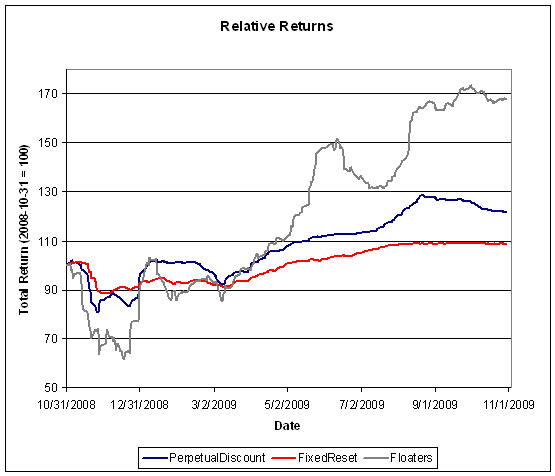
The preferred share market closed a lousy month on a high note, with PerpetualDiscounts up 13bp and FixedResets up 11bp. Volume was light, which may be related to the banks’ year-ends today; the prop desks being less willing than usual to facilitate trading by taking positions.

PerpetualDiscounts closed yielding 6.04%, equivalent to 8.46% interest at the standard equivalency factor of 1.4x. Long Corporates continue to yield a hair under 6.0% – having returned +44bp for the month – and thus the pre-tax interest-equivalent spread is now in the 245-250bp range, indistinguishable from the 250bp reported on October 28.

HIMIPref™ Preferred Indices
These values reflect the December 2008 revision of the HIMIPref™ Indices

Values are provisional and are finalized monthly
Index Mean
Current
Yield
(at bid)
Median
YTW
Median
Average
Trading
Value
Median
Mod Dur
(YTW)
Issues Day’s Perf. Index Value
Ratchet 0.00 % 0.00 % 0 0.00 0 -0.2234 % 1,474.1
FixedFloater 6.54 % 4.61 % 48,168 18.06 1 2.2769 % 2,381.1
Floater 2.64 % 3.09 % 99,856 19.48 3 -0.2234 % 1,841.5
OpRet 4.88 % -6.10 % 117,472 0.09 15 -0.2045 % 2,289.4
SplitShare 6.39 % 6.47 % 456,408 3.93 2 0.1989 % 2,068.0
Interest-Bearing 0.00 % 0.00 % 0 0.00 0 -0.2045 % 2,093.4
Perpetual-Premium 5.91 % 5.96 % 137,808 13.78 11 -0.0807 % 1,852.9
Perpetual-Discount 5.99 % 6.04 % 205,311 13.85 63 0.1279 % 1,731.6
FixedReset 5.53 % 4.26 % 443,286 3.99 41 0.1094 % 2,106.7
Performance Highlights
Issue Index Change Notes
TD.PR.Q Perpetual-Discount -1.78 % YTW SCENARIO
Maturity Type : Limit Maturity
Maturity Date : 2039-10-30
Maturity Price : 23.59
Evaluated at bid price : 23.78
Bid-YTW : 5.92 %
BAM.PR.J OpRet -1.39 % YTW SCENARIO
Maturity Type : Soft Maturity
Maturity Date : 2018-03-30
Maturity Price : 25.00
Evaluated at bid price : 24.75
Bid-YTW : 5.66 %
RY.PR.G Perpetual-Discount 1.04 % YTW SCENARIO
Maturity Type : Limit Maturity
Maturity Date : 2039-10-30
Maturity Price : 19.36
Evaluated at bid price : 19.36
Bid-YTW : 5.82 %
TD.PR.O Perpetual-Discount 1.05 % YTW SCENARIO
Maturity Type : Limit Maturity
Maturity Date : 2039-10-30
Maturity Price : 21.15
Evaluated at bid price : 21.15
Bid-YTW : 5.77 %
PWF.PR.M FixedReset 1.13 % YTW SCENARIO
Maturity Type : Call
Maturity Date : 2014-03-02
Maturity Price : 25.00
Evaluated at bid price : 26.80
Bid-YTW : 4.18 %
BNS.PR.N Perpetual-Discount 1.36 % YTW SCENARIO
Maturity Type : Limit Maturity
Maturity Date : 2039-10-30
Maturity Price : 22.91
Evaluated at bid price : 23.07
Bid-YTW : 5.72 %
CIU.PR.A Perpetual-Discount 1.56 % YTW SCENARIO
Maturity Type : Limit Maturity
Maturity Date : 2039-10-30
Maturity Price : 19.56
Evaluated at bid price : 19.56
Bid-YTW : 5.99 %
PWF.PR.E Perpetual-Discount 1.57 % YTW SCENARIO
Maturity Type : Limit Maturity
Maturity Date : 2039-10-30
Maturity Price : 22.15
Evaluated at bid price : 22.60
Bid-YTW : 6.10 %
BAM.PR.G FixedFloater 2.28 % YTW SCENARIO
Maturity Type : Limit Maturity
Maturity Date : 2039-10-30
Maturity Price : 25.00
Evaluated at bid price : 16.62
Bid-YTW : 4.61 %
Volume Highlights
Issue Index Shares
Traded
Notes
TRP.PR.A FixedReset 141,755 Recent new issue.
YTW SCENARIO
Maturity Type : Call
Maturity Date : 2015-01-30
Maturity Price : 25.00
Evaluated at bid price : 25.37
Bid-YTW : 4.39 %
CM.PR.J Perpetual-Discount 104,400 TD crossed 99,900 at 18.90.
YTW SCENARIO
Maturity Type : Limit Maturity
Maturity Date : 2039-10-30
Maturity Price : 18.70
Evaluated at bid price : 18.70
Bid-YTW : 6.06 %
MFC.PR.B Perpetual-Discount 66,942 RBC crossed 56,700 at 19.30.
YTW SCENARIO
Maturity Type : Limit Maturity
Maturity Date : 2039-10-30
Maturity Price : 19.24
Evaluated at bid price : 19.24
Bid-YTW : 6.14 %
TD.PR.K FixedReset 51,550 Desjardins crossed 43,300 at 27.20.
YTW SCENARIO
Maturity Type : Call
Maturity Date : 2014-08-30
Maturity Price : 25.00
Evaluated at bid price : 27.16
Bid-YTW : 4.32 %
BMO.PR.N FixedReset 44,500 RBC bought two blocks from TD at 27.95: 12,500 and 10,000 shares.
YTW SCENARIO
Maturity Type : Call
Maturity Date : 2014-03-27
Maturity Price : 25.00
Evaluated at bid price : 27.91
Bid-YTW : 3.92 %
CM.PR.H Perpetual-Discount 31,507 RBC crossed 10,000 at 20.03 and 10,600 at 20.00.
YTW SCENARIO
Maturity Type : Limit Maturity
Maturity Date : 2039-10-30
Maturity Price : 20.00
Evaluated at bid price : 20.00
Bid-YTW : 6.04 %
There were 23 other index-included issues trading in excess of 10,000 shares.
Issue Comments

TDS.PR.B: Partial Call for Redemption

TD Split Inc. has announced:

that it has called 194,364 Preferred Shares for cash redemption on November 13, 2009 representing approximately 21.4% of the outstanding Preferred Shares as a result of holders of 194,364 Capital Shares exercising their special annual retraction rights. The Preferred Shares shall be redeemed on a pro rata basis, so that each remaining holder of Preferred Shares will have approximately 21.4% of their Preferred Shares redeemed. The redemption price for the Preferred Shares will be $28.10 per share. Holders of Preferred Shares that have been called for redemption will be entitled to receive dividends thereon which have been declared but remain unpaid up to but not including November 13, 2009.

In addition, holders of a further 129,600 Preferred and Capital Shares have deposited such shares concurrently for retraction on November 13, 2009. As a result, a total of 323,964 Preferred and Capital Shares, or approximately 31.3% of both classes of shares currently outstanding will be redeemed.

Payment of the amount due to retracting shareholders will be made by the Company on November 13, 2009. From and after November 14, 2009 the holders of Preferred Shares that have been called for redemption will not be entitled to dividends or to exercise any right in respect of such shares except to receive the amount due on redemption.

TDS.PR.B was last mentioned on PrefBlog when it was upgraded to Pfd-3(high) by DBRS. TDS.PR.B is tracked by HIMIPref™ but is relegated to the “Scraps” subindex on both credit and volume concerns.

Interesting External Papers

Stop-Loss Orders

Stop-Loss Orders have always seemed completely insane to me. They completely ignore fundamentals; they are set according to price only.

If you’re willing to sell something at $20, why wouldn’t you sell it at $21 when you have the chance? The deliberate introduction of negative convexity into a portfolio – without getting paid for it! – is something that has bothered me even before I could express the idea in terms of convexity.

I was asked a question regarding Stop-Loss orders recently, which I answered as politely as I could; but it would be helpful to have some academic references to buttress my biases … or, who knows, maybe even refute them, although that would be the complete antithesis of how I have managed money throughout my career.

So … I’m starting this post to keep my notes in. Carry on!

Positive Feedback Investment Strategies and Destabilizing Rational Speculation, J. Bradford De Long, Andrei Shleifer, Lawrence H. Summers and Robert J. Waldmann. Yep, that’s THE Larry Summers. Anyway, the argument here is that there will be a certain proportion of “positive feedback” traders in the market, no matter what – they might even be margin traders, getting margin calls in a down market. Therefore, it becomes rational for informed traders to overreact to actual news, because they know that uninformed traders will overreact even more while the informed traders liquidate. While interesting, the authors are more interested in demonstrating the variability of the market and determining “critical points” – where a decline becomes a discontinuous crash – rather than looking at empirical evidence of stop-loss profit-and-loss.

Market Liquidity, Hedging, and Crashes by Gerard Gennotte and Hane Leland has much the same theme. There’s a nice line in the conclusion: “Traditional models which do not recognize that many investors are poorly informed will grossly overestimate the liquidity of stock markets” …. I’ll have to think about how that might tie in with the Credit Cruch!

Issue Comments

FortisAlberta 30-Year Note & FTS.PR.F

FortisAlberta has issued new 30-year notes at 5.37%:

DBRS has today assigned a rating of A (low), with a Stable trend, to the $125 million 5.37% medium-term notes (MTNs) due October 30, 2039, issued by FortisAlberta Inc. (FortisAlberta). The MTNs are expected to settle on October 30, 2009. The MTNs are being issued pursuant to FortisAlberta’s Short Form Base Shelf Prospectus dated December 15, 2008.

The MTNs will rank equally with all of FortisAlberta’s other present and future unsecured and unsubordinated senior obligations.

Thirty-year medium-term notes, eh? There’s a stretch!

FortisAlberta is a wholly-owned subsidary of Fortis Inc.:

As owner and operator of more than 60 per cent of Alberta’s total electricity distribution network, FortisAlberta’s focus remains the safe and reliable delivery of electricity to 460,700 customers in 175 communities across southern and central Alberta.

The Corporation is a regulated electricity distribution utility in the Province of Alberta. Its business is the ownership and operation of regulated electricity distribution facilities that distribute electricity generated by other market participants from high-voltage transmission substations to end-use customers. The Corporation does not own or operate generation or transmission assets and is not involved in the direct sale of electricity. The Corporation has limited exposure to exchange rate fluctuations on foreign currency transactions. It is intended that the Corporation remain a regulated electric utility for the foreseeable future, focusing on the delivery of safe, reliable and cost-effective electricity services to its customers in Alberta.

While FortisAlberta is the largest of Fortis Inc.’s electric companies, in terms of both assets and profits, it’s a relatively small component of the entire group, contributing about 15% of total profit in 2008. Additionally, there is a big difference between a small regional fully-regulated subsidiary and a multinational company with ambitions:

Fortis is the largest investor-owned distribution utility in Canada serving more than 2,000,000 gas and electricity customers. Its regulated holdings include electric utilities in five Canadian provinces and three Caribbean countries and a natural gas utility in British Columbia. Fortis owns non-regulated generation assets, primarily hydroelectric, across Canada and in Belize and Upper New York State and hotels and commercial real estate in Canada. In 2008, the Corporation’s electricity distribution systems met a combined peak electricity demand of more than 5,700 megawatts (“MW”) and its gas distribution systems met a peak day demand of 1,402 terajoules (“TJ”). The vision of Fortis is to be the world leader in those segments of the regulated utility industry in which it operates and the leading service provider within its service areas. Fortis has adopted a strategy of profitable growth with earnings per common share as the primary measure of performance. The Corporation’s first priority is to pursue organic growth opportunities in existing operations. Additionally, Fortis pursues profitable growth through acquisitions.

Despite the caveat, it’s of interest to compare the 5.37% on the subsidiary’s 30-year note with the YTW on the parent’s PerpetualDiscount issue, FTS.PR.F.

FTS.PR.F closed today at 21.85-95, with a yield-to-worst of 5.70%. At this point, a table is in order:

Fortis Inc
and
FortisAlberta
Attribute Fortis Inc. FortisAlberta
Credit Rating
Senior Bond
DBRS
BBB(high) A(low)
Credit Rating
Senior Bond
S&P
A- A-
Credit Rating
Preferred
DBRS
Pfd-3(high) NR
Credit Rating
Preferred
S&P
P-2 NR
Yield
Long Bond
N/A 5.37%
Yield
PerpetualDiscount
5.70% (div)
7.98% (int. eq.)
N/A

I like DBRS’ ratings better than S&P’s – it seems to me that some notching is appropriate in this case. While the parent is wonderfully diversified relative to the subsidiary, which would normally imply equal ratings, in this case the sub is a regulated utility, while the parent is an expanding collection of businesses, some of which are unregulated. While I will agree that a compelling case can be made for equal ratings, I like a one notch better.

It is notable that FTS.PR.F is trading below the yield of the better-rated index; this is probably due to the market’s fondness for non-financials, which is proxied by the “cumulative” attribute. For all that, the spread of about 260bp (interest equivalent) is probably a little low, given that the index-to-index spread is about 250bp. To me, the preferred seems a little expensive against the bond here, all in.

Market Action

October 29, 2009

The CIT restructuring continues to encourage speculation:

Since CIT Chief Executive Officer Jeffrey Peek started a $30 billion debt swap Oct. 1, the company’s notes due Nov. 3 have dropped 13 cents to 67 cents on the dollar, according to Trace, the bond-price reporting system of the Financial Industry Regulatory Authority. Holders of the $500 million in notes are being offered 90 cents on the dollar in new debt and equity in an out-of-court exchange. They would get 70 cents on the dollar in bonds and new stock in a pre-packaged bankruptcy.

The CIT notes due Nov. 3 fell 2.5 cents to 67 cents on the dollar yesterday, Trace data show.

The cost to protect CIT debt against default for five years has risen 4.7 percentage points to 38.7 percent upfront since Sept. 30, according to CMA DataVision.

It was a mild day for the Canadian preferred share market, with PerpetualDiscounts gaining 1bp, while FixedResets gained 2bp. Volume was steady.

HIMIPref™ Preferred Indices
These values reflect the December 2008 revision of the HIMIPref™ Indices

Values are provisional and are finalized monthly
Index Mean
Current
Yield
(at bid)
Median
YTW
Median
Average
Trading
Value
Median
Mod Dur
(YTW)
Issues Day’s Perf. Index Value
Ratchet 0.00 % 0.00 % 0 0.00 0 0.0000 % 1,477.4
FixedFloater 6.69 % 4.74 % 47,663 17.89 1 -1.4554 % 2,328.1
Floater 2.64 % 3.09 % 103,575 19.48 3 0.0000 % 1,845.7
OpRet 4.87 % -6.52 % 115,996 0.09 15 0.0281 % 2,294.1
SplitShare 6.41 % 6.37 % 461,873 3.93 2 0.3548 % 2,063.9
Interest-Bearing 0.00 % 0.00 % 0 0.00 0 0.0281 % 2,097.7
Perpetual-Premium 5.90 % 5.90 % 139,747 13.78 11 -0.1283 % 1,854.4
Perpetual-Discount 6.00 % 6.05 % 207,650 13.82 63 0.0102 % 1,729.4
FixedReset 5.53 % 4.28 % 443,397 4.00 41 0.0219 % 2,104.4
Performance Highlights
Issue Index Change Notes
HSB.PR.D Perpetual-Discount -2.18 % YTW SCENARIO
Maturity Type : Limit Maturity
Maturity Date : 2039-10-29
Maturity Price : 21.11
Evaluated at bid price : 21.11
Bid-YTW : 6.00 %
POW.PR.B Perpetual-Discount -1.58 % YTW SCENARIO
Maturity Type : Limit Maturity
Maturity Date : 2039-10-29
Maturity Price : 21.22
Evaluated at bid price : 21.22
Bid-YTW : 6.37 %
BAM.PR.G FixedFloater -1.46 % YTW SCENARIO
Maturity Type : Limit Maturity
Maturity Date : 2039-10-29
Maturity Price : 25.00
Evaluated at bid price : 16.25
Bid-YTW : 4.74 %
PWF.PR.M FixedReset -1.30 % YTW SCENARIO
Maturity Type : Call
Maturity Date : 2014-03-02
Maturity Price : 25.00
Evaluated at bid price : 26.50
Bid-YTW : 4.48 %
RY.PR.G Perpetual-Discount -1.24 % YTW SCENARIO
Maturity Type : Limit Maturity
Maturity Date : 2039-10-29
Maturity Price : 19.16
Evaluated at bid price : 19.16
Bid-YTW : 5.88 %
BNS.PR.Q FixedReset -1.16 % YTW SCENARIO
Maturity Type : Call
Maturity Date : 2013-11-24
Maturity Price : 25.00
Evaluated at bid price : 25.60
Bid-YTW : 4.34 %
PWF.PR.L Perpetual-Discount -1.14 % YTW SCENARIO
Maturity Type : Limit Maturity
Maturity Date : 2039-10-29
Maturity Price : 20.81
Evaluated at bid price : 20.81
Bid-YTW : 6.17 %
TD.PR.O Perpetual-Discount -1.09 % YTW SCENARIO
Maturity Type : Limit Maturity
Maturity Date : 2039-10-29
Maturity Price : 20.93
Evaluated at bid price : 20.93
Bid-YTW : 5.83 %
CIU.PR.A Perpetual-Discount 1.05 % YTW SCENARIO
Maturity Type : Limit Maturity
Maturity Date : 2039-10-29
Maturity Price : 19.26
Evaluated at bid price : 19.26
Bid-YTW : 6.09 %
GWO.PR.L Perpetual-Discount 1.47 % YTW SCENARIO
Maturity Type : Limit Maturity
Maturity Date : 2039-10-29
Maturity Price : 23.30
Evaluated at bid price : 23.45
Bid-YTW : 6.09 %
MFC.PR.A OpRet 1.78 % YTW SCENARIO
Maturity Type : Soft Maturity
Maturity Date : 2015-12-18
Maturity Price : 25.00
Evaluated at bid price : 26.31
Bid-YTW : 3.25 %
BNS.PR.P FixedReset 2.42 % YTW SCENARIO
Maturity Type : Call
Maturity Date : 2013-05-25
Maturity Price : 25.00
Evaluated at bid price : 25.80
Bid-YTW : 4.04 %
Volume Highlights
Issue Index Shares
Traded
Notes
BNS.PR.X FixedReset 48,022 TD bought 10,000 from National at 27.21.
YTW SCENARIO
Maturity Type : Call
Maturity Date : 2014-05-25
Maturity Price : 25.00
Evaluated at bid price : 27.22
Bid-YTW : 4.17 %
SLF.PR.F FixedReset 36,250 RBC crossed 33,100 at 27.05.
YTW SCENARIO
Maturity Type : Call
Maturity Date : 2014-07-30
Maturity Price : 25.00
Evaluated at bid price : 26.98
Bid-YTW : 4.31 %
SLF.PR.B Perpetual-Discount 35,419 RBC crossed 22,900 at 19.88.
YTW SCENARIO
Maturity Type : Limit Maturity
Maturity Date : 2039-10-29
Maturity Price : 19.87
Evaluated at bid price : 19.87
Bid-YTW : 6.12 %
CM.PR.H Perpetual-Discount 28,537 RBC crossed 17,700 at 20.04.
YTW SCENARIO
Maturity Type : Limit Maturity
Maturity Date : 2039-10-29
Maturity Price : 19.95
Evaluated at bid price : 19.95
Bid-YTW : 6.06 %
RY.PR.B Perpetual-Discount 27,963 YTW SCENARIO
Maturity Type : Limit Maturity
Maturity Date : 2039-10-29
Maturity Price : 20.14
Evaluated at bid price : 20.14
Bid-YTW : 5.85 %
RY.PR.E Perpetual-Discount 27,875 RBC crossed 15,000 at 19.40.
YTW SCENARIO
Maturity Type : Limit Maturity
Maturity Date : 2039-10-29
Maturity Price : 19.34
Evaluated at bid price : 19.34
Bid-YTW : 5.83 %
There were 37 other index-included issues trading in excess of 10,000 shares.
Issue Comments

Big 8 Split to Relever: DBRS puts BIG.PR.B on Review-Negative

Dominion Bond Rating Service has announced:

has today placed the Pfd-2 (high) rating of the Class B Preferred Shares, Series 1 (the Class B Preferred Shares) issued by Big 8 Split Inc. (the Company) Under Review with Negative Implications.

The Company currently has 1,204,980 Class B Preferred Shares and an equal number of Class A capital shares (the Capital Shares) outstanding. The Class B Preferred Shares receive a fixed cumulative quarterly distribution yielding 7.00% annually on the issue price of $12 per share. The scheduled final maturity date of the Class B Preferred Shares is December 15, 2013.

The Company has filed a preliminary prospectus for the issuance of Class C Preferred Shares, Series 1 (the Class C Preferred Shares; collectively, with the Class B Preferred Shares, the Preferred Shares) and additional Capital Shares. The Company intends to declare and pay a dividend in Capital Shares to the current holders of the Capital Shares. The Company will then offer to issue a greater amount of Class C Preferred Shares than Capital Shares so that there will be an equal number of Capital Shares and Preferred Shares of the Company outstanding. The Class C Preferred Shares will rank pari passu with the Class B Preferred Shares with respect to return of principal and payment of dividends.

As of October 22, 2009, the net asset value (NAV) of the Company was $42.01 per unit, providing downside protection of approximately 71% to the Class B Preferred Shares. The re-leveraging of the Company described above at the time of issuance of the Class C Preferred Shares and additional Capital Shares will result in a lower amount of downside protection being available to the Class B Preferred Shares. Consequently, the rating on the Class B Preferred Shares has been placed Under Review with Negative Implications. Once the Class C Preferred Shares are issued, the Preferred Shares will benefit from the same amount of downside protection. Based on information received from TD Sponsored Companies Inc. (the Administrator and Promoter of the Company) to date, it is expected that the rating on the Class B Preferred Shares will be downgraded to Pfd-2 upon completion of the issuance of Class C Preferred Shares and additional Capital Shares.

The preliminary prospectus is on SEDAR:

A holder retracting Preferred Shares will receive a cash price per Preferred Share retracted equal to the amount, if any, by which 95% of the Unit Value exceeds the aggregate of (i) the average cost to the Company, including commissions, of purchasing a Capital Share in the market; and (ii) $1.00. See “Description of the Securities Distributed – Attributes of the Preferred Shares”.

Any outstanding Preferred Shares will be redeemed by the Company on December 15, 2013 (the “Redemption Date”) at a price per share (the “Preferred Share Redemption Price”) equal to the lesser of $12.00 and Unit Value.

The Company may also redeem Preferred Shares on December 15 of any year commencing in 2010 at a price per share equal to the Preferred Share Redemption Price to the extent that unmatched Capital Shares have been tendered for retraction under a Special Annual Retraction. See “Description of the Securities Distributed – Attributes of the Preferred Shares”.

In addition, the Board of Directors has the right to redeem the Preferred Shares then outstanding at the next Annual Retraction Payment Date if the market value of the Portfolio Shares held by the Company is $15,000,000 or less for two consecutive Valuation Dates.

It will be the policy of the Board of Directors of the Company to declare and pay quarterly distributions in an amount equal to the dividends received by the Company on the Portfolio Shares minus the dividends payable on the Company’s preferred shares and all administrative and operating expenses where the dividends on the Portfolio Shares exceed the dividends. It will be the policy of the Board of Directors of the Company to declare and pay quarterly distributions in an amount equal to the dividends received by the Company on the Portfolio Shares minus the dividends payable on the Company’s preferred shares and all administrative and operating expenses where the dividends on the Portfolio Shares exceed the dividends

These terms are heavily weighted weighted against the preferred shareholders (annual redemption possibility at par; poor retraction rights; no NAV test on distributions to Capital Unitholders) but … a fat coupon just might tip the scales. Sadly, the coupon on the new issue is not yet known – but most potential investors will be more interested in the four year term and good credit quality.

BIG.PR.B was last mentioned on PrefBlog when it was upgraded to Pfd-2(high) by DBRS. BIG.PR.B is not tracked by HIMIPref™.

Market Action

October 28, 2009

CIT amended terms on its exchange offer:

  • Extension of the expiration date of the offers and the solicitation of acceptances of the Plan of Reorganization only with respect to offers made by CIT Group Funding Company of Delaware LLC (“Delaware Funding”) from October 29, 2009 to November 5, 2009. The Early Tender Date for these notes is October 29, 2009,
  • Increased the interest rate payable on the Series B Notes from 9.0% per annum to 10.25% per annum.

… which sounds to me like the deal’s in trouble. They’ve also responded to Carl Icahn’s overtures (reported on PrefBlog on October 23) in a surprisingly mild-mannered way … but to no avail. Icahn’s stepping up the pressure:

Carl Icahn, who says he’s the largest bondholder of CIT Group Inc. with $2 billion of debt, stepped up his attacks on the lender’s restructuring plan as a deadline approaches tomorrow to avert collapse.

Icahn gave CIT an hour to respond late yesterday afternoon to his offer to provide $4.5 billion in financing, and threatened to sue the New York-based company if it chose a competing package from other bondholders. CIT said its plan to either exchange $30 billion of debt for new bonds and equity or file a pre-packaged bankruptcy is worth more to creditors.

Icahn, 73, who built his reputation in the 1980s as a corporate raider, said yesterday the investments are worth more in a traditional bankruptcy than in a so-called pre-packaged workout. He is proposing to buy “smaller” holders’ bonds for 60 cents on the dollar in a tender offer lasting 30 days if they reject CIT’s plans, “assuring them a floor price in the event the notes trade lower,” he said yesterday in a statement.

Egan-Jones says the pre-pack should be voted down:

CIT Group Inc. bondholders should reject a proposed $30 billion debt swap and pre-packaged bankruptcy plan designed to avert the 101-year-old commercial lender’s collapse, according to Egan-Jones Ratings Co.

CIT’s unsecured debt is worth about 90 cents on the dollar and senior creditors can expect close to full recovery, Egan- Jones President Sean Egan and analysts Kent Hughes and Gale Gillespie wrote in a report dated today.

And today, the secured facility was increased:

it has expanded its current $3 billion senior secured credit facility by an additional $4.5 billion. The new $4.5 billion tranche, which is being provided by a diverse group of lenders, including many of the Company’s bondholders, will be secured by substantially the same assets as the existing $3 billion tranche and any additional collateral that becomes available as a result of the Company’s refinancing of certain existing secured credit facilities.

The new $4.5 billion tranche matures in January 2012, and includes an option for the Company to extend all or a portion of the new tranche for an additional year. It is expected to close today and will be used to refinance a portion of the Company’s existing secured indebtedness, which may come due as a result of the restructuring, and for general corporate purposes.

The Company also addressed a commitment letter received yesterday from Carl Icahn to provide CIT a new $4.5 billion term loan. Although Mr. Icahn and his advisors had been in discussions with the Company for several days and were fully aware of CIT’s deadline, they provided the Company less than one hour to review and accept his commitment letter. Additionally, despite several requests from the Company for information and multiple deadline extensions, the Company has yet to receive a signed credit agreement and evidence of Mr. Icahn’s ability to fund the commitment.

As a result of the lack of evidence that Mr. Icahn has arranged sufficient funding at this time, CIT’s Board of Directors determined that the best interests of the Company and its stakeholders would be served by proceeding with the credit facility provided by a diverse group of lenders.

Norway has increased its policy rate:

Norges Bank raised its key interest rate a quarter point from a record low and signaled steeper increases than it previously forecast over the next three years as inflation accelerates and unemployment remains low.

The Oslo-based bank raised the overnight deposit rate to 1.5 percent, becoming the first European central bank to reverse its easing cycle since the credit crisis started to abate.

The bank expects underlying inflation, which adjusts for energy and taxes, to average 2.75 percent this year and 1.75 percent in 2010. The mainland economy will shrink 1.25 percent this year and grow 2.75 percent in 2010, it estimates.

The key rate will average 1.75 percent this year and 2.25 percent in 2010, rising to an average 4.25 percent by 2012, the bank said.

The AIG bail-out is providing providing fodder for conspiracy theorists:

The Federal Reserve Bank of New York said Tuesday that it had no choice but to instruct American International Group last November to reimburse the full amount of what it owed to big banks on derivatives contracts, a move that ended months of effort by the insurance giant to negotiate lower payments.

Fed officials offered the explanation in a rare response to a media report after Bloomberg News said that the New York Fed, led at the time by then-President Timothy F. Geithner, directed AIG to make the payments after it received a massive government bailout. The officials said AIG lost its leverage in demanding a better deal once the company had been saved from bankruptcy.

Lawmakers and financial analysts critical of the payouts say it amounted to a back-door bailout for big banks.

The precise cost to taxpayers of these decisions is difficult to determine. Bloomberg, quoting an industry source, reported Tuesday that AIG was aiming to pay just 40 percent of the $32.5 billion it owed to the banks. Using those figures, the report concluded that the government needlessly overpaid $13 billion.

New York Fed officials explained that the main reason creditors were willing for a time to accept less than full reimbursement was their fear of an AIG bankruptcy. The government’s rescue of the company removed that threat and left the company with virtually no way to wrestle concessions from the banks.

Just because conspiracy theorists are nuts doesn’t mean they’re always wrong!

The SEC released today Testimony Concerning Dark Pools, Flash Orders, High Frequency Trading, and Other Market Structure Issues. Interesting, although ultimately unsatisfying: I remain perplexed regarding the badness of flash orders and high-frequency trading:

while flash orders may potentially be providing benefits to certain traders, it may no longer serve the interests of long-term investors or the markets as a whole. The Commission has stated, both in adopting Regulation NMS and in proposing to ban flash orders, that the interests of long-term investors should be upheld as against those of professional short-term traders, when those interests are in conflict. The comment period on the proposal to ban flash orders remains open until November 23, and the staff and the Commission look forward to carefully analyzing the comments received.

It was another putrid period of poorly performing preferreds today, with PerpetualDiscounts down 20bp and FixedResets losing 11bp. Volume was off a bit (prefhound was putting his orders through Pure today), but still healthy.

PerpetualDiscounts now yield 6.05%, equivalent to 8.47% interest at the standard equivalency factor of 1.4x. Long Corporates now yield a hair under 6.0%, so let’s call the Pre-Tax Interest-Equivalent Spread (also called the Seniority Spread, according to me) 250bp, with all levels indistinguishable from those reported on October 21.

HIMIPref™ Preferred Indices
These values reflect the December 2008 revision of the HIMIPref™ Indices

Values are provisional and are finalized monthly
Index Mean
Current
Yield
(at bid)
Median
YTW
Median
Average
Trading
Value
Median
Mod Dur
(YTW)
Issues Day’s Perf. Index Value
Ratchet 0.00 % 0.00 % 0 0.00 0 0.5390 % 1,477.4
FixedFloater 6.59 % 4.65 % 47,374 18.00 1 -2.4260 % 2,362.4
Floater 2.64 % 3.08 % 106,963 19.51 3 0.5390 % 1,845.7
OpRet 4.87 % -6.67 % 114,728 0.09 15 -0.0051 % 2,293.5
SplitShare 6.43 % 6.51 % 477,131 3.93 2 -0.3535 % 2,056.6
Interest-Bearing 0.00 % 0.00 % 0 0.00 0 -0.0051 % 2,097.1
Perpetual-Premium 5.90 % 5.93 % 141,654 13.82 11 -0.0183 % 1,856.7
Perpetual-Discount 6.00 % 6.05 % 214,992 13.82 63 -0.2038 % 1,729.2
FixedReset 5.53 % 4.30 % 447,423 4.00 41 -0.1075 % 2,103.9
Performance Highlights
Issue Index Change Notes
BAM.PR.G FixedFloater -2.43 % YTW SCENARIO
Maturity Type : Limit Maturity
Maturity Date : 2039-10-28
Maturity Price : 25.00
Evaluated at bid price : 16.49
Bid-YTW : 4.65 %
BNS.PR.P FixedReset -2.40 % YTW SCENARIO
Maturity Type : Call
Maturity Date : 2018-05-25
Maturity Price : 25.00
Evaluated at bid price : 25.19
Bid-YTW : 4.77 %
MFC.PR.A OpRet -1.71 % YTW SCENARIO
Maturity Type : Soft Maturity
Maturity Date : 2015-12-18
Maturity Price : 25.00
Evaluated at bid price : 25.85
Bid-YTW : 3.58 %
GWO.PR.L Perpetual-Discount -1.66 % YTW SCENARIO
Maturity Type : Limit Maturity
Maturity Date : 2039-10-28
Maturity Price : 22.97
Evaluated at bid price : 23.11
Bid-YTW : 6.18 %
POW.PR.B Perpetual-Discount -1.33 % YTW SCENARIO
Maturity Type : Limit Maturity
Maturity Date : 2039-10-28
Maturity Price : 21.56
Evaluated at bid price : 21.56
Bid-YTW : 6.27 %
TD.PR.A FixedReset -1.28 % YTW SCENARIO
Maturity Type : Call
Maturity Date : 2014-03-02
Maturity Price : 25.00
Evaluated at bid price : 25.47
Bid-YTW : 4.51 %
GWO.PR.F Perpetual-Discount -1.26 % YTW SCENARIO
Maturity Type : Limit Maturity
Maturity Date : 2039-10-28
Maturity Price : 23.99
Evaluated at bid price : 24.29
Bid-YTW : 6.14 %
PWF.PR.G Perpetual-Premium -1.19 % YTW SCENARIO
Maturity Type : Limit Maturity
Maturity Date : 2039-10-28
Maturity Price : 23.76
Evaluated at bid price : 24.06
Bid-YTW : 6.16 %
TD.PR.Q Perpetual-Discount -1.15 % YTW SCENARIO
Maturity Type : Limit Maturity
Maturity Date : 2039-10-28
Maturity Price : 23.96
Evaluated at bid price : 24.17
Bid-YTW : 5.82 %
RY.PR.C Perpetual-Discount -1.10 % YTW SCENARIO
Maturity Type : Limit Maturity
Maturity Date : 2039-10-28
Maturity Price : 19.75
Evaluated at bid price : 19.75
Bid-YTW : 5.83 %
BAM.PR.P FixedReset 1.13 % YTW SCENARIO
Maturity Type : Call
Maturity Date : 2014-10-30
Maturity Price : 25.00
Evaluated at bid price : 26.85
Bid-YTW : 5.47 %
NA.PR.N FixedReset 1.16 % YTW SCENARIO
Maturity Type : Call
Maturity Date : 2013-09-14
Maturity Price : 25.00
Evaluated at bid price : 26.20
Bid-YTW : 3.95 %
ENB.PR.A Perpetual-Premium 1.20 % YTW SCENARIO
Maturity Type : Call
Maturity Date : 2009-11-27
Maturity Price : 25.00
Evaluated at bid price : 25.31
Bid-YTW : 0.84 %
BAM.PR.K Floater 1.98 % YTW SCENARIO
Maturity Type : Limit Maturity
Maturity Date : 2039-10-28
Maturity Price : 12.85
Evaluated at bid price : 12.85
Bid-YTW : 3.08 %
Volume Highlights
Issue Index Shares
Traded
Notes
CIU.PR.B FixedReset 60,475 Desjardins crossed 50,000 at 28.00.
YTW SCENARIO
Maturity Type : Call
Maturity Date : 2014-07-01
Maturity Price : 25.00
Evaluated at bid price : 28.00
Bid-YTW : 4.17 %
SLF.PR.D Perpetual-Discount 47,778 RBC crossed 40,000 at 18.49.
YTW SCENARIO
Maturity Type : Limit Maturity
Maturity Date : 2039-10-28
Maturity Price : 18.40
Evaluated at bid price : 18.40
Bid-YTW : 6.13 %
TRP.PR.A FixedReset 40,025 Recent new issue.
YTW SCENARIO
Maturity Type : Call
Maturity Date : 2015-01-30
Maturity Price : 25.00
Evaluated at bid price : 25.28
Bid-YTW : 4.46 %
RY.PR.I FixedReset 34,255 RBC bought 10,000 from anonymous at 25.69.
YTW SCENARIO
Maturity Type : Call
Maturity Date : 2014-03-26
Maturity Price : 25.00
Evaluated at bid price : 25.57
Bid-YTW : 4.34 %
SLF.PR.B Perpetual-Discount 27,339 RBC crossed 22,900 at 19.88.
YTW SCENARIO
Maturity Type : Limit Maturity
Maturity Date : 2039-10-28
Maturity Price : 19.80
Evaluated at bid price : 19.80
Bid-YTW : 6.14 %
W.PR.J Perpetual-Discount 25,800 RBC crossed 23,600 at 23.30.
YTW SCENARIO
Maturity Type : Limit Maturity
Maturity Date : 2039-10-28
Maturity Price : 23.12
Evaluated at bid price : 23.38
Bid-YTW : 6.03 %
There were 31 other index-included issues trading in excess of 10,000 shares.
Reader Initiated Comments

Alpha Trading, Pure and Preferred Shares

Assiduous Reader prefhound writes in and says:

I have a question about two weird pref share trades that ocurred in my [REDACTED BY JH] account today.

I was buying something (after trying other prices) at an offer price of $22.40, so I put in a buy limit price of $22.40. I was filled at 22.39, but my trade volume and price does not show up in the daily quotes (high for this stock is given as 22.27; my volume and trade is not reported by the TSX and my fill made no difference to the offer price of 22.40 and number of lots).

Several hours later, I was selling something (again after trying higher prices) at a bid price of $21.58. I placed a limit sell at $21.58 but was filled at 21.59 (again one penny difference), but my trade volume and price do not show up again.

Is it possible that [REDACTED BY JH] is blindly internally matching bids and offers at a 1 cent difference to the market, then filling by a cross with me and not reporting the trade?

Alternatively, is this a “dark pool” or “rapid trading” issue?

I guess I am not supposed to be unhappy with internal crosses at 1 cent bonus to me, but I’m wondering if unreported trades don’t distort the market — my trade in the second stock is 5X the reported volume!

Your trade was almost certainly filled by an Alternative Trading System such as Alpha Trading Systems, which currently claims overall market share of 20% and challenges to become the primary market in some securities.

Now, it’s very nice to get filled a penny better than you expected – but there are issues for those among us who attempt to sell liquidity. If your limit order has been routed to the Toronto Stock Exchange, for example, and you look at only data feeds from the Exchange, you might be doing yourself out of a little money.

Say you put in a bid at 20.00 at a time when the Exchange is quoting the issue at 19.90-10. Immediatley afterwards, the Exchange will report the quote as 20.00-10 … so far, so good. But there could be ten bazillion market orders to sell coming down the pipe, all of them getting filled on Alpha at the Alpha bid of 20.01. Not only will you not get filled, but you won’t even know about these orders.

Alpha’s October Newsletter contains a discussion of their market data pricing strategy, and their website shows a list of authorized vendors of this data.

To get an idea of volumes and delayed quotes, you may wish to go to the sites of Alternative Trading Systems – I have added a category of links (in the right hand navigation panel) titled “Quotes (Delayed)” with some addresses. For example, the following data can be compiled for GWO.PR.H:

Trading in GWO.PR.H
2009-10-28
Exchange Range Volume Closing Quote
TMX 19.58-70 5,566 19.52-66, 2×1
Pure 19.61-73
(Last 10 Trades)
4,500 None-19.84, 0x5
Alpha Last trade 2009-10-20
Contingent Capital

OSFI Joins Contingent Capital Bandwagon

The Office of the Superintendent of Financial Institutions (OSFI) has released a speech by Julie Dickson to the C.D. Howe Institute titled Considerations along the Path to Financial Regulatory Reform.

The most important part was the section on contingent capital:

Explore the use of contingent capital. This refers to sizeable levels of lower quality capital that could convert into high quality capital at pre-specified points, and clearly before an institution could receive government support. Such conversions could make use of triggers in the terms of a bank’s lower quality capital, while the bank remains a going-concern. This would add market discipline for even the largest banks during good times (as common shareholders could be significantly diluted in an adverse scenario), while stabilizing the situation by recapitalizing such banks if they fall on hard times. Boards and management of these recapitalized banks could be replaced. Issues to be studied to make such a proposal operational include grandfathering of existing lower quality securities, and/or transitioning towards new features in lower quality securities, considering capital markets implications of changing the terms of lower quality capital and the selection of triggers, and determining the amounts and market for such instruments.

Contingent capital was first proposed in such a form – as far as I know! – in HM Treasury’s response to the Turner Report.

Under the heading Making Failure a Viable Option, she advocates:

More control of counterparty risk via capital rules and limits, so that imposing losses on major institutions who are debt holders in a failed financial institution does not prove fatal.

It is possible that this might be an attack on the utterly ridiculous Basel II risk weighting of bank paper according to the credit rating of the bank’s supervisor; that is, paper issued by a US bank is risk-weighted according to the credit rating of the US, which is perhaps the most difficult thing to understand about the Basel Rules. If the regulators are serious about reducing systemic risk, then paper issued by other financial institutions should attract a higher risk weighting than that of a credit-equivalent non-financial firm, not less.

I have often remarked on the Bank of Canada’s attempts to expand its bureaucratic turf throughout the crisis; two can play at that game!

one could try to experiment and adjust capital requirements up or down based on macro indicators. But, the challenge will be how to make a regime which ties macro indicators to capital effective. Indeed, in upturns in the domestic market where capital targets are increased due to macro factors, companies would have the option to obtain loans from banks in countries with less robust economic conditions, as banks in that country will have lower requirements. Thus, an increase in capital in the domestic market might not have the desired impact of slowing things down.

Alternatively, because many countries have well developed financial sectors, borrowers can go beyond the regulated financial sector to find money, as regulated financial institutions are not the only game in town.

Umm … hello? The objective of varying credit requirements is to strengthen the banks should there be a possible downturn; the Greenspan thesis is that it is extremely difficult to tell if you’re in a bubble while you’re in the middle of it (and therefore, you do more damage by prevention than is done by cure) has attracted academic support (as well as being simple common sense; if a bubble was obvious, it wouldn’t exist).

Most authorities agree that Central Banks have the responsibility for “slowing things down” via monetary policy; OSFI should stick to its knitting and concentrate on assuring the relative health of the regulated financial sector it regulates.

Of particular interest is her disagreement with one element of Treasury’s wish-list:

Yes, regulators should try to assess systemic risk. But no, we should not try to define systemically important financial institutions.

The IMF work on identifying systemic institutions rightly points out that what is systemic in one situation may not be in another, and that there is considerable judgement involved.

Ms. Dickson also made several remarks about market discipline, which should not be taken seriously.

Update: I’ve been trying to find the “IMF work” referred to in the last quoted paragraph; so far, my best guess is Chapter 3 of the April ’09 Global Financial Stability Report:

Cascade effects. Another use of the joint probability distribution is the probability of cascade effects, which examines the likelihood that one or more FIs in the system become distressed given that a specific FI becomes distressed. It is a useful indicator to quantify the systemic importance of a specific FI, since it provides a direct measure of its effect on the system as a whole. As an example, the probability of cascade effects is estimated given that Lehman or AIG became distressed. These probabilities reached 97 percent and 95, respectively, on September 12, 2008, signaling a possible “domino” effect in the days after Lehman’s collapse (Figure 3.10). Note that the probability of cascade effects for both institutions had already increased by August 2007, well before Lehman collapsed.

The IMF Country Report No. 09/229 – United States: Selected Issues points out:

It remains to be seen how the Federal Reserve, in consultation with the Treasury, will draw up rules to guide the identification of systemic firms to be brought under its purview, and how the FSOC will ensure that remaining intermediaries are monitored from a broader financial stability perspective. Although the criteria for Tier 1 FHC status appropriately include leverage and interconnectedness as well as size, identifying systemic institutions ex ante will remain a difficult task (cf., AIG).

I have sent an inquiry to OSFI asking for a specific reference.

Update, 2009-11-9: OSFI’s bureaucrats have not seen fit to respond to my query, but the Bank for International Settlements has just published the Report to G20 Finance Ministers and Governors: Guidance to Assess the Systemic Importance of Financial Institutions, Markets and Instruments: Initial Considerations which includes the paragraph:

The assessment is likely to be time-varying depending on the economic environment. Systemic importance will depend significantly on the specifics of the economic environment at the time of assessment. Structural trends and the cyclical factors will influence the outcome of the assessment. For instance, under weak economic conditions there is a higher probability that losses will be correlated and failures in even relatively unimportant elements of the financial sector could become triggers for more general losses of confidence. A loss of confidence is often associated with uncertainty of asset values, and can manifest in a contagious “run” on short-run liabilities of financial institutions, or more generally, in a loss of funding for key components of the system. The dependence of the assessment on the specific economic and financial environment has implications about the frequency with which such assessments should take place, with the need for more frequent assessments to take account of new information when financial systems are under stress or where material changes in the environment or the business and risk profile of the individual component have taken place.

It is regrettable that OSFI does not have a sufficiently scholarly approach to its work to provide references in the published version of Julie Dickson’s speeches – or that she would not insist on such an approach. It is equally regrettable that OSFI is unable to answer a simple question regarding such a reference within a day or so.