Interesting External Papers

BIS Releases March 2009 Quarterly Review

The Bank for International Settlements has announced the release of its Quarterly review, chock full of heartwarming stories:

  • Overview: Investors ponder depth and duration of global recession
  • Highlights of international banking and financial market activity
  • Assessing the risk of banking crises – revisited
  • The US dollar shortage in global banking
  • US dollar money market funds and non-US banks
  • Execution methods in foreign exchange markets

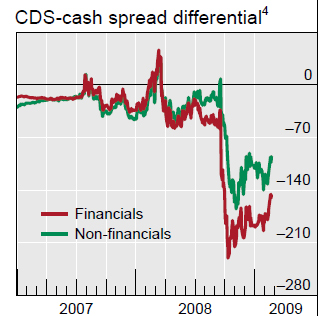
One sign of dysfunctionality, which has been highlighted but not quantified by PrefBlog, is the CDS Basis:

At the same time, signs of dysfunction continued, highlighting the fragile state of market conditions and investor sentiment. The fragility was apparent, for example, in measures such as the CDS-cash basis, which reflects the pricing differential between CDS contracts and corresponding cash market bonds. Though not as pronounced as in the aftermath of the Lehman Brothers bankruptcy, the basis remained unusually wide in the new year, suggesting that arbitrage activities that would usually tend to compress the price differential continued to be constrained by elevated capital and financing costs for leveraged investors (Graph 2, right-hand panel). Similar effects were observed elsewhere, as evident from high and variable liquidity premia in the markets for government bonds and swaps (see bond market section below).

In a normal world (subject to caveats about creditor status, a la Lyondell), one should be relatively indifferent as to whether one holds a cash bond or a BA+CDS package. This is not a normal world.
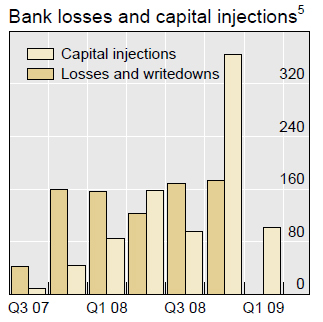
Also of interest is the relative size of writedowns vs. capital injections:
We talk about sub-debt and Innovative Tier 1 Capital a lot on this blog … BIS notes:

Subordinated bank CDS spreads, in turn, remained under pressure from uncertainties about the implications of government interventions for investors in lower-seniority debt instruments, including the treatment of hybrid securities issued to bolster banks’ capital positions. Earlier investor concerns over a large issuer’s decision not to call outstanding hybrid securities at the contractual redemption date, in contrast, eased after other borrowers decided to redeem their issues. Related fears about extension risk (ie the risk of maturities on similar securities being extended beyond the agreed call dates) had fed into the markets for subordinated CDS, which are widely used to hedge hybrid instruments

… and TIPS are also of interest:

Technical factors also continued to influence break-even inflation rates in major industrialised countries. While expected rapid disinflation contributed to falling break-even rates at shorter horizons, much of the recent movement in long-term break-even rates seemed to be due to factors not directly linked to inflation expectations. These included rapid unwinding of positions, intense safe haven demand for the liquidity of nominal Treasuries and rising liquidity premia in index-linked bonds, all of which helped push break-even rates to unusually low levels (see box). However, with some of these forces easing in early 2009, break-even inflation rates began to edge upwards from their lows.

The box discusses the importance of technical factors and – again! – the differing behaviour of swap instruments that do not tie up cash:

Linked to these liquidity effects, and to some extent indistinguishable from them, are technical market factors, which also appear to have been important drivers of break-even rates recently. Such factors include sell-side pressures from leveraged investors that were forced to unwind inflation-linked bond positions in adverse market conditions, which in turn resulted in rising real yields and hence falling break-even rates.

Evidence from inflation swap markets can shed some light on the importance of these effects. An inflation swap is a derivative instrument that is similar to a regular interest rate swap. However, instead of exchanging a fixed payment for a variable payment linked to a short-term interest rate, the inflation swap links the variable payment to a measure of inflation, typically the accrued inflation over the life of the swap. The fixed leg of the inflation swap therefore provides a direct break-even inflation “price”, which is unaffected by any differential liquidity conditions in nominal and real bond markets or by flight-to-liquidity flows.

The paper on the US dollar in international banking has some great graphs showing the gross up of the non-domestic-currency balance sheets of various banks:

The analysis suggests that many European banking systems built up long US dollar positions vis-à-vis non-banks and funded them by interbank borrowing and via FX swaps, exposing them to funding risk. When heightened credit risk concerns crippled these sources of short-term funding, the chronic US dollar funding needs became acute. The resulting stresses on banks’ balance sheets have persisted, resulting in tighter credit standards and reduced lending as banks struggle to repair their balance sheets.

On a related note, the paper on Money Market Funds claims:

In sum, the run on US dollar money market funds after the Lehman failure stressed global interbank markets because the funds bulked so large as suppliers of US dollars to non-US banks. Public policies stopped the run and replaced the reduced private supply of dollars with public funding.

… and …

Records of the mid-2008 holdings of the 15 largest prime funds (Table 1), accounting for over 40% of prime funds’ assets, show that the funds placed half of their portfolios with non-US banks. Thus, such US money market funds’ investment in non-US banks reached an estimated $1 trillion in mid-2008 out of total assets of over $2 trillion. To this can be added one half of the assets of European US dollar funds represented by the Institutional Money Market Fund Association, about $180 billion out of $360 billion in early September 2008.

Overall, European banks appear to have relied on money market funds for about an eighth of their $8 trillion in dollar funding. By contrast, central banks, which invest 10–15% of US dollar reserves in banks (McCauley (2007)), provided only $500 billion to European banks at the peak of their holdings in the third quarter of 2007. Given these patterns, any run on dollar money market funds was bound to make trouble for European banks.

… and …

As investors in short-term debt, MMFs are important providers of liquidity to financial intermediaries through purchases of certificates of deposit (CDs) and commercial paper (CP) issued by banks, and through repo transactions. For example, MMFs held nearly 40% of the outstanding volume of CP in the first half of 2008. Consequently, when MMFs shift away from these assets into safer ones, funding liquidity for financial institutions can be affected.

The run focussed on non-bank-sponsored MMFs:

The largest redemptions occurred at institutional prime funds managed by the remaining securities firms and small independent managers, which investors doubted could support their funds. Two-day redemptions at the largest institutional prime fund managed by the three largest securities firms were 20%, 36% and 38% of assets, well above the 16% average. By contrast, the largest such funds managed by affiliates of seven large banks met two-day calls of 2%, 5%, 5%, 7%, 10%, 10% and 17% of assets (Graph 4, right-hand panel). On 21 September, Goldman Sachs and Morgan Stanley announced plans to become bank holding companies; Bank of America had announced its purchase of Merrill Lynch on 15 September. American Beacon, an independent money fund spun off by American Airlines, faced two-day redemptions of 46% of its assets and resorted to in-kind redemption.

The authors refer to the Volker report (that I enthusiastically endorse, at least the MMF parts):

Some former policymakers and current market participants, however, have called for money market funds that offer transaction services, withdrawal on demand and a stable net asset value to be organised and supervised as banks with access to last resort lending (Group of 30 (2009)). Further, they would require any short-term funds that were not thus organised and supervised to have a floating net asset value.

Also, as I wrote in an essay, bank sponsored MMFs should be consolidated with bank assets for risk-weight and leverage purposes.


Market Action

March 2, 2009

Whoosh! In like a lion, all right!

Suncor Energy Inc. dropped 10 percent after its shares were downgraded at Raymond James & Associates Inc. on expectations of lower oil and gas prices. Potash Corp. of Saskatchewan Inc. fell 9.8 percent on speculation that the recession will cut demand for grains and fertilizers. Manulife Financial Corp. slumped to the lowest in almost nine years on renewed speculation that it will sell stock to cover investment losses and pay for an acquisition.

The Standard & Poor’s/TSX Composite Index fell 5.4 percent to 7,687.51 in Toronto, the steepest loss since Dec. 1. Only 20 of Canada’s main stock benchmark’s 215 members rose. The S&P/TSX is down 14 percent this year, adding to a 2008’s 35 percent drop.

How bad is liquidity? I understand TD Waterhouse refused to bid on about $20,000-worth (present value) of 20-year Ontario Hydro coupons for a retail account. Now, that’s bad.

Prefs were not unscathed, but managed to stagger to a not-as-horrible-as-November finish amidst very light volume. Given all the recent hand-wringing about MFC, it will be interesting to see how their new and wildly popular Fixed-Reset opens on Wednesday.

HIMIPref™ Preferred Indices
These values reflect the December 2008 revision of the HIMIPref™ Indices

Values are provisional and are finalized monthly
Index Mean
Current
Yield
(at bid)
Median
YTW
Median
Average
Trading
Value
Median
Mod Dur
(YTW)
Issues Day’s Perf. Index Value
Ratchet 0.00 % 0.00 % 0 0.00 0 -2.0789 % 811.6
FixedFloater 0.00 % 0.00 % 0 0.00 0 -2.0789 % 1,312.5
Floater 5.77 % 7.35 % 69,721 12.01 3 -2.0789 % 1,013.9
OpRet 5.28 % 4.77 % 149,376 3.76 15 -0.2597 % 2,042.0
SplitShare 6.86 % 9.30 % 60,053 4.84 6 -1.6222 % 1,617.3
Interest-Bearing 6.22 % 11.61 % 39,285 0.79 1 -2.1298 % 1,888.6
Perpetual-Premium 0.00 % 0.00 % 0 0.00 0 -1.1191 % 1,483.8
Perpetual-Discount 7.27 % 7.35 % 172,708 12.11 71 -1.1191 % 1,366.5
FixedReset 6.19 % 5.70 % 514,868 13.90 27 -0.6025 % 1,779.7
Performance Highlights
Issue Index Change Notes
LFE.PR.A SplitShare -7.06 % Asset coverage of 1.2+:1 as of February 13 according to Quadra (the fund’s individual website is down. Trouble paying the bills, maybe?). Traded 1300 shares (count ’em!) in a range of 6.65-11 before closing at 6.85-09, 3×21.
YTW SCENARIO
Maturity Type : Hard Maturity
Maturity Date : 2012-12-01
Maturity Price : 10.00
Evaluated at bid price : 6.85
Bid-YTW : 17.11 %
BNS.PR.R FixedReset -5.66 % Traded 11,590 shares in a range of 19.80-66 before closing at 20.00-25, 10×40.
YTW SCENARIO
Maturity Type : Limit Maturity
Maturity Date : 2039-03-02
Maturity Price : 20.00
Evaluated at bid price : 20.00
Bid-YTW : 5.11 %
BAM.PR.K Floater -4.97 % YTW SCENARIO
Maturity Type : Limit Maturity
Maturity Date : 2039-03-02
Maturity Price : 7.27
Evaluated at bid price : 7.27
Bid-YTW : 7.38 %
MFC.PR.C Perpetual-Discount -4.75 % YTW SCENARIO
Maturity Type : Limit Maturity
Maturity Date : 2039-03-02
Maturity Price : 15.25
Evaluated at bid price : 15.25
Bid-YTW : 7.42 %
BNS.PR.N Perpetual-Discount -4.58 % YTW SCENARIO
Maturity Type : Limit Maturity
Maturity Date : 2039-03-02
Maturity Price : 18.77
Evaluated at bid price : 18.77
Bid-YTW : 7.11 %
CM.PR.G Perpetual-Discount -4.52 % YTW SCENARIO
Maturity Type : Limit Maturity
Maturity Date : 2039-03-02
Maturity Price : 17.33
Evaluated at bid price : 17.33
Bid-YTW : 7.93 %
IAG.PR.A Perpetual-Discount -4.39 % YTW SCENARIO
Maturity Type : Limit Maturity
Maturity Date : 2039-03-02
Maturity Price : 15.01
Evaluated at bid price : 15.01
Bid-YTW : 7.68 %
SBN.PR.A SplitShare -4.05 % Asset coverage of 1.5-:1 as of February 19 according to Mulvihill.
YTW SCENARIO
Maturity Type : Hard Maturity
Maturity Date : 2014-12-01
Maturity Price : 10.00
Evaluated at bid price : 8.30
Bid-YTW : 9.24 %
POW.PR.A Perpetual-Discount -3.72 % YTW SCENARIO
Maturity Type : Limit Maturity
Maturity Date : 2039-03-02
Maturity Price : 18.62
Evaluated at bid price : 18.62
Bid-YTW : 7.67 %
CM.PR.D Perpetual-Discount -3.28 % YTW SCENARIO
Maturity Type : Limit Maturity
Maturity Date : 2039-03-02
Maturity Price : 18.87
Evaluated at bid price : 18.87
Bid-YTW : 7.75 %
PWF.PR.L Perpetual-Discount -3.26 % YTW SCENARIO
Maturity Type : Limit Maturity
Maturity Date : 2039-03-02
Maturity Price : 16.04
Evaluated at bid price : 16.04
Bid-YTW : 8.09 %
TD.PR.S FixedReset -3.10 % YTW SCENARIO
Maturity Type : Limit Maturity
Maturity Date : 2039-03-02
Maturity Price : 20.35
Evaluated at bid price : 20.35
Bid-YTW : 4.69 %
CM.PR.H Perpetual-Discount -3.08 % YTW SCENARIO
Maturity Type : Limit Maturity
Maturity Date : 2039-03-02
Maturity Price : 15.76
Evaluated at bid price : 15.76
Bid-YTW : 7.75 %
GWO.PR.I Perpetual-Discount -2.97 % YTW SCENARIO
Maturity Type : Limit Maturity
Maturity Date : 2039-03-02
Maturity Price : 14.70
Evaluated at bid price : 14.70
Bid-YTW : 7.67 %
CM.PR.I Perpetual-Discount -2.84 % YTW SCENARIO
Maturity Type : Limit Maturity
Maturity Date : 2039-03-02
Maturity Price : 15.40
Evaluated at bid price : 15.40
Bid-YTW : 7.76 %
BAM.PR.B Floater -2.67 % YTW SCENARIO
Maturity Type : Limit Maturity
Maturity Date : 2039-03-02
Maturity Price : 7.30
Evaluated at bid price : 7.30
Bid-YTW : 7.35 %
BMO.PR.H Perpetual-Discount -2.63 % YTW SCENARIO
Maturity Type : Limit Maturity
Maturity Date : 2039-03-02
Maturity Price : 19.23
Evaluated at bid price : 19.23
Bid-YTW : 6.96 %
BNA.PR.C SplitShare -2.54 % Asset coverage of 1.9-:1 as of January 31 according to the company.
YTW SCENARIO
Maturity Type : Hard Maturity
Maturity Date : 2019-01-10
Maturity Price : 25.00
Evaluated at bid price : 10.73
Bid-YTW : 16.21 %
BMO.PR.J Perpetual-Discount -2.52 % YTW SCENARIO
Maturity Type : Limit Maturity
Maturity Date : 2039-03-02
Maturity Price : 15.50
Evaluated at bid price : 15.50
Bid-YTW : 7.34 %
CM.PR.E Perpetual-Discount -2.33 % YTW SCENARIO
Maturity Type : Limit Maturity
Maturity Date : 2039-03-02
Maturity Price : 18.02
Evaluated at bid price : 18.02
Bid-YTW : 7.91 %
TD.PR.A FixedReset -2.22 % YTW SCENARIO
Maturity Type : Limit Maturity
Maturity Date : 2039-03-02
Maturity Price : 21.97
Evaluated at bid price : 22.01
Bid-YTW : 4.68 %
STW.PR.A Interest-Bearing -2.13 % Asset coverage of 1.5+:1 based on Capital Unit NAV of 2.37 as of Feb. 26 and 2.12 Capital Units per preferred.
YTW SCENARIO
Maturity Type : Hard Maturity
Maturity Date : 2009-12-31
Maturity Price : 10.00
Evaluated at bid price : 9.65
Bid-YTW : 11.61 %
PWF.PR.K Perpetual-Discount -2.11 % YTW SCENARIO
Maturity Type : Limit Maturity
Maturity Date : 2039-03-02
Maturity Price : 15.76
Evaluated at bid price : 15.76
Bid-YTW : 7.99 %
POW.PR.B Perpetual-Discount -2.09 % YTW SCENARIO
Maturity Type : Limit Maturity
Maturity Date : 2039-03-02
Maturity Price : 17.76
Evaluated at bid price : 17.76
Bid-YTW : 7.69 %
RY.PR.G Perpetual-Discount -2.00 % YTW SCENARIO
Maturity Type : Limit Maturity
Maturity Date : 2039-03-02
Maturity Price : 16.17
Evaluated at bid price : 16.17
Bid-YTW : 7.03 %
CM.PR.J Perpetual-Discount -1.99 % YTW SCENARIO
Maturity Type : Limit Maturity
Maturity Date : 2039-03-02
Maturity Price : 14.75
Evaluated at bid price : 14.75
Bid-YTW : 7.76 %
TD.PR.M OpRet -1.87 % YTW SCENARIO
Maturity Type : Soft Maturity
Maturity Date : 2013-10-30
Maturity Price : 25.00
Evaluated at bid price : 25.18
Bid-YTW : 4.65 %
BNS.PR.L Perpetual-Discount -1.69 % YTW SCENARIO
Maturity Type : Limit Maturity
Maturity Date : 2039-03-02
Maturity Price : 16.92
Evaluated at bid price : 16.92
Bid-YTW : 6.75 %
SLF.PR.C Perpetual-Discount -1.62 % YTW SCENARIO
Maturity Type : Limit Maturity
Maturity Date : 2039-03-02
Maturity Price : 14.62
Evaluated at bid price : 14.62
Bid-YTW : 7.63 %
SLF.PR.E Perpetual-Discount -1.54 % YTW SCENARIO
Maturity Type : Limit Maturity
Maturity Date : 2039-03-02
Maturity Price : 14.67
Evaluated at bid price : 14.67
Bid-YTW : 7.69 %
CIU.PR.A Perpetual-Discount -1.49 % YTW SCENARIO
Maturity Type : Limit Maturity
Maturity Date : 2039-03-02
Maturity Price : 16.51
Evaluated at bid price : 16.51
Bid-YTW : 7.03 %
BMO.PR.M FixedReset -1.42 % YTW SCENARIO
Maturity Type : Limit Maturity
Maturity Date : 2039-03-02
Maturity Price : 20.90
Evaluated at bid price : 20.90
Bid-YTW : 4.59 %
HSB.PR.C Perpetual-Discount -1.39 % YTW SCENARIO
Maturity Type : Limit Maturity
Maturity Date : 2039-03-02
Maturity Price : 17.75
Evaluated at bid price : 17.75
Bid-YTW : 7.35 %
TD.PR.Y FixedReset -1.38 % YTW SCENARIO
Maturity Type : Limit Maturity
Maturity Date : 2039-03-02
Maturity Price : 20.71
Evaluated at bid price : 20.71
Bid-YTW : 4.74 %
NA.PR.L Perpetual-Discount -1.38 % YTW SCENARIO
Maturity Type : Limit Maturity
Maturity Date : 2039-03-02
Maturity Price : 17.16
Evaluated at bid price : 17.16
Bid-YTW : 7.16 %
NA.PR.M Perpetual-Discount -1.38 % YTW SCENARIO
Maturity Type : Limit Maturity
Maturity Date : 2039-03-02
Maturity Price : 20.07
Evaluated at bid price : 20.07
Bid-YTW : 7.57 %
POW.PR.C Perpetual-Discount -1.34 % YTW SCENARIO
Maturity Type : Limit Maturity
Maturity Date : 2039-03-02
Maturity Price : 19.20
Evaluated at bid price : 19.20
Bid-YTW : 7.71 %
BNS.PR.P FixedReset -1.31 % YTW SCENARIO
Maturity Type : Limit Maturity
Maturity Date : 2039-03-02
Maturity Price : 22.51
Evaluated at bid price : 22.60
Bid-YTW : 4.58 %
RY.PR.W Perpetual-Discount -1.30 % YTW SCENARIO
Maturity Type : Limit Maturity
Maturity Date : 2039-03-02
Maturity Price : 18.27
Evaluated at bid price : 18.27
Bid-YTW : 6.78 %
RY.PR.E Perpetual-Discount -1.23 % YTW SCENARIO
Maturity Type : Limit Maturity
Maturity Date : 2039-03-02
Maturity Price : 16.10
Evaluated at bid price : 16.10
Bid-YTW : 7.06 %
GWO.PR.F Perpetual-Discount -1.22 % YTW SCENARIO
Maturity Type : Limit Maturity
Maturity Date : 2039-03-02
Maturity Price : 20.25
Evaluated at bid price : 20.25
Bid-YTW : 7.30 %
MFC.PR.B Perpetual-Discount -1.21 % YTW SCENARIO
Maturity Type : Limit Maturity
Maturity Date : 2039-03-02
Maturity Price : 16.30
Evaluated at bid price : 16.30
Bid-YTW : 7.17 %
BAM.PR.O OpRet -1.17 % YTW SCENARIO
Maturity Type : Option Certainty
Maturity Date : 2013-06-30
Maturity Price : 25.00
Evaluated at bid price : 21.05
Bid-YTW : 9.88 %
PWF.PR.H Perpetual-Discount -1.17 % YTW SCENARIO
Maturity Type : Limit Maturity
Maturity Date : 2039-03-02
Maturity Price : 18.61
Evaluated at bid price : 18.61
Bid-YTW : 7.86 %
GWO.PR.J FixedReset -1.14 % YTW SCENARIO
Maturity Type : Limit Maturity
Maturity Date : 2039-03-02
Maturity Price : 24.17
Evaluated at bid price : 24.22
Bid-YTW : 5.34 %
CM.PR.K FixedReset -1.14 % YTW SCENARIO
Maturity Type : Limit Maturity
Maturity Date : 2039-03-02
Maturity Price : 21.44
Evaluated at bid price : 21.75
Bid-YTW : 5.10 %
RY.PR.F Perpetual-Discount -1.13 % YTW SCENARIO
Maturity Type : Limit Maturity
Maturity Date : 2039-03-02
Maturity Price : 15.82
Evaluated at bid price : 15.82
Bid-YTW : 7.11 %
RY.PR.I FixedReset -1.12 % YTW SCENARIO
Maturity Type : Limit Maturity
Maturity Date : 2039-03-02
Maturity Price : 21.96
Evaluated at bid price : 22.00
Bid-YTW : 4.64 %
POW.PR.D Perpetual-Discount -1.09 % YTW SCENARIO
Maturity Type : Limit Maturity
Maturity Date : 2039-03-02
Maturity Price : 16.39
Evaluated at bid price : 16.39
Bid-YTW : 7.79 %
SLF.PR.B Perpetual-Discount -1.02 % YTW SCENARIO
Maturity Type : Limit Maturity
Maturity Date : 2039-03-02
Maturity Price : 15.50
Evaluated at bid price : 15.50
Bid-YTW : 7.76 %
RY.PR.L FixedReset 1.09 % YTW SCENARIO
Maturity Type : Limit Maturity
Maturity Date : 2039-03-02
Maturity Price : 23.21
Evaluated at bid price : 23.25
Bid-YTW : 5.17 %
ACO.PR.A OpRet 1.14 % YTW SCENARIO
Maturity Type : Call
Maturity Date : 2009-12-31
Maturity Price : 25.50
Evaluated at bid price : 25.80
Bid-YTW : 4.21 %
TD.PR.O Perpetual-Discount 1.15 % YTW SCENARIO
Maturity Type : Limit Maturity
Maturity Date : 2039-03-02
Maturity Price : 18.44
Evaluated at bid price : 18.44
Bid-YTW : 6.67 %
GWO.PR.H Perpetual-Discount 1.36 % YTW SCENARIO
Maturity Type : Limit Maturity
Maturity Date : 2039-03-02
Maturity Price : 16.35
Evaluated at bid price : 16.35
Bid-YTW : 7.43 %
BNA.PR.A SplitShare 2.16 % Asset coverage of 1.9-:1 as of January 31 according to the company.
YTW SCENARIO
Maturity Type : Hard Maturity
Maturity Date : 2010-09-30
Maturity Price : 25.00
Evaluated at bid price : 23.70
Bid-YTW : 9.89 %
Volume Highlights
Issue Index Shares
Traded
Notes
CM.PR.R OpRet 51,000 TD crossed 30,300 at 25.74.
YTW SCENARIO
Maturity Type : Soft Maturity
Maturity Date : 2013-04-29
Maturity Price : 25.15
Evaluated at bid price : 25.56
Bid-YTW : 4.64 %
BNS.PR.X FixedReset 44,487 Scotia bought 13,400 from anonymous at 25.10.
YTW SCENARIO
Maturity Type : Limit Maturity
Maturity Date : 2039-03-02
Maturity Price : 25.06
Evaluated at bid price : 25.11
Bid-YTW : 6.31 %
TD.PR.E FixedReset 28,950 TD crossed 10,000 at 25.16.
YTW SCENARIO
Maturity Type : Limit Maturity
Maturity Date : 2039-03-02
Maturity Price : 25.06
Evaluated at bid price : 25.11
Bid-YTW : 6.27 %
RY.PR.P FixedReset 25,225 YTW SCENARIO
Maturity Type : Limit Maturity
Maturity Date : 2039-03-02
Maturity Price : 25.01
Evaluated at bid price : 25.06
Bid-YTW : 6.15 %
RY.PR.R FixedReset 25,199 YTW SCENARIO
Maturity Type : Call
Maturity Date : 2014-03-26
Maturity Price : 25.00
Evaluated at bid price : 25.15
Bid-YTW : 6.28 %
DFN.PR.A SplitShare 16,850 YTW SCENARIO
Maturity Type : Hard Maturity
Maturity Date : 2014-12-01
Maturity Price : 10.00
Evaluated at bid price : 8.26
Bid-YTW : 9.30 %
There were 15 other index-included issues trading in excess of 10,000 shares.
HIMI Preferred Indices

HIMIPref™ Preferred Indices: February 2009

HIMI Index Values 2009-2-27
These values reflect the December 2008 Revision
Index Closing Value (Total Return) Issues Mean Credit Quality Median YTW Median DTW Median Daily Trading Mean Current Yield
Ratchet 828.8 0 N/A N/A N/A N/A N/A
FixedFloater 1,340.4 0 N/A N/A N/A N/A N/A
Floater 1,035.5 3 1.54 7.00% 12.4 71M 5.65%
OpRet 2,047.3 15 1.37 4.82% 3.95 149M 5.26%
SplitShare 1,644.0 15 2.00 9.31% 4.85 62M 6.75%
Interest-Bearing 1,929.7 1 2.00 8.02% 0.8 38M 6.09%
Perpetual-Premium 1,500.5 0 N/A N/A N/A N/A N/A
Perpetual-Discount 1,382.0 71 1.25 7.29% 12.2 173M 7.19%
FixedReset 1,790.5 27 1.03 5.72% 13.9 534M 6.15%

For Index Revisions during February 2009, see the post HIMIPref™ Index Rebalancing: February 2009.

Publication of index details is embargoed for six months following index date.

Issue Comments

CWB.PR.A Goes West on Closing

Canadian Western Bank has announced:

that it has closed the previously announced private and public offerings of 8.0 million Preferred Units for gross proceeds of $200 million. The private placement consisted of 5.4 million Preferred Units for gross proceeds of $135 million to three institutional purchasers, The bought deal public offering consisted of 2.6 million Preferred Units (“Public Offering Preferred Units”) for gross proceeds of $65 million. Genuity Capital Markets acted as agent and lead underwriter, respectively, on the transactions. Preferred Units consist of one Non-Cumulative 5-Year Rate Reset Preferred Share, Series 3 (the “Series 3 Preferred Shares”) in the capital of the Bank and a certain number of common share purchase warrants (each whole warrant a “Warrant”). Each whole Warrant is exercisable at a price of $14.00 to purchase one common share in the capital of the Bank for five years.

The Bank has granted the underwriters an option to purchase, on the same terms, up to an additional 390,000 Public Offering Preferred Units. This option is exercisable in whole or in part by the underwriters at any time within the next 30 days. The maximum gross proceeds raised under the public offering would be $74.75 million should this option be exercised in full.

It was not a particularly successful issue, trading 99,125 shares in a range of 21.95-24.00 (!!) before closing at 21.80-95.

As noted in the report of the new issue announcement, this issue will not be tracked by HIMIPref™.

Update, 2009-3-12: Canadian Western Bank has announced:

it had closed the issuance of an additional 390,000 Preferred Units as a result of the underwriters exercising their full over-allotment option under the recently announced Preferred Unit public offering. Each Preferred Unit consists of one non-cumulative 5-year rate reset preferred share, series 3 and 1.78 common share purchase warrants. Each whole warrant entitles the holder to purchase one common share of the Bank for a 5 year period at a price of $14.00 per share. The Preferred Units were sold at $25 per unit on the same terms as the public offering.
The gross proceeds from the exercise of the over-allotment were $9,750,000. Total gross proceeds from the private offering of Preferred Units, the public offering of Preferred Units and the exercise of the over-allotment option were $209,750,000.

CWB.PR.A closed today at 21.60-70, 10×26. Somebody really wants those warrants!

Issue Comments

SXT.PR.A: Small Partial Redemption

Sixty Split Corp. has announced:

that it has called 8,298 Preferred Shares for cash redemption on March 13, 2009 (in accordance with the Company’s Articles) representing approximately 1.219% of the outstanding Preferred Shares as a result of the special annual retraction of 85,596 Capital Shares by the holders thereof. The Preferred Shares shall be redeemed on a pro rata basis, so that each holder of Preferred Shares of record on March 12, 2009 will have approximately 1.219% of their Preferred Shares redeemed. The redemption price for the Preferred Shares will be $25.00 per share

Holders of Preferred Shares that are on record for dividends but have been called for redemption will be entitled to receive dividends thereon which have been declared but remain unpaid up to but not including March 13, 2009.

SXT.PR.A is tracked by HIMIPref™ but is not currently included in the HIMIPref™ Indices due to low averageTradingValue. It was last moved to “Scraps” on the March 30, 2007 Rebalancing.

Index Construction / Reporting

HIMIPref™ Index Rebalancing: February 2009

HIMI Index Changes, February, 2009
Issue From To Because
BCE.PR.Y Ratchet Scraps Credit
FAL.PR.B Ratchet Scraps Volume
BCE.PR.A FixFloat Scraps Credit
BCE.PR.C FixFloat Scraps Credit
BCE.PR.F FixFloat Scraps Credit
BCE.PR.G FixFloat Scraps Credit
BCE.PR.I FixFloat Scraps Credit
BCE.PR.R FixFloat Scraps Credit
BCE.PR.Z FixFloat Scraps Credit
TRI.PR.B Floater Scraps Volume
ALB.PR.A SplitShare Scraps Credit
DF.PR.A SplitShare Scraps Credit
FBS.PR.B SplitShare Scraps Credit
FFN.PR.A SplitShare Scraps Credit
FTN.PR.A SplitShare Scraps Credit
LBS.PR.A SplitShare Scraps Credit
PPL.PR.A SplitShare Scraps Credit
SBC.PR.A SplitShare Scraps Credit
WFS.PR.A SplitShare Scraps Credit
FIG.PR.A InterestBearing Scraps Credit

Note that FAL.PR.B has been called for redemption and will be removed from the “Scraps” index effective March 2. This month’s change reverses the January change.

There were the following intra-month changes:

HIMI Index Changes during February 2009
Issue Action Index Because
CM.PR.L Add FixedReset New Issue
Banking Crisis 2008

Citigroup Suspends Preferred Dividend; Offers Exchange to Common

Citigroup has announced:

it will issue common stock in exchange for preferred securities, which will substantially increase its tangible common equity (TCE) without any additional U.S. government investment. The transaction is intended to build Citi’s TCE to a level that removes uncertainty and restores investor confidence in the company.

Citi will offer to exchange common stock for up to $27.5 billion of its existing preferred securities and trust preferred securities at a conversion price of $3.25 a share. The U.S. government will match this exchange up to a maximum of $25 billion face value of its preferred stock at the same conversion price.

This transaction could increase the TCE of the company from the fourth quarter level of $29.7 billion to as much as $81 billion, which assumes the exchange of $27.5 billion of preferred securities, the maximum eligible under this transaction. Citi’s Tier 1 capital ratio is 11.9 percent as of December 31, 2008, and is among the highest of major banks. This ratio is not impacted by this transaction.

Based on the maximum eligible conversion, the U.S. government would own approximately 36 percent of Citi’s outstanding common stock and existing shareholders would own approximately 26 percent of the outstanding shares. All investors’ new stakes will be determined following the exchange.

In connection with the transactions, Citi will suspend dividends on its preferred shares. As a result, the common stock dividend also will be suspended. The company will continue to pay the distribution on its Trust Preferred Securities and Enhanced Trust Preferred Securities at the current rates.

Issue Comments

Fitch Downgrades Manulife; Assigns Preferred Rating

Fitch Ratings has announced it:

has downgraded the ratings of Manulife Financial Corporation (MFC) and its operating subsidiaries. At the same time Fitch assigns an ‘A’ rating to MFC’s Non-cumulative Preferred Class A, Series 4. The Rating Outlook is Negative. (See complete list of ratings actions at the end of this release.)

The rating action reflects Fitch’s updated review of MFC’s exposure to the volatile global equity market conditions, which are having a negative impact on MFC’s earnings performance and capital levels. In Fitch’s view, MFC’s earnings and capital volatility are outside of Fitch’s rating rationale for the prior ratings. The key driver of this heightened volatility is the combination of MFC’s outsized, unhedged equity market exposure and the potential for further equity market declines in the next 12 to 18 months.

The total effect of the approximately 23% decline in global equity markets in fourth-quarter 2008 was estimated to account for $2.9 billion of MFC’s reported $1.9 billion net loss available to common shareholders. MFC’s high degree of sensitivity to the equity markets was driven primarily by significant increased actuarial reserving for guarantees on its $74 billion book of guaranteed segregated funds /variable annuities business. Additional drivers were declines in values of common equities in the investment portfolios of its operating entities, as well as its equity exposure to variable life reserves, and declining fee revenue.

Fitch notes that this equity market volatility is two-sided and that a significant advance in equity market levels could result in increases in reported earnings and capital for MFC due to declining reserving and capital requirements on the segregated fund/variable annuity guarantee business.

While Fitch views the capitalization of MFC’s operating companies as quite strong at year-end 2008 when measured by risked-based capital metrics, these levels are being challenged due to the recent equity market declines and anticipated increases in actuarial reserve and capital requirements related to the large block of unhedged variable annuity guarantees written before 2008. Fitch does not envision any near-term liquidity problems as the guarantees are not near-term cash claims.

Fitch believes MFC has good financial flexibility and the ability to raise capital to meet potential capital requirements and/or potential acquisition-related needs at the new rating levels through the issuance of debt or additional forms of equity through its recently increased Canadian and new U.S. shelf registrations.

Fitch rates Sun Life Financial Preferreds at “A”; Great-West Lifeco Preferreds at “A”; and National Bank Preferreds at “A”; inter alia.

Manulife has the following preferreds outstanding: MFC.PR.A (OpRet); MFC.PR.B (PerpetualDiscount); and MFC.PR.C (PerpetualDiscount). These issues were last mentioned on PrefBlog when S&P Downgraded to P-1(low) on February 24.

Issue Comments

FTU.PR.A: Preferred Dividend Suspended

US Financial 15 Split Corp. has announced:

that it has suspended its regular monthly dividends effectively immediately for Priority Equity (“Preferred”) shareholders in order to preserve cash and to assist in rebuilding the net asset value in an attempt to meet longer term objectives. Since the Preferred shares are cumulative, this suspended dividend (and all subsequent dividends not paid) will be accrued to the benefit of the Preferred shareholders and recorded as a liability in the Company’s net asset value. Also, there will not be a distribution paid to Class A Shares for February 27, 2009 as per the Prospectus which states no regular monthly dividends or other distributions will be paid on the Class A Shares in any month as long as the net asset value per unit is equal to or less than $15.00. The net asset value as of February 13, 2009 was $4.17 and has been adversely impacted by the significant declines in the US financial services companies held in the portfolio.

FTU.PR.A was last mentioned on PrefBlog in October when DBRS ceased coverage at the request of Quadra. Quadra has also suspended dividends on XMF.PR.A and XCM.PR.A, with considerably less provocation.

FTU.PR.A is tracked by HIMIPref™. It was moved from the SplitShares subIndex to “Scraps” in April 2008 on credit concerns.

Seminars

Seminar, March 26: SplitShares

Update, 2009-8-25: To gain access to the on-line video of this seminar and the ancillary written material, please visit PrefLetter.com

I am pleased to announce the next seminar in the series on the theory and practice of preferred share investing.

These seminars will be aimed at active and potential preferred share investors who wish to review relative valuation techniques in preferred share analysis.

All seminars will be presented by James Hymas, who has written extensively on the subject of preferred share investment and has been referred to as a "top expert" on the subject.

Questions are encouraged throughout the seminars, as well as in informal discussion at the end of the session.

Each seminar is two hours in length; coffee and tea will be served. The cost of attendance is $100, but a discount of $50 will be given to participants who have an annual subscription to PrefLetter with at least one issue remaining at the time of the seminar.

All seminars will be video-recorded for future distribution.

Thursday, March 26

SplitShares: Theory & Practice

"SplitShares" are popular with investors who:

  • wish to obtain tax-advantaged income
  • want an investment with a fixed-term

These issues are characterized by:

  • Fund owns portfolio of stocks (usually financials)
  • Fund finances portfolio with two classes of stock
    • Capital Units get increased expected returns at expense of safety
    • Preferred shares get increased safety at the expense of expected return
  • Cumulative Dividends
  • There is a set wind-up date for the fund

This seminar will review the theory of SplitShare Preferred evaluation, including:

  • Credit Quality
  • Embedded calls
  • Embedded puts
  • The importance of ex-Dividend dates
  • Investment characteristics relative to bonds

Examples of relative valuation in current markets will be supplied and discussed.

Attendence is limited; a reservation will avoid disappointment.

Location: Days Hotel & Conference Center, (at Carlton & College, downtown Toronto) Yorkville Room (see map).

Time: March 26, 2009, 6pm-8pm.

Reservations: Please visit the PrefLetter Seminar Page.

Update, 2009-8-24: The seminar and its ancillary material have been accredited for four hours of IDA Professional Development Continuing Education.

Update, 2009-8-24: ◦This program is eligible for four CE credit hours, as granted by CFA Institute. If you are a CFA Institute member, CE credit for your participation in this program will be automatically recorded in your CE Diary.