Miscellaneous News

Lehman Discloses Basel II Ratios

Lehman is in the news:

Lehman Brothers Holdings Inc., the securities firm that lost almost 75 percent of its market value this year, sank to the lowest since 2000 in New York trading as customers’ votes of confidence failed to halt speculation that the stock may drop further.

Lehman, once the biggest U.S. underwriter of mortgage bonds, fell 40 cents, or 5.2 percent, to $16.40 before the official open on the New York Stock Exchange. Shares of the New York-based investment bank have lost 24 percent this week.

“There’s a concentrated effort to break Lehman,” [Ladenburg Thalmann & Co. analyst Richard] Bove said. “And I can’t say it won’t work because it worked with Bear.”

About 70.3 million shares, or 10 percent of Lehman’s outstanding stock, were sold short by investors as of June 30, compared with 37 million at the start of the year, the New York Stock Exchange said yesterday.

According to Lehman:

Lehman’s Capital
May 31, 2008
Item Billions (except for percentages)
Common Equity $19.3
Intangibles (4.1)
Deferred Tax (2.3)
own debt valuation (1.5)
Other (0.1)
Qualifying unrestricted securities 7.9
Qualifying Restricted Securities 4.0
Total Tier 1 Capital 23.2
Qualifying subordinated notes 11.6
Total Capital 34.8
Risk Weighted Assets : Credit Risk 93.3
Risk Weighted Assets: Market Risk 91.1
Risk Weighted Assets: Operational Risk 32.2
Total Risk Weighted Assets 216.6
Tier 1 Ratio 10.7%
Total Capital Ratio 16.1%
The number above does not reflect the impact of the issuance of $4.0 billion of Common Stock and of $2.0 billion of 8.75% Non-Cumulative Mandatory Convertible Preferred Stock Series Q on June 12, 2008.

So what’s the problem? Well, problem #1 is leverage:

Lehman Brothers Leverage Ratios
Item 2008-5-31 2008-2-29 2007-11-30
Total Stockholders’ Equity $26,276 $24,832 $22,490
Junior Sub. Notes 5,004 4,976 4,740
Intangibles (4,101) (4,112) (4,127)
Tangible Equity Capital $27,179 $25,696 $23,103
Total Assets 639,432 786,035 691,063
Leverage Ratio 24.34x 31.65x 30.73x
Net Assets 327,774 396,673 372,959
Net Leverage Ratio 12.06x 15.44x 16.14x
The table above does not reflect the impact of the issuance of $4.0 billion of common stock and of $2.0 billion of 8.75% Non-Cumulative Mandatory Convertible Preferred Stock, Series Q, on June 12, 2008. On a pro forma basis including those equity issuances, the Company’s leverage ratio and net leverage ratio would have been 20.00x and 10.06x, respectively.

The company states:

The Company believes that a more meaningful, comparative ratio for companies in the securities industry is net leverage, which is the result of net assets divided by tangible equity capital.

The Company’s net leverage ratio is calculated as net assets divided by tangible equity capital. The Company calculates net assets by excluding from total assets: (i) cash and securities segregated and on deposit for regulatory and other purposes; (ii) collateralized lending agreements; and (iii) identifiable intangible assets and goodwill. The Company believes net leverage based on net assets to be a more useful measure of leverage, because it excludes certain low-risk, non-inventory assets and utilizes tangible equity capital as a measure of equity base.

Virtually the entire difference between “Total Assets” and “Net Assets” is due to “Collateralized lending agreements”.

One manner in which they attempt to address the liquidity risk is:

Seeking term funding whenever possible. The average remaining maturity of the Company’s tri-party repurchase agreements, excluding government and agency securities, was 35 days at May 31, 2008, compared with 22 days at February 29, 2008 and 27 days at November 30, 2007. Excluding securities that can be pledged to central banks, the average remaining maturity of the Company’s tri-party repurchase agreements was over 40 days at May 31, 2008.

Conclusions? You won’t find any here! If they were to experience difficulty in rolling their repos, the difference between “gross assets” and “net assets” could become rather important.

Market Action

July 10, 2008

We may be nearing the point of crisis.

Accrued Interest is getting panicky:

Unfortunately, the panic is legitimate. No one knows what a GSE bailout will look like.

There are also rumors that PIMCO and SAC were not trading with Lehman. Both PIMCO and SAC have denied the rumor. Worth noting that PIMCO was one of the first to stop trading with Bear Stearns.

The more panicky things get, the more likely we get a relief rally after bank earnings are out. Odds are good that it will be a mixed bag, with some banks looking particularly ugly (Wachovia this morning warned of a huge loss) and others will be bad but not that bad.

What’s all this about? The GSEs are looking sick … very sick indeed:

Chances are increasing that the U.S. will bail out Fannie Mae and Freddie Mac because they don’t have enough capital to weather the worst housing slump since the Great Depression, former St. Louis Federal Reserve President William Poole said in an interview. Freddie Mac owed $5.2 billion more than its assets were worth in the first quarter, making it insolvent under fair value accounting rules. The fair value of Fannie Mae assets fell 66 percent to $12.2 billion, data provided by the Washington- based company show, and may be negative next quarter, Poole said.

“Congress ought to recognize that these firms are insolvent, that it is allowing these firms to continue to exist as bastions of privilege, financed by the taxpayer,” Poole, 71, who left the Fed in March, said in the interview yesterday.

There are soothing words from the administration:

U.S. Treasury Secretary Henry Paulson said he’s been assured by the regulator for Fannie Mae and Freddie Mac that the two government-chartered mortgage companies have enough capital.

The Office of Federal Housing Enterprise Oversight “has made clear that they are adequately capitalized,” Paulson told the House Financial Services Committee.

… but as of noon:

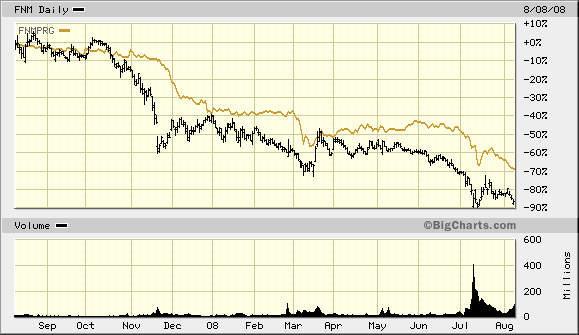
Freddie Mac (FRE US) sank 16 percent to $8.57, a 16-year low. UBS AG analysts cut their price target on the second-largest mortgage-finance company to $10 from $28, citing growing credit losses and problems raising capital.

Fannie Mae slumped 5.2 percent to $14.52, the lowest since July 1991. MGIC Investment Corp. (MTG US), the largest U.S. mortgage insurer, lost 17 percent to $5.55.

… even while the implicit guarantee became a whole lot more explicit

Fannie Mae and Freddie Mac, the largest buyers of U.S. home loans, are too big for the government to let them fail, leading Republican and Democratic lawmakers said.

The government-chartered companies, which own or guarantee about half the $12 trillion of U.S. mortgages, can count on a federal lifeline, said Republican Senator John McCain of Arizona and Democratic Senator Charles Schumer of New York.

The remarks by the presumptive Republican presidential candidate and the head of the congressional Joint Economic Committee followed a slide in the firms’ shares to the lowest level since 1991. They indicate Congress would push the administration to use government funds to prevent the companies failing and threatening a deeper housing recession.

Naked Capitalism reviews media stories on disaster planning

I said it most recently on May 2:

The GSEs have to start being regulated like banks; there’s no question in my mind about that.

If Congress wants to cut a special deal with them to achieve politically favourable goals, it should simply buy a preferred share – with cash – make it puttable to the company unless the company does A, B and C, and write a specific exclusion to the capital rules allowing this to be Tier 1 capital. Then … walk away and let the regular regulators do as they please.

Yet another thoroughly appalling day, with PerpetualDiscounts getting absolutely hammered. The average yield of 6.34% is equivalent to 8.88% interest (with a conversion factor of 1.4x), representing a spread of about 278bp over long corporates.

You know … I’m not worried about myself so much (I’m fairly phlegmatic about market prices), and I’m not worried about the fund so much (while it’s underperforming due to PerpetualDiscount exposure, it’s executing a steady stream of little income-enhancing trades that will eventually pay off), and I’m not worried about the market so much (all we have to fear is defaults, and none of those are even on the horizon, for instruments I hold. None of this excitement is showing up in the Canadian bond market at all.), but I am worried about retail. This is the type of environment where even very reasonable people might panic – or, worse, indulge in a little market timing – and these investors could hurt themselves badly.

Note that these indices are experimental; the absolute and relative daily values are expected to change in the final version. In this version, index values are based at 1,000.0 on 2006-6-30
Index Mean Current Yield (at bid) Mean YTW Mean Average Trading Value Mean Mod Dur (YTW) Issues Day’s Perf. Index Value
Ratchet 4.30% 2.40% 48,291 0.08 1 -0.2352% 1,119.7
Fixed-Floater 4.66% 4.38% 71,482 16.36 6 -0.1903% 1,090.4
Floater 4.08% 4.10% 50,672 17.22 3 -1.2984% 902.4
Op. Retract 4.96% 3.71% 165,062 2.54 17 +0.0677% 1,046.4
Split-Share 5.39% 6.68% 64,639 4.13 14 -0.5388% 1,023.8
Interest Bearing 6.16% 5.56% 45,237 1.97 3 -0.4326% 1,118.7
Perpetual-Premium 6.04% 5.94% 66,893 10.89 4 -0.1225% 998.3
Perpetual-Discount 6.29% 6.34% 242,094 13.45 67 -0.8872% 840.2
Major Price Changes
Issue Index Change Notes
CM.PR.D PerpetualDiscount -6.0418% Now with a pre-tax bid-YTW of 6.83% based on a bid of 21.15 and a limitMaturity.
NA.PR.L PerpetualDiscount -3.1480% Now with a pre-tax bid-YTW of 6.57% based on a bid of 18.46 and a limitMaturity.
SLF.PR.C PerpetualDiscount -2.9213% Now with a pre-tax bid-YTW of 6.50% based on a bid of 17.28 and a limitMaturity.
SBC.PR.A SplitShare -2.7054% Asset coverage of 1.9+:1 as of July 3, according to Brompton Group. Now with a pre-tax bid-YTW of 6.03% based on a bid of 9.71 and a hardMaturity 2012-11-30.
PWF.PR.G PerpetualDiscount -2.6778% Now with a pre-tax bid-YTW of 6.35% based on a bid of 23.26 and a limitMaturity.
CM.PR.H PerpetualDiscount -2.5056% Now with a pre-tax bid-YTW of 6.88% based on a bid of 17.51 and a limitMaturity.
BAM.PR.M PerpetualDiscount -2.4814% Now with a pre-tax bid-YTW of 7.64% based on a bid of 15.72 and a limitMaturity.
BAM.PR.K Floater -2.4500%  
W.PR.J PerpetualDiscount -2.4368% Now with a pre-tax bid-YTW of 6.64% based on a bid of 21.22 and a limitMaturity.
ENB.PR.A PerpetualDiscount -2.4319% Now with a pre-tax bid-YTW of 5.98% based on a bid of 23.27 and a limitMaturity.
CM.PR.P PerpetualDiscount -2.4295% Now with a pre-tax bid-YTW of 6.88% based on a bid of 20.08 and a limitMaturity.
POW.PR.D PerpetualDiscount -2.3736% Now with a pre-tax bid-YTW of 6.65% based on a bid of 18.92 and a limitMaturity.
W.PR.H PerpetualDiscount -2.2556% Now with a pre-tax bid-YTW of 6.66% based on a bid of 20.80 and a limitMaturity.
SLF.PR.A PerpetualDiscount -2.1627% Now with a pre-tax bid-YTW of 6.31% based on a bid of 19.00 and a limitMaturity.
LBS.PR.A SplitShare -1.8943% Asset coverage of just under 2.0:1 as of July 3, according to Brompton Group. Now with a pre-tax bid-YTW of 5.62% based on a bid of 9.84 and a limitMaturity.
SLF.PR.D PerpetualDiscount -1.7704% Now with a pre-tax bid-YTW of 6.53% based on a bid of 17.20 and a limitMaturity.
CM.PR.I PerpetualDiscount -1.7694% Now with a pre-tax bid-YTW of 6.86% based on a bid of 17.21 and a limitMaturity.
PWF.PR.F PerpetualDiscount -1.7370% Now with a pre-tax bid-YTW of 6.65% based on a bid of 19.80 and a limitMaturity.
SLF.PR.E PerpetualDiscount -1.6854% Now with a pre-tax bid-YTW of 6.49% based on a bid of 17.50 and a limitMaturity.
BAM.PR.B Floater -1.6145%  
CU.PR.A PerpetualPremium (for now!) -1.5650% Now with a pre-tax bid-YTW of 5.99% based on a bid of 24.53 and a limitMaturity.
BMO.PR.J PerpetualDiscount -1.5426% Now with a pre-tax bid-YTW of 6.18% based on a bid of 18.51 and a limitMaturity.
CIU.PR.A PerpetualDiscount -1.5337% Now with a pre-tax bid-YTW of 6.06% based on a bid of 19.26 and a limitMaturity.
GWO.PR.G PerpetualDiscount -1.5041% Now with a pre-tax bid-YTW of 6.47% based on a bid of 20.30 and a limitMaturity.
BMO.PR.H PerpetualDiscount -1.3395% Now with a pre-tax bid-YTW of 6.31% based on a bid of 21.36 and a limitMaturity.
BSD.PR.A InterestBearing -1.3388% Asset coverage of just under 1.7:1 as of July 4, according to Brookfield Funds. Now with a pre-tax bid-YTW of 6.92% (mostly as interest) based on a bid of 9.58 and a hardMaturity 2015-3-31 at 10.00.
BNS.PR.J OpRet
PerpetualDiscount
-1.2670% Now with a pre-tax bid-YTW of 6.02% based on a bid of 21.82 and a limitMaturity.
POW.PR.C PerpetualDiscount -1.2417% Now with a pre-tax bid-YTW of 6.54% based on a bid of 22.27 and a limitMaturity.
TD.PR.Q PerpetualDiscount -1.2068% Now with a pre-tax bid-YTW of 5.91% based on a bid of 23.74 and a limitMaturity.
RY.PR.F PerpetualDiscount -1.0870% Now with a pre-tax bid-YTW of 6.22% based on a bid of 18.20 and a limitMaturity.
SLF.PR.B PerpetualDiscount -1.0417% Now with a pre-tax bid-YTW of 6.38% based on a bid of 19.00 and a limitMaturity.
GWO.PR.H OpRet -1.0390% Now with a pre-tax bid-YTW of 6.43% based on a bid of 19.05 and a limitMaturity.
FBS.PR.B SplitShare -1.0363% Asset coverage of 1.5+:1 as of July 10, according to TD Securities. Now with a pre-tax bid-YTW of 6.38% based on a bid of 9.55 and a limitMaturity.
CM.PR.J PerpetualDiscount -1.0077% Now with a pre-tax bid-YTW of 6.77% based on a bid of 16.70 and a limitMaturity.
BCE.PR.Y FixFloat +1.2245%  
IAG.PR.A PerpetualDiscount +2.0307% Now with a pre-tax bid-YTW of 6.25% based on a bid of 18.59 and a limitMaturity.
MFC.PR.B PerpetualDiscount +2.9101% Now with a pre-tax bid-YTW of 6.05% based on a bid of 19.45 and a limitMaturity.
Volume Highlights
Issue Index Volume Notes
CGI.PR.C Scraps (would be SplitShare but there are volume concerns) 100,000 CIBC crossed 100,000 at 23.75. Asset coverage of about maybe 4.0+:1 as of May 31, according to their Current Information and Annual Report … but this figure is not official and should be checked. Now with a pre-tax bid-YTW of 5.13% based on a bid of 23.12 and a softMaturity 2016-6-14 at 25.00.
ACO.PR.A OpRet 40,160 CIBC crossed 40,000 at 26.50. Now with a pre-tax bid-YTW of 2.62% based on a bid of 26.51 and a call 2008-12-31 at 26.00.
CM.PR.I PerpetualDiscount 31,500 Now with a pre-tax bid-YTW of 6.86% based on a bid of 17.21 and a limitMaturity.
CM.PR.H PerpetualDiscount 29,665 Now with a pre-tax bid-YTW of 6.88% based on a bid of 17.51 and a limitMaturity.
BCE.PR.Y FixFloat 27,518 HSBC bought 10,000 from Nesbitt at 25.00, and another 10,000 a split-second later at 25.44. HSBC was on the buy-side for nine of the last ten trades for BCE.PR.Y, taking the price up to 25.44, up $0.99 from yesterday’s close. A buy-in? A whoopsee? Who knows?
TD.PR.O PerpetualDiscount 26,150 Now with a pre-tax bid-YTW of 5.97% based on a bid of 20.38 and a limitMaturity.

There were eightteen other index-included $25-pv-equivalent issues trading over 10,000 shares today.

Taxation

Marginal Tax Rates: BC 2008

Here are the rates from the E&Y Tax Calculator, as updated to include legislation to May 8, 2008.

Clawbacks are not included; I am hopeful that at some point I will be able to get some authoritative data on the effects of clawbacks, but have not found anything credible … please contact me if you do know of any credible public sources!

Investors Taxable Income Marginal Rate on Interest Marginal Rate on Dividends Equivalency Factor
Widows & Orphans $30,000 20.24% 0.00% 1.25
Professionals $75,000 32.50% 4.40% 1.42
Plutocrats $150,000 43.70% 18.47% 1.45

Look at those rates, eh? The choice between interest and dividends is roughly the same as in Ontario at all income levels … but I look at the rate on dividends for “professionals” and I just can’t believe my eyes!

The comments to the Ontario update included some discussion of the calculation of the equivalency factor in the presence of the OAS clawback.

Market Action

July 9, 2008

Times are tough! European banks are paying a spread of 542bp for Innovative Tier 1 Capital:

European banks are having to pay the highest costs in at least a decade to raise capital reserves required by regulators.

Investors now demand 542 basis points of extra yield over government debt to buy so-called Tier 1 securities, which regulators demand banks hold to buffer depositors and senior bondholders against losses, according to Merrill Lynch & Co.’s Euro Sub-Debt Tier 1 Index. The index started the year at 284 basis points.

Regulators consider Tier 1 securities as close to equity because in some circumstances issuers can defer interest payments. Instead of a fixed due date, the bonds often give the issuer the option of redeeming them after five or 10 years and inflict higher interest payments if that doesn’t happen.

As financing costs increase banks may no longer view a higher coupon as penalizing them, meaning investors risk holding bonds that may never mature, said Simon Adamson, an analyst at debt research firm CreditSights Inc. in London.

I don’t know the details of the “Euro Sub-Debt Tier 1 Index”, but the spread probably relates to 10-year governments; the so-called bonds will (probably!) have a call and step-up provision at that time so the salesmen can pretend it’s 10-year money.

By way of comparison, we know from yesterday that PerpetualDiscounts are trading to yield 265bp over long corporates, and long corporates are trading about 200bp over Canadas. As a further comparison, the NBC CaPS II, 7.447% until the pretend-maturity 2020-6-30 (after which it’s BAs + 409bp), are quoted at 370bp over the Canada 2018s.

No prizes will be awarded for guessing which direction the market took today! This is getting awfully depressing, you know? But there’s no way of telling when this trend will reverse … and in the meantime, there are some awfully juicy swaps popping up often enough to make life interesting for a fully invested portfolio that isn’t afraid of trading.

The sloppiness of the market is well illustrated by the fact that the market did not appear to notice that National Bank went ex-Dividend today.

Note that these indices are experimental; the absolute and relative daily values are expected to change in the final version. In this version, index values are based at 1,000.0 on 2006-6-30
Index Mean Current Yield (at bid) Mean YTW Mean Average Trading Value Mean Mod Dur (YTW) Issues Day’s Perf. Index Value
Ratchet 4.29% -0.48% 50,270 0.08 1 +0.2358% 1,122.4
Fixed-Floater 4.64% 4.37% 71,686 16.38 6 -0.1151% 1,092.5
Floater 4.03% 4.05% 50,894 17.34 3 -0.2713% 914.3
Op. Retract 4.96% 3.78% 169,146 2.54 17 -0.0276% 1,045.7
Split-Share 5.37% 6.35% 64,972 4.13 14 -0.0279% 1,029.4
Interest Bearing 6.13% 5.41% 45,516 1.99 3 +0.4059% 1,123.6
Perpetual-Premium 6.03% 5.94% 65,096 10.91 4 -0.6692% 999.5
Perpetual-Discount 6.23% 6.28% 243,672 13.53 67 -0.4592% 847.7
Major Price Changes
Issue Index Change Notes
SLF.PR.D PerpetualDiscount -2.9917% Now with a pre-tax bid-YTW of 6.42% based on a bid of 17.51 and a limitMaturity.
ELF.PR.F PerpetualDiscount -2.5789% Now with a pre-tax bid-YTW of 7.21% based on a bid of 18.51 and a limitMaturity.
BAM.PR.J OpRet -2.5652% Now with a pre-tax bid-YTW of 6.95% based on a bid of 22.41 and a softMaturity 2018-3-30 at 25.00. Compare with BAM.PR.H (5.41% to 2012-3-30), BAM.PR.I (5.99% to 2013-12-30) and BAM.PR.O (6.27% to 2013-6-30).
PWF.PR.I PerpetualDiscount -2.4777% Now with a pre-tax bid-YTW of 6.25% based on a bid of 24.01 and a limitMaturity.
SLF.PR.E PerpetualDiscount -2.4658% Now with a pre-tax bid-YTW of 6.38% based on a bid of 17.80 and a limitMaturity.
CM.PR.D PerpetualDiscount -2.1304% Now with a pre-tax bid-YTW of 6.40% based on a bid of 22.51 and a limitMaturity.
MFC.PR.B PerpetualDiscount -2.1233% Now with a pre-tax bid-YTW of 6.22% based on a bid of 18.90 and a limitMaturity.
CM.PR.I PerpetualDiscount -2.1229% Now with a pre-tax bid-YTW of 6.73% based on a bid of 17.52 and a limitMaturity.
SLF.PR.B PerpetualDiscount -2.0908% Now with a pre-tax bid-YTW of 6.31% based on a bid of 19.20 and a limitMaturity.
IAG.PR.A PerpetualDiscount -2.0430% Now with a pre-tax bid-YTW of 6.37% based on a bid of 18.22 and a limitMaturity.
GWO.PR.I PerpetualDiscount -1.9391% Now with a pre-tax bid-YTW of 6.42% based on a bid of 17.70 and a limitMaturity.
HSB.PR.D PerpetualDiscount -1.8687% Now with a pre-tax bid-YTW of 6.50% based on a bid of 19.43 and a limitMaturity.
PWF.PR.L PerpetualDiscount -1.7500% Now with a pre-tax bid-YTW of 6.51% based on a bid of 19.65 and a limitMaturity.
BNS.PR.O PerpetualDiscount -1.6082% Now with a pre-tax bid-YTW of 5.88% based on a bid of 23.86 and a limitMaturity.
PWF.PR.E PerpetualDiscount -1.5712% Now with a pre-tax bid-YTW of 6.48% based on a bid of 21.30 and a limitMaturity.
CM.PR.G PerpetualDiscount -1.4126% Now with a pre-tax bid-YTW of 6.70% based on a bid of 20.24 and a limitMaturity.
W.PR.J PerpetualDiscount -1.4053% Now with a pre-tax bid-YTW of 6.47% based on a bid of 21.75 and a limitMaturity.
PWF.PR.K PerpetualDiscount -1.3326% Now with a pre-tax bid-YTW of 6.45% based on a bid of 19.25 and a limitMaturity.
CM.PR.J PerpetualDiscount -1.2873% Now with a pre-tax bid-YTW of 6.70% based on a bid of 16.87 and a limitMaturity.
W.PR.H PerpetualDiscount -1.1152% Now with a pre-tax bid-YTW of 6.50% based on a bid of 21.28 and a limitMaturity.
GWO.PR.H PerpetualDiscount -1.0791% Now with a pre-tax bid-YTW of 6.36% based on a bid of 19.25 and a limitMaturity.
PWF.PR.G PerpetualDiscount -1.0352% Now with a pre-tax bid-YTW of 6.71% based on a bid of 17.96 and a limitMaturity.
BAM.PR.I OpRet +1.0305% See BAM.PR.J, above.
NA.PR.M PerpetualDiscount +1.1838% Ex-Dividend today but nobody noticed. Now with a pre-tax bid-YTW of 6.08% based on a bid of 24.65 and a limitMaturity.
NA.PR.K PerpetualDiscount +1.3546% Ex-Dividend today but nobody noticed. Now with a pre-tax bid-YTW of 6.28% based on a bid of 23.25 and a limitMaturity.
POW.PR.D PerpetualDiscount +1.4129% Now with a pre-tax bid-YTW of 6.49% based on a bid of 19.38 and a limitMaturity.
BAM.PR.O OpRet +2.1505% See BAM.PR.J, above.
Volume Highlights
Issue Index Volume Notes
MFC.PR.B PerpetualDiscount 214,850 CIBC crossed 150,000 at 19.25, then Nesbitt crossed 50,000 at the same price. Now with a pre-tax bid-YTW of 6.22% based on a bid of 18.90 and a limitMaturity.
CM.PR.A OpRet 53,600 CIBC crossed 50,000 at 25.85. Now with a pre-tax bid-YTW of -0.48% based on a bid of 25.80 and a call 2008-8-8 at 25.75.
TD.PR.P PerpetualDiscount 33,798 Nesbitt crossed 29,300 at 22.30. Now with a pre-tax bid-YTW of 5.85% based on a bid of 22.46 and a limitMaturity.
PWF.PR.E PerpetualDiscount 33,100 Nesbitt crossed 30,000 at 21.35. Now with a pre-tax bid-YTW of 6.48% based on a bid of 21.30 and a limitMaturity.
TD.PR.O PerpetualDiscount 30,986 Now with a pre-tax bid-YTW of 5.93% based on a bid of 20.50 and a limitMaturity.

There were nineteen other index-included $25-pv-equivalent issues trading over 10,000 shares today.

Interesting External Papers

Deposit Insurance in Chile

My route to this paper is, perhaps, best described at another time. But Deposit Insurance: Handle with Care is a good background paper with excellent references.

The abstract:

Explicit deposit insurance has been spreading rapidly in the past decades, most recently to countries with low levels of financial and institutional development. This paper documents the extent of crosscountry differences in deposit-insurance design and reviews empirical evidence on how particular design features affect private market discipline, banking stability, financial development, and the effectiveness of crisis resolution. This evidence challenges the wisdom of encouraging countries to adopt explicit deposit insurance without first stopping to assess and remedy weaknesses in their informational and supervisory environments. The paper also includes recommendations for reforming the Chilean deposit insurance system based on the results of the research reviewed here.

… and a few observations …

On investigating individual design features, Demirgüç-Kunt and Detragiache also show that deposit insurance causes the most trouble in countries where coverage is extensive, where authorities amass a large fund of explicit reserves and earmark it for insolvency resolution, and where the scheme is administered by government officials rather than the private sector.

It is common practice to issue blanket guarantees to arrest a banking crisis. Countries that have adopted this strategy include Sweden (1992), Japan (1996), Thailand (1997), Korea (1997), Malaysia (1998), and Indonesia (1998). More recently, Turkey tried to halt its financial panic by guaranteeing not just bank depositors, but all domestic and foreign nondeposit creditors of Turkish banks. Advocates of using blanket guarantees to halt a systemic crisis argue that sweeping guarantees can be helpful, even essential, in halting depositors’ flight to quality. However, because blanket guarantees create an expectation of their future use in similar circumstances, they undermine market discipline and may prove greatly destabilizing over longer periods. Although some countries have managed to scale back formal insurance coverage once a crisis has receded, it is very difficult to scale back informal coverage in a credible manner.

Concentrated banking systems experience fewer systemic banking crises (Beck, Demirgüç-Kunt, and Levine, 2003) and almost always generate a high level of implicit insurance coverage, partly because of “too big to fail” pressures. Not surprisingly, empirical evidence confirms that incremental exposure to moral hazard from introducing an explicit insurance system is limited in highly concentrated environments.

By the way …

Deposit insurance was established in Chile in 1986. The system does not have a permanent fund in place. The Chilean Central Bank guarantees 100 percent of demand deposits in full, and 90 percent of household savings and time deposits up to UF 120 per person (approximately US$ 2,800). To limit the Central Bank’s exposure, banks with demand deposits in excess of 2.5 times the capital reserves are required to maintain 100 percent reserves at the Central Bank in short-term central bank or government securities. Foreign exchange deposits are covered, but coverage excludes interbank deposits. Membership is compulsory for all banks, and the scheme is publicly administered.

Taxation

Marginal Tax Rates: Ontario 2008

Here are the rates from the E&Y Tax Calculator, as updated to include legislation to May 8, 2008.

Clawbacks are not included; I am hopeful that at some point I will be able to get some authoritative data on the effects of clawbacks, but have not found anything credible … please contact me if you do know of any credible public sources!

Investors Taxable Income Marginal Rate
on Interest
Marginal Rate
on Eligible Dividends
Equivalency Factor
Widows & Orphans $30,000 21.05% 0.00% 1.27
Professionals $75,000 39.41% 13.81% 1.42
Plutocrats $150,000 46.41% 23.96% 1.42

These figures are not much different from the 2006 numbers. The top marginal rate on eligible dividends is expected to increase to 26.7% in 2012; this would decrease the equivalency factor to 1.37. But frankly, I take estimates of future taxation rates with a grain of salt – we have no way of knowing what will be politically convenient next month, let alone four years off.

Issue Comments

BBO.PR.A Announces Rights Offering

The marvellously named “Big Bank Big Oil Split Corp” has announced:

that it has received all necessary approvals for its previously announced rights offering (the “Rights Offering”).

Under the Rights Offering holders of class A capital shares (“Capital Shares”) at the close of business on July 17, 2008 will receive rights (“Rights”) to purchase Combined Units on the basis of one Right for each Capital Share held. Two Rights will entitle the holder to purchase a Combined Unit, consisting of one Capital Share, one class A preferred share (“Preferred Share”) and one Warrant for a subscription price of $26.38 per Combined Unit. Each Warrant may be used to purchase one Capital Share and one Preferred Share. Rights may be exercised at any time up to the expiry of the Rights at 4:00 p.m. (Toronto time) on August 13, 2008.

Holders of Rights who exercise all of their Rights may also subscribe for additional Combined Units that may be available as a result of unexercised Rights. Rightsholders may exercise their Rights through the broker or dealer which holds their Rights.

The Rights will be listed and posted for trading on the TSX under the symbol BBO.RT. Holders of Rights should contact the broker or dealer who holds their Rights on their behalf to exercise their Rights. A prospectus describing the Rights Offering is expected to be mailed to Capital Shareholders on or around July 23, 2008.

So, the issue might get bigger – a good thing, since there are less than 1.9-million shares outstanding with a $10.00 par value. Asset coverage is just under 2.6:1 as of July 3, according to Claymore Investments.

BBO.PR.A is not tracked by HIMIPref™.

Issue Comments

MFC.PR.A / MFC.PR.B / MFC.PR.C : DBRS says "Trend Positive"

DBRS has announced:

today changed the trend on its ratings of the Debt and Preferred Shares of Manulife Financial Corporation (Manulife or the Company) and its related entities to Positive from Stable. The trends on the Claims Paying Ability of The Manufacturers Life Insurance Company and the Short-Term Limited Recourse Notes of Maritime Life Canadian Funding remain stable.

The positive trend reflects the Company’s strong earnings performance since the acquisition of John Hancock Financial Services (JHFS) in 2004, advantageous strategic positions in selected diverse products and geographic market segments, consistency in being among the first to introduce new and innovative products tempered by effective risk and expense management controls and the most conservative capitalization of its peer group. Diversification and strong earnings in the absence of any meaningful financial leverage allow Manulife to stand out among its peers from the perspective of creditworthiness. The resolution of the current turmoil in the capital markets, provided that Manulife continues to cope favourably, is expected to precipitate an upgrade in the Company’s credit ratings.

Following its successful integration of JHFS, Manulife has become one of the five largest life insurance and wealth management organizations in North America and one of the top 10 in the world, enjoying excellent geographic and product diversification, notably in such attractive markets as U.S. long-term care, U.S. variable annuities, and Asian wealth accumulation products, which leverage off the Company’s North American successes. Distribution networks are similarly well-diversified, the broadening and deepening of which is the key to the Company’s continuing success. Like most life insurance concerns, the Company is increasingly focused on growing its wealth management and payout businesses, which are well-aligned with demographic trends, but it retains leading positions in the sale of new life insurance protection products in both Canada and the United States, where profit margins tend to be more generous and cash flows more stable, despite the expected new business strain.

Excellent risk-management practices and strong independent governance has helped the Company to maintain stable profitability. The Company’s large block of in-force policies provides a stable core to earnings as conservative reserving practices pay off over time through the release of excess provisions for adverse deviation and consistently favourable experience gains. Unlike several of its U.S. peers, a high-quality asset portfolio has limited the Company’s exposure to the recent softness in credit markets related to asset-backed securities and the U.S. housing markets.

The issues continue to be rated P-1 by S&P on their national scale.

All three issues are tracked by HIMIPref™. MFC.PR.A is part of the Operating Retractible index; the others are part of the PerpetualDiscount index.

Perhaps this is not, strictly, sufficiently newsworthy to be worth a post … but gracious heavens, we could all use a little bit of good news around now!

Market Action

July 8, 2008

Bradford & Bingley, a small UK mortgage bank with a market cap of about $400-million seems to be in trouble:

Bradford & Bingley dropped as much as 26 percent, the largest decline since it sold shares to the public in 2000, and was down 8 pence to 34 pence at 11:30 a.m. The shares fell 16 percent yesterday and 18 percent July 4, bringing this year’s decline to 88 percent and valuing the bank at 212 million pounds ($419 million).

Bradford & Bingley has been hurt by the seizure in credit markets because it depends on capital markets for about 52 of its funding. Leicester, England-based Alliance & Leicester Plc, which gets about 59 percent from wholesale markets, declined as much as 10 percent today in London and traded at 226.25 pence at 11:20 a.m.

As a warning to those who might put too high an emphasis on the (very important) Tier 1 ratio and Total Capital ratio … as of Dec. 31/2007 they had GBP 1.4-billion in Tier 1 Capital, Tier 1 Ratio of 8.6%, Total Capital Ratio of 15.1%. You can’t put all your trust in one number!

Meanwhile, OFHEO says that, contrary to yesterday‘s speculation, Fannie & Freddie don’t need capital:

Freddie Mac and Fannie Mae, whose shares have tumbled more than 60 percent this year, have enough capital to survive a slump in the housing market and meet new accounting rules, their regulator said.

“An accounting principle should not drive a capital decision by a regulator,” Lockhart later told reporters at a mortgage conference in Arlington, Virginia, today sponsored by the Federal Deposit Insurance Corp.

However, there’s lots of bad news to go ’round! IndyMac is looking fairly ill:

IndyMac Bancorp Inc., the California- based lender that is firing half its employees, is facing “elevated levels of deposit withdrawals” after U.S. Senator Charles Schumer said the bank may be on the brink of failure.

Because it doesn’t have enough capital to meet the “well capitalized” threshold set by regulators, IndyMac said it can’t fund its lending with deposits acquired through independent brokers. IndyMac’s request for a waiver from the FDIC to allow for brokered deposits hasn’t been approved, the company said.

Naked Capitalism has more details.

Remember my table of CM issues on June 26? And the table of PWF issues yesterday, that Assiduous Reader prefhound noted was the last cum-dividend day? Well, here’s the table again, now that the dividend has gone ex:

PWF Perpetuals
Issue Dividend Quote Pre-Tax
Bid-YTW
PWF.PR.K 1.2375 19.51-99 6.36%
PWF.PR.L 1.275 20.00-28 6.39%
PWF.PR.F 1.3125 20.25-49 6.50%
PWF.PR.E 1.375 21.64-75 6.37%
PWF.PR.H 1.4375 23.05-49 6.53%
PWF.PR.G 1.475 24.15-18 6.11%
PWF.PR.I 1.50 24.62-88 6.10%

I said it yesterday … I’ll say it again: Negative Convexity? Negative Schmonvexity! It just doesn’t make any sense!

I hate to say it … but it was yet another bad day for PerpetualDiscounts! This is the ninth consecutive loss; the last gaining day was June 24; the cumulative loss since then is 3.73%.

Long corporates still yield about 6.1% … the perpetualDiscount weighted mean pre-tax bid-YTW of 6.25% dividend is equivalent (with a 1.4x factor) to 8.75% … spread to long corporates is now 265bp.

Note that these indices are experimental; the absolute and relative daily values are expected to change in the final version. In this version, index values are based at 1,000.0 on 2006-6-30
Index Mean Current Yield (at bid) Mean YTW Mean Average Trading Value Mean Mod Dur (YTW) Issues Day’s Perf. Index Value
Ratchet 4.29% 2.40% 46,532 0.08 1 -0.4304% 1,119.7
Fixed-Floater 4.64% 4.36% 72,010 16.39 6 +0.2803% 1,093.8
Floater 4.02% 4.04% 51,785 17.36 3 -0.1192% 916.7
Op. Retract 4.96% 3.55% 168,148 2.55 17 -0.1875% 1,046.0
Split-Share 5.36% 6.32% 65,302 4.13 14 -0.6337% 1,029.7
Interest Bearing 6.15% 5.31% 45,169 2.27 3 -0.2688% 1,119.0
Perpetual-Premium 5.99% 5.89% 65,389 11.00 4 -0.0149% 1,006.2
Perpetual-Discount 6.20% 6.25% 245,331 13.56 67 -0.3472% 851.6
Major Price Changes
Issue Index Change Notes
POW.PR.D PerpetualDiscount -4.21% Now with a pre-tax bid-YTW of 6.58% based on a bid of 19.11 and a limitMaturity.
BAM.PR.I OpRet -2.9600% Now with a pre-tax bid-YTW of 6.21% based on a bid of 24.26 and a softMaturity 2013-12-30 at 25.00. Compare with BAM.PR.H (5.23% to 2012-3-30), BAM.PR.J (6.59% to 2018-3-30) and BAM.PR.O (6.77% to 2013-6-30).
PWF.PR.H PerpetualDiscount -2.8214% Now with a pre-tax bid-YTW of 6.53% based on a bid of 22.05 and a limitMaturity.
POW.PR.C PerpetualDiscount -2.6293% Now with a pre-tax bid-YTW of 6.45% based on a bid of 22.59 and a limitMaturity.
W.PR.J PerpetualDiscount -2.3894% Now with a pre-tax bid-YTW of 6.37% based on a bid of 22.06 and a limitMaturity.
NA.PR.L PerpetualDiscount -2.2040% Now with a pre-tax bid-YTW of 6.48% based on a bid of 19.08 and a limitMaturity.
BNA.PR.C SplitShare -2.1142% Asset coverage of 3.2+:1 as of June 30 according to the company. Now with a pre-tax bid-YTW of 8.17% based on a bid of 18.52 and a hardMaturity 2019-1-10 at 25.00. Compare with BNA.PR.A (6.14% to 2010-9-30) and BNA.PR.B (8.46% to 2016-3-25).
FFN.PR.A SplitShare -2.1000% Asset coverage of just under 1.8:1 as of June 30, according to the company. Now with a pre-tax bid-YTW of 5.70% based on a bid of 9.79 and a hardMaturity 2014-12-1.
FBS.PR.B SplitShare -1.9348% Asset coverage of just under 1.5:1 as of July 3, according to the company. Now with a pre-tax bid-YTW of 6.10% based on a bid of 9.63 and a hardMaturity 2011-12-15 at 10.00.
MFC.PR.C PerpetualDiscount -1.7204% Now with a pre-tax bid-YTW of 6.22% based on a bid of 18.28 and a limitMaturity.
BAM.PR.M PerpetualDiscount -1.7178% Now with a pre-tax bid-YTW of 7.49% based on a bid of 16.02 and a limitMaturity.
SLF.PR.C PerpetualDiscount -1.6429% Now with a pre-tax bid-YTW of 6.25% based on a bid of 17.96 and a limitMaturity.
PWF.PR.F PerpetualDiscount -1.5872% Now with a pre-tax bid-YTW of 6.50% based on a bid of 20.25 and a limitMaturity.
BAM.PR.B Floater -1.4963%  
BNS.PR.K PerpetualDiscount -1.2884% Now with a pre-tax bid-YTW of 6.04% based on a bid of 19.92 and a limitMaturity.
CM.PR.E PerpetualDiscount -1.1369% Now with a pre-tax bid-YTW of 6.74% based on a bid of 20.87 and a limitMaturity.
W.PR.H PerpetualDiscount -1.0575% Now with a pre-tax bid-YTW of 6.43% based on a bid of 21.52 and a limitMaturity.
HSB.PR.D PerpetualDiscount -1.0000% Now with a pre-tax bid-YTW of 6.37% based on a bid of 19.80 and a limitMaturity.
MFC.PR.B PerpetualDiscount +1.0995% Now with a pre-tax bid-YTW of 6.09% based on a bid of 19.31 and a limitMaturity.
CM.PR.P PerpetualDiscount +1.2195% Now with a pre-tax bid-YTW of 6.65% based on a bid of 20.75 and a limitMaturity.
RY.PR.A PerpetualDiscount +1.5925% Now with a pre-tax bid-YTW of 6.11% based on a bid of 18.50 and a limitMaturity.
PWF.PR.E PerpetualDiscount +4.0897% Now with a pre-tax bid-YTW of 6.37% based on a bid of 21.64 and a limitMaturity.
Volume Highlights
Issue Index Volume Notes
BAM.PR.H OpRet 57,721 CIBC crossed 25,000 at 25.50, then another 25,000 at the same price. Now with a pre-tax bid-YTW of 5.23% based on a bid of 25.50 and a softMaturity 2012-3-30. For comparables, see above.
PWF.PR.J OpRet 53,619 CIBC crossed 50,000 at 25.55. Now with a pre-tax bid-YTW of 4.22% based on a bid of 25.50 and a softMaturity 2013-7-30 at 25.00.
BCE.PR.A FixFloat 35,500  
BCE.PR.I FixFloat 32,260 CIBC crossed 24,900 at 24.30
BAM.PR.I OpRet 30,766 CIBC bought 20,000 from Anonymous at 25.00. Now with a pre-tax bid-YTW of 6.21% based on a bid of 24.26 and a softMaturity 2013-12-30 at 25.00. For comparables, see above.

There were twenty-two other index-included $25-pv-equivalent issues trading over 10,000 shares today.
Regulation

SEC Releases Credit Rating Agency Review Report

The SEC has found smoking guns for conflict of interest at the CRAs:

The SEC report describes an e-mail in which an analyst refers to the market for collateralized debt obligations as a “monster.”

“Let’s hope we are all wealthy and retired by the time this house of cards falters,” said the e-mail, which was sent Dec. 15, 2006, to another analyst at the same firm.

“I am trying to ascertain whether we can determine at this point if we will suffer any loss of business because of our decision and if so how much,” said a 2004 e-mail an analyst sent to a senior business manager. The SEC said it found no evidence such considerations affected “rating methodology or models.”

In another internal communication, two analysts at a rating company discussed whether they should grade an offering.

“One analyst expressed concern that her firm’s model did not capture `half’ of the deal’s risk, but that `it could be structured by cows and we would rate it,”’ the SEC said.

It’s hard to tell how seriously to take this report. What kind of reply was received by the analyst who asked about loss of business? Was he told it was none of his business? Was he ripped a new one? Was he told he’d damn well better rate the puppy triple-A? The full press release is available as is the full report, with the following “remedial action” notes:

  • The Staff has recommended that each examined NRSRO evaluate, both at this time and on a periodic basis, whether it has sufficient staff and resources to manage its volume of business and meet its obligations under the Section 15E of the Exchange Act and the rules applicable to NRSROs. Each examined NRSRO stated that it will implement the Staff’s recommendation.
  • The Staff has recommended that each NRSRO examined conduct a review of its current disclosures relating to processes and methodologies for rating RMBS and CDOs to assess whether it is fully disclosing its ratings methodologies in compliance with Section 15E of the Exchange Act and the rules applicable to NRSROs. Further, the Staff has recommended that each NRSRO examined review whether its policies governing the timing of disclosure of a significant change to a process or methodology are reasonably designed to comply with these requirements. Each examined NRSRO stated that it will implement the Staff’s recommendations.
  • The Staff has recommended that each NRSRO examined conduct a review to determine whether its written policies and procedures used to determine credit ratings for RMBS and CDOs are fully documented in accordance with the requirements of Rule 17g-2. Each examined NRSRO stated that it will implement the Staff’s recommendation.
  • The Staff has recommended that each NRSRO examined conduct a review of its current policies and practices for documenting the credit ratings process and the identities of RMBS and CDO ratings analysts and committee members to review whether they are reasonably designed to ensure compliance with Rule 17g-2 and to address weaknesses in the policies or in adherence to existing policies that result in gaps in documentation of significant steps and participants in the credit ratings process. Each examined NRSRO stated that it will implement the Staff’s recommendations.
  • The Staff has recommended that each NRSRO examined conduct a review to determine if adequate resources are devoted to surveillance of outstanding RMBS and CDO ratings. This review should include, for example, whether the rating agency maintains adequate staffing and has adequate expertise dedicated to performing ongoing surveillance. The Staff has also recommended that the NRSROs ensure that they have comprehensive written surveillance procedures. Finally, the Staff has recommended that all appropriate surveillance records be maintained. Each examined NRSRO stated that it will implement the Staff’s recommendations.
  • The Staff recommended that each NRSRO examined review its practices, policies and procedures for mitigating and managing the “issuer pays” conflict of interest. In particular, the Staff recommended that each NRSRO examined consider and implement steps that would insulate or prevent the possibility that considerations of market share and other business interests could influence ratings or ratings criteria. Each examined NRSRO stated that it would implement the Staff’s recommendations.
  • The Staff has recommended that each NRSRO examined conduct a review of its policies and procedures for managing the securities ownership conflict of interest to determine whether these policies are reasonably designed to ensure that their employees’ personal trading is appropriate and comply with the requirements of Rule 17g-5. Each examined NRSRO stated that it will implement the Staff’s recommendation.
  • The Staff has recommended that two of the NRSROs examined review whether their internal audit functions, particularly in the RMBS and CDO ratings areas, are adequate and whether they provide for proper management follow-up. Both of these NRSROs stated that it will implement the Staff’s recommendation.