Category: Interesting External Papers

Interesting External Papers

IIAC Releases 3Q09 Equity Report

The Investment Industry Association of Canada has released its 3Q09 Equity Market Report:

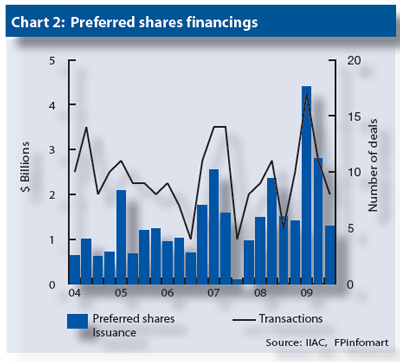
After a stellar start in Q1, preferred share issuance has also slowed down considerably with only $1.3 billion in financings recorded for the year. (Chart 2). This is largely due to reduced offerings from financial institutions who shored up their capital base in previous periods. Limited partnership issuance only reached $100 million on the quarter with only four deals coming to market during the period.

Interesting External Papers

Liquidity and Forced Sales

The Bank of England has released a working paper by Viral V Acharya, Hyun Song Shin and Tanju Yorulmazer titled Endogenous choice of bank liquidity: the role of fire sales:

Banks’ liquidity is a crucial determinant of the adversity of banking crises. In this paper, we consider the effect of fire sales and entry during crises on banks’ ex-ante choice of liquid asset holdings. We consider a setting with limited pledgeability of risky cash flows relative to safe ones and a differential expertise between banks and outsiders in employing banking assets. When a large number of banks fail, market for assets clears only at fire-sale prices and outsiders enter the market if prices fall sufficiently low. In such states, there is a private benefit of liquid holdings to banks from purchasing assets. There is also a social benefit since greater banking system liquidity reduces inefficiency from liquidation of assets to outsiders. When pledgeability of risky cash flows is high, for instance, in countries with well-developed capital markets, banks hold less liquidity than is socially optimal due to risk-shifting incentives; otherwise, banks may hold even more liquidity than is socially optimal to capitalise on fire sales. However, if there is a systemic cost associated with crises, for example, in the form of fiscal costs associated with provision of deposit insurance, then socially optimal liquidity may always be higher than the privately optimal one, and, in turn, regulation in the form of prudent liquidity requirements may be desirable. We provide some international evidence on banks’ liquid holdings that is consistent with model’s predictions.

Regretably, I don’t have a lot of time today to go into this further.

Interesting External Papers

Monetary Policy and Housing Bubbles

The Bank of Canada has released a Working Paper by Hajime Tomura titled Optimal Monetary Policy during
Endogenous Housing-Market Boom-Bust Cycles
:

This paper uses a small-open economy model for the Canadian economy to examine the optimal Taylor-type monetary policy rule that stabilizes output and inflation in an environment where endogenous boom-bust cycles in house prices can occur. The model shows that boom-bust cycles in house prices emerge when credit-constrained mortgage borrowers expect that future house prices will rise and this expectation is neither shared by savers nor realized ex-post. These boom-bust cycles replicate the stylized features of housing-market boom-bust cycles in industrialized countries. In an environment where mortgage borrowers are occasionally over-optimistic, the central bank should be less responsive to inflation, more responsive to output, and slower to adjust the nominal policy interest rate. This optimal monetary policy rule dampens endogenous boom-bust cycles in house prices, but prolongs inflation target horizons due to weak policy reactions to inflation fluctuations after fundamental shocks.

As summarized in Section 2, cross-country data for industrialized countries indicate that the nominal policy interest rate and the CPI inflation rate have tended to decline during housing booms and rise after the peaks of housing booms. The model explains this observation as follows. When borrowers expect that future house prices will rise, they increase housing investments, which causes a housing boom. Since borrowers are credit-constrained, they work more to finance their housing investments during the boom. At the same time, when savers do not share the optimistic expectations of borrowers, they instead expect the boom to be temporary and increase savings for a future recession. The increases in labour supply and savings reduce real wages and the real interest rate, respectively. Given sticky prices, a resulting fall in the marginal cost of production lowers the inflation rate, and, in response to this, the central bank cuts the policy rate. When the optimistic expectations of borrowers are not realized ex-post, a housing bust occurs, and savings and labour supply decline. As a consequence, the inflation rate rises, inducing a monetary policy tightening.

Since borrowers are credit-constrained, they work more to finance their housing investments during the boom. sounds a little backwards to me. I would say that “Credit constrained borrowers can work more during the boom, which allows them to finance increased housing investments”. I don’t find the rest of the rationale very convincing, frankly.

The problem of the interplay between monetary policy and housing bubbles has been discussed on PrefBlog before; e.g. Taylor Rules and the Credit Crunch Cause, with David Pappell warning

The Fed should respond to inflation, not inflation forecasts, especially in an environment where large negative output gaps are causing forecasted inflation to fall.

… a conclusion supported by the KC Fed paper discussed in KC Fed: Monetary Policy Amidst Deflationary Pressures. The problem was also discussed on Econbrowser in the post The Taylor Rule and the Housing Boom, which discusses the paper Dr. Taylor presented at the 2007 Jackson Hole conference, Housing and Monetary Policy

It strikes me that the Taylor Rule’s greatest strength, simplicity, is also its greatest weakness. Policy failure can result from misestimation of either of the two input variables. For policy purposes, it might be worthwhile to see how well other estimations that measure approximately the same thing can be added into the mix so that, for instance, inflation could be estimated not just by the CPI, but also with raw housing prices; the output gap supplemented by raw unemployment figures, and so on. Hell, I use 23 valuation parameters to assess the value of a preferred share, each of them taking a slightly different look at the problem.

Interesting External Papers

Canadian Bond Liquidity Premia

The Autumn 2009 Bank of Canada Review contained an article by Alejandro Garcia and Jun Yang titled Understanding Corporate Bond Spreads Using Credit Default Swaps that, frankly, has me rather puzzled.

They state:

We use credit default swaps to decompose the spreads on Canadian corporate bonds because, as discussed in the next section, their lower susceptibility to liquidity effects makes them a much purer measure of default risk.

CDS contracts are commonly used to extract proxies for default risk for several reasons. As contracts, not securities, CDSs are far less sensitive to liquidity effects, since securities are in fi xed supply, while the supply of CDSs can be arbitrarily large. Because of this reduced sensitivity, CDSs provide a better measure of default risk. As well, it is less costly for investors to liquidate CDSs prior to maturity than to liquidate a corporate bond, since investors simply enter into a swap contract in the opposite direction. Further, CDSs are not likely to become “special” like treasury bills, or “squeezed” like corporate bonds. In principle, therefore, CDSs should contain mainly default information about the reference entity. However, they are not totally immune to liquidity effects, since search costs may be high for illiquid CDS contracts.

In this model, investors demand a return for holding corporate bonds that includes the risk-free rate, the default risk of the issuer, and the liquidity premium associated with the security. Similarly, investors demand compensation for selling the CDS that includes the risk-free rate and the default risk associated with the reference entity (bond issuer). Note that, in the model, we assume that the bond yield includes compensation for liquidity and default risk, whereas the CDS includes compensation only for default risk.

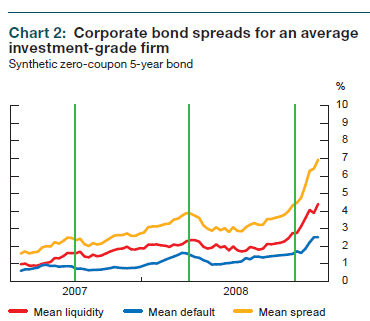
They derive the following decomposition. It should be noted that their phrase “average investment grade firm” is a little general, since they only had data for six companies, all BBB:

My problem is that I don’t understand their methodology. It ignores arbitrage – which means that you cannot capture the liquidity component by buying the bond and buying protection – and it would appear to blow up when confronted with the problem of positive basis trades, which (as observed by Choudhry) are are most common; negative basis trades became more common during the Crunch due to funding risk. For example:

BMO Capital Markets: Negative Basis Trades:

We recently executed a number of negative basis trades for clients involving auto companies when bond spreads were trading significantly wider than the CDS cost of protection. Investors were typically able to earn net spreads in excess of 25 bps after hedging both their interest rate risk and credit risk. This net spread offered a very attractive return for the risk resulting from this combination of transactions, i.e. a better than senior bank debt spread for assuming credit risk exposure that is meaningfully lower than direct bank exposure since the investor only looks to the bank CDS counterparty if the bond issuer fails.

Negative basis opportunities arise from time to time, but tend not to last for very long – investors who are able to act quickly are the big beneficiaries. We are active in the market, highlighting negative basis trade ideas for interested investors.

I have sent a query to the authors and will update this post if I get an answer.

Update: The methodology’s seminal paper by Longstaff (better link) examines CDS & bond yield spreads for Enron, which occasionally went negative, particularly towards the end. He notes:

It is important to acknowledge that our empirical approach of using a bracketing set of bonds does not eliminate all measurement error. This may partially explain why some of the percentages shown in Figure 3 for the size of the default component (particularly for the cases in which the Treasury and Refcorp curves are used) are in excess of 100.

It strikes me that dismissing negative basis as measurement error is cheating.

Doubt has been cast on the methodology by the results of Mahanti, Nashikkary & Subrahmanyam

Recent research has shown that default risk accounts for only a part of the total yield spread on risky corporate bonds relative to their risk-less benchmarks. One candidate for the unexplained portion of the spread is a premium for liquidity. We investigate this possibility by relating the liquidity of corporate bonds, as measured by their ease of market access, to the basis between the credit default swap (CDS) price of the issuer and the par-equivalent corporate bond yield spread. The ease of access of a bond is measured using a recently developed measure called latent liquidity, which is defined as the weighted average turnover of funds holding the bond, where the weights are their fractional holdings of the bond. We find that bonds with higher latent liquidity are more expensive relative to their CDS contracts, after controlling for other realized measures of liquidity. Additionally, we document the positive effects of liquidity in the CDS market on the CDS-bond basis. We also find that several firm-level variables related to credit risk negatively affect the basis, indicating that the CDS price does not fully capture the credit risk of the bond. In a similar vein, we document that bond-level variables related to features of the contract that may be related to credit risk, such as the presence of covenants, have a negative impact on the CDS-bond basis. These findings are consistent with the presence of frictions in the arbitrage mechanism between the CDS and bond markets, due to the costs of shorting” bonds.

free printable las vegas casino coupons Cleopatra Slots Free canadian on line casinos
free igt slots New Usa Online Casinos play free igt slots
online casinos no deposit codes Free Vegas Slots free slots casino downloads
slot games Slot No Download Free online slot games with no download free us no deposit slots 125.
Spin casino free no download slot machines 829. Casino Bonus Codes For Wild Vegas free bonus codes online casino
casino slots free play, Play Online Casinos For Fun no deposit online casino codes,
Las vegas usa no deposit bonus codes monopoly casino download 264. Slot Frog Prince Online 1 hour free casinos slot machine free game trial 529.
usa free no deposit casino monopoly money Rtg Casino Coupon Codes free no download roulette games
usa friendly casinos online with no deposit bonus, Free Casino Slots No Downloading free spins no deposit casino forums
newest no deposit slot bonuses Free No Deposit Casinos Top 100 cirrus casino no deposit bonus codes
no deposit required casino lists Free Monolopy Slots Online With No Downloads slots of fun
sportsbook no deposit bonus Free Fun Slots No Download new no deposit casino bonus codes,
no deposit casino usa Free No Deposit Casino Codes new no deposit rtg casino codes
texas tea slots for free, Play Free Slot Machine free download casino games for mac
club player no deposit bonus codes! Google Free Slots instant no deposit casino codes
brand new casinos online? Freeslotscasinos free hour play for usa members
casinos online with no deposits; Cirrus Casino Code No Deposit $10 dollar minimum deposit online casino
free slotmachines New Bonus Online Casino No Deposit free online cherry slot games
freecasinoslots Megga Bingo Slot Machines slot of vegas no deposit codes
search one hour free play casinos with no deposites, New Nodepositcasinos free casino cash
free chips no deposit no down load Virtval Casino Monopoly casino download free play casinos 599.
google freeslots Texas Tea Slot Machine freevideocasinogames!
play free online games Cleopatra Free Casino Slots Games us no deposite casinos;
free texas tea slot machine Casinos With Free Or Fun Slots No Download No Registration cleopatra online slot?
casino slots free play, 10 Dollar Deposit Casinos $10 minimum deposit casino
“little green men slot machine” Wild Vegas No Deposit free casino
virtual casinobonus codes Party City Casino Promo Codes “virtualcasino”
best usa online casino coupons Free Chip Virtual Casino “free slots no registration”
casino free chip codes Casino Royal newest online casinos;
real vegas casinio coupon codes Free Casino Super Slots no deposit bonus for us players
free play casino games; Us Casino No Deposit Only cool cat deposit bonus
free printable las vegas casino coupons Free Real Slots No Downloads canadian on line casinos
free igt slots No Deposit Bonus Playtech Casinos play free igt slots
online casinos no deposit codes No Download No Deposit Casino free slots casino downloads
slot games Play For Free Online Free online slot games with no download free us no deposit slots 125.
Spin casino free no download slot machines 829. New No Deposit Slots For Usa Players free bonus codes online casino
casino slots free play, Free Texas Tea Slot Machine no deposit online casino codes,
Las vegas usa no deposit bonus codes monopoly casino download 264. Hollywoodcasino Free Slots 1 hour free casinos slot machine free game trial 529.
usa free no deposit casino monopoly money Slot For Free free no download roulette games
usa friendly casinos online with no deposit bonus, Freecasinogame free spins no deposit casino forums
newest no deposit slot bonuses Freeonlinecasinogames cirrus casino no deposit bonus codes
no deposit required casino lists Free And Safe Online Casino Games slots of fun
sportsbook no deposit bonus Bet Royal Casino Codes new no deposit casino bonus codes,
no deposit casino usa Free Bonus Slot Games new no deposit rtg casino codes
texas tea slots for free, Google Freeslots free download casino games for mac
club player no deposit bonus codes! Sun Moon Slots instant no deposit casino codes
brand new casinos online? No Deposit And Casino free hour play for usa members
casinos online with no deposits; Casino Free Chip Codes $10 dollar minimum deposit online casino
free slotmachines No Deposit Casino Blog free online cherry slot games
freecasinoslots Slots Of Vegas Bonus Codes slot of vegas no deposit codes
search one hour free play casinos with no deposites, Free Hoyle Casino Games free casino cash
free chips no deposit no down load Club Player Casino Codes Monopoly casino download free play casinos 599.
google freeslots Free Slots An Poker Games No Loading freevideocasinogames!
play free online games Casino Games us no deposite casinos;
free texas tea slot machine Free No Deposit Casinos For Usa Players cleopatra online slot?
casino slots free play, Online Free Slot Machine Wheel Of Fortune $10 minimum deposit casino
“little green men slot machine” Online Slots No Deposit Bonus For All Rtg free casino
virtual casinobonus codes Online Rtg Casino Free Code “virtualcasino”
best usa online casino coupons Free Double Diamond Slot Games “free slots no registration”
casino free chip codes Las Vegas Slot Machines Free Play newest online casinos;
real vegas casinio coupon codes Free Double Diamond Game no deposit bonus for us players
free play casino games; Msn Free Casino Video Slots cool cat deposit bonus
free printable las vegas casino coupons Free Chips No Deposit No Down Load canadian on line casinos
free igt slots Usa No Deposit Bomus Cainos play free igt slots
online casinos no deposit codes Free Usa Slots free slots casino downloads
slot games New Casinos With Free Cash No Deposit Free online slot games with no download free us no deposit slots 125.
Spin casino free no download slot machines 829. Play Free Casinos Igt free bonus codes online casino
casino slots free play, Soaring Eagle Casino Free Games no deposit online casino codes,
Las vegas usa no deposit bonus codes monopoly casino download 264. Bonus Codes For Cirrus Casino 1 hour free casinos slot machine free game trial 529.
usa free no deposit casino monopoly money Free Pull No Deposit Casino Tournaments free no download roulette games
usa friendly casinos online with no deposit bonus, Free Casino Slots Games free spins no deposit casino forums
newest no deposit slot bonuses Online Vegas Bonus Code Paypal cirrus casino no deposit bonus codes
no deposit required casino lists Slots Of Vegas Coupon Codes slots of fun
sportsbook no deposit bonus Free Gambling At Cherry Casino new no deposit casino bonus codes,
no deposit casino usa Igt Slot Games Downloads new no deposit rtg casino codes
texas tea slots for free, No Deposit Bonus Codes Us free download casino games for mac
club player no deposit bonus codes! Free.games.slot.machine instant no deposit casino codes
brand new casinos online? Virtual Games Online For Free free hour play for usa members
casinos online with no deposits; Casino Coupon Code $10 dollar minimum deposit online casino
free slotmachines Coolcat Casino No Deposit Bonus Codes free online cherry slot games
freecasinoslots No Deposit Usa Casinos slot of vegas no deposit codes
search one hour free play casinos with no deposites, Free Slots Games Download free casino cash
free chips no deposit no down load Slotsonline Monopoly casino download free play casinos 599.
google freeslots New Casinos For Us Players freevideocasinogames!
play free online games Wheel Of Fortune Free Online Slots us no deposite casinos;
free texas tea slot machine 1 Hour Free Play cleopatra online slot?
casino slots free play, Slot Nut Casino $10 minimum deposit casino
“little green men slot machine” Cleopatra Game Free free casino
virtual casinobonus codes Cleopatra Slot Games For Free Online “virtualcasino”
best usa online casino coupons All Usa Free Money Casinos “free slots no registration”
casino free chip codes Play Cherry Master Online newest online casinos;
real vegas casinio coupon codes Online No Deposit Accepting Usa Casinos no deposit bonus for us players
free play casino games; Us Online Casinos Free Money cool cat deposit bonus
free printable las vegas casino coupons Free Poker Games To Download canadian on line casinos
free igt slots Gamble Online Free Money play free igt slots
online casinos no deposit codes Real Vegas Casino No Deposit Codes free slots casino downloads
slot games No Deposit Bonus Codes For Coolcat Casino Free online slot games with no download free us no deposit slots 125.
Spin casino free no download slot machines 829. Online Arcades free bonus codes online casino
casino slots free play, Free Casino Cash no deposit online casino codes,
Las vegas usa no deposit bonus codes monopoly casino download 264. Usa Casino Free Play Codes 1 hour free casinos slot machine free game trial 529.
usa free no deposit casino monopoly money 10 Dollar Minimum Deposit Online Casino free no download roulette games
usa friendly casinos online with no deposit bonus, Free Video Bonus Slot Machines Flash free spins no deposit casino forums
newest no deposit slot bonuses Freeslots Nodownload cirrus casino no deposit bonus codes
no deposit required casino lists Free Us No Deposit Casinos Free Chips slots of fun
sportsbook no deposit bonus Newest No Deposit Usa Casinos new no deposit casino bonus codes,
no deposit casino usa Tree No Download Slots new no deposit rtg casino codes
texas tea slots for free, Practice Play Casino free download casino games for mac
club player no deposit bonus codes! Us Internet Casinos instant no deposit casino codes
brand new casinos online? Free Money To Play Online Casino free hour play for usa members
casinos online with no deposits; Golden Casino Free Slots $10 dollar minimum deposit online casino
free slotmachines Free Chips No Deposit Casinos With Coupon Codes free online cherry slot games
freecasinoslots Usa Friendly Casinos slot of vegas no deposit codes
search one hour free play casinos with no deposites, Casinogratis free casino cash
free chips no deposit no down load Freetournaments Slot Monopoly casino download free play casinos 599.
google freeslots Prince Casino freevideocasinogames!
play free online games Free Wheel Of Fortune Slots us no deposite casinos;
free texas tea slot machine Casinos Bonus Codes Online cleopatra online slot?
casino slots free play, New No Deposit Casino Codes $10 minimum deposit casino
“little green men slot machine” New No Deposit Casino Bonus free casino
virtual casinobonus codes Online Gambling No Deposit “virtualcasino”
best usa online casino coupons Free Bonus Casinos “free slots no registration”
casino free chip codes Free Casinos Coupon Codes newest online casinos;
real vegas casinio coupon codes Cirrus No Deposit Codes no deposit bonus for us players
free play casino games; Cazino cool cat deposit bonus
free printable las vegas casino coupons No Deposit Redeem Codes canadian on line casinos
free igt slots Free Play Casinos play free igt slots
online casinos no deposit codes Play Free Casino Slot Machines Games free slots casino downloads
slot games Casinos Online With No Deposits Free online slot games with no download free us no deposit slots 125.
Spin casino free no download slot machines 829. Online Casinos No Deposit Codes free bonus codes online casino
casino slots free play, Freechip Casino no deposit online casino codes,
Las vegas usa no deposit bonus codes monopoly casino download 264. Online Slot Machines For The United States 1 hour free casinos slot machine free game trial 529.
usa free no deposit casino monopoly money Wild Vegas No Deposite Bonus Code free no download roulette games
usa friendly casinos online with no deposit bonus, Casino Bonuses Blogs free spins no deposit casino forums
newest no deposit slot bonuses No Deposit Usa Online Casino For Real Money cirrus casino no deposit bonus codes
no deposit required casino lists Cirrus Casino No Deposit Code slots of fun
sportsbook no deposit bonus Casino To Play Free Money new no deposit casino bonus codes,
no deposit casino usa Slotmashine new no deposit rtg casino codes
texas tea slots for free, No Deposit Bonus Usa Casinos free download casino games for mac
club player no deposit bonus codes! Rtg Codes For Virtual Casino instant no deposit casino codes
brand new casinos online? Wild Vegas No Deposit Codes free hour play for usa members
casinos online with no deposits; No Deposit Free Money Casino Codes $10 dollar minimum deposit online casino
free slotmachines Free Online Slots Play Now No Downloading No Credit Card free online cherry slot games
freecasinoslots Free Money For Slots slot of vegas no deposit codes
search one hour free play casinos with no deposites, Free Slots For Mac free casino cash
free chips no deposit no down load Fun Free Online Slots No Downloads Monopoly casino download free play casinos 599.

Interesting External Papers

BoC Publishes Autumn 2009 Review

The Bank of Canada has announced that the Bank of Canada Review: Autumn 2009 is now available, with the following articles:

  • Bank of Canada Liquidity Actions in Response to the Financial Market Turmoil
  • Understanding Corporate Bond Spreads Using Credit Default Swaps
  • Agency Confl icts in the Process of Securitization

The second article is sufficiently important (by which I mean “important to me”) that it will be reviewed in its own post.

Interesting External Papers

Brown & Holden on Pegged Limit Orders

Pegged Orders were first discussed on PrefBlog in a review of Jeffrey MacIntosh’s essay in the Financial Post. A discussion paper published by IIROC, Dark Pools, Dark Orders, and other Developments in Market Structure in Canada requests commentary on potential regulation of this order type; and the order type was also discussed in the November 2009 edition of PrefLetter.

David P. Brown of the University of Wisconsin and Craig W. Holden of Indiana University wrote a paper in 2005 titled Pegged Limit Orders that is of great interest:

Limit orders face mispricing risk – the risk of executing at a stale limit price after an innovation in public valuation, because limit-order traders generally do not continuously monitor market conditions. We analyze the impact of pegged limit orders that automatically adjust the limit price in a hybrid market. We find the direct effect is to increase limit-order profits, reduce dealer profits, and increase market-order losses. However, the indirect effect is to increase the quantity of limit orders submitted. A numerical calibration finds that when dealers supply relatively little liquidity, there is a net benefit to market orders as well.

Well, relatively little liqudity supply from the dealers is a major attribute of the preferred share market, so let’s look at this a little more. They define two types of risk assumed when entering a limit order:

There are two kinds of risk facing limit orders. 1 One is execution risk – the limit order quantity executed is random. A second is mispricing risk – a limit order may execute after an innovation in public valuation (e.g. a public news item) at a mispriced limit price, because limit-order traders generally are off the exchange and do not monitor market conditions continuously. We analyze whether mispricing risk can be reduced by creating pegged limit orders that automatically adjust the limit price, even in the absence of direct intervention by the limit-order trader.

Mispricing risk is especially important during market crashes.

They design a model, play with it, and find:

Initially, we analyze the direct effect of a design change from Regular LOs to Market-PLOs, and then to Quote-PLOs (holding limit-order quantities fixed). We find:

  • • an increase in limit-order trader profits (Quote-PLOs > Market-PLOs > Regular LOs), because updating limit prices avoids states in which limit orders execute at a loss following a public value innovation,
  • • a reduction in dealer profits (Quote-PLOs < Market-PLOs < Regular LOs), because dealers suffer in two ways: (1) dealers cannot profit by picking off mispriced limit orders and (2) updated limit orders are more effective in competing with the dealers for the incoming flow of market orders,
  • • a reduction of market-order trader profits (or equivalently an increase in their losses) (Quote-PLOs < Market-PLOs < Regular LOs), because market orders lose the opportunity to pick off mispriced limit orders.

Which sounds very reasonable. A Market-PLO is linked to a market index, whereas a Quote-PLO is linked to the quote on a particular security.

Next, we analyze the indirect effect of a design change, allowing limit-order traders to choose the optimal quantities to submit. We find an increase in the quantity of limit orders submitted (Quote-PLOs > Market-PLOs > Regular LOs), because designs which avoid mispricing are more profitable. For marketorder traders, we find that the indirect effect is opposite the direct effect and increases market-order trader profits (Quote-PLOs > Market-PLOs > Regular LOs). This is because a greater quantity of limit orders reduces the probability of exhausting the total depth supplied by limit orders and dealers at the inside spread, and trading at prices outside the spread. Finally, we perform a numerical calibration exercise to analyze the combined impact of the direct and indirect effects on market-order trader profits. We find that under conditions when dealers endogenously choose to supply relatively little liquidity, then the indirect effect dominates and market-order traders benefit. Conversely, under conditions when dealers endogenously choose to supply a relatively large amount of liquidity, then the direct effect dominates and market-order traders lose. Empirically testable predictions of the model are that the introduction of pegged limit orders should cause a jump in limit order use, the cost of trading using market orders should decline in stocks where dealers supply relatively little liquidity, and overall volume should increase.

Interesting External Papers

TIPS: GAO vs. TBAC

The United States Government Accountability Office released a September report to Treasury, Treasury Inflation Protected Securities Should Play a Heightened Role in Addressing Debt Management Challenges:

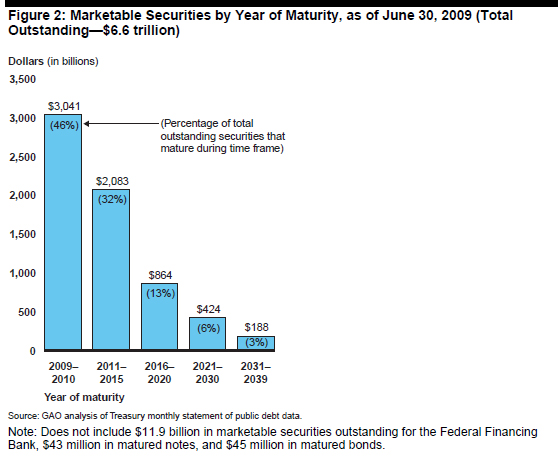
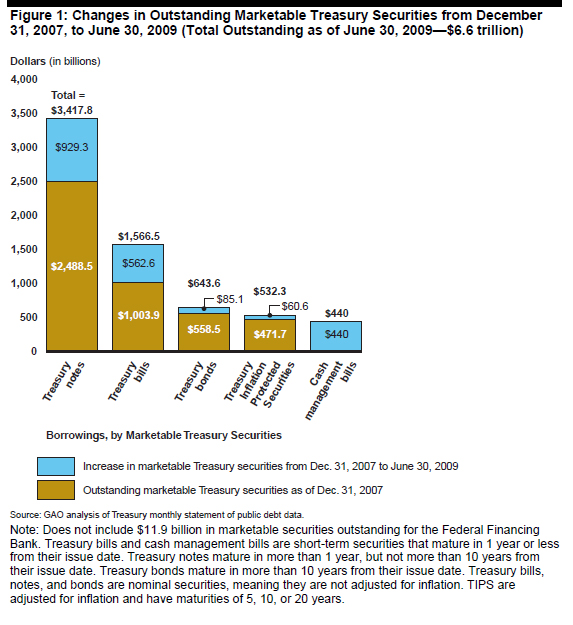
Treasury faces two near-term challenges in managing the growing government debt: the rise in total outstanding debt and the shortening of the average maturity of the debt profile.3 Treasury’s total outstanding debt increased by $2.3 trillion (25 percent increase in federal debt) since the onset of the economic recession in December 2007. In actions Treasury described as in accordance with normal operating procedures, Treasury increased short-term borrowing to address its massive and immediate borrowing needs. As a result, the average maturity of Treasury’s debt decreased as the percentage of marketable debt maturing within 1 year increased from 35.6 percent to 41.1 percent between September 2007 and June 2009.


Click for big

Click for big.

Another ex-ante study, noted that if the TIPS program were as liquid as the market for off-the-run nominal Treasuries, Treasury would have realized total cost savings from the TIPS program of $22 billion to $32 billion. Over the short run, economists recognize that an assessment of TIPS program’s relative costs depends on whether Treasury or the investor is the beneficiary from differences in expected and actual inflation. The time horizon of the analysis affects the results since, over the long run, the average amount by which actual inflation exceeds expected inflation will roughly equal the average amount when the opposite is true.

23William C. Dudley, Jennifer Roush, and Michelle Steinberg Ezer, “The Case for TIPS: An Examination of the Costs and Benefits,” FRBNY Economic Policy Review (July 2009); and Dean Croushore, “An Evaluation of Inflation Forecasts From Surveys Using Real-Time Data,” Federal Reserve Bank of Philadelphia Working Papers (December 2008).

The next part is interesting … I didn’t know that!

In addition, technical market factors closely linked to liquidity effects appear to have contributed to the decline in breakeven inflation rates. Lehman Brothers owned TIPS as part of repo trades or posted TIPS as counterparty collateral. Because of Lehman’s bankruptcy, the court and its counterparty needed to sell these TIPS, which created a flood of TIPS on the market. There appeared to be few buyers and distressed market makers were unwilling to take positions in these TIPS. As a result, the TIPS yields rose sharply.

The conclusion is:

GAO recommends that, in the context of projected sustained increases in federal debt, the Secretary of the Treasury take steps to increase TIPS liquidity and reduce their cost to Treasury: increase issuance, issue longer-dated maturities, and conduct more frequent auctions. Also, the Secretary should continually review the appropriate composition of the TIPS program and consider: the impact of Treasury’s public statements and TIPS issuance on TIPS liquidity, how different analytical perspectives are valuable for evaluating cost, how TIPS can diversify Treasury’s investor base, and how TIPS impact the cost of nominal securities.

However, the Treasury Borrowing Advisory Committee stated in its November 4th Report:

There was lively debate among the Committee members regarding the GAO Report published September 2009 entitled “Treasury Inflation Protected Securities Should Play a Heightened Role in Addressing Debt Management Challenges.” Committee members could not come to broad agreement on the findings of the report. While Committee members acknowledged the benefits of TIPS as a debt management tool, some members reiterated their higher cost to date versus nominal Treasury securities.

So take your choice.

I have previously highlighted the slides for the TBAC presentation.

Interesting External Papers

TBAC Claims Real Rates Bigger Problem Than Inflation

My attention was drawn to the latest efforts of the Treasury Borrowing Advisory Committee by a Bloomberg story:

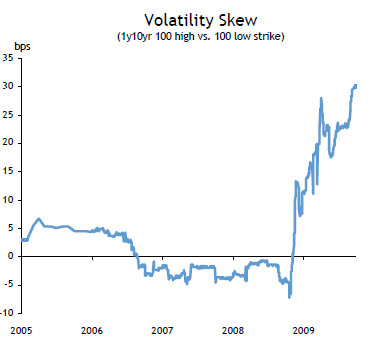
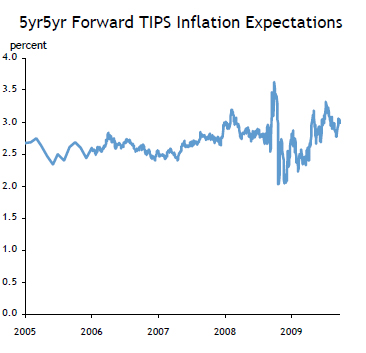
The 13-member committee of bond dealers and investors that Treasury Secretary Timothy Geithner depends on for advice, and includes officials of Pacific Investment Management Co. and Goldman Sachs Group Inc., highlighted the surge on page 36 of a 67-page report on Nov. 3. On the same page, they showed inflation expectations are subdued based on gauges watched by the Federal Reserve. In their discussions, the group noted that a second year of government debt sales approaching $2 trillion may weigh on investors as the Fed stops buying notes and bonds.

The presentation is on-line. Lots of fascinating charts, including the two highlighted ones:

Option Skew…

…and forward inflation…

This looks like good stuff – and I believe I’ve highlighted some of their work before, in the context of five-year TIPS elimination – that I want to chew on for a while … but I’m knee-deep in PrefLetter at the moment … and then there’s some urgent programming … then a couple of letters …

How might an investor exploit a high-real-rate-low-inflation scenario? Answer that, win a kewpie doll.

Update: The report to the Treasury Secretary is online:

With regard to TIPS, the Committee recommends increasing TIPS issuance from $58 billion in 2009 to $70-$80 billion in 2010. The auction schedules for both 5 and 10-year TIPS would be maintained, although sizes would increase. However, 20-year TIPS issuance would be replaced with 30-year TIPS, on the same auction schedule, with larger sizes. The Committee felt that this would both lengthen the average maturity of Treasury’s debt, while attracting investors interested in longer duration inflation protection. In the medium term, the Committee felt that the market could support increases in both auction sizes and frequency, growing gross TIPS issuance to $100-$130 billion per annum. These actions maintain, if not increase, the proportion of TIPS to total marketable debt outstanding.

Contingent Capital

Contingent Capital: Blinder Supports Squam Lake Model

Alan S. Blinder, the Gordon S. Rentschler Memorial Professor of Economics and Public Policy at Princeton University and former Vice-Chairman of the Fed’s Board of Governors, gave a wonderfully informative and chatty speech at the Federal Reserve Bank of Boston conference at Chatham, Massachussets, on October 23, 2009 titled
It’s Broke, Let’s Fix It: Rethinking Financial Regulation.

One quote I simply must highlight is:

After all, regulatory failure on a grand scale was one major cause of the mess.

However, at the moment I am more interested in his thoughts on Contingent Capital than anything else:

I myself am attracted to a particular idea for “contingent capital” suggested recently by the Squam Lake Working Group on Financial Regulation, an ad hoc panel of academic experts. Under the proposal, regulators would have the power, by declaring a systemic crisis, Their idea, which derives from Mark Flannery’s (2005) clever earlier proposal for “reverse convertible debentures,” is to require certain banks to issue a novel type of convertible bond. Conventional convertible debt gets exchanged for equity at the option of the bondholder; and because this option has value, convertible debt bears lower interest rates than ordinary debt. The proposed new form of convertible debt would reverse the optionality by giving it to the regulators instead.

Under the proposal, regulators would have the power, by declaring a systemic crisis, to force holders of these special convertibles (but not holders of other debt instruments) to convert to equity. As in many cases, one key question is price—specifically, how large an interest rate premium would investors demand to cover the risk that their bonds could be converted into equity against their will? If this premium proved to be very large, these new convertibles would be a very expensive form of “capital” that banks might shun, preferring ordinary equity instead. Only experience will tell. —thus giving banks more equity capital (and less debt) just when they need it most. Naturally, the existence of such an option would detract from the value of the bond and therefore would make the interest rate on reverse convertibles higher than on ordinary debt. Indeed, if the requirement was limited to TBTF institutions, as seems appropriate, that higher interest rate on a fraction of their debt would constitute a natural penalty cost for being TBTF. Furthermore, the spread on this new type of debt over regular debt could become a useful market indicator of the likelihood of a systemic crisis.

As in many cases, one key question is price—specifically, how large an interest rate premium would investors demand to cover the risk that their bonds could be converted into equity against their will? If this premium proved to be very large, these new convertibles would be a very expensive form of “capital” that banks might shun, preferring ordinary equity instead. Only experience will tell.

I have previously discussed the Squam Lake proposals, as well as the original Flannery paper; I think they need a little work. My major objections are that:

  • It mixes book value with market value; theoretically suspect and leading in times of stress to unpredictable – probably procyclical – results, and
  • by incorporating regulatory discretion into the conversion trigger, it unnecessarily introduces regulatory uncertainty into the evaluation of the investment, as well as encouraging regulatory capture and even corruption.

He breaks my heart by advocating credit ratings by government agencies:

But many observers think the fundamental problem lies deeper: with the issuer-pays model. As long as rating agencies are for-profit companies, paid by the issuers of the securities they rate, the agencies will have a natural tendency to try to please their customers—just as any business does. Unfortunately, the most obvious alternative, switching to an investors-pay model, is probably infeasible except in markets with very few investors. Otherwise, information flows too readily, and everyone wants to free ride. What to do? The way out of this dilemma, it seems to me, is to arrange for some sort of third-party payment. The government (e.g., the SEC) or an organized exchange or clearinghouse seem to be the natural alternative payers. In either case, they could raise the necessary funds by levying a user-fee on all issuers.

He also discusses the separation of prop trading from vanilla banking:

For example, the Group of Thirty (2009, p. 28)—hardly a bunch of wild-eyed radicals–recently concluded that, “Large, systemically important banking institutions should be restricted in undertaking proprietary activities that present particularly high risks…and large proprietary trading should be limited by strict capital and liquidity requirements.” That’s not quite a ban, but it’s getting close.

But there is a downside. Roping off “proprietary trading” from other, closely-related activities of banks is not as easy as it sounds. For example, banks buy and sell securities, foreign exchange, and other assets for their clients all the time. Often, such buying and selling is imperfectly synchronized or leaves banks with open positions for other reasons. Does that constitute “proprietary trading”? Furthermore, market-making has obvious synergies with dealing on behalf of clients. Do we want to label all such activities as “proprietary trading”? The point is: There is no bright line. That is why Adair Turner (2009), the chairman of Britain’s FSA, concluded that “we could not proceed by a binary legal distinction—banks can do this but not that—but had to focus on the scale of position-taking and the capital held against position-taking.”

I say – yes. we do want to label all such activities as “proprietary trading”; and the fact that there is no bright line is just something we’ll have to get used to. As previously urged on PrefBlog, I suggest that there be two regulatory regimes – for investment banks and vanilla banks, the former imposing relatively heavier capital charges on long term positions, the latter imposing relatively heavier charges on short term positions. It won’t be perfect, by any stretch of the imagination; but it will allow each type of institutions to make decisions on a tactical basis, according to their marginal value.

One of the things that brought down the investment banks was that they engaged in buy-and-hold strategies, which are more properly the province of vanilla banks, which have (or should have!) the expertise and controls in place to look beyond the next portfolio flip.

Contingent Capital

Contingent Capital: Squam Lake Working Group

The papers of the Squam Lake Working Group , a very distinguished group of academics, are published by the Council on Foreign Relations (which seems rather strange, but there you go), who also publish the periodical Foreign Affairs, which I love but don’t have time to read any more.

The Squam Lake paper titled An Expedited Resolution Mechanism for Distressed Financial Firms: Regulatory Hybrid Securities is of great interest, albeit lamentably short on detail.

Most notably, they propose a double trigger for conversion:

A bank’s hybrid securities should convert from debt to equity only if two conditions are met. The first requirement is a declaration by regulators that the financial system is suffering from a systemic crisis. The second is a violation by the bank of covenants in the hybrid-security contract.

This double trigger is important for two reasons. First, debt is valuable in a bank’s capital structure because it provides an important disciplining force for management. The possibility that the hybrid security will conveniently morph from debt to equity whenever the bank suffers significant losses would undermine this productive discipline. If conversion is limited to only systemic crises, the hybrid security will provide the same benefit as debt in all but the most extreme periods.

Second, the bank-specific component of the trigger is also important. If conversion were triggered solely by the declaration of a systemic crisis, regulators would face enormous political pressure when deciding whether to make such a declaration. Replacing regulatory discretion with an objective criterion creates more problems because the aggregate data regulators might use for such a trigger are likely to be imprecise, subject to revisions, and measured with time lags. And, perhaps most important, if conversion depended on only a systemic trigger, even sound banks would be forced to convert in a crisis. This would dull the incentive for these banks to remain sound.

I don’t like the first trigger, the declaration by regulators that a systemic crisis exists. First, there is more than one regulator, which will lead, at the very least, to delays while simultaneous announcements are arranged and, at worst, to political kerfuffles regarding cross-border banks if there is no widespread agreement.

Secondly, it introduces an element of political uncertainty regarding conversion, which will lead to the political pressure they allude to in their discussion of the second trigger.

Thirdly, I just plain don’t trust the regulators.

It will be noted that the group skims rather lightly over the justification for the first trigger!

The group also suggests using Tier 1 Capital Ratios as a trigger:

What sort of covenant would make sense for the bank-specific trigger? One possibility, which we find appealing, would be based on the measures used to determine a bank’s capital adequacy, such as the ratio of Tier 1 capital to risk-adjusted assets.

I don’t like it, for reasons which have been discussed in my posts Contingent Capital: Reverse Convertible Debentures and Lloyds bank to Issue Contingent Capital with Tier 1 Ratio Trigger?. Tier 1 ratios are too easy for a bank and regulators to manipulate, do not measure the degree of investor confidence in an institution and do not provide a framework for market arbitrage. As a bank’s situation deteriorates, the price response of the hybrid should gradually become more-and-more equity-like, which suggests a market based approach rather than the binary now-it’s-debt-now-it’s-equity paradigm implied by an all-or-nothing conversion based on calculated figures. I have not seen anything yet to shake my belief that a fixed-rate conversion with a trigger based on the trading price of the common is the best solution.

The authors discuss the conversion rate:

In addition to the triggers, this new instrument will have to specify the rate at which the debt converts into equity. The conversion rate might depend, for example, on the market value of equity or on the market value of both equity and the hybrid security. Conversions based on market values, however, can create opportunities for manipulation. Bondholders might try to push the stock price down by shorting the stock, for example, so they would receive a larger slice of the equity in the conversion. Using the average stock price over a longer period, such as the past twenty days, to measure the value of equity makes this manipulation more difficult, but it opens the door for another manipulation. If the stock price falls precipitously during a systemic crisis, management might intentionally violate the trigger and force conversion at a stale price that now looks good to the stockholders. Finally, in some circumstances, a conversion ratio that depends on the stock price can lead to a “death spiral,” in which the dilution of the existing stockholders’ claims that would occur in a conversion lowers the stock price, which leads to more dilution, which lowers the price even further.

An alternative approach is to convert each dollar of debt into a fixed quantity of equity shares, rather than a fixed value of equity. There are at least two advantages of such an approach. First, because the number of shares to be issued in a conversion is fixed, death spirals are not a problem. Second, although management might consider triggering conversion (for example, by acquiring a large number of risky assets) to avoid a required interest or principal payment on the debt, this would not be optimal unless the stock price were so low that the shares to be issued were worth less than the bond payment. Thus, management would want to intentionally induce conversion only when the bank is struggling. The advantages and disadvantages of different conversion schemes are complicated, however, and will require both further study and detailed input from the financial and regulatory community.

It seems that they believe that a problem with the conversion at a fixed rate is the potential for manipulation of the trigger terms by management. This would be avoided with a market-based trigger.