Category: Interesting External Papers

Interesting External Papers

Carney, Haldane, Swaps

Let’s say you sit on the Public Services Board of a seaside town; one of the things your board does is hire lifeguards for the beach.

One day, a vacationer drowns. You do what you can for the family and then haul the lifeguard on duty up in front of a committee to see why someone drowned on his watch.

“Not my fault!” the lifeguard tells you “He didn’t know how to swim very well and he went into treacherous waters.”

So what do you do? Chances are that you scream at the little twerp “Of course he went into treacherous waters without knowing how to swim well, you moron. That’s what vacationers do! That’s precisely why we hired you!”

Reasonable enough, eh? You’d fire the lifeguard if that was his best answer.

So why are we so indulgent with bank regulators? The banks were stupid. Of COURSE the damn banks were stupid. That’s what banks are best at, for Pete’s sake! We KNOW that. If they weren’t stupid, we wouldn’t need regulators, would we?

Which is all a way of saying how entertaining I find the bureaucratic scapegoating of banks in the aftermath of the crisis.

In my post reporting Carney’s last speech, I highlighted his reference to a speech by Haldane:

These exposures were compounded by the rapid expansion of banks into over-the-counter derivative products. In essence, banks wrote a series of large out-of-the-money options in markets such as those for credit default swaps. As credit standards deteriorated, the tail risks embedded in these strategies became fatter. With pricing and risk management lagging reality, there was a widespread misallocation of capital.

footnote: See A. Haldane, ―The Contribution of the Financial Sector—Miracle or Mirage?‖ Speech delivered at the Future of Finance Conference, London, 14 July 2010.

An interesting viewpoint, since writing a CDS is the same thing as buying a bond, but without the funding risk. I’ll have to check out that reference sometime.

I have now read Haldane’s speech, titled The contribution of the financial sector – miracle or mirage?, and it seems that what Haldane says is a bit of stretch … and the interpretation by Carney is a bit more of a stretch.

Haldane’s thesis is

Essentially, high returns to finance may have been driven by banks assuming higher risk. Banks’ profits, like their contribution to GDP, may have been flattered by the mis-measurement of risk.

The crisis has subsequently exposed the extent of this increased risk-taking by banks. In particular, three (often related) balance sheet strategies for boosting risks and returns to banking were dominant in the run-up to crisis:

  • increased leverage, on and off-balance sheet;
  • increased share of assets held at fair value; and
  • writing deep out-of-the-money options.

What each of these strategies had in common was that they generated a rise in balance sheet risk, as well as return. As importantly, this increase in risk was to some extent hidden by the opacity of accounting disclosures or the complexity of the products involved. This resulted in a divergence between reported and risk-adjusted returns. In other words, while reported ROEs rose, risk-adjusted ROEs did not (Haldane (2009)).

I don’t have any huge problems with his section on leverage. The second section makes the point:

Among the major global banks, the share of loans to customers in total assets fell from around 35% in 2000 to 29% by 2007 (Chart 29). Over the same period, trading book asset shares almost doubled from 20% to almost 40%. These large trading books were associated with high leverage among the world’s largest banks (Chart 30). What explains this shift in portfolio shares? Regulatory arbitrage appears to have been a significant factor. Trading book assets tended to attract risk weights appropriate for dealing with market but not credit risk. This meant it was capital-efficient for banks to bundle loans into tradable structured credit products for onward sale. Indeed, by securitising assets in this way, it was hypothetically possible for two banks to swap their underlying claims but for both firms to claim capital relief. The system as a whole would then be left holding less capital, even though its underlying exposures were identical. When the crisis came, tellingly losses on structured products were substantial (Chart 31).

… which is all entirely reasonable and is a failure of regulation, not that you’ll see anybody get fired for it.

The third section mentions Credit Default Swaps:

A third strategy, which boosted returns by silently assuming risk, arises from offering tail risk insurance. Banks can in a variety of ways assume tail risk on particular instruments – for example, by investing in high-default loan portfolios, the senior tranches of structured products or writing insurance through credit default swap (CDS) contracts. In each of these cases, the investor earns an above-normal yield or premium from assuming the risk. For as long as the risk does not materialise, returns can look riskless – a case of apparent “alpha”. Until, that is, tail risk manifests itself, at which point losses can be very large. There are many examples of banks pursuing essentially these strategies in the run-up to crisis. For example, investing in senior tranches of sub-prime loan securitisations is, in effect, equivalent to writing deep-out-of-the-money options, with high returns except in those tail states of the world when borrowers default en masse. It is unsurprising that issuance of asset-backed securities, including sub-prime RMBS (residential mortgage-backed securities), grew dramatically during the course of this century, easily outpacing Moore’s Law (the benchmark for the growth in computing power since the invention of the transistor) (Chart 32).

A similar risk-taking strategy was the writing of explicit insurance contracts against such tail risks, for example through CDS. These too grew very rapidly ahead of crisis (Chart 34). Again, the writers of these insurance contracts gathered a steady source of premium income during the good times – apparently “excess returns”. But this was typically more than offset by losses once bad states materialised. This, famously, was the strategy pursued by some of the monoline insurers and by AIG. For example, AIG’s capital market business, which included its ill-fated financial products division, reported total operating income of $2.3 billion in the run-up to crisis from 2003 to 2006, but reported operating losses of around $40 billion in 2008 alone.

I have a big problem with the concept of CDSs as options. Writing a Credit Default Swap is, essentially, the same thing as buying a corporate bond on margin. If the CDS is cash-covered, the risk profile is very similar to a corporate bond, differing only in some special cases that did not have a huge impact on the crisis.

You can, if you squint, call it an option, but only to the extent that any loan has an implicit option for the borrower not to repay the debt. If you misprice that option – more usually referred to as default risk – sure, you will eventually lose money.

But AIG’s big problem was not that it wrote CDSs, it was that it wrote far too many of them; it was effective leverage that was the big problem. And the potential for contagion if AIG fell was not so much the fault of the manner in which the deals were structured as it was the fault of the banks for not insisting on collateral, and the fault of the regulators for not addressing the problem with uncollateralized loans.

So Haldane’s thir point is more than just a little shaky, and Carney’s use of this to state that derivative use by banks was a contributing factor to the Panic of 2007 is shakier.
Interesting External Papers

BIS Releases Quarterly Review, September 2010

The Bank for International Settlements has released its BIS Quarterly Review, September 2010 with sections on:

  • Overview: growth concerns take centre stage
  • Highlights of international banking and financial market activity
  • Debt reduction after crises
  • The collapse of international bank finance during the crisis: evidence from syndicated loan markets
  • Options for meeting the demand for international liquidity during financial crises
  • Bank structure, funding risk and the transmission of shocks across countries: concepts and measurement

They note:

Increasing growth concerns led investors to remain cautious. Nevertheless, prices rose in both equity and corporate bond markets in response to the improved conditions in euro sovereign debt markets, positive US and European corporate earnings announcements and greater clarity on the regulatory agenda (Graph 5, left-hand panel). Equity volatility also declined (Graph 5, centre panel). Given the significant drops earlier in the year, however, North American and European equity markets remained flat or below their levels at the beginning of the year. In contrast, there were gains for some Latin American markets and large losses for Chinese, Japanese and Australian markets.

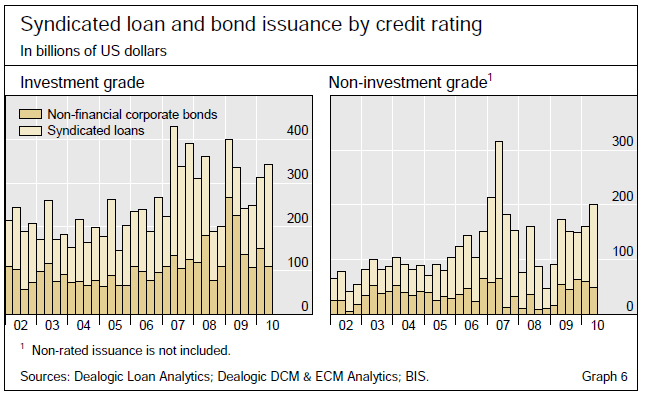
Despite unchanged credit spreads (Graph 5, right-hand panel), both investment grade and high-yield corporate bonds generated large returns due to falling risk-free rates (Graph 6, left-hand panel). The superior performance of bond markets relative to equity markets was mirrored in global investment flows. In the United States, large outflows from equity mutual funds from May to July were offset by large inflows to bond mutual funds (Graph 6, centre panel). These inflows picked up again during July.

And here’s an interesting tid-bit:

One of the few developed economies (in addition to Greece) that bucked the trend of lower net issuance was Canada. Canadian residents raised $30 billion on the international debt market, about three times as much as in the previous quarter and the highest since the second quarter of 2008. Canadian financial institutions issued approximately $19 billion. Canadian provincial governments, led by Ontario, also borrowed sizeable amounts ($9 billion), whereas non-financial corporations issued $2 billion, slightly less than in the previous quarter.

The paper on syndicated loans shows some trends that I consider rather alarming:

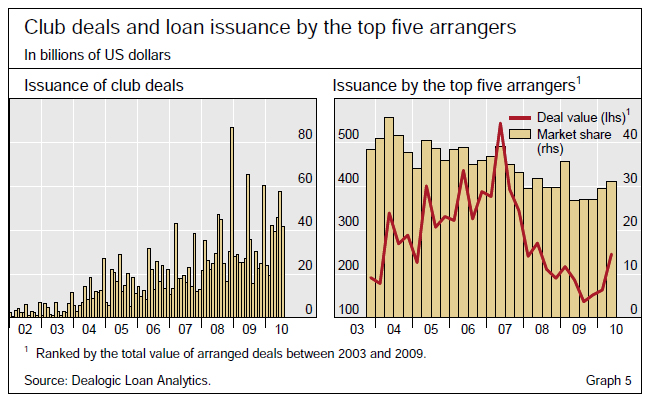
Changes in syndication arrangements may be indicative of credit supply constraints. For instance, syndicated loan transactions in the form of “club deals” gained importance, increasing from 12% of total issuance in 2008 to 17% in 2009 (Graph 5, left-hand panel). A club deal is a loan syndicated by a small number of participating banks, which are not entitled to transfer their portion of the loan to a third party (White & Case (2003)). Such smaller syndicates result in lower restructuring and monitoring costs, and are thus preferred by lead arrangers when default is more likely. From this perspective, greater use of club deals might be an indication of both growing bank risk aversion and higher credit risk at a time of greatly increased economic uncertainty. This is consistent with Esty and Megginson (2003), who find that syndicate size is positively related to the strength of creditor rights and the reliability of legal enforcement.


Click for big

Click for big

The concept of private placements, with issues being continually forced from the public into more private structures, increases the opacity of the securities market. Many issues are forced there as a result of prospectus and reporting requirements for the public markets; I don’t think anybody’s ever done a cost/benefit analysis for the addition of further pages to prospectuses or for things like Sarbox and TRACE: it sounds good at the time, so it just happens.

The authors conclude, in part:

The results raise at least two issues. The first concerns the extent to which constraints in syndicated loan supply can be expected to ease in the near term. dysfunctional securitisation markets might constrain the ability of banks to place syndicated loans in the secondary market for a while. Moreover, repairing bank balance sheets takes time. But the sensitivity of syndicated loan supply to changes in bank CDS spreads may suggest that measures that alleviate concerns about banks’ soundness and ease bank funding pressures could have significant positive effects on credit supply even in the near term.

Second, recent developments in syndicated loan markets might be indicative of structural changes in credit markets. The gradual return to more normal functioning of the corporate bond markets could have eased funding constraints for banks and corporations. In particular, those with an investment grade rating might be more reliant on market finance in the future. Moreover, looking forward, emerging market banks may play a much bigger role in syndicated loan markets, and in international banking more generally, than in the past. The syndicated loan market with its role in financing trade and mergers and acquisitions might be one key area of expansion for these banks.

OK, so my question is: to what extent could making life easier for public issuers reduce the dependence of credit supply to non-financial firms on the (perceived) credit quality of the banks?

Interesting External Papers

BoC Releases Summer 2010 Review

The Bank of Canada has released the Bank of Canada Review: Summer 2010 with articles:

  • Lessons Learned from Research on Infl ation Targeting
  • Monetary Policy and the Zero Bound on Nominal Interest Rates
  • Price-Level Targeting and Relative-Price Shocks
  • Should Monetary Policy Be Used to Counteract Financial Imbalances?
  • Conference Summary: New Frontiers in Monetary Policy Design

The Financial Imbalances article points out:

Another potentially important cost of leaning against
fi nancial imbalances stems from the difficulty of identifying them and of calibrating an appropriate response. If fi nancial imbalances are falsely identified, responding to them through monetary policy could induce undesirable economic fluctuations (Greenspan 2002; Bernanke and Gertler 1999).

The question, according to the authors, is:

Granted that appropriate supervision and regulation
are the fi rst line of defence against financial imbalances, the key question is whether they should be the only one. In this context, developing a view on whether monetary policy should lean against financial imbalances requires that we first examine the interaction between the effects of prudential tools and those of monetary policy on fi nancial imbalances that stem from various sources.

A credit-fuelled housing bubble is a particularly relevant example of a fi nancial imbalance. This section considers the case of over-exuberance in the housing sector, represented as a temporary increase in the perceived value of housing that results in a short-term surge in mortgage credit. This example is calibrated to produce housing-market dynamics that are roughly similar to those of the housing market in the United States in the run-up to the recent crisis. Specifically, the size of the shock is set at 5 per cent of the value of housing collateral; this leads to an average increase in mortgage debt in the first year of about 16 per cent, comparable with the average annual growth rate of mortgage debt over the 2003–06 period.

We evaluate the relative merits of using monetary policy to contain this imbalance and compare it with a well-targeted prudential instrument—namely, an adjustment in the mortgage loan-to-value (LTV) ratio.

The authors have the fortitude to emphasize:

As mentioned in the introduction, one important argument against using monetary policy as a tool in these situations is that fi nancial imbalances cannot be detected with certainty. This uncertainty applies not only to monetary policy, but also to prudential policy, and should play a role in determining how forcefully to react to the prospect of building financial imbalances.

By me, this is such an important consideration that it virtually negates the concept of leaning against the flow. I am in favour of a progressive surcharge on banks’ Risk Weighted Assets based on how much these have changed over the past few years, but that’s based more on management factors than economic ones.

By definition, a bubble will have lots of defenders ready to explain why it is not a bubble, as discussed recently in FRBB: Bubbles Happen. Trying to nip bubbles in bud on the basis of a bureaucrat deciding that eggs should cost $2.99 a dozen and $3.25 is too much is fraught with dangers.

Interesting External Papers

BoC Studies Capital Ratio Cost/Benefits

The Bank of Canada has released:

a comprehensive assessment of the potential impact on the Canadian economy of new global capital and liquidity standards, which are to be finalized later this year by the G-20.

The study is titled Strengthening International Capital and Liquidity Standards: A Macroeconomic Impact Assessment for Canada:

While this country boasts a strong financial sector, it too was buffeted by financial shocks from abroad. Our economy could not escape the spillover effects of the ensuing global economic downturn. Canadian economic output fell by more than 3 per cent during the crisis, and more than 400,000 jobs disappeared.

This looks like mistake number one, according to me – it assumes that the damage caused during the Panic of 2007 was all attributable to the financial crisis itself, which I think is a load of hooey.

Recessions are good things; a recession is nature’s way of telling us we’re doing things wrong. Most of the harm experienced in Canada during the Panic may be ascribed to the auto industry … hands up everybody who thinks that there were no problems in the auto industry prior to the crisis! Didn’t think so … the Panic brought things to light and forced the decision makers to address a problem … it didn’t actually cause the problem.

Financial crises are damaging because they bring a lot of problems to light all at the same time.

But for the first time, I see official acknowledgement that higher capital ratios are not automatically good:

The benefits of higher capital and liquidity standards must be weighed against their potential costs to the Canadian economy. Over time, it is expected that banks will seek to pass on the cost of higher capital and liquidity requirements through higher lending rates to borrowers. The cost of higher capital is higher lending spreads, which the Bank calculates would increase by about 14 basis points for every percentage-point increase in bank capital requirements. This figure was then used as an input to the Bank’s macroeconomic models to gauge the impact on economic output. New liquidity requirements also present costs for the Canadian economy. These requirements are estimated to add roughly an additional 14 basis points to lending spreads, and thus are equivalent in impact to an additional 1-percentage-point increase in bank capital requirements. Consequently, the cost of a 2-percentage-point increase in capital requirements, in conjunction with the new liquidity standards, should be an increase in lending spreads of about 42 basis points.

However, they show more than just a little political influence with:

In the wake of the crisis, the Bank of Canada cut its target for the overnight rate to a historic low of one-quarter of one per cent, and decades of progress in improving Canada’s fiscal position suffered a setback as fiscal support for the Canadian economy pushed federal and provincial government budgets back into substantial deficits.

The GST cut and elimination of the structural surplus had nothing to do with it, so vote Conservative!

The regulators have been busy:

To assess the potential economic implications of these reforms, the Financial Stability Board (FSB) and the BCBS conducted two international studies that assessed (i) the longer-run macroeconomic benefits and costs (the LEI report) and (ii) the shorter-term transition costs (the MAG report) associated with adopting the new standards. (footnote) The reports are: “An Assessment of the Long-Term Economic Impact of the New Regulatory Framework” (the LEI report), and “Assessing the Macroeconomic Impact of the Transition to Stronger Capital and Liquidity Requirements – Interim Report “ (the MAG report). Both are available at http://www.bis.org.

They do acknowledge a major problem:

No allowance is made for the possibility that households and firms may find cheaper alternative sources of financing in the longer run that would reduce the impact of the new rules on the economy.

If loan rates increase 42bp, I would consider that a certainty. Private mortgages will take off and I’m wondering about the potential to start a private mortgage fund myself. What’s more, this will siphon off the good business from the banks and leave them with the dregs … but there’s no allowance for it.

Specifically, assuming a starting probability of a crisis of 4.5 per cent in any given country, the LEI report found that an increase of 2 percentage points in bank capital ratios reduced the probability of a financial crisis by 2.9 percentage points, while increases in capital ratios of 4 and 6 percentage points reduced the probability of a financial crisis by 3.6 and 4 percentage points, respectively. These calculations assume a combined effect from increases in capital as well as from new liquidity rules.

When these reductions in the probability of a crisis (e.g., 2.9 percentage points for a 2-percentage-point increase in capital ratios) are multiplied by the cumulative cost of crises (63 per cent of GDP), the benefits to annual economic output are potentially large, in the order of 2 per cent of GDP

If, as I assert, the bulk of the costs experienced during financial crises are simply reflections of structural problems that are merely brought to light by the crisis, then this calculation is … er … inoperable.

For example, following the approach used by the United Kingdom Financial Services Authority (U.K. FSA) and described in Barrell et al. (2009), the annual probability of a domestic financial crisis was estimated based on several domestic factors, including the unweighted capital ratio of banks, their liquid assets as a share of total assets, and house prices expressed in real terms. This approach suggests a 1.7 per cent probability of a financial crisis occurring in Canada (implying that a financial crisis occurs, on average, every 60 years or so). This figure is substantially lower than the LEI report’s 4.5 per cent likelihood of a foreign financial crisis (approximately once every 22 years).

Since the banks nearly blew themselves in the late eighties with the MBA crisis, I guess that means we’ve got about forty years to go.

As indicated in Annex 1, most Canadian banks appear to be well placed to meet the new Liquidity Coverage Ratio requirement, since they carry a large stock of residential mortgages that could be converted at a small cost to federal government-guaranteed National Housing Act Mortgage-Backed Securities that would qualify as eligible liquid assets under the new rules.

Great! Wave a magic wand, and suddenly you get to recategorize existing assets. This part really gives me a lot of confidence, you know?

Given the current exceptionally low level of bank deposit rates and the cost of bank debt funding more generally, it is also assumed that the wider interest margins will effectively result in higher interest rates (lending spreads) on bank loans to households, firms, and other sectors of the economy. It is further assumed that the higher lending spreads will be passed along to all bank borrowers, and not just to certain subgroups, such as households or small and medium-sized businesses (SMEs), because all banks in Canada and abroad will be affected by the higher capital and liquidity requirements.

Apparently, Dr. Pangloss had a hand in this report. As noted above, increased spreads will increase the opportunity for shadow banks to move in … there will be a lot of business borrowing at prime (or prime+) who are going to find the commercial paper market (either directly or via BAs) and short-term bond issuance to be a whole lot more attractive if spreads increase 42bp.

Don’t get me wrong! I’m very happy to see that, at last, there is some official acknowledgment that increased capital standards will have a cost. But I think some of the embedded assumptions are more than just a little bit suspect and I look forward to seeing academic attacks on this paper.

A related post is Elliott: Quantifying the Effects on Lending of Increased Capital Requirements

Interesting External Papers

FRBB: Bubbles Happen

The Federal Reserve Bank of Boston has released a discussion paper by Kristopher S. Gerardi, Christopher L. Foote, and Paul S. Willen titled Reasonable People Did Disagree: Optimism and Pessimism About the U.S. Housing Market Before the Crash:

Understanding the evolution of real-time beliefs about house price appreciation is central to understanding the U.S. housing crisis. At the peak of the recent housing cycle, both borrowers and lenders appealed to optimistic house price forecasts to justify undertaking increasingly risky loans. Many observers have argued that these rosy forecasts ignored basic theoretical and empirical evidence that pointed to a massive overvaluation of housing and thus to an inevitable and severe price decline. We revisit the boom years and show that the economics profession provided little such countervailing evidence at the time. Many economists, skeptical that a bubble existed, attempted to justify the historic run-up in housing prices based on housing fundamentals. Other economists were more uncertain, pointing to some evidence of bubble-like behavior in certain regional housing markets. Even these more skeptical economists, however, refused to take a conclusive position on whether a bubble existed. The small number of economists who argued forcefully for a bubble often did so years before the housing market peak, and thus lost a fair amount of credibility, or they make arguments fundamentally at odds with the data even ex post. For example, some economists suggested that cities where new construction was limited by zoning regulations or geography were particularly “bubble-prone,” yet the data shows that the cities with the biggest gyrations in house prices were often those at the epicenter of the new construction boom. We conclude by arguing that economic theory provides little guidance as to what should be the “correct” level of asset prices —including housing prices. Thus, while optimistic forecasts held by many market participants in 2005 turned out to be inaccurate, they were not ex ante unreasonable.

I’ll admit I was undecided about whether to highlight this paper in its own post, or simply to mention it in today’s market update … until I read the following:

It is instructive to read the logic of non-economists who looked at house price data in the same period. Paolo Pellegrini and John Paulson, whose wildly successful 2006 bet against subprime mortgages is now the stuff of Wall Street legend, made the following argument, as chronicled in Zuckerman (2009). First, they noted that house prices had deviated from trend:

Those facts are indisputable, but the logic that followed would have earned the two investors a zero on an undergraduate finance exam:

Ha-ha! I hope this gets quoted extensively by Fabulous Fabio and Alan Greenspan as they defend themselves against the charges that they bear personal responsibility for the Panic of 2007.

The authors don’t spare Krugman:

Krugman’s thesis seems to hinge on the idea that scarce coastal land is valuable and bubbles can only happen when assets are in short supply, but the whole point about bubbles is that the fundamentals of supply and demand do not matter. Thus, there is no reason why land in places where it is easy to build could not experience bubbles. Ex post, as we will explore at length, the places in the United States where the housing market most resembled a bubble were Phoenix and Las Vegas. According to recent research, both locations are characterized by relatively high housing-supply elasticities; unlike certain coastal areas, the two cities have an abundance of surrounding land on which to accommodate new construction.

The authors’ purpose is clear:

Ultimately, our paper argues that the academic research available in 2006 was basically inconclusive and could not convincingly support or refute any hypothesis about the future path of asset prices. Thus, investors who believed that house prices were going to fall could find evidence to support their position, while those who wanted to believe that house prices would continue to rise could not be dissuaded either. There were reasonable arguments on both sides.

One of the bubbleistas was Baker:

In addition to the divergence between rents and prices in the U.S. housing market, Baker also called attention to changes in demographic trends that could put additional downward pressure on house prices. He noted that during the 1970s and early 1980s, housing grew from about 17 percent of consumption to more than 25 percent, in large part due to increased demand for housing from the first baby boom cohorts, who were then entering adulthood. From the early 1980s to the mid-1990s, the housing share of consumption remained relatively constant, consistent with the modest demographic changes taking place in the United States at that time. In the future, Baker argued, as the baby boomers entered retirement, housing demand—and hence prices—would likely fall.

This argument has been taken up by some researchers at BIS, as discussed on August 4.

Baker also supplied contemporary arguments against the Greenspan-dunnit thesis:

As we will
discuss in more detail below, many economists pointed to low interest rates as justifying higher housing prices, but Baker was skeptical of this claim. Nominal interest rates were indeed low in the early 2000s, as the Federal Reserve had adopted a loose monetary policy to combat the effects of the 2001 recession. However, Baker pointed out that nominal rates could not explain the divergence of housing prices from fundamentals, as it is the real interest rate (the difference between the nominal rate and expected inflation) that should influence prices.

Another very interesting point is:

The evolving landscape of mortgage lending is also relevant to an ongoing debate in the literature about the direction of causality between reduced underwriting standards and higher house prices. Did lax lending standards shift out the demand curve for new homes and raise house prices, or did higher house prices reduce the chance of future loan losses, thereby encouraging lenders to relax their standards? Economists will debate this issue for some time. For our part, we simply point out that an in-depth study of lending standards would have been of little help to an economist trying to learn whether the early-to-mid 2000s increase in house prices was sustainable. If one economist argued that lax standards were fueling an unsustainable surge in house prices, another could have responded that reducing credit constraints generally brings asset prices closer to fundamental values, not farther away.

Another good point is:

If we have learned anything from this crisis, it is that large declines in house prices are always a possibility, so regulators and policymakers must take them into account when making decisions. A 30 percent fall in house prices over three years may be very difficult, if not impossible, to generate in any plausible econometric model, but a truly robust financial institution must be able to withstand one. The fact that so many professional investors as well as individual households ignored this possibility, even in 2006, suggests that we cannot allow investors to try to time market collapses.

All in all, most interesting and well balanced. Related posts on PrefBlog include:

As for me … I’ve always disclaimed any ability or interest in forecasting macroeconomic trends. But what I have said is … bad investments will hurt you. Concentration will kill you.

The Panic of 2007 wasn’t caused by Merrill Lynch et al. buying sub-prime paper. It was caused by the fact that they levered it up big time.

Interesting External Papers

FRBB Publishes 1H10 Research Review

The Federal Reserve Bank of Boston has released its Research Review, Jan-Jun 2010, with summaries of the following:

  • Public Policy Discussion Papers
    • Person-to-Person Electronic Funds Transfers: Recent Developments and Policy Issues (highlighted February 24)
    • Mobile Payments in the United States at Retail Point of Sale: Current Market and Future Prospects
  • Working Papers
    • Insuring Consumption Using Income-Linked Assets
    • What Explains Differences in Foreclosure Rates? A Response to Piskorski, Seru, and Vig
    • A Short Survey of Network Economics
    • The Asymmetric Effects of Tariffs on Intra-Firm Trade and Offshoring Decisions
    • Public and Private Values
    • Moral Hazard, Peer Monitoring, and Microcredit: Field Experimental Evidence from Paraguay
    • The Sensitivity of Long-Term Interest Rates to Economic News: Comment
    • Wage Setting Patterns and Monetary Policy: International Evidence
  • Public Policy Briefs
    • State Government Budgets and the Recovery Act
    • The Role of Expectations and Output in the Inflation Process: An Empirical Assessment (highlighted June 28)
  • Conferences
    • Oil and the Macroeconomy in a Changing World

Sadly, not much there of relevance to a fixed income portfolio manager. but the first two articles might inform the TTC Presto/Open debate … assuming that any of the participants want an informed debate, which is a bit of a long shot.

Interesting External Papers

Elliott: Quantifying the Effects on Lending of Increased Capital Requirements

On July 12 I briefly introduced a study by the Institute of International Finance forecasting ruin and desolation in the worst-case scenario of every single proposed banking regulation being imposed.

Additionally, my attention was drawn to a Wall Street Journal article by David Enrich, titled Studies Question Bank Capital Fears which pooh-poohed the entire notion, referring to studies by Douglas J. Elliott of the Brookings Institute and three mysteriously unnamed researchers at Harvard and UChicago.

So I’ve had a look at the paper by Douglas Elliott, titled Quantifying the Effects on Lending of Increased Capital Requirements. This paper was given a passing mention in the IIF paper, by the way.

Mr. Elliott first derives an equation giving the lower bound of the interest rate on a loan:

L*(1‐t) >= (E*re)+((D*rd)+C+A‐O)*(1‐t)

where
L = Effective interest rate on the loan, including the annualized effect of fees
t = Marginal tax rate for the bank
E = Proportion of equity backing the loan
re = Required rate of return on the marginal equity
D = Proportion of debt and deposits funding the loan, assumed to be the amount of the loan minus E
Rd = Effective marginal interest rate on D, including indirect costs of raising funds, such as from running a
branch network
C = The credit spread, equal to the probability‐weighted expected loss
A = Administrative and other expenses related to the loan
O = Other offsetting benefits to the bank of making the loan

He then assigns values to build a base case, then increases the proportion of equity while jiggling other numbers to estimate the effects on loan costs of this change.

Base Case and Possible Future per Elliott
Variable Base Case Possible Future
Equity 6% 10%
ROE 15% 14%
Proportion Debt 94% 90%
Cost of Debt 2.0% 1.8%
Credit Spread 1.0% 0.95%
Admin 1.5% 1.4%
Offsetting Benefits -0.5% -0.6%
Marginal Tax Rate 30% 30%
Loan Rate 5.17% 5.37%

He concludes that a hike in capital ratios from 6% to 10% will quite feasibly result in an increase in the loan rate of 20bp. Several variables were adjusted in this estimation:

Return on debt/deposits: Creditors ought also to be willing to drop their required returns at least modestly to reflect the lowered risk. On the deposit side, part of the adjustment might be a shift in deposit market share towards more efficient banks whose indirect cost of raising deposits is lower.

I don’t buy it. The bulk of deposits are explicitly federally insured anyway and the uninsured deposits are implicitly insured – I don’t believe uninsured depositors at US banks have yet lost a single dollar as a result of FDIC siezure. Thus, the entire 20bp reduction in the Cost of Debt will have to come from the wholesale funding markets and senior bonds. This claim will require a lot more backup than currently provided.

Credit spread: Banks ought to be able to reduce credit risk marginally by turning down less attractive loans and by imposing covenants or other features that reduce the bank’s risk of loss. The 5 basis point reduction was chosen because it appears achievable from changes in covenants and loan protections without the necessity to turn down more loans. Thus, the drop in loan supply appears unlikely to be significant.

I don’t buy it. People who “work” for banks may be a little on the otnay ootay ightbray side, if you get my drift, but I don’t believe that you can improve credit losses by 5bp simply by fiat. This claim is reminiscent of politicians who sweep into office promising more services and lower taxes, to be paid for with efficiency gains. I have no doubt but that efficiency can be improved … but show me first, OK?

Administrative costs and other benefits: These small changes would seem feasible, if banks found it necessary to alter the way they do business. This is one area where reductions in compensation could make a significant difference. Market share shifts could also account for a significant part of the change.

I don’t buy it. See above. I am particulary incensed that administrative costs are presumed to go down at the same time as extra covenants, etc, are being added to the loan terms. That doesn’t sound quite right.

So according to me, the possible future looks more like:

Base Case and Possible Future per Elliott
Variable Possible Future per Elliott Possible Future per JH
Equity 10% 10%
ROE 14% 14%
Proportion Debt 90% 90%
Cost of Debt 1.8% 2.0%
Credit Spread 0.95% 1.0%
Admin 1.4% 1.5%
Offsetting Benefits -0.6% -0.5%
Marginal Tax Rate 30% 30%
Loan Rate 5.37% 5.80%

So throwing out the more dubious changes adds 43bp on to loan cost, meaning the effect of increasing capital from 6% to 10% is not 20bp as Elliott claims, but more like 63bp according to me.

Who’s right? Who’s wrong? Who knows? There is no supporting detail in the paper that tracks the performance of the model through time. We don’t even know if the model accounts for enough of the truth to be worth-while, let alone how sticky the numbers are, or how well correllated they might be.

Anyway, according to this simple model, changing the base case in a manner with which I am more familiar, increasing capital from 6% to 10% raises the cost of a loan 63bp. 63bp! That’s a lot! Hands up everybody who doesn’t think 63bp on their mortgage is a lot!

I’m too much of an economic auto-didact to really know whether it’s strictly kosher to reverse engineer the Taylor Rule, but if we use a Taylor output gap coefficient of 0.5 then a tightening due to capital costs of 63bp means the output gap will grow by 126bp. And that’s a big number.

All in all, while the Elliott paper is interesting and provides a decent intuitive framework for a first stab at quantifying economic effects of bank capital increases, I don’t feel that there’s enough meat on these bones to justify a conclusion that we can hike bank capital and get away scot free.

And I’m still waiting for OSFI to quantify the bad effects of its insistence on high capital levels, together with the claimed good effects!

Interesting External Papers

HFT: A Boon for Value Investors?

Reginald Smith of the Bouchet-Franklin Institute (not a brand name institution, by any measure) has written a paper titled Is high-frequency trading inducing changes in market microstructure and dynamics?:

Using high-frequency time series of stock prices and share volumes sizes from January 2002-May 2009, this paper investigates whether the effects of the onset of high-frequency trading, most prominent since 2005, are apparent in the dynamics of the dollar traded volume. Indeed it is found in almost all of 14 heavily traded stocks, that there has been an increase in the Hurst exponent of dollar traded volume from Gaussian noise in the earlier years to more self-similar dynamics in later years. This shift is linked both temporally to the Reg NMS reforms allowing high-frequency trading to flourish as well as to the declining average size of trades with smaller trades showing markedly higher degrees of self-similarity.

The abstract immediately suggested the title of this post. If large stocks are correlated with each other (rather than, you know, with how their business is doing) then deviations from fair value will be more frequent, offering value traders more entry and exit points.

In addition, the HFT strategy of taking advantage of pricing signals from large orders has forced many orders off exchanges into proprietary trading networks called ‘dark pools’ which get their name from the fact they are private networks which only report the prices of transactions after the transaction has occurred and typically anonymously match large orders without price advertisements.

I can assure you that this is correct; I can assure you that the size of an order required to move the market is smaller than you might think; and I can assure you that there are many, many institutional PMs who will grin at you condescendingly when you tell them this. This comes from personal experience with S&P 500 stocks, not the preferred share backwater, by the way.

Given the relative burstiness of signals with H > 0.5 we can also determine that volatility in trading patterns is no longer due to just adverse events but is becoming an increasingly intrinsic part of trading activity. Like internet traffic Leland et. al. (1994), if HFT trades are self-similar with H > 0.5, more participants in the market generate more volatility, not more predictable behavior.

Traded value, and by extension trading volume, fluctuations are starting to show self-similarity at increasingly shorter timescales. Values which were once only present on the orders of several hours or days are now commonplace in the timescale of seconds or minutes. It is important that the trading algorithms of HFT traders, as well as those who seek to understand, improve, or regulate HFT realize that the overall structure of trading is influenced in a measurable manner by HFT and that Gaussian noise models of short term trading volume fluctuations likely are increasingly inapplicable.

Interesting External Papers

BoE Releases June Financial Stability Report

The Bank of England has released the Financial Stability Report, June 2010, stuffed with the usual high-quality research.

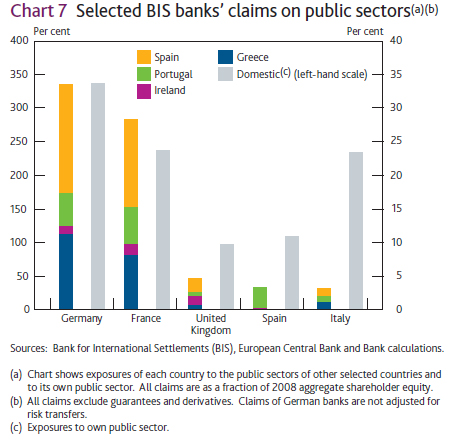
Although UK banks have limited holdings of sovereign debt in economies where fiscal concerns have been most acute (Section 2), they have counterparty relationships with European banking systems that have larger exposures (Chart 7). These banks face further write-downs in 2010, according to the IMF and ECB.


Click for big

Contingent Capital got an oblique mention:

The Bank welcomes the Government’s establishment of a new independent commission to review the structure of and competition in the UK banking system. Incentives to become [Too Important To Fail] could also be reduced by restrictions on activities and capital surcharges on institutions generating systemic risk. And further measures are needed to ensure that banks’ uninsured creditors face a credible threat of loss. For example, there is international debate about requiring uninsured creditors to recapitalise distressed banks through an extension of the scope of statutory resolution regimes nd through convertible debt instruments.

The Bank of Canada continues to display either its arrogance or ignorance (you pick) by refusing to answer my query regarding Carney’s Ban the Bond speech.

Bless their hearts, they also point out the problem of Central Clearing single point failure, which has been given short shrift in the proposals:

Initiatives are under way to extend central counterparty (CCP) clearing. But this will only improve resilience if appropriate CCP risk management standards are in place (see box on pages 69–70). For example, holding sufficient resources to meet the default of at least the two largest member counterparties — in stressed but plausible market conditions — would help to reduce systemic risks.

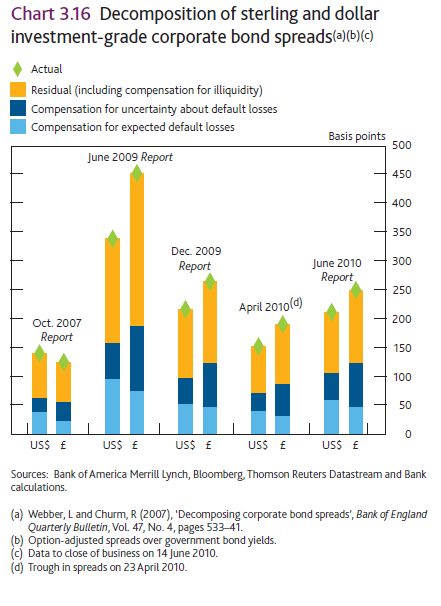
They publish their liquidity calculations again: do not buy a single corporate credit without understanding the implications and rationale behind this chart!


Click for Big

Box 7 contains an interesting discussion of the sadly neglected cost-benefit analysis of higher capital levels:

Estimates from the structural model can be used to compare the marginal benefits and costs of higher capital levels. Chart A shows that marginal costs are roughly linear in the capital ratio. Marginal benefits decline sharply as capital levels rise, reflecting the decreasing likelihood of shocks that are
large enough to cause a bank’s default (Chart B). Confidence intervals around the central estimates (magenta lines) are also shown.(15) Although only illustrative, these estimates suggest marginal costs and benefits are equated at capital ratios between 10% and 15%.

They also focus on the distinction between trading and investing:

The current definition of the regulatory trading book is based on the concept of ‘trading intent’. From a prudential perspective, however, a firm’s intention to trade is less relevant than its ability to trade, which may be constrained by a lack of market liquidity. The current regime is also inconsistent in the treatment of risk either side of the trading/banking book boundary. Broadly, the banking book captures default risk, while the trading book focuses on market risk. And the assumption underlying the trading book regime is that positions can be liquidated or hedged in a short time period.

This treatment of risk renders the framework susceptible to regulatory arbitrage, as banks have an incentive to classify assets as ‘tradable’ in order to benefit from lower capital charges. This arbitrage opportunity was reflected in the accumulation of increasingly large volumes of illiquid credit-related products in banks’ trading books prior to the crisis (Chart 5.5). During the crisis, a large proportion of trading losses were linked to these credit positions (Chart 5.6).

Interesting External Papers

IMF Releases GFSR Update

The International Monetary Fund has released an update to the Global Financial Stability Report:

Despite generally improved economic conditions and a long period of healing after the failure of Lehman Brothers, progress toward global financial stability has recently experienced a setback. Sovereign risks in parts of the euro area have materialized and spread to the financial sector there, threatening to spill over to other regions and re-establish an adverse feedback loop with the economy. Further decisive follow-up is needed to the significant national and supranational policy responses that have been taken in order to strengthen confidence in the financial system and ensure continuation of the economic recovery.

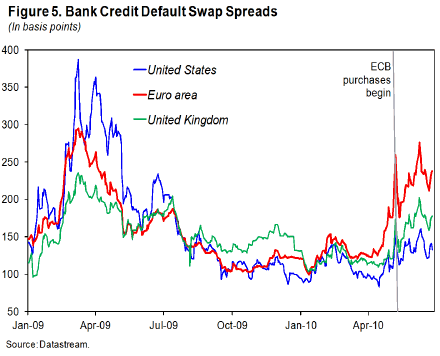
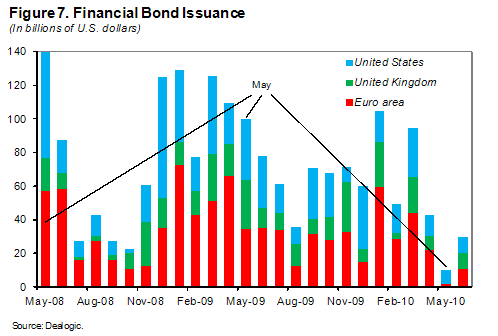
Banks are also confronted by significant funding pressures coming from maturing bonds. As was emphasized in the April 2010 GFSR, banks face a wall of maturities in the next few years, especially in the euro area, and the recent turbulence has at least temporarily dampened the primary market for financial institutions’ bond issuance

Regulatory reform efforts aimed at making the global financial system safer need to continue in an expeditious fashion. The basics of such reforms—to the quality and quantity of capital and more liquidity—need to be finalized and an appropriate timetable for implementation established. The current level of uncertainty surrounding the final set of reforms is making it difficult for banks to take business decisions about various activities and constraining their willingness to lend. Greater clarity on the details and timing of intended regulatory reforms is thus required. Moreover, the implementation schedule will need to take into account the current health of the financial institutions and the status of the economic recovery to support trend growth and enhance stability. A crucial complement to regulatory reform is strong supervision. This applies in the steady state, but even more so during the transition period when there may be variances in the implementation of the new rules between jurisdictions. Adherence to strong supervisory principles can help contain the risk of regulatory arbitrage.

Presumably, the regulators will require extra staff, and hence extra managers. Fortunately, the IMF has some very well trained and competent staff who are willing to discuss the potential for new jobs!