Category: Issue Comments

Issue Comments

IGM.PR.B Placed On CreditWatch Negative By S&P

Standard & Poor’s has announced:

  • •IGM Financial Inc. today announced that its subsidiary, Mackenzie Financial Corporation, has entered into an agreement to acquire a 10% interest in China Asset Management Co., Ltd. for approximately CAD$468 million.
  • •In our view, given that IGM may finance a significant portion of the acquisition through the issuance of debt and/or preferred shares, we would expect the company to operate with debt to EBITDA levels closer to 1.5x compared with our previous projections of 1.0x.
  • •We are placing our ‘A+/A-1+’ issuer credit ratings on IGM on CreditWatch with negative implications.
  • •The CreditWatch negative indicates that we could lower the ratings of IGM upon the close of the transaction due to higher leverage. We expect to resolve the CreditWatch once the transaction is consummated, or in the event the minority acquisition plans are called off.

S&P Global Ratings said today it placed its ‘A+/A-1+’ issuer credit ratings on IGM Financial Inc. on CreditWatch with negative implications. We also placed our ‘A+’ issue-level rating on IGM’s senior unsecured debt, ‘A-‘ issue-level rating on IGM’s preferred stock, and ‘P-1 (Low)’ Canadian national scale preferred share rating on CreditWatch negative.

As we believe, IGM intends to finance a significant portion of the acquisition through the issuance of debt and/or preferred shares, we would expect the company to operate with debt to EBITDA levels closer to 1.5x compared with our previous projections of 1.0x, and EBITDA coverage metrics between 9x and 10x compared with our previous assessment of 10x to 11x. As a result of the modest deterioration of credit protection measures, we would assess IGM’s financial risk profile to be more in line with the “modest” category compared with our previous assessment of “minimal” upon the close of the transaction. IGM does have a sizeable portfolio of investments on its balance sheet to provide additional credit protection measures beyond these metrics.

The IGM Press Release notes:

Mackenzie Investments’ interest in China AMC leverages Power Corporation of Canada’s long term presence and investment record in China which includes a 10% ownership in China AMC acquired in 2011.

The proposed transaction is expected to be accretive to IGM Financial’s earnings in the first full year of ownership. IGM Financial expects to finance the transaction with a combination of existing cash and the issuance of debt and/or preferred shares in the first half of 2017.

The transaction is expected to close in the first half of 2017, and is subject to customary closing conditions, including Chinese regulatory approvals.

Update, 2016-12-30: DBRS is more sanguine, but they’ve already got IGM a notch lower!

DBRS Limited (DBRS) today notes that it does not expect to be taking any action on IGM Financial Inc.’s (IGM) ratings following the December 29, 2016, announcement of an agreement by IGM’s subsidiary, Mackenzie Financial Corporation, to acquire a 10% interest in China Asset Management Co. Ltd (China AMC) and potentially acquire an additional 3.9% interest. The value of the acquired 10% share will be approximately $468 million.

Currently, IGM’s Issuer Rating and Unsecured Debentures rating are both A (high) and its First Preferred Shares rating is Pfd-2 (high). All trends are Stable.

Issue Comments

BK.PR.A To Get Bigger

p>Quadravest has announced:

Canadian Banc Corp. (the “Company”) is pleased to announce it has filed a preliminary short form prospectus with respect to an additional offering of its Preferred Shares. This offering is being led by National Bank Financial Inc.

The Preferred Shares are listed and posted for trading on the Toronto Stock Exchange (the “TSX”) under the symbol “BK.PR.A”. On December 21, 2016 the closing price of the Preferred Shares on the TSX was $10.56.

The authorized capital of the Company also consists of Class A Shares (the “Class A Shares”). On December 12, 2016 the Company declared a special capital gains dividend, payable partially in cash and partially in Class A Shares, to holders of Class A Shares of record on January 5, 2017. The special dividend will be payable on January 9, 2017, the same date the Preferred Shares will be issued under the short form prospectus. The number of Class A Shares being issued as a result of this special dividend will be equal to the number of Preferred Shares expected to be issued in the offering.

A copy of the preliminary short form prospectus will be available from National Bank Financial Inc.

BK.PR.A is tracked by HIMIPref™ but is relegated to the Scraps subindex on both volume and credit concerns.

Update, 2017-1-15: Just a few more shares:

Canadian Banc Corp. (the “Company”) is pleased to announce it has completed its Offering of 393,602 Preferred Shares at $10.35 per share for aggregate gross proceeds of $4,073,781. The Preferred Shares will trade on the Toronto Stock Exchange under the symbol BK.PR.A.

The authorized capital of the Company also consists of Class A Shares (the “Class A Shares”). The Company declared a special capital gains dividend, payable partially in cash and partially in Class A Shares, to holders of Class A Shares of record on January 5, 2017. The number of Class A Shares being issued as a result of this special dividend will be equal to the number of Preferred Shares issued in this offering.

Issue Comments

BCE.PR.K / BCE.PR.L: 9% Conversion to FloatingReset

BCE Inc. has announced:

that 2,254,079 of its 25,000,000 fixed-rate Cumulative Redeemable First Preferred Shares, Series AK (Series AK Preferred Shares) have been tendered for conversion on December 31, 2016, on a one-for-one basis, into floating-rate Cumulative Redeemable First Preferred Shares, Series AL (Series AL Preferred Shares). Consequently, BCE will issue 2,254,079 new Series AL Preferred Shares as of December 31, 2016.

The remaining Series AK Preferred Shares will continue to be listed on the Toronto Stock Exchange under the symbol BCE.PR.K. The Series AK Preferred Shares will pay on a quarterly basis, for the five-year period beginning on December 31, 2016, as and when declared by the Board of Directors of BCE, a fixed quarterly cash dividend based on an annual dividend rate of 2.954%.

The Series AL Preferred Shares will pay for each quarterly period beginning with the quarterly period from and including December 31, 2016 up to but excluding March 31, 2017, as and when declared by the Board of Directors of BCE, a quarterly floating cash dividend based on the T-Bill Rate for such quarterly period plus 1.88%, calculated in accordance with the articles of BCE. The floating dividend rate applicable to the Series AL Preferred Shares for the quarterly period beginning on December 31, 2016 is 0.58907% (annual rate of 2.389% based on an initial T-Bill Rate of 0.509%). The Series AL Preferred Shares will be listed on the Toronto Stock Exchange under the symbol BCE.PR.L and will start trading on January 3, 2017.

It will be recalled that the rate reset to 2.954% for BCE.PR.K was announced on December 1 and that I recommended that holders of BCE.PR.K not convert.

Issue Comments

SLF.PR.I: No Conversion to FloatingReset

Sun Life Financial Inc. has announced

that after having taken into account all election notices received by the December 16, 2016 deadline for the conversion of its Class A Non-Cumulative Rate Reset Preferred Shares Series 12R (the “Series 12R Shares”) into Class A Non-Cumulative Floating Rate Preferred Shares Series 13QR (the “Series 13QR Shares”), there were 832,321 Series 12R Shares tendered for conversion, which is less than the one million shares required to give effect to conversions into Series 13QR Shares, meaning there will be no conversion of Series 12R Shares into Series 13QR Shares.

For the five-year period commencing on December 31, 2016 to but excluding December 31, 2021, holders of the Series 12R Shares will be entitled to receive non-cumulative preferential cash dividends on a quarterly basis, as and when declared by the Board of Directors of Sun Life Financial and subject to the Insurance Companies Act (Canada), based on an annual dividend rate of 3.806% per annum or $0.237875 per share per quarter, being equal to the sum of the 5-year Government of Canada Yield, as defined in the terms of the Series 12R Shares, on Thursday, December 1, 2016 plus 2.73%, as determined in accordance with the terms of those shares.

Subject to regulatory approval, Sun Life Financial may redeem the Series 12R Shares in whole or in part on December 31, 2021 and on the 31st of December every five years thereafter by the payment of an amount for each share so redeemed of $25.00, together with all declared and unpaid dividends to the date fixed for such redemption.

It will be recalled that the extension of SLF.PR.I was announced in November; the rate reset to 3.806% was announced on December 1 and I recommended holders not convert on December 9.

Issue Comments

TA Proposes Sleazy Exchange Offer

TransAlta Corporation has announced:

that its Board of Directors has approved a transaction pursuant to which all the currently outstanding first preferred shares in the capital of the Corporation are proposed to be exchanged for shares in a single new series of cumulative redeemable minimum rate reset first preferred shares, series 1, in the capital of the Corporation (the “New Preferred Shares”) pursuant to a plan of arrangement (the “Arrangement”). The terms of the New Preferred Shares will be substantially the same as the terms of the existing first preferred shares with the exception of an adjustment to the reset spread to 5.29%, a change to December 31, 2021 for the next reset date, and the addition of a minimum reset coupon rate of 6.5%.

The Corporation currently has four series of cumulative redeemable rate reset first preferred shares outstanding, being the series A shares, series C shares, series E shares and series G shares, and one series of cumulative redeemable floating rate first preferred shares outstanding, being the series B shares (collectively, the “Existing Preferred Shares”). Pursuant to the Arrangement, the outstanding Existing Preferred Shares will be exchanged for New Preferred Shares at an exchange ratio specific to each series of Existing Preferred Shares.

The Arrangement is expected to provide several benefits to holders of Existing Preferred Shares including:

  • dividend volatility will be minimized as a result of the downside protection provided under the terms of the New Preferred Shares, which will include a “minimum floor” mechanism pursuant to which holders of the New Preferred Shares will have certainty that the reset coupon rate will be no lower than 6.50%;
  • the dividends to be paid to holders of the New Preferred Shares are expected to be greater than the current dividends received by holders of the Existing Preferred Shares over the initial five-year reset period based on current interest rate levels;
  • trading liquidity is expected to be enhanced, as the consolidation of the Existing Preferred Shares into one series of New Preferred Shares is expected to provide holders of New Preferred Shares with more flexibility and depth in the market to buy and sell such New Preferred Shares; and
  • the exchange of Existing Preferred Shares for New Preferred Shares will constitute an automatic tax deferred exchange for Canadian income tax purposes. The Arrangement will, however, provide holders of Existing Preferred Shares with an option, at their election, to have the exchange occur in a manner which may allow a shareholder to realize a capital gain or a capital loss for Canadian income tax purposes.

The Arrangement is also expected to benefit TransAlta by:

    reducing the Corporation’s notional capital balance of preferred shares by approximately $300 million, which strengthens the balance sheet and improves certain financial ratios; and

  • providing future preferred share issuance capacity based on the equity treatment guidelines of the Corporation’s credit rating agencies.

Pursuant to the Arrangement, (i) holders of series A shares will receive 0.503 of a New Preferred Share; (ii) holders of series B shares will receive 0.550 of a New Preferred Share; (iii) holders of series C shares will receive 0.705 of a New Preferred Share; (iv) holders of series E shares will receive 0.790 of a New Preferred Share; and (v) holders of series G shares will receive 0.820 of a New Preferred Share. The New Preferred Shares will pay fixed cumulative dividends of $1.625 per share per annum, yielding 6.5% per annum, payable on the last business day of March, June, September and December of each year, as and when declared by the Board of Directors of TransAlta. The dividend rate will be reset on December 31, 2021 and every five years thereafter at a rate equal to the sum of the then five-year Government of Canada bond yield and 5.29%, provided that, in any event, such calculated rate shall not be less than 6.50%. The New Preferred Shares will be redeemable by TransAlta, at its option, on December 31, 2021 and on December 31 in every fifth year thereafter.

The Corporation will deliver an information circular, describing the proposed Arrangement in greater detail, to holders of Existing Preferred Shares entitled to vote in connection with the Arrangement, with a view to completing the Arrangement in the first quarter of 2017. Holders of Existing Preferred Shares are encouraged to review the information circular as it includes important information pertaining to the Arrangement.

The closing of the Arrangement will be subject to various conditions to be set out in the information circular, including: (i) the approval of not less than two-thirds of the votes cast in person or by proxy at a special meeting of holders of each series of Existing Preferred Shares; (ii) approval of the Arrangement by the Court of Queen’s Bench of Alberta; and (iii) any required regulatory approvals, including the listing of the New Preferred Shares on the Toronto Stock Exchange.

PricewaterhouseCoopers LLP has provided its fairness opinion that the Arrangement is fair, from a financial point of view, to holders of each series of Existing Preferred Shares. Based on the fairness opinion and after consulting with its financial and legal advisors, among other considerations, the Board of Directors of the Corporation (i) has unanimously determined that the Arrangement is in the best interests of the Corporation; (ii) has unanimously determined that the Arrangement is fair to the holders of each series of Existing Preferred Shares; and (iii) recommends that holders of each series of Existing Preferred Shares vote in favour of the Arrangement. In connection with the Arrangement, CIBC World Markets Inc. acted as the financial advisor to the Corporation and Norton Rose Fulbright Canada LLP acted as legal counsel to the Corporation.

DBRS has assigned the new issue a provisional Pfd-3 Trend-Negative rating.

The market seemed to like the proposed exchange, with TA preferred issues jumping in price:

Ticker Bid
12/16
Bid
12/19
Change Implied
New Issue
Price
TA.PR.D 11.91 12.26 +2.94% 24.37
TA.PR.E 11.40 13.00 +14.04% 23.63
TA.PR.F 15.59 17.05 +9.36% 24.18
TA.PR.H 16.97 19.07 +12.37% 24.14
TA.PR.J 18.07 19.70 +9.02% 24.02

So it looks as if prices instantly adjusted on the day to reflect a $25 trading price for the new issue, less a deal-risk discount of about 4%. So far, this is normal and unobjectionable.

The objectionable part of this plan becomes clear once we start looking at the Implied Volatility of the FixedResets. One thing is very clear: given the higher coupon on the new issue, it may be expected to trade at a much higher price than the issues it replaces – regardless of the exact level, it will also be clear that there is therefore much less potential upside (if spreads narrow), if any, before the issue gets called, while the downside (if spreads should widen) is more or less the same. Normally, as is formally explained by the theory of Implied Volatility, the reduced chance of an upside win is offset by a higher yield, which will result in increased income if spreads remain stagnant.

This deal takes away that upside, without compensation.

For instance lets look at the Implied Volatility of the TA series of FixedResets as of last Friday:

impvol_ta_161216
Click for Big

The curve has been fit using the four extant FixedReset issues only (TA.PR.E is a FloatingReset). We can see that in order to be consistent with four extant issues, the new issue should yield about 7.5%, whereas in fact it only yields about 6.5%. In this model, the fair price for the new issue is about 21.69 and purchasers of the TA shares at the new level are going to be awfully disappointed.

It may certainly be objected that the derived level of Implied Volatility in the above analysis is unwarrantably high at 25% and I have certainly not been shy about stating in the past that I consider a reasonable value to be in the high single digits. So let’s re-run the analysis, constraining Implied Volatility to be 10%. We get:

impvol_ta_161216_constrained
Click for Big

Even with this constraint, we see that in order to be consistent with Friday’s closing bids for the extant issues the new issue should offer a yield of just under 7.0% – compared to the 6.5% actually offered – which in turn implies that the free trading price of the new issue is predicted to be about 23.30 … again, purchasers of the TA shares at the new level are going to be disappointed.

Finally, we can look at the Implied Volatility analysis with end of day prices. Obviously, as shown in the table above, there was a very large move in the prices of these issues. This happened very quickly as illustrated in the day’s chart for TA.PR.H:

taprh_161219
Click for Big

… and the day’s action has changed the Implied Volatility analysis to:

impvol_ta_161219
Click for Big

It is only in this analysis that we may conclude that the new issue is well-priced, as the theoretical yield for consistency is only 6.35% compared to the actual offer of 6.50%.

All of this analysis leads to the conclusion that this is a rotten deal for the preferred shareholders, so rotten that we may call it a sleazy attempt by the company to pull the wool over the eyes of unsophisticated retail investors. As the company admits, they look forward to:

reducing the Corporation’s notional capital balance of preferred shares by approximately $300 million

That $300-million is money that currently can potentially be earned by the current shareholders with price increases on the extant issues; price increases that could result from an increase in the GOC-5 yield, or from straightforward spread narrowing. The company is giving up nothing – NOTHING! – in order to capture this entire amount for themselves.

But, whimpers the incompetent dork from PriceWaterhouseCoopers who signed his name to the fairness opinion, we are giving up something!

the dividends to be paid to holders of the New Preferred Shares are expected to be greater than the current dividends received by holders of the Existing Preferred Shares over the initial five-year reset period based on current interest rate levels.

Sure, based on current interest rate levels. But my vast experience in fixed income has led me to the arcane knowledge that interest rate levels do not always remain constant – however convenient it might be for analysis to assume that they do – and that we should at least be aware of what happens in various scenarios. So with the aid of a handy xlsx MS-Excel spreadsheet we can draw a graph of what will happen if the GOC-5 yield changes:

totaltadividends
Click for Big

Yes, that’s right: preferred shareholders will get a little extra income after the Exchange for as long as the GOC-5 yield is under 2%. Once they rise above that, though, the Exchange makes them worse off. There is no compensation in this deal for the reduction of potential income in the event that yields rise. Whether yields rise in the future is a matter of opinion, snivel the directors who claim this is fair to shareholders … but with the North American economy beginning to show signs of life, it will be very hard to find takers for bets they’ll remain constant when these bets are presented straightforwardly and honestly.

So, to put things in a nutshell, Transalta wants to eliminate (more or less) potential capital gains should spreads narrow in the future, and reduce potential income increases should GOC-5 yields increase in the future; all this for a very, very tiny increase in current income. Hell, why not send them the deed to your house and car, while you’re at it?

This is a shitty deal for shareholders. Vote No. I will note that as a matter of practicalities, the idea of selling into this stupidly inflated market and becoming indifferent to how this abusive deal turns out is also quite attractive.

Update, 2016-12-24 I was perplexed by a comment on Financial Wisdom Forum:

More on the TransAlta exchange.

http://business.financialpost.com/news/ … picks=true

FWIW, I am quite satisfied with the offer because I’m a trader and am more than happy to bail on these PF-3 issues because I really believe that one would have to be wearing super sized rose coloured glasses to think that they would someday trade or be redeemed at par, especially with a company like TA that has slashed the dividend on the common to 4 cents/quarter.

The case for the “No” vote does not depend on the hope that the shares will “someday trade or be redeemed at par”, and demonstrating this should actually make the argument more clear for those who have difficulty with the concept of Implied Volatility.

Let us examine the specific case of TA.PR.D; the following analysis framework may be applied to the other series with changes in numbers.

TA.PR.D:

  • pays $0.67725 p.a. until the next Exchange Date
  • will reset to GOC-5 + 203bp (paid on par value of $25) on each Exchange Date
    • This is equal to (25 * GOC-5) + (25 * 203bp)
    • which is equal to (25 * GOC-5) + $0.5075
  • may be redeemed at $25 on each Exchange Date
  • Exchange Dates are 2021-3-31 and every five years thereafter

The company proposes to exchange each share of this for 0.503 of a New Preferred Share; each New Preferred Share will

  • Pay 6.50% of $25.00 = 1.625 until the next Exchange Date
  • will reset to GOC-5 + 529bp (paid on par value of $25) on each Exchange Date
  • may be redeemed at $25 on each Exchange Date
  • Exchange Dates are 2021-12-31 and every five years thereafter

The fact that holders will be getting only 0.503 New Preferred Shares for each share of TA.PR.D makes the changes a little more complex for many investors, so as a thought experiment, let’s design a Notional Share which we will assume will be offered 1 for 1 for TA.PR.D, with the new holdings, in total, having exactly the same characteristics as the proposed new holdings of the New Preferred Shares.

A Notional Preferred Share:

  • pays $0.817375 until the next Exchange Date
  • will reset to 0.503 (GOC-5 + 529bp) * 25 on each Exchange Date
    • This is equal to (0.503 * 25 * GOC-5) + (0.503 * 25 * 529bp)
    • which is equal to 12.575 * GOC-5 + $0.6652175
    • subject to a minimum rate of $0.817375
  • may be redeemed at $12.575 on each Exchange Date
  • Exchange Dates are 2021-12-31 and every five years thereafter

So when we compare the currently held TA.PR.D to the Notional Share we see that:

  • The Notional Share will pay an extra $0.14 annually for each of the next five years (approximately), for a total of $0.70.
  • The redemption price will drop from $25 to $12.575
  • The dividends after the next Exchange Date (if it is left outstanding) will depend on the GOC-5 yield, as indicated on the following chart
taprd_notional_dividendsafterreset_rev1
Click for Big

The big problem, of course, is the change in redemption price – holders lose out on a lot of potential capital gains if the market improves, either through increases in the GOC-5 yield (which should increase the trading price of the preferreds) or through a narrowing of spreads (which may occur because the market improves, or TA’s credit improves, or both). In addition, we see that increases in the GOC-5 rate greatly improve the dividend payout from TA.PR.D and the much higher redemption price means these potential increases will not be called away unless for a gigantic premium over the current price.

Issue Comments

DF.PR.A To Get Bigger

Quadravest has announced:

Dividend 15 Split Corp. II (the “Company”) is pleased to announce it has filed a preliminary short form prospectus in each of the provinces of Canada with respect to an offering of Preferred Shares and Class A Shares of the Company. The offering will be co-led by National Bank Financial Inc., CIBC, RBC Capital Markets, Scotia Capital Inc., and will also include BMO Capital Markets, TD Securities Inc., GMP Securities L.P., Canaccord Genuity Corp., Raymond James, Desjardins Securities Inc., Echelon Wealth Partners, Mackie Research Capital Corporation and Manulife Securities Incorporated.

The Preferred Shares will be offered at a price of $10.00 per Preferred Share to yield 5.25% on the issue price and the Class A Shares will be offered at a price of $7.50 per Class A Share to yield 16.00% on the issue price. The closing price on the TSX of each of the Preferred Shares and the Class A Shares on December 12, 2016 was $10.31 and $7.75, respectively.

Since inception of the Company, the aggregate dividends paid on the Preferred Shares have been $10.90 per share and the aggregate dividends paid on the Class A Shares have been $5.27 per share, for a combined total of $16.17 unit. All distributions to date have been made in tax advantage eligible Canadian dividends or capital gains dividends.

The net proceeds of the offering will be used by the Company to invest in an actively managed portfolio of dividend yielding common shares which includes each of the 15 Canadian companies listed below:

Bank of Montreal Enbridge Inc. TELUS Corporation
The Bank of Nova Scotia Manulife Financial Corp. Thomson‐Reuters Corporation
BCE Inc. National Bank of Canada The Toronto‐Dominion Bank
Canadian Imperial Bank of Commerce Royal Bank of Canada TransAlta Corporation
CI Financial Corp. Sun Life Financial Inc. TransCanada Corporation

The Company’s investment objectives are:

Preferred Shares:
i. to provide holders of the Preferred Shares with fixed, cumulative preferential monthly cash dividends in the amount of $0.04375 per Preferred Share to yield 5.25% per annum on the original issue price; and
ii. on or about December 1, 2019, to pay the holders of the Preferred Shares the original issue price of those shares.

Class A Shares:
i. to provide holders of the Class A Shares with regular monthly cash dividends currently targeted to be $0.10 per Class A; and
ii. on or about December 1, 2019, to pay the holders of Class A Shares at least the original issue price of those shares.

The sales period of this overnight offering will end at 9:00 a.m. (EST) on December 14, 2016.

Update, 2016-12-15: Quadravest has announced:

Dividend 15 Split Corp. II (the “Company”) is pleased to announce it has completed the overnight marketing of up to 2,290,000 Preferred Shares and up to 2,290,000 Class A Shares of the Company. Total proceeds of the offering are expected to be approximately $40.1 million. The offering is being co-led by National Bank Financial Inc., CIBC, RBC Capital Markets, Scotia Capital Inc., and also includes BMO Capital Markets, TD Securities Inc., GMP Securities L.P., Canaccord Genuity Corp., Raymond James, Desjardins Securities Inc., Echelon Wealth Partners, Mackie Research Capital Corporation and Manulife Securities Incorporated.

The sales period of the overnight offering has now ended.

The Preferred Shares will be offered at a price of $10.00 per Preferred Share to yield 5.25% on the issue price and the Class A Shares will be offered at a price of $7.50 per Class A Share to yield 16.00% on the issue price. The closing price on the TSX of each of the Preferred Shares and the Class A Shares on December 13, 2016 was $10.32 and $7.90, respectively.

Issue Comments

SLF.PR.I: Convert or Hold?

It will be recalled that SLF.PR.I will reset to 3.806% effective December 31; the extension was announced 2016-11-14.

Holders of SLF.PR.I have the option to convert to FloatingResets, which will pay 3-month bills plus 273bp on the par value of $25.00, reset quarterly. The deadline for notifying the company of the intent to convert is 5:00 p.m. (ET) on Friday, December 16, 2016.; but note that this is a company deadline and that brokers will generally set their deadlines a day or two in advance, so there’s not much time to lose if you’re planning to convert! However, if you miss the brokerage deadline they’ll probably do it on a ‘best efforts’ basis if you grovel in a sufficiently entertaining fashion. The ticker for the new FloatingReset has not yet been announced.

As this issue is from an insurer and there is no provision for conversion into common shares at the option of the issuer, I consider this to be subject to my Deemed Retraction policy; accordingly I have placed a maturity entry dated 2025-1-31 at par in the call schedule of this instrument for analytical purposes. Note that this approach is due to analysis and there is no contractual provision in the terms of issue for any such maturity. It will be noted that this does not affect the following analysis, which requires only the two issues be interconvertible and therefore equivalent five years hence.

The most logical way to analyze the question of whether or not to convert is through the theory of Preferred Pairs, for which a calculator is available. Briefly, a Strong Pair is defined as a pair of securities that can be interconverted in the future (e.g., BAM.PR.R and the FloatingReset that will exist if enough holders convert). Since they will be interconvertible on this future date, it may be assumed that they will be priced identically on this date (if they aren’t then holders will simply convert en masse to the higher-priced issue). And since they will be priced identically on a given date in the future, any current difference in price must be offset by expectations of an equal and opposite value of dividends to be received in the interim. And since the dividend rate on one element of the pair is both fixed and known, the implied average rate of the other, floating rate, instrument can be determined. Finally, we say, we may compare these average rates and take a view regarding the actual future course of that rate relative to the implied rate, which will provide us with guidance on which element of the pair is likely to outperform the other until the next interconversion date, at which time the process will be repeated.

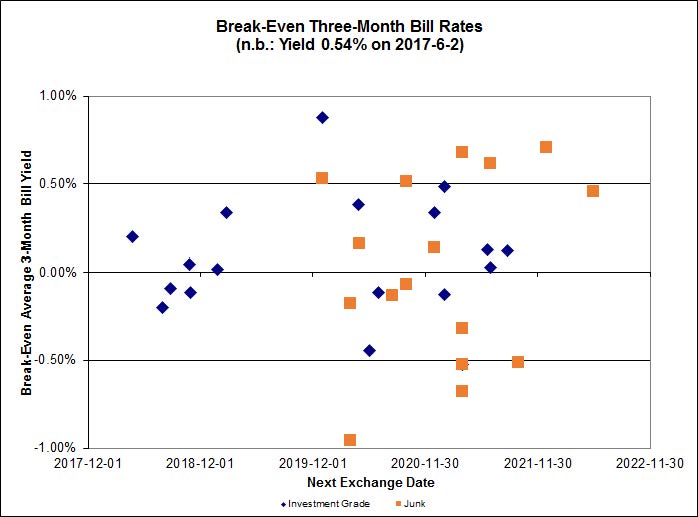
We can show the break-even rates for each FixedReset / FloatingReset Strong Pair graphically by plotting the implied average 3-month bill rate against the next Exchange Date (which is the date to which the average will be calculated).

pairs_fr_161209
Click for Big

The market appears to have a distaste at the moment for floating rate product; most of the implied rates until the next interconversion are lower than the current 3-month bill rate and the averages for investment-grade and junk issues are both well below current market rates, at -0.04% and -0.42%, respectively! Whatever might be the result of the next few Bank of Canada overnight rate decisions, I suggest that it is unlikely that the average rate over the next five years will be lower than current – but if you disagree, of course, you may interpret the data any way you like.

Since credit quality of each element of the pair is equal to the other element, it should not make any difference whether the pair examined is investment-grade or junk, although we might expect greater variation of implied rates between junk issues on grounds of lower liquidity, and this is just what we see.

If we plug in the current bid price of the SLF.PR.I FixedReset, we may construct the following table showing consistent prices for its soon-to-be-issued FloatingReset counterpart given a variety of Implied Breakeven yields consistent with issues currently trading:

Estimate of FloatingReset (received in exchange for SLF.PR.I) Trading Price In Current Conditions
  Assumed FloatingReset
Price if Implied Bill
is equal to
FixedReset Bid Price Spread +0.50% 0.00% -0.50%
SLF.PR.I 19.74 273bp 19.15 18.65 18.14

Based on current market conditions, I suggest that the FloatingResets that will result from conversion are likely to be cheap and trading below the price of their FixedReset counterparts. Therefore, I recommend that holders of SLF.PR.I continue to hold the issue and not to convert. I will note that, given the apparent cheapness of the FloatingResets, it may be a good trade to swap the FixedReset for the FloatingReset in the market once both elements of each pair are trading and you can – presumably, according to this analysis – do it with a reasonably good take-out in price, rather than doing it through the company on a 1:1 basis. But that, of course, will depend on the prices at that time and your forecast for the path of policy rates over the next five years. There are no guarantees – my recommendation is based on the assumption that current market conditions with respect to the pairs will continue until the FloatingResets commence trading and that the relative pricing of the two new pairs will reflect these conditions.
Note as well that conversion rights are dependent upon at least one million shares of each series being outstanding after giving effect to holders’ instructions; e.g., if only 100,000 shares of SLF.PR.I are tendered for conversion, then no conversions will be allowed; but if only 100,000 shares of SLF.PR.I will remain after the rest are all tendered, then conversion will be mandatory. However, this is relatively rare: all Strong Pairs have some version of this condition; there are 49 Strong Pairs outstanding; and only nine issues which did not create the potential Strong Pair.

Issue Comments

ECN.PR.A Weak on Light Volume

ECN Capital Corp. has announced:

that it has closed the previously announced offering of 4,000,000 6.50% Cumulative 5-Year Minimum Rate Reset Preferred Shares, Series A (the “Series A Preferred Shares” or the “Offering”) at a price of $25.00 per share for aggregate gross proceeds of $100,000,000. The Offering was conducted by a syndicate of underwriters led by BMO Capital Markets, CIBC World Markets, National Bank Financial, RBC Capital Markets, TD Securities, Desjardins Securities, Cormark Securities, GMP Securities, HSBC Securities (Canada) and Raymond James.

The net proceeds will be be used to originate and finance, directly and indirectly, finance assets and for general corporate purposes.

The Series A Preferred Shares will commence trading today on the Toronto Stock Exchange under the symbol “ECN.PR.A”.

The Company also filed on November 22, 2016 its interim carve-out financial statements as at and for the three and nine-month periods ended September 30, 2016, together with its amended management’s discussion and analysis of financial condition and results of operations for the same period (which non material amendments relate to non-GAAP financial measures, results of operations and related party transactions). These documents were filed on SEDAR and are incorporated by reference into the Corporation’s prospectus in connection with the Offering. For more information, please visit SEDAR at www.sedar.com.

ECN.PR.A is a FixedReset, 6.50%+544M650, announced 2016-11-23. It will be tracked by HIMIPref™ but relegated to the Scraps index on credit concerns.

The issue traded 134,385 shares today in a range of 24.30-65 before closing at 24.32-40, 3×1. Vital statistics are:

ECN.PR.A FixedReset YTW SCENARIO
Maturity Type : Limit Maturity
Maturity Date : 2046-12-02
Maturity Price : 22.91
Evaluated at bid price : 24.32
Bid-YTW : 6.67 %
Issue Comments

BCE.PR.K To Reset At 2.954%

BCE Inc. has released its Notice of Conversion Privilege for BCE.PR.K:

1. Holders of BCE Inc. fixed-rate Series AK Preferred Shares have the right to convert all or part of their shares, effective on December 31, 2016, on a one-for-one basis, into floating-rate Cumulative Redeemable First Preferred Shares, Series AL of BCE Inc. (the “Series AL Preferred Shares”). In order to convert their shares, holders must exercise their right of conversion during the conversion period, which runs from December 1, 2016 until 5:00 p.m. (Montréal/Toronto time) on December 16, 2016.

4. As of December 31, 2016, the Series AK Preferred Shares will, should they remain outstanding, pay, on a quarterly basis, as and when declared by the Board of Directors of BCE Inc., a fixed cash dividend for the following five years that will be based on a fixed rate equal to the sum of: (a) the yield to maturity compounded semi-annually (the “Government of Canada Yield”), computed on December 1, 2016 in accordance with the articles of BCE Inc., of a Canadian dollar denominated non-callable Government of Canada bond with a term to maturity of five years, and (b) 1.88%. The “Government of Canada Yield” computed on December 1, 2016 is 1.074%. Accordingly, the annual fixed dividend rate applicable to the Series AK Preferred Shares for the period of five years beginning on December 31, 2016 will be 2.954%.

5. As of December 31, 2016, the Series AL Preferred Shares, if issued, will pay, for each quarterly period beginning with the quarterly period from and including December 31, 2016 up to but excluding March 31, 2017, as and when declared by the Board of Directors of BCE Inc., a quarterly floating dividend rate equal to the “Floating Quarterly Dividend Rate” for such quarterly period. The “Floating Quarterly Dividend Rate” for any such quarterly period shall be equal to the rate, expressed as a percentage, equal to the sum of:
(a) the “T-Bill Rate”, calculated in accordance with the articles of BCE Inc. on the 30th day prior to the first day of the new quarterly period, and (b) 1.88%, calculated on the basis of the actual number of days in such quarterly period divided by 365. The “T-Bill Rate” means, for any quarterly period, the average yield expressed as a percentage per annum on three-month Government of Canada Treasury Bills, as reported by the Bank of Canada, for the most recent treasury bills auction preceding the applicable calculation date. The “Floating Quarterly Dividend Rate” computed on December 1, 2016 and applicable to the Series AL Preferred Shares for the quarterly period beginning on December 31, 2016 will be 0.58907% (annual rate of 2.389%, based on an initial T-Bill Rate of 0.509%).

BCE.PR.K is a FixedReset, 4.15%+188, that commenced trading 2011-7-5 after being announced 2011-6-20. The issue is notorious for having been to subject of an experiment by BCE to see if stockbrokers and their clients were really as dumb as all that; this was tested by reopening the issue when the spread was nowhere near market rates. The experiment concluded that giving the salesmen a 3% commission on sales to retail is a great business, at which point the experimenters sent another letter to the OSC decrying trailer fees on mutual funds and collapsed in giggles.

I will make a recommendation regarding whether this issue should be converted or held in the near future.

Issue Comments

SLF.PR.I To Reset At 3.806%

Sun Life Financial Inc. has announced (although not yet on their website because they’re morons):

the dividend rates for its Class A Non-Cumulative Rate Reset Preferred Shares Series 12R (the “Series 12R Shares”) and Class A Non-Cumulative Floating Rate Preferred Shares Series 13QR (the “Series 13QR Shares”).

With respect to any Series 12R Shares that remain outstanding after December 31, 2016, commencing as of that date, holders thereof will be entitled to receive non-cumulative preferential cash dividends on a quarterly basis, as and when declared by the Board of Directors of Sun Life Financial and subject to the Insurance Companies Act (Canada). The dividend rate for the five-year period commencing on December 31, 2016 to but excluding December 31, 2021 will be 3.806% per annum or $0.237875 per share per quarter, being equal to the sum of the five year Government of Canada Yield, as defined in the terms of the Series 12R Shares, on Thursday, December 1, 2016 plus 2.73%, as determined in accordance with the terms of the Series 12R Shares.

With respect to any Series 13QR Shares that are issued on December 31, 2016, holders thereof will be entitled to receive floating rate non-cumulative preferential cash dividends on a quarterly basis, as and when declared by the Board of Directors of Sun Life Financial and subject to the Insurance Companies Act (Canada), based on a dividend rate equal to the sum of the three month T-Bill Rate, as defined in the terms of the Series 13QR Shares, plus 2.73% (calculated on the basis of the actual number of days elapsed in such Quarterly Floating Rate Period divided by 365 days), subject to certain adjustments in accordance with the terms of the Series 13QR Shares. The dividend rate for the period commencing on December 31, 2016 to but excluding March 31, 2017 will be equal to 3.239% per annum or $0.199664 per share, as determined in accordance with the terms of the Series 13QR Shares.

Beneficial owners of Series 12R Shares who wish to exercise the right of conversion applicable to those shares should communicate as soon as possible with their broker or other nominee and should ensure that their instructions are followed in order to meet the deadline to exercise such right of conversion, which is 5:00 p.m. (ET) on Friday, December 16, 2016.

An application will be made to list the Series 13QR Shares on the Toronto Stock Exchange.

The term extension for SLF.PR.I was previously reported on PrefBlog. I will make a recommendation regarding holding or converting the shares in the near future.