Category: Issue Comments

Issue Comments

BAM.PF.I Holds Its Own On Excellent Volume

Brookfield Asset Management Inc. has announced:

the completion of its previously announced Class A Preference Shares, Series 46 issue in the amount of C$300,000,000. The offering was underwritten on a bought deal basis by a syndicate led by TD Securities Inc. and Scotiabank.

The Preferred Shares, Series 46 were issued at a price of C$25.00 per share, for gross proceeds of C$300,000,000. Holders of the Series 46 Shares will be entitled to receive a cumulative quarterly fixed dividend yielding 4.80% annually for the initial period ending March 31, 2022. Thereafter, the dividend rate will be reset every five years at a rate equal to the greater of: (i) the 5-year Government of Canada bond yield plus 3.85%, and (ii) 4.80%. The Series 44 Shares will commence trading on the Toronto Stock Exchange this morning under the ticker symbol BAM.PF.I. The Preferred Shares, Series 46 may not be offered or sold in the United States or to U.S. persons absent registration or an applicable exemption from the registration requirements under the U.S. Securities Act.

BAM.PF.I is a FixedReset, 4.80%+385M480 announced November 10. It will be tracked by HIMIPref™ and has been assigned to the FixedReset subindex.

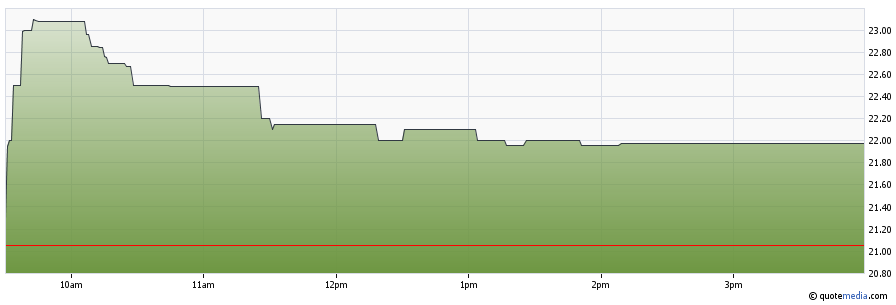
BAM.PF.I traded a very good 1,374,591 shares today in a range of 24.85-00 before closing at 24.95-96, 85×1. Vital statistics are:

BAM.PF.I FixedReset YTW SCENARIO
Maturity Type : Limit Maturity
Maturity Date : 2046-11-18
Maturity Price : 23.12
Evaluated at bid price : 24.95
Bid-YTW : 4.72 %

An Implied Volatility analysis yields ambiguous results:

impVol_BAM_161118
Click for Big

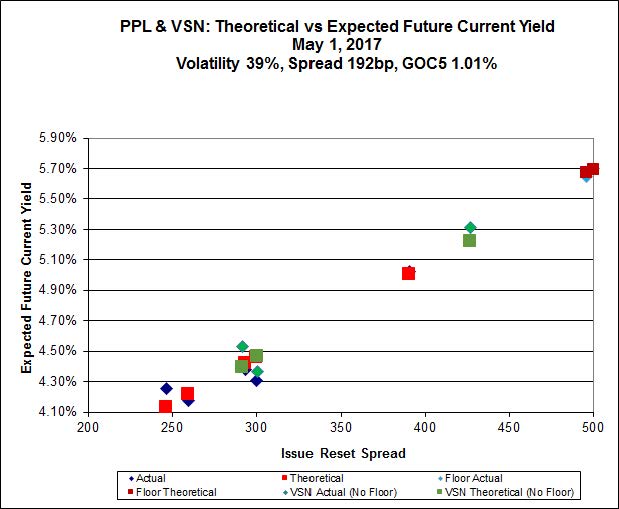
While BAM.PF.I looks a little expensive in this analysis (with a theoretical price of 24.58), it must be remembered that
i) the fit is very messy
ii) the analysis makes no accounting for the reset floor

Issue Comments

RON.PR.A, RON.PR.B To Be Redeemed At $24.00

RONA Inc. has announced (although not yet on its website):

that the holders (collectively, the “Preferred Shareholders”) of record of its Cumulative 5-Year Rate Reset Series 6 Class A Preferred Shares and Cumulative Floating Rate Series 7 Class A Preferred Shares (collectively, the “Preferred Shares”) have approved the statutory plan of arrangement for the acquisition of the Preferred Shares by Gestion Lowe’s Canada, Inc., a wholly-owned subsidiary of Lowe’s Companies, Inc., for C$24 per Preferred Share, in cash, at the special meeting held today pursuant to the arrangement agreement dated Oct. 6, 2016 (the “Arrangement”).

The Arrangement was approved by 95.19% of the votes cast by the Preferred Shareholders present in person or represented by proxy at the special meeting.

The completion of the Arrangement remains subject to the granting of the final order by the Québec Superior Court and the satisfaction or waiver of the other customary closing conditions. If court approval is obtained and the other conditions to the completion of the Arrangement are satisfied or waived, RONA expects that the Arrangement will be completed on or about Nov. 18, 2016.

RON.PR.A and RON.PR.B have provided great entertainment this year and were last mentioned on PrefBlog when the Plan of Arrangement was proposed in early October.

Issue Comments

AIM: S&P Revises Outlook To Negative

Standard & Poor’s has announced:

  • •We are revising our outlook on Montreal-based Aimia Inc. to negative from stable and affirming our ratings on the company, including our ‘BBB-‘ long-term corporate credit rating.
  • •In our opinion, Aimia’s competitive position has deteriorated based on the prospect of lower growth, which contributes to a weaker assessment of Aimia’s business profile and tighter leverage threshold to maintain the investment-grade rating.
  • •We estimate the company will generate adjusted debt-to-EBITDA of 2.6x-2.8x at the end of this year, which we consider high for the rating given our revised view of the business.
  • •The negative outlook reflects our uncertainty about the company’s ability to sustain adjusted debt-to-EBITDA of about 2x beyond 2018.


“The outlook revision reflects our view that Aimia’s competitive position has deteriorated based on lower growth prospects,” said S&P Global Ratings credit analyst Alessio Di Francesco.

This contributes to a weaker assessment of Aimia’s business risk profile and a tighter leverage threshold to maintain the investment-grade rating.

In our opinion, Aimia’s growth outside of Canada should remain subdued from competitive pressures and challenging economic conditions. As such, we believe the Aeroplan program will continue to be the main driver of free cash flow for the company in the future. Although we expect positive gross billings growth and improved profitability within the program in the next couple of years, we believe EBITDA growth is below what we had previously expected. Moreover, Aimia’s commercial partnership services agreement with Air Canada expires in 2020, and we believe the renegotiation may expose the company to higher costs, lower margins, and conceivably weaker engagement. On the other hand, a new agreement could add new avenues for redemption and engagement.

We could lower the rating by the end of 2018 if adjusted debt-to-EBITDA does not improve to about 2x, in line with our base-case forecast. This could occur if we expect gross billings or EBITDA margins to decline at Aeroplan or if an increase in distributions contributes to negative discretionary cash flow.

We could revise the outlook to stable within the next 24 months if adjusted debt-to-EBITDA improves in line with our expectations and we believe the company will sustain leverage of about 2.0x beyond 2018.

Issues affected are AIM.PR.A, AIM.PR.B and AIM.PR.C.

Issue Comments

FBS.PR.C Upgraded To Pfd-2(high) by DBRS

DBRS has announced that it:

has today upgraded the rating of Class C Preferred Shares, Series 1 (the Preferred Shares) issued by 5Banc Split Inc. (the Company) to Pfd-2 (high).

As of November 3, 2016, the downside protection was approximately 72%. Based on the dividend yield on the underlying Portfolio holdings as of November 3, 2016, the Preferred Share dividend coverage ratio was approximately 2.5 times (x). The Company’s excess dividends, net of all expenses, may be distributed to the holders of the Capital Shares.

FBS.PR.C is tracked by HIMIPref™, but is relegated to the Scraps subindex on volume concerns. More information can be obtained via the company’s page maintained by its sponsor. With slightly less than 1.1-million Units outstanding, the fund is too small for investment on an active basis, but I track it anyway. The issue was last mentioned on PrefBlog when Timbercreek took over sponsorship of the fund.

Issue Comments

BIG.PR.D Upgraded To Pfd-2 by DBRS

DBRS has announced that it:

) has today upgraded the rating of Class D Preferred Shares, Series 1 (the Preferred Shares) issued by Big 8 Split Inc. (the Company) to Pfd-2 from Pfd-2 (low).

Dividends received from the Portfolio are used to pay fixed cumulative quarterly distributions to holders of the Preferred Shares, yielding 4.50% per annum on the initial issue price of $10.00. The Capital Shares receive excess dividend income after the Preferred Share distributions and other Company expenses have been paid. Based on the current dividend yield on the Portfolio, the Preferred Share dividend coverage ratio is approximately 1.8 times, and as such there is no grind on the portfolio. In order to generate additional returns, the Company has the ability to engage in securities lending.

Downside protection available to the Preferred Shares consists of the net asset value of the Capital Shares. As of November 3, 2016, the downside protection was approximately 58.9%.

BIG.PR.D is not tracked by HIMIPref™, but more information can be obtained via the company’s page maintained by its sponsor. With slightly less than 1.2-million Units outstanding, the fund is simply too small for investment on an active basis. The issue was last mentioned on PrefBlog when Timbercreek took over sponsorship of the fund.

Issue Comments

BPO: DBRS Confirms At Pfd-3

DBRS has announced that it:

has today confirmed Brookfield Office Properties Inc.’s (BPO or the Company) Senior Unsecured Notes (the Notes) rating at BBB and Cumulative Redeemable Preferred Shares, Class AAA rating at Pfd-3, both with Stable trends. This rating action removes the ratings from Under Review with Developing Implications.

In July 2016, BPY completed an internal restructuring to consolidate the ownership of its core retail and office assets within the United States by transferring to a subsidiary of BPO its core retail investments (the Transaction).

In DBRS’s view, the Transaction modestly improves BPO’s business risk assessment by increasing the size and scale of the Company’s real estate investments, which complement asset quality and diversification by asset type, partially offset by geographic concentration in the United States. DBRS estimates annual EBITDA will increase to $1.7 billion from $1.0 billion on a pro forma basis in Q1 2016. DBRS also believes the core retail investments complement the quality of BPO’s office assets and will provide a stable and diverse source of cash flow for the Company.

The Transaction also has a modestly positive impact on BPO’s financial risk assessment by improving key financial metrics. DBRS estimates an improvement in BPO’s EBITDA interest coverage (including capitalized interest) to 1.72 times (x) from 1.59x and debt-to-EBITDA to 13.5x from 14.2x, respectively.

With the improvement of EBITDA interest coverage (including capitalized interest) to levels above 1.70x, BPO has met DBRS’s 12-month expectation. DBRS expects BPO to improve this key metric above 2.00x and its fixed-charge coverage to 1.75x over the longer term, which is more consistent with the current rating category.

The core retail investments are held by various entities that now structurally sit in between BPO and its key U.S. operating assets. Three of these entities (the BPO Co-Borrowers), along with certain subsidiaries of BPY, are co-borrowers of a $2.5 billion external credit facility (the Credit Facility). While the BPO Co-Borrowers have not yet drawn on the Credit Facility (currently, $1.14 billion has been drawn by the other co-borrowers), the Credit Facility’s agreement states that all borrowers (including the BPO Co-Borrowers) are jointly and severally liable for any amounts drawn. As such, the Notes are structurally subordinated (see the discussion on structural subordination below) to the lenders of the Credit Facility. DBRS has also assumed the Credit Facility is fully drawn and included this amount in its calculation of BPO’s key financial metrics.

STRUCTURAL SUBORDINATION
As discussed above, the BPO Co-Borrowers are jointly and severally liable for any amounts drawn from the Credit Facility. The transfer of the core retail investments to a subsidiary of BPO has structurally placed the lenders of the Credit Facility closer to BPO’s key U.S. operating subsidiaries relative to the holders of BPO’s Notes. As such, the lenders of the Credit Facility now rank ahead of BPO’s Noteholders in their claim to the cash flow and assets of the Company’s key U.S. operating subsidiaries and core retail investment in an event of default scenario.

DBRS has not lowered the rating of the Notes by one notch, as DBRS believes the issue of subordination is mitigated by several credit-enhancing factors. These factors are as follows: (1) The core retail investment is self-sustaining and generates more-than-sufficient cash flow to fund its own capital requirements and any amounts drawn on the Credit Facility. (2) The core retail investment has added significant asset value ($9.1 billion) relative to the debt incurred by BPO. (3) BPO will benefit from substantial distributions from the core retail investment. (4) BPO’s operating subsidiaries and investments (excluding the core retail investment and key U.S. operating subsidiaries) will continue to provide an adequate source of cash flow distributions as well as account for a significant proportion of the Company’s assets.

DBRS notes, however, that any material deterioration in the credit quality of the core retail investment (e.g., caused by an increase in debt and/or reduced cash flow) or any material increase in subordination could result in the reduced effectiveness of the above-noted mitigating factors. In such an event, a one-notch downgrade of BPO’s ratings would be warranted.

The November 1, 2016 announcement of a continued review was reported on PrefBlog.

Affected issues are: BPO.PR.A, BPO.PR.C, BPO.PR.J, BPO.PR.K, BPO.PR.N, BPO.PR.P, BPO.PR.R, BPO.PR.S, BPO.PR.T, BPO.PR.W, BPO.PR.X and BPO.PR.Y.

Issue Comments

DBRS: BPO Remains on 'Review-Developing'

DBRS has announced that it:

has today maintained its status of Under Review with Developing Implications on the ratings of Brookfield Office Properties Inc.’s (BPO or the Company) Senior Unsecured Notes and Cumulative Redeemable Preferred Shares, Class AAA (the Preferred Shares). The Under Review with Developing Implications status reflects the completion of the review of the downstream guarantees provided by Brookfield Property Partners LP (BPY) and its other related entities to BPO’s Senior Unsecured Notes and Preferred Shares (the downstream guarantees) and BPO’s recent internal restructuring. DBRS had originally placed the ratings on Under Review status on August 3, 2016, following the announcement of the downstream guarantees.

DBRS reviewed the downstream guarantee documents for BPO’s Senior Unsecured Notes and the Preferred Shares against the “DBRS Criteria: Guarantees and Other Forms of Support” (February 2016) and all of DBRS’s guarantee criteria were met. DBRS concluded the downstream guarantees provided by BPY; other related entities of BPY and BPY’s credit risk profile do not have any credit implications for the ratings of BPO’s Senior Unsecured Debentures and the Preferred Shares.

In July 2016, BPY completed an internal restructure to consolidate the ownership of its core retail and core office assets within the United States by transferring to a subsidiary of BPO its core retail investments, valued at approximately USD 9.1 billion. These core retail investments structurally sit in between BPO and its key U.S. operating assets.

The resolution of the Under Review status will be based on DBRS’s review of the above-referenced transaction and its impact on BPO. DBRS will focus on: (1) the Company’s business risk profile, assessing the potential benefits to asset quality, size and scale and asset type diversification; (2) the Company’s financial risk profile on a pro forma basis; (3) the potential for structural subordination of BPO’s Senior Unsecured Notes; and (4) legal review of executed documents.

DBRS aims to resolve the Under Review status within the next several weeks.

The original announcement of the review was reported on PrefBlog.

Affected issues are: BPO.PR.A, BPO.PR.C, BPO.PR.J, BPO.PR.K, BPO.PR.N, BPO.PR.P, BPO.PR.R, BPO.PR.S, BPO.PR.T, BPO.PR.W, BPO.PR.X and BPO.PR.Y.

Issue Comments

BMO.PR.B Soars To Premium On Awesome Volume

Bank of Montreal has announced (although not yet on their website):

it has closed its domestic public offering of Non-Cumulative 5-Year Rate Reset Class B Preferred Shares Series 38 (the “Preferred Shares Series 38”). The offering was underwritten on a bought deal basis by a syndicate of underwriters led by BMO Capital Markets. Bank of Montreal issued 24 million Preferred Shares Series 38 at a price of $25 per share to raise gross proceeds of $600 million.

The Preferred Shares Series 38 were issued under a prospectus supplement dated October 14, 2016, to the Bank’s short form base shelf prospectus dated April 13, 2016. Such shares will commence trading on the Toronto Stock Exchange today under the ticker symbol BMO.PR.B.

BMO.PR.B is a FixedReset, 4.85%+406, NVCC-compliant issue announced October 14. It will be tracked by HIMIPref™ and assigned to the FixedResets subindex.

The issue traded a staggering 4,330,078 shares in a range of 25.69-82 before closing at 25.69-70, 27×87. The volume ranks it sixth in my database (over 1-million records dating back to 1993-12-31), just behind NVA.PR.A (Nova Energy), which traded 4.4-million shares on 1997-3-24 (shortly after issue) and the highest single-issue daily volume since GWO.PR.E, which traded 5.3-million shares on 1999-3-18 (also shortly after issue). So, this is the highest single-issue daily volume so far this century.

Vital statistics are:

BMO.PR.B FixedReset YTW SCENARIO
Maturity Type : Call
Maturity Date : 2022-02-25
Maturity Price : 25.00
Evaluated at bid price : 25.69
Bid-YTW : 4.29 %

As has often been the case lately, Implied Volatility analysis results in a chart that can be interpreted in two ways:

impVol_BMO_161021
Click for Big

The curve fits very well, with a very high Implied Volatility. If one takes the view that GOC-5 rates will increase dramatically over the next few years, the low-spread, low-price issues will be preferred (as this will lead to capital gains on these issues, but not the new one since the call provision caps the expected price); if one takes the view that the current GOC yield curve represents the new normal, then the new issue will be preferred (as one will then expect Implied Volatility to decrease, flattening the fitted curve, resulting in capital losses for the low-spread issues).

Issue Comments

MFC.PR.G To Be Extended

Manulife Financial Corporation has announced:

that it does not intend to exercise its right to redeem all or any of its currently outstanding 8,000,000 Non-cumulative Rate Reset Class 1 Shares Series 5 (the “Series 5 Preferred Shares”) (TSX: MFC.PR.G) on December 19, 2016. As a result, subject to certain conditions described in the prospectus supplement dated November 29, 2011 relating to the issuance of the Series 5 Preferred Shares (the “Prospectus”), the holders of the Series 5 Preferred Shares have the right, at their option, to convert all or part of their Series 5 Preferred Shares on a one-for-one basis into Non-cumulative Floating Rate Class 1 Shares Series 6 of Manulife (the “Series 6 Preferred Shares”) on December 19, 2016. A formal notice of the right to convert Series 5 Preferred Shares into Series 6 Preferred Shares will be sent to the registered holders of the Series 5 Preferred Shares in accordance with the share conditions of the Series 5 Preferred Shares. Holders of Series 5 Preferred Shares are not required to elect to convert all or any part of their Series 5 Preferred Shares into Series 6 Preferred Shares. Holders who do not exercise their right to convert their Series 5 Preferred Shares into Series 6 Preferred Shares on such date will retain their Series 5 Preferred Shares, unless automatically converted in accordance with the conditions below.

The foregoing conversion right is subject to the conditions that: (i) if, after December 5, 2016, Manulife determines that there would be less than 1,000,000 Series 5 Preferred Shares outstanding on December 19, 2016, then all remaining Series 5 Preferred Shares will automatically be converted into an equal number of Series 6 Preferred Shares on December 19, 2016, and (ii) alternatively, if, after December 5, 2016, Manulife determines that there would be less than 1,000,000 Series 6 Preferred Shares outstanding on December 19, 2016, then no Series 5 Preferred Shares will be converted into Series 6 Preferred Shares. In either case, Manulife will give written notice to that effect to any registered holders of Series 5 Preferred Shares affected by the preceding minimums on or before December 12, 2016.

The dividend rate applicable to the Series 5 Preferred Shares for the 5-year period commencing on December 20, 2016, and ending on December 19, 2021, and the dividend rate applicable to the Series 6 Preferred Shares for the 3-month period commencing on December 20, 2016, and ending on March 19, 2017, will be determined and announced by way of a news release on November 21, 2016. Manulife will also give written notice of these dividend rates to the registered holders of Series 5 Preferred Shares.

Beneficial owners of Series 5 Preferred Shares who wish to exercise their right of conversion should instruct their broker or other nominee to exercise such right before 5:00 p.m. (Toronto time) on December 5, 2016. Conversion inquiries should be directed to Manulife’s Registrar and Transfer Agent, CST Trust Company, at 1-800-387-0825.

Subject to certain conditions described in the Prospectus, Manulife may redeem the Series 5 Preferred Shares, in whole or in part, on December 19, 2021 and on December 19 every five years thereafter and may redeem the Series 6 Preferred Shares, in whole or in part, after December 19, 2016.

The Toronto Stock Exchange (“TSX”) has conditionally approved the listing of the Series 6 Preferred Shares effective upon conversion. Listing of the Series 6 Preferred Shares is subject to Manulife fulfilling all the listing requirements of the TSX and, upon approval, the Series 6 Preferred Shares will be listed on the TSX under the trading symbol “MFC.PR.Q”.

Issue Comments

FTS Downgraded to Pfd-3(high) by DBRS; Outlook Upgraded by S&P

DBRS has announced that it:

has today downgraded the following ratings of Fortis Inc. (Fortis or the HoldCo) and removed them from Under Review with Negative Implications where they were placed on February 9, 2016:

— Issuer Rating, downgraded to BBB (high), Stable trend, from A (low)
— Unsecured Debentures, downgraded to BBB (high), Stable trend, from A (low)
— Preferred Shares, downgraded to Pfd-3 (high), Stable trend, from Pfd-2 (low)

DBRS’s rating action largely reflects a significant increase in debt at the HoldCo’s level and incorporates the modest improvement of Fortis’s business risk profile following the completion of the acquisition of ITC Holdings Corp. (ITC) on October 14, 2016.

Based on DBRS’s rating approach to holding companies, DBRS recognizes that Fortis is a holding company of large, diverse and stable cash flow-generating regulated assets. This acts as a partial mitigation on the structural subordination issue. However, the incremental debt resulting from the Acquisition far outweighs the incremental cash flow to Fortis. Based on Fortis’s forecast, its non-consolidated metrics are expected to improve slightly in 2017 and 2018, but it will not be until 2019 that these metrics are expected to improve to the pre-Acquisition level. As a result, a one-notch downgrade is appropriate. The Stable trend reflects DBRS’s expectations as follows: (1) The post-close common equity of approximately $500 million will be issued in 2017, and the proceeds will be used to repay the EBF borrowings. (2) Non-consolidated metrics are expected to improve slightly over the next 24 months and further improve thereafter as ITC and other Fortis capital projects are completed and start generating cash flow. (3) During this period, all capital projects at regulated subsidiaries are expected to be self-financed with no further equity injection to be required from Fortis. The regulated rate base, which excludes the Waneta Expansion, is expected to increase to approximately $25.2 billion in 2017 (pro forma). As such, cash flow in the form of dividends to Fortis is expected to increase without additional debt expected to be issued at the HoldCo level. Combined with Fortis’s plan to slightly reduce its HoldCo debt, DBRS expects Fortis’s non-consolidated financial profile to strengthen over the medium term.

S&P is much more cheerful, maintaining an investment-grade rating of P-2:

  • •On Oct. 14 2016, St. John’s, Nfld.-based utility holding company Fortis Inc. announced the closing of its US$11.3 billion acquisition of ITC Holdings Corp., a U.S.-based electricity transmission operator.
  • •We are revising our outlook on Fortis and its subsidiaries, FortisAlberta Inc. and Caribbean Utilities Co. Ltd., to stable from negative.
  • •We are also affirming our ratings on Fortis and its subsidiaries.
  • •The stable outlook reflects the closing of the transaction consistent with our expectations including the sale of 19.9% of ITC to an infrastructure-focused minority investor.


The stable outlook reflects S&P Global Ratings’ view of Fortis’ stable and predictable cash flow, underpinned by the company’s regulated operations with
generally supportive regulatory frameworks. During our two-year outlook period, we expect Fortis to focus on its regulated businesses, including the ITC integration. Although credit metrics will be weak in 2016 due to the timing of the acquisition’s closing, we expect credit metrics to stabilize and improve during our outlook period, with AFFO-to-debt at about 10.5%.

We could take a negative rating action on Fortis if the company’s AFFO-to-debt were to fall below 10% during our outlook period. This could happen because of cost overruns from post-merger integration efforts with ITC, material adverse regulatory decisions, Fortis encountering operational difficulties that lead to unexpected increased costs or material debt-funded acquisitions.

We could take a positive rating action if Fortis improves its financial position, with AFFO-to-debt approaching 15% with no increase in business risk. However, based on our financial forecast, the ITC acquisition, and the company’s capital programs, we believe the prospect of a positive rating action is highly unlikely during our outlook horizon.

So mark up another example for the “Credit analysis is complicated and subjective” thesis!

Affected issues are: FTS.PR.F, FTS.PR.G, FTS.PR.H, FTS.PR.I, FTS.PR.J, FTS.PR.K and FTS.PR.M.