Category: Issue Comments

Better Communication, Please!

FTS.PR.H to Reset At 2.50%; Company Management Uncommunicative

As I noted on May 4:

Fortis still hasn’t announced a reset rate for FTS.PR.H yet, despite the fact that it must have been calculated:

“Fixed Rate Calculation Date” means, for any Subsequent Fixed Rate Period, the 30th day prior to the first day of such Subsequent Fixed Rate Period.

“Subsequent Fixed Rate Period” means, for the initial Subsequent Fixed Rate Period, the period commencing on June 1, 2015 to, but excluding, June 1, 2020 and, for each succeeding Subsequent Fixed Rate Period, the period commencing on the first day of June immediately following the end of the immediately preceding Subsequent Fixed Rate Period to, but excluding, June 1 in the fifth year thereafter.

The Annual Fixed Dividend Rate applicable to a Subsequent Fixed Rate Period will be determined by the Corporation on the Fixed Rate Calculation Date. Such determination will, in the absence of manifest error, be final and binding upon the Corporation and upon all holders of the Series H First Preference Shares. The Corporation will, on the Fixed Rate Calculation Date, give written notice of the Annual Fixed Dividend Rate for the ensuing Subsequent Fixed Rate Period to the registered holders of the then outstanding Series H First Preference Shares.

I assume this figure will be released tomorrow morning:

Fortis Inc. (“Fortis” or the “Corporation”) (TSX:FTS) will release its first quarter 2015 results on Tuesday, May 5, 2015. A teleconference and webcast will be held the same day at 10:00 a.m. (Eastern). Barry Perry, President and Chief Executive Officer, Fortis, and Karl Smith, Executive Vice President, Chief Financial Officer, Fortis, will discuss the Corporation’s first quarter 2015 results.

Analysts, members of the media and other interested parties in North America are invited to participate by calling 1.877.223.4471. International participants may participate by calling 647.788.4922. Please dial in 10 minutes prior to the start of the call. No pass code is required.

Well, nothing was announced with the 15Q1 results and the company has yet to respond to two separate eMails I’ve sent, from which I conclude that Fortis management is arrogant shit.

However, as Assiduous Reader FletcherLynn points out in a comment, they have announced third quarter dividends:

$0.15625 per share on the First Preference Shares, Series “H” of the Corporation, payable on 1 September 2015 to the Shareholders of Record at the close of business on 19 August 2015, provided, for greater certainty, that if no such Series “H” shares are outstanding on such date as a result of the exercise by Shareholders of their right to convert Series “H” shares into Cumulative Redeemable Floating Rate First Preference Shares, Series “I” of the Corporation effective 1 June 2015 (the “Conversion Right”), no such dividend shall be payable.

5.$0.13125 per share on the First Preference Shares, Series “I” of the Corporation, payable on 1 September 2015 to the Shareholders of Record at the close of business on 19 August 2015, provided, for greater certainty, that if no such Series “I” shares are issued on 1 June 2015 pursuant to the Conversion Right, no such dividend shall be payable.

So $0.15625 per quarter for FTS.PR.H is $0.625 p.a., is 2.50% of par value which, given that FTS.PR.H resets at +145, as announced in January, 2010, means that GOC-5 must have been 1.05% on the Fixed Rate Calculation Date, which was 30 days prior to June 1, or May 2, which was a Saturday, which means that May 1 must have been used, for which I used 1.04% as the closing value for GOC-5.

In addition, the $0.13125 dividend for FTS.PR.I is $0.525 p.a., is 2.10% p.a., implying a 3-Month bill yield of 0.65%, which is reasonably close to the 0.64% I used on May 1 for the closing bill yield.

It will be noted that 2.50% on FTS.PR.H represents a stunning 41% reduction in dividend from the original 4.25%.

Since Fortis management is completely shitty and their investor relations department under a vow of silence, there is no information publicly available regarding conversion notification deadlines, but a little bird has given me information that the CDS notification deadline (the deadline for your broker to notify the Canadian Depository for Securities (which holds all the shares) is 5pm on May 19. Note that this is the Tuesday following the Victoria Day long weekend; since the market will be closed May 18, you probably won’t have much luck calling your broker the day before. So, while every brokerage will set its own internal deadline, I suggest Friday, May 15 is probably the last day they will take your instruction; although sometimes you can have them act on a best-efforts basis on the last day provided you grovel in a sufficiently entertaining fashion.

I will post in the middle of next week with my final recommendation, but at this point I will tentatively suggest that FTS.PR.I will trade lower than FTS.PR.H and hence those who really want the former issue will (probably!) be better off executing a trade in the market (assuming reasonable transaction costs.

Issue Comments

Low Spread FixedResets: April, 2015

As noted in MAPF Portfolio Composition: April 2015, the fund now has a large allocation to FixedResets, mostly of relatively low spread.

Many of these were largely purchased with proceeds of sales of DeemedRetractibles from the same issuer; it is interesting to look at the price trend of some of the Straight/FixedReset pairs. We’ll start with GWO.PR.N / GWO.PR.I; the fund sold the latter to buy the former at a takeout of about $1.00 in mid-June, 2014; relative prices over the past year are plotted as:
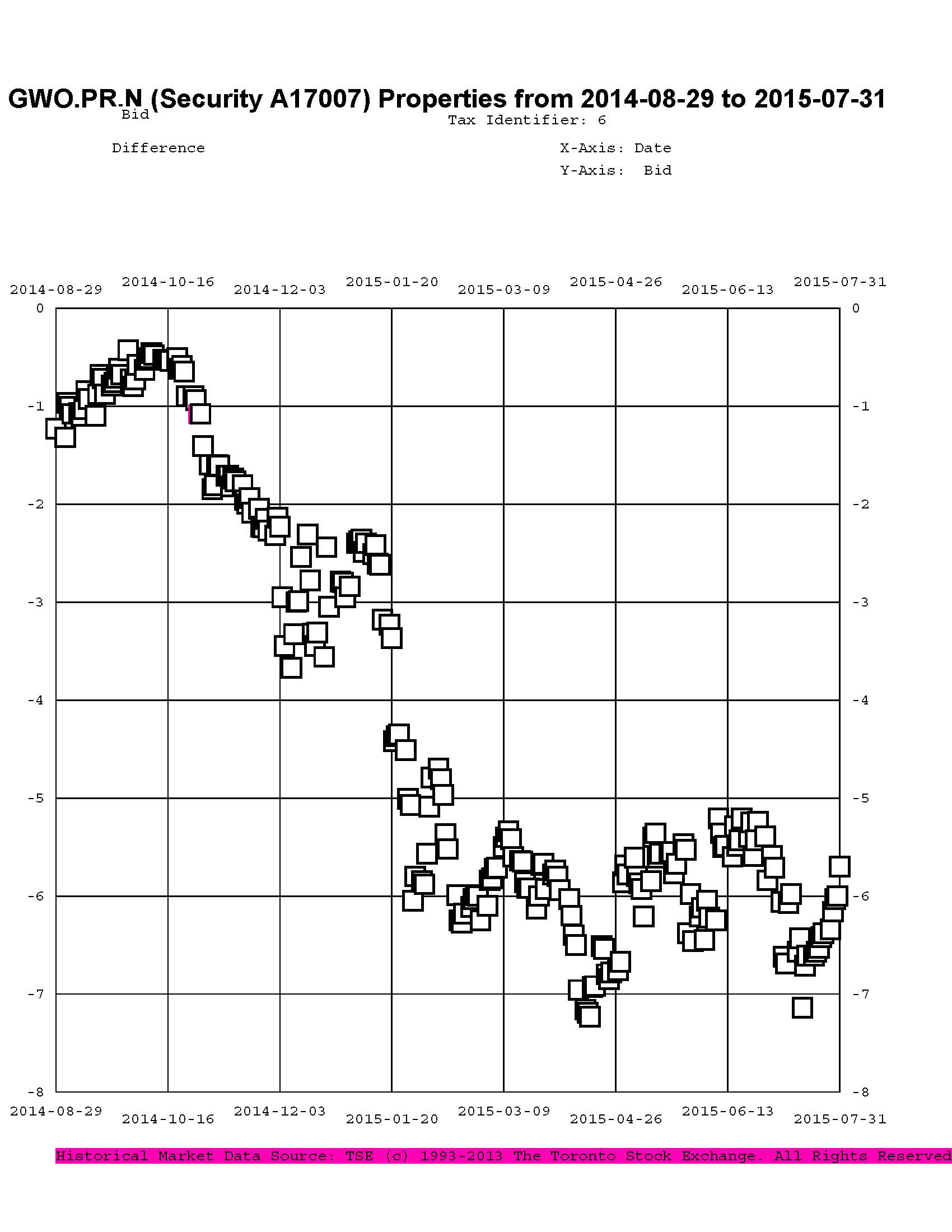
GWOPRN_GWOPRI_bidDiff_150430
Click for Big

Given that the April month-end take-out was $5.69, this is clearly a trade that has not worked out very well.

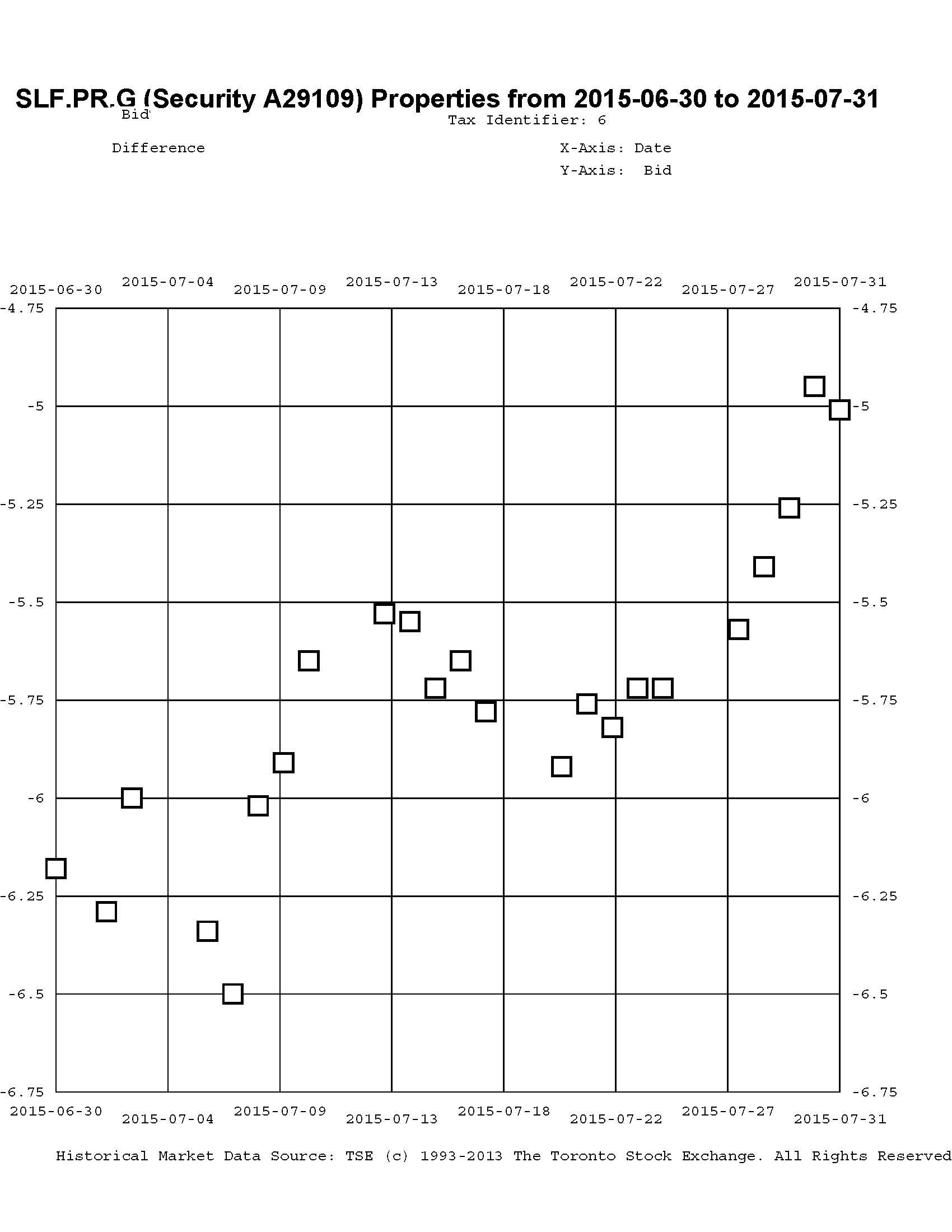
In July, 2014, I reported sales of SLF.PR.D to purchase SLF.PR.G at a take-out of about $0.15:
SLFPRG_SLFPRD_bidDiff_150430
Click for Big

There were similar trades in August, 2014 (from SLF.PR.C) at a take-out of $0.35. The April month-end take-out (bid price SLF.PR.D less bid price SLF.PR.G) was $6.25, so that hasn’t worked very well either.

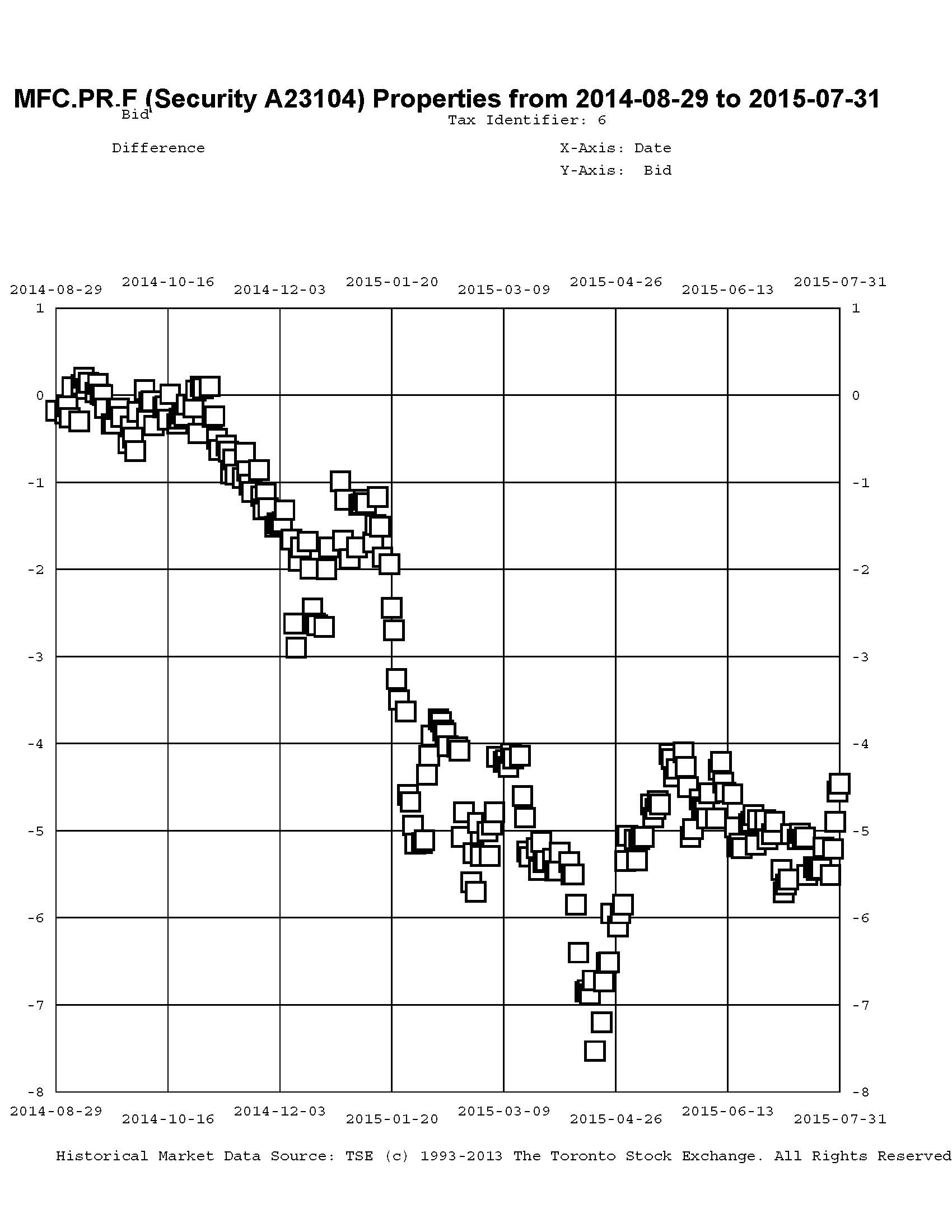
November saw the third insurer-based sector swap, as the fund sold MFC.PR.C to buy the FixedReset MFC.PR.F at a post-dividend-adjusted take-out of about $0.85 … given a February month-end take-out of about $5.29, that’s another regrettable trade, although another piece executed in December at a take-out of $1.57 has less badly.
MFCPRF_MFCPRC_bidDiff_150430
Click for Big

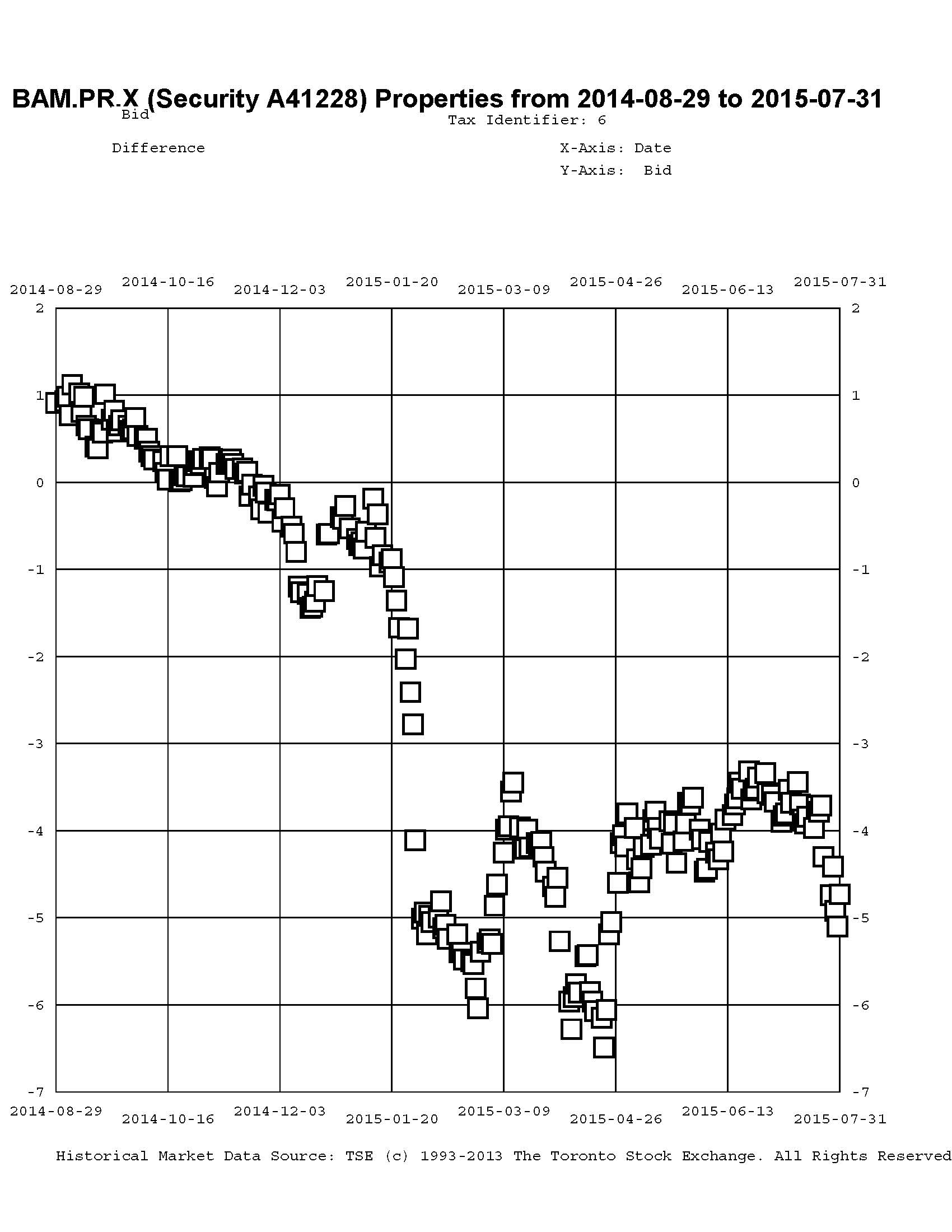
This trend is not restricted to the insurance sector, which I expect will become subject to NVCC rules in the relatively near future and are thus subject to the same redemption assumptions I make for DeemedRetractibles. Other pairs of interest are BAM.PR.X / BAM.PR.N:
BAMPRX_BAMPRN_bidDiff_150430
Click for Big

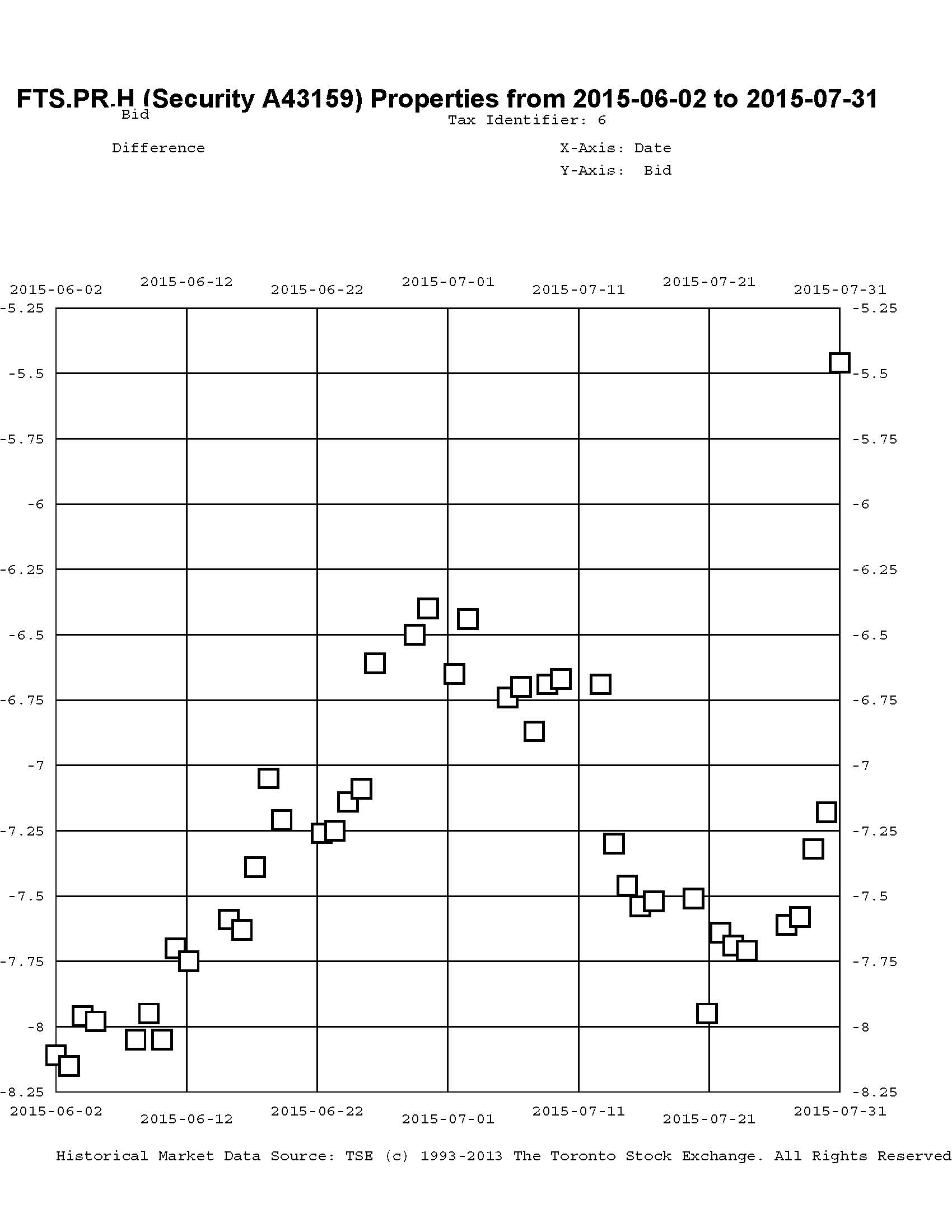
… and FTS.PR.H / FTS.PR.J:
FTSPRH_FTSPRJ_bidDiff_150430
Click for Big

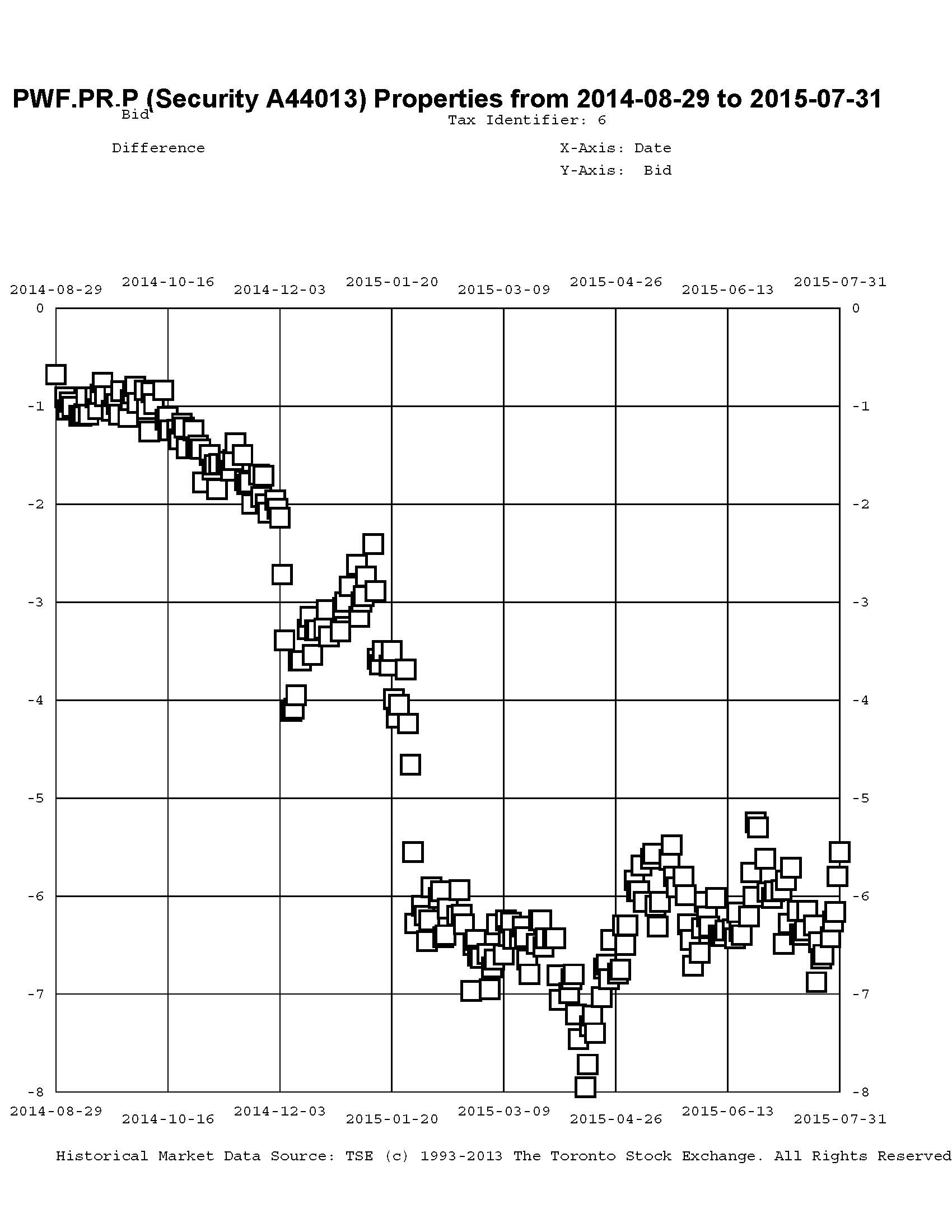
… and PWF.PR.P / PWF.PR.S:

PWFPRP_PWFPRS_bidDiff_150430
Click for Big

I will agree that the fund’s trades highlighted in this post may be decried as cases of monumental bad timing, but I should point out that in May, 2014, the fund was 63.9% Straight / 9.5% FixedReset while in April 2015 the fund was 10% Straight / 85% FixedReset, FloatingReset and FixedFloater (The latter figures include allocations from those usually grouped as ‘Scraps’). Given that the indices are roughly 30% Straight / 60% FixedReset & FloatingReset, it is apparent that the fund was extremely overweighted in Straights / underweighted in FixedResets in May 2014 but this situation has now reversed. HIMIPref™ analytics have been heavily favouring low-spread issues and the fund’s holdings are overwhelmingly of this type.

Summarizing the charts above in tabular form, we see:

FixedReset Straight Take-out
December 2013
Take-out
MAPF Trade
Take-out
December 2014
Take-out March 2015 Take-out
April 2015
GWO.PR.N
3.65%+130
GWO.PR.I
4.5%
($0.04) $1.00 $2.95 $5.74 $5.69
SLF.PR.G
4.35%+141
SLF.PR.D
4.45%
($1.29) $0.25 $2.16 $6.16 $6.25
MFC.PR.F
4.20%+141
MFC.PR.C
4.50%
($1.29) $0.86 $1.20 $5.46 $5.35
BAM.PR.X
4.60%+180
BAM.PR.N
4.75%
($2.06)   $0.17 $4.76 $4.18
FTS.PR.H
4.25%+145
FTS.PR.J
4.75%
$0.60   $5.68 $8.86 $8.07
PWF.PR.P
4.40%+160
PWF.PR.S
4.80%
($0.67)   $3.00 $6.43 $6.50
The ‘Take-Out’ is the bid price of the Straight less the bid price of the FixedReset; approximate execution prices are used for the “MAPF Trade” column. Bracketted figures in the ‘Take-Out’ columns indicate a ‘Pay-Up’

There was not much change from March month-end to April month-end, although the charts show some great excitement in mid-March, with spreads widening dramatically. The following chart shows the normalized total return of the HIMIPref™ FixedReset index through the month:

FR_TRIV_150501
Click for Big

So why is all this happening? One should take care in explaining market movements, but it is my belief that in the latter half of 2013 we were dealing with the ‘taper tantrum’ – the market’s fears that Fed tapering and subsequent tapering would lead to massive spikes in yields; this led to a great preference for FixedResets over Straights. Now, with the economic news getting less inflationary with every news story and Europe and Japan desperately trying to reflate their sluggish economies, the market seems to think that these rate increases are still a long way off … leading to a great preference for Straights over FixedResets.

In addition, the graphs show a sharp spike in early December, during which the low-spread FixedResets were very badly hurt; I believe this to be due to a combination of tax-loss selling and a panicky response to the 29% reduction in the TRP.PR.A dividend.

And in January it just got worse with Canada yields plummeting after the Bank of Canada rate cut with speculation rife about future cuts although this slowly died away.

And in late March / early April it got worse again, with one commenter attributing at least some of the blame to the John Heinzl piece in which I pointed out the expected reduction in dividend payouts! Insofar as I am willing to guess what motivates ‘the market’, I will guess that the rally in the latter half of April is due to a feeling that the previously scheduled European deflation has been cancelled, which in turn encouraged an increase in Treasury yields which fed through to the Canadian market.

There was some good discussion about the declining phase in the comments to the January 29 market action report. I take the view that we’ve seen this show before: during the Credit Crunch, Floaters got hit extremely badly (to the point at which their fifteen year total return was negative) because (as far as I can make out) their dividend rate was dropping (as it was linked to Prime) while the yields on other perpetual preferred instruments were skyrocketing (due to credit concerns). Thus, at least some investors insisted on getting long term corporate yields from rates based (indirectly and with a lag, in the case of FixedResets) on short-term government policy rates. And it’s happening again!

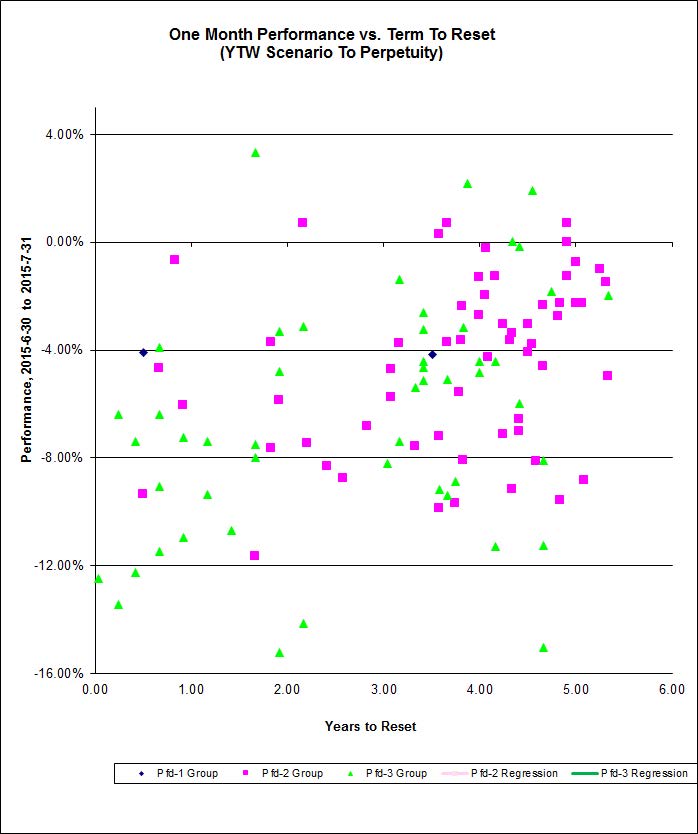
Here’s the April performance for FixedResets that had a YTW Scenario of ‘To Perptuity’ at mid-month.:

FR_1MoPerf_150430
Click for Big

The end-of-month rally has been rather disorderly; correlations between Issue Reset Spread and monthly performance for April are basically zero.

Issue Comments

TLM.PR.A To Be Acquired At $25.00 May 8

Talisman Energy Inc. has announced:

that the completion of the acquisition of Talisman by Repsol S.A. is scheduled to occur on May 8, 2015. Regulatory approvals required under the arrangement agreement with Repsol have been obtained. The completion of the transaction remains subject to the satisfaction of customary closing deliverables.

The deal was announced in December and approved by shareholders in February.

TLM.PR.A is a FixedReset, 4.20%+277, that commenced trading 2011-12-13 after being announced 2011-12-5.

Update, 2015-5-9: Done:

Talisman Energy Inc. (TSX:TLM) (NYSE:TLM) announces that the acquisition of Talisman by Repsol S.A. by way of an arrangement under the Canada Business Corporations Act has been completed.

Under the arrangement, a wholly-owned subsidiary of Repsol has acquired all of the outstanding common shares of Talisman at a price of US $8.00 per share and all of the outstanding preferred shares of Talisman at a price of CDN $25.1093 (representing CDN $25.00 plus accrued and unpaid dividends) per share.

With the completion of the arrangement, the common shares will be delisted from the Toronto Stock Exchange and the New York Stock Exchange, and the preferred shares will be delisted from the Toronto Stock Exchange.

Issue Comments

BRF.PR.B Listed – No Action Despite 45% Conversion

Not much to report here! BRF.PR.B, a FloatingReset +262 that has resulted from a partial conversion of BRF.PR.A but there were no trades and a $5.00 spread on the quote.

However, TMXMoney reports that there are 4,518,289 shares outstanding compared to 5,481,711 for BRF.PR.A, implying a 45% conversion rate, in line with the recent 42% rate for BNS.PR.Y / BNS.PR.D and 43% rate for AIM.PR.A / AIM.PR.G despite my exhortation to continue to hold the FixedReset half of the pair.

For what it’s worth, the bid on BRF.PR.B looks reasonable relative to the bid on BRF.PR.A, resulting in an implied averge 3-month bill rate of 0.06% which, while certainly subject to criticism, is not utterly ridiculous compared to other FixedReset / FloatingReset Strong Pairs:

pairs_FR_150501
Click for Big

Vital statistics (again, with the caveat that the quote has a ridiculous spread and is unsupported by any trading activity) are:

BRF.PR.B FloatingReset YTW SCENARIO
Maturity Type : Limit Maturity
Maturity Date : 2045-05-01
Maturity Price : 20.00
Evaluated at bid price : 20.00
Bid-YTW : 4.08 %
Issue Comments

FFH: S&P Revises Outlook To Stable From Negative

S&P revised the outlook on Fairfax Financial Holdings Inc. to Negative in February following the Brit acquisition, citing:

the significant potential decline in the group’s capital adequacy following the completion of the Brit PLC acquisition.

Today they gave the company’s capital plans their seal of approval:

  • •Fairfax Financial Holdings Ltd. will likely maintain very strong capital adequacy per our capital model.
  • •We are revising our outlook on Fairfax to stable from negative and affirming our ratings on Fairfax and its core insurance affiliates.
  • •The stable outlook reflects our view that the pending acquisition of Brit PLC will not have a significant adverse impact on the group’s capital adequacy.

Standard & Poor’s Ratings Services said today that it revised its outlook on Fairfax Financial Holdings Ltd. to stable from negative. At the same time, we affirmed our ‘BBB-‘ long-term counterparty credit rating on Fairfax and our ‘A-‘ long-term counterparty credit and financial strength ratings on its core insurance affiliates.

Our analysis of Fairfax’s acquisition and consolidation of Brit PLC and the associated capital-raising initiatives indicates that Fairfax’s capital adequacy is likely to remain at the ‘AA’ level. Although the company will have less of a cushion than it had as of year-end 2014, its capitalization remains consistent with our expectations.

The stable outlook is based on our view that the pending acquisition of Brit PLC will not have a significant adverse impact on the group’s capital adequacy after taking into account recent capital-raising initiatives and our expectations for organic capital growth during the next two years.

One of the methods Fairfax used to stabilize its capital levels was raising about $750-million in equities and preferreds. In addition – and perhaps more to the point – a 30% stake in Brit was conditionally sold to OMERS in mid-April:

Fairfax Financial Holdings Ltd. is bringing the Ontario Municipal Employees Retirement System in on its acquisitions of a specialty insurance company.

The two Toronto-based groups have entered into a memorandum of understanding where OMERS would take would take as much as a 30 per cent stake in Brit PLC, a specialty insurer that underwrites unique policies to protect against risks such as war and terrorism, satellite launch failures and the cancellations of sporting events. Brit is one of the largest insurers in the Lloyd’s of London marketplace, which connects global clients with insurance for complex and unusual risks.

Right now, OMERS has no investment in Brit shares. The new deal won’t clear until after Fairfax’s offer for Brit becomes unconditional in all respects, receives regulatory approvals and other conditions.

The agreement between Fairfax and OMERS also hinges on other requirements, such as those related to Brit’s dividend, exit provisions and other governance arrangements.

Fairfax has a number of preferred share issues outstanding: FFH.PR.C, FFH.PR.D, FFH.PR.E, FFH.PR.F, FFH.PR.G, FFH.PR.I, FFH.PR.K and FFH.PR.M.

Issue Comments

BMO.PR.J To Be Redeemed At A Premium

Bank of Montreal has announced (last week, actually, but I missed it):

that it will exercise its right to redeem all of its $350,000,000 Non-Cumulative Perpetual Class B Preferred Shares Series 13 (“Preferred Shares Series 13”) on May 25, 2015, at the redemption price of $25.25 per share, for total redemption proceeds of approximately $353.5 million.

Payment of the redemption price will be made by Bank of Montreal on or after May 25, 2015, upon surrender of the Preferred Shares Series 13.

Separately from the payment of the redemption price, the final quarterly dividend of $0.28125 per share for the Preferred Shares Series 13 will be paid in the usual manner on May 25, 2015, to shareholders of record on May 1, 2015.

Notice will be delivered to holders of the Preferred Shares Series 13 in accordance with the terms outlined in the Preferred Shares Series 13 prospectus supplement.

BMO.PR.J is a 4.50% DeemedRetractible announced 2007-1-8 which commenced trading 2007-1-17.

Holders are strongly urged to consider the tax implications of the redemption: it is being executed at a premium to par ($25.25) and will therefore be treated for tax purposes as a sale at 25.00 with a Deemed Dividend (taxed like any other dividend) of $0.25. If an investor sells on the market, however, it will be taxed as a sale at whatever price he gets (probably a penny or two below the redemption price), with none of the Deemed Dividend complication. The choice between the two options will be a function of transaction costs and the investors individual tax circumstances; please consult your personal tax advisor.

Issue Comments

BNS.PR.D: No Surprises On Debut

As has been previously reported on PrefBlog, there was a 42% conversion of BNS.PR.Y into BNS.PR.D on its first Exchange Date.

BNS.PR.D is a FloatingReset 3MoBills+100bp. The issue traded 500 shares today (consolidated exchanges) in a range of 22.00-23.90 (!) before closing at 21.90-30.

Vital statistics are:

BNS.PR.D FloatingReset YTW SCENARIO
Maturity Type : Hard Maturity
Maturity Date : 2022-01-31
Maturity Price : 25.00
Evaluated at bid price : 21.90
Bid-YTW : 3.66 %

As may be seen on the Strong Pairs analysis …:

pairs_FR_150427
Click for Big

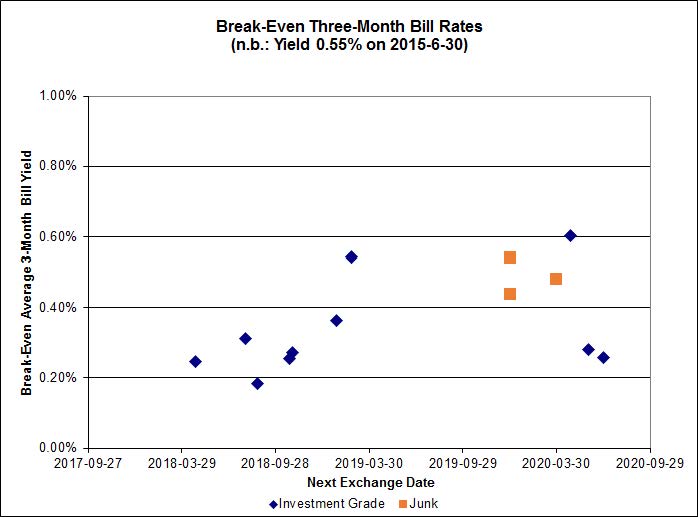
investment grade FixedReset/FloatingReset pairs have an average break-even three-month bill rate of about 0.20%; outliers are TRP.PR.A / TRP.PR.F (not shown) at -0.77%, and the BNS.PR.Y / BNS.PR.D pair at +0.63%.

Issue Comments

TD.PF.E Settles: A Little Soft On Moderate Volume

TD.PF.E, a FixedReset, 3.70%+287, announced April 15 has settled. It will be tracked by HIMIPref™ and has been assigned to the FixedReset subindex.

The issue traded 832,925 shares today (consolidated exchanges) in a range of 24.79-93 before closing at 24.91-92.

Vital statistics are:

TD.PF.E FixedReset YTW SCENARIO
Maturity Type : Limit Maturity
Maturity Date : 2045-04-24
Maturity Price : 23.10
Evaluated at bid price : 24.91
Bid-YTW : 3.62 %

The calculation for Implied Volatility is a mess with a very poor fit, but this is due to the presence of two NVCC non-compliant issues that are, quite correctly, priced by the market using a different paradigm than the five NVCC compliant issues:

impVol_TD_150424
Click for Big

The fit is greatly improved when only NVCC-compliant issues are used for the calculation:

impVol_TD_150424_compliantOnly
Click for Big

However, as was found at the time of announcement, it is clear that the Implied Volatility of the TD series of FixedResets is unreasonably high and that we have reason to fear severe underperformance by the lower-spread issues, should spreads increase sufficiently to give pause to those who feel that any TD issue will be near par forever, regardless of its terms.

Issue Comments

DF.PR.A To Get Bigger

Quadravest has announced:

Dividend 15 Split Corp. II (the “Company”) is pleased to announce it has filed a preliminary short form prospectus in each of the provinces of Canada with respect to an offering of Preferred Shares and Class A Shares of the Company. The offering will be co-led by National Bank Financial Inc., CIBC, RBC Capital Markets and will also include Scotia Capital Inc., TD Securities Inc., BMO Capital Markets, GMP Securities L.P., Canaccord Genuity Corp., Dundee Securities, Raymond James, Desjardins Securities Inc., Mackie Research Capital Corporation and Manulife Securities Incorporated.

The Preferred Shares will be offered at a price of $10.00 per Preferred Share to yield 5.25% on the issue price and the Class A Shares will be offered at a price of $8.60 per Class A Share to yield 13.95% on the issue price. The closing price on the TSX of each of the Preferred Shares and the Class A Shares on April 21, 2015 was $10.20 and $8.96, respectively.

Since inception of the Company, the aggregate dividends paid on the Preferred Shares have been $4.40 per share and the aggregate dividends paid on the Class A Shares have been $9.20 per share, for a combined total of $13.60 unit. All distributions to date have been made in tax advantage eligible Canadian dividends or capital gains dividends.

The net proceeds of the offering will be used by the Company to invest in an actively managed portfolio of dividend yielding
common shares which includes each of the 15 Canadian companies listed below:

Bank of Montreal Enbridge Inc. TELUS Corporation
The Bank of Nova Scotia Manulife Financial Corp. Thomson-Reuters Corporation
BCE Inc. National Bank of Canada The Toronto-Dominion Bank
Canadian Imperial Bank of Commerce Royal Bank of Canada TransAlta Corporation
CI Financial Corp. Sun Life Financial Inc. TransCanada Corporation

The Company’s investment objectives are:
Preferred Shares:
i. to provide holders of the Preferred Shares with fixed, cumulative preferential monthly cash dividends in the amount of $0.04375 per Preferred Share to yield 5.25% per annum on the original issue price; and
ii. on or about December 1, 2019, to pay the holders of the Preferred Shares the original issue price of those shares.

Class A Shares:
i. to provide holders of the Class A Shares with regular monthly cash dividends currently targeted to be $0.10 per Class A; and
ii. on or about December 1, 2019, to pay the holders of Class A Shares at least the original issue price of those shares.

The sales period of this overnight offering will end at 9:00 a.m. (EST) on April 23, 2015.

It’s nice work if you can get it! The NAVPU on April 21 was $16.51!

DF.PR.A was last mentioned on PrefBlog when it got bigger in September, 2014. DF.PR.A is tracked by HIMIPref™ but is relegated to the Scraps index on credit concerns.

Update, 2015-04-23: The offering did quite well:

Dividend 15 Split Corp. II (the “Company”) is pleased to announce it has completed the overnight marketing of up to 2,700,000 Preferred Shares and up to 2,700,000 Class A Shares of the Company. Total proceeds of the offering are expected to be approximately $50.2 million.

The offering is being co-led by National Bank Financial Inc., CIBC, RBC Capital Markets and will also include Scotia Capital Inc., TD Securities Inc., BMO Capital Markets, GMP Securities L.P., Canaccord Genuity Corp., Dundee Securities, Raymond James, Desjardins Securities Inc., Mackie Research Capital Corporation and Manulife Securities Incorporated.

The sales period of the overnight offering has now ended.

Issue Comments

BNS.PR.Y / BNS.PR.D: Results of Conversion = 42%

The Bank of Nova Scotia has announced:

that 4,457,262 of its 10,600,000 Non-cumulative 5-Year Rate Reset Preferred Shares Series 30 of Scotiabank (the “Preferred Shares Series 30”) have been elected for conversion on April 27, 2015, on a one-for-one basis, into Non-cumulative Floating Rate Preferred Shares Series 31 of Scotiabank (the “Preferred Shares Series 31”). Consequently, on April 27, 2015, Scotiabank will have 6,142,738 Preferred Shares Series 30 and 4,457,262 Preferred Shares Series 31 issued and outstanding. The Preferred Shares Series 30 and Preferred Shares Series 31 will be listed on the Toronto Stock Exchange under the symbols BNS.PR.Y and BNS.PR.D, respectively.

This is a conversion rate of 42%, comparable to the recent AIM.PR.A / AIM.PR.B rate of 43%, and a little higher than the FFH.PR.E / FFH.PR.F rate of 31%.

Readers will remember that I recommended holders of BNS.PR.Y retain their shares and the reasoning behind this conclusion remains valid, according to the latest analysis of FixedReset / FloatingReset Strong Pairs outstanding:

pairs_FR_150417
Click for Big

Investment-Grade pairs outstanding currently require break-even three-month bill rates of 0.28%. If the new BNS.PR.Y / BNS.PR.D pair trades at this implied rate then, given today’s closing bid of 21.52 for BNS.PR.Y, the bid for BNS.PR.D will be 20.91, about 2.8% lower.