Category: Issue Comments

Issue Comments

TRP.PR.G Soft On Excellent Volume

TransCanada Corporation has announced:

that it has completed its public offering of cumulative redeemable first preferred shares, series 11 (the “Series 11 Preferred Shares”). TransCanada issued 10 million Series 11 Preferred Shares for aggregate gross proceeds of $250 million through a syndicate of underwriters co-led by Scotiabank and RBC Capital Markets.

The net proceeds of the offering will be used for general corporate purposes and to reduce short term indebtedness of TransCanada and its affiliates, which short term indebtedness was used to fund TransCanada’s capital program and for general corporate purposes.

The Series 11 Preferred Shares will begin trading today on the TSX under the symbol TRP.PR.G.

TRP.PR.G is a FixedReset, 3.80%+296, announced February 23. It will be tracked by HIMIPref™ and has been assigned to the FixedReset subindex.

The issue has been rated Pfd-2(low) by DBRS.

TRP.PR.G traded 1,511,656 shares today (consolidated exchanges) in a range of 24.83-93 before closing at 24.83-85. Vital statistics are:

TRP.PR.G FixedReset YTW SCENARIO
Maturity Type : Limit Maturity
Maturity Date : 2045-03-02
Maturity Price : 23.06
Evaluated at bid price : 24.83
Bid-YTW : 3.66 %

Implied Volatility theory suggests that TRP.PR.G is $1.22 cheap:

impVol_TRP_150302
Click for Big
Issue Comments

FFH.PR.E To Reset At 2.91%

Fairfax Financial Holdings Limited has announced:

that it has determined the fixed dividend rate on its Cumulative 5-Year Rate Reset Preferred Shares, Series E (“Series E Shares”) (TSX: FFH.PR.E) for the five years commencing April 1, 2015 and ending March 31, 2020. The fixed quarterly dividends on the Series E Shares during that period will be paid at an annual rate of 2.91% (Cdn. $0.18188 per share per quarter).

Holders of Series E Shares have the right, at their option, exercisable not later than 5:00pm (Toronto time) on March 16, 2015, to convert all or part of their Series E Shares, on a one-for-one basis, into Cumulative Floating Rate Preferred Shares, Series F (the “Series F Shares”), effective March 31, 2015. The quarterly floating rate dividends on the Series F Shares will be paid at an annual rate, calculated for each quarter, of 2.16% over the annual yield on three month Government of Canada treasury bills. The actual quarterly dividend rate in respect of the April 1, 2015 to June 29, 2015 dividend period for the Series F Shares will be 0.647753% (2.627 % on an annualized basis) and the dividend, if and when declared, for such dividend period will be Cdn. $0.16194 per share, payable on June 29, 2015.

Holders of Series E Shares are not required to elect to convert all or any part of their Series E Shares into Series F Shares.

As provided in the share conditions of the Series E Shares, (i) if Fairfax determines that there would be fewer than 1,000,000 Series E Shares outstanding after March 31, 2015, all remaining Series E Shares will be automatically converted into Series F Shares on a one-for-one basis effective March 31, 2015; and (ii) if Fairfax determines that there would be fewer than 1,000,000 Series F Shares outstanding after March 31, 2015, no Series E Shares will be permitted to be converted into Series F Shares. There are currently 7,915,539 Series E Shares outstanding.

The Toronto Stock Exchange (“TSX”) has conditionally approved the listing of the Series F Shares effective upon conversion. Listing of the Series F Shares is subject to Fairfax fulfilling all the listing requirements of the TSX and, upon approval, the Series F Shares will be listed on the TSX under the trading symbol “FFH.PR.F”.

Fairfax is a financial services holding company which, through its subsidiaries, is engaged in property and casualty insurance and reinsurance and investment management.

FFH.PR.E is a FixedReset that commenced trading 2010-2-1 after being announced 2010-1-21.

The initial dividend rate was 4.75%, so the dividend is being cut by a horrific 39%.

As noted in the release, the deadline for conversion instructions to reach the company is March 16 at 5pm; I will post a note a few days in advance of the deadline with a recommendation regarding whether holders should or should not exchange their shares.

Implied Volatility theory – with tomorrow’s new issue deemed to be bid at par – suggests that FFH.PR.E is currently $0.43 cheap … but the fit is very poor:

impVol_FFH_150302
Click for Big
Issue Comments

AIM.PR.A To Reset at 4.50%

Aimia has announced:

the applicable dividend rates for its Cumulative Rate Reset Preferred Shares, Series 1 (the “Series 1 Shares”) and its Cumulative Floating Rate Preferred Shares, Series 2 (the “Series 2 Shares”), further to the February 27, 2015 notice that it will not exercise its right to redeem all or any part of the outstanding Series 1 Shares and, as a result of which, subject to certain conditions, the holders of the Series 1 Shares will have the right to convert all or part of their Series 1 Shares into Series 2 Shares on a one-for-one basis.

With respect to any Series 1 Shares that remain outstanding after March 31, 2015, holders of the Series 1 Shares will be entitled to receive quarterly fixed, cumulative, preferential cash dividends, as and when declared by the Board of Directors of Aimia, subject to the provisions of the Canada Business Corporations Act. The dividend rate for the five-year period from and including March 31, 2015 to but excluding March 31, 2020 will be 4.5%, being 3.75% over the five-Year Government of Canada bond yield, as determined in accordance with the terms of the Series 1 Shares.

With respect to any Series 2 Shares that may be issued on March 31, 2015, holders of the Series 2 Shares will be entitled to receive quarterly floating rate, cumulative, preferential cash dividends, calculated on the basis of the actual number of days elapsed in such quarterly period divided by 365, as and when declared by the Board of Directors of Aimia, subject to the provisions of the Canada Business Corporations Act. The dividend rate for the floating rate period from and including March 31, 2015 to but excluding June 30, 2015 will be 4.217%, being 3.75% over the 90-day Government of Canada Treasury Bill yield, as determined in accordance with the terms of the Series 2 Shares.

Beneficial owners of Series 1 Shares who wish to exercise their conversion right should communicate as soon as possible with their broker or other nominee to obtain instructions for exercising such right on or prior to the deadline for exercise, which is 5:00 p.m. (Montreal time) on March 17, 2015.

Inquiries should be directed to Aimia’s Registrar and Transfer Agent, CST Trust Company, at 1-800-387-0825 (toll free in Canada and the United States).

The extension has been previously reported on PrefBlog. AIM.PR.A changed its ticker from AER.PR.A in October, 2011. AER.PR.A commenced trading 2010-1-20 after being announced 2010-1-12.

The initial dividend rate was 6.50%, so the new rate of 4.50% represents a decline of about 31%.

As noted in the release, the deadline for conversion instructions to reach the company is March 17 at 5pm Montreal Time; I will post a note a few days in advance of the deadline with a recommendation regarding whether holders should or should not exchange their shares.

Issue Comments

Low-Spread FixedResets: February, 2015

As noted in MAPF Portfolio Composition: February 2015, the fund now has a fairly large allocation to FixedResets, although this segment remains below index weight.

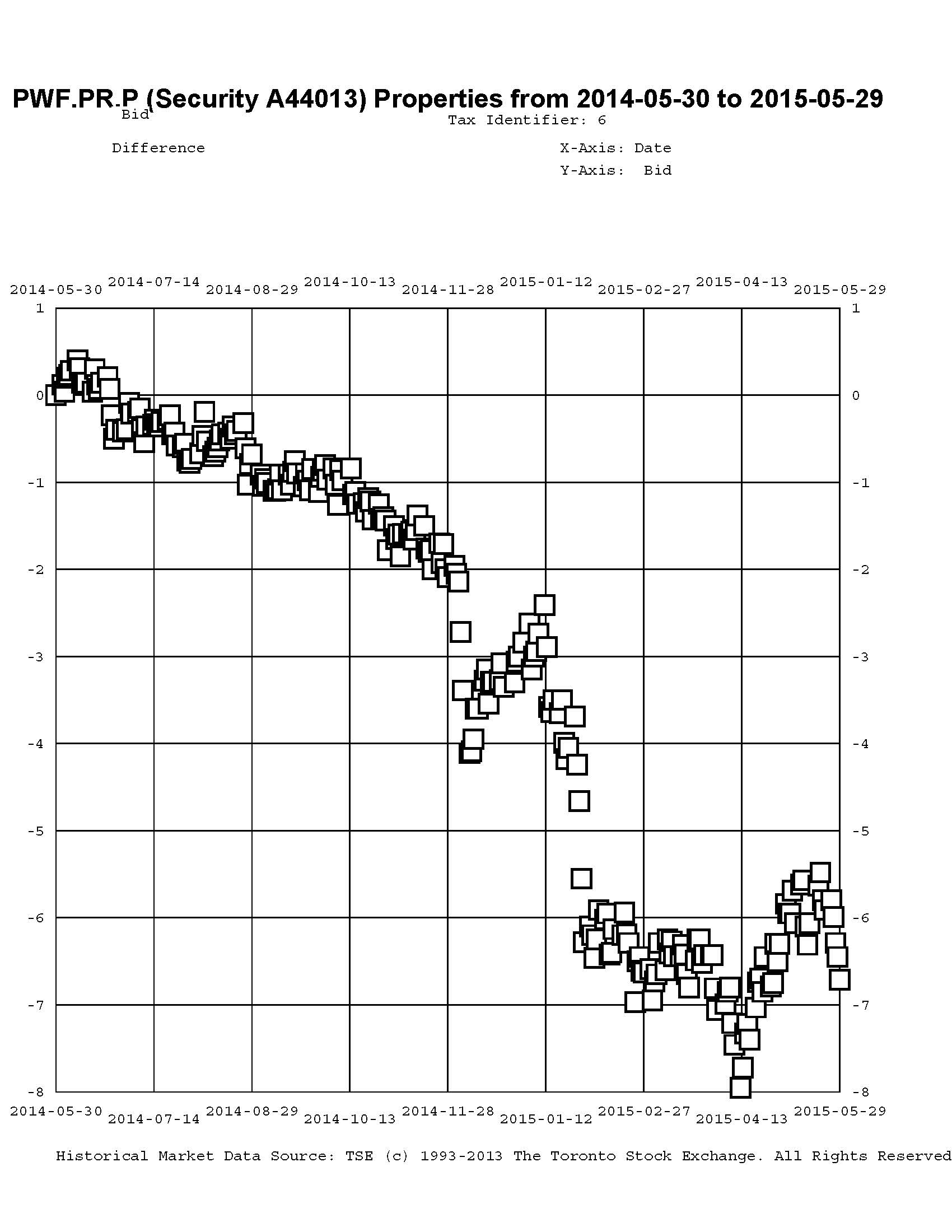
As these were largely purchased with proceeds of sales of DeemedRetractibles from the same issuer, it is interesting to look at the price trend of some of the Straight/FixedReset pairs. We’ll start with GWO.PR.N / GWO.PR.I; the fund sold the latter to buy the former at a takeout of about $1.00 in mid-June, 2014; relative prices over the past year are plotted as:

GWOPRN_GWOPRI_bidDiff_150227
Click for Big

Given that the February month-end take-out was $6.25, this is clearly a trade that has not worked out very well.

In July, 2014, I reported sales of SLF.PR.D to purchase SLF.PR.G at a take-out of about $0.15:

SLFPRG_SLFPRD_bidDiff_150227
Click for Big

There were similar trades in August, 2014 (from SLF.PR.C) at a take-out of $0.35. The February month-end take-out (bid price SLF.PR.D less bid price SLF.PR.G) was $6.45, so that hasn’t worked very well either.

The trend paused in September, 2014 and, indeed, can be said to have reversed, with the fund selling SplitShares (PVS.PR.B at 25.25-30) to purchase PerpetualDiscounts (BAM.PR.M / BAM.PR.N at about 21.25), a trade which worked out favourably and has been sort-of reversed (into PVS.PR.D) in November 2014.

In October 2014 there was another bit of counterflow, as the fund sold more SplitShares (CGI.PR.D at about 25.25) to purchase more PerpetualDiscounts (CU.PR.F and CU.PR.G, at about 21.25) which again worked out well and was reversed in November, selling the CU issues at about 22.45 to purchase low-spread FixedResets (TRP.PR.A and TRP.PR.B) at about 21.50 and 18.75 (post dividend equivalent), which was basically down by transaction costs at November month-end, but a significant loser by December month-end.

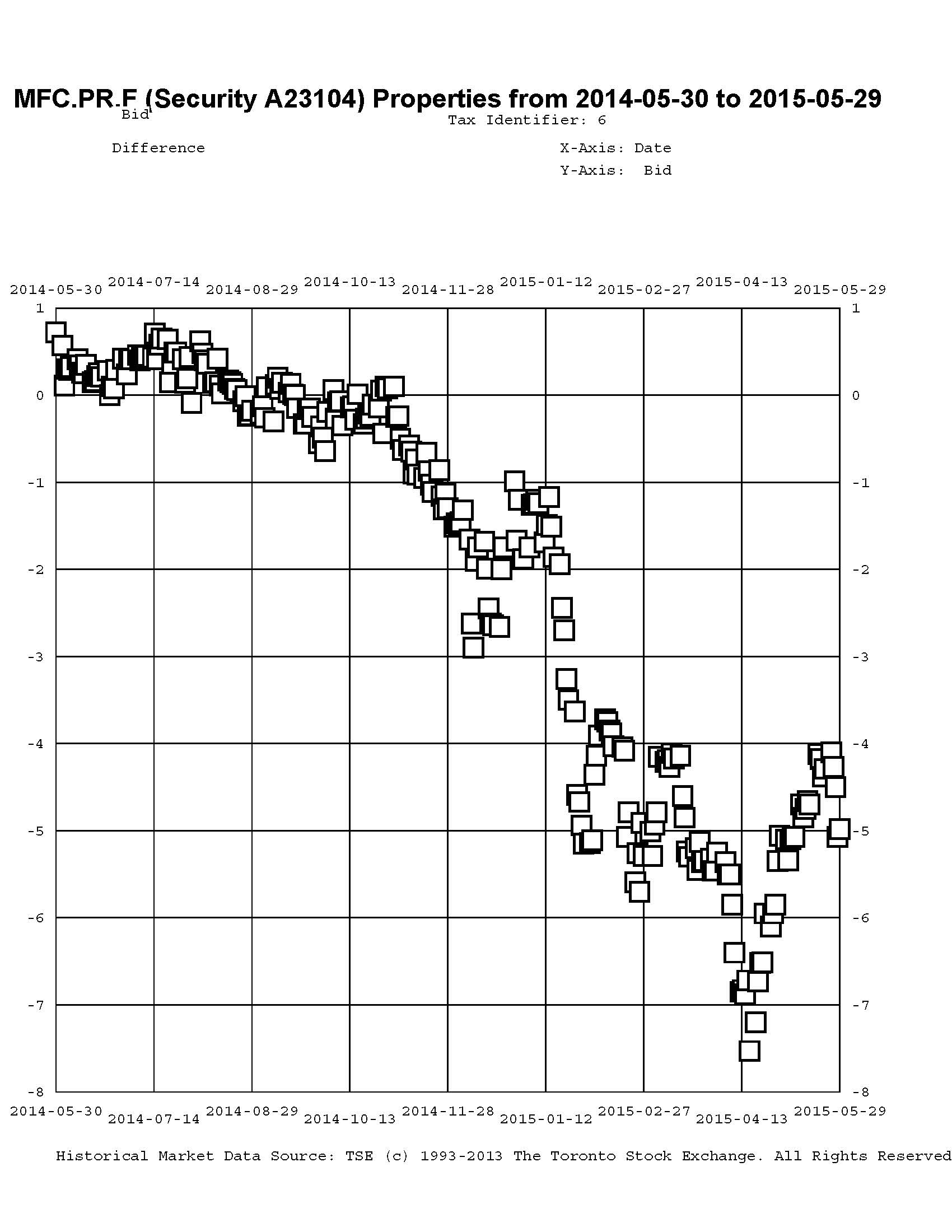
And November saw the third insurer-based sector swap, as the fund sold MFC.PR.C to buy the FixedReset MFC.PR.F at a post-dividend-adjusted take-out of about $0.85 … given a February month-end take-out of about $5.29, that’s another regrettable trade, although another piece executed in December at a take-out of $1.57 has less badly.

MFCPRF_MFCPRC_bidDiff_150227
Click for Big

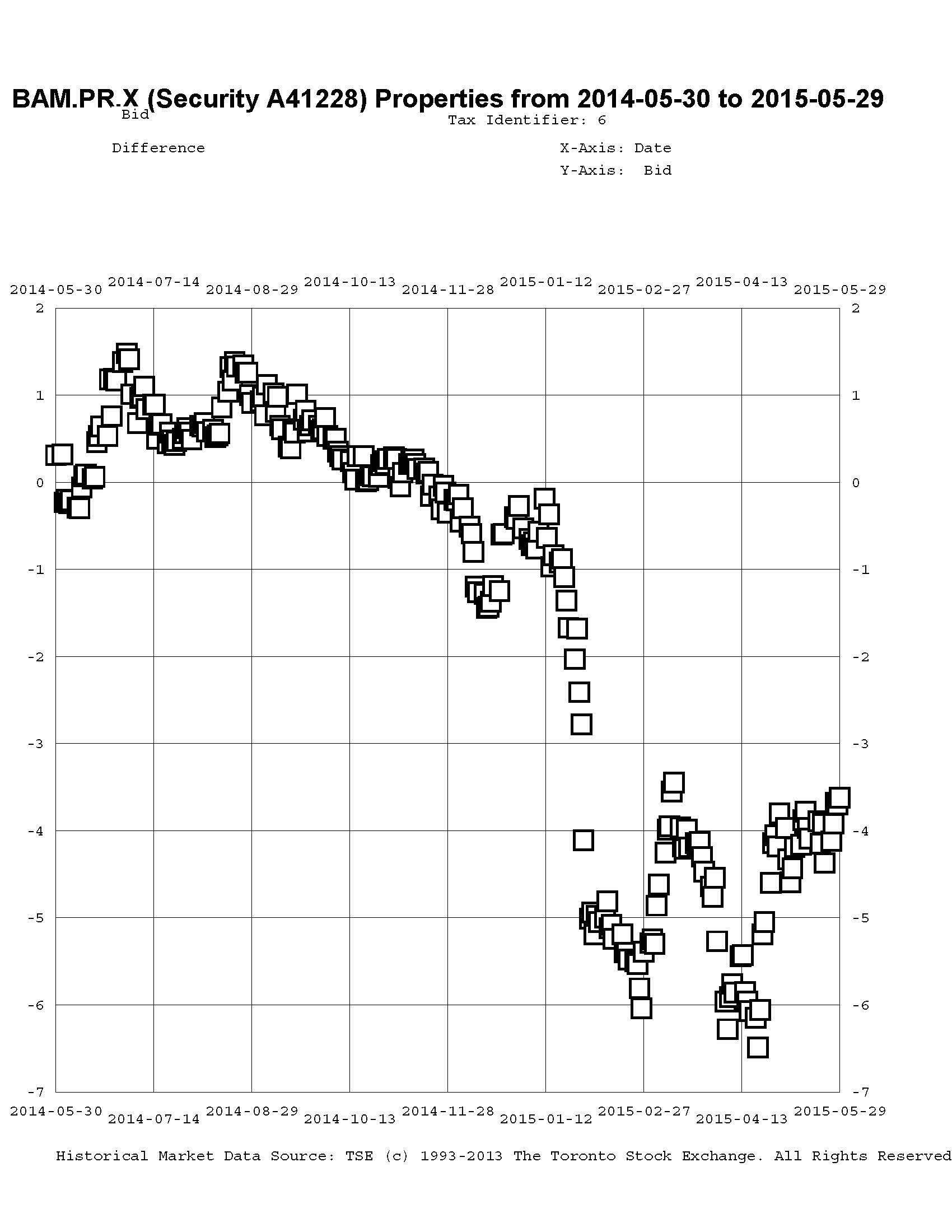
This trend is not restricted to the insurance sector, which I expect will become subject to NVCC rules in the relatively near future and are thus subject to the same redemption assumptions I make for DeemedRetractibles. Other pairs of interest are BAM.PR.X / BAM.PR.N:

BAMPRX_BAMPRN_bidDiff_140227
Click for Big

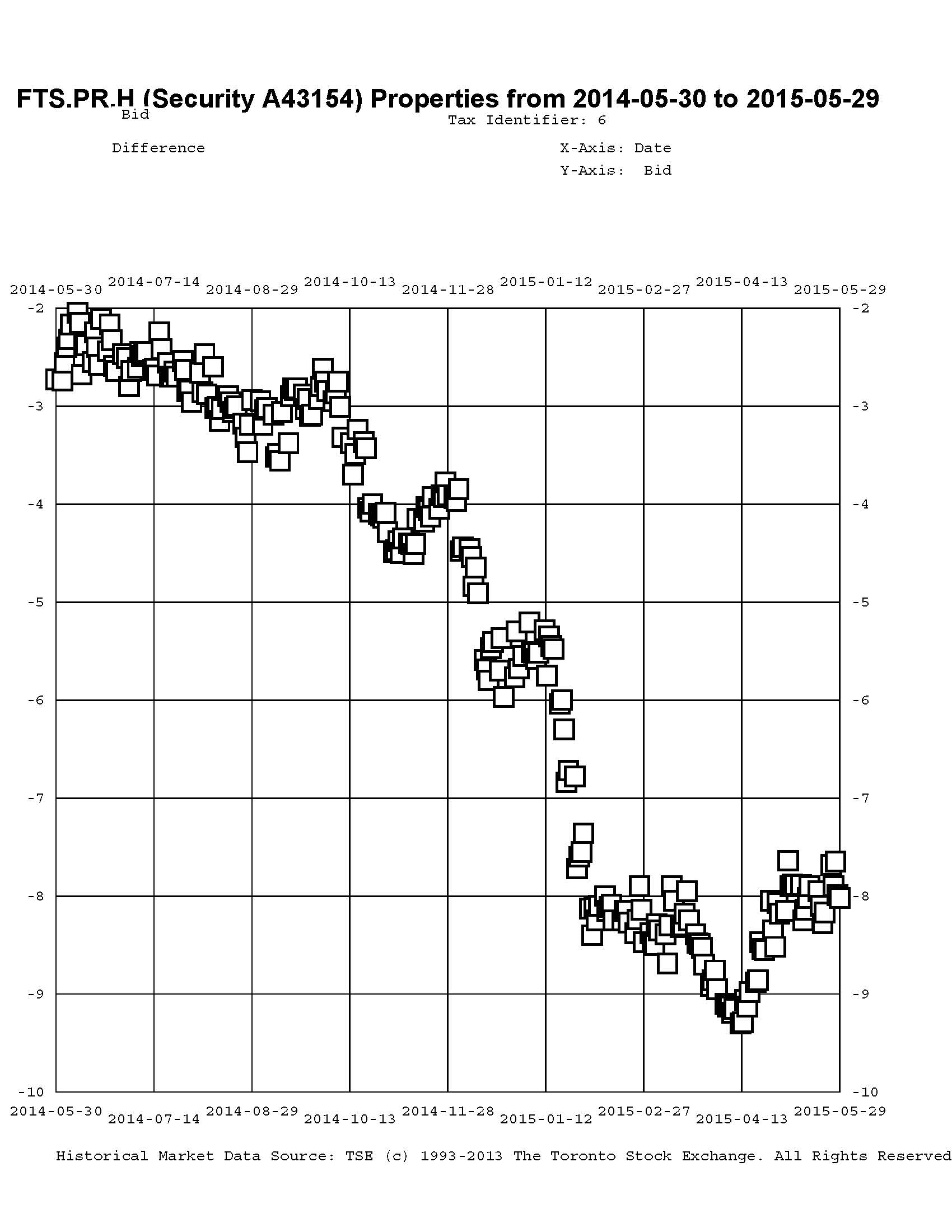
… and FTS.PR.H / FTS.PR.J:

FTSPRH_FTSPRJ_bidDiff_150227
Click for Big

… and PWF.PR.P / PWF.PR.S:

PWFPRP_PWFPRS_bidDiff_150227
Click for Big

I will agree that the fund’s trades highlighted in this post may be decried as cases of monumental bad timing, but I should point out that in May, 2014, the fund was 63.9% Straight / 9.5% FixedReset
while in February 2015 the fund was 35% Straight / 50% FixedReset & FloatingReset (The latter figures include allocations from those usually grouped as ‘Scraps’). Given that the indices are roughly 30% Straight / 60% FixedReset & FloatingReset, it is apparent that the fund was extremely overweighted in Straights / underweighted in FixedResets in May 2014 and that this qualitative tilt remains, but is no longer extreme. However, HIMIPref™ analytics have been heavily favouring low-spread issues and the fund’s holdings are overwhelmingly of this type.

Summarizing the charts above in tabular form, we see:

FixedReset Straight Take-out
December 2013
Take-out
MAPF Trade
Take-out
December 2014
Take-out
January 2014
Take-out
February 2014
GWO.PR.N
3.65%+130
GWO.PR.I
4.5%
($0.04) $1.00 $2.95 $5.80 $6.25
SLF.PR.G
4.35%+141
SLF.PR.D
4.45%
($1.29) $0.25 $2.16 $6.12 $6.45
MFC.PR.F
4.20%+141
MFC.PR.C
4.50%
($1.29) $0.86 $1.20 $5.15 $5.29
BAM.PR.X
4.60%+180
BAM.PR.N
4.75%
($2.06)   $0.17 $4.11 $5.39
FTS.PR.H
4.25%+145
FTS.PR.J
4.75%
$0.60   $5.68 $7.36 $8.47
PWF.PR.P
4.40%+160
PWF.PR.S
4.80%
($0.67)   $3.00 $6.28 $6.63
The ‘Take-Out’ is the bid price of the Straight less the bid price of the FixedReset; approximate execution prices are used for the “MAPF Trade” column. Bracketted figures in the ‘Take-Out’ columns indicate a ‘Pay-Up’

So why is all this happening? One should take care in explaining market movements, but it is my belief that in the latter half of 2013 we were dealing with the ‘taper tantrum’ – the market’s fears that Fed tapering and subsequent tapering would lead to massive spikes in yields; this led to a great preference for FixedResets over Straights. Now, with the economic news getting less inflationary with every news story and Europe and Japan desperately trying to reflate their sluggish economies, the market seems to think that these rate increases are still a long way off … leading to a great preference for Straights over FixedResets.

In addition, the graphs show a sharp spike in early December, during which the low-spread FixedResets were very badly hurt; I believe this to be due to a combination of tax-loss selling and a panicky response to the 29% reduction in the TRP.PR.A dividend.

And in January it just got worse with Canada yields plummeting after the Bank of Canada rate cut with speculation rife about future cuts although this has recently become less emphatic.

There was some good discussion about what is going on in the comments to the January 29 market action report. I take the view that we’ve seen this show before: during the Credit Crunch, Floaters got hit extremely badly (to the point at which their fifteen year total return was negative) because (as far as I can make out) their dividend rate was dropping (as it was linked to Prime) while the yields on other perpetual preferred instruments were skyrocketing (due to credit concerns). Thus, at least some investors insisted on getting long term corporate yields from rates based on short-term government policy rates. And it’s happening again!

Here’s the February performance for FixedResets that had a YTW Scenario of ‘To Perptuity’ at mid-month. The correlations for both the Pfd-2 Group and the Pfd-3 Group are both so poor that the regression lines are essentially meaningless: 7% and 1%, respectively:

FR_1MoPerf_150227_IRS
Click for Big

However, the chart for the same data showing performance against term-to-reset is significantly better, with correlations of 23% and 7%:

FR_1MoPerf_150227_term
Click for Big
Issue Comments

AZP.PR.A, AZP.PR.B and AZP.PR.C Removed From Watch-Negative By S&P

Standard & Poor’s has announced:

  • •We are affirming our ‘B’ corporate credit ratings on U.S. power generator Atlantic Power Corp. (APC) and affiliate Atlantic Power Limited Partnership, and are removing them from CreditWatch with negative implications.
  • •At the same time, we are revising our recovery ratings on APC’s senior unsecured debt to ‘2’ from ‘4’.
  • •The outlook on all ratings is stable.


The CreditWatch placement followed the departure of the company’s CEO and a significant cut in distributions by the company that had triggered our review of the company’s financial plan. In September 2014, APC had lowered its dividend by 70% (C$0.12 annually from C$0.40), a second distribution cut in 18 months, following a 65% reduction in February 2013. The company had also revised its distribution payments to a quarterly schedule from monthly payouts. The company had cited a reevaluation of its medium-term plan, including debt maturities and recontracting risk from 2017 onward that had caused the change in its payout policy.

The challenge management faces at this point is the relatively high leverage as it deals with recontracting risk in 2017 and 2018. Atlantic is considering selling assets (the company has made statements that its wind assets could be candidates for sale) and using proceeds for deleveraging.

We are affirming the ratings based on our expectations that:

  • •The sale of the wind portfolio would appear to be a likely divestment by the company. APC is not restricted by its capital structure on use of proceeds and wind assets appear to be attractive assets in the current market.
  • •Even if a sale does not close successfully, ratios are incrementally weaker but the level of financial performance on a quality of cash flow (QCF) score of ‘6’ is adequate for the rating.
  • •There are no debt acceleration covenants in the documents. If Atlantic cannot meet its EBITDA to interest covenant it will have restrictions on dividend payments over a specified amount, but the covenant breach is not an event of default.
  • •We expect the company to be in compliance with its covenants in first-half 2015 (APC’s bond fixed-charge ratio was not in compliance at year-end 2014 because of make-whole charges incurred in February 2014).
  • •Management changes have concluded and a new CEO has taken charge.

“The stable outlook reflects our expectation that the company will maintain POCF to mandatory debt service levels above 1.9x and POCF to debt above 13%,” said Standard & Poor’s credit analyst Aneesh Prabhu.

We also expect POCF to interest levels to be above 2x. Selling the wind assets will not change these levels materially, but we expect a potential sale (and proceeds used for debt reduction) to move consolidated debt leverages, as reflected in consolidated debt to EBITDA by 50 basis points to below 6x by year-end 2015, which supports ratings.

The now concluded ‘Watch-Negative’ was reported on PrefBlog 2014-9-17.

Issue Comments

TD.PR.R To Be Redeemed, Some Day

For those of you who missed it in the post announcing the new TD FixedReset issue, Toronto-Dominion Bank has announced:

It is the intention of the Bank to exercise its right to redeem all of its outstanding 10 million Non-cumulative Redeemable Class A First Preferred Shares, Series R (the “Series R Shares”). The foregoing statement of intention does not constitute formal notice of redemption. Should the Bank exercise its right to redeem the Series R Shares, formal notice of redemption will be issued by the Bank in due course.

TD.PR.R is a DeemedRetractible, 5.60%, which commenced trading March 12, 2008 after being announced March 3, 2008.

It is currently redeemable at 25.75; the redemption price declines by $0.25 on 2015-4-30. There can be no great surprise about the redemption intention announcement, given that the redemption of the very similar TD.PR.P and TD.PR.Q issues was announced in late January.

Issue Comments

AIM.PR.A To Be Extended

Aimia has announced:

that it does not intend to exercise its right to redeem all or any part of the currently outstanding 6,900,000 Cumulative Rate Reset Preferred Shares, Series 1 (the “Series 1 Shares”) on March 31, 2015. As a result and subject to certain conditions set out in the prospectus supplement dated January 13, 2010 relating to the issuance of the Series 1 Shares, the holders of the Series 1 Shares have the right to convert all or part of their Series 1 Shares, on a one-for-one basis, into Cumulative Floating Rate Preferred Shares, Series 2 (the “Series 2 Shares”) of Aimia on March 31, 2015. Holders who do not exercise their right to convert their Series 1 Shares into Series 2 Shares on such date will continue to hold their Series 1 Shares.

The foregoing conversion right is subject to the conditions that: (i) if Aimia determines that there would be less than 1,000,000 Series 2 Shares outstanding after March 31, 2015, then holders of Series 1 Shares will not be entitled to convert their shares into Series 2 Shares, and (ii) alternatively, if Aimia determines that there would remain outstanding less than 1,000,000 Series 1 Shares after March 31, 2015, then all remaining Series 1 Shares will automatically be converted into Series 2 Shares on a one-for-one basis on March 31, 2015. In either case, Aimia will give written notice to that effect to registered holders of Series 1 Shares no later than March 24, 2015.

The dividend rate applicable to the Series 1 Shares for the 5-year period from and including March 31, 2015 to but excluding March 31, 2020, and the dividend rate applicable to the Series 2 Shares for the 3-month period from and including March 31, 2015 to but excluding June 30, 2015, will be announced by way of a press release on March 2, 2015.

Beneficial owners of Series 1 Shares who wish to exercise their conversion right should communicate as soon as possible with their broker or other nominee to obtain instructions for exercising such right on or prior to the deadline for exercise, which is 5:00 p.m. (Montreal time) on March 17, 2015.

Inquiries should be directed to Aimia’s Registrar and Transfer Agent, CST Trust Company, at 1-800-387-0825 (toll free in Canada and the United States).

No surprises here, since the issue resets at GOC5 + 375bp and was quoted at 22.38-50 on February 27 to yield 4.97%-93 to perpetuity.

AIM.PR.A changed its ticker from AER.PR.A in October, 2011. AER.PR.A commenced trading 2010-1-20 after being announced 2010-1-12.

Issue Comments

OSP.PR.A Well Bid On Good Volume

Brompton Funds Ltd. has announced:

that Brompton Oil Split Corp. (the “Company”) has completed its initial public offering of 2,800,000 Class A shares and 2,800,000 Preferred shares for total gross proceeds of $70 million. The Class A and Preferred shares will commence trading today on the Toronto Stock Exchange under the symbol OSP and OSP.PR.A, respectively.

The Company will invest in a portfolio (the “Portfolio”) of equity securities of at least 15 large capitalization North American oil and gas issuers selected by the Manager from the S&P 500 Index and the S&P/TSX Composite Index, giving consideration to, among other metrics, attractive valuation, growth prospects, profitability, liquidity, sustainability of dividends and a strong balance sheet. The Portfolio will be focused primarily on oil and gas issuers that have significant exposure to oil, and will initially include equities of the following oil and gas issuers:

ARC Resources Ltd. Chevron Corporation Occidental Petroleum Corporation
Canadian Natural Resources Limited Encana Corporation PrairieSky Royalty Ltd.
ConocoPhillips EOG Resources Inc. Suncor Energy Inc.
Crescent Point Energy Corp. Husky Energy Inc. Vermilion Energy Inc.
Cenovus Energy Inc. Imperial Oil Limited Exxon Mobil Corporation

The investment objectives for the Class A shares are to provide holders with regular monthly non-cumulative cash distributions targeted to be 8.0% per annum on the $15.00 issue price, and the opportunity for growth in net asset value. The investment objectives for the Preferred shares are to provide holders with fixed cumulative preferential quarterly cash distributions in the amount of 5.0% per annum on the $10.00 issue price, and to return the original issue price on the maturity date, March 31, 2020.

Brompton Funds Limited is the manager and portfolio manager of the Company. In addition to Brompton Oil Split Corp., the Manager currently manages 4 other split-share funds with assets under management over $900 million. The portfolio management team is led by Laura Lau, an award winning portfolio manager with over 20 years of experience in financial services, who has a proven track record in managing flow-through funds and resource assets. The team also includes Michael Clare, an experienced energy and flow-through portfolio manager who specializes in the analysis of crude oil and natural gas markets.

The syndicate of agents for the offering was led by Scotiabank, CIBC and RBC Capital Markets and included TD Securities Inc., BMO Capital Markets, National Bank Financial Inc., GMP Securities L.P., Raymond James Ltd., Canaccord Genuity Corp., Desjardins Securities Inc., Dundee Securities Ltd., Industrial Alliance Securities Inc. and Mackie Research Capital Corporation.

OSP.PR.A commenced trading today right on schedule. It is a Split Share, 5-Year, with a 5% coupon.

The issue traded 354,334 shares today (consolidated exchanges) in a range of 10.00-15 before closing at 10.11-14.

DBRS has confirmed its provisional rating of Pfd-3(high):

DBRS Limited (DBRS) has today finalized the provisional rating of Pfd-3 (high) to the Preferred Shares to be issued by Brompton Oil Split Corp. (the Company). The Company issued an equal number of Preferred Shares and Class A Shares at an issue price of $10.00 per Preferred Share and $15.00 per Class A Share. The Preferred Shares and Class A Shares are scheduled to mature on March 31, 2020.

Net proceeds from the offering were used to invest in the common shares of at least 15 large capitalization North American oil and gas issuers (the Portfolio). The Portfolio is initially equally weighted and will be rebalanced at least semi-annually. A portion of the Portfolio’s investments are denominated in U.S. dollars; however, this exposure is expected to be hedged completely back to the Canadian dollar.

The Company has advised DBRS that 2,800,000 Preferred Shares and 2,800,000 Class A Shares were issued on the initial offering, for gross proceeds of $70,000,000. The initial downside protection available to holders of the Preferred Shares is approximately 57.3% (after offering expenses). Dividends received on the Portfolio are used to pay a fixed cumulative quarterly distribution to holders of the Preferred Shares of $0.1250 per Preferred Share ($0.50 per annum or 5.0% per annum on the initial issue price of $10.00 per Preferred Share), while holders of the Capital Shares are expected to receive a regular monthly non-cumulative cash distribution of $0.10 per Class A Share. The Preferred Share dividend coverage ratio is approximately 0.9 times, based on the initial offering size. The Company has the ability to write covered call options or engage in securities lending in order to generate additional income. The Company has also granted a security interest in the Portfolio to RBC Investor Services Trust, in its capacity as custodian of the Company’s property (the Custodian), as security for any obligations owing by the Company to the Custodian. The Custodian also has a right to exercise set-off against the Company’s property (including the Portfolio) to the extent that the Company fails to satisfy any obligations owing to the Custodian.

Vital statistics are:

OSP.PR.A SplitShare YTW SCENARIO
Maturity Type : Hard Maturity
Maturity Date : 2020-03-31
Maturity Price : 10.00
Evaluated at bid price : 10.11
Bid-YTW : 4.78 %
Issue Comments

IAG.PR.F To Be Redeemed

Industrial Alliance Insurance and Financial Services Inc. has announced:

The net proceeds [from an offering of sub-debt] will be added to the Company’s general funds and will be used for general corporate purposes (including, subject to the prior approval of the Autorité des marchés financiers, the redemption of Industrial Alliance’s outstanding 5.90% Non-Cumulative Class A Preferred Shares Series F (the “Series F Preferred Shares”), which Industrial Alliance currently intends to effect on March 31, 2015 (the “Series F Redemption”)).

Subject to the prior approval of the Autorité des marchés financiers, following the closing of the Offering, Industrial Alliance intends to issue a redemption notice to redeem the Series F Preferred Shares. Upon the Series F Redemption, Industrial Alliance will pay to the holders of the Series F Preferred Shares the redemption price of $26 less any taxes required to be withheld or deducted. There are 4,000,000 Series F Preferred Shares outstanding as of today. A formal notice and instructions for the redemption of the Series F Preferred Shares will be sent to all shareholders in accordance with the rights, privileges, restrictions and conditions attached to the Series F Preferred Shares.

Separately from the redemption price, the final quarterly dividend of $0.36875 per Series F Preferred Share will be paid in the usual manner on March 31, 2015 to shareholders of record on February 27, 2015. After the Series F Preferred Shares are redeemed, holders of Series F Preferred Shares will cease to be entitled to distributions of dividends and will not be entitled to exercise any rights as holders other than to receive the redemption price and the final quarterly dividend described above.

On a pro forma basis, after giving effect to the Offering and the Series F Redemption, the Company estimates that, as at December 31, 2014: (i) its debt ratio would increase from 13.2% to 18.1% if only its outstanding debentures are considered “debt”; (ii) its debt ratio would increase from 23.7% to 26.1% if its outstanding debentures and preferred shares are considered “debt”; and (iii) its solvency ratio would increase by 7 percentage points to 216%.

Holders are reminded that the $26 redemption price is a premium of $1.00 over par value and this amount will be considered a Deemed Dividend for tax purposes – that is, the transaction will be considered as a sale at $25.00 and a dividend of $1.00. Thus, some taxable holders will find it advantageous to sell into the market at a few pennies below the redemption value, in order to maximize (minimize) their capital gain (loss) while minimizing dividend income. Please consult your personal tax advisor.

IAG.PR.F has been tracked by HIMIPref™ and is assigned to the DeemedRetractible subindex.

Issue Comments

TLM.PR.A Deal Approved – Redemption Coming Soon?

Talisman Energy Inc. has announced:

that the holders of its Common Shares and Preferred Shares have approved the proposed arrangement under which Repsol S.A., through a wholly-owned subsidiary, is to acquire all of the outstanding shares of Talisman. Of the votes cast, over 99% of holders of each class of shares voted in favour of the agreement at the special meeting of shareholders held earlier today.

The completion of the arrangement remains subject to the granting of a final order by the Court of Queen’s Bench of Alberta, the receipt of required regulatory approvals and the satisfaction or waiver of other customary closing conditions. It is anticipated that the completion of the transaction will occur in the second quarter of 2015 and all regulatory approvals are on track.

However, it looks like shareholder approval was already factored into market prices, since the common closed at $9.51, well within its range of the past two weeks and actually down $0.02 on the day, while the preferred improved from 24.00-12 yesterday to 24.25-34 today.

It looks like traders are still accounting for a healthy amount of deal risk, since the common closed today at USD 7.68 on the New York Exchange, with a closing quote of 7.45 bid without. The day’s range was 7.65-71, compared with a deal price of USD 8.00, which (at today’s currency close of 1.2459), equates to CAD 9.57. The USD 7.68 close represents a 4% discount to deal price.

Thus, given that the preferreds are bid at 24.25, and will go ex-dividend for $0.2625 on March 11 (estimated) payable March 31 (estimated), both issues are showing comparable deal-risk.

Is it too much or too little? I don’t know – as I stated in my initial report on the potential deal, I don’t do deal risk. I will, however, bet a nickel that if the deal falls through, the preferreds will drop by $10.00 instantly.

The deal has attracted the usual weeping and wailing over a head-office closing from the usual suspects, who consider Canadians to be too stupid to take whatever money they’ve made from the investment to start new companies.