Category: Issue Comments

Issue Comments

BSC.PR.B Upgraded to Pfd-2 by DBRS

DBRS has announced that it:

has today upgraded the rating of the Class B Preferred Shares, Series 1 (the Class B Preferred Shares) issued by BNS Split Corp. II (the Company) to Pfd-2 from Pfd-2 (low). The Class B Preferred Shares were issued in September 2010, following a reorganization of the Company. The Company used the proceeds from the initial share issuance of Class A Preferred Shares and Class A Capital Shares to purchase a portfolio of common shares of Bank of Nova Scotia (currently rated AA by DBRS).

The performance of the Company has been positive since the last rating action. Downside protection increased steadily to 67.5% on April 10, 2014, from 63.9% on August 1, 2013, while increases in dividend distributions from underlying banks helped boost the dividend coverage ratio. As a result, the rating of the Class B Preferred Shares has been upgraded to Pfd-2 from Pfd-2 (low).

BSC.PR.B was last mentioned on PrefBlog at the time of a partial redemption last September (with a brief aside recently that it is the most illiquid issue in the HIMIPref™ universe). It is tracked by HIMIPref™ but relegated to the Scraps index on volume concerns.

Issue Comments

BMO.PR.S Surges On Enormous Volume

Bank of Montreal has announced:

it has closed its inaugural Basel III-compliant public offering of Non-Cumulative 5-year Rate Reset Class B Preferred Shares Series 27 (the “Preferred Shares Series 27”). The offering was underwritten on a bought deal basis by a syndicate led by BMO Capital Markets. Bank of Montreal issued 20 million Preferred Shares Series 27 at a price of $25 per share to raise gross proceeds of $500 million.

The Preferred Shares Series 27 were issued under a prospectus supplement dated April 16, 2014, to the Bank’s short form base shelf prospectus dated March 13, 2014. Such shares will commence trading on the Toronto Stock Exchange today under the ticker symbol BMO.PR.S.

BMO.PR.S is a FixedReset, 4.00%+233, NVCC-compliant issue announced April 14. It will be tracked by HIMIPref™ and is assigned to the FixedReset Sub-Index. DBRS has confirmed their Pfd-2(stable) preliminary rating on the issue. Note that this is one notch below the other BMO issues due to NVCC uncertainty.

The issue traded 1,557,213 shares today in a range of 25.31-43 before closing at 25.42-44, 89×30. Vital statistics are:

BMO.PR.S FixedReset YTW SCENARIO
Maturity Type : Call
Maturity Date : 2019-05-25
Maturity Price : 25.00
Evaluated at bid price : 25.42
Bid-YTW : 3.65 %

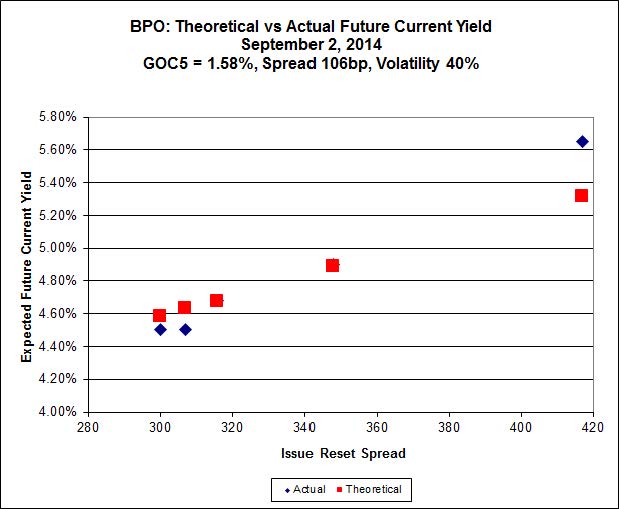
If we compare BMO.PR.S to its sort-of peers with volatility theory, we find:

Volatility_BMO_FR
Click for Big

So, we see that BMO.PR.S is still cheap to the theoretical curve, and that the theoretical curve is absurdly steep, which favours higher-spread issue such as BMO.PR.S. On the other hand, BMO.PR.S has over five years to go until its call date, well in excess of the 3-year figure I use for convenience, and that it’s NVCC compliant unlike the other plotted members, and that an assumption of directionality in price (and therefore a steep curve) is entirely rational for the non-NVCC issues. So take your choice.

Issue Comments

BAM: Trend Revised to Stable by DBRS

DBRS has announced:

The trend change reflects the combination of (1) increased financial flexibility to BAM, as 85% of its invested capital is now in listed companies (compared to DBRS’s estimate of 70% a year ago); (2) increased proportion and predictability of its asset management fees under the current corporate structure, a large proportion of which are fixed or based on sizes of investment under management, rather than performance or investment gains; and (3) improved financial metrics in 2013 due to strong operating cash flows from its investments and asset management fees, reduced corporate debt level and settlement of its contingent swap liabilities. With the improvements in 2013, BAM’s financial metrics with funds from operations (FFO, as defined by the Company) to debt of 38% and FFO interest coverage of 6.0 times (x) in 2013 (adjusted to exclude from FFO the one-time carried interests on private funds of $565 million) have exceeded the respective levels of 35% and 5.5x, targets DBRS had indicated in its previous report as necessary to maintain the current rating (“Funds from operation” are defined by BAM as “net income prior to fair value changes, depreciation and amortization, and deferred income taxes, and it also includes BAM’s proportionate share of FFO in its equity accounted investments”). The trend revision also factors into DBRS’s expectation that the Company will maintain these financial metrics generally in line with these targets for the foreseeable future.

BAM’s rating remains supported by its strong liquidity and financial flexibility, which has been further strengthened in the past two years with the listing of all its flagship companies. At a company level, BAM had access to $814 million of cash and financial assets and unused committed bank facilities of about $2.0 billion as at December 31, 2013. After the listing of Brookfield Property Partners, 85% of BAM’s invested capital is now invested in listed assets. Total market valuation of these listed assets (as at March 28, 2014) and its cash balance will be adequate to cover 5.5x of company-level debt of $3.980 billion at year-end 2013, compared to 4.6x a year ago.

This trend change follows a similar move by S&P last September.

Brookfield Asset Management is the proud issuer of:

FixedResets BAM.PF.A, BAM.PF.B, BAM.PF.E, BAM.PR.P, BAM.PR.R, BAM.PR.T, BAM.PR.X, BAM.PR.Z
Floaters BAM.PR.B, BAM.PR.C, BAM.PR.K
RatchetRate BAM.PR.E
FixedFloater BAM.PR.G
Straight Perpetual BAM.PR.M, BAM.PR.N, BAM.PF.C, BAM.PF.D

Issue Comments

NEW.PR.C Refunding To Proceed

Scotia Managed Companies has announced:

that the final condition required to extend the term of the Company for an additional five years to June 26, 2019 has been met as holders of 97.2% of Class A Capital Shares have elected to extend. Holders of Class A Capital Shares previously approved the extension of the term of the Company subject to the condition that a minimum of 1,287,000 Class A Capital Shares remain outstanding after giving effect to the special retraction right (the “Special Retraction Right”).

Under the Special Retraction Right, 72,755 Class A Capital Shares have been tendered to the Company for retraction on June 26, 2014. The holders of the remaining 2,500,623 Class A Capital Shares will continue to enjoy the benefits of a leveraged participation in the capital appreciation of the Company’s portfolio while potentially deferring any capital gains tax liability which would otherwise be realized on the redemption of their Class A Capital Shares. As part of the extension, the Company’s portfolio of common shares of Canadian chartered banks, telecommunication, utility and pipeline companies will be expanded to include selected issuers in the oil and gas sector and will be rebalanced to equal weight.

The Company’s Class B preferred shares, Series 2 (the “Series 2 Preferred Shares”) will be redeemed by the Company on June 26, 2014 in accordance with their redemption provisions at a price per share equal to the lesser of $13.70 and the Net Asset Value per Unit. In order to maintain the leveraged “split share” structure of the Company, the Company intends to create and issue a third series of Class B preferred shares (the “Series 3 Preferred Shares”), which are expected to be issued immediately following this redemption. In addition, the Company may also undertake a concurrent public offering of additional Class A Capital Shares at the same time the Series 3 Preferred Shares are offered.

NewGrowth Corp. is a mutual fund corporation whose Class A Capital Shares and Preferred Shares are listed for trading on the Toronto Stock Exchange under the symbols NEW.A and NEW.PR.C respectively.

The refunding has been discussed on PrefBlog. NEW.PR.C is tracked by HIMIPref™ but is assigned to the Scraps index on volume concerns.

Update, 2014-5-27: The refunding issue has been provisionally rated Pfd-2 by DBRS.

Issue Comments

LCS.PR.A To Get Bigger

Brompton Funds has announced:

that the Company’s treasury offering of class A and preferred shares has been priced at $7.00 per class A share and $10.00 per preferred share. The final class A share and preferred share offering prices were determined so as to be non-dilutive to the net asset value per unit of the Company on April 16, 2014, the most recently calculated net asset value, as adjusted for dividends and certain expenses accrued prior to or upon settlement of the offering.

Brompton Lifeco Split Corp. invests in a portfolio, on an approximately equal weight basis, of common shares of Canada’s four largest publicly-listed life insurance companies: Great-West Lifeco Inc., Industrial Alliance Insurance and Financial Services Inc., Manulife Financial Corporation and Sun Life Financial Inc.

The Company intends to file a final prospectus in each of the provinces and territories of Canada in connection with the offering. The offering is expected to close on or about May 1, 2014 and is subject to customary closing conditions including approvals of applicable securities regulatory authorities and the Toronto Stock Exchange.

The syndicate of agents for the offering is being led by RBC Capital Markets, CIBC, and Scotiabank, and includes BMO Capital Markets, National Bank Financial Inc., GMP Securities L.P., Raymond James Ltd., Desjardins Securities Inc., Dundee Securities Ltd., Mackie Research Capital Corporation, and Manulife Securities Incorporated.

On February 18, shareholders approved a term extension:

At a special meeting of preferred and class A shareholders (“Shareholders”) of Brompton Lifeco Split Corp. (“LCS”) held today, shareholders approved a special resolution to extend the term of LCS for approximately 5 years to April 29, 2019 and thereafter for successive terms of up to 5 years as determined by the LCS board of directors. Holders of Class A Shares voted approximately 99% in favour of the extension and holders of Preferred Shares voted approximately 97% in favour of the extension. The extension allows Shareholders to continue their investment in LCS’ portfolio of common shares of four Canadian life insurance companies (Great-West Lifeco Inc., Industrial Alliance Insurance and Financial Services Inc., Manulife Financial Corporation and Sun Life Financial Inc.). Shareholders will continue to have monthly and annual retraction rights.

In addition to the daily liquidity provided by the TSX listings, shareholders who do not wish to continue their investment may redeem either their preferred shares or class A shares on April 30, 2014 and each extension of the term thereafter on the same terms that currently exist. Further details are available in the management information circular dated January 15, 2014.

Prior to that (as a sweetener!) the company announced the dividend rate for the extension:

As previously announced, Brompton Lifeco Split Corp. (“LCS” or the “Fund”) will hold a special meeting of shareholders on February 18, 2014 to consider the proposed extension of the term of the Class A Shares and Preferred Shares of the Fund. If approved, shareholders will be able to continue their investment in the Fund beyond its currently scheduled termination date of April 30, 2014. The proposed extension will not result in any changes to shareholder redemption rights and is subject to shareholder approval. In the event that the proposed extension is not approved by shareholders, the Fund will terminate and Class A and Preferred shareholders will receive net asset value per Class A and Preferred Share, respectively.

If the extension is approved, the term of the Class A Shares and Preferred Shares will be extended to April 29, 2019 and the distribution rate for the Fund’s Preferred Shares for the new term commencing on May 1, 2014 will be $0.575 per share per annum payable quarterly. This represents a 5.75% yield on the par value ($10.00) of the Preferred Share and is based on current market rates for preferred shares with similar terms. In addition, the Fund intends to maintain the targeted monthly Class A Share distribution at $0.075 per Class A Share.

LCS invests in a portfolio, on an approximately equal weight basis, of common shares of Canada’s 4 largest publicly-listed life insurance companies: Great-West Lifeco Inc., Industrial Alliance Insurance and Financial Services Inc., Manulife Financial Corporation and Sun Life Financial Inc.

The information circular for the term extension was published in January.

LCS.PR.A was placed under Review-Positive by DBRS:

As part of the term extension, the fixed cumulative quarterly distributions to the Preferred Shares will be increased to $0.14375 per preferred share starting May 1, 2014, yielding 5.75% annually on their issue price of $10.00 per share (up from 5.25% previously). Holders of the Class A Shares are expected to continue receiving regular monthly targeted cash distributions of $0.075 per share, yielding 6% annually on their issue price of $15.00 per share. Class A Share distributions were suspended in March 2011, due to the net asset value of the Company falling below $15.00 per unit (i.e., 33% downside protection), but were reinstated in July 2013.

On December 23, 2013, DBRS upgraded the ratings of the Preferred Shares to Pfd-4 (high) from Pfd-5 (high). Since then, the performance of the Company has been generally stable, although downside protection has fallen slightly in April (37.2% as of April 10, 2014). Despite the drop, downside protection remains above levels typically seen at the Pfd-4 (high) level, and as a result, the rating of the Preferred Shares has been placed Under Review with Positive Implications.

The company’s upgrade to Pfd-4(high) by DBRS was reported on PrefBlog. LCS.PR.A is not tracked by HIMIPref™ as it is a very small issue – less than 1.7-million units are outstanding … let’s hope that changes!

Issue Comments

FFN.PR.A: Term Extension Details

Financial 15 Split Corp. II has released the Management Information Circular for its May 14 meeting.

The Articles of the Company currently provide that the Preferred Shares and the Class A Shares shall be redeemed by the Company on the Termination Date, which is currently scheduled for December 1, 2014. Shareholders are being asked to pass a special resolution which would, among other things, extend the Termination Date initially to December 1, 2019.

OK, a five year extension is fine since there is a Special Retraction Rights for preferred shareholders:

If the extension of the Termination Date is approved, a Shareholder who retracts a Class A Share under the 2014 Special Retraction Right will receive a retraction price per Class A Share equal to the net asset value per Unit calculated on June 13, 2014, less $10.00. A Shareholder who retracts a Preferred Share under the 2014 Special Retraction Right will receive a retraction price per Preferred Share equal to the lesser of (i) $10.00 and (ii) the net asset value per Unit calculated on June 13, 2014. Shareholders wishing to take advantage of the 2014 Special Retraction Right must surrender their Shares for retraction no later than the close of business on June 4, 2014. Payment for the Class A Shares or Preferred Shares so tendered for retraction pursuant to the 2014 Special Retraction Right will be made no later than June 27, 2014.

Similarly, there will be a Continuing Special Retraction Right, particularly necessary since there will be no vote on further extensions:

By approving the special resolution to extend the Termination Date of the Company to December 1, 2019, Shareholders will also be approving the extension of the Company for an additional term of five years as determined by the Board of Directors of the Company. The Termination Date may then be a further extended for additional successive terms of five years each in the discretion of the Board of Directors. Shareholders will be able to redeem their Shares in connection with any such five year extension by exercising an additional retraction right (the Continuing Special Retraction Right) which is again designed to provide Shareholders with an opportunity to retract their Shares and receive a retraction price that is calculated in the same way that such price would be calculated if the Company were to terminate on its scheduled Termination Date.

Similarly to FTN.PR.A, there’s a peculiar price calculation in the event of a semi-forced liquidation:

In the event the Company were to receive notice from the TSX that the Preferred Shares and the Class A Shares are to be delisted by the TSX, or if the net asset value of the Company were on any Valuation Date (as defined below) be less than $5,000,000 (each such event a Liquidation Event), the Manager could determine to cause the Company to redeem all outstanding Preferred Shares and Class A Shares on a date determined by the directors of the Company (the Liquidation Date) upon payment: (a) of an amount (the Preferred Share Liquidation Redemption Amount) in respect of each Preferred Share to be so redeemed equal to (i) (A) the net asset value of the Company on the Liquidation Date multiplied by a fraction, the numerator of which is the volume-weighted average trading price on the TSX (the VWAP) of the Preferred Shares calculated over the 20 trading days ending immediately prior to the announcement by the Company of the occurrence of the Liquidation Event and the denominator of which is the aggregate VWAP of the Preferred Shares and the Class A Shares calculated over the 20 trading days ending immediately prior to such announcement, divided by (B) the number of Preferred Shares outstanding on the Liquidation Date, plus (ii) all accrued and unpaid and declared and unpaid dividends on a Preferred Share to be so redeemed to but excluding the Liquidation Date;

As with FTN.PR.A, I don’t like it but it’s a minor issue.

The dividend will remain unchanged for the first extension:

For the fiscal year of the Company commencing December 1, 2014 and ending November 30, 2015, the dividend rate on the Preferred Shares will remain unchanged, such that holder of the Preferred Shares will continue to be entitled to receive fixed, cumulative, preferential monthly cash dividends of $0.04375 per Preferred Share. The special resolution will also permit the Company to set the prescribed minimum dividend rate on the Preferred Shares for the five year period commencing December 1, 2014 and for any five year extension of the term of the Company thereafter. This minimum rate would continue to be 5.25% of the Preferred Share Repayment Amount for the five year period from December 1, 2014 to November 30, 2019. The press release referred to above announcing the annual dividend rate for the Preferred Shares would also specify the minimum dividend rate established by the Company.

The monthly retraction formula is being changed in favour of retractors and the manager, to the disadvantage of the continuing shareholders:

Shareholders are being asked at the Meeting to approve a reduction in the discount to net asset value applicable on monthly redemptions of Shares from 4% to 2%. That is, holders of Preferred Shares would be entitled to receive a price per share equal to the lesser of (i) $10.00 and (ii) 98% of the net asset value per Unit determined as of the applicable retraction date, less the cost to the Company of the purchase of a Class A Share in the market for cancellation and less any other applicable costs and holders of Class A Shares would be entitled to receive a retraction price per share equal to 98% of the net asset value per Unit determined as of the applicable retraction date, less the cost to the Company of the purchase of a Preferred Share in the market for cancellation and less any other applicable costs.

The manager has the ability to earn a performance ha-ha fee:

Under the Investment Management Agreement, the Manager is currently entitled to a performance fee equal to 20% of the total return per Unit of the Company for a financial year (which includes all cash distributions per Unit made during the year and any increase in the net asset value per Unit from the beginning of the year after the deduction on a per Unit basis of all fees, other expenses and distributions) that exceeds 112% of the Bonus Threshold. The “Bonus Threshold”, for any financial year immediately following a year for which a performance fee is payable, is equal to the net asset value per Unit at the beginning of that financial year. The “Bonus Threshold”, for any financial year immediately following a year for which a performance fee is not payable, is equal to the greater of (i) the net asset value per Unit at the end of the immediately prior financial year; and (ii) the Bonus Threshold for the prior year, minus the Adjustment Amount. The “Adjustment Amount” for any financial year is the amount, if any, by which the net asset value per Unit at the end of the immediately prior financial year plus dividends paid in that prior year exceeds the Bonus Threshold for that prior year.

It will be somewhat easier for the manager to “earn” a performance fee:

Accordingly, Shareholders are being asked to pass a resolution to approve changes to the Investment Management Agreement to provide for the deletion of the $25.00 Condition and the Ratings Condition. In their place, a new condition would be imposed, such that no performance fee could be paid to the Manager in respect of any fiscal year of the Company unless, at the end of such fiscal year, the net asset value per Unit of the Company was at least two times the amount of the Preferred Share Repayment Amount (representing a minimum coverage requirement of 200% for the Preferred Shares). As the Preferred Share Repayment Amount is currently $10.00 per Preferred Share, this would require the net asset value per Unit of the Company to be at least $20.00 before any performance fee could be paid.

The performance fee is nonsensical and constitutes yet another reason not to buy the Capital Units. The return on the fund is going to be overwhelmingly determined by the performance of the benchmark; manager skill is secondary. If they really wanted to be paid for performance, the calculation would depend on the fund performance relative to a benchmark over a period of not less than four years.

But it doesn’t matter to preferred shareholders. Nothing will be payable unless there’s Asset Coverage of at least 2:1, which is fine, and every penny of the fee comes out of the Capital Unitholders’ hide anyway. So who cares?

The final item fraught with interest is the NAV test, whereby there are no distributions to Capital Units if the NAV is less than $15.00. This will remain unchanged.

All in all, it’s a good deal for preferred shareholders. I recommend that Preferred Shareholders vote in favour of the Special Resolution.

Issue Comments

FTN.PR.A: Term Extension Proposal Details

Financial 15 Split Corp. has released the Management Information Circular for its May 14 meeting.

The Articles of the Company currently provide that the Preferred Shares and the Class A Shares shall be redeemed by the Company on the Termination Date, which is currently scheduled for December 1, 2015. Shareholders are being asked to pass a special resolution which would, among other things, extend the Termination Date initially to December 1, 2020.

OK, a five year extension is fine. What’s more, there is not just one, but two, count ’em, two Special Retraction Rights for preferred shareholders:

If the extension of the Termination Date is approved, a Shareholder who retracts a Class A Share under the 2014 Special Retraction Right will receive a retraction price per Class A Share equal to the net asset value per Unit calculated on June 13, 2014, less $10.00. A Shareholder who retracts a Preferred Share under the 2014 Special Retraction Right will receive a retraction price per Preferred Share equal to the lesser of (i) $10.00 and (ii) the net asset value per Unit calculated on June 13, 2014. Shareholders wishing to take advantage of the 2014 Special Retraction Right must surrender their Shares for retraction no later than the close of business on June 4, 2014. Payment for the Class A Shares or Preferred Shares so tendered for retraction pursuant to the 2014 Special Retraction Right will be made no later than June 27, 2014.

If the extension of the Termination Date is approved, a Shareholder who retracts a Preferred Share under the 2015 Special Retraction Right will receive a retraction price per Preferred Share equal to the lesser of (i) $10.00 and (ii) the net asset value per Unit calculated on November 30, 2015. Shareholders wishing to take advantage of the 2015 Special Retraction Right must surrender their Preferred Shares for retraction no later than the close of business on November 13, 2015. Payment for the Preferred Shares so tendered for retraction pursuant to the 2015 Special Retraction Right will be made no later than December 15, 2015.

They don’t want to take another vote in five years:

By approving the special resolution to extend the Termination Date of the Company to December 1, 2020, Shareholders will also be approving the extension of the Company for an additional term of five years as determined by the Board of Directors of the Company. The Termination Date may then be further extended for additional successive terms of five years each in the discretion of the Board of Directors. Shareholders will be able to redeem their Shares in connection with any such five year extension by exercising an additional retraction right (the Continuing Special Retraction Right) which is again designed to provide Shareholders with an opportunity to retract their Shares and receive a retraction price that is calculated in the same way that such price would be calculated if the Company were to terminate on its scheduled Termination Date.

Oddly, there is a strange price calculation in the event of a (semi-)forced liquidation:

In the event the Company were to receive notice from the TSX that the Preferred Shares and the Class A Shares are to be delisted by the TSX, or if the net asset value of the Company were on any Valuation Date (as defined below) be less than $5,000,000 (each such event a Liquidation Event), the Manager could determine to cause the Company to redeem all outstanding Preferred Shares and Class A Shares on a date determined by the directors of the Company (the Liquidation Date) upon payment:

(g) of an amount (the Preferred Share Liquidation Redemption Amount) in respect of each Preferred Share to be so redeemed equal to (i) (A) the net asset value of the Company on the Liquidation Date multiplied by a fraction, the numerator of which is the volume-weighted average trading price on the TSX (the VWAP) of the Preferred Shares calculated over the 20 trading days ending immediately prior to the announcement by the Company of the occurrence of the Liquidation Event and the denominator of which is the aggregate VWAP of the Preferred Shares and the Class A Shares calculated over the 20 trading days ending immediately prior to such announcement, divided by (B) the number of Preferred Shares outstanding on the Liquidation Date, plus (ii) all accrued and unpaid and declared and unpaid dividends on a Preferred Share to be so redeemed to but excluding the Liquidation Date; and

I don’t understand the necessity for this and don’t like it, but the chances of it being triggered are remote and the ill effects if it is are fairly muted, so we’ll let it pass.

A critical issue is the dividend rate on the preferreds:

The special resolution will permit the Company to file an amendment to the Articles that will permit the Company to determine the annual rate of cumulative preferential monthly dividends for the Preferred Shares for the one year period commencing December 1, 2015 and for each fiscal year of the Company thereafter, subject to prescribed minimum annual dividend. Such determination will be made no later than September 30 (or the first business day thereafter, if September 30 is not a business day) each year during the term of the Company and announced by press release.

The special resolution will also permit the Company to set the prescribed minimum dividend rate on the Preferred Shares for the five year period commencing December 1, 2015 and for any five year extension of the term of the Company thereafter. This minimum rate would be a specified percentage of the Preferred Share Repayment Amount. The Preferred Share Repayment Amount is the amount payable per Preferred Share on the Termination Date and is currently $10.00 per Preferred Share. In the event of any subdivision or consolidation of the Preferred Shares, the Preferred Share Repayment Amount would be adjusted accordingly. The press release referred to above announcing the annual dividend rate for the Preferred Shares would also specify the minimum dividend rate established by the Company.

The prescribed minimum dividend amount for the Preferred Shares would be set at 5.25% of the Preferred Share Repayment Amount for the initial five year extension term beginning on December 1, 2015 and ending on November 30, 2020. This change will provide the Board of Directors with the opportunity to make any appropriate changes to the amounts paid on the Preferred Shares in the context of market conditions existing at the relevant time. As there would no longer be a fixed Termination Date for the Company, the Board of Directors believes it important to provide for additional flexibility in this regard.

Fair enough. The dividend rate will not go down for the first extension (and if it doesn’t go up enough, we can take advantage of the 2015 Special Retraction Right. The “minimum dividend rate” appears to be setting up for a potential floating rate with a cap and collar, such as is the case with Canadian Banc Corp.

The monthly retraction formula is being changed in favour of retractors and the manager, to the disadvantage of the continuing shareholders:

Shareholders are being asked at the Meeting to approve a reduction in the discount to net asset value applicable on monthly redemptions of Shares from 4% to 2%. That is, holders of Preferred Shares would be entitled to receive a price per share equal to the lesser of (i) $10.00 and (ii) 98% of the net asset value per Unit determined as of the applicable retraction date, less the cost to the Company of the purchase of a Class A Share in the market for cancellation and less any other applicable costs and holders of Class A Shares would be entitled to receive a retraction price per share equal to 98% of the net asset value per Unit determined as of the applicable retraction date, less the cost to the Company of the purchase of a Preferred Share in the market for cancellation and less any other applicable costs.

It is therefore proposed that the 2% discount would be payable to the Manager to partially compensate the Manager for this reduction in management fees.

The manager has the ability to earn a performance ha-ha fee:

Under the Investment Management Agreement, the Manager is currently entitled to a performance fee equal to 20% of the total return per Unit of the Company for a financial year (which includes all cash distributions per Unit made during the year and any increase in the net asset value per Unit from the beginning of the year after the deduction on a per Unit basis of all fees, other expenses and distributions) that exceeds 112% of the Bonus Threshold. The “Bonus Threshold”, for any financial year immediately following a year for which a performance fee is payable, is equal to the net asset value per Unit at the beginning of that financial year. The “Bonus Threshold”, for any financial year immediately following a year for which a performance fee is not payable, is equal to the greater of (i) the net asset value per Unit at the end of the immediately prior financial year; and (ii) the Bonus Threshold for the prior year, minus the Adjustment Amount. The “Adjustment Amount” for any financial year is the amount, if any, by which the net asset value per Unit at the end of the immediately prior financial year plus dividends paid in that prior year exceeds the Bonus Threshold for that prior year.

It will be somewhat easier for the manager to “earn” a performance fee:

Accordingly, Shareholders are being asked to pass a resolution to approve changes to the Investment Management Agreement to provide for the deletion of the $25.00 Condition and the Ratings Condition. In their place, a new condition would be imposed, such that no performance fee could be paid to the Manager in respect of any fiscal year of the Company unless, at the end of such fiscal year, the net asset value per Unit of the Company was at least two times the amount of the Preferred Share Repayment Amount (representing a minimum coverage requirement of 200% for the Preferred Shares).

The performance fee is nonsensical and constitutes yet another reason not to buy the Capital Units. The return on the fund is going to be overwhelmingly determined by the performance of the benchmark; manager skill is secondary. If they really wanted to be paid for performance, the calculation would depend on the fund performance relative to a benchmark over a period of not less than four years.

But it doesn’t matter to preferred shareholders. Nothing will be payable unless there’s Asset Coverage of at least 2:1, which is fine, and every penny of the fee comes out of the Capital Unitholders’ hide anyway. So who cares?

The final item fraught with interest is the NAV test, whereby there are no distributions to Capital Units if the NAV is less than $15.00. This will remain unchanged.

All in all, it’s a good deal for preferred shareholders. I recommend that Preferred Shareholders vote in favour of the Special Resolution.

Issue Comments

BMO.PR.O To Be Redeemed

Bank of Montreal has announced:

its intention to redeem all of its $275,000,000 Non-Cumulative 5-Year Rate Reset Class B Preferred Shares Series 21 (“Preferred Shares Series 21”) on May 25, 2014.

The Preferred Shares Series 21 are redeemable at Bank of Montreal’s option on May 25, 2014, at a redemption price of $25.00 per share. Payment of the redemption price will be made by Bank of Montreal on or after May 26, 2014, upon surrender of the Preferred Shares Series 21.

Separately from the payment of the redemption price, the final quarterly dividend of $0.40625 per share for the Preferred Shares Series 21 will be paid in the usual manner on May 26, 2014, to shareholders of record on May 1, 2014.

Notice will be delivered to holders of the Preferred Shares Series 21 in accordance with the terms outlined in the Preferred Shares Series 21 prospectus supplement.

BMO.PR.O is a FixedReset, 6.50%+458, commenced trading 2009-3-20 after being announced 2009-3-11. The size of the Issue Reset Spread means that the redemption shouldn’t come as a surprise to anyone.

Issue Comments

POW.PR.F Sinking Fund

I received a call today from Assiduous Reader HR, who brought to my attention the buy-back provisions of POW.PR.F:

The First Preferred Shares – 1986 Series are entitled to a quarterly cumulative dividend at a floating rate equal to one quarter of 70% of the average prime rate of two major Canadian chartered banks. Dividends are payable on the 15th day of each of the months of January, April, July, and October in each year.

The shares are redeemable by the Corporation for $50 per share plus declared and unpaid dividends. The Corporation will make all reasonable efforts to purchase for cancellation on the open market 20,000 shares per quarter, such number being cumulative only in the same calendar year.

It’s interesting because according to the 2013 Annual Report:

During the twelve months ended December 31, 2013, the Corporation purchased 12,000 of such shares.

In 2012:

During the twelve months ended December 31, 2012, the Corporation purchased 40,000 such shares.

In 2011:

A total of 77,300 such shares were purchased during the twelve months ended December 31, 2011.

In 2010:

A total of 80,000 such shares were purchased during the twelve months ended December 31, 2010.

In 2009:

A
total of 80,000 such shares were purchased during the twelve months ended December 31, 2009.

In 2008:

A total of 60,000 such shares were purchased during the twelve-month period of 2008.

So it’s clear they’ve made their quota occasionally, but have fallen far short in the past two years. Now, let it be said that these things are hopelessly illiquid. According to the Exchange, there are 530,578 outstanding, about $25-million worth. They are the second-least liquid issue in the HIMIPref™ universe, with an Average Daily Trading Value of only $1,290, beaten only by BSC.PR.B, a split-share with only 713,371 shares outstanding (at a par value of 18.85). They were intermittently included in the Floater subindex a few times in the 1990s – one month in 1994, two months in 1996, two in 1997 and one in 1999 – but otherwise, and since November 30, 1999, they have been relegated to the Scraps sub-index on volume concerns.

But look at this!

POWPRF
Click for Big

Since January 2, 2013, there has not been a single day on which the closing quote provided by the Exchange has been above $50.00. The maximum offer has been $49.90. So, one might think, “all reasonable efforts” would include lifting the offer every day, even if only for 100 shares a time, but this clearly isn’t happening. How come?

I suspect that one reason is the volume: in all of 2013, all of 47,734 shares traded on the Toronto Exchange (there may have been more on Alpha, etc., but my guess is ‘not many’). So to give them their due, buying 12,000 shares ranks as something of an accomplishment, even though it doesn’t meet quota.

It occurred to me that there might be exchange rules with respect to issuer bids. According to the Exchange rules on Normal Course Issuer Bids:

It is inappropriate for an issuer making a Normal Course Issuer Bid to abnormally influence the market price of its shares. Therefore, purchases made by Issuers pursuant to a Normal Course Issuer Bid must not be transacted at a price which is higher than the last independent trade of a Board Lot of the class of shares which is the subject of the Normal Course Issuer Bid.

So if a single Board Lot escapes their net and hits an independent bid, then they can’t bid any more than that price until a higher independent transaction occurs.

Not only that, but there are time and volume restrictions in a NCIB:

“normal course issuer bid” means an issuer bid by a listed issuer to acquire its listed securities where the purchases:

(a) if the issuer is not an investment fund, do not, when aggregated with all other purchases by the listed issuer during the same trading day, aggregate more than the greater of: (i) 25% of the average daily trading volume of the listed securities of that class; and (ii) 1,000 securities;

(b) if the issuer is an investment fund, do not, when aggregated with the total of all other purchases by the listed issuer during the preceding 30 days, aggregate more than 2% of the listed securities of that class outstanding on the date of acceptance of the notice of normal course issuer bid by the Exchange; and

(c) over a 12-month period, commencing on the date specified in the notice of the normal course issuer bid, do not exceed the greater of
(i) 10% of the public float on the date of acceptance of the notice of normal course issuer bid by the Exchange; or

(ii) 5% of such class of securities issued and outstanding on the date of acceptance of the notice of normal course issuer bid by the Exchange, excluding any securities held by or on behalf of the listed issuer on the date of acceptance of the notice of normal course issuer bid by the Exchange,

and for the purposes of (b) and (c), whether such purchases are made through the facilities of a stock exchange or otherwise, but excluding purchases made under a circular bid.

7. Block Purchase Exception—A listed issuer may make one block purchase per calendar week which exceeds the daily repurchase restriction contained in subsection 628(a)(ix)(a) of the Company Manual, subject to maximum annual aggregate limits. Once the block purchase exception has been relied on, the listed issuer may not make any further purchases under the normal course issuer bid for the remainder of that calendar day.

8. Purchases at the Opening and Closing—A listed issuer shall not make any purchases of its securities pursuant to a normal course issuer bid at the opening of a trading session, or during the 30 minutes before the scheduled close of a trading session. However, notwithstanding Policy 6-501(1)(1), purchases of securities pursuant to a normal course issue bid may be effected through the Exchange’s Market-On-Close facility

These restrictions were important during the NCIB for CWB.PR.A:

Apart from block purchase exceptions, the maximum number of preferred shares that may purchased per trading day is 1,538, an amount equal to 25% of the average daily trading volume of the preferred shares on the TSX for the six month period ended January 31, 2013.

Now, despite spending a considerable amount of time with Mr. Google, SEDAR and the Power Corporation website, I have not been able to find anything that definitively states that the purchases of POW.PR.F constitute a Normal Course Issuer Bid. I think they do, but I’m not a specialist in such matters and if I was, I’d shoot myself. There are a lot of rules and compliance for such a hopelessly illiquid security must be a nightmare.

But I will send an inquiry to the company.

Issue Comments

LFE.PR.B Monthly Retraction Price

The calculation of the monthly retraction price stated in the Annual Information Form:

Except as noted below, holders of Preferred Shares whose Shares are surrendered for retraction will be entitled to receive a price per Share (the “Preferred Share Retraction Price”) equal to the sum of (i) the sum of (A) the lesser of (x) $10.00 and (y) 98% of the net asset value per Unit determined as of the Retraction Date, less in either case the cost to the Company of the purchase of a Class A Share in the market for cancellation and less any other applicable costs, plus (B) an amount equal to any accrued and unpaid dividends on each Preferred Share to but excluding the applicable Retraction Date, plus (ii) all declared and unpaid dividends (“Dividends Owing”) on a Preferred Share to be retracted to but excluding the applicable Retraction Date.

… differs from that specified in the prospectus:

Holders retracting a Preferred Share will be entitled to receive an amount per Preferred Share equal to the lesser of (i) $10.00; and (ii) 96% of the Net Asset Value determined as of the Retraction Date less the cost to the Company of the purchase of a Class A Share in the market for cancellation.

Complicating matters – there’s always a complication! – was the 2012 Capital Reorganization, in which:

amend the Articles of the Company to decrease the discount to net asset value applicable to monthly redemptions of shares from 4% to 2% and provide for the amount of this reduced discount to be paid to Quadravest, and not retained by the Company;

I sent an inquiry to the company:

I am concerned regarding the phrase ” less in either case ” found in the AIF version. If, for instance, there was a situation in which NAVPU was $12 and the market price of a Class A Share was $1, it would appear that this $1 for the Class A share would be deducted from ” (x) $10.00 ” and thus [assuming that amount (ii) = 0] the Preferred Share Retraction Price would be $9.00, whereas under the prospectus language, the Preferred Share Retraction Price would be $10.00.

To but it another way, the AIF phrase “less in either case” appears to apply to both case (x) and case (y), which differs from the prospectus language, unamended by the reorganization, and which doesn’t make a lot of sense anyway.

Can you clarify the calculation of the Preferred Share Retraction Price?

The company responded very quickly and efficiently:

Payment for LFE.PR.B shares retracted would be the lessor of (a) $10 or (b) 98% of the net asset value per unit, less the cost to buy a LFE share in the market for cancellation.

In your example below, based on a net asset value per unit of $12, the calculation (b) above would be: (98% x $12) less $1 = $10.76. Please note there could also be a maximum of 1% charged should the fund have to unwind securities in the event of a large volume of retractions in a particular month.

Therefore the lessor of (a) and (b) would still be $10.

I don’t expect the monthly retraction option to be viable unless there is another market crash, but it’s always nice to have these things nailed down in advance.