Category: MAPF

MAPF

MAPF Performance: November 2010

The fund had another good month in November.

The fund’s Net Asset Value per Unit as of the close November 30 was $11.8495.

Returns to November 30, 2010
Period MAPF Index CPD
according to
Claymore
One Month +1.40% +0.65% +0.25%
Three Months +8.52% +5.16% +3.81%
One Year +18.53% +12.32% +8.71%
Two Years (annualized) +50.73% +23.15% +20.04% *
Three Years (annualized) +24.94% +6.24% +4.06%
Four Years (annualized) +16.67% +2.89%  
Five Years (annualized) +14.59% +3.19%  
Six Years (annualized) +13.18% +3.45%  
Seven Years (annualized) +13.42% +3.82%  
Eight Years (annualized) +15.44% +4.30%  
Nine Years (annualized) +13.41% +4.10%  
The Index is the BMO-CM “50”
MAPF returns assume reinvestment of dividends, and are shown after expenses but before fees.
CPD Returns are for the NAV and are after all fees and expenses.
* CPD does not directly report its two-year returns. The figure shown is the square root of product of the current one-year return and the similar figure reported for November 2009.
Figures for Omega Preferred Equity (which are after all fees and expenses) for 1-, 3- and 12-months are +0.29%, +3.83% and +10.39%, respectively, according to Morningstar after all fees & expenses. Three year performance is +5.09%.
Figures for Jov Leon Frazer Preferred Equity Fund Class I Units (which are after all fees and expenses) for 1-, 3- and 12-months are -0.10%, +2.24% & +7.27% respectively, according to Morningstar
Figures for Manulife Preferred Income Fund (formerly AIC Preferred Income Fund) (which are after all fees and expenses) for 1-, 3- and 12-months are +0.00%, +2.44% & +5.78%, respectively
Figures for Horizons AlphaPro Preferred Share ETF are not yet available (inception date 2010-11-23)

MAPF returns assume reinvestment of dividends, and are shown after expenses but before fees. Past performance is not a guarantee of future performance. You can lose money investing in Malachite Aggressive Preferred Fund or any other fund. For more information, see the fund’s main page. The fund is available either directly from Hymas Investment Management or through a brokerage account at Odlum Brown Limited.

Sometimes everything works … sometimes the trading works, but sectoral shifts overwhelm the increment … sometimes nothing works. The fund seeks to earn incremental return by selling liquidity (that is, taking the other side of trades that other market participants are strongly motivated to execute), which can also be referred to as ‘trading noise’. There were a lot of strongly motivated market participants during the Panic of 2007, generating a lot of noise! Unfortunately, the conditions of the Panic may never be repeated in my lifetime … but the fund will simply attempt to make trades when swaps seem profitable, whether that implies monthly turnover of 10% or 100%.

The fund’s returns were helped along by the overweighting in deeply discounted PerpetualDiscounts in which the fund is still overweighted (see MAPF Portfolio Composition: November 2010) although not as overweighted as it has been. While this type of issue generally outperformed, the effect is nowhere near as marked as was reported in October.


Click for Big

There’s plenty of room for new money left in the fund. I have shown in recent issues of PrefLetter that market pricing for FixedResets is demonstrably stupid and I have lots of confidence – backed up by my bond portfolio management experience in the markets for Canadas and Treasuries, and equity trading on the NYSE & TSX – that there is enough demand for liquidity in any market to make the effort of providing it worthwhile (although the definition of “worthwhile” in terms of basis points of outperformance changes considerably from market to market!) I will continue to exert utmost efforts to outperform but it should be borne in mind that there will almost inevitably be periods of underperformance in the future.

The yields available on high quality preferred shares remain elevated, which is reflected in the current estimate of sustainable income.

Calculation of MAPF Sustainable Income Per Unit
Month NAVPU Portfolio
Average
YTW
Leverage
Divisor
Securities
Average
YTW
Capital
Gains
Multiplier
Sustainable
Income
per
current
Unit
June, 2007 9.3114 5.16% 1.03 5.01% 1.1883 0.3926
September 9.1489 5.35% 0.98 5.46% 1.1883 0.4203
December, 2007 9.0070 5.53% 0.942 5.87% 1.1883 0.4448
March, 2008 8.8512 6.17% 1.047 5.89% 1.1883 0.4389
June 8.3419 6.034% 0.952 6.338% 1.1883 $0.4449
September 8.1886 7.108% 0.969 7.335% 1.1883 $0.5054
December, 2008 8.0464 9.24% 1.008 9.166% 1.1883 $0.6206
March 2009 $8.8317 8.60% 0.995 8.802% 1.1883 $0.6423
June 10.9846 7.05% 0.999 7.057% 1.1883 $0.6524
September 12.3462 6.03% 0.998 6.042% 1.1883 $0.6278
December 2009 10.5662 5.74% 0.981 5.851% 1.0000 $0.6182
March 2010 10.2497 6.03% 0.992 6.079% 1.0000 $0.6231
June 10.5770 5.96% 0.996 5.984% 1.0000 $0.6329
September 11.3901 5.43% 0.980 5.540% 1.0000 $0.6310
November 2010 11.8495 5.39% 0.998 5.401% 1.0000 $0.6400
NAVPU is shown after quarterly distributions of dividend income and annual distribution of capital gains.
Portfolio YTW includes cash (or margin borrowing), with an assumed interest rate of 0.00%
The Leverage Divisor indicates the level of cash in the account: if the portfolio is 1% in cash, the Leverage Divisor will be 0.99
Securities YTW divides “Portfolio YTW” by the “Leverage Divisor” to show the average YTW on the securities held; this assumes that the cash is invested in (or raised from) all securities held, in proportion to their holdings.
The Capital Gains Multiplier adjusts for the effects of Capital Gains Dividends. On 2009-12-31, there was a capital gains distribution of $1.989262 which is assumed for this purpose to have been reinvested at the final price of $10.5662. Thus, a holder of one unit pre-distribution would have held 1.1883 units post-distribution; the CG Multiplier reflects this to make the time-series comparable. Note that Dividend Distributions are not assumed to be reinvested.
Sustainable Income is the resultant estimate of the fund’s dividend income per current unit, before fees and expenses. Note that a “current unit” includes reinvestment of prior capital gains; a unitholder would have had the calculated sustainable income with only, say, 0.9 units in the past which, with reinvestment of capital gains, would become 1.0 current units.

Significant positions were held in Fixed-Reset issues on November 30; all of which (with the exception of the two YLO issues) currently have their yields calculated with the presumption that they will be called by the issuers at par at the first possible opportunity. This presents another complication in the calculation of sustainable yield. The fund also holds a position in a SplitShare (BNA.PR.C) which also has its yield calculated with the expectation of a maturity.

However, if the entire portfolio except for the PerpetualDiscounts were to be sold and reinvested in these issues, the yield of the portfolio would be the 5.51% shown in the MAPF Portfolio Composition: November 2010 analysis (which is in excess of the 5.41% index yield on November 30). Given such reinvestment, the sustainable yield would be $11.8495 * 0.0551 = $0.6529, a nice increase from the $0.6474 reported last month.

Note that there will be a drag on the calculation in up-markets due to presence of shorter-term issues (or, at least, presumed shorter term issues!); the question is whether the positive effect of these issues in down markets will outweight their negative effect in up-markets – all I can say is … it has in the past!

Different assumptions lead to different results from the calculation, but the overall positive trend is apparent. I’m very pleased with the results! It will be noted that if there was no trading in the portfolio, one would expect the sustainable yield to be constant (before fees and expenses). The success of the fund’s trading is showing up in

  • the very good performance against the index
  • the long term increases in sustainable income per unit

As has been noted, the fund has maintained a credit quality equal to or better than the index; outperformance is due to constant exploitation of trading anomalies.

Again, there are no predictions for the future! The fund will continue to trade between issues in an attempt to exploit market gaps in liquidity, in an effort to outperform the index and keep the sustainable income per unit – however calculated! – growing.
MAPF

MAPF Portfolio Composition: November 2010

Turnover remained fairly constant in November, at just under 30%.

Trades were, as ever, triggered by a desire to exploit transient mispricing in the preferred share market (which may be thought of as “selling liquidity”), rather than any particular view being taken on market direction, sectoral performance or credit anticipation.

MAPF Sectoral Analysis 2010-11-30
HIMI Indices Sector Weighting YTW ModDur
Ratchet 0% N/A N/A
FixFloat 0% N/A N/A
Floater 0% N/A N/A
OpRet 0% N/A N/A
SplitShare 2.2% (+0.8) 5.97% 6.70
Interest Rearing 0% N/A N/A
PerpetualPremium 18.9% (+10.3) 5.76% 9.49
PerpetualDiscount 65.1% (-9.5) 5.51% 14.65
Fixed-Reset 10.2% (0) 3.36% 3.11
Scraps (FixedReset) 3.6% (0) 6.83% 12.58
Cash 0.2% (-1.4) 0.00% 0.00
Total 100% 5.39% 12.24
Totals and changes will not add precisely due to rounding. Bracketted figures represent change from October month-end. Cash is included in totals with duration and yield both equal to zero.

The “total” reflects the un-leveraged total portfolio (i.e., cash is included in the portfolio calculations and is deemed to have a duration and yield of 0.00.). MAPF will often have relatively large cash balances, both credit and debit, to facilitate trading. Figures presented in the table have been rounded to the indicated precision.

The increase in PerpetualPremium holdings at the expense of PerpetualDiscounts is related to a shift in credit quality from the Pfd-1(low) bucket to the Pfd-2(high) bucket and will be discussed below.

As reported in the post HIMIPref™ Index Performance, November 2010, PerpetualDiscounts significantly outperformed PerpetualPremiums over the month; unfortunately, heterogeniety of the data set does not allow us to conclude that Implied Volatility increased. In fact, for the three issuers with a sufficient sample of dividend rates, volatility was relatively constant, although it became more homogeneous between these specific issuers.

Analysis of the data using the Straight Perpetual Implied Volatility Calculator produces the following table:

Fits to Implied Volatility
Issuer 2010-10-29 2010-11-30
Yield Volatility Yield Volatility
PWF 4.40% 25% 4.45% 25%
CM 4.80% 17% 4.13% 24%
GWO 0.99% 35% 3.60% 30%
Calculations are performed with a time horizon of three years for all issues

As discussed in the October edition of PrefLetter, the implied volatility calculated for GWO is very high and implies a questionable assessment of the probability distribution of future yields, but it looks like the market is finding a level for Implied Volatility in the mid- to high-twenties.

Graphs from the Straight Perpetual Volatility Calculator for November 30 are:


Click for Big


Click for Big


Click for Big

The yield pick-up for holding high-coupon Straights is such one should no longer automatically buy the deepest-discount issue in a series!

Credit distribution is:

MAPF Credit Analysis 2010-11-30
DBRS Rating Weighting
Pfd-1 0 (0)
Pfd-1(low) 54.5% (-10.1)
Pfd-2(high) 21.9% (+8.7)
Pfd-2 0 (0)
Pfd-2(low) 19.9% (+2.9)
Pfd-3(high) 3.6% (0)
Cash 0.2% (-1.4)
Totals will not add precisely due to rounding. Bracketted figures represent change from October month-end.

As noted earlier, the shift in holdings weight from Pfd-1(low) to Pfd-2(high) is related to the shift from PerpetualDiscounts to PerpetualPremiums. Most of the move is explained by the following trades:

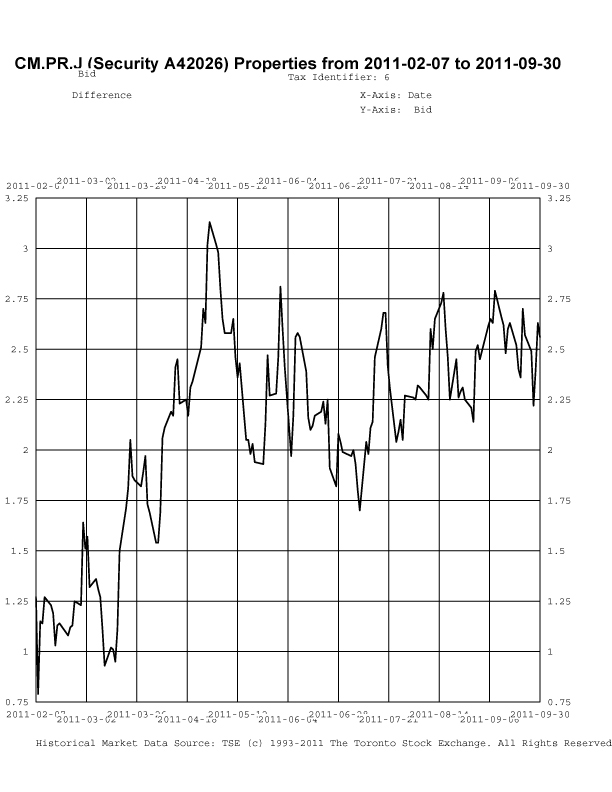
November Swap from Low-Coupon CM to High-Coupon IAG
Date CM.PR.I CM.PR.H IAG.PR.F
10/29
Bid
22.48 22.93 25.40
11/5
Trade
Sold
22.83
Sold
23.29
Bot
25.49
11/30
Bid
22.80 23.17 25.18
Dividends     Earned
0.36875
11/24
This table represents an attempt to present fairly the net effect of a sequence of trades. Full particulars of all fund transactions will be disclosed when the fund’s audited financials are published.

Liquidity Distribution is:

MAPF Liquidity Analysis 2010-10-29
Average Daily Trading Weighting
<$50,000 0.0% (0)
$50,000 – $100,000 11.6% (-1.3)
$100,000 – $200,000 18.9% (-5.3)
$200,000 – $300,000 20.3% (+0.3)
>$300,000 49.1% (+7.2)
Cash 0.2% (-1.4)
Totals will not add precisely due to rounding. Bracketted figures represent change from October month-end.

MAPF is, of course, Malachite Aggressive Preferred Fund, a “unit trust” managed by Hymas Investment Management Inc. Further information and links to performance, audited financials and subscription information are available the fund’s web page. The fund may be purchased either directly from Hymas Investment Management or through a brokerage account at Odlum Brown Limited. A “unit trust” is like a regular mutual fund, but is sold by offering memorandum rather than prospectus. This is cheaper, but means subscription is restricted to “accredited investors” (as defined by the Ontario Securities Commission) and those who subscribe for $150,000+. Fund past performances are not a guarantee of future performance. You can lose money investing in MAPF or any other fund.

A similar portfolio composition analysis has been performed on the Claymore Preferred Share ETF (symbol CPD) as of August 31, 2010, and published in the September, 2010, PrefLetter. When comparing CPD and MAPF:

  • MAPF credit quality is better
  • MAPF liquidity is a higher
  • MAPF Yield is higher
  • Weightings in
    • MAPF is much more exposed to Straight Perpetuals
    • MAPF is much less exposed to Operating Retractibles
    • MAPF is slightly more exposed to SplitShares
    • MAPF is less exposed to FixFloat / Floater / Ratchet
    • MAPF weighting in FixedResets is much lower
MAPF

MAPF Performance: October 2010

The fund had another good month in October.

The fund’s Net Asset Value per Unit as of the close September 30 was $11.6856.

Returns to October 29, 2010
Period MAPF Index CPD
according to
Claymore
One Month +2.59% +2.02% +1.40%
Three Months +8.80% +5.85% +4.70%
One Year +21.24% +14.27% +10.82%
Two Years (annualized) +42.59% +16.00% +13.07% *
Three Years (annualized) +24.25% +5.72% +3.56%
Four Years (annualized) +16.77% +2.95%  
Five Years (annualized) +14.60% +3.37%  
Six Years (annualized) +13.20% +3.48%  
Seven Years (annualized) +13.51% +3.78%  
Eight Years (annualized) +15.05% +4.22%  
Nine Years (annualized) +13.13% +4.14%  
The Index is the BMO-CM “50”
MAPF returns assume reinvestment of dividends, and are shown after expenses but before fees.
CPD Returns are for the NAV and are after all fees and expenses.
* CPD does not directly report its two-year returns. The figure shown is the square root of product of the current one-year return and the similar figure reported for October 2009.
Figures for Omega Preferred Equity (which are after all fees and expenses) for 1-, 3- and 12-months are +1.45%, +4.97% and +12.58%, respectively, according to Morningstar after all fees & expenses
Figures for Jov Leon Frazer Preferred Equity Fund Class I Units (which are after all fees and expenses) for 1-, 3- and 12-months are +1.15%, +3.56% & +9.06% respectively, according to Morningstar
Figures for Manulife Preferred Income Fund (formerly AIC Preferred Income Fund) (which are after all fees and expenses) for 1-, 3- and 12-months are +0.99%, +2.79% & +7.55%, respectively
Figures for Horizons AlphaPro Preferred Share ETF are not yet available (inception date 2010-11-23)

MAPF returns assume reinvestment of dividends, and are shown after expenses but before fees. Past performance is not a guarantee of future performance. You can lose money investing in Malachite Aggressive Preferred Fund or any other fund. For more information, see the fund’s main page. The fund is available either directly from Hymas Investment Management or through a brokerage account at Odlum Brown Limited.

Sometimes everything works … sometimes the trading works, but sectoral shifts overwhelm the increment … sometimes nothing works. The fund seeks to earn incremental return by selling liquidity (that is, taking the other side of trades that other market participants are strongly motivated to execute), which can also be referred to as ‘trading noise’. There have been a lot of strongly motivated market participants in the recent past, generating a lot of noise! Unfortunately, the conditions of the Panic of 2007 may never be repeated in my lifetime … but the fund will simply attempt to make trades when swaps seem profitable, whether that implies monthly turnover of 10% or 100%.

The fund’s returns were helped along by the overweighting in deeply discounted PerpetualDiscounts; as discussed in MAPF Portfolio Composition: October 2010, volatility has been rising while yields have been falling, which resulted in this type of issue strongly outperforming.


Click for Big

There’s plenty of room for new money left in the fund. I have shown in recent issues of PrefLetter that market pricing for FixedResets is demonstrably stupid and I have lots of confidence – backed up by my bond portfolio management experience in the markets for Canadas and Treasuries, and equity trading on the NYSE & TSX – that there is enough demand for liquidity in any market to make the effort of providing it worthwhile (although the definition of “worthwhile” in terms of basis points of outperformance changes considerably from market to market!) I will continue to exert utmost efforts to outperform but it should be borne in mind that there will almost inevitably be periods of underperformance in the future.

The yields available on high quality preferred shares remain elevated, which is reflected in the current estimate of sustainable income.

Calculation of MAPF Sustainable Income Per Unit
Month NAVPU Portfolio
Average
YTW
Leverage
Divisor
Securities
Average
YTW
Capital
Gains
Multiplier
Sustainable
Income
per
current
Unit
June, 2007 9.3114 5.16% 1.03 5.01% 1.1883 0.3926
September 9.1489 5.35% 0.98 5.46% 1.1883 0.4203
December, 2007 9.0070 5.53% 0.942 5.87% 1.1883 0.4448
March, 2008 8.8512 6.17% 1.047 5.89% 1.1883 0.4389
June 8.3419 6.034% 0.952 6.338% 1.1883 $0.4449
September 8.1886 7.108% 0.969 7.335% 1.1883 $0.5054
December, 2008 8.0464 9.24% 1.008 9.166% 1.1883 $0.6206
March 2009 $8.8317 8.60% 0.995 8.802% 1.1883 $0.6423
June 10.9846 7.05% 0.999 7.057% 1.1883 $0.6524
September 12.3462 6.03% 0.998 6.042% 1.1883 $0.6278
December 2009 10.5662 5.74% 0.981 5.851% 1.0000 $0.6182
March 2010 10.2497 6.03% 0.992 6.079% 1.0000 $0.6231
June 10.5770 5.96% 0.996 5.984% 1.0000 $0.6329
September 11.3901 5.43% 0.980 5.540% 1.0000 $0.6310
October 2010 11.6856 5.25% 0.994 5.282% 1.0000 $0.6172
NAVPU is shown after quarterly distributions of dividend income and annual distribution of capital gains.
Portfolio YTW includes cash (or margin borrowing), with an assumed interest rate of 0.00%
The Leverage Divisor indicates the level of cash in the account: if the portfolio is 1% in cash, the Leverage Divisor will be 0.99
Securities YTW divides “Portfolio YTW” by the “Leverage Divisor” to show the average YTW on the securities held; this assumes that the cash is invested in (or raised from) all securities held, in proportion to their holdings.
The Capital Gains Multiplier adjusts for the effects of Capital Gains Dividends. On 2009-12-31, there was a capital gains distribution of $1.989262 which is assumed for this purpose to have been reinvested at the final price of $10.5662. Thus, a holder of one unit pre-distribution would have held 1.1883 units post-distribution; the CG Multiplier reflects this to make the time-series comparable. Note that Dividend Distributions are not assumed to be reinvested.
Sustainable Income is the resultant estimate of the fund’s dividend income per current unit, before fees and expenses. Note that a “current unit” includes reinvestment of prior capital gains; a unitholder would have had the calculated sustainable income with only, say, 0.9 units in the past which, with reinvestment of capital gains, would become 1.0 current units.

Significant positions were held in Fixed-Reset issues on October 29; all of which (with the exception of YPG.PR.D) currently have their yields calculated with the presumption that they will be called by the issuers at par at the first possible opportunity. This presents another complication in the calculation of sustainable yield.

However, if the entire portfolio except for the PerpetualDiscounts were to be sold and reinvested in these issues, the yield of the portfolio would be the 5.54% shown in the MAPF Portfolio Composition: October 2010 analysis (which is in excess of the 5.41% index yield on October 29). Given such reinvestment, the sustainable yield would be $11.6856 * 0.0554 = $0.6474, a slight increase from the 0.6435 reported last month.

It is no surprise that this estimate is down, since there will be a drag on the calculation in up-markets due to presence of shorter-term issues (or, at least, presumed shorter term issues!); the question is whether the positive effect of these issues in down markets will outweight their negative effect in up-markets – all I can say is … it has in the past!

Different assumptions lead to different results from the calculation, but the overall positive trend is apparent. I’m very pleased with the results! It will be noted that if there was no trading in the portfolio, one would expect the sustainable yield to be constant (before fees and expenses). The success of the fund’s trading is showing up in

  • the very good performance against the index
  • the long term increases in sustainable income per unit

As has been noted, the fund has maintained a credit quality equal to or better than the index; outperformance is due to constant exploitation of trading anomalies.

Again, there are no predictions for the future! The fund will continue to trade between issues in an attempt to exploit market gaps in liquidity, in an effort to outperform the index and keep the sustainable income per unit – however calculated! – growing.

MAPF

MAPF Portfolio Composition: October 2010

Turnover picked up slightly in October to 28%

Trades were, as ever, triggered by a desire to exploit transient mispricing in the preferred share market (which may be thought of as “selling liquidity”), rather than any particular view being taken on market direction, sectoral performance or credit anticipation.

MAPF Sectoral Analysis 2010-10-29
HIMI Indices Sector Weighting YTW ModDur
Ratchet 0% N/A N/A
FixFloat 0% N/A N/A
Floater 0% N/A N/A
OpRet 0% N/A N/A
SplitShare 1.4% (+0.8) 6.00% 6.70
Interest Rearing 0% N/A N/A
PerpetualPremium 8.6% (+3.2) 5.83% 10.40
PerpetualDiscount 74.6% (-5.2) 5.54% 14.60
Fixed-Reset 10.2% (+2.0) 2.91% 3.14
Scraps (FixedReset) 3.6% (-0.4) 6.53% 12.87
Cash 1.6% (-0.4) 0.00% 0.00
Total 100% 5.25% 12.66
Totals and changes will not add precisely due to rounding. Bracketted figures represent change from September month-end. Cash is included in totals with duration and yield both equal to zero.

The “total” reflects the un-leveraged total portfolio (i.e., cash is included in the portfolio calculations and is deemed to have a duration and yield of 0.00.). MAPF will often have relatively large cash balances, both credit and debit, to facilitate trading. Figures presented in the table have been rounded to the indicated precision.

Prices of PerpetualDiscounts increased during the month, as did implied volatility. The fund increased its position in near-par PerpetualDiscounts over the month.

Following last month’s performance report, analysis of the data using the Straight Perpetual Implied Volatility Calculator produces the following table:

Fits to Implied Volatility
Issuer 2010-10-29 2010-09-30
Yield Volatility Yield Volatility
PWF 4.40% 25% 5.35% 14%
CM 4.80% 17% 5.10% 16%
GWO 0.99% 35% 5.50% 12%

As discussed in the October edition of PrefLetter, the implied volatility calculated for GWO is ludicrously high and implies a ridiculous assessment of the probability distribution of future yields; now it appears that PWF issues are headed that way as well.

Graphs from the Straight Perpetual Volatility Calculator for October 29 are:


Click for Big


Click for Big


Click for Big

The yield pick-up for holding high-coupon Straights is such one should no longer automatically buy the deepest-discount issue in a series!

Credit distribution is:

MAPF Credit Analysis 2010-10-29
DBRS Rating Weighting
Pfd-1 0 (0)
Pfd-1(low) 64.6% (+5.3)
Pfd-2(high) 13.2% (-9.0)
Pfd-2 0 (0)
Pfd-2(low) 17.0% (+4.4)
Pfd-3(high) 3.6% (-0.4)
Cash 1.6% (-0.4)
Totals will not add precisely due to rounding. Bracketted figures represent change from September month-end.

The decline in holdings of issues rated Pfd-2(high) was due mainly to swaps out of MFC.PR.D:

MAPF October Swaps out of MFD.PR.D
Date MFC.PR.D RY.PR.P BNS.PR.X RY.PR.R
9/30
Bid
27.49 27.76 28.16 27.81
10/6 Sold
27.74
Bot
27.72
  Bot
27.82
10/7 Sold
27.74
Bot
27.73
Bot
27.56
 
10/29
Bid
27.84 27.60 27.95 27.62
Dividends   10/22
0.391
10/1
0.391
10/22
0.391
This table attempts to present fairly a simplified summary of a sequence of trades. Full disclosure of actual trades, prices and commissions will be made at the time of publication of the 2010 Financial Statements.

Liquidity Distribution is:

MAPF Liquidity Analysis 2010-10-29
Average Daily Trading Weighting
<$50,000 0.0% (0)
$50,000 – $100,000 12.9 (+3.9)
$100,000 – $200,000 24.2% (+4.0)
$200,000 – $300,000 20.0% (-3.6)
>$300,000 41.2% (-3.9)
Cash 1.6% (-0.4)
Totals will not add precisely due to rounding. Bracketted figures represent change from September month-end.

MAPF is, of course, Malachite Aggressive Preferred Fund, a “unit trust” managed by Hymas Investment Management Inc. Further information and links to performance, audited financials and subscription information are available the fund’s web page. The fund may be purchased either directly from Hymas Investment Management or through a brokerage account at Odlum Brown Limited. A “unit trust” is like a regular mutual fund, but is sold by offering memorandum rather than prospectus. This is cheaper, but means subscription is restricted to “accredited investors” (as defined by the Ontario Securities Commission) and those who subscribe for $150,000+. Fund past performances are not a guarantee of future performance. You can lose money investing in MAPF or any other fund.

A similar portfolio composition analysis has been performed on the Claymore Preferred Share ETF (symbol CPD) as of August 31, 2010, and published in the September, 2010, PrefLetter. When comparing CPD and MAPF:

  • MAPF credit quality is better
  • MAPF liquidity is a higher
  • MAPF Yield is higher
  • Weightings in
    • MAPF is much more exposed to PerpetualDiscounts
    • MAPF is much less exposed to Operating Retractibles
    • MAPF is slightly more exposed to SplitShares
    • MAPF is less exposed to FixFloat / Floater / Ratchet
    • MAPF weighting in FixedResets is much lower
MAPF

MAPF Performance: September 2010

The fund had a very good month in September.

The fund’s Net Asset Value per Unit as of the close September 30 was $11.3901, after a dividend distribution of $0.151525.

Returns to September 30, 2010
Period MAPF Index CPD
according to
Claymore
One Month +4.32% +2.41% +2.12%
Three Months +9.12% +5.69% +4.85%
One Year +15.49% +9.92% +7.90%
Two Years (annualized) +36.73% +10.07% +8.15% *
Three Years (annualized) +21.64% +4.19% +2.34%
Four Years (annualized) +16.17% +2.60%  
Five Years (annualized) +14.05% +2.89%  
Six Years (annualized) +12.86% +3.27%  
Seven Years (annualized) +13.23% +3.52%  
Eight Years (annualized) +15.41% +3.98%  
Nine Years (annualized) +12.97% +3.90%  
The Index is the BMO-CM “50”
MAPF returns assume reinvestment of dividends, and are shown after expenses but before fees.
CPD Returns are for the NAV and are after all fees and expenses.
* CPD does not directly report its two-year returns. The figure shown is the square root of product of the current one-year return and the similar figure reported for September 2009.
Figures for Omega Preferred Equity (which are after all fees and expenses) for 1-, 3- and 12-months are +2.06%, +5.25% and +9.39%, respectively, according to Morningstar after all fees & expenses
Figures for Jov Leon Frazer Preferred Equity Fund Class I Units (which are after all fees and expenses) for 1-, 3- and 12-months are +1.18%, +4.00% & +6.35% respectively, according to Morningstar
Figures for Manulife Preferred Income Fund (formerly AIC Preferred Income Fund) (which are after all fees and expenses) for 1-, 3- and 12-months are +1.84%, +3.91% & +6.66%, respectively

MAPF returns assume reinvestment of dividends, and are shown after expenses but before fees. Past performance is not a guarantee of future performance. You can lose money investing in Malachite Aggressive Preferred Fund or any other fund. For more information, see the fund’s main page. The fund is available either directly from Hymas Investment Management or through a brokerage account at Odlum Brown Limited.

My personal benchmark for a “good year” is index+500bp before fees; a glance at the annualized performance to September, 2010 shows that I’ve been able to meet that goal four times out of nine attempts, when measured to September month-ends.

Sometimes everything works … sometimes the trading works, but sectoral shifts overwhelm the increment … sometimes nothing works. The fund seeks to earn incremental return by selling liquidity (that is, taking the other side of trades that other market participants are strongly motivated to execute), which can also be referred to as ‘trading noise’. There have been a lot of strongly motivated market participants in the past year, generating a lot of noise! The conditions of the past two years may never be repeated in my lifetime … but the fund will simply attempt to make trades when swaps seem profitable, whether that implies monthly turnover of 10% or 100%.

The fund’s returns were helped along by the overweighting in deeply discounted PerpetualDiscounts; as discussed in MAPF Portfolio Composition: September 2010, volatility has been rising while yields have been falling, which resulted in this type of issue strongly outperforming.


Click for Big

There’s plenty of room for new money left in the fund. I have shown in recent issues of PrefLetter that market pricing for FixedResets is demonstrably stupid and I have lots of confidence – backed up by my bond portfolio management experience in the markets for Canadas and Treasuries, and equity trading on the TSX – that there is enough demand for liquidity in any market to make the effort of providing it worthwhile (although the definition of “worthwhile” in terms of basis points of outperformance changes considerably from market to market!) I will continue to exert utmost efforts to outperform but it should be borne in mind that there will almost inevitably be periods of underperformance in the future.

The yields available on high quality preferred shares remain elevated, which is reflected in the current estimate of sustainable income.

Calculation of MAPF Sustainable Income Per Unit
Month NAVPU Portfolio
Average
YTW
Leverage
Divisor
Securities
Average
YTW
Capital
Gains
Multiplier
Sustainable
Income
per
current
Unit
June, 2007 9.3114 5.16% 1.03 5.01% 1.1883 0.3926
September 9.1489 5.35% 0.98 5.46% 1.1883 0.4203
December, 2007 9.0070 5.53% 0.942 5.87% 1.1883 0.4448
March, 2008 8.8512 6.17% 1.047 5.89% 1.1883 0.4389
June 8.3419 6.034% 0.952 6.338% 1.1883 $0.4449
September 8.1886 7.108% 0.969 7.335% 1.1883 $0.5054
December, 2008 8.0464 9.24% 1.008 9.166% 1.1883 $0.6206
March 2009 $8.8317 8.60% 0.995 8.802% 1.1883 $0.6423
June 10.9846 7.05% 0.999 7.057% 1.1883 $0.6524
September 12.3462 6.03% 0.998 6.042% 1.1883 $0.6278
December 2009 10.5662 5.74% 0.981 5.851% 1.0000 $0.6182
March 2010 10.2497 6.03% 0.992 6.079% 1.0000 $0.6231
June 10.5770 5.96% 0.996 5.984% 1.0000 $0.6329
September 2010 11.3901 5.43% 0.980 5.540% 1.0000 $0.6310
NAVPU is shown after quarterly distributions of dividend income and annual distribution of capital gains.
Portfolio YTW includes cash (or margin borrowing), with an assumed interest rate of 0.00%
The Leverage Divisor indicates the level of cash in the account: if the portfolio is 1% in cash, the Leverage Divisor will be 0.99
Securities YTW divides “Portfolio YTW” by the “Leverage Divisor” to show the average YTW on the securities held; this assumes that the cash is invested in (or raised from) all securities held, in proportion to their holdings.
The Capital Gains Multiplier adjusts for the effects of Capital Gains Dividends. On 2009-12-31, there was a capital gains distribution of $1.989262 which is assumed for this purpose to have been reinvested at the final price of $10.5662. Thus, a holder of one unit pre-distribution would have held 1.1883 units post-distribution; the CG Multiplier reflects this to make the time-series comparable. Note that Dividend Distributions are not assumed to be reinvested.
Sustainable Income is the resultant estimate of the fund’s dividend income per current unit, before fees and expenses. Note that a “current unit” includes reinvestment of prior capital gains; a unitholder would have had the calculated sustainable income with only, say, 0.9 units in the past which, with reinvestment of capital gains, would become 1.0 current units.

Significant positions were held in Fixed-Reset issues on June 30; all of which (with the exception of YPG.PR.C) currently have their yields calculated with the presumption that they will be called by the issuers at par at the first possible opportunity. This presents another complication in the calculation of sustainable yield.

However, if the entire portfolio except for the PerpetualDiscounts were to be sold and reinvested in these issues, the yield of the portfolio would be the 5.65% shown in the MAPF Portfolio Composition: September 2010 analysis (which is in excess of the 5.53% index yield on September 30). Given such reinvestment, the sustainable yield would be $11.3901 * 0.565 = 0.6435, down from the 0.6463 reported in June 2010 (the best comparator due to the influence of dividends earned but not yet distributed).

It is no surprise that this estimate is down, since there will be a drag on the calculation in up-markets due to presence of shorter-term issues (or, at least, presumed shorter term issues!); the question is whether the positive effect of these issues in down markets will outweight their negative effect in up-markets – all I can say is … it has in the past!

Different assumptions lead to different results from the calculation, but the overall positive trend is apparent. I’m very pleased with the results! It will be noted that if there was no trading in the portfolio, one would expect the sustainable yield to be constant (before fees and expenses). The success of the fund’s trading is showing up in

  • the very good performance against the index
  • the long term increases in sustainable income per unit

As has been noted, the fund has maintained a credit quality equal to or better than the index; outperformance is due to constant exploitation of trading anomalies.

Again, there are no predictions for the future! The fund will continue to trade between issues in an attempt to exploit market gaps in liquidity, in an effort to outperform the index and keep the sustainable income per unit – however calculated! – growing.

MAPF

MAPF Portfolio Composition: September 2010

Turnover picked up in September to 23%

Trades were, as ever, triggered by a desire to exploit transient mispricing in the preferred share market (which may be thought of as “selling liquidity”), rather than any particular view being taken on market direction, sectoral performance or credit anticipation.

MAPF Sectoral Analysis 2010-9-30
HIMI Indices Sector Weighting YTW ModDur
Ratchet 0% N/A N/A
FixFloat 0% N/A N/A
Floater 0% N/A N/A
OpRet 0% N/A N/A
SplitShare 0.6% (0) 6.48% 6.75
Interest Rearing 0% N/A N/A
PerpetualPremium 5.4% (+5.4) 5.88% 13.99
PerpetualDiscount 79.8% (-6.9) 5.65% 14.45
Fixed-Reset 8.2% (-0.7) 3.55% 3.37
Scraps (FixedReset) 4.0% (0) 6.72% 12.78
Cash 2.0% (+2.2) 0.00% 0.00
Total 100% 5.43% 13.11
Totals and changes will not add precisely due to rounding. Bracketted figures represent change from August month-end. Cash is included in totals with duration and yield both equal to zero.

The “total” reflects the un-leveraged total portfolio (i.e., cash is included in the portfolio calculations and is deemed to have a duration and yield of 0.00.). MAPF will often have relatively large cash balances, both credit and debit, to facilitate trading. Figures presented in the table have been rounded to the indicated precision.

September marked a distinct change in the market: with the increasing price and implied volatility of PerpetualDiscount preferred shares (see MAPF Performance: August 2010) the fund not only took a position in PerpetualPremium Preferred Shares, but also increased its holdings of PerpetualDiscounts priced in the 24.00-25.00 range.

Following last month’s performance report, analysis of the data using the Straight Perpetual Implied Volatility Calculator produces the following table:

Fits to Implied Volatility
Issuer 2010-09-30 2010-08-31 2010-07-30
Yield Volatility Yield Volatility Yield Volatility
PWF 5.35% 14% 5.85% 9% 5.89% 9%
CM 5.10% 16% 5.46% 11% 5.77% 0.01%
GWO 5.50% 12% 5.77% 10% 5.82% 10%

Graphs from the Straight Perpetual Volatility Calculator for September 30 are:


Click for big


Click for big


Click for big

It is very clear that Implied Volatility has increased dramatically over the past two months – so dramatically, in fact, that the percentage of the portfolio comprised of PerpetualDiscounts priced between 24.00 and 25.00 has increased to 6.2% in September, from 4.9% in August and 0% in July; this is in addition to the more dramatic inclusion of PerpetualPremiums in the portfolio.

The yield pick-up for holding high-coupon Straights is such that the fund is starting to toy with the idea of selling the more deeply discounted PerpetualDiscounts to buy the higher priced ones; only nibbles as yet, but it has been a long, long time since the fund has “sold volatility”.

Credit distribution is:

MAPF Credit Analysis 2010-9-30
DBRS Rating Weighting
Pfd-1 0 (0)
Pfd-1(low) 59.2% (-2.8)
Pfd-2(high) 22.2% (+2.8)
Pfd-2 0 (0)
Pfd-2(low) 12.6% (-2.2)
Pfd-3(high) 4.0% (0)
Cash 2.0% (+2.2)
Totals will not add precisely due to rounding. Bracketted figures represent change from August month-end.

Liquidity Distribution is:

MAPF Liquidity Analysis 2010-9-30
Average Daily Trading Weighting
<$50,000 0.0% (0)
$50,000 – $100,000 9.0% (-2.9)
$100,000 – $200,000 20.2% (-5.3)
$200,000 – $300,000 23.6% (-7.5)
>$300,000 45.1% (+13.4)
Cash 2.0% (+2.2)
Totals will not add precisely due to rounding. Bracketted figures represent change from August month-end.

MAPF is, of course, Malachite Aggressive Preferred Fund, a “unit trust” managed by Hymas Investment Management Inc. Further information and links to performance, audited financials and subscription information are available the fund’s web page. The fund may be purchased either directly from Hymas Investment Management or through a brokerage account at Odlum Brown Limited. A “unit trust” is like a regular mutual fund, but is sold by offering memorandum rather than prospectus. This is cheaper, but means subscription is restricted to “accredited investors” (as defined by the Ontario Securities Commission) and those who subscribe for $150,000+. Fund past performances are not a guarantee of future performance. You can lose money investing in MAPF or any other fund.

A similar portfolio composition analysis has been performed on the Claymore Preferred Share ETF (symbol CPD) as of August 31, 2010, and published in the September, 2010, PrefLetter. When comparing CPD and MAPF:

  • MAPF credit quality is better
  • MAPF liquidity is a higher
  • MAPF Yield is higher
  • Weightings in
    • MAPF is much more exposed to PerpetualDiscounts
    • MAPF is much less exposed to Operating Retractibles
    • MAPF is now about equally exposed to SplitShares
    • MAPF is less exposed to FixFloat / Floater / Ratchet
    • MAPF weighting in FixedResets is much lower
MAPF

MAPF Performance: August 2010

The fund had a good month in August, outperforming its benchmark and the passive funds despite being hurt by holdings in MFC.

The fund’s Net Asset Value per Unit as of the close August 31 was $11.0637.

Returns to August 31, 2010
Period MAPF Index CPD
according to
Claymore
One Month +1.66% +1.31% +1.12%
Three Months +10.34% +6.17% +5.35%
One Year +9.49% +6.26% +5.08%
Two Years (annualized) +31.76% +7.35% +5.48% *
Three Years (annualized) +19.66% +2.90% +1.20%
Four Years (annualized) +15.36% +2.26%  
Five Years (annualized) +13.41% +2.54%  
Six Years (annualized) +12.23% +2.94%  
Seven Years (annualized) +13.04% +3.36%  
Eight Years (annualized) +13.70% +3.74%  
Nine Years (annualized) +12.95% +3.68%  
The Index is the BMO-CM “50”
MAPF returns assume reinvestment of dividends, and are shown after expenses but before fees.
CPD Returns are for the NAV and are after all fees and expenses.
* CPD does not directly report its two-year returns. The figure shown is the square root of product of the current one-year return and the similar figure reported for August 2009.
Figures for Omega Preferred Equity (which are after all fees and expenses) for 1-, 3- and 12-months are +1.39%, +6.23% and +6.42%, respectively, according to Morningstar after all fees & expenses
Figures for Jov Leon Frazer Preferred Equity Fund Class I Units (which are after all fees and expenses) for 1-, 3- and 12-months are +1.14%, +5.56% & +3.61% respectively, according to Morningstar
Figures for AIC Preferred Income Fund (which are after all fees and expenses) for 1-, 3- and 12-months are +0.74%, +5.21% & +3.65%, respectively

MAPF returns assume reinvestment of dividends, and are shown after expenses but before fees. Past performance is not a guarantee of future performance. You can lose money investing in Malachite Aggressive Preferred Fund or any other fund. For more information, see the fund’s main page. The fund is available either directly from Hymas Investment Management or through a brokerage account at Odlum Brown Limited.

My personal benchmark for a “good year” is index+500bp before fees; a glance at the annualized performance to June, 2010 shows that I’ve been able to meet that goal five times out of nine attempts.

Sometimes everything works … sometimes the trading works, but sectoral shifts overwhelm the increment … sometimes nothing works. The fund seeks to earn incremental return by selling liquidity (that is, taking the other side of trades that other market participants are strongly motivated to execute), which can also be referred to as ‘trading noise’. There have been a lot of strongly motivated market participants in the past year, generating a lot of noise! The conditions of the past two years may never be repeated in my lifetime … but the fund will simply attempt to make trades when swaps seem profitable, whether that implies monthly turnover of 10% or 100%.

As mentioned, the fund was hurt by a significant position in MFC shares, but this was more than offset by an overweight position in PerpetualDiscounts and, more particularly, more deeply discounted PerpetualDiscounts. If we look at returns for the month in the sector, plotted against their 2010-7-30 bid price, we get, essentially, a mess:


Click for Big

The slope of the regression line is -0.23%/dollar, but the adjusted R-Square is only 6.2%.

… but when we disaggregate the date, we see things of greater interest:


Click for big

The regression on CM has adjusted R-Square = 92%, slope = -0.62%/$; GWO -14.4% and -0.12%/$; PWF 46% and -0.32%/$.

Further analysis of the data using the Straight Perpetual Implied Volatility Calculator produces the following table:

Fits to Implied Volatility
Issuer 2010-08-31 2010-07-30
Yield Volatility Yield Volatility
PWF 5.85% 9% 5.89% 9%
CM 5.46% 11% 5.77% 0.01%
GWO 5.77% 10% 5.82% 10%
CM 2010-07-30

Click for Big

CM 2010-08-31

Click for Big

GWO 2010-07-30

Click for Big

GWO 2010-08-31

Click for Big

PWF 2010-07-30

Click for Big

PWF 2010-08-31

Click for Big

There’s plenty of room for new money left in the fund. I have shown in recent issues of PrefLetter that market pricing for FixedResets is demonstrably stupid and I have lots of confidence – backed up by my bond portfolio management experience in the markets for Canadas and Treasuries, and equity trading on the TSX – that there is enough demand for liquidity in any market to make the effort of providing it worthwhile (although the definition of “worthwhile” in terms of basis points of outperformance changes considerably from market to market!) I will continue to exert utmost efforts to outperform but it should be borne in mind that there will almost inevitably be periods of underperformance in the future.

The yields available on high quality preferred shares remain elevated, which is reflected in the current estimate of sustainable income.

Calculation of MAPF Sustainable Income Per Unit
Month NAVPU Portfolio
Average
YTW
Leverage
Divisor
Securities
Average
YTW
Capital
Gains
Multiplier
Sustainable
Income
per
current
Unit
June, 2007 9.3114 5.16% 1.03 5.01% 1.1883 0.3926
September 9.1489 5.35% 0.98 5.46% 1.1883 0.4203
December, 2007 9.0070 5.53% 0.942 5.87% 1.1883 0.4448
March, 2008 8.8512 6.17% 1.047 5.89% 1.1883 0.4389
June 8.3419 6.034% 0.952 6.338% 1.1883 $0.4449
September 8.1886 7.108% 0.969 7.335% 1.1883 $0.5054
December, 2008 8.0464 9.24% 1.008 9.166% 1.1883 $0.6206
March 2009 $8.8317 8.60% 0.995 8.802% 1.1883 $0.6423
June 10.9846 7.05% 0.999 7.057% 1.1883 $0.6524
September 12.3462 6.03% 0.998 6.042% 1.1883 $0.6278
December 2009 10.5662 5.74% 0.981 5.851% 1.0000 $0.6182
March 2010 10.2497 6.03% 0.992 6.079% 1.0000 $0.6231
June 10.5770 5.96% 0.996 5.984% 1.0000 $0.6329
August 2010 11.0637 5.81% 1.002 5.798% 1.0000 $0.6415
NAVPU is shown after quarterly distributions of dividend income and annual distribution of capital gains.
Portfolio YTW includes cash (or margin borrowing), with an assumed interest rate of 0.00%
The Leverage Divisor indicates the level of cash in the account: if the portfolio is 1% in cash, the Leverage Divisor will be 0.99
Securities YTW divides “Portfolio YTW” by the “Leverage Divisor” to show the average YTW on the securities held; this assumes that the cash is invested in (or raised from) all securities held, in proportion to their holdings.
The Capital Gains Multiplier adjusts for the effects of Capital Gains Dividends. On 2009-12-31, there was a capital gains distribution of $1.989262 which is assumed for this purpose to have been reinvested at the final price of $10.5662. Thus, a holder of one unit pre-distribution would have held 1.1883 units post-distribution; the CG Multiplier reflects this to make the time-series comparable. Note that Dividend Distributions are not assumed to be reinvested.
Sustainable Income is the resultant estimate of the fund’s dividend income per current unit, before fees and expenses. Note that a “current unit” includes reinvestment of prior capital gains; a unitholder would have had the calculated sustainable income with only, say, 0.9 units in the past which, with reinvestment of capital gains, would become 1.0 current units.

Significant positions were held in Fixed-Reset issues on June 30; all of which (with the exception of YPG.PR.C) currently have their yields calculated with the presumption that they will be called by the issuers at par at the first possible opportunity. This presents another complication in the calculation of sustainable yield.

However, if the entire portfolio except for the PerpetualDiscounts were to be sold and reinvested in these issues, the yield of the portfolio would be the 5.88% shown in the MAPF Portfolio Composition: August 2010 analysis (which is in excess of the 5.69% index yield on August 31). Given such reinvestment, the sustainable yield would be $11.0637 * 0.0588 = 0.6505, down from the 0.6545 reported in May 2010 (the best comparator due to the influence of dividends earned but not yet distributed).

It is no surprise that this estimate is down, since there will be a drag on the calculation in up-markets due to presence of shorter-term issues (or, at least, presumed shorter term issues!); the question is whether the positive effect of these issues in down markets will outweight their negative effect in up-markets – all I can say is … it has in the past!

Different assumptions lead to different results from the calculation, but the overall positive trend is apparent. I’m very pleased with the results! It will be noted that if there was no trading in the portfolio, one would expect the sustainable yield to be constant (before fees and expenses). The success of the fund’s trading is showing up in

  • the very good performance against the index
  • the long term increases in sustainable income per unit

As has been noted, the fund has maintained a credit quality equal to or better than the index; outperformance is due to constant exploitation of trading anomalies.

Again, there are no predictions for the future! The fund will continue to trade between issues in an attempt to exploit market gaps in liquidity, in an effort to outperform the index and keep the sustainable income per unit – however calculated! – growing.

MAPF

MAPF Portfolio Composition: August 2010

Turnover declined in August to an anemic 13%.

Trades were, as ever, triggered by a desire to exploit transient mispricing in the preferred share market (which may be thought of as “selling liquidity”), rather than any particular view being taken on market direction, sectoral performance or credit anticipation.

MAPF Sectoral Analysis 2010-8-31
HIMI Indices Sector Weighting YTW ModDur
Ratchet 0% N/A N/A
FixFloat 0% N/A N/A
Floater 0% N/A N/A
OpRet 0% N/A N/A
SplitShare 0.6% (-2.3) 6.99% 6.79
Interest Rearing 0% N/A N/A
PerpetualPremium 0.0% (0) N/A N/A
PerpetualDiscount 86.7% (+4.1) 5.88% 14.10
Fixed-Reset 8.9% (-1.2) 4.11% 3.43
Scraps (FixedReset) 4.0% (-0.2) 6.77% 12.59
Cash -0.2% (-0.4) 0.00% 0.00
Total 100% 5.77% 13.08
Totals and changes will not add precisely due to rounding. Bracketted figures represent change from July month-end. Cash is included in totals with duration and yield both equal to zero.

The “total” reflects the un-leveraged total portfolio (i.e., cash is included in the portfolio calculations and is deemed to have a duration and yield of 0.00.). MAPF will often have relatively large cash balances, both credit and debit, to facilitate trading. Figures presented in the table have been rounded to the indicated precision.

During the month, almost the entire remaining position of BNA.PR.C, a split share based on BAM.A, was swapped into BAM.PR.N, a PerpetualDiscount.

Credit distribution is:

MAPF Credit Analysis 2010-8-31
DBRS Rating Weighting
Pfd-1 0 (0)
Pfd-1(low) 62.0% (-10.6)
Pfd-2(high) 19.4% (+11.2)
Pfd-2 0 (0)
Pfd-2(low) 14.8% (-0.1)
Pfd-3(high) 4.0% (-0.2)
Cash -0.2% (-0.4)
Totals will not add precisely due to rounding. Bracketted figures represent change from June month-end.

The shift of about 11% (net) of the portfolio from Pfd-1(low) to Pfd-2(high) was set in motion by the downgrade of MFC early in the month. As at 2010-7-30, the fund held 16.2% of its portfolio in MFC issues; this figure was 14.7% at month end. The decline was due to both the poor performance of MFC issues in August, and to the fact that these shares went ex-dividend on August 13. A net reduction of less than 0.2% in portfolio weight resulted from a net disposition of MFC shares that occurred when a swap from MFC.PR.C to MFC.PR.B could not be executed in its entirety.

Liquidity Distribution is:

MAPF Liquidity Analysis 2010-8-31
Average Daily Trading Weighting
<$50,000 0.0% (0)
$50,000 – $100,000 11.9% (+9.1)
$100,000 – $200,000 25.5% (-12.0)
$200,000 – $300,000 31.1% (+2.7)
>$300,000 31.7% (+0.6)
Cash -0.2% (-0.4)
Totals will not add precisely due to rounding. Bracketted figures represent change from July month-end.

The increase in holdings of issues with an average daily trading value of less than $100,000 (as defined by HIMIPref™) was due not to trades but to changes in the market: the fund maintains positions in W.PR.J and PWF.PR.L, both of which saw this metric decline from just over the line to just under during August.

MAPF is, of course, Malachite Aggressive Preferred Fund, a “unit trust” managed by Hymas Investment Management Inc. Further information and links to performance, audited financials and subscription information are available the fund’s web page. The fund may be purchased either directly from Hymas Investment Management or through a brokerage account at Odlum Brown Limited. A “unit trust” is like a regular mutual fund, but is sold by offering memorandum rather than prospectus. This is cheaper, but means subscription is restricted to “accredited investors” (as defined by the Ontario Securities Commission) and those who subscribe for $150,000+. Fund past performances are not a guarantee of future performance. You can lose money investing in MAPF or any other fund.

A similar portfolio composition analysis has been performed on the Claymore Preferred Share ETF (symbol CPD) as of August 17, 2009, and published in the September, 2009, PrefLetter. When comparing CPD and MAPF:

  • MAPF credit quality is better
  • MAPF liquidity is a higher
  • MAPF Yield is higher
  • Weightings in
    • MAPF is much more exposed to PerpetualDiscounts
    • MAPF is much less exposed to Operating Retractibles
    • MAPF is now about equally exposed to SplitShares
    • MAPF is less exposed to FixFloat / Floater / Ratchet
    • MAPF weighting in FixedResets is much lower
MAPF

MAPF Performance: July 2010

The fund had a good month in July, outperforming all the relevant indices and passive funds as the Seniority Spread (interest-equivalent PerpetualDiscount yield less the yield on long corporates) declined from 290bp on June 30 to 275bp on July 30 . Long corporate yields increased slightly on the month from 5.45% to 5.5%.

The fund’s Net Asset Value per Unit as of the close July 30 was $10.8826.

Returns to July 30, 2010
Period MAPF Index CPD
according to
Claymore
One Month +2.89% +1.87% +1.56%
Three Months +9.73% +5.11% +5.18%
One Year +15.45% +9.88% +7.13%
Two Years (annualized) +34.45% +8.18% +6.18% *
Three Years (annualized) +18.87% +2.65% +0.99%
Four Years (annualized) +15.39% +2.15%  
Five Years (annualized) +13.14% +2.34%  
Six Years (annualized) +12.16% +2.79%  
Seven Years (annualized) +13.14% +3.25%  
Eight Years (annualized) +13.17% +3.62%  
Nine Years (annualized) +12.96% +3.66%  
The Index is the BMO-CM “50”
MAPF returns assume reinvestment of dividends, and are shown after expenses but before fees.
CPD Returns are for the NAV and are after all fees and expenses.
* CPD does not directly report its two-year returns. The figure shown is the square root of product of the current one-year return and the similar figure reported for July 2009.
Figures for Omega Preferred Equity (which are after all fees and expenses) for 1-, 3- and 12-months are +1.71%, +5.21% and +8.78%, respectively, according to Morningstar after all fees & expenses
Figures for Jov Leon Frazer Preferred Equity Fund Class I Units (which are after all fees and expenses) for 1-, 3- and 12-months are +1.58%, +5.01% & +5.97% respectively, according to Morningstar
Figures for AIC Preferred Income Fund (which are after all fees and expenses) for 1-, 3- and 12-months are +1.27%, +4.80% & +5.80%, respectively

MAPF returns assume reinvestment of dividends, and are shown after expenses but before fees. Past performance is not a guarantee of future performance. You can lose money investing in Malachite Aggressive Preferred Fund or any other fund. For more information, see the fund’s main page. The fund is available either directly from Hymas Investment Management or through a brokerage account at Odlum Brown Limited.

I am very pleased with the returns over the past year (which, now that the market and the fund’s returns have moderated, are now merely superb, as opposed to “ridiculous” or “nonsensical”). My personal benchmark for a “good year” is index+500bp before fees; a glance at the annualized performance to June, 2010 shows that I’ve been able to meet that goal five times out of nine attempts.

Sometimes everything works … sometimes the trading works, but sectoral shifts overwhelm the increment … sometimes nothing works. The fund seeks to earn incremental return by selling liquidity (that is, taking the other side of trades that other market participants are strongly motivated to execute), which can also be referred to as ‘trading noise’. There have been a lot of strongly motivated market participants in the past year, generating a lot of noise! The conditions of the past two years may never be repeated in my lifetime … but the fund will simply attempt to make trades when swaps seem profitable, whether that implies monthly turnover of 10% or 100%.

There’s plenty of room for new money left in the fund. I have shown in recent issues of PrefLetter that market pricing for FixedResets is demonstrably stupid and I have lots of confidence – backed up by my bond portfolio management experience in the markets for Canadas and Treasuries, and equity trading on the TSX – that there is enough demand for liquidity in any market to make the effort of providing it worthwhile (although the definition of “worthwhile” in terms of basis points of outperformance changes considerably from market to market!) I will continue to exert utmost efforts to outperform but it should be borne in mind that there will almost inevitably be periods of underperformance in the future.

The yields available on high quality preferred shares remain elevated, which is reflected in the current estimate of sustainable income.

Calculation of MAPF Sustainable Income Per Unit
Month NAVPU Portfolio
Average
YTW
Leverage
Divisor
Securities
Average
YTW
Capital
Gains
Multiplier
Sustainable
Income
per
current
Unit
June, 2007 9.3114 5.16% 1.03 5.01% 1.1883 0.3926
September 9.1489 5.35% 0.98 5.46% 1.1883 0.4203
December, 2007 9.0070 5.53% 0.942 5.87% 1.1883 0.4448
March, 2008 8.8512 6.17% 1.047 5.89% 1.1883 0.4389
June 8.3419 6.034% 0.952 6.338% 1.1883 $0.4449
September 8.1886 7.108% 0.969 7.335% 1.1883 $0.5054
December, 2008 8.0464 9.24% 1.008 9.166% 1.1883 $0.6206
March 2009 $8.8317 8.60% 0.995 8.802% 1.1883 $0.6423
June 10.9846 7.05% 0.999 7.057% 1.1883 $0.6524
September 12.3462 6.03% 0.998 6.042% 1.1883 $0.6278
December 2009 10.5662 5.74% 0.981 5.851% 1.0000 $0.6182
March 2010 10.2497 6.03% 0.992 6.079% 1.0000 $0.6231
June 10.5770 5.96% 0.996 5.984% 1.0000 $0.6329
July 2010 10.8826 5.81% 0.998 5.821% 1.0000 $0.6336
NAVPU is shown after quarterly distributions of dividend income and annual distribution of capital gains.
Portfolio YTW includes cash (or margin borrowing), with an assumed interest rate of 0.00%
The Leverage Divisor indicates the level of cash in the account: if the portfolio is 1% in cash, the Leverage Divisor will be 0.99
Securities YTW divides “Portfolio YTW” by the “Leverage Divisor” to show the average YTW on the securities held; this assumes that the cash is invested in (or raised from) all securities held, in proportion to their holdings.
The Capital Gains Multiplier adjusts for the effects of Capital Gains Dividends. On 2009-12-31, there was a capital gains distribution of $1.989262 which is assumed for this purpose to have been reinvested at the final price of $10.5662. Thus, a holder of one unit pre-distribution would have held 1.1883 units post-distribution; the CG Multiplier reflects this to make the time-series comparable. Note that Dividend Distributions are not assumed to be reinvested.
Sustainable Income is the resultant estimate of the fund’s dividend income per current unit, before fees and expenses. Note that a “current unit” includes reinvestment of prior capital gains; a unitholder would have had the calculated sustainable income with only, say, 0.9 units in the past which, with reinvestment of capital gains, would become 1.0 current units.

Significant positions were held in Fixed-Reset issues on June 30; all of which (with the exception of YPG.PR.C) currently have their yields calculated with the presumption that they will be called by the issuers at par at the first possible opportunity. A split-share issue (BNA.PR.C) is also held; since this has a maturity date, the yield cannot be regarded as permanently sustainable. This presents another complication in the calculation of sustainable yield.

However, if the entire portfolio except for the PerpetualDiscounts were to be sold and reinvested in these issues, the yield of the portfolio would be the 5.96% shown in the MAPF Portfolio Composition: July 2010 analysis (which is in excess of the 5.89% index yield on July 30). Given such reinvestment, the sustainable yield would be $10.8826 * 0.0596 = 0.6486, down slightly from the 0.6503 reported in April 2010 (the best comparator due to the influence of dividends earned but not yet distributed). I do not believe the difference to be significant – changes in credit quality of the PerpetualDiscounts will have a larger effect than that! It might be said that the portfolio has borne little or no cost for the downside protection implicit in its holdings of the SplitShares and high-premium FixedResets.

Different assumptions lead to different results from the calculation, but the overall positive trend is apparent. I’m very pleased with the results! It will be noted that if there was no trading in the portfolio, one would expect the sustainable yield to be constant (before fees and expenses). The success of the fund’s trading is showing up in

  • the very good performance against the index
  • the long term increases in sustainable income per unit

As has been noted, the fund has maintained a credit quality equal to or better than the index; outperformance is due to constant exploitation of trading anomalies.

Again, there are no predictions for the future! The fund will continue to trade between issues in an attempt to exploit market gaps in liquidity, in an effort to outperform the index and keep the sustainable income per unit – however calculated! – growing.

MAPF

MAPF Portfolio Composition: July 2010

Turnover declined in July to a sleepy 25%.

Trades were, as ever, triggered by a desire to exploit transient mispricing in the preferred share market (which may be thought of as “selling liquidity”), rather than any particular view being taken on market direction, sectoral performance or credit anticipation.

MAPF Sectoral Analysis 2010-6-30
HIMI Indices Sector Weighting YTW ModDur
Ratchet 0% N/A N/A
FixFloat 0% N/A N/A
Floater 0% N/A N/A
OpRet 0% N/A N/A
SplitShare 2.9% (0) 7.56% 6.74
Interest Rearing 0% N/A N/A
PerpetualPremium 0.0% (0) N/A N/A
PerpetualDiscount 82.6% (+0.2) 5.96% 13.96
Fixed-Reset 10.1% (+0.3) 3.64% 3.49
Scraps (FixedReset) 4.2% (-0.2) 7.05% 12.41
Cash 0.2% (-0.2) 0.00% 0.00
Total 100% 5.81% 12.60
Totals and changes will not add precisely due to rounding. Bracketted figures represent change from June month-end. Cash is included in totals with duration and yield both equal to zero.

The “total” reflects the un-leveraged total portfolio (i.e., cash is included in the portfolio calculations and is deemed to have a duration and yield of 0.00.). MAPF will often have relatively large cash balances, both credit and debit, to facilitate trading. Figures presented in the table have been rounded to the indicated precision.

Credit distribution is:

MAPF Credit Analysis 2010-7-30
DBRS Rating Weighting
Pfd-1 0 (0)
Pfd-1(low) 72.6% (+3.4)
Pfd-2(high) 8.2% (-3.6)
Pfd-2 0 (0)
Pfd-2(low) 14.9% (+0.8)
Pfd-3(high) 4.2% (-0.2)
Cash 0.2% (-0.2)
Totals will not add precisely due to rounding. Bracketted figures represent change from June month-end.

Liquidity Distribution is:

MAPF Liquidity Analysis 2010-7-30
Average Daily Trading Weighting
<$50,000 0.0% (0)
$50,000 – $100,000 2.8% (-0.1)
$100,000 – $200,000 37.5% (-3.2)
$200,000 – $300,000 28.4% (-3.6)
>$300,000 31.1% (+7.1)
Cash 0.2% (-0.2)
Totals will not add precisely due to rounding. Bracketted figures represent change from June month-end.

MAPF is, of course, Malachite Aggressive Preferred Fund, a “unit trust” managed by Hymas Investment Management Inc. Further information and links to performance, audited financials and subscription information are available the fund’s web page. The fund may be purchased either directly from Hymas Investment Management or through a brokerage account at Odlum Brown Limited. A “unit trust” is like a regular mutual fund, but is sold by offering memorandum rather than prospectus. This is cheaper, but means subscription is restricted to “accredited investors” (as defined by the Ontario Securities Commission) and those who subscribe for $150,000+. Fund past performances are not a guarantee of future performance. You can lose money investing in MAPF or any other fund.

A similar portfolio composition analysis has been performed on the Claymore Preferred Share ETF (symbol CPD) as of August 17, 2009, and published in the September, 2009, PrefLetter. When comparing CPD and MAPF:

  • MAPF credit quality is better
  • MAPF liquidity is a little lower
  • MAPF Yield is higher
  • Weightings in
    • MAPF is much more exposed to PerpetualDiscounts
    • MAPF is much less exposed to Operating Retractibles
    • MAPF is more exposed to SplitShares
    • MAPF is less exposed to FixFloat / Floater / Ratchet
    • MAPF weighting in FixedResets is much lower