Category: MAPF

MAPF

MAPF Now Available through Odlum Brown

I am pleased to announce that Malachite Aggressive Preferred Fund (MAPF) is now available for purchase through Odlum Brown Limited, an independent, full-service investment firm providing disciplined investment advice and objective research with a singular focus on clients.

MAPF a “unit trust” focussed on the Canadian preferred share market, managed by Hymas Investment Management Inc. Further information and links to performance figures and audited financials are available the fund’s web page. A “unit trust” is like a regular mutual fund, but is sold by offering memorandum rather than prospectus. This is cheaper, but means subscription is restricted to “accredited investors” (as defined by the Ontario Securities Commission) and those who subscribe for $150,000+. Fund past performances are not a guarantee of future performance. You can lose money investing in MAPF or any other fund.

Note that MAPF may not be held in RRSPs or other registered accounts.

MAPF

MAPF Performance: June 2010

The fund had a very good month in June, outperforming all the relevant indices and passive funds as the Seniority Spread (interest-equivalent PerpetualDiscount yield less the yield on long corporates) declined significantly from 315bp on May 31 to 290bp on June 30. The spread narrowing was not the only part of the story, however, as long corporate yields declined from 5.65% to 5.45%.

The fund’s Net Asset Value per Unit as of the close June was $10.5770 after a dividend distribution of $0.143686 per unit.

Returns to June 30, 2010
Period MAPF Index CPD
according to
Claymore
One Month +5.49% +2.87% +2.59%
Three Months +4.60% +1.17% +1.33%
One Year +20.72% +12.67% +9.02%
Two Years (annualized) +31.02% +6.05% +4.17%*
Three Years (annualized) +17.96% +2.47% +0.44%
Four Years (annualized) +14.64% +1.77%  
Five Years (annualized) +12.55% +1.96%  
Six Years (annualized) +12.09% +2.71%  
Seven Years (annualized) +13.24% +2.93%  
Eight Years (annualized) +12.45% +3.55%  
Nine Years (annualized) +12.78% +3.50%  
The Index is the BMO-CM “50”
MAPF returns assume reinvestment of dividends, and are shown after expenses but before fees.
CPD Returns are for the NAV and are after all fees and expenses.
* CPD does not directly report its two-year returns. The figure shown is the square root of product of the current one-year return and the similar figure reported for June 2009.
Figures for Omega Preferred Equity (which are after all fees and expenses) for 1-, 3- and 12-months are +3.01%, +1.35% and +11.46%, respectively, according to Morningstar after all fees & expenses
Figures for Jov Leon Frazer Preferred Equity Fund Class I Units (which are after all fees and expenses) for 1-, 3- and 12-months are +2.74%, +0.66% & +7.33% respectively, according to Morningstar
Figures for AIC Preferred Income Fund (which are after all fees and expenses) for 1-, 3- and 12-months are +3.12%, +0.20% & +7.08%, respectively

MAPF returns assume reinvestment of dividends, and are shown after expenses but before fees. Past performance is not a guarantee of future performance. You can lose money investing in Malachite Aggressive Preferred Fund or any other fund. For more information, see the fund’s main page.

I am very pleased with the returns over the past year (which, now that the market and the fund’s returns have moderated, are now merely superb, as opposed to “ridiculous” or “nonsensical”), but implore Assiduous Readers not to project this level of outperformance for the indefinite future. The year in the preferred share market was filled with episodes of panic and euphoria, together with many new entrants who do not appear to know what they are doing; perfect conditions for a disciplined quantitative approach.

Sometimes everything works … sometimes the trading works, but sectoral shifts overwhelm the increment … sometimes nothing works. The fund seeks to earn incremental return by selling liquidity (that is, taking the other side of trades that other market participants are strongly motivated to execute), which can also be referred to as ‘trading noise’. There have been a lot of strongly motivated market participants in the past year, generating a lot of noise! The conditions of the past two years may never be repeated in my lifetime … but the fund will simply attempt to make trades when swaps seem profitable, whether that implies monthly turnover of 10% or 100%.

There’s plenty of room for new money left in the fund. Just don’t expect the current level of outperformance every year, OK? While I will continue to exert utmost efforts to outperform, it should be borne in mind that beating the index by 500bp represents a good year, and there will almost inevitably be periods of underperformance in the future.

The yields available on high quality preferred shares remain elevated, which is reflected in the current estimate of sustainable income.

Calculation of MAPF Sustainable Income Per Unit
Month NAVPU Portfolio
Average
YTW
Leverage
Divisor
Securities
Average
YTW
Capital
Gains
Multiplier
Sustainable
Income
per
current
Unit
June, 2007 9.3114 5.16% 1.03 5.01% 1.1883 0.3926
September 9.1489 5.35% 0.98 5.46% 1.1883 0.4203
December, 2007 9.0070 5.53% 0.942 5.87% 1.1883 0.4448
March, 2008 8.8512 6.17% 1.047 5.89% 1.1883 0.4389
June 8.3419 6.034% 0.952 6.338% 1.1883 $0.4449
September 8.1886 7.108% 0.969 7.335% 1.1883 $0.5054
December, 2008 8.0464 9.24% 1.008 9.166% 1.1883 $0.6206
March 2009 $8.8317 8.60% 0.995 8.802% 1.1883 $0.6423
June 10.9846 7.05% 0.999 7.057% 1.1883 $0.6524
September 12.3462 6.03% 0.998 6.042% 1.1883 $0.6278
December 2009 10.5662 5.74% 0.981 5.851% 1.0000 $0.6182
March 2010 10.2497 6.03% 0.992 6.079% 1.0000 $0.6231
June 2010 10.5770 5.96% 0.996 5.984% 1.0000 $0.6329
NAVPU is shown after quarterly distributions of dividend income and annual distribution of capital gains.
Portfolio YTW includes cash (or margin borrowing), with an assumed interest rate of 0.00%
The Leverage Divisor indicates the level of cash in the account: if the portfolio is 1% in cash, the Leverage Divisor will be 0.99
Securities YTW divides “Portfolio YTW” by the “Leverage Divisor” to show the average YTW on the securities held; this assumes that the cash is invested in (or raised from) all securities held, in proportion to their holdings.
The Capital Gains Multiplier adjusts for the effects of Capital Gains Dividends. On 2009-12-31, there was a capital gains distribution of $1.989262 which is assumed for this purpose to have been reinvested at the final price of $10.5662. Thus, a holder of one unit pre-distribution would have held 1.1883 units post-distribution; the CG Multiplier reflects this to make the time-series comparable. Note that Dividend Distributions are not assumed to be reinvested.
Sustainable Income is the resultant estimate of the fund’s dividend income per current unit, before fees and expenses. Note that a “current unit” includes reinvestment of prior capital gains; a unitholder would have had the calculated sustainable income with only, say, 0.9 units in the past which, with reinvestment of capital gains, would become 1.0 current units.

Significant positions were held in Fixed-Reset issues on June 30; all of which (with the exception of YPG.PR.C) currently have their yields calculated with the presumption that they will be called by the issuers at par at the first possible opportunity. A split-share issue (BNA.PR.C) is also held; since this has a maturity date, the yield cannot be regarded as permanently sustainable. This presents another complication in the calculation of sustainable yield.

However, if the entire portfolio except for the PerpetualDiscounts were to be sold and reinvested in these issues, the yield of the portfolio would be the 6.11% shown in the MAPF Portfolio Composition: June 2010 analysis (which is in excess of the 5.97% index yield on June 30). Given such reinvestment, the sustainable yield would be $10.5770 * 0.0611 = 0.6463, whereas a similar calculations for March results in $0.6457 (figures for April and May are not comparable due to distributions of dividends to unitholders).

Different assumptions lead to different results from the calculation, but the overall positive trend is apparent. I’m very pleased with the results! It will be noted that if there was no trading in the portfolio, one would expect the sustainable yield to be constant (before fees and expenses). The success of the fund’s trading is showing up in

  • the very good performance against the index
  • the long term increases in sustainable income per unit

As has been noted, the fund has maintained a credit quality equal to or better than the index; outperformance is due to constant exploitation of trading anomalies.

Again, there are no predictions for the future! The fund will continue to trade between issues in an attempt to exploit market gaps in liquidity, in an effort to outperform the index and keep the sustainable income per unit – however calculated! – growing.
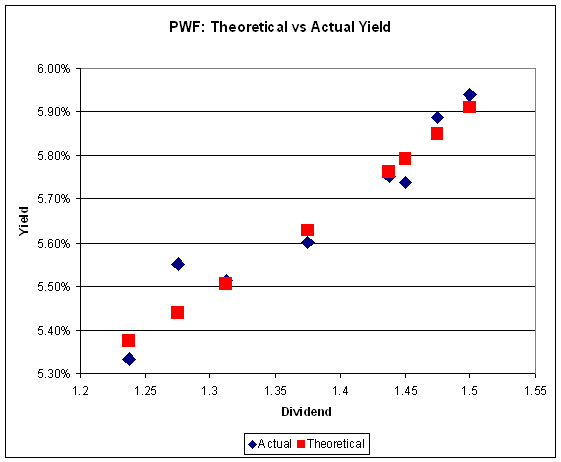
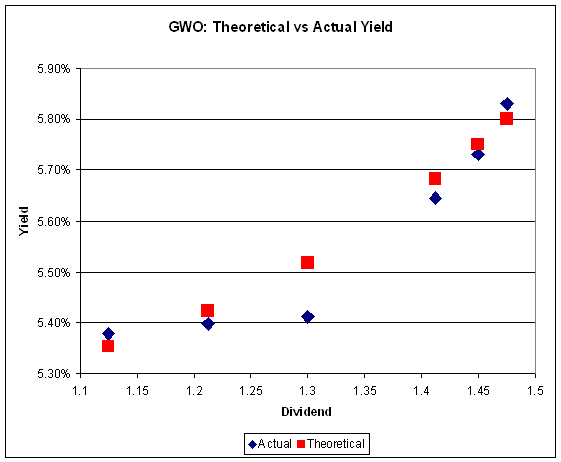
MAPF

MAPF Portfolio Composition: June 2010

Turnover picked up substantially in June to about 53%. It’s about time we saw some useful volatility!

Trades were, as ever, triggered by a desire to exploit transient mispricing in the preferred share market (which may the thought of as “selling liquidity”), rather than any particular view being taken on market direction, sectoral performance or credit anticipation.

MAPF Sectoral Analysis 2010-6-30
HIMI Indices Sector Weighting YTW ModDur
Ratchet 0% N/A N/A
FixFloat 0% N/A N/A
Floater 0% N/A N/A
OpRet 0% N/A N/A
SplitShare 2.9% (-1.1) 7.97% 6.79
Interest Rearing 0% N/A N/A
PerpetualPremium 0.0% (0) N/A N/A
PerpetualDiscount 82.4% (+1.1) 6.11% 13.77
Fixed-Reset 9.8% (+0.6) 3.86% 3.44
Scraps (FixedReset) 4.4% (-0.5) 7.01% 12.53
Cash 0.4% (-0.1) 0.00% 0.00
Total 100% 5.96% 12.45
Totals and changes will not add precisely due to rounding. Bracketted figures represent change from May month-end. Cash is included in totals with duration and yield both equal to zero.

The “total” reflects the un-leveraged total portfolio (i.e., cash is included in the portfolio calculations and is deemed to have a duration and yield of 0.00.). MAPF will often have relatively large cash balances, both credit and debit, to facilitate trading. Figures presented in the table have been rounded to the indicated precision.

I recently received a question from a potential investor:

I just had a look at MAPF’s portfolio composition and noticed that it is very heavily in perpetual preferreds at a discount. I’m a bit surprised. I would think the general expectation is that interest rates will rise, which would reduce prices for perpetuals. What is the transient mispricing in the market for perpetuals that you are seeing now? Thanks very much in advance and best wishes,

I replied:

HIMIPref assigns a valuation to each issue which may be approximated as

V = Y + D

where Y is yield and D is Disparity.

Since PerpetualDiscounts yield so much more than FixedResets, there is somthing of a hurdle the latter class must get over before they are valued sufficiently highly to be included in a portfolio, but this effect is relatively small (see http://www.prefshares.com/overview/valuation.php)

Disparity is calclated according to the individual issue’s distance from the self-consistent yield curve. Fitting the yield curve provides several normalization factors, so that, for instance, the average disparity of all FixedResets will be zero, of all PerpetualDiscounts to be zero, of all issues rated Pfd-1(low) to be zero, etc. Note, however that the yield curve fitting is done with squared error, so that this will not be precisely true.

PerpetualDiscounts are far more widely dispersed about their mean than FixedResets; for instance, there is very obvious evidence of Credit Stratification (see http://www.prefblog.com/?p=2340) in this class, whereas the market appears to treat all FixedResets of like credit identically (see last two issues of PrefLetter).

Thus, the issues with the highest Valuation will tend to be PerpetualDiscounts.

When you write “the general expectation is that interest rates will rise”, I have to ask: which interest rates? Long, short, corporate, government? Long Corporates have been on wheels lately, fuelled by increasing speculation regarding deflation.

I guess I didn’t really answer one part of his question in detail: What is the transient mispricing in the market for perpetuals that you are seeing now? However, I show a sequence of trades below in which the fund was able to improve credit quality at what may be considered to be a low cost.

Credit distribution is:

MAPF Credit Analysis 2010-6-30
DBRS Rating Weighting
Pfd-1 0 (0)
Pfd-1(low) 69.2% (+8.2)
Pfd-2(high) 11.8% (-5.5)
Pfd-2 0 (0)
Pfd-2(low) 14.1% (-2.2)
Pfd-3(high) 4.4% (-0.5)
Cash 0.4% (-0.1)
Totals will not add precisely due to rounding. Bracketted figures represent change from Junel month-end.

The increase in credit quality was due in part to swaps from POW.PR.D (Pfd-2(high)) to GWO.PR.I (Pfd-1(low)):

MAPF Trades, POW.PR.D to GWO.PR.I
Date POW.PR.D GWO.PR.I
5/31 19.77
bid
6.43%
Yield
17.64
bid
6.39%
Yield
6/18 Sold
21.01
Bought
18.70
6/23 Sold
20.78
Bought
18.74
6/25 Sold
20.87
Bought
18.85
6/30 20.69
bid
6.07%
Yield
18.81
bid
6.02%
Yield
Dividends Ex 6/21
0.3125
 
Only major trades are shown. Not all trades affecting credit quality are reported. Details are incomplete and approximate. All trades wil be published at the time the Semi-annual report is released.

Liquidity Distribution is:

MAPF Liquidity Analysis 2010-6-30
Average Daily Trading Weighting
<$50,000 0.0% (0)
$50,000 – $100,000 2.9% (+2.9)
$100,000 – $200,000 40.8% (+13.4)
$200,000 – $300,000 32.0% (-18.5)
>$300,000 24.0% (+0.4)
Cash 0.4% (-0.1)
Totals will not add precisely due to rounding. Bracketted figures represent change from May month-end.

MAPF is, of course, Malachite Aggressive Preferred Fund, a “unit trust” managed by Hymas Investment Management Inc. Further information and links to performance, audited financials and subscription information are available the fund’s web page. A “unit trust” is like a regular mutual fund, but is sold by offering memorandum rather than prospectus. This is cheaper, but means subscription is restricted to “accredited investors” (as defined by the Ontario Securities Commission) and those who subscribe for $150,000+. Fund past performances are not a guarantee of future performance. You can lose money investing in MAPF or any other fund.

A similar portfolio composition analysis has been performed on the Claymore Preferred Share ETF (symbol CPD) as of August 17, 2009, and published in the September, 2009, PrefLetter. When comparing CPD and MAPF:

  • MAPF credit quality is better
  • MAPF liquidity is a little lower
  • MAPF Yield is higher
  • Weightings in
    • MAPF is much more exposed to PerpetualDiscounts
    • MAPF is much less exposed to Operating Retractibles
    • MAPF is more exposed to SplitShares
    • MAPF is less exposed to FixFloat / Floater / Ratchet
    • MAPF weighting in FixedResets is much lower
MAPF

MAPF Performance: May 2010

The fund had a positive month in May following three consecutive losses, and outperformed all the relevant indices and passive funds as the Floating Rate sector took a large loss. The Seniority Spread declined marginally (and perhaps spuriously) from 320bp on April 30 to 315bp on May 31.

The fund’s Net Asset Value per Unit as of the close May 31 was $10.1623.

Returns to May 31, 2010
Period MAPF Index CPD
according to
Claymore
One Month +1.10% +0.30% +0.94%
Three Months -3.25% -2.29% -2.11%
One Year +20.07% 11.29% +7.73%
Two Years (annualized) +23.43% +2.76% +0.64%*
Three Years (annualized) +16.09% +1.16% -0.89%
Four Years (annualized) +13.26% +1.13%  
Five Years (annualized) +11.61% +1.51%  
Six Years (annualized) +11.37% +2.37%  
Seven Years (annualized) +12.74% +2.63%  
Eight Years (annualized) +11.94% +3.27%  
Nine Years (annualized) +12.43% +3.11%  
The Index is the BMO-CM “50”
MAPF returns assume reinvestment of dividends, and are shown after expenses but before fees.
CPD Returns are for the NAV and are after all fees and expenses.
* CPD does not directly report its two-year returns. The figure shown is the square root of product of the current one-year return and the similar figure reported for May 2009.
Figures for Omega Preferred Equity (which are after all fees and expenses) for 1-, 3- and 12-months are +0.4%, -2.4% and +10.3%, respectively, according to Morningstar after all fees & expenses
Figures for Jov Leon Frazer Preferred Equity Fund Class I Units (which are after all fees and expenses) for 1-, 3- and 12-months are +0.6%, -2.5% & +5.5% respectively, according to Morningstar
Figures for AIC Preferred Income Fund (which are after all fees and expenses) for 1-, 3- and 12-months are +0.4%, -2.5% & +4.6%, respectively

MAPF returns assume reinvestment of dividends, and are shown after expenses but before fees. Past performance is not a guarantee of future performance. You can lose money investing in Malachite Aggressive Preferred Fund or any other fund. For more information, see the fund’s main page.

I am very pleased with the returns over the past year (which, now that the market and the fund’s returns have moderated, are now merely incredible, as opposed to “ridiculous” or “nonsensical”), but implore Assiduous Readers not to project this level of outperformance for the indefinite future. The year in the preferred share market was filled with episodes of panic and euphoria, together with many new entrants who do not appear to know what they are doing; perfect conditions for a disciplined quantitative approach.

Sometimes everything works … sometimes the trading works, but sectoral shifts overwhelm the increment … sometimes nothing works. The fund seeks to earn incremental return by selling liquidity (that is, taking the other side of trades that other market participants are strongly motivated to execute), which can also be referred to as ‘trading noise’. There have been a lot of strongly motivated market participants in the past year, generating a lot of noise! The conditions of the past year may never be repeated in my lifetime … but the fund will simply attempt to make trades when swaps seem profitable, whether that implies monthly turnover of 10% or 100%.

There’s plenty of room for new money left in the fund. Just don’t expect the current level of outperformance every year, OK? While I will continue to exert utmost efforts to outperform, it should be borne in mind that beating the index by 500bp represents a good year, and there will almost inevitably be periods of underperformance in the future.

The yields available on high quality preferred shares remain elevated, which is reflected in the current estimate of sustainable income.

Calculation of MAPF Sustainable Income Per Unit
Month NAVPU Portfolio
Average
YTW
Leverage
Divisor
Securities
Average
YTW
Capital
Gains
Multiplier
Sustainable
Income
per
current
Unit
June, 2007 9.3114 5.16% 1.03 5.01% 1.1883 0.3926
September 9.1489 5.35% 0.98 5.46% 1.1883 0.4203
December, 2007 9.0070 5.53% 0.942 5.87% 1.1883 0.4448
March, 2008 8.8512 6.17% 1.047 5.89% 1.1883 0.4389
June 8.3419 6.034% 0.952 6.338% 1.1883 $0.4449
September 8.1886 7.108% 0.969 7.335% 1.1883 $0.5054
December, 2008 8.0464 9.24% 1.008 9.166% 1.1883 $0.6206
March 2009 $8.8317 8.60% 0.995 8.802% 1.1883 $0.6423
June 10.9846 7.05% 0.999 7.057% 1.1883 $0.6524
September 12.3462 6.03% 0.998 6.042% 1.1883 $0.6278
December 2009 10.5662 5.74% 0.981 5.851% 1.0000 $0.6182
March 2010 10.2497 6.03% 0.992 6.079% 1.0000 $0.6231
May 2010 10.1623 6.35% 0.995 6.382% 1.0000 $0.6486
NAVPU is shown after quarterly distributions of dividend income and annual distribution of capital gains.
Portfolio YTW includes cash (or margin borrowing), with an assumed interest rate of 0.00%
The Leverage Divisor indicates the level of cash in the account: if the portfolio is 1% in cash, the Leverage Divisor will be 0.99
Securities YTW divides “Portfolio YTW” by the “Leverage Divisor” to show the average YTW on the securities held; this assumes that the cash is invested in (or raised from) all securities held, in proportion to their holdings.
The Capital Gains Multiplier adjusts for the effects of Capital Gains Dividends. On 2009-12-31, there was a capital gains distribution of $1.989262 which is assumed for this purpose to have been reinvested at the final price of $10.5662. Thus, a holder of one unit pre-distribution would have held 1.1883 units post-distribution; the CG Multiplier reflects this to make the time-series comparable. Note that Dividend Distributions are not assumed to be reinvested.
Sustainable Income is the resultant estimate of the fund’s dividend income per current unit, before fees and expenses. Note that a “current unit” includes reinvestment of prior capital gains; a unitholder would have had the calculated sustainable income with only, say, 0.9 units in the past which, with reinvestment of capital gains, would become 1.0 current units.

Significant positions were held in Fixed-Reset issues on April 30; all of which (with the exception of YPG.PR.C) currently have their yields calculated with the presumption that they will be called by the issuers at par at the first possible opportunity. A split-share issue (BNA.PR.C) is also held; since this has a maturity date, the yield cannot be regarded as permanently sustainable. This presents another complication in the calculation of sustainable yield.

However, if the entire portfolio except for the PerpetualDiscounts were to be sold and reinvested in these issues, the yield of the portfolio would be the 6.44% shown in the MAPF Portfolio Composition: May 2010 analysis (which is in excess of the 6.29% index yield on May 31). Given such reinvestment, the sustainable yield would be $10.1623 * 0.0644 = $0.6545 , whereas similar calculations for April and March result in $0.6503 and $0.6457, respectively.

Different assumptions lead to different results from the calculation, but the overall positive trend is apparent. I’m very pleased with the results! It will be noted that if there was no trading in the portfolio, one would expect the sustainable yield to be constant (before fees and expenses). The success of the fund’s trading is showing up in

  • the very good performance against the index
  • the long term increases in sustainable income per unit

As has been noted, the fund has maintained a credit quality equal to or better than the index; outperformance is due to constant exploitation of trading anomalies.

Again, there are no predictions for the future! The fund will continue to trade between issues in an attempt to exploit market gaps in liquidity, in an effort to outperform the index and keep the sustainable income per unit – however calculated! – growing.

MAPF

MAPF Portfolio Composition: May 2010

Turnover picked up a little in May to about 17%.

Trades were, as ever, triggered by a desire to exploit transient mispricing in the preferred share market (which may the thought of as “selling liquidity”), rather than any particular view being taken on market direction, sectoral performance or credit anticipation.

MAPF Sectoral Analysis 2010-5-31
HIMI Indices Sector Weighting YTW ModDur
Ratchet 0% N/A N/A
FixFloat 0% N/A N/A
Floater 0% N/A N/A
OpRet 0% N/A N/A
SplitShare 4.0% (-0.2) 8.37% 6.84
Interest Rearing 0% N/A N/A
PerpetualPremium 0.0% (0) N/A N/A
PerpetualDiscount 81.3% (+3.1) 6.44% 13.29
Fixed-Reset 9.2% (-3.0) 4.53% 3.61
Scraps (FixedReset) 4.9% (-0.1) 7.24% 12.18
Cash 0.5% (0) 0.00% 0.00
Total 100% 6.35% 12.01
Totals and changes will not add precisely due to rounding. Bracketted figures represent change from April month-end. Cash is included in totals with duration and yield both equal to zero.

The “total” reflects the un-leveraged total portfolio (i.e., cash is included in the portfolio calculations and is deemed to have a duration and yield of 0.00.). MAPF will often have relatively large cash balances, both credit and debit, to facilitate trading. Figures presented in the table have been rounded to the indicated precision.

Credit distribution is:

MAPF Credit Analysis 2010-5-31
DBRS Rating Weighting
Pfd-1 0 (0)
Pfd-1(low) 61.0% (-5.9)
Pfd-2(high) 17.3% (+0.1)
Pfd-2 0 (0)
Pfd-2(low) 16.3% (+6.0)
Pfd-3(high) 4.9% (-0.1)
Cash 0.5% (0)
Totals will not add precisely due to rounding. Bracketted figures represent change from April month-end.

The decline in credit quality was due to the purchase of W.PR.J from a grab-bag of issues, mainly MFC.PR.C and MFC.PR.D:

Major MAPF Trades Affecting Credit Quality
Date W.PR.J MFC.PR.C MFC.PR.D
4/30
Bid
21.50 17.85 26.83
5/7 Bot
21.46
Sold
18.14
Sold
27.00
5/30
Bid
21.62 18.07 26.87
Dividends   5/22
Missed 0.28125
5/22
Missed 0.4125
Only major trades are shown. Details are incomplete and approximate. All trades wil be published at the time the Semi-annual report is released.

Liquidity Distribution is:

MAPF Liquidity Analysis 2010-5-31
Average Daily Trading Weighting
<$50,000 0.0% (0)
$50,000 – $100,000 0.0% (0)
$100,000 – $200,000 27.4% (+3.3)
$200,000 – $300,000 48.5% (+3.4)
>$300,000 23.6% (-6.7)
Cash 0.5% (0)
Totals will not add precisely due to rounding. Bracketted figures represent change from April month-end.

MAPF is, of course, Malachite Aggressive Preferred Fund, a “unit trust” managed by Hymas Investment Management Inc. Further information and links to performance, audited financials and subscription information are available the fund’s web page. A “unit trust” is like a regular mutual fund, but is sold by offering memorandum rather than prospectus. This is cheaper, but means subscription is restricted to “accredited investors” (as defined by the Ontario Securities Commission) and those who subscribe for $150,000+. Fund past performances are not a guarantee of future performance. You can lose money investing in MAPF or any other fund.

A similar portfolio composition analysis has been performed on the Claymore Preferred Share ETF (symbol CPD) as of August 17, 2010, and published in the September PrefLetter. When comparing CPD and MAPF:

  • MAPF credit quality is better
  • MAPF liquidity is a little better
  • MAPF Yield is higher
  • Weightings in
    • MAPF is much more exposed to PerpetualDiscounts
    • MAPF is much less exposed to Operating Retractibles
    • MAPF is more exposed to SplitShares
    • MAPF is less exposed to FixFloat / Floater / Ratchet
    • MAPF weighting in FixedResets is much lower
MAPF

MAPF Performance: April 2010

The fund experienced a negative return in April – as did nearly all sectors of the preferred share market – but outperformed both DPS.UN and CPD due to its heavy weighting in PerpetualDiscounts.

I am somewhat at a loss to account for the weakness YTD in PerpetualDiscounts. It doesn’t make much sense given that long corporate bond yields are declining and have reached 5.7% – as I recently discussed with John Heinzl of the Globe & Mail.

I believe that the phenomenon is due to retail’s understanding of the facts (relentlessly driven home by the media) that the BoC rate has nowhere to go but up; that increases in this rate will probably happen sooner rather than later; and that a portion of these increases will be reflected in the 5-Year Canada yield and hence to mortgages. However, the reasoning becomes suspect when, as I believe, this reasoning is extended to apply to long corporate bond yields and PerpetualDiscount yields.

Is it a “good time to buy”? Well, the Seniority Spread (the difference between the interest-equivalent pre-tax PerpetualDiscount yield and the long corporate yield) is exceptionally high at the moment at 320bp. This spread has been exceeded in the past 16+ years only at the depths of the Credit Crunch in November/December 2008 (when it briefly spiked to about 450bp). The range I have dubbed “Credit Crunch Normal” is 200-225bp; the long-term, pre-Credit-Crunch range was 100-150bp.

So I am prepared to go so far as to say that the attractiveness of PerpetualDiscounts vs. Long Corporates is currently enhanced relative to other times and that investors with a disciplined asset allocation framework will therefor finding their models leading to a greater weight in PDs than might otherwise be the case.

However, I dislike the entire concept of “good time to buy”. Investment allocation decisions should be based on portfolio needs long term expectations, not developed on the fly in an attempt to time the markets.

The fund’s Net Asset Value per Unit as of the close April 30 was $10.0518.

Returns to April 30, 2010
Period MAPF Index CPD
according to
Claymore
One Month -1.93% -1.94% -2.15%
Three Months -5.35% -2.22% -2.90%
One Year +28.29% 16.52% +10.99%
Two Years (annualized) +23.60% +3.28% +0.87%*
Three Years (annualized) +15.33% +0.22% -1.97
Four Years (annualized) +13.10% +1.20%  
Five Years (annualized) +11.72% +1.64%  
Six Years (annualized) +11.39% +2.32%  
Seven Years (annualized) +13.28% +2.88%  
Eight Years (annualized) +11.79% +3.26%  
Nine Years (annualized) +12.27% +3.00%  
The Index is the BMO-CM “50”
MAPF returns assume reinvestment of dividends, and are shown after expenses but before fees.
CPD Returns are for the NAV and are after all fees and expenses.
* CPD does not directly report its two-year returns. The figure shown is the square root of product of the current one-year return and the similar figure reported for April 2009.
Figures for Omega Preferred Equity (which are after all fees and expenses) for 1-, 3- and 12-months are -2.0%, -2.6% and +14.2%, respectively, according to Morningstar after all fees & expenses
Figures for Jov Leon Frazer Preferred Equity Fund Class I Units (which are after all fees and expenses) for 1-, 3- and 12-months are -2.6%, -2.6% & +8.4% respectively, according to Morningstar
Figures for AIC Preferred Income Fund (which are after all fees and expenses) for 1-, 3- and 12-months are -3.2%, -2.8% & +5.1%, respectively

MAPF returns assume reinvestment of dividends, and are shown after expenses but before fees. Past performance is not a guarantee of future performance. You can lose money investing in Malachite Aggressive Preferred Fund or any other fund. For more information, see the fund’s main page.

I am very pleased with the returns over the past year, but implore Assiduous Readers not to project this level of outperformance for the indefinite future. The year in the preferred share market was filled with episodes of panic and euphoria, together with many new entrants who do not appear to know what they are doing; perfect conditions for a disciplined quantitative approach.

Sometimes everything works … sometimes the trading works, but sectoral shifts overwhelm the increment … sometimes nothing works. The fund seeks to earn incremental return by selling liquidity (that is, taking the other side of trades that other market participants are strongly motivated to execute), which can also be referred to as ‘trading noise’. There have been a lot of strongly motivated market participants in the past year, generating a lot of noise! The conditions of the past year may never be repeated in my lifetime … but the fund will simply attempt to make trades when swaps seem profitable, whether that implies monthly turnover of 10% or 100%.

There’s plenty of room for new money left in the fund. Just don’t expect the current level of outperformance every year, OK? While I will continue to exert utmost efforts to outperform, it should be borne in mind that beating the index by 500bp represents a good year, and there will almost inevitably be periods of underperformance in the future.

The yields available on high quality preferred shares remain elevated, which is reflected in the current estimate of sustainable income.

Calculation of MAPF Sustainable Income Per Unit
Month NAVPU Portfolio
Average
YTW
Leverage
Divisor
Securities
Average
YTW
Capital
Gains
Multiplier
Sustainable
Income
per
current
Unit
June, 2007 9.3114 5.16% 1.03 5.01% 1.1883 0.3926
September 9.1489 5.35% 0.98 5.46% 1.1883 0.4203
December, 2007 9.0070 5.53% 0.942 5.87% 1.1883 0.4448
March, 2008 8.8512 6.17% 1.047 5.89% 1.1883 0.4389
June 8.3419 6.034% 0.952 6.338% 1.1883 $0.4449
September 8.1886 7.108% 0.969 7.335% 1.1883 $0.5054
December, 2008 8.0464 9.24% 1.008 9.166% 1.1883 $0.6206
March 2009 $8.8317 8.60% 0.995 8.802% 1.1883 $0.6423
June 10.9846 7.05% 0.999 7.057% 1.1883 $0.6524
September 12.3462 6.03% 0.998 6.042% 1.1883 $0.6278
December 2009 10.5662 5.74% 0.981 5.851% 1.0000 $0.6182
March 2010 10.2497 6.03% 0.992 6.079% 1.0000 $0.6231
April 2010 10.0518 6.33% 0.995 6.362% 1.0000 $0.6395
NAVPU is shown after quarterly distributions of dividend income and annual distribution of capital gains.
Portfolio YTW includes cash (or margin borrowing), with an assumed interest rate of 0.00%
The Leverage Divisor indicates the level of cash in the account: if the portfolio is 1% in cash, the Leverage Divisor will be 0.99
Securities YTW divides “Portfolio YTW” by the “Leverage Divisor” to show the average YTW on the securities held; this assumes that the cash is invested in (or raised from) all securities held, in proportion to their holdings.
The Capital Gains Multiplier adjusts for the effects of Capital Gains Dividends. On 2009-12-31, there was a capital gains distribution of $1.989262 which is assumed for this purpose to have been reinvested at the final price of $10.5662. Thus, a holder of one unit pre-distribution would have held 1.1883 units post-distribution; the CG Multiplier reflects this to make the time-series comparable. Note that Dividend Distributions are not assumed to be reinvested.
Sustainable Income is the resultant estimate of the fund’s dividend income per current unit, before fees and expenses. Note that a “current unit” includes reinvestment of prior capital gains; a unitholder would have had the calculated sustainable income with only, say, 0.9 units in the past which, with reinvestment of capital gains, would become 1.0 current units.

Significant positions were held in Fixed-Reset issues on April 30; all of which (with the exception of YPG.PR.C) currently have their yields calculated with the presumption that they will be called by the issuers at par at the first possible opportunity. A split-share issue (BNA.PR.C) is also held. This presents another complication in the calculation of sustainable yield.

However, if the entire portfolio except for the PerpetualDiscounts were to be sold and reinvested in these issues, the yield of the portfolio would be the 6.47% shown in the MAPF Portfolio Composition: April 2010 analysis (which is in excess of the 6.35% index yield on April 30). Given such reinvestment, the sustainable yield would be $10.0518 * 0.0647 = 0.6503, whereas similar calculations for March and February result in $0.6457 and $0.6418, respectively.

Different assumptions lead to different results from the calculation, but the overall positive trend is apparent. I’m very pleased with the results! It will be noted that if there was no trading in the portfolio, one would expect the sustainable yield to be constant (before fees and expenses). The success of the fund’s trading is showing up in

  • the very good performance against the index
  • the long term increases in sustainable income per unit

As has been noted, the fund has maintained a credit quality equal to or better than the index; outperformance is due to constant exploitation of trading anomalies.

Again, there are no predictions for the future! The fund will continue to trade between issues in an attempt to exploit market gaps in liquidity, in an effort to outperform the index and keep the sustainable income per unit – however calculated! – growing.

MAPF

MAPF Portfolio Composition: April 2010

Turnover was very low in April at about 10%. The current decline in the number trading opportunities is annoying, but one of the great constants in financial markets is a demand for liquidity and the fund is ready to meet that demand at a moment’s notice.

Trades were, as ever, triggered by a desire to exploit transient mispricing in the preferred share market (which may the thought of as “selling liquidity”), rather than any particular view being taken on market direction, sectoral performance or credit anticipation.

MAPF Sectoral Analysis 2010-4-30
HIMI Indices Sector Weighting YTW ModDur
Ratchet 0% N/A N/A
FixFloat 0% N/A N/A
Floater 0% N/A N/A
OpRet 0% N/A N/A
SplitShare 4.2% (+0.2) 8.17% 6.84
Interest Rearing 0% N/A N/A
PerpetualPremium 0.0% (0) N/A N/A
PerpetualDiscount 78.2% (+0.3) 6.47% 13.24
Fixed-Reset 12.2% (-0.1) 4.62% 3.66
Scraps (FixedReset) 5.0% (+0.1) 7.23% 12.33
Cash 0.5% (-0.3) 0.00% 0.00
Total 100% 6.33% 11.70
Totals and changes will not add precisely due to rounding. Bracketted figures represent change from March month-end. Cash is included in totals with duration and yield both equal to zero.

The “total” reflects the un-leveraged total portfolio (i.e., cash is included in the portfolio calculations and is deemed to have a duration and yield of 0.00.). MAPF will often have relatively large cash balances, both credit and debit, to facilitate trading. Figures presented in the table have been rounded to the indicated precision.

Credit distribution is:

MAPF Credit Analysis 2010-4-30
DBRS Rating Weighting
Pfd-1 0 (0)
Pfd-1(low) 66.9% (-1.8)
Pfd-2(high) 17.2% (+1.7)
Pfd-2 0 (0)
Pfd-2(low) 10.3% (+0.2)
Pfd-3(high) 5.0% (+0.1)
Cash 0.5% (-0.3)
Totals will not add precisely due to rounding. Bracketted figures represent change from March month-end.

Liquidity Distribution is:

MAPF Liquidity Analysis 2010-4-30
Average Daily Trading Weighting
<$50,000 0.0% (0)
$50,000 – $100,000 0.0% (0)
$100,000 – $200,000 24.1% (-0.6)
$200,000 – $300,000 45.1% (+11.6)
>$300,000 30.3% (-10.7)
Cash 0.5% (-0.3)
Totals will not add precisely due to rounding. Bracketted figures represent change from March month-end.

MAPF is, of course, Malachite Aggressive Preferred Fund, a “unit trust” managed by Hymas Investment Management Inc. Further information and links to performance, audited financials and subscription information are available the fund’s web page. A “unit trust” is like a regular mutual fund, but is sold by offering memorandum rather than prospectus. This is cheaper, but means subscription is restricted to “accredited investors” (as defined by the Ontario Securities Commission) and those who subscribe for $150,000+. Fund past performances are not a guarantee of future performance. You can lose money investing in MAPF or any other fund.

A similar portfolio composition analysis has been performed on the Claymore Preferred Share ETF (symbol CPD) as of August 17 and published in the September PrefLetter. When comparing CPD and MAPF:

  • MAPF credit quality is better
  • MAPF liquidity is a little better
  • MAPF Yield is higher
  • Weightings in
    • MAPF is much more exposed to PerpetualDiscounts
    • MAPF is much less exposed to Operating Retractibles
    • MAPF is more exposed to SplitShares
    • MAPF is less exposed to FixFloat / Floater / Ratchet
    • MAPF weighting in FixedResets is much lower
MAPF

MAPF Performance: March, 2010

The fund underperformed in March, weighed down by its lack of holdings in the Floating Rate sector, in which performance continues to astonish, and by its overweighting in PerpetualDiscounts, which underperformed.

The fund’s Net Asset Value per Unit as of the close March 31 was $10.2497, after giving effect to a dividend distribution of $0.136431.

Returns to March, 2010
Period MAPF Index CPD
according to
Claymore
One Month -2.42% -0.66% -0.89%
Three Months -1.70% +0.33% -1.29%
One Year +45.76% +26.39% +21.33%
Two Years (annualized) +25.27% +4.33% N/A*
Three Years (annualized) +15.59% +0.38%  
Four Years (annualized) +12.97% +1.33%  
Five Years (annualized) +11.92% +2.10%  
Six Years (annualized) +10.90% +2.09%  
Seven Years (annualized) +14.68% +3.31%  
Eight Years (annualized) +12.23% +3.43%  
Nine Years (annualized) +12.65% +3.19%  
The Index is the BMO-CM “50”
MAPF returns assume reinvestment of dividends, and are shown after expenses but before fees.
CPD Returns are for the NAV and are after all fees and expenses.
* CPD does not directly report its two-year returns. The figure shown would be the product of the current one-year return and the similar figure reported for March 2009; but that figure was not published by Claymore at that time.
Figures for Omega Preferred Equity (which are after all fees and expenses) for 1-, 3- and 12-months are -0.8%, +0.2% and +24.0%, respectively, according to Morningstar after all fees & expenses
Figures for Jov Leon Frazer Preferred Equity Fund Class I Units (which are after all fees and expenses) for 1-, 3- and 12-months are -0.4%, +0.4% & +19.0% respectively, according to Morningstar
Figures for AIC Preferred Income Fund (which are after all fees and expenses) for 1-, 3- and 12-months are +0.3%, +0.3% & N/A, respectively

MAPF returns assume reinvestment of dividends, and are shown after expenses but before fees. Past performance is not a guarantee of future performance. You can lose money investing in Malachite Aggressive Preferred Fund or any other fund. For more information, see the fund’s main page.

I am very pleased with the returns over the past year, but implore Assiduous Readers not to project this level of outperformance for the indefinite future. The year in the preferred share market was filled with episodes of panic and euphoria, together with many new entrants who do not appear to know what they are doing; perfect conditions for a disciplined quantitative approach.

Sometimes everything works … sometimes the trading works, but sectoral shifts overwhelm the increment … sometimes nothing works. The fund seeks to earn incremental return by selling liquidity (that is, taking the other side of trades that other market participants are strongly motivated to execute), which can also be referred to as ‘trading noise’. There have been a lot of strongly motivated market participants in the past year, generating a lot of noise! The conditions of the past year may never be repeated in my lifetime … but the fund will simply attempt to make trades when swaps seem profitable, whether that implies monthly turnover of 10% or 100%.

There’s plenty of room for new money left in the fund. Just don’t expect the current level of outperformance every year, OK? While I will continue to exert utmost efforts to outperform, it should be borne in mind that beating the index by 500bp represents a good year, and there will almost inevitably be periods of underperformance in the future.

The yields available on high quality preferred shares remain elevated, which is reflected in the current estimate of sustainable income.

Calculation of MAPF Sustainable Income Per Unit
Month NAVPU Portfolio
Average
YTW
Leverage
Divisor
Securities
Average
YTW
Capital
Gains
Multiplier
Sustainable
Income
per
current
Unit
June, 2007 9.3114 5.16% 1.03 5.01% 1.1883 0.3926
September 9.1489 5.35% 0.98 5.46% 1.1883 0.4203
December, 2007 9.0070 5.53% 0.942 5.87% 1.1883 0.4448
March, 2008 8.8512 6.17% 1.047 5.89% 1.1883 0.4389
June 8.3419 6.034% 0.952 6.338% 1.1883 $0.4449
September 8.1886 7.108% 0.969 7.335% 1.1883 $0.5054
December, 2008 8.0464 9.24% 1.008 9.166% 1.1883 $0.6206
March 2009 $8.8317 8.60% 0.995 8.802% 1.1883 $0.6423
June 10.9846 7.05% 0.999 7.057% 1.1883 $0.6524
September 12.3462 6.03% 0.998 6.042% 1.1883 $0.6278
December 2009 10.5662 5.74% 0.981 5.851% 1.0000 $0.6182
March 2010 10.2497 6.03% 0.992 6.079% 1.0000 $0.6231
NAVPU is shown after quarterly distributions of dividend income and annual distribution of capital gains.
Portfolio YTW includes cash (or margin borrowing), with an assumed interest rate of 0.00%
The Leverage Divisor indicates the level of cash in the account: if the portfolio is 1% in cash, the Leverage Divisor will be 0.99
Securities YTW divides “Portfolio YTW” by the “Leverage Divisor” to show the average YTW on the securities held; this assumes that the cash is invested in (or raised from) all securities held, in proportion to their holdings.
The Capital Gains Multiplier adjusts for the effects of Capital Gains Dividends. On 2009-12-31, there was a capital gains distribution of $1.989262 which is assumed for this purpose to have been reinvested at the final price of $10.5662. Thus, a holder of one unit pre-distribution would have held 1.1883 units post-distribution; the CG Multiplier reflects this to make the time-series comparable. Note that Dividend Distributions are not assumed to be reinvested.
Sustainable Income is the resultant estimate of the fund’s dividend income per current unit, before fees and expenses. Note that a “current unit” includes reinvestment of prior capital gains; a unitholder would have had the calculated sustainable income with only, say, 0.9 units in the past which, with reinvestment of capital gains, would become 1.0 current units.

Significant positions were also held in Fixed-Reset issues on March; all of which (with the exception of YPG.PR.C) currently have their yields calculated with the presumption that they will be called by the issuers at par at the first possible opportunity. This presents another complication in the calculation of sustainable yield.

However, if the entire portfolio except for the PerpetualDiscounts were to be sold and reinvested in these issues, the yield of the portfolio would be the 6.30% shown in the MAPF Portfolio Composition: March 2010 analysis(which is in excess of the 6.16% index yield on March 31). Given such reinvestment, the sustainable yield would be $10.2497 * 0.0630 = 0.6457 whereas similar calculations for February and January result in $0.6418 and $0.6338, respectively

Different assumptions lead to different results from the calculation, but the overall positive trend is apparent. I’m very pleased with the results! It will be noted that if there was no trading in the portfolio, one would expect the sustainable yield to be constant (before fees and expenses). The success of the fund’s trading is showing up in

  • the very good performance against the index
  • the long term increases in sustainable income per unit

As has been noted, the fund has maintained a credit quality equal to or better than the index; outperformance is due to constant exploitation of trading anomalies.

Again, there are no predictions for the future! The fund will continue to trade between issues in an attempt to exploit market gaps in liquidity, in an effort to outperform the index and keep the sustainable income per unit – however calculated! – growing.

MAPF

MAPF Portfolio Composition: March 2010

Turnover increased slightly in March to about 28%. The current decline in the number trading opportunities is annoying, but one of the great constants in financial markets is a demand for liquidity and the fund is ready to meet that demand at a moment’s notice.

Trades were, as ever, triggered by a desire to exploit transient mispricing in the preferred share market (which may the thought of as “selling liquidity”), rather than any particular view being taken on market direction, sectoral performance or credit anticipation.

MAPF Sectoral Analysis 2010-3-31
HIMI Indices Sector Weighting YTW ModDur
Ratchet 0% N/A N/A
FixFloat 0% N/A N/A
Floater 0% N/A N/A
OpRet 0% N/A N/A
SplitShare 4.0% (0) 8.14% 6.92
Interest Rearing 0% N/A N/A
PerpetualPremium 0.0% (0) N/A N/A
PerpetualDiscount 77.9% (+0.4) 6.30% 13.51
Fixed-Reset 12.3% (-1.3) 3.65% 3.77
Scraps (FixedReset) 4.9% (+0.1) 7.02% 12.58
Cash 0.8% (+0.8) 0.00% 0.00
Total 100% 6.03% 11.88
Totals and changes will not add precisely due to rounding. Bracketted figures represent change from February month-end. Cash is included in totals with duration and yield both equal to zero.

The “total” reflects the un-leveraged total portfolio (i.e., cash is included in the portfolio calculations and is deemed to have a duration and yield of 0.00.). MAPF will often have relatively large cash balances, both credit and debit, to facilitate trading. Figures presented in the table have been rounded to the indicated precision.

Credit distribution is:

MAPF Credit Analysis 2010-3-31
DBRS Rating Weighting
Pfd-1 0 (0)
Pfd-1(low) 68.7% (-7.0)
Pfd-2(high) 15.5% (+6.2)
Pfd-2 0 (0)
Pfd-2(low) 10.1% (0)
Pfd-3(high) 4.9% (+0.1)
Cash 0.8% (+0.8)
Totals will not add precisely due to rounding. Bracketted figures represent change from February month-end.

Liquidity Distribution is:

MAPF Liquidity Analysis 2010-3-31
Average Daily Trading Weighting
<$50,000 0.0% (0)
$50,000 – $100,000 0.0% (0)
$100,000 – $200,000 24.7% (+0.7)
$200,000 – $300,000 33.5% (-9.2)
>$300,000 41.0 (+7.7)
Cash 0.8% (+0.8)
Totals will not add precisely due to rounding. Bracketted figures represent change from February month-end.

MAPF is, of course, Malachite Aggressive Preferred Fund, a “unit trust” managed by Hymas Investment Management Inc. Further information and links to performance, audited financials and subscription information are available the fund’s web page. A “unit trust” is like a regular mutual fund, but is sold by offering memorandum rather than prospectus. This is cheaper, but means subscription is restricted to “accredited investors” (as defined by the Ontario Securities Commission) and those who subscribe for $150,000+. Fund past performances are not a guarantee of future performance. You can lose money investing in MAPF or any other fund.

A similar portfolio composition analysis has been performed on the Claymore Preferred Share ETF (symbol CPD) as of August 17 and published in the September PrefLetter. When comparing CPD and MAPF:

  • MAPF credit quality is better
  • MAPF liquidity is a little better
  • MAPF Yield is higher
  • Weightings in
    • MAPF is much more exposed to PerpetualDiscounts
    • MAPF is much less exposed to Operating Retractibles
    • MAPF is more exposed to SplitShares
    • MAPF is less exposed to FixFloat / Floater / Ratchet
    • MAPF weighting in FixedResets is much lower
MAPF

HIMI Signs Bare Trustee Agreement with IIROC

The Investment Industry Regulatory Organization of Canada has released the IIROC List of Bare Trustee Agreements as of March 31, which includes Hymas Investment Management Inc. as a “bare trustee” for Malachite Aggressive Preferred Fund.

The significance of this agreement is found in the Joint Regulatory Financial Questionaire and Report (click “Joint Regulatory Financial Questionnaire And Report”, “Dealer Member Rules”, “Forms”, “PDF”; strangely, the direct link requires a password). HIMI is now an “acceptable securities location” and hence when filling out the “Statement of Net Allowable Assets and Risk Adjusted Capital” (page 14 of the PDF), positions held in the fund on the broker’s books no longer have to be included on line 18, “Securities held at non-acceptable securities locations”, as a 100% deduction from capital.

Incidentally, do you see line 20 of that form, “Unresolved Differences”? That line was my job, back in the Richardson Greenshields days.