Category: Market Action

Market Action

March 24, 2015

It’s nice to see my number one market worry get some play in the press:

1. Fund managers decide how much their assets are worth

Legalese: “Asset valuations will be determined by managers. The fund does not intend to commission periodic appraisals of the investments and will not be obligated to provide fair market value estimates.”

What that means: Private equity managers often have large holdings in illiquid assets such as troubled companies and real estate, which are, in fact, difficult to value. That said, it’s in the managers’ best interests to assign generous values because the managers typically get to keep 20 percent of profits and rely on historical returns to pitch new funds to investors.

Fed watching has become more intensive:

The euro made its third attempt this month to climb and stay above $1.10 as Federal Reserve Vice Chairman Stanley Fischer added to speculation U.S. interest rates will increase at a limited pace as stimulus expands in Europe.

The single currency extended its biggest weekly gain in three years on Monday after Fischer said there won’t be a “smooth upward path” for interest rates even as the first increase may be warranted before the end of 2015.

San Francisco Fed President John Williams, who votes on central bank policy this year, said in remarks prepared for delivery in Sydney Tuesday that a discussion should happen mid-year about tightening policy. He also said that he sees a stronger dollar pushing down growth.

“Williams gave dollar a bit of a lift because he didn’t rule out a tightening in June,” said Yuji Saito, director of foreign exchange at Credit Agricole SA in Tokyo. “Markets remain mixed over the outlook of the Fed tightening with Fischer’s comments blending with that of Williams’.”

Fischer said Monday in New York that “a smooth path upward in the federal funds rate will almost certainly not be realized” as the economy will encounter headwinds such as the surprise plunge in oil prices. He said while forward guidance on rates remains important, its role may diminish.

Traders predict 56 basis points of increases to the federal funds target rate over the next 12 months, down from 62 on March 6, according to a Credit Suisse Group AG swaps index.

Stanford’s just hired a new honcho for their $21-billion endowment fund. I know nothing more about the guy than what’s in the Bloomberg notice – but what I do know, I like!

Wallace graduated from Yale in New Haven, Connecticut, in 2002 and went to work for the university’s renowned investment arm, which is run by David Swensen, according to the office. In 2005, he joined Alta Advisers, an investment company serving the family of Swedish industrialist Hans Rausing.

Before his career in investment management, Wallace danced professionally for 16 years with the American Ballet Theater, the Boston Ballet and the Washington Ballet, according to a profile. He has also served on an investment committee for Cambridge University and as a governor of the Royal Ballet School in London.

See – he’s buy-side! Always has been buy-side! Uncontaminated by any sell-side idiocy and – presumably! – with a good record of buy-side performance. And the fact that he had an actual career before going into the biz is also a plus – it increases the chance that he’s not a dork, although you never can be sure …

Did you load up on debt in the past couple of years? You’re in good company:

Vancouver, B.C. – TELUS announced today it is offering $1.75 billion of senior unsecured notes in three series, the first with a 3-year maturity, the second with a 7-year maturity and the third with a long 30-year maturity. The notes are offered through a syndicate of agents led by CIBC World Markets, Scotia Capital, and TD Securities. Closing of the offering is expected to occur on or about March 27, 2015.

The 1.50 per cent 3-year Notes, Series CS, were priced at $99.962 per $100 principal amount for an effective yield of 1.513 per cent per annum and will mature on March 27, 2018. The 2.35 per cent 7-year Notes, Series CT, were priced at $99.731 per $100 principal amount for an effective yield of 2.392 per cent per annum and will mature on March 28, 2022. The 4.40 per cent long 30-year Notes, Series CU, were priced at $99.972 per $100 principal amount for an effective yield of 4.402 per cent per annum and will mature on January 29, 2046.

The net proceeds will be used to fund all or a portion of the remaining $1.2 billion required to acquire the AWS-3 spectrum licences and repay short term indebtedness, with any remaining balance used for general corporate purposes.

Of course, all that debt comes with a price:

DBRS Limited (DBRS) has today placed the Issuer Rating, Notes rating and Commercial Paper rating of TELUS Corporation (TELUS or the Company; rated A (low), A (low) and R-1 (low), respectively) and the Senior Debentures rating of TELUS Communications Inc. (rated A (low)) Under Review with Negative Implications. The rating action follows the Company’s announcement that it has secured 15 megahertz (MHz) of AWS-3 (advanced wireless services) spectrum for $1.5 billion. While DBRS recognizes the importance of investing sufficiently in spectrum over the long term, the Negative Implications of the review status reflect DBRS’s concern that this particularly large spectrum purchase will likely be financed with debt and weaken the financial risk profile of TELUS well beyond its previously stated policy range (net debt-to-EBITDA of 1.5 times (x) to 2.0x) and levels appropriate for the current rating categories. Operationally and financially, DBRS expects TELUS will continue to perform well and deliver mid-single digit growth in EBITDA to approximately $4.4 billion in 2015, based on the Company’s growing subscriber bases across both wireless and wireline, increasing revenues per user and ongoing network expansion.

Notwithstanding the Company’s prospects for growth in earnings over the near to medium term, DBRS questions TELUS’ willingness and ability to deleverage toward its previously stated leverage target within a reasonable time frame (i.e., two years), given its capital investment plan and anticipated returns to shareholders. In its ongoing review with management, DBRS will focus on an update of the Company’s business strategy going forward (including capital investment and spectrum purchases) and its financial management intentions (including dividend distributions, share repurchases and financing sources) in order to determine whether a downgrade is warranted. DBRS aims to receive clarity from TELUS management on the aforementioned issues in the coming weeks in order to resolve the Under Review status of the ratings.

But don’t worry! All that debt will be inflated away:

Data today showed the cost of living in the U.S. excluding food and fuel rose more than forecast in February, reflecting broad-based gains that helped keep a floor under inflation.

The so-called core consumer-price index climbed 0.2 percent for a second month, a Labor Department report showed Tuesday in Washington. A broader measure of prices overall also climbed 0.2 percent, the first advance in four months, as fuel costs stabilized.

Purchases of new homes in the U.S. unexpectedly rose in February to a seven-year high as stronger job gains helped bolster industry activity amid severe weather. Sales climbed 7.8 percent to a 539,000 annualized pace, the most since February 2008.

But the US has a problem: too many jobs:

Now, Goldman Sachs Group Inc. is weighing in. Job growth will have to slow going forward to catch down to the rest of the data, according to David Mericle, a Goldman Sachs economist, who says the pace of employment gains has “been running ‘too hot’ recently” relative to overall economic growth.

“Our model suggests that the recent 275-300k rate of monthly payroll gains is likely to be as good as it gets,” Mericle wrote in a note to clients. “Under our baseline forecast for 3% real GDP growth this year and next, we expect a gradual deceleration to a roughly 200k rate. The risks to both the GDP and employment numbers in 2016 are a bit to the downside.”

Outsize payroll growth in recent months has helped generate a swift decline in the unemployment rate. In February, it was 5.5 percent, down from 6.7 percent a year earlier.

The speed of the drop has taken Federal Reserve policy makers by surprise, and it prompted them to lower their year-end forecasts for the unemployment rate at the Federal Open Market Committee’s March meeting. The central tendency of those projections, which excludes the top and bottom three of the 17 committee members’ forecasts, fell to 5 percent to 5.2 percent from 5.2-5.3 percent in December, when the previous set of projections were published.

That 5-5.2 percent range matches the central tendency of what Fed officials deem to be “full employment.” Fed officials would say lower rates of unemployment would start to spur an acceleration in consumer price increases

It isn’t just Big Data that’s watching you … it’s your colleagues!

Stroz Friedberg, a New York-based consulting firm that specializes in digital forensics, is rolling out software called Scout, which evaluates users through the content of their e-mails and other communications using linguistic and behavioral analysis techniques developed by the FBI. The software establishes a base line and then scans for variations that may signal that an employee presents a growing risk to the company. Red flags could include a spike in references to financial stresses such as “late rent” and “medical bills.”

Edward Stroz, the firm’s founder and a former FBI agent, says that while companies may have found this idea too intrusive in the past, he’s seen a change in perception in the past year. He’s still careful when discussing the software, describing it as a way to help employers build a “caring workplace.”

Some of the methods at companies that hire Securonix make even Baikalov wonder how much is too much. He cites the practice of matching information on user behavior online with feeds from video cameras and other systems that monitor physical locations. Some companies, he says, have created ticket systems so employees can report suspicious behavior by colleagues. “Is it too much, or is it actually the right amount of diligence?” he says. “I’m really curious how much we will get out of it. It’s really the extreme in kind of Orwell-like monitoring.”

And it’s been too long since my last rant on university tuition:

Some top-ranked business schools are raising tuition by between 2 percent and 10 percent this fall, bumping up the cost of classes for the 2015-16 academic year to nearly $66,000 at the high end. Throw in room and board, fees, and textbooks, and it will cost as much as $99,000 to attend B-school next year, according to data compiled by Bloomberg Business.

Half of the MBA programs ranked in Bloomberg Businessweek’s top 20 have announced updated tuition numbers so far this year. Of that group, the University of Maryland’s Smith School of Business has biggest tuition hike, with tuition up by 9.9 percent next year for out-of-state residents, bringing the cost of classes to $52,380 from $47,655.

It’s ridiculous. How can a university education possibly cost that much? How can it possibly be worth that much?

It was a mixed day for the Canadian preferred share market, with PerpetualDiscounts and FixedResets both gaining 13bp, while DeemedRetractibles were off 8bp. The Performance Highlights table is back to it’s usual (for the past four months) length. Volume was on the high side of average.

For as long as the FixedReset market is so violently unsettled, I’ll keep publishing updates of the more interesting and meaningful series of FixedResets’ Implied Volatilities. This doesn’t include Enbridge because although Enbridge has a large number of issues outstanding, all of which are quite liquid, the range of Issue Reset Spreads is too small for decent conclusions. The low is 212bp (ENB.PR.H; second-lowest is ENB.PR.D at 237bp) and the high is a mere 268 for ENB.PF.G.

Remember that all rich /cheap assessments are:
» based on Implied Volatility Theory only
» are relative only to other FixedResets from the same issuer
» assume constant GOC-5 yield
» assume constant Implied Volatility
» assume constant spread

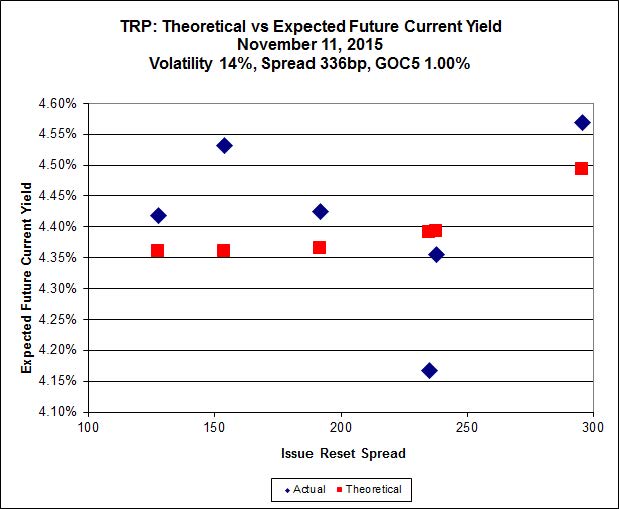
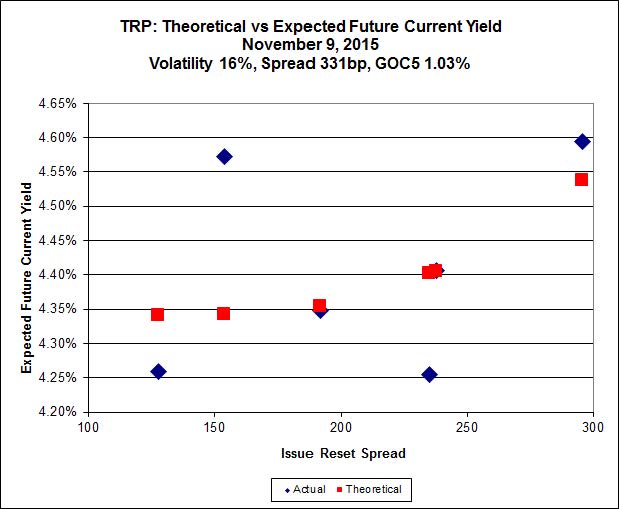
Here’s TRP:

impVol_TRP_150324
Click for Big

TRP.PR.E, which resets 2019-10-30 at +235, is bid at 24.75 to be $1.23 rich, while TRP.PR.G, resetting 2020-11-30 at +296, is $1.24 cheap at its bid price of 24.95.

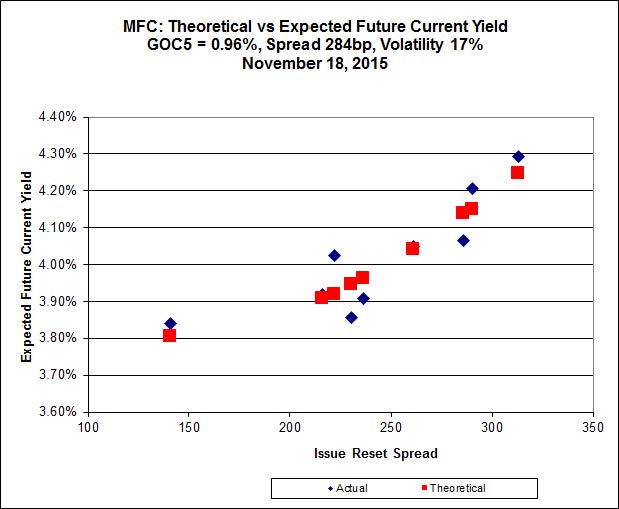
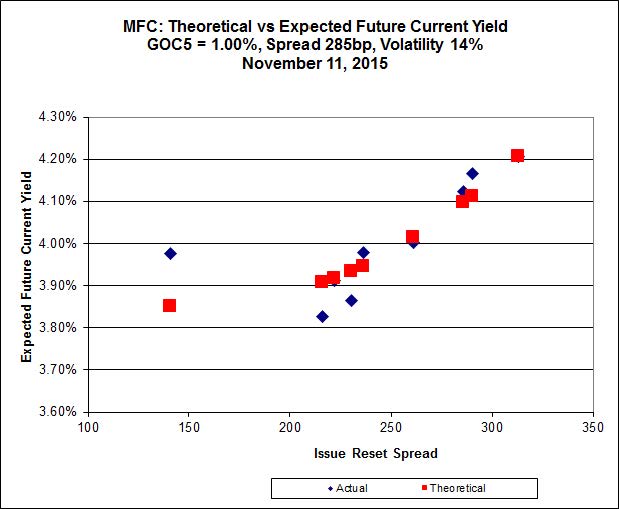
impVol_MFC_150324
Click for Big

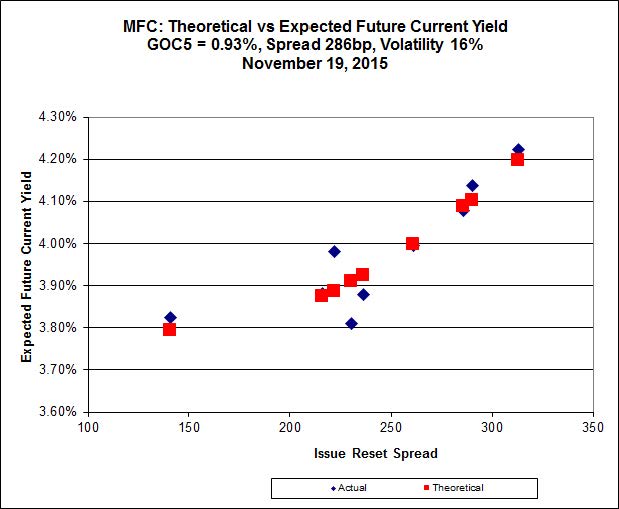
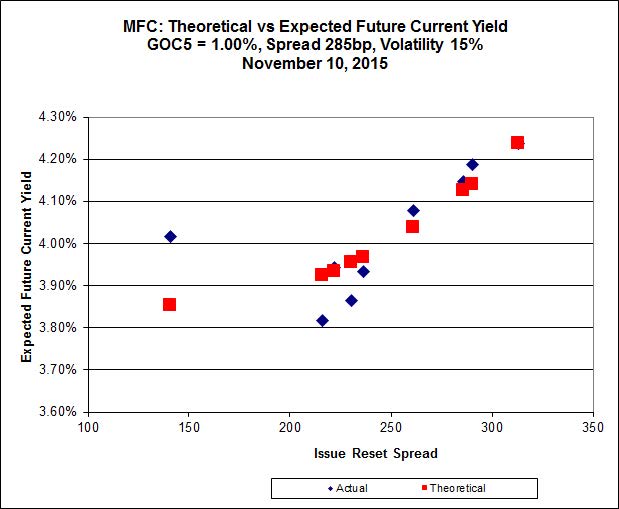
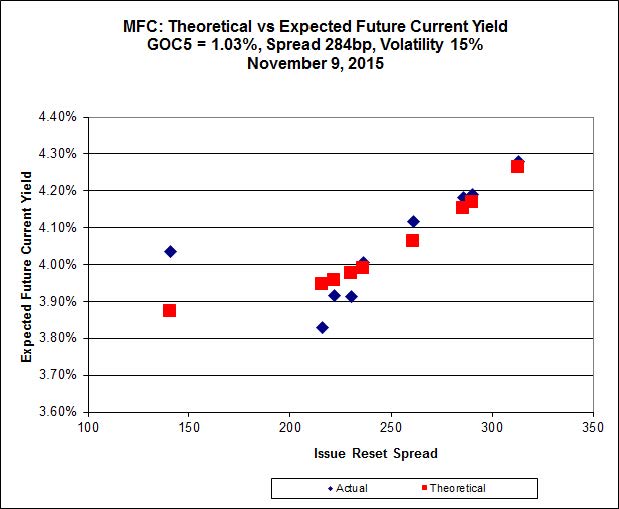
Another excellent fit, but the numbers are perplexing. Implied Volatility for MFC continues to be a conundrum, although it declined substantially today. It is still too high if we consider that NVCC rules will never apply to these issues; it is still too low if we consider them to be NVCC non-compliant issues (and therefore with Deemed Maturities in the call schedule).

Most expensive is MFC.PR.L, resetting at +216 on 2019-6-19, bid at 24.41 to be $0.74 rich, while MFC.PR.G, resetting at +290bp on 2016-12-19, is bid at 25.54 to be $0.64 cheap.

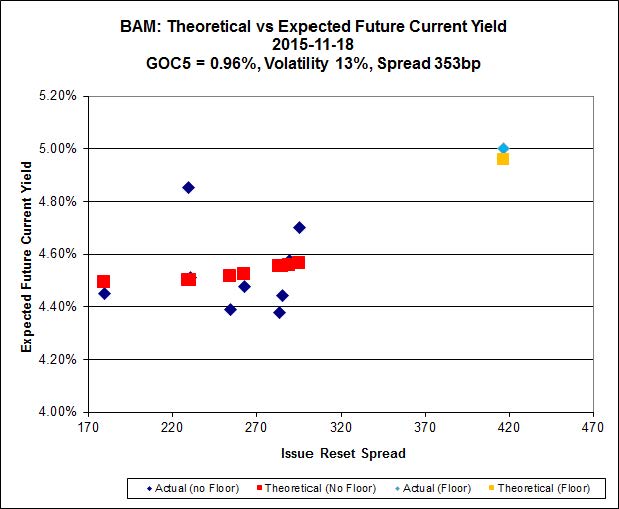
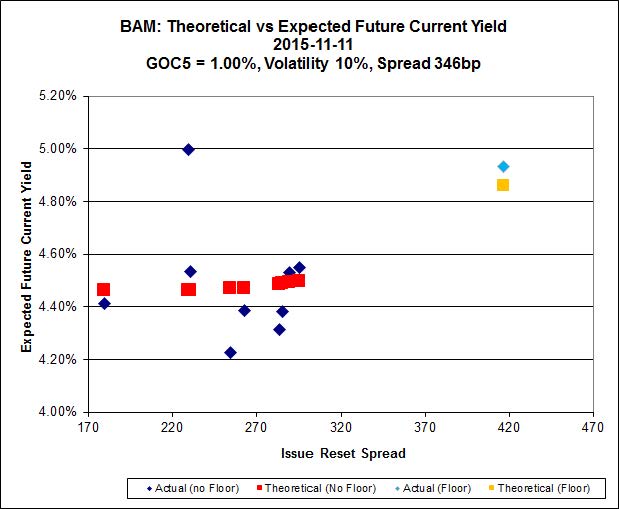
impVol_BAM_150324
Click for Big

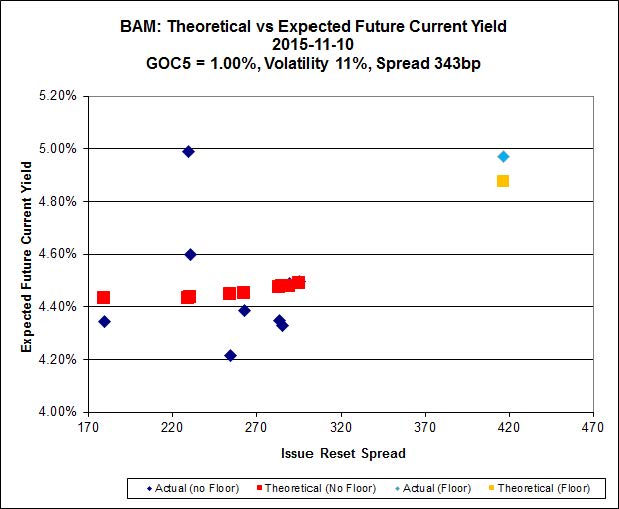
The fit on this series is actually quite reasonable – it’s the scale that makes it look so weird.

The cheapest issue relative to its peers is BAM.PR.R, resetting at +230bp on 2016-6-30, bid at 21.36 to be $0.61 cheap. BAM.PF.E, resetting at +255bp 2020-3-31 is bid at 24.30 and appears to be $0.70 rich.

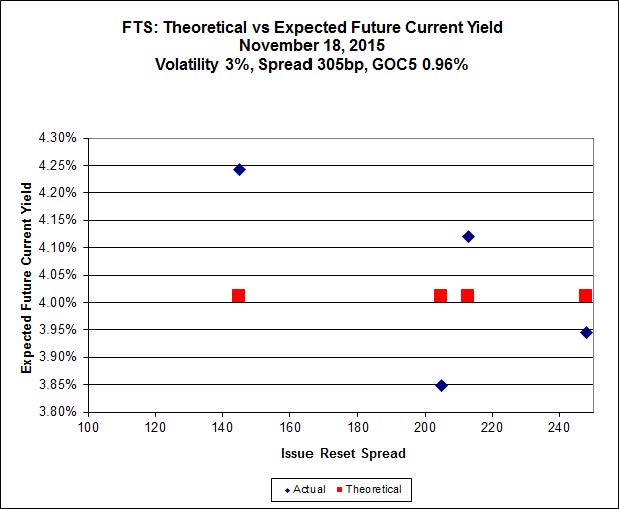
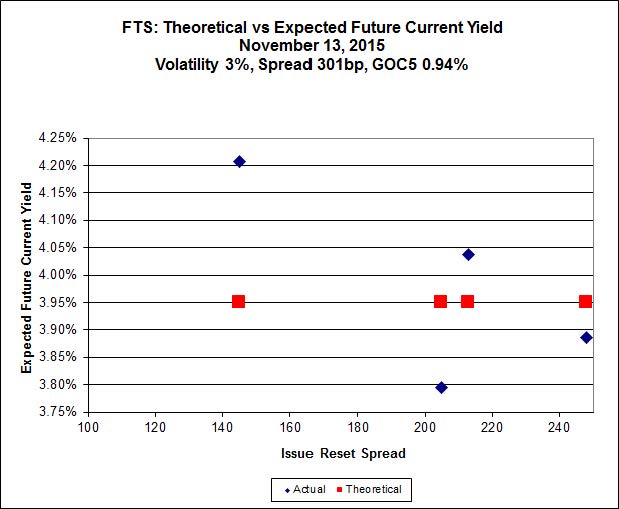
impVol_FTS_150324
Click for Big

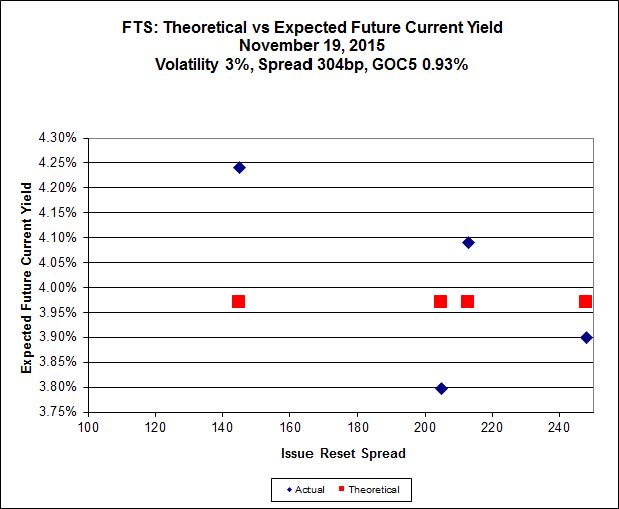
This is just weird because the middle is expensive and the ends are cheap but anyway … FTS.PR.H, with a spread of +145bp, and bid at 16.32, looks $1.47 cheap and resets 2015-6-1. FTS.PR.K, with a spread of +205bp and resetting 2019-3-1, is bid at 23.71 and is $1.06 rich.

pairs_FR_150324
Click for Big

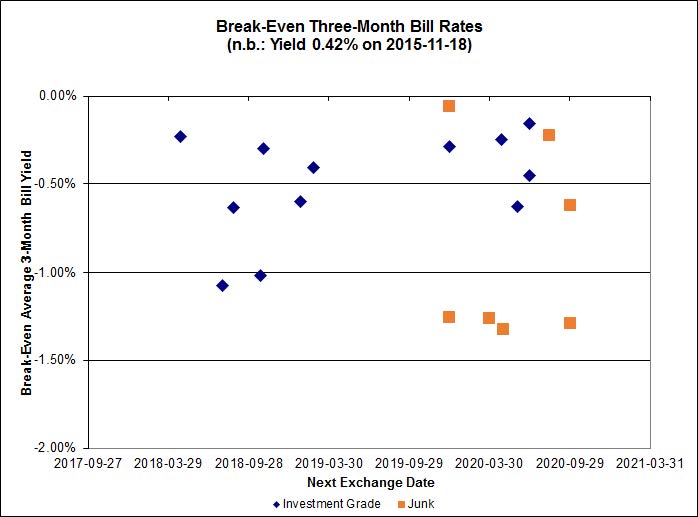
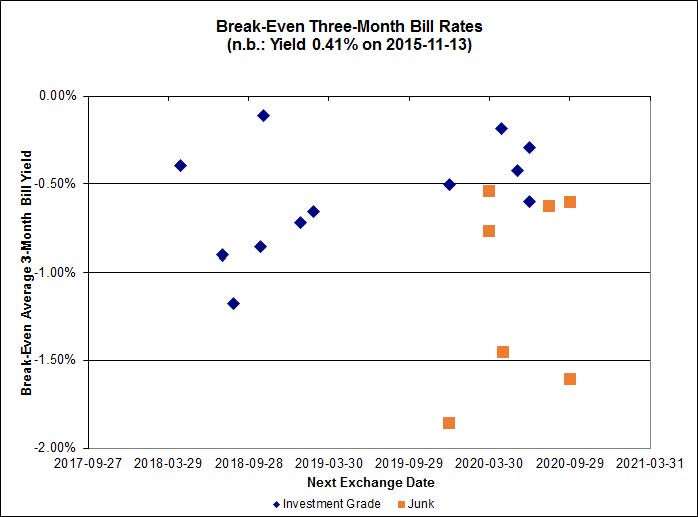
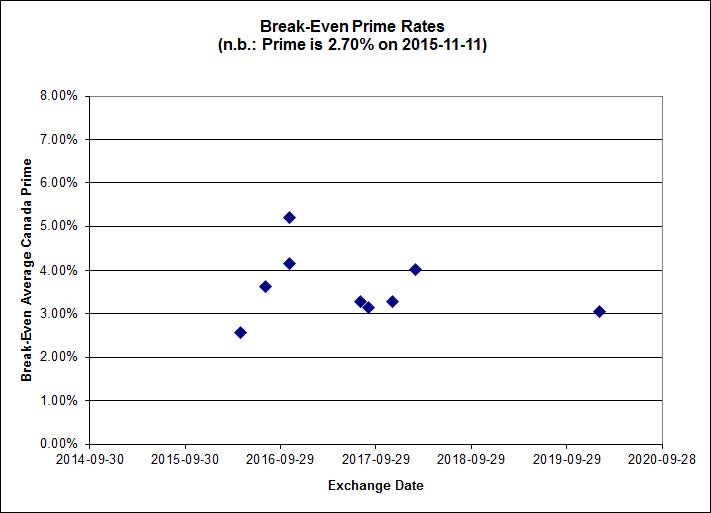
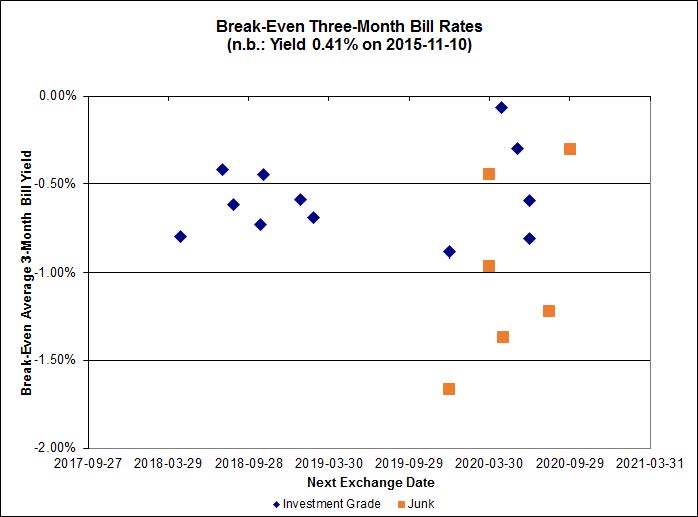
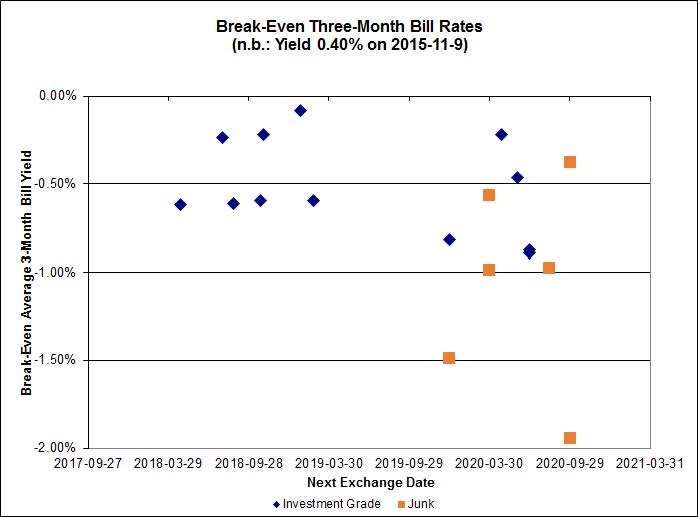
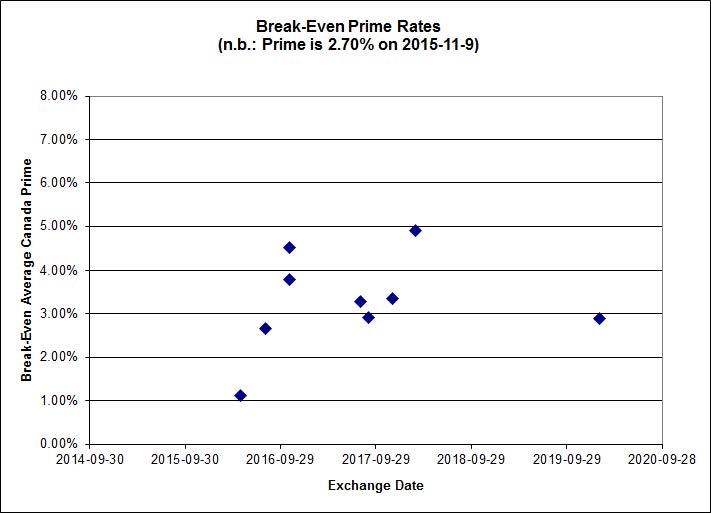
Investment-grade pairs predict an average over the next five years of about 0.10% – except for one outlier, TRP.PR.A / TRP.PR.F, which has a break-even of -0.48%. The DC.PR.B / DC.PR.D pair has gone completely insane and now predicts an average bill rate over the next 4 3/4 years of -5.15% … but the indicated bid of 19.08 on DC.PR.D is just a little bit more Toronto Stock Exchange idiocy, since the low for the day was 21.65 on frenetic volume of 1,500 shares.

pairs_FF_150324
Click for Big

Shall we just say that this exhibits a high level of confidence in the continued rapacity of Canadian banks?

HIMIPref™ Preferred Indices
These values reflect the December 2008 revision of the HIMIPref™ Indices

Values are provisional and are finalized monthly
Index Mean
Current
Yield
(at bid)
Median
YTW
Median
Average
Trading
Value
Median
Mod Dur
(YTW)
Issues Day’s Perf. Index Value
Ratchet 0.00 % 0.00 % 0 0.00 0 -1.2562 % 2,310.7
FixedFloater 0.00 % 0.00 % 0 0.00 0 -1.2562 % 4,040.3
Floater 3.28 % 3.24 % 61,794 19.12 3 -1.2562 % 2,456.5
OpRet 4.07 % 0.97 % 102,798 0.24 1 0.0000 % 2,765.8
SplitShare 4.36 % 4.42 % 32,890 3.48 4 0.2807 % 3,209.8
Interest-Bearing 0.00 % 0.00 % 0 0.00 0 0.0000 % 2,529.1
Perpetual-Premium 5.30 % 1.00 % 58,783 0.09 25 -0.0658 % 2,523.4
Perpetual-Discount 4.97 % 5.00 % 168,673 15.26 9 0.1305 % 2,816.3
FixedReset 4.38 % 3.38 % 231,905 16.83 85 0.1295 % 2,434.5
Deemed-Retractible 4.90 % 0.53 % 112,569 0.17 37 -0.0842 % 2,658.2
FloatingReset 2.43 % 2.82 % 82,031 6.31 8 0.1173 % 2,343.6
Performance Highlights
Issue Index Change Notes
BAM.PR.K Floater -2.89 % YTW SCENARIO
Maturity Type : Limit Maturity
Maturity Date : 2045-03-24
Maturity Price : 14.78
Evaluated at bid price : 14.78
Bid-YTW : 3.37 %
CU.PR.D Perpetual-Premium -1.65 % YTW SCENARIO
Maturity Type : Limit Maturity
Maturity Date : 2045-03-24
Maturity Price : 24.59
Evaluated at bid price : 25.03
Bid-YTW : 4.92 %
GWO.PR.H Deemed-Retractible -1.27 % YTW SCENARIO
Maturity Type : Hard Maturity
Maturity Date : 2025-01-31
Maturity Price : 25.00
Evaluated at bid price : 24.78
Bid-YTW : 4.98 %
MFC.PR.K FixedReset -1.19 % YTW SCENARIO
Maturity Type : Hard Maturity
Maturity Date : 2025-01-31
Maturity Price : 25.00
Evaluated at bid price : 24.16
Bid-YTW : 3.70 %
FTS.PR.H FixedReset -1.15 % YTW SCENARIO
Maturity Type : Limit Maturity
Maturity Date : 2045-03-24
Maturity Price : 16.32
Evaluated at bid price : 16.32
Bid-YTW : 3.35 %
SLF.PR.G FixedReset -1.01 % YTW SCENARIO
Maturity Type : Hard Maturity
Maturity Date : 2025-01-31
Maturity Price : 25.00
Evaluated at bid price : 17.65
Bid-YTW : 6.18 %
IFC.PR.A FixedReset 1.18 % YTW SCENARIO
Maturity Type : Hard Maturity
Maturity Date : 2025-01-31
Maturity Price : 25.00
Evaluated at bid price : 21.45
Bid-YTW : 4.81 %
BNS.PR.Z FixedReset 1.20 % YTW SCENARIO
Maturity Type : Hard Maturity
Maturity Date : 2022-01-31
Maturity Price : 25.00
Evaluated at bid price : 23.59
Bid-YTW : 3.29 %
MFC.PR.C Deemed-Retractible 1.26 % YTW SCENARIO
Maturity Type : Hard Maturity
Maturity Date : 2025-01-31
Maturity Price : 25.00
Evaluated at bid price : 24.20
Bid-YTW : 4.95 %
ENB.PR.F FixedReset 1.46 % YTW SCENARIO
Maturity Type : Limit Maturity
Maturity Date : 2045-03-24
Maturity Price : 20.10
Evaluated at bid price : 20.10
Bid-YTW : 4.21 %
CIU.PR.C FixedReset 1.48 % YTW SCENARIO
Maturity Type : Limit Maturity
Maturity Date : 2045-03-24
Maturity Price : 17.10
Evaluated at bid price : 17.10
Bid-YTW : 3.19 %
PWF.PR.P FixedReset 1.50 % YTW SCENARIO
Maturity Type : Limit Maturity
Maturity Date : 2045-03-24
Maturity Price : 19.00
Evaluated at bid price : 19.00
Bid-YTW : 3.20 %
HSE.PR.A FixedReset 1.88 % YTW SCENARIO
Maturity Type : Limit Maturity
Maturity Date : 2045-03-24
Maturity Price : 17.32
Evaluated at bid price : 17.32
Bid-YTW : 3.68 %
ENB.PR.J FixedReset 1.92 % YTW SCENARIO
Maturity Type : Limit Maturity
Maturity Date : 2045-03-24
Maturity Price : 21.43
Evaluated at bid price : 21.76
Bid-YTW : 4.04 %
Volume Highlights
Issue Index Shares
Traded
Notes
FTS.PR.G FixedReset 155,021 Nesbitt crossed 148,900 at 23.80.
YTW SCENARIO
Maturity Type : Limit Maturity
Maturity Date : 2045-03-24
Maturity Price : 22.78
Evaluated at bid price : 23.71
Bid-YTW : 3.12 %
TD.PF.A FixedReset 153,647 RBC crossed 42,800 at 24.96. TD crossed two blocks of 50,000 each at the same price.
YTW SCENARIO
Maturity Type : Limit Maturity
Maturity Date : 2045-03-24
Maturity Price : 23.16
Evaluated at bid price : 24.92
Bid-YTW : 3.06 %
TRP.PR.C FixedReset 143,666 Nesbitt crossed 131,300 at 17.21.
YTW SCENARIO
Maturity Type : Limit Maturity
Maturity Date : 2045-03-24
Maturity Price : 17.28
Evaluated at bid price : 17.28
Bid-YTW : 3.44 %
TD.PF.C FixedReset 126,115 TD crossed two blocks of 50,000 each, both at 24.71.
YTW SCENARIO
Maturity Type : Limit Maturity
Maturity Date : 2045-03-24
Maturity Price : 23.06
Evaluated at bid price : 24.69
Bid-YTW : 3.12 %
RY.PR.M FixedReset 115,625 Recent new issue.
YTW SCENARIO
Maturity Type : Limit Maturity
Maturity Date : 2045-03-24
Maturity Price : 23.00
Evaluated at bid price : 24.65
Bid-YTW : 3.35 %
CM.PR.P FixedReset 110,344 Desjardins crossed 100,000 at 24.65.
YTW SCENARIO
Maturity Type : Limit Maturity
Maturity Date : 2045-03-24
Maturity Price : 23.12
Evaluated at bid price : 24.85
Bid-YTW : 3.01 %
There were 36 other index-included issues trading in excess of 10,000 shares.
Wide Spread Highlights
Issue Index Quote Data and Yield Notes
GWO.PR.H Deemed-Retractible Quote: 24.78 – 25.18
Spot Rate : 0.4000
Average : 0.2519

YTW SCENARIO
Maturity Type : Hard Maturity
Maturity Date : 2025-01-31
Maturity Price : 25.00
Evaluated at bid price : 24.78
Bid-YTW : 4.98 %

CU.PR.D Perpetual-Premium Quote: 25.03 – 25.45
Spot Rate : 0.4200
Average : 0.3114

YTW SCENARIO
Maturity Type : Limit Maturity
Maturity Date : 2045-03-24
Maturity Price : 24.59
Evaluated at bid price : 25.03
Bid-YTW : 4.92 %

MFC.PR.K FixedReset Quote: 24.16 – 24.60
Spot Rate : 0.4400
Average : 0.3451

YTW SCENARIO
Maturity Type : Hard Maturity
Maturity Date : 2025-01-31
Maturity Price : 25.00
Evaluated at bid price : 24.16
Bid-YTW : 3.70 %

MFC.PR.I FixedReset Quote: 25.80 – 26.08
Spot Rate : 0.2800
Average : 0.1894

YTW SCENARIO
Maturity Type : Call
Maturity Date : 2017-09-19
Maturity Price : 25.00
Evaluated at bid price : 25.80
Bid-YTW : 3.09 %

GWO.PR.I Deemed-Retractible Quote: 24.35 – 24.57
Spot Rate : 0.2200
Average : 0.1562

YTW SCENARIO
Maturity Type : Hard Maturity
Maturity Date : 2025-01-31
Maturity Price : 25.00
Evaluated at bid price : 24.35
Bid-YTW : 4.85 %

SLF.PR.E Deemed-Retractible Quote: 23.76 – 24.08
Spot Rate : 0.3200
Average : 0.2603

YTW SCENARIO
Maturity Type : Hard Maturity
Maturity Date : 2025-01-31
Maturity Price : 25.00
Evaluated at bid price : 23.76
Bid-YTW : 5.16 %

Market Action

March 23, 2015

Negative yields bring reaching for yield:

Norway’s $870 billion sovereign wealth fund said this month that it added Nigeria and lifted its share of lower-rated company debt to the highest since at least 2006. Allianz SE, Europe’s biggest insurer, is shifting from German bunds to bulk up on mortgages. JPMorgan Asset Management is buying speculative-grade corporate debt to boost returns.

Norges Bank Investment Management, the world’s largest sovereign wealth fund, increased corporate bonds rated BBB or lower to 8.3 percent of its debt assets at the end of last year from 7.5 percent in the prior quarter, the fund said March 13.

Among those assets are about $200 million of bonds issued by Petroleo Brasiliero SA. Brazil’s state-controlled oil company, the biggest corporate debt issuer in emerging markets, has seen its benchmark 2024 bonds tumble almost 10 percent since allegations of kickbacks and bribes emerged in November.

The fund also added developing countries such as Ghana and Mauritius and invested in Nigeria’s currency for the first time. It has just 0.1 percent in top-rated corporate bonds.

Scotia has announced a sub-debt offering with a coupon of 2.58% to its pretend-maturity of 2022-3-30:

The Bank of Nova Scotia (“Scotiabank”) (TSX: BNS) (NYSE: BNS) today announced an inaugural Basel III-compliant offering of $1.25 billion of 2.58% Subordinated Debentures due 2027 (the “Debentures”) pursuant to its June 27, 2014 base shelf prospectus.

The Debentures, to be sold through an agency syndicate led by Scotiabank Global Banking & Markets, are expected to be issued on March 30, 2015. Interest will be payable semi-annually from the date of issue until March 30, 2022 at a rate of 2.58% per annum. From March 30, 2022 to maturity on March 30, 2027, the Debentures will pay a quarterly coupon at a rate equal to the 90 day bankers’ acceptance plus 1.19%, beginning June 30, 2022.

On or after March 30, 2022, Scotiabank may, at its option, with the prior approval of the Superintendent of Financial Institutions (Canada), in whole at any time or in part from time to time at a redemption price which is equal to par, plus accrued and unpaid interest, redeem the Debentures, on not less than 30 nor more than 60 days’ notice to registered holders.

Net proceeds from this transaction will be used for general banking purposes.

Scotiabank intends to file, in Canada, a pricing supplement to its June 27, 2014 base shelf prospectus. A copy of this document as well as the base shelf prospectus can be obtained at www.sedar.com.

This issue is rated A(low) by DBRS (emphasis added):

DBRS assigned the NVCC Sub Debt a rating equal to the Bank’s intrinsic assessment of AA (low) less three rating notches because the NVCC Sub Debt has the Office of the Superintendent of Financial Institutions (OSFI)-required non-viability contingent capital (NVCC) triggers and no additional triggers. Furthermore, DBRS has assumed that Scotiabank will follow the market precedent if issuing NVCC preferred shares in the future. Under this assumption, in the event of a conversion to common shares, the NVCC Sub Debt would have a potential for recovery that is sufficiently better than the NVCC Preferred Shares to allow for a differentiation in the NVCC Sub Debt rating relative to the NVCC Preferred Shares rating. Please see the DBRS press release entitled “DBRS Provides Guidance on Canadian Bank Non-Viability Contingent Capital Ratings” dated January 10, 2014, for more details.

I was hoping to learn today about the extent of the exercise of the hypothetical Unit Special Retraction Right of BSD / BSD.PR.A (discussed in the post BSD.PR.A Hypothetical Preferred Special Retraction Right: 44% Tender) but sadly there is nothing as yet.

It was a mixed day for the Canadian preferred share market, with PerpetualDiscounts down 36bp, FixedResets off 4bp and DeemedRetractibles gaining 4bp. Volatility was much lower than what has become normal over the last four months. Volume was below average.

For as long as the FixedReset market is so violently unsettled, I’ll keep publishing updates of the more interesting and meaningful series of FixedResets’ Implied Volatilities. This doesn’t include Enbridge because although Enbridge has a large number of issues outstanding, all of which are quite liquid, the range of Issue Reset Spreads is too small for decent conclusions. The low is 212bp (ENB.PR.H; second-lowest is ENB.PR.D at 237bp) and the high is a mere 268 for ENB.PF.G.

Remember that all rich /cheap assessments are:
» based on Implied Volatility Theory only
» are relative only to other FixedResets from the same issuer
» assume constant GOC-5 yield
» assume constant Implied Volatility
» assume constant spread

Here’s TRP:

impVol_TRP_150323
Click for Big

TRP.PR.E, which resets 2019-10-30 at +235, is bid at 24.72 to be $1.25 rich, while TRP.PR.G, resetting 2020-11-30 at +296, is $1.21 cheap at its bid price of 24.95.

impVol_MFC_150323
Click for Big

Another excellent fit, but the numbers are perplexing. Implied Volatility for MFC continues to be a conundrum, although it declined substantially today. It is still too high if we consider that NVCC rules will never apply to these issues; it is still too low if we consider them to be NVCC non-compliant issues (and therefore with Deemed Maturities in the call schedule).

Most expensive is MFC.PR.L, resetting at +216 on 2019-6-19, bid at 24.30 to be $0.62 rich, while MFC.PR.G, resetting at +290bp on 2016-12-19, is bid at 25.57 to be $0.61 cheap.

impVol_BAM_150323
Click for Big

The fit on this series is actually quite reasonable – it’s the scale that makes it look so weird.

The cheapest issue relative to its peers is BAM.PR.R, resetting at +230bp on 2016-6-30, bid at 21.50 to be $0.54 cheap. BAM.PF.E, resetting at +255bp 2020-3-31 is bid at 24.52 and appears to be $0.92 rich.

impVol_FTS_150323
Click for Big

This is just weird because the middle is expensive and the ends are cheap but anyway … FTS.PR.H, with a spread of +145bp, and bid at 16.51, looks $1.31 cheap and resets 2015-6-1. FTS.PR.K, with a spread of +205bp and resetting 2019-3-1, is bid at 23.70 and is $0.99 rich.

pairs_FR_150323
Click for Big

Investment-grade pairs predict an average over the next five years of a little under 0.10% – except for one outlier, TRP.PR.A / TRP.PR.F, which has a break-even of -0.47%. The DC.PR.B / DC.PR.D pair has gone from the extreme to the ludicrous and now predicts an average bill rate over the next 4 3/4 years of -2.30%.

pairs_FF_150323
Click for Big

Shall we just say that this exhibits a high level of confidence in the continued rapacity of Canadian banks?

HIMIPref™ Preferred Indices
These values reflect the December 2008 revision of the HIMIPref™ Indices

Values are provisional and are finalized monthly
Index Mean
Current
Yield
(at bid)
Median
YTW
Median
Average
Trading
Value
Median
Mod Dur
(YTW)
Issues Day’s Perf. Index Value
Ratchet 0.00 % 0.00 % 0 0.00 0 2.5089 % 2,340.1
FixedFloater 0.00 % 0.00 % 0 0.00 0 2.5089 % 4,091.7
Floater 3.24 % 3.24 % 62,102 19.15 3 2.5089 % 2,487.7
OpRet 4.07 % 0.96 % 103,794 0.24 1 0.0000 % 2,765.8
SplitShare 4.37 % 4.42 % 32,120 3.48 4 -0.4988 % 3,200.8
Interest-Bearing 0.00 % 0.00 % 0 0.00 0 0.0000 % 2,529.1
Perpetual-Premium 5.30 % 0.81 % 58,024 0.09 25 0.1094 % 2,525.1
Perpetual-Discount 4.97 % 5.02 % 170,899 15.21 9 -0.3621 % 2,812.7
FixedReset 4.38 % 3.44 % 237,616 16.82 85 -0.0421 % 2,431.4
Deemed-Retractible 4.90 % -1.46 % 109,935 0.15 37 0.0352 % 2,660.4
FloatingReset 2.43 % 2.89 % 83,375 6.31 8 0.3048 % 2,340.9
Performance Highlights
Issue Index Change Notes
TRP.PR.D FixedReset -1.11 % YTW SCENARIO
Maturity Type : Limit Maturity
Maturity Date : 2045-03-23
Maturity Price : 22.85
Evaluated at bid price : 24.00
Bid-YTW : 3.36 %
ENB.PR.J FixedReset -1.07 % YTW SCENARIO
Maturity Type : Limit Maturity
Maturity Date : 2045-03-23
Maturity Price : 21.35
Evaluated at bid price : 21.35
Bid-YTW : 4.15 %
PVS.PR.C SplitShare -1.06 % YTW SCENARIO
Maturity Type : Hard Maturity
Maturity Date : 2017-12-10
Maturity Price : 25.00
Evaluated at bid price : 25.13
Bid-YTW : 4.75 %
BNS.PR.Z FixedReset -1.02 % YTW SCENARIO
Maturity Type : Hard Maturity
Maturity Date : 2022-01-31
Maturity Price : 25.00
Evaluated at bid price : 23.31
Bid-YTW : 3.49 %
PWF.PR.T FixedReset 1.03 % YTW SCENARIO
Maturity Type : Limit Maturity
Maturity Date : 2045-03-23
Maturity Price : 23.41
Evaluated at bid price : 25.45
Bid-YTW : 3.11 %
TRP.PR.F FloatingReset 1.06 % YTW SCENARIO
Maturity Type : Limit Maturity
Maturity Date : 2045-03-23
Maturity Price : 19.00
Evaluated at bid price : 19.00
Bid-YTW : 3.15 %
HSE.PR.A FixedReset 1.19 % YTW SCENARIO
Maturity Type : Limit Maturity
Maturity Date : 2045-03-23
Maturity Price : 17.00
Evaluated at bid price : 17.00
Bid-YTW : 3.75 %
TRP.PR.C FixedReset 2.75 % YTW SCENARIO
Maturity Type : Limit Maturity
Maturity Date : 2045-03-23
Maturity Price : 17.16
Evaluated at bid price : 17.16
Bid-YTW : 3.47 %
BAM.PR.K Floater 8.48 % Not significant – just a reversal of Friday‘s nonsense. Thank you, Toronto Stock Exchange!
YTW SCENARIO
Maturity Type : Limit Maturity
Maturity Date : 2045-03-23
Maturity Price : 15.22
Evaluated at bid price : 15.22
Bid-YTW : 3.27 %
Volume Highlights
Issue Index Shares
Traded
Notes
RY.PR.M FixedReset 300,440 Recent new issue.
YTW SCENARIO
Maturity Type : Limit Maturity
Maturity Date : 2045-03-23
Maturity Price : 22.98
Evaluated at bid price : 24.60
Bid-YTW : 3.35 %
RY.PR.Z FixedReset 202,531 Nesbitt crossed blocks of 111,000 and 75,000, both at 25.15.
YTW SCENARIO
Maturity Type : Limit Maturity
Maturity Date : 2045-03-23
Maturity Price : 23.23
Evaluated at bid price : 25.01
Bid-YTW : 3.01 %
RY.PR.J FixedReset 155,144 Scotia crossed 150,000 at 25.10.
YTW SCENARIO
Maturity Type : Limit Maturity
Maturity Date : 2045-03-23
Maturity Price : 23.15
Evaluated at bid price : 25.00
Bid-YTW : 3.39 %
TD.PF.D FixedReset 96,490 Recent new issue.
YTW SCENARIO
Maturity Type : Limit Maturity
Maturity Date : 2045-03-23
Maturity Price : 23.14
Evaluated at bid price : 24.99
Bid-YTW : 3.41 %
MFC.PR.L FixedReset 87,807 Nesbitt crossed 84,000 at 24.43.
YTW SCENARIO
Maturity Type : Hard Maturity
Maturity Date : 2025-01-31
Maturity Price : 25.00
Evaluated at bid price : 24.30
Bid-YTW : 3.71 %
BMO.PR.S FixedReset 77,489 RBC crossed 75,000 at 25.12.
YTW SCENARIO
Maturity Type : Limit Maturity
Maturity Date : 2045-03-23
Maturity Price : 23.23
Evaluated at bid price : 25.01
Bid-YTW : 3.11 %
There were 25 other index-included issues trading in excess of 10,000 shares.
Wide Spread Highlights
Issue Index Quote Data and Yield Notes
TD.PR.T FloatingReset Quote: 24.03 – 24.70
Spot Rate : 0.6700
Average : 0.3918

YTW SCENARIO
Maturity Type : Hard Maturity
Maturity Date : 2022-01-31
Maturity Price : 25.00
Evaluated at bid price : 24.03
Bid-YTW : 2.69 %

GWO.PR.N FixedReset Quote: 18.37 – 18.87
Spot Rate : 0.5000
Average : 0.2989

YTW SCENARIO
Maturity Type : Hard Maturity
Maturity Date : 2025-01-31
Maturity Price : 25.00
Evaluated at bid price : 18.37
Bid-YTW : 5.70 %

ENB.PR.J FixedReset Quote: 21.35 – 21.80
Spot Rate : 0.4500
Average : 0.2841

YTW SCENARIO
Maturity Type : Limit Maturity
Maturity Date : 2045-03-23
Maturity Price : 21.35
Evaluated at bid price : 21.35
Bid-YTW : 4.15 %

PWF.PR.P FixedReset Quote: 18.72 – 19.14
Spot Rate : 0.4200
Average : 0.2841

YTW SCENARIO
Maturity Type : Limit Maturity
Maturity Date : 2045-03-23
Maturity Price : 18.72
Evaluated at bid price : 18.72
Bid-YTW : 3.25 %

BNS.PR.Z FixedReset Quote: 23.31 – 23.65
Spot Rate : 0.3400
Average : 0.2117

YTW SCENARIO
Maturity Type : Hard Maturity
Maturity Date : 2022-01-31
Maturity Price : 25.00
Evaluated at bid price : 23.31
Bid-YTW : 3.49 %

TRP.PR.D FixedReset Quote: 24.00 – 24.30
Spot Rate : 0.3000
Average : 0.1997

YTW SCENARIO
Maturity Type : Limit Maturity
Maturity Date : 2045-03-23
Maturity Price : 22.85
Evaluated at bid price : 24.00
Bid-YTW : 3.36 %

Market Action

March 20, 2015

Greek bank depositors not only have to deal with the potential for bank failure should Greece exit the Euro, but I’m sure they’re also worried about a punitive tax on deposits in good banks. So they’ve found another option:

GreekCash
Click for Big

It nice to see a supervisor fired for poor supervision:

Citigroup Inc. fired a trader on Friday for allegedly mismarking an inflation-options book and dismissed his boss for lax oversight, according to a person familiar with the matter.

Carl Bonde lost his job in New York after the bank determined he’d inflated the value of his trading positions by less than $30 million, the person said. Keith Price, head of U.S. inflation trading, was dismissed for his failure to supervise Bonde, said the person, who asked not to be identified discussing a personnel matter.

How ’bout them equities, eh?

Global stocks powered to their best weekly rally in nearly two years, sending two of the biggest equity benchmarks to the brink of records, on speculation the U.S. Federal Reserve will leave interest rates at zero past mid-year while European policy makers press stimulus.

The MSCI All-Country World Index surged 3.2 percent for the five days, pushing the Nasdaq Composite Index to within 7 points of wiping out all its losses since the Internet bubble. The Stoxx Europe 600 Index soared 1.9 percent to close 0.4 percent from its March 2000 high.

Other benchmark indexes also gained during the week. The Standard & Poor’s 500 Index rose 2.7 percent to 2,108.10 in the five days, 0.4 percent away from a record. In London, the FTSE 100 Index hit a fresh record, climbing above 7,000 for the first time. The Russell 2000 Index gained 2.8 percent to an all-time high.

Capital Power Corporation, proud issuer of CPX.PR.A, CPX.PR.C and CPX.PR.E, has been confirmed at Pfd-3(low) by DBRS:

DBRS Limited (DBRS) has today confirmed the rating of the Preferred Shares of Capital Power Corporation (CPC or the Company) at Pfd-3 (low) with a Stable trend. CPC’s Preferred Shares rating is based on the credit quality of its subsidiary, Capital Power L.P. (CPLP; rated BBB). Please see the CPLP rating report dated March 20, 2015, for more information on the credit quality of CPLP. The one-notch differential in the ratings of CPC and CPLP reflects the structural subordination at CPC.

CPC’s financial risk profile is based on its deconsolidated credit metrics. As CPC has no bonds/debentures issued at the parent level and is not expected to issue any debt in the foreseeable future, its adjusted leverage primarily consists of its preferred shares outstanding, which are treated as debt by DBRS. In the adjusted debt-to-capital calculation, the amount of preferred shares over the 20% preferred shares-to-equity threshold (defined as the percentage of preferred shares outstanding divided by total equity, excluding preferreds and minority interest) is treated as debt by DBRS. In 2014, CPC had $464 million of preferred shares outstanding, of which $67 million was treated as debt. As such, CPC’s unconsolidated debt-to-capital ratio was approximately 3% in 2014, which remains supportive of the current rating category. In addition, the unconsolidated fixed charge coverage ratio is expected to remain high at around five times.

It was a good day for the Canadian preferred share market, with PerpetualDiscounts winning 78bp, FixedResets up 10bp and DeemedRetractibles gaining 2bp. The Performance Highlights table has a good length, capped by winning PerpetualDiscounts. Volume was extremely high.

For as long as the FixedReset market is so violently unsettled, I’ll keep publishing updates of the more interesting and meaningful series of FixedResets’ Implied Volatilities. This doesn’t include Enbridge because although Enbridge has a large number of issues outstanding, all of which are quite liquid, the range of Issue Reset Spreads is too small for decent conclusions. The low is 212bp (ENB.PR.H; second-lowest is ENB.PR.D at 237bp) and the high is a mere 268 for ENB.PF.G.

Remember that all rich /cheap assessments are:
» based on Implied Volatility Theory only
» are relative only to other FixedResets from the same issuer
» assume constant GOC-5 yield
» assume constant Implied Volatility
» assume constant spread

Here’s TRP:

impVol_TRP_150320
Click for Big

TRP.PR.E, which resets 2019-10-30 at +235, is bid at 24.81 to be $1.31 rich, while TRP.PR.G, resetting 2020-11-30 at +296, is $1.37 cheap at its bid price of 24.92.

impVol_MFC_150320
Click for Big

Another excellent fit, but the numbers are perplexing. Implied Volatility for MFC continues to be a conundrum, although it declined substantially today. It is still too high if we consider that NVCC rules will never apply to these issues; it is still too low if we consider them to be NVCC non-compliant issues (and therefore with Deemed Maturities in the call schedule).

Most expensive is MFC.PR.L, resetting at +216 on 2019-6-19, bid at 24.48 to be $0.72 rich, while MFC.PR.H, resetting at +313bp on 2017-3-19, is bid at 26.05 to be $0.63 cheap.

impVol_BAM_150320
Click for Big

The fit on this series is actually quite reasonable – it’s the scale that makes it look so weird.

The cheapest issue relative to its peers is BAM.PR.R, resetting at +230bp on 2016-6-30, bid at 21.53 to be $0.56 cheap. BAM.PF.E, resetting at +255bp 2020-3-31 is bid at 24.51 and appears to be $0.93 rich

impVol_FTS_150320
Click for Big

This is just weird because the middle is expensive and the ends are cheap but anyway … FTS.PR.H, with a spread of +145bp, and bid at 16.60, looks $1.28 cheap and resets 2015-6-1. FTS.PR.K, with a spread of +205bp and resetting 2019-3-1, is bid at 23.70 and is $0.92 rich.

pairs_FR_150320
Click for Big

Investment-grade pairs predict an average over the next five years of about 0.00% – except for one outlier, TRP.PR.A / TRP.PR.F, which has a break-even of -0.63%. The DC.PR.B / DC.PR.D pair has gone from the extreme to the ludicrous and now predicts an average bill rate over the next 4 3/4 years of -2.36%

pairs_FF_150320
Click for Big

Shall we just say that this exhibits a high level of confidence in the continued rapacity of Canadian banks?

HIMIPref™ Preferred Indices
These values reflect the December 2008 revision of the HIMIPref™ Indices

Values are provisional and are finalized monthly
Index Mean
Current
Yield
(at bid)
Median
YTW
Median
Average
Trading
Value
Median
Mod Dur
(YTW)
Issues Day’s Perf. Index Value
Ratchet 0.00 % 0.00 % 0 0.00 0 -3.1190 % 2,282.9
FixedFloater 0.00 % 0.00 % 0 0.00 0 -3.1190 % 3,991.5
Floater 3.32 % 3.21 % 63,097 19.21 3 -3.1190 % 2,426.9
OpRet 4.07 % 0.93 % 105,377 0.25 1 -0.0397 % 2,765.8
SplitShare 4.46 % 4.31 % 57,630 4.43 5 -0.1429 % 3,216.8
Interest-Bearing 0.00 % 0.00 % 0 0.00 0 -0.0397 % 2,529.1
Perpetual-Premium 5.29 % 1.26 % 57,461 0.09 25 0.0516 % 2,522.3
Perpetual-Discount 4.96 % 5.02 % 172,159 15.24 9 0.7483 % 2,822.9
FixedReset 4.38 % 3.42 % 241,019 16.83 85 0.0976 % 2,432.4
Deemed-Retractible 4.90 % -1.43 % 112,770 0.11 37 0.0171 % 2,659.5
FloatingReset 2.49 % 2.90 % 86,537 6.31 8 -0.0748 % 2,333.7
Performance Highlights
Issue Index Change Notes
BAM.PR.K Floater -9.54 % A nonsensical closing bid, courtesy of those hard-working bank employees at the Toronto Stock Exchange. The issue traded 4,040 shares in a range of 15.41-72. As with the same issue on March 10, it is not clear whether this is due to inadequate Toronto Stock Exchange reporting or inadequate Toronto Stock Exchange supervision of market-makers.
YTW SCENARIO
Maturity Type : Limit Maturity
Maturity Date : 2045-03-20
Maturity Price : 14.03
Evaluated at bid price : 14.03
Bid-YTW : 3.55 %
ENB.PR.Y FixedReset -1.32 % YTW SCENARIO
Maturity Type : Limit Maturity
Maturity Date : 2045-03-20
Maturity Price : 20.15
Evaluated at bid price : 20.15
Bid-YTW : 4.14 %
TRP.PR.F FloatingReset -1.31 % YTW SCENARIO
Maturity Type : Limit Maturity
Maturity Date : 2045-03-20
Maturity Price : 18.80
Evaluated at bid price : 18.80
Bid-YTW : 3.25 %
SLF.PR.H FixedReset -1.28 % YTW SCENARIO
Maturity Type : Hard Maturity
Maturity Date : 2025-01-31
Maturity Price : 25.00
Evaluated at bid price : 22.36
Bid-YTW : 4.39 %
CGI.PR.D SplitShare -1.21 % YTW SCENARIO
Maturity Type : Soft Maturity
Maturity Date : 2023-06-14
Maturity Price : 25.00
Evaluated at bid price : 25.30
Bid-YTW : 3.60 %
BNS.PR.Z FixedReset 1.03 % YTW SCENARIO
Maturity Type : Hard Maturity
Maturity Date : 2022-01-31
Maturity Price : 25.00
Evaluated at bid price : 23.55
Bid-YTW : 3.33 %
IAG.PR.G FixedReset 1.10 % YTW SCENARIO
Maturity Type : Call
Maturity Date : 2017-06-30
Maturity Price : 25.00
Evaluated at bid price : 25.69
Bid-YTW : 2.99 %
BAM.PR.R FixedReset 1.13 % YTW SCENARIO
Maturity Type : Limit Maturity
Maturity Date : 2045-03-20
Maturity Price : 21.53
Evaluated at bid price : 21.53
Bid-YTW : 3.69 %
MFC.PR.L FixedReset 1.16 % YTW SCENARIO
Maturity Type : Hard Maturity
Maturity Date : 2025-01-31
Maturity Price : 25.00
Evaluated at bid price : 24.48
Bid-YTW : 3.62 %
CIU.PR.C FixedReset 1.26 % YTW SCENARIO
Maturity Type : Limit Maturity
Maturity Date : 2045-03-20
Maturity Price : 16.86
Evaluated at bid price : 16.86
Bid-YTW : 3.25 %
BAM.PR.N Perpetual-Discount 1.32 % YTW SCENARIO
Maturity Type : Limit Maturity
Maturity Date : 2045-03-20
Maturity Price : 22.70
Evaluated at bid price : 23.04
Bid-YTW : 5.15 %
BAM.PF.C Perpetual-Discount 1.43 % YTW SCENARIO
Maturity Type : Limit Maturity
Maturity Date : 2045-03-20
Maturity Price : 23.12
Evaluated at bid price : 23.45
Bid-YTW : 5.17 %
CU.PR.F Perpetual-Discount 1.61 % YTW SCENARIO
Maturity Type : Limit Maturity
Maturity Date : 2045-03-20
Maturity Price : 23.63
Evaluated at bid price : 24.00
Bid-YTW : 4.71 %
Volume Highlights
Issue Index Shares
Traded
Notes
RY.PR.M FixedReset 276,913 Recent inventory blow-out.
YTW SCENARIO
Maturity Type : Limit Maturity
Maturity Date : 2045-03-20
Maturity Price : 22.99
Evaluated at bid price : 24.61
Bid-YTW : 3.36 %
POW.PR.D Perpetual-Premium 230,738 Nesbitt crossed blocks of 50,000 shares, 110,600 and 60,000, all at 25.25.
YTW SCENARIO
Maturity Type : Call
Maturity Date : 2015-04-19
Maturity Price : 25.00
Evaluated at bid price : 25.30
Bid-YTW : 1.26 %
IAG.PR.G FixedReset 167,264 Nesbitt crossed 160,600 at 25.60.
YTW SCENARIO
Maturity Type : Call
Maturity Date : 2017-06-30
Maturity Price : 25.00
Evaluated at bid price : 25.69
Bid-YTW : 2.99 %
NA.PR.S FixedReset 162,676 TD crossed 125,000 at 25.40.
YTW SCENARIO
Maturity Type : Limit Maturity
Maturity Date : 2045-03-20
Maturity Price : 23.34
Evaluated at bid price : 25.32
Bid-YTW : 3.15 %
RY.PR.J FixedReset 157,750 RBC crossed 69,800 at 24.99 and 16,000 at 25.00. RBC bought blocks of 17,700 and 19,900 from Nesbitt at 24.99.
YTW SCENARIO
Maturity Type : Limit Maturity
Maturity Date : 2045-03-20
Maturity Price : 23.14
Evaluated at bid price : 24.97
Bid-YTW : 3.40 %
ENB.PR.N FixedReset 146,462 RBC crossed 139,000 at 21.00.
YTW SCENARIO
Maturity Type : Limit Maturity
Maturity Date : 2045-03-20
Maturity Price : 21.00
Evaluated at bid price : 21.00
Bid-YTW : 4.20 %
BMO.PR.S FixedReset 142,232 Nesbitt crossed 48,300 at 25.06. RBC crossed 52,800 at 25.06 and 25,000 at 25.12.
YTW SCENARIO
Maturity Type : Limit Maturity
Maturity Date : 2045-03-20
Maturity Price : 23.30
Evaluated at bid price : 25.20
Bid-YTW : 3.08 %
RY.PR.E Deemed-Retractible 137,605 Nesbitt crossed blocks of 65,100 and 70,000, both at 25.55.
YTW SCENARIO
Maturity Type : Call
Maturity Date : 2015-04-19
Maturity Price : 25.25
Evaluated at bid price : 25.57
Bid-YTW : -7.21 %
ENB.PR.D FixedReset 105,044 RBC crossed blocks of 35,000 and 51,400 at 19.54.
YTW SCENARIO
Maturity Type : Limit Maturity
Maturity Date : 2045-03-20
Maturity Price : 19.40
Evaluated at bid price : 19.40
Bid-YTW : 4.21 %
CM.PR.Q FixedReset 102,874 RBC crossed 35,500 at 24.87.
YTW SCENARIO
Maturity Type : Limit Maturity
Maturity Date : 2045-03-20
Maturity Price : 23.09
Evaluated at bid price : 24.86
Bid-YTW : 3.45 %
ENB.PR.F FixedReset 102,498 Nesbitt sold 18,500 to RBC at 20.00 and crossed 42,900 at the same price.
YTW SCENARIO
Maturity Type : Limit Maturity
Maturity Date : 2045-03-20
Maturity Price : 19.92
Evaluated at bid price : 19.92
Bid-YTW : 4.26 %
BMO.PR.T FixedReset 101,392 TD crossed 50,000 and 45,000 at 24.95.
YTW SCENARIO
Maturity Type : Limit Maturity
Maturity Date : 2045-03-20
Maturity Price : 23.10
Evaluated at bid price : 24.71
Bid-YTW : 3.09 %
There were 49 other index-included issues trading in excess of 10,000 shares.
Wide Spread Highlights
Issue Index Quote Data and Yield Notes
BAM.PR.K Floater Quote: 14.03 – 15.89
Spot Rate : 1.8600
Average : 1.1308

YTW SCENARIO
Maturity Type : Limit Maturity
Maturity Date : 2045-03-20
Maturity Price : 14.03
Evaluated at bid price : 14.03
Bid-YTW : 3.55 %

CGI.PR.D SplitShare Quote: 25.30 – 25.80
Spot Rate : 0.5000
Average : 0.3579

YTW SCENARIO
Maturity Type : Soft Maturity
Maturity Date : 2023-06-14
Maturity Price : 25.00
Evaluated at bid price : 25.30
Bid-YTW : 3.60 %

TD.PR.Z FloatingReset Quote: 23.85 – 24.26
Spot Rate : 0.4100
Average : 0.2781

YTW SCENARIO
Maturity Type : Hard Maturity
Maturity Date : 2022-01-31
Maturity Price : 25.00
Evaluated at bid price : 23.85
Bid-YTW : 2.94 %

MFC.PR.K FixedReset Quote: 24.32 – 24.80
Spot Rate : 0.4800
Average : 0.3627

YTW SCENARIO
Maturity Type : Hard Maturity
Maturity Date : 2025-01-31
Maturity Price : 25.00
Evaluated at bid price : 24.32
Bid-YTW : 3.62 %

BMO.PR.R FloatingReset Quote: 23.90 – 24.20
Spot Rate : 0.3000
Average : 0.2021

YTW SCENARIO
Maturity Type : Hard Maturity
Maturity Date : 2022-01-31
Maturity Price : 25.00
Evaluated at bid price : 23.90
Bid-YTW : 2.87 %

ENB.PR.T FixedReset Quote: 20.48 – 20.79
Spot Rate : 0.3100
Average : 0.2233

YTW SCENARIO
Maturity Type : Limit Maturity
Maturity Date : 2045-03-20
Maturity Price : 20.48
Evaluated at bid price : 20.48
Bid-YTW : 4.18 %

Market Action

March 19, 2015

TIPS are in high demand:

The U.S. Treasury Department can thank the Federal Reserve for the surge in demand at Thursday’s auction of inflation-protected bonds.

The $13 billion in 10-year Treasury Inflation-Protected Securities, or TIPS, were sold at a yield of 0.2 percent, the lowest at an auction of the debt since May 2013. The Fed indicated Wednesday it isn’t in a rush to raise interest rates, leaving the door open for economic growth to stoke inflation.

Ten-year break-evens, the difference between yields on 10-year Treasury inflation protected securities and nominal equivalents, show investors expect U.S. consumer prices to rise 1.79 percent a year for the coming decade, up from a 2015 low of 1.49 percent on Jan. 14.

The gauge rose as much as 0.09 percentage point Thursday as rising prices for TIPS pulled their yields down and further away from yields on benchmark 10-year notes.

It was a mixed day for the Canadian preferred share market, with PerpetualDiscounts up 11bp, FixedResets gaining 10bp and DeemedRetractibles off 2bp. There was no real pattern in the Performance Highlights table, other than that it was dominated by winners; Floaters did well. Volume was well above average.

For as long as the FixedReset market is so violently unsettled, I’ll keep publishing updates of the more interesting and meaningful series of FixedResets’ Implied Volatilities. This doesn’t include Enbridge because although Enbridge has a large number of issues outstanding, all of which are quite liquid, the range of Issue Reset Spreads is too small for decent conclusions. The low is 212bp (ENB.PR.H; second-lowest is ENB.PR.D at 237bp) and the high is a mere 268 for ENB.PF.G.

Remember that all rich /cheap assessments are:
» based on Implied Volatility Theory only
» are relative only to other FixedResets from the same issuer
» assume constant GOC-5 yield
» assume constant Implied Volatility
» assume constant spread

Here’s TRP:

impVol_TRP_150319
Click for Big

TRP.PR.E, which resets 2019-10-30 at +235, is bid at 24.68 to be $1.23 rich, while TRP.PR.G, resetting 2020-11-30 at +296, is $1.40 cheap at its bid price of 24.85.

impVol_MFC_150319
Click for Big

Another excellent fit, but the numbers are perplexing. Implied Volatility for MFC continues to be a conundrum, although it declined substantially today. It is still too high if we consider that NVCC rules will never apply to these issues; it is still too low if we consider them to be NVCC non-compliant issues (and therefore with Deemed Maturities in the call schedule).

Most expensive is MFC.PR.L, resetting at +216 on 2019-6-19, bid at 24.20 to be $0.47 rich, while MFC.PR.H, resetting at +313bp on 2017-3-19, is bid at 25.85 to be $0.82 cheap.

impVol_BAM_150319
Click for Big

The fit on this series is actually quite reasonable – it’s the scale that makes it look so weird.

The cheapest issue relative to its peers is BAM.PR.R, resetting at +230bp on 2016-6-30, bid at 21.29 to be $0.71 cheap. BAM.PF.E, resetting at +255bp 2020-3-31 is bid at 24.45 and appears to be $0.90 rich

impVol_FTS_150319
Click for Big

This is just weird because the middle is expensive and the ends are cheap but anyway … FTS.PR.H, with a spread of +145bp, and bid at 16.70, looks $1.23 cheap and resets 2015-6-1. FTS.PR.K, with a spread of +205bp and resetting 2019-3-1, is bid at 23.71 and is $0.91 rich.

pairs_FR_150319
Click for Big

Investment-grade pairs predict an average over the next five years of about 0.00% – except for one outlier, TRP.PR.A / TRP.PR.F, which has a break-even of -0.40%. The DC.PR.B / DC.PR.D pair has gone from the extreme to the ludicrous and now predicts an average bill rate over the next 4 3/4 years of -2.78%

pairs_FF_150319
Click for Big

Shall we just say that this exhibits a high level of confidence in the continued rapacity of Canadian banks?

HIMIPref™ Preferred Indices
These values reflect the December 2008 revision of the HIMIPref™ Indices

Values are provisional and are finalized monthly
Index Mean
Current
Yield
(at bid)
Median
YTW
Median
Average
Trading
Value
Median
Mod Dur
(YTW)
Issues Day’s Perf. Index Value
Ratchet 0.00 % 0.00 % 0 0.00 0 1.8624 % 2,356.4
FixedFloater 0.00 % 0.00 % 0 0.00 0 1.8624 % 4,120.0
Floater 3.22 % 3.21 % 63,980 19.22 3 1.8624 % 2,505.0
OpRet 4.07 % 0.76 % 106,654 0.25 1 0.1589 % 2,766.9
SplitShare 4.46 % 4.44 % 57,559 4.42 5 0.0159 % 3,221.4
Interest-Bearing 0.00 % 0.00 % 0 0.00 0 0.1589 % 2,530.1
Perpetual-Premium 5.29 % 0.08 % 56,492 0.09 25 0.1567 % 2,521.0
Perpetual-Discount 4.99 % 4.99 % 164,926 15.17 9 0.1124 % 2,801.9
FixedReset 4.38 % 3.52 % 241,768 16.69 85 0.1007 % 2,430.0
Deemed-Retractible 4.90 % -1.42 % 110,252 0.12 37 -0.0224 % 2,659.1
FloatingReset 2.49 % 2.93 % 87,529 6.31 8 0.2894 % 2,335.5
Performance Highlights
Issue Index Change Notes
HSE.PR.A FixedReset -1.18 % YTW SCENARIO
Maturity Type : Limit Maturity
Maturity Date : 2045-03-19
Maturity Price : 16.78
Evaluated at bid price : 16.78
Bid-YTW : 3.97 %
TRP.PR.C FixedReset -1.01 % YTW SCENARIO
Maturity Type : Limit Maturity
Maturity Date : 2045-03-19
Maturity Price : 16.69
Evaluated at bid price : 16.69
Bid-YTW : 3.74 %
MFC.PR.C Deemed-Retractible 1.22 % YTW SCENARIO
Maturity Type : Hard Maturity
Maturity Date : 2025-01-31
Maturity Price : 25.00
Evaluated at bid price : 24.04
Bid-YTW : 5.02 %
BAM.PR.B Floater 1.37 % YTW SCENARIO
Maturity Type : Limit Maturity
Maturity Date : 2045-03-19
Maturity Price : 15.56
Evaluated at bid price : 15.56
Bid-YTW : 3.20 %
TRP.PR.D FixedReset 1.46 % YTW SCENARIO
Maturity Type : Limit Maturity
Maturity Date : 2045-03-19
Maturity Price : 22.99
Evaluated at bid price : 24.34
Bid-YTW : 3.40 %
BAM.PR.C Floater 1.65 % YTW SCENARIO
Maturity Type : Limit Maturity
Maturity Date : 2045-03-19
Maturity Price : 15.42
Evaluated at bid price : 15.42
Bid-YTW : 3.23 %
FTS.PR.H FixedReset 1.71 % YTW SCENARIO
Maturity Type : Limit Maturity
Maturity Date : 2045-03-19
Maturity Price : 16.70
Evaluated at bid price : 16.70
Bid-YTW : 3.45 %
ENB.PR.Y FixedReset 1.74 % YTW SCENARIO
Maturity Type : Limit Maturity
Maturity Date : 2045-03-19
Maturity Price : 20.42
Evaluated at bid price : 20.42
Bid-YTW : 4.19 %
TRP.PR.F FloatingReset 1.87 % YTW SCENARIO
Maturity Type : Limit Maturity
Maturity Date : 2045-03-19
Maturity Price : 19.05
Evaluated at bid price : 19.05
Bid-YTW : 3.21 %
BAM.PR.K Floater 2.58 % YTW SCENARIO
Maturity Type : Limit Maturity
Maturity Date : 2045-03-19
Maturity Price : 15.51
Evaluated at bid price : 15.51
Bid-YTW : 3.21 %
ELF.PR.H Perpetual-Premium 2.87 % YTW SCENARIO
Maturity Type : Call
Maturity Date : 2021-04-17
Maturity Price : 25.00
Evaluated at bid price : 25.78
Bid-YTW : 5.11 %
Volume Highlights
Issue Index Shares
Traded
Notes
RY.PR.M FixedReset 483,371 Inventory blow-out sale.
YTW SCENARIO
Maturity Type : Limit Maturity
Maturity Date : 2045-03-19
Maturity Price : 22.96
Evaluated at bid price : 24.53
Bid-YTW : 3.46 %
TD.PF.B FixedReset 222,494 TD crossed blocks of 50,000 shares, 49,700 and 100,000, all at 24.88.
YTW SCENARIO
Maturity Type : Limit Maturity
Maturity Date : 2045-03-19
Maturity Price : 23.16
Evaluated at bid price : 24.86
Bid-YTW : 3.17 %
RY.PR.H FixedReset 184,144 RBC crossed 168,700 at 24.94
YTW SCENARIO
Maturity Type : Limit Maturity
Maturity Date : 2045-03-19
Maturity Price : 23.16
Evaluated at bid price : 24.86
Bid-YTW : 3.17 %
SLF.PR.I FixedReset 135,882 Nesbitt crossed 118,700 at 25.30.
YTW SCENARIO
Maturity Type : Hard Maturity
Maturity Date : 2025-01-31
Maturity Price : 25.00
Evaluated at bid price : 25.24
Bid-YTW : 3.58 %
BAM.PF.A FixedReset 73,320 Nesbitt crossed 64,600 at 25.25.
YTW SCENARIO
Maturity Type : Limit Maturity
Maturity Date : 2045-03-19
Maturity Price : 23.37
Evaluated at bid price : 25.20
Bid-YTW : 3.72 %
GWO.PR.L Deemed-Retractible 71,300 Scotia crossed 20,000 at 26.18; Nesbitt crossed 50,000 at the same price.
YTW SCENARIO
Maturity Type : Call
Maturity Date : 2015-04-18
Maturity Price : 26.00
Evaluated at bid price : 26.18
Bid-YTW : -5.25 %
There were 43 other index-included issues trading in excess of 10,000 shares.
Wide Spread Highlights
Issue Index Quote Data and Yield Notes
ENB.PF.E FixedReset Quote: 22.20 – 22.48
Spot Rate : 0.2800
Average : 0.1834

YTW SCENARIO
Maturity Type : Limit Maturity
Maturity Date : 2045-03-19
Maturity Price : 21.77
Evaluated at bid price : 22.20
Bid-YTW : 4.21 %

GWO.PR.P Deemed-Retractible Quote: 26.30 – 26.56
Spot Rate : 0.2600
Average : 0.1722

YTW SCENARIO
Maturity Type : Call
Maturity Date : 2020-03-31
Maturity Price : 25.25
Evaluated at bid price : 26.30
Bid-YTW : 4.40 %

MFC.PR.H FixedReset Quote: 25.85 – 26.15
Spot Rate : 0.3000
Average : 0.2163

YTW SCENARIO
Maturity Type : Call
Maturity Date : 2017-03-19
Maturity Price : 25.00
Evaluated at bid price : 25.85
Bid-YTW : 2.85 %

SLF.PR.I FixedReset Quote: 25.24 – 25.49
Spot Rate : 0.2500
Average : 0.1698

YTW SCENARIO
Maturity Type : Hard Maturity
Maturity Date : 2025-01-31
Maturity Price : 25.00
Evaluated at bid price : 25.24
Bid-YTW : 3.58 %

PWF.PR.P FixedReset Quote: 18.60 – 18.93
Spot Rate : 0.3300
Average : 0.2503

YTW SCENARIO
Maturity Type : Limit Maturity
Maturity Date : 2045-03-19
Maturity Price : 18.60
Evaluated at bid price : 18.60
Bid-YTW : 3.43 %

PWF.PR.L Perpetual-Premium Quote: 25.35 – 25.65
Spot Rate : 0.3000
Average : 0.2225

YTW SCENARIO
Maturity Type : Call
Maturity Date : 2015-10-31
Maturity Price : 25.00
Evaluated at bid price : 25.35
Bid-YTW : 3.91 %

Market Action

March 18, 2015

Lucky Assiduous Readers! It’s time for me to get on my favourite hobby-horse again … one I’ve been riding for over twenty five years now … and will probably keep flogging even if it dies:

GICs also have a psychological benefit because, unlike bonds, GIC prices don’t change when interest rates rise or fall.

” GIC prices don’t change when interest rates rise or fall.”

This is not correct. Reported GIC prices generally don’t change, but the actual price you can get for it (if transferable) does – and so does the actual value of the cash flows.

The brokerage industry’s obfuscation of value with respect to GICs is going to be yet another competitive advantage for the banks when CRM2 and mandatory performance reporting come into force.

For a longer rant, see my essay Preferred Shares and GICs; those who are more interested in cheap entertainment can just look at the comments to the Globe story.

But the big news of the day was FOMC press release:

Consistent with its previous statement, the Committee judges that an increase in the target range for the federal funds rate remains unlikely at the April FOMC meeting. The Committee anticipates that it will be appropriate to raise the target range for the federal funds rate when it has seen further improvement in the labor market and is reasonably confident that inflation will move back to its 2 percent objective over the medium term. This change in the forward guidance does not indicate that the Committee has decided on the timing of the initial increase in the target range.

When the Committee decides to begin to remove policy accommodation, it will take a balanced approach consistent with its longer-run goals of maximum employment and inflation of 2 percent. The Committee currently anticipates that, even after employment and inflation are near mandate-consistent levels, economic conditions may, for some time, warrant keeping the target federal funds rate below levels the Committee views as normal in the longer run.

There was no dissent.

And the markets went wild!

The Federal Reserve dropped an assurance it will be “patient” in raising interest rates, ending an era in its communications policy and opening the door for higher borrowing costs as early as June.

“An increase in the target range for the federal funds rate remains unlikely at the April” meeting, the Federal Open Market Committee said in a statement Wednesday in Washington. Fed officials also lowered their median estimate for the federal funds rate at the end of 2015 to 0.625 percent, compared with 1.125 percent in December forecasts.

Stocks rose, erasing earlier losses, after the FOMC announcement. The Standard & Poor’s 500 Index was up 0.6 percent at 2,087.04 as of 2:11 p.m. in New York. Ten-year Treasury notes yielded 1.99 percent, down 6 basis points.

In December, the FOMC dropped a clause from its statement that it would hold rates low for a “considerable time” and instead said it would be “patient” in weighing an increase.

In fact, the market took the release as a whole to be a dovish indicator:

Money-market futures traders cut the odds of a Federal Reserve interest-rate increase below 50 percent until December after Chair Janet Yellen lowered her outlook for growth and the pace of policy tightening.

The likelihood that policy makers will lift their benchmark rate from near zero in September fell to 39 percent from 55 percent on Tuesday, according to calculations by Bloomberg using federal fund futures contracts. Futures traders have wiped out the chance of an increase in June, assigning it an 11 percent probability.

While the policy-setting Federal Open Market Committee dropped a commitment to be “patient” when raising rates, a key shift was policy makers’ lowering of their median estimate for benchmark borrowing costs during the next two years, according to Brian Smedley, an interest-rate strategist at Bank of America Corp. in New York. The fresh set of estimates reduced the median for the federal funds rate at the end of 2015 to 0.625 percent, compared with a December forecast of 1.125 percent.

The OECD is not impressed by Canada’s prospects:

Smacked by the oil crash, Canada has taken a big hit in a new OECD economic forecast.

In its updated projections released Wednesday, the Organization for Economic Co-operation and Development cut its outlook for growth in Canada this year to 2.2 per cent, down from 2.6 per cent in its November forecast.

For 2016, the group now sees growth of 2.1 per cent, down from 2.4 per cent.

“Oil and commodity exporters are facing weaker growth prospects as the result of lower prices,” the OECD said.

Like Canada, the forecast for Brazil has been cut.

“The main class of countries for which near-term growth prospects have worsened since the November 2014 economic outlook is the commodity exporters,” the OECD said.

“The interim projections are significantly lower for oil-exporters Canada and Brazil, with short-term growth prospects in Brazil also being restrained by monetary and fiscal tightening and increasing political uncertainty,” it added.

“Growth has already slowed in many other oil-exporting countries, and with the fall in commodity prices going well beyond oil, exporters of metals, coal and some agricultural commodities also face less favourable growth prospects this year.”

It was a mildly positive day for the Canadian preferred share market, with PerpetualDiscounts gaining 3bp, FixedResets flat, and DeemedRetractibles up 6bp. The overall calmness masked a lot of volatility, with a fairly lengthy Performance Highlights table dominated by losing FixedResets. Volume was very high.

PerpetualDiscounts now yield 4.99%, equivalent to 6.49% interest at the standard equivalency factor of 1.3x. Long corporates now yield about 3.7%, so the pre-tax interest-equivalent spread (in this context, the “Seniority Spread”) is now 280bp, a widening from the 270bp reported March 11.

For as long as the FixedReset market is so violently unsettled, I’ll keep publishing updates of the more interesting and meaningful series of FixedResets’ Implied Volatilities. This doesn’t include Enbridge because although Enbridge has a large number of issues outstanding, all of which are quite liquid, the range of Issue Reset Spreads is too small for decent conclusions. The low is 212bp (ENB.PR.H; second-lowest is ENB.PR.D at 237bp) and the high is a mere 268 for ENB.PF.G.

Remember that all rich /cheap assessments are:
» based on Implied Volatility Theory only
» are relative only to other FixedResets from the same issuer
» assume constant GOC-5 yield
» assume constant Implied Volatility
» assume constant spread

Here’s TRP:

impVol_TRP_150318
Click for Big

TRP.PR.E, which resets 2019-10-30 at +235, is bid at 24.55 to be $1.15 rich, while TRP.PR.G, resetting 2020-11-30 at +296, is $1.32 cheap at its bid price of 24.90.

impVol_MFC_150318
Click for Big

Another excellent fit, but the numbers are perplexing. Implied Volatility for MFC continues to be a conundrum, although it declined substantially today. It is still too high if we consider that NVCC rules will never apply to these issues; it is still too low if we consider them to be NVCC non-compliant issues (and therefore with Deemed Maturities in the call schedule).

Most expensive is MFC.PR.M, resetting at +236 on 2019-12-19, bid at 24.95 to be $0.40 rich, while MFC.PR.H, resetting at +313bp on 2017-3-19, is bid at 25.99 to be $0.67 cheap.

impVol_BAM_150318
Click for Big

The fit on this series is actually quite reasonable – it’s the scale that makes it look so weird.

The cheapest issue relative to its peers is BAM.PR.R, resetting at +230bp on 2016-6-30, bid at 21.33 to be $0.61 cheap. BAM.PF.E, resetting at +255bp 2020-3-31 is bid at 24.41 and appears to be $0.91 rich.

impVol_FTS_150318
Click for Big

This is just weird because the middle is expensive and the ends are cheap but anyway … FTS.PR.H, with a spread of +145bp, and bid at 16.42, looks $1.45 cheap and resets 2015-6-1. FTS.PR.K, with a spread of +205bp and resetting 2019-3-1, is bid at 23.82 and is $1.09 rich.

pairs_FF_150318
Click for Big

Investment-grade pairs predict an average over the next five years of about 0.00% – except for one outlier, TRP.PR.A / TRP.PR.F, which has a break-even of -0.75%. The DC.PR.B / DC.PR.D pair has gone from the extreme to the ludicrous and now predicts an average bill rate over the next 4 3/4 years of -2.06%

pairs_FR_150318
Click for Big

Shall we just say that this exhibits a high level of confidence in the continued rapacity of Canadian banks?

HIMIPref™ Preferred Indices
These values reflect the December 2008 revision of the HIMIPref™ Indices

Values are provisional and are finalized monthly
Index Mean
Current
Yield
(at bid)
Median
YTW
Median
Average
Trading
Value
Median
Mod Dur
(YTW)
Issues Day’s Perf. Index Value
Ratchet 0.00 % 0.00 % 0 0.00 0 -1.2762 % 2,313.3
FixedFloater 0.00 % 0.00 % 0 0.00 0 -1.2762 % 4,044.7
Floater 3.28 % 3.28 % 64,441 19.05 3 -1.2762 % 2,459.2
OpRet 4.07 % 1.38 % 108,246 0.25 1 -0.0397 % 2,762.6
SplitShare 4.46 % 4.42 % 57,844 4.43 5 -0.0040 % 3,220.9
Interest-Bearing 0.00 % 0.00 % 0 0.00 0 -0.0397 % 2,526.1
Perpetual-Premium 5.30 % 1.28 % 56,233 0.08 25 -0.1768 % 2,517.1
Perpetual-Discount 5.00 % 4.99 % 164,286 15.43 9 0.0281 % 2,798.8
FixedReset 4.39 % 3.51 % 244,388 16.67 85 -0.0036 % 2,427.6
Deemed-Retractible 4.90 % -1.61 % 106,628 0.12 37 0.0587 % 2,659.6
FloatingReset 2.50 % 2.93 % 90,485 6.31 8 -0.0214 % 2,328.8
Performance Highlights
Issue Index Change Notes
ELF.PR.H Perpetual-Premium -2.68 % YTW SCENARIO
Maturity Type : Limit Maturity
Maturity Date : 2045-03-18
Maturity Price : 24.58
Evaluated at bid price : 25.06
Bid-YTW : 5.56 %
MFC.PR.F FixedReset -2.22 % YTW SCENARIO
Maturity Type : Hard Maturity
Maturity Date : 2025-01-31
Maturity Price : 25.00
Evaluated at bid price : 18.90
Bid-YTW : 5.82 %
SLF.PR.G FixedReset -2.21 % YTW SCENARIO
Maturity Type : Hard Maturity
Maturity Date : 2025-01-31
Maturity Price : 25.00
Evaluated at bid price : 17.66
Bid-YTW : 6.31 %
TRP.PR.C FixedReset -2.15 % YTW SCENARIO
Maturity Type : Limit Maturity
Maturity Date : 2045-03-18
Maturity Price : 16.86
Evaluated at bid price : 16.86
Bid-YTW : 3.70 %
HSE.PR.A FixedReset -2.13 % YTW SCENARIO
Maturity Type : Limit Maturity
Maturity Date : 2045-03-18
Maturity Price : 16.98
Evaluated at bid price : 16.98
Bid-YTW : 3.92 %
BAM.PR.C Floater -1.49 % YTW SCENARIO
Maturity Type : Limit Maturity
Maturity Date : 2045-03-18
Maturity Price : 15.17
Evaluated at bid price : 15.17
Bid-YTW : 3.28 %
BMO.PR.Q FixedReset -1.27 % YTW SCENARIO
Maturity Type : Hard Maturity
Maturity Date : 2022-01-31
Maturity Price : 25.00
Evaluated at bid price : 23.25
Bid-YTW : 3.61 %
MFC.PR.L FixedReset -1.19 % YTW SCENARIO
Maturity Type : Hard Maturity
Maturity Date : 2025-01-31
Maturity Price : 25.00
Evaluated at bid price : 24.06
Bid-YTW : 3.89 %
BAM.PR.K Floater -1.18 % YTW SCENARIO
Maturity Type : Limit Maturity
Maturity Date : 2045-03-18
Maturity Price : 15.12
Evaluated at bid price : 15.12
Bid-YTW : 3.29 %
BAM.PR.B Floater -1.16 % YTW SCENARIO
Maturity Type : Limit Maturity
Maturity Date : 2045-03-18
Maturity Price : 15.35
Evaluated at bid price : 15.35
Bid-YTW : 3.24 %
ENB.PR.T FixedReset -1.12 % YTW SCENARIO
Maturity Type : Limit Maturity
Maturity Date : 2045-03-18
Maturity Price : 20.39
Evaluated at bid price : 20.39
Bid-YTW : 4.31 %
GWO.PR.N FixedReset -1.08 % YTW SCENARIO
Maturity Type : Hard Maturity
Maturity Date : 2025-01-31
Maturity Price : 25.00
Evaluated at bid price : 18.35
Bid-YTW : 5.83 %
PWF.PR.P FixedReset -1.01 % YTW SCENARIO
Maturity Type : Limit Maturity
Maturity Date : 2045-03-18
Maturity Price : 18.71
Evaluated at bid price : 18.71
Bid-YTW : 3.41 %
FTS.PR.M FixedReset 1.00 % YTW SCENARIO
Maturity Type : Limit Maturity
Maturity Date : 2045-03-18
Maturity Price : 23.23
Evaluated at bid price : 25.15
Bid-YTW : 3.34 %
MFC.PR.N FixedReset 1.44 % YTW SCENARIO
Maturity Type : Hard Maturity
Maturity Date : 2025-01-31
Maturity Price : 25.00
Evaluated at bid price : 24.66
Bid-YTW : 3.67 %
CIU.PR.C FixedReset 1.83 % YTW SCENARIO
Maturity Type : Limit Maturity
Maturity Date : 2045-03-18
Maturity Price : 16.65
Evaluated at bid price : 16.65
Bid-YTW : 3.45 %
Volume Highlights
Issue Index Shares
Traded
Notes
CM.PR.G Perpetual-Premium 322,060 Called for redemption April 30.
YTW SCENARIO
Maturity Type : Call
Maturity Date : 2015-04-17
Maturity Price : 25.00
Evaluated at bid price : 25.29
Bid-YTW : -0.26 %
RY.PR.M FixedReset 315,655 Recent new issue.
YTW SCENARIO
Maturity Type : Limit Maturity
Maturity Date : 2045-03-18
Maturity Price : 22.91
Evaluated at bid price : 24.40
Bid-YTW : 3.48 %
FTS.PR.H FixedReset 230,857 TD crossed blocks of 41,900 and 70,000 at 16.94, then crossed 110,900 at 16.75.
YTW SCENARIO
Maturity Type : Limit Maturity
Maturity Date : 2045-03-18
Maturity Price : 16.42
Evaluated at bid price : 16.42
Bid-YTW : 3.51 %
W.PR.H Perpetual-Premium 194,892 Desjardins crossed blocks of 96,300 and 96,800 at 25.30.
YTW SCENARIO
Maturity Type : Limit Maturity
Maturity Date : 2045-03-18
Maturity Price : 24.87
Evaluated at bid price : 25.18
Bid-YTW : 5.55 %
CU.PR.C FixedReset 165,965 Desjardins crossed 159,200 at 24.30.
YTW SCENARIO
Maturity Type : Limit Maturity
Maturity Date : 2045-03-18
Maturity Price : 23.16
Evaluated at bid price : 24.11
Bid-YTW : 3.39 %
BNS.PR.R FixedReset 145,300 Nesbitt crossed 62,700 and 75,000 at 25.67.
YTW SCENARIO
Maturity Type : Hard Maturity
Maturity Date : 2022-01-31
Maturity Price : 25.00
Evaluated at bid price : 25.64
Bid-YTW : 3.05 %
BMO.PR.T FixedReset 144,975 Nesbitt crossed 46,900 and 75,000 at 24.79. TD sold 19,900 to anonymous at the same price.
YTW SCENARIO
Maturity Type : Limit Maturity
Maturity Date : 2045-03-18
Maturity Price : 23.10
Evaluated at bid price : 24.70
Bid-YTW : 3.18 %
RY.PR.B Deemed-Retractible 114,122 Nesbitt crossed 111,200 at 25.65.
YTW SCENARIO
Maturity Type : Call
Maturity Date : 2015-04-17
Maturity Price : 25.25
Evaluated at bid price : 25.62
Bid-YTW : -9.44 %
There were 56 other index-included issues trading in excess of 10,000 shares.
Wide Spread Highlights
Issue Index Quote Data and Yield Notes
ELF.PR.H Perpetual-Premium Quote: 25.06 – 26.00
Spot Rate : 0.9400
Average : 0.5411

YTW SCENARIO
Maturity Type : Limit Maturity
Maturity Date : 2045-03-18
Maturity Price : 24.58
Evaluated at bid price : 25.06
Bid-YTW : 5.56 %

BAM.PR.K Floater Quote: 15.12 – 15.89
Spot Rate : 0.7700
Average : 0.5081

YTW SCENARIO
Maturity Type : Limit Maturity
Maturity Date : 2045-03-18
Maturity Price : 15.12
Evaluated at bid price : 15.12
Bid-YTW : 3.29 %

MFC.PR.L FixedReset Quote: 24.06 – 24.54
Spot Rate : 0.4800
Average : 0.3081

YTW SCENARIO
Maturity Type : Hard Maturity
Maturity Date : 2025-01-31
Maturity Price : 25.00
Evaluated at bid price : 24.06
Bid-YTW : 3.89 %

FTS.PR.J Perpetual-Premium Quote: 24.60 – 25.25
Spot Rate : 0.6500
Average : 0.4875

YTW SCENARIO
Maturity Type : Limit Maturity
Maturity Date : 2045-03-18
Maturity Price : 24.18
Evaluated at bid price : 24.60
Bid-YTW : 4.84 %

MFC.PR.C Deemed-Retractible Quote: 23.75 – 24.23
Spot Rate : 0.4800
Average : 0.3527

YTW SCENARIO
Maturity Type : Hard Maturity
Maturity Date : 2025-01-31
Maturity Price : 25.00
Evaluated at bid price : 23.75
Bid-YTW : 5.18 %

FTS.PR.H FixedReset Quote: 16.42 – 16.83
Spot Rate : 0.4100
Average : 0.2940

YTW SCENARIO
Maturity Type : Limit Maturity
Maturity Date : 2045-03-18
Maturity Price : 16.42
Evaluated at bid price : 16.42
Bid-YTW : 3.51 %

Market Action

March 17, 2015

The Bank of Canada rate cut is making a difference where it counts:

Bank of Montreal has renewed the mortgage war among Canada’s banks, slashing the posted rate on its five-year fixed mortgage to 2.79 per cent from 2.99 per cent, even as Ottawa and the International Monetary Fund fret over the state of Canada’s overheating housing market.

Toronto-Dominion Bank quickly rushed to match BMO’s rate special, saying it will drop its five-year fixed mortgage rate from 3.09 per cent to 2.79 starting Wednesday.

It hadn’t occurred to me that deferred prosecution settlements for criminal charges were actually bureaucratic job creation schemes, but that’s the way it is!

Deferred prosecution and non-prosecution agreements, as they are called, have been widely used by the Justice Department in recent years in investigations ranging from sanctions violations to market manipulation. A decision to revoke such a deal with a bank would be unprecedented.

Such settlements require the banks to admit responsibility and cooperate with ongoing investigations. Critics including Securities and Exchange Commission Chair Mary Jo White, who pioneered such agreements, argue the deals have been overused and don’t curb misconduct. The Justice Department defends the settlements, saying they force banks to correct wrongdoing and allow oversight.

There’s a fascinating article on Bloomberg about the mystic quality of private equity valuations:

For the most mature startups, investors agree to grant higher valuations, which help the companies with recruitment and building credibility, in exchange for guarantees that they’ll get their money back first if the company goes public or sells. They can also negotiate to receive additional free shares if a subsequent round’s valuation is less favorable. Interviews with more than a dozen founders, venture capitalists, and the attorneys who draw up investment contracts reveal the most common financial provisions used in private-market technology deals today.

The backroom agreements are becoming more common as tech companies stay private longer, according to the interviews and financial documents obtained by Bloomberg Business. The practice obfuscates the meaning of a valuation, which can become dangerous down the road because private investors aren’t taking the same risks a public-market shareholder would. By the time a company does go public, the valuation it got from VCs may not align with its balance sheet.

Each provision covers different ways to make sure new investors get paid back, even if disaster strikes, if an initial public offering gives the company a market cap far less than its private number, or, more commonly, if the startup has to raise money again at a lower valuation. One stipulation, called senior liquidation preference, ensures that a certain group gets its money back before anyone else, including employees. Another class, called downside protection or ratchets, automatically grants additional shares in the event of a declining valuation, removing a great deal of risk that the stake will ever lose value.

The Obama administration is proposing to impose a fiduciary standard on brokers handling retirement accounts:

The plan to be issued by the Labor Department would require brokers to act in a customer’s best interest, a change that could limit the earnings of financial advisers in the handling of Americans’ $11 trillion of retirement savings.

At the heart of the proposal is an effort to tighten the legal standard for brokers handling retirement funds in individual retirement accounts and 401(k)s, which now hold more than $11 trillion. Under current rules, brokers can sell any product that is “suitable” for an investor, meaning it fits the client’s needs and tolerance for risk.

Brokers typically earn money from upfront sales commissions or fees paid by investors who purchase mutual funds. White House officials said that kind of compensation arrangement provides an incentive to recommend products that net higher fees or commissions without yielding better returns for investors. Clients lose as much as $17 billion a year from such conflicted advice, according to the Obama administration.

Subjecting brokers to a fiduciary duty, a standard that now applies to professional money managers, will lead to more lawsuits against the industry and add burdensome compliance requirements, industry groups argue.

The added costs will probably prompt brokers to drop client accounts with less than $50,000 of assets, leaving those investors to manage their own savings, according to the Securities Industry and Financial Markets Association.

So naturally every office-seeker in town is jumping on the bandwagon:

The SEC should “implement a uniform fiduciary duty for broker-dealers and investment advisers where the standard is to act in the best interest of the investor,” White said Tuesday at a conference sponsored by the Securities Industry and Financial Markets Association in Phoenix.

The SEC, which oversees the brokerage industry as a whole, has studied the issue for years without taking any regulatory action. The agency now finds itself in the middle of what promises to be one of the most bruising Wall Street lobbying battles in years.

The financial industry has been watching closely for White to reveal her position, which would break a standoff between the two Democrat and two Republican commissioners. White said she will begin talking with other commissioners about the outlines of new rules.

Some investor groups say the current rules don’t go far enough to limit conflicts of interests for brokers, who are paid by mutual funds and other companies for selling their products.

White’s support for the measures aligns her with the Obama administration and congressional Democrats. It pits her against many Republicans, who have said a fiduciary standard will be costly for brokers and could make them drop less wealthy clients.

So who’s going to sell anything? And what will happen to new issue commissions, which are formally paid by the issuer? Proxy solicitation fees?

The only way fiduciary duty can work is if it exists in isolation. Perfect isolation. That means that one guy can’t be a fiduciary to somebody and a broker to somebody else; and it means that one firm can’t have both fiduciaries and brokers, and it means that one firm can’t have subsidiaries – or even significant stock holdings – in both fiduciary firms and broking firms. And guess what? That ain’t gonna happen.

Perhaps you will say that Chinese Walls will work just as well. Perhaps you will insist that proper oversight and regulation will regulate a distinction between the buy side and the sell side. Perhaps you are a fool. Follow the money. Regulation will produce nothing more than a few cushy jobs for regulators, reams of ultimately unread paperwork generated by guys who have better things to do and a total lack of service to Granny with her $50,000 account but – on the bright side – lots of new business for banks, who will stick their clients into GOOD SAFE GICS and ZERO-RISK Principal Protected Notes!

“>Truth in Advertising
Click for Big

For as long as the FixedReset market is so violently unsettled, I’ll keep publishing updates of the more interesting and meaningful series of FixedResets’ Implied Volatilities. This doesn’t include Enbridge because although Enbridge has a large number of issues outstanding, all of which are quite liquid, the range of Issue Reset Spreads is too small for decent conclusions. The low is 212bp (ENB.PR.H; second-lowest is ENB.PR.D at 237bp) and the high is a mere 268 for ENB.PF.G.

Remember that all rich /cheap assessments are:
» based on Implied Volatility Theory only
» are relative only to other FixedResets from the same issuer
» assume constant GOC-5 yield
» assume constant Implied Volatility
» assume constant spread

Here’s TRP:

impVol_TRP_150317
Click for Big

TRP.PR.E, which resets 2019-10-30 at +235, is bid at 24.41 to be $1.12 rich, while TRP.PR.G, resetting 2020-11-30 at +296, is $1.23 cheap at its bid price of 24.78.

impVol_MFC_150317
Click for Big

Another excellent fit, but the numbers are perplexing. Implied Volatility for MFC continues to be a conundrum, although it declined substantially today. It is still too high if we consider that NVCC rules will never apply to these issues; it is still too low if we consider them to be NVCC non-compliant issues (and therefore with Deemed Maturities in the call schedule).

Most expensive is MFC.PR.L, resetting at +216 on 2019-6-19, bid at 24.35 to be $0.63 rich, while MFC.PR.H, resetting at +313bp on 2017-3-19, is bid at 25.86 to be $0.69 cheap.

impVol_BAM_150317
Click for Big

The fit on this series is actually quite reasonable – it’s the scale that makes it look so weird.

The cheapest issue relative to its peers is BAM.PR.R, resetting at +230bp on 2016-6-30, bid at 21.44 to be $0.44 cheap. BAM.PF.E, resetting at +255bp 2020-3-31 is bid at 24.44 and appears to be $0.98 rich.

impVol_FTS_150317
Click for Big

This is just weird because the middle is expensive and the ends are cheap but anyway … FTS.PR.H, with a spread of +145bp, and bid at 16.50, looks $1.46 cheap and resets 2015-6-1. FTS.PR.K, with a spread of +205bp and resetting 2019-3-1, is bid at 23.72 and is $1.07 rich.

pairs_FR_150317
Click for Big

The cancellation of the previously announced deflationary environment had an immediate effect on the implied three month bill rate, with investment-grade pairs predicting an average over the next five years of about 0.00% – except for one outlier, TRP.PR.A / TRP.PR.F, which has a break-even of -0.83%. The DC.PR.B / DC.PR.D pair has gone from the extreme to the ludicrous and now predicts an average bill rate over the next 4 3/4 years of -2.09%

pairs_FF_150317
Click for Big

Shall we just say that this exhibits a high level of confidence in the continued rapacity of Canadian banks?

It was a rough day for the Canadian preferred share market, with PerpetualDiscounts losing 31bp, FixedResets down 29bp and DeemedRetractibles off 7bp. Floater and FixedReset losers dominated the Performance Highlights table. Volume was average.

HIMIPref™ Preferred Indices
These values reflect the December 2008 revision of the HIMIPref™ Indices

Values are provisional and are finalized monthly
Index Mean
Current
Yield
(at bid)
Median
YTW
Median
Average
Trading
Value
Median
Mod Dur
(YTW)
Issues Day’s Perf. Index Value
Ratchet 0.00 % 0.00 % 0 0.00 0 -1.5126 % 2,343.2
FixedFloater 0.00 % 0.00 % 0 0.00 0 -1.5126 % 4,097.0
Floater 3.24 % 3.23 % 65,483 19.17 3 -1.5126 % 2,491.0
OpRet 4.07 % 1.21 % 100,236 0.26 1 0.0000 % 2,763.7
SplitShare 4.46 % 4.42 % 55,440 4.43 5 0.5269 % 3,221.1
Interest-Bearing 0.00 % 0.00 % 0 0.00 0 0.0000 % 2,527.1
Perpetual-Premium 5.29 % 0.40 % 57,945 0.08 25 -0.1250 % 2,521.5
Perpetual-Discount 5.00 % 4.99 % 152,053 15.14 9 -0.3082 % 2,798.0
FixedReset 4.39 % 3.51 % 245,770 16.68 85 -0.2937 % 2,427.6
Deemed-Retractible 4.90 % -0.14 % 107,334 0.12 37 -0.0661 % 2,658.1
FloatingReset 2.50 % 2.93 % 83,830 6.32 8 -0.0643 % 2,329.3
Performance Highlights
Issue Index Change Notes
MFC.PR.F FixedReset -2.42 % YTW SCENARIO
Maturity Type : Hard Maturity
Maturity Date : 2025-01-31
Maturity Price : 25.00
Evaluated at bid price : 19.33
Bid-YTW : 5.54 %
IAG.PR.G FixedReset -2.21 % YTW SCENARIO
Maturity Type : Call
Maturity Date : 2017-06-30
Maturity Price : 25.00
Evaluated at bid price : 25.70
Bid-YTW : 2.96 %
TRP.PR.C FixedReset -2.10 % YTW SCENARIO
Maturity Type : Limit Maturity
Maturity Date : 2045-03-17
Maturity Price : 17.23
Evaluated at bid price : 17.23
Bid-YTW : 3.62 %
SLF.PR.G FixedReset -2.06 % YTW SCENARIO
Maturity Type : Hard Maturity
Maturity Date : 2025-01-31
Maturity Price : 25.00
Evaluated at bid price : 18.06
Bid-YTW : 6.04 %
BAM.PR.B Floater -1.96 % YTW SCENARIO
Maturity Type : Limit Maturity
Maturity Date : 2045-03-17
Maturity Price : 15.53
Evaluated at bid price : 15.53
Bid-YTW : 3.20 %
BAM.PR.T FixedReset -1.67 % YTW SCENARIO
Maturity Type : Limit Maturity
Maturity Date : 2045-03-17
Maturity Price : 21.46
Evaluated at bid price : 21.81
Bid-YTW : 3.74 %
BAM.PR.X FixedReset -1.65 % YTW SCENARIO
Maturity Type : Limit Maturity
Maturity Date : 2045-03-17
Maturity Price : 18.50
Evaluated at bid price : 18.50
Bid-YTW : 3.87 %
BAM.PR.K Floater -1.29 % YTW SCENARIO
Maturity Type : Limit Maturity
Maturity Date : 2045-03-17
Maturity Price : 15.30
Evaluated at bid price : 15.30
Bid-YTW : 3.25 %
BAM.PR.C Floater -1.28 % YTW SCENARIO
Maturity Type : Limit Maturity
Maturity Date : 2045-03-17
Maturity Price : 15.40
Evaluated at bid price : 15.40
Bid-YTW : 3.23 %
FTS.PR.H FixedReset -1.26 % YTW SCENARIO
Maturity Type : Limit Maturity
Maturity Date : 2045-03-17
Maturity Price : 16.50
Evaluated at bid price : 16.50
Bid-YTW : 3.50 %
CU.PR.C FixedReset -1.16 % YTW SCENARIO
Maturity Type : Limit Maturity
Maturity Date : 2045-03-17
Maturity Price : 23.07
Evaluated at bid price : 23.92
Bid-YTW : 3.42 %
IFC.PR.A FixedReset -1.13 % YTW SCENARIO
Maturity Type : Hard Maturity
Maturity Date : 2025-01-31
Maturity Price : 25.00
Evaluated at bid price : 21.06
Bid-YTW : 5.12 %
ENB.PR.H FixedReset -1.07 % YTW SCENARIO
Maturity Type : Limit Maturity
Maturity Date : 2045-03-17
Maturity Price : 18.45
Evaluated at bid price : 18.45
Bid-YTW : 4.30 %
MFC.PR.N FixedReset -1.06 % YTW SCENARIO
Maturity Type : Hard Maturity
Maturity Date : 2025-01-31
Maturity Price : 25.00
Evaluated at bid price : 24.31
Bid-YTW : 3.85 %
ENB.PR.Y FixedReset -1.04 % YTW SCENARIO
Maturity Type : Limit Maturity
Maturity Date : 2045-03-17
Maturity Price : 19.94
Evaluated at bid price : 19.94
Bid-YTW : 4.30 %
CIU.PR.C FixedReset 7.21 % Notoriously volatile. Rarely means anything.
YTW SCENARIO
Maturity Type : Limit Maturity
Maturity Date : 2045-03-17
Maturity Price : 16.35
Evaluated at bid price : 16.35
Bid-YTW : 3.52 %
Volume Highlights
Issue Index Shares
Traded
Notes
SLF.PR.G FixedReset 95,348 Desjardins sold blocks of 10,800 shares, 26,100 and 13,100 to anonymous at 18.20. Desjardins then went to the well again, selling blocks of 12,500 and 12,400 to anonymous at 18.10.
YTW SCENARIO
Maturity Type : Hard Maturity
Maturity Date : 2025-01-31
Maturity Price : 25.00
Evaluated at bid price : 18.06
Bid-YTW : 6.04 %
GWO.PR.N FixedReset 71,710 Desjardins sold 46,700 to anonymous at 18.65, then sold 13,700 to RBC at the same price.
YTW SCENARIO
Maturity Type : Hard Maturity
Maturity Date : 2025-01-31
Maturity Price : 25.00
Evaluated at bid price : 18.55
Bid-YTW : 5.70 %
HSE.PR.E FixedReset 56,820 Recent new issue.
YTW SCENARIO
Maturity Type : Limit Maturity
Maturity Date : 2045-03-17
Maturity Price : 23.16
Evaluated at bid price : 25.00
Bid-YTW : 4.34 %
FTS.PR.M FixedReset 53,290 RBC crossed 50,000 at 24.98.
YTW SCENARIO
Maturity Type : Limit Maturity
Maturity Date : 2045-03-17
Maturity Price : 23.15
Evaluated at bid price : 24.90
Bid-YTW : 3.39 %
RY.PR.M FixedReset 42,770 Recent new issue.
YTW SCENARIO
Maturity Type : Limit Maturity
Maturity Date : 2045-03-17
Maturity Price : 22.85
Evaluated at bid price : 24.25
Bid-YTW : 3.51 %
RY.PR.I FixedReset 41,200 Scotia crossed 40,000 at 25.41.
YTW SCENARIO
Maturity Type : Hard Maturity
Maturity Date : 2022-01-31
Maturity Price : 25.00
Evaluated at bid price : 25.42
Bid-YTW : 2.98 %
There were 34 other index-included issues trading in excess of 10,000 shares.
Wide Spread Highlights
Issue Index Quote Data and Yield Notes
MFC.PR.F FixedReset Quote: 19.33 – 20.00
Spot Rate : 0.6700
Average : 0.4716

YTW SCENARIO
Maturity Type : Hard Maturity
Maturity Date : 2025-01-31
Maturity Price : 25.00
Evaluated at bid price : 19.33
Bid-YTW : 5.54 %

BAM.PF.E FixedReset Quote: 24.44 – 24.80
Spot Rate : 0.3600
Average : 0.2335

YTW SCENARIO
Maturity Type : Limit Maturity
Maturity Date : 2045-03-17
Maturity Price : 22.96
Evaluated at bid price : 24.44
Bid-YTW : 3.61 %

TRP.PR.F FloatingReset Quote: 18.66 – 19.30
Spot Rate : 0.6400
Average : 0.5216

YTW SCENARIO
Maturity Type : Limit Maturity
Maturity Date : 2045-03-17
Maturity Price : 18.66
Evaluated at bid price : 18.66
Bid-YTW : 3.28 %

BMO.PR.L Deemed-Retractible Quote: 25.86 – 26.10
Spot Rate : 0.2400
Average : 0.1511

YTW SCENARIO
Maturity Type : Call
Maturity Date : 2015-05-25
Maturity Price : 25.50
Evaluated at bid price : 25.86
Bid-YTW : -0.14 %

CU.PR.C FixedReset Quote: 23.92 – 24.50
Spot Rate : 0.5800
Average : 0.4962

YTW SCENARIO
Maturity Type : Limit Maturity
Maturity Date : 2045-03-17
Maturity Price : 23.07
Evaluated at bid price : 23.92
Bid-YTW : 3.42 %

MFC.PR.N FixedReset Quote: 24.31 – 24.65
Spot Rate : 0.3400
Average : 0.2576

YTW SCENARIO
Maturity Type : Hard Maturity
Maturity Date : 2025-01-31
Maturity Price : 25.00
Evaluated at bid price : 24.31
Bid-YTW : 3.85 %

Market Action

March 16, 2015

Nothing happened today.

The Canadian preferred share market was on fire today, with PerpetualDiscounts winning 88bp, FixedResets up 28bp and DeemedRetractibles gaining 15bp. There’s a good list of winners in the Performance Highlights table. Volume was below average.

For as long as the FixedReset market is so violently unsettled, I’ll keep publishing updates of the more interesting and meaningful series of FixedResets’ Implied Volatilities. This doesn’t include Enbridge because although Enbridge has a large number of issues outstanding, all of which are quite liquid, the range of Issue Reset Spreads is too small for decent conclusions. The low is 212bp (ENB.PR.H; second-lowest is ENB.PR.D at 237bp) and the high is a mere 268 for ENB.PF.G.

Remember that all rich /cheap assessments are:
» based on Implied Volatility Theory only
» are relative only to other FixedResets from the same issuer
» assume constant GOC-5 yield
» assume constant Implied Volatility
» assume constant spread

Here’s TRP:

impVol_TRP_150316
click for Big

TRP.PR.E, which resets 2019-10-30 at +235, is bid at 24.32 to be $1.03 rich, while TRP.PR.G, resetting 2020-11-30 at +296, is $1.21 cheap at its bid price of 24.80.

impVol_MFC_150316
click for Big

Another excellent fit, but the numbers are perplexing. Implied Volatility for MFC continues to be a conundrum, although it declined substantially today. It is still too high if we consider that NVCC rules will never apply to these issues; it is still too low if we consider them to be NVCC non-compliant issues (and therefore with Deemed Maturities in the call schedule).

Most expensive is MFC.PR.L, resetting at +216 on 2019-6-19, bid at 24.35 to be $0.43 rich, while MFC.PR.H, resetting at +313bp on 2017-3-19, is bid at 26.00 to be $0.58 cheap.

impVol_BAM_150316
click for Big

The fit on this series is actually quite reasonable – it’s the scale that makes it look so weird.

The cheapest issue relative to its peers is BAM.PR.R, resetting at +230bp on 2016-6-30, bid at 21.59 to be $0.59 cheap. BAM.PF.E, resetting at +255bp 2020-3-31 is bid at 24.67 and appears to be $0.99 rich.

impVol_FTS_150316
click for Big

This is just weird because the middle is expensive and the ends are cheap but anyway … FTS.PR.H, with a spread of +145bp, and bid at 16.71, looks $1.36 cheap and resets 2015-6-1. FTS.PR.K, with a spread of +205bp and resetting 2019-3-1, is bid at 23.79 and is $1.00 rich.

pairs_FR_150316
click for Big

The cancellation of the previously announced deflationary environment had an immediate effect on the implied three month bill rate, with investment-grade pairs predicting an average over the next five years of about 0.00% – except for one outlier, TRP.PR.A / TRP.PR.F, which has a break-even of -0.87%.

pairs_FF_150316
click for Big

Shall we just say that this exhibits a high level of confidence in the continued rapacity of Canadian banks?

HIMIPref™ Preferred Indices
These values reflect the December 2008 revision of the HIMIPref™ Indices

Values are provisional and are finalized monthly
Index Mean
Current
Yield
(at bid)
Median
YTW
Median
Average
Trading
Value
Median
Mod Dur
(YTW)
Issues Day’s Perf. Index Value
Ratchet 0.00 % 0.00 % 0 0.00 0 -0.1277 % 2,379.2
FixedFloater 0.00 % 0.00 % 0 0.00 0 -0.1277 % 4,159.9
Floater 3.19 % 3.19 % 65,776 19.27 3 -0.1277 % 2,529.2
OpRet 4.07 % 1.20 % 101,525 0.26 1 0.0397 % 2,763.7
SplitShare 4.48 % 4.56 % 51,332 4.46 5 -0.0917 % 3,204.2
Interest-Bearing 0.00 % 0.00 % 0 0.00 0 0.0397 % 2,527.1
Perpetual-Premium 5.28 % -0.62 % 58,962 0.08 25 0.2035 % 2,524.7
Perpetual-Discount 4.98 % 4.98 % 152,763 15.16 9 0.8808 % 2,806.6
FixedReset 4.38 % 3.51 % 249,495 16.75 85 0.2787 % 2,434.8
Deemed-Retractible 4.90 % -1.07 % 108,726 0.12 37 0.1548 % 2,659.8
FloatingReset 2.50 % 2.87 % 86,719 6.32 8 -0.1230 % 2,330.8
Performance Highlights
Issue Index Change Notes
CIU.PR.C FixedReset -7.52 % YTW SCENARIO
Maturity Type : Limit Maturity
Maturity Date : 2045-03-16
Maturity Price : 15.25
Evaluated at bid price : 15.25
Bid-YTW : 3.78 %
TRP.PR.F FloatingReset -2.12 % YTW SCENARIO
Maturity Type : Limit Maturity
Maturity Date : 2045-03-16
Maturity Price : 18.50
Evaluated at bid price : 18.50
Bid-YTW : 3.30 %
SLF.PR.H FixedReset -1.05 % YTW SCENARIO
Maturity Type : Hard Maturity
Maturity Date : 2025-01-31
Maturity Price : 25.00
Evaluated at bid price : 22.51
Bid-YTW : 4.40 %
BAM.PF.E FixedReset 1.15 % YTW SCENARIO
Maturity Type : Limit Maturity
Maturity Date : 2045-03-16
Maturity Price : 23.04
Evaluated at bid price : 24.67
Bid-YTW : 3.56 %
CU.PR.C FixedReset 1.17 % YTW SCENARIO
Maturity Type : Limit Maturity
Maturity Date : 2045-03-16
Maturity Price : 23.21
Evaluated at bid price : 24.20
Bid-YTW : 3.37 %
BAM.PF.C Perpetual-Discount 1.26 % YTW SCENARIO
Maturity Type : Limit Maturity
Maturity Date : 2045-03-16
Maturity Price : 22.91
Evaluated at bid price : 23.22
Bid-YTW : 5.22 %
TRP.PR.A FixedReset 1.37 % YTW SCENARIO
Maturity Type : Limit Maturity
Maturity Date : 2045-03-16
Maturity Price : 20.74
Evaluated at bid price : 20.74
Bid-YTW : 3.47 %
MFC.PR.C Deemed-Retractible 1.40 % YTW SCENARIO
Maturity Type : Hard Maturity
Maturity Date : 2025-01-31
Maturity Price : 25.00
Evaluated at bid price : 23.95
Bid-YTW : 5.07 %
MFC.PR.M FixedReset 1.42 % YTW SCENARIO
Maturity Type : Hard Maturity
Maturity Date : 2025-01-31
Maturity Price : 25.00
Evaluated at bid price : 24.93
Bid-YTW : 3.60 %
MFC.PR.N FixedReset 1.53 % YTW SCENARIO
Maturity Type : Hard Maturity
Maturity Date : 2025-01-31
Maturity Price : 25.00
Evaluated at bid price : 24.57
Bid-YTW : 3.71 %
FTS.PR.J Perpetual-Premium 1.54 % YTW SCENARIO
Maturity Type : Limit Maturity
Maturity Date : 2045-03-16
Maturity Price : 24.60
Evaluated at bid price : 25.03
Bid-YTW : 4.76 %
BAM.PR.M Perpetual-Discount 1.65 % YTW SCENARIO
Maturity Type : Limit Maturity
Maturity Date : 2045-03-16
Maturity Price : 22.49
Evaluated at bid price : 22.78
Bid-YTW : 5.21 %
MFC.PR.F FixedReset 1.85 % YTW SCENARIO
Maturity Type : Hard Maturity
Maturity Date : 2025-01-31
Maturity Price : 25.00
Evaluated at bid price : 19.81
Bid-YTW : 5.25 %
BAM.PR.N Perpetual-Discount 1.97 % YTW SCENARIO
Maturity Type : Limit Maturity
Maturity Date : 2045-03-16
Maturity Price : 22.51
Evaluated at bid price : 22.77
Bid-YTW : 5.22 %
HSE.PR.A FixedReset 2.00 % YTW SCENARIO
Maturity Type : Limit Maturity
Maturity Date : 2045-03-16
Maturity Price : 17.34
Evaluated at bid price : 17.34
Bid-YTW : 3.84 %
TRP.PR.C FixedReset 2.33 % YTW SCENARIO
Maturity Type : Limit Maturity
Maturity Date : 2045-03-16
Maturity Price : 17.60
Evaluated at bid price : 17.60
Bid-YTW : 3.54 %
Volume Highlights
Issue Index Shares
Traded
Notes
CM.PR.G Perpetual-Premium 229,837 Called for redemption April 30.
YTW SCENARIO
Maturity Type : Call
Maturity Date : 2015-04-15
Maturity Price : 25.00
Evaluated at bid price : 25.29
Bid-YTW : -0.62 %
CM.PR.Q FixedReset 85,660 Recent new issue.
YTW SCENARIO
Maturity Type : Limit Maturity
Maturity Date : 2045-03-16
Maturity Price : 23.02
Evaluated at bid price : 24.66
Bid-YTW : 3.57 %
BNS.PR.Y FixedReset 84,421 Scotia bought 10,000 from TD at 22.50.
YTW SCENARIO
Maturity Type : Hard Maturity
Maturity Date : 2022-01-31
Maturity Price : 25.00
Evaluated at bid price : 22.45
Bid-YTW : 3.64 %
RY.PR.M FixedReset 65,251 Recent new issue.
YTW SCENARIO
Maturity Type : Limit Maturity
Maturity Date : 2045-03-16
Maturity Price : 22.84
Evaluated at bid price : 24.23
Bid-YTW : 3.52 %
HSE.PR.E FixedReset 63,080 Recent new issue.
YTW SCENARIO
Maturity Type : Limit Maturity
Maturity Date : 2045-03-16
Maturity Price : 23.13
Evaluated at bid price : 24.92
Bid-YTW : 4.36 %
TD.PF.D FixedReset 55,955 Recent new issue.
YTW SCENARIO
Maturity Type : Limit Maturity
Maturity Date : 2045-03-16
Maturity Price : 23.13
Evaluated at bid price : 24.97
Bid-YTW : 3.50 %
There were 24 other index-included issues trading in excess of 10,000 shares.
Wide Spread Highlights
Issue Index Quote Data and Yield Notes
CIU.PR.C FixedReset Quote: 15.25 – 16.80
Spot Rate : 1.5500
Average : 0.9596

YTW SCENARIO
Maturity Type : Limit Maturity
Maturity Date : 2045-03-16
Maturity Price : 15.25
Evaluated at bid price : 15.25
Bid-YTW : 3.78 %

CU.PR.D Perpetual-Premium Quote: 25.25 – 25.64
Spot Rate : 0.3900
Average : 0.2779

YTW SCENARIO
Maturity Type : Call
Maturity Date : 2021-09-01
Maturity Price : 25.00
Evaluated at bid price : 25.25
Bid-YTW : 4.78 %

TRP.PR.E FixedReset Quote: 24.32 – 24.65
Spot Rate : 0.3300
Average : 0.2247

YTW SCENARIO
Maturity Type : Limit Maturity
Maturity Date : 2045-03-16
Maturity Price : 22.94
Evaluated at bid price : 24.32
Bid-YTW : 3.45 %

BAM.PR.K Floater Quote: 15.50 – 15.89
Spot Rate : 0.3900
Average : 0.3095

YTW SCENARIO
Maturity Type : Limit Maturity
Maturity Date : 2045-03-16
Maturity Price : 15.50
Evaluated at bid price : 15.50
Bid-YTW : 3.21 %

GWO.PR.F Deemed-Retractible Quote: 25.69 – 25.99
Spot Rate : 0.3000
Average : 0.2211

YTW SCENARIO
Maturity Type : Call
Maturity Date : 2015-04-15
Maturity Price : 25.00
Evaluated at bid price : 25.69
Bid-YTW : -28.20 %

RY.PR.H FixedReset Quote: 24.70 – 24.95
Spot Rate : 0.2500
Average : 0.1745

YTW SCENARIO
Maturity Type : Limit Maturity
Maturity Date : 2045-03-16
Maturity Price : 23.10
Evaluated at bid price : 24.70
Bid-YTW : 3.20 %

Market Action

March 13, 2015

Jobs, jobs, … oopsy!:

Canadian employment was little changed in February and the unemployment rate jumped to a five-month high as an oil shock ripples through the economy.

Nationwide employment fell by 1,000 positions, and the jobless rate rose to 6.8 percent, the highest since September, from 6.6 percent in January, Statistics Canada said Friday in Ottawa.

Today’s report also showed wage growth weakening and even deeper losses in the private sector.

Canada’s currency extended losses after the report and was down 0.7 percent to C$1.2779 against its U.S. counterpart at 9:56 a.m. in Toronto. The currency has lost 5.2 percent since the Bank of Canada cut interest rates on Jan. 21 to provide an economic buffer for the oil price shock.

Jobs in the natural resource sector were down 16,900 last month. Alberta, home to the bulk of Canada’s oil production, posted a 14,000 decline in employment and its highest jobless rate since 2011, rising 0.8 percentage points to 5.3 percent. Wages in the province have stagnated since June, when crude prices began a seven-month drop to less than $50 a barrel, from more than $100.

Nationally, gains in public sector employment, which were up 24,300 in February, offset a 29,000 decline in private sector jobs.

By industry, the biggest decline nationally was the 19,900 positions lost in manufacturing, followed by the natural resource sector. Construction and education were the biggest gainers during the month. Average hourly wages rose 1.8 percent in February from a year earlier.

So it looks like the Conservatives won’t aim for re-election on their Economic Action Plan; it seems much wiser to stir up suspicion against and disdain for a domestic minority. I do not believe that the public sector hirings have been for secret policemen, since Bill C-51 has not yet become law and we can count on our wise masters in Ottawa to show scrupulous regard for the law.

Meanwhile, US authorities are licking their chops over another episode of regulatory extortion:

The U.S. Justice Department is seeking about $1 billion each from global banks being investigated for manipulation of currency markets, according to two people familiar with the talks.

The figure is a starting point in settlement discussions, with some banks being asked for more and some less than $1 billion. One bank that has cooperated from the beginning is expected to pay far less, one of the people said. Penalties of about $4 billion are on the table, according to one of the people, though the number could change markedly.

Banks are pushing back harder than in some previous negotiations, including those for mortgage-backed securities, and the final penalties could be lower, people close to the talks said.

As talks to resolve the U.S. cases advance, the Justice Department and New York’s state banking regulator have opened up a new investigation into whether banks abused a longstanding practice in the currency spot markets known as “last look.” The practice allows banks to back out of unfavorable trades at the last moment.

Last look?

“Last look” refers to the feature on many platforms in which the party that is making markets gets a chance to reject a trade if it doesn’t want to complete.

It dates back to the practice in phone-to-phone trading of checking the price was still in line with the market at the end of a conversation between a dealer and client or broker, aiming to get as close to the prevailing rate as possible.

But industry figures worry that it has been used by some trading systems in recent years to systematically reject unfavourable orders or to float false orders that would never be executed to flush out the positions of other players.

Oh, OK. It’s the cool way to say “subject”.

Overall, it was another quiet, mixed day for the Canadian preferred share market, with PerpetualDiscounts off 8bp, FixedResets gaining 1bp and DeemedRetractibles up 4bp. The calm is deceptive, though, as the Performance Highlights table continues to show a lot of churn. Volume was slightly below average.

For as long as the FixedReset market is so violently unsettled, I’ll keep publishing updates of the more interesting and meaningful series of FixedResets’ Implied Volatilities. This doesn’t include Enbridge because although Enbridge has a large number of issues outstanding, all of which are quite liquid, the range of Issue Reset Spreads is too small for decent conclusions. The low is 212bp (ENB.PR.H; second-lowest is ENB.PR.D at 237bp) and the high is a mere 268 for ENB.PF.G.

Remember that all rich /cheap assessments are:
» based on Implied Volatility Theory only
» are relative only to other FixedResets from the same issuer
» assume constant GOC-5 yield
» assume constant Implied Volatility
» assume constant spread

Here’s TRP:

impVol_TRP_150313
Click for Big

TRP.PR.E, which resets 2019-10-30 at +235, is bid at 23.82 to be $0.82 rich, while TRP.PR.G, resetting 2020-11-30 at +296, is $1.01 cheap at its bid price of 24.78.

impVol_MFC_150313
Click for Big

Another excellent fit, but the numbers are perplexing. Implied Volatility for MFC continues to be a conundrum, although it declined substantially today. It is still too high if we consider that NVCC rules will never apply to these issues; it is still too low if we consider them to be NVCC non-compliant issues (and therefore with Deemed Maturities in the call schedule).

Most expensive is MFC.PR.L, resetting at +216 on 2019-6-19, bid at 24.25 to be $0.58 rich, while MFC.PR.H, resetting at +313bp on 2017-3-19, is bid at 26.01 to be $0.49 cheap.

impVol_BAM_150313
Click for Big

The fit on this series is actually quite reasonable – it’s the scale that makes it look so weird.

The cheapest issue relative to its peers is BAM.PR.R, resetting at +230bp on 2016-6-30, bid at 21.50 to be $0.60 cheap. BAM.PF.E, resetting at +255bp 2020-3-31 is bid at 24.39 and appears to be $0.80 rich.

impVol_FTS_150313
Click for Big

This is just weird because the middle is expensive and the ends are cheap but anyway … FTS.PR.H, with a spread of +145bp, and bid at 16.60, looks $1.45 cheap and resets 2015-6-1. FTS.PR.K, with a spread of +205bp and resetting 2019-3-1, is bid at 23.71 and is $1.03 rich.

pairs_FR_150313
Click for Big

The cancellation of the previously announced deflationary environment had an immediate effect on the implied three month bill rate, with investment-grade pairs predicting an average over the next five years of between 0.00% and 0.10%

pairs_FF_150313
Click for Big

Shall we just say that this exhibits a high level of confidence in the continued rapacity of Canadian banks?

HIMIPref™ Preferred Indices
These values reflect the December 2008 revision of the HIMIPref™ Indices

Values are provisional and are finalized monthly
Index Mean
Current
Yield
(at bid)
Median
YTW
Median
Average
Trading
Value
Median
Mod Dur
(YTW)
Issues Day’s Perf. Index Value
Ratchet 0.00 % 0.00 % 0 0.00 0 0.0000 % 2,382.2
FixedFloater 0.00 % 0.00 % 0 0.00 0 0.0000 % 4,165.2
Floater 3.18 % 3.18 % 68,450 19.31 3 0.0000 % 2,532.5
OpRet 4.07 % 1.31 % 100,250 0.27 1 0.0000 % 2,762.6
SplitShare 4.48 % 4.57 % 53,461 4.44 5 -0.0717 % 3,207.1
Interest-Bearing 0.00 % 0.00 % 0 0.00 0 0.0000 % 2,526.1
Perpetual-Premium 5.29 % 0.83 % 56,717 0.08 25 0.0642 % 2,519.5
Perpetual-Discount 5.03 % 5.01 % 153,307 15.40 9 -0.0800 % 2,782.1
FixedReset 4.39 % 3.51 % 248,913 16.79 85 0.0057 % 2,428.0
Deemed-Retractible 4.91 % -0.77 % 107,878 0.13 37 0.0427 % 2,655.7
FloatingReset 2.49 % 2.93 % 80,342 6.33 8 -0.0107 % 2,333.6
Performance Highlights
Issue Index Change Notes
HSE.PR.A FixedReset -2.69 % YTW SCENARIO
Maturity Type : Limit Maturity
Maturity Date : 2045-03-13
Maturity Price : 17.00
Evaluated at bid price : 17.00
Bid-YTW : 3.91 %
CIU.PR.C FixedReset -2.43 % YTW SCENARIO
Maturity Type : Limit Maturity
Maturity Date : 2045-03-13
Maturity Price : 16.49
Evaluated at bid price : 16.49
Bid-YTW : 3.49 %
MFC.PR.F FixedReset -1.52 % YTW SCENARIO
Maturity Type : Hard Maturity
Maturity Date : 2025-01-31
Maturity Price : 25.00
Evaluated at bid price : 19.45
Bid-YTW : 5.46 %
GWO.PR.N FixedReset -1.08 % YTW SCENARIO
Maturity Type : Hard Maturity
Maturity Date : 2025-01-31
Maturity Price : 25.00
Evaluated at bid price : 18.30
Bid-YTW : 5.86 %
MFC.PR.C Deemed-Retractible -1.01 % YTW SCENARIO
Maturity Type : Hard Maturity
Maturity Date : 2025-01-31
Maturity Price : 25.00
Evaluated at bid price : 23.62
Bid-YTW : 5.24 %
TRP.PR.F FloatingReset 1.07 % YTW SCENARIO
Maturity Type : Limit Maturity
Maturity Date : 2045-03-13
Maturity Price : 18.90
Evaluated at bid price : 18.90
Bid-YTW : 3.23 %
BAM.PR.T FixedReset 1.28 % YTW SCENARIO
Maturity Type : Limit Maturity
Maturity Date : 2045-03-13
Maturity Price : 21.73
Evaluated at bid price : 22.20
Bid-YTW : 3.66 %
SLF.PR.G FixedReset 1.49 % YTW SCENARIO
Maturity Type : Hard Maturity
Maturity Date : 2025-01-31
Maturity Price : 25.00
Evaluated at bid price : 18.40
Bid-YTW : 5.81 %
MFC.PR.B Deemed-Retractible 1.58 % YTW SCENARIO
Maturity Type : Hard Maturity
Maturity Date : 2025-01-31
Maturity Price : 25.00
Evaluated at bid price : 24.40
Bid-YTW : 4.98 %
BAM.PF.E FixedReset 2.05 % YTW SCENARIO
Maturity Type : Limit Maturity
Maturity Date : 2045-03-13
Maturity Price : 22.94
Evaluated at bid price : 24.39
Bid-YTW : 3.62 %
Volume Highlights
Issue Index Shares
Traded
Notes
RY.PR.M FixedReset 196,652 New issue settled today.
YTW SCENARIO
Maturity Type : Limit Maturity
Maturity Date : 2045-03-13
Maturity Price : 22.85
Evaluated at bid price : 24.25
Bid-YTW : 3.51 %
CM.PR.Q FixedReset 140,573 Recent new issue.
YTW SCENARIO
Maturity Type : Limit Maturity
Maturity Date : 2045-03-13
Maturity Price : 23.00
Evaluated at bid price : 24.61
Bid-YTW : 3.57 %
TD.PR.R Deemed-Retractible 136,308 Called for redemption effective April 30.
YTW SCENARIO
Maturity Type : Call
Maturity Date : 2015-04-30
Maturity Price : 25.50
Evaluated at bid price : 25.80
Bid-YTW : 1.10 %
HSE.PR.E FixedReset 86,715 Recent new issue.
YTW SCENARIO
Maturity Type : Limit Maturity
Maturity Date : 2045-03-13
Maturity Price : 23.13
Evaluated at bid price : 24.92
Bid-YTW : 4.36 %
SLF.PR.G FixedReset 71,530 RBC crossed 57,800 at 18.50.
YTW SCENARIO
Maturity Type : Hard Maturity
Maturity Date : 2025-01-31
Maturity Price : 25.00
Evaluated at bid price : 18.40
Bid-YTW : 5.81 %
BIP.PR.A FixedReset 55,400 Recent new issue.
YTW SCENARIO
Maturity Type : Limit Maturity
Maturity Date : 2045-03-13
Maturity Price : 22.96
Evaluated at bid price : 24.50
Bid-YTW : 4.44 %
There were 27 other index-included issues trading in excess of 10,000 shares.
Wide Spread Highlights
Issue Index Quote Data and Yield Notes
MFC.PR.C Deemed-Retractible Quote: 23.62 – 24.27
Spot Rate : 0.6500
Average : 0.4416

YTW SCENARIO
Maturity Type : Hard Maturity
Maturity Date : 2025-01-31
Maturity Price : 25.00
Evaluated at bid price : 23.62
Bid-YTW : 5.24 %

CU.PR.C FixedReset Quote: 23.92 – 24.60
Spot Rate : 0.6800
Average : 0.5189

YTW SCENARIO
Maturity Type : Limit Maturity
Maturity Date : 2045-03-13
Maturity Price : 23.07
Evaluated at bid price : 23.92
Bid-YTW : 3.42 %

ENB.PR.T FixedReset Quote: 20.49 – 20.81
Spot Rate : 0.3200
Average : 0.2024

YTW SCENARIO
Maturity Type : Limit Maturity
Maturity Date : 2045-03-13
Maturity Price : 20.49
Evaluated at bid price : 20.49
Bid-YTW : 4.28 %

CIU.PR.C FixedReset Quote: 16.49 – 16.90
Spot Rate : 0.4100
Average : 0.3123

YTW SCENARIO
Maturity Type : Limit Maturity
Maturity Date : 2045-03-13
Maturity Price : 16.49
Evaluated at bid price : 16.49
Bid-YTW : 3.49 %

BAM.PR.N Perpetual-Discount Quote: 22.33 – 22.64
Spot Rate : 0.3100
Average : 0.2416

YTW SCENARIO
Maturity Type : Limit Maturity
Maturity Date : 2045-03-13
Maturity Price : 21.91
Evaluated at bid price : 22.33
Bid-YTW : 5.31 %

NA.PR.Q FixedReset Quote: 25.30 – 25.50
Spot Rate : 0.2000
Average : 0.1371

YTW SCENARIO
Maturity Type : Hard Maturity
Maturity Date : 2022-01-31
Maturity Price : 25.00
Evaluated at bid price : 25.30
Bid-YTW : 3.35 %

Market Action

March 12, 2015

There’s an interesting piece on Bloomberg about a guy who exploits death-spiral financing:

What Sason discovered is a way to get shares in desperate and broke companies at big discounts by lending them money. Magna has done deals with at least 80 companies. Of those, the stocks of 71 have gone down since the investment. He can still turn a profit, because the terms of the deals allow him to turn debt into equity at a fixed discount. No matter where the stock is trading, he gets it for less.

Magna functions as a pawnshop for penny stocks—shares of obscure ventures that change hands far from the rules of the New York Stock Exchange. His customers have included a would-be Chilean copper miner, an inventor of thought-controlled phones, and at least two executives later busted for fraud. They come to Sason to trade a lot of their stock for a little bit of money. Often they’re aware the deal is likely to be bad for their shareholders.

If the share price goes lower before Magna can unload its investment, the companies have to give up even more stock, all but eliminating the risk for Sason. Critics call it “death-spiral financing” because it drives stocks into the ground. Others in the field say they sometimes make double, triple, or even 10 times their investment in just a few months.

The business is legal, but the loopholes in securities law it exploits are too sketchy for most of the Ivy League types at banks and hedge funds. At least six other lenders of last resort to penny-stock companies have been sued by the Securities and Exchange Commission for breaking the rules around dumping shares or other violations. One was arrested by the FBI. It’s worked out better for Sason, who hasn’t had any issues with the authorities. He’s using death-spiral profits to diversify Magna and turn himself into an entertainment mogul.

Kevin Carmichael of the Centre for International Governance Innovation (last mentioned on PrefBlog on December 30, 2014) writes a piece in the Globe titled The most alarming thing about Canada’s housing market is routinely ignored:

So Royal Bank of Canada chief executive David McKay thinks Canada’s housing market is just fine. That’s reassuring, to a point. It would be more so if Canada had a public authority in place to verify Mr. McKay’s confidence. The fact there is no such entity undermines Ottawa’s belief that it has something to teach the world about financial regulation.

But the bigger moral hazard is Canada’s housing policy. Most Canadian mortgages are insured, and that insurance is backed by the federal government. There is little reason for a banker to worry much about warning lights in a system like that. In fact, it is a selling point. “What we keep trying to educate is our first loss is covered by government guaranteed insurance,” Mr. McKay said.

In other words, if you are thinking about buying RBC stock, no need to assume the bank would suffer big losses in the event of a housing crash: it will be taxpayers who take the hit. Mr. McKay and the leaders of Canada’s other big banks can make bets on the positive indicators – and play down the bad stuff – because they have relatively little to lose. They have every incentive to go all in on housing – and they have. The chartered banks are holding almost $1-trillion in outstanding residential credit, according to Bank of Canada data.

So there are two problems with this. First, there is no ‘moral hazard associated with CMHC insurance. Moral hazard is the assumption that you’ll be rescued if things go wrong. With CMHC insurance this opprobrious term does not apply because it’s not an assumption. It’s a business transaction. The banks – or their clients – have paid for insurance and are entitled to the benefits of that insurance. Now, one may argue that the insurance is priced too low, or shouldn’t be made so freely available, or anything else you please, but to claim that this is an example of “moral hazard” is to misuse the term.

But the big problem is Mr. Carmichael’s belief that we need a fresh new batch of expensive regulators to tell us when houses are expensive.

There is no single entity that is in charge of deflating the asset-price bubbles that turn into busts if left unchecked. The Bank of Canada has no regulatory power. It could adjust interest rates, but that is a blunt response to a potential bubble in housing, farmland or some other asset. The priority of the Office of the Superintendent of Financial Institutions is making sure none of the big banks fail, not keeping an eye for other weak spots in the broader financial system. That job technically falls to the Finance Department, which, until Canada starts appointing technocrats to run its ministries, will inevitably be controlled by a politician. And a politician always will have an incentive to avoid unpopular decisions such as making it more difficult to buy a home.

The big assumption here is that wise bureaucrats can identify asset bubbles better than anybody else, since mystic infallibility is a perquisite of government employees. This assumption has been discussed in the States, where (in contrast to Canada) public discussion of actual issues by those who might be expected to have some kind of clue is encouraged … for instance, by Ben Bernanke in 2002, when he was a mere Fed governor and not the chair:

My talk today will address a contentious issue, summarized by the following pair of questions: Can the Federal Reserve (or any central bank) reliably identify “bubbles” in the prices of some classes of assets, such as equities and real estate? And, if it can, what if anything should it do about them?

As I will argue today, I think for the Fed to be an “arbiter of security speculation or values” is neither desirable nor feasible.1 Of course, to do its job the Fed must monitor financial markets intensively and continuously. The financial markets are vital components of the economic machinery. Moreover, asset prices contain an enormous amount of useful and timely information about developments in the broader economy, information that should certainly be taken into account in the setting of monetary policy. For example, to the extent that a stock-market boom causes, or simply forecasts, sharply higher spending on consumer goods and new capital, it may indicate incipient inflationary pressures. Policy tightening might therefore be called for–but to contain the incipient inflation not to arrest the stock-market boom per se.2

The second part of my prescription is for the Fed to use its regulatory, supervisory, and lender-of-last-resort powers to protect and defend the financial system. In particular, alone and in concert with other agencies, the Fed should ensure that financial institutions and markets are well prepared for the contingency of a large shock to asset prices. The Fed and other regulators should insist that banks be well capitalized and well diversified and that they stress-test their portfolios against a wide range of scenarios. The Fed can also contribute to reducing the probability of boom-and-bust cycles occurring in the first place, by supporting such objectives as more-transparent accounting and disclosure practices and working to improve the financial literacy and competence of investors.3 Finally, if a sudden correction in asset prices does occur, the Fed’s first responsibility is to do its part to ensure the integrity of the financial infrastructure–in particular, the payments system and the systems for settling trades of securities and other financial instruments. If necessary, the Fed should provide ample liquidity until the immediate crisis has passed. The Fed’s response to the 1987 stock market break is a good example of what I have in mind.4

If we could accurately and painlessly rid asset markets of bubbles, of course we would want to do so. But as a practical matter, this is easier said than done, particularly if we intend to use monetary policy as the instrument, for two main reasons. First, the Fed cannot reliably identify bubbles in asset prices. Second, even if it could identify bubbles, monetary policy is far too blunt a tool for effective use against them.

Wise words indeed! We cannot identify asset bubbles with any more reliability than we can indulge in any other form of market timing, but what we can do is perform stress tests and explore what-if scenarios to examine risks to the financial system.

Next up is Fed Governor Frederic S. Mishkin in a 2008 speech titled How Should We Respond to Asset Price Bubbles?:

At some point, however, the bubble bursts. The collapse in asset prices then leads to a reversal of the feedback loop in which loans go sour, lenders cut back on credit supply, the demand for the assets declines further, and prices drop even more. The resulting loan losses and declines in asset prices erode the balance sheets at financial institutions, further diminishing credit and investment across a broad range of assets. The decline in lending depresses business and household spending, which weakens economic activity and increases macroeconomic risk in credit markets.5 In the extreme, the interaction between asset prices and the health of financial institutions following the collapse of an asset price bubble can endanger the operation of the financial system as a whole.6

To be clear, not all asset price bubbles create these risks to the financial system. For example, the bubble in technology stocks in the late 1990s was not fueled by a feedback loop between bank lending and rising equity values; indeed, the bursting of the tech-stock bubble was not accompanied by a marked deterioration in bank balance sheets. But potential for some asset price bubbles to create larger difficulties for the financial system than others implies that our regulatory framework should be designed to address the potential challenges to the financial system created by these bubbles.

More generally, our approach to regulation should favor policies that will help prevent future feedback loops between asset price bubbles and credit supply. A few broad principles are helpful in thinking about what such policies should look like. First, regulations should be designed with an eye toward fixing market failures. Second, regulations should be designed so as not to exacerbate the interaction between asset price bubbles and credit provision. For example, research has shown that the rise in asset values that accompanies a boom results in higher capital buffers at financial institutions, supporting further lending in the context of an unchanging benchmark for capital adequacy; in the bust, the value of this capital can drop precipitously, possibly even necessitating a cut in lending.15 It is important for research to continue to analyze the role of bank capital requirements in promoting financial stability, including whether capital requirements should be adjusted over the business cycle or whether other changes in our regulatory structure are necessary to ensure macroeconomic efficiency.16 Finally, in general, regulatory policies are appropriately focused on the soundness of individual institutions. However, during certain periods, risks across institutions become highly correlated, and we need to consider whether such policies might need to take account of these higher-stress environments in assessing the resilience of both individual institutions and the financial system as a whole in the face of potential external shocks.

Again, this is good stuff essentially reiterating the thrust of the Bernanke speech with the benefit of some experience and supporting my contentions.

Under Yellen, however, we seem to be moving at least somewhat in the other direction:

The Federal Reserve has created a committee led by Vice Chairman Stanley Fischer to monitor financial stability, reinforcing its efforts to avoid the emergence of asset-price bubbles.

Joining Fischer on the Committee on Financial Stability are Governors Daniel Tarullo and Lael Brainard, according to the central bank’s latest Board Committee list.

Fed officials want to ensure that six years of near-zero interest rates don’t lead to a repeat of the excessive risk-taking that fanned the U.S. housing boom and subsequent financial crisis.

“They’re putting the varsity team on it, but whether or not they’re going to be able to call bubbles better than anyone else is really is an open question,” Drew Matus, deputy U.S. chief economist at UBS Securities LLC in New York, said in an interview yesterday.

As I have said before, I don’t think any bureaucrat has the ability to determine whether or not housing prices are too high or too low and should not have the ability to target them. To consider the question to bark up the wrong tree. The critical question is (in the context of Mr. Carmichael’s article) ‘what might happen if housing prices give up all their real (inflation adjusted) gains from the past ten years in the next year or two?’ What’s that risk and are the probable consequences of such a bust sufficiently horrific that Something Must Be Done?

I have proposed in the past and will continue to propose that banks’ asset mix be an important input into countercyclical capital requirements. For instance, Canadian banks now have about 40% of their assets in mortgages compared to a long term average of 30%. While I have no idea what the “proper” proportion might be (maybe 60% is the magic number!) I do know that this represents a change and that change may be good and may be bad but is always risky. So, I say, it should be OSFI who, in such a situation, tells the banks … ‘OK. For the first 30% of your assets that are mortgages, capital requirements are the same as they always have been. But on the next 5% of mortgage assets, capital requirements are surcharged by 50%. On any amount over 35%, surcharged 100%’. Such a regime allows the banks to conduct business according to profitability, while making ‘excess’ business a little less profitable because it needs more capital.

And, of course, the big villain here is not the inability of the federal government to appoint a House Price Approval Commission, but their fuelling of the fire with massively expanded CMHC guarantees. And, I will note, I discussed on December 27, 2012 the response of David Dodge (the last independent Bank of Canada governor) to the reckless expansion of the CMHC, as quoted by the Globe and Mail in a piece titled Ottawa’s $800-billion housing problem:

It was a sweltering afternoon in July, 2006, and David Dodge was meeting with executives at Canada Mortgage and Housing Corp. in Ottawa, in search of the answer to a pressing question: Why were they lowering their standards in such a reckless fashion?

Now CMHC was abandoning its old ways. It was starting to allow more exotic kinds of mortgages, similar to what lenders were offering in the United States – 35-year loans, and loans on which the buyers had to pay only the interest at first, giving them low monthly payments at first but saddling them with more debt down the road.

To Mr. Dodge, these were irresponsible moves that would encourage some people to borrow too much or jump into the market before they were ready, creating new risks for the economy. “This is a mistake,” he told CMHC brass bluntly.

Lower mortgage standards were going to cause already-frothy house prices to inflate even more – an “excessive exuberance,” the governor called it – as buyers rushed in, borrowing greater amounts of money and purchasing bigger homes than they could otherwise afford.

“This is absolutely not the appropriate thing to do,” a frustrated Mr. Dodge told the meeting.

Yep, Mr. Dodge knew his business all right. Last of a dying breed.

However … say what you like about financial industry regulation, there’s no denying it’s an effective form of foreign aid:

It’s noon inside the offices of ForexChile in Santiago, and dozens of salespeople are working the phones, talking up investments linked to everything from Facebook stock to copper futures. They hold out tantalizing prospects to those on the other end of the line: potential returns of 20 percent, 30 percent, even 40 percent.

Familiar, yes — and illegal if this were the U.S. Because what these people are selling are neither stocks nor bonds nor futures nor funds. They are offering contracts for difference, financial derivatives that are off-limits to retail investors in the U.S. and highly regulated elsewhere.

The scene unfolds daily inside one of the most fashionable business addresses in Chile, where the contracts are perfectly legal and trading in them has exploded. BEFX, another brokerage that sells them, estimates that as much as $14 billion in leveraged trades are made every month. That’s about six times the turnover in the nation’s stocks.

It was a violently mixed day for the Canadian preferred share market, with PerpetualDiscounts losing 41bp, FixedResets up 21bp and DeemedRetractibles gaining 7bp. The Performance Highlights table is dominated by winning FixedResets. Volume was only average – somewhat surprisingly, since I would have expected four new issue settlements in four days to have caused a lot of churn. Well – we’ll see what tomorrow will bring, with the settlement of the new Royal Bank FixedReset, 3.60%+262.

For as long as the FixedReset market is so violently unsettled, I’ll keep publishing updates of the more interesting and meaningful series of FixedResets’ Implied Volatilities. This doesn’t include Enbridge because although Enbridge has a large number of issues outstanding, all of which are quite liquid, the range of Issue Reset Spreads is too small for decent conclusions. The low is 212bp (ENB.PR.H; second-lowest is ENB.PR.D at 237bp) and the high is a mere 268 for ENB.PF.G.

Remember that all rich /cheap assessments are:
» based on Implied Volatility Theory only
» are relative only to other FixedResets from the same issuer
» assume constant GOC-5 yield
» assume constant Implied Volatility
» assume constant spread

Here’s TRP:

impVol_TRP_150312
Click for Big

TRP.PR.E, which resets 2019-10-30 at +235, is bid at 24.12 to be $1.12 rich, while TRP.PR.G, resetting 2020-11-30 at +296, is $0.98 cheap at its bid price of 24.80.

impVol_MFC_150312
Click for Big

Another excellent fit, but the numbers are perplexing. Implied Volatility for MFC continues to be a conundrum, although it declined substantially today. It is still too high if we consider that NVCC rules will never apply to these issues; it is still too low if we consider them to be NVCC non-compliant issues (and therefore with Deemed Maturities in the call schedule).

Most expensive is MFC.PR.L, resetting at +216 on 2019-6-19, bid at 24.05 to be $0.44 rich, while MFC.PR.H, resetting at +313bp on 2017-3-19, is bid at 25.90 to be $0.51 cheap.

impVol_BAM_150312
Click for Big

The fit on this series is actually quite reasonable – it’s the scale that makes it look so weird.

The cheapest issue relative to its peers is BAM.PR.R, resetting at +230bp on 2016-6-30, bid at 21.30 to be $0.65 cheap. BAM.PF.E, resetting at +255bp 2020-3-31 is bid at 23.90 and appears to be $0.46 rich.

impVol_FTS_150312
Click for Big

This is just weird because the middle is expensive and the ends are cheap but anyway … FTS.PR.H, with a spread of +145bp, and bid at 16.60, looks $1.49 cheap and resets 2015-6-1. FTS.PR.K, with a spread of +205bp and resetting 2019-3-1, is bid at 23.72 and is $1.03 rich.

pairs_FR_150312
Click for Big

The cancellation of the previously announced deflationary environment had an immediate effect on the implied three month bill rate, with investment-grade pairs predicting an average over the next five years of between 0.00% and 0.10%

pairs_FF_150312
Click for Big

Shall we just say that this exhibits a high level of confidence in the continued rapacity of Canadian banks?

HIMIPref™ Preferred Indices
These values reflect the December 2008 revision of the HIMIPref™ Indices

Values are provisional and are finalized monthly
Index Mean
Current
Yield
(at bid)
Median
YTW
Median
Average
Trading
Value
Median
Mod Dur
(YTW)
Issues Day’s Perf. Index Value
Ratchet 0.00 % 0.00 % 0 0.00 0 -0.1487 % 2,382.2
FixedFloater 0.00 % 0.00 % 0 0.00 0 -0.1487 % 4,165.2
Floater 3.18 % 3.19 % 70,741 19.28 3 -0.1487 % 2,532.5
OpRet 4.07 % 1.29 % 103,877 0.27 1 -0.0794 % 2,762.6
SplitShare 4.47 % 4.43 % 54,218 4.44 5 -0.0637 % 3,209.4
Interest-Bearing 0.00 % 0.00 % 0 0.00 0 -0.0794 % 2,526.1
Perpetual-Premium 5.30 % 1.48 % 57,411 0.08 25 -0.1049 % 2,517.9
Perpetual-Discount 5.02 % 4.99 % 154,888 15.44 9 -0.4078 % 2,784.4
FixedReset 4.40 % 3.61 % 242,117 16.54 84 0.2058 % 2,427.9
Deemed-Retractible 4.91 % 0.79 % 108,651 0.13 37 0.0748 % 2,654.6
FloatingReset 2.54 % 2.97 % 83,226 6.32 8 -0.0962 % 2,333.9
Performance Highlights
Issue Index Change Notes
FTS.PR.J Perpetual-Premium -1.61 % YTW SCENARIO
Maturity Type : Limit Maturity
Maturity Date : 2045-03-12
Maturity Price : 24.08
Evaluated at bid price : 24.50
Bid-YTW : 4.86 %
BAM.PR.N Perpetual-Discount -1.36 % YTW SCENARIO
Maturity Type : Limit Maturity
Maturity Date : 2045-03-12
Maturity Price : 22.00
Evaluated at bid price : 22.44
Bid-YTW : 5.28 %
BAM.PF.C Perpetual-Discount -1.29 % YTW SCENARIO
Maturity Type : Limit Maturity
Maturity Date : 2045-03-12
Maturity Price : 22.50
Evaluated at bid price : 22.90
Bid-YTW : 5.29 %
BAM.PF.D Perpetual-Discount -1.19 % YTW SCENARIO
Maturity Type : Limit Maturity
Maturity Date : 2045-03-12
Maturity Price : 22.95
Evaluated at bid price : 23.25
Bid-YTW : 5.27 %
MFC.PR.B Deemed-Retractible -1.07 % YTW SCENARIO
Maturity Type : Hard Maturity
Maturity Date : 2025-01-31
Maturity Price : 25.00
Evaluated at bid price : 24.02
Bid-YTW : 5.18 %
MFC.PR.M FixedReset 1.02 % YTW SCENARIO
Maturity Type : Hard Maturity
Maturity Date : 2025-01-31
Maturity Price : 25.00
Evaluated at bid price : 24.73
Bid-YTW : 3.74 %
SLF.PR.I FixedReset 1.04 % YTW SCENARIO
Maturity Type : Call
Maturity Date : 2016-12-31
Maturity Price : 25.00
Evaluated at bid price : 25.34
Bid-YTW : 3.35 %
BAM.PF.G FixedReset 1.05 % YTW SCENARIO
Maturity Type : Limit Maturity
Maturity Date : 2045-03-12
Maturity Price : 23.17
Evaluated at bid price : 25.07
Bid-YTW : 3.82 %
SLF.PR.H FixedReset 1.12 % YTW SCENARIO
Maturity Type : Hard Maturity
Maturity Date : 2025-01-31
Maturity Price : 25.00
Evaluated at bid price : 22.60
Bid-YTW : 4.43 %
TRP.PR.C FixedReset 1.23 % YTW SCENARIO
Maturity Type : Limit Maturity
Maturity Date : 2045-03-12
Maturity Price : 17.26
Evaluated at bid price : 17.26
Bid-YTW : 3.74 %
IAG.PR.G FixedReset 1.35 % YTW SCENARIO
Maturity Type : Call
Maturity Date : 2017-06-30
Maturity Price : 25.00
Evaluated at bid price : 26.25
Bid-YTW : 1.97 %
TRP.PR.B FixedReset 1.40 % YTW SCENARIO
Maturity Type : Limit Maturity
Maturity Date : 2045-03-12
Maturity Price : 15.21
Evaluated at bid price : 15.21
Bid-YTW : 3.65 %
ENB.PR.Y FixedReset 1.42 % YTW SCENARIO
Maturity Type : Limit Maturity
Maturity Date : 2045-03-12
Maturity Price : 20.04
Evaluated at bid price : 20.04
Bid-YTW : 4.36 %
CIU.PR.C FixedReset 2.80 % YTW SCENARIO
Maturity Type : Limit Maturity
Maturity Date : 2045-03-12
Maturity Price : 16.90
Evaluated at bid price : 16.90
Bid-YTW : 3.53 %
Volume Highlights
Issue Index Shares
Traded
Notes
HSE.PR.E FixedReset 609,364 New issue settled today.
YTW SCENARIO
Maturity Type : Limit Maturity
Maturity Date : 2045-03-12
Maturity Price : 23.14
Evaluated at bid price : 24.95
Bid-YTW : 4.42 %
BIP.PR.A FixedReset 388,980 New issue settled today.
YTW SCENARIO
Maturity Type : Limit Maturity
Maturity Date : 2045-03-12
Maturity Price : 22.97
Evaluated at bid price : 24.51
Bid-YTW : 4.51 %
CM.PR.Q FixedReset 236,325 Recent new issue.
YTW SCENARIO
Maturity Type : Limit Maturity
Maturity Date : 2045-03-12
Maturity Price : 23.05
Evaluated at bid price : 24.75
Bid-YTW : 3.62 %
TRP.PR.G FixedReset 111,431 Recent new issue.
YTW SCENARIO
Maturity Type : Limit Maturity
Maturity Date : 2045-03-12
Maturity Price : 23.05
Evaluated at bid price : 24.80
Bid-YTW : 3.79 %
TD.PF.D FixedReset 57,850 Recent new issue.
YTW SCENARIO
Maturity Type : Limit Maturity
Maturity Date : 2045-03-12
Maturity Price : 23.12
Evaluated at bid price : 24.95
Bid-YTW : 3.58 %
GWO.PR.R Deemed-Retractible 51,273 RBC crossed 33,200 at 25.30.
YTW SCENARIO
Maturity Type : Hard Maturity
Maturity Date : 2025-01-31
Maturity Price : 25.00
Evaluated at bid price : 25.30
Bid-YTW : 4.64 %
There were 31 other index-included issues trading in excess of 10,000 shares.
Wide Spread Highlights
Issue Index Quote Data and Yield Notes
GWO.PR.G Deemed-Retractible Quote: 25.35 – 25.88
Spot Rate : 0.5300
Average : 0.3230

YTW SCENARIO
Maturity Type : Call
Maturity Date : 2015-04-11
Maturity Price : 25.00
Evaluated at bid price : 25.35
Bid-YTW : -14.63 %

FTS.PR.J Perpetual-Premium Quote: 24.50 – 25.09
Spot Rate : 0.5900
Average : 0.3994

YTW SCENARIO
Maturity Type : Limit Maturity
Maturity Date : 2045-03-12
Maturity Price : 24.08
Evaluated at bid price : 24.50
Bid-YTW : 4.86 %

MFC.PR.B Deemed-Retractible Quote: 24.02 – 24.50
Spot Rate : 0.4800
Average : 0.3052

YTW SCENARIO
Maturity Type : Hard Maturity
Maturity Date : 2025-01-31
Maturity Price : 25.00
Evaluated at bid price : 24.02
Bid-YTW : 5.18 %

MFC.PR.H FixedReset Quote: 25.90 – 26.25
Spot Rate : 0.3500
Average : 0.2422

YTW SCENARIO
Maturity Type : Call
Maturity Date : 2017-03-19
Maturity Price : 25.00
Evaluated at bid price : 25.90
Bid-YTW : 2.72 %

FTS.PR.G FixedReset Quote: 23.80 – 24.14
Spot Rate : 0.3400
Average : 0.2379

YTW SCENARIO
Maturity Type : Limit Maturity
Maturity Date : 2045-03-12
Maturity Price : 22.82
Evaluated at bid price : 23.80
Bid-YTW : 3.29 %

BAM.PF.F FixedReset Quote: 25.11 – 25.42
Spot Rate : 0.3100
Average : 0.2080

YTW SCENARIO
Maturity Type : Limit Maturity
Maturity Date : 2045-03-12
Maturity Price : 23.23
Evaluated at bid price : 25.11
Bid-YTW : 3.80 %

Market Action

March 11, 2015

Matthew Katke has pleaded guilty to being a bond trader:

A former Nomura Holdings Inc. and Royal Bank of Scotland Group Plc trader pleaded guilty in a securities-fraud case and agreed to cooperate with U.S. prosecutors.

Matthew Katke pleaded guilty Wednesday to conspiracy to commit securities fraud for participating in a multimillion-dollar scheme to cheat customers who bought and sold bonds, U.S. Attorney Deirdre Daly in Connecticut said in a statement. A lawyer for Katke, Richard Albert, declined to comment on the plea.

As part of the scheme, Katke and his co-conspirators made misrepresentations to induce buying customers to pay inflated prices and sellers who were customers to accept deflated prices for bonds, prosecutors said.

It’s basically similar to the Litvak case, last discussed on PrefBlog on March 7, 2014, which is currently being appealed:

But the government failed to prove that Litvak acted with the fraudulent intent necessary for a securities fraud conviction, his attorneys told the Second Circuit Wednesday, adding that the court failed to instruct the jury that they couldn’t convict him without that element.

“The government prosecuted Mr. Litvak for conduct that was not a crime,” attorneys for Litvak wrote in the brief. “The district court’s deficient jury instructions, and its exclusion of evidence central to Mr. Litvak’s defenses of immateriality and good faith, exacerbated the flaws inherent in the government’s theory of the case and enabled the jury to reach a verdict that does not comply with the law.”

But Litvak’s attorneys countered Wednesday that under the government’s theory, “garden-variety statements” made in the course of any negotiation could be used to support felony charges.

“Every car salesman who tells a customer that he cannot lower his price any further because he would earn only a miniscule profit on the sale as it is would be guilty of fraud,” they said in the brief.

Although Litvak was sentenced in July, the Second Circuit in October granted his bail request while he awaits the outcome of his appeal, saying there’s a substantial chance Litvak’s conviction will be overturned.

But the war on markets is being led by weenies who’ve never traded a bond:

Investigators have been finding signs that dealers are lying to clients and striking improper deals such as parking debt, Michael Osnato, head of the complex financial instruments group in the Securities and Exchange Commission’s enforcement division, said in an interview earlier this year. He called bad behavior in the market “more pervasive than we would like.”

So we must all be regulators (until the objective of making everything exchange-traded has been reached):

Regulators have been trying to change behavior on Wall Street after the worst financial crisis since the Great Depression, extracting tens of billions of dollars in settlements for probes ranging from sales of mortgage bonds to the setting of benchmark interest rates.

Banks placed at least eight traders on leave last year amid investigations of activities after the financial crisis in the markets for bonds backed by loans and leases, where trades aren’t executed on exchanges and prices generally aren’t disclosed publicly, people with knowledge of the decisions said at the time.

“People in the industry are scared of making a mistake or even asking a question,” said Andrew J. Frisch, a lawyer who’s represented people against whom enforcement actions have been brought. The heightened scrutiny and sense that it can lead to arbitrary regulatory actions is putting traders on a “knife’s edge,” he said.

The government’s case against former Jefferies Group LLC trader Jesse Litvak raised the specter that certain types of alleged dishonesty can be treated as criminal even though they’re regarded as commonplace by traders and investors. The Litvak case is one model for future potential action by investigators, people with knowledge of the matter said in November.

The agency is using technology to further its policing of markets, combing repositories of data such as Finra’s Trace system to look for red flags instead of waiting for complaints, he said. Employers as well as individuals may be held accountable, he said.

And adult behaviour will no longer be required:

Canter testified for the prosecution saying the spreadsheet showed that Litvak had misled him about how much Jefferies had paid for bonds, including one instance when Canter agreed to raise a bid, yet the firm still paid the original price.

Canter, then AllianceBernstein’s portfolio manager responsible for its public-private investment fund, said Litvak apologized after being confronted following a long weekend. Litvak said it was a “hard year” and that “guys were doing whatever they needed” to make money, according to Canter. Canter said he was “very angry” and yelled at Litvak.

Canter told the jury that he put Jefferies in “the penalty box” after confronting Litvak in November 2011, stopped doing business with the firm for about a month and hadn’t done much with Jefferies since.

Because regulation is wonderful:

David Sutton is looking for the worst possible news about Uber Technologies. An accident in San Francisco, an assault in Boston: Such bad tidings for Uber are ammunition for Sutton, a 48-year-old publicist. “Uber is a creep magnet,” Sutton says in a news release sent to U.S. local and national media outlets in February.

Sutton is a hired gun in the dirty war that’s broken out between old-line taxi companies and Uber, the ride-share phenom. His client, a powerful trade association, represents 1,000 taxi and limousine firms worldwide. These firms want to kill the young juggernaut—or at least buy themselves enough time to develop rival car-hailing apps.

Behind the scenes, one of the world’s largest private transportation companies—a firm few people have probably ever heard of—is exerting pressure through operators like Sutton. The company, Transdev, is Uber’s single biggest competitor. It has 10,000 vehicles in more than 100 cities worldwide, including Denver, London, and Paris, as well as shuttle services to 50 airports in North America. Transdev is co-owned by two French companies—Veolia Environnement, a public utility company, and Caisse des Dépôts et Consignations, a state-owned bank. And it’s lobbying hard to contain the disruption to the $11 billion global taxi market.

Joseph says Transdev subsidiaries have prompted investigations into Uber by sending letters to regulators in core markets like Colorado, Maryland, and Pennsylvania. Transdev was also among the companies that took the battle to a commercial court in Paris, which last year resulted in a 100,000-euro ($107,000) fine for Uber’s UberPop ride-sharing service, Europe’s equivalent of UberX.

On another note, there is push to make American universities more expensive members of the Junior Justice League:

Three U.S. senators introduced a new bill on Wednesday, March 11, that would require all colleges receiving federal funding to appoint an independent advocate to help sexual assault victims.

The revamped Survivor Outreach and Support on Campus Act, also known as the S.O.S. Campus Act, is sponsored by Democratic Senators Barbara Boxer of California, Kirsten Gillibrand of New York, and Tim Kaine of Virginia. It hits the Senate floor weeks after a dozen senators introduced a bipartisan sexual assault bill that would steepen penalties for colleges that fail to report attacks.

If passed, the legislation would require colleges receiving federal funding to appoint a confidential, independent advocate to guide students who’ve reported being sexually assaulted through the disciplinary process. The advocate would help students access medical care and forensic exams, if necessary; make sure students are aware of their options for reporting sexual assault to law enforcement; and help students get counseling and crisis intervention services. They would not require students to report the sexual assault to police or to university officials.

It was a mixed day for the Canadian preferred share market, with PerpetualDiscounts gaining 7bp, FixedResets up 8bp and DeemedRetractibles off 10bp. Despite this apparent calm, the Performance Highlights table shows a lot of churn, dominated by winning FixedResets. Volume was above average.

PerpetualDiscounts now yield 5.01%, equivalent to 6.51% interest at the standard equivalency factor of 1.3x. Long corporates now yield about 3.8%, so the pre-tax interest-equivalent spread (in this context, the “Seniority Spread”) is now about 270bp, a narrowing from the 280bp reported March 4.

For as long as the FixedReset market is so violently unsettled, I’ll keep publishing updates of the more interesting and meaningful series of FixedResets’ Implied Volatilities. This doesn’t include Enbridge because although Enbridge has a large number of issues outstanding, all of which are quite liquid, the range of Issue Reset Spreads is too small for decent conclusions. The low is 212bp (ENB.PR.H; second-lowest is ENB.PR.D at 237bp) and the high is a mere 268 for ENB.PF.G.

Remember that all rich /cheap assessments are:
» based on Implied Volatility Theory only
» are relative only to other FixedResets from the same issuer
» assume constant GOC-5 yield
» assume constant Implied Volatility
» assume constant spread

Here’s TRP:

impVol_TRP_150311
Click for Big

TRP.PR.E, which resets 2019-10-30 at +235, is bid at 24.12 to be $1.15 rich, while TRP.PR.G, resetting 2020-11-30 at +296, is $1.16 cheap at its bid price of 24.71.

impVol_MFC_150311
Click for Big

Another excellent fit, but the numbers are perplexing. Implied Volatility for MFC continues to be a conundrum, although it declined substantially today. It is still too high if we consider that NVCC rules will never apply to these issues; it is still too low if we consider them to be NVCC non-compliant issues (and therefore with Deemed Maturities in the call schedule).

Most expensive is MFC.PR.L, resetting at +216 on 2019-6-19, bid at 24.05 to be $0.47 rich, while MFC.PR.H, resetting at +313bp on 2017-3-19, is bid at 25.89 to be $0.42 cheap.

impVol_BAM_150311
Click for Big

The fit on this series is actually quite reasonable – it’s the scale that makes it look so weird.

The cheapest issue relative to its peers is BAM.PR.R, resetting at +230bp on 2016-6-30, bid at 21.21 to be $0.61 cheap. BAM.PF.E, resetting at +255bp 2020-3-31 is bid at 23.80 and appears to be $0.42 rich.

impVol_FTS_150311
Click for Big

This is just weird because the middle is expensive and the ends are cheap but anyway … FTS.PR.H, with a spread of +145bp, and bid at 16.60, looks $1.51 cheap and resets 2015-6-1. FTS.PR.K, with a spread of +205bp and resetting 2019-3-1, is bid at 23.71 and is $1.01 rich.

pairs_FR_150311
Click for Big

The cancellation of the previously announced deflationary environment had an immediate effect on the implied three month bill rate, with investment-grade pairs predicting an average over the next five years of a whopping 0.10%

pairs_FF_150311
Click for Big

Shall we just say that this exhibits a high level of confidence in the continued rapacity of Canadian banks?

HIMIPref™ Preferred Indices
These values reflect the December 2008 revision of the HIMIPref™ Indices

Values are provisional and are finalized monthly
Index Mean
Current
Yield
(at bid)
Median
YTW
Median
Average
Trading
Value
Median
Mod Dur
(YTW)
Issues Day’s Perf. Index Value
Ratchet 0.00 % 0.00 % 0 0.00 0 2.6243 % 2,385.8
FixedFloater 0.00 % 0.00 % 0 0.00 0 2.6243 % 4,171.4
Floater 3.18 % 3.16 % 71,256 19.35 3 2.6243 % 2,536.2
OpRet 4.07 % 0.99 % 105,146 0.27 1 0.0000 % 2,764.8
SplitShare 4.47 % 4.42 % 54,365 4.45 5 0.1556 % 3,211.5
Interest-Bearing 0.00 % 0.00 % 0 0.00 0 0.0000 % 2,528.1
Perpetual-Premium 5.29 % 0.35 % 56,366 0.08 25 0.0250 % 2,520.6
Perpetual-Discount 5.00 % 5.01 % 157,285 15.40 9 0.0714 % 2,795.8
FixedReset 4.40 % 3.62 % 236,637 16.69 82 0.0751 % 2,422.9
Deemed-Retractible 4.91 % -0.50 % 106,129 0.14 37 -0.0970 % 2,652.6
FloatingReset 2.53 % 2.97 % 84,528 6.32 8 0.2679 % 2,336.1
Performance Highlights
Issue Index Change Notes
TRP.PR.C FixedReset -3.56 % YTW SCENARIO
Maturity Type : Limit Maturity
Maturity Date : 2045-03-11
Maturity Price : 17.05
Evaluated at bid price : 17.05
Bid-YTW : 3.78 %
BAM.PR.R FixedReset -1.56 % YTW SCENARIO
Maturity Type : Limit Maturity
Maturity Date : 2045-03-11
Maturity Price : 21.21
Evaluated at bid price : 21.21
Bid-YTW : 3.96 %
IAG.PR.A Deemed-Retractible -1.43 % YTW SCENARIO
Maturity Type : Hard Maturity
Maturity Date : 2025-01-31
Maturity Price : 25.00
Evaluated at bid price : 24.15
Bid-YTW : 5.03 %
CIU.PR.C FixedReset -1.26 % YTW SCENARIO
Maturity Type : Limit Maturity
Maturity Date : 2045-03-11
Maturity Price : 16.44
Evaluated at bid price : 16.44
Bid-YTW : 3.63 %
BMO.PR.R FloatingReset 1.01 % YTW SCENARIO
Maturity Type : Hard Maturity
Maturity Date : 2022-01-31
Maturity Price : 25.00
Evaluated at bid price : 24.00
Bid-YTW : 2.83 %
BAM.PR.B Floater 1.08 % YTW SCENARIO
Maturity Type : Limit Maturity
Maturity Date : 2045-03-11
Maturity Price : 15.85
Evaluated at bid price : 15.85
Bid-YTW : 3.14 %
BAM.PF.F FixedReset 1.12 % YTW SCENARIO
Maturity Type : Limit Maturity
Maturity Date : 2045-03-11
Maturity Price : 23.24
Evaluated at bid price : 25.12
Bid-YTW : 3.80 %
MFC.PR.M FixedReset 1.16 % YTW SCENARIO
Maturity Type : Hard Maturity
Maturity Date : 2025-01-31
Maturity Price : 25.00
Evaluated at bid price : 24.48
Bid-YTW : 3.86 %
BAM.PR.C Floater 1.35 % YTW SCENARIO
Maturity Type : Limit Maturity
Maturity Date : 2045-03-11
Maturity Price : 15.73
Evaluated at bid price : 15.73
Bid-YTW : 3.16 %
FTS.PR.H FixedReset 1.47 % YTW SCENARIO
Maturity Type : Limit Maturity
Maturity Date : 2045-03-11
Maturity Price : 16.60
Evaluated at bid price : 16.60
Bid-YTW : 3.61 %
IFC.PR.A FixedReset 1.86 % YTW SCENARIO
Maturity Type : Hard Maturity
Maturity Date : 2025-01-31
Maturity Price : 25.00
Evaluated at bid price : 21.39
Bid-YTW : 5.14 %
TRP.PR.A FixedReset 2.33 % YTW SCENARIO
Maturity Type : Limit Maturity
Maturity Date : 2045-03-11
Maturity Price : 20.17
Evaluated at bid price : 20.17
Bid-YTW : 3.66 %
BAM.PR.K Floater 5.62 % YTW SCENARIO
Maturity Type : Limit Maturity
Maturity Date : 2045-03-11
Maturity Price : 15.49
Evaluated at bid price : 15.49
Bid-YTW : 3.21 %
Volume Highlights
Issue Index Shares
Traded
Notes
CM.PR.Q FixedReset 898,300 New issue settled today.
YTW SCENARIO
Maturity Type : Limit Maturity
Maturity Date : 2045-03-11
Maturity Price : 23.07
Evaluated at bid price : 24.80
Bid-YTW : 3.60 %
TD.PF.D FixedReset 212,820 Recent new issue.
YTW SCENARIO
Maturity Type : Limit Maturity
Maturity Date : 2045-03-11
Maturity Price : 23.12
Evaluated at bid price : 24.94
Bid-YTW : 3.58 %
TD.PF.B FixedReset 45,881 Nesbitt crossed 40,000 at 24.60.
YTW SCENARIO
Maturity Type : Limit Maturity
Maturity Date : 2045-03-11
Maturity Price : 23.07
Evaluated at bid price : 24.60
Bid-YTW : 3.29 %
ENB.PF.A FixedReset 31,759 Desjardins bought 15,800 from Nesbitt at 22.00.
YTW SCENARIO
Maturity Type : Limit Maturity
Maturity Date : 2045-03-11
Maturity Price : 21.65
Evaluated at bid price : 22.00
Bid-YTW : 4.31 %
ENB.PF.C FixedReset 30,493 Nesbitt crossed 20,000 at 21.95.
YTW SCENARIO
Maturity Type : Limit Maturity
Maturity Date : 2045-03-11
Maturity Price : 21.59
Evaluated at bid price : 21.93
Bid-YTW : 4.31 %
CM.PR.G Perpetual-Premium 26,357 Called for redemption effective 2015-4-30.
YTW SCENARIO
Maturity Type : Call
Maturity Date : 2015-04-10
Maturity Price : 25.00
Evaluated at bid price : 25.29
Bid-YTW : -1.50 %
There were 38 other index-included issues trading in excess of 10,000 shares.
Wide Spread Highlights
Issue Index Quote Data and Yield Notes
IAG.PR.A Deemed-Retractible Quote: 24.15 – 24.58
Spot Rate : 0.4300
Average : 0.2784

YTW SCENARIO
Maturity Type : Hard Maturity
Maturity Date : 2025-01-31
Maturity Price : 25.00
Evaluated at bid price : 24.15
Bid-YTW : 5.03 %

PWF.PR.T FixedReset Quote: 25.01 – 25.40
Spot Rate : 0.3900
Average : 0.2536

YTW SCENARIO
Maturity Type : Limit Maturity
Maturity Date : 2045-03-11
Maturity Price : 23.26
Evaluated at bid price : 25.01
Bid-YTW : 3.37 %

SLF.PR.E Deemed-Retractible Quote: 23.71 – 24.08
Spot Rate : 0.3700
Average : 0.2389

YTW SCENARIO
Maturity Type : Hard Maturity
Maturity Date : 2025-01-31
Maturity Price : 25.00
Evaluated at bid price : 23.71
Bid-YTW : 5.17 %

GWO.PR.S Deemed-Retractible Quote: 26.27 – 26.61
Spot Rate : 0.3400
Average : 0.2193

YTW SCENARIO
Maturity Type : Hard Maturity
Maturity Date : 2025-01-31
Maturity Price : 25.00
Evaluated at bid price : 26.27
Bid-YTW : 4.60 %

ENB.PR.Y FixedReset Quote: 19.76 – 20.13
Spot Rate : 0.3700
Average : 0.2668

YTW SCENARIO
Maturity Type : Limit Maturity
Maturity Date : 2045-03-11
Maturity Price : 19.76
Evaluated at bid price : 19.76
Bid-YTW : 4.42 %

GWO.PR.I Deemed-Retractible Quote: 23.84 – 24.40
Spot Rate : 0.5600
Average : 0.4618

YTW SCENARIO
Maturity Type : Hard Maturity
Maturity Date : 2025-01-31
Maturity Price : 25.00
Evaluated at bid price : 23.84
Bid-YTW : 5.10 %