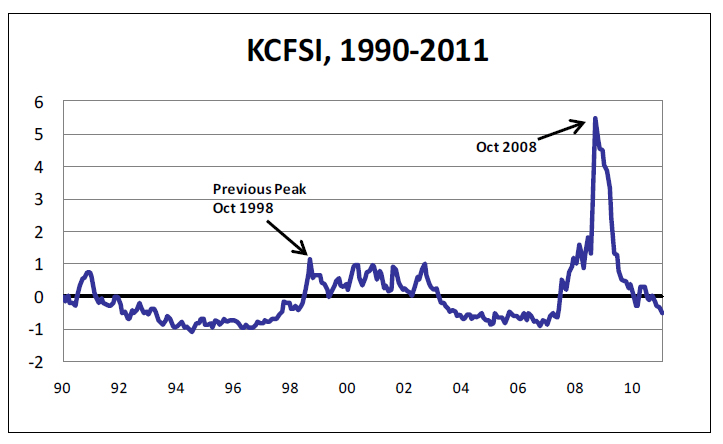
Category: Market Action

Market Action

July 8, 2010

There’s some criticism of the European stress tests:

Regulators have told lenders the tests may assume a loss of about 17 percent on Greek government debt, 3 percent on Spanish bonds and none on German debt, said two people briefed on the talks who declined to be identified because the details are private.

“This isn’t a stress test,” said Jaap Meijer, a London- based analyst at Evolution Securities Ltd. It’s “merely the current valuation of government bonds.”

Credit markets are pricing in losses of about 60 percent on Greek bonds should the government default, more than three times the level said to be assumed by CEBS. Derivatives known as recovery swaps are trading at rates that imply investors would get back about 40 percent in a Greek default or restructuring.

“I wonder how much these stress tests are reverse- engineered to inspire confidence in the market” and banks, said Bruce Packard, an analyst at Seymour Pierce Ltd. in London.

Reverse engineering? Surely not! That’s done by evil bonus-seeking bankers underwriting sub-prime, not by Holy Regulators!

American banks are hoping to generate investor opposition to fair value accounting:

The American Bankers Association opposes the Financial Accounting Standards Board’s plan to apply fair-value rules to all financial instruments, including loans, rather than just to securities. The group says the rule could make strong banks appear undercapitalized.

The association’s website, noting that FASB’s stated mission is to serve investors, provides a sample letter for people writing to the board and suggests they focus on why the proposal isn’t “useful for investors.”

The ABA has devoted a whole page to the campaign.

State Street reached for yield – and suffered:

State Street Corp., the third-largest U.S. custody bank, reported second-quarter earnings that missed analysts’ estimates because of a $251 million after-tax charge related to its securities lending business.

State Street recorded the charge, which reduced earnings by 50 cents a share, to replenish funds that managed money on behalf of securities lenders. The funds invest cash deposited as collateral by securities borrowers. The injection allows State Street to lift redemption restrictions placed on clients in the fall of 2008 after the funds suffered losses.

Pensions & Investments has some interesting background:

It could be argued that the U.S. pension fund sector had historically engaged proportionately more in leveraged finance — by lending securities to raise cash collateral that can be reinvested for returns — than securities lending over recent years and that pension funds only very recently adopted a profile more in line with the U.S. mutual fund sector. That profile has maturity and liquidity more in line with the underlying loan transaction, that is, short term.

The mean return of the total return to lendable securities in a portfolio generated by the U.S. pension fund sector is almost double than that of the U.S. mutual fund sector over the three-year period under consideration. What should really worry the pension fund sector now is that the difference is at its historic low. The pension fund sector has reined in reinvestment guidelines and reduced its return expectations to reduce risk.

AIG writ small!

It was a good day in the Canadian preferred share market, with PerpetualDiscounts up 16bp and FixedResets gaining 3bp. Volume was moderate.

HIMIPref™ Preferred Indices
These values reflect the December 2008 revision of the HIMIPref™ Indices

Values are provisional and are finalized monthly
Index Mean
Current
Yield
(at bid)
Median
YTW
Median
Average
Trading
Value
Median
Mod Dur
(YTW)
Issues Day’s Perf. Index Value
Ratchet 2.83 % 2.94 % 23,320 20.28 1 0.0000 % 2,048.5
FixedFloater 0.00 % 0.00 % 0 0.00 0 0.1860 % 3,099.6
Floater 2.32 % 1.98 % 45,470 22.44 4 0.1860 % 2,209.2
OpRet 4.88 % 1.08 % 80,223 0.08 11 0.0849 % 2,341.7
SplitShare 6.39 % 6.32 % 87,945 3.45 2 0.0882 % 2,171.5
Interest-Bearing 0.00 % 0.00 % 0 0.00 0 0.0849 % 2,141.2
Perpetual-Premium 5.97 % 5.61 % 117,537 1.85 4 0.0497 % 1,919.3
Perpetual-Discount 5.92 % 5.96 % 180,568 13.97 73 0.1553 % 1,826.3
FixedReset 5.36 % 3.74 % 317,257 3.49 47 0.0271 % 2,203.0
Performance Highlights
Issue Index Change Notes
PWF.PR.H Perpetual-Discount -1.14 % YTW SCENARIO
Maturity Type : Limit Maturity
Maturity Date : 2040-07-08
Maturity Price : 23.22
Evaluated at bid price : 23.49
Bid-YTW : 6.12 %
HSB.PR.C Perpetual-Discount 1.13 % YTW SCENARIO
Maturity Type : Limit Maturity
Maturity Date : 2040-07-08
Maturity Price : 21.45
Evaluated at bid price : 21.45
Bid-YTW : 6.00 %
GWO.PR.H Perpetual-Discount 1.23 % YTW SCENARIO
Maturity Type : Limit Maturity
Maturity Date : 2040-07-08
Maturity Price : 20.55
Evaluated at bid price : 20.55
Bid-YTW : 5.95 %
W.PR.J Perpetual-Discount 1.51 % YTW SCENARIO
Maturity Type : Limit Maturity
Maturity Date : 2040-07-08
Maturity Price : 23.25
Evaluated at bid price : 23.55
Bid-YTW : 5.96 %
W.PR.H Perpetual-Discount 1.53 % YTW SCENARIO
Maturity Type : Limit Maturity
Maturity Date : 2040-07-08
Maturity Price : 22.60
Evaluated at bid price : 23.18
Bid-YTW : 5.94 %
Volume Highlights
Issue Index Shares
Traded
Notes
BNS.PR.N Perpetual-Discount 106,516 Desjardins crossed 100,000 at 22.70.
YTW SCENARIO
Maturity Type : Limit Maturity
Maturity Date : 2040-07-08
Maturity Price : 22.56
Evaluated at bid price : 22.70
Bid-YTW : 5.79 %
IAG.PR.C FixedReset 106,016 RBC crossed 50,000 at 26.80; Nesbitt crossed 50,000 at 26.81.
YTW SCENARIO
Maturity Type : Call
Maturity Date : 2014-01-30
Maturity Price : 25.00
Evaluated at bid price : 26.81
Bid-YTW : 4.07 %
TRP.PR.C FixedReset 87,830 Recent new issue.
YTW SCENARIO
Maturity Type : Limit Maturity
Maturity Date : 2040-07-08
Maturity Price : 23.15
Evaluated at bid price : 25.07
Bid-YTW : 3.91 %
PWF.PR.J OpRet 75,950 Nesbitt crossed 60,000 at 25.51.
YTW SCENARIO
Maturity Type : Call
Maturity Date : 2010-08-07
Maturity Price : 25.50
Evaluated at bid price : 25.50
Bid-YTW : 1.08 %
RY.PR.N FixedReset 64,593 RBC crossed 55,000 at 27.45.
YTW SCENARIO
Maturity Type : Call
Maturity Date : 2014-03-26
Maturity Price : 25.00
Evaluated at bid price : 27.37
Bid-YTW : 3.71 %
SLF.PR.G FixedReset 58,000 Nesbitt crossed 44,200 at 25.20.
YTW SCENARIO
Maturity Type : Limit Maturity
Maturity Date : 2040-07-08
Maturity Price : 25.12
Evaluated at bid price : 25.17
Bid-YTW : 3.93 %
There were 31 other index-included issues trading in excess of 10,000 shares.
Market Action

July 7, 2010

There’s some doubt about the EU stress tests:

Investors say they don’t know if some banks are hiding bad loans, whether they have enough capital to withstand a debt default by a European state and whether governments can afford to rescue them. The European Union still hasn’t disclosed the tests’ criteria, including if they contain a sovereign default.

Protecting the senior bonds of 11 U.S. banks from default using credit default swaps costs an average of about 144 basis points, according to data compiled by CMA DataVision. In Europe, the average cost has climbed to about 224 basis points this year, the data show.

Europe’s largest banks are trading at a discount to their book value while their U.S. counterparts trade at a premium. Europe’s 20 largest lenders are trading at about 10 percent less than the net value of their assets. The 20 biggest U.S. banks trade at a 10 percent premium, Bloomberg data show.

Some European lenders used accounting-rule changes made in October 2008, about a month after Lehman Brothers Holdings Inc.’s collapse, to allow them to avoid writedowns on assets based on plunging market values, unless a default was deemed likely. Under pressure from EU leaders, the International Accounting Standards Board approved changes letting financial institutions in more than 100 countries that use International Financial Reporting Standards to reclassify some investments so they no longer had to book paper gains and losses as credit markets fluctuated.

Deutsche Bank, for example, used the change to shift about 38 billion euros of assets, including commercial real estate and leveraged finance, into its loan book from the third quarter of 2008 to the first quarter of 2009, saving it a net 3.2 billion euros in markdowns based on valuation gains and losses through the first quarter of 2010. ING Groep NV, the biggest Dutch financial-services company, reclassified 24.4 billion euros and Societe Generale SA shifted 25.3 billion euros in assets, escaping about 2.8 billion euros in losses.

Perhaps in response (yes, OSFI, sometimes regulators respond to investor outcry! How ’bout dat?), C-EBS has released some details:

The macro-economic scenarios include a set of key macro-economic variables (e.g. the evolution of GDP, of unemployment and of the consumer price index), differentiated for EU Member States, the rest of the EEA countries and the US. The exercise also envisages adverse conditions in financial markets and a shock on interest rates to capture an increase in risk premia linked to a deterioration in the EU government bond markets.

On aggregate, the adverse scenario assumes a 3 percentage point deviation of GDP for the EU compared to the European Commission’s forecasts over the two-year time horizon. The sovereign risk shock in the EU represents a deterioration of market conditions as compared to the situation observed in early May 2010.

Mr Joseph S Tracy, Executive Vice President of the Federal Reserve Bank of New York, spoke at the Westchester County Bankers Association, Tarrytown, New York, 25 June 2010, drawing parallels between the Credit Crunch and the Panic of 1907.

There’s an interesting trend in bond underwriting:

Borrowers are obtaining credit from banks competing for a pool of bond deals that dropped to $1.18 trillion in the first half from $1.92 trillion a year earlier as Europe’s sovereign debt crisis pared sales, according to data compiled by Bloomberg. The number of banks on each high-yield deal has almost tripled since 2000, cutting fees by an average of 57 percent per firm.

“We’ve been very clear with our banking business partners that we’ll take care of those who are good to us,” said Martin of London-based Virgin, which enlisted a record 14 banks to sell debt in January. “If you want to be in the bond, we need you to give us your balance sheet as well.”

Martin included Credit Suisse, Citigroup, Barclays Capital and HSBC Holdings Plc in Virgin Media’s bond offering, along with 10 other managers, after they agreed to join a 1.925 billion-pound ($2.9 billion) credit facility. The four banks, whose spokesmen declined to comment, ultimately weren’t needed on the loan.

There’s a big TIPS sale tomorrow and speculation there will be a big concession:

Barclays Plc’s Michael Pond, the top-rated analyst of Treasury Inflation Protected Securities, said the U.S. may struggle to sell a record-tying $12 billon of the securities tomorrow with the government likely to bolster the size of future auctions and inflation expectations low.

“We are concerned that the market will have difficulty absorbing this much supply given other headwinds and believe a significant concession is needed for the auction to go well,” Pond said in a note to clients dated July 2. “The level of real yields combined with the size presents a high hurdle for a good auction.”

The $12 billion of 10-year TIPS will match the record amount sold in January 2004. The U.S. will sell $30 billion of the security during the second half of 2010, based on the size of tomorrow’s auction and the Treasury’s plans to reopen the issue twice, Pond wrote. That amount is up from $15 billion worth of sales during the second half of last year and the historical high of $21 billion during the first half of 2004, he wrote.

Real yields, which take into account inflation or deflation, have fallen to 1.218 percent on 10-year Treasuries, from 1.685 percent April 2, according to Bloomberg Data. Current real yield levels, only 30 basis points away from the 91 basis point yield experienced in March of 2008 during the deflation scare, leaves the security with “limited upside,” Pond wrote. “At current levels, this would be the lowest yield at a 10-year TIPS auction.

I was briefly quoted in the Globe, deprecating GICs:

So why would anyone choose a government bond?

“The main thing is liquidity,” says James Hymas, president of Hymas Investment Management in Toronto.

With most GICs (cashable GICs being the major exception), you agree to lock in your money for a certain period. In exchange, you earn a higher return. Bonds can be sold at any time, but you earn a lower return.

“I don’t really recommend GICs at the best of times because of the liquidity issue,” he says.

The semi-annual TXPR index rebalancing should be announced soon – last year’s announcement was on Friday, July 10.

PerpetualDiscounts were flat on the day, while FixedResets rose by 15bp on average volume.

PerpetualDiscounts now show a median-weighted-average yield of 5.99%, equivalent to 8.39% interest at the standard equivalency factor of 1.4x. Long corporates now yield about 5.50%, so the pre-tax interest-equivalent spread (also called the Seniority Spread) is now about 290bp, unchanged from June 30.

HIMIPref™ Preferred Indices
These values reflect the December 2008 revision of the HIMIPref™ Indices

Values are provisional and are finalized monthly
Index Mean
Current
Yield
(at bid)
Median
YTW
Median
Average
Trading
Value
Median
Mod Dur
(YTW)
Issues Day’s Perf. Index Value
Ratchet 2.83 % 2.93 % 24,289 20.29 1 0.0000 % 2,048.5
FixedFloater 0.00 % 0.00 % 0 0.00 0 -0.1592 % 3,093.8
Floater 2.33 % 1.97 % 45,911 22.46 4 -0.1592 % 2,205.1
OpRet 4.88 % 2.37 % 81,254 0.08 11 -0.0428 % 2,339.7
SplitShare 6.39 % 6.22 % 88,649 3.45 2 -1.0037 % 2,169.6
Interest-Bearing 0.00 % 0.00 % 0 0.00 0 -0.0428 % 2,139.4
Perpetual-Premium 5.97 % 5.80 % 118,453 1.85 4 0.1437 % 1,918.3
Perpetual-Discount 5.93 % 5.99 % 181,718 13.94 73 -0.0048 % 1,823.5
FixedReset 5.36 % 3.71 % 320,116 3.49 47 0.1463 % 2,202.4
Performance Highlights
Issue Index Change Notes
BNA.PR.C SplitShare -2.82 % YTW SCENARIO
Maturity Type : Hard Maturity
Maturity Date : 2019-01-10
Maturity Price : 25.00
Evaluated at bid price : 19.27
Bid-YTW : 8.25 %
GWO.PR.I Perpetual-Discount -1.42 % YTW SCENARIO
Maturity Type : Limit Maturity
Maturity Date : 2040-07-07
Maturity Price : 18.70
Evaluated at bid price : 18.70
Bid-YTW : 6.07 %
HSB.PR.C Perpetual-Discount -1.30 % YTW SCENARIO
Maturity Type : Limit Maturity
Maturity Date : 2040-07-07
Maturity Price : 21.21
Evaluated at bid price : 21.21
Bid-YTW : 6.06 %
MFC.PR.C Perpetual-Discount -1.16 % YTW SCENARIO
Maturity Type : Limit Maturity
Maturity Date : 2040-07-07
Maturity Price : 18.73
Evaluated at bid price : 18.73
Bid-YTW : 6.07 %
CM.PR.K FixedReset -1.13 % YTW SCENARIO
Maturity Type : Call
Maturity Date : 2014-08-30
Maturity Price : 25.00
Evaluated at bid price : 26.25
Bid-YTW : 3.92 %
PWF.PR.M FixedReset 1.17 % YTW SCENARIO
Maturity Type : Call
Maturity Date : 2014-03-02
Maturity Price : 25.00
Evaluated at bid price : 26.84
Bid-YTW : 3.70 %
PWF.PR.O Perpetual-Discount 1.43 % YTW SCENARIO
Maturity Type : Limit Maturity
Maturity Date : 2040-07-07
Maturity Price : 23.79
Evaluated at bid price : 23.98
Bid-YTW : 6.05 %
PWF.PR.E Perpetual-Discount 1.52 % YTW SCENARIO
Maturity Type : Limit Maturity
Maturity Date : 2040-07-07
Maturity Price : 22.25
Evaluated at bid price : 22.65
Bid-YTW : 6.07 %
Volume Highlights
Issue Index Shares
Traded
Notes
BNS.PR.N Perpetual-Discount 106,615 Desjardins crossed 100,000 at 22.75.
YTW SCENARIO
Maturity Type : Limit Maturity
Maturity Date : 2040-07-07
Maturity Price : 22.56
Evaluated at bid price : 22.70
Bid-YTW : 5.79 %
TRP.PR.C FixedReset 55,375 Recent new issue.
YTW SCENARIO
Maturity Type : Limit Maturity
Maturity Date : 2040-07-07
Maturity Price : 23.12
Evaluated at bid price : 25.00
Bid-YTW : 3.93 %
PWF.PR.P FixedReset 51,954 Recent new issue.
YTW SCENARIO
Maturity Type : Limit Maturity
Maturity Date : 2040-07-07
Maturity Price : 23.20
Evaluated at bid price : 25.25
Bid-YTW : 3.92 %
BMO.PR.J Perpetual-Discount 45,870 YTW SCENARIO
Maturity Type : Limit Maturity
Maturity Date : 2040-07-07
Maturity Price : 19.87
Evaluated at bid price : 19.87
Bid-YTW : 5.75 %
BMO.PR.M FixedReset 34,840 YTW SCENARIO
Maturity Type : Call
Maturity Date : 2013-09-24
Maturity Price : 25.00
Evaluated at bid price : 26.10
Bid-YTW : 3.68 %
IAG.PR.C FixedReset 33,400 RBC bought 10,000 from anonymous at 26.80.
YTW SCENARIO
Maturity Type : Call
Maturity Date : 2014-01-30
Maturity Price : 25.00
Evaluated at bid price : 26.77
Bid-YTW : 4.11 %
There were 29 other index-included issues trading in excess of 10,000 shares.
Market Action

July 6, 2010

There’s some interesting speculation about credit spreads:

Executives who run big companies and big funds expect to be dealing with sovereign debt problems for years to come.

That’s one of the big conclusions from a survey of executives commissioned by Royal Bank of Canada’s capital markets unit.

Some of the most striking findings were a high degree of concern that a Group of Twenty country would default in the coming three years (Italy was voted most likely), skepticism that the euro-zone would survive that period intact, and a belief that high quality corporate bonds might be safer than some government bonds.

A full 40 per cent of respondents said that they expected yields on the highest level of corporate debt to drop below yields on sovereign debt of the countries where they are based, according to the poll of about 440 executives around the world.

Geez … you mean we have to re-write the textbooks again? We haven’t even finished rewriting the sections on monetary policy!

A good day in the Canadian preferred share market, with PerpetualDiscounts up 32bp and FixedResets gaining 7bp, with good volume.

HIMIPref™ Preferred Indices
These values reflect the December 2008 revision of the HIMIPref™ Indices

Values are provisional and are finalized monthly
Index Mean
Current
Yield
(at bid)
Median
YTW
Median
Average
Trading
Value
Median
Mod Dur
(YTW)
Issues Day’s Perf. Index Value
Ratchet 2.82 % 2.93 % 25,298 20.30 1 0.0000 % 2,048.5
FixedFloater 0.00 % 0.00 % 0 0.00 0 0.0398 % 3,098.7
Floater 2.32 % 1.97 % 47,770 22.47 4 0.0398 % 2,208.6
OpRet 4.87 % 2.85 % 76,683 0.09 11 0.1415 % 2,340.7
SplitShare 6.33 % 6.33 % 89,679 3.45 2 0.3943 % 2,191.6
Interest-Bearing 0.00 % 0.00 % 0 0.00 0 0.1415 % 2,140.3
Perpetual-Premium 5.96 % 5.70 % 120,189 1.85 4 0.1092 % 1,915.6
Perpetual-Discount 5.91 % 5.98 % 185,432 13.96 73 0.3160 % 1,823.6
FixedReset 5.36 % 3.80 % 319,266 3.49 47 0.0745 % 2,199.1
Performance Highlights
Issue Index Change Notes
PWF.PR.E Perpetual-Discount -1.18 % YTW SCENARIO
Maturity Type : Limit Maturity
Maturity Date : 2040-07-06
Maturity Price : 22.25
Evaluated at bid price : 22.65
Bid-YTW : 6.18 %
BAM.PR.M Perpetual-Discount -1.09 % YTW SCENARIO
Maturity Type : Limit Maturity
Maturity Date : 2040-07-06
Maturity Price : 18.20
Evaluated at bid price : 18.20
Bid-YTW : 6.59 %
POW.PR.C Perpetual-Discount -1.04 % YTW SCENARIO
Maturity Type : Limit Maturity
Maturity Date : 2040-07-06
Maturity Price : 23.57
Evaluated at bid price : 23.85
Bid-YTW : 6.10 %
SLF.PR.B Perpetual-Discount 1.00 % YTW SCENARIO
Maturity Type : Limit Maturity
Maturity Date : 2040-07-06
Maturity Price : 20.17
Evaluated at bid price : 20.17
Bid-YTW : 6.00 %
CM.PR.P Perpetual-Discount 1.08 % YTW SCENARIO
Maturity Type : Limit Maturity
Maturity Date : 2040-07-06
Maturity Price : 22.81
Evaluated at bid price : 23.50
Bid-YTW : 5.83 %
GWO.PR.H Perpetual-Discount 1.09 % YTW SCENARIO
Maturity Type : Limit Maturity
Maturity Date : 2040-07-06
Maturity Price : 20.42
Evaluated at bid price : 20.42
Bid-YTW : 5.99 %
MFC.PR.C Perpetual-Discount 1.17 % YTW SCENARIO
Maturity Type : Limit Maturity
Maturity Date : 2040-07-06
Maturity Price : 18.95
Evaluated at bid price : 18.95
Bid-YTW : 6.00 %
PWF.PR.H Perpetual-Discount 1.18 % YTW SCENARIO
Maturity Type : Limit Maturity
Maturity Date : 2040-07-06
Maturity Price : 23.72
Evaluated at bid price : 24.00
Bid-YTW : 6.10 %
BNS.PR.X FixedReset 1.28 % YTW SCENARIO
Maturity Type : Call
Maturity Date : 2014-05-25
Maturity Price : 25.00
Evaluated at bid price : 27.70
Bid-YTW : 3.23 %
HSB.PR.C Perpetual-Discount 1.37 % YTW SCENARIO
Maturity Type : Limit Maturity
Maturity Date : 2040-07-06
Maturity Price : 21.49
Evaluated at bid price : 21.49
Bid-YTW : 5.98 %
TD.PR.Q Perpetual-Discount 1.39 % YTW SCENARIO
Maturity Type : Limit Maturity
Maturity Date : 2040-07-06
Maturity Price : 24.19
Evaluated at bid price : 24.41
Bid-YTW : 5.74 %
TD.PR.R Perpetual-Discount 1.47 % YTW SCENARIO
Maturity Type : Limit Maturity
Maturity Date : 2040-07-06
Maturity Price : 24.22
Evaluated at bid price : 24.44
Bid-YTW : 5.73 %
MFC.PR.B Perpetual-Discount 1.54 % YTW SCENARIO
Maturity Type : Limit Maturity
Maturity Date : 2040-07-06
Maturity Price : 19.80
Evaluated at bid price : 19.80
Bid-YTW : 5.93 %
GWO.PR.J FixedReset 2.17 % YTW SCENARIO
Maturity Type : Call
Maturity Date : 2014-01-30
Maturity Price : 25.00
Evaluated at bid price : 26.83
Bid-YTW : 3.84 %
Volume Highlights
Issue Index Shares
Traded
Notes
TRP.PR.C FixedReset 131,715 Recent new issue.
YTW SCENARIO
Maturity Type : Limit Maturity
Maturity Date : 2040-07-06
Maturity Price : 23.11
Evaluated at bid price : 24.96
Bid-YTW : 3.94 %
PWF.PR.P FixedReset 75,914 Recent new issue.
YTW SCENARIO
Maturity Type : Limit Maturity
Maturity Date : 2040-07-06
Maturity Price : 23.17
Evaluated at bid price : 25.15
Bid-YTW : 3.94 %
W.PR.J Perpetual-Discount 53,600 Scotia crossed 50,000 at 23.10.
YTW SCENARIO
Maturity Type : Limit Maturity
Maturity Date : 2040-07-06
Maturity Price : 22.81
Evaluated at bid price : 23.09
Bid-YTW : 6.08 %
SLF.PR.C Perpetual-Discount 51,607 Desjardins crossed two blocks of 10,000 each at 18.47 and 18.48. Nesbitt crossed 12,300 at 18.48.
YTW SCENARIO
Maturity Type : Limit Maturity
Maturity Date : 2040-07-06
Maturity Price : 18.47
Evaluated at bid price : 18.47
Bid-YTW : 6.08 %
PWF.PR.J OpRet 38,220 TD crossed 16,300 at 25.76.
YTW SCENARIO
Maturity Type : Call
Maturity Date : 2010-08-05
Maturity Price : 25.50
Evaluated at bid price : 25.75
Bid-YTW : 2.85 %
RY.PR.X FixedReset 36,821 TD crossed 25,000 at 27.75.
YTW SCENARIO
Maturity Type : Call
Maturity Date : 2014-09-23
Maturity Price : 25.00
Evaluated at bid price : 27.70
Bid-YTW : 3.70 %
There were 37 other index-included issues trading in excess of 10,000 shares.
Market Action

July 7, 2010

Lobbying against end-user margin requirements for OTC derivatives (mentioned on June 30) appears to have had some effect, according to Jim Hamilton’s World of Securities Regulation in a discussion of a letter from senators Dodd & Lincoln:

The Dodd-Frank Wall Street Reform and Consumer Protection Act does not authorize regulators to impose margin on end users that use derivatives to hedge or mitigate commercial risk, said Senator Chris Dodd and Senator Blanche Lincoln, who have instructed the SEC and CFTC not to make hedging so costly that it becomes prohibitively expensive for end users to manage their risks. In a letter to the Chairs of the House Financial Services and Agriculture Committees, the senators emphasized that Congress does not intend to regulate end users as major swap participants or swap dealers just because they use swaps to hedge or manage the commercial risks associated with their business. Just as Congress has heard the end user community, they said, regulators must carefully consider the impact of regulation and capital and margin on end users.

We’ll see how this works out, but the camel’s got his nose in the tent!

There’s an entertaining scuffle between Themis Trading:

A gift received by a sixth rate player. Now, we didn’t expect to be showered with gifts from the LSE but a simple “thank you” would have been nice. After all, a paper written by “two or three guys” managed to accomplish something that an organization headed by commercial director, Natan Tiefenbrun, couldn’t do by themselves.

So this brings us to the rubbish which was written by that previously mentioned commercial director. If you care to read his piece, here it is: http://tradeturquoise.blogspot.com/

It seems like Natan is tired because he read a piece written by Kate Welling about Themis Trading ([link]). If reading 16 pages gets him tired, maybe he should get some Red Bull. Much of Natan’s rant against Themis Trading sounds like a defense of HFT. Maybe that’s because he also has a very conflicted ownership structure with brokers owning almost half of his MTF.

Natan’s piece is titled Luddites Unite:

One again these self-proclaimed defenders of “fair markets” make dozens of claims about how exchanges, brokers and high-frequency traders are conniving to screw both retail and institutional investors. Here are some of my favourite excerpts:…

By me, the fundamental difference is one of philosophy, explained by Themis principal Sal Arnuk early on in the article that started the spat (which is copy protected, so no quotes for you!). He’s worried about what happened in the Flash Crash to those who panicked and those who had stop-loss orders in place. I suggest that the fact that these people lost money is a good thing. The less stupid money there is in the market, the better.

Much of the hand-wringing regarding securitization revolves around adverse selection – the idea that originators will securitize their worst loans. Credit Sights is alleging an interesting twist on that story:

Spanish savings banks may be hiding losses on home loans by taking non-performing mortgages out of securitized transactions, according to CreditSights Inc.

By carrying the bad loans on their own books the so-called cajas sidestep downgrades to their mortgage-backed securities, the independent bond research firm said in a report.

CreditSights follows a sample of 143 Spanish residential mortgage-backed securities collateralized by 136 billion euros ($170 billion) of loans, with about 45 percent originated by cajas. While the savings banks give little information about the state of their loan books, investor reports on the performance of the securitized debt suggest asset quality is weaker than at commercial lenders, CreditSights said.

“Caja-originated mortgages are performing much worse than those extended by Spain’s commercial banks,” analysts David Watts, John Raymond and Hana Galetova wrote. By buying mortgages out of the pools “they could have been artificially reducing the level of bad loans in RMBS while simultaneously undermining the quality of the cajas’ own assets,” they wrote.

Over a million people attended the Pride Parade in a stunning rebuke to nasty backstairs whisperers and grandstanding politicians (presumably under the influence of foreign governments). Left to itself, the City of Toronto can’t run a souvlaki cart; I suggest that in future it recognizes its total incompetence and stops interfering with the internal decisions of groups who actually bring money into the city.

Yet another power outage today … and the clowndorks are discussing who should march in somebody else’s parade.

It was a strong day in the Canadian preferred share market, with PerpetualDiscounts gaining 25bp and FixedResets up 23bp, on light volume.

HIMIPref™ Preferred Indices
These values reflect the December 2008 revision of the HIMIPref™ Indices

Values are provisional and are finalized monthly
Index Mean
Current
Yield
(at bid)
Median
YTW
Median
Average
Trading
Value
Median
Mod Dur
(YTW)
Issues Day’s Perf. Index Value
Ratchet 2.82 % 2.92 % 26,350 20.31 1 0.0000 % 2,048.5
FixedFloater 0.00 % 0.00 % 0 0.00 0 -0.3307 % 3,097.5
Floater 2.32 % 1.97 % 49,728 22.46 4 -0.3307 % 2,207.8
OpRet 4.87 % 3.46 % 77,056 0.40 11 0.1307 % 2,337.4
SplitShare 6.35 % 6.31 % 88,433 3.45 2 0.4179 % 2,183.0
Interest-Bearing 0.00 % 0.00 % 0 0.00 0 0.1307 % 2,137.3
Perpetual-Premium 5.97 % 5.91 % 121,841 1.85 4 0.1491 % 1,913.5
Perpetual-Discount 5.93 % 6.00 % 186,915 13.91 73 0.2547 % 1,817.8
FixedReset 5.35 % 3.82 % 320,924 3.49 47 0.2320 % 2,197.5
Performance Highlights
Issue Index Change Notes
TRI.PR.B Floater -1.48 % YTW SCENARIO
Maturity Type : Limit Maturity
Maturity Date : 2040-07-05
Maturity Price : 22.98
Evaluated at bid price : 23.25
Bid-YTW : 1.86 %
BMO.PR.N FixedReset 1.02 % YTW SCENARIO
Maturity Type : Call
Maturity Date : 2014-03-27
Maturity Price : 25.00
Evaluated at bid price : 27.80
Bid-YTW : 3.48 %
CM.PR.K FixedReset 1.14 % YTW SCENARIO
Maturity Type : Call
Maturity Date : 2014-08-30
Maturity Price : 25.00
Evaluated at bid price : 26.55
Bid-YTW : 3.61 %
BNS.PR.O Perpetual-Discount 1.23 % YTW SCENARIO
Maturity Type : Limit Maturity
Maturity Date : 2040-07-05
Maturity Price : 24.38
Evaluated at bid price : 24.60
Bid-YTW : 5.69 %
BMO.PR.H Perpetual-Discount 1.28 % YTW SCENARIO
Maturity Type : Limit Maturity
Maturity Date : 2040-07-05
Maturity Price : 22.92
Evaluated at bid price : 23.80
Bid-YTW : 5.60 %
GWO.PR.J FixedReset 1.31 % YTW SCENARIO
Maturity Type : Call
Maturity Date : 2014-01-30
Maturity Price : 25.00
Evaluated at bid price : 26.26
Bid-YTW : 4.51 %
BAM.PR.M Perpetual-Discount 1.88 % YTW SCENARIO
Maturity Type : Limit Maturity
Maturity Date : 2040-07-05
Maturity Price : 18.40
Evaluated at bid price : 18.40
Bid-YTW : 6.51 %
Volume Highlights
Issue Index Shares
Traded
Notes
MFC.PR.C Perpetual-Discount 69,950 RBC bought 10,000 from Scotia at 18.78; TD crossed 47,700 at 18.75.
YTW SCENARIO
Maturity Type : Limit Maturity
Maturity Date : 2040-07-05
Maturity Price : 18.73
Evaluated at bid price : 18.73
Bid-YTW : 6.07 %
PWF.PR.P FixedReset 68,974 Recent new issue.
YTW SCENARIO
Maturity Type : Limit Maturity
Maturity Date : 2040-07-05
Maturity Price : 23.16
Evaluated at bid price : 25.10
Bid-YTW : 3.95 %
TRP.PR.C FixedReset 63,995 Recent new issue.
YTW SCENARIO
Maturity Type : Limit Maturity
Maturity Date : 2040-07-05
Maturity Price : 23.11
Evaluated at bid price : 24.95
Bid-YTW : 3.94 %
TRI.PR.B Floater 60,300 RBC sold blocks of 10,000 and 15,000 to anonymous at 23.60; RBC crossed 25,000 at the same price.
YTW SCENARIO
Maturity Type : Limit Maturity
Maturity Date : 2040-07-05
Maturity Price : 22.98
Evaluated at bid price : 23.25
Bid-YTW : 1.86 %
TD.PR.S FixedReset 60,230 RBC crossed 35,000 at 26.00; Desjardins crossed 10,000 at the same price.
YTW SCENARIO
Maturity Type : Call
Maturity Date : 2013-08-30
Maturity Price : 25.00
Evaluated at bid price : 26.05
Bid-YTW : 3.82 %
CM.PR.I Perpetual-Discount 42,600 YTW SCENARIO
Maturity Type : Limit Maturity
Maturity Date : 2040-07-05
Maturity Price : 19.71
Evaluated at bid price : 19.71
Bid-YTW : 5.97 %
There were 18 other index-included issues trading in excess of 10,000 shares.
Market Action

July 2, 2010

The US jobs number was poor:

Employment at companies rose 83,000, less than the 110,000 gain forecast by economists in a Bloomberg News survey. Including government, payrolls fell for the first time this year because of a drop in federal census workers. The jobless rate dropped to 9.5 percent from 9.7 percent as the labor force shrank, the Labor Department reported today in Washington.

OSFI has published a presentation by Michel Montambeault, Director, to the Canada Institute of Actuaries (CIA) Annual Meeting, on the topic of “Canadian Mortality Experience”, 29 June 2010, Vancouver, British Columbia. In related news, a cluster of longevity genes has been identified:

U.S. scientists say they have discovered the genetic signature of an exceptionally long life, and with nothing more than a DNA sample they can predict – with 77 per cent accuracy – those biologically built to live beyond a century.

They also predict that such a test, based on a set of 150 genetic markers, will be available to the curious by summer’s end.

“It’s really quite revolutionary,” said Thomas Perls, associate professor of medicine at Boston University and senior author of a research paper published online Thursday by the journal Science. “With the accuracy we’ve demonstrated, companies are going to pick this up. We’ll see it on the market in a month.”

Adverse selection just became a bigger risk for the insurance companies!

I sent an eMail to the Toronto Stock Exchange:

On June 30, MFC.PR.B traded 5,792 shares on the TSX in a range of 19.63-80 and closed at 19.01-66, 10×12. The last trade was at 3:58pm, 300 shares at 19.66.

I have a number of questions:
i) Who is the market maker for this issue?
ii) Which firm employs the market maker?
iii) What committments were made regarding spreads by the market maker?
iv) How have these committments been kept over the past year?
v) How have other committments made by this market maker been kept over the past year?
vi) How have other committments made by the market maker’s firm been kept over the past year?

We’ll see what happens with that! (Fearless prediction: Nothing).

On an extremely quiet day in the Canadian preferred share market, PerpetualDiscounts lost 4bp while FixedResets gained 14bp.

HIMIPref™ Preferred Indices
These values reflect the December 2008 revision of the HIMIPref™ Indices

Values are provisional and are finalized monthly
Index Mean
Current
Yield
(at bid)
Median
YTW
Median
Average
Trading
Value
Median
Mod Dur
(YTW)
Issues Day’s Perf. Index Value
Ratchet 2.82 % 2.92 % 26,768 20.33 1 0.0000 % 2,048.5
FixedFloater 0.00 % 0.00 % 0 0.00 0 -1.0732 % 3,107.8
Floater 2.32 % 1.97 % 46,034 22.46 4 -1.0732 % 2,215.1
OpRet 4.87 % 3.59 % 79,627 0.88 11 -0.0671 % 2,334.3
SplitShare 6.38 % 6.36 % 87,888 3.46 2 -0.2195 % 2,173.9
Interest-Bearing 0.00 % 0.00 % 0 0.00 0 -0.0671 % 2,134.5
Perpetual-Premium 5.98 % 5.88 % 121,604 1.86 4 -0.2973 % 1,910.6
Perpetual-Discount 5.94 % 6.01 % 188,996 13.90 73 -0.0418 % 1,813.2
FixedReset 5.37 % 3.90 % 325,073 3.49 47 0.1434 % 2,192.4
Performance Highlights
Issue Index Change Notes
BAM.PR.B Floater -2.03 % YTW SCENARIO
Maturity Type : Limit Maturity
Maturity Date : 2040-07-02
Maturity Price : 14.99
Evaluated at bid price : 14.99
Bid-YTW : 2.93 %
BAM.PR.K Floater -1.70 % YTW SCENARIO
Maturity Type : Limit Maturity
Maturity Date : 2040-07-02
Maturity Price : 15.00
Evaluated at bid price : 15.00
Bid-YTW : 2.93 %
BAM.PR.H OpRet -1.23 % YTW SCENARIO
Maturity Type : Call
Maturity Date : 2010-08-01
Maturity Price : 25.50
Evaluated at bid price : 25.60
Bid-YTW : 1.24 %
PWF.PR.A Floater -1.12 % YTW SCENARIO
Maturity Type : Limit Maturity
Maturity Date : 2040-07-02
Maturity Price : 21.75
Evaluated at bid price : 22.00
Bid-YTW : 1.97 %
PWF.PR.O Perpetual-Discount -1.00 % YTW SCENARIO
Maturity Type : Limit Maturity
Maturity Date : 2040-07-02
Maturity Price : 23.58
Evaluated at bid price : 23.76
Bid-YTW : 6.22 %
BAM.PR.R FixedReset 1.15 % YTW SCENARIO
Maturity Type : Limit Maturity
Maturity Date : 2040-07-02
Maturity Price : 23.26
Evaluated at bid price : 25.50
Bid-YTW : 4.77 %
BNS.PR.Q FixedReset 1.28 % YTW SCENARIO
Maturity Type : Call
Maturity Date : 2013-11-24
Maturity Price : 25.00
Evaluated at bid price : 25.99
Bid-YTW : 3.60 %
NA.PR.O FixedReset 1.56 % YTW SCENARIO
Maturity Type : Call
Maturity Date : 2014-03-17
Maturity Price : 25.00
Evaluated at bid price : 27.94
Bid-YTW : 3.49 %
MFC.PR.B Perpetual-Discount 2.84 % YTW SCENARIO
Maturity Type : Limit Maturity
Maturity Date : 2040-07-02
Maturity Price : 19.55
Evaluated at bid price : 19.55
Bid-YTW : 6.01 %
Volume Highlights
Issue Index Shares
Traded
Notes
RY.PR.R FixedReset 31,130 Desjardins crossed 27,400 at 27.37.
YTW SCENARIO
Maturity Type : Call
Maturity Date : 2014-03-26
Maturity Price : 25.00
Evaluated at bid price : 27.50
Bid-YTW : 3.62 %
RY.PR.A Perpetual-Discount 25,703 YTW SCENARIO
Maturity Type : Limit Maturity
Maturity Date : 2040-07-02
Maturity Price : 19.56
Evaluated at bid price : 19.56
Bid-YTW : 5.77 %
MFC.PR.D FixedReset 19,477 YTW SCENARIO
Maturity Type : Call
Maturity Date : 2014-07-19
Maturity Price : 25.00
Evaluated at bid price : 27.50
Bid-YTW : 4.02 %
TRP.PR.C FixedReset 14,275 Recent new issue.
YTW SCENARIO
Maturity Type : Limit Maturity
Maturity Date : 2040-07-02
Maturity Price : 23.11
Evaluated at bid price : 24.96
Bid-YTW : 4.02 %
BNS.PR.N Perpetual-Discount 13,990 YTW SCENARIO
Maturity Type : Limit Maturity
Maturity Date : 2040-07-02
Maturity Price : 22.42
Evaluated at bid price : 22.55
Bid-YTW : 5.83 %
CM.PR.L FixedReset 13,735 YTW SCENARIO
Maturity Type : Call
Maturity Date : 2014-05-30
Maturity Price : 25.00
Evaluated at bid price : 27.78
Bid-YTW : 3.35 %
There were 5 other index-included issues trading in excess of 10,000 shares.
Market Action

June 30, 2010

Corporations are well placed to weather the next crisis:

Companies from the U.S. to Europe and Asia are selling the fewest bonds since 2004, as rising cash levels allow borrowers to weather a slowing economy.

Debt offerings fell to $1.17 trillion in the first half of the year, 39 percent less than the same period in 2009, according to data compiled by Bloomberg. The decline was led by financial companies, which issued 35 percent less debt.

Issuance is declining as borrowers with 15 percent more cash than a year earlier avoid tapping credit markets amid concern that Europe’s sovereign-debt crisis may slow the global economic recovery. Corporate bonds have returned 4.9 percent in the first half of the year, beating the MSCI World Index of stocks, which is down 8.9 percent, by the most in nine years.

Cash at investment-grade companies rose to $668 billion at the end of the first quarter from $580 billion a year earlier, while debt fell 2 percent to $2.3 trillion, JPMorgan Chase & Co. analysts led by Eric Beinstein in New York wrote last week.

In the midst of the sovereign debt crisis, the EU is taking firm action:

Bankers in Europe will not be allowed to take home more than a third of their bonuses in cash from the start of next year under planned new rules, a British lawmaker said Tuesday.

Under the negotiated agreement, cash could only constitute 30 percent of a regular bonus and one-fifth a large bonus. A new watchdog for European banks will define what constitutes a large bonus. There will also be an opportunity for a “clawback” of bonuses if deals made to reach profit targets later fell apart.

In addition, banks that have received government bailouts will have to limit bonuses paid to their managers, while directors will not be eligible to receive any bonus unless it is justified to supervisors. Banks must also set limits on bonuses in relation to salaries to avoid any windfall payouts.

What will happen, I think, is that talent will migrate to hedge funds, which will take over a significant part of the market-making function. Maybe this is a good thing. But I doubt that anybody’s thought about it.

Ms Gertrude Tumpel-Gugerell, Member of the Executive Board of the European Central Bank, spoke at the US Financial Services Roundtable, Brussels, 28 June 2010, stringing together non-sequiters to reach a politically desirable conclusion (emphasis added):

The first priority relates to the development of financial infrastructures in those markets where they are not yet sufficiently used or available, notably in OTC derivatives markets. The crisis has shown that markets with adequate infrastructures and hence proper risk management and risk provisions have proven to be more resilient than markets without such infrastructures, such as the OTC derivatives markets. Therefore, expanding the use of central counterparties (CCPs) in these increasingly systemically relevant markets is a key measure to reduce counterparty and operational risk. Another important step is the mandatory reporting of all trades to centralised trade registries, so-called trade repositories, in order to enhance market transparency. In my view, if CCPs and trade repositories for credit default swaps had been available before the Lehman default, Lehman’s CDS exposures could have been managed in a much more transparent and resilient way and could have mitigated the negative chain reaction on CDS markets that followed the demise of Lehman.

CCPs and trade repositories for OTC derivatives are ultimately beneficial for all stakeholders. Still, there are the well-known challenges of effective collective action in the context of the provision of public goods. Hence, private sector efforts alone may not suffice to foster sufficient progress towards the use of CCPs and trade repositories for OTC derivatives. It is therefore important to adopt and implement the regulatory requirements for the mandatory central clearing of all eligible products and the reporting of trades to trade repositories in a timely manner. Given, however, the global nature of OTC derivatives markets, it is clear that such regulatory tools will only be successful if they are applied in a coordinated manner around the globe. I strongly support the recently launched work of the Financial Stability Board to develop common approaches to fostering the central clearing of eligible OTC derivatives as well as to expand the range of potentially clearable products through enhanced standardisation.

Quite frankly, I don’t understand her use of the word “therefore”!

The OSC has published a new edition of Perspectives. Articles feature:

  • CSA publishes proposed amendments to mutual fund regulations
  • CSA publishes frequently asked questions about order protection and locked and crossed markets
  • OSC updates registrant section of its website

There’s some more reaction to mandatory margining proposals, this time from ISDA:

A change in the wording of the financial reform bill now being finalized in the US Congress could cost US companies as much as $1 trillion in capital and liquidity requirements, according to research by the International Swaps and Derivatives Association, Inc. (ISDA). About $400 billion would be needed as collateral that corporations could be required to post with their dealer counterparties to cover the current exposure of their OTC derivatives transactions. ISDA estimates that $370 billion represents the additional credit capacity that companies could need to maintain to cover potential future exposure of those transactions. If markets return to levels prevailing at the end of 2008, additional collateral needs would bring the total to $1 trillion.

That will be a nice little profit centre for the banks – setting up credit lines dedicated to collateralization! Now, is this a good thing, or a bad thing? Nobody knows. It hasn’t been discussed.

Naturally, some companies will be affected more than others:

Berkshire [Hathaway Inc.] owns derivatives with a notional value of about $62 billion and has “negligible” collateral requirements, Barclays analyst Jay Gelb said today in a report. [Warren] Buffett’s firm, based in Omaha, Nebraska, may need to post $6 billion to $8 billion in collateral under rules being debated by the U.S. Congress, he said.

The SEC has announced new rules to discourage political corruption in the investment advisory business. Sadly, there are no rules disallowing the hiring of former SEC employees.

CM has issued CHF 500-million in 5-year covered bonds at 1.75%. Bonds OnLine is reporting 5-year Swiss governments at a rather alarming -0.26% (that’s right, negative twenty-six beeps); the only data I can find for 5-years on the Swiss National Bank site is dated May 31. DBRS rates them AAA:

The ratings are based on several factors. First, the Covered Bonds are senior unsecured direct obligations of CIBC, which is the fifth largest bank in Canada and rated AA and R-1 (high) with a Stable trend by DBRS. Second, in addition to a general recourse to CIBC’s assets, the Covered Bonds are supported by a diversified collateral pool of first-lien prime residential mortgages insured by Canada Mortgage and Housing Corporation (CMHC) (the Cover Pool). CMHC is an agent of Her Majesty in right of Canada and is rated AAA by DBRS.

MFC.PR.B traded 5,792 shares on the TSX today in a range of 19.63-80 and closed at 19.01-66, 10×12. The last trade was at 3:58pm, 300 shares at 19.66. I can only suppose the market maker decided to get an early start on his weekend.

Much the same thing happened with GWO.PR.J: traded 3,400 shares in a range of 26.62-85 before closing at 25.92-62, 20×7.

BAM.PR.G traded 145 shares, all at 21.40, and closed at 20.91-40, 15×10. I can only imagine that the market maker was overwhelmed by the volume.

These are particularly annoying incidents, because it’s not just month-end, it’s quarter-end.

PerpetualDiscounts squeaked out a win today, gaining 4bp, while FixedResets gained 7bp on light volume and, as we have seen, a surprising and probably spurious amount of volatility.

PerpetualDiscounts now yield 5.97%, equivalent to 8.36% interest at the standard conversion factor of 1.4x. Long corporates now yield an astonishing (to me) 5.45%, so the pre-tax interest-equivalent spread (also called the Seniority Spread) now stands at about 290bp, the same level reported on June 23, but a narrowing of 25bp from the 315bp spread reported on May 31.

And that’s a wrap for June, 2010!

HIMIPref™ Preferred Indices
These values reflect the December 2008 revision of the HIMIPref™ Indices

Values are provisional and are finalized monthly
Index Mean
Current
Yield
(at bid)
Median
YTW
Median
Average
Trading
Value
Median
Mod Dur
(YTW)
Issues Day’s Perf. Index Value
Ratchet 2.81 % 2.92 % 27,881 20.35 1 0.0000 % 2,048.0
FixedFloater 5.20 % 3.37 % 21,210 19.70 1 -2.2897 % 3,077.5
Floater 2.42 % 2.85 % 76,191 20.08 3 -0.2578 % 2,239.0
OpRet 4.87 % 3.57 % 82,897 0.89 11 -0.0423 % 2,335.9
SplitShare 6.37 % 6.35 % 91,524 3.47 2 -0.0439 % 2,178.7
Interest-Bearing 0.00 % 0.00 % 0 0.00 0 -0.0423 % 2,136.0
Perpetual-Premium 0.00 % 0.00 % 0 0.00 0 0.0431 % 1,916.3
Perpetual-Discount 5.94 % 5.97 % 192,482 13.90 77 0.0431 % 1,814.0
FixedReset 5.37 % 3.90 % 335,785 3.46 47 0.0686 % 2,189.3
Performance Highlights
Issue Index Change Notes
MFC.PR.B Perpetual-Discount -2.96 % YTW SCENARIO
Maturity Type : Limit Maturity
Maturity Date : 2040-06-30
Maturity Price : 19.01
Evaluated at bid price : 19.01
Bid-YTW : 6.17 %
GWO.PR.J FixedReset -2.63 % YTW SCENARIO
Maturity Type : Call
Maturity Date : 2014-01-30
Maturity Price : 25.00
Evaluated at bid price : 25.92
Bid-YTW : 4.90 %
BAM.PR.G FixedFloater -2.29 % YTW SCENARIO
Maturity Type : Limit Maturity
Maturity Date : 2040-06-30
Maturity Price : 25.00
Evaluated at bid price : 20.91
Bid-YTW : 3.37 %
BAM.PR.B Floater -1.80 % YTW SCENARIO
Maturity Type : Limit Maturity
Maturity Date : 2040-06-30
Maturity Price : 15.30
Evaluated at bid price : 15.30
Bid-YTW : 2.85 %
PWF.PR.F Perpetual-Discount -1.27 % YTW SCENARIO
Maturity Type : Limit Maturity
Maturity Date : 2040-06-30
Maturity Price : 21.50
Evaluated at bid price : 21.77
Bid-YTW : 6.13 %
TD.PR.N OpRet -1.26 % YTW SCENARIO
Maturity Type : Soft Maturity
Maturity Date : 2014-01-30
Maturity Price : 25.00
Evaluated at bid price : 25.77
Bid-YTW : 3.92 %
BAM.PR.K Floater -1.04 % YTW SCENARIO
Maturity Type : Limit Maturity
Maturity Date : 2040-06-30
Maturity Price : 15.26
Evaluated at bid price : 15.26
Bid-YTW : 2.86 %
TD.PR.G FixedReset 1.13 % YTW SCENARIO
Maturity Type : Call
Maturity Date : 2014-05-30
Maturity Price : 25.00
Evaluated at bid price : 27.75
Bid-YTW : 3.56 %
BAM.PR.H OpRet 1.21 % YTW SCENARIO
Maturity Type : Call
Maturity Date : 2010-07-30
Maturity Price : 25.50
Evaluated at bid price : 25.92
Bid-YTW : -13.77 %
TRI.PR.B Floater 1.29 % YTW SCENARIO
Maturity Type : Limit Maturity
Maturity Date : 2040-06-30
Maturity Price : 23.32
Evaluated at bid price : 23.60
Bid-YTW : 1.82 %
Volume Highlights
Issue Index Shares
Traded
Notes
TRP.PR.C FixedReset 376,889 Recent new issue.
YTW SCENARIO
Maturity Type : Limit Maturity
Maturity Date : 2040-06-30
Maturity Price : 23.10
Evaluated at bid price : 24.93
Bid-YTW : 4.03 %
PWF.PR.P FixedReset 159,850 Recent new issue.
YTW SCENARIO
Maturity Type : Limit Maturity
Maturity Date : 2040-06-30
Maturity Price : 23.16
Evaluated at bid price : 25.11
Bid-YTW : 4.04 %
PWF.PR.J OpRet 121,223 Called for redemption.
YTW SCENARIO
Maturity Type : Call
Maturity Date : 2011-05-30
Maturity Price : 25.25
Evaluated at bid price : 25.71
Bid-YTW : 3.51 %
PWF.PR.I Perpetual-Discount 82,900 RBC crossed blocks of 10,000 and 57,300, both at 24.90.
YTW SCENARIO
Maturity Type : Limit Maturity
Maturity Date : 2040-06-30
Maturity Price : 24.42
Evaluated at bid price : 24.80
Bid-YTW : 6.15 %
TRP.PR.B FixedReset 78,929 Nesbitt crossed 50,000 at 24.56.
YTW SCENARIO
Maturity Type : Limit Maturity
Maturity Date : 2040-06-30
Maturity Price : 24.55
Evaluated at bid price : 24.60
Bid-YTW : 3.90 %
BNS.PR.M Perpetual-Discount 27,091 YTW SCENARIO
Maturity Type : Limit Maturity
Maturity Date : 2040-06-30
Maturity Price : 19.80
Evaluated at bid price : 19.80
Bid-YTW : 5.79 %
There were 22 other index-included issues trading in excess of 10,000 shares.
Market Action

June 29, 2010

The Bank for International Settlements released its annual report with chapters on:

  • Beyond the rescue: exiting intensive care and finishing the reforms
  • From the emergency room to intensive care: the year in retrospect
  • Low interest rates: do the risks outweigh the rewards?
  • Post-crisis policy challenges in emerging market economies
  • Fiscal sustainability in the industrial countries: risks and challenges
  • The future of the financial sector
  • Macroprudential policy and addressing procyclicality
  • The BIS: mission, activities, governance and financial results

Naturally enough, the sections that dealt with regulation are in complete alignment with the G-20 communique. What a coincidence that is!

There’s a hiccup on the way to the US Bank Bill:

U.S. Representative Barney Frank may reconvene the House-Senate financial-overhaul conference today to address Republican protests over a $19 billion bank fee in the bill, according to a scheduling announcement sent to lawmakers.

One plan under consideration would instead cover the shortfall in the bill with an increase in the fund that the Federal Deposit Insurance Corp. maintains to repay customers their deposits when a bank fails. Another would save money by closing the Troubled Asset Relief Program two months early, according to the announcement.

Changing the bank fee could end an impasse that threatened to delay the final Senate vote on the bill after the death of Senator Robert Byrd, a West Virginia Democrat. Byrd’s absence left Democrats in need of all four Republicans who previously backed the measure. One of those Republicans, Senator Scott Brown of Massachusetts, withdrew his support earlier today, citing the fee.

PrefBlog has added to its list of interesting things to do while drunk:

Mr Perkins, who worked for City brokers PVM Oil, had gone on a golfing weekend organised by the company.

Then he took the Monday off work and continued to binge drink from midday onwards.

By the evening, Mr Perkins had made his first batch of unauthorised trades.

In his stupor, he casually notched up thousands of trades worth a total of $520million (£345million).

He drunkenly bought a net 7.13million barrels of oil during the typically quiet overnight period, and at times was personally responsible for 69 per cent of the overall volume of Brent crude being traded globally.

His actions sent prices surging by more than $1.50 to $73.50 for a barrel of Brent crude oil – the highest it had been for eight months.

The deals ended up costing his company £6million and potentially cost companies worldwide more than £100million.

Westcoast did a 10-year bond issue:

Westcoast Energy Inc. raised C$250 million from an issue of 10-year bonds maturing July 2020, pricing the offering at 138.5 basis points over the relevant benchmark for a yield of 4.571%, according to a person familiar with the matter.

The bonds carry a coupon of 4.57%.

Westcoast is owned by Spectra Energy Corp. (SE).

There’s an odd lawsuit against the Greater Toronto Hockey League claiming not that try-outs were rigged, or anything like that, but that everybody should get a chance to play (70-odd players tried out for 17 positions):

“Their direct actions have caused irreparable psychological damage to Daniel Longo’s self esteem as an impressionable teenager and demoralized Daniel as an athlete and team hockey player with his peers,” the Longo statement of claim reads. “The conduct by all defendants destroyed the dignity of my son, whom in good conscience gave his team nothing but his best efforts.”

Valela’s statement of claim states: “When Christopher was advised of his termination by my wife and I, he vowed never to play the game he loved since childhood. And, morevoer, his misguided group of defendants demoralized my wife and I, whom had gone well beyond the call of duty as parents in support of the Toronto Avalanche hockey team for two seasons.”

I know a teenager who quit an activity after finding out he wasn’t good enough. Has it always been this way, or is all the fashionable self-esteem crap raising a nation of quitters?

Tragedy struck the Canadian preferred share market today, as PerpetualDiscounts suffered their first loss since May 20. The PerpetualDiscount index gained on twenty-six consecutive trading days, for a total return of +7.43% as median weighted average yield declined from 6.39% to 6.01%. Over the same period, FixedResets had a total return of +1.68%.

I had been hoping to close the quarter with a full month’s run of gains … but you can’t win them all!

PerpetualDiscounts lost 4bp while FixedResets gained 11bp today. Volume picked up to above-average levels, perhaps related to portfolio shuffling with respect to PWF.PR.P and TRP.PR.C, which both closed today.

HIMIPref™ Preferred Indices
These values reflect the December 2008 revision of the HIMIPref™ Indices

Values are provisional and are finalized monthly
Index Mean
Current
Yield
(at bid)
Median
YTW
Median
Average
Trading
Value
Median
Mod Dur
(YTW)
Issues Day’s Perf. Index Value
Ratchet 2.81 % 2.91 % 29,040 20.36 1 0.0000 % 2,048.0
FixedFloater 5.08 % 3.25 % 21,966 19.86 1 -0.0467 % 3,149.6
Floater 2.42 % 2.80 % 75,818 20.22 3 -0.6041 % 2,244.8
OpRet 4.87 % 3.31 % 86,299 0.41 11 0.1166 % 2,336.9
SplitShare 6.36 % 6.27 % 87,069 3.47 2 -0.5455 % 2,179.7
Interest-Bearing 0.00 % 0.00 % 0 0.00 0 0.1166 % 2,136.9
Perpetual-Premium 0.00 % 0.00 % 0 0.00 0 -0.0402 % 1,915.5
Perpetual-Discount 5.94 % 6.00 % 194,603 13.91 77 -0.0402 % 1,813.2
FixedReset 5.37 % 3.93 % 340,948 3.52 47 0.1140 % 2,187.8
Performance Highlights
Issue Index Change Notes
NA.PR.L Perpetual-Discount -1.49 % YTW SCENARIO
Maturity Type : Limit Maturity
Maturity Date : 2040-06-29
Maturity Price : 20.55
Evaluated at bid price : 20.55
Bid-YTW : 6.00 %
CM.PR.J Perpetual-Discount -1.16 % YTW SCENARIO
Maturity Type : Limit Maturity
Maturity Date : 2040-06-29
Maturity Price : 18.79
Evaluated at bid price : 18.79
Bid-YTW : 5.99 %
BNA.PR.C SplitShare -1.06 % YTW SCENARIO
Maturity Type : Hard Maturity
Maturity Date : 2019-01-10
Maturity Price : 25.00
Evaluated at bid price : 19.56
Bid-YTW : 8.00 %
PWF.PR.G Perpetual-Discount 1.11 % YTW SCENARIO
Maturity Type : Limit Maturity
Maturity Date : 2040-06-29
Maturity Price : 24.32
Evaluated at bid price : 24.60
Bid-YTW : 6.10 %
PWF.PR.F Perpetual-Discount 1.38 % YTW SCENARIO
Maturity Type : Limit Maturity
Maturity Date : 2040-06-29
Maturity Price : 21.79
Evaluated at bid price : 22.05
Bid-YTW : 6.05 %
BAM.PR.O OpRet 1.84 % YTW SCENARIO
Maturity Type : Option Certainty
Maturity Date : 2013-06-30
Maturity Price : 25.00
Evaluated at bid price : 25.97
Bid-YTW : 3.64 %
Volume Highlights
Issue Index Shares
Traded
Notes
TRP.PR.C FixedReset 567,818 New issue settled today.
YTW SCENARIO
Maturity Type : Limit Maturity
Maturity Date : 2040-06-29
Maturity Price : 23.07
Evaluated at bid price : 24.83
Bid-YTW : 4.05 %
PWF.PR.P FixedReset 563,942 New issue settled today.
YTW SCENARIO
Maturity Type : Limit Maturity
Maturity Date : 2040-06-29
Maturity Price : 23.12
Evaluated at bid price : 25.00
Bid-YTW : 4.06 %
BNS.PR.N Perpetual-Discount 411,715 Nesbitt crossed 400,000 at 22.85.
YTW SCENARIO
Maturity Type : Limit Maturity
Maturity Date : 2040-06-29
Maturity Price : 22.72
Evaluated at bid price : 22.87
Bid-YTW : 5.84 %
TD.PR.C FixedReset 160,065 Scotia crossed 77,000 at 26.70; TD crossed blocks of 20,000 and 25,000 at the same price.
YTW SCENARIO
Maturity Type : Call
Maturity Date : 2014-03-02
Maturity Price : 25.00
Evaluated at bid price : 26.69
Bid-YTW : 3.90 %
TD.PR.G FixedReset 70,200 TD crossed blocks of 25,000 and 10,000 at 27.40; National sold 10,000 to anonymous at the same price.
YTW SCENARIO
Maturity Type : Call
Maturity Date : 2014-05-30
Maturity Price : 25.00
Evaluated at bid price : 27.44
Bid-YTW : 3.89 %
PWF.PR.J OpRet 60,633 Called for redemption.
YTW SCENARIO
Maturity Type : Call
Maturity Date : 2010-07-29
Maturity Price : 25.50
Evaluated at bid price : 25.72
Bid-YTW : 3.31 %
There were 43 other index-included issues trading in excess of 10,000 shares.
Market Action

June 28, 2010

The Federal Reserve Bank of Boston has released a Public Policy Brief by Jeffrey C. Fuhrer and Giovanni P. Olivei titled The Role of Expectations and Output in the Inflation Process: An Empirical Assessment:

This brief examines two issues of current interest concerning inflation: (1) whether “well-anchored” expectations will help to restrain inflation’s decline and whether an “un-anchoring” of expectations could lead to undesirably high inflation and (2) to what extent output (or utilization) gaps are useful components of empirical models of inflation and, if they are useful, to what extent current gaps might counterbalance the effect of expectations on inflation. The goals of conducting this examination are to articulate a reasonably coherent framework for the discussion, highlight the key areas of uncertainty, and provide new empirical evidence that sheds some light on these areas.

Nothing much happened in the credit markets, so I’ll discuss Toronto politics. Why not?

I am pleased to see that Queers Against Israeli Apartheid is being readmitted to the Pride Parade:

Pride Toronto has announced that its recent resolution to restrict the use of certain language during the 2010 Parade has been replaced by the requirement that each participating group read, sign and agree to abide by the City of Toronto’s Declaration of a Non-Discrimination Policy, and that all groups that uphold this policy are welcome to participate in the 2010 Pride Parade.

The requirement to “read, sign and agree to abide by the City of Toronto’s Declaration of a Non-Discrimination Policy” is more than just a little bit precious, but if Pride wants to jump through those hoops, that’s their business. To me, it just shows there’s not much point in getting involved with any sponsored civic activity.

Two mayoral hopefuls seem to think this is an issue in which the city should be involved:

“I want to express my disappointment and disgust with Pride Toronto’s decision to allow this hateful group to march,” said mayoral hopeful Rob Ford.

Giorgio Mammoliti, who is also running for mayor, will introduce a motion at council demanding that Pride return all city funding, about $250,000.

Pride’s done a lot more to bring money into the city than either of those two clowns ever have! I think they should concentrate a little more on how to get a souvlaki cart licensed in less than three years.

PerpetualDiscounts gained 14bp today to keep the streak alive – two more days and they will have gone the entire month of June without a loss. FixedResets were flat; volume was moderate; volatility was almost non-existent.

HIMIPref™ Preferred Indices
These values reflect the December 2008 revision of the HIMIPref™ Indices

Values are provisional and are finalized monthly
Index Mean
Current
Yield
(at bid)
Median
YTW
Median
Average
Trading
Value
Median
Mod Dur
(YTW)
Issues Day’s Perf. Index Value
Ratchet 2.80 % 2.91 % 30,248 20.37 1 -2.3621 % 2,048.0
FixedFloater 5.08 % 3.25 % 21,722 19.87 1 0.5164 % 3,151.1
Floater 2.40 % 2.80 % 77,029 20.22 3 -0.0914 % 2,258.4
OpRet 4.87 % 3.49 % 86,042 0.42 11 -0.2502 % 2,334.2
SplitShare 6.33 % 6.22 % 88,425 3.47 2 -0.2829 % 2,191.6
Interest-Bearing 0.00 % 0.00 % 0 0.00 0 -0.2502 % 2,134.4
Perpetual-Premium 0.00 % 0.00 % 0 0.00 0 0.1369 % 1,916.3
Perpetual-Discount 5.93 % 6.01 % 194,811 13.93 77 0.1369 % 1,813.9
FixedReset 5.42 % 3.97 % 318,296 3.46 45 -0.0050 % 2,185.3
Performance Highlights
Issue Index Change Notes
BAM.PR.E Ratchet -2.36 % YTW SCENARIO
Maturity Type : Limit Maturity
Maturity Date : 2040-06-28
Maturity Price : 21.67
Evaluated at bid price : 20.75
Bid-YTW : 2.91 %
BAM.PR.O OpRet -2.30 % YTW SCENARIO
Maturity Type : Option Certainty
Maturity Date : 2013-06-30
Maturity Price : 25.00
Evaluated at bid price : 25.50
Bid-YTW : 4.30 %
GWO.PR.J FixedReset -1.22 % YTW SCENARIO
Maturity Type : Call
Maturity Date : 2014-01-30
Maturity Price : 25.00
Evaluated at bid price : 26.62
Bid-YTW : 4.06 %
Volume Highlights
Issue Index Shares
Traded
Notes
TD.PR.O Perpetual-Discount 44,405 Nesbitt crossed blocks of 10,500 and 16,500, both at 21.30.
YTW SCENARIO
Maturity Type : Limit Maturity
Maturity Date : 2040-06-28
Maturity Price : 21.24
Evaluated at bid price : 21.24
Bid-YTW : 5.82 %
TD.PR.K FixedReset 31,754 RBC crossed 24,800 at 27.50.
YTW SCENARIO
Maturity Type : Call
Maturity Date : 2014-08-30
Maturity Price : 25.00
Evaluated at bid price : 27.45
Bid-YTW : 3.98 %
RY.PR.A Perpetual-Discount 29,747 RBC crossed 15,000 at 19.68.
YTW SCENARIO
Maturity Type : Limit Maturity
Maturity Date : 2040-06-28
Maturity Price : 19.68
Evaluated at bid price : 19.68
Bid-YTW : 5.73 %
POW.PR.A Perpetual-Discount 28,800 RBC crossed 28,800 (yes, every share that traded) at 23.15.
YTW SCENARIO
Maturity Type : Limit Maturity
Maturity Date : 2040-06-28
Maturity Price : 22.69
Evaluated at bid price : 22.93
Bid-YTW : 6.12 %
TD.PR.M OpRet 26,336 RBC crossed 20,000 at 26.31.
YTW SCENARIO
Maturity Type : Call
Maturity Date : 2010-07-28
Maturity Price : 25.75
Evaluated at bid price : 25.99
Bid-YTW : 2.18 %
RY.PR.X FixedReset 21,760 YTW SCENARIO
Maturity Type : Call
Maturity Date : 2014-09-23
Maturity Price : 25.00
Evaluated at bid price : 27.35
Bid-YTW : 4.03 %
There were 25 other index-included issues trading in excess of 10,000 shares.
Market Action

June 25, 2010

It looks like tranche retention will become law, as proposed by the SEC and supported by John Hull, among others:

Private lenders will be required to keep at least a 5 percent stake in loans they package and sell under an agreement reached by House and Senate lawmakers who are negotiating the financial-regulatory bill.

Lawmakers said the goal of the risk retention rule, also known as the skin-in-the-game provision, is to raise the quality of loans by keeping companies tied to the loans they make. Lax underwriting on subprime mortgages helped fuel the mortgage market collapse in 2007.

The measure would affect credit-card debt, auto loans, mortgages and other securitized debt. Issuers of asset-backed debt and the originators who supply them with pools of loans would be forced to retain at least 5 percent of the credit risk.

Lawmakers exempted many mortgages from the rules after lobbying by brokers and community banks, who said forcing lenders to keep loans on their books would tie up capital and lead to higher interest rates.

So higher interest rates is OK for credit-card debt, auto loans and other things, but not for Holy Mortgages? Haven’t I heard this song before?

The basic problem with the proposal is that tranche retention was the actual problem during the crisis – if the investment banks had be forced to sell their holdings to arms-length third parties, price discovery and lack of appetite would have been apparent much, much sooner.

I have even more disdain for the proposed underwriting rules:

Dodd proposed adding language based on the Merkley-Levin proposal to curb conflicts of interest by preventing firms that underwrite an asset-backed security from placing bets against the security.

The conflict-of-interest provision is aimed at addressing the fraudulent activity alleged in the Securities and Exchange Commission’s lawsuit against Goldman Sachs Group Inc. The SEC is alleging the bank created and sold collateralized debt obligations linked to subprime mortgages without disclosing that hedge fund Paulson & Co. helped pick the underlying securities and bet against the vehicles.

Every time a dealer sells me something as principal, he’s betting against it. Every single time! What’s the big deal here?

The congressional panel has approved a reconciled bill; most is as reported above, but there’s another thing:

An amendment introduced by Senator Susan Collins, the Maine Republican who joined Democrats in voting for the broader bill, will bar bank holding companies from keeping less capital than their bank subsidiaries. That will have an impact on the use of trust preferred securities, known as TruPS. Lawmakers bowed to pressure from banks, agreeing to a transition period for large firms and grandfathering of the securities for smaller lenders.

Banks with assets of at least $15 billion will get five years to replace TruPS with common stock or other securities that count as capital. Community banks that have raised cash through TruPS since 2000 will, in effect, get 20 years to make the switch because most of the securities have 30-year maturities. Smaller lenders sold roughly $45 billion of the $150 billion in TruPS issued by U.S. banks, which packaged them into collateralized debt obligations.

I’m not sure yet, but I think that this outlaws double leverage, at least as far as banks are concerned.

Importantly, there is a job-creation scheme for ex-regulators:

Large hedge and private equity funds will be forced to register with the SEC, subjecting them to mandatory federal oversight for the first time. Venture capital funds were exempted from the registration rule.

Any firm with $150 million or more in assets, such as ESL Investments Inc. and Soros Fund Management, will be covered by the law. Funds also must hire a chief compliance officer and set up policies to avoid conflicts of interest.

Complying with registration rules may cost hedge funds as much as $500 million in the first year, said Judith Gross, founder of JG Advisory Services LLC, a New York-based consulting firm to the hedge-fund industry. The estimate is based on 2,000 new registrants and reflects the cost of implementing necessary compliance procedures.

Salesmen are still salesmen, at least for a while:

Lawmakers scrapped a proposal that would have made securities firms more accountable to individual investors. Instead, the SEC is required to study whether changes are necessary.

The debate focused on whether stock brokers who offer clients investment advice should have a fiduciary duty that requires disclosure of all conflicts and restricts marketing to products that are in customers’ best interests. Currently, brokers must only ensure that a stock or bond is suitable before selling it to a client.

There is a States-rights turf battle brewing over insurance:

The bill creates a new Federal Insurance Office within the Treasury to monitor insurers, and requires a study that will recommend ways to further overhaul regulation of the industry. Industry groups say a new layer of oversight may complicate compliance and increase costs.

Insurers, which are mainly regulated by states, will now have to deal with a national watchdog. State insurance commissioners are concerned federal oversight will interfere with rules already in place. Insurers are concerned that they will have to devote more resources to answer to multiple officials.

Morningstar is rating fundcos on how precious they are. To hell with performance!

Today’s lesson is on “getting it”, as explained by Kenneth Feinberg:

New government oversight should avert a return to the “good old days” of outsize bonuses and lavish perks on Wall Street even if bankers still don’t “get it,” Obama administration paymaster Kenneth Feinberg said.

Earlier this week, Feinberg said he will step down from his Treasury Department pay post by the end of August to focus on his new job as the government-appointed administrator of BP Plc’s $20 billion fund to pay claims stemming from the Gulf of Mexico oil spill.

Feinberg gets it!

Turkey has announced that Mustafa Kemal Ataturk’s reputation is so dubious it requires special protection:

Furious over Internet insults of the country’s beloved founder, Turkey has gone on the offensive against Google, tightening a ban on YouTube and cutting public access to a host of Google-owned sites.

The country began blocking access to websites in 2007, after parliament adopted an a law against cyber crime in an effort to curb child porn, prevent the dissemination of terrorist propaganda and stamp out illegal gambling. Websites deemed to be disrespectful of Turkey’s founder, Mustafa Kemal Ataturk, and of religious beliefs were also outlawed.

Under court order, Turkey’s telecommunications authority banned access to YouTube, the video-sharing site, in May 2008, after users complained that some videos insulted Ataturk. Earlier this month, Turkey expanded the ban to include some Google pages that use the same Internet Protocol addresses as YouTube, to prevent users from circumventing the ban. The search giant Google Inc. is YouTube’s parent company.

Volume was light today as all the part-timers stayed home to play with their dollies (though, to be fair, it is possible that somebody might be wearing a T-shirt with a slogan that might have made them uncomfortable (see May 18)). PerpetualDiscounts made another gain, 7bp this time, to keep the streak alive, while FixedResets gained 8bp.

HIMIPref™ Preferred Indices
These values reflect the December 2008 revision of the HIMIPref™ Indices

Values are provisional and are finalized monthly
Index Mean
Current
Yield
(at bid)
Median
YTW
Median
Average
Trading
Value
Median
Mod Dur
(YTW)
Issues Day’s Perf. Index Value
Ratchet 2.73 % 2.79 % 30,017 20.48 1 0.0000 % 2,097.6
FixedFloater 5.11 % 3.27 % 21,388 19.86 1 0.1881 % 3,134.9
Floater 2.40 % 2.80 % 80,158 20.24 3 0.0000 % 2,260.5
OpRet 4.86 % 1.86 % 85,166 0.08 11 -0.0845 % 2,340.0
SplitShare 6.31 % 6.16 % 91,670 3.48 2 0.1089 % 2,197.8
Interest-Bearing 0.00 % 0.00 % 0 0.00 0 -0.0845 % 2,139.7
Perpetual-Premium 0.00 % 0.00 % 0 0.00 0 0.0657 % 1,913.7
Perpetual-Discount 5.94 % 6.01 % 195,599 13.93 77 0.0657 % 1,811.4
FixedReset 5.42 % 3.99 % 323,227 3.47 45 0.0816 % 2,185.4
Performance Highlights
Issue Index Change Notes
POW.PR.A Perpetual-Discount -1.20 % YTW SCENARIO
Maturity Type : Limit Maturity
Maturity Date : 2040-06-25
Maturity Price : 22.73
Evaluated at bid price : 23.02
Bid-YTW : 6.09 %
MFC.PR.C Perpetual-Discount 1.12 % YTW SCENARIO
Maturity Type : Limit Maturity
Maturity Date : 2040-06-25
Maturity Price : 18.96
Evaluated at bid price : 18.96
Bid-YTW : 5.98 %
GWO.PR.J FixedReset 1.24 % YTW SCENARIO
Maturity Type : Call
Maturity Date : 2014-01-30
Maturity Price : 25.00
Evaluated at bid price : 26.95
Bid-YTW : 3.67 %
Volume Highlights
Issue Index Shares
Traded
Notes
BMO.PR.O FixedReset 35,560 YTW SCENARIO
Maturity Type : Call
Maturity Date : 2014-06-24
Maturity Price : 25.00
Evaluated at bid price : 27.56
Bid-YTW : 3.93 %
BNS.PR.T FixedReset 33,747 TD bought 13,100 from Nesbitt at 27.40.
YTW SCENARIO
Maturity Type : Call
Maturity Date : 2014-05-25
Maturity Price : 25.00
Evaluated at bid price : 27.61
Bid-YTW : 3.70 %
BMO.PR.N FixedReset 25,685 YTW SCENARIO
Maturity Type : Call
Maturity Date : 2014-03-27
Maturity Price : 25.00
Evaluated at bid price : 27.50
Bid-YTW : 3.79 %
MFC.PR.E FixedReset 23,824 YTW SCENARIO
Maturity Type : Call
Maturity Date : 2014-10-19
Maturity Price : 25.00
Evaluated at bid price : 26.44
Bid-YTW : 4.19 %
RY.PR.B Perpetual-Discount 22,148 YTW SCENARIO
Maturity Type : Limit Maturity
Maturity Date : 2040-06-25
Maturity Price : 20.56
Evaluated at bid price : 20.56
Bid-YTW : 5.79 %
BNS.PR.K Perpetual-Discount 16,062 YTW SCENARIO
Maturity Type : Limit Maturity
Maturity Date : 2040-06-25
Maturity Price : 20.85
Evaluated at bid price : 20.85
Bid-YTW : 5.86 %
There were 21 other index-included issues trading in excess of 10,000 shares.
Market Action

June 24, 2010

How ’bout them Greek swaps, eh?:

Credit-default swaps on Greece rose 38 basis points to an all-time high of 970 basis points, according to CMA DataVision. Contracts on Portuguese government securities climbed 16 basis points to a two-week high of 336.5, while Spain rose 4 to 269.

The politicians have come up with a solution of how to solve their GSE mess: make the banks pay:

Bank executives were panicking last night over a proposed fix to Title II of financial reform literally penciled in at the last minute. The fear is that that the proposed change to the orderly liquidation authority could leave banks on the hook for a possible wind-down of Fannie Mae and Freddie Mac that could cost as much as $400 billion. In the House counter-offer below, Fannie and Freddie are penciled in as falling under the definition of ‘financial company,’ meaning they could be resolved by the orderly liquidation process. This process is paid for by the sale of the failing company’s assets and/or through assessments on other financial companies, possibly putting the Street in line to pay for the liquidation of the troubled housing giants.

Competition between Treasury and the FDIC to deal with private equity purchasers of banks was mentioned on April 30. That trend is continuing:

Buyout firms thwarted by regulators from taking over failed banks have found a solution: Acquire lenders that are still in business.

Moelis Capital Partners LLC, Thomas H. Lee Partners LP and the Carlyle Group are among firms that agreed to buy stakes in at least five U.S. banks since April. While most are small, with assets of less than $1 billion, their status as banks means they can buy more distressed lenders that can be merged and sold later — a tactic that made some private-equity investors billionaires in the 1990s.

In at least three cases, the shift in tactics requires approval from the Treasury, which owns stakes in small banks through its injection of U.S. bailout funds. Capital infusions for Pacific Capital, Hampton Roads and Sterling are all contingent on the government writing down its investment.

The Canadian preferred share market continued to move ahead on lower than average volume today, with PerpetualDiscounts and FixedResets both gaining 7bp.

HIMIPref™ Preferred Indices
These values reflect the December 2008 revision of the HIMIPref™ Indices

Values are provisional and are finalized monthly
Index Mean
Current
Yield
(at bid)
Median
YTW
Median
Average
Trading
Value
Median
Mod Dur
(YTW)
Issues Day’s Perf. Index Value
Ratchet 2.72 % 2.79 % 31,245 20.49 1 0.0000 % 2,097.6
FixedFloater 5.12 % 3.27 % 21,669 19.86 1 0.4726 % 3,129.0
Floater 2.40 % 2.80 % 78,917 20.24 3 0.7369 % 2,260.5
OpRet 4.86 % 2.47 % 88,391 0.43 11 0.1938 % 2,342.0
SplitShare 6.32 % 6.21 % 95,256 3.49 2 -0.2173 % 2,195.5
Interest-Bearing 0.00 % 0.00 % 0 0.00 0 0.1938 % 2,141.5
Perpetual-Premium 0.00 % 0.00 % 0 0.00 0 0.0739 % 1,912.4
Perpetual-Discount 5.94 % 6.02 % 196,472 13.92 77 0.0739 % 1,810.2
FixedReset 5.42 % 4.03 % 327,124 3.47 45 0.0722 % 2,183.6
Performance Highlights
Issue Index Change Notes
GWO.PR.M Perpetual-Discount -1.48 % YTW SCENARIO
Maturity Type : Limit Maturity
Maturity Date : 2040-06-24
Maturity Price : 23.85
Evaluated at bid price : 24.04
Bid-YTW : 6.06 %
TD.PR.C FixedReset -1.01 % YTW SCENARIO
Maturity Type : Call
Maturity Date : 2014-03-02
Maturity Price : 25.00
Evaluated at bid price : 26.53
Bid-YTW : 4.07 %
CM.PR.L FixedReset 1.04 % YTW SCENARIO
Maturity Type : Call
Maturity Date : 2014-05-30
Maturity Price : 25.00
Evaluated at bid price : 27.40
Bid-YTW : 3.74 %
TRI.PR.B Floater 1.51 % YTW SCENARIO
Maturity Type : Limit Maturity
Maturity Date : 2040-06-24
Maturity Price : 23.20
Evaluated at bid price : 23.50
Bid-YTW : 1.82 %
POW.PR.A Perpetual-Discount 1.53 % YTW SCENARIO
Maturity Type : Limit Maturity
Maturity Date : 2040-06-24
Maturity Price : 23.03
Evaluated at bid price : 23.30
Bid-YTW : 6.01 %
BAM.PR.O OpRet 2.06 % YTW SCENARIO
Maturity Type : Option Certainty
Maturity Date : 2013-06-30
Maturity Price : 25.00
Evaluated at bid price : 26.25
Bid-YTW : 3.24 %
Volume Highlights
Issue Index Shares
Traded
Notes
BMO.PR.J Perpetual-Discount 138,025 Desjardins crossed 30,200 at 19.88.
YTW SCENARIO
Maturity Type : Limit Maturity
Maturity Date : 2040-06-24
Maturity Price : 19.82
Evaluated at bid price : 19.82
Bid-YTW : 5.75 %
TD.PR.O Perpetual-Discount 127,971 Nesbitt crossed 11,000 at 21.25.
YTW SCENARIO
Maturity Type : Limit Maturity
Maturity Date : 2040-06-24
Maturity Price : 21.30
Evaluated at bid price : 21.30
Bid-YTW : 5.79 %
RY.PR.A Perpetual-Discount 68,060 YTW SCENARIO
Maturity Type : Limit Maturity
Maturity Date : 2040-06-24
Maturity Price : 19.64
Evaluated at bid price : 19.64
Bid-YTW : 5.74 %
SLF.PR.F FixedReset 55,790 YTW SCENARIO
Maturity Type : Call
Maturity Date : 2014-07-30
Maturity Price : 25.00
Evaluated at bid price : 26.85
Bid-YTW : 4.05 %
BMO.PR.O FixedReset 44,752 YTW SCENARIO
Maturity Type : Call
Maturity Date : 2014-06-24
Maturity Price : 25.00
Evaluated at bid price : 27.56
Bid-YTW : 3.93 %
RY.PR.R FixedReset 33,710 YTW SCENARIO
Maturity Type : Call
Maturity Date : 2014-03-26
Maturity Price : 25.00
Evaluated at bid price : 27.19
Bid-YTW : 3.95 %
There were 23 other index-included issues trading in excess of 10,000 shares.