Market Action

March 4, 2015

The effect of shareholder-friendly actions on creditworthiness was discussed in the post Rating Agencies Unhappy With Enbridge (particularly in the comments!). Nowadays, shareholders are really feeling the love:

Stock buybacks, which along with dividends eat up sums of money equal to almost all the Standard & Poor’s 500 Index’s earnings, vaulted to a record in February, with chief executive officers announcing $104.3 billion in planned repurchases. That’s the most since TrimTabs Investment Research began tracking the data in 1995 and almost twice the $55 billion bought a year earlier.

Even with 10-year Treasury yields holding below 2.1 percent, economic growth trailing forecasts and earnings estimates deteriorating, the stock market snapped back last month as companies announced an average of more than $5 billion in buybacks each day. That’s enough to cover about 2 percent of the value of shares traded on U.S. exchanges, data compiled by Bloomberg show.

Companies in the S&P 500 have spent more than $2 trillion on their own stock since 2009, underpinning an equity rally in which the index has more than tripled. They were on pace to spend a sum equal to 95 percent of their earnings on repurchases and dividends in 2014, data compiled in October showed.

The BoC took no action on yields today:

The Bank of Canada today announced that it is maintaining its target for the overnight rate at 3/4 per cent. The Bank Rate is correspondingly 1 per cent and the deposit rate is 1/2 per cent.

Total CPI inflation in Canada has fallen as expected, reflecting the significant drop in oil prices. Core inflation remains close to 2 per cent and continues to be temporarily boosted by the pass-through effects of the lower Canadian dollar, as well as sector-specific factors.

Financial conditions in Canada have eased materially since January, in response to the Bank’s recent monetary policy action and to global financial developments. This easing is reflected across the yield curve and in a wide range of asset prices, including the Canadian dollar. These conditions will mitigate the negative effects of the oil price shock, further boosting growth through stronger non-energy exports and investment.

In light of these developments, the risks around the inflation profile are now more balanced and financial stability risks are evolving as expected in January. At present, we judge that the current degree of monetary policy stimulus is still appropriate and the target for the overnight rate remains at 3/4 per cent.

To some extent, this was foreshadowed by the GDP numbers released yesterday:

The Canadian dollar rose the most in two weeks after a report showed the economy grew at a faster rate than estimated with policy makers meeting Wednesday to consider further monetary stimulus.

The GDP report showed consumers boosted spending and businesses built up stockpiles of unsold goods. Gross domestic product expanded at a 2.4 percent annual pace, higher than the Bloomberg News forecast for a 2 percent gain.

The government also raised third-quarter growth to 3.2 percent, from an initially reported 2.8 percent.

But clearly this foreshadowing was incomplete:

As expected, the Bank of Canada maintained the overnight rate at 0.75 per cent, sending the Canadian dollar and short-term yields higher.

The Canadian dollar was trading below 79.8 cents (U.S.) against the greenback prior to the announcement, and proceeded to spike by more than half a cent.

Meanwhile, the yield on the two-year Government of Canada bond rose by 10 basis points to 0.6 per cent. On Feb. 23, the yield bottomed out at 0.386 per cent.

To adapt a tagline from Lay’s potato chips, the market was, prior to this announcement, back to betting that the Bank of Canada can’t just cut rates once. Nearly one full cut was fully priced in by the September announcement, with 10 per cent odds of the central bank being at the zero lower bound by its final meeting of the year.

Traders pared their bets on the likelihood of more stimulus following this statement; as of 10:15 a.m. ET, just over 25 basis points of easing are expected by the end of 2015.

Longevity risk and the impact of new actuarial tables on companies with pension plans was discussed on February 9. Now Sun Life and BCE have done a pension risk-transfer deal:

Sun Life Financial Inc., Canada’s third-largest life insurer, agreed to take on a C$5 billion ($4 billion) pension liability from telecommunications company BCE Inc.

BCE, known by its brand name Bell, will pay monthly premiums to the Toronto-based insurer, the companies said today in a statement that didn’t disclose terms.

BCE is joining large employers such as New York-based Verizon Communications Inc. in turning to insurers to cap liabilities that can increase if retirees live longer than expected or bond yields remain near record-low levels. Verizon in 2012 struck a deal to transfer about $7.5 billion in pension obligations to Prudential Financial Inc.

My new favourite SEC Commissioner Daniel M. Gallagher has some interesting things to say about boosting micro-cap liquidity:

Second, the Committee will examine secondary market trading of small company shares, particularly through Venture Exchanges. I believe Venture Exchanges are a vital bookend to our JOBS Act rulemaking on Regulation A+.[2] In thinking about these entities, I’ve been envisioning them as national securities exchanges, with full state law preemption, but with tailored periodic reporting and listing requirements that are more appropriate for small businesses.[3] They would be exempt from the National Market System rules and Unlisted Trading Privileges requirements, so as to concentrate liquidity in the listing venue, and would be free to structure trading however they see fit (e.g., periodic auctions instead of continuous trading). I believe these principles would create liquidity in Regulation A+ shares. Moreover, these same principles could be extended to the shares of the smallest public companies, currently traded over-the-counter, to facilitate liquidity for them as well. We must embrace change. We must depart from the failed policies and feeble ideas of the past, in order to pursue critically-needed innovation like Venture Exchanges. I believe this Commission has the courage and leadership to do so.

It’s nice to see some acknowledgement that the National Market System rules, which incorporate the National Best Bid and Offer rules have some effect beyond being fairsy-wairsy to Granny.

A Pew Research study recently awarded India a better-than-awful grade on religious freedom, while noting a very high level of social hostilities. They may want to review the ‘freedom’ part:

A prime filet mignon at New York’s Old Homestead Steakhouse will set you back $56. Wolfgang Puck’s Cut in London charges as much as $210 for a ribeye. In Tokyo, a sirloin can top $250.

But nowhere is a juicy piece of beef as dear as in Mumbai, where it can now cost you five years in prison.

The government of the state of Maharashtra this week banned possession of beef and its byproducts and the slaughtering of cows, bulls and bullocks. The prohibition marks a victory for hardline Hindu groups that have sought to protect an animal their religion considers holy.

It was a positive day for the Canadian preferred share market, with PerpetualDiscounts gaining 3bp, FixedResets up 8bp and DeemedRetractibles winning 12bp. Beneath the placid surface, however, there continued to be a lot of churn in the market, with the Performance Highlights table relatively lengthy and dominated by winning FixedResets (although HSE.PR.C was a loser, hurt by today’s new issue announcement). Volume was above average.

PerpetualDiscounts now yield 5.03%, equivalent to 6.54% interest at the standard equivalency factor of 1.3x. Long corporates now yield about 3.75%, so the pre-tax interest-equivalent spread (in this context, the “Seniority Spread”) is now about 280bp, a slight (and perhaps spurious) widening from the 275bp reported February 25.

For as long as the FixedReset market is so violently unsettled, I’ll keep publishing updates of the more interesting and meaningful series of FixedResets’ Implied Volatilities. This doesn’t include Enbridge because although Enbridge has a large number of issues outstanding, all of which are quite liquid, the range of Issue Reset Spreads is too small for decent conclusions. The low is 212bp (ENB.PR.H; second-lowest is ENB.PR.D at 237bp) and the high is a mere 268 for ENB.PF.G.

Remember that all rich /cheap assessments are:
» based on Implied Volatility Theory only
» are relative only to other FixedResets from the same issuer
» assume constant GOC-5 yield
» assume constant Implied Volatility
» assume constant spread

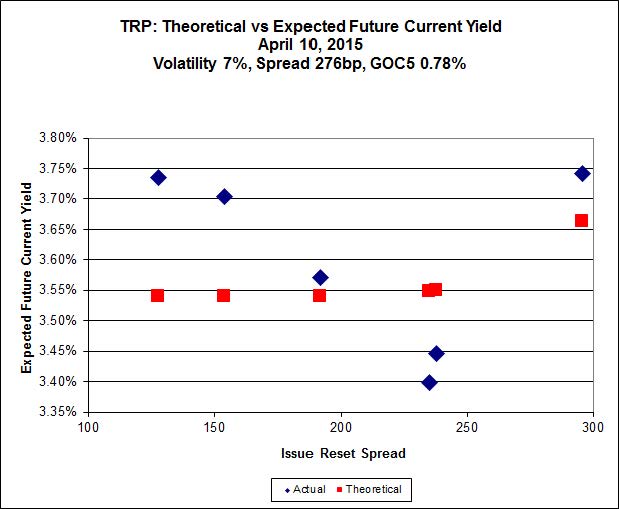
Here’s TRP:

impVol_TRP_150304
Click for Big

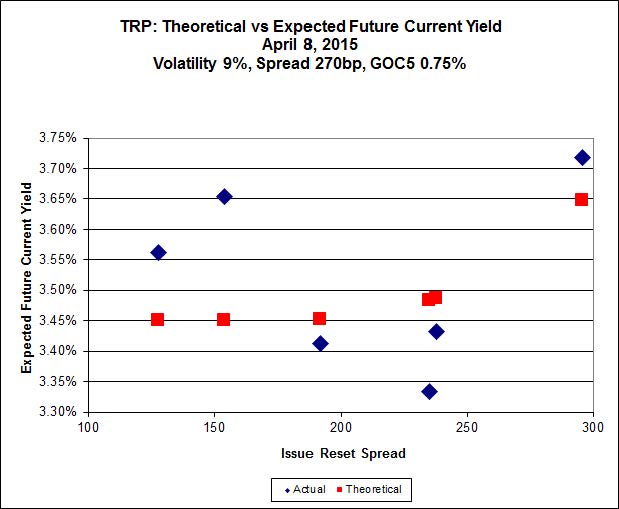
TRP.PR.E, which resets 2019-10-30 at +235, is bid at 24.75 to be $1.72 rich, while TRP.PR.G, resetting 2020-11-30 at +296, is $1.18 cheap at its bid price of 24.83.

impVol_MFC_150304
Click for Big

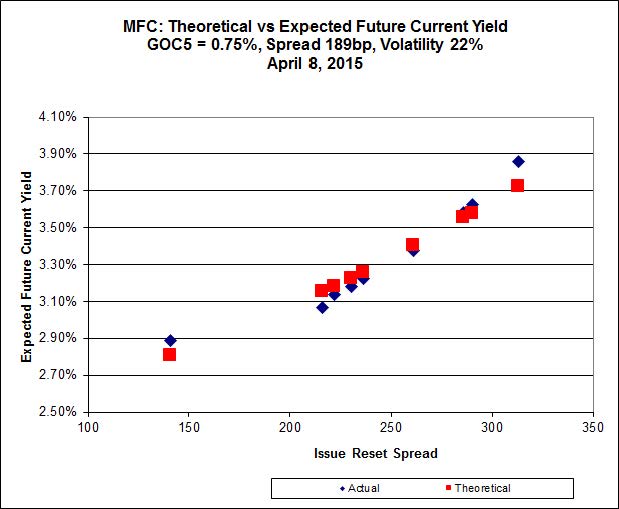
Another excellent fit, but the numbers are perplexing. Implied Volatility for MFC continues to be a conundrum, although it declined substantially today. It is still too high if we consider that NVCC rules will never apply to these issues; it is still too low if we consider them to be NVCC non-compliant issues (and therefore with Deemed Maturities in the call schedule).

Most expensive is MFC.PR.L, resetting at +216 on 2019-6-19, bid at 23.71 to be $0.28 rich, while MFC.PR.H, resetting at +313bp on 2017-3-19, is bid at 25.85 to be $0.52 cheap.

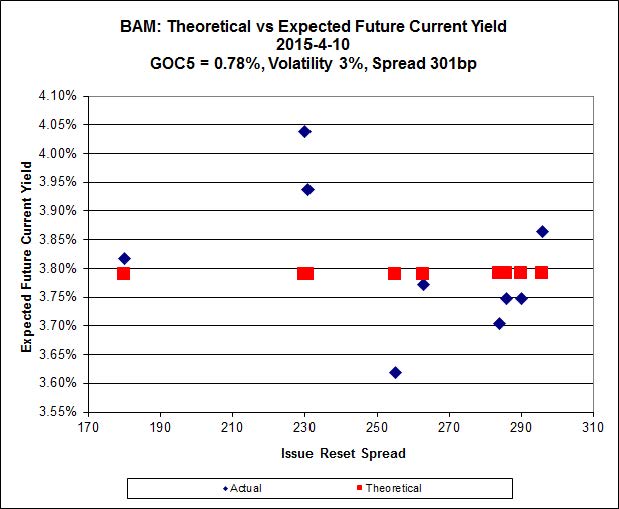
impVol_BAM_150304
Click for Big

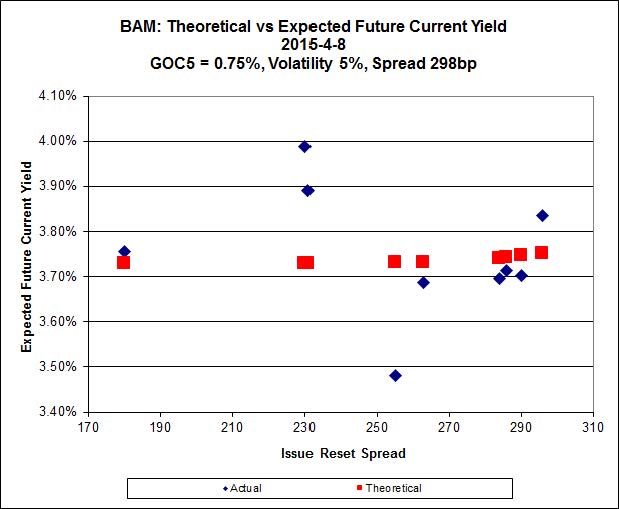
The fit on this series is actually quite reasonable – it’s the scale that makes it look so weird.

The cheapest issue relative to its peers is BAM.PR.X, resetting at +180bp on 2017-6-30, bid at 18.11 to be $0.66 cheap. BAM.PF.E, resetting at +255bp 2020-3-31 is bid at 24.34 and appears to be $0.63 rich.

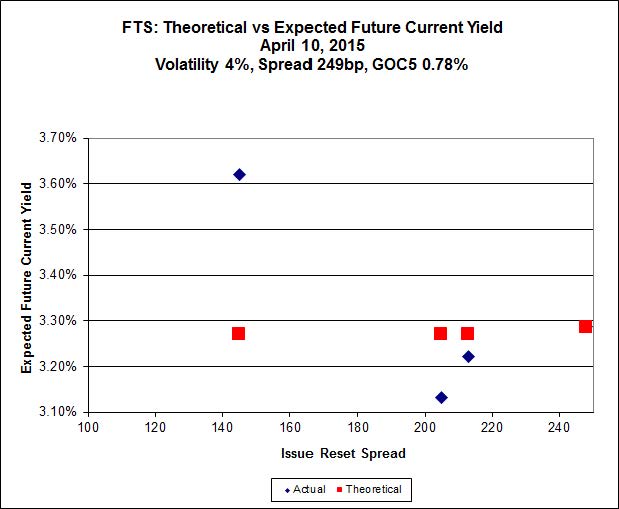
impVol_FTS_150304
Click for Big

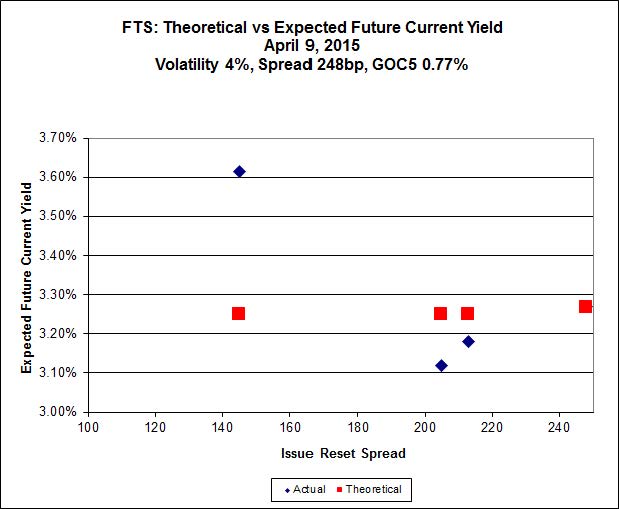
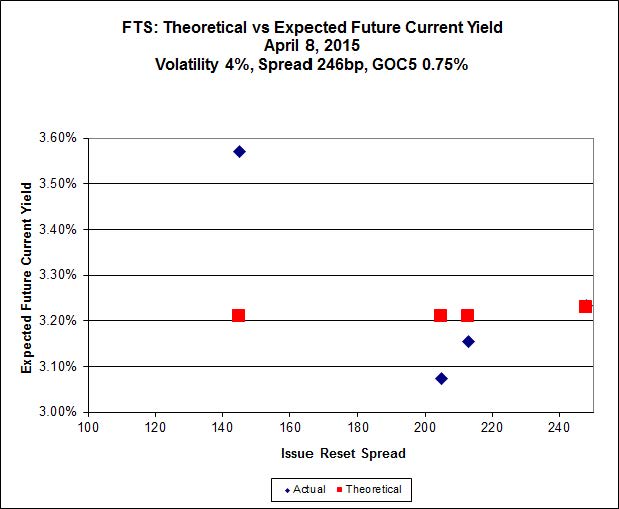
This is just weird because the middle is expensive and the ends are cheap but anyway … FTS.PR.H, with a spread of +145bp, and bid at 16.69, looks $1.46 cheap and resets 2015-6-1. FTS.PR.K, with a spread of +205bp and resetting 2019-3-1, is bid at 23.80 and is $1.09 rich.

pairs_FR_150304
Click for Big

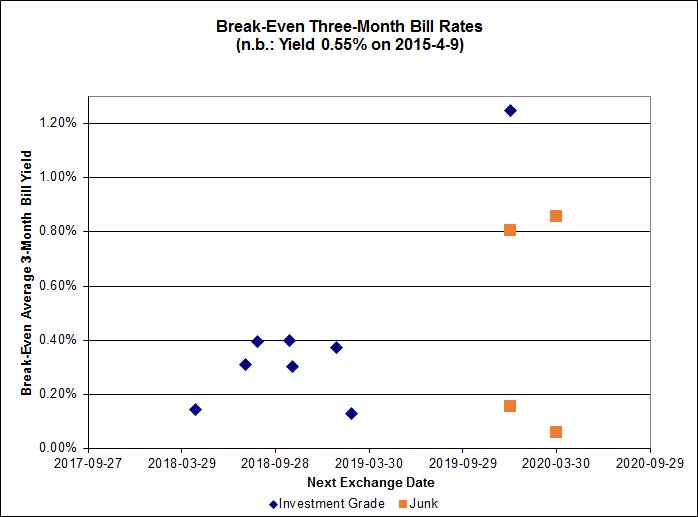
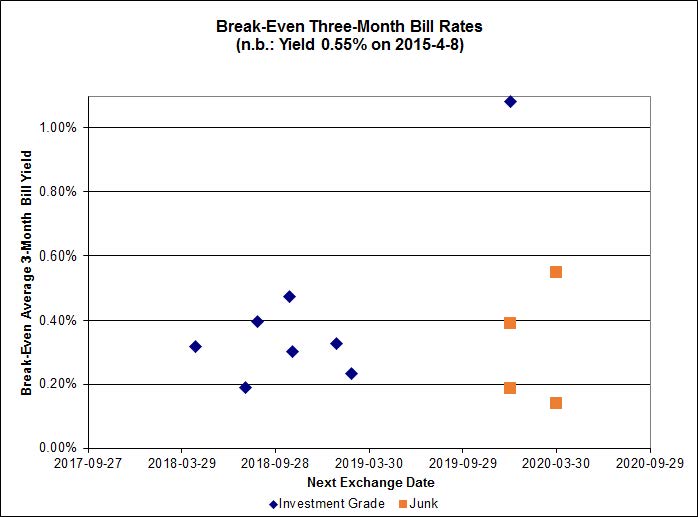
This is rather odd – the investment grade break-even rates are clustered just below zero, with one outlier: the TRP.PR.A / TRP.PR.F pair, clocking in at more aggressive 1.45%.

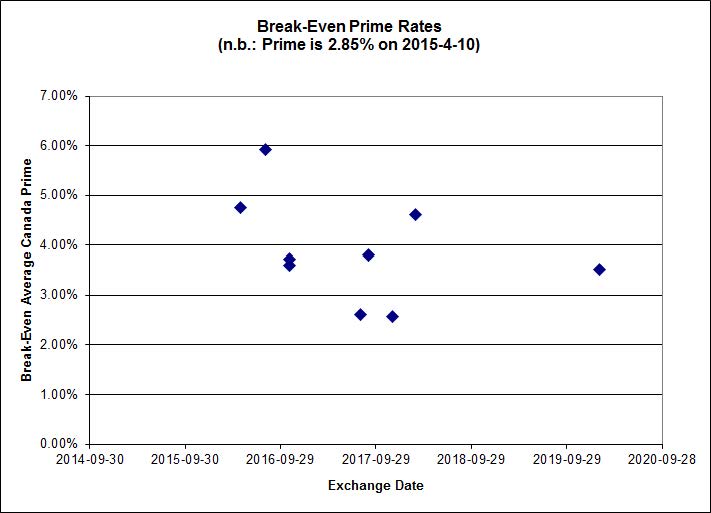
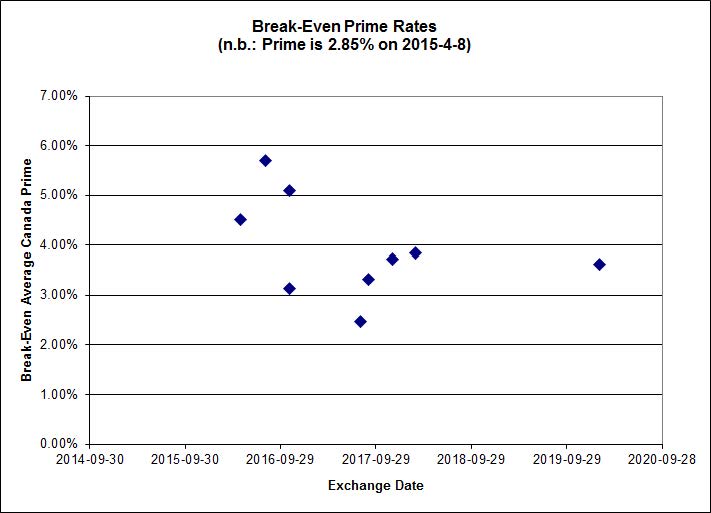
pairs_FF_150304The market’s distaste for product linked to Money Market rates does not extend to prime, as shown by the FixedFloater/RatchetRate pairs:

Click for Big

Shall we just say that this exhibits a high level of confidence in the continued rapacity of Canadian banks?

HIMIPref™ Preferred Indices
These values reflect the December 2008 revision of the HIMIPref™ Indices

Values are provisional and are finalized monthly
Index Mean
Current
Yield
(at bid)
Median
YTW
Median
Average
Trading
Value
Median
Mod Dur
(YTW)
Issues Day’s Perf. Index Value
Ratchet 0.00 % 0.00 % 0 0.00 0 0.9081 % 2,401.7
FixedFloater 0.00 % 0.00 % 0 0.00 0 0.9081 % 4,199.2
Floater 3.13 % 3.15 % 76,995 19.29 3 0.9081 % 2,553.1
OpRet 4.07 % 1.20 % 111,004 0.29 1 0.1193 % 2,762.6
SplitShare 4.48 % 4.61 % 54,247 4.46 5 -0.5403 % 3,201.9
Interest-Bearing 0.00 % 0.00 % 0 0.00 0 0.1193 % 2,526.1
Perpetual-Premium 5.29 % -1.76 % 57,249 0.08 25 -0.0172 % 2,521.7
Perpetual-Discount 4.94 % 5.03 % 156,616 15.14 9 0.0324 % 2,813.2
FixedReset 4.41 % 3.54 % 233,329 16.81 80 0.0820 % 2,424.5
Deemed-Retractible 4.90 % -0.63 % 107,551 0.15 37 0.1173 % 2,659.5
FloatingReset 2.49 % 2.83 % 87,528 6.35 8 0.5234 % 2,349.4
Performance Highlights
Issue Index Change Notes
SLF.PR.H FixedReset -2.16 % YTW SCENARIO
Maturity Type : Hard Maturity
Maturity Date : 2025-01-31
Maturity Price : 25.00
Evaluated at bid price : 22.60
Bid-YTW : 4.28 %
HSE.PR.C FixedReset -1.62 % YTW SCENARIO
Maturity Type : Limit Maturity
Maturity Date : 2045-03-04
Maturity Price : 23.12
Evaluated at bid price : 24.84
Bid-YTW : 4.03 %
CGI.PR.D SplitShare -1.13 % YTW SCENARIO
Maturity Type : Soft Maturity
Maturity Date : 2023-06-14
Maturity Price : 25.00
Evaluated at bid price : 25.31
Bid-YTW : 3.58 %
BAM.PR.T FixedReset 1.12 % YTW SCENARIO
Maturity Type : Limit Maturity
Maturity Date : 2045-03-04
Maturity Price : 22.22
Evaluated at bid price : 22.50
Bid-YTW : 3.62 %
BAM.PF.B FixedReset 1.12 % YTW SCENARIO
Maturity Type : Limit Maturity
Maturity Date : 2045-03-04
Maturity Price : 22.98
Evaluated at bid price : 24.30
Bid-YTW : 3.62 %
PWF.PR.P FixedReset 1.21 % YTW SCENARIO
Maturity Type : Limit Maturity
Maturity Date : 2045-03-04
Maturity Price : 18.42
Evaluated at bid price : 18.42
Bid-YTW : 3.36 %
MFC.PR.F FixedReset 1.32 % YTW SCENARIO
Maturity Type : Hard Maturity
Maturity Date : 2025-01-31
Maturity Price : 25.00
Evaluated at bid price : 19.25
Bid-YTW : 5.50 %
SLF.PR.G FixedReset 1.37 % YTW SCENARIO
Maturity Type : Hard Maturity
Maturity Date : 2025-01-31
Maturity Price : 25.00
Evaluated at bid price : 17.75
Bid-YTW : 6.13 %
IFC.PR.A FixedReset 1.54 % YTW SCENARIO
Maturity Type : Hard Maturity
Maturity Date : 2025-01-31
Maturity Price : 25.00
Evaluated at bid price : 20.41
Bid-YTW : 5.59 %
BAM.PR.K Floater 1.55 % YTW SCENARIO
Maturity Type : Limit Maturity
Maturity Date : 2045-03-04
Maturity Price : 15.74
Evaluated at bid price : 15.74
Bid-YTW : 3.20 %
TRP.PR.F FloatingReset 2.06 % YTW SCENARIO
Maturity Type : Limit Maturity
Maturity Date : 2045-03-04
Maturity Price : 19.80
Evaluated at bid price : 19.80
Bid-YTW : 3.09 %
TRP.PR.B FixedReset 2.63 % YTW SCENARIO
Maturity Type : Limit Maturity
Maturity Date : 2045-03-04
Maturity Price : 14.85
Evaluated at bid price : 14.85
Bid-YTW : 3.46 %
Volume Highlights
Issue Index Shares
Traded
Notes
PWF.PR.T FixedReset 260,300 Nesbitt crossed one block of 156,400 shares and two of 50,000 each, all at 25.05.
YTW SCENARIO
Maturity Type : Limit Maturity
Maturity Date : 2045-03-04
Maturity Price : 23.29
Evaluated at bid price : 25.10
Bid-YTW : 3.21 %
TRP.PR.G FixedReset 209,020 Recent new issue.
YTW SCENARIO
Maturity Type : Limit Maturity
Maturity Date : 2045-03-04
Maturity Price : 23.06
Evaluated at bid price : 24.83
Bid-YTW : 3.66 %
GWO.PR.H Deemed-Retractible 129,040 Desjardins bought 112,900 from anonymous at 24.95.
YTW SCENARIO
Maturity Type : Hard Maturity
Maturity Date : 2025-01-31
Maturity Price : 25.00
Evaluated at bid price : 24.90
Bid-YTW : 4.88 %
GWO.PR.N FixedReset 120,730 Desjardins crossed 50,000 at 18.35.
YTW SCENARIO
Maturity Type : Hard Maturity
Maturity Date : 2025-01-31
Maturity Price : 25.00
Evaluated at bid price : 18.25
Bid-YTW : 5.79 %
OSP.PR.A SplitShare 87,500 Recent new issue.
YTW SCENARIO
Maturity Type : Hard Maturity
Maturity Date : 2020-03-31
Maturity Price : 10.00
Evaluated at bid price : 10.20
Bid-YTW : 4.61 %
MFC.PR.M FixedReset 73,937 Nesbitt crossed 50,000 at 24.50 and 19,800 at 24.45.
YTW SCENARIO
Maturity Type : Hard Maturity
Maturity Date : 2025-01-31
Maturity Price : 25.00
Evaluated at bid price : 24.44
Bid-YTW : 3.79 %
There were 36 other index-included issues trading in excess of 10,000 shares.
Wide Spread Highlights
Issue Index Quote Data and Yield Notes
CGI.PR.D SplitShare Quote: 25.31 – 26.00
Spot Rate : 0.6900
Average : 0.5335

YTW SCENARIO
Maturity Type : Soft Maturity
Maturity Date : 2023-06-14
Maturity Price : 25.00
Evaluated at bid price : 25.31
Bid-YTW : 3.58 %

PWF.PR.F Perpetual-Premium Quote: 25.49 – 25.88
Spot Rate : 0.3900
Average : 0.2577

YTW SCENARIO
Maturity Type : Call
Maturity Date : 2015-04-03
Maturity Price : 25.00
Evaluated at bid price : 25.49
Bid-YTW : -12.59 %

IFC.PR.C FixedReset Quote: 24.84 – 25.25
Spot Rate : 0.4100
Average : 0.3056

YTW SCENARIO
Maturity Type : Hard Maturity
Maturity Date : 2025-01-31
Maturity Price : 25.00
Evaluated at bid price : 24.84
Bid-YTW : 3.74 %

MFC.PR.N FixedReset Quote: 24.12 – 24.59
Spot Rate : 0.4700
Average : 0.3671

YTW SCENARIO
Maturity Type : Hard Maturity
Maturity Date : 2025-01-31
Maturity Price : 25.00
Evaluated at bid price : 24.12
Bid-YTW : 3.89 %

IFC.PR.A FixedReset Quote: 20.41 – 21.14
Spot Rate : 0.7300
Average : 0.6273

YTW SCENARIO
Maturity Type : Hard Maturity
Maturity Date : 2025-01-31
Maturity Price : 25.00
Evaluated at bid price : 20.41
Bid-YTW : 5.59 %

TRP.PR.F FloatingReset Quote: 19.80 – 20.35
Spot Rate : 0.5500
Average : 0.4485

YTW SCENARIO
Maturity Type : Limit Maturity
Maturity Date : 2045-03-04
Maturity Price : 19.80
Evaluated at bid price : 19.80
Bid-YTW : 3.09 %

New Issues

New Issue: BIP FixedReset, 4.50%+356

Brookfield Infrastructure Partners L.P. has announced:

that it has agreed to issue 5,000,000 Cumulative Class A Preferred Limited Partnership Units, Series 1 (“Series 1 Preferred Units”) on a bought deal basis to a syndicate of underwriters led by CIBC, RBC Capital Markets, Scotiabank and TD Securities Inc. The Series 1 Preferred Units will be issued at a price of $25.00 per unit, for gross proceeds of $125,000,000. Holders of the Series 1 Preferred Units will be entitled to receive a cumulative quarterly fixed distribution at a rate of 4.50% annually for the initial period ending June 30, 2020. Thereafter, the distribution rate will be reset every five years at a rate equal to the 5-year Government of Canada bond yield plus 3.56%. The Series 1 Preferred Units are redeemable on or after June 30, 2020.

Holders of the Series 1 Preferred Units will have the right, at their option, to reclassify their Series 1 Preferred Units into Cumulative Class A Preferred Limited Partnership Units, Series 2 (“Series 2 Preferred Units”), subject to certain conditions, on June 30, 2020 and on June 30 every 5 years thereafter. Holders of Series 2 Preferred Units will be entitled to receive a cumulative quarterly floating distribution at a rate equal to the 90-day Canadian Treasury Bill yield plus 3.56%.

Brookfield Infrastructure has granted the underwriters an option, exercisable until 48 hours prior to closing, to purchase up to an additional 2,000,000 Series 1 Preferred Units which, if exercised, would increase the gross offering size to $175,000,000. The Series 1 Preferred Units will be offered in all provinces and territories of Canada by way of a supplement to Brookfield Infrastructure’s existing short form base shelf prospectus.

Brookfield Infrastructure intends to use the net proceeds of the issue of the Series 1 Preferred Units for general corporate purposes, including to fund new investments that were previously announced and repay amounts outstanding under its credit facilities. The offering of Series 1 Preferred Units is expected to close on or about March 12, 2015.

But have a look at the issuer! Brookfield Infrastructure Partners L.P.! LP, LP! For various tax reasons I am not competent to either judge or explain, this means that they cannot guarantee that the distributions will actually be dividends; instead, the distributions will be partially a return of capital and the “Certain Canadian Federal Income Tax Considerations” section of the prospectus will be more fraught with interest than otherwise might be the case.

For the past five years, the Return of Capital proportion of distribution with respect to ordinary units has been (starting with 2014) 1.60%, 76.90%, 47.03%, 63.44% and 79.00%, which many will consider gives rise to a pleasant deferral of tax (you eventually pay tax. Don’t worry about that! The ROC lowers the Adjusted Cost Base for capital gains purposes).

Just what the proportions might be in the future is for God to know and man to guess, but it appears that REI.PR.A and REI.PR.C and AX.PR.A, AX.PR.E and AX.PR.G, which also have this ROC structure now have some competition in the ‘deferred taxation’ space.

New Issues

New Issue: HSE FixedReset, 4.50%+357

Husky Energy has announced that it:

has agreed to issue to a syndicate of underwriters led by TD Securities Inc. and RBC Capital Markets for distribution to the public 6,000,000 Cumulative Redeemable Preferred Shares, Series 5 (the “Series 5 Shares”).

The Series 5 Shares will be issued at a price of $25.00 per Series 5 Share, for aggregate gross proceeds of $150 million. Holders of the Series 5 Shares will be entitled to receive a cumulative quarterly fixed dividend yielding 4.50 percent annually for the initial period ending March 31, 2020. Thereafter, the dividend rate will be reset every five years at a rate equal to the five-year Government of Canada bond yield plus 3.57 percent.

Holders of Series 5 Shares will have the right, at their option, to convert their shares into Cumulative Redeemable Preferred Shares, Series 6 (the “Series 6 Shares”), subject to certain conditions, on March 31, 2020 and on March 31 every five years thereafter. Holders of the Series 6 Shares will be entitled to receive cumulative quarterly floating dividends at a rate equal to the 90-day Government of Canada Treasury Bill rate plus 3.57 percent.

Husky has granted the underwriters an option, exercisable in whole or in part prior to closing, to purchase up to an additional 2,000,000 Series 5 Shares at the same offering price. The Series 5 Shares will be offered by way of prospectus supplement to the short form base shelf prospectus of Husky Energy dated February 23, 2015.

The prospectus supplement will be filed with securities regulatory authorities in all provinces of Canada.

The net proceeds of the offering will be used for the partial repayment of short term debt incurred in connection with the Company’s U.S. refining operations.

The offering is expected to close on or about March 12, 2015, subject to customary closing conditions and receipt of required regulatory approvals.

They later announced:

that the underwriters of its Cumulative Redeemable Preferred Shares, Series 5 (the “Series 5 Shares”) offering have exercised their option to increase the size to 8,000,000 shares, due to positive investor response.

The aggregate gross proceeds from the upsized offering will be $200 million. Closing of the offering is expected on or about March 12, subject to customary closing conditions and receipt of required regulatory approvals.

It astonishes me to report that the recently issued HSE.PR.C, a FixedReset 4.50%+313 resetting 2019-12-31 (a mere three months prior to the resetting of the new issue) was not more badly hurt by the news: yesterday it closed at 25.25-30 (3.94%-93) and today it closed at 24.84-93 ( ) on good volume of 77,500, which is far in excess of the turnover it saw in February. Come on, people! Surely rational expectations decree that a 44bp difference in reset rates should be worth more than that!

It might be, of course, that the market is asserting that the new issue is grossly underpriced and will pop as soon as it starts trading. This interpretation is consistent with the exercise of the underwriters’ option. And it is also possible that the market is asserting that Five-Year Canada yields in late 2019/early 2020 will be so high that a mere 44bp in dividend rates will be a mere bagatelle. And it is also possible that the market is asserting that the credit quality of HSE is so incredibly wonderful and adamantine that both issues are certain to be called on their first exchange dates and refinanced at a much cheaper rate.

Well, the market can assert whatever it likes. And it will.

After all, look at TRP.PR.E and TRP.PR.G, which show a bid price difference of $0.08 today, despite an Issue Reset Spread difference of 61bp, albeit with thirteen month difference in next Exchange Date. I suspect that eventually this recent spate of high-spread issues will force down the prices of the older, somewhat lower-spread issues (the very low spread issues have, I think, taken their hits already). But I’ve been wrong before and will be wrong again, so don’t mortgage the house.

Market Action

March 3, 2015

Daniel M. Gallagher has just become my favourite SEC commissioner:

During a fireside chat at today’s Institute of International Bankers’ 26th Annual Washington Conference, I expressed my concern about the number and aggregate impact of regulations that have been imposed on U.S. financial services firms since the enactment of the Dodd-Frank Act in 2010. These regulations come from an alphabet soup of domestic regulators, including the SEC, and many are related to the edicts of non-accountable international bodies such as the Financial Stability Board. Unfortunately, in promulgating many of these myriad regulations, a robust cost-benefit analysis was not required—and therefore none was performed. Even where a cost-benefit analysis was performed (an exercise for the most part limited to rules adopted by the SEC or CFTC, either independently or jointly with other regulators, given their statutory mandate for cost-benefit analysis), such analysis encompassed only the incremental effects of the rule being considered for adoption. No regulator, as far as I know, has considered the overall regulatory burden on financial services firms when determining whether to impose additional costly regulations. We as regulators are, when it comes to the possibility that our rules are causing death by a thousand cuts, the proverbial ostrich—head firmly entrenched in the sand.

There is yet another rate cut:

India’s central bank lowered interest rates in an unscheduled move for the second time this year, a sign of approval for Prime Minister Narendra Modi’s first full-year budget.

Governor Raghuram Rajan cut the benchmark repurchase rate to 7.5 percent from 7.75 percent, the Reserve Bank of India said in a statement on Wednesday. The central bank acted due to weakness in the economy and after it agreed upon a formal inflation target with the government, Rajan said.

“This makes explicit what was implicit before –- that the government and the Reserve Bank have common objectives and that fiscal and monetary policy will work in a complementary way,” Rajan said in the statement, referring to the monetary policy framework agreement. “In sum, then, the government intends to compensate for the delay in fiscal consolidation with a commitment to an improvement in the quality of adjustment.”

The decision came four days after Modi pushed back deficit targets to spur economic growth through corporate tax cuts and increased spending on infrastructure. More than a dozen central banks from Turkey to China have eased policy in 2015 as a slide in oil prices damps inflation.

It was a fine day for the Canadian preferred share market, with both PerpetualDiscounts and FixedResets up 39bp, while DeemedRetractibles gained 17bp. The Performance Highlights table is dominated by FixedReset winners. Volume was average.

For as long as the FixedReset market is so violently unsettled, I’ll keep publishing updates of the more interesting and meaningful series of FixedResets’ Implied Volatilities. This doesn’t include Enbridge because although Enbridge has a large number of issues outstanding, all of which are quite liquid, the range of Issue Reset Spreads is too small for decent conclusions. The low is 212bp (ENB.PR.H; second-lowest is ENB.PR.D at 237bp) and the high is a mere 268 for ENB.PF.G.

Remember that all rich /cheap assessments are:
» based on Implied Volatility Theory only
» are relative only to other FixedResets from the same issuer
» assume constant GOC-5 yield
» assume constant Implied Volatility
» assume constant spread

Here’s TRP:

impVol_TRP_150303
Click for Big

TRP.PR.E, which resets 2019-10-30 at +235, is bid at 24.65 to be $1.67 rich, while TRP.PR.G, resetting 2020-11-30 at +296, is $1.21 cheap at its bid price of 24.83.

impVol_MFC_150303
Click for Big

Another excellent fit, but the numbers are perplexing. Implied Volatility for MFC continues to be a conundrum, although it declined substantially today. It is still too high if we consider that NVCC rules will never apply to these issues; it is still too low if we consider them to be NVCC non-compliant issues (and therefore with Deemed Maturities in the call schedule).

Most expensive is MFC.PR.L, resetting at +216 on 2019-6-19, bid at 23.84 to be $0.39 rich, while MFC.PR.H, resetting at +313bp on 2017-3-19, is bid at 25.89 to be $0.57 cheap.

impVol_BAM_150303
Click for Big

The fit on this series is actually quite reasonable – it’s the scale that makes it look so weird.

The cheapest issue relative to its peers is BAM.PR.X, resetting at +180bp on 2017-6-30, bid at 18.15 to be $0.39 cheap. BAM.PF.E, resetting at +255bp 2020-3-31 is bid at 24.38 and appears to be $0.75 rich.

impVol_FTS_150303
Click for Big

This is just weird because the middle is expensive and the ends are cheap but anyway … FTS.PR.H, with a spread of +145bp, and bid at 16.63, looks $1.36 cheap and resets 2015-6-1. FTS.PR.K, with a spread of +205bp and resetting 2019-3-1, is bid at 23.80 and is $1.09 rich.

pairs_FR_150303
Click for Big

This is rather odd – the investment grade break-even rates are clustered around negative 20bp, with one outlier: the TRP.PR.A / TRP.PR.F pair, clocking in at more reasonable 1.24%.

The market’s distaste for product linked to Money Market rates does not extend to prime, as shown by the FixedFloater/RatchetRate pairs:

pairs_FF_150303
Click for Big

Shall we just say that this exhibits a high level of confidence in the continued rapacity of Canadian banks?

HIMIPref™ Preferred Indices
These values reflect the December 2008 revision of the HIMIPref™ Indices

Values are provisional and are finalized monthly
Index Mean
Current
Yield
(at bid)
Median
YTW
Median
Average
Trading
Value
Median
Mod Dur
(YTW)
Issues Day’s Perf. Index Value
Ratchet 0.00 % 0.00 % 0 0.00 0 1.4136 % 2,380.0
FixedFloater 0.00 % 0.00 % 0 0.00 0 1.4136 % 4,161.4
Floater 3.16 % 3.17 % 77,523 19.25 3 1.4136 % 2,530.2
OpRet 4.08 % 1.59 % 110,955 0.29 1 0.1195 % 2,759.3
SplitShare 4.46 % 4.36 % 54,631 4.46 5 0.2589 % 3,219.3
Interest-Bearing 0.00 % 0.00 % 0 0.00 0 0.1195 % 2,523.1
Perpetual-Premium 5.29 % -2.23 % 56,555 0.08 25 0.2210 % 2,522.1
Perpetual-Discount 4.95 % 5.06 % 157,544 15.10 9 0.3907 % 2,812.3
FixedReset 4.42 % 3.43 % 229,811 16.80 80 0.3893 % 2,422.6
Deemed-Retractible 4.90 % 0.79 % 106,008 0.16 37 0.1715 % 2,656.4
FloatingReset 2.50 % 2.92 % 88,523 6.35 8 0.1230 % 2,337.1
Performance Highlights
Issue Index Change Notes
TRP.PR.A FixedReset -1.27 % YTW SCENARIO
Maturity Type : Limit Maturity
Maturity Date : 2045-03-03
Maturity Price : 19.51
Evaluated at bid price : 19.51
Bid-YTW : 3.62 %
PWF.PR.P FixedReset -1.14 % YTW SCENARIO
Maturity Type : Limit Maturity
Maturity Date : 2045-03-03
Maturity Price : 18.20
Evaluated at bid price : 18.20
Bid-YTW : 3.40 %
CU.PR.C FixedReset -1.11 % YTW SCENARIO
Maturity Type : Limit Maturity
Maturity Date : 2045-03-03
Maturity Price : 23.17
Evaluated at bid price : 24.13
Bid-YTW : 3.31 %
HSE.PR.A FixedReset -1.07 % YTW SCENARIO
Maturity Type : Limit Maturity
Maturity Date : 2045-03-03
Maturity Price : 17.56
Evaluated at bid price : 17.56
Bid-YTW : 3.77 %
PWF.PR.T FixedReset 1.00 % YTW SCENARIO
Maturity Type : Limit Maturity
Maturity Date : 2045-03-03
Maturity Price : 23.34
Evaluated at bid price : 25.25
Bid-YTW : 3.18 %
NA.PR.S FixedReset 1.01 % YTW SCENARIO
Maturity Type : Limit Maturity
Maturity Date : 2045-03-03
Maturity Price : 23.24
Evaluated at bid price : 25.05
Bid-YTW : 3.22 %
MFC.PR.B Deemed-Retractible 1.02 % YTW SCENARIO
Maturity Type : Hard Maturity
Maturity Date : 2025-01-31
Maturity Price : 25.00
Evaluated at bid price : 24.75
Bid-YTW : 4.78 %
SLF.PR.H FixedReset 1.05 % YTW SCENARIO
Maturity Type : Hard Maturity
Maturity Date : 2025-01-31
Maturity Price : 25.00
Evaluated at bid price : 23.10
Bid-YTW : 4.01 %
GWO.PR.N FixedReset 1.11 % YTW SCENARIO
Maturity Type : Hard Maturity
Maturity Date : 2025-01-31
Maturity Price : 25.00
Evaluated at bid price : 18.20
Bid-YTW : 5.83 %
BAM.PR.Z FixedReset 1.15 % YTW SCENARIO
Maturity Type : Limit Maturity
Maturity Date : 2045-03-03
Maturity Price : 23.58
Evaluated at bid price : 25.51
Bid-YTW : 3.72 %
POW.PR.G Perpetual-Premium 1.16 % YTW SCENARIO
Maturity Type : Call
Maturity Date : 2017-04-15
Maturity Price : 26.00
Evaluated at bid price : 26.95
Bid-YTW : 3.94 %
MFC.PR.C Deemed-Retractible 1.17 % YTW SCENARIO
Maturity Type : Hard Maturity
Maturity Date : 2025-01-31
Maturity Price : 25.00
Evaluated at bid price : 24.29
Bid-YTW : 4.86 %
VNR.PR.A FixedReset 1.25 % YTW SCENARIO
Maturity Type : Limit Maturity
Maturity Date : 2045-03-03
Maturity Price : 23.18
Evaluated at bid price : 24.31
Bid-YTW : 3.75 %
ENB.PR.N FixedReset 1.40 % YTW SCENARIO
Maturity Type : Limit Maturity
Maturity Date : 2045-03-03
Maturity Price : 20.99
Evaluated at bid price : 20.99
Bid-YTW : 4.23 %
MFC.PR.K FixedReset 1.42 % YTW SCENARIO
Maturity Type : Hard Maturity
Maturity Date : 2025-01-31
Maturity Price : 25.00
Evaluated at bid price : 23.61
Bid-YTW : 3.98 %
IFC.PR.C FixedReset 1.43 % YTW SCENARIO
Maturity Type : Hard Maturity
Maturity Date : 2025-01-31
Maturity Price : 25.00
Evaluated at bid price : 24.85
Bid-YTW : 3.73 %
HSE.PR.C FixedReset 1.53 % YTW SCENARIO
Maturity Type : Limit Maturity
Maturity Date : 2045-03-03
Maturity Price : 23.25
Evaluated at bid price : 25.25
Bid-YTW : 3.94 %
MFC.PR.M FixedReset 1.62 % YTW SCENARIO
Maturity Type : Hard Maturity
Maturity Date : 2025-01-31
Maturity Price : 25.00
Evaluated at bid price : 24.46
Bid-YTW : 3.78 %
BAM.PR.B Floater 1.66 % YTW SCENARIO
Maturity Type : Limit Maturity
Maturity Date : 2045-03-03
Maturity Price : 15.95
Evaluated at bid price : 15.95
Bid-YTW : 3.16 %
TRP.PR.F FloatingReset 2.11 % YTW SCENARIO
Maturity Type : Limit Maturity
Maturity Date : 2045-03-03
Maturity Price : 19.40
Evaluated at bid price : 19.40
Bid-YTW : 3.16 %
TRP.PR.B FixedReset 2.55 % YTW SCENARIO
Maturity Type : Limit Maturity
Maturity Date : 2045-03-03
Maturity Price : 14.47
Evaluated at bid price : 14.47
Bid-YTW : 3.55 %
BAM.PR.C Floater 2.58 % YTW SCENARIO
Maturity Type : Limit Maturity
Maturity Date : 2045-03-03
Maturity Price : 15.90
Evaluated at bid price : 15.90
Bid-YTW : 3.17 %
CIU.PR.C FixedReset 3.01 % YTW SCENARIO
Maturity Type : Limit Maturity
Maturity Date : 2045-03-03
Maturity Price : 16.45
Evaluated at bid price : 16.45
Bid-YTW : 3.38 %
Volume Highlights
Issue Index Shares
Traded
Notes
TRP.PR.G FixedReset 365,122 Recent new issue.
YTW SCENARIO
Maturity Type : Limit Maturity
Maturity Date : 2045-03-03
Maturity Price : 23.06
Evaluated at bid price : 24.83
Bid-YTW : 3.66 %
RY.PR.J FixedReset 175,280 RBC crossed two blocks of 25,000 each, both at 25.00. Scotia crossed two blocks of 20,000 each and one of 10,000, all at 25.00. Scotia sold two blocks of 10,000 each to RBC at 25.00.
YTW SCENARIO
Maturity Type : Limit Maturity
Maturity Date : 2045-03-03
Maturity Price : 23.15
Evaluated at bid price : 25.00
Bid-YTW : 3.42 %
CM.PR.G Perpetual-Premium 107,624 Called for redemption April 30.
YTW SCENARIO
Maturity Type : Call
Maturity Date : 2015-04-02
Maturity Price : 25.00
Evaluated at bid price : 25.28
Bid-YTW : -2.44 %
BAM.PR.Z FixedReset 51,285 Desjardins crossed 50,000 at 25.60.
YTW SCENARIO
Maturity Type : Limit Maturity
Maturity Date : 2045-03-03
Maturity Price : 23.58
Evaluated at bid price : 25.51
Bid-YTW : 3.72 %
ENB.PR.D FixedReset 47,246 TD crossed 25,000 at 19.23.
YTW SCENARIO
Maturity Type : Limit Maturity
Maturity Date : 2045-03-03
Maturity Price : 19.19
Evaluated at bid price : 19.19
Bid-YTW : 4.29 %
TD.PF.B FixedReset 42,861 Desjardins crossed 27,100 at 24.75.
YTW SCENARIO
Maturity Type : Limit Maturity
Maturity Date : 2045-03-03
Maturity Price : 23.08
Evaluated at bid price : 24.63
Bid-YTW : 3.14 %
There were 34 other index-included issues trading in excess of 10,000 shares.
Wide Spread Highlights
Issue Index Quote Data and Yield Notes
RY.PR.F Deemed-Retractible Quote: 25.30 – 26.00
Spot Rate : 0.7000
Average : 0.4517

YTW SCENARIO
Maturity Type : Call
Maturity Date : 2016-05-24
Maturity Price : 25.00
Evaluated at bid price : 25.30
Bid-YTW : 3.54 %

FTS.PR.G FixedReset Quote: 23.66 – 24.30
Spot Rate : 0.6400
Average : 0.4465

YTW SCENARIO
Maturity Type : Limit Maturity
Maturity Date : 2045-03-03
Maturity Price : 22.75
Evaluated at bid price : 23.66
Bid-YTW : 3.16 %

BAM.PF.B FixedReset Quote: 24.03 – 24.60
Spot Rate : 0.5700
Average : 0.4019

YTW SCENARIO
Maturity Type : Limit Maturity
Maturity Date : 2045-03-03
Maturity Price : 22.86
Evaluated at bid price : 24.03
Bid-YTW : 3.67 %

BAM.PR.T FixedReset Quote: 22.25 – 22.73
Spot Rate : 0.4800
Average : 0.3125

YTW SCENARIO
Maturity Type : Limit Maturity
Maturity Date : 2045-03-03
Maturity Price : 21.76
Evaluated at bid price : 22.25
Bid-YTW : 3.64 %

BAM.PR.K Floater Quote: 15.50 – 15.99
Spot Rate : 0.4900
Average : 0.3247

YTW SCENARIO
Maturity Type : Limit Maturity
Maturity Date : 2045-03-03
Maturity Price : 15.50
Evaluated at bid price : 15.50
Bid-YTW : 3.25 %

RY.PR.L FixedReset Quote: 26.34 – 26.77
Spot Rate : 0.4300
Average : 0.2707

YTW SCENARIO
Maturity Type : Call
Maturity Date : 2019-02-24
Maturity Price : 25.00
Evaluated at bid price : 26.34
Bid-YTW : 2.87 %

Issue Comments

FFH.PR.M Soft On Moderate Volume

Fairfax Financial Holdings Limited has announced that it:

has completed its previously announced bought deal financings for Subordinate Voting Shares, Preferred Shares, Series M (“Series M Shares”) and Senior Notes due 2025 (“Notes”). As a result of the underwriters’ exercising their over-allotment option to purchase an additional 150,000 Subordinate Voting Shares, at a price of $650.00 per Subordinate Voting Share, Fairfax has issued 1,150,000 Subordinate Voting Shares for gross proceeds of $747,500,000 (the “Subordinate Voting Share Offering”). The underwriters for the offering of Series M Shares (the “Preferred Share Offering”) also exercised their option to purchase an additional 1,200,000 Series M Shares at a price of $25.00 per share. As a result, Fairfax has issued 9,200,000 Series M Shares for gross proceeds of $230 million pursuant to the Preferred Share Offering. In addition, Fairfax has completed its previously announced offering of Notes in an aggregate principal amount of $350 million (the “Notes Offering”). The total gross proceeds of the Subordinate Voting Share Offering, Preferred Share Offering and Notes Offering are approximately $1.325 billion.

The Series M Shares were sold through a syndicate of Canadian underwriters led by BMO Capital Markets, RBC Capital Markets and Scotiabank and that also included CIBC World Markets Inc., National Bank Financial Inc., TD Securities Inc., Canaccord Genuity Corp., Desjardins Securities Inc., GMP Securities L.P. and Cormark Securities Inc.

Fairfax intends to use the net proceeds of the Subordinate Voting Share Offering, the Preferred Share Offering and the Notes Offering to partially fund the previously announced proposed acquisition of all of the issued and to be issued shares of Brit plc. There can be no assurance that such acquisition will be completed. If the acquisition is not successfully completed, Fairfax intends to use the net proceeds from the offerings to augment its cash position, to increase short-term investments and marketable securities held at the holding company level, to refinance or retire outstanding debt and other corporate obligations of Fairfax and its subsidiaries from time to time, and for general corporate purposes.

FFH.PR.M is a FixedReset, 4.75%+398, announced February 20. It will be tracked by HIMIPref™ and will be assigned to the Scraps index on credit concerns.

The issue traded 774,812 shares today (consolidated exchanges) in a range of 24.63-75 before closing at 24.65-74. Vital Statistics are:

FFH.PR.M FixedReset YTW SCENARIO
Maturity Type : Limit Maturity
Maturity Date : 2045-03-03
Maturity Price : 23.03
Evaluated at bid price : 24.65
Bid-YTW : 4.74 %

Implied Volatility theory provides a very poor fit to the data:

impVol_FFH_150303
Click for Big

According to this FFH.PR.M, resetting at +398bp on 2020-3-31, is $0.85 cheap at its bid of 24.65..

Issue Comments

CM.PR.G To Be Redeemed

Canadian Imperial Bank of Commerce has announced:

its intention to redeem all of its issued and outstanding Non-cumulative Class A Preferred Shares Series 29 (TSX: CM.PR.G), for cash. The redemption will occur on April 30, 2015. The redemption price is $25.00 per Series 29 share.

The $0.337500 quarterly dividend announced on February 26, 2015 will be the final dividend on the Series 29 shares and will be paid on April 28, 2015, covering the period to April 30, 2015, to shareholders of record on March 27, 2015.

Holders of the Series 29 shares should contact the financial institution, broker or other intermediary through which they hold the shares to confirm how they will receive their redemption proceeds.

CM.PR.G was issued in accordance with a prospectus dated June 4, 2004 as a matched unit of a warrant and a Series 28 preferred; it was a Straight Perpetual paying 5.40%.

The issue is noteworthy because it was convertible into common at the option of the bank; the right to exercise this option was assigned to OSFI in August, 2011, and the shares were thereafter deemed to be NVCC-compliant. Due to this, the initial assignment of these shares to the DeemedRetractible index was reversed and the issue considered to be a Straight Perpetual for reporting and analytical purposes. CM.PR.G is the last of CIBC’s preferreds that has been treated in this way; CM.PR.D and CM.PR.E have already been redeemed.

Market Action

March 2, 2015

The latest hot new financial indicator is: How much European sovereign debt trades at negative yields?:

The European Central Bank’s imminent bond-buying plan has left $1.9 trillion of the euro region’s government securities with negative yields.

Germany sold five-year notes at an average yield of minus 0.08 percent on Wednesday, a euro-area record, meaning investors buying the securities will get less back than they paid when the debt matures in April 2020.

By the next day, German notes with a maturity out to seven years had sub-zero yields, while rates on seven other euro-area nations’ debt were also negative. While some bonds had such yields as far back as 2012, the phenomenon has gathered pace since the ECB’s decision to cut its deposit rate to below zero last year.

And there are more global rate cuts:

The dollar rallied with gold as the yuan slipped to a two-year low after China cut interest rates for the second time in three months. Oil retreated following its first monthly gain since June.

The Bloomberg Dollar Spot Index increased 0.2 percent at 1:22 p.m. in Hong Kong as China’s currency traded at its weakest level since October 2012 and the euro slipped 0.2 percent.

China’s second rate cut in 14 weeks was the latest in a wave of global easing that underscores diverging economic outlooks for the U.S. versus the rest of the world. A private measure of factory activity in Asia’s largest economy showed a faster-than-estimated expansion Monday as lawmakers prepare to meet in Beijing. The euro area updates on consumer prices and U.S. private spending data are due.

The People’s Bank of China announced a benchmark lending and deposit rate cut of a quarter percentage point Saturday. A day later, a government factory gauge for February signaled contraction for a second month, underscoring the scope for looser policy.

The yuan traded at 6.2732 per dollar after the central bank reduced its reference rate to the weakest since November today. Today’s purchasing managers index from HSBC Holdings Plc and Markit Economics came in at 50.7, beating economists’ estimates for it to hold steady from a preliminary reading of 50.1. Readings above 50 denote expansion.

The Bloomberg gauge of dollar strength traded at 1,174.11, less than one point from its highest level in at least 10 years. The greenback was stronger against 13 of 16 major peers, advancing 0.5 percent against the Australian and New Zealand currencies. The euro bought $1.1179.

There are more worries about corporate bond liquidity:

Investors have a fickle relationship with credit mutual funds lately, pouring cash in one year and yanking it out the next.

As a result, the world’s biggest mutual-fund firms are preparing for when sentiment sours for a prolonged period. They’re increasing the amount of cash in their portfolio and boosting their holdings of corporate-bond exchange-traded fund shares — which trade like stocks instead of the antiquated, telephone-based system of buying and selling debt.

Up to 10 percent of some corporate-debt funds’ holdings now consist of ETFs, a proportion that’s been rising for the past two years, according to Tabb Group research.

The potential for big outflows from U.S. bonds is all the scarier now because trading volumes have failed to keep pace with the 21 percent growth in outstanding debt since 2007. While taxable bond funds have received $932 billion of deposits since the end of 2007, Wall Street’s biggest banks have cut holdings of the debt previously used to facilitate trading.

“There has, indeed, been a meaningful deterioration in the ability to trade corporate bonds from the pre- to post-crisis period,” Barclays Plc analysts led by Jeffrey Meli and Bradley Rogoff wrote in a Feb. 27 report. “This has resulted in increased investor reliance on products such as ETFs” to manage liquidity.

Of course, there are some questions about how well ETFs will work as a liquidity tool in a downturn, too. There’s the potential for ETF shares to move away from the underlying market in a time of stress, forcing fire sales of assets that don’t trade as often.

The fragile new equilibrium stems from “liquidity mismatches between the assets themselves and the instruments being used to manage daily liquidity needs,” Barclays analysts wrote. Well-intentioned regulations and “a growing demand for liquidity may have led to increased instability and fire-sale risk in corporate debt markets.”

This has even attracted the attention of one of the well-intentioned regulators:

A lack of liquidity in corporate-bond markets could pose a “systemic risk” to the economy when interest rates rise, U.S. Securities and Exchange Commission member Daniel Gallagher said.

Gallagher, a Republican, warned that the Financial Stability Oversight Council, a group of U.S. regulators that monitors emerging systemic risks, hasn’t paid enough attention to the $7.3 trillion corporate-bond market, which has ballooned over the past seven years amid low interest rates. He made the remarks Monday at a banking conference in Washington.

The SEC last year began testing whether fixed-income mutual funds could withstand a possible sell-off during a period of financial stress, people with knowledge of the matter have said. The agency hasn’t made its findings public, but some large money managers have warned the market is primed for failure when the Federal Reserve starts raising interest rates.

I’ve said it before … I’ll say it again … it’s one thing to say that the banks’ pool of capital may not be used to inventory corporates, but that pool has to be replaced. The logical replacement source is hedge funds, pension funds and insurance companies starting to act as traders but – given that fantasies of creating liquidity through exchange-like electronic marketplaces is nothing more than the psychedelic dream of morons with no knowledge of the market whatsoever – that means they’ll have to have SEC clearance to act as traders. That is, with a Salesforce (that’s expensive!) and no moronic whimpering about fairness to clients. I’m not going to hold my breath. Instead, I’ll continue to be fearful of what will happen when what happened to sub-prime paper during the Credit Crunch happens to corporate debt in the next crisis, which will kill the market for a few years and do massive damage to the economy. There might be a few bargains, though, for those with dry ammunition and permission from our wise masters at the regulatory agencies to invest in fire-sale corporate debt.

Ian McGugan in the Globe writes a piece titled Why decades of inflationary pressure may be ahead of us which drew my attention to a BIS working paper by Mikael Juselius and Elod Takats titled Can Demography Affect Inflation and Monetary Policy?:

Several countries are concurrently experiencing historically low inflation rates and ageing populations. Is there a connection, as recently suggested by some senior central bankers? We undertake a comprehensive test of this hypothesis in a panel of 22 countries over the 1955-2010 period. We find a stable and significant correlation between demography and low-frequency inflation. In particular, a larger share of dependents (ie young and old) is correlated with higher inflation, while a larger share of working age cohorts is correlated with lower inflation. The results are robust to different country samples, time periods, control variables and estimation techniques. We also find a significant, albeit unstable, relationship between demography and monetary policy.

Given these developments, some senior central bankers have suggested an alternative to the “pure mistake” view, arguing that low-frequency inflation may be linked to demographic change. Governor Shirakawa of the Bank of Japan (2011a, 2011b, 2012 and 2013) has argued that population ageing can lead to deflationary pressures by lowering expectations of future economic growth. While people might ignore the implications of an ageing population for a while, they revise their expectations when they recognise the extent of the economic impact. The resulting loss of demand and investment might not be easily offset by monetary policy, especially if inflation is already low and policy rates are close to the zero lower bound. President Bullard of the St Louis Federal Reserve Bank has suggested a different explanation focusing on the political economy of central banking. Bullard et al (2012) argue that the old might prefer lower inflation than the young due to the redistributive effects of inflation. Thus, to the degree their policies reflect voter preference, central banks might engineer lower inflation when populations age.

The potential connection between demography and inflation has also sparked interest from researchers at policy institutions such as the International Monetary Fund. Motivated by the experience of Japan, for example, Anderson et al (2014) find that ageing causes deflationary pressures, mainly via slowing growth. Imam (2013) finds that it can weaken monetary transmission. Yoon et al (2014) find, based on a panel regression, that ageing is deflationary.

According to our estimates, demography accounts for around one-third of the variation in inflation and for the bulk of the deceleration between the late 1970s and early 1990s. Furthermore, our estimates reveal a stable U-shaped pattern: a larger share of dependents (ie young and old) is correlated with higher inflation, and a larger share of working age cohorts is correlated with lower inflation.

It was a mixed day for the Canadian preferred share market, with PerpetualDiscounts off 6bp, FixedResets up 43bp and DeemedRetractibles gaining 1bp. There is a lengthy Performance Highlights table, suitably dominated by winning FixedResets. Volume was very high.

For as long as the FixedReset market is so violently unsettled, I’ll keep publishing updates of the more interesting and meaningful series of FixedResets’ Implied Volatilities. This doesn’t include Enbridge because although Enbridge has a large number of issues outstanding, all of which are quite liquid, the range of Issue Reset Spreads is too small for decent conclusions. The low is 212bp (ENB.PR.H; second-lowest is ENB.PR.D at 237bp) and the high is a mere 268 for ENB.PF.G.

Remember that all rich /cheap assessments are:
» based on Implied Volatility Theory only
» are relative only to other FixedResets from the same issuer
» assume constant GOC-5 yield
» assume constant Implied Volatility
» assume constant spread

Here’s TRP:

impVol_TRP_150302
Click for Big

The new issue, TRP.PR.G has caused a large change in the curve-fitting for the TRP series of FixedResets. TRP.PR.E, which resets 2019-10-30 at +235, is bid at 24.44 to be $1.47 rich, while TRP.PR.G, resetting 2020-11-30 at +296, is $1.22 cheap at its bid price of 24.83.

impVol_MFC_150302
Click for Big

Another excellent fit, but the numbers are perplexing. Implied Volatility for MFC continues to be a conundrum, although it declined substantially today. It is still too high if we consider that NVCC rules will never apply to these issues; it is still too low if we consider them to be NVCC non-compliant issues (and therefore with Deemed Maturities in the call schedule).

Most expensive is MFC.PR.L, resetting at +216 on 2019-6-19, bid at 23.70 to be $0.42 rich, while MFC.PR.H, resetting at +313bp on 2017-3-19, is bid at 25.71 to be $0.56 cheap.

impVol_BAM_150302
Click for Big

The fit on this series is actually quite reasonable – it’s the scale that makes it look so weird.

The cheapest issue relative to its peers is BAM.PR.Z, resetting at +296bp on 2017-12-31, bid at 25.22 to be $0.43 cheap. BAM.PF.E, resetting at +255bp 2020-3-31 is bid at 24.25 and appears to be $0.74 rich.

impVol_FTS_150302
Click for Big

This is just weird because the middle is expensive and the ends are cheap but anyway … FTS.PR.H, with a spread of +145bp, and bid at 16.65, looks $1.28 cheap and resets 2015-6-1. FTS.PR.K, with a spread of +205bp and resetting 2019-3-1, is bid at 23.68 and is $0.99 rich.

pairs_FR_150302
Click for Big

The investment grade break-even rates average close to zero.

On the other hand, the market’s distaste for product linked to Money Market rates does not extend to prime, as shown by the FixedFloater/RatchetRate pairs:

pairs_FF_150302
Click for Big

Shall we just say that this exhibits a high level of confidence in the continued rapacity of Canadian banks?

HIMIPref™ Preferred Indices
These values reflect the December 2008 revision of the HIMIPref™ Indices

Values are provisional and are finalized monthly
Index Mean
Current
Yield
(at bid)
Median
YTW
Median
Average
Trading
Value
Median
Mod Dur
(YTW)
Issues Day’s Perf. Index Value
Ratchet 0.00 % 0.00 % 0 0.00 0 1.9210 % 2,346.9
FixedFloater 0.00 % 0.00 % 0 0.00 0 1.9210 % 4,103.4
Floater 3.20 % 3.25 % 78,183 19.05 3 1.9210 % 2,494.9
OpRet 4.08 % 1.98 % 112,355 0.30 1 -0.0398 % 2,756.0
SplitShare 4.47 % 4.58 % 53,344 4.49 5 -0.0239 % 3,211.0
Interest-Bearing 0.00 % 0.00 % 0 0.00 0 -0.0398 % 2,520.1
Perpetual-Premium 5.30 % -1.19 % 56,512 0.08 25 0.0141 % 2,516.6
Perpetual-Discount 4.97 % 5.06 % 146,066 15.33 9 -0.0558 % 2,801.3
FixedReset 4.44 % 3.53 % 233,061 16.91 80 0.4292 % 2,413.2
Deemed-Retractible 4.93 % 0.07 % 101,561 0.16 39 0.0142 % 2,651.9
FloatingReset 2.50 % 2.90 % 89,933 6.35 8 0.3219 % 2,334.2
Performance Highlights
Issue Index Change Notes
CIU.PR.C FixedReset -5.78 % Not real: this is simply another example either of the Exchange’s shoddy reporting or their inability to enforce market-making responsibilities. The day’s low was 16.78, VWAP was 16.90. Volume was 1,156 shares (consolidated exchanges), which probably overwhelmed the systems, poor little dears, on nine trades including four odd lots. A fine way to welcome CIU.PR.C on the first day of its return from the Scraps index, where it had been relegated on volume concerns!
YTW SCENARIO
Maturity Type : Limit Maturity
Maturity Date : 2045-03-02
Maturity Price : 15.97
Evaluated at bid price : 15.97
Bid-YTW : 3.49 %
VNR.PR.A FixedReset -1.76 % YTW SCENARIO
Maturity Type : Limit Maturity
Maturity Date : 2045-03-02
Maturity Price : 23.04
Evaluated at bid price : 24.01
Bid-YTW : 3.81 %
ENB.PR.D FixedReset 1.05 % YTW SCENARIO
Maturity Type : Limit Maturity
Maturity Date : 2045-03-02
Maturity Price : 19.25
Evaluated at bid price : 19.25
Bid-YTW : 4.27 %
HSE.PR.A FixedReset 1.08 % YTW SCENARIO
Maturity Type : Limit Maturity
Maturity Date : 2045-03-02
Maturity Price : 17.75
Evaluated at bid price : 17.75
Bid-YTW : 3.73 %
TRP.PR.C FixedReset 1.20 % YTW SCENARIO
Maturity Type : Limit Maturity
Maturity Date : 2045-03-02
Maturity Price : 16.90
Evaluated at bid price : 16.90
Bid-YTW : 3.58 %
PWF.PR.T FixedReset 1.21 % YTW SCENARIO
Maturity Type : Limit Maturity
Maturity Date : 2045-03-02
Maturity Price : 23.26
Evaluated at bid price : 25.00
Bid-YTW : 3.22 %
BNS.PR.P FixedReset 1.30 % YTW SCENARIO
Maturity Type : Call
Maturity Date : 2018-04-25
Maturity Price : 25.00
Evaluated at bid price : 25.65
Bid-YTW : 2.58 %
BAM.PR.C Floater 1.37 % YTW SCENARIO
Maturity Type : Limit Maturity
Maturity Date : 2045-03-02
Maturity Price : 15.50
Evaluated at bid price : 15.50
Bid-YTW : 3.25 %
TRP.PR.D FixedReset 1.44 % YTW SCENARIO
Maturity Type : Limit Maturity
Maturity Date : 2045-03-02
Maturity Price : 22.81
Evaluated at bid price : 23.94
Bid-YTW : 3.41 %
FTS.PR.G FixedReset 1.44 % YTW SCENARIO
Maturity Type : Limit Maturity
Maturity Date : 2045-03-02
Maturity Price : 22.86
Evaluated at bid price : 23.89
Bid-YTW : 3.12 %
ENB.PF.C FixedReset 1.47 % YTW SCENARIO
Maturity Type : Limit Maturity
Maturity Date : 2045-03-02
Maturity Price : 22.16
Evaluated at bid price : 22.80
Bid-YTW : 3.98 %
TRP.PR.E FixedReset 1.54 % YTW SCENARIO
Maturity Type : Limit Maturity
Maturity Date : 2045-03-02
Maturity Price : 22.98
Evaluated at bid price : 24.44
Bid-YTW : 3.36 %
ENB.PR.F FixedReset 1.56 % YTW SCENARIO
Maturity Type : Limit Maturity
Maturity Date : 2045-03-02
Maturity Price : 20.12
Evaluated at bid price : 20.12
Bid-YTW : 4.25 %
BNS.PR.Z FixedReset 1.58 % YTW SCENARIO
Maturity Type : Hard Maturity
Maturity Date : 2022-01-31
Maturity Price : 25.00
Evaluated at bid price : 23.16
Bid-YTW : 3.60 %
SLF.PR.H FixedReset 1.60 % YTW SCENARIO
Maturity Type : Hard Maturity
Maturity Date : 2025-01-31
Maturity Price : 25.00
Evaluated at bid price : 22.86
Bid-YTW : 4.14 %
CU.PR.C FixedReset 1.67 % YTW SCENARIO
Maturity Type : Limit Maturity
Maturity Date : 2045-03-02
Maturity Price : 23.29
Evaluated at bid price : 24.40
Bid-YTW : 3.26 %
BNS.PR.Y FixedReset 1.69 % YTW SCENARIO
Maturity Type : Hard Maturity
Maturity Date : 2022-01-31
Maturity Price : 25.00
Evaluated at bid price : 22.22
Bid-YTW : 3.71 %
BAM.PR.B Floater 1.82 % YTW SCENARIO
Maturity Type : Limit Maturity
Maturity Date : 2045-03-02
Maturity Price : 15.69
Evaluated at bid price : 15.69
Bid-YTW : 3.21 %
MFC.PR.F FixedReset 1.88 % YTW SCENARIO
Maturity Type : Hard Maturity
Maturity Date : 2025-01-31
Maturity Price : 25.00
Evaluated at bid price : 19.00
Bid-YTW : 5.65 %
TRP.PR.F FloatingReset 2.15 % YTW SCENARIO
Maturity Type : Limit Maturity
Maturity Date : 2045-03-02
Maturity Price : 19.00
Evaluated at bid price : 19.00
Bid-YTW : 3.23 %
IFC.PR.A FixedReset 2.19 % YTW SCENARIO
Maturity Type : Hard Maturity
Maturity Date : 2025-01-31
Maturity Price : 25.00
Evaluated at bid price : 20.05
Bid-YTW : 5.81 %
IAG.PR.G FixedReset 2.20 % YTW SCENARIO
Maturity Type : Call
Maturity Date : 2017-06-30
Maturity Price : 25.00
Evaluated at bid price : 25.98
Bid-YTW : 2.41 %
ENB.PF.A FixedReset 2.56 % YTW SCENARIO
Maturity Type : Limit Maturity
Maturity Date : 2045-03-02
Maturity Price : 22.19
Evaluated at bid price : 22.82
Bid-YTW : 3.98 %
BAM.PR.K Floater 2.58 % YTW SCENARIO
Maturity Type : Limit Maturity
Maturity Date : 2045-03-02
Maturity Price : 15.50
Evaluated at bid price : 15.50
Bid-YTW : 3.25 %
Volume Highlights
Issue Index Shares
Traded
Notes
TRP.PR.G FixedReset 1,351,456 New issue settled today.
YTW SCENARIO
Maturity Type : Limit Maturity
Maturity Date : 2045-03-02
Maturity Price : 23.06
Evaluated at bid price : 24.83
Bid-YTW : 3.66 %
RY.PR.J FixedReset 182,598 TD crossed 50,000 at 24.98; RBC crossed 49,500 at 24.99.
YTW SCENARIO
Maturity Type : Limit Maturity
Maturity Date : 2045-03-02
Maturity Price : 23.13
Evaluated at bid price : 24.96
Bid-YTW : 3.43 %
CU.PR.C FixedReset 157,914 RBC crossed 150,000 at 23.92.
YTW SCENARIO
Maturity Type : Limit Maturity
Maturity Date : 2045-03-02
Maturity Price : 23.29
Evaluated at bid price : 24.40
Bid-YTW : 3.26 %
ENB.PR.P FixedReset 118,389 TD crossed 10,900 at 20.38; RBC crossed 98,400 at 20.57.
YTW SCENARIO
Maturity Type : Limit Maturity
Maturity Date : 2045-03-02
Maturity Price : 20.42
Evaluated at bid price : 20.42
Bid-YTW : 4.21 %
TRP.PR.E FixedReset 104,106 Scotia crossed 100,000 at 24.25.
YTW SCENARIO
Maturity Type : Limit Maturity
Maturity Date : 2045-03-02
Maturity Price : 22.98
Evaluated at bid price : 24.44
Bid-YTW : 3.36 %
NA.PR.Q FixedReset 83,250 RBC crossed 76,700 at 25.25.
YTW SCENARIO
Maturity Type : Hard Maturity
Maturity Date : 2022-01-31
Maturity Price : 25.00
Evaluated at bid price : 25.25
Bid-YTW : 3.32 %
There were 52 other index-included issues trading in excess of 10,000 shares.
Wide Spread Highlights
Issue Index Quote Data and Yield Notes
IFC.PR.A FixedReset Quote: 20.05 – 20.78
Spot Rate : 0.7300
Average : 0.4651

YTW SCENARIO
Maturity Type : Hard Maturity
Maturity Date : 2025-01-31
Maturity Price : 25.00
Evaluated at bid price : 20.05
Bid-YTW : 5.81 %

CIU.PR.C FixedReset Quote: 15.97 – 17.00
Spot Rate : 1.0300
Average : 0.7693

YTW SCENARIO
Maturity Type : Limit Maturity
Maturity Date : 2045-03-02
Maturity Price : 15.97
Evaluated at bid price : 15.97
Bid-YTW : 3.49 %

MFC.PR.K FixedReset Quote: 23.28 – 23.81
Spot Rate : 0.5300
Average : 0.3282

YTW SCENARIO
Maturity Type : Hard Maturity
Maturity Date : 2025-01-31
Maturity Price : 25.00
Evaluated at bid price : 23.28
Bid-YTW : 4.15 %

MFC.PR.J FixedReset Quote: 25.10 – 25.66
Spot Rate : 0.5600
Average : 0.3676

YTW SCENARIO
Maturity Type : Hard Maturity
Maturity Date : 2025-01-31
Maturity Price : 25.00
Evaluated at bid price : 25.10
Bid-YTW : 3.53 %

MFC.PR.H FixedReset Quote: 25.71 – 26.10
Spot Rate : 0.3900
Average : 0.2356

YTW SCENARIO
Maturity Type : Call
Maturity Date : 2017-03-19
Maturity Price : 25.00
Evaluated at bid price : 25.71
Bid-YTW : 3.06 %

BAM.PF.A FixedReset Quote: 25.27 – 25.65
Spot Rate : 0.3800
Average : 0.2443

YTW SCENARIO
Maturity Type : Limit Maturity
Maturity Date : 2045-03-02
Maturity Price : 23.39
Evaluated at bid price : 25.27
Bid-YTW : 3.70 %

Issue Comments

TRP.PR.G Soft On Excellent Volume

TransCanada Corporation has announced:

that it has completed its public offering of cumulative redeemable first preferred shares, series 11 (the “Series 11 Preferred Shares”). TransCanada issued 10 million Series 11 Preferred Shares for aggregate gross proceeds of $250 million through a syndicate of underwriters co-led by Scotiabank and RBC Capital Markets.

The net proceeds of the offering will be used for general corporate purposes and to reduce short term indebtedness of TransCanada and its affiliates, which short term indebtedness was used to fund TransCanada’s capital program and for general corporate purposes.

The Series 11 Preferred Shares will begin trading today on the TSX under the symbol TRP.PR.G.

TRP.PR.G is a FixedReset, 3.80%+296, announced February 23. It will be tracked by HIMIPref™ and has been assigned to the FixedReset subindex.

The issue has been rated Pfd-2(low) by DBRS.

TRP.PR.G traded 1,511,656 shares today (consolidated exchanges) in a range of 24.83-93 before closing at 24.83-85. Vital statistics are:

TRP.PR.G FixedReset YTW SCENARIO
Maturity Type : Limit Maturity
Maturity Date : 2045-03-02
Maturity Price : 23.06
Evaluated at bid price : 24.83
Bid-YTW : 3.66 %

Implied Volatility theory suggests that TRP.PR.G is $1.22 cheap:

impVol_TRP_150302
Click for Big
Issue Comments

FFH.PR.E To Reset At 2.91%

Fairfax Financial Holdings Limited has announced:

that it has determined the fixed dividend rate on its Cumulative 5-Year Rate Reset Preferred Shares, Series E (“Series E Shares”) (TSX: FFH.PR.E) for the five years commencing April 1, 2015 and ending March 31, 2020. The fixed quarterly dividends on the Series E Shares during that period will be paid at an annual rate of 2.91% (Cdn. $0.18188 per share per quarter).

Holders of Series E Shares have the right, at their option, exercisable not later than 5:00pm (Toronto time) on March 16, 2015, to convert all or part of their Series E Shares, on a one-for-one basis, into Cumulative Floating Rate Preferred Shares, Series F (the “Series F Shares”), effective March 31, 2015. The quarterly floating rate dividends on the Series F Shares will be paid at an annual rate, calculated for each quarter, of 2.16% over the annual yield on three month Government of Canada treasury bills. The actual quarterly dividend rate in respect of the April 1, 2015 to June 29, 2015 dividend period for the Series F Shares will be 0.647753% (2.627 % on an annualized basis) and the dividend, if and when declared, for such dividend period will be Cdn. $0.16194 per share, payable on June 29, 2015.

Holders of Series E Shares are not required to elect to convert all or any part of their Series E Shares into Series F Shares.

As provided in the share conditions of the Series E Shares, (i) if Fairfax determines that there would be fewer than 1,000,000 Series E Shares outstanding after March 31, 2015, all remaining Series E Shares will be automatically converted into Series F Shares on a one-for-one basis effective March 31, 2015; and (ii) if Fairfax determines that there would be fewer than 1,000,000 Series F Shares outstanding after March 31, 2015, no Series E Shares will be permitted to be converted into Series F Shares. There are currently 7,915,539 Series E Shares outstanding.

The Toronto Stock Exchange (“TSX”) has conditionally approved the listing of the Series F Shares effective upon conversion. Listing of the Series F Shares is subject to Fairfax fulfilling all the listing requirements of the TSX and, upon approval, the Series F Shares will be listed on the TSX under the trading symbol “FFH.PR.F”.

Fairfax is a financial services holding company which, through its subsidiaries, is engaged in property and casualty insurance and reinsurance and investment management.

FFH.PR.E is a FixedReset that commenced trading 2010-2-1 after being announced 2010-1-21.

The initial dividend rate was 4.75%, so the dividend is being cut by a horrific 39%.

As noted in the release, the deadline for conversion instructions to reach the company is March 16 at 5pm; I will post a note a few days in advance of the deadline with a recommendation regarding whether holders should or should not exchange their shares.

Implied Volatility theory – with tomorrow’s new issue deemed to be bid at par – suggests that FFH.PR.E is currently $0.43 cheap … but the fit is very poor:

impVol_FFH_150302
Click for Big
Issue Comments

AIM.PR.A To Reset at 4.50%

Aimia has announced:

the applicable dividend rates for its Cumulative Rate Reset Preferred Shares, Series 1 (the “Series 1 Shares”) and its Cumulative Floating Rate Preferred Shares, Series 2 (the “Series 2 Shares”), further to the February 27, 2015 notice that it will not exercise its right to redeem all or any part of the outstanding Series 1 Shares and, as a result of which, subject to certain conditions, the holders of the Series 1 Shares will have the right to convert all or part of their Series 1 Shares into Series 2 Shares on a one-for-one basis.

With respect to any Series 1 Shares that remain outstanding after March 31, 2015, holders of the Series 1 Shares will be entitled to receive quarterly fixed, cumulative, preferential cash dividends, as and when declared by the Board of Directors of Aimia, subject to the provisions of the Canada Business Corporations Act. The dividend rate for the five-year period from and including March 31, 2015 to but excluding March 31, 2020 will be 4.5%, being 3.75% over the five-Year Government of Canada bond yield, as determined in accordance with the terms of the Series 1 Shares.

With respect to any Series 2 Shares that may be issued on March 31, 2015, holders of the Series 2 Shares will be entitled to receive quarterly floating rate, cumulative, preferential cash dividends, calculated on the basis of the actual number of days elapsed in such quarterly period divided by 365, as and when declared by the Board of Directors of Aimia, subject to the provisions of the Canada Business Corporations Act. The dividend rate for the floating rate period from and including March 31, 2015 to but excluding June 30, 2015 will be 4.217%, being 3.75% over the 90-day Government of Canada Treasury Bill yield, as determined in accordance with the terms of the Series 2 Shares.

Beneficial owners of Series 1 Shares who wish to exercise their conversion right should communicate as soon as possible with their broker or other nominee to obtain instructions for exercising such right on or prior to the deadline for exercise, which is 5:00 p.m. (Montreal time) on March 17, 2015.

Inquiries should be directed to Aimia’s Registrar and Transfer Agent, CST Trust Company, at 1-800-387-0825 (toll free in Canada and the United States).

The extension has been previously reported on PrefBlog. AIM.PR.A changed its ticker from AER.PR.A in October, 2011. AER.PR.A commenced trading 2010-1-20 after being announced 2010-1-12.

The initial dividend rate was 6.50%, so the new rate of 4.50% represents a decline of about 31%.

As noted in the release, the deadline for conversion instructions to reach the company is March 17 at 5pm Montreal Time; I will post a note a few days in advance of the deadline with a recommendation regarding whether holders should or should not exchange their shares.