Contingent Capital

Feds Consulting on Bank Recapitalization Regime

The Ministry of Finance has announced:

a public consultation on a key element of the Government’s comprehensive risk management framework for Canada’s domestic systemically important banks.

The proposed regime focuses on a specific range of liabilities and excludes deposits. In addition, insured deposits will continue to be guaranteed by the Canada Deposit Insurance Corporation.

Comments on the attached draft consultation paper can be submitted to the Department of Finance at ConsultationsFSS-SSF@fin.gc.ca or to the address below. The closing date for comments is September 12.

I think the first thing to observe from this announcement is that this is a deliberate slap in the face to OSFI and an indicator, yet again, of the politicization of the bank regulatory framework.

The consultation paper claims as its objective:

The Taxpayer Protection and Bank Recapitalization regime for Canada’s D-SIBs would allow for the expedient conversion of certain bank liabilities into regulatory capital when a D-SIB fails (i.e., at the point when the institution becomes non-viable). It would thus enable a resolution strategy that protects taxpayers by ensuring that losses are borne by shareholders and creditors of the failed bank while preserving the same legal entity and contracts of the bank (i.e., keeping it open or “continuing”) and, in turn, maintaining the critical services the bank provides to its customers.

… and hints at a favourable view towards a holdco/opco bank structure:

The bail-in (or equivalent) powers introduced or planned in other jurisdictions reflect the way that major banks in those jurisdictions are structured. For example, the U.S. and U.K. have large banking groups that are organized with a non-operating holding company at the top of the group, and operating bank subsidiaries underneath. In contrast, Canadian banks are organized with an operating bank as the top-tier parent company. The Government welcomes views on the potential merits of a holding company model (similar to that of other major jurisdictions) in the context of reforms to strengthen Canada’s bank resolution framework.

It is not clear whether this would or could involve a decrease in the protectionism that has given rise to the Big 6 oligopoly.

… and summarizes:

The purpose of this consultation paper is to set out the major features of a proposed Taxpayer Protection and Bank Recapitalization regime for Canada. The overarching policy objective that drives the design of the regime is to preserve financial stability while protecting taxpayers. This objective is supported by the Taxpayer Protection and Bank Recapitalization regime by:

  • ◾Reducing the likelihood of a D-SIB failure by enhancing market discipline, limiting moral hazard and constraining incentives for excessive risk-taking by ensuring that bank creditors and capital providers bear losses in the event of a D-SIB becoming non-viable;
  • ◾Ensuring that, in the event that a D-SIB experiences severe losses leading to non-viability, it can be quickly restored to viability with no or minimal taxpayer exposure to loss through a resolution strategy which enables conversion of certain liabilities into additional equity capital; and,
  • ◾Supporting D-SIBs’ ability to provide critical services to the financial system and economy during normal times and in the event that a D-SIB experiences severe losses.

First, they want statutory conversion power:

The Government proposes that the cornerstone of the Taxpayer Protection and Bank Recapitalization regime be a statutory power allowing for the permanent conversion—in whole or in part—of specified eligible liabilities into common shares of a bank (see Scope of Applicationbelow) designated as a D-SIB by OSFI,[6] following certain preconditions (see Sequencing and Preconditionsbelow). The power would also allow for (but not require) the permanent cancellation, in whole or in part, of pre-existing shares of the bank. [Footnote]

[Footnote reads]: For greater certainty, this power would only be applied to common shares of the bank which were outstanding prior to the point of non-viability

Two pre-conditions would exist before this statutory conversion:

First, there must be a determination by the Superintendent of Financial Institutions that the bank has ceased, or is about to cease, to be viable. Second, there must be a full conversion of the bank’s NVCC instruments.[8]

Note that these are necessary, but not sufficient, preconditions for the exercise of the conversion power. Authorities would retain the discretion to not exercise the conversion power even if the preconditions had been met. For example, authorities may decide not to exercise the power if conversion of NVCC instruments were deemed to be sufficient to adequately recapitalize the bank.

This would apply to new senior debt; existing senior debt will be grandfathered.

In order to allow for a smooth transition for affected market participants and to maximize legal clarity and enforceability of the Taxpayer Protection and Bank Recapitalization regime, the Government proposes that the conversion power only apply to D-SIB liabilities that are issued, originated or renegotiated after an implementation date determined by the Government. The regime would not be applied retroactively to liabilities outstanding as of the implementation date.

The Government proposes that “long-term senior debt”—senior unsecured debt[9] that is tradable and transferable with an original term to maturity of over 400 days—be subject to conversion through the exercise of the statutory conversion power.[10] Authorities would also have the ability to cancel, in whole or in part, the pre-existing common shares of the bank in the context of exercising the conversion power. This scope of application would minimize the practical and legal impediments to exercising a conversion in a timely fashion. It would also minimize any potential adverse impacts on banks’ access to liquidity under stress and support financial stability more broadly.

They would choose the proportion of senior debt converted, and there would be no ‘cram-down’ on more junior instruments other than common shares:

The Government proposes that authorities have the flexibility to determine, at the time of resolution, the portion of eligible liabilities that is to be converted into common shares in accordance with the conversion power. All long-term senior debt holders would be converted on a pro rata basis—that is, each of these creditors would have the same portion (up to 100 per cent) of the par value of their claims converted to common shares.

Authorities’ determination of the total amount of eligible liabilities to be converted would be based on ensuring that the D-SIB emerges from a conversion well-capitalized, with a buffer of capital above the target capital requirements set by OSFI.

Conversion of eligible liabilities would respect the hierarchy of claims in liquidation on a relative, not absolute, basis. For example, for every dollar of their claim that is converted, long-term senior debt holders would receive economic entitlements (in the form of common shares) that are more favourable than those provided to former NVCC subordinated debt investors, but NVCC subordinated debt investors would not be subject to 100 per cent losses in the context of exercising the conversion power.

Conversion terms would be similar in form to NVCC conversion:

Building on this approach, and to provide greater certainty and transparency to investors and creditors that may be subject to the statutory conversion power, the Government proposes to link the conversion terms it would apply with respect to eligible liabilities to those of outstanding NVCC instruments. Specifically, the number of common shares that would be provided for each dollar of par value of a claim that is converted would be tied to the conversion formulas of any outstanding NVCC instruments.

This approach would be communicated to all market participants in advance, and would be applied as follows: long-term senior debt holders would receive, for each dollar of par value converted, an amount of common shares determined as a fixed multiple, X,of the most favourable conversion formula[12] among the bank’s NVCC subordinated debt instruments (or, if none exists, the bank’s NVCC preferred shares[13]).[14]

As with the overall approach, the fixed conversion multiplier, X, would be set in advance by public authorities through regulation or guidance (and would thus be public information).[Footnote]

[Footnote reads:] For example, a potential range for the conversion multiplier would be 1.1 to 2.0.

As discussed in the post Royal Bank Issues NVCC-Compliant Sub-Debt, the conversion multiplier is essentially affects the floor conversion price of the common (which may be assumed to be very low in a non-viability situation); $5 for preferred shares, For sub-debt, the formula is:

The “Contingent Conversion Formula” is (Multiplier x Note Value) ÷ Conversion Price = number of Common Shares into which each Note shall be converted.

The “Multiplier” is 1.5.

The “Note Value” of a Note is the Par Value plus accrued and unpaid interest on such Note.

The “Conversion Price” of each Note is the greater of (i) a floor price of $5, and (ii) the Current Market Price of the Common Shares.

If they want to keep the senior debt senior to the sub-debt, the conversion multiplier may have to be more than 1.5! However, they’re also giving themselves the ability to cancel existing common, so it doesn’t really matter what the multiplier is.

In a startling nod to the rule of law, there is actually an intention to allow access to the courts to complain!

The Government proposes that shareholders and creditors subject to conversion be entitled to be made no worse off than they would have been if the bank had been resolved through liquidation. The Government further proposes that the process for determining and, if necessary, providing compensation to shareholders and creditors that have been subject to conversion build on existing processes set out in subsections 39.23 to 39.37 of the Canada Deposit Insurance Corporation Act.

The Canada Deposit Insurance Corporation Act contains the usual bafflegab, but essentially allows dissenting bond-holders to take their case for additional compensation to court.

There will be a minimum amount of convertible instruments:

The Government therefore proposes that D-SIBs be subject to a Higher Loss Absorbency (HLA) requirement to be met flexibly through the sum of regulatory capital (i.e., common equity and NVCC instruments) and long-term senior debt (see Scope of Applicationabove) that is directly issued by the parent bank.

The Government proposes that the HLA requirement be set at a specific value (as opposed to a range). The Government further proposes that this value be between 17 and 23 per cent of risk-weighted assets (RWA). For example, a HLA requirement at the low end of this range (17 per cent of RWA) would ensure that banks could absorb losses of 5.5 per cent of RWA and emerge from a conversion with common equity of 11.5 per cent of RWA (Basel III minimum Total Capital Ratio of 10.5 per cent plus a buffer of 1 per cent).

They state an intention to fiddle with deposit insurance:

The Government is committed to ensuring that Canada’s deposit insurance framework adequately protects the savings of Canadian consumers. In this regard, deposits will be excluded from the Taxpayer Protection and Bank Recapitalization regime. As announced in Economic Action Plan 2014, the Government plans to undertake a broad review of Canada’s deposit insurance framework by examining the appropriate level, nature, and pricing of protection provided to deposits and depositors.

This is very mysterious, but I assume that uninsured deposits – and deposit notes! – will be senior to senior debt. I just hope to bloody hell they resolve the BA vs. BDN mystery.

Finally, they list the specific questions they want to pretend to address:

Questions for Consultation

1.Is the proposed scope of securities and liabilities that would be subject to the conversion power appropriate? Why / why not?

2.Is the proposed minimum term to maturity at issuance of 400 days appropriate for the purpose of differentiating between short-term and long-term liabilities?

3.Does the proposed regime strike the correct balance between flexibility for authorities and clarity and transparency for market participants?

4.Is the proposal for a fixed conversion multiplier appropriate? Why / why not? What considerations should be taken into account when setting the value of a fixed conversion multiplier as proposed?

5.Is the proposed form of the Higher Loss Absorbency requirement appropriate? What considerations should be taken into account when setting this requirement?

6.Should authorities have the flexibility to provide compensation to written-down creditors in the form of preferred shares in the bank (i.e., instead of common shares)? Why / why not?

7.What would be an appropriate transition period for implementation of the Taxpayer Protection and Bank Recapitalization regime?

8.Are the proposed objectives for the review of existing resolution powers and incorporation of the conversion power into Canada’s bank resolution framework appropriate? What additional considerations should be taken into account to maximize the effectiveness of the conversion power as part of the overall resolution framework?

9.Could a holding company model provide advantages in the application of the bridge bank powers (i.e., akin to the U.S. approach) or conversion powers (i.e., akin to the U.K. approach)?

As usual, there are two fundamental objections to the proposed scheme: firstly, these are all low-trigger conversions, which might be good enough to resolve a crisis, but do not even attempt to avert a crisis; secondly, it gives powers formerly held by a bankruptcy court to a handful of highly politicized, unscrutinized bureaucrats in the CDIC.

I see the whole thing as a lot of flim-flam; a fig-leaf over the ravaging of the rule of law. In any future horrific scenario, there will be so much uncertainty regarding the fate of capital instruments that a bank in dire straits simply will not be able to issue anything.

Market Action

August 5, 2014

I would have thought it axiomatic that any investment in corporate securities bears with it a chance of loss – but maybe others have different axioms:

One of the biggest winners in the push to make money-market funds safer for investors is turning out to be none other than the U.S. government.

Rules adopted by regulators last month will require money funds that invest in riskier assets to abandon their traditional $1 share-price floor and disclose daily changes in value. For companies that use the funds like bank accounts, the prospect of prices falling below $1 may prompt them to shift their cash into the shortest-term Treasuries, creating as much as $500 billion of demand in two years, according to Bank of America Corp.

Boeing Co., the world’s largest maker of planes, and the state of Maryland are already looking to make the switch to avoid the possibility of any potential losses. With the $1.39 trillion U.S. bill market accounting for the smallest share of Treasuries in six decades, the extra demand may help the world’s largest debtor nation contain its own funding costs as the Federal Reserve moves to raise interest rates.

The changes are intended to prevent a repeat of 2008, when the collapse of the 37-year-old, $62.5 billion Reserve Primary Fund triggered a run on other money funds and deepened the worst financial crisis since the Great Depression.

Still, investors using prime funds to manage their idle cash may find floating prices an unnecessary risk when differences in fund rates are so minimal, said Brian Smedley, an interest-rate strategist at Bank of America in New York.

He estimates about half the $964 billion held in institutional prime funds will flow into those that only invest in government debt and yield about 0.013 percentage point less, before the new rules become fully effective in 2016.

“We’re not really getting paid for the risks associated” and the rules will make these funds even less attractive, Joseph D’Angelo, who oversees $70 billion as head of money-market fixed-income at Prudential Investment Management, said in a July 30 telephone interview from Newark, New Jersey.

“We’re definitely worried about breaking the buck,” Verett Mims, assistant treasurer at Chicago-based Boeing, said in a telephone interview on July 30. “That’s our biggest problem, the notion of principal preservation.”

The state of Maryland may also refrain from investing in prime money-market funds as a result of the floating-price rule, according to its treasurer, Nancy Kopp.

The changes “make these money market funds less usable, if not usable at all as investment vehicles,” she said in a July 22 conference call organized by the Chamber of Conference.

It seems pretty clear to me that the only thing that will do a lot of good in reducing the risk of capital loss in holding Money Market Funds is capital – whether such capital is directly issued by the MMF, or ‘borrowed’ through a guarantee relationship, probably with its sponsor. But not, apparently, clear to everybody.

It was a mostly negative day for the Canadian preferred share market, with PerpetualDiscounts down 18bp, FixedResets gaining 1bp and DeemedRetractibles off 17bp. There was a bit more volatility than usual. Volume was extremely low.

HIMIPref™ Preferred Indices
These values reflect the December 2008 revision of the HIMIPref™ Indices

Values are provisional and are finalized monthly
Index Mean
Current
Yield
(at bid)
Median
YTW
Median
Average
Trading
Value
Median
Mod Dur
(YTW)
Issues Day’s Perf. Index Value
Ratchet 0.00 % 0.00 % 0 0.00 0 0.7003 % 2,625.7
FixedFloater 4.17 % 3.40 % 26,521 18.61 1 -0.2188 % 4,163.9
Floater 2.92 % 3.04 % 45,340 19.59 4 0.7003 % 2,715.2
OpRet 4.03 % 0.29 % 77,632 0.08 1 0.0393 % 2,715.8
SplitShare 4.25 % 3.95 % 54,871 4.03 6 -0.0082 % 3,117.3
Interest-Bearing 0.00 % 0.00 % 0 0.00 0 0.0393 % 2,483.3
Perpetual-Premium 5.49 % -5.14 % 88,559 0.09 19 0.0641 % 2,436.2
Perpetual-Discount 5.23 % 5.19 % 118,171 15.17 17 -0.1809 % 2,585.4
FixedReset 4.29 % 3.58 % 196,063 8.56 75 0.0145 % 2,558.7
Deemed-Retractible 5.00 % 0.28 % 110,677 0.24 42 -0.1689 % 2,548.6
FloatingReset 2.69 % 2.21 % 79,873 3.84 6 0.0527 % 2,512.6
Performance Highlights
Issue Index Change Notes
CIU.PR.C FixedReset -1.68 % YTW SCENARIO
Maturity Type : Limit Maturity
Maturity Date : 2044-08-05
Maturity Price : 21.35
Evaluated at bid price : 21.66
Bid-YTW : 3.39 %
TRP.PR.B FixedReset -1.25 % YTW SCENARIO
Maturity Type : Limit Maturity
Maturity Date : 2044-08-05
Maturity Price : 19.80
Evaluated at bid price : 19.80
Bid-YTW : 3.57 %
FTS.PR.J Perpetual-Discount -1.23 % YTW SCENARIO
Maturity Type : Limit Maturity
Maturity Date : 2044-08-05
Maturity Price : 23.64
Evaluated at bid price : 24.01
Bid-YTW : 5.01 %
BAM.PR.X FixedReset 1.00 % YTW SCENARIO
Maturity Type : Limit Maturity
Maturity Date : 2044-08-05
Maturity Price : 21.86
Evaluated at bid price : 22.14
Bid-YTW : 3.93 %
MFC.PR.F FixedReset 2.27 % YTW SCENARIO
Maturity Type : Hard Maturity
Maturity Date : 2025-01-31
Maturity Price : 25.00
Evaluated at bid price : 23.02
Bid-YTW : 4.15 %
Volume Highlights
Issue Index Shares
Traded
Notes
TD.PF.B FixedReset 189,588 Recent new issue.
YTW SCENARIO
Maturity Type : Limit Maturity
Maturity Date : 2044-08-05
Maturity Price : 23.19
Evaluated at bid price : 25.08
Bid-YTW : 3.62 %
BMO.PR.W FixedReset 151,540 Recent new issue.
YTW SCENARIO
Maturity Type : Limit Maturity
Maturity Date : 2044-08-05
Maturity Price : 23.14
Evaluated at bid price : 24.98
Bid-YTW : 3.60 %
BNS.PR.M Deemed-Retractible 78,890 Scotia crossed 70,000 at 25.74.
YTW SCENARIO
Maturity Type : Call
Maturity Date : 2014-09-04
Maturity Price : 25.50
Evaluated at bid price : 25.72
Bid-YTW : -5.25 %
ENB.PF.E FixedReset 54,595 Recent new issue.
YTW SCENARIO
Maturity Type : Limit Maturity
Maturity Date : 2044-08-05
Maturity Price : 23.11
Evaluated at bid price : 24.99
Bid-YTW : 4.12 %
ENB.PR.F FixedReset 40,378 Scotia crossed 12,100 at 24.80.
YTW SCENARIO
Maturity Type : Limit Maturity
Maturity Date : 2044-08-05
Maturity Price : 23.16
Evaluated at bid price : 24.70
Bid-YTW : 3.98 %
ENB.PR.N FixedReset 30,165 Scotia crossed 24,300 at 24.90.
YTW SCENARIO
Maturity Type : Limit Maturity
Maturity Date : 2044-08-05
Maturity Price : 23.14
Evaluated at bid price : 24.78
Bid-YTW : 4.08 %
There were 15 other index-included issues trading in excess of 10,000 shares.
Wide Spread Highlights
Issue Index Quote Data and Yield Notes
TRP.PR.E FixedReset Quote: 25.37 – 25.95
Spot Rate : 0.5800
Average : 0.3298

YTW SCENARIO
Maturity Type : Limit Maturity
Maturity Date : 2044-08-05
Maturity Price : 23.26
Evaluated at bid price : 25.37
Bid-YTW : 3.74 %

PWF.PR.P FixedReset Quote: 23.11 – 23.49
Spot Rate : 0.3800
Average : 0.2377

YTW SCENARIO
Maturity Type : Limit Maturity
Maturity Date : 2044-08-05
Maturity Price : 22.69
Evaluated at bid price : 23.11
Bid-YTW : 3.40 %

CU.PR.D Perpetual-Discount Quote: 24.55 – 24.95
Spot Rate : 0.4000
Average : 0.2739

YTW SCENARIO
Maturity Type : Limit Maturity
Maturity Date : 2044-08-05
Maturity Price : 24.14
Evaluated at bid price : 24.55
Bid-YTW : 5.05 %

BAM.PR.G FixedFloater Quote: 22.80 – 23.23
Spot Rate : 0.4300
Average : 0.3100

YTW SCENARIO
Maturity Type : Limit Maturity
Maturity Date : 2044-08-05
Maturity Price : 22.85
Evaluated at bid price : 22.80
Bid-YTW : 3.40 %

CU.PR.E Perpetual-Discount Quote: 24.48 – 24.80
Spot Rate : 0.3200
Average : 0.2221

YTW SCENARIO
Maturity Type : Limit Maturity
Maturity Date : 2044-08-05
Maturity Price : 24.07
Evaluated at bid price : 24.48
Bid-YTW : 5.07 %

GWO.PR.I Deemed-Retractible Quote: 22.71 – 22.98
Spot Rate : 0.2700
Average : 0.1753

YTW SCENARIO
Maturity Type : Hard Maturity
Maturity Date : 2025-01-31
Maturity Price : 25.00
Evaluated at bid price : 22.71
Bid-YTW : 5.76 %

MAPF

MAPF Portfolio Composition: July, 2014

Turnover remained steady in July, at about 9%.

There is extreme segmentation in the marketplace, with OSFI’s NVCC rule changes in February 2011 having had the effect of splitting the formerly relatively homogeneous Straight Perpetual class of preferreds into three parts:

  • Unaffected Straight Perpetuals
  • DeemedRetractibles explicitly subject to the rules (banks)
  • DeemedRetractibles considered by me, but not (yet!) by the market, to be likely to be explicitly subject to the rules in the future (insurers and insurance holding companies)

This segmentation, and the extreme valuation differences between the segments, has cut down markedly on the opportunities for trading. Another trend that hasn’t helped was the migration of PerpetualDiscounts into PerpetualPremiums (due to price increases) in early 2013 – many of the PerpetualPremiums had negative Yields-to-Worst and those that don’t aren’t particularly thrilling; speaking very generally, PerpetualPremiums are to be avoided, not traded! While market weakness since the peak of the PerpetualDiscount subindex in May, 2013, has mitigated the situation somewhat, there is still only a small population of PerpetualDiscounts compared to somewhat larger population of PerpetualPremiums – most of which are trading at a negative Yield-to-Worst.

To make this more clear, it used to be that there were 70-odd Straight Perpetuals and I was more or less indifferent as to which ones I owned (subject, of course, to issuer concentration concerns and other risk management factors). Thus, if any one of these 70 were to go down in price by – say – $0.25, I would quite often have something in inventory that I’d be willing to swap for it. The segmentation means that I am no longer indifferent; in addition to checking the valuation of a potential buy to other Straights, I also have to check its peer group. This cuts down on the potential for trading.

There is no real hope that this situation will be corrected in the near-term. OSFI has indicated that the long-promised “Draft Definition of Capital” for insurers will not be issued “for public consultation in late 2012 or early 2013”, as they fear that it might encourage speculation in the marketplace. It is not clear why OSFI is so afraid of informed speculation, since the constant speculation in the marketplace is currently less informed than it would be with a little bit of regulatory clarity.

As a result of this delay, I have extended the Deemed Maturity date for insurers and insurance holding companies by three years (to 2025-1-31), in the expectation that when OSFI finally does provide clarity, they will allow the same degree of lead-in time for these companies as they did for banks. This had a major effect on the durations of preferred shares subject to the change but, fortunately, not much on their calculated yields as most of these issues were either trading near par when the change was made or were trading at sufficient premium that a par call was expected on economic grounds. However, with the declines in the market over the past nine months, the expected capital gain on redemption of the insurance-issued DeemedRetractibles has become an important component of the calculated yield.

Due to further footdragging by OSFI, I will be extending the DeemedMaturity date for insurance issues by another two years in the near future.

Sectoral distribution of the MAPF portfolio on July 31 was as follows:

MAPF Sectoral Analysis 2014-07-31
HIMI Indices Sector Weighting YTW ModDur
Ratchet 0% N/A N/A
FixFloat 0% N/A N/A
Floater 0% N/A N/A
OpRet 0% N/A N/A
SplitShare 12.7% (-2.5) 4.36% 5.31
Interest Rearing 0% N/A N/A
PerpetualPremium 0% N/A N/A
PerpetualDiscount 9.5% (+1.3) 5.20% 15.08
Fixed-Reset 21.6% (+4.6) 4.24% 8.90
Deemed-Retractible 45.9% (-2.5) 5.64% 8.14
Scraps (Various) 10.6% (-0.4) 5.67% 10.69
Cash -0.3% (-0.5) 0.00% 0.00
Total 100% 5.15% 8.90
Totals and changes will not add precisely due to rounding. Bracketted figures represent change from June month-end. Cash is included in totals with duration and yield both equal to zero.
DeemedRetractibles are comprised of all Straight Perpetuals (both PerpetualDiscount and PerpetualPremium) issued by BMO, BNS, CM, ELF, GWO, HSB, IAG, MFC, NA, RY, SLF and TD, which are not exchangable into common at the option of the company. These issues are analyzed as if their prospectuses included a requirement to redeem at par on or prior to 2022-1-31 (banks) or 2025-1-3 (insurers and insurance holding companies), in addition to the call schedule explicitly defined. See OSFI Does Not Grandfather Extant Tier 1 Capital, CM.PR.D, CM.PR.E, CM.PR.G: NVCC Status Confirmed and the January, February, March and June, 2011, editions of PrefLetter for the rationale behind this analysis. (all recent editions have a short summary of the argument included in the “DeemedRetractible” section)

Note that the estimate for the time this will become effective for insurers and insurance holding companies was extended by three years in April 2013, due to the delays in OSFI’s providing clarity on the issue.

The “total” reflects the un-leveraged total portfolio (i.e., cash is included in the portfolio calculations and is deemed to have a duration and yield of 0.00.). MAPF will often have relatively large cash balances, both credit and debit, to facilitate trading. Figures presented in the table have been rounded to the indicated precision.

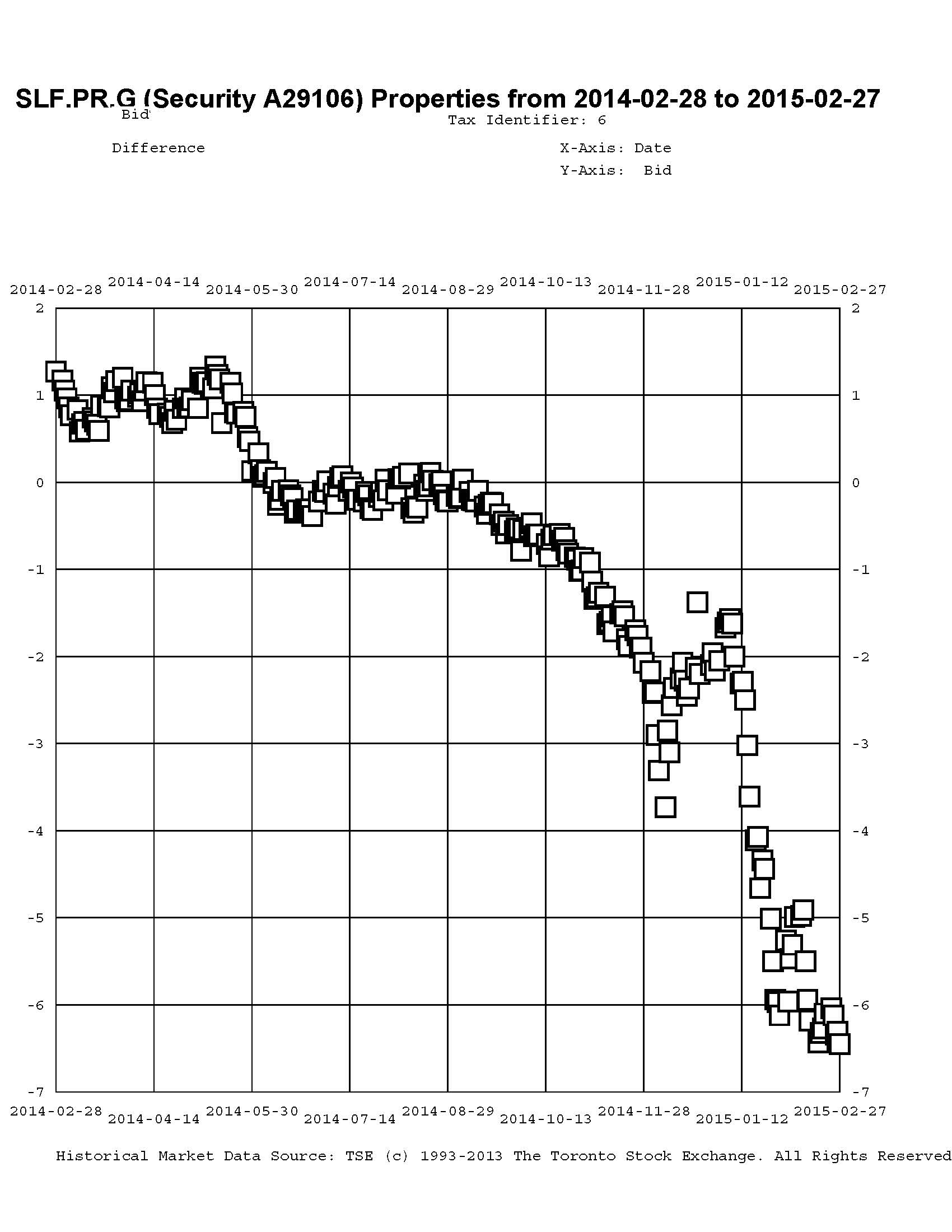
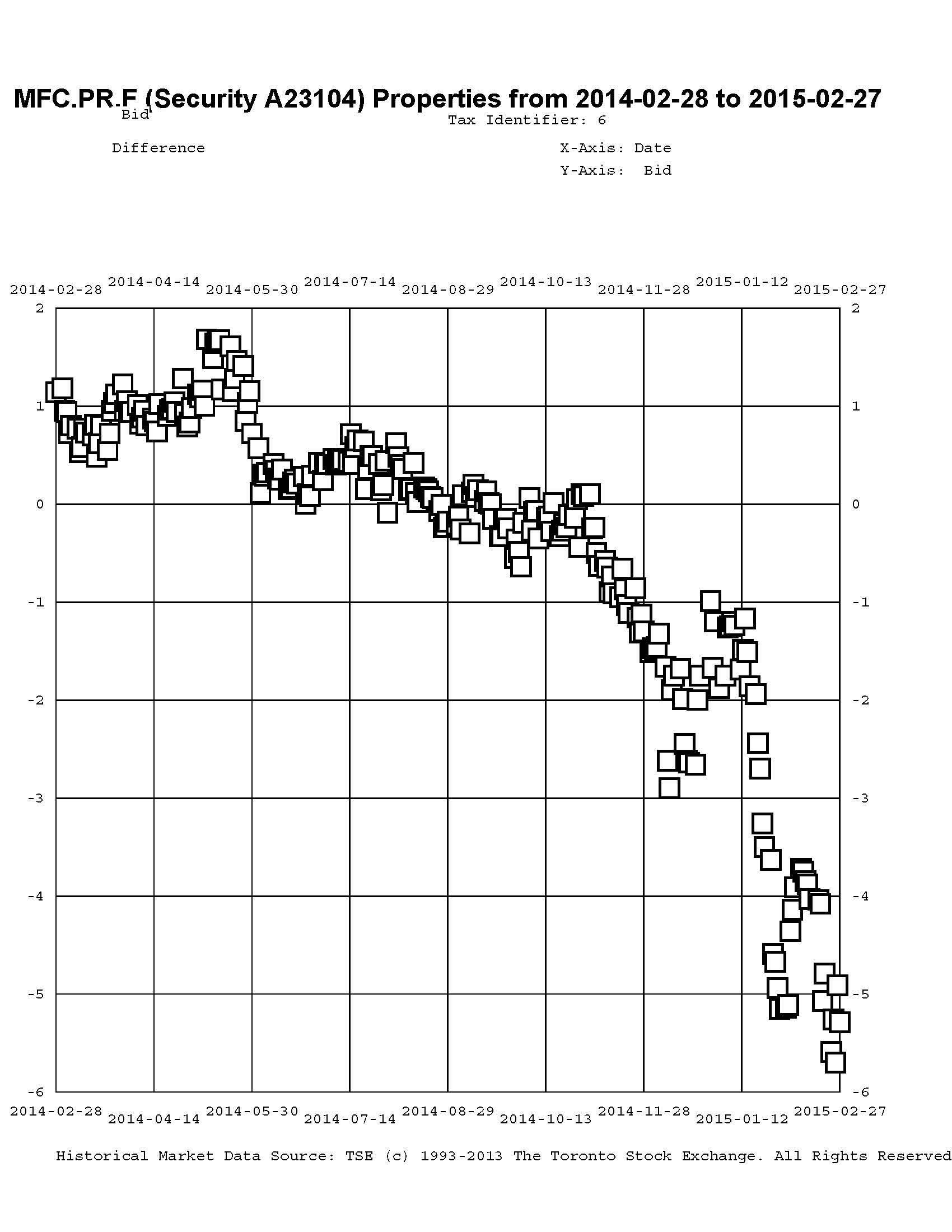
There were significant trades towards the end of the month into FixedResets (mainly SLF.PR.G at about 22.50) from DeemedRetractibles (mainly SLF.PR.D at about 22.65). These trade were a little underwater at month-end, with SLF.PR.D bid at 22.47 and SLF.PR.G at 22.50. Regrettably, June’s trades of GWO.PR.I into GWO.PR.N, performed at a take-out of $1.00, continued to deteriorate – from the June month-end take-out of $1.33 to the July 31 take-out of $1.64.

Credit distribution is:

MAPF Credit Analysis 2014-7-31
DBRS Rating Weighting
Pfd-1 0 (0)
Pfd-1(low) 26.6% (-1.4)
Pfd-2(high) 51.2% (+1.4)
Pfd-2 0%
Pfd-2(low) 11.9% (+1.0)
Pfd-3(high) 0.0% (-0.4)
Pfd-3 4.8% (+0.1)
Pfd-3(low) 3.2% (+0.2)
Pfd-4(high) 0.7% (+0.1)
Pfd-4 0%
Pfd-4(low) 0.8% (0)
Pfd-5(high) 1.1% (-0.3)
Cash -0.3% (-0.5)
Totals will not add precisely due to rounding. Bracketted figures represent change from June month-end.

Liquidity Distribution is:

MAPF Liquidity Analysis 2014-7-31
Average Daily Trading Weighting
<$50,000 10.7% (+9.3)
$50,000 – $100,000 8.7% (-18.0)
$100,000 – $200,000 51.4% (+18.8)
$200,000 – $300,000 24.1% (-8.8)
>$300,000 5.3% (-1.9)
Cash -0.3% (-0.5)
Totals will not add precisely due to rounding. Bracketted figures represent change from May month-end.

The apparent decline in liquidity is due to migration: for example, the fund holds a large position in IAG.PR.A, which has an Average Daily Trading Value of about $56,000 at June month-end and $48,000 at July month-end.

IAGPRA_VolSpot_140731
Click for Big

IAGPRA_VolAvg_140731
Click for Big

MAPF is, of course, Malachite Aggressive Preferred Fund, a “unit trust” managed by Hymas Investment Management Inc. Further information and links to performance, audited financials and subscription information are available the fund’s web page. The fund may be purchased either directly from Hymas Investment Management or through a brokerage account at Odlum Brown Limited. A “unit trust” is like a regular mutual fund, but is sold by offering memorandum rather than prospectus. This is cheaper, but means subscription is restricted to “accredited investors” (as defined by the Ontario Securities Commission) or those who subscribe for $150,000+. Fund past performances are not a guarantee of future performance. You can lose money investing in MAPF or any other fund.

A similar portfolio composition analysis has been performed on the Claymore Preferred Share ETF (symbol CPD) (and other funds) as of August 31, 2012, and published in the October (mainly methodology), November (most funds), and December (ZPR) 2012, PrefLetter. While direct comparisons are difficult due to the introduction of the DeemedRetractible class of preferred share (see above) it is fair to say:

  • MAPF credit quality is better
  • MAPF liquidity is a bit lower
  • MAPF Yield is higher
  • Weightings
    • MAPF is much more exposed to DeemedRetractibles
    • MAPF is much less exposed to Operating Retractibles
    • MAPF is much more exposed to SplitShares
    • MAPF is less exposed to FixFloat / Floater / Ratchet
    • MAPF weighting in FixedResets is much lower
Market Action

August 1, 2014

At present, it appears that confidence in the markets is increased by regulation (at least according to the regulators):

Singapore will introduce a minimum price for mainboard shares and reduce the lot size for transactions after a slump in the stocks of three commodity companies erased $6.9 billion in market value over three days in October.

The city-state will impose a minimum trading price of S$0.20 to address risks of low-priced securities being more susceptible to excessive speculation and potential market manipulation, according to a joint statement by the Monetary Authority of Singapore and Singapore Exchange Ltd. (SGX) yesterday. Other new measures include collection of a 5 percent collateral and reporting of short positions.

The day will come when confidence in the markets is decreased by regulation.

Today’s jobs number was good, but not great:

Today’s U.S. jobs report supports Federal Reserve Chair Janet Yellen’s view that there’s still plenty of slack left in the labor market, bolstering the case for continued stimulus, economists said.

While the Labor Department report showed employers added more than 200,000 jobs for the sixth straight month in July, there were also signs of continued weakness. A broad measure of unemployment that includes people working part-time because they can’t find full-time jobs increased last month, while wages stagnated, the report showed.

The headline unemployment rate unexpectedly rose to 6.2 percent from 6.1 percent as more people sought jobs. The share of Americans employed or looking for work, known as the participation rate, increased to 62.9 percent in July from 62.8 percent in June, which matched the lowest level since 1978.

Junk ETFs got hammered this week:

It’s been an ugly week for U.S. high-yield bonds, the worst in more than a year.

As investors fled, they turned to the easiest exits and pulled more than $1 billion from exchange-traded funds, according to data compiled by Bloomberg. With Wall Street banks generally devoting less capital to trading, there wasn’t much of a buffer on the other side to prop up values.

The result: Yields on the notes posted their biggest weekly increase since May 2012, surging to 5.7 percent from 5.3 percent on July 25, according to Barclays U.S. Corporate High Yield index data. The notes tumbled 1.3 percent in July, the first month of losses since last August.

Interesting to see continued muttering about dealer inventories. Eventually, something’s gotta give.

Water woes in California are getting severe:

Rod Cardella, a Mendota, California, grower of wine grapes, onions and almonds, had to wait a year to have a fourth water well dug on his property as the record drought gripping the most populous U.S. state increased demand for groundwater.

Cardella, 66, who founded Cardella Ranch with his father in 1970 and produces grapes for E&J Gallo Winery, the largest exporter of California wines, paid $500,000 to add the well in June after the federal government said it wouldn’t supply his area with its usual water allocation. The drought forced Cardella to leave half his ranch, including onion and cotton fields, unplanted this year.

With 82 percent of California now experiencing extreme drought after three years of record low rainfall, reservoirs are 45 percent below normal and declining. Governor Jerry Brown has called for a statewide voluntary reduction of water use by 20 percent, and residents now face fines of as much as $500 a day for wasting water.

Farmers have left fallow an estimated half-million acres. The dry spell is likely to boost the prices of food nationwide, according to the U.S. Agriculture Department, as farm and shipping interests stand to lose billions in revenue. California produces half of the fruits, vegetables and nuts consumed in the U.S. The price that some farmers pay for water has risen as much as 10 times what it cost before the drought.

Maybe desalinization plants could run off solar energy? That sounds like a good use for intermittent power.

But we won’t answer that question in Canada:

According to the most recent data from the OECD (from 2011), Canada falls well behind most other wealthy nations on total spending on research and development. At 1.74 per cent of GDP, we lag behind countries including the U.S. (2.77 per cent), Sweden (3.37 per cent) and Finland (3.78 per cent). Israel, a powerhouse in innovation and creative design, tops the list at 4.38 per cent.

It was a mixed day for the Canadian preferred share market, with PerpetualDiscounts up 15bp, FixedResets off 4bp and DeemedRetractibles down 9bp. Volatility was minor. Volume was virtually non-existent, as everybody took a holiday except for the minimum-wage scum.

HIMIPref™ Preferred Indices
These values reflect the December 2008 revision of the HIMIPref™ Indices

Values are provisional and are finalized monthly
Index Mean
Current
Yield
(at bid)
Median
YTW
Median
Average
Trading
Value
Median
Mod Dur
(YTW)
Issues Day’s Perf. Index Value
Ratchet 0.00 % 0.00 % 0 0.00 0 0.0000 % 2,607.5
FixedFloater 4.16 % 3.39 % 26,907 18.64 1 0.2193 % 4,173.0
Floater 2.94 % 3.06 % 45,165 19.55 4 0.0000 % 2,696.3
OpRet 4.03 % 0.23 % 78,630 0.08 1 -0.0785 % 2,714.7
SplitShare 4.25 % 3.89 % 55,639 3.99 6 -0.1608 % 3,117.5
Interest-Bearing 0.00 % 0.00 % 0 0.00 0 -0.0785 % 2,482.3
Perpetual-Premium 5.49 % -3.99 % 91,665 0.09 19 0.0993 % 2,434.6
Perpetual-Discount 5.22 % 5.17 % 117,015 15.22 17 0.1459 % 2,590.1
FixedReset 4.29 % 3.56 % 198,723 8.57 75 -0.0408 % 2,558.3
Deemed-Retractible 4.99 % -0.38 % 115,073 0.15 42 -0.0948 % 2,552.9
FloatingReset 2.68 % 2.22 % 81,224 3.86 6 -0.1448 % 2,511.3
Performance Highlights
Issue Index Change Notes
MFC.PR.F FixedReset -3.10 % YTW SCENARIO
Maturity Type : Hard Maturity
Maturity Date : 2025-01-31
Maturity Price : 25.00
Evaluated at bid price : 22.51
Bid-YTW : 4.42 %
IGM.PR.B Perpetual-Premium 1.08 % YTW SCENARIO
Maturity Type : Call
Maturity Date : 2014-12-31
Maturity Price : 26.00
Evaluated at bid price : 26.30
Bid-YTW : 2.86 %
Volume Highlights
Issue Index Shares
Traded
Notes
TD.PF.B FixedReset 286,749 Recent new issue.
YTW SCENARIO
Maturity Type : Limit Maturity
Maturity Date : 2044-08-01
Maturity Price : 23.19
Evaluated at bid price : 25.09
Bid-YTW : 3.62 %
BMO.PR.W FixedReset 201,265 Recent new issue.
YTW SCENARIO
Maturity Type : Limit Maturity
Maturity Date : 2044-08-01
Maturity Price : 23.13
Evaluated at bid price : 24.97
Bid-YTW : 3.61 %
ENB.PF.E FixedReset 67,748 Recent new issue.
YTW SCENARIO
Maturity Type : Limit Maturity
Maturity Date : 2044-08-01
Maturity Price : 23.10
Evaluated at bid price : 24.95
Bid-YTW : 4.13 %
PWF.PR.T FixedReset 51,000 Nesbitt crossed 50,000 at 26.00.
YTW SCENARIO
Maturity Type : Call
Maturity Date : 2019-01-31
Maturity Price : 25.00
Evaluated at bid price : 25.86
Bid-YTW : 3.39 %
RY.PR.X FixedReset 36,200 Called for redemption, August 24.
YTW SCENARIO
Maturity Type : Call
Maturity Date : 2014-09-23
Maturity Price : 25.00
Evaluated at bid price : 24.99
Bid-YTW : 3.84 %
MFC.PR.C Deemed-Retractible 32,452 Scotia crossed 24,200 at 22.82.
YTW SCENARIO
Maturity Type : Hard Maturity
Maturity Date : 2025-01-31
Maturity Price : 25.00
Evaluated at bid price : 22.60
Bid-YTW : 5.83 %
There were 10 other index-included issues trading in excess of 10,000 shares.
Wide Spread Highlights
Issue Index Quote Data and Yield Notes
PWF.PR.O Perpetual-Premium Quote: 26.00 – 26.86
Spot Rate : 0.8600
Average : 0.5365

YTW SCENARIO
Maturity Type : Call
Maturity Date : 2018-10-31
Maturity Price : 25.00
Evaluated at bid price : 26.00
Bid-YTW : 4.78 %

MFC.PR.F FixedReset Quote: 22.51 – 23.20
Spot Rate : 0.6900
Average : 0.5472

YTW SCENARIO
Maturity Type : Hard Maturity
Maturity Date : 2025-01-31
Maturity Price : 25.00
Evaluated at bid price : 22.51
Bid-YTW : 4.42 %

SLF.PR.H FixedReset Quote: 25.45 – 25.83
Spot Rate : 0.3800
Average : 0.2632

YTW SCENARIO
Maturity Type : Call
Maturity Date : 2016-09-30
Maturity Price : 25.00
Evaluated at bid price : 25.45
Bid-YTW : 3.21 %

FTS.PR.F Perpetual-Discount Quote: 24.51 – 24.85
Spot Rate : 0.3400
Average : 0.2268

YTW SCENARIO
Maturity Type : Limit Maturity
Maturity Date : 2044-08-01
Maturity Price : 24.03
Evaluated at bid price : 24.51
Bid-YTW : 5.05 %

PVS.PR.C SplitShare Quote: 25.95 – 26.20
Spot Rate : 0.2500
Average : 0.1608

YTW SCENARIO
Maturity Type : Hard Maturity
Maturity Date : 2017-12-10
Maturity Price : 25.00
Evaluated at bid price : 25.95
Bid-YTW : 3.89 %

BAM.PR.G FixedFloater Quote: 22.85 – 23.11
Spot Rate : 0.2600
Average : 0.1784

YTW SCENARIO
Maturity Type : Limit Maturity
Maturity Date : 2044-08-01
Maturity Price : 22.89
Evaluated at bid price : 22.85
Bid-YTW : 3.39 %

Miscellaneous News

Hymas Investment Management Inc. Complaints Policy

The regulators have decided I don’t pay enough tax, so in accordance with CSA Staff Notice 31-338 Guidance on Dispute Resolution Services Client Disclosure for Registered Dealers and Advisers that are not members of a Self-Regulatory Organization I have joined the Ombudsman for Banking Services and Investments and, more importantly, paid my OBSI Portfolio Manager Membership Fee. Assiduous Readers will be relieved to learn that since this fee is not actually charged by a Securities Commission, I do not expect it to be included when the various commissions discuss the rate of increase in regulatory fees.

I haven’t had a single complaint in the fourteen years I’ve run my own shop, and none in the eight years before that during which I was with Greydanus, Boeckh & Associates, Inc., but who knows? Tomorrow there might be a flood.

Procedures for clients with complaints are detailed on the Hymas Investment Management Inc. website under the heading "Complaints".

Market Action

July 31, 2014

How ’bout that London property market, eh?:

For equity-derivatives broker Andrew Adamson, it was a trade too good to pass up.

In October, he was offered 1,000 pounds ($1,700) per square foot for his London townhouse. Other homes in the area were going for about 30 percent less. Adamson accepted it immediately.

London’s housing market, having outperformed the rest of the U.K. with price gains of more than 50 percent in five years, is cooling as owners like Adamson cash out. They’re leaving the city for less costly suburban and country homes because they expect mortgage rates to rise and new lending rules to damp prices. London estate agents had the largest increase in instructions to sell homes in Britain in June and the biggest drop in people seeking to buy them, according to the Royal Institution of Chartered Surveyors.

“Now is the time people are cashing in,” said Adamson, 46, who used the 2 million pounds he raised from the sale to buy a country manor in Hampshire, southern England, for 400,000 pounds less.

IIROC answers the question: what is the purpose of regulatory requirements for advisors to take CSI courses?

CSI was created in 1970 by one of IIROC’s predecessor organizations, the Investment Dealers Association (IDA), and the Canadian stock exchanges to educate and test the proficiency of individuals entering the industry. In 2002, CSI converted to a for-profit corporation with the IDA as its sole shareholder. The IDA sold CSI to ONCAP II, LP (a private equity fund managed by ONCAP Management Partners) for net proceeds of approximately $57 million in 2005 following a targeted auction. $28.5 million of those proceeds were applied as a membership fee reduction distributed to the IDA membership over two years. $28 million of the proceeds were applied to fund the creation of the Investment Industry Association of Canada.

The document notes that over ten thousand people took the Canadian Securities Course in 2013 at an average price of over $900 a head – and that’s just the biggest bit. Nice work if you can get it! The new generation of regulators is trying to think up another way of extracting money from the industry, so they can be bold entrepreneurs, too.

There’s more news about corporate bond liquidity:

The $8.2 billion of risk-sharing securities sold in the last year by government-controlled Fannie Mae and Freddie Mac can shift their losses from homeowner defaults to bond buyers. One slice of a deal issued in May traded at 95.7 cents on the dollar yesterday, down from 99.7 cents at the end of last month, according to Trace, the bond-price reporting system of the Financial Industry Regulatory Authority.

While JPMorgan Chase & Co. analysts say they fail to see “any fundamental reason” for the tumble, investors from CQS U.K. LLP to Calvert Investment Management Inc. are speculating that the drop is mainly about the growing amount of the debt running into limits created by new regulations on bond dealers’ ability to smooth trading by building up their inventories.

As a few holders continued selling the Fannie Mae and Freddie Mac securities without an immediate emergence of investor demand, most of the dealers active in trading the debt “disappeared,” said Vishal Khanduja, a money manager at Bethesda, Maryland-based Calvert, which oversees about $13 billion.

Until recently, “everybody wanted to trade it: I think there were 10 to 12 dealers messaging me and looking to make markets,” Khanduja said in a telephone interview. “It’s partially indicative of the regulations’ impact on their balance sheets.”

Dealers have reduced their bond holdings in response to rules ranging from the international Basel III accord on banks’ capital to the U.S. Volcker Rule limiting their ability to make bets with their own money. An expansion of Finra’s Trace trade disclosures to more types of debt is also increasing risks and cutting into profits for market makers.

Inventories of corporate securities and other debt without government backing at the biggest dealers fell to $56 billion in March 2013 from as much as $235 billion in 2007, according to the last Federal Reserve data before a change in calculations.

I continue to think there’s an opportunity there for an actively managed fund to make a bit of money pretending to be a trading desk. Call it ‘HFT comes to the bond markets’. You could call these shops by some kind of special name … maybe “investment dealers” or something like that.

Don’t get me wrong! I’m not completely convinced that the new Volcker and capital rules are completely wrong, in and of themselves. What bothers me is that not a single person ever thought about the consequences and how these consequences might impact on the purpose of the capital markets – which is not “To be nice to granny”, by the way, but “To get money from investors to businesses”.

OK now, call it in the air, heads or tails? Risk-On or Risk-Off?

The Dow fell 317.06 points, or 1.9 percent, to 16,563.30 at 4 p.m. in New York, for the largest one-day retreat since Feb. 3. The Standard & Poor’s 500 Index slid 2 percent, the most since April 10, to 1,930.67. The gauge dropped 1.5 percent in July, its first monthly decline since January. The Nasdaq 100 Index lost 2.1 percent. The MSCI All-Country World Index tumbled 1.5 percent for its worst loss in almost six months.

Concern grew that the improving economy may force the Federal Reserve to raise interest rates sooner than expected.

U.S. gross domestic product expanded at a 4 percent annual pace in the second quarter, confirming the central bank’s view that a first-quarter contraction was transitory. Data today showed fewer Americans filed applications for unemployment insurance benefits over the past month than at any time in more than eight years, signaling employers are hanging on to workers as demand improves.

Valener Inc., proud issuer of VNR.PR.A, was confirmed at Pfd-2(low) by DBRS:

DBRS has today confirmed Valener Inc.’s (Valener or the Company) Cumulative Rate Reset Preferred Shares, Series A rating at Pfd-2 (low), with a Stable trend. The rating is based on the credit quality of Valener’s 29%-owned Gaz Métro Limited Partnership (GMLP), which guarantees the First Mortgage Bonds and Senior Secured Notes (rated “A,” Stable) of Gaz Métro inc. (GMi), and Valener’s low non-consolidated leverage. GMi owns the remaining 71% of GMLP.

Valener’s rating is based on the following factors: (1) continually strong and predictable cash flow from GMLP to Valener. GMLP has made cash distributions to its partners in an amount of over 90% of its net income, excluding non-recurring items, for most of the last 20 years. (2) GMLP is expected to continue to maintain its distributions of at least 85% of its net income, excluding non-recurring items, as set out under the partnership agreement between Valener and GMLP (the Partnership Agreement). In the event that GMi, as general partner of GMLP, intends to distribute less than 85% of its net income, excluding non-recurring items, it would require the approval of at least 90% of GMi’s directors. (3) Valener’s non-consolidated debt-to-capital structure is expected to remain below 20%. If its non-consolidated debt leverage ratio is above 20%, Valener is expected to issue equity to bring the ratio back under the 20% threshold in a timely manner. (4) DBRS expects that the majority of Valener’s cash flow will be derived from GMLP. Any material investment carried out by Valener and not through GMLP could have a negative rating impact. (5) DBRS expects that Valener will maintain its 29% interest in GMLP and its pro rata representation on GMi’s board of directors.

Shaw Communications Inc., proud issuer of SJR.PR.A, was confirmed at Pfd-3 by DBRS:

DBRS has today confirmed Shaw Communications Inc.’s (Shaw or the Company) Issuer Rating at BBB, Senior Notes rating at BBB and Preferred Shares rating at Pfd-3. The confirmation follows the Company’s announcement to acquire ViaWest for USD 830 million, financed with approximately CAD 500 million of cash on hand and approximately CAD 400 million from Shaw’s existing credit facility. Shaw will also assume USD 370 million of borrowings under committed non-recourse debt financing at ViaWest. The purchase price of USD 1.2 billion represents a multiple of approximately 13.0x adjusted EBITDA annualized for the three months ended June 30, 2014, which is consistent with recent market transactions. The acquisition is expected to close in September 2014 and is subject to U.S. regulatory approval.

ViaWest is a privately held provider of data centre infrastructure, cloud technology and managed IT solutions. The company employs over 350 people and services more than 1,300 customers across seven states. ViaWest operates 27 data centers in Colorado, Utah, Oregon, Nevada, Texas, Minnesota and Arizona.

It was a mixed day for the Canadian preferred share market, with PerpetualDiscounts up 13bp, FixedResets gaining 11bp and DeemedRetractibles off 4bp. Floaters got hammered, otherwise volatility was a yawn. Volume was average.

HIMIPref™ Preferred Indices
These values reflect the December 2008 revision of the HIMIPref™ Indices

Values are provisional and are finalized monthly
Index Mean
Current
Yield
(at bid)
Median
YTW
Median
Average
Trading
Value
Median
Mod Dur
(YTW)
Issues Day’s Perf. Index Value
Ratchet 3.05 % 3.04 % 21,349 19.63 1 0.4090 % 2,607.5
FixedFloater 4.17 % 3.40 % 27,217 18.63 1 0.0000 % 4,163.9
Floater 2.94 % 3.05 % 44,990 19.58 4 -2.2855 % 2,696.3
OpRet 4.02 % -0.86 % 79,859 0.08 1 -0.2741 % 2,716.8
SplitShare 4.25 % 3.78 % 53,922 3.99 6 -0.0265 % 3,122.6
Interest-Bearing 0.00 % 0.00 % 0 0.00 0 -0.2741 % 2,484.3
Perpetual-Premium 5.52 % -3.22 % 82,318 0.08 17 -0.0046 % 2,432.2
Perpetual-Discount 5.22 % 5.16 % 101,771 15.22 20 0.1277 % 2,586.3
FixedReset 4.34 % 3.60 % 198,032 6.66 79 0.1118 % 2,559.4
Deemed-Retractible 4.99 % -0.85 % 116,925 0.15 42 -0.0398 % 2,555.4
FloatingReset 2.68 % 2.18 % 84,154 3.86 6 -0.0132 % 2,515.0
Performance Highlights
Issue Index Change Notes
BAM.PR.B Floater -3.35 % YTW SCENARIO
Maturity Type : Limit Maturity
Maturity Date : 2044-07-31
Maturity Price : 17.04
Evaluated at bid price : 17.04
Bid-YTW : 3.10 %
BAM.PR.K Floater -3.07 % YTW SCENARIO
Maturity Type : Limit Maturity
Maturity Date : 2044-07-31
Maturity Price : 17.06
Evaluated at bid price : 17.06
Bid-YTW : 3.10 %
BAM.PR.C Floater -3.03 % YTW SCENARIO
Maturity Type : Limit Maturity
Maturity Date : 2044-07-31
Maturity Price : 17.30
Evaluated at bid price : 17.30
Bid-YTW : 3.05 %
TRP.PR.C FixedReset 1.13 % YTW SCENARIO
Maturity Type : Limit Maturity
Maturity Date : 2044-07-31
Maturity Price : 21.90
Evaluated at bid price : 22.45
Bid-YTW : 3.44 %
GWO.PR.H Deemed-Retractible 1.16 % YTW SCENARIO
Maturity Type : Hard Maturity
Maturity Date : 2025-01-31
Maturity Price : 25.00
Evaluated at bid price : 24.40
Bid-YTW : 5.23 %
Volume Highlights
Issue Index Shares
Traded
Notes
TD.PF.B FixedReset 1,012,592 New issue settled today.
YTW SCENARIO
Maturity Type : Limit Maturity
Maturity Date : 2044-07-31
Maturity Price : 23.18
Evaluated at bid price : 25.07
Bid-YTW : 3.63 %
BMO.PR.W FixedReset 488,035 Recent new issue.
YTW SCENARIO
Maturity Type : Limit Maturity
Maturity Date : 2044-07-31
Maturity Price : 23.14
Evaluated at bid price : 25.01
Bid-YTW : 3.60 %
ENB.PF.E FixedReset 97,047 Recent new issue.
YTW SCENARIO
Maturity Type : Limit Maturity
Maturity Date : 2044-07-31
Maturity Price : 23.10
Evaluated at bid price : 24.95
Bid-YTW : 4.13 %
TD.PF.A FixedReset 92,440 Desjardins crossed blocks of 49,900 and 27,000, both at 25.38.
YTW SCENARIO
Maturity Type : Limit Maturity
Maturity Date : 2044-07-31
Maturity Price : 23.27
Evaluated at bid price : 25.38
Bid-YTW : 3.60 %
BMO.PR.S FixedReset 46,468 TD crossed 35,000 at 25.46.
YTW SCENARIO
Maturity Type : Call
Maturity Date : 2019-05-25
Maturity Price : 25.00
Evaluated at bid price : 25.40
Bid-YTW : 3.59 %
BAM.PR.X FixedReset 36,398 TD crossed 23,900 at 21.93.
YTW SCENARIO
Maturity Type : Limit Maturity
Maturity Date : 2044-07-31
Maturity Price : 21.53
Evaluated at bid price : 21.91
Bid-YTW : 3.98 %
There were 29 other index-included issues trading in excess of 10,000 shares.
Wide Spread Highlights
Issue Index Quote Data and Yield Notes
TRP.PR.C FixedReset Quote: 22.45 – 22.99
Spot Rate : 0.5400
Average : 0.3629

YTW SCENARIO
Maturity Type : Limit Maturity
Maturity Date : 2044-07-31
Maturity Price : 21.90
Evaluated at bid price : 22.45
Bid-YTW : 3.44 %

PWF.PR.F Perpetual-Discount Quote: 25.08 – 25.40
Spot Rate : 0.3200
Average : 0.2080

YTW SCENARIO
Maturity Type : Call
Maturity Date : 2014-08-30
Maturity Price : 25.00
Evaluated at bid price : 25.08
Bid-YTW : 1.35 %

CM.PR.K FixedReset Quote: 24.99 – 25.25
Spot Rate : 0.2600
Average : 0.1540

YTW SCENARIO
Maturity Type : Hard Maturity
Maturity Date : 2022-01-31
Maturity Price : 25.00
Evaluated at bid price : 24.99
Bid-YTW : 3.68 %

RY.PR.Z FixedReset Quote: 25.58 – 25.91
Spot Rate : 0.3300
Average : 0.2293

YTW SCENARIO
Maturity Type : Call
Maturity Date : 2019-05-24
Maturity Price : 25.00
Evaluated at bid price : 25.58
Bid-YTW : 3.43 %

SLF.PR.C Deemed-Retractible Quote: 22.48 – 22.76
Spot Rate : 0.2800
Average : 0.1830

YTW SCENARIO
Maturity Type : Hard Maturity
Maturity Date : 2025-01-31
Maturity Price : 25.00
Evaluated at bid price : 22.48
Bid-YTW : 5.83 %

FTS.PR.J Perpetual-Discount Quote: 24.24 – 24.60
Spot Rate : 0.3600
Average : 0.2697

YTW SCENARIO
Maturity Type : Limit Maturity
Maturity Date : 2044-07-31
Maturity Price : 23.85
Evaluated at bid price : 24.24
Bid-YTW : 4.96 %

Issue Comments

TD.PF.B Firm On Excellent Volume

TD.PF.B, a FixedReset 3.80%+227, NVCC-compliant, announced July 22 settled today. It will be tracked by HIMIPref™ and has been assigned to the FixedReset subindex.

The issue traded 1,287,892 shares today (consolidated tape) in a range of 24.99-08 before closing at 25.07-08, 118×17.

Vital statistics are:

TD.PF.B FixedReset YTW SCENARIO
Maturity Type : Limit Maturity
Maturity Date : 2044-07-31
Maturity Price : 23.18
Evaluated at bid price : 25.07
Bid-YTW : 3.63 %

Implied Volatility indicates, as with BMO.PR.W, yesterday, the NVCC-compliant issues appear to be trading in-line with the non-compliant issues, at a very high Implied Volatility. Note that the two issues with the highest Issue Reset Spreads, TD.PR.I and TD.PR.K, were redeemed after the close.

ImpliedVolatility_TD_FR_140731

Click for Big
Market Action

July 30, 2014

The Swedes are serious about bank regulation:

Sweden will start publishing banks’ individual capital requirements in a step designed to reveal risks investors have so far been unable to measure based on reported buffers.

The Swedish Financial Supervisory Authority is planning to follow its Danish counterpart and disclose so-called Pillar 2 requirements as Scandinavia leads Europe in stepping up efforts to improve transparency. In Denmark, which like Sweden has a bank industry whose assets are four times gross domestic product, lenders can be shut down by the regulator if reserves drop below individual requirements.

Sweden already requires its biggest banks to meet some of the world’s most rigorous capital standards, ranging from 14 percent for Nordea Bank AB (NDA) to 19 percent for Swedbank AB. In May, the FSA said banks should hold a 1 percent counter-cyclical buffer after household debt burdens swelled to a record.

BIS explains pillar 2 requirements:

There are three main areas that might be particularly suited to treatment under Pillar 2: risks considered under Pillar 1 that are not fully captured by the Pillar 1 process (e.g. the proposed operational risk charge in Pillar 1 may not adequately cover all the specific risks of any given institution); those factors not taken into account by the Pillar 1 process (e.g. interest rate risk); and factors external to the bank (e.g. business cycle effects).

Authoritarian governments world-wide are clamping down on housing bubbles:

Singapore and Hong Kong, as a special administrative region of China, have governments with policy-making power over their entire geographic areas, where they are relatively free of political opposition from neighborhood groups or borough councils that stymie directives or mitigate their effectiveness. The Asian cities control the land supply and are the biggest landlords.

That allows them to implement decisive policy measures. For example, in January 2013, the Monetary Authority of Singapore, effectively the central bank and chief regulator, cut the mortgage ratio allowable on purchases of second homes while more than doubling minimum down payments from 10 percent to 25 percent. The banks had no choice but to follow.

Hong Kong and Singapore haven’t shied away from using taxes to discriminate against foreign buyers — something other locales with surging prices have yet to do. Non-permanent residents in both cities are subject to an additional 15 percent tax when they buy property, except in Singapore where Americans are exempted by treaty.

The U.K. government has tried some measures. After it increased the stamp duty to 7 percent on high-value properties in March 2012, price increases for homes valued from 5 million pounds to 10 million pounds ($8.5 million to $17 million) slowed from 9.7 percent to 5.8 percent in the subsequent year, according to broker Knight Frank LLP.

Bank of England Governor Mark Carney announced another set of measures last month, citing concerns over household indebtedness and the threat of a property bubble. They limit mortgages to less than 4.5 times a borrowers’ annual income and require banks to refuse loans to those failing to prove they could afford a 3 percentage-point rise in interest rates.

But France wins the prize:

French President Francois Hollande’s government may have made a housing slump worse, pushing the construction market to its lowest in more than 15 years.

Housing starts fell 19 percent in the second quarter from a year earlier, and permits — a gauge of future construction — dropped 13 percent, the French Housing Ministry said yesterday.

The rout stems from a law this year that seeks to make housing more affordable by capping rents in expensive neighborhoods. To protect home buyers, the law also boosted the number of documents that must be provided by sellers, leading to a decline in home sales and longer transaction times.

Meanwhile, the Bank of England is cracking down on the rule of law:

Miscreant bankers face having their bonuses clawed back for up to seven years after their award under measures set out on Wednesday by the Bank of England, as it tightens its regulatory clampdown on wrongdoing in the financial sector.

Lawyers say enforcing clawbacks is untested in the UK courts if a banker refuses to pay up, and there are also questions over what happens to tax paid on a recovered bonus. But some senior figures in the sector support the idea.

The Bank and the fellow regulator the Financial Conduct Authority (FCA) also proposed in a new consultation that senior managers face clawbacks of up to 10 years if they are being investigated.

“These proposals are tougher than the industry would have liked, but there was a general resignation that they would be implemented whatever the costs and technical difficulties and however far it puts the UK outside international norms,” said Nicholas Stretch of law firm CMS.

Great, huh? Now the regulators can decide after the fact whether or not something was reckless and impose a fine of whatever they like. Untrammelled by parliament or those old fogeys in the courts! Hurrah!

…and there’s more!

Bank regulators have just given the top people in U.K. corporate life another reason to avoid job offers from domestic banks.

Requiring bankers to have annual “MOT”-style tests of their fit and proper status, and bringing in a new, tougher “senior manager regime” sounds good for accountability, post-Libor, and chief executives are used to longer deferral periods for their pay.

But incomers will hesitate about being held responsible, perhaps even criminally, for malpractice somewhere in their hugely complex universal bank.

Moreover, some of the BoE proposals are actively disconcerting. Banning so-called buyout clauses – compensation of new employees for deferred income lost by leaving their old jobs – would prevent some of the more outlandish recent payments made to bank bosses. But they also incentivise candidates to stay put.

Also, the ability to demand repayment of awards already paid will almost certainly make UK banks less inviting places to work, even though the minimum period in which bonuses can be clawed back has been cut by two years to seven years.

Today’s FOMC statement is moderately positive:

The Committee currently judges that there is sufficient underlying strength in the broader economy to support ongoing improvement in labor market conditions. In light of the cumulative progress toward maximum employment and the improvement in the outlook for labor market conditions since the inception of the current asset purchase program, the Committee decided to make a further measured reduction in the pace of its asset purchases.

To support continued progress toward maximum employment and price stability, the Committee today reaffirmed its view that a highly accommodative stance of monetary policy remains appropriate. In determining how long to maintain the current 0 to 1/4 percent target range for the federal funds rate, the Committee will assess progress–both realized and expected–toward its objectives of maximum employment and 2 percent inflation.

When the Committee decides to begin to remove policy accommodation, it will take a balanced approach consistent with its longer-run goals of maximum employment and inflation of 2 percent. The Committee currently anticipates that, even after employment and inflation are near mandate-consistent levels, economic conditions may, for some time, warrant keeping the target federal funds rate below levels the Committee views as normal in the longer run.

Voting against was Charles I. Plosser who objected to the guidance indicating that it likely will be appropriate to maintain the current target range for the federal funds rate for “a considerable time after the asset purchase program ends,” because such language is time dependent and does not reflect the considerable economic progress that has been made toward the Committee’s goals.

Jeff Kearns of Bloomberg notes:

Since meeting in mid-June, the committee has come closer to achieving its goals for stable prices and full employment. Employers added 288,000 jobs last month, helping push down unemployment to 6.1 percent, the lowest in almost six years.

Today’s Commerce Department report showed gross domestic product expanded at a 4 percent annual pace in the second quarter, confirming the Fed’s view that a first-quarter contraction was transitory.

Yellen told lawmakers this month that while her view of the economy has turned “more positive,” she’s concerned about signs of job-market “slack” such as low participation in the labor force.

“We need to be careful to make sure that the economy is on a solid trajectory before we consider raising interest rates,” she said in her semi-annual testimony. “There are mixed signals.”

Among them: average hourly earnings fell or were stagnant in the past four months, after adjusting for inflation.

Simon Kennedy of Bloomberg reports on an interesting difference between UK and US mortgage debt:

While investors bet the U.K. central bank will raise its benchmark interest rate as soon as the end of this year, with its U.S. counterpart following six months later, economists at London-based Fathom Consulting aren’t so sure.

While the International Monetary Fund has called the U.K. the fastest-growing rich economy this year, Fathom says the U.S. household sector may be better placed than that of the U.K. to stomach higher interest rates. No one expects Yellen’s Fed to act on interest rates when policy makers meet today.

A key measure of how vulnerable households are to increased rates is their exposure to variable-rate home loans, known as adjustable rate mortgages or ARMs in the U.S.

In the U.S., the share of mortgage applications based on such loans has declined to fewer than 20 percent from about 50 percent before the financial crisis, according to Fathom’s July 28 report.

By contrast, about 70 percent of outstanding British mortgages are at a variable rate, meaning the BOE will try to keep increases to a minimum, they said.

After all that we need some comic relief, so let’s mock an unsigned article that came to my attention today:

s we have discussed previously, the Portfolio Turnover Ratio (PTR) for any given mutual or exchange-traded fund is a quick and easy tool to use when you’re trying to figure out which is the better investment for your savings. A fund’s PTR gives you a way to judge how much activity and risk the professional money managers are taking on to generate their investment returns.

As you can clearly see from the PTRs listed above, and despite the same investment objectives and risk profiles, each fund’s manager has a completely different trading strategy! The PTRs for TD points to a serious disconnect between their managers’ actual trading strategy and their fund’s stated investment objective and risk profile, whereas the PTRs for the RBC managers fits aptly with their stated investment objective and risk profile.

OK, so maybe you bought the TD fund in 2008 and still hold it today thinking that you were staying true to your conservative buy and hold investment strategy. But unfortunately someone forgot to tell the fund’s investment managers at TD what kind of investor you are because, unbeknownst to you, they bought and sold every investment in the fund more than 14 times! Yes, that’s right! On average, they’ve traded your savings over and over again 2.82 times every year since 2008, which appears to be in contrast to the fund’s stated investment objective and risk profile!

Some of you may want to argue with me that your investment in the TD fund did fine in terms of your over-all rate of returns, and for some investors that’s all that matters – how much did I make? Some investors don’t care about the risks they have to take to get results, and in good markets even risky investments go up in value. But ignoring an investment’s risks can be dangerous when markets are not so good. These particular mutual funds are a good case in point. Look at the difference in losses between these two funds in the 2009 downturn in market: the TD Canadian Equity fund lost 46% in the 12 months ending February 2009 compared to a 23% decline for RBC Canadian Equity Fund. So, what we can learn from this particular case study is that when you take the time to study a fund’s PTR to make more informed investment choices, taking into account good and bad market cycles, you’ll come out the real winner.

Equating portfolio turnover to risk, without examining what those trades actually were, implying that TD’s underperformance in the twelve month’s ending February, 2009, was due to portfolio turnover, and completely ignoring benchmarks is the height of ignorance. According to one source (I can’t be bothered to look it up):

•By comparison, the Toronto Stock Exchange lost money almost 30% of the time. The worst 1 year return was -38% (ending February 2009).

This leads to a suspicion that the RBC fund got very lucky on its market timing, while TD underperformed by what would be a gigantic amount in normal times, but is somewhat less surprising considering the time period. But, of course, it’s only a suspicion. Only a complete idiot would draw any conclusions at all based solely on these numbers; but properly supported investment conclusions – even when it’s only a question of categorization – require a bit of work.

It was a mixed day for the Canadian preferred share market, with PerpetualDiscounts up 2bp, FixedResets off 11bp and DeemedRetractibles gaining 1bp. Volatility was minimal, but Assiduous Reader thom4kat will be gratified to see the table includes GWO.PR.N! The issue had 25 trades timestamped after 3:05pm, nothing very big, but it looks like they just kept chip-chip-chipping away at the bid and wore it out. It made the Wide Spreads Table, too, which tells you that … um … it made the Wide Spreads Table. Volume was average.

PerpetualDiscounts now yield 5.16%, equivalent to 6.71% interest at the standard equivalency factor of 1.3x. Long corporates now yield about 4.2%, so the pre-tax interest-equivalent spread (in this context, the “Seniority Spread”) is now about 250bp, a significant widening from the 240bp reported July 23.

HIMIPref™ Preferred Indices
These values reflect the December 2008 revision of the HIMIPref™ Indices

Values are provisional and are finalized monthly
Index Mean
Current
Yield
(at bid)
Median
YTW
Median
Average
Trading
Value
Median
Mod Dur
(YTW)
Issues Day’s Perf. Index Value
Ratchet 3.07 % 3.04 % 20,209 19.59 1 0.9080 % 2,596.9
FixedFloater 4.17 % 3.40 % 28,121 18.63 1 0.0000 % 4,163.9
Floater 2.87 % 2.96 % 45,044 19.82 4 -0.6121 % 2,759.4
OpRet 4.01 % -4.29 % 75,401 0.08 1 -0.0391 % 2,724.3
SplitShare 4.25 % 3.78 % 54,003 3.99 6 0.0730 % 3,123.4
Interest-Bearing 0.00 % 0.00 % 0 0.00 0 -0.0391 % 2,491.1
Perpetual-Premium 5.52 % -6.83 % 81,677 0.08 17 0.0346 % 2,432.3
Perpetual-Discount 5.23 % 5.16 % 104,392 15.22 20 0.0192 % 2,583.0
FixedReset 4.40 % 3.61 % 195,245 8.58 78 -0.1087 % 2,556.5
Deemed-Retractible 4.98 % -2.11 % 117,265 0.09 42 0.0094 % 2,556.4
FloatingReset 2.68 % 2.15 % 87,250 3.86 6 0.1247 % 2,515.3
Performance Highlights
Issue Index Change Notes
GWO.PR.N FixedReset -1.55 % YTW SCENARIO
Maturity Type : Hard Maturity
Maturity Date : 2025-01-31
Maturity Price : 25.00
Evaluated at bid price : 21.02
Bid-YTW : 4.95 %
BAM.PR.Z FixedReset -1.04 % YTW SCENARIO
Maturity Type : Call
Maturity Date : 2017-12-31
Maturity Price : 25.00
Evaluated at bid price : 25.80
Bid-YTW : 3.94 %
Volume Highlights
Issue Index Shares
Traded
Notes
BMO.PR.W FixedReset 1,311,855 New issue settled today.
YTW SCENARIO
Maturity Type : Limit Maturity
Maturity Date : 2044-07-30
Maturity Price : 23.13
Evaluated at bid price : 24.96
Bid-YTW : 3.61 %
BAM.PF.F FixedReset 181,250 Nesbitt crossed 176,000 at 25.41.
YTW SCENARIO
Maturity Type : Limit Maturity
Maturity Date : 2044-07-30
Maturity Price : 23.28
Evaluated at bid price : 25.41
Bid-YTW : 4.23 %
ENB.PF.E FixedReset 141,973 Recent new issue.
YTW SCENARIO
Maturity Type : Limit Maturity
Maturity Date : 2044-07-30
Maturity Price : 23.11
Evaluated at bid price : 24.99
Bid-YTW : 4.12 %
ENB.PR.N FixedReset 125,515 Scotia crossed two blocks of 25,000 each and one of 50,000, all at 24.87.
YTW SCENARIO
Maturity Type : Limit Maturity
Maturity Date : 2044-07-30
Maturity Price : 23.15
Evaluated at bid price : 24.82
Bid-YTW : 4.07 %
TRP.PR.D FixedReset 100,717 RBC crossed 34,500 at 25.24; Nesbitt crossed 38,400 at the same price.
YTW SCENARIO
Maturity Type : Limit Maturity
Maturity Date : 2044-07-30
Maturity Price : 23.22
Evaluated at bid price : 25.13
Bid-YTW : 3.75 %
ENB.PF.C FixedReset 93,510 Scotia crossed two blocks of 25,000 each, both at 25.10 and bought 14,400 from Instinet at 25.11.
YTW SCENARIO
Maturity Type : Limit Maturity
Maturity Date : 2044-07-30
Maturity Price : 23.16
Evaluated at bid price : 25.10
Bid-YTW : 4.12 %
There were 35 other index-included issues trading in excess of 10,000 shares.
Wide Spread Highlights
Issue Index Quote Data and Yield Notes
CIU.PR.A Perpetual-Discount Quote: 22.91 – 23.91
Spot Rate : 1.0000
Average : 0.6580

YTW SCENARIO
Maturity Type : Limit Maturity
Maturity Date : 2044-07-30
Maturity Price : 22.63
Evaluated at bid price : 22.91
Bid-YTW : 5.09 %

GWO.PR.N FixedReset Quote: 21.02 – 21.37
Spot Rate : 0.3500
Average : 0.2400

YTW SCENARIO
Maturity Type : Hard Maturity
Maturity Date : 2025-01-31
Maturity Price : 25.00
Evaluated at bid price : 21.02
Bid-YTW : 4.95 %

TRP.PR.A FixedReset Quote: 23.26 – 23.50
Spot Rate : 0.2400
Average : 0.1540

YTW SCENARIO
Maturity Type : Limit Maturity
Maturity Date : 2044-07-30
Maturity Price : 22.40
Evaluated at bid price : 23.26
Bid-YTW : 3.66 %

IAG.PR.F Deemed-Retractible Quote: 26.14 – 26.49
Spot Rate : 0.3500
Average : 0.2673

YTW SCENARIO
Maturity Type : Call
Maturity Date : 2018-03-31
Maturity Price : 25.25
Evaluated at bid price : 26.14
Bid-YTW : 4.96 %

ELF.PR.F Perpetual-Discount Quote: 24.10 – 24.38
Spot Rate : 0.2800
Average : 0.2025

YTW SCENARIO
Maturity Type : Limit Maturity
Maturity Date : 2044-07-30
Maturity Price : 23.85
Evaluated at bid price : 24.10
Bid-YTW : 5.53 %

MFC.PR.F FixedReset Quote: 23.01 – 23.74
Spot Rate : 0.7300
Average : 0.6545

YTW SCENARIO
Maturity Type : Hard Maturity
Maturity Date : 2025-01-31
Maturity Price : 25.00
Evaluated at bid price : 23.01
Bid-YTW : 4.16 %

Issue Comments

BMO.PR.W Firm On Excellent Volume

Bank of Montreal has announced:

it has closed its domestic public offering of Non-Cumulative 5-Year Rate Reset Class B Preferred Shares Series 31 (the “Preferred Shares Series 31”). The offering was underwritten on a bought deal basis by a syndicate of underwriters led by BMO Capital Markets. Bank of Montreal issued 12 million Preferred Shares Series 31 at a price of $25 per share to raise gross proceeds of $300 million.

The Preferred Shares Series 31 were issued under a prospectus supplement dated July 23, 2014, to the Bank’s short form base shelf prospectus dated March 13, 2014. Such shares will commence trading on the Toronto Stock Exchange today under the ticker symbol BMO.PR.W.

BMO.PR.W is a FixedReset, 3.80%+222, announced July 22. It will be tracked by HIMIPref™ and has been assigned to the FixedReset subindex.

The issue traded 1,727,555 shares today (consolidated exchanges) in a range of 24.89-99 before closing at 24.96-98, 30×131. Vital statistics are:

BMO.PR.W FixedReset YTW SCENARIO
Maturity Type : Limit Maturity
Maturity Date : 2044-07-30
Maturity Price : 23.13
Evaluated at bid price : 24.96
Bid-YTW : 3.61 %

The Implied Volatility chart is:

ImpliedVolatility_BMOFR_140730
Click for Big

So, overall, it would appear that Implied Volatility continues to be 40%+ (which I interpret as being due to a high level of expected directionality in prices, i.e., towards $25) and the NVCC-compliant issues continue to trade in line with the non-compliant issues. Regrettably, there isn’t much of a range in the Issue Reset Spreads of the compliant issues.

Market Action

July 29, 2014

A silly publication titled Virtuous Banking: Placing ethos and purpose at the heart of finance has just hit the streets with a thud:

While it cannot plausibly be argued that a systematically stable system is not to be desired, the current approach focuses far too much on this and ignores the crucial root cause of the banking crisis: a calamity that has its origins in the profligate and irresponsible actions of a significant number of bankers and banking institutions, urged on by a banking culture that was at its core fundamentally self-serving. There was on the part of organisations and people,a systemic disregard for the regulatory system, a belief that the pursuit of individual advantage would act for the advantage of all. The banking sector had, in short, lost its ethos. Instead of a culture that prioritised its own self-interest, it should look towards the fulfilment of a broader common good and its wider social purpose.

Given the failure of rule following ethics as evinced by the crash and multiple scandals, bankers evidently and most obviously need to be of good character. Bankers need to know the good, do the good and be good.

In short, if we want to place ethos and virtue firmly at the heart of banking, policy makers will need to ensure that there are suitable internal checks on banking institutions through better governance, and that there are adequate external checks on banking behaviour through improved competition and diversity. The ten recommendations below outline how such a programme for reform could be pursed in the next parliament, regardless of which political party assumes power.

1. Define and enshrine an overarching purpose for banking: A criticism often levelled at the banks is that they either perform no clear social purpose or, if they do, this is often not reflected in the actions of bankers.

2. Co-design codes of conduct to place customers at the heart of standards:

3. Require all bankers to swear the Bankers’ Oath::

4. Toughen shareholder fiduciary duties to promote activism:

5. Encourage the banks to compete on customer satisfaction:

6. Reclassify small businesses as consumers:

7. Launch a competition to kick-start the online advice market:

8. Conduct an immediate review into the diversity of UK banking:

9. Localise the British Business Bank through [Local Enterprise Partnerships]:

10. Utilise public funds to boost the digital finance market: …. we recommend that the Department for Business, Innovation and Skills conduct a review to determine the viability of utilising local government funds to increase lending to small businesses and social enterprises through digital lending platforms.

How sweet. Wency Leung in the Globe quoted one instant rejoinder:

A proposed version of the bankers’ oath reads: “I will remember that I remain a member of society, with special obligations to the financial security and wellbeing of my customers, their families and the communities they reside in.”

“People pledge allegiance to flags and all sorts of things, but it may or may not affect their behaviour,” says Gini Graham Scott, a Lafayette, Calif.-based consultant specializing in business and work relationships, and author of The Truth About Lying: Why and How We All Do It and What to Do About It.

For some, she says, an oath may simply represent a token formality that doesn’t really have much meaning. And people tend to lie more often in cultures that emphasize competition and monetary, materialistic values, Scott says.

It was a mixed day for the Canadian preferred share market, with PerpetualDiscounts off 1bp, FixedResets gaining 7bp and DeemedRetractibles up 9bp. Volatility was minimal. Volume was below average.

HIMIPref™ Preferred Indices
These values reflect the December 2008 revision of the HIMIPref™ Indices

Values are provisional and are finalized monthly
Index Mean
Current
Yield
(at bid)
Median
YTW
Median
Average
Trading
Value
Median
Mod Dur
(YTW)
Issues Day’s Perf. Index Value
Ratchet 3.10 % 3.07 % 19,873 19.53 1 -0.5221 % 2,573.5
FixedFloater 4.17 % 3.40 % 28,388 18.63 1 0.0000 % 4,163.9
Floater 2.86 % 2.95 % 45,308 19.84 4 0.0272 % 2,776.4
OpRet 4.01 % -4.88 % 75,705 0.08 1 0.1961 % 2,725.4
SplitShare 4.25 % 3.86 % 53,422 4.00 6 0.0266 % 3,121.1
Interest-Bearing 0.00 % 0.00 % 0 0.00 0 0.1961 % 2,492.1
Perpetual-Premium 5.52 % -3.89 % 81,919 0.09 17 0.0254 % 2,431.4
Perpetual-Discount 5.23 % 5.14 % 104,401 15.21 20 -0.0149 % 2,582.5
FixedReset 4.40 % 3.60 % 193,525 6.75 77 0.0691 % 2,559.3
Deemed-Retractible 4.98 % 0.08 % 117,715 0.09 43 0.0879 % 2,556.1
FloatingReset 2.68 % 2.20 % 88,137 3.84 6 0.0329 % 2,512.2
Performance Highlights
Issue Index Change Notes
MFC.PR.F FixedReset -1.59 % YTW SCENARIO
Maturity Type : Hard Maturity
Maturity Date : 2025-01-31
Maturity Price : 25.00
Evaluated at bid price : 22.92
Bid-YTW : 4.20 %
CIU.PR.C FixedReset 1.57 % YTW SCENARIO
Maturity Type : Limit Maturity
Maturity Date : 2044-07-29
Maturity Price : 21.60
Evaluated at bid price : 22.00
Bid-YTW : 3.33 %
Volume Highlights
Issue Index Shares
Traded
Notes
RY.PR.X FixedReset 184,620 Called for redemption August 25.
YTW SCENARIO
Maturity Type : Call
Maturity Date : 2014-09-23
Maturity Price : 25.00
Evaluated at bid price : 24.97
Bid-YTW : 4.17 %
RY.PR.H FixedReset 139,810 Nesbitt crossed 117,600 at 25.20.
YTW SCENARIO
Maturity Type : Limit Maturity
Maturity Date : 2044-07-29
Maturity Price : 23.22
Evaluated at bid price : 25.20
Bid-YTW : 3.60 %
CM.PR.O FixedReset 85,920 Nesbitt crossed 40,000 at 25.60; TD sold 10,000 to anonymous at 25.59.
YTW SCENARIO
Maturity Type : Call
Maturity Date : 2019-07-31
Maturity Price : 25.00
Evaluated at bid price : 25.58
Bid-YTW : 3.53 %
CM.PR.M FixedReset 73,300 Called for redemption July 31.
YTW SCENARIO
Maturity Type : Hard Maturity
Maturity Date : 2022-01-31
Maturity Price : 25.00
Evaluated at bid price : 24.98
Bid-YTW : 5.86 %
ENB.PF.E FixedReset 73,000 Recent new issue.
YTW SCENARIO
Maturity Type : Limit Maturity
Maturity Date : 2044-07-29
Maturity Price : 23.11
Evaluated at bid price : 24.98
Bid-YTW : 4.12 %
PWF.PR.I Perpetual-Premium 69,235 TD crossed 60,000 at 25.40.
YTW SCENARIO
Maturity Type : Call
Maturity Date : 2014-08-28
Maturity Price : 25.00
Evaluated at bid price : 25.37
Bid-YTW : -11.93 %
There were 25 other index-included issues trading in excess of 10,000 shares.
Wide Spread Highlights
Issue Index Quote Data and Yield Notes
MFC.PR.F FixedReset Quote: 22.92 – 23.67
Spot Rate : 0.7500
Average : 0.5718

YTW SCENARIO
Maturity Type : Hard Maturity
Maturity Date : 2025-01-31
Maturity Price : 25.00
Evaluated at bid price : 22.92
Bid-YTW : 4.20 %

CIU.PR.A Perpetual-Discount Quote: 22.90 – 23.34
Spot Rate : 0.4400
Average : 0.2829

YTW SCENARIO
Maturity Type : Limit Maturity
Maturity Date : 2044-07-29
Maturity Price : 22.62
Evaluated at bid price : 22.90
Bid-YTW : 5.09 %

HSE.PR.A FixedReset Quote: 23.07 – 23.44
Spot Rate : 0.3700
Average : 0.2538

YTW SCENARIO
Maturity Type : Limit Maturity
Maturity Date : 2044-07-29
Maturity Price : 22.69
Evaluated at bid price : 23.07
Bid-YTW : 3.60 %

FTS.PR.F Perpetual-Discount Quote: 24.52 – 24.77
Spot Rate : 0.2500
Average : 0.1941

YTW SCENARIO
Maturity Type : Limit Maturity
Maturity Date : 2044-07-29
Maturity Price : 24.04
Evaluated at bid price : 24.52
Bid-YTW : 5.05 %

MFC.PR.I FixedReset Quote: 26.10 – 26.25
Spot Rate : 0.1500
Average : 0.0992

YTW SCENARIO
Maturity Type : Call
Maturity Date : 2017-09-19
Maturity Price : 25.00
Evaluated at bid price : 26.10
Bid-YTW : 3.10 %

SLF.PR.H FixedReset Quote: 25.41 – 25.64
Spot Rate : 0.2300
Average : 0.1800

YTW SCENARIO
Maturity Type : Call
Maturity Date : 2016-09-30
Maturity Price : 25.00
Evaluated at bid price : 25.41
Bid-YTW : 3.27 %