Index Construction / Reporting

Index Performance: December 2009

Performance of the HIMIPref™ Indices for December, 2009, was:

Total Return
Index Performance
December 2009
Three Months
to
December 31, 2009
Ratchet +7.87%* +6.68%*
FixFloat +8.35% +2.96%
Floater +7.87% +6.68%
OpRet +1.07% +2.13%
SplitShare -0.83% +1.43%
Interest +1.07%**** +2.13%****
PerpetualPremium +0.56% +0.96%
PerpetualDiscount +1.14% +0.81%
FixedReset +1.37% +3.26%
* The last member of the RatchetRate index was transferred to Scraps at the February, 2009, rebalancing; subsequent performance figures are set equal to the Floater index
**** The last member of the InterestBearing index was transferred to Scraps at the June, 2009, rebalancing; subsequent performance figures are set equal to the OperatingRetractible index
Passive Funds (see below for calculations)
CPD +1.98% +2.90%
DPS.UN +1.78% +2.34%
Index
BMO-CM 50 +1.97% +2.46%

The charts have a calmer look to them this month, now that the apocalyptic months of October and November 2008 have been removed from the trailing 12-months, together with the enormous rally of December 2008.

The pre-tax interest equivalent spread of PerpetualDiscounts over Long Corporates (which I also refer to as the Seniority Spread) closed the year at 220bp, a slight tightening from the 225bp at November month-end.

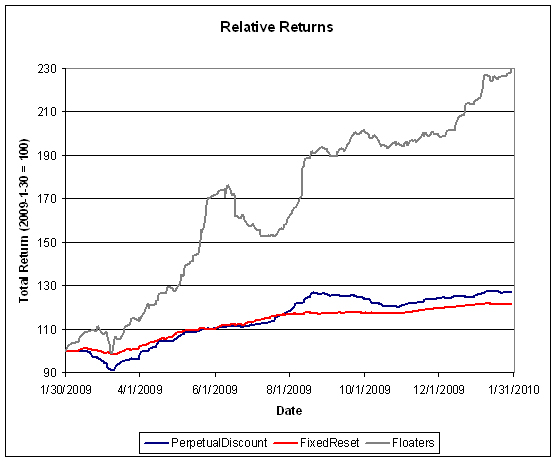
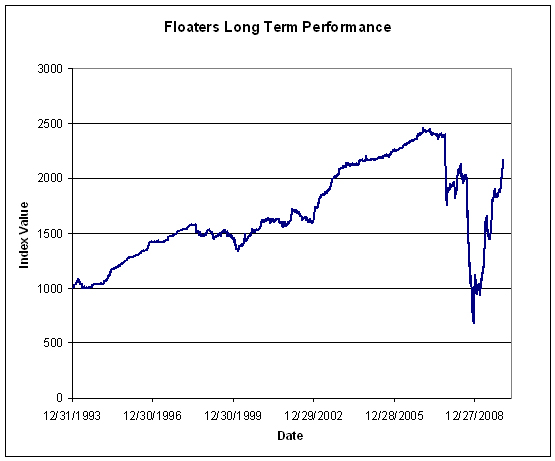
Meanwhile, Floaters continued their wild ride.


Click for big


Click for big


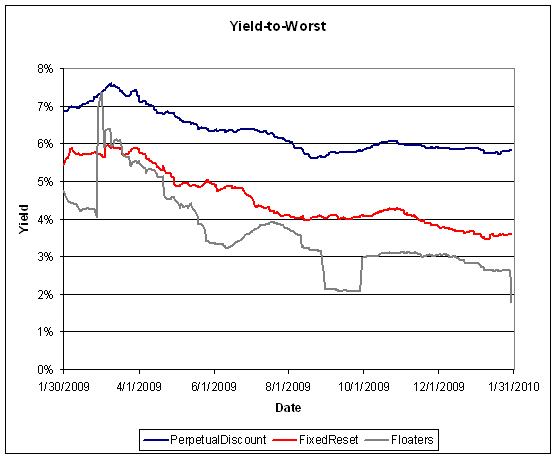
Click for big

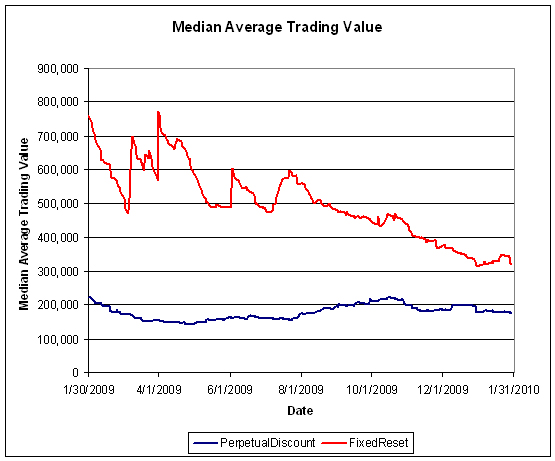
Volume may be under-reported due to the influence of Alternative Trading Systems (as discussed in the November PrefLetter), but I am biding my time before incorporating ATS volumes into the calculations, to see if the effect is transient or not. The average volume of FixedResets continues to decline, which may be due to a number of factors:

  • The calculation is an exponential moving average with dampening applied to spikes. While this procedure has worked very well in the past (it is used to estimate the maximum size of potential trades when performing simulations) there are no guarantees that it works well this particular time
  • There hasn’t been much issuance of investment-grade FixedResets recently, which will decrease the liquidity of the whole group, both for technical and real reasons
  • The issues are becoming seasoned, as the shares gradually find their way into the accounts of buy-and-hold investors
As usual, I will make no predictions of how long the calculated current trend will continue or what liquidity might be like next year!

Perhaps more interesting is the question of total returns on FixedResets. It will not have escaped notice that they outperformed PerpetualDiscounts for the month and quarter, but how long can that last? The median weighted average yield to worst for the asset class is a mere 3.59% … and that works out to an expected total return of about 30bp per month.

Thirty beeps per month depends on their being called at the proper time – the median weighted average duration to worst is 3.85 years, or call it four years’ term. Calls look like a virtual certainty at this time; if these issues aren’t called en masse it will almost certainly be because we’ve had another financial disaster and holders will wish they had been called. There will be many, of course, who think they might be reset rather than called while trading at a huge premium, but these guys also wear tin-foil hats and sell new issues to their clients, so those opinions can be discounted.

Thirty beeps per month for four years! There’s nothing intrinsically wrong with that yield, given that Claymore’s short-term corporate bond product, CBO, has a yield of 2.52% gross of MER 0.25% (and note that this product has positions in bank sub-debt and Innovative Tier 1 Capital in addition to, you know, short term corporate bonds), so the pre-tax interest equivalent spread after fees for FixedResets over CBO of 276bp. One can quite easily make a case that FixedResets are still cheap by those standards.

But what I’m saying is that fixed income mathematics are cruel and inexorable. Every beep of monthly return in excess of the 30bp average will be paid for by underperformance relative to that yardstick sometime before the (presumed) call – so the current levels of monthly and quarterly returns will not last forever. It is interesting to speculate just how returns will normalize … will it be a gradual process, with some months making 40bp and others making 20bp? Or will the correction occur in one big fat lump when the first one gets called? Stay tuned!

Compositions of the passive funds were discussed in the September edition of PrefLetter.

Alas and alack! Claymore cannot be bothered to publish NAVs on New Year’s Eve, so I’ll have to update this post with passive fund returns when the information is available.

Update, 2010-01-11: Claymore has published NAV and distribution data (problems with the page in IE8 can be kludged by using compatibility view) for its exchange traded fund (CPD) and I have derived the following table:

CPD Return, 1- & 3-month, to October 30, 2009
Date NAV Distribution Return for Sub-Period Monthly Return
September 30 16.62      
October 30 16.41     -1.26%
November 30, 2009 16.77     +2.19%
December 24 16.76 0.21 +1.19% +1.98%
December 31 16.89 0.00 +0.78%
Quarterly Return +2.90%

Claymore currently holds $373,729,364 (advisor & common combined) in CPD assets, up $23-million on the month and a stunning increase from the $84,005,161 reported in the Dec 31/08 Annual Report

The DPS.UN NAV for December 30 has been published so we may calculate the approximate December returns.

DPS.UN NAV Return, December-ish 2009
Date NAV Distribution Return for sub-period Return for period
December 2, 2009 19.94      
December 29, 2009 19.84**** 0.30 +1.00% 1.35%
December 30, 2009 19.91   +0.35%
Estimated December Beginning Stub +0.06% **
Estimated December Ending Stub +0.36% *
Estimated December Return +1.78% ***
*CPD had a NAVPU of 16.89 on December 31 and 16.83 on December 30, hence the total return for the period for CPD was +0.36%. The return for DPS.UN in this period is presumed to be equal.
**CPD had a NAVPU of 16.77 on November 30 and 16.78 on December 2, hence the total return for the period for CPD was +0.06%. The return for DPS.UN in this period is presumed to be equal.
*** The estimated December return for DPS.UN’s NAV is therefore the product of three period returns, +0.06%, +1.35% and +0.36% to arrive at an estimate for the calendar month of +1.78%
**** CPD was had a NAV of 16.83 on 12/30 and NAV 16.77 on 12.29. Therefore, the return for the day was +0.36%. Since the NAV of DPS.UN was 19.91 on 12/30, we may estimate the NAV of DPS.UN as 19.84 on 12/29.

Now, to see the DPS.UN quarterly NAV approximate return, we refer to the calculations for November and October:

DPS.UN NAV Returns, three-month-ish to end-December-ish, 2009
October-ish -2.46%
November-ish +3.09%
December-ish +1.78%
Three-months-ish +2.34%
Issue Comments

Best & Worst Performers: December 2009

These are total returns, with dividends presumed to have been reinvested at the bid price on the ex-date. The list has been restricted to issues in the HIMIPref™ indices.

December 2009
Issue Index DBRS Rating Monthly Performance Notes (“Now” means “December 30”)
GWO.PR.I PerpetualDiscount Pfd-1(low) -2.75% The second-best performer in November, so this is just a bounce-back. Now with a pre-tax bid-YTW of 5.98% based on a bid of 18.96 and a limitMaturity.
BNA.PR.C SplitShare Pfd-2(low) -2.38% Now with a pre-tax bid-YTW of 8.34% based on a bid of 18.90 and a hardMaturity 2019-1-10 at 25.00.
CIU.PR.A PerpetualDiscount Pfd-2(high) -2.33% Now with a pre-tax bid-YTW of 5.92% based on a bid of 19.69 and a limitMaturity.
CU.PR.B PerpetualPremium Pfd-2(high) -1.44% Now with a pre-tax bid-YTW of 5.74% based on a bid of 17.69 and a call 2012-7-1 at 25.00.
ELF.PR.F PerpetualDiscount Pfd-2(low) -1.44% Now with a pre-tax bid-YTW of 6.78% based on a bid of 19.63 and a limitMaturity.
TD.PR.O PerpetualDiscount Pfd-1(low) +5.50% Now with a pre-tax bid-YTW of 5.35% based on a bid of 23.01 and a limitMaturity.
BAM.PR.K Floater Pfd-2(low) +6.30%  
BAM.PR.G FixFloat Pfd-2(low) +6.35% Also the third-best performer in November, so it’s really on a tear!
BAM.PR.B Floater Pfd-2(low) +7.06%  
TRI.PR.B Floater Pfd-2(low) +9.46%  
Index Construction / Reporting

HIMIPref™ Index Rebalancing: December 2009

HIMI Index Changes, December 31, 2009
Issue From To Because
TD.PR.Q PerpetualDiscount PerpetualPremium Price
TD.PR.R PerpetualDiscount PerpetualPremium Price
RY.PR.H PerpetualDiscount PerpetualPremium Price
NA.PR.K PerpetualDiscount PerpetualPremium Price
PWF.PR.I PerpetualDiscount PerpetualPremium Price
BMO.PR.L PerpetualDiscount PerpetualPremium Price
IAG.PR.E PerpetualDiscount PerpetualPremium Price
GWO.PR.F PerpetualPremium PerpetualDiscount Price
PWF.PR.G PerpetualPremium PerpetualDiscount Price

There were the following intra-month changes:

HIMI Index Changes during December 2009
Issue Action Index Because
STW.PR.A Delete Scraps Matured
IGM.PR.B Add PerpetualDiscount New Issue
YPG.PR.D Add Scraps New Issue
Market Action

December 31, 2009

James Hamilton of Econbrowser has an excellent post on the Fed and the proposed term deposit facility:

We sometimes describe fiscal policy as determining the overall level of the public debt, while monetary policy determines the composition of that debt between money and interest-bearing federal obligations. By that definition, the Fed has clearly now entered the realm of implementing fiscal policy, by issuing debt directly in the form of interest-bearing reserves, reverse repos, and now term deposits.

But I fear that as this marriage between fiscal and monetary policy becomes consummated, an amicable divorce is not the most likely outcome.

My advice would be the sooner the Fed can return to plain vanilla central banking, the better.

I have heard reports that driving in the country has become a process of counting windmills … but I have my own way of counting. Say a standard wind farm has the following specifications:

The facility is expected to be completed in one year at a cost of CA$285 million, and will generate 300 GWh of wind energy a year from 43 Siemens 2.3 MW turbines.

So each turbine costs about $7-million bucks and generates about 7.5 GWh electricity per year. Ontario will pay 13.5 cents per kWh for on-shore wind. A profligate energy user (i.e., somebody who uses a toaster while the kitchen light is on) will pay 6.7 cents per kWh. So the loss to Smitherman’s ex-ministry is … call it 7 cents per kWh … and remember, we have assumed that transmission and administration is free, never mind the fact that wind power needs back-up plants built, and will accrue extra costs as this back-up switches on and off.

So, a loss of 7 cents per kWh on 7.5GWh annually is … um … carry three … 52.5 megacents per annum; in more familiar units, over half a million bucks. Enjoy the view! And remember – it’s not just empty-headed feel-goodism … it’s also an exciting new class of parasitic pseudo-industry creating jobs for pseudo-entrepreneurs!

The US Municipal Bond Insurance market is still trying to find its feet:

Insured bonds reached a peak of 57.1% of new issuance in 2005, but as most insurers were downgraded after they unsuccessfully ventured into the hazardous territory of structured finance, that number dwindled to just 8.7% this month, according to Thomson Reuters.

But responding to claims that the insurance market has a much-diminished future, Dominic Frederico, chief executive officer of Assured Guaranty Ltd., has a pretty simple reply.

“If there are naysayers, I would say, ‘Okay, then: explain my third quarter,’ ” he told investors in a conference call last month.

Assured, which operates the only two legacy insurers to have made it through the recession with investment-grade ratings, saw operating earnings — excluding net-realized investment gains and losses — jump to $70 million last quarter, compared to $26 million in the third quarter of 2008.

Preferred shares closed the year strongly on light volume, with PerpetualDiscounts up 26bp and FixedResets gaining 13bp.

PereptualDiscounts closed yielding 5.85%, equivalent to 8.19% interest at the standard equivalency factor of 1.4x. Long Corporates closed yielding 6.0% – maybe just a hair over – so the pre-tax interest-equivalent spread (also called the Seniority Spread) is about 220bp, a slight tightening from the December 16 and November 30 figures of 225bp.

HIMIPref™ Preferred Indices
These values reflect the December 2008 revision of the HIMIPref™ Indices

Values are provisional and are finalized monthly
Index Mean
Current
Yield
(at bid)
Median
YTW
Median
Average
Trading
Value
Median
Mod Dur
(YTW)
Issues Day’s Perf. Index Value
Ratchet 0.00 % 0.00 % 0 0.00 0 0.3484 % 1,626.4
FixedFloater 5.69 % 3.84 % 37,404 18.97 1 -0.4690 % 2,736.4
Floater 2.41 % 2.82 % 106,796 20.16 3 0.3484 % 2,031.8
OpRet 4.83 % -1.09 % 115,458 0.09 15 0.0406 % 2,333.8
SplitShare 6.40 % -6.01 % 189,048 0.08 2 0.6219 % 2,098.6
Interest-Bearing 0.00 % 0.00 % 0 0.00 0 0.0406 % 2,134.0
Perpetual-Premium 5.83 % 5.71 % 73,799 2.30 7 0.2659 % 1,891.1
Perpetual-Discount 5.79 % 5.85 % 188,197 14.11 68 0.2613 % 1,804.6
FixedReset 5.39 % 3.59 % 312,272 3.85 41 0.1268 % 2,177.5
Performance Highlights
Issue Index Change Notes
BMO.PR.K Perpetual-Discount -1.06 % YTW SCENARIO
Maturity Type : Limit Maturity
Maturity Date : 2039-12-31
Maturity Price : 23.22
Evaluated at bid price : 23.40
Bid-YTW : 5.68 %
CL.PR.B Perpetual-Premium 1.01 % YTW SCENARIO
Maturity Type : Call
Maturity Date : 2010-01-30
Maturity Price : 25.25
Evaluated at bid price : 26.10
Bid-YTW : -31.38 %
BNS.PR.T FixedReset 1.07 % YTW SCENARIO
Maturity Type : Call
Maturity Date : 2014-05-25
Maturity Price : 25.00
Evaluated at bid price : 28.05
Bid-YTW : 3.20 %
BAM.PR.K Floater 1.10 % YTW SCENARIO
Maturity Type : Limit Maturity
Maturity Date : 2039-12-31
Maturity Price : 13.80
Evaluated at bid price : 13.80
Bid-YTW : 2.85 %
RY.PR.C Perpetual-Discount 1.12 % YTW SCENARIO
Maturity Type : Limit Maturity
Maturity Date : 2039-12-31
Maturity Price : 20.85
Evaluated at bid price : 20.85
Bid-YTW : 5.59 %
SLF.PR.C Perpetual-Discount 1.27 % YTW SCENARIO
Maturity Type : Limit Maturity
Maturity Date : 2039-12-31
Maturity Price : 19.10
Evaluated at bid price : 19.10
Bid-YTW : 5.87 %
BNS.PR.J Perpetual-Discount 1.46 % YTW SCENARIO
Maturity Type : Limit Maturity
Maturity Date : 2039-12-31
Maturity Price : 22.80
Evaluated at bid price : 23.86
Bid-YTW : 5.45 %
BNA.PR.C SplitShare 1.50 % YTW SCENARIO
Maturity Type : Hard Maturity
Maturity Date : 2019-01-10
Maturity Price : 25.00
Evaluated at bid price : 18.90
Bid-YTW : 8.34 %
SLF.PR.B Perpetual-Discount 1.52 % YTW SCENARIO
Maturity Type : Limit Maturity
Maturity Date : 2039-12-31
Maturity Price : 20.65
Evaluated at bid price : 20.65
Bid-YTW : 5.85 %
HSB.PR.C Perpetual-Discount 1.83 % YTW SCENARIO
Maturity Type : Limit Maturity
Maturity Date : 2039-12-31
Maturity Price : 22.11
Evaluated at bid price : 22.25
Bid-YTW : 5.76 %
Volume Highlights
Issue Index Shares
Traded
Notes
GWO.PR.F Perpetual-Premium 84,426 RBC crossed 83,100 at 24.55.
YTW SCENARIO
Maturity Type : Limit Maturity
Maturity Date : 2039-12-31
Maturity Price : 24.24
Evaluated at bid price : 24.55
Bid-YTW : 6.04 %
CM.PR.E Perpetual-Discount 47,540 RBC crossed 40,100 at 23.93.
YTW SCENARIO
Maturity Type : Limit Maturity
Maturity Date : 2039-12-31
Maturity Price : 23.61
Evaluated at bid price : 23.90
Bid-YTW : 5.85 %
BMO.PR.L Perpetual-Discount 29,930 CIBC sold 15,000 to RBC at 25.15 and 10,800 to Desjardins at the same price.
YTW SCENARIO
Maturity Type : Limit Maturity
Maturity Date : 2039-12-31
Maturity Price : 24.82
Evaluated at bid price : 25.05
Bid-YTW : 5.86 %
PWF.PR.I Perpetual-Discount 25,500 TD crossed 18,900 at 25.12.
YTW SCENARIO
Maturity Type : Limit Maturity
Maturity Date : 2039-12-31
Maturity Price : 24.75
Evaluated at bid price : 25.07
Bid-YTW : 6.09 %
GWO.PR.G Perpetual-Discount 22,900 RBC crossed 15,000 at 21.90.
YTW SCENARIO
Maturity Type : Limit Maturity
Maturity Date : 2039-12-31
Maturity Price : 21.61
Evaluated at bid price : 21.90
Bid-YTW : 5.96 %
RY.PR.T FixedReset 17,700 YTW SCENARIO
Maturity Type : Call
Maturity Date : 2014-09-23
Maturity Price : 25.00
Evaluated at bid price : 28.10
Bid-YTW : 3.58 %
There were 10 other index-included issues trading in excess of 10,000 shares.
Market Action

December 30, 2009

Pop quiz! What do the securities and airline industries have in common?:

If these customers can’t use laptops or wi-fi and have to waste half their day going through security, they may abandon airlines at a faster rate than they are already, turning instead to modern business tools such as the web and teleconferencing, Kokonis said. Over the past year, he added, international premium flights were down 30 to 35 per cent.

What makes this even worse, [Robert] Mann [president of R.W. Mann & Company Inc., a consultancy in Port Washington, N.Y.] said, is that most in the industry realize new security measures are essentially political moves aimed at assuaging the public.

“It’s security theatre,” Mann said, noting that “there are a lot of us in the business that roll our eyes when these things happen.”

CIBC has issued covered bonds:

Series CB3 (CHF 375 million) covered bonds have a coupon rate of 1.75% and a maturity date of January 30, 2015. Series CB4 (CHF 300 million) covered bonds have a coupon rate of three-month CHF LIBOR plus 0.1% and a maturity date of December 30, 2011.

Swiss Government 5-years (there must be a cool name for them!) are now yielding 0.16%. Three month CHF LIBOR is 0.25%.

The last Canadian 5-Year NHA MBS auction was on October 16 with an average yield of 3.268%, as part of the Insured Mortgage Purchase Plan. Five year Canadas averaged 2.71% in October.

Preferred shares got on the up escalator today, although volume remained seasonably light. PerpetualDiscounts were up 31bp, while FixedResets gained 22bp, taking yields down to … 3.59%!

PerpetualDiscounts now yield 5.86%, equivalent to 8.20% interest at the standard equivalency factor of 1.4x. Long Corporates are now a hair over 6.0%, with a total return of -1.63% on the month-to-date, so the pre-tax interest-equivalent spread is now about 220bp, slightly tighter than the 225bp reported on December 16, but still wider than “Credit Crunch Normal” of 200bp and far above the long-term range of 100-150bp.

HIMIPref™ Preferred Indices
These values reflect the December 2008 revision of the HIMIPref™ Indices

Values are provisional and are finalized monthly
Index Mean
Current
Yield
(at bid)
Median
YTW
Median
Average
Trading
Value
Median
Mod Dur
(YTW)
Issues Day’s Perf. Index Value
Ratchet 0.00 % 0.00 % 0 0.00 0 0.5149 % 1,620.7
FixedFloater 5.67 % 3.82 % 37,670 19.00 1 0.5238 % 2,749.3
Floater 2.42 % 2.83 % 107,699 20.15 3 0.5149 % 2,024.7
OpRet 4.84 % -1.69 % 120,224 0.10 15 0.4590 % 2,332.8
SplitShare 6.44 % -6.24 % 195,292 0.08 2 0.0222 % 2,085.6
Interest-Bearing 0.00 % 0.00 % 0 0.00 0 0.4590 % 2,133.1
Perpetual-Premium 5.85 % 5.69 % 73,882 2.30 7 -0.0113 % 1,886.1
Perpetual-Discount 5.80 % 5.86 % 192,709 14.12 68 0.3133 % 1,799.9
FixedReset 5.39 % 3.59 % 324,259 3.84 41 0.2250 % 2,174.7
Performance Highlights
Issue Index Change Notes
CIU.PR.A Perpetual-Discount -1.25 % YTW SCENARIO
Maturity Type : Limit Maturity
Maturity Date : 2039-12-30
Maturity Price : 19.71
Evaluated at bid price : 19.71
Bid-YTW : 5.91 %
MFC.PR.A OpRet 1.02 % YTW SCENARIO
Maturity Type : Call
Maturity Date : 2010-07-19
Maturity Price : 26.25
Evaluated at bid price : 26.72
Bid-YTW : 0.87 %
POW.PR.D Perpetual-Discount 1.12 % YTW SCENARIO
Maturity Type : Limit Maturity
Maturity Date : 2039-12-30
Maturity Price : 20.78
Evaluated at bid price : 20.78
Bid-YTW : 6.04 %
TD.PR.Q Perpetual-Discount 1.13 % YTW SCENARIO
Maturity Type : Limit Maturity
Maturity Date : 2039-12-30
Maturity Price : 24.87
Evaluated at bid price : 25.10
Bid-YTW : 5.67 %
TRI.PR.B Floater 1.14 % YTW SCENARIO
Maturity Type : Limit Maturity
Maturity Date : 2039-12-30
Maturity Price : 21.25
Evaluated at bid price : 21.25
Bid-YTW : 1.85 %
SLF.PR.A Perpetual-Discount 1.19 % YTW SCENARIO
Maturity Type : Limit Maturity
Maturity Date : 2039-12-30
Maturity Price : 20.35
Evaluated at bid price : 20.35
Bid-YTW : 5.88 %
ELF.PR.G Perpetual-Discount 1.42 % YTW SCENARIO
Maturity Type : Limit Maturity
Maturity Date : 2039-12-30
Maturity Price : 18.06
Evaluated at bid price : 18.06
Bid-YTW : 6.61 %
NA.PR.N FixedReset 1.51 % YTW SCENARIO
Maturity Type : Call
Maturity Date : 2013-09-14
Maturity Price : 25.00
Evaluated at bid price : 26.94
Bid-YTW : 3.31 %
CIU.PR.B FixedReset 2.00 % YTW SCENARIO
Maturity Type : Call
Maturity Date : 2014-07-01
Maturity Price : 25.00
Evaluated at bid price : 28.62
Bid-YTW : 3.40 %
BAM.PR.H OpRet 2.06 % YTW SCENARIO
Maturity Type : Call
Maturity Date : 2010-01-29
Maturity Price : 25.50
Evaluated at bid price : 26.30
Bid-YTW : -29.72 %
BAM.PR.J OpRet 2.19 % YTW SCENARIO
Maturity Type : Call
Maturity Date : 2014-04-30
Maturity Price : 26.00
Evaluated at bid price : 27.03
Bid-YTW : 4.21 %
Volume Highlights
Issue Index Shares
Traded
Notes
CM.PR.K FixedReset 65,650 Nesbitt crossed 60,800 at 26.65.
YTW SCENARIO
Maturity Type : Call
Maturity Date : 2014-08-30
Maturity Price : 25.00
Evaluated at bid price : 26.60
Bid-YTW : 3.74 %
BMO.PR.M FixedReset 40,400 Nesbitt crossed 10,700 at 26.85, then another 28,500 at the same price.
YTW SCENARIO
Maturity Type : Call
Maturity Date : 2013-09-24
Maturity Price : 25.00
Evaluated at bid price : 26.80
Bid-YTW : 3.06 %
IGM.PR.B Perpetual-Discount 32,915 Recent Inventory Blow-out.
YTW SCENARIO
Maturity Type : Limit Maturity
Maturity Date : 2039-12-30
Maturity Price : 24.13
Evaluated at bid price : 24.33
Bid-YTW : 6.12 %
BNS.PR.T FixedReset 32,400 CIBC bought 18,500 from National at 28.15.
YTW SCENARIO
Maturity Type : Call
Maturity Date : 2014-05-25
Maturity Price : 25.00
Evaluated at bid price : 28.14
Bid-YTW : 3.47 %
CM.PR.H Perpetual-Discount 28,096 YTW SCENARIO
Maturity Type : Limit Maturity
Maturity Date : 2039-12-30
Maturity Price : 20.60
Evaluated at bid price : 20.60
Bid-YTW : 5.83 %
MFC.PR.D FixedReset 27,667 YTW SCENARIO
Maturity Type : Call
Maturity Date : 2014-07-19
Maturity Price : 25.00
Evaluated at bid price : 28.15
Bid-YTW : 3.68 %
There were 21 other index-included issues trading in excess of 10,000 shares.
Issue Comments

CBU.PR.A Announces Normal Course Issuer Bid

First Asset CanBanc Split Corp. has announced:

acceptance by the Toronto Stock Exchange (the “TSX”) of the Corporation’s Notice of Intention to make a Normal Course Issuer Bid (the “NCIB”) to permit the Corporation to acquire its Preferred Shares and Class A Shares (collectively, the “Securities”).

Pursuant to the NCIB, the Corporation proposes to purchase through the facilities of the TSX, from time to time, if it is considered advisable, up to 122,735 Preferred Shares and up to 122,735 Class A Shares of the Corporation, representing approximately 10% of the public float which is the same number as the Corporation’s issued and outstanding Securities, being 1,227,358 Preferred Shares and 1,227,358 Class A Shares as of the date hereof. The Corporation will not purchase in any given 30-day period, in the aggregate, more than 24,547 Preferred Shares and 24,547 Class A Shares, being 2% of the issued and outstanding Securities as of the date hereof. Purchases of Securities under the NCIB may commence on January 5, 2010. The Board of Directors of First Asset Investment Management Inc., the manager of the Corporation, believes that such purchases are in the best interests of the Corporation and are a desirable use of the Corporation’s funds. All purchases will be made through the facilities of the TSX in accordance with its rules and policies. All Securities purchased by the Corporation pursuant to the NCIB will not be cancelled and will be held for resale. The NCIB will expire on January 4, 2011.

On December 31, 2008, the Trust announced that it was making a Normal Course Issuer Bid, which commenced January 5, 2009, to purchase up to 132,000 Preferred Shares and up to 132,000 Class A Shares through the facilities of the TSX. Under the bid, which expires on January 4, 2010, an aggregate of 72,600 Class A Shares were repurchased at an average price of $14.90 per Class A Share including commissions. No Preferred Shares were repurchased.

I see lots of announcements of NCIBs, but not so many announcements of actual purchases!

It’s not entirely clear to me how the bookkeeping works. According to the June 2009 Financials:

A unit represents one Class A Share and one Preferred Share. The issued and outstanding units as at June 30, 2009 consists of 1,281,758 Class A Shares and 1,286,958 Preferred Shares. The Fund will ensure that an equal number of Class A Shares and Preferred Shares continue to be outstanding.

Now there are, according to the press release, 1,227,358 each, a decline of 54,400 Capital and 59,600 preferred in the past six months. And there was nothing on the books in June about the fund holding “treasury shares” or anything like that. However the prospectus (on SEDAR, dated October 31, 2008) states:

Preferred Shares may be surrendered at any time for retraction by the Company but will be retracted only on the second last Business Day of a month (the “Retraction Date”). Preferred Shares surrendered for retraction by a Preferred Shareholder at least ten Business Days prior to a Retraction Date will be retracted on such Retraction Date and such Preferred Shareholder will be paid on or before the 15th Business Day of the following month. Holders whose Preferred Shares are retracted on a Retraction Date will be entitled to receive a retraction price per share equal to the lesser of (i) 95% of the NAV per Unit determined as of the relevant Retraction Date less the pro rata portion of the Note then outstanding and less the cost to the Company of the purchase of a Class A Share for cancellation, and (ii) $10.00. The cost of the purchase of a Class A Share will include the purchase price of the Class A Share, commission and such other costs, if any, related to the liquidation of any portion of the Portfolio required to fund such purchase. If the Manager is unable to acquire sufficient Class A Shares for cancellation, the Preferred Shares will be redeemed on a pro rata basis based on the number of Class A Shares acquired or surrendered prior to the Retraction Date. If on any Retraction Date, Class A Shares are not required to be purchased in the market for cancellation in connection with the retraction of some or all of the Preferred Shares to be retracted, then the amount of the cost of a purchase of a Class A Share shall be such amount as the Manager determines is fair in the circumstances.

So it may be that the shares under this issuer bid are not cancelled immediately upon purchase, but are held for a few days and then cancelled to offset preferred share redemptions. But … it’s not clear.

Bookkeeping aside, the timing on this issue was excellent. They invested the proceeds at far better prices than anticipated in the prospectus and have benefitted to the point where a unit sold at $25 last fall is now worth $35.65 and the capital units are trading at a big fat discount to intrinsic value.

CBU.PR.A was last mentioned on PrefBlog when it was upgraded to Pfd-2 by DBRS. CBU.PR.A is not tracked by HIMIPref™.

Market Action

December 29, 2009

The boo-hoo-hoo crowd was in full cry December 24, with Dealbook exposing the revelation that Goldman Sachs occasionally trades as principal:

Mr. Egol, a Princeton graduate, had risen to prominence inside the bank by creating mortgage-related securities, named Abacus, that were at first intended to protect Goldman from investment losses if the housing market collapsed. As the market soured, Goldman created even more of these securities, enabling it to pocket huge profits.

Goldman’s own clients who bought them, however, were less fortunate, Gretchen Morgenson and Louise Story write in The New York Times.

Pension funds and insurance companies lost billions of dollars on securities that they believed were solid investments, according to former Goldman employees with direct knowledge of the deals who asked not to be identified because they have confidentiality agreements with the firm.

While the investigations are in the early phases, authorities appear to be looking at whether securities laws or rules of fair dealing were violated by firms that created and sold these mortgage-linked debt instruments and then bet against the clients who purchased them, people briefed on the matter say.

Michael DuVally, a Goldman Sachs spokesman, declined to make Mr. Egol available for comment. But Mr. DuVally said many of the C.D.O.’s created by Wall Street were made to satisfy client demand for such products, which the clients thought would produce profits because they had an optimistic view of the housing market. In addition, he said that clients knew Goldman might be betting against mortgages linked to the securities, and that the buyers of synthetic mortgage C.D.O.’s were large, sophisticated investors, he said.

The last paragraph says it all, really, and Goldman’s response was not necessary. Who are the investors? Were they prudent? Did they do due diligence? Did they merely have the misfortune to have A SMALL PART OF THEIR PORTFOLIO caught up in the train wreck? The ever-so-diligent reporter at the New York Times doesn’t bother even to ask such questions. It’s simply boo-hoo-hoo, a client bought something and it went down, it must be the seller’s fault.

The biggest danger the capital markets now face is over-regulation (as alluded to in a speech by John Taylor). Until performance becomes a serious consideration when placing assets for management (with risk firmly in mind at all times) and Portfolio Managers as a group start taking responsibility for their performance (which they certainly don’t want to do), we will keep seeing this friction … which basically means, until human nature changes.

There are some complaints that the Financial Crisis Inquiry Commission is making it stretch. I have no doubt but that there will be a star-studded roll of witnesses and some first-rate data collected … just how objectively that data is turned into recommendations will be another thing entirely! I think it entirely likely that regulation will become so stifling that a huge wave of hedge funds forms to compete with the banks at the margins, taking the old-style merchant-banking partnerships and trading houses as their models.

There is, surprisingly, some difference of opinion on the future course of 10-Year Treasury yields:

Yields on benchmark 10-year notes will climb about 40 percent to 5.5 percent, the biggest annual increase since 1999, according to David Greenlaw, chief fixed-income economist at Morgan Stanley in New York.

Ten-year notes will end 2010 at 3.97 percent, according to the average of 60 estimates in a Bloomberg News survey that gives greater weight to the most-recent forecasts.

Edward McKelvey, senior economist in New York at Goldman Sachs Group Inc., the top-ranked U.S. economic forecasters in 2009, according to data compiled by Bloomberg, expects yields to drop to 3.25 percent.

Forecasting is a mug’s game.

A massive financial industry investment in the UK may be reconsidered:

Jamie Dimon, chief executive, made the coded warning to Alistair Darling in an angry phone call after the Government revealed its 50pc super-tax on bonuses in the pre-Budget report. Although Mr Dimon did not explicitly threaten to can the 1.9m square foot Docklands development, he pointedly used it to demonstrate the bank’s commitment to London.

When JP Morgan bought the land for £237m in November last year, it wrote into its contract with Songbird Estates, the owner of Canary Wharf, an option to pull out. A decision has to be made before the option expires by the end of 2010.

Bankers say regulatory pressure and the shifting tax regime have made Britain a far less attractive place to do business. International banks, which assess where to place their capital at the end of every financial year, now plan to scale back investment in the UK. Even Paris, which has introduced a watered-down version of the super-tax on cash bonuses alone, is stealing a march over its traditionally superior rival, London.

It was a quiet day for preferreds, with not much volume or price volatility. PerpetualDiscounts gained 7bp, while FixedResets gained just under 5bp.

HIMIPref™ Preferred Indices
These values reflect the December 2008 revision of the HIMIPref™ Indices

Values are provisional and are finalized monthly
Index Mean
Current
Yield
(at bid)
Median
YTW
Median
Average
Trading
Value
Median
Mod Dur
(YTW)
Issues Day’s Perf. Index Value
Ratchet 0.00 % 0.00 % 0 0.00 0 -0.1440 % 1,612.4
FixedFloater 5.70 % 3.84 % 38,153 18.97 1 1.7591 % 2,734.9
Floater 2.43 % 2.82 % 111,929 20.18 3 -0.1440 % 2,014.4
OpRet 4.86 % -0.92 % 125,186 0.09 15 0.0536 % 2,322.1
SplitShare 6.44 % -4.21 % 203,292 0.08 2 -0.1996 % 2,085.2
Interest-Bearing 0.00 % 0.00 % 0 0.00 0 0.0536 % 2,123.4
Perpetual-Premium 5.85 % 5.73 % 76,623 2.30 7 0.1473 % 1,886.3
Perpetual-Discount 5.82 % 5.87 % 195,472 14.11 68 0.0724 % 1,794.2
FixedReset 5.40 % 3.68 % 334,233 3.84 41 0.0454 % 2,169.8
Performance Highlights
Issue Index Change Notes
TD.PR.Q Perpetual-Discount -1.74 % YTW SCENARIO
Maturity Type : Limit Maturity
Maturity Date : 2039-12-29
Maturity Price : 24.59
Evaluated at bid price : 24.82
Bid-YTW : 5.73 %
PWF.PR.H Perpetual-Discount -1.02 % YTW SCENARIO
Maturity Type : Limit Maturity
Maturity Date : 2039-12-29
Maturity Price : 23.92
Evaluated at bid price : 24.30
Bid-YTW : 6.01 %
BAM.PR.G FixedFloater 1.76 % YTW SCENARIO
Maturity Type : Limit Maturity
Maturity Date : 2039-12-29
Maturity Price : 25.00
Evaluated at bid price : 19.09
Bid-YTW : 3.84 %
Volume Highlights
Issue Index Shares
Traded
Notes
TD.PR.C FixedReset 77,322 Scotia crossed 73,600 at 27.15.
YTW SCENARIO
Maturity Type : Call
Maturity Date : 2014-03-02
Maturity Price : 25.00
Evaluated at bid price : 27.02
Bid-YTW : 3.74 %
CM.PR.K FixedReset 40,950 Nesbitt crossed 29,400 at 26.65.
YTW SCENARIO
Maturity Type : Call
Maturity Date : 2014-08-30
Maturity Price : 25.00
Evaluated at bid price : 26.60
Bid-YTW : 3.73 %
TD.PR.K FixedReset 22,411 TD crossed 21,400 at 28.05.
YTW SCENARIO
Maturity Type : Call
Maturity Date : 2014-08-30
Maturity Price : 25.00
Evaluated at bid price : 28.06
Bid-YTW : 3.68 %
BNS.PR.M Perpetual-Discount 20,572 YTW SCENARIO
Maturity Type : Limit Maturity
Maturity Date : 2039-12-29
Maturity Price : 20.55
Evaluated at bid price : 20.55
Bid-YTW : 5.58 %
CM.PR.J Perpetual-Discount 20,273 YTW SCENARIO
Maturity Type : Limit Maturity
Maturity Date : 2039-12-29
Maturity Price : 19.33
Evaluated at bid price : 19.33
Bid-YTW : 5.83 %
BNS.PR.L Perpetual-Discount 18,020 YTW SCENARIO
Maturity Type : Limit Maturity
Maturity Date : 2039-12-29
Maturity Price : 20.57
Evaluated at bid price : 20.57
Bid-YTW : 5.57 %
There were 15 other index-included issues trading in excess of 10,000 shares.
Issue Comments

RPQ.PR.A Wound Up Early

Connor, Clark & Lunn has announced:

that its shareholders have approved the proposal to change the redemption date of the Preferred Shares from June 30, 2011 to December 22, 2009 (the “Proposal”). As a result of the Proposal, Shareholders will have their Preferred Shares redeemed by the Company on December 22, 2009 and will be paid the net asset value per Preferred Share as of December 18, 2009.

Trading of the Preferred Shares will be halted at the opening of market on December 22, 2009 and the Preferred Shares will be delisted at the close of business on that day.

The redemption price was $12.98 per share compared with $25.00 par value.

RPQ.PR.A was last discussed on PrefBlog at the time that the wind-up was proposed

RPQ.PR.A was not tracked by HIMIPref™.

Issue Comments

RPB.PR.A Wound Up Early

Connor Clark & Lunn has announced:

that its shareholders have approved a proposal to change the redemption date of the Preferred Shares from March 23, 2012 to December 22, 2009 (the “Proposal”). As a result of the Proposal, Shareholders will have their Preferred Shares redeemed by the Company on December 22, 2009 and will be paid the net asset value redemption price per Preferred Share as of December 18, 2009 plus a redemption premium of $1.00 per Preferred Share.

Trading of the Preferred Shares will be halted at the opening of market on December 22, 2009 and the Preferred Shares will be delisted at the close of business on that day.

The redemption price was $6.55 including the $1 premium to NAV, on shares with a $25.00 par value.

RPB.PR.A was last discussed on PrefBlog at the time of the release of the Information Circular.

The issue was not tracked by HIMIPref™.

Market Action

December 24, 2009

California’s in trouble:

The state also has struggled to implement cost-cutting measures that were part of the $85 billion spending plan approved in July. Courts blocked part of the budget that cut funding for home care for the disabled and another part that borrowed $800 million from an account that sets aside money for local transportation agencies.

An accounting error means the state has to spend almost $1 billion more on schools than budgeted. Officials also underestimated the cost of health care for the poor by $900 million, and lawmakers failed to pass legislation to realize $1 billion less in anticipated prison spending.

Combined, the state faces a $6.3 billion gap in the current year and another $14.4 billion in the next.

Democrats, who control both chambers of the Legislature, are expected to oppose wholesale cuts to health and welfare programs. Such resistance, along with Republican opposition to tax increases, will be exacerbated as election-year politics heightens the partisan divide. Half of the state’s 120 Assembly and Senate seats go before voters in November.

The basic problem is gerrymandering:

I’d place California’s ridiculous two-thirds majority vote requirement for budget passage higher on the list of culprits that create gridlock. But I wouldn’t argue with Schwarzenegger’s thesis: Gerrymandering tends to reward extremism in both parties and punish compromise, locking lawmakers into ideological corners.

Districts were shaped to be “safe” for either a Democrat or a Republican. As a result, the real election battles have been waged in the party primaries. And since low-turnout primaries normally are dominated by party purists, the contests usually have been won by candidates who run the furthest to the left or the right.

Republicans pledge not to raise taxes. Democrats promise a laundry list of social programs the state can’t afford.

Then they come to Sacramento and can’t compromise.

Without wishing to be overly dramatic, it is this sort of legislative impasse that has enabled many dictators in the past to come to power – most famously, Julius Caesar.

The markets closed early today, in order that members of the most highly paid profession on the planet will have additional opportunity to bark at counter-clerks and restaurant personnel who have to work. Me, I’m just going to put my feet up and sneer at the unemployed.

In the spirit of Christmas, the TSX has not yet made closing data available, despite the fact that the market closed three hours ago. I will update the indices … later.

…later: A quiet day, with PerpetualDiscounts basically flat at FixedResets losing (yes, losing!) 4bp.

HIMIPref™ Preferred Indices
These values reflect the December 2008 revision of the HIMIPref™ Indices

Values are provisional and are finalized monthly
Index Mean
Current
Yield
(at bid)
Median
YTW
Median
Average
Trading
Value
Median
Mod Dur
(YTW)
Issues Day’s Perf. Index Value
Ratchet 0.00 % 0.00 % 0 0.00 0 0.9761 % 1,614.7
FixedFloater 5.80 % 3.93 % 39,441 18.86 1 0.9688 % 2,687.7
Floater 2.43 % 2.81 % 113,511 20.21 3 0.9761 % 2,017.3
OpRet 4.86 % -1.64 % 126,708 0.09 15 0.0306 % 2,320.9
SplitShare 6.43 % -7.57 % 211,093 0.08 2 -0.0443 % 2,089.3
Interest-Bearing 0.00 % 0.00 % 0 0.00 0 0.0306 % 2,122.2
Perpetual-Premium 5.86 % 5.83 % 76,456 2.31 7 0.0000 % 1,883.5
Perpetual-Discount 5.82 % 5.85 % 197,157 14.10 68 -0.0023 % 1,792.9
FixedReset 5.40 % 3.65 % 337,146 3.86 41 -0.0356 % 2,168.8
Performance Highlights
Issue Index Change Notes
POW.PR.D Perpetual-Discount 1.18 % YTW SCENARIO
Maturity Type : Limit Maturity
Maturity Date : 2039-12-24
Maturity Price : 20.50
Evaluated at bid price : 20.50
Bid-YTW : 6.12 %
TRI.PR.B Floater 1.25 % YTW SCENARIO
Maturity Type : Limit Maturity
Maturity Date : 2039-12-24
Maturity Price : 21.01
Evaluated at bid price : 21.01
Bid-YTW : 1.87 %
Volume Highlights
Issue Index Shares
Traded
Notes
GWO.PR.L Perpetual-Discount 40,350 Nesbitt crossed 10,000 at 23.30.
YTW SCENARIO
Maturity Type : Limit Maturity
Maturity Date : 2039-12-24
Maturity Price : 23.12
Evaluated at bid price : 23.26
Bid-YTW : 6.10 %
RY.PR.R FixedReset 33,735 RBC crossed 29,100 at 27.97.
YTW SCENARIO
Maturity Type : Call
Maturity Date : 2014-03-26
Maturity Price : 25.00
Evaluated at bid price : 27.95
Bid-YTW : 3.44 %
IGM.PR.B Perpetual-Discount 28,200 Inventory Blow-out Sale
YTW SCENARIO
Maturity Type : Limit Maturity
Maturity Date : 2039-12-24
Maturity Price : 24.11
Evaluated at bid price : 24.30
Bid-YTW : 6.13 %
GWO.PR.X OpRet 27,447 Called for redemption. CIBC bought 17,500 from Desjardins at 26.01.
YTW SCENARIO
Maturity Type : Call
Maturity Date : 2010-10-30
Maturity Price : 25.67
Evaluated at bid price : 25.98
Bid-YTW : 3.13 %
BNA.PR.C SplitShare 17,550 National crossed 15,100 at 18.80.
YTW SCENARIO
Maturity Type : Hard Maturity
Maturity Date : 2019-01-10
Maturity Price : 25.00
Evaluated at bid price : 18.70
Bid-YTW : 8.47 %
POW.PR.D Perpetual-Discount 15,551 YTW SCENARIO
Maturity Type : Limit Maturity
Maturity Date : 2039-12-24
Maturity Price : 20.50
Evaluated at bid price : 20.50
Bid-YTW : 6.12 %
There were 10 other index-included issues trading in excess of 10,000 shares.