Market Action

May 20, 2011

Another bad day for Greek bonds:

The yield on the Greek 10-year bond added 56 basis points, driving the difference with German bunds to a record 1,349 basis points.

Stocks and the euro extended losses as the Associated Press reported Norway froze a 235 million kroner ($42.3 million) grant to Greece because it hasn’t lived up to conditions linked to the grant, while Fitch Ratings said any potential extension of Greek bond maturities would be considered a default as it downgraded the debt.

The yield on Greek 10-year bonds surged 1.11 percentage points to 16.55 percent this week. The Portuguese 10-year yield increased 27 basis points to 9.38 percent, sending the spread with benchmark German bunds 33 basis points wider. Irish 10-year bond yields rose six basis points, with similar-maturity Spanish yields nine basis points higher.

The IMF has lent some money to Portugal:

The International Monetary Fund approved a 26 billion-euro ($36.8 billion) loan to Portugal as part of a joint bailout with the European Union in the latest effort to stem the region’s sovereign debt crisis.

The Washington-based institution will make 6.1 billion euros available immediately, the fund said in an e-mailed statement today. The IMF followed European officials, who on May 16 endorsed the 78-billion ($110 billion) joint package.

Sadly, the article does not address the question of whether the cheque was delivered by women in skimply little maid outfits.

The FRB-Boston has released a public policy brief by Jeffrey C. Fuhrer and Giovanni P. Olivei titled The Estimated Macroeconomic Effects of the Federal Reserve’s Large-Scale Treasury Purchase Program:

This brief examines an issue of current importance to the conduct of U.S. economic policy: how has the Federal Open Market Committee (FOMC) plan to purchase up to $600 billion of Treasury securities by June 30, 2011 affected the movement of inflation, GDP, and employment to more desirable medium-term and long-term levels? Following the FOMC’s announcement of the plan on November 3, 2010, other events that potentially influence Treasury yields have been at play. To estimate the effects that the FOMC Treasury purchases may have on the goal of achieving more desirable levels of inflation and employment, the authors make use of different models to gauge the likely effect upon interest rates, the interest rate effects on real spending (GDP), and how changes in GDP may be affecting the employment rate.

The FRB-Cleveland has published the May, 2011, edition of Economic Trends.

OSFI has released the Spring, 2011, edition of the OSFI Pillar with articles (well, notes, really):

  • OSFI Plan and Priorities for 2011-2014
  • Draft revised MCT guideline for P&C insurers
  • Speech by Assistant Superintendent Ted Price
  • Speech by Superintendent Julie Dickson
  • External peer review panel on 25th CPP Actuarial Report
  • Draft Stress Testing Guideline for Defined Benefit Pension Plans

There was good inflation news:

The consumer price index increased 0.3 percent in April after a 1.1 percent gain in the previous month, Statistics Canada reported today. The median forecast of 27 economists in a Bloomberg News survey was for a 0.5 percent advance.

Consumer prices rose 3.3 percent from a year earlier, matching the annual rate of advance in March.

The TMX will resist bank hegemony. Go, guys, go!

Bubble, bubble, toil and trouble:

Housing costs for the average two-storey home in Vancouver today eat up the equivalent of 80 per cent of a typical family’s annual pretax income, according to new research, putting ownership out of reach for most.

Across the country, homeowners are putting a larger portion of their earnings toward their homes, and interest-rate increases are likely to put further pressure on homeowners in the coming months, the Royal Bank of Canada said in its quarterly affordability index.

The problem is especially pronounced in Vancouver, where the bank estimated families must now dedicate 72 per cent of their household income to pay the mortgage, property taxes and utilities on a bungalow. In Toronto, it would take 47.5 per cent.

It was another fine day for the Canadian preferred share market, with PerpetualDiscounts inching ahead by 1bp, FixedResets up 11bp and DeemedRetractibes rocketting 28bp. The last group were led by SLF issues, which went ex-Dividend today. Volume was mediocre.

See you after the Rapture!

HIMIPref™ Preferred Indices
These values reflect the December 2008 revision of the HIMIPref™ Indices

Values are provisional and are finalized monthly
Index Mean
Current
Yield
(at bid)
Median
YTW
Median
Average
Trading
Value
Median
Mod Dur
(YTW)
Issues Day’s Perf. Index Value
Ratchet 0.00 % 0.00 % 0 0.00 0 0.1753 % 2,460.0
FixedFloater 0.00 % 0.00 % 0 0.00 0 0.1753 % 3,699.8
Floater 2.45 % 2.25 % 41,507 21.63 4 0.1753 % 2,656.2
OpRet 4.87 % 3.51 % 62,267 0.44 9 0.0129 % 2,423.4
SplitShare 5.21 % -1.59 % 56,280 0.57 6 0.3934 % 2,514.7
Interest-Bearing 0.00 % 0.00 % 0 0.00 0 0.0129 % 2,216.0
Perpetual-Premium 5.74 % 5.29 % 135,095 0.84 9 -0.0859 % 2,064.0
Perpetual-Discount 5.49 % 5.53 % 120,357 14.53 15 0.0112 % 2,164.1
FixedReset 5.15 % 3.22 % 195,420 2.87 57 0.1056 % 2,311.1
Deemed-Retractible 5.14 % 4.91 % 328,831 8.10 53 0.2761 % 2,140.3
Performance Highlights
Issue Index Change Notes
MFC.PR.C Deemed-Retractible 1.09 % YTW SCENARIO
Maturity Type : Hard Maturity
Maturity Date : 2022-01-31
Maturity Price : 25.00
Evaluated at bid price : 22.25
Bid-YTW : 5.89 %
ELF.PR.F Deemed-Retractible 1.15 % YTW SCENARIO
Maturity Type : Hard Maturity
Maturity Date : 2022-01-31
Maturity Price : 25.00
Evaluated at bid price : 22.84
Bid-YTW : 6.54 %
BMO.PR.L Deemed-Retractible 1.18 % YTW SCENARIO
Maturity Type : Call
Maturity Date : 2014-06-24
Maturity Price : 25.75
Evaluated at bid price : 26.51
Bid-YTW : 4.60 %
SLF.PR.B Deemed-Retractible 1.24 % YTW SCENARIO
Maturity Type : Hard Maturity
Maturity Date : 2022-01-31
Maturity Price : 25.00
Evaluated at bid price : 23.44
Bid-YTW : 5.55 %
SLF.PR.A Deemed-Retractible 1.36 % YTW SCENARIO
Maturity Type : Hard Maturity
Maturity Date : 2022-01-31
Maturity Price : 25.00
Evaluated at bid price : 23.32
Bid-YTW : 5.56 %
SLF.PR.F FixedReset 1.51 % YTW SCENARIO
Maturity Type : Call
Maturity Date : 2014-07-30
Maturity Price : 25.00
Evaluated at bid price : 27.45
Bid-YTW : 2.60 %
BNA.PR.D SplitShare 1.52 % YTW SCENARIO
Maturity Type : Call
Maturity Date : 2011-06-19
Maturity Price : 26.00
Evaluated at bid price : 26.70
Bid-YTW : -27.48 %
SLF.PR.D Deemed-Retractible 1.70 % YTW SCENARIO
Maturity Type : Hard Maturity
Maturity Date : 2022-01-31
Maturity Price : 25.00
Evaluated at bid price : 22.28
Bid-YTW : 5.80 %
SLF.PR.C Deemed-Retractible 1.71 % YTW SCENARIO
Maturity Type : Hard Maturity
Maturity Date : 2022-01-31
Maturity Price : 25.00
Evaluated at bid price : 22.26
Bid-YTW : 5.81 %
SLF.PR.E Deemed-Retractible 1.72 % YTW SCENARIO
Maturity Type : Hard Maturity
Maturity Date : 2022-01-31
Maturity Price : 25.00
Evaluated at bid price : 22.30
Bid-YTW : 5.84 %
Volume Highlights
Issue Index Shares
Traded
Notes
TD.PR.G FixedReset 304,677 TD crossed five blocks; 100,000 shares, then 60,000 and 35,000, followed by two of 50,000 each, all at 27.48.
YTW SCENARIO
Maturity Type : Call
Maturity Date : 2014-05-30
Maturity Price : 25.00
Evaluated at bid price : 27.43
Bid-YTW : 3.05 %
POW.PR.B Perpetual-Discount 76,960 Nesbitt crossed 40,000 at 23.90; RBC crossed 29,500 at the same price.
YTW SCENARIO
Maturity Type : Limit Maturity
Maturity Date : 2041-05-20
Maturity Price : 23.67
Evaluated at bid price : 23.94
Bid-YTW : 5.65 %
GWO.PR.G Deemed-Retractible 54,883 Nesbitt crossed 37,200 at 25.05.
YTW SCENARIO
Maturity Type : Hard Maturity
Maturity Date : 2022-01-31
Maturity Price : 25.00
Evaluated at bid price : 25.02
Bid-YTW : 5.31 %
RY.PR.I FixedReset 44,488 RBC crossed 38,000 at 26.20.
YTW SCENARIO
Maturity Type : Call
Maturity Date : 2014-03-26
Maturity Price : 25.00
Evaluated at bid price : 26.18
Bid-YTW : 3.19 %
BNS.PR.R FixedReset 37,193 Nesbitt crossed 30,000 at 26.18.
YTW SCENARIO
Maturity Type : Call
Maturity Date : 2014-02-25
Maturity Price : 25.00
Evaluated at bid price : 26.15
Bid-YTW : 3.32 %
RY.PR.X FixedReset 35,640 RBC crossed 25,000 at 27.39.
YTW SCENARIO
Maturity Type : Call
Maturity Date : 2014-09-23
Maturity Price : 25.00
Evaluated at bid price : 27.39
Bid-YTW : 3.25 %
There were 29 other index-included issues trading in excess of 10,000 shares.
Wide Spread Highlights
Issue Index Quote Data and Yield Notes
FTS.PR.E OpRet Quote: 26.75 – 27.18
Spot Rate : 0.4300
Average : 0.2753

YTW SCENARIO
Maturity Type : Call
Maturity Date : 2013-07-01
Maturity Price : 25.75
Evaluated at bid price : 26.75
Bid-YTW : 2.79 %

ELF.PR.F Deemed-Retractible Quote: 22.84 – 23.40
Spot Rate : 0.5600
Average : 0.4187

YTW SCENARIO
Maturity Type : Hard Maturity
Maturity Date : 2022-01-31
Maturity Price : 25.00
Evaluated at bid price : 22.84
Bid-YTW : 6.54 %

IAG.PR.A Deemed-Retractible Quote: 22.93 – 23.29
Spot Rate : 0.3600
Average : 0.2248

YTW SCENARIO
Maturity Type : Hard Maturity
Maturity Date : 2022-01-31
Maturity Price : 25.00
Evaluated at bid price : 22.93
Bid-YTW : 5.76 %

TCA.PR.Y Perpetual-Premium Quote: 50.11 – 50.39
Spot Rate : 0.2800
Average : 0.1915

YTW SCENARIO
Maturity Type : Limit Maturity
Maturity Date : 2041-05-20
Maturity Price : 46.84
Evaluated at bid price : 50.11
Bid-YTW : 5.56 %

PWF.PR.E Perpetual-Discount Quote: 24.70 – 24.99
Spot Rate : 0.2900
Average : 0.2035

YTW SCENARIO
Maturity Type : Limit Maturity
Maturity Date : 2041-05-20
Maturity Price : 23.53
Evaluated at bid price : 24.70
Bid-YTW : 5.56 %

W.PR.H Perpetual-Discount Quote: 24.40 – 24.94
Spot Rate : 0.5400
Average : 0.4585

YTW SCENARIO
Maturity Type : Limit Maturity
Maturity Date : 2041-05-20
Maturity Price : 24.09
Evaluated at bid price : 24.40
Bid-YTW : 5.70 %

Interesting External Papers

BoC Releases Spring, 2011, Review

The Bank of Canada has released the Bank of Canada Review, Spring 2011, a Special Issue devoted to Lessons from the Financial Crisis with articles:

  • Understanding and Measuring Liquidity Risk: A Selection of Recent Research
  • Unconventional Monetary Policy: The International Experience with Central Bank Asset Purchases
  • Lessons from the Use of Extraordinary Central Bank Liquidity Facilities
  • Central Bank Collateral Policy: Insights from Recent Experience

Sadly, despite the promising focus of the special issue, I found nothing of particular interest in the material.

Market Action

May 19, 2011

The lifecos continue to whine about new capital requirements:

International Financial Reporting Standards (IFRS) set to take effect 2014 “will severely inhibit” the core business of Canadian lifecos, Donald Stewart, chief executive of Sun Life Financial Inc., told the company’s meeting Wednesday.

One of the main problems with IFRS is that it changes the way companies value products such as life insurance policies, potentially forcing companies to hike prices beyond the reach of many Canadians. Mr. Stewart warned this wouldn’t benefit either the industry or the country.

Meanwhile, insurers are also bracing for the impact of new capital rules that are “significantly more onerous” than existing regulations, he said.

The industry is working with the Office of the Superintendent of Financial institutions, the regulator, to try to ensure that the new capital rules are not excessively stringent.

The comments echo recent statements made by Don Guloien, chief executive of Manulife Financial Corp. Mr. Guloien told his company’s annual meeting May 5 that new accounting and capital rules constitute one of the single biggest risks that Manulife currently faces.

The industry is particularly concerned that the new IFRS accounting rules will make earnings more volatile. That could have a negative impact on capital and on key capital ratios used by the regulator to determine a company’s financial health.

DSK has quit the IMF to pursue other interests.

Here’s a straw in the wind:

Amazon.com Inc. (AMZN) now sells 105 books for its Kindle electronic-readers for every 100 printed books.

Sales of the e-books for the Kindle, introduced in 2007, surpassed hardcover titles in July 2010, and overtook paperbacks six months later, the Seattle-based company said today in a statement.

It was a strong day in the Canadian preferred share market, with PerpetualDiscounts gaining 20bp, FixedResets up 5bp and DeemedRetractibles leaping ahead 38bp. The Performance Highlights table told a tale, with nine entries, all DeemedRetractible and mostly insurers – which was also the tilt on the volume table, although not to as large an extent. Volume was comfortably above average.

HIMIPref™ Preferred Indices
These values reflect the December 2008 revision of the HIMIPref™ Indices

Values are provisional and are finalized monthly
Index Mean
Current
Yield
(at bid)
Median
YTW
Median
Average
Trading
Value
Median
Mod Dur
(YTW)
Issues Day’s Perf. Index Value
Ratchet 0.00 % 0.00 % 0 0.00 0 -0.0350 % 2,455.7
FixedFloater 0.00 % 0.00 % 0 0.00 0 -0.0350 % 3,693.3
Floater 2.45 % 2.25 % 41,884 21.64 4 -0.0350 % 2,651.5
OpRet 4.87 % 3.51 % 61,098 1.15 9 0.1804 % 2,423.1
SplitShare 5.24 % -1.75 % 56,727 0.57 6 -0.0505 % 2,504.8
Interest-Bearing 0.00 % 0.00 % 0 0.00 0 0.1804 % 2,215.7
Perpetual-Premium 5.74 % 4.88 % 126,595 0.84 9 0.0551 % 2,065.8
Perpetual-Discount 5.49 % 5.51 % 120,608 14.56 15 0.2021 % 2,163.8
FixedReset 5.15 % 3.29 % 195,962 2.88 57 0.0509 % 2,308.7
Deemed-Retractible 5.14 % 4.90 % 322,437 8.11 53 0.3755 % 2,134.4
Performance Highlights
Issue Index Change Notes
HSB.PR.C Deemed-Retractible 1.00 % YTW SCENARIO
Maturity Type : Call
Maturity Date : 2014-07-30
Maturity Price : 25.00
Evaluated at bid price : 25.20
Bid-YTW : 5.09 %
SLF.PR.A Deemed-Retractible 1.04 % YTW SCENARIO
Maturity Type : Hard Maturity
Maturity Date : 2022-01-31
Maturity Price : 25.00
Evaluated at bid price : 23.30
Bid-YTW : 5.72 %
HSB.PR.D Deemed-Retractible 1.06 % YTW SCENARIO
Maturity Type : Hard Maturity
Maturity Date : 2022-01-31
Maturity Price : 25.00
Evaluated at bid price : 24.85
Bid-YTW : 5.19 %
IAG.PR.A Deemed-Retractible 1.06 % YTW SCENARIO
Maturity Type : Hard Maturity
Maturity Date : 2022-01-31
Maturity Price : 25.00
Evaluated at bid price : 22.93
Bid-YTW : 5.76 %
SLF.PR.D Deemed-Retractible 1.14 % YTW SCENARIO
Maturity Type : Hard Maturity
Maturity Date : 2022-01-31
Maturity Price : 25.00
Evaluated at bid price : 22.18
Bid-YTW : 6.00 %
BMO.PR.K Deemed-Retractible 1.14 % YTW SCENARIO
Maturity Type : Call
Maturity Date : 2016-12-25
Maturity Price : 25.00
Evaluated at bid price : 25.66
Bid-YTW : 4.72 %
GWO.PR.G Deemed-Retractible 1.25 % YTW SCENARIO
Maturity Type : Hard Maturity
Maturity Date : 2022-01-31
Maturity Price : 25.00
Evaluated at bid price : 25.09
Bid-YTW : 5.27 %
GWO.PR.H Deemed-Retractible 1.37 % YTW SCENARIO
Maturity Type : Hard Maturity
Maturity Date : 2022-01-31
Maturity Price : 25.00
Evaluated at bid price : 23.67
Bid-YTW : 5.63 %
MFC.PR.B Deemed-Retractible 1.75 % YTW SCENARIO
Maturity Type : Hard Maturity
Maturity Date : 2022-01-31
Maturity Price : 25.00
Evaluated at bid price : 22.65
Bid-YTW : 5.83 %
Volume Highlights
Issue Index Shares
Traded
Notes
SLF.PR.B Deemed-Retractible 123,976 Nesbitt crossed 100,000 at 23.34.
YTW SCENARIO
Maturity Type : Hard Maturity
Maturity Date : 2022-01-31
Maturity Price : 25.00
Evaluated at bid price : 23.45
Bid-YTW : 5.69 %
FTS.PR.E OpRet 101,512 Nesbitt crossed 100,000 at 26.75.
YTW SCENARIO
Maturity Type : Call
Maturity Date : 2013-07-01
Maturity Price : 25.75
Evaluated at bid price : 26.75
Bid-YTW : 2.79 %
SLF.PR.C Deemed-Retractible 86,594 Nesbitt crossed 25,000 at 22.10; RBC crossed 27,200 at the same price.
YTW SCENARIO
Maturity Type : Hard Maturity
Maturity Date : 2022-01-31
Maturity Price : 25.00
Evaluated at bid price : 22.16
Bid-YTW : 6.01 %
MFC.PR.B Deemed-Retractible 67,453 Desjardins crossed 15,000 at 22.44, then another 40,000 at 22.62.
YTW SCENARIO
Maturity Type : Hard Maturity
Maturity Date : 2022-01-31
Maturity Price : 25.00
Evaluated at bid price : 22.65
Bid-YTW : 5.83 %
CM.PR.M FixedReset 65,904 TD crossed 25,000 at 27.90; Desjardins crossed 31,900 at 28.05.
YTW SCENARIO
Maturity Type : Call
Maturity Date : 2014-08-30
Maturity Price : 25.00
Evaluated at bid price : 27.90
Bid-YTW : 2.90 %
TRP.PR.C FixedReset 59,013 Scotia crossed two blocks of 25,000 each at 25.70.
YTW SCENARIO
Maturity Type : Call
Maturity Date : 2016-02-29
Maturity Price : 25.00
Evaluated at bid price : 25.70
Bid-YTW : 3.80 %
There were 41 other index-included issues trading in excess of 10,000 shares.
Wide Spread Highlights
Issue Index Quote Data and Yield Notes
W.PR.H Perpetual-Discount Quote: 24.41 – 25.00
Spot Rate : 0.5900
Average : 0.3692

YTW SCENARIO
Maturity Type : Limit Maturity
Maturity Date : 2041-05-19
Maturity Price : 24.10
Evaluated at bid price : 24.41
Bid-YTW : 5.69 %

SLF.PR.F FixedReset Quote: 27.41 – 27.75
Spot Rate : 0.3400
Average : 0.2392

YTW SCENARIO
Maturity Type : Call
Maturity Date : 2014-07-30
Maturity Price : 25.00
Evaluated at bid price : 27.41
Bid-YTW : 3.11 %

HSB.PR.C Deemed-Retractible Quote: 25.20 – 25.49
Spot Rate : 0.2900
Average : 0.2050

YTW SCENARIO
Maturity Type : Call
Maturity Date : 2014-07-30
Maturity Price : 25.00
Evaluated at bid price : 25.20
Bid-YTW : 5.09 %

MFC.PR.B Deemed-Retractible Quote: 22.65 – 22.98
Spot Rate : 0.3300
Average : 0.2633

YTW SCENARIO
Maturity Type : Hard Maturity
Maturity Date : 2022-01-31
Maturity Price : 25.00
Evaluated at bid price : 22.65
Bid-YTW : 5.83 %

MFC.PR.C Deemed-Retractible Quote: 22.01 – 22.24
Spot Rate : 0.2300
Average : 0.1647

YTW SCENARIO
Maturity Type : Hard Maturity
Maturity Date : 2022-01-31
Maturity Price : 25.00
Evaluated at bid price : 22.01
Bid-YTW : 6.02 %

SLF.PR.E Deemed-Retractible Quote: 22.20 – 22.45
Spot Rate : 0.2500
Average : 0.1896

YTW SCENARIO
Maturity Type : Hard Maturity
Maturity Date : 2022-01-31
Maturity Price : 25.00
Evaluated at bid price : 22.20
Bid-YTW : 6.04 %

Issue Comments

RBS.PR.A: Partial Redemption Call

R Split III Corp. has announced:

that it has called 138,250 Preferred Shares for cash redemption on May 31, 2011 (in accordance with the Company’s Articles) representing approximately 8.9583729% of the outstanding Preferred Shares as a result of the annual retraction of 276,500 Capital Shares by the holders thereof. The Preferred Shares shall be redeemed on a pro rata basis, so that each holder of Preferred Shares of record on May 30, 2011 will have approximately 8.9583729% of their Preferred Shares redeemed. The redemption price for the Preferred Shares will be $29.22 per share.

In addition, holders of a further 150,000 Capital Shares and 75,000 Preferred Shares have deposited such shares concurrently for retraction on May 31, 2011. As a result, a total of 426,500 Capital Shares and 213,250 Preferred Shares, or approximately 13.1778% of both classes of shares currently outstanding, will be redeemed.

Holders of Preferred Shares that are on record for dividends but have been called for redemption will be entitled to receive dividends thereon which have been declared but remain unpaid up to but not including May 31, 2011.

Payment of the amount due to holders of Preferred Shares will be made by the Company on May 31, 2011. From and after May 31, 2011 the holders of Preferred Shares that have been called for redemption will not be entitled to dividends or to exercise any rights in respect of such shares except to receive the amount due on redemption.

R Split III Corp. is a mutual fund corporation created to hold a portfolio of common shares of Royal Bank of Canada. Capital Shares and Preferred Shares of R Split III Corp. are listed for trading on The Toronto Stock Exchange under the symbols RBS and RBS.PR.A respectively.

RBS.PR.A was last mentioned on PrefBlog when there was a partial call for redemption in May, 2010. RBS.PR.A is not tracked by HIMIPref™.

Publications

Opinion: OSFI and the Bond Indices

OSFI wants to include contingent capital in the bond indices … even though Contingent Capital issues are not bonds!

Look for the opinion link!

Also available is the draft version with footnotes

The article has also been published on-line by Advisors’ Edge Report with the title OSFI Targets Bond Investors.

Update, 2011-6-21: Investors with an interest in the subject are urged to read Rowland Fleming’s explanation of how Bre-X became an index constituent.

Update, 2015-4-26: In the article, I attempt to differentiate between “good indices” and “bad indices”; the proliferation of ETFs has caused a corresponding proliferation of indices, which concerns a few US-based heavyweight lobbies:

ETFs – Since the Commission first permitted the creation of exchange-traded funds through an exemption from the Investment Advisers Act, well over a trillion dollars have been invested in these funds. ETFs, which were originally conceived as plain vanilla, index-tracking investments, can offer significant benefits to retail investors. In recent years, however, the Commission staff has approved through ad-hoc exemptive orders new and exotic versions of ETFs, many of which pose significant risks that are likely to be poorly understood by unsophisticated retail investors. For example, Commission staff has permitted ETF providers to: create their own indices just so they can create an ETF to track those indices, create inverse and leveraged ETFs, and even create actively managed ETFs.

Press Clippings

Financial Post: Opt for dividend half of split-share companies

Eric Lam of the Financial Post has published a piece titled Opt for dividend half of split-share companies in which I am quoted:

James Hymas, an expert on preferred shares and president of Hymas Investment Management, recommends preferred shares over capital shares. “The preferred shares are very often a good investment for a fixed income retail investor looking for a short-term investment. Capital shares are almost always a poor investment.”

While the investments carry a paper expense ratio generally between 1% and 1.5%, the fees are borne almost entirely by capital shareholders.

For example, if the underlying portfolio is worth $15 and preferred shareholders are guaranteed $10 on maturity, then capital shareholders only really have a claim on $5, but are paying fees on much more than that, he said.

Another factor to consider is that split preferred shares often receive very low credit ratings from credit agencies due to the multiplying risks involved in holding a basket of companies. However, Mr. Hymas argues that investors holding split preferred shares are still better off as investors in common or preferred shares in an operating company generally get nothing in the event of a default.

For those interested, Mr. Hymas recommends investors look for annual yields of at least 4.5% or more. Deciding on credit volatility means taking a good hard look at the underlying portfolio.

Mr. Hymas is keeping an eye on two different preferred shares from BAM Split Corp. that carry shares in Brookfield Asset Management Inc. and must be redeemed by 2016 and 2019 respectively. Another is the preferred shares of Dividend 15 Split Corp. II, which holds 15 companies including the big five banks and telecoms such as Telus Corp. and BCE Inc. It matures in 2014.

Market Action

May 18, 2011

There’s a scuffle about a Greek default:

European Central Bank officials ruled out a Greek debt restructuring, clashing with political leaders over a solution to the sovereign financial crisis.

“A Greek debt restructuring is not the appropriate way forward — it would create a catastrophe” because it would damage the banking system, ECB Executive Board member Juergen Stark said today in Lagonissi, Greece. Fellow board member Lorenzo Bini Smaghi said in Milan that “a solution for reducing debt but not paying for it will not work.”

Now, I will not claim that I’m the world’s greatest scholar on the debt crisis, but that seems to me to be the first official admission that the purpose of the various bail-outs is to save the banks. Anybody have anything both earlier and more explicit?

More gloomy punditry on US housing:

More than half U.S. homeowners and renters say housing won’t recover until at least 2014, reflecting a deepening pessimism about the real estate market, according to a survey by Trulia Inc. and RealtyTrac Inc.

The survey, taken in April, found that 54 percent of respondents don’t expect a recovery for at least three years, up from 34 percent in November, the two real estate data companies said today. Those who see a turnaround by the end of next year fell to 15 percent from 27 percent.

The housing market is weakening as near record-low interest rates and falling prices fail to boost demand after the expiration of a federal tax credit for homebuyers last year. Values will come under more pressure as 1.8 million properties that are delinquent or in foreclosure are added to the inventory of unsold homes, according to a March estimate by CoreLogic Inc., a real estate information firm in Santa Ana, California.

The iPad has been extraordinarily disruptive:

The iPad is wreaking havoc on the personal-computer market.

Hewlett-Packard Co. (HPQ)’s consumer PC sales plunged 23 percent last quarter, and the company lopped $1 billion off its annual sales forecast. And while rival Dell Inc. (DELL) beat analysts’ estimates because of corporate demand, its sales to consumers slumped 7.5 percent. More than 70 million tablets like the Apple Inc. (AAPL) iPad will be sold in 2011, a total that will balloon to 246 million in three years, Jefferies & Co. said yesterday.

You don’t need a full-blown computer to use eMail or look at dirty pictures on the internet!

There’s sales parties, sure. And then there’s REALLY GOOD sales parties!

A Munich Re unit hosted about 20 prostitutes at a Budapest party to reward the insurer’s high- performing agents, a spokesman said.

Ergo hosted the party for about 100 guests at the historic Gellert spa, Handelsblatt reported in a preview of an article to be published today. Women wore color-coded armbands, the newspaper said, citing unidentified guests, with red for hostesses, yellow for those available for sexual favors and white for women reserved for executives and top agents. After each trip to beds set up near the thermal baths, a woman would receive a stamp on her forearm, the paper reported.

And, just to get even further off topic, The Periodic Table of Videos is a great website!

It was a sharply mixed day for the Canadian preferred share market, with PerpetualDiscounts winning 20bp, FixedResets losing 17bp, and DeemedRetractibles ahead 11bp. The Performance Highlights table is more interesting than usual, but still nothing like the glory days of late 4Q08 / 1Q09, which will be treasured in my memory for as long as I still have one.

PerpetualDiscounts now yield 5.51%, equivalent to 7.16% interest at the standard equivalency factor of 1.3x. Long Corporates now yield a little under 5.4% (maybe I should say, a little over 5.35%), so the pre-tax interest-equivalent spread is now about 180bp, about the same as reported on May 11.

HIMIPref™ Preferred Indices
These values reflect the December 2008 revision of the HIMIPref™ Indices

Values are provisional and are finalized monthly
Index Mean
Current
Yield
(at bid)
Median
YTW
Median
Average
Trading
Value
Median
Mod Dur
(YTW)
Issues Day’s Perf. Index Value
Ratchet 0.00 % 0.00 % 0 0.00 0 0.1638 % 2,456.6
FixedFloater 0.00 % 0.00 % 0 0.00 0 0.1638 % 3,694.6
Floater 2.45 % 2.25 % 41,160 21.63 4 0.1638 % 2,652.4
OpRet 4.88 % 3.60 % 61,442 1.15 9 -0.0301 % 2,418.7
SplitShare 5.23 % -1.74 % 56,975 0.58 6 -0.0765 % 2,506.1
Interest-Bearing 0.00 % 0.00 % 0 0.00 0 -0.0301 % 2,211.7
Perpetual-Premium 5.74 % 5.51 % 127,951 0.85 9 0.0110 % 2,064.7
Perpetual-Discount 5.50 % 5.51 % 120,382 14.56 15 0.1969 % 2,159.5
FixedReset 5.15 % 3.28 % 198,675 2.88 57 -0.1704 % 2,307.5
Deemed-Retractible 5.16 % 4.95 % 309,083 8.09 53 0.1104 % 2,126.4
Performance Highlights
Issue Index Change Notes
FTS.PR.H FixedReset -1.55 % YTW SCENARIO
Maturity Type : Call
Maturity Date : 2015-07-01
Maturity Price : 25.00
Evaluated at bid price : 25.40
Bid-YTW : 3.78 %
BMO.PR.J Deemed-Retractible -1.14 % YTW SCENARIO
Maturity Type : Hard Maturity
Maturity Date : 2022-01-31
Maturity Price : 25.00
Evaluated at bid price : 24.30
Bid-YTW : 4.85 %
GWO.PR.G Deemed-Retractible 1.10 % YTW SCENARIO
Maturity Type : Hard Maturity
Maturity Date : 2022-01-31
Maturity Price : 25.00
Evaluated at bid price : 24.78
Bid-YTW : 5.43 %
IAG.PR.A Deemed-Retractible 1.89 % YTW SCENARIO
Maturity Type : Hard Maturity
Maturity Date : 2022-01-31
Maturity Price : 25.00
Evaluated at bid price : 22.69
Bid-YTW : 5.89 %
Volume Highlights
Issue Index Shares
Traded
Notes
CM.PR.H Deemed-Retractible 71,328 TD crossed 45,200 at 24.99.
YTW SCENARIO
Maturity Type : Hard Maturity
Maturity Date : 2022-01-31
Maturity Price : 25.00
Evaluated at bid price : 24.99
Bid-YTW : 4.86 %
GWO.PR.N FixedReset 64,427 TD crossed 58,900 at 24.75.
YTW SCENARIO
Maturity Type : Hard Maturity
Maturity Date : 2022-01-31
Maturity Price : 25.00
Evaluated at bid price : 24.62
Bid-YTW : 3.95 %
SLF.PR.D Deemed-Retractible 49,067 TD crossed 20,200 at 21.75.
YTW SCENARIO
Maturity Type : Hard Maturity
Maturity Date : 2022-01-31
Maturity Price : 25.00
Evaluated at bid price : 21.93
Bid-YTW : 6.14 %
FTS.PR.E OpRet 47,400 Nesbitt crossed 45,600 at 26.75.
YTW SCENARIO
Maturity Type : Call
Maturity Date : 2013-07-01
Maturity Price : 25.75
Evaluated at bid price : 26.75
Bid-YTW : 2.78 %
BNS.PR.M Deemed-Retractible 44,623 TD crossed 24,800 at 24.40.
YTW SCENARIO
Maturity Type : Hard Maturity
Maturity Date : 2022-01-31
Maturity Price : 25.00
Evaluated at bid price : 24.37
Bid-YTW : 4.86 %
RY.PR.P FixedReset 41,400 Nesbitt crossed 40,000 at 27.10.
YTW SCENARIO
Maturity Type : Call
Maturity Date : 2014-03-26
Maturity Price : 25.00
Evaluated at bid price : 27.05
Bid-YTW : 3.23 %
There were 32 other index-included issues trading in excess of 10,000 shares.
Wide Spread Highlights
Issue Index Quote Data and Yield Notes
BNA.PR.E SplitShare Quote: 24.35 – 24.80
Spot Rate : 0.4500
Average : 0.2828

YTW SCENARIO
Maturity Type : Hard Maturity
Maturity Date : 2017-12-10
Maturity Price : 25.00
Evaluated at bid price : 24.35
Bid-YTW : 5.31 %

ALB.PR.B SplitShare Quote: 22.31 – 22.59
Spot Rate : 0.2800
Average : 0.1782

YTW SCENARIO
Maturity Type : Call
Maturity Date : 2012-03-29
Maturity Price : 21.80
Evaluated at bid price : 22.31
Bid-YTW : 1.34 %

GWO.PR.N FixedReset Quote: 24.62 – 24.85
Spot Rate : 0.2300
Average : 0.1388

YTW SCENARIO
Maturity Type : Hard Maturity
Maturity Date : 2022-01-31
Maturity Price : 25.00
Evaluated at bid price : 24.62
Bid-YTW : 3.95 %

PWF.PR.M FixedReset Quote: 26.70 – 27.00
Spot Rate : 0.3000
Average : 0.2170

YTW SCENARIO
Maturity Type : Call
Maturity Date : 2014-03-02
Maturity Price : 25.00
Evaluated at bid price : 26.70
Bid-YTW : 3.55 %

BAM.PR.P FixedReset Quote: 27.52 – 27.81
Spot Rate : 0.2900
Average : 0.2132

YTW SCENARIO
Maturity Type : Call
Maturity Date : 2014-10-30
Maturity Price : 25.00
Evaluated at bid price : 27.52
Bid-YTW : 4.15 %

MFC.PR.B Deemed-Retractible Quote: 22.26 – 22.52
Spot Rate : 0.2600
Average : 0.1901

YTW SCENARIO
Maturity Type : Hard Maturity
Maturity Date : 2022-01-31
Maturity Price : 25.00
Evaluated at bid price : 22.26
Bid-YTW : 6.04 %

Interesting External Papers

Swiss "Too Big to Fail" Project Nearing Completion

Thomas J Jordan, Vice Chairman of the Governing Board of the Swiss National Bank, gave a speech at the International Center for Monetary and Banking Studies, Geneva, 17 May 2011 titled Approaching the finishing line – the too big to fail
project in Switzerland

A central component of the Swiss approach is that systemically important banks should markedly improve their capital base and liquidity positions, both qualitatively and quantitatively, and reduce their risk exposure to other banks.(footnote)

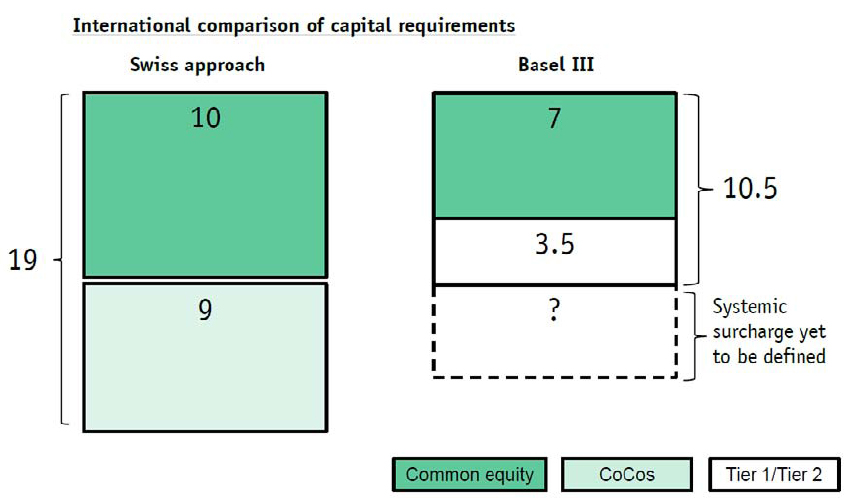
Footnote: The new capital adequacy regulations for systemically important banks are to apply to risk-weighted capital and to the leverage ratio. Furthermore, they are designed to be progressive. In other words, the bigger the bank, the higher the requirement. Given the current size of Switzerland’s two big banks, the requirement would be 19% total capital of the risk-weighted assets, of which 9% can be held in convertible capital (cocos) and 10% must be held in common equity.

I am very pleased to see that the capital adequacy requirements are progressive and that the exposure to other banks is being addressed.

I can’t say I’m similarly impressed by the trigger for the cocos (I would prefer a trigger based on market price of the common)

If common equity falls below the threshold of 5%, the cocos will be converted and the emergency planning for separating the systemically important functions from the rest of the bank will be initiated.

… but you can’t have everything!

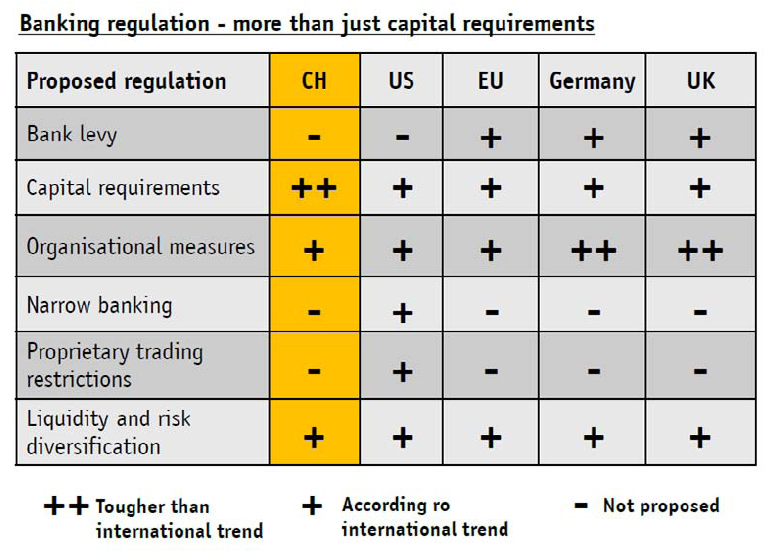
He takes a little dig at the US solution of banning prop-trading by the banks:

Firstly, regulation is never free of charge for every participant. However, analysis of the possible costs of regulation must always differentiate between the private and the social costs: in practice, regulation is bound to lead to additional costs for those regulated. This is part of the plan and makes economic sense provided that these additional costs are smaller than the benefits that regulation brings to the entire economy. If regulation leads to the elimination or reduction of market distortions – such as subsidies, for example – then an economically more efficient result is obtained.

Secondly, regulation can be formulated in a more or less cost-efficient manner. Particular attention was paid to this element in Switzerland. For instance, the additional capital required here by systemically important banks can largely be held in the form of more cost-efficient convertible capital. Other, far more drastic measures, such as a strict ban on certain business activities or the introduction of a bank tax – as discussed in other countries – were firmly rejected, partly for cost reasons.

He then provides an economic rationale for CoCos:

an increase in capital should not have any effect on a bank’s overall financing costs. Owing in part to the preferential tax treatment of borrowed funds, the Modigliani-Miller theorem referred to here, cannot be applied directly in practice, which means that overall financing costs would rise if capital increases. However, this is exactly what the proposed measures on convertible capital take into account. They create better conditions, so that capital structure will have less influence on a bank’s financing costs.

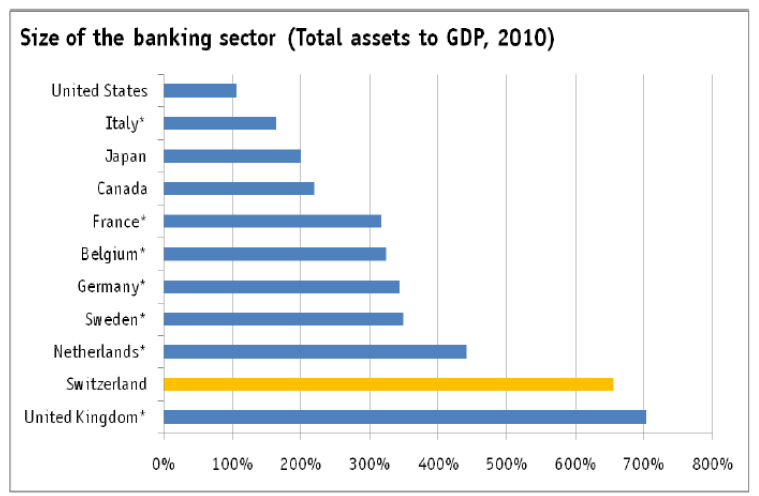
I liked Chart 2:


Click for big

But Chart 8 was pretty good to:


Click for Big

And there’s a handy scoresheet!


Click for big
Issue Comments

ABK.PR.B Warrants Expiring Soon

Allbanc Split Corp has announced:

Allbanc Split Corp. (the “Company”) is pleased to announce that it will be hosting an investor update conference call on Tuesday, May 24, 2011, with Brian McChesney, President and CEO of Scotia Managed Companies Administration (the “Administrator”).
The conference call will provide an update on the Company’s portfolio and performance.

Investors and investment advisors are reminded that the Fund currently has warrants outstanding which expire on June 6, 2011 at 5:00 p.m. (Toronto time). Note that investment dealers may have deadlines earlier than June 6, 2011.

Conference Call
Tuesday, May 24, 2011 at 11:00 a.m. (EST)
Featuring Brian McChesney, President and CEO of the Administrator
Dial-in Numbers: 416-340-2217 or 1-866-696-5910
Passcode: 6138843#

A replay of the conference call will be available at 905-694-9451 or 1-800-408-3053, passcode 1365315#.
Each warrant entitles the holder to purchase one Unit, each Unit consisting of one Class A Capital Share and one Class B Preferred Share, for a subscription price of $62.78 per Unit. The warrants are listed on the Toronto Stock Exchange under the ticker symbol ABK.WT.

Holders of Class B Preferred Shares are entitled to receive quarterly fixed cumulative dividends equal to $0.3344 per Class B Preferred Share. The Company’s Capital Share dividend policy is to pay holders of Class A Capital Shares quarterly dividends in an amount equal to the dividends received on the underlying portfolio securities minus the dividends payable on the Class B Preferred Shares and all administrative and operating expenses provided the net asset value per Unit at the time of declaration, after giving effect to the dividend, would be greater than the original issue price of the Class B Preferred Shares.

Allbanc Split Corp. is a mutual fund corporation created to hold a portfolio of publicly listed common shares of selected Canadian chartered banks. The Class A Capital Shares and Class B Preferred Shares of Allbanc Split Corp. are all listed for trading on The Toronto Stock Exchange under the symbols ABK.A and ABK.PR.B respectively.

The NAV as of May 12 was 66.86, sufficient for Asset Coverage of 2.5-:1, and making the warrants significantly in-the-money. The warrants issue was reported on PrefBlog.

ABK.PR.B was last mentioned on PrefBlog when there was a partial call for redemption in February. AKB.PR.B is not tracked by HIMIPref™ but if the warrant issue goes well – and there is every reason to believe it should – it will be added.

Issue Comments

ALB.PR.B Issues Warrants

Allbanc Split Corp. II has announced:

the Company has issued one half warrant for every Capital Share to holders of Capital Shares of the Company of record as at the close of business on May 16, 2011.

Each whole warrant will entitle the holder to purchase one Unit, each Unit consisting of two Capital Shares and one Preferred Share, for a subscription price of $50.12 per Unit. Commencing May 17, 2011, warrants may be exercised at any time on or before 5:00 p.m. (Toronto time) on November 30, 2011. The warrants are listed on The Toronto Stock Exchange under the ticker symbol ALB.WT.

Holders of Preferred Shares are entitled to receive quarterly fixed cumulative distributions equal to $0.2316 per Preferred Share. The Company’s Capital Share dividend policy is to pay a quarterly dividend on the Capital Shares equal to the dividends received by the Company on the underlying portfolio securities minus the dividends payable on the Preferred Shares and all administrative and operating expenses provided the net asset value per Unit at the time of declaration, after giving effect to the dividend, would be greater than the original issue price of the Preferred Shares.

Allbanc Split Corp. II is a mutual fund corporation created to hold a portfolio of publicly listed common shares of selected Canadian chartered banks. Capital Shares and Preferred Shares of Allbanc Split Corp. II are listed for trading on The Toronto Stock Exchange under the symbols ALB and ALB.PR.B respectively.

ALB.PR.B was last mentioned on PrefBlog when it was issued in February. ALB.PR.B is tracked by HIMIPref™ and comprises part of the SplitShare subindex.