Interesting External Papers

BoE Publishes 2Q09 Quarterly Bulletin

The Bank of England has released its Quarterly Bulletin 2Q09, filled with the usual charts and top-quality research.

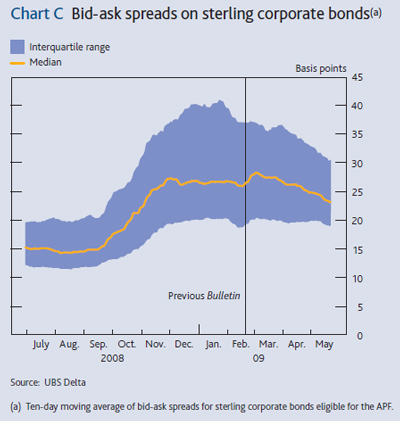
Corporate bond liquidity, as measured by bid/offer spreads, is healing:

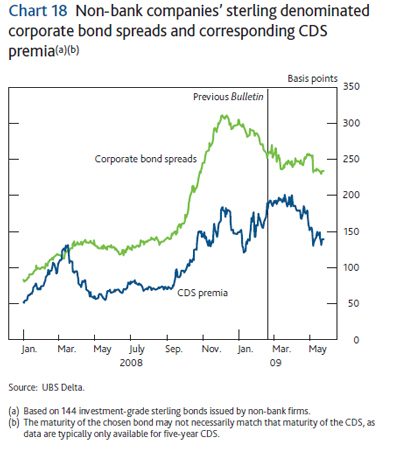
There is still a huge CDS basis, implying poor ability to borrow for leverage:

In addition to the general review, there are longer “Research and Analysis” articles on:

  • Quantitative Easing
  • Public Attitudes to Inflation and Monetary Policy
  • The Economics and Estimation of Negative Equity
  • Summaries of recent Boe Working Papers

Sadly, there is no chart of the decomposition of corporate bond spreads into default / default uncertainty / liquidity. It is my understanding that the system has been so stressed that they are reviewing all their embedded assumptions and calculations in their model to take a view on whether they can still trust it. A lot of quant models have blown up over the past two years!

Market Action

June 11, 2009

Incompetent Portfolio Managers now have a new object of veneration: the Globe and Mail has published a hagiography of St. Busseri the Crybaby after he squared his rot for a good boo-hoo-hoo:

Mr. Busseri found himself in the crosshairs of what he called a “character assassination” attempt by TriNorth.

The attack came in the form of a published group letter that criticized his management skills at previous jobs, including his stint restructuring Environmental Management Solutions Inc., a onetime proxy battle target now known as Englobe Corp.

“When you’re married and have kids, it’s disturbing and disappointing when people behave like this,” Mr. Busseri said. “It feels like intimidation.”

The published group letter makes interesting reading:

Busseri has no record of creating shareholder value as a leader of a public company.
The facts are:
• From October 2004 to January 2008, while Busseri was President and CEO and a Board Member of EnGlobe Corp. (TSX: EG) the company share price fell 58%.
• The TSX Composite rose 56% over the same period.
• Between 2004 and 2007, EnGlobe had cumulative operating losses of about $8.2 million, on $317 million of revenues
• Busseri led Capital Environmental Resources Inc. (later re-named Waste Services Inc.) from 1997 until his departure in August 2000.
• In the last 14 months of Busseri’s tenure, Capital / Waste Services share price fell 73%.
• The S&P rose 17% over the same period.
• Busseri was no longer employed with the company after Capital / Waste Services reported a loss of $6.6 million – its largest loss ever.
• Busseri recently left the position of Executive Vice President at Hanfeng Evergreen Inc. in April 2009 after a four-month tenure.

Um … where’s the character assassination? Where’s the stuff that makes marriage and kids such an issue?

I have no idea who is better suited to lead Trinorth. I don’t care. It makes no difference to me. But in mounting his proxy battle, Busseri has necessarily voiced his opinion on the competence of Trinorth’s board:

It is clear to the Concerned Shareholders that the Current Board – the same directors being nominated by management of TriNorth – are either unable or unwilling to preserve, protect and build value for all shareholders.

OK, so he’s got an opinion. It’s necessarily an opinion. So the competence of the person giving that opinion is fair game. I see nothing in the Trinorth letter that is objectionable: they didn’t make any allegations regarding his personal life; they stuck very closely to the man’s business track record.

When I read someone’s opinion about the markets, I want to know their track records – which is why opinions from journalists and sell-side analysts are ignored, although data is always gratefully received. I suppose, in Mr. Busseri’s eyes – and in the eyes of the extremely sympathetic Globe reporters – my desire to review performance track records when assessing opinion makes me a Bad Person. And, I suppose, non-disclosure of performance history is to be considered an entirely reasonable adjunct to dispensing portfolio advice.

The Basel Committee on Banking Supervision has expanded:

The Basel Committee on Banking Supervision decided to broaden its membership and to invite as new members representatives from the G20 countries that are not currently in the Basel Committee. These are Argentina, Indonesia, Saudi Arabia, South Africa and Turkey. In addition, Hong Kong SAR and Singapore have also been invited to become members. The Basel Committee’s governing body will likewise be expanded to include central bank governors and heads of supervision from these new member organisations.

Since the New Activism will create a lot of jobs for ex-regulators, it’s important that regulators everywhere have a chance to burnish their resumes!

The Bank of Canada has published a new working paper by Bruno Feunou, Jean-Sebastian Fontaine and Romeo Tedongap, The Equity Premium and the Volatility Spread: The Role of Risk-Neutral Skewness:

We introduce the Homoscedastic Gamma [HG] model where the distribution of returns is characterized by its mean, variance and an independent skewness parameter under both measures. The model predicts that the spread between historical and risk-neutral volatilities is a function of the risk premium and of skewness. In fact, the equity premium is twice the ratio of the volatility spread to skewness. We measure skewness from option prices and test these predictions. We find that conditioning on skewness increases the predictive power of the volatility spread and that coefficient estimates accord with theory. In short, the data do not reject the model’s implications for the equity premium. We also check the model’s implications for option pricing and show that the information content of skewness leads to improved in-sample and out-of-sample pricing performances as well as improved hedging performances. Our results imply that expanding around the Gaussian density is restrictive and does not offer sufficient flexibility to match the skewness and kurtosis implicit in option data. Finally, we document the term structure of option-implied volatility, skewness and kurtosis and find that time-dependence in returns has a greater impact on skewness.

I do not pretend to be an expert on option pricing theory, but the paper looks very interesting!

Mark Carney made a speech today – nothing much new, but he wants to create new jobs for regulators:

Fourth, all countries must accept their responsibilities for promoting an open, flexible, and resilient international monetary system. Responsibility means recognizing spillovers between economies and financial systems and working to mitigate those that could amplify adverse dynamics. It means submitting to peer review within the Financial Stability Board and external review by the International Monetary Fund.

Treasuries bounced back when the long bond auction did not go as badly as expected:

The yield on the 10-year note fell nine basis points, or 0.09 percentage point, to 3.86 percent, after climbing as high as 4.0038 percent, at 4:40 p.m. in New York, according to BGCantor Market Data. The yield last touched 4 percent on Oct. 16. The 3.125 percent security maturing in May 2019 rose 23/32, or $7.19 per $1,000 face amount, to 94.

The 30-year bond yield fell seven basis points to 4.69 percent. It earlier touched 4.8391 percent, the highest since October 2007.

The bonds sold today drew a yield of 4.72 percent, the highest since August 2007. The average forecast by eight bond- trading firms surveyed by Bloomberg News was 4.80 percent. The sale is a reopening of the $14 billion 30-year bond auction on May 7, which drew a yield of 4.288 percent.

Incidentally, those who are impressed by how much long corporates have tightened may be interested to learn … it ain’t just Canada:

One veteran salesman and friend of the blog notes that there are no sellers and only buyers. He offers that volume is lighter than one would expect because the street is not carrying much paper and that has made some paper very prices.

By way of example of the steaminess of the market he cited the McDonald 2018 bond which traded at T + 90 today. One month ago the bond was at 150 and two months ago around 20.

There is a 2035 Walmart which traded + 105 yesterday. That boond was T+ 200 a month ago.

The rally is relentless and marches on.

Mind you, that’s not as impressive as it sounds. A month ago, long Treasuries were at 4.18%.

PerpetualDiscounts shone today on continued heavy volume.

HIMIPref™ Preferred Indices
These values reflect the December 2008 revision of the HIMIPref™ Indices

Values are provisional and are finalized monthly
Index Mean
Current
Yield
(at bid)
Median
YTW
Median
Average
Trading
Value
Median
Mod Dur
(YTW)
Issues Day’s Perf. Index Value
Ratchet 0.00 % 0.00 % 0 0.00 0 1.7608 % 1,312.2
FixedFloater 7.10 % 5.60 % 30,066 16.16 1 -1.6699 % 2,123.8
Floater 2.89 % 3.26 % 85,801 19.11 3 1.7608 % 1,639.3
OpRet 4.99 % 3.80 % 146,570 3.62 14 0.3178 % 2,186.5
SplitShare 5.80 % 5.92 % 59,455 4.25 3 0.3666 % 1,879.7
Interest-Bearing 5.99 % 7.61 % 24,108 0.54 1 0.0000 % 1,989.2
Perpetual-Premium 0.00 % 0.00 % 0 0.00 0 0.2625 % 1,739.0
Perpetual-Discount 6.32 % 6.31 % 160,503 13.44 71 0.2625 % 1,601.6
FixedReset 5.69 % 4.84 % 550,668 4.37 39 -0.1111 % 2,006.7
Performance Highlights
Issue Index Change Notes
IAG.PR.C FixedReset -1.74 % YTW SCENARIO
Maturity Type : Call
Maturity Date : 2014-01-30
Maturity Price : 25.00
Evaluated at bid price : 25.36
Bid-YTW : 5.81 %
BAM.PR.G FixedFloater -1.67 % YTW SCENARIO
Maturity Type : Limit Maturity
Maturity Date : 2039-06-11
Maturity Price : 25.00
Evaluated at bid price : 15.31
Bid-YTW : 5.60 %
BNS.PR.Q FixedReset -1.57 % YTW SCENARIO
Maturity Type : Limit Maturity
Maturity Date : 2039-06-11
Maturity Price : 24.47
Evaluated at bid price : 24.52
Bid-YTW : 4.65 %
BNS.PR.L Perpetual-Discount -1.43 % YTW SCENARIO
Maturity Type : Limit Maturity
Maturity Date : 2039-06-11
Maturity Price : 18.64
Evaluated at bid price : 18.64
Bid-YTW : 6.13 %
GWO.PR.J FixedReset -1.15 % YTW SCENARIO
Maturity Type : Call
Maturity Date : 2014-01-30
Maturity Price : 25.00
Evaluated at bid price : 25.86
Bid-YTW : 5.12 %
BNA.PR.C SplitShare 1.10 % YTW SCENARIO
Maturity Type : Hard Maturity
Maturity Date : 2019-01-10
Maturity Price : 25.00
Evaluated at bid price : 15.66
Bid-YTW : 10.76 %
BAM.PR.K Floater 1.13 % YTW SCENARIO
Maturity Type : Limit Maturity
Maturity Date : 2039-06-11
Maturity Price : 12.00
Evaluated at bid price : 12.00
Bid-YTW : 3.27 %
NA.PR.K Perpetual-Discount 1.19 % YTW SCENARIO
Maturity Type : Limit Maturity
Maturity Date : 2039-06-11
Maturity Price : 23.51
Evaluated at bid price : 23.80
Bid-YTW : 6.21 %
HSB.PR.E FixedReset 1.53 % YTW SCENARIO
Maturity Type : Call
Maturity Date : 2014-07-30
Maturity Price : 25.00
Evaluated at bid price : 27.00
Bid-YTW : 4.83 %
BAM.PR.I OpRet 1.56 % YTW SCENARIO
Maturity Type : Soft Maturity
Maturity Date : 2013-12-30
Maturity Price : 25.00
Evaluated at bid price : 24.05
Bid-YTW : 6.44 %
ENB.PR.A Perpetual-Discount 1.70 % YTW SCENARIO
Maturity Type : Limit Maturity
Maturity Date : 2039-06-11
Maturity Price : 24.26
Evaluated at bid price : 24.56
Bid-YTW : 5.63 %
BAM.PR.J OpRet 1.70 % YTW SCENARIO
Maturity Type : Soft Maturity
Maturity Date : 2018-03-30
Maturity Price : 25.00
Evaluated at bid price : 22.25
Bid-YTW : 7.11 %
BAM.PR.H OpRet 1.84 % YTW SCENARIO
Maturity Type : Soft Maturity
Maturity Date : 2012-03-30
Maturity Price : 25.00
Evaluated at bid price : 25.05
Bid-YTW : 5.60 %
MFC.PR.C Perpetual-Discount 2.29 % YTW SCENARIO
Maturity Type : Limit Maturity
Maturity Date : 2039-06-11
Maturity Price : 17.85
Evaluated at bid price : 17.85
Bid-YTW : 6.34 %
CU.PR.B Perpetual-Discount 2.43 % YTW SCENARIO
Maturity Type : Call
Maturity Date : 2012-07-01
Maturity Price : 25.00
Evaluated at bid price : 25.31
Bid-YTW : 5.65 %
TRI.PR.B Floater 3.14 % YTW SCENARIO
Maturity Type : Limit Maturity
Maturity Date : 2039-06-11
Maturity Price : 16.76
Evaluated at bid price : 16.76
Bid-YTW : 2.37 %
IAG.PR.A Perpetual-Discount 4.42 % YTW SCENARIO
Maturity Type : Limit Maturity
Maturity Date : 2039-06-11
Maturity Price : 17.50
Evaluated at bid price : 17.50
Bid-YTW : 6.60 %
Volume Highlights
Issue Index Shares
Traded
Notes
BMO.PR.H Perpetual-Discount 157,200 Nesbitt crossed 100,000 at 22.00; Scotia crossed 50,000 at the same price.
YTW SCENARIO
Maturity Type : Limit Maturity
Maturity Date : 2039-06-11
Maturity Price : 21.64
Evaluated at bid price : 21.92
Bid-YTW : 6.09 %
BAM.PR.P FixedReset 115,840 Recent new issue.
YTW SCENARIO
Maturity Type : Call
Maturity Date : 2014-10-30
Maturity Price : 25.00
Evaluated at bid price : 25.57
Bid-YTW : 6.58 %
MFC.PR.E FixedReset 88,153 Recent new issue.
YTW SCENARIO
Maturity Type : Call
Maturity Date : 2014-10-19
Maturity Price : 25.00
Evaluated at bid price : 25.22
Bid-YTW : 5.49 %
PWF.PR.I Perpetual-Discount 67,970 Nesbitt crossed 50,000 at 23.00.
YTW SCENARIO
Maturity Type : Limit Maturity
Maturity Date : 2039-06-11
Maturity Price : 22.69
Evaluated at bid price : 22.91
Bid-YTW : 6.65 %
RY.PR.D Perpetual-Discount 55,180 RBC crossed 25,000 at 18.52.
YTW SCENARIO
Maturity Type : Limit Maturity
Maturity Date : 2039-06-11
Maturity Price : 18.47
Evaluated at bid price : 18.47
Bid-YTW : 6.16 %
CM.PR.L FixedReset 52,643 National crossed 25,000 at 27.15.
YTW SCENARIO
Maturity Type : Call
Maturity Date : 2014-05-30
Maturity Price : 25.00
Evaluated at bid price : 27.06
Bid-YTW : 4.85 %
There were 60 other index-included issues trading in excess of 10,000 shares.
Issue Comments

CU.PR.B Closes at Premium

It’s been a long time … but if the issue can hold on to its gains for another three weeks, then we’ll have a member of the long neglected PerpetualPremium index.

Vital statistics are:

CU.PR.B Perpetual-Discount YTW SCENARIO
Maturity Type : Call
Maturity Date : 2012-07-01
Maturity Price : 25.00
Evaluated at bid price : 25.31
Bid-YTW : 5.65 %

It was transferred from PerpetualPremium to PerpetualDiscount at the June 2008 rebalancing, which left four issues in the PerpetualPremium index as of 2008-6-30.

Market Action

June 10, 2009

Here’s a switch! Treasuries were under pressure today … Russia’s concerned about credit quality:

Thirty-year bond yields reached the most in a year after a Russian central bank official said the nation may buy International Monetary Fund bonds.

Russia’s central bank may switch some of its reserves from Treasuries to International Monetary Fund bonds, the bank’s first deputy chairman, Alexei Ulyukayev, said in Moscow today. His comments were confirmed by a bank official who declined to be named, citing bank policy.

Finance Minister Alexei Kudrin said last month that Russia planned to buy $10 billion of IMF bonds using money from its foreign reserves.

Russia holds $138.4 billion of U.S. debt. China is the largest U.S. creditor, with $767.9 billion. The U.S. government must rely on foreign investors to sustain record borrowing.

The dollar fell as Russia’s announcement added to speculation central banks around the world may try to diversify their reserves away from the U.S. currency. The Dollar Index, used by the ICE to track the greenback against the euro, yen, pound, Canadian dollar, Swiss franc and Swedish krona, decreased 0.2 percent to 79.649, after sliding 1.3 percent yesterday.

“The market is reacting to this Russia thing,” said Arthur Bass, a managing director of derivatives in New York at the brokerage Newedge USA LLC. “The dollar has restarted its dive to lower levels.”

Perhaps not surprisingly, the Treasury 10-year auction was horrible:

Treasuries declined, pushing 10-year yields to the highest level since October, as the government sold $19 billion of the securities and Russia said it may switch some reserves from U.S. debt.

The notes drew a yield of 3.99 percent, the highest since August 2008. The auction was the second of three sales this week that will raise $65 billion, part of the government’s record borrowing program. A Russian central bank official said the nation may buy International Monetary Fund bonds.

“There are an awful lot of Treasuries being auctioned and there’s going to be more and more and more and more,” said Jay Mueller, who manages about $3 billion of bonds at Wells Fargo Capital Management in Milwaukee.

The yield on the 10-year note rose seven basis points, or 0.07 percentage point, to 3.92 percent at 2:44 p.m. in New York, according to BGCantor Market Data. It earlier reached 3.99 percent, the highest since Oct. 16. The 3.125 percent security maturing in May 2019 declined 1/2, or $5.00 per $1,000 face amount, to 93 1/2.

The 30-year bond yield touched 4.83 percent, the highest in a year. The government is scheduled to sell $11 billion of the securities tomorrow.

Lots of volume but not much price action for preferreds today, although Floaters got hit – largely due to TRI.PR.B, which had low volume and a high closing spread, so it’s not clear how seriously the decline should be taken. PerpetualDiscounts closed with a yield of 6.35%, equivalent to 8.89% interest at the standard equivalency factor of 1.4x; long corporates are now yielding about 6.6%, having returned +3.43% on the month-to-date, so the pre-tax interest-equivalent spread is now about 229bp … up from the 213bp calculated on June 4 due almost entirely to a decline in long corporate bonds that has – over the week – been unmatched by preferred shares … the yield on PerpetualDiscounts is actually fractionally higher that it was at the last calculation.

HIMIPref™ Preferred Indices
These values reflect the December 2008 revision of the HIMIPref™ Indices

Values are provisional and are finalized monthly
Index Mean
Current
Yield
(at bid)
Median
YTW
Median
Average
Trading
Value
Median
Mod Dur
(YTW)
Issues Day’s Perf. Index Value
Ratchet 0.00 % 0.00 % 0 0.00 0 -1.9893 % 1,289.5
FixedFloater 6.98 % 5.51 % 30,057 16.28 1 0.4516 % 2,159.9
Floater 2.92 % 3.28 % 86,200 18.96 3 -1.9893 % 1,610.9
OpRet 4.98 % 3.81 % 135,650 0.94 14 0.1757 % 2,179.5
SplitShare 5.82 % 5.88 % 60,155 4.25 3 -0.0611 % 1,872.9
Interest-Bearing 5.99 % 7.57 % 25,082 0.54 1 0.0000 % 1,989.2
Perpetual-Premium 0.00 % 0.00 % 0 0.00 0 -0.0174 % 1,734.4
Perpetual-Discount 6.33 % 6.35 % 160,883 13.37 71 -0.0174 % 1,597.4
FixedReset 5.68 % 4.79 % 557,261 4.36 39 0.0137 % 2,008.9
Performance Highlights
Issue Index Change Notes
TRI.PR.B Floater -5.25 % Not necessarily a meaningful decline, as this traded 1,975 shares in a range of 16.01-17.15 before closing at 16.25-10, 3×10.
YTW SCENARIO
Maturity Type : Limit Maturity
Maturity Date : 2039-06-10
Maturity Price : 16.25
Evaluated at bid price : 16.25
Bid-YTW : 2.44 %
NA.PR.M Perpetual-Discount -2.05 % YTW SCENARIO
Maturity Type : Limit Maturity
Maturity Date : 2039-06-10
Maturity Price : 23.72
Evaluated at bid price : 23.91
Bid-YTW : 6.35 %
MFC.PR.B Perpetual-Discount -1.38 % YTW SCENARIO
Maturity Type : Limit Maturity
Maturity Date : 2039-06-10
Maturity Price : 18.60
Evaluated at bid price : 18.60
Bid-YTW : 6.29 %
PWF.PR.K Perpetual-Discount -1.21 % YTW SCENARIO
Maturity Type : Limit Maturity
Maturity Date : 2039-06-10
Maturity Price : 18.78
Evaluated at bid price : 18.78
Bid-YTW : 6.70 %
GWO.PR.I Perpetual-Discount -1.13 % YTW SCENARIO
Maturity Type : Limit Maturity
Maturity Date : 2039-06-10
Maturity Price : 17.55
Evaluated at bid price : 17.55
Bid-YTW : 6.43 %
BMO.PR.J Perpetual-Discount -1.01 % YTW SCENARIO
Maturity Type : Limit Maturity
Maturity Date : 2039-06-10
Maturity Price : 18.66
Evaluated at bid price : 18.66
Bid-YTW : 6.09 %
NA.PR.L Perpetual-Discount -1.00 % YTW SCENARIO
Maturity Type : Limit Maturity
Maturity Date : 2039-06-10
Maturity Price : 19.75
Evaluated at bid price : 19.75
Bid-YTW : 6.22 %
TD.PR.C FixedReset 1.17 % YTW SCENARIO
Maturity Type : Call
Maturity Date : 2014-03-02
Maturity Price : 25.00
Evaluated at bid price : 25.96
Bid-YTW : 4.86 %
CM.PR.E Perpetual-Discount 1.21 % YTW SCENARIO
Maturity Type : Limit Maturity
Maturity Date : 2039-06-10
Maturity Price : 21.75
Evaluated at bid price : 21.75
Bid-YTW : 6.54 %
BAM.PR.J OpRet 1.37 % YTW SCENARIO
Maturity Type : Soft Maturity
Maturity Date : 2018-03-30
Maturity Price : 25.00
Evaluated at bid price : 22.21
Bid-YTW : 7.36 %
BAM.PR.M Perpetual-Discount 1.52 % YTW SCENARIO
Maturity Type : Limit Maturity
Maturity Date : 2039-06-10
Maturity Price : 16.05
Evaluated at bid price : 16.05
Bid-YTW : 7.59 %
ELF.PR.F Perpetual-Discount 1.81 % YTW SCENARIO
Maturity Type : Limit Maturity
Maturity Date : 2039-06-10
Maturity Price : 18.56
Evaluated at bid price : 18.56
Bid-YTW : 7.29 %
BAM.PR.N Perpetual-Discount 2.64 % YTW SCENARIO
Maturity Type : Limit Maturity
Maturity Date : 2039-06-10
Maturity Price : 15.96
Evaluated at bid price : 15.96
Bid-YTW : 7.63 %
Volume Highlights
Issue Index Shares
Traded
Notes
BAM.PR.P FixedReset 128,920 Recent new issue.
YTW SCENARIO
Maturity Type : Call
Maturity Date : 2014-10-30
Maturity Price : 25.00
Evaluated at bid price : 25.37
Bid-YTW : 6.76 %
RY.PR.R FixedReset 99,685 National bought two lots of 10,000 from RBC at 26.95, then crossed 30,000 at 27.00.
YTW SCENARIO
Maturity Type : Call
Maturity Date : 2014-03-26
Maturity Price : 25.00
Evaluated at bid price : 26.96
Bid-YTW : 4.52 %
MFC.PR.E FixedReset 98,740 Recent new issue.
YTW SCENARIO
Maturity Type : Call
Maturity Date : 2014-10-19
Maturity Price : 25.00
Evaluated at bid price : 25.17
Bid-YTW : 5.53 %
TD.PR.M OpRet 88,225 RBC crossed 75,000 at 26.10, then another 10,000 at the same price.
YTW SCENARIO
Maturity Type : Soft Maturity
Maturity Date : 2013-10-30
Maturity Price : 25.00
Evaluated at bid price : 26.05
Bid-YTW : 3.81 %
BNS.PR.X FixedReset 66,350 National bought 10,000 from Scotia at 27.10, then crossed 30,000 at the same price.
YTW SCENARIO
Maturity Type : Call
Maturity Date : 2014-05-25
Maturity Price : 25.00
Evaluated at bid price : 27.02
Bid-YTW : 4.65 %
BNS.PR.Q FixedReset 56,779 RBC crossed 25,000 at 24.99, then bought 10,000 from National at the same price. It is interesting to note that BNS.PR.Q carries terms of 5.00%+170 resetting in October 2013 and trades in block size at par … while today’s new BMO issue is 5.40%+241 resetting in February 2015. Huh. Make of it what you will … that’s a pretty hefty new issue concession … or something.
YTW SCENARIO
Maturity Type : Limit Maturity
Maturity Date : 2039-06-10
Maturity Price : 24.86
Evaluated at bid price : 24.91
Bid-YTW : 4.58 %
There were 51 other index-included issues trading in excess of 10,000 shares.
Seminars

FloatingRate Video Seminar Accredited for CE Hours

I am pleased to announce that the Seminar on FloatingRate issues has been accredited for four hours of IDA Continuing Education – Professional Development.

Note that this seminar does not cover FixedResets; it deals exclusively with the issues eligible for the HIMIPref™ sub-indices comprising FloatingRate; that is, Ratches, FixedFloaters and Floaters.

Access to the material may be purchased by clicking the icon below:

New Issues

New Issue: BMO FixedReset 5.40%+241

Issue: Non-Cumulative 5-Year Rate Reset Class B Preferred Shares Series 23

Size: 8-million shares (=$200-million) + greenshoe 3-million shares (=$75-million)

Dividends: 5.40% (=$1.35 annually); reset to 5-Year Canadas + 241bp each Reset Date. First dividend lovely and fat at $0.58808 payable November 25, 2009, assuming a June 19 close.

Reset Dates: February 25, 2015 and every five years thereafter.

Convertable: By holder every Reset Date to and from Series 24, which pay 3-month bills +241bp, reset quarterly.

Redeemable: Every Reset Date at $25.00. Series 24 is redeemable every Reset Date at $25 and at $25.50 at all other times.

BMO Press Release.

Update: I am advised on good authority that the size of the deal has been increased to 14-million shares (=$350-million) with a 2-million share greenshoe (=$50-million).

Update, 2009-6-19: Press Release confirming the size increase.

Market Action

June 9, 2009

Here’s another good reason to avoid working for a bank:

Treasury Secretary Timothy Geithner said federal bank regulators and the Securities and Exchange Commission will play key roles in the administration’s effort to change the way financial executives are paid.

Geithner said the Obama administration is moving ahead with its guidelines on corporate compensation, part of a broader plan for an overhaul of financial regulation that will be announced next week. Changes are needed so bank executives aren’t enticed to take on too much risk, he said.

You will note that regulators are the chosen method of enforcement, not ownership – so efforts to repay TARP funds will only go so far. It will be most interesting to see how this plays out … will the big banks start contracting out work they want done properly? Or will they embrace the Canadian cult of mediocrity?

DBRS today revised its methodology for Secured Leveraged Loans:

Under the revised policy, the result of any notch-up of the instrument rating for a high-yield issuer will be limited to an instrument rating of BBB (low), regardless of the level of the recovery rating that may have been assigned to the instrument.

In assigning ratings to leveraged finance (i.e., high-yield) issues, DBRS first assigns an issuer rating that reflects the default risk of the issuer itself, then assigns separate recovery ratings and instrument ratings to the issuer’s specific debt instruments. The instrument rating is a blend of both the issuer rating and the recovery rating and, therefore, may be notched up from the issuer rating in cases where the recovery rating reflects above-average post-default recovery prospects. Likewise, the instrument rating may be notched down in cases where the recovery rating reflects diminished recovery prospects.

The likelihood of default is more remote for investment-grade issuers, which is why DBRS only assigns recovery ratings to non-investment-grade issuers. The effect of this policy refinement is to lessen the weighting of recovery on the instrument ratings of non-investment-grade credits that are on the cusp of becoming investment grade. DBRS believes – and empirical data demonstrates – that default is a substantial possibility for issuers in the B category and below; therefore, the recovery outlook should weigh relatively heavily on the instrument rating. As a company moves through the BB range and approaches investment grade, the likelihood of default is significantly less, and it is appropriate to restrict the beneficial impact of the recovery rating on the final instrument rating outcome.

This resulted in changes of rating for Sears MTNs:

In Sears Canada’s case, the Company was originally assigned an issuer rating of BB. However, based on DBRS’s recovery analysis, expected recovery is 90% to 100% for the MTN holders in a post-default scenario. This level of recovery equates to a recovery rating of RR1 and an MTN rating of BBB, or three notches above the issuer rating (see the DBRS rating report dated September 19, 2008).

In reviewing our leveraged finance methodology, DBRS noted that as a company moves through the BB rating range and approaches investment grade, the likelihood of default is significantly less; therefore, DBRS felt it appropriate to restrict the beneficial impact of the recovery rating on the final instrument rating outcome. Thus, the effect of this policy refinement is to lessen the weighting of recovery on the instrument ratings of non-investment-grade credits that are on the cusp of becoming investment grade.

The revised leveraged finance methodology has therefore capped Sears Canada’s MTN rating at BBB (low), two notches above the issuer rating.

… and Domtar:

Domtar was originally assigned (and maintains) an Issuer Rating of BB. However, based on DBRS’s recovery analysis, the Secured debt was assigned a recovery rating of RR1, which assumes an expected recovery of 90% to 100% in a post-default scenario. The RR1 equated to a Secured rating of BBB, or three notches above the issuer rating (see rating report dated May 12, 2009).

In reviewing our leveraged finance methodology, DBRS noted that as a company moves through the BB rating range and approaches investment grade, the likelihood of default is significantly lower. Therefore, DBRS felt it appropriate to restrict the beneficial impact of the recovery rating on the final instrument rating outcome. The effect of this policy refinement is to lessen the weighting of recovery on the instrument ratings of credits that are on the cusp between investment grade and non-investment grade.

The revised leveraged finance methodology has therefore capped Domtar’s Secured rating at BBB (low), which is effectively a two-notch upgrade above the issuer rating.

Connor Clark has announced:

the closing of the initial public offering of Canadian Banc Capital Securities Trust (“Canadian Banc” or the “Fund”). The Fund raised gross proceeds of $96,289,000 from the issuance of 3,600,000 Class A Units and 251,560 Class F Units (collectively the “Units”) at a price of $25.00 per Unit.

Excuse me for living, but this product looks completely insane to me. Expenses are:

  • 5.25% New issue selling commission on the Class A units. (one-time)
  • About maybe 0.7% issue expenses (one-time)
  • Management fee of 0.50%
  • Service fee of 0.40% on Class A units
  • 0.35% Counterparty fee
  • Ongoing expenses of 0.15%

Amortizing the issue expenses over the five year life of the fund and assuming all units are Class A gives you an MER of 2.45%. The counterparty fee is there because the fund is structured to pay the income as return of capital / capital gains.

And all for what? A FIVE YEAR investment in PERPETUAL SECURITIES. That fact alone makes my hackles rise; you can just bet it’s being sold to Granny as a five year investment. They justify this in the prospectus by using pretend-maturities:

The Portfolio Manager uses the first date upon which the securities may be called at par (rather than the legal maturity) in order to calculate duration. Based on this approach, the duration of the Indicative Portfolio is approximately 6.4 years.

The preferred share market had another strong day today, as FixedResets continued their march towards a zero percent yield-to-call!

HIMIPref™ Preferred Indices
These values reflect the December 2008 revision of the HIMIPref™ Indices

Values are provisional and are finalized monthly
Index Mean
Current
Yield
(at bid)
Median
YTW
Median
Average
Trading
Value
Median
Mod Dur
(YTW)
Issues Day’s Perf. Index Value
Ratchet 0.00 % 0.00 % 0 0.00 0 0.1701 % 1,315.6
FixedFloater 7.02 % 5.54 % 30,356 16.23 1 2.6490 % 2,150.2
Floater 2.87 % 3.30 % 86,548 18.91 3 0.1701 % 1,643.6
OpRet 4.99 % 3.79 % 136,773 2.54 14 0.0993 % 2,175.7
SplitShare 5.82 % 6.32 % 55,642 4.25 3 1.6132 % 1,874.0
Interest-Bearing 5.99 % 7.53 % 25,248 0.54 1 0.0000 % 1,989.2
Perpetual-Premium 0.00 % 0.00 % 0 0.00 0 0.1958 % 1,734.7
Perpetual-Discount 6.33 % 6.34 % 163,038 13.46 71 0.1958 % 1,597.7
FixedReset 5.68 % 4.80 % 562,427 4.36 39 0.1791 % 2,008.7
Performance Highlights
Issue Index Change Notes
MFC.PR.C Perpetual-Discount -1.40 % YTW SCENARIO
Maturity Type : Limit Maturity
Maturity Date : 2039-06-09
Maturity Price : 17.57
Evaluated at bid price : 17.57
Bid-YTW : 6.44 %
POW.PR.C Perpetual-Discount -1.21 % YTW SCENARIO
Maturity Type : Limit Maturity
Maturity Date : 2039-06-09
Maturity Price : 21.97
Evaluated at bid price : 21.97
Bid-YTW : 6.73 %
BAM.PR.M Perpetual-Discount 1.35 % YTW SCENARIO
Maturity Type : Limit Maturity
Maturity Date : 2039-06-09
Maturity Price : 15.81
Evaluated at bid price : 15.81
Bid-YTW : 7.71 %
PWF.PR.I Perpetual-Discount 1.42 % YTW SCENARIO
Maturity Type : Limit Maturity
Maturity Date : 2039-06-09
Maturity Price : 22.63
Evaluated at bid price : 22.85
Bid-YTW : 6.66 %
RY.PR.W Perpetual-Discount 1.52 % YTW SCENARIO
Maturity Type : Limit Maturity
Maturity Date : 2039-06-09
Maturity Price : 20.06
Evaluated at bid price : 20.06
Bid-YTW : 6.17 %
GWO.PR.J FixedReset 1.56 % YTW SCENARIO
Maturity Type : Call
Maturity Date : 2014-01-30
Maturity Price : 25.00
Evaluated at bid price : 26.10
Bid-YTW : 4.88 %
BAM.PR.N Perpetual-Discount 1.57 % YTW SCENARIO
Maturity Type : Limit Maturity
Maturity Date : 2039-06-09
Maturity Price : 15.55
Evaluated at bid price : 15.55
Bid-YTW : 7.84 %
CM.PR.P Perpetual-Discount 1.57 % YTW SCENARIO
Maturity Type : Limit Maturity
Maturity Date : 2039-06-09
Maturity Price : 21.69
Evaluated at bid price : 21.97
Bid-YTW : 6.34 %
GWO.PR.I Perpetual-Discount 1.95 % YTW SCENARIO
Maturity Type : Limit Maturity
Maturity Date : 2039-06-09
Maturity Price : 17.75
Evaluated at bid price : 17.75
Bid-YTW : 6.36 %
POW.PR.D Perpetual-Discount 2.03 % YTW SCENARIO
Maturity Type : Limit Maturity
Maturity Date : 2039-06-09
Maturity Price : 19.13
Evaluated at bid price : 19.13
Bid-YTW : 6.66 %
BAM.PR.G FixedFloater 2.65 % YTW SCENARIO
Maturity Type : Limit Maturity
Maturity Date : 2039-06-09
Maturity Price : 25.00
Evaluated at bid price : 15.50
Bid-YTW : 5.54 %
BNA.PR.C SplitShare 6.89 % Asset coverage of 1.9-:1 as of May 29 according to the company.
YTW SCENARIO
Maturity Type : Hard Maturity
Maturity Date : 2019-01-10
Maturity Price : 25.00
Evaluated at bid price : 15.51
Bid-YTW : 10.89 %
Volume Highlights
Issue Index Shares
Traded
Notes
BAM.PR.P FixedReset 268,697 Recent new issue.
YTW SCENARIO
Maturity Type : Call
Maturity Date : 2014-10-30
Maturity Price : 25.00
Evaluated at bid price : 25.38
Bid-YTW : 6.74 %
MFC.PR.E FixedReset 103,352 Recent new issue.
YTW SCENARIO
Maturity Type : Call
Maturity Date : 2014-10-19
Maturity Price : 25.00
Evaluated at bid price : 25.18
Bid-YTW : 5.51 %
BNS.PR.P FixedReset 72,452 RBC crossed 60,500 at 25.25.
YTW SCENARIO
Maturity Type : Limit Maturity
Maturity Date : 2039-06-09
Maturity Price : 25.10
Evaluated at bid price : 25.15
Bid-YTW : 4.80 %
RY.PR.D Perpetual-Discount 61,662 YTW SCENARIO
Maturity Type : Limit Maturity
Maturity Date : 2039-06-09
Maturity Price : 18.45
Evaluated at bid price : 18.45
Bid-YTW : 6.17 %
BNS.PR.T FixedReset 56,900 RBC crossed 46,500 at 27.18.
YTW SCENARIO
Maturity Type : Call
Maturity Date : 2014-05-25
Maturity Price : 25.00
Evaluated at bid price : 27.13
Bid-YTW : 4.54 %
CM.PR.M FixedReset 43,600 National Bank crossed 25,000 at 27.15.
YTW SCENARIO
Maturity Type : Call
Maturity Date : 2014-08-30
Maturity Price : 25.00
Evaluated at bid price : 27.22
Bid-YTW : 4.98 %
There were 46 other index-included issues trading in excess of 10,000 shares.
Issue Comments

YPG.PR.A & YPG.PR.B: Normal Course Issuer Bid

Yellow Pages Income Fund has announced:

that its subsidiary YPG Holdings Inc. has received approval from the Toronto Stock Exchange on its notice of intention to make a normal course issuer bid for its first preferred shares through the facilities of the Toronto Stock Exchange from June 11, 2009 to no later than June 10, 2010, in accordance with applicable regulations of the Toronto Stock Exchange.

Under its normal course issuer bid, YPG Holdings intends to purchase for cancellation up to but not more than 1,200,000 and 800,000 of its outstanding first preferred shares, series 1 and first preferred shares, series 2, respectively, representing 10% of the public float of each series of first preferred shares outstanding on June 9, 2009. YPG Holdings currently has 12,000,000 first preferred shares, series 1 and 8,000,000 first preferred shares, series 2 issued and outstanding. Within the past 12 months, YPG Holdings has not purchased any of its first preferred shares. The average daily trading volumes of YPG Holdings’ first preferred shares, series 1 and first preferred shares, series 2 for the period between December 1, 2008 and May 31, 2009 were 17,290 and 20,929, respectively. In accordance with the rules of the Toronto Stock Exchange, the maximum numbers of first preferred shares, series 1 and first preferred shares, series 2 that can be purchased on a daily basis by YPG Holdings are respectively 4,322 and 5,232, subject to the block purchase exception.

YPG Holdings believes that the trading price of the series 1 and series 2 first preferred shares may from time to time not reflect the fundamentals and future prospects for the business of YPG Holdings and the Fund. YPG Holdings’ directors have authorized this normal course issuer bid and, in their opinion, such purchases are in the best interest of YPG Holdings and its securityholders and constitute an appropriate use of YPG Holdings’ funds.

The yields of YPG.PR.A and YPG.PR.A were discussed on PrefBlog last March; while the junkier credits have surged in price since then, they closed last night at 22.50-73 (7.82-50%) and 17.46-69 (10.98-76%), giving interest equivalent yields well in excess of, for instance, the YPG 5.25 of 2016, currently quoted to yield 7.48%.

Not much has happened as yet on this news, although prices have moved up … YPG.PR.A is now 22.61-87 and YPG.PR.B is now 17.71-99. Note that today is the last cum-dividend date for the current coupon: it goes ex-Dividend tomorrow.

It is not my normal practice to comment on NCIB’s unless the company has a history of actually putting up a little actual cash to back up their press release … but in this case spreads are so extreme that a healthy company might well consider a buy-back attractive.

Market Action

June 8, 2009

More evidence that the credit markets are mending, this time from the CDO market:

A “remarkable change” in investor sentiment has doubled the price of some collateralized loan obligation securities in the past month, according to Morgan Stanley analysts.

CLOs are a type of collateralized debt obligation that pool high-yield, high-risk, or junk, loans and slice them into securities of varying risk and return. Pieces graded AA, the third highest-level of investment grade, rose from 23 cents on the dollar to 47 cents in the past month, Morgan Stanley analysts led by Vishwanath Tirupattur wrote in a June 5 report. Securities ranked A have gained 13 cents from 10 cents since the end of last month, the report said.

Ares Management LLC and Boston-based Sankaty Advisors LLC are among investors that started bidding on CLO securities in late April and the first week of May. Prices for the single-A portions had dropped 90 percent since the financial crisis began in 2007 even as the loans packaged in them had regained some their value. The S&P/LSTA U.S. Leveraged Loan 100, an index of loans rated below investment grade, rose 12 cents from Dec. 31 to 73.6 cents on the dollar on May 1. Loans have since increased in value to 79 cents.

“The continuing rally in underlying leveraged loans has been a major driver of this change in investor sentiment,” on CLOs, the analysts wrote in the report. A “fierce rally” is under way, they wrote.

The top-rated CLO bonds have risen from 71 cents on the dollar to 77 cents since May, the report said.

At the same time, hedge fund financing is getting a little harder:

HSBC Holdings Plc’s U.S. securities division will no longer extend structured financing to hedge-fund investors to leverage their investments, a person familiar with the company’s plans said.

The bank is halting the financing by its structured-funds products division and eliminating an unspecified number of jobs in New York, said the person, who asked not to be identified because the information hasn’t been made public. The group reports to Steven Phan, global head of the investment access and solutions groups in London, the person said. Phan declined to comment.

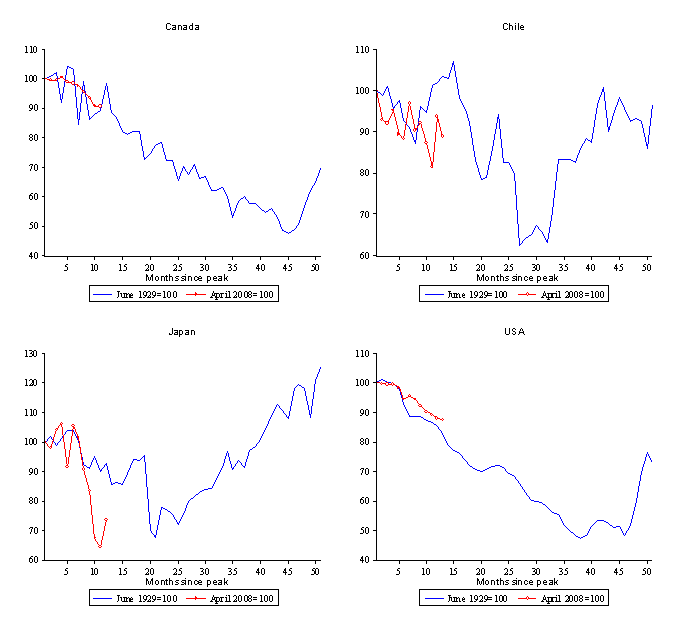
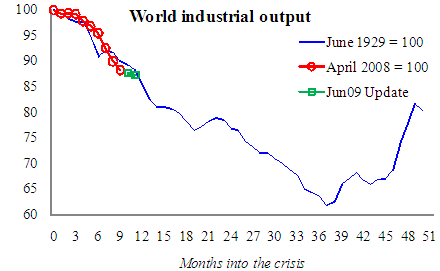
Remember those charts comparing the current bear to others? They’re looking a lot better now, but into the breach step Barry Eichengreen & Kevin H. O’Rourke, just in case anybody’s feeling cheerful, with a piece on VoxEU A Tale of Two Depressions:

This is an update of the authors’ 6 April 2009 column comparing today’s global crisis to the Great Depression. World industrial production, trade, and stock markets are diving faster now than during 1929-30. Fortunately, the policy response to date is much better. The update shows that trade and stock markets have shown some improvement without reversing the overall conclusion — today’s crisis is at least as bad as the Great Depression.


Click for big


Click for big

On a brighter note, equities were rescued from a bad day by Nobel Laureate Paul Krugman:

The U.S. economy probably will emerge from the recession by September, Nobel Prize-winning economist Paul Krugman said.

“I would not be surprised if the official end of the U.S. recession ends up being, in retrospect, dated sometime this summer,” he said in a lecture today at the London School of Economics. “Things seem to be getting worse more slowly. There’s some reason to think that we’re stabilizing.”

FixedResets had another good day, bringing the median YTW down to 4.81%. Since 5-Year Canadas have now gapped up to 2.69%, it is interesting to speculate on the terms of the next FixedReset issue. Could a bank do something at 5.00%+230?

HIMIPref™ Preferred Indices
These values reflect the December 2008 revision of the HIMIPref™ Indices

Values are provisional and are finalized monthly
Index Mean
Current
Yield
(at bid)
Median
YTW
Median
Average
Trading
Value
Median
Mod Dur
(YTW)
Issues Day’s Perf. Index Value
Ratchet 0.00 % 0.00 % 0 0.00 0 0.0973 % 1,313.4
FixedFloater 7.20 % 5.72 % 30,134 16.00 1 0.0000 % 2,094.7
Floater 2.87 % 3.31 % 79,559 18.89 3 0.0973 % 1,640.8
OpRet 5.00 % 3.80 % 137,033 2.54 14 -0.0596 % 2,173.5
SplitShare 5.91 % 5.80 % 51,469 4.25 3 -0.0620 % 1,844.3
Interest-Bearing 5.99 % 7.49 % 25,292 0.54 1 -1.2821 % 1,989.2
Perpetual-Premium 0.00 % 0.00 % 0 0.00 0 -0.0125 % 1,731.3
Perpetual-Discount 6.34 % 6.35 % 163,873 13.46 71 -0.0125 % 1,594.5
FixedReset 5.69 % 4.81 % 568,541 4.36 39 0.1293 % 2,005.1
Performance Highlights
Issue Index Change Notes
ELF.PR.F Perpetual-Discount -2.87 % YTW SCENARIO
Maturity Type : Limit Maturity
Maturity Date : 2039-06-08
Maturity Price : 18.26
Evaluated at bid price : 18.26
Bid-YTW : 7.41 %
STW.PR.A Interest-Bearing -1.28 % YTW SCENARIO
Maturity Type : Hard Maturity
Maturity Date : 2009-12-31
Maturity Price : 10.00
Evaluated at bid price : 10.01
Bid-YTW : 7.49 %
RY.PR.W Perpetual-Discount -1.20 % YTW SCENARIO
Maturity Type : Limit Maturity
Maturity Date : 2039-06-08
Maturity Price : 19.76
Evaluated at bid price : 19.76
Bid-YTW : 6.27 %
BAM.PR.I OpRet -1.19 % YTW SCENARIO
Maturity Type : Soft Maturity
Maturity Date : 2013-12-30
Maturity Price : 25.00
Evaluated at bid price : 24.02
Bid-YTW : 6.83 %
NA.PR.K Perpetual-Discount -1.05 % YTW SCENARIO
Maturity Type : Limit Maturity
Maturity Date : 2039-06-08
Maturity Price : 23.28
Evaluated at bid price : 23.55
Bid-YTW : 6.27 %
POW.PR.C Perpetual-Discount 1.04 % YTW SCENARIO
Maturity Type : Limit Maturity
Maturity Date : 2039-06-08
Maturity Price : 21.97
Evaluated at bid price : 22.24
Bid-YTW : 6.63 %
PWF.PR.L Perpetual-Discount 1.09 % YTW SCENARIO
Maturity Type : Limit Maturity
Maturity Date : 2039-06-08
Maturity Price : 19.52
Evaluated at bid price : 19.52
Bid-YTW : 6.64 %
BAM.PR.J OpRet 1.25 % YTW SCENARIO
Maturity Type : Soft Maturity
Maturity Date : 2018-03-30
Maturity Price : 25.00
Evaluated at bid price : 21.94
Bid-YTW : 7.54 %
CIU.PR.A Perpetual-Discount 2.02 % YTW SCENARIO
Maturity Type : Limit Maturity
Maturity Date : 2039-06-08
Maturity Price : 19.20
Evaluated at bid price : 19.20
Bid-YTW : 6.04 %
Volume Highlights
Issue Index Shares
Traded
Notes
MFC.PR.E FixedReset 149,351 Recent new issue.
YTW SCENARIO
Maturity Type : Call
Maturity Date : 2014-10-19
Maturity Price : 25.00
Evaluated at bid price : 25.15
Bid-YTW : 5.54 %
BAM.PR.P FixedReset 111,109 Recent new issue.
YTW SCENARIO
Maturity Type : Call
Maturity Date : 2014-10-30
Maturity Price : 25.00
Evaluated at bid price : 25.36
Bid-YTW : 6.76 %
TD.PR.N OpRet 83,019 TD crossed 41,000 at 26.06; RBC crossed 39,800 at 26.05.
YTW SCENARIO
Maturity Type : Call
Maturity Date : 2010-05-30
Maturity Price : 25.75
Evaluated at bid price : 26.07
Bid-YTW : 3.68 %
TD.PR.P Perpetual-Discount 79,020 TD crossed 25,000 at 21.35; RBC bought 34,800 from Nesbitt at the same price.
YTW SCENARIO
Maturity Type : Limit Maturity
Maturity Date : 2039-06-08
Maturity Price : 21.25
Evaluated at bid price : 21.25
Bid-YTW : 6.27 %
BNS.PR.Q FixedReset 57,703 Nesbitt crossed 40,000 at 24.95.
YTW SCENARIO
Maturity Type : Limit Maturity
Maturity Date : 2039-06-08
Maturity Price : 24.81
Evaluated at bid price : 24.86
Bid-YTW : 4.58 %
PWF.PR.E Perpetual-Discount 47,105 Nesbitt bought 13,000 from RBC at 21.40.
YTW SCENARIO
Maturity Type : Limit Maturity
Maturity Date : 2039-06-08
Maturity Price : 21.30
Evaluated at bid price : 21.30
Bid-YTW : 6.56 %
There were 31 other index-included issues trading in excess of 10,000 shares.
Issue Comments

KSP.UN Downgraded to Pfd-4 by DBRS

DBRS has announced that it:

has today downgraded the LROC Preferred Units issued by Kingsway Linked Return of Capital Trust to Pfd-4 from Pfd-3. The rating remains Under Review with Negative Implications, where it was initially placed on February 10, 2009.

The LROC Preferred Units are supported by an exposure to a note guaranteed by Kingsway Financial Services Inc. and Kingsway America Inc. (collectively, Kingsway) through a forward purchase agreement. The downgrade of the LROC Preferred Units is a result of DBRS downgrading the long-term debt ratings of Kingsway on June 4, 2009, to BB (low) from BBB (low) and leaving the ratings Under Review with Negative Implications.

The DBRS downgrade of Kingsway has been previously discussed on PrefBlog.

KSP.UN is not tracked by HIMIPref™.