Issue Comments

TD.PR.Y, FixedReset To Be Extended at +168

The Toronto-Dominion Bank has announced:

that it does not intend to exercise its right to redeem all or any part of the currently outstanding 10 million Non-Cumulative 5-Year Rate Reset Preferred Shares, Series Y (the “Series Y Shares”) of TD on October 31, 2013. As a result and subject to certain conditions set out in the prospectus dated July 7, 2008 relating to the issuance of the Series Y Shares, the holders of the Series Y Shares have the right to convert all or part of their Series Y Shares, on a one-for-one basis, into Non-Cumulative Floating Rate Preferred Shares, Series Z (the “Series Z Shares”) of TD on October 31, 2013. Holders who do not exercise their right to convert their Series Y Shares into Series Z Shares on such date will continue to hold their Series Y Shares.

The foregoing conversion right is subject to the conditions that: (i) if TD determines that there would be less than 1,000,000 Series Z Shares outstanding after October 31, 2013, then holders of Series Y Shares will not be entitled to convert their shares into Series Z Shares, and (ii) alternatively, if TD determines that there would remain outstanding less than 1,000,000 Series Y Shares after October 31, 2013, then all remaining Series Y Shares will automatically be converted into Series Z Shares on a one-for-one basis on October 31, 2013. In either case, TD will give written notice to that effect to holders of Series Y Shares no later than October 24, 2013.

The dividend rate applicable to the Series Y Shares for the 5-year period from and including October 31, 2013 to but excluding October 31, 2018, and the dividend rate applicable to the Series Z Shares for the 3-month period from and including October 31, 2013 to but excluding January 31, 2014, will be determined and announced by way of a press release on October 1, 2013.

Beneficial owners of Series Y Shares who wish to exercise their conversion right should communicate as soon as possible with their broker or other nominee to obtain instructions for exercising such right on or prior to the deadline for exercise, which is 5:00 p.m. (Toronto time) on October 16, 2013.

The current GOC5 rate is 1.91%, so pending the official announcement October 1, we may assume the new rate will be 3.59%, or $0.8975 p.a. This represents a steep decline from the original rate of 5.10% (or $1.275 p.a.), so my mailbox will be filling up shortly with outraged queries from casual investors.

We can examine the comparables with the help of the Pairs Equivalency Calculator:

FixedReset / FloatingReset Strong Pairs
FixedReset FloatingReset Next
Exchange
Date
Implied
3-Month
Bill Rate
BNS.PR.P BNS.PR.A 2018-4-26 2.42%
TD.PR.S TD.PR.T 2018-7-31 2.17%
BMO.PR.M BMO.PR.R 2018-8-25 2.18%

The closing bid for TD.PR.Y yesterday was 25.01; assuming this holds after the conversion privilege is no longer available then the average implied three-month bill rate of 2.26% calculated above in turn implies a bid on the new issue of 25.39.

So, as of right now, it looks like conversion is recommended. Naturally, investors will want to wait until the last moment before making a decision.

Additionally, it will be noted that although the deadline for notifying the company is October 16, intermediary brokers will almost always have earlier internal deadlines. Also, it is normal that trades must be settled before notice can be given … so for most brokers, I suggest that the last day for trading the issue in the hopes of reaping enormous profits on conversion will be Wednesday October 9 (remember there is a skip-day for Thanksgiving). This strategy didn’t work very well for the BMO.PR.M / BMO.PR.R conversion, when the price of BMO.PR.M was supported by the conversion privilege and promptly sank after the last trading day to settle prior to the notification date. But there will be some who try!

Market Action

September 25, 2013

One thing (well, one of many things) that has bothered me over the years is the story of Henry Ford as philantropist:

Henry Ford’s vision was that a mass-manufacturing solution would save so much money that his investments would soon pay off. They did, and there was a side benefit: Ford could then afford to pay his workers a much higher wage than average — $5 a day — which made them into consumers who could afford his cars. It’s the kind of long-range view that Ford and other automakers are taking now toward China.

This is repeated so often I sometimes think I must be the only person in the world who realizes that it doesn’t make any sense at all. You can’t get rich taking in each other’s laundry. I find that Ford itself promulgates this myth, albeit with enough supporting narrative to make the real story clear:

After the success of the moving assembly line, Henry Ford had another transformative idea: in January 1914, he startled the world by announcing that Ford Motor Company would pay $5 a day to its workers. The pay increase would also be accompanied by a shorter workday (from nine to eight hours). While this rate didn’t automatically apply to every worker, it more than doubled the average autoworker’s wage.

While Henry’s primary objective was to reduce worker attrition—labor turnover from monotonous assembly line work was high—newspapers from all over the world reported the story as an extraordinary gesture of goodwill.

After Ford’s announcement, thousands of prospective workers showed up at the Ford Motor Company employment office. People surged toward Detroit from the American South and the nations of Europe. As expected, employee turnover diminished. And, by creating an eight-hour day, Ford could run three shifts instead of two, increasing productivity.

Henry Ford had reasoned that since it was now possible to build inexpensive cars in volume, more of them could be sold if employees could afford to buy them. The $5 day helped better the lot of all American workers and contributed to the emergence of the American middle class. In the process, Henry Ford had changed manufacturing forever.

I suspect that this myth was developed in an attempt to spike the guns of the nascent socialist movement:

The fact is that about 6% of Americans were voting Socialist that year, and any decent newspaper would be keeping track of the local races. It’s also important to note that there were many political parties then, including multiple leftist parties, and it would be not unusual to have half a dozen candidates for any office.

Also of note is that socialists were already closely aligned with labor unions, and this is evident in the platform planks.

And to those who think the socialist movement in America has been a failure, take a look at the list of platform planks from 1914: women’s suffrage, clean schools, child labor laws, free schoolbooks, public sector unions, workplace safety inspections, etc.

Every time I see the hoary old chestnut of perpetual motion by high wages repeated, I get just a little more irritated. What Henry Ford did was to increase productivity – wages were increased solely because he had to. It is increased productivity that makes us rich.

There are rumours of potential big changes in the corporate bond markets:

Deutsche Bank AG (DBK) is trying to drum up interest with some of its largest competitors to create a multi-dealer U.S. bond trading platform at the same time that asset managers discuss ways to make buying and selling debt easier, according to people familiar with the matter.

Europe’s biggest investment bank by revenue has pitched its plan for an electronic trading network to JPMorgan Chase & Co. (JPM), Citigroup Inc. (C) and Barclays Plc (BARC), according to five people briefed on the talks, who asked to not be named because the discussions are private. Executives at State Street Corp. (STT) and FMR LLC’s Fidelity Investments are among institutional investors that have held a series of meetings, the last one in July in New York, to address the difficulty of finding the bonds they want to trade, according to two different people.

The platform, dubbed Oasis, from Frankfurt-based Deutsche Bank is aimed at the least-active part of the $4.2 trillion-a-year market where bonds might not trade for days or weeks, two of the people said. It follows a more successful introduction of the same idea in Europe, according to one executive.

Oasis clients would tell their bank how much of a particular corporate bond they want to buy or sell, a process known as an indication of interest, and the dealer would enter a resting order into the electronic system, two of the people involved said. If another party is interested and the trade crosses, the transaction would be done between banks so that the clients remain anonymous, the people said.

Information leakage, or the possibility of rival investors profiting off an investor’s plan to trade, is a major concern among bank clients that Oasis is meant to address, the people said. If the system succeeds, clients could eventually be allowed to access Oasis directly, they said.

Investors and their banks may have trouble moving more of the market onto computers. Corporate debt is unsuitable for full electronic trading, according to a study last month by McKinsey & Co. and Greenwich Associates. There are more bonds than stocks, and debt trades less frequently, making a full transition to computer-based buying and selling unlikely, the consultants said.

Dealers have resisted a shift to electronic bond trading because the increased transparency can cut profits. In the 90 days after the Financial Industry Regulatory Authority’s Trace started disseminating prices of junk bonds, trading in the securities dropped 41 percent, according to Massachusetts Institute of Technology and Harvard University researchers.

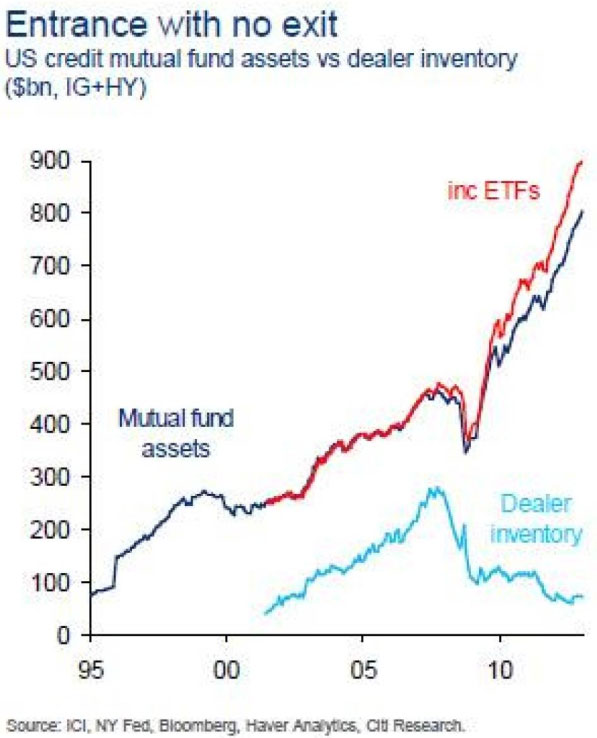
I think the process is doomed to failure, although it might be a step in the right direction. The big problem is lack of inventories, which are small because the profits are thin and the capital expensive. I think the only logical goal is for the big pension funds to act more like trading desks, making markets and swapping stuff in and out of their portfolios on demand (while maintaining overall portfolio objectives) – the way, for instance, I have been trading fixed income in my small way for the past twenty-one years (although, with respect to bonds, only through brokers). I suspect, however, that there are immense cultural and regulatory roadblocks between the current reality and the endgame.

There’s a funny story on French regulation:

This week, a Paris court of appeal ordered the cosmetics chain Sephora to close its flagship store on the avenue at 9 p.m., rather than staying open until midnight during the week and until 1 a.m. on Fridays and Saturdays.

But at a time when the national economy remains stuck in a rut and unemployment continues to rise, this latest ruling on Sephora has struck a raw nerve. The case was brought by a consortium of labour unions, which has been zealous in its attempts to have the store-closing hour law enforced, arguing that it needs to protect workers from unscrupulous owners who force them to work antisocial hours. But that logic is patently untrue in this case.

The cosmetics chain reckons it does about 20 per cent of its business after 9 p.m., and the 50 sales staff who work the late shift do so voluntarily – and are paid an hourly rate that is 25 per cent higher than the day shift. Many of them are students or part-time workers, and they have publicly expressed their indignation about being put out of work by labour unions.

S&P has a very interesting report on Exchange operational issues and problems thereof and credit implications thereof thereof:

We view stock exchanges’ higher vulnerability to operational risk (compared with derivative and futures exchanges), primarily as a function of the numerous point-to-point connections between stock exchanges and the variety of order types they process. Derivatives and futures exchanges, like IntercontinentalExchange and CME Group, tend to have “vertical silo” business models, in which the listings, trading, and clearing of contracts are done under one roof. This means they are less connected to other exchanges and clearinghouses.

The greater fragmentation in the equities markets (especially in the U.S.) creates more interconnectivity between exchanges, which leaves them more vulnerable to operational failures. There are 16 SEC-registered securities exchanges and more than 50 alternative trading platforms in the U.S., each of which is linked with others though a vast web of connections, including those that provide connectivity, routing services, and market data. And additional regulatory and disclosure requirements for stock exchanges, such as the consolidated tape–which provides real time data on prices and trading volumes–increase the complexity of the systems and exposure to operational problems.

Numerous order types also add to the complexity of the equities markets and amplify operational risk. To make the matter even more complicated, there have been discrepancies around how some exchanges execute their order types compared with their own rule books. For example, in January 2013, BATS announced that upon a National Best Bid and Offer (NBBO) update on BATS’ BYX Exchange, BZX Exchange, and BATS Options, it had discovered a problem with its matching engine that caused the execution of a short sale order at a price that was equal to or less than the NBBO. The problem started in 2008, but it took the company more than four years to identify it.

There’s been another breakthrough in solar energy technology, not made in Ontario as we spent all the potential research money on not-ready-for-prime-time technology:

The Fraunhofer Institute for Solar Energy Systems ISE, Soitec, CEA-Leti and the Helmholtz Center Berlin jointly announced today having achieved a new world record for the conversion of sunlight into electricity using a new solar cell structure with four solar subcells. Surpassing competition after only over three years of research, and entering the roadmap at world class level, a new record efficiency of 44.7% was measured at a concentration of 297 suns. This indicates that 44.7% of the solar spectrum’s energy, from ultraviolet through to the infrared, is converted into electrical energy. This is a major step towards reducing further the costs of solar electricity and continues to pave the way to the 50% efficiency roadmap.

S&P is also taking a wait and see attitude towards Fairfax, proud issuer of XXX:

Standard & Poor’s Ratings Services said today that the Sept. 23, 2013, signing of a letter of intent by an investor consortium led by Fairfax Financial Holdings Ltd. (Fairfax) to acquire BlackBerry Ltd., subject to due diligence, for approximately $4.7 billion has no effect on the ratings on Fairfax. As disclosed in the announcement, Fairfax currently owns about 10% of BlackBerry’s common shares, which it intends to contribute to the transaction. We expect the consortium to complete its due diligence by Nov. 4, 2013. If satisfactory, the consortium would enter into a definitive transaction agreement with BlackBerry at that time. Until then BlackBerry will be free to consider alternative offers. We will monitor the development of this transaction during the next six weeks and evaluate any potential impact on Fairfax as more information becomes available about the financing structure and the likelihood of the transaction being completed.

It was a mixed day for the Canadian preferred share market, with PerpetualDiscounts gaining 11bp, FixedResets ostensibly down 42bp and DeemedRetractibles up 21bp. The large FixedReset loss is about half due to a single issue, FTS.PR.K, which ostensibly closed at 20.27-24.29, 1×1 after trading 31,415 shares in a range of 24.25-50. So this is either a lazy market maker or stupid dumb reporting by the Toronto Stock Exchange – I can’t be bothered to work out which. The Performance Highlights table is extremely lengthy. Volume was very high.

PerpetualDiscounts now yield 5.53%, equivalent to 7.19% interest at the standard equivalency factor of 1.3x. Long corporates now yield about 4.9%, so the pre-tax interest-equivalent spread (in this context, the Seniority Spread) is now about 230bp, a small (and perhaps spurious) decline from the 235bp reported September 18.

HIMIPref™ Preferred Indices
These values reflect the December 2008 revision of the HIMIPref™ Indices

Values are provisional and are finalized monthly
Index Mean
Current
Yield
(at bid)
Median
YTW
Median
Average
Trading
Value
Median
Mod Dur
(YTW)
Issues Day’s Perf. Index Value
Ratchet 0.00 % 0.00 % 0 0.00 0 -0.3316 % 2,554.1
FixedFloater 4.11 % 3.43 % 31,729 18.43 1 0.0000 % 4,037.7
Floater 2.65 % 2.85 % 63,821 20.10 5 -0.3316 % 2,757.7
OpRet 4.61 % 1.47 % 68,400 0.51 3 0.2441 % 2,645.3
SplitShare 4.75 % 4.62 % 59,717 4.05 6 0.1957 % 2,950.6
Interest-Bearing 0.00 % 0.00 % 0 0.00 0 0.2441 % 2,418.8
Perpetual-Premium 5.86 % 5.87 % 125,696 13.97 2 0.0591 % 2,264.6
Perpetual-Discount 5.54 % 5.53 % 140,667 14.36 36 0.1080 % 2,356.5
FixedReset 4.93 % 3.67 % 242,855 3.67 85 -0.4238 % 2,454.4
Deemed-Retractible 5.10 % 4.45 % 196,168 3.75 43 0.2052 % 2,386.3
Performance Highlights
Issue Index Change Notes
FTS.PR.K FixedReset -17.10 % The “last” quote sold to me at an enormous price by the Toronto Stock Exchange is 20.27-24.29, 1×1 after trading 31,415 shares in a range of 24.25-50. So this is either a lazy market maker or stupid dumb reporting by the Exchange.
YTW SCENARIO
Maturity Type : Limit Maturity
Maturity Date : 2043-09-25
Maturity Price : 20.27
Evaluated at bid price : 20.27
Bid-YTW : 5.01 %
SLF.PR.G FixedReset -2.74 % YTW SCENARIO
Maturity Type : Hard Maturity
Maturity Date : 2025-01-31
Maturity Price : 25.00
Evaluated at bid price : 23.45
Bid-YTW : 4.26 %
TRI.PR.B Floater -2.04 % YTW SCENARIO
Maturity Type : Limit Maturity
Maturity Date : 2043-09-25
Maturity Price : 21.08
Evaluated at bid price : 21.08
Bid-YTW : 2.48 %
BAM.PF.D Perpetual-Discount -1.72 % YTW SCENARIO
Maturity Type : Limit Maturity
Maturity Date : 2043-09-25
Maturity Price : 21.08
Evaluated at bid price : 21.08
Bid-YTW : 5.85 %
CIU.PR.C FixedReset -1.56 % YTW SCENARIO
Maturity Type : Limit Maturity
Maturity Date : 2043-09-25
Maturity Price : 21.85
Evaluated at bid price : 22.10
Bid-YTW : 3.86 %
BAM.PR.M Perpetual-Discount -1.41 % YTW SCENARIO
Maturity Type : Limit Maturity
Maturity Date : 2043-09-25
Maturity Price : 20.35
Evaluated at bid price : 20.35
Bid-YTW : 5.87 %
BAM.PF.C Perpetual-Discount -1.16 % YTW SCENARIO
Maturity Type : Limit Maturity
Maturity Date : 2043-09-25
Maturity Price : 20.45
Evaluated at bid price : 20.45
Bid-YTW : 5.97 %
PWF.PR.S Perpetual-Discount -1.10 % YTW SCENARIO
Maturity Type : Limit Maturity
Maturity Date : 2043-09-25
Maturity Price : 22.29
Evaluated at bid price : 22.58
Bid-YTW : 5.39 %
MFC.PR.J FixedReset -1.07 % YTW SCENARIO
Maturity Type : Call
Maturity Date : 2018-03-19
Maturity Price : 25.00
Evaluated at bid price : 24.93
Bid-YTW : 4.11 %
TRP.PR.B FixedReset -1.07 % YTW SCENARIO
Maturity Type : Limit Maturity
Maturity Date : 2043-09-25
Maturity Price : 20.36
Evaluated at bid price : 20.36
Bid-YTW : 4.10 %
GWO.PR.N FixedReset -1.06 % YTW SCENARIO
Maturity Type : Hard Maturity
Maturity Date : 2025-01-31
Maturity Price : 25.00
Evaluated at bid price : 22.40
Bid-YTW : 4.57 %
IFC.PR.C FixedReset -1.05 % YTW SCENARIO
Maturity Type : Call
Maturity Date : 2016-09-30
Maturity Price : 25.00
Evaluated at bid price : 25.34
Bid-YTW : 3.72 %
FTS.PR.J Perpetual-Discount -1.00 % YTW SCENARIO
Maturity Type : Limit Maturity
Maturity Date : 2043-09-25
Maturity Price : 22.37
Evaluated at bid price : 22.70
Bid-YTW : 5.27 %
ELF.PR.H Perpetual-Discount 1.00 % YTW SCENARIO
Maturity Type : Limit Maturity
Maturity Date : 2043-09-25
Maturity Price : 23.86
Evaluated at bid price : 24.24
Bid-YTW : 5.77 %
HSB.PR.D Deemed-Retractible 1.00 % YTW SCENARIO
Maturity Type : Call
Maturity Date : 2014-12-31
Maturity Price : 25.00
Evaluated at bid price : 25.20
Bid-YTW : 4.32 %
SLF.PR.A Deemed-Retractible 1.03 % YTW SCENARIO
Maturity Type : Hard Maturity
Maturity Date : 2025-01-31
Maturity Price : 25.00
Evaluated at bid price : 22.63
Bid-YTW : 5.94 %
GWO.PR.G Deemed-Retractible 1.32 % YTW SCENARIO
Maturity Type : Hard Maturity
Maturity Date : 2025-01-31
Maturity Price : 25.00
Evaluated at bid price : 23.86
Bid-YTW : 5.78 %
RY.PR.C Deemed-Retractible 1.44 % YTW SCENARIO
Maturity Type : Call
Maturity Date : 2015-11-24
Maturity Price : 25.00
Evaluated at bid price : 25.40
Bid-YTW : 4.04 %
ELF.PR.G Perpetual-Discount 1.86 % YTW SCENARIO
Maturity Type : Limit Maturity
Maturity Date : 2043-09-25
Maturity Price : 21.85
Evaluated at bid price : 21.85
Bid-YTW : 5.54 %
Volume Highlights
Issue Index Shares
Traded
Notes
FTS.PR.E OpRet 90,900 Nesbitt crossed blocks of 50,000 and 40,000, both at 25.95.
YTW SCENARIO
Maturity Type : Call
Maturity Date : 2013-10-25
Maturity Price : 25.75
Evaluated at bid price : 25.90
Bid-YTW : 1.47 %
RY.PR.D Deemed-Retractible 70,639 TD bought 14,400 from RBC at 25.22, then crossed 40,000 at the same price.
YTW SCENARIO
Maturity Type : Hard Maturity
Maturity Date : 2022-01-31
Maturity Price : 25.00
Evaluated at bid price : 25.22
Bid-YTW : 4.45 %
BAM.PR.T FixedReset 67,825 TD crossed 60,700 at 24.22.
YTW SCENARIO
Maturity Type : Limit Maturity
Maturity Date : 2043-09-25
Maturity Price : 22.97
Evaluated at bid price : 24.14
Bid-YTW : 4.43 %
BMO.PR.K Deemed-Retractible 63,794 Nesbitt crossed 50,000 at 25.85.
YTW SCENARIO
Maturity Type : Call
Maturity Date : 2016-11-25
Maturity Price : 25.00
Evaluated at bid price : 25.75
Bid-YTW : 4.40 %
BNS.PR.L Deemed-Retractible 57,855 TD crossed 50,000 at 25.40.
YTW SCENARIO
Maturity Type : Hard Maturity
Maturity Date : 2022-01-31
Maturity Price : 25.00
Evaluated at bid price : 25.38
Bid-YTW : 4.40 %
BNS.PR.Q FixedReset 54,394 YTW SCENARIO
Maturity Type : Hard Maturity
Maturity Date : 2022-01-31
Maturity Price : 25.00
Evaluated at bid price : 25.15
Bid-YTW : 3.72 %
There were 61 other index-included issues trading in excess of 10,000 shares.
Wide Spread Highlights
Issue Index Quote Data and Yield Notes
FTS.PR.K FixedReset Quote: 20.27 – 24.49
Spot Rate : 4.2200
Average : 2.2600

YTW SCENARIO
Maturity Type : Limit Maturity
Maturity Date : 2043-09-25
Maturity Price : 20.27
Evaluated at bid price : 20.27
Bid-YTW : 5.01 %

TRP.PR.C FixedReset Quote: 23.15 – 23.80
Spot Rate : 0.6500
Average : 0.4314

YTW SCENARIO
Maturity Type : Limit Maturity
Maturity Date : 2043-09-25
Maturity Price : 22.62
Evaluated at bid price : 23.15
Bid-YTW : 3.93 %

CIU.PR.C FixedReset Quote: 22.10 – 23.00
Spot Rate : 0.9000
Average : 0.7068

YTW SCENARIO
Maturity Type : Limit Maturity
Maturity Date : 2043-09-25
Maturity Price : 21.85
Evaluated at bid price : 22.10
Bid-YTW : 3.86 %

BAM.PF.C Perpetual-Discount Quote: 20.45 – 20.91
Spot Rate : 0.4600
Average : 0.3064

YTW SCENARIO
Maturity Type : Limit Maturity
Maturity Date : 2043-09-25
Maturity Price : 20.45
Evaluated at bid price : 20.45
Bid-YTW : 5.97 %

IAG.PR.A Deemed-Retractible Quote: 22.10 – 22.53
Spot Rate : 0.4300
Average : 0.2885

YTW SCENARIO
Maturity Type : Hard Maturity
Maturity Date : 2025-01-31
Maturity Price : 25.00
Evaluated at bid price : 22.10
Bid-YTW : 6.06 %

GWO.PR.Q Deemed-Retractible Quote: 23.85 – 24.30
Spot Rate : 0.4500
Average : 0.3203

YTW SCENARIO
Maturity Type : Hard Maturity
Maturity Date : 2025-01-31
Maturity Price : 25.00
Evaluated at bid price : 23.85
Bid-YTW : 5.74 %

Issue Comments

DFN.PR.A Secondary Offering Successful

Quadravest Capital Management Inc. has announced:

Dividend 15 Split Corp. (the “Company”) is pleased to announce that it has completed the overnight marketing of up to 1,866,380 Preferred Shares and up to 1,866,380 Class A Shares. Total proceeds of the offering are expected to be approximately $38 million [Footnote]. Due to strong demand the Company increased the size of the offering from its original target. The offering was co-led by National Bank Financial, CIBC World Markets and RBC Capital Markets and also included BMO Nesbitt Burns Inc. and TD Securities Inc. The sales period of this overnight offering has now ended.

[Footnote reads:] (1) Offering includes public transaction and private placement

The overnight offering was reported on PrefBlog yesterday.

Market Action

September 24, 2013

I’m glad to see someone resisting the politicization of the Fed:

Richard Fisher, president of the Federal Reserve Bank of Dallas, said the White House botched the nomination for Chairman Ben S. Bernanke’s successor by allowing an unprecedented public debate over who would be the best choice.

“The White House has mishandled this terribly,” Fisher said today in response to a question from the audience after giving a speech in San Antonio, Texas. “This should not be a public debate,” he said, adding that the Fed “must never be a political instrument.”

There is some concern regarding the seasonal adjustments in the US jobs number:

Yet a new paper presented by Johns Hopkins economist Jonathan Wright at the Brookings Institution’s Panel of Economic Activity indicates that the Fed may have been misled by meaningless data. The evidence suggests that employment growth was just as anemic in July, when the Bureau of Labor Statistics reported 332,000 new jobs, as it was in February, when the BLS reported that only 104,000 jobs were added.

The problem is due to some peculiarities in the formula for seasonal adjustments. Weather, the school calendar and holidays all affect how many people are working in any given month, creating a lot of volatility in the raw jobs numbers. For example, the BLS reported that 1.2 million jobs were lost in July and 378,000 were added in August. Thanks to seasonal adjustments, however, most people think that 104,000 jobs were added in July and 169,000 were added in August. The truth is somewhere in between.

First, the Fed has become hypersensitive to monthly jobs data. Second, the process by which the BLS smooths out its raw data seems to have been corrupted by a statistical artifact. As Wright explains, the job losses associated with the Great Recession were concentrated at the end of 2008 and the beginning of 2009 — the coldest months of the year. That distorted the BLS’s seasonal adjustment algorithm, which uses the past three years of data to determine the “normal” pattern of employment growth in different months.

This was first suspected by economists at Nomura and Goldman Sachs, as Cardiff Garcia reported at FT Alphaville. However, Wright’s paper presents the first conclusive evidence.

It is becoming apparent that Obamacare is more like wealth transfer than insurance:

Binko is one of 2.7 million healthy 18- to 34-year-olds, dubbed the young invincibles, that the Obama administration has said are needed in the exchanges to offset the cost of providing care for millions of other uninsured people who are likely to be older and sicker. Without young adults, who pay for insurance yet rarely use it, premium costs in the exchanges may soar.

“For young people learning to take care of ourselves, it’s foolish if we have to take care of the older generation too,” Binko, who now lives in Los Angeles, said in an interview.

Young invincibles are the focus of a pitched battle between Obamacare backers and the law’s opponents as the U.S. nears the Oct. 1 roll-out of government-run insurance exchanges. It’s a conflict playing out on television and the Internet, on college campuses and in door-to-door campaigns by volunteers nationwide.

“This demographic is critical,” Caroline Pearson, a vice president at Washington-based consulting firm Avalere Health LLC, said in an interview. “If you mostly have high risk people, premiums go up. It becomes a death spiral.”

Whether or not wealth transfer is desirable, if indulged in it should be financed through the tax system, rather than dressed up as something it isn’t.

Here are some illuminating tech facts:

BlackBerry, which released the flagship Z10 touchscreen phone earlier this year, sold 5.9 million smartphones during the last three months. Apple sold more than 9 million over the weekend.

The companies’ different trajectories became even more vivid today when BlackBerry said it tentatively agreed to a $4.7 billion buyout by a group led by Fairfax Financial Holdings. Meanwhile, Apple’s stock rose 5 percent following the sales announcement, giving the California company a market value of almost $446 billion.

Speaking of Blackberry, it’s setting records:

BlackBerry Ltd. (BBRY), once valued at $83 billion, may be stuck with the cheapest valuation ever for a North American technology or telecommunications takeover.

The smartphone maker said yesterday it reached a tentative agreement for a $4.7 billion buyout by a group led by Fairfax Financial Holdings Ltd. (FFH), its biggest shareholder. Including net cash, the proposal values the Waterloo, Ontario-based company at an 80 percent discount to its book value and just 0.17 times its sales, the cheapest revenue multiple on record among similar-sized North American telecommunications or technology acquisitions, according to data compiled by Bloomberg.

AltaGas Ltd., proud issuer of ALA.PR.A, was confirmed at Pfd-3 [Stable] by DBRS:

DBRS has today confirmed the ratings on both the Medium-Term Notes and Issuer Rating of AltaGas Ltd. (AltaGas or the Company) at BBB and on the Preferred Shares – Cumulative at Pfd-3, all with Stable trends. The confirmation reflects Company’s: (1) improving business risk profile, as almost 80% of the Company’s earnings are supported by either stable regulated returns or long-term contacts; (2) diversified sources of revenue from its Utilities, Power and Gas segments operating in Canada and the United States; (3) improved quality of earnings since the addition of utilities (SEMCO Energy Inc. and Pacific Northern Gas Ltd.) and cleaner power generation assets (Blythe Energy, LLC (Blythe)) to the Company’s portfolio. These new assets are primarily underpinned by long-term take-or-pay commitments, resulting in no incremental direct exposure to commodity price risk.

DBRS notes that in the past five years, AltaGas’s credit metrics have weakened due to its aggressive growth capital expenditures (capex) program, which has added approximately $4 billion in new and expanded assets. Company’s key credit metrics are expected to remain weak over the near term, but are expected to recover in the medium term as major projects come on stream and full-year benefits from new assets are realized. Going forward, DBRS expects the Company to finance its capex program with a prudent mix of equity and debt and maintain credit metrics consistent with its current rating.

It was a strong day for the Canadian preferred share market, with PerpetualDiscounts winning 31bp, FixedResets gaining 17bp and DeemedRetractibles up 27bp. The Performance Highlights table is suitable skewed towards winners. Volume was very extremely awfully high.

HIMIPref™ Preferred Indices
These values reflect the December 2008 revision of the HIMIPref™ Indices

Values are provisional and are finalized monthly
Index Mean
Current
Yield
(at bid)
Median
YTW
Median
Average
Trading
Value
Median
Mod Dur
(YTW)
Issues Day’s Perf. Index Value
Ratchet 0.00 % 0.00 % 0 0.00 0 -0.6688 % 2,562.6
FixedFloater 4.11 % 3.43 % 29,363 18.43 1 1.7621 % 4,037.7
Floater 2.64 % 2.87 % 62,895 20.05 5 -0.6688 % 2,766.9
OpRet 4.63 % 2.44 % 65,857 0.51 3 0.1415 % 2,638.8
SplitShare 4.76 % 4.82 % 59,666 4.05 6 -0.0944 % 2,944.8
Interest-Bearing 0.00 % 0.00 % 0 0.00 0 0.1415 % 2,412.9
Perpetual-Premium 5.86 % 5.88 % 126,314 13.95 2 -0.0197 % 2,263.2
Perpetual-Discount 5.53 % 5.54 % 140,017 14.34 36 0.3079 % 2,354.0
FixedReset 4.91 % 3.59 % 240,667 3.65 85 0.1741 % 2,464.9
Deemed-Retractible 5.11 % 4.51 % 195,581 4.71 43 0.2658 % 2,381.4
Performance Highlights
Issue Index Change Notes
TRI.PR.B Floater -3.28 % YTW SCENARIO
Maturity Type : Limit Maturity
Maturity Date : 2043-09-24
Maturity Price : 21.25
Evaluated at bid price : 21.52
Bid-YTW : 2.40 %
SLF.PR.E Deemed-Retractible 1.06 % YTW SCENARIO
Maturity Type : Hard Maturity
Maturity Date : 2025-01-31
Maturity Price : 25.00
Evaluated at bid price : 21.86
Bid-YTW : 6.07 %
BNS.PR.Y FixedReset 1.09 % YTW SCENARIO
Maturity Type : Hard Maturity
Maturity Date : 2022-01-31
Maturity Price : 25.00
Evaluated at bid price : 24.16
Bid-YTW : 3.73 %
IFC.PR.A FixedReset 1.10 % YTW SCENARIO
Maturity Type : Hard Maturity
Maturity Date : 2025-01-31
Maturity Price : 25.00
Evaluated at bid price : 23.92
Bid-YTW : 4.42 %
GWO.PR.Q Deemed-Retractible 1.19 % YTW SCENARIO
Maturity Type : Hard Maturity
Maturity Date : 2025-01-31
Maturity Price : 25.00
Evaluated at bid price : 23.76
Bid-YTW : 5.78 %
SLF.PR.D Deemed-Retractible 1.21 % YTW SCENARIO
Maturity Type : Hard Maturity
Maturity Date : 2025-01-31
Maturity Price : 25.00
Evaluated at bid price : 21.83
Bid-YTW : 6.03 %
SLF.PR.B Deemed-Retractible 1.39 % YTW SCENARIO
Maturity Type : Hard Maturity
Maturity Date : 2025-01-31
Maturity Price : 25.00
Evaluated at bid price : 22.64
Bid-YTW : 5.98 %
BAM.PF.B FixedReset 1.62 % YTW SCENARIO
Maturity Type : Limit Maturity
Maturity Date : 2043-09-24
Maturity Price : 22.70
Evaluated at bid price : 23.88
Bid-YTW : 4.64 %
BAM.PR.G FixedFloater 1.76 % YTW SCENARIO
Maturity Type : Limit Maturity
Maturity Date : 2043-09-24
Maturity Price : 23.23
Evaluated at bid price : 23.10
Bid-YTW : 3.43 %
FTS.PR.J Perpetual-Discount 1.82 % YTW SCENARIO
Maturity Type : Limit Maturity
Maturity Date : 2043-09-24
Maturity Price : 22.57
Evaluated at bid price : 22.93
Bid-YTW : 5.21 %
Volume Highlights
Issue Index Shares
Traded
Notes
TRP.PR.B FixedReset 677,768 RBC crossed five blocks; two of 258,900 each, two of 25,000 each and the last for 97,000, all at 20.59.
YTW SCENARIO
Maturity Type : Limit Maturity
Maturity Date : 2043-09-24
Maturity Price : 20.58
Evaluated at bid price : 20.58
Bid-YTW : 4.06 %
FTS.PR.J Perpetual-Discount 133,955 Nesbitt crossed blocks of 63,000 and 60,000, both at 22.60.
YTW SCENARIO
Maturity Type : Limit Maturity
Maturity Date : 2043-09-24
Maturity Price : 22.57
Evaluated at bid price : 22.93
Bid-YTW : 5.21 %
FTS.PR.F Perpetual-Discount 107,755 Desjardins crossed blocks of 43,800 and 50,000, both at 22.90.
YTW SCENARIO
Maturity Type : Limit Maturity
Maturity Date : 2043-09-24
Maturity Price : 22.70
Evaluated at bid price : 22.99
Bid-YTW : 5.37 %
PWF.PR.P FixedReset 63,871 RBC crossed 38,200 at 24.30.
YTW SCENARIO
Maturity Type : Limit Maturity
Maturity Date : 2043-09-24
Maturity Price : 23.15
Evaluated at bid price : 24.15
Bid-YTW : 3.78 %
BMO.PR.O FixedReset 63,170 RBC crossed 50,000 at 25.81.
YTW SCENARIO
Maturity Type : Call
Maturity Date : 2014-05-25
Maturity Price : 25.00
Evaluated at bid price : 25.78
Bid-YTW : 2.54 %
CU.PR.F Perpetual-Discount 59,765 Scotia crossed 47,200 at 21.59.
YTW SCENARIO
Maturity Type : Limit Maturity
Maturity Date : 2043-09-24
Maturity Price : 21.47
Evaluated at bid price : 21.75
Bid-YTW : 5.21 %
There were 80 other index-included issues trading in excess of 10,000 shares.
Wide Spread Highlights
Issue Index Quote Data and Yield Notes
TRI.PR.B Floater Quote: 21.52 – 22.49
Spot Rate : 0.9700
Average : 0.6428

YTW SCENARIO
Maturity Type : Limit Maturity
Maturity Date : 2043-09-24
Maturity Price : 21.25
Evaluated at bid price : 21.52
Bid-YTW : 2.40 %

IFC.PR.A FixedReset Quote: 23.92 – 24.70
Spot Rate : 0.7800
Average : 0.4842

YTW SCENARIO
Maturity Type : Hard Maturity
Maturity Date : 2025-01-31
Maturity Price : 25.00
Evaluated at bid price : 23.92
Bid-YTW : 4.42 %

ELF.PR.H Perpetual-Discount Quote: 24.00 – 24.70
Spot Rate : 0.7000
Average : 0.5125

YTW SCENARIO
Maturity Type : Limit Maturity
Maturity Date : 2043-09-24
Maturity Price : 23.64
Evaluated at bid price : 24.00
Bid-YTW : 5.83 %

HSB.PR.D Deemed-Retractible Quote: 24.95 – 25.50
Spot Rate : 0.5500
Average : 0.3815

YTW SCENARIO
Maturity Type : Hard Maturity
Maturity Date : 2022-01-31
Maturity Price : 25.00
Evaluated at bid price : 24.95
Bid-YTW : 5.05 %

PWF.PR.P FixedReset Quote: 24.15 – 24.60
Spot Rate : 0.4500
Average : 0.3004

YTW SCENARIO
Maturity Type : Limit Maturity
Maturity Date : 2043-09-24
Maturity Price : 23.15
Evaluated at bid price : 24.15
Bid-YTW : 3.78 %

SLF.PR.A Deemed-Retractible Quote: 22.40 – 22.86
Spot Rate : 0.4600
Average : 0.3192

YTW SCENARIO
Maturity Type : Hard Maturity
Maturity Date : 2025-01-31
Maturity Price : 25.00
Evaluated at bid price : 22.40
Bid-YTW : 6.06 %

Issue Comments

RBS.PR.B Upgraded to Pfd-2 by DBRS

DBRS has announced that it:

has today upgraded the rating of the Class B Preferred Shares, Series 1 (the Preferred Shares), issued by R Split III Corp. (the Company) to Pfd-2 from Pfd-2 (low). Approximately 1.23 million Preferred Shares were issued at $13.60 each on May 31, 2012, following the redemption of the Class A Preferred Shares in accordance with their original terms as part of a share capital reorganization. The final redemption date for the Preferred Shares is May 31, 2017.

The net proceeds from the issuance of the Preferred Shares were used by the Company to purchase common shares (the Portfolio) of Royal Bank of Canada (RBC; rated AA, Stable by DBRS).

Downside protection available to holders of the Preferred Shares increased to 68.8% as of September 12, 2013, compared to 66.3% on April 18, 2013. In addition, RBC raised its dividends on August 29, 2013, increasing quarterly distributions by four cents to 67 cents per share. This dividend boost increases the Preferred Share distribution coverage ratio to 2.6 times (up from 2.3 times in April 2013). The upgrade of the rating of the Preferred Shares is based primarily on the increasing level of downside protection available and the improved distribution coverage ratio.

RBS.PR.B is not tracked by HIMIPref™ – too small! It was last mentioned on PrefBlog when the offering was completed in May, 2012.

Issue Comments

DFN.PR.A To Get Bigger In Overnight Secondary Offering

Quadravest Capital Management Inc. has announced:

Dividend 15 Split Corp. (the “Company”) is pleased to announce that it has filed a short form prospectus in each of the provinces of Canada with respect to an additional offering of Preferred Shares and Class A Shares. The offering will be co-led by National Bank Financial, CIBC World Markets and RBC Capital Markets.

The Class A shares will be offered at a price of $10.75 per share to yield 11.16% and the Preferred Shares will be offered at a price of $10.00 per share to yield 5.25%. The closing price of the Class A Shares on September 23, 2013 on the TSX was $11.32 and the closing price of the Preferred Shares on September 23, 2013 on the TSX was $10.25. Since the Company commenced on March 16, 2004, it has exceeded its distribution objectives. The aggregate dividends paid on Class A shares have been $14.80 per share, representing 113 regular consecutive monthly distributions, plus six special distributions. The Preferred Shares have received a total of $4.96 per share for a combined total distribution of $19.76 per unit paid by the Company. All distributions have been made in tax advantage eligible Canadian dividends or capital gains dividends.

The proceeds of the secondary offering, net of expenses and the Agents’ fee, will be used by the Company to invest in an actively managed portfolio of dividend-yielding common shares which includes each of the 15 Canadian companies listed below. These are currently among the highest dividend-yielding securities in the S&P/TSX 60 Index:

Bank of Montreal Enbridge Inc. TELUS Corporation
The Bank of Nova Scotia Manulife Financial Corp. Thomson-Reuters Corporation
BCE Inc. National Bank of Canada The Toronto-Dominion Bank
Canadian Imperial Bank of Commerce Royal Bank of Canada TransAlta Corporation
CI Financial Corp. Sun Life Financial Inc. TransCanada Corporation

The Company’s investment objectives are:
Preferred Shares:
i. to provide holders of the Preferred Shares with fixed, cumulative preferential monthly cash dividends in the amount of $0.04375 per Preferred Share to yield 5.25% per annum on the original issue price; and
ii. on or about December 1, 2019, to pay the holders of the Preferred Shares the original issue price of those shares.

Class A Shares:
i. to provide holders of the Class A Shares with regular monthly cash dividends initially targeted to be $0.10 per Class A; and
ii. on or about December 1, 2019, to pay the holders of Class A Shares at least the original issue price of those shares.

The sales period of this overnight offering will end at 8:30 a.m. EST on September 25, 2013.

A copy of the preliminary short form prospectus is available from National Bank Financial, CIBC World Markets and RBC Capital Markets.

Commissions, trailing commissions, management fees and expenses all may be associated with mutual fund investments. Investors should read the prospectus before investing. Mutual funds are not guaranteed, their values change frequently and past performance may not be repeated.

$10.75 for the capital units looks very rich considering that the September 13 NAVPU was $19.34, which gives the capital units an intrinsic value of $9.34. Still, the closing price of DFN today was indeed $11.40, so fools who believe that greater fools will be around tomorrow will find this offering of great interest.

The preferred shares are incredibly attractive at the indicated price of $10.00, but I’ll bet a nickel nobody other than the underwriters actually buys at that level; however, at today’s closing quote of 10.20-25 they are still very attractive and many will find them of interest particularly if they decline with the additional supply.

DFN.PR.A is tracked by HIMIPref™ but relegated to the Scraps index on credit concerns. It was recently confirmed at Pfd-3 by DBRS. Income Coverage in 13H1 was 85%.

Market Action

September 23, 2013

S&P’s chief economist has more tapering chatter:

  • That the Fed did not announce tapering in September did not surprise us, as we have stuck to our December call.
  • Starting to taper was conditional on U.S. growth moving up a notch, which has not happened; in fact, the Fed has lowered its growth outlook.
  • In the wake of a financial crisis and deep recession, central banks face asymmetric risks: Tightening policy too early carries higher risks than leaving policy loose for too long.
  • Forward guidance attempts to guide markets, but, by incentivizing markets to hang on every central bank utterance, and react in a globally synchronized way, it risks amplifying the policy signals and creating volatility.
  • The new Fed chair should resist the temptation to overengineer forward guidance, but rather double down on the core message: The Fed has the requisite tools and is determined to use them.

Julie Dickson of OSFI made a speech to the 2013 National Insurance Conference of Canada:

Given that catastrophic risk seems to be growing, going forward we may also see insurers more actively expanding risk transfer mechanisms through Insurance Linked Securities (ILS). Catastrophe bonds can be used to help companies to reduce exposure to certain risks, including earthquakes. Cat bonds are an effective way to transfer risk to capital markets, instead of reinsurance markets, and to spread risks. At the same time, they do not eliminate all risk. For example, basis risk, where the trigger for a claim might not be directly matched to the losses of the insurer, could result in the insurer experiencing losses with no protection. From a capital perspective, if the link is not one-for-one with the expected losses, there is no capital benefit. But such catastrophe bonds can be a good addition to an insurer’s risk management program.

While issuance of catastrophe bonds may be a good addition to a company’s risk management tools, investments in catastrophe bonds could present risks to investors, particularly if the investments are being made in a search for yield, without regard to an understanding of the risks involved.

Another example of search for yield, which has recently been expressed in international circles [Footnote], is concern about too much capital from institutional investors (such as pension funds) entering the insurance system in search of yield. Such excess funding or capital can put downward pressure on premium rates, and assuming those rates were properly reflective of risk, this is not what should be happening (for example, where the increased severity and frequency of actual catastrophe risk is on the rise).

While we have not seen similar behaviours in Canada thus far, it is important to continue to be on the lookout for any evidence of a search for yield and unintended consequences.

[Footnote reads]:September 4, 2013, Lloyd’s chairman warns on ‘systemic risk’ of capital rush, Alistair Gray, Financial Times. The article can be found at the following link (subscription required): http://www.ft.com/intl/cms/s/0/04b80c2e-15aa-11e3-b519-
00144feabdc0.html

There’s a report on the report referenced in the footnote here.

I don’t consider this a big deal, but it’s one of the more precious initiatives around:

We are proposing amendments to Item 402 of Regulation S-K to implement Section 953(b) of the Dodd-Frank Wall Street Reform and Consumer Protection Act. Section 953(b) directs the Commission to amend Item 402 of Regulation S-K to require disclosure of the median of the annual total compensation of all employees of an issuer (excluding the chief executive officer), the annual total compensation of that issuer’s chief executive officer and the ratio of the median of the annual total compensation of all employees to the annual total compensation of the chief executive officer. The proposed disclosure would be required in any annual report, proxy or information statement or registration statement that requires executive compensation disclosure pursuant to Item 402 of Regulation S-K. The proposed disclosure requirements would not apply to emerging growth companies, smaller reporting companies or foreign private issuers.

On the other hand, this one is just stupid:

The OCC, Board, FDIC, Commission, FHFA, and HUD (the agencies) are seeking comment on a joint proposed rule (the proposed rule, or the proposal) to revise the proposed rule the agencies published in the Federal Register on April 29, 2011, and to implement the credit risk retention requirements of section 15G of the Securities Exchange Act of 1934 (15. U.S.C. 78o-11), as added by section 941 of the Dodd-Frank Wall Street Reform and Consumer Protection Act (Dodd-Frank Act). Section 15G generally requires the securitizer of asset-backed securities to retain not less than 5 percent of the credit risk of the assets collateralizing the asset-backed securities. Section 15G includes a variety of exemptions from these requirements, including an exemption for asset-backed securities that are collateralized exclusively by residential mortgages that qualify as “qualified residential mortgages,” as such term is defined by the agencies by rule.

It was credit risk retention by the brokerages that sparked the crisis in the first place!

Power Corporation, proud issuer of POW.PR.A, POW.PR.B, POW.PR.C, POW.PR.D, POW.PR.F and POW.PR.G, was confirmed at Pfd-2(high) by DBRS:

The credit strength of POW is directly tied to its roughly two-thirds equity interest in Power Financial Corporation (PWF), which represents a substantial majority of the Company’s earnings and cash flow, as well as the Company’s estimated net asset value.

As the controlling shareholder of PWF, and, by extension, of GWO and IGM, POW defines the strategic vision for its financial services investments, while setting the “tone from the top” in terms of conservative management style and risk analysis and tolerance. The Company’s senior officers and delegates exercise a greater degree of influence through their active participation on the respective boards and board committees of POW’s various subsidiaries than is generally the case at more widely held companies. Such an integrated management and governance approach is seldom encountered and has served the Company’s stakeholders well. On a stand-alone basis, POW’s financial profile is conservative, with debt and preferred shares representing just over 13% of capitalization. Financial leverage appears to be used to fund a portfolio of cash and short-term investments and a modest level of working capital. The Company’s liquidity is strong, with nearly $700 million in cash and short-term securities at June 30, 2013.

Power Financial Corporation, proud issuer of PWF.PR.A, PWF.PR.E, PWF.PR.F, PWF.PR.G, PWF.PR.H, PWF.PR.I, PWF.PR.K, PWF.PR.L, PWF.PR.M, PWF.PR.O, PWF.PR.P, PWF.PR.R and PWF.PR.S, has also been confirmed at Pfd-1(low) by DBRS:

The financial strength of PWF is largely derived from its controlling interests in two of Canada’s leading financial service providers: Great-West Lifeco Inc. (GWO; rated AA (low), Stable), one of the three largest life insurance concerns in Canada, and IGM Financial Inc. (IGM; rated A (high), Stable), one of the largest mutual fund complexes in Canada.

The Company’s almost 30% indirect equity interest in Pargesa Holding S.A. (Pargesa), a Geneva-based holding company, provides some additional geographic and industry diversification. While Pargesa does pay a small dividend, which is normally passed through to the Company, it is primarily managed to maximize net asset value over the long term.

The Company’s financial leverage has been maintained at a reasonable level for the past ten years. The Company’s capitalization remains conservative, with a less than 20% unconsolidated total debt (including preferred shares) ratio at the end of June 2013. Fixed charge coverage ratios are similarly strong relative to both earnings and cash flow. Liquidity is not a source of concern, with approximately $800 million in cash and short-term securities at the holding company level at June 30, 2013, in addition to stores of liquidity at both GWO and IGM.

I’m sure we’ll soon be seeing some commentary on FFH, in the wake of their big deal:

BlackBerry Ltd. (BB) reached a tentative agreement for a $4.7 billion buyout by a group led by its biggest shareholder, forging a path to go private after years of losing ground to Apple (AAPL) Inc.’s iPhone and Google Inc.’s Android.

The group led by Fairfax Financial Holdings Ltd. (FFH) would offer $9 a share in cash, according to a statement today — a 3.1 percent premium over BlackBerry’s closing price last week. The consortium is still seeking financing for the offer, which will be subject to due diligence and further negotiation.

It was a mixed day for the Canadian preferred share market, with PerpetualDiscounts and FixedResets both off 3bp, while DeemedRetractibles were up 14bp. The performance highlights table is surprisingly lengthy, given the modest overall moves. Volume was average.

HIMIPref™ Preferred Indices
These values reflect the December 2008 revision of the HIMIPref™ Indices

Values are provisional and are finalized monthly
Index Mean
Current
Yield
(at bid)
Median
YTW
Median
Average
Trading
Value
Median
Mod Dur
(YTW)
Issues Day’s Perf. Index Value
Ratchet 0.00 % 0.00 % 0 0.00 0 -0.5460 % 2,579.9
FixedFloater 4.19 % 3.50 % 29,486 18.29 1 0.6652 % 3,967.8
Floater 2.62 % 2.86 % 63,714 20.09 5 -0.5460 % 2,785.5
OpRet 4.63 % 2.57 % 65,856 0.08 3 0.0129 % 2,635.1
SplitShare 4.75 % 4.62 % 57,743 4.06 6 0.0163 % 2,947.6
Interest-Bearing 0.00 % 0.00 % 0 0.00 0 0.0129 % 2,409.5
Perpetual-Premium 5.86 % 5.87 % 123,746 13.98 2 -0.2750 % 2,263.7
Perpetual-Discount 5.55 % 5.63 % 138,720 14.35 36 -0.0313 % 2,346.8
FixedReset 4.92 % 3.65 % 239,366 3.68 85 -0.0303 % 2,460.6
Deemed-Retractible 5.13 % 4.59 % 194,537 6.88 43 0.1383 % 2,375.1
Performance Highlights
Issue Index Change Notes
TRI.PR.B Floater -1.72 % YTW SCENARIO
Maturity Type : Limit Maturity
Maturity Date : 2043-09-23
Maturity Price : 22.01
Evaluated at bid price : 22.25
Bid-YTW : 2.33 %
FTS.PR.H FixedReset -1.70 % YTW SCENARIO
Maturity Type : Limit Maturity
Maturity Date : 2043-09-23
Maturity Price : 20.80
Evaluated at bid price : 20.80
Bid-YTW : 4.24 %
HSE.PR.A FixedReset -1.39 % YTW SCENARIO
Maturity Type : Limit Maturity
Maturity Date : 2043-09-23
Maturity Price : 22.75
Evaluated at bid price : 23.42
Bid-YTW : 4.04 %
BNS.PR.Y FixedReset -1.20 % YTW SCENARIO
Maturity Type : Hard Maturity
Maturity Date : 2022-01-31
Maturity Price : 25.00
Evaluated at bid price : 23.90
Bid-YTW : 3.88 %
CU.PR.G Perpetual-Discount -1.16 % YTW SCENARIO
Maturity Type : Limit Maturity
Maturity Date : 2043-09-23
Maturity Price : 21.35
Evaluated at bid price : 21.35
Bid-YTW : 5.33 %
CU.PR.C FixedReset -1.12 % YTW SCENARIO
Maturity Type : Limit Maturity
Maturity Date : 2043-09-23
Maturity Price : 23.20
Evaluated at bid price : 24.77
Bid-YTW : 4.28 %
PWF.PR.K Perpetual-Discount -1.05 % YTW SCENARIO
Maturity Type : Limit Maturity
Maturity Date : 2043-09-23
Maturity Price : 22.16
Evaluated at bid price : 22.56
Bid-YTW : 5.55 %
POW.PR.G Perpetual-Discount -1.01 % YTW SCENARIO
Maturity Type : Limit Maturity
Maturity Date : 2043-09-23
Maturity Price : 24.09
Evaluated at bid price : 24.49
Bid-YTW : 5.71 %
TRP.PR.C FixedReset 1.05 % YTW SCENARIO
Maturity Type : Limit Maturity
Maturity Date : 2043-09-23
Maturity Price : 22.62
Evaluated at bid price : 23.15
Bid-YTW : 3.93 %
PWF.PR.E Perpetual-Discount 1.16 % YTW SCENARIO
Maturity Type : Limit Maturity
Maturity Date : 2043-09-23
Maturity Price : 24.15
Evaluated at bid price : 24.40
Bid-YTW : 5.72 %
IAG.PR.A Deemed-Retractible 1.30 % YTW SCENARIO
Maturity Type : Hard Maturity
Maturity Date : 2025-01-31
Maturity Price : 25.00
Evaluated at bid price : 21.85
Bid-YTW : 6.19 %
GWO.PR.N FixedReset 1.79 % YTW SCENARIO
Maturity Type : Hard Maturity
Maturity Date : 2025-01-31
Maturity Price : 25.00
Evaluated at bid price : 22.70
Bid-YTW : 4.42 %
CIU.PR.C FixedReset 1.99 % YTW SCENARIO
Maturity Type : Limit Maturity
Maturity Date : 2043-09-23
Maturity Price : 22.15
Evaluated at bid price : 22.51
Bid-YTW : 3.78 %
Volume Highlights
Issue Index Shares
Traded
Notes
BNS.PR.Q FixedReset 65,851 Nesbitt crossed 25,000 at 25.18.
YTW SCENARIO
Maturity Type : Hard Maturity
Maturity Date : 2022-01-31
Maturity Price : 25.00
Evaluated at bid price : 25.17
Bid-YTW : 3.71 %
BNS.PR.L Deemed-Retractible 59,650 Nesbitt crossed 50,000 at 25.39.
YTW SCENARIO
Maturity Type : Hard Maturity
Maturity Date : 2022-01-31
Maturity Price : 25.00
Evaluated at bid price : 25.38
Bid-YTW : 4.40 %
CU.PR.F Perpetual-Discount 58,700 Nesbitt crossed blocks of 20,000 and 25,000, both at 21.60.
YTW SCENARIO
Maturity Type : Limit Maturity
Maturity Date : 2043-09-23
Maturity Price : 21.26
Evaluated at bid price : 21.54
Bid-YTW : 5.26 %
TD.PR.S FixedReset 32,273 RBC crossed 17,000 at 24.85.
YTW SCENARIO
Maturity Type : Hard Maturity
Maturity Date : 2022-01-31
Maturity Price : 25.00
Evaluated at bid price : 24.80
Bid-YTW : 3.65 %
BNS.PR.Z FixedReset 26,246 TD crossed 11,600 at 24.15.
YTW SCENARIO
Maturity Type : Hard Maturity
Maturity Date : 2022-01-31
Maturity Price : 25.00
Evaluated at bid price : 24.17
Bid-YTW : 4.00 %
PWF.PR.M FixedReset 24,500 TD crossed 22,000 at 25.43.
YTW SCENARIO
Maturity Type : Call
Maturity Date : 2014-01-31
Maturity Price : 25.00
Evaluated at bid price : 25.41
Bid-YTW : 3.84 %
There were 33 other index-included issues trading in excess of 10,000 shares.
Wide Spread Highlights
Issue Index Quote Data and Yield Notes
TRP.PR.B FixedReset Quote: 20.50 – 20.96
Spot Rate : 0.4600
Average : 0.2756

YTW SCENARIO
Maturity Type : Limit Maturity
Maturity Date : 2043-09-23
Maturity Price : 20.50
Evaluated at bid price : 20.50
Bid-YTW : 4.07 %

BNS.PR.Y FixedReset Quote: 23.90 – 24.30
Spot Rate : 0.4000
Average : 0.2358

YTW SCENARIO
Maturity Type : Hard Maturity
Maturity Date : 2022-01-31
Maturity Price : 25.00
Evaluated at bid price : 23.90
Bid-YTW : 3.88 %

PWF.PR.A Floater Quote: 23.37 – 23.97
Spot Rate : 0.6000
Average : 0.4369

YTW SCENARIO
Maturity Type : Limit Maturity
Maturity Date : 2043-09-23
Maturity Price : 23.11
Evaluated at bid price : 23.37
Bid-YTW : 2.23 %

CIU.PR.A Perpetual-Discount Quote: 21.76 – 22.39
Spot Rate : 0.6300
Average : 0.4742

YTW SCENARIO
Maturity Type : Limit Maturity
Maturity Date : 2043-09-23
Maturity Price : 21.76
Evaluated at bid price : 21.76
Bid-YTW : 5.34 %

FTS.PR.J Perpetual-Discount Quote: 22.52 – 22.90
Spot Rate : 0.3800
Average : 0.2752

YTW SCENARIO
Maturity Type : Limit Maturity
Maturity Date : 2043-09-23
Maturity Price : 22.22
Evaluated at bid price : 22.52
Bid-YTW : 5.31 %

FTS.PR.K FixedReset Quote: 24.45 – 24.75
Spot Rate : 0.3000
Average : 0.1998

YTW SCENARIO
Maturity Type : Limit Maturity
Maturity Date : 2043-09-23
Maturity Price : 22.94
Evaluated at bid price : 24.45
Bid-YTW : 4.04 %

Issue Comments

BAM Outlook Raised to Stable by S&P

Standard and Poor’s has announced:

  • We are revising our outlook on Brookfield Asset Management Inc. to stable from negative.
  • At the same time, we are affirming our ratings on the company, including our ‘A-‘ long-term and ‘A-2’ short-term corporate credit ratings.
  • We base the outlook revision on our view that Brookfield’s credit measures have improved to levels within our target range for the rating on a sustainable basis, primarily because of improved funds from operations (FFO) generation.
  • Our estimate of Brookfield’s year-end 2013 FFO incorporates strong growth (before gains), driven by improved performance across most of the company’s operating platforms.


We view Brookfield’s portfolio diversity favorably and believe that the considerable level of diversification in the cash-generating assets of the investment platforms provides the company with strong insulation against geographic or asset-type-specific underperformance. Furthermore, Brookfield has a global investment portfolio with 80% of assets located in developed countries, with relatively more stable economic, political, and legal frameworks, such as the U.S., Canada, and Australia, and 20% in the growing and more volatile markets in Asia and South America. We believe the flexibility of having a high percent of invested assets in listed entities provides an additional level of liquidity that supports Brookfield’s ability to pay its corporate obligations in case of a sharper-than-expected decline in FFO or an unexpected cash need. In our opinion, Brookfield management has substantial noncore assets and financial instruments that can be quickly monetized.

The stable outlook reflects our view that debt at the corporate level has steadied and that FFO from investments has improved and should continue to increase modestly. Hence, FFO to debt at the company has improved to levels within our targets on a sustainable basis. We view Brookfield as an operating holding company and our target credit measure ranges recognize that its investments have become increasingly more liquid and provide strong financial flexibility. At the current rating level, we expect Brookfield to maintain FFO to debt of between 28%-38% and FFO coverage between 4.2x-5.5x as well as for it to maintain an investment strategy consistent with an operating holding company.

Coincidentally, this happened on the same day as Desjardins rhapsodized over the common stock:

Desjardins Securities reiterated its “top pick” rating on Brookfield Asset Management Inc., saying it is “comfortable” the Toronto-company’s shares have the potential to double in price within five years.

The company’s focus on real estate, infrastructure, power generation and asset management make it attractive to institutional and retail investors who are in search of yield but wary of “fragile” equity markets, Desjardins analysts Michael Goldberg and Bradley Romain wrote in a research report today.

Brookfield Asset Management is the proud issuer of:

FixedResets BAM.PF.A, BAM.PF.B, BAM.PR.P, BAM.PR.R, BAM.PR.T, BAM.PR.X, BAM.PR.Z
Floaters BAM.PR.B, BAM.PR.C, BAM.PR.K
RatchetRate BAM.PR.E
FixedFloater BAM.PR.G
OperatingRetractible BAM.PR.J
Straight Perpetual BAM.PR.M, BAM.PR.N, BAM.PF.C

New Issues

New Issue: PPL FixedReset, 4.70%+260

Pembina Pipeline Corporation has announced:

that it has entered into an agreement with a syndicate of underwriters, led by RBC Capital Markets and Scotiabank, pursuant to which the underwriters have agreed to purchase from Pembina 6,000,000 cumulative redeemable rate reset class A preferred shares, series 3 (the “Series 3 Preferred Shares”) at a price of $25.00 per share for distribution to the public.

The holders of Series 3 Preferred Shares will be entitled to receive fixed cumulative dividends at an annual rate of $1.1750 per share, payable quarterly on the 1st day of March, June, September and December, as and when declared by the Board of Directors of Pembina, yielding 4.70 per cent per annum, for the initial fixed rate period to but excluding March 1, 2019. The first quarterly dividend payment date is scheduled for December 1, 2013. The dividend rate will reset on March 1, 2019 and every five years thereafter at a rate equal to the sum of the then five-year Government of Canada bond yield plus 2.60 per cent. The Series 3 Preferred Shares are redeemable by Pembina, at its option, on March 1, 2019 and on March 1 of every fifth year thereafter at a price of $25.00 per share plus accrued and unpaid dividends.

The holders of Series 3 Preferred Shares will have the right to convert their shares into cumulative redeemable floating rate class A preferred shares, series 4 (the “Series 4 Preferred Shares”), subject to certain conditions, on March 1, 2019 and on March 1 of every fifth year thereafter. The holders of Series 4 Preferred Shares will be entitled to receive quarterly floating rate cumulative dividends, as and when declared by the Board of Directors of Pembina, at a rate equal to the sum of the then 90-day Government of Canada treasury bill rate plus 2.60 per cent.

Pembina has granted to the underwriters an option, exercisable at any time up to 48 hours prior to the closing of the offering, to purchase up to an additional 2,000,000 Series 3 Preferred Shares at a price of $25.00 per share.

Proceeds from the offering will be used to partially fund capital projects, to reduce short-term indebtedness and for other general corporate purposes of the Company and its affiliates.

Closing of the offering is expected on October 2, 2013, subject to customary closing conditions.

The offering is being made by means of a prospectus supplement under the short form base shelf prospectus filed by the Company on February 22, 2013 in each of the provinces of Canada.

This offering actually seems fairly priced relative to PPL.PR.A, which resets at +247 and trades a little under $24.

Update, 2013-9-25: Rated Pfd-3 [Stable] by DBRS.

Market Action

September 20, 2013

We’re getting a good start on October tapering chatter:

Federal Reserve Bank of St. Louis President James Bullard, a voter on policy this year who has backed record stimulus, said a small tapering of bond buying is possible next month after the Fed made a close call this week in deciding not to slow purchases.

“That was a borderline decision” after “weaker data came in,” Bullard said today on Bloomberg Television’s “Bloomberg Surveillance” with Tom Keene and Sara Eisen. “The committee came down on the side of, ‘Let’s wait.’”

Bullard called October a “live meeting,” because “it’s possible you could get some data that change the complexion of the outlook and could make the committee be comfortable with a small taper in October.”

Meanwhile, political games in Washington may have an effect:

The U.S. House voted to finance the federal government through Dec. 15 and choke off funding for President Barack Obama’s health-care law, setting up what could be a prolonged showdown with the Senate and White House.

House Republicans said they wouldn’t accept Senate Majority Leader Harry Reid’s plan to remove the health-care language from the bill next week and warned of a temporary government shutdown after the fiscal year ends Sept. 30.

“We’ll add some other things that they hate and make them eat that, and we’ll play this game up until either Sept. 30, Oct. 3, somewhere in between,” said freshman Representative Richard Hudson, a North Carolina Republican. “At that point Harry Reid’s going to realize we’re serious and hopefully at that point, he’ll begin to negotiate with us.”

Inflation continues to be the least of our worries:

Canada’s inflation rate slowed for the first time in four months in August, approaching the bottom of the central bank’s target band, on lower costs for mortgage interest and prescription drugs.

The consumer price index rose 1.1 percent in August from a year ago, following July’s 1.3 percent pace, Statistics Canada said today from Ottawa. The core rate, which excludes eight volatile products, slowed to 1.3 percent from 1.4 percent.

Bank of Canada Governor Stephen Poloz, who sets policy to keep price gains in the middle of a 1 percent to 3 percent range, has said inflation will remain below 2 percent until mid-2015. The central bank’s key lending rate has been 1 percent for three years, the longest pause since the 1950s, and economists surveyed by Bloomberg predict Poloz won’t raise borrowing costs until the second half of 2014.

I must tell you about my wonderful new flashlight I purchased a few days ago from Baby Point Hardware


Click for big

The light source is a 3×8 grid of halogen lamps; it’s powered by 3 AA batteries. The light is very bright and by itself is reason to be impressed. There’s a magnet on the back – so I’ve got mine stuck to my fridge – and there’s also a plastic fold-out hook (like the hook on a clothes hanger) for hanging it somewhere convenient. What I find very impressive is that the halogen bulbs are recessed behind a cover that has a lens in front of each bulb. When you shine the light at a wall, it doesn’t make a diffuse rectangular pattern as one might expect, it makes a circular pattern just like a regular single-light-source flashlight would. I think this is really great engineering and – best of all – it only cost ten bucks and change!

My only complaint is that there is no manufacturer information on the case – the only clue is a logo for “Lightway”. However logical the name “Lightway” might be for a flashlight, it doesn’t help much with Google searches, which bring up a lot of Christian ministries but not a single flashlight manufacturer.

What a great time to be alive! Even little things like flashlights are being improved out of all recognition!

In markets, Canadian equity volume was huge as some tech firm did what tech firms do best.

It was a mixed day for the Canadian preferred share market, with PerpetualDiscounts up 24bp, FixedResets off 2bp and DeemedRetractibles gaining 2bp. The Performance Highlights table is longer than might be expected, but with mixed contents. Volume was very low.

HIMIPref™ Preferred Indices
These values reflect the December 2008 revision of the HIMIPref™ Indices

Values are provisional and are finalized monthly
Index Mean
Current
Yield
(at bid)
Median
YTW
Median
Average
Trading
Value
Median
Mod Dur
(YTW)
Issues Day’s Perf. Index Value
Ratchet 0.00 % 0.00 % 0 0.00 0 0.0894 % 2,594.0
FixedFloater 4.21 % 3.53 % 29,924 18.25 1 1.5766 % 3,941.6
Floater 2.61 % 2.86 % 64,699 20.09 5 0.0894 % 2,800.8
OpRet 4.63 % 2.39 % 68,254 0.52 3 -0.3207 % 2,634.7
SplitShare 4.75 % 4.61 % 58,475 4.07 6 0.0554 % 2,947.1
Interest-Bearing 0.00 % 0.00 % 0 0.00 0 -0.3207 % 2,409.2
Perpetual-Premium 5.84 % 5.83 % 122,767 3.73 2 0.2561 % 2,269.9
Perpetual-Discount 5.55 % 5.58 % 138,725 14.32 36 0.2369 % 2,347.5
FixedReset 4.92 % 3.67 % 239,866 3.48 85 -0.0260 % 2,461.3
Deemed-Retractible 5.13 % 4.68 % 196,317 6.91 43 0.0191 % 2,371.8
Performance Highlights
Issue Index Change Notes
FTS.PR.H FixedReset -1.58 % YTW SCENARIO
Maturity Type : Limit Maturity
Maturity Date : 2043-09-20
Maturity Price : 21.16
Evaluated at bid price : 21.16
Bid-YTW : 4.25 %
TRI.PR.B Floater -1.31 % YTW SCENARIO
Maturity Type : Limit Maturity
Maturity Date : 2043-09-20
Maturity Price : 22.38
Evaluated at bid price : 22.64
Bid-YTW : 2.28 %
IFC.PR.A FixedReset -1.05 % YTW SCENARIO
Maturity Type : Hard Maturity
Maturity Date : 2025-01-31
Maturity Price : 25.00
Evaluated at bid price : 23.56
Bid-YTW : 4.63 %
MFC.PR.F FixedReset -1.02 % YTW SCENARIO
Maturity Type : Hard Maturity
Maturity Date : 2025-01-31
Maturity Price : 25.00
Evaluated at bid price : 23.40
Bid-YTW : 4.40 %
PWF.PR.A Floater 1.08 % YTW SCENARIO
Maturity Type : Limit Maturity
Maturity Date : 2043-09-20
Maturity Price : 23.20
Evaluated at bid price : 23.50
Bid-YTW : 2.22 %
HSE.PR.A FixedReset 1.37 % YTW SCENARIO
Maturity Type : Limit Maturity
Maturity Date : 2043-09-20
Maturity Price : 22.93
Evaluated at bid price : 23.75
Bid-YTW : 4.03 %
BAM.PR.G FixedFloater 1.58 % YTW SCENARIO
Maturity Type : Limit Maturity
Maturity Date : 2043-09-20
Maturity Price : 22.81
Evaluated at bid price : 22.55
Bid-YTW : 3.53 %
MFC.PR.H FixedReset 1.79 % YTW SCENARIO
Maturity Type : Call
Maturity Date : 2017-03-19
Maturity Price : 25.00
Evaluated at bid price : 26.12
Bid-YTW : 3.26 %
Volume Highlights
Issue Index Shares
Traded
Notes
BNS.PR.Q FixedReset 50,841 YTW SCENARIO
Maturity Type : Hard Maturity
Maturity Date : 2022-01-31
Maturity Price : 25.00
Evaluated at bid price : 25.15
Bid-YTW : 3.79 %
BAM.PF.D Perpetual-Discount 31,500 YTW SCENARIO
Maturity Type : Limit Maturity
Maturity Date : 2043-09-20
Maturity Price : 21.38
Evaluated at bid price : 21.38
Bid-YTW : 5.76 %
BNS.PR.P FixedReset 21,942 Desjardins bought 19,900 from anonymous at 24.80.
YTW SCENARIO
Maturity Type : Call
Maturity Date : 2018-04-25
Maturity Price : 25.00
Evaluated at bid price : 24.80
Bid-YTW : 3.66 %
CM.PR.L FixedReset 21,915 YTW SCENARIO
Maturity Type : Call
Maturity Date : 2014-04-30
Maturity Price : 25.00
Evaluated at bid price : 25.78
Bid-YTW : 2.81 %
TD.PR.I FixedReset 19,725 RBC crossed 17,800 at 26.04.
YTW SCENARIO
Maturity Type : Call
Maturity Date : 2014-07-31
Maturity Price : 25.00
Evaluated at bid price : 25.99
Bid-YTW : 2.61 %
RY.PR.R FixedReset 16,588 YTW SCENARIO
Maturity Type : Call
Maturity Date : 2014-02-24
Maturity Price : 25.00
Evaluated at bid price : 25.45
Bid-YTW : 3.09 %
There were 21 other index-included issues trading in excess of 10,000 shares.
Wide Spread Highlights
Issue Index Quote Data and Yield Notes
BNS.PR.N Deemed-Retractible Quote: 25.63 – 25.94
Spot Rate : 0.3100
Average : 0.2265

YTW SCENARIO
Maturity Type : Call
Maturity Date : 2016-01-27
Maturity Price : 25.25
Evaluated at bid price : 25.63
Bid-YTW : 4.87 %

TRI.PR.B Floater Quote: 22.64 – 22.99
Spot Rate : 0.3500
Average : 0.2667

YTW SCENARIO
Maturity Type : Limit Maturity
Maturity Date : 2043-09-20
Maturity Price : 22.38
Evaluated at bid price : 22.64
Bid-YTW : 2.28 %

SLF.PR.A Deemed-Retractible Quote: 22.34 – 22.60
Spot Rate : 0.2600
Average : 0.1811

YTW SCENARIO
Maturity Type : Hard Maturity
Maturity Date : 2025-01-31
Maturity Price : 25.00
Evaluated at bid price : 22.34
Bid-YTW : 6.08 %

ENB.PR.T FixedReset Quote: 23.84 – 24.08
Spot Rate : 0.2400
Average : 0.1713

YTW SCENARIO
Maturity Type : Limit Maturity
Maturity Date : 2043-09-20
Maturity Price : 22.67
Evaluated at bid price : 23.84
Bid-YTW : 4.56 %

BAM.PR.J OpRet Quote: 26.35 – 26.63
Spot Rate : 0.2800
Average : 0.2119

YTW SCENARIO
Maturity Type : Call
Maturity Date : 2014-03-31
Maturity Price : 26.00
Evaluated at bid price : 26.35
Bid-YTW : 2.39 %

ENB.PR.H FixedReset Quote: 23.32 – 23.60
Spot Rate : 0.2800
Average : 0.2163

YTW SCENARIO
Maturity Type : Limit Maturity
Maturity Date : 2043-09-20
Maturity Price : 22.45
Evaluated at bid price : 23.32
Bid-YTW : 4.40 %